

I used ChatGPT to push the math and logic of my ‘realist’ interpretation of (1) matter-antimatter annihilation and creation (the Dirac and Breit-Wheeler processes, respectively) and (2) dark matter and dark energy to its logical and philosophical limits. For those who do not like to read, I made two short audio videos as well: the one on my “mirror force” idea is here, and from there you can go to the other video(s) in the playlist. 🙂 The implications for cosmogenesis models are rather profound – it calls for another approach to explain any “Big Bang” that may or may not have occurred when our Universe was born – so that is something to explore in the future, perhaps.
Tag: dark matter
The metaphysics of physics: final thoughts
I wrote my last post here two months ago and so, yes, I feel I have done a good job of ‘switching off’. I have to: I’ve started a new and pretty consuming job as ICT project manager. 🙂
Before starting work, I did take a relaxing break: I went to Barcelona and read quite a few books and, no, no books on quantum physics. Historical and other things are more fun and give you less of a headache.
However, having said that, the peace and quiet did lead to some kind of ‘final thoughts’ on the ‘metaphysics of physics’, and I also did what I never did in regard to my intuition that dark matter/energy might be explained by some kind of ‘mirror force’: the electromagnetic force as it appears in a mirror image. Not much change in the math, but physical left- and right-hand rules for magnetic effects that just swap for each other.
You can find the results of that in a very concise (four pages only) paper on my ResearchGate site, and also in two lectures (each a bit more than one hour) on my YouTube channel. The first video focuses on ‘big questions’, while the second one talks about this ‘mirror’ force (I previously referred to it as a ‘anti-force’ but I realize that’s not a good term), and on how that would fit with Maxwell’s equations (including Maxwell’s equation written in four-vector algebra).
Have fun and keep thinking. Most importantly: keep thinking for yourself ! Do not take anything for granted in this brave new world. 🙂
Epilogue: an Easter podcast
I have been thinking on my explanation of dark matter/energy, and I think it is sound. It solves the last asymmetry in my models, and explains all. So, after a hiatus of two years, I bothered to make a podcast on my YouTube channel once again. It talks about everything. Literally everything !
It makes me feel my quest for understanding of matter and energy – in terms of classical concepts and measurements (as depicted below) – has ended. Perhaps I will write more but that would only be to promote the material, which should promote itself if it is any good (which I think it is).

I should, by way of conclusion, say a few final words about Feynman’s 1963 Lectures now. When everything is said and done, it is my reading of them which had triggered this blog about ten years ago. I would now recommend Volume I and II (classical physics and electromagnetic theory) – if only because it gives you all the math you need to understand all of physics – but not Volume III (the lectures on quantum mechanics). They are outdated, and I do find Feynman guilty of promoting rather than explaining the hocus-pocus around all of the so-called mysteries in this special branch of physics.
Quantum mechanics is special, but I do conclude now that it can all be explained in terms of classical concepts and quantities. So, Gell-Mann’s criticism of Richard Feynman is, perhaps, correct: Mr. Feynman did, perhaps, make too many jokes – and it gets annoying because he must have known some of what he suggests does not make sense – even if I would not go as far as Gell-Mann, who says “Feynman was only concerned about himself, his ego, and his own image !” 
So, I would recommend my own alternative series of ‘lectures’. Not only are they easier to read, but they also embody a different spirit of writing. Science is not about you, it is about thinking for oneself and deciding on what is truthful and useful, and what is not. So, to conclude, I will end by quoting Ludwig Boltzmann once more:
“Bring forward what is true.
Write it so that it is clear.
Defend it to your last breath.”
Ludwig Boltzmann (1844 – 1906)
Post scriptum: As for the ‘hocus-pocus’ in Feynman’s Lectures, we should, perhaps, point once again to some of our early papers on the flaws in his arguments. We effectively put our finger on the arbitrary wavefunction convention, or the (false) boson-fermion dichotomy, or the ‘time machine’ argument that is inherent to his explanation of the Hamiltonian, and so on. We published these things on Academia.edu before (also) putting our (later) papers ResearchGate, so please check there for the full series. 🙂
Post scriptum (23 April 2023): Also check out this video, which was triggered by someone who thought my models amount to something like a modern aether theory, which it is definitely not the case: https://www.youtube.com/watch?v=X38u2-nXoto. 🙂 I really think it is my last reflection on these topics. I need to focus on my day job, sports, family, etcetera again ! 🙂
An antiforce to explain dark matter?
If you are interested in physics and cosmological theories, then you will know all research has been shaken up by the discovery of dark matter and dark energy. The fact of the matter is this: in 2011, a Nobel Prize was awarded to different teams of astronomers who, independently, discovered a whole lot of matter in our Universe – most matter in the Universe, actually – and that mainstream physicists have no idea about how to go about it in terms of modeling its structure and true nature: it seems quantum field theory and confined quarks and gluons and color charges are pretty useless in this regard.
The discovery goes back to 1998 (so it took the Nobel Prize committee more than ten years to verify it or to see its enormous value as a discovery), and is duly reported in the Wikipedia article on the cosmological constant because of its implications, although I have issues with the contributor to that article talking about ‘a repulsive force’ that would counterbalance the gravitational braking produced by the matter contained in the universe’: that sounds whacky to me. 🙂
The bottom line is this: according to research quoted by NASA, roughly 68% of the Universe would be dark energy, while dark matter makes up another 27%. Hence, all normal matter – including our Earth and all we observe as normal matter outside of it – would add up to less than 5% of it. Hence, NASA rightly notes we should, perhaps, not refer to ‘normal’ matter as ‘normal’ matter at all, since it is such a small fraction of the universe!
Now, as mentioned above: theoretical physicists have no clue about the nature of this dark matter. As our modeling of electrons and protons as two- and three-dimensional electromagnetic oscillations has provided easy answers to difficult questions, we thought we might, perhaps, explore one particularity of the electromagnetic force. Indeed, the electromagnetic force introduces this weird asymmetry in Nature: we know that, in our world, the magnetic field lags the electric field. The phase difference is 90 degrees, and you probably have a good mental image of that electric and magnetic field vector oscillating up and down and also moving together along a line in space. [If not, have a look at this GIF animation in the Wikipedia article on Maxwell’s equations. It shows a linearly polarized wave: both the electric and magnetic field vector oscillate along a straight line rather than rotating around (as they would do in a circularly or elliptically polarized wave).]
Of course, you may not think of this as a necessary asymmetry: if the magnetic field vector were to be 180 degrees out of phase with the electric field vector, then that would make no sense because the magnetic and electric field vectors would be working against each other. Also, we would have no propagation mechanism and all that. In fact, we would have no electromagnetic force theory and we would, quite simply, not be here to write this.
However, that is not what I mean by an asymmetry: what I am saying is that we can imagine another alternative. We can imagine the magnetic field vector to lead instead of to lag in regard to the electric field vector. Hence, Occam’s Razor tells us we should seriously consider such force actually exists! The situation is not unlike how the positron was discovered: people start looking for it because, in the math of his wave equation, Dirac saw positrons could possibly exist. Once people started seriously considering it, they actually found it (Anderson, 1932).
Exceptional measurements require exceptional explanations and so, yes, we thought: why not apply Occam’s Razor once more? Our idea of an antiforce is or was the one degree of freedom in our mathematical representation of matter-particles that we had not exploited yet[1], so our intuition tells us it might be worth considering.
Have a look at it (click the link to our RG paper here). It is a very short and crisp paper, and we think of it as fun to read but that is, of course, for you to judge. 🙂
[1] Truth be told, we were not aware or intrigued by the idea of dark matter or energy about a year ago. We can, however, now see we are actually closing and exploiting an aspect of our modeling of the electromagnetic force which we had not seen before. The history of science shows Occam’s Razor is a good guide for getting at the right model, and so we feel our rather radical use of this principle – in the tradition of P.A.M. Dirac and others, indeed! – may yield interesting results once more.
Movies, space travel and life elsewhere
I went to see the follow-up to Avatar (‘The Way of Water’). It took over 10 years to produce it. Indeed, how time flies: the first ‘Avatar’ was released in 2009 and was, apparently, the highest grossing film of all times (according to Wikipedia, at least). This installment is not doing badly either in terms of revenue and popularity but, frankly, I found it rather underwhelming. This may be because of the current international situation. Indeed, I wonder why American soldiers must always be the ‘true’ space explorers in such movies. Why not some friendly Chinese or Indian explorers? Fortunately, it will be a while before mankind will be able to build spaceships that can travel at speeds that would allow us to visit, say, the Gliese 667 Cc planet, which may well be the nearest planet that is inhabitable (practically speaking), but which is about 22 lightyears away, so that would be a few thousand years of travel with our current spacecraft. Mankind will have to find a way to keep our own planet inhabitable for some more time… Planets like Gliese 667 Cc and other exoplanets that may have life like we know it, will be safe from us for quite a while. 🙂
These are rather philosophical thoughts, but they came up as I was adding an annex to my one and only paper on cosmology, in which I argue there are no mysteries left: the question of ‘dark matter’ is solved when we think of it as anti-matter, and even the accelerating rate of expansion of the Universe could probably be explained by assuming our Universe is just a blob in a larger cluster of universes. These other universes are, obviously, beyond our horizon: that horizon is just the age of the Universe, which is currently estimated to be about 13.8 billion (109) years and which determines the limits of the observable Universe. Hence, not only can we not see or know the outer edges of our Universe (because those outer parts moved further out in the meanwhile, and at the rather astonishing speed of 2c/3, and so must assume the end-to-end distance across the Universe is of the order of 46 billion lightyears), but we would also never see the other universes that are tearing our own Universe apart, so to speak.
By the way, this thought is quite consistent with an earlier thought I had – much before I even knew about this acceleration in the expansion of our Universe when thinking about the Big Bang theory: I always wondered why the coming-into-being of our Universe should be such simple linear and unique process. Why not think of several Big Bangs at different places and times? So, if other universes would exist and tear ours apart, so to speak, then here you have the explanation !
[…]
However, I am not writing this post to share some assumptions or observations. It is to share this thought: is it not strange to think we know all about how reality works (as mentioned, I think there are no real questions or mysteries left in the science of physics) but that, at the same time, we are quite alone with our science and technology here on Earth?
Indeed, other forms of intelligent life are likely (highly likely, in light of the rather incredible size of the Universe), but they are too far away to be relevant to us: probably hundreds or even thousands of lightyears away, rather than only 20 or 40 of lightyears, which is the distance to the nearest terrestrial exoplanets, such as the mentioned Gliese 667 Cc planet. So we know it all and we relish in such knowledge and then, one day, we just die?
It is a strange thought, isn’t it?
All you need to know about cosmology…
I just did a short paper with, yes, all you need to know about cosmology. It recapitulates my theory of dark matter (antimatter), how we might imagine the Big Bang (not a single one, probably!), the possibility of an oscillating Universe, possible extraterrestrial life, interstellar communication, and, yes, life itself. It also tries to offer a more intuitive explanation of SRT/GRT based on an analysis of the argument of the quantum-mechanical wavefunction – although it may not come across as being very ‘intuitive’ (my math is, without any doubt, much more intuitive to me than to you – if only because it is a ‘language’ I developed over years!).
I introduced the paper with a rather long comment on one of the ResearchGate discussion threads: Is QM consistent?. I copy it here for the convenience of my readers. 🙂
The concept of ‘dimension’ may well be the single most misunderstood concept in physics. The bare minimum rule to get out of the mess and have fruitful exchanges with other (re)searchers is to clearly distinguish between mathematical and physical dimensions. Physical dimensions are covered by the 2019 revision of SI units, which may well be the most significant consolidation of theory which science has seen over the past hundred years or so (since Einstein’s SRT/GRT theories, in fact). Its definitions (e.g. the definition of the fine-structure constant) – combined with the CODATA values for commonly repeated measurements – sum up all of physics.
A few months before his untimely demise, H.A. Lorentz delivered his last contributions to quantum physics (Solvay Conference, 1927, General Discussion). He did not challenge the new physics, but did remark it failed to prove a true understanding of what was actually going on by not providing a consistent interpretation of the equations (which he did not doubt were true, in the sense of representing scientifically established facts and repeated measurements) in other words. Among various other remarks, he made this one: “We are trying to represent phenomena. We try to form an image of them in our mind. Till now, we always tried to do using the ordinary notions of space and time. These notions may be innate; they result, in any case, from our personal experience, from our daily observations. To me, these notions are clear, and I admit I am not able to have any idea about physics without those notions. The image I want to have when thinking physical phenomena has to be clear and well defined, and it seems to me that cannot be done without these notions of a system defined in space and in time.”
Systems of equations may be reduced or expanded to include more or less mathematical (and physical) dimensions, but one has to be able to reduce them to the basic laws of physics (the mass-energy equivalence relation, the relativistically correct expression of Newton’s force law, the Planck-Einstein relation, etcetera), whose dimensions are physical. The real and imaginary part of the wavefunction represents kinetic and potential energy sloshing back and forth in a system, always adding up to the total energy of the system. The sum of squares of the real and imaginary part adding up to give us the energy density (non-normalized wavefunction) at each point in space or, after normalization, a probability P(r) to find the electron as a function of the position vector r. The argument of the wavefunction itself is invariant and, therefore, is consistent with both SRT as well as GRT (see Annex I and II of The Finite Universe).
The quantum-mechanical wavefunction is, therefore, the pendant to both the Planck-Einstein relation and the mass-energy equivalence relation. Indeed, all comes out of the E = h·f = p·λ and E = mc2 equations (or their reduced forms) combined with Maxwell’s equations written in terms of the scalar and vector potential. The indeterminacy in regard to the position is statistical only: it arises because of the high velocity of the pointlike charge, which makes it impossible to accurately determine its position at any point in time. In other words, the problem is that we are not able to determine the initial condition of the system. If we would be able to do so, we would be able to substitute the indefinite integrals used to derive and define the quantum-mechanical operators to definite integrals, and so we would have a completely defined system. [See: The Meaning of Uncertainty and the Geometry of the Wavefunction.]
Quarks make sense as mathematical form factors only: they reduce the complexity of the scattering matrix, but they are no equivalent to a full and consistent application to the conservation and symmetry laws (conservation of energy, linear and angular momentum, physical action, and elementary charge). The quark hypothesis suffers from the same defect or weakness as the one that H.A. Lorentz noted in regard to the Uncertainty Principle, or in regard to 19th century aether theories. I paraphrase: “The conditions of an experiment are such that, from a practical point of view, we would have indeterminism, but there is no need to elevate indeterminism to a philosophical principle.” Likewise, the elevation of quarks – the belief that these mathematical form factors have some kind of ontological status – may satisfy some kind of deeper religious thirst for knowledge, but that is all there is to it.
Post-WWII developments saw a confluence of (Cold War) politics and scientific dogma – which is not at all unusual in the history of thought, but which has been documented now sufficiently well to get over it (see: Oliver Consa, February 2020, Something is rotten in the state of QED). Of course, there was also a more innocent driver here, which Feynman writes about rather explicitly: students were no longer electing physics as a study because everything was supposed to be solved in that field, and all that was left was engineering. Hence, Feynman and many others probably did try to re-establish an original sense of mystery and wonder to attract the brightest. As Feynman’s writes in the epilogue to his Lectures: “The main purpose of my teaching has not been to prepare you for some examination—it was not even to prepare you to serve industry or the military. I [just] wanted most to give you some appreciation of the wonderful world and the physicist’s way of looking at it, which, I believe, is a major part of the true culture of modern times.”
In any case, I think Caltech’s ambitious project to develop an entirely new way of presenting the subject was very successful. I see very few remaining fundamental questions, except – perhaps – the questions related to the nature of electric charge (fractal?), but all other questions mentioned as ‘unsolved problems’ on Wikipedia’s list for physics and cosmology (see: https://en.wikipedia.org/wiki/List_of_unsolved_problems_in_physics), such as the question of dark matter (antimatter), the arrow of time, one-photon Mach-Zehnder interference, the anomaly in the magnetic moment of an electron, etcetera, come across as comprehensible and, therefore, ‘solved’ to me. As such, I repeat what I think of as a logical truth: quantum physics is fully consistent. ‘Numerical’ interpretations of quantum physics (such as SO(4), for example) may not be wrong, but they do not provide me with the kind of understanding I was looking for, and finally – after many years of deep questioning myself and others – have found.
Feynman is right that the Great Law of Nature may be summarized as U = 0 (Lectures, II-25-6) but also notes this: “This simple notation just hides the complexity in the definitions of symbols: it is just a trick.” It is like talking of “the night in which all cows are equally black” (Hegel, Phänomenologie des Geistes, Vorrede, 1807). Hence, the U = 0 equation needs to be separated out. I note a great majority of people on this forum try to do that in a very sensible way, i.e. they are aware that science differs from religion in that it seeks to experimentally verify its propositions: it measures rather than believes, and these measurements are cross-checked by a global community and, thereby, establish a non-subjective reality, of which I feel part. A limited number of searchers may believe their version of truth is more true than mainstream views, but I would suggest they do some more reading before trying to re-invent the wheel.
For the rest, we should heed Wittgenstein’s final philosophical thesis on this forum, I think: “Wovon man nicht sprechen kann, darüber muß man schweigen.” Again, this applies to scientific discourse only, of course. We are all free to publish whatever nonsense we want on other forums. Chances are more people would read me there, but as the scope for some kind of consensus decreases accordingly, I try to refrain from doing so.
PS: To understand relativity theory, one must agree on the notion of ‘synchronized clocks’. Synchronization in the context of SRT does not correspond to the everyday usage of the concept. It is not a matter of making them ‘tick’ the same: we must simply assume that the clock that is used to measure the distance from A to B does not move relative to the clock that is used to measure the distance from B to A: clocks that are moving relative to each other cannot be made to tick the same. An observer in the inertial reference frame can only agree to a t = t’ = 0 point (or, as we are talking time, a t = t’ = 0 instant, we should say). From an ontological perspective, this entails both observers can agree on the notion of an infinitesimally small point in space and an infinitesimally small instant of time. Again, these notions are mathematical concepts and do not correspond to the physical concept of quantization of energy, which is given by the Planck-Einstein relation. But the mathematical or philosophical notion does not come across as problematic to me. Likewise, the idea of instantaneous or momentaneous momentum may or may not correspond to a physical reality, but I do not think of it as problematic. When everything is said and done, we do need math to describe physical reality. Feynman’s U = 0 (un)worldliness equation is, effectively, like a very black cow in a very dark night: I just cannot ‘see’ it. 🙂 The notion of infinitesimally small time and distance scales is just like reading the e-i*pi = -1 identity, the ei0 = e0 = 1 or i2 = -1 relations for me. Interpreting i as a rotation by 90 degrees along the circumference of a circle ensures these notions come across as obvious logical (or mathematical/philosophical) truths. 🙂 What is amazing is that complex numbers describe Nature so well, but then mankind took a long time to find that out! [Remember: Euler was an 18th century mathematician, and Louis de Broglie a 20th century physicist so, yes, they are separated by two full centuries!]
The Nature of Antimatter (dark matter)
The electromagnetic force has an asymmetry: the magnetic field lags the electric field. The phase shift is 90 degrees. We can use complex notation to write the E and B vectors as functions of each other. Indeed, the Lorentz force on a charge is equal to: F = qE + q(v×B). Hence, if we know the (electric field) E, then we know the (magnetic field) B: B is perpendicular to E, and its magnitude is 1/c times the magnitude of E. We may, therefore, write:
B = –iE/c
The minus sign in the B = –iE/c expression is there because we need to combine several conventions here. Of course, there is the classical (physical) right-hand rule for E and B, but we also need to combine the right-hand rule for the coordinate system with the convention that multiplication with the imaginary unit amounts to a counterclockwise rotation by 90 degrees. Hence, the minus sign is necessary for the consistency of the description. It ensures that we can associate the aeiEt/ħ and ae–iEt/ħ functions with left and right-handed spin (angular momentum), respectively.
Now, we can easily imagine a antiforce: an electromagnetic antiforce would have a magnetic field which precedes the electric field by 90 degrees, and we can do the same for the nuclear force (EM and nuclear oscillations are 2D and 3D oscillations respectively). It is just an application of Occam’s Razor principle: the mathematical possibilities in the description (notations and equations) must correspond to physical realities, and vice versa (one-on-one). Hence, to describe antimatter, all we have to do is to put a minus sign in front of the wavefunction. [Of course, we should also take the opposite of the charge(s) of its antimatter counterpart, and please note we have a possible plural here (charges) because we think of neutral particles (e.g. neutrons, or neutral mesons) as consisting of opposite charges.] This is just the principle which we already applied when working out the equation for the neutral antikaon (see Annex IV and V of the above-referenced paper):
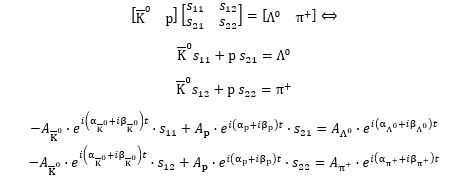
Don’t worry if you do not understand too much of the equations: we just put them there to impress the professionals. 🙂 The point is this: matter and antimatter are each other opposite, literally: the wavefunctions aeiEt/ħ and –aeiEt/ħ add up to zero, and they correspond to opposite forces too! Of course, we also have lightparticles, so we have antiphotons and antineutrinos too.
We think this explains the rather enormous amount of so-called dark matter and dark energy in the Universe (the Wikipedia article on dark matter says it accounts for about 85% of the total mass/energy of the Universe, while the article on the observable Universe puts it at about 95%!). We did not say much about this in our YouTube talk about the Universe, but we think we understand things now. Dark matter is called dark because it does not appear to interact with the electromagnetic field: it does not seem to absorb, reflect or emit electromagnetic radiation, and is, therefore, difficult to detect. That should not be a surprise: antiphotons would not be absorbed or emitted by ordinary matter. Only anti-atoms (i.e. think of a antihydrogen atom as a antiproton and a positron here) would do so.
So did we explain the mystery? We think so. 🙂
We will conclude with a final remark/question. The opposite spacetime signature of antimatter is, obviously, equivalent to a swap of the real and imaginary axes. This begs the question: can we, perhaps, dispense with the concept of charge altogether? Is geometry enough to understand everything? We are not quite sure how to answer this question but we do not think so: a positron is a positron, and an electron is an electron¾the sign of the charge (positive and negative, respectively) is what distinguishes them! We also think charge is conserved, at the level of the charges themselves (see our paper on matter/antimatter pair production and annihilation).
We, therefore, think of charge as the essence of the Universe. But, yes, everything else is sheer geometry! 🙂
 Reading Feynman