

Gary Zukov was in his late thirties when he wrote his Dancing Wu Li Masters. It further built on Fritjov Capra’s Tao of Physics. Both Zukov and Capra are still alive: 80+ years now. Both books still sell well, just like John Gribbin’s In Search of Schrödinger’s cat. I quote from Amazon’s sales headline for the latter:
“Quantum theory is so shocking that Einstein could not bring himself to accept it. It is so important that it provides the fundamental underpinning of all modern sciences. Without it, we’d have no nuclear power or nuclear weapons, no TV, no computers, no science of molecular biology, no understanding of DNA, no genetic engineering.”
Einstein could not bring himself to accept it, right? And TV or nuclear power or molecular biology would never have seen the light without Bohr and Heisenberg taking over from Einstein, Lorentz, or de Broglie, right? […] Plain nonsense. Einstein’s revolution is over. It is about time the likes of Zukov, Capra, Gribbin and their contemporaries – Hossenfelder, Lee Smolin, Sean Carroll, etcetera – accept it: Einstein was right along, and accusing Einstein of not having an open mind – he pioneered the true bedrock of physics: relativity theory, didn’t he? – sounds nuts to me.[1]
I am wondering if a book like the one I am thinking of – some kind of exchange between the wisdom that generations hand over – would ever make for a bestseller. Probably not. In any case, I want to write the first pages of such a book here.
Fields, charge, and energy concepts
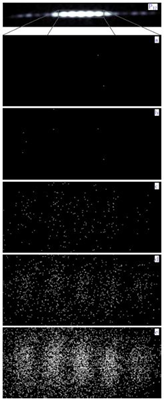
Papa, I understand your particle theory now. It explains the diffraction pattern on the detector plate when you send electrons through a slit. I can also see why this two-slit interference pattern is just a superposition of two one-slit diffraction patterns. No mystery. Agreed. But photons?
What do you mean?
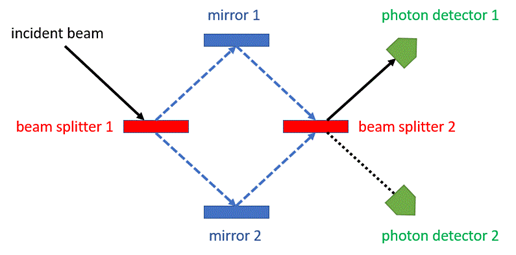
Your explanation of electron interference does away with interference. It explains this arriving of one electron – arriving as the lump it always one – when going through a slit or past the edge of a far more massive and complicated structure or system of charged oscillations. But in the one-photon Mach-Zehnder experiment – or when measuring radio signal strengths at a distance – we have photons – or half-photons (the linear components of circularly polarized photons – I am just quoting your own theory here) – coming together and vanishing (destructive interference) or – quite the opposite – combining into some new photon with twice the energy of the incoming full- or half-photons?
You are now fully grown up – a promising young adolescent with an MD degree – and so you should think for yourself now. The dominating Copenhagen interpretation of quantum mechanics tells us that Nature is just some kind of black box, and the best we can do is to think of some input-output relations to describe what goes in and what comes out. I have been fighting on many fronts, and I first wanted to get my matter-particle model right. I should now go back to these experiments demonstrating how light interference might or might not work. They all involve an apparatus which is referred to as an interferometer. There are various types around, but the Michelson-Morley interferometer still describes the basic components. We have a light source, some mirrors and one or more beam splitters – which are, basically, still simple half-silvered mirrors. The beam splitter splits the beam, and the mirrors are then adjusted so as to produce constructive or destructive interference.
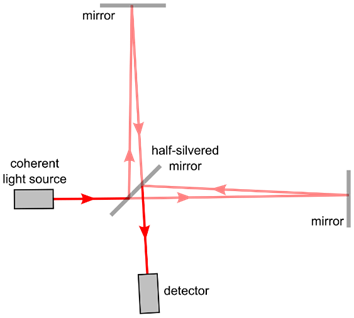
The classical explanation is easy enough: the two beams arrive in phase or, alternatively, out of phase and we, therefore, have constructive or destructive interference when recombining them. However, when we want to analyze this in terms of one single photon, this classical picture becomes quite complicated. Physicists will tell you the photon cannot actually split itself, and they will start talking about amplitudes – based on which they will calculate probabilities of this or that happening – but they will never explain what is actually happening.
I always told you it should be possible to develop a classical picture of all of this, and that classical picture of what is happening in terms of photons would be pretty much like what is shown below. Photons arrive in lumps too, but a circularly polarized photon can be split into two linearly polarized half-photons – just like an electromagnetic wave that is circularly polarized. There is no mystery: the wave components – linear or circularly polarized photons – have the same properties as the wave. 😊
Papa, I do not get the recombination stuff when we are talking photons. Where is the energy going? These idealized experiments show that we always get a recombined beam with the same frequency – or one that vanishes – but, according to classical theory, we must have in-between realities. When the phase difference between the two incoming beams is small, its amplitude is going to be much larger. To be precise, it is going to be twice the amplitude of the incoming beams for Δ = 0. In contrast, if the two beams are out of phase, the amplitude is going to be much smaller, and it is going to be zero if the two waves are 180 degrees out of phase (Δ = π), as shown below. That does not make sense because twice the amplitude means four times the energy, and zero amplitude means zero energy. The energy conservation law is being violated: photons are being multiplied or, conversely, are being destroyed.

Darling, you must remember light-particles are fundamentally different from matter-particles. There is no kinetic energy: no physical charge in a weird dance. Field energy is like the field itself: we are talking a force without a charge to act upon. The superposition principle in physics applies to fields in a very different way than it applies to charged particles. Bose-Einstein versus Fermi-Dirac statistics. Photons – light-particles in general – ‘occupy’ space very differently than matter-particles: they can literally be on top of each other if they are all in phase or – conversely – out of phase. In the first case, they combine to produce twice the energy. Because photon frequencies and amplitudes do not change, it looks like the number of photons must double. Conversely, field energies combine to make photons with opposite phase vanish into nothing. It is a weird thing, perhaps – but it makes sense to me. All that I know is that we should not substitute this coherent world view for the guru-like models that have been perpetuated by Heisenberg and Bohr. [I explicitly exclude Born, because I think his interpretation of the wavefunction as a hardcore probability distribution function based on energy densities made sense.]
You should read Lamb’s Anti-Photon article once more. It has (almost) all of the answers. Fields exchange energy with matter-particles in quantized units only. It is all very marvelous but not mysterious.[2]
Are fields potential energy?
Not quite. The physical dimension of an electric or magnetic field, a potential, energy itself (kinetic or potential energy), are all different, and you need to keep track of those dimensions when analyzing interference or how the superposition principle comes into play. But I would be rewriting a lot of what I wrote already to convey the deeper understanding you need.
Fritjov Capra started off the right footing when he wrote out his motivation: “Science does not need mysticism and mysticism does not need science. But man needs both.” That is about all we have in common. Too bad he didn’t do more with it. But modern-day physicists do not do much more, either.
What do you mean?
Einstein never got a Nobel Prize for his relativity theory. This Stockholm Royal Academy of Sciences makes weird decisions. Just last year, they gave a Nobel Prize to a climate change denier. There is something rotten in academia, but it will take a while before academia (or the Stockholm Royal Academy of Sciences) recognizes that. In the meanwhile, Alfred Nobel must be turning around in his grave. I cannot imagine Einstein would worry about it. 😊
Brussels, 12 September 2023
[1] I warmly recommend reading Einstein’s articles directly. His 1905 article on special relativity theory toys and plays with ideas (such as the idea of an electron having some lateral mass in its motion – which I subscribe to: too bad Einstein did not explore Schrödinger’s Zitterbewegung hypothesis) like no one else can. Accusing Einstein of a lack of imagination – which is what is implied here – is utterly nonsensical.
[2] Pages 148-153 of my manuscript have the basic explanation of one-photon Mach-Zehnder interference. Go have a look. I should write it all out, but I was born lazy. 😊
 Reading Feynman