

I added a very last paper to my list on ResearchGate. Its title is: what about multi-charge Zitterbewegung models? Indeed, if this local and realist interpretation of quantum mechanics is to break through, then it is logical to wonder about a generalization of a model involving only one charge: think of an electron (e.g., Consa, 2018) or proton model (e.g., Vassallo & Kovacs, 2023) here. With a generalization, we do not mean some unique general solution for all motion, but just what would result from combining 1-charge models into structures with two or more charges. [Just to be sure, we are not talking about electron orbitals here: Schrödinger’s equation models these sufficiently well. No. We are talking about the possible equations of motion of the charges in a neutron, the deuteron nucleus, and a helium-3 or helium-4 nucleus.]
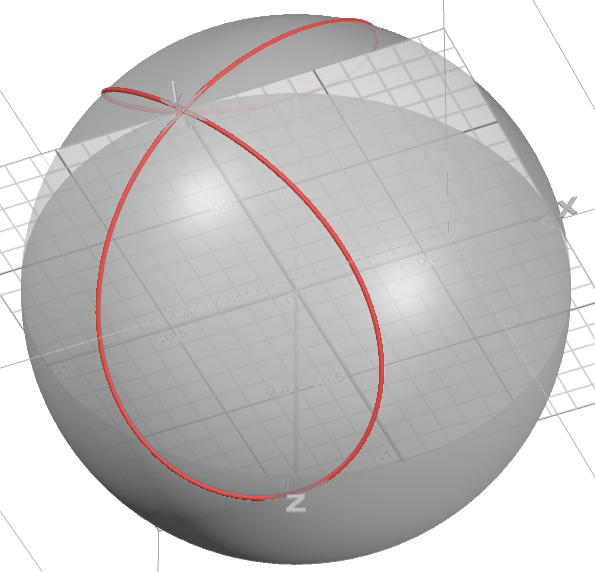
So our question in this paper is this: how do we build the real world from elementary electron and proton particle models? We speculate about that using our own simplified models, which boil down to two geometrical elements: (i) the planar or 2D ring current of the zbw electron, and (ii) the three-dimensional Lissajous trajectory on a sphere which we think might make sense when modeling the orbital of the zbw charge in a proton. Both have the advantage they involve only one frequency rather than the two frequencies (or two modes of oscillation) one sees in helical or toroidal models. Why do we prefer to stick to the idea of one frequency only, even if we readily admit helical or toroidal models are far more precise in terms of generating the experimentally measured value of the magnetic moment of electrons and protons, respectively? The answer is simple: I am just an amateur and so I like to roll with very simple things when trying to tackle something difficult. 🙂
So, go and have a look at our reflections on multi-charge Zitterbewegung models – if only because we also started writing about the history of the Zitterbewegung interpretation and a few other things. To sum it up:
- The paper offers a new brief history of how interpretations of the new quantum physics evolved, and why I am with Schrödinger’s Zitterbewegung hypothesis: it just explains the (possible) structure of elementary particles so well.
- It speculates about how positive and negative charge may combine in a neutron, and then also about how a deuteron nucleus might look like.
- We did not get to specific suggestions for helium-3 and helium-4 nuclei because these depend on how you think about the neutron and the deuteron nucleus. However, I do spell out why and how about I think of a neutron playing the role I think it plays in a nucleus: the glue that holds protons together (so there is no need for quark-gluon theory, I think, even if I do acknowledge the value of some triadic color scheme on top of the classical quantum numbers).
- Indeed, despite my aversion of the new metaphysics that crept into physics in the 1970s, I explain why the idea of some color typing (not a color charge but just an extra triadic classification of charge) might still be useful. [I secretly hope this may help me to understand why this color scheme was introduced in the 1970s, because I do not see it as anything more than mathematical factoring of matrix equations describing disequilibrium states – which may be impossible to solve.]
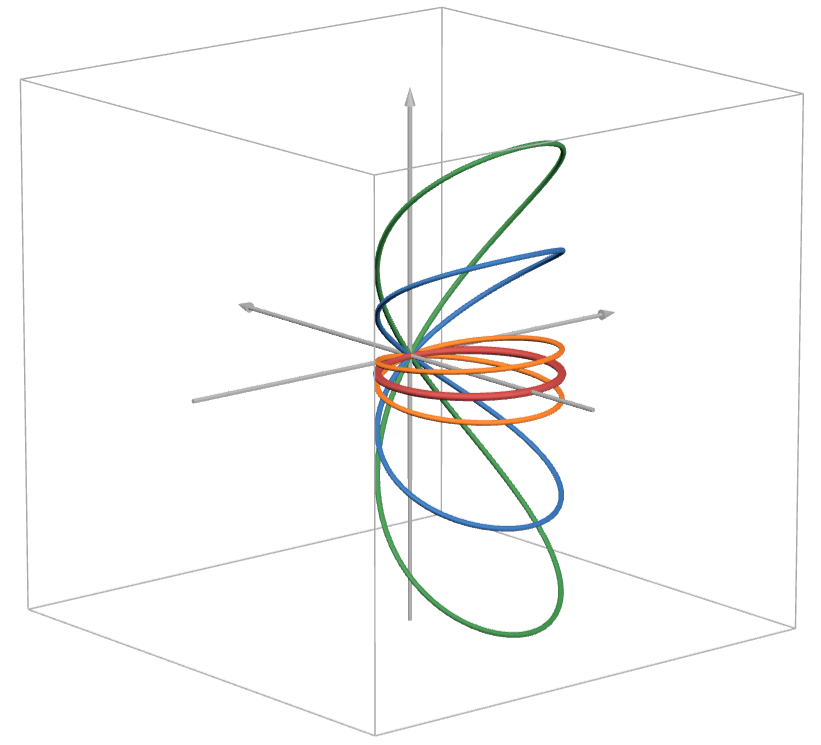
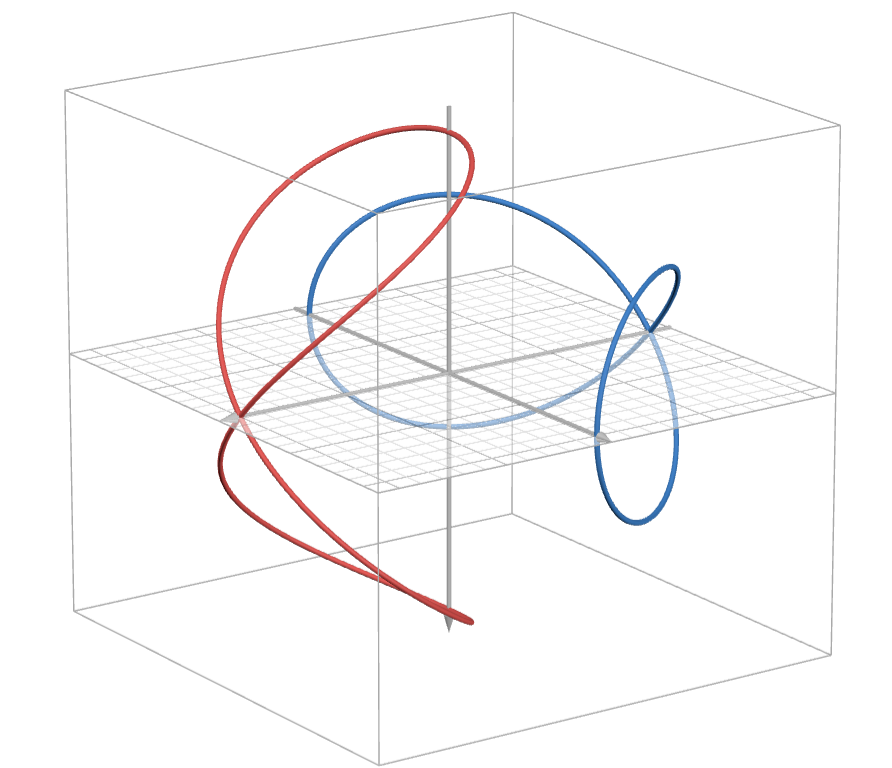
Have a look, even if it is only to appreciate some of the 3D images of what I think as elementary equations of motion (I copy some below). I should do more with these images. Some art, perhaps, using OpenAI’s DALL·E image generator. Who knows: perhaps AI may, one day, solve the n-body problems I write about and, thereby, come up with the ultimate interpretation of quantum mechanics?
That sounds crazy but, from one or two conversations (with real people), it looks like I am not alone with that idea. 🙂 There are good reasons why CERN turned to AI a few years ago: for the time being, they use it to detect anomalies in the jets that come out of high-energy collissions, but – who knows? – perhaps a more advanced AI Logic Theorist programme could simplify the rather messy quark-gluon hypothesis some day?
Because I am disengaging from this field (it is mentally exhausting, and one gets stuck rather quickly), I surely hope so.
 Reading Feynman