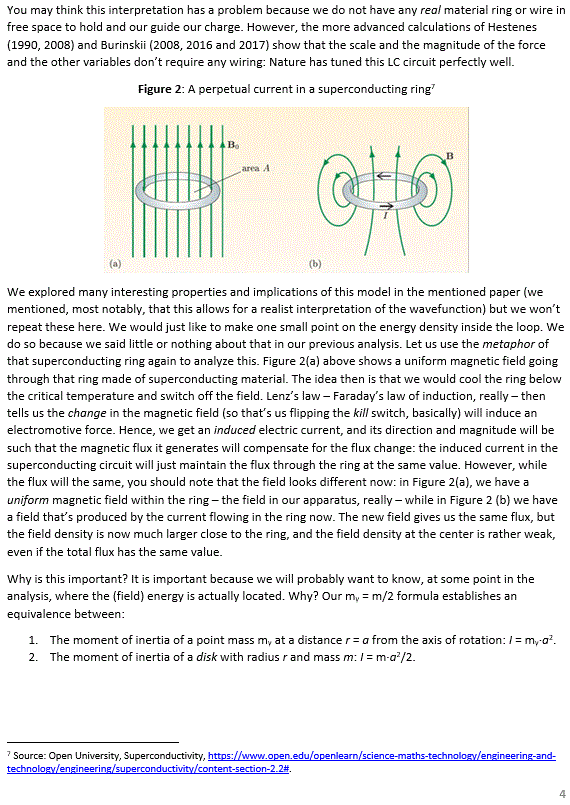
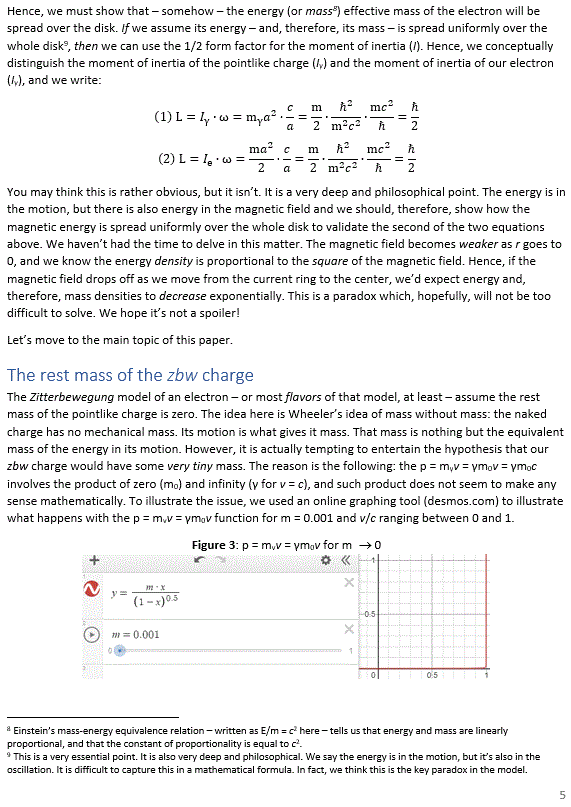
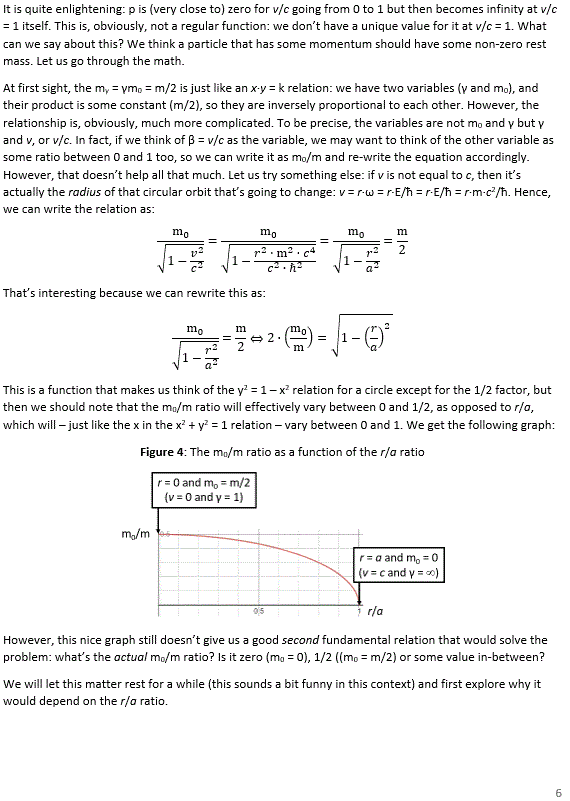
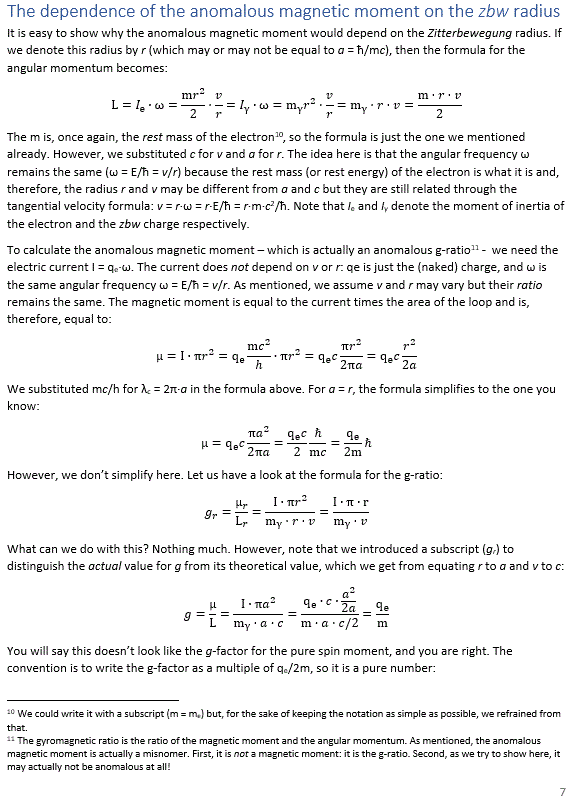
Mainstream physics tells a mesmerizing story about the electron. It claims the particle is an infinitely small mathematical point surrounded by a chaotic, ghostly cloud of virtual particles popping into and out of existence. To calculate its anomalous magnetic moment (AMM), Quantum Electrodynamics (QED) forces us to compute thousands of divergent multi-loop Feynman diagrams, shield the math behind infinite renormalization patches, and celebrate the final numbers as a triumph of quantum mystery.
But what if the anomaly isn’t a quantum mystery at all? What if it is a relativistic and field-theoretic necessity of a finite-sized charge?
In our newly published paper on ResearchGate, we demonstrate that a single topological primitive—the hollow toroidal current sheet—reproduces the electron’s anomalous magnetic moment with an astonishing precision down to 0.5 parts per million from a single closed-form transcendental equation. No virtual loops. No renormalization. No curve-fitting.
Here is how geometry, relativity, and Maxwell’s field equations combine to reshape our understanding of the electron.
The Three Pillars of the RealQM Electron
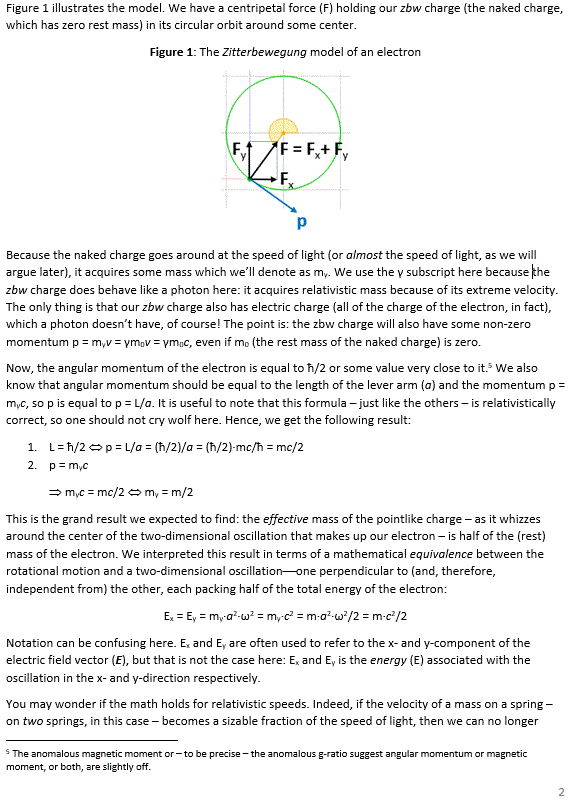
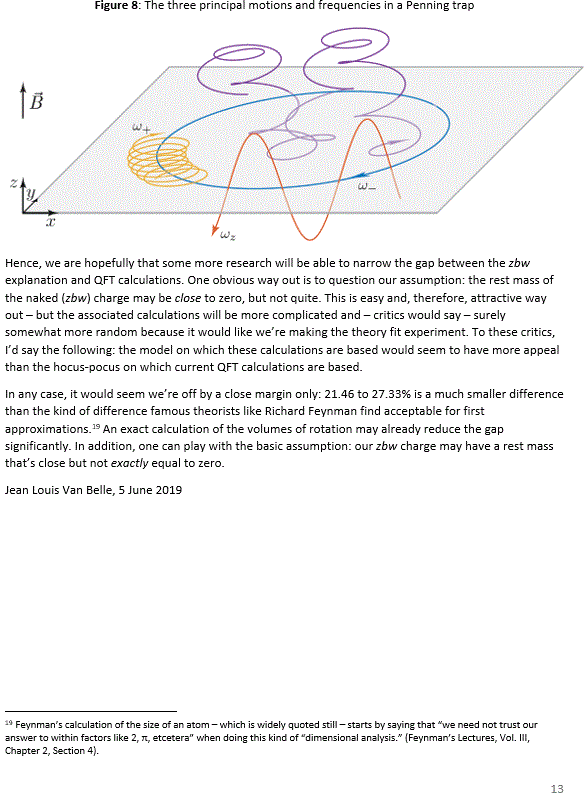
When you model the electron as a localized 2D charge surface spinning poloidally while orbiting macroscopically at the Zitterbewegung frequency, the abstract QED coefficients (C1, C2, C3) translate directly into clear classical mechanics:
- First-Order (C1 = +0.5): Pure Geometry. The famous Schwinger term factors into three un-tuned spatial constraints: a poloidal shell factor (2/3), a toroidal track path dilution (1/2), and a relativistic vector retardation alignment (3/2). They cancel out, leaving the pristine 1/2 value (0.5).
- Second-Order (C2 approx -0.328): Pure Relativity. Moving a finite-sized charge along a circular path forces its constituent elements onto a helical trajectory in spacetime. To respect the speed of light, the center of mass must slow down orbitally. This creates an isotropic 3D Lenz’s Law dampening force of exactly -1/3, which the curvature asymmetry of the donut walls pulls up to the precise -0.328 neighborhood.
- Third-Order (C3 +1.003): Field Equations. As the self-interaction fields propagate inward, they hit the absolute Born-Infeld vacuum saturation ceiling at the core filament. This triggers a hard-wall phase reflection, flipping the force vector back to positive and locking a stable baseline standing wave at about +1.0.
Beyond the Taylor Series: The Master Equation
Historically, physicists probably liked to slice the anomaly into sequential loops because calculational and analytical tools were limited. Nature does not. The non-linear feedback loop between the electron’s charge distribution and its self-generated electromagnetic metric is instantaneous and total.
By varying a unified Born-Infeld-Maxwell action over a curved toroidal manifold, the entire power series collapses into a single, elegant transcendental master equation:

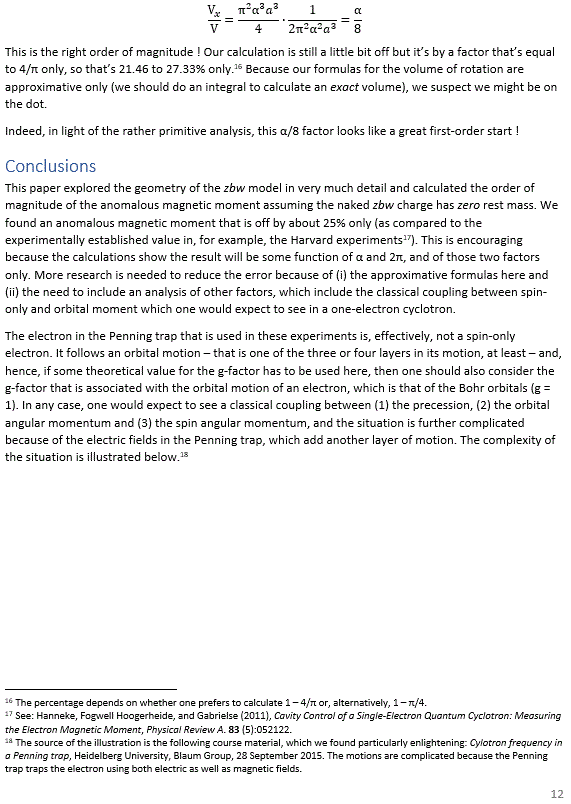
The Gauss Hypergeometric Function acts as the structural volume deformation factor of the space inside the tube. Solving this equation yields a raw output of 0.0011602—capturing the immense scale of the measured anomaly while leaving an honest, un-tuned opening of just 0.5 parts per million for even higher-order corrections to our geometric baseline model.
Is the Topology Unique?
Corporate physics gatekeepers will ask if this is just clever numerology. The answer is locked in the strict laws of topology. According to the Poincaré-Hopf theorem, a genus-1 manifold (the torus) is the unique closed 2D surface embedded in 3D space capable of hosting a continuous, nowhere-vanishing vector field—like our simultaneous spin and orbital currents—without creating infinite fluid shear or destructive coordinate dead zones.
The electron is not an abstract point; it is a self-sustaining topological soliton.
Read the Full Paper and Join the Discussion
We have laid out the entire framework, the full equations of motion, and the topological uniqueness proofs with absolute transparency. Read the complete text and audit the un-tuned baselines by downloading the manuscript directly on ResearchGate:
👉 Read the Full Paper on ResearchGate
Let’s bring physics back to reality.
Final Note on Precision and the Path Forward (16 July 2026)
The current experimental precision for the electron’s anomalous magnetic moment is at the parts-per-billion level (ppb), while our un-tuned geometric baseline matches it to 0.5 ppm. This difference is not a failure but a precise measure of dynamic geometric effects—self-inductance, Doppler compression, and non-linear feedback—that our static baseline does not yet include. Moreover, the experimental extraction of the anomaly is itself embedded in QED assumptions, introducing a subtle but real circularity. Our model provides a completely independent, first-principles benchmark. Future refinements—such as a non-uniform or fractal charge distribution—will close the gap without invoking virtual particles. The geometry is the scaffold; the dynamics will provide the polish.