Intuitive explanation and visualization of proto-electron capture/ejection (neutron-proton) and electron pair creation/annihilation

How do abstract quantum selection rules and multi-dimensional tensor interactions manifest as concrete, deterministic spatial geometries?

By modeling elementary charges as self-confined genus-1 (toroidal) fluid metric deformations rather than infinitely dense point particles, we eliminate point-charge infinities and render the structural transitions of matter-antimatter interactions and baryon transformations.

Animation 1: Face-to-face coaxial alignment of the electron and positron tori results in complete phase-cancellation of the internal localized current density vectors. The self-confining magnetic pressure drops, causing the geometric structure to unwind symmetrically into two unconfined, linear transverse photons polarized exactly (90 degrees) out of phase.
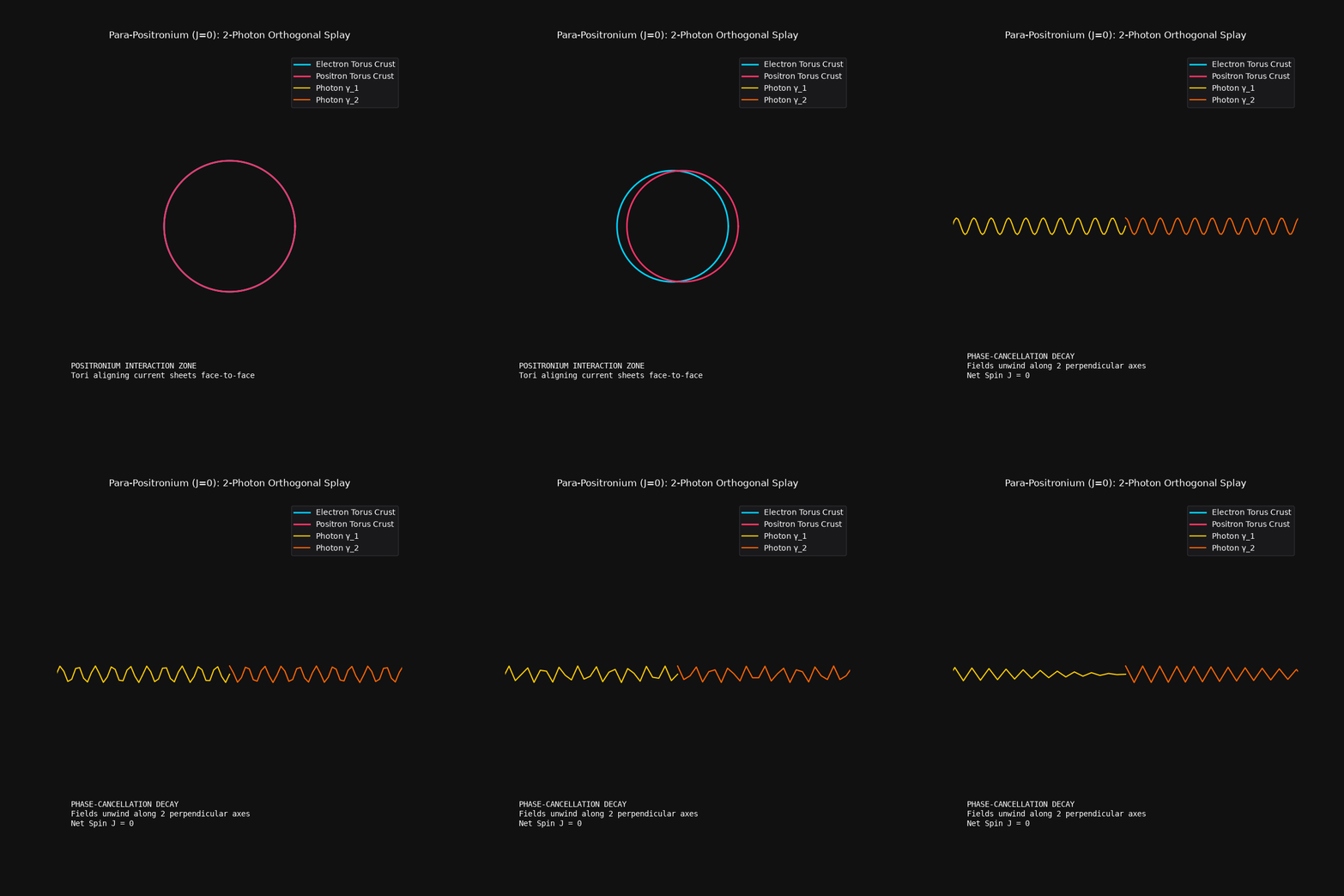
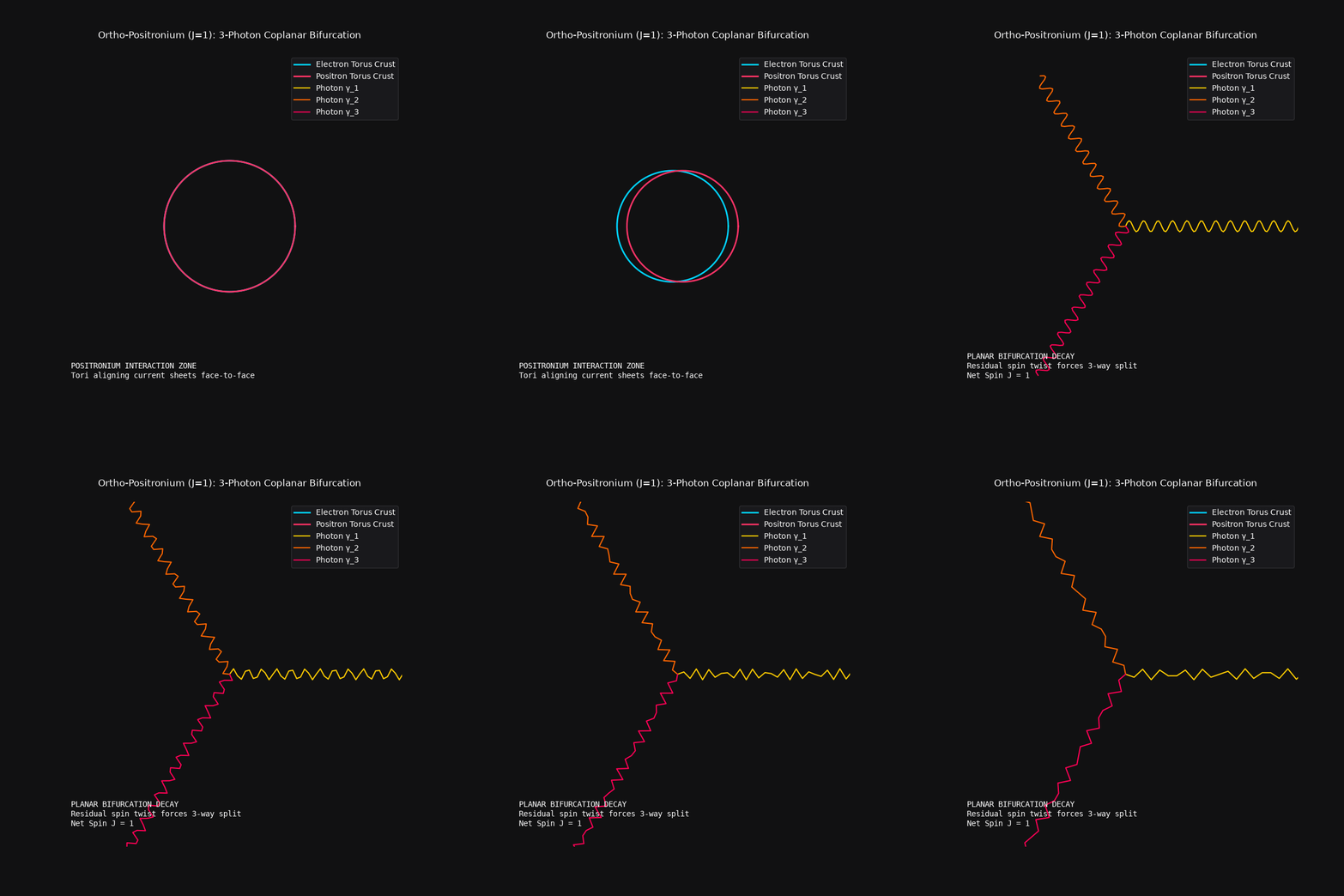
Animation 2: Parallel alignment of the internal particle current rotations traps a residual net angular momentum “twist” that cannot be neutralized by a simple face-to-face collapse. The structure undergoes a flat planar bifurcation, splitting into three coplanar linear wave envelopes spaced 120 degrees apart to carry away the macroscopic spin-1 invariant.
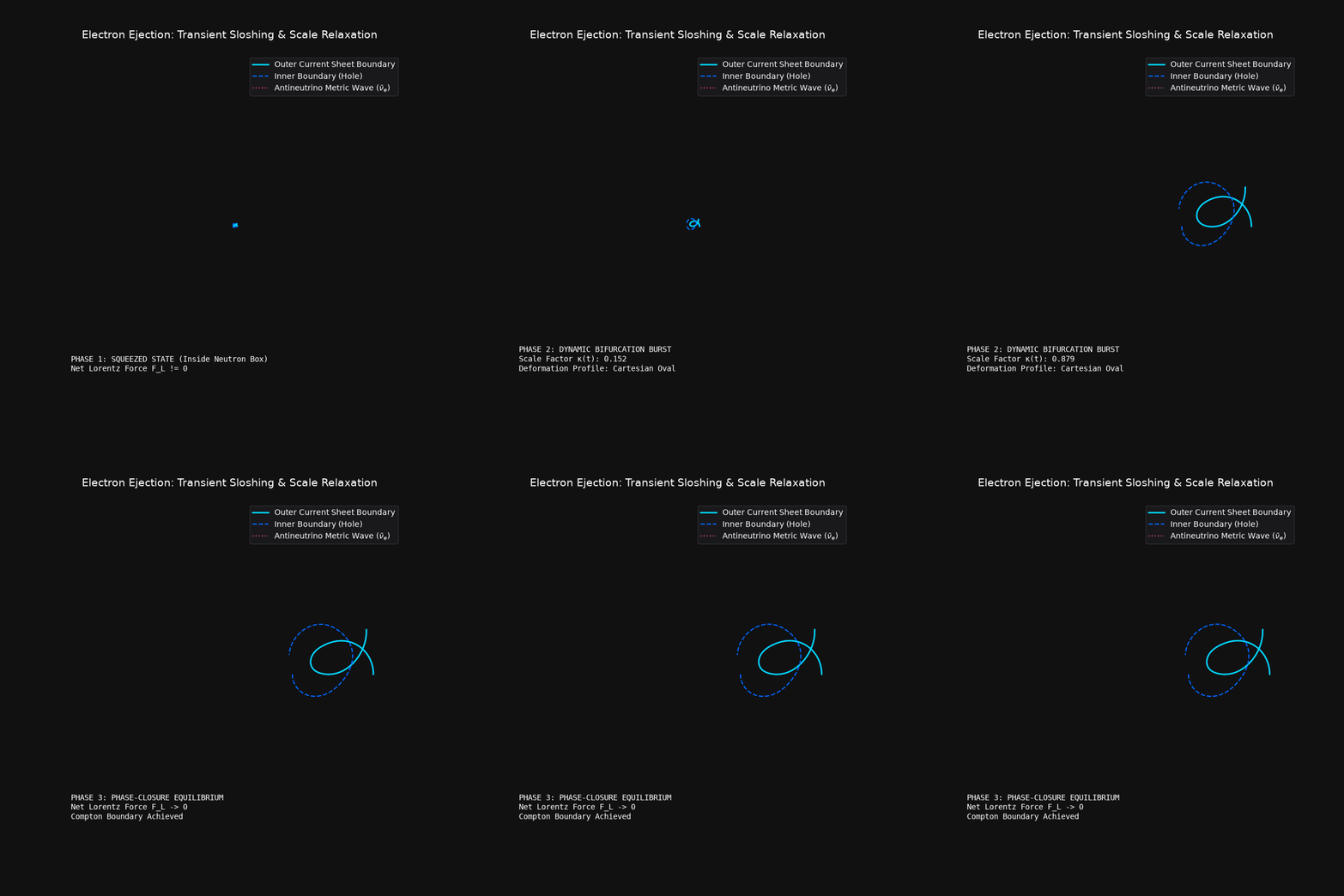
Animation 3: Electron Ejection (beta decay). The proto-electron current sheet transitions out of its unstable, highly compressed femtometer state inside the neutron core via a sigmoidal scale relaxation sequence. The inner boundary experiences a severe cross-sectional pressure gradient, sloshing the tube into a transient Cartesian oval (“egg-shape”) before stabilizing as a free electron torus at the full Compton radius baseline, shedding an antineutrino wave packet.
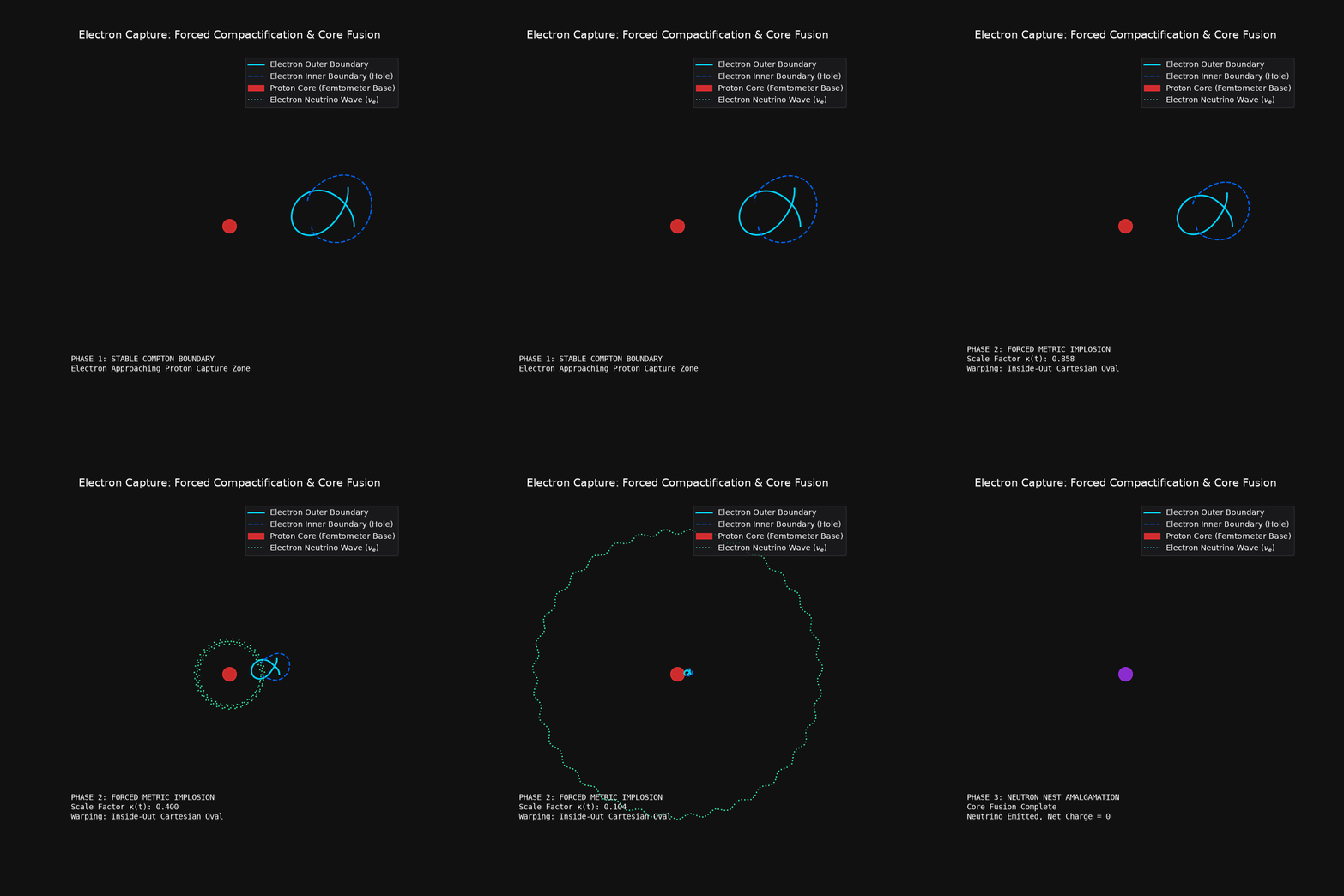
Animation 4: Electron Capture (the exact topological inverse of ejection). A free electron torus is funneled inward and undergoes forced compactification. The cross-section is driven “inside-out” under extreme pressure before fusing into the proton core to form a charge-neutral neutron, radiating an electron neutrino wave packet in the process. Guided by the deep geometric gradient surrounding the proton core, the incoming free electron’s scale factor is crushed forcefully from the Compton domain down to the tight baryon domain. The cross-sectional oval distorts inside-out under extreme localized pressure before fusing seamlessly into the purple, charge-neutralized neutron matrix, ejecting the excess spatial footprint as a sharp neutrino wave.
We Could Have Stopped There Too

(But the Question About Annihilation Would Not Stay Quiet)

In a previous post, I wrote that we could stop here — after revisiting the photon wavefunction and trying to say, as carefully as possible, what such a wavefunction might represent in physical reality rather than merely in calculation. That paper already felt like a natural resting point: the mathematics was consistent, the interpretation restrained, and the temptation to add speculative layers had been resisted.

But, as often happens, the very act of stopping made the next question louder.

If one is willing to take wavefunctions seriously — not as mystical probability clouds but as structured representations of physical processes — then one cannot avoid revisiting an older and more uncomfortable puzzle: matter–antimatter pair creation and annihilation. In particular, the question that has bothered me for years refused to go away:

What, exactly, happens to electric charge in electron–positron annihilation?

In January 2025, I wrote a paper on this topic together with ChatGPT-4.0. That version deliberately stopped short of resolution. It explored wavefunctional representations, respected global conservation laws, and openly admitted that familiar intuitions about charge seemed to fail locally. I resisted easy exits: latent charge states, hidden reservoirs, or metaphysical bookkeeping devices introduced only to preserve comfort.

At the time, that felt honest enough.

What changed since then is not the question, but the discipline with which I was forced to re-examine my own assumptions.

Over the past months, continued work with a more advanced AI system (ChatGPT-5.2), across many iterations and with partial memory of prior discussions, introduced a form of pressure that was unfamiliar but productive. The AI did not argue for a competing ontology. Instead, it kept doing something more unsettling: it repeatedly asked why certain assumptions were still being carried along at all.

In hindsight, I can see that I was still clinging — subconsciously — to the idea that charge must be something that persists, even if I no longer knew where to put it. That assumption had survived earlier criticism not because it was well-justified, but because it was deeply ingrained.

What finally shifted the balance was a stricter application of Occam’s razor — applied not to equations, but to ontological commitments. If charge is inseparable from a specific physical organization (of motion, phase, and localization), then insisting that it must survive the dissolution of that organization is not conservative reasoning. It is surplus.

This led, reluctantly but unavoidably, to a provisional reformulation: perhaps charge is not a substance that must “go somewhere,” but a mode of organization that ceases to exist when the organization itself dissolves. This idea is not offered as a new metaphysical doctrine. On the contrary, it emerged as a refusal to introduce additional entities whose only role would be to save intuition.

The revised paper therefore appears in two parts. The January version is preserved intact, as a record of where the reasoning stood at that time. The new December revision does not correct it so much as re-read it under harsher criteria of conceptual economy. Several distinctions — including the boson–fermion divide — remain descriptively useful, but are relieved of explanatory burdens they were never meant to carry.

As before, no final answers are claimed. The ontological and philosophical implications are intentionally left for the reader — real or imaginary — to judge. The role of AI in this process was not to supply insight, but to apply relentless pressure against conceptual inertia. Any logical errors or unwarranted commitments that remain are mine alone, even if much of the textual consistency was produced by artificial means.

We could, perhaps, stop here as well.

But I have learned to be suspicious of that feeling. When a question keeps knocking, it is usually because something unnecessary is still being held onto — and is asking to be let go.