Every student of physics encounters the so-called classical electron radius. It is usually introduced as a curious length scale that appears when one equates the rest energy of the electron with the energy stored in its electrostatic field.
The reasoning is simple enough. If the electron’s charge were somehow concentrated within a sphere of radius r, one can calculate the energy stored in the electric field surrounding that charge. Setting that field energy equal to the famous E = mc² gives a radius of about 2.8 femtometer.
This number has been known for more than a century and is still quoted in textbooks. Yet its physical meaning has always been somewhat puzzling. The derivation relies on a rather arbitrary assumption: that the electron’s rest energy originates entirely from its electrostatic field.
In a recent paper I revisited this question from a different angle. Instead of thinking of the electron as a static charged sphere, one may think of it as having a dynamical structure: a circulating charge. Such a motion – just the good old magnetic or ring current model of an electron – naturally produces a magnetic moment, and when one calculates the radius required to reproduce the observed magnetic moment of the electron, a very familiar scale emerges: the Compton radius.
This leads to a simple hierarchy of length scales:
Compton scale (internal dynamics) ↓ Classical electron radius (re = a·rC) ↓ Coulomb field extending outward to infinity
In other words, the classical electron radius does not represent the literal size of the electron. Rather, it appears to be the electromagnetic coupling scale associated with a charge circulating at the Compton radius.
From this perspective the rest energy of the electron is not stored in its external Coulomb field. Instead, it may be associated with the internal electromagnetic dynamics of the circulating charge. The familiar Coulomb field is then simply the long-range electromagnetic “tail” of that dynamical structure.
Looking at the problem in this way also suggests a natural question about the proton. If one performs the same classical self-energy calculation for the proton, one obtains a radius far smaller than the experimentally measured proton radius—by roughly a factor of five hundred. This striking difference hints that the electron and the proton, although carrying the same unit charge, may correspond to very different internal charge dynamics. To be precise, we think of the proton as a three-dimensional oscillation of charge (as opposed to the two-dimensional ring current model for the electron).
Another numerical curiosity emerges in this comparison. Physicists often marvel at the small value of the fine-structure constant (see our previous post on that). Yet the much larger ratio between the proton and electron masses—about 1836—may be even more mysterious. Two particles carrying identical charge nevertheless differ enormously in mass and characteristic size.
Perhaps the most important lesson of all this is methodological. The classical electron radius should probably not be interpreted as the size of the electron. It is better understood as a scale that reflects how strongly the electron couples to the electromagnetic field.
Seen in this light, the old “classical” radius acquires a new and rather natural meaning within a dynamical electromagnetic picture of the electron.
After a break of a few months, I produced another lengthy video on quantum physics. 40 minutes. Check it out: https://www.youtube.com/watch?v=k_I3Noaup0E. The hypothesis that I, somewhat desperately, advanced in my last paper on the proton model – that the Zitterbewegung model of a proton does not quite look like that of an electron, and that we are probably talking about a “blob” of charge (sphere- or shell-like, or some other “form factor”, perhaps) – makes more sense to me now. I explored it with ChatGPT-4o, and this video is the result. I should immediately that I am immensely impressed with ChatGPT-4o: ChatGPT-3 was not able to really “understand” what I was talking about a year ago or so.
Who knows, perhaps we might imagine other ChatGPT-4o users will take the “dialogue” with AI on these particle models further, and fully develop them not only intuitively but also analytically. As I am currently trying out some AI-powered audio and video applications, I tried Pictory (pictory.ai): I gave it the url of my own long-winding video and it created this video: The proton as a dynamic blob of charge. 100 seconds only instead of 40 minutes. Its contents is, of course, superficial – but I think it is creative and nicely upbeat. I fed both video back to ChatGPT-4o, and it suggested the following refinements if ever I would like to re-do the video(s) – which I am not going to do, but you might like to further explore the remarks it made:
Consistency in Notation and Conventions:
Ensure that polar and azimuthal angles are consistently defined throughout. Your initial derivations and explanations switched between conventions, potentially confusing viewers about which angle is associated with which base vector.
Tangential Velocity Decomposition:
The explanation of how the tangential velocity is decomposed into orthogonal components was accurate but could benefit from a clearer mention of why the orthogonality matters in interpreting the motion on the sphere. Adding a visual representation would further clarify the concept.
The concept of “sloshing” energy between kinetic and electromagnetic forms was well described but could benefit from highlighting the broader implications of this periodic exchange in classical and relativistic oscillators .
Pointlike Charge versus Blob View:
The transition from discussing a pointlike charge to a “blob” of charge was a major theme but could be expanded by discussing how this shift impacts the assumptions about uniform or non-uniform charge density, as well as its implications for observable properties like the magnetic moment.
The discussion of symmetry along one axis of the double-loop motion was solid but might benefit from more detail on how this symmetry impacts the interpretation of observable properties like the magnetic moment .
Incorporate links to experimental observations, such as the measured magnetic moment and charge radius of the proton, was referenced. Integrating these observations with the theoretical results could be more explicit to strengthen the practical implications .
Visualizations:
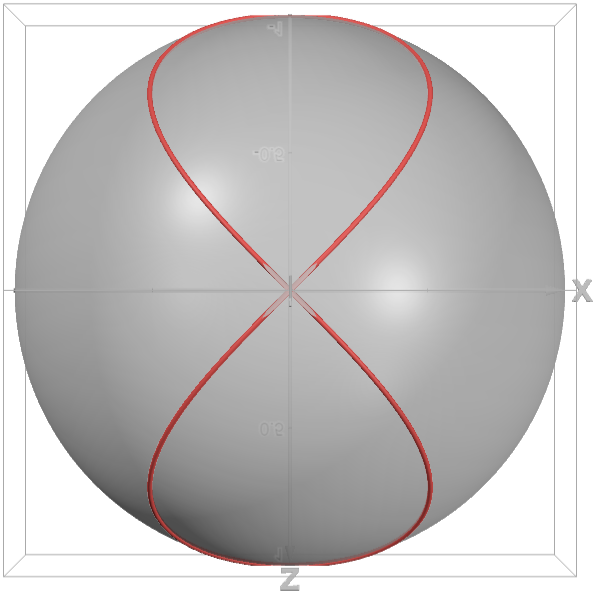
Consider incorporating visualized trajectories (e.g., the double-loop Lissajous pattern), and how they connect to the derived equations and the observed non-constant tangential velocity. This connection will help bridge the abstract mathematics with physical intuition .
Clarifications on Variability:
The variability of the tangential velocity in the context of symmetry and non-orthogonality in 3D motion, was a key discussion point. Reinforce why this variability does not conflict with the broader relativistic constraints.
In our previous post, we wrote that we’ve said goodbye to this fascinating field of research. We did: I entered this line of research – fundamental physics – as an amateur 10+ years ago, and now I leave it—as much an amateur now as back then. I wanted to understand the new theories which emerged over the past 50 years or so. Concepts such as the strong force or weak interactions and the new weird charges that come it with: flavors and colors—or all of the new quantum numbers and the associated new conservation laws, which Nature apparently does not respect because of some kind of hidden variables which cause the symmetries that are inherent to conservation laws to break down. […] Apparently, I didn’t get it. 🙂
However, in the process of trying to understand, a whole other mental picture or mindset emerged: we now firmly believe that classical mechanics and electromagnetism – combined with a more creative or realistic explanation of the Planck-Einstein relation – are sufficient to explain most, if not all, of the observations that have been made in this field since Louis de Broglie suggested matter-particles must be similar to light quanta—in the sense that both are energy packets because they incorporate some oscillation of a definite frequency given by the Planck-Einstein relation. They are also different, of course: elementary particles are – in this world view – orbital oscillations of charge (with, of course, an electromagnetic field that is generated by such moving charge), while light-particles (photons and neutrinos) are oscillations of the electromagnetic field—only!
So, then we spend many years trying to contribute to the finer details of this world view. We think we did what we could as part of a part-time and non-professional involvement in this field. So, yes, we’re done. We wrote that some time already. However, we wanted to leave a few thoughts on our proton model: it is not like an electron. In our not-so-humble view, the Zitterbewegung theory applies to it—but in a very different way. Why do we think that? We write that out in our very last paper: concluding remarks on the proton puzzle. Enjoy it !
That brings the number of papers on RG up to 80 now. Too much ! There will be more coming, but in the field that I work in: computer science. Stay tuned !
Today I made a major step towards a very different Zitterbewegung model of a proton. With different, I mean different from the usual toroidal or helical model(s). I had a first version of this paper but the hyperlink gives you the updated paper. The update is small but very important: I checked all the formulas with ChatGPT and, hence, consider that as confirmation that I am on the right track. To my surprise, ChatGPT first fed me the wrong formula for an orbital frequency formula. Because I thought it could not be wrong on such simple matters, I asked it to check and double-check. It came with rather convincing geometrical explanations but I finally found an error in its reasoning, and the old formula from an online engineering textbook turned out to be correct.
In any case, I now have a sparring partner – ChatGPT o1 – to further develop the model that we finally settled on. That is a major breakthrough in this realistic interpretation of quantum theory and particle models that I have been trying to develop: the electron model is fine, and so now all that is left is this proton model. And then, of course, a model for a neutron or the deuteron nucleus. That will probably be a retirement project, or something for my next life. 🙂
Post scriptum: I followed up. “A theory’s value lies in its utility and ability to explain phenomena, regardless of whether it’s mainstream or not.” That’s ChatGPT’s conclusion after various explorations and chats with it over the past few weeks: https://lnkd.in/ekAAbvwc. I think I tried to push its limits when discussing problems in physics, leading it to make a rather remarkable distinction between “it’s” perspective and mine (see point 6 of Annex I of https://lnkd.in/eFVAyHn8), but – frankly – it may have no limits. As far as I can see, ChatGPT-o1 is truly amazing: sheer logic. 🙂 hashtag#AIhashtag#ChatGPThashtag#theoryofreality
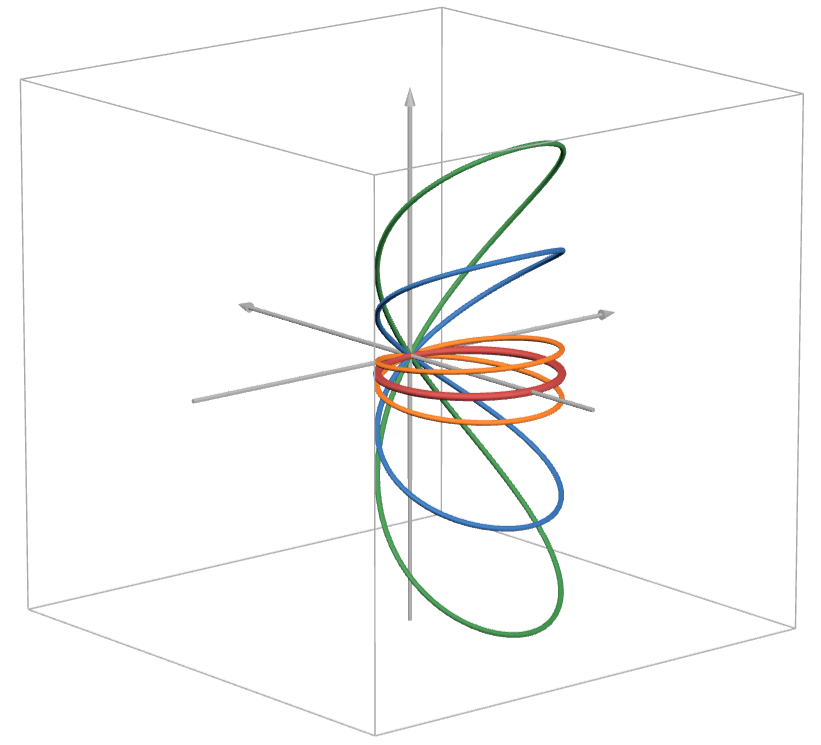
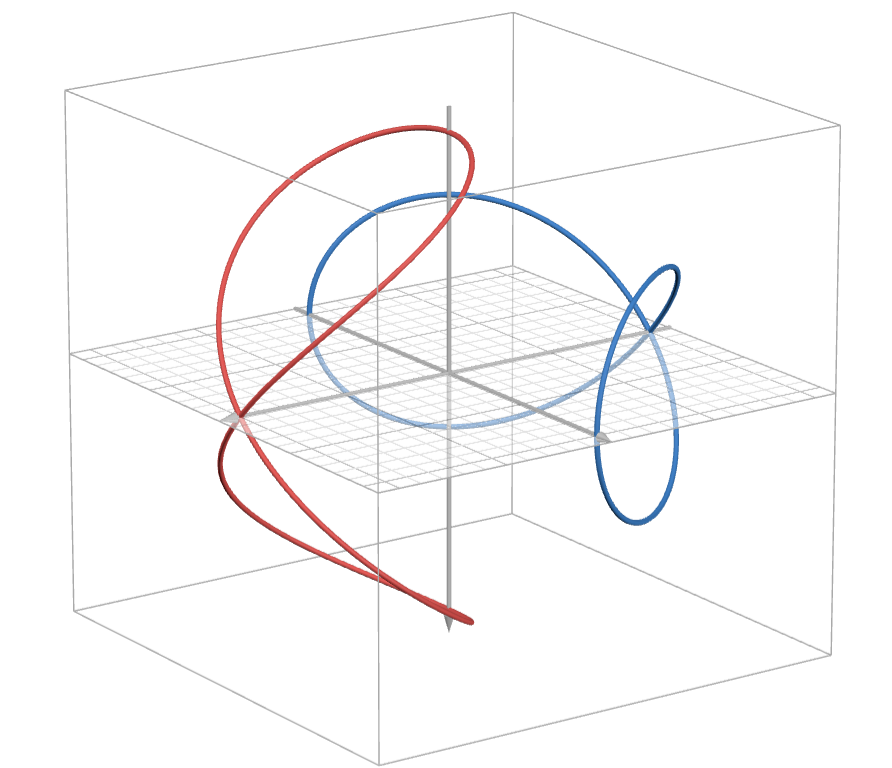
I added a very last paper to my list on ResearchGate. Its title is: what about multi-charge Zitterbewegung models? Indeed, if this local and realist interpretation of quantum mechanics is to break through, then it is logical to wonder about a generalization of a model involving only one charge: think of an electron (e.g., Consa, 2018) or proton model (e.g., Vassallo & Kovacs, 2023) here. With a generalization, we do not mean some unique general solution for all motion, but just what would result from combining 1-charge models into structures with two or more charges. [Just to be sure, we are not talking about electron orbitals here: Schrödinger’s equation models these sufficiently well. No. We are talking about the possible equations of motion of the charges in a neutron, the deuteron nucleus, and a helium-3 or helium-4 nucleus.]
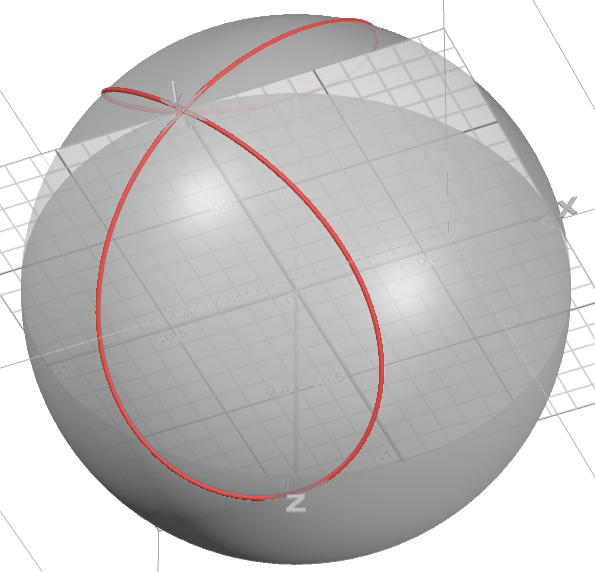
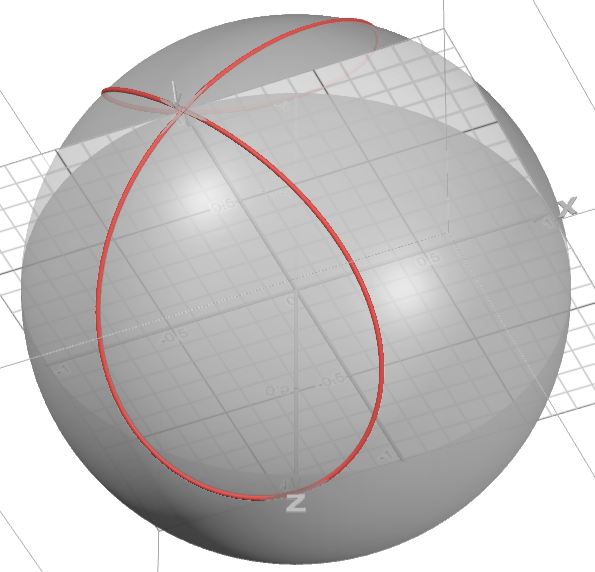
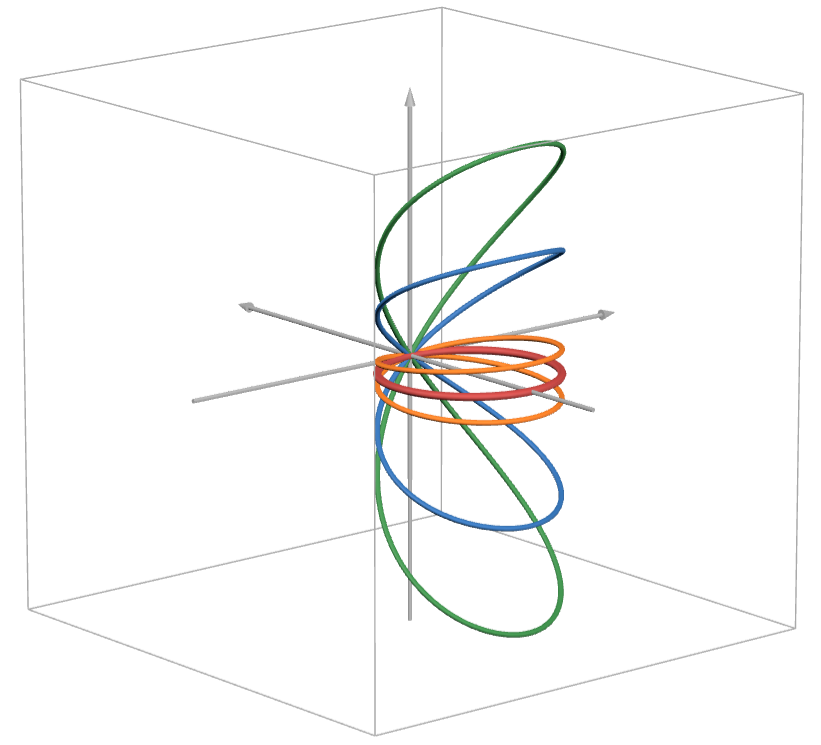
So our question in this paper is this: how do we build the real world from elementary electron and proton particle models? We speculate about that using our own simplified models, which boil down to two geometrical elements: (i) the planar or 2D ring current of the zbw electron, and (ii) the three-dimensional Lissajous trajectory on a sphere which we think might make sense when modeling the orbital of the zbw charge in a proton. Both have the advantage they involve only one frequency rather than the two frequencies (or two modes of oscillation) one sees in helical or toroidal models. Why do we prefer to stick to the idea of one frequency only, even if we readily admit helical or toroidal models are far more precise in terms of generating the experimentally measured value of the magnetic moment of electrons and protons, respectively? The answer is simple: I am just an amateur and so I like to roll with very simple things when trying to tackle something difficult. 🙂
So, go and have a look at our reflections on multi-charge Zitterbewegung models – if only because we also started writing about the history of the Zitterbewegung interpretation and a few other things. To sum it up:
The paper offers a new brief history of how interpretations of the new quantum physics evolved, and why I am with Schrödinger’s Zitterbewegung hypothesis: it just explains the (possible) structure of elementary particles so well.
It speculates about how positive and negative charge may combine in a neutron, and then also about how a deuteron nucleus might look like.
We did not get to specific suggestions for helium-3 and helium-4 nuclei because these depend on how you think about the neutron and the deuteron nucleus. However, I do spell out why and how about I think of a neutron playing the role I think it plays in a nucleus: the glue that holds protons together (so there is no need for quark-gluon theory, I think, even if I do acknowledge the value of some triadic color scheme on top of the classical quantum numbers).
Indeed, despite my aversion of the new metaphysics that crept into physics in the 1970s, I explain why the idea of some color typing (not a color charge but just an extra triadic classification of charge) might still be useful. [I secretly hope this may help me to understand why this color scheme was introduced in the 1970s, because I do not see it as anything more than mathematical factoring of matrix equations describing disequilibrium states – which may be impossible to solve.]
Have a look, even if it is only to appreciate some of the 3D images of what I think as elementary equations of motion (I copy some below). I should do more with these images. Some art, perhaps, using OpenAI’s DALL·E image generator. Who knows: perhaps AI may, one day, solve the n-body problems I write about and, thereby, come up with the ultimate interpretation of quantum mechanics?
That sounds crazy but, from one or two conversations (with real people), it looks like I am not alone with that idea. 🙂 There are good reasons why CERN turned to AI a few years ago: for the time being, they use it to detect anomalies in the jets that come out of high-energy collissions, but – who knows? – perhaps a more advanced AI Logic Theorist programme could simplify the rather messy quark-gluon hypothesis some day?
Because I am disengaging from this field (it is mentally exhausting, and one gets stuck rather quickly), I surely hope so.
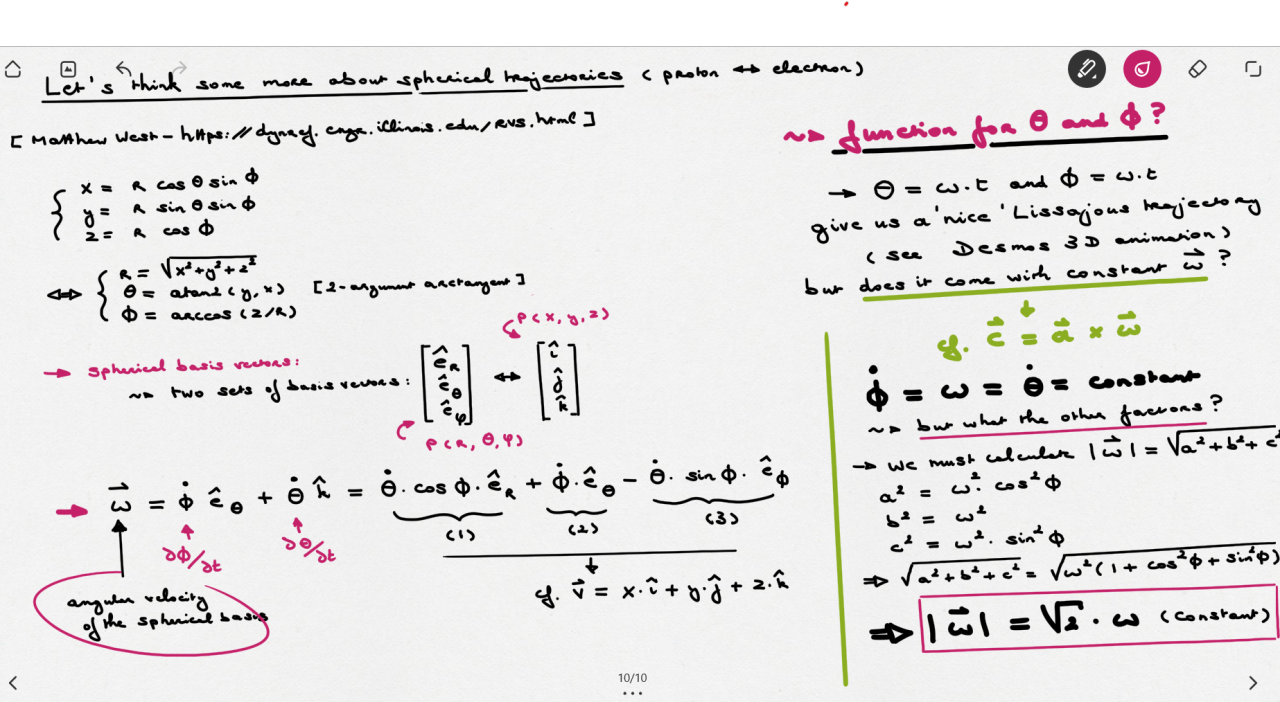
For this kind of thinking or problem solving, I guess I am still better than ChatGPT-4. 🙂 ChatGPT-4 did pass ‘my’ Turing test on intelligence, however. And that is quite something. I write about the ouch!factor in my recent LinkedIn article on AI. Yesterday, I definitely had such ouch! feeling (gentle – just in the sense that I thought ChatGPT-4 was smarter than me on this too), but so it’s OK now. 🙂 I win. A nice thing about this simple calculation is that this SQRT(2) factor pops up: it must be the same SQRT(2) factor that is related to the magnetic moment of a proton in my proton radius derivation, although I am not yet sure why and how exactly.
I did a quick video on it on YouTube: https://www.youtube.com/watch?v=-HnaLG8bY6o. Unfortunately, I cannot extract a transcript from it for ChatGPT-4. However, I had a quick conversation with it on what remains to be done, and that is to calculate the magnetic moment of this 3D Lissajous loop (it will depend on the orientation but we just need it in one direction: where it is strongest because that is how it will line up in a Penning trap of whatever device that is/was used to determine its value). I asked ChatGPT how it could possibly help with these calculations, mentioning the Biot-Savart law and the 3D integrals this would imply. This was ChatGPT’s answer:
“Regarding the Biot-Savart law and calculating the magnetic moment for such a complex 3D current loop, you’re correct that this involves intricate 3D integrals. I can certainly help set up or guide through parts of the calculation, especially in formulating the integral and explaining how to approach the problem. If you share the specifics of your current loop’s geometry and the required variables, we can work through how to structure the integrals needed for the magnetic moment calculation. Feel free to provide details if you want to give this a try!”
AI is, clearly, not was it was even just a year ago: it is much better now. As for me, I will let the problem rest now. 🙂
Pre-scriptum 2 (18 September): Please do check out the comment from the ‘Physics Detective’ to this post (and the Physics Detective site itself, of course): a Möbius ring for the electron and – who knows – a 3D trefoil loop for the proton might do the trick in 2D/3D as well. It would be nice if it did because it would bring helical/toroidal/solenoid-like spin of the charge itself into the model, possibly unifying the math behind these models. Thank you for noting this, John ! 🙂
Original post (9/10):
End of last year, I started to play with ChatGPT-4. Only a few times, really, because, for ordinary questions or web searches, it is not much better than your Google AI assistant or Microsoft’s CoPilot: it just comes with a very pleasant style of conversation (yes). I counted and, so far, I only five conversations with it. However, I do admit I have a habit of continuing an old conversation (ChatGPT now uses your old conversations anyway). Also, these five conversations were good and long. It helped me, for example, greatly to get a quick overview and understanding of IT product offerings in the cloud: it made/makes great comparisons between the offerings of Google Cloud, Azure and AWS, not only for infrastructure but also in the area of modern AI applications. I also asked questions on other technical things, like object-oriented programming, and in this field also it really excels at giving you very precise and relevant answers. In fact, I now understand why many programmers turn to it to write code. 🙂
However, I was mainly interested in ChatGPT-4 because it knows how to parse (read: it can read) documents now. So it does a lot more than just scraping things on products and services from websites. To be precise, it does not just parse text only: it actually ‘understands’ complex mathematical formulas and advanced symbols (think of differential operators here), and so that’s what I wanted to use it for. Indeed, I asked it to read my papers on ResearchGate and, because I do think I should rewrite and restructure them (too many of them cover more or less the same topic), I asked it to rewrite some of them. However, I was very dissatisfied with the result, and so the versions on RG are still the versions that I wrote: no change by AI whatsoever. Just in case you wonder. 🙂
The point is this: I am not ashamed to (a) admit I did that and (b) to share the link of the conversation here, which shows you that I got a bit impatient and why and how I left that conversation last year. I simply thought ChatGPT-4 did not have a clue about what I was writing about. So… It did not pass my Turing test on this particular topic, and that was that. Again: this was about a year ago. So what happened now?
I have a bit of time on my hands currently, and so I revisited some of my research in this very weird field. In fact, I was thinking about one problem about my Zitterbewegung proton model which I can’t solve. It bothers me. It is this: I am happy with my proton model – which is an exceedingly simple 3D elementary particle model, but I want the equations of motion for it. Yes. It is simple. It is what Dirac said: if you don’t have the equations of motion, you have nothing. That’s physics, and the problem with modern or mainstream quantum mechanics (the Bohr-Heisenberg interpretation, basically: the idea that probabilities cannot be further explained) is because it forgets about that. It dissatisfies not only me but anyone with common sense, I think. 😉 So I want these equations of motion. I have them for an electron (simple ring current), and now I hope to see them – one day, at least – for the proton also. [I am actually not too worried about it because others have developed such equations of motion already. However, such models (e.g., Vassallo and Kovacs, 2023) are, usually, toroidal and, therefore, involve two frequencies rather than just one. They are also not what I’d refer to as pure mass-without-mass models. Hence, they do not look so nice – geometrically speaking – to me as my own spherical model.
But so I do not have equations of motion for my model. This very particular problem should be rather straightforward but it is not: 3D motion is far more complex than 2D motion. Calculating a magnetic moment for (i) a simple ring current or for (ii) a very complex motion of charge in three dimensions are two very different things. The first is easy. The second is incredibly complicated. So, I am happy that my paper on my primitive efforts to find something better (I call it the “proton yarnball puzzle”) attracted almost no readers, because it is an awful paper, indeed! It rambles about me trying this or that, and it is full of quick-and-dirty screenshots from the free online Desmos 3D graphing calculator – which I find great to quickly get a visual on something that moves around in two or in three dimensions. But so whatever I try, it explains, basically, nothing: my only real result is nothing more than a Lissajous curve in three dimensions (you can look at it on this shared Desmos link). So, yes: poor result. Bad. That is all that I have despite spending many sleepness nights and long weekends trying to come up with something better.
It is already something, of course: it confirms my intuition that trajectories involving only one frequency (unlike toroidal models) are easy to model. But it is a very far cry from doing what I should be doing, and that is to calculate how this single frequency and/or angular and tangential velocity (the zbw charge goes at the speed of light, but the direction of its travel changes, so we effectively need to think of c as a vector quantity here) translates into frequencies for the polar and azimuthal angles we would associate with a pointlike charge zipping around on a spherical surface.
Needless to say, the necessary formulas are there: you can google them. For example, I like the presentation of dynamics by Matthew West of Illinois: clear and straightforward. But so how should I apply these to my problem? Working with those formulas is not all that easy. Something inside of me says I must incorporate the math of those Lissajous curves, but have a look at: that’s not the easiest math, either! To make a long story short, I thought that, one year later, I might try to have a chat with ChatGPT-4 again. This time around, I was very focused on this only, and I took my time to very clearly write out what I wanted it to solve for me. Have a look at the latter part of the chat in the link to the chat. So… What was the result of this new chat with GPT-4?
It did not give me any immediate and obvious analytical solution to my question. No. I also did not expect that. There are modeling choices to be made and all that. As I mention above, simple things may not be easy. Think of modeling a three-body problem, for example: this too has no closed-form solution, and that is strange. However, while – I repeat – it was not able to generate some easy orbitals for a pointlike charge whizzing around on a surface, I was very happy with the conversation, because I noted two things that are very different from last year’s conversation:
ChatGPT-4 now perfectly understands what I am talking about. In fact, I accidentally pressed enter even before I finished writing something, and it perfectly anticipated what I wanted to tell it so as to make sure it would ‘understand’ what I was asking. So that is amazing. It is still ChatGPT-4, just like last year, but I just felt it had become much smarter. [Of course, it is also possible that I want just too impatient and too harsh with it last year, but I do not think so: ChatGPT learns, obviously, so it does get better and better at what it does.]
In terms of a way forward, it did not come up with an immediate solution. I had not expected that. But it gently explained the options (which, of course, all amount to the same: I need to use these dynamical equations and make some assumptions to simplify here and there, and then see what comes out of it) and, from that explanation, I again had the feeling it ‘knew’ what it was talking about it.
So, no solution. Yes. I would say: no solution yet. But I think I probably can come up with some contour of a solution, and I have a feeling ChatGPT-4 might be able to fill in the nitty-gritty of the math behind it. So I should think of presenting some options to it. One thing is sure: ChatGPT-4 has come a long way in terms of understanding abstruse or abstract theories, such as this non-mainstream interpretation of quantum mechanics: the Zitterbewegung interpretation of quantum mechanics (see the Zitter Institute for more resources). So, as far as I am concerned, it is not “non-mainstream” anymore. Moreover, it is, of course, the only right interpretation of quantum mechanics. […] Now that I think of it, I should tell that to ChatGPT-4 too next time. 🙂
Post scriptum: For those who wonder, I shared the Desmos link with ChatGPT also, and it is not able to ‘see’ what is there. However, I copied the equation into the chat and, based on its knowledge of what Desmos does and does not, it immediately ‘knew’ what I was trying to do. That is pretty impressive, if you ask me ! I mean… How easy is it to talk to friends and acquaintances about topics like this? Pretty tough comparison, isn’t it? 🙂
As for ‘my’ problem, I consider it solved. I invite anyone reading this to work out more detail (like the precessional motion which makes the trajectory go all over the sphere instead of just one quadrant of it). If I would be a PhD student in physics, it’s the topic I’d pick. But then I am not a PhD student, and I do plan to busy my mind with other things from now on, like I wrote so clearly in my other post scriptum. 🙂
My ‘last’ post talks about the end of physics as a science: nothing or nothing much is left to explain but – of course – a lot of engineering is left to be done! 😉
I had been wanting to update my paper on matter-antimatter pair creation and annihilation for a long time, and I finally did it: here is the new version of it. It was one of my early papers on ResearchGate and, somewhat surprising, it got quite a few downloads (all is relative: I am happy with a few thousand). I actually did not know why, but now I understand: it does take down the last defenses of QCD- and QFT-theorists. As such, I now think this paper is at least as groundbreaking as my paper on de Broglie’s matter-wave (which gets the most reads), or my paper on the proton radius (which gets the most recommendations).
My paper on de Broglie’s matter-wave is important because it explains why and how de Broglie’s bright insight (matter having some frequency and wavelength) was correct, but got the wrong interpretation: the frequencies and wavelengths are orbital frequencies, and the wavelengths are are not to be interpreted as linear distances (not like wavelengths of light) but the quantum-mechanical equivalent of the circumferences of orbital radii. The paper also shows why spin (in this or the opposite direction) should be incorporated into any analysis straight from the start: you cannot just ignore spin and plug it in back later. The paper on the proton radius shows how that works to yield short and concise explanations of the measurable properties of elementary particles (the electron and the proton). The two combined provide the framework: an analysis of matter in terms of pointlike particles does not get us anywhere. We must think of matter as charge in motion, and we must analyze the two- or three-dimensional structure of these oscillations, and use it to also explain interactions between matter-particles (elementary or composite) and light-particles (photons and neutrinos, basically). I have explained these mass-without-mass models too many times now, so I will not dwell on it.
So, how that paper on matter-antimatter pair creation and annihilation fit in? The revision resulted in a rather long and verbose thing, so I will refer you to it and just summarize it very briefly. Let me start by copying the abstract: “The phenomenon of matter-antimatter pair creation and annihilation is usually taken as confirmation that, somehow, fields can condense into matter-particles or, conversely, that matter-particles can somehow turn into lightlike particles (photons and/or neutrinos, which are nothing but traveling fields: electromagnetic or, in the case of the neutrino, some strong field, perhaps). However, pair creation usually involves the presence of a nucleus or other charged particles (such as electrons in experiment #E144). We, therefore, wonder whether pair creation and annihilation cannot be analyzed as part of some nuclear process. To be precise, we argue that the usual nuclear reactions involving protons and neutrons can effectively account for the processes of pair creation and annihilation. We therefore argue that the need to invoke some quantum field theory (QFT) to explain these high-energy processes would need to be justified much better than it currently is.”
Needless to say, the last line above is a euphemism: we think our explanation is complete, and that QFT is plain useless. We wrote the following rather scathing appreciation of it in a footnote of the paper: “We think of Aitchison & Hey’s presentation of [matter-antimatter pair creation and annihilation] in their Gauge Theories in Particle Physics (2012) – or presentations (plural), we should say. It is considered to be an advanced but standard textbook on phenomena like this. However, one quickly finds oneself going through the index and scraping together various mathematical treatments – wondering what they explain, and also wondering how all of the unanswered questions or hypotheses (such as, for example, the particularities of flavor mixing, helicity, the Majorana hypothesis, etcetera) contribute to understanding the nature of the matter at hand. I consider it a typical example of how – paraphrasing Sabine Hossenfelder’s judgment on the state of advanced physics research – physicist do indeed tend to get lost in math.”
That says it all. Our thesis is that charge cannot just appear or disappear: it is not being created out of nothing (or out of fields, we should say). The observations (think of pion production and decay from cosmic rays here) and the results of the experiments (the mentioned #E144 experiment or other high-energy experiments) cannot be disputed, but the mainstream interpretation of what actually happens or might be happening in those chain reactions suffers from what, in daily life, we would refer to as ‘very sloppy accounting’. Let me quote or paraphrase a few more lines from my paper to highlight the problem, and to also introduce my interpretation of things which, as usual, are based on a more structural analysis of what matter actually is:
“Pair creation is most often observed in the presence of a nucleus. The role of the nucleus is usually reduced to that of a heavy mass only: it only appears in the explanation to absorb or provide some kinetic energy in the overall reaction. We instinctively feel the role of the nucleus must be far more important than what is usually suggested. To be specific, we suggest pair creation should (also) be analyzed as being part of a larger nuclear process involving neutron-proton interactions. […]”
“Charge does not get ‘lost’ or is ‘created’, but [can] switch its ‘spacetime’ or ‘force’ signature [when interacting with high-energy (anti)photons or (anti)neutrinos].”
“[The #E144 experiment or other high-energy experiments involving electrons] accounts for the result of the experiment in terms of mainstream QED analysis, and effectively thinks of the pair production being the result of the theoretical ‘Breit-Wheeler’ pair production process from photons only. However, this description of the experiment fails to properly account for the incoming beam of electrons. That, then, is the main weakness of the ‘explanation’: it is a bit like making abstraction of the presence of the nucleus in the pair creation processes that take place near them (which, as mentioned above, account for the bulk of those).”
We will say nothing more about it here because we want to keep our blog post(s) short: read the paper! 🙂 To wrap this up for you, the reader(s) of this post, we will only quote or paraphrase some more ontological or philosophical remarks in it:
“The three-layered structure of the electron (the classical, Compton and Bohr radii of the electron) suggest that charge may have some fractal structure and – moreover – that such fractal structure may be infinite. Why do we think so? If the fractal structure would not be infinite, we would have to acknowledge – logically – that some kind of hard core charge is at the center of the oscillations that make up these particles, and it would be very hard to explain how this can actually disappear.” [Note: This is a rather novel new subtlety in our realist interpretation of quantum physics, so you may want to think about it. Indeed, we were initially not very favorable to the idea of a fractal charge structure because such fractal structure is, perhaps, not entirely consistent with the idea of a Zitterbewegung charge with zero rest mass), we think much more favorably of the hypothesis now.]
“The concept of charge is and remains mysterious. However, in philosophical or ontological terms, I do not think of it as a mystery: at some point, we must, perhaps, accept that the essence of the world is charge, and that:
There is also an antiworld, and that;
It consists of an anticharge that we can fully define in terms of the signature of the force(s) that keep it together, and that;
The two worlds can, quite simply, not co-exist or – at least – not interact with each other without annihilating each other.
Such simple view of things must, of course, feed into cosmological theories: how, then, came these two worlds into being? We offered some suggestions on that in a rather simple paper on cosmology (our one and only paper on the topic), but it is not a terrain that we have explored (yet).”
So, I will end this post in pretty much the same way as the old Looney Tunes or Merrie Melodies cartoons used to end, and that’s by saying: “That’s all Folks.” 🙂
Enjoy life and do not worry too much. It is all under control and, if it is not, then that is OK too. 🙂
In this blog, we talked a lot about the Zitterbewegung model of an electron, which is a model which allows us to think of the elementary wavefunction as representing a radius or position vector. We write:
ψ = r = a·e±iθ = a·[cos(±θ) + i · sin(±θ)]
It is just an application of Parson’s ring current or magneton model of an electron. Note we use boldface to denote vectors, and that we think of the sine and cosine here as vectors too! You should note that the sine and cosine are the same function: they differ only because of a 90-degree phase shift: cosθ = sin(θ + π/2). Alternatively, we can use the imaginary unit (i) as a rotation operator and use the vector notation to write: sinθ = i·cosθ.
In one of our introductory papers (on the language of math), we show how and why this all works like a charm: when we take the derivative with respect to time, we get the (orbital or tangential) velocity (dr/dt = v), and the second-order derivative gives us the (centripetal) acceleration vector (d2r/dt2 = a). The plus/minus sign of the argument of the wavefunction gives us the direction of spin, and we may, perhaps, add a plus/minus sign to the wavefunction as a whole to model matter and antimatter, respectively (the latter assertion is very speculative though, so we will not elaborate that here).
One orbital cycle packs Planck’s quantum of (physical) action, which we can write either as the product of the energy (E) and the cycle time (T), or the momentum (p) of the charge times the distance travelled, which is the circumference of the loop λ in the inertial frame of reference (we can always add a classical linear velocity component when considering an electron in motion, and we may want to write Planck’s quantum of action as an angular momentum vector (h or ħ) to explain what the Uncertainty Principle is all about (statistical uncertainty, nothing ontological), but let us keep things simple as for now):
h = E·T = p·λ
It is important to distinguish between the electron and the charge, which we think of being pointlike: the electron is charge in motion. Charge is just charge: it explains everything and its nature is, therefore, quite mysterious: is it really a pointlike thing, or is there some fractal structure? Of these things, we know very little, but the small anomaly in the magnetic moment of an electron suggests its structure might be fractal. Think of the fine-structure constant here, as the factor which distinguishes the classical, Compton and Bohr radii of the electron: we associate the classical electron radius with the radius of the poinlike charge, but perhaps we can drill down further.
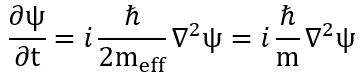
We also showed how the physical dimensions work out in Schroedinger’s wave equation. Let us jot it down to appreciate what it might model, and appreciate why complex numbers come in handy:
Schroedinger’s equation in free space
This is, of course, Schroedinger’s equation in free space, which means there are no other charges around and we, therefore, have no potential energy terms here. The rather enigmatic concept of the effective mass (which is half the total mass of the electron) is just the relativistic mass of the pointlike charge as it whizzes around at lightspeed, so that is the motion which Schroedinger referred to as its Zitterbewegung (Dirac confused it with some motion of the electron itself, further compounding what we think of as de Broglie’s mistaken interpretation of the matter-wave as a linear oscillation: think of it as an orbital oscillation). The 1/2 factor is there in Schroedinger’s wave equation for electron orbitals, but he replaced the effective mass rather subtly (or not-so-subtly, I should say) by the total mass of the electron because the wave equation models the orbitals of an electron pair (two electrons with opposite spin). So we might say he was lucky: the two mistakes together (not accounting for spin, and adding the effective mass of two electrons to get a mass factor) make things come out alright. 🙂
However, we will not say more about Schroedinger’s equation for the time being (we will come back to it): just note the imaginary unit, which does operate like a rotation operator here. Schroedinger’s wave equation, therefore, must model (planar) orbitals. Of course, the plane of the orbital itself may be rotating itself, and most probably is because that is what gives us those wonderful shapes of electron orbitals (subshells). Also note the physical dimension of ħ/m: it is a factor which is expressed in m2/s, but when you combine that with the 1/m2 dimension of the ∇2 operator, then you get the 1/s dimension on both sides of Schroedinger’s equation. [The ∇2 operator is just the generalization of the d2r/dx2 but in three dimensions, so x becomes a vector: x, and we apply the operator to the three spatial coordinates and get another vector, which is why we call ∇2 a vector operator. Let us move on, because we cannot explain each and every detail here, of course!]
We need to talk forces and fields now. This ring current model assumes an electromagnetic field which keeps the pointlike charge in its orbit. This centripetal force must be equal to the Lorentz force (F), which we can write in terms of the electric and magnetic field vectors E and B (fields are just forces per unit charge, so the two concepts are very intimately related):
We use a different imaginary unit here (j instead of i) because the plane in which the magnetic field vector B is going round and round is orthogonal to the plane in which E is going round and round, so let us call these planes the xy– and xz-planes respectively. Of course, you will ask: why is the B-plane not the yz-plane? We might be mistaken, but the magnetic field vector lags the electric field vector, so it is either of the two, and so now you can check for yourself of what we wrote above is actually correct. Also note that we write 1 as a vector (1) or a complex number: 1 = 1 + i·0. [It is also possible to write this: 1 = 1 + i·0 or 1 = 1 + i·0. As long as we think of these things as vectors – something with a magnitude and a direction – it is OK.]
You may be lost in math already, so we should visualize this. Unfortunately, that is not easy. You may to google for animations of circularly polarized electromagnetic waves, but these usually show the electric field vector only, and animations which show bothE and B are usually linearly polarized waves. Let me reproduce the simplest of images: imagine the electric field vector E going round and round. Now imagine the field vector B being orthogonal to it, but also going round and round (because its phase follows the phase of E). So, yes, it must be going around in the xz– or yz-plane (as mentioned above, we let you figure out how the various right-hand rules work together here).
Rotational plane of the electric field vector
You should now appreciate that the E and B vectors – taken together – will also form a plane. This plane is not static: it is not the xy-, yz– or xz-plane, nor is it some static combination of two of these. No! We cannot describe it with reference to our classical Cartesian axes because it changes all the time as a result of the rotation of both the E and B vectors. So how we can describe that plane mathematically?
The Irish mathematician William Rowan Hamilton – who is also known for many other mathematical concepts – found a great way to do just that, and we will use his notation. We could say the plane formed by the E and B vectors is the E–B plane but, in line with Hamilton’s quaternion algebra, we will refer to it as the k-plane. How is it related to what we referred to as the i– and j-planes, or the xy– and xz-plane as we used to say? At this point, we should introduce Hamilton’s notation: he did write i and j in boldface (we do not like that, but you may want to think of it as just a minor change in notation because we are using these imaginary units in a new mathematical space: the quaternion number space), and he referred to them as basic quaternions in what you should think of as an extension of the complex number system. More specifically, he wrote this on a now rather famous bridge in Dublin:
i2 = -1
j2 = -1
k2 = -1
i·j = k
j·i= –k
The first three rules are the ones you know from complex number math: two successive rotations by 90 degrees will bring you from 1 to -1. The order of multiplication in the other two rules ( i·j = k and j·i = –k ) gives us not only the k-plane but also the spin direction. All other rules in regard to quaternions (we can write, for example, this: i ·j·k = -1), and the other products you will find in the Wikipedia article on quaternions) can be derived from these, but we will not go into them here.
Now, you will say, we do not really need that k, do we? Just distinguishing between i and j should do, right? The answer to that question is: yes, when you are dealing with electromagnetic oscillations only! But it is no when you are trying to model nuclear oscillations! That is, in fact, exactly why we need this quaternion math in quantum physics!
Let us think about this nuclear oscillation. Particle physics experiments – especially high-energy physics experiments – effectively provide evidence for the presence of a nuclear force. To explain the proton radius, one can effectively think of a nuclear oscillation as an orbital oscillation in three rather than just two dimensions. The oscillation is, therefore, driven by two (perpendicular) forces rather than just one, with the frequency of each of the oscillators being equal to ω = E/2ħ = mc2/2ħ.
Each of the two perpendicular oscillations would, therefore, pack one half-unit of ħ only. The ω = E/2ħ formula also incorporates the energy equipartition theorem, according to which each of the two oscillations should pack half of the total energy of the nuclear particle (so that is the proton, in this case). This spherical view of a proton fits nicely with packing models for nucleons and yields the experimentally measured radius of a proton:
Proton radius formula
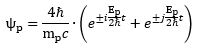
Of course, you can immediately see that the 4 factor is the same factor 4 as the one appearing in the formula for the surface area of a sphere (A = 4πr2), as opposed to that for the surface of a disc (A = πr2). And now you should be able to appreciate that we should probably represent a proton by a combination of two wavefunctions. Something like this:
Proton wavefunction
What about a wave equation for nuclear oscillations? Do we need one? We sure do. Perhaps we do not need one to model a neutron as some nuclear dance of a negative and a positive charge. Indeed, think of a combination of a proton and what we will refer to as a deep electron here, just to distinguish it from an electron in Schroedinger’s atomic electron orbitals. But we might need it when we are modeling something more complicated, such as the different energy states of, say, a deuteron nucleus, which combines a proton and a neutron and, therefore, two positive charges and one deep electron.
According to some, the deep electron may also appear in other energy states and may, therefore, give rise to a different kind of hydrogen (they are referred to as hydrinos). What do I think of those? I think these things do not exist and, if they do, they cannot be stable. I also think these researchers need to come up with a wave equation for them in order to be credible and, in light of what we wrote about the complications in regard to the various rotational planes, that wave equation will probably have all of Hamilton’s basic quaternions in it. [But so, as mentioned above, I am waiting for them to come up with something that makes sense and matches what we can actually observe in Nature: those hydrinos should have a specific spectrum, and we do not such see such spectrum from, say, the Sun, where there is so much going on so, if hydrinos exist, the Sun should produce them, right? So, yes, I am rather skeptical here: I do think we know everything now and physics, as a science, is sort of complete and, therefore, dead as a science: all that is left now is engineering!]
But, yes, quaternion algebra is a very necessary part of our toolkit. It completes our description of everything! 🙂
The work on the neutron model inspired me to have another look at the 1/4 factor which bothered me when applying mass-without-mass models to the proton. I think I nailed it: it is just another form factor. Have a look at the proton paper. Mystery solved – finally ! 🙂
Pre-scriptum (6 February 2021): We solved this one. The proton is, effectively, a 3D zbw oscillation (as opposed to the 2D oscillation of the pointlike charge in an electron. See our latest paper on the nuclear force.
Our alternative realist interpretation of quantum physics is pretty complete but one thing that has been puzzling us is the mass density of a proton: why is it so massive as compared to an electron? We simplified things by adding a factor in the Planck-Einstein relation. To be precise, we wrote it as E = 4·h·f. This allowed us to derive the proton radius from the ring current model:
This felt a bit artificial. Writing the Planck-Einstein relation using an integer multiple of h or ħ (E = n·h·f = n·ħ·ω) is not uncommon. You should have encountered this relation when studying the black-body problem, for example, and it is also commonly used in the context of Bohr orbitals of electrons. But why is n equal to 4 here? Why not 2, or 3, or 5 or some other integer? We do not know: all we know is that the proton is very different. A proton is, effectively, not the antimatter counterpart of an electron—a positron. While the proton is much smaller – 459 times smaller, to be precise – its mass is 1,836 times that of the electron. Note that we have the same 1/4 factor here because the mass and Compton radius are inversely proportional:
This doesn’t look all that bad but it feels artificial. In addition, our reasoning involved a unexplained difference – a mysterious but exact SQRT(2) factor, to be precise – between the theoretical and experimentally measured magnetic moment of a proton. In short, we assumed some form factor must explain both the extraordinary mass density as well as this SQRT(2) factor but we were not quite able to pin it down, exactly. A remark on a video on our YouTube channel inspired us to think some more – thank you for that, Andy! – and we think we may have the answer now.
We now think the mass – or energy – of a proton combines two oscillations: one is the Zitterbewegung oscillation of the pointlike charge (which is a circular oscillation in a plane) while the other is the oscillation of the plane itself. The illustration below is a bit horrendous (I am not so good at drawings) but might help you to get the point. The plane of the Zitterbewegung (the plane of the proton ring current, in other words) may oscillate itself between +90 and −90 degrees. If so, the effective magnetic moment will differ from the theoretical magnetic moment we calculated, and it will differ by that SQRT(2) factor.
Hence, we should rewrite our paper, but the logic remains the same: we just have a much better explanation now of why we should apply the energy equipartition theorem.
Mystery solved! 🙂
Post scriptum (9 August 2020): The solution is not as simple as you may imagine. When combining the idea of some other motion to the ring current, we must remember that the speed of light – the presumed tangential speed of our pointlike charge – cannot change. Hence, the radius must become smaller. We also need to think about distinguishing two different frequencies, and things quickly become quite complicated.
I just produced a first draft of the Metaphysics page of my new physics site. It does not only deal with the fundamental concepts we have been developing but – as importantly, if not more – it also offers some thoughts on all of the unanswered questions which, when trying to do science and be logical, are at least as important as the questions we do consider to be solved. Click the link or the tab. Enjoy ! 🙂 As usual, feedback is more than welcome!
Pre-scriptum (PS), added on 6 March 2020: The ideas below also naturally lead to a theory about what a neutrino might actually be. As such, it’s a complete ‘alternative’ Theory of Everything. I uploaded the basics of such theory on my academia.edu site. For those who do not want to log on to academia.edu, you can also find the paper on my author’s page on Phil Gibb’s site.
Text:
We were rather tame in our last paper on the oscillator model of an electron. We basically took some philosophical distance from it by stating we should probably only think of it as a mathematical equivalent to Hestenes’ concept of the electron as a superconducting loop. However, deep inside, we feel we should not be invoking Maxwell’s laws of electrodynamics to explain what a proton and an electron might actually be. The basics of the ring current model can be summed up in one simple equation:
c = a·ω
This is the formula for the tangential velocity. Einstein’s mass-energy equivalence relation and the Planck-Einstein relation explain everything else[1], as evidenced by the fact that we can immediately derive the Compton radius of an electron from these three equations, as shown below:The reader might think we are just ‘casually connecting formulas’ here[2] but we feel we have a full-blown theory of the electron here: simple and consistent. The geometry of the model is visualized below. We think of an electron (and a proton) as consisting of a pointlike elementary charge – pointlike but notdimensionless[3] – moving about at (nearly) the speed of light around the center of its motion.
The relation works perfectly well for the electron. However, when applying the a = ħ/mc radius formula to a proton, we get a value which is about 1/4 of the measured proton radius: about 0.21 fm, as opposed to the 0.83-0.84 fm charge radius which was established by Professors Pohl, Gasparan and others over the past decade.[4] In our papers on the proton radius[5], we motivated the 1/4 factor by referring to the energy equipartition theorem and assuming energy is, somehow, equally split over electromagnetic field energy and the kinetic energy in the motion of the zbw charge. However, the reader must have had the same feeling as we had: these assumptions are rather ad hoc. We, therefore, propose something more radical:
When considering systems (e.g. electron orbitals) and excited states of particles, angular momentum comes in units (nearly) equal to ħ, but when considering the internal structure of elementary particles, (orbital) angular momentum comes in an integer fraction of ħ. This fraction is 1/2 for the electron[6] and 1/4 for the proton.
Let us write this out for the proton radius:What are the implications for the assumed centripetal force keeping the elementary charge in motion? The centripetal acceleration is equal to ac = vt2/a = a·ω2. It is probably useful to remind ourselves how we get this result so as to make sure our calculations are relativistically correct. The position vector r (which describes the position of the zbw charge) has a horizontal and a vertical component: x = a·cos(ωt) and y = a·sin(ωt). We can now calculate the two components of the (tangential) velocity vector v = dr/dt as vx = –a·ω·sin(ωt) and vy y = –a· ω·cos(ωt) and, in the next step, the components of the (centripetal) acceleration vector ac: ax = –a·ω2·cos(ωt) and ay = –a·ω2·sin(ωt). The magnitude of this vector is then calculated as follows:
Now, Newton’s force law tells us that the magnitude of the centripetal force will be equal to:
F = mγ·ac = mγ·a·ω2
As usual, the mγ factor is, once again, the effective mass of the zbw charge as it zitters around the center of its motion at (nearly) the speed of light: it is half the electron mass.[7] If we denote the centripetal force inside the electron as Fe, we can relate it to the electron mass me as follows:Assuming our logic in regard to the effective mass of the zbw charge inside a proton is also valid – and using the 4E = ħω and a = ħ/4mc relations – we get the following equation for the centripetal force inside of a proton: How should we think of this? In our oscillator model, we think of the centripetal force as a restoring force. This force depends linearly on the displacement from the center and the (linear) proportionality constant is usually written as k. Hence, we can write Fe and Fp as Fe = -kex and Fp = -kpx respectively. Taking the ratio of both so as to have an idea of the respective strength of both forces, we get this:
The ap and ae are acceleration vectors – not the radius. The equation above seems to tell us that the centripetal force inside of a proton gives the zbw charge inside – which is nothing but the elementary charge, of course – an acceleration that is four times that of what might be going on inside the electron.
Nice, but how meaningful are these relations, really? If we would be thinking of the centripetal or restoring force as modeling some elasticity of spacetime – the guts intuition behind far more complicated string theories of matter – then we may think of distinguishing between a fundamental frequency and higher-level harmonics or overtones.[8] We will leave our reflections at that for the time being.
We should add one more note, however. We only talked about the electron and the proton here. What about other particles, such as neutrons or mesons? We do not consider these to be elementary because they are not stable: we think they are not stable because the Planck-Einstein relation is slightly off, which causes them to disintegrate into what we’ve been trying to model here: stable stuff. As for the process of their disintegration, we think the approach that was taken by Gell-Man and others[9] is not productive: inventing new quantities that are supposedly being conserved – such as strangeness – is… Well… As strange as it sounds. We, therefore, think the concept of quarks confuses rather than illuminates the search for a truthful theory of matter.
Jean Louis Van Belle, 6 March 2020
[1] In this paper, we make abstraction of the anomaly, which is related to the zbw charge having a (tiny) spatial dimension.
[2] We had a signed contract with the IOP and WSP scientific publishing houses for our manuscript on a realist interpretation of quantum mechanics (https://vixra.org/abs/1901.0105) which was shot down by this simple comment. We have basically stopped tried convincing mainstream academics from that point onwards.
[6] The reader may wonder why we did not present the ½ fraction is the first set of equations (calculation of the electron radius). We refer him or her to our previous paper on the effective mass of the zbw charge (https://vixra.org/abs/2003.0094). The 1/2 factor appears when considering orbital angular momentum only.
[7] The reader may not be familiar with the concept of the effective mass of an electron but it pops up very naturally in the quantum-mechanical analysis of the linear motion of electrons. Feynman, for example, gets the equation out of a quantum-mechanical analysis of how an electron could move along a line of atoms in a crystal lattice. See: Feynman’s Lectures, Vol. III, Chapter 16: The Dependence of Amplitudes on Position (https://www.feynmanlectures.caltech.edu/III_16.html). We think of the effective mass of the electron as the relativistic mass of the zbw charge as it whizzes about at nearly the speed of light. The rest mass of the zbw charge itself is close to – but also not quite equal to – zero. Indeed, based on the measured anomalous magnetic moment, we calculated the rest mass of the zbw charge as being equal to about 3.4% of the electron rest mass (https://vixra.org/abs/2002.0315).
I’ve been working across Asia – mainly South Asia – for over 25 years now. You will google the exact meaning but my definition of a wallah is a someone who deals in something: it may be a street vendor, or a handyman, or anyone who brings something new. I remember I was one of the first to bring modern mountain bikes to India, and they called me a gear wallah—because they were absolute fascinated with the number of gears I had. [Mountain bikes are now back to a 2 by 10 or even a 1 by 11 set-up, but I still like those three plateaux in front on my older bikes—and, yes, my collection is becoming way too large but I just can’t do away with it.]
It just makes me wonder: why is the outcome of this 100-year old battle between mainstream hocus-pocus and real physics so undecided?
I’ve come to think of mainstream physicists as peddlers in mysteries—whence the title of my post. It’s a tough conclusion. Physics is supposed to be the King of Science, right? Hence, we shouldn’t doubt it. At the same time, it is kinda comforting to know the battle between truth and lies rages everywhere—including inside of the King of Science.
Preliminary note: Since writing the post, I developed a more comprehensive paper. You can find it on my academia.edu site (click here). It’s a bit longer – and also more technical – than the post below. Have fun ! 🙂
According to common wisdom, we need to introduce a new charge – and, therefore, a new force – to explain why protons will stick together. But we have neutrons too, right? Can’t they serve as glue? Now that’s an idea. About 99.999866 per cent of helium on this planet consists of two protons and two neutrons: we write this isotope as 4He. The only other stable isotope is 3He, which consists of two protons and one neutron. Let me google this… This is what Wikipedia writes: “Within the nucleus, protons and neutrons are bound together through the nuclear force. Neutrons are required for the stability of nuclei, with the exception of the single-proton hydrogen atom.”[1]
So now we need to examine this glue: what is it? What’s the difference between a neutron and a proton? A proton is stable. Neutrons are only stable inside of a nucleus: free neutrons decay. Their mean lifetime is almost 15 minutes, so that’s almost eternity in atomic physics. Almost, but not quite: free neutrons are transient oscillations. Why are neutrons stable in a nucleus but not in free space? We think it’s the Planck-Einstein relation: two protons, two neutrons and two electrons – a helium atom, in other words – are stable because all of the angular momenta in the oscillation add up to (some multiple of) Planck’s (reduced) quantum of action. The angular momentum of a neutron in free space does not, so it has to fall apart in a (stable) proton and a (stable) electron – and then a neutrino which carries the remainder of the energy. Let’s jot it down:Let’s think about energy first. The neutron’s energy is about 939,565,420 eV. The proton energy is about 938,272,088 eV. The difference is 1,293,332 eV. That’s almost 1.3 MeV.[2] The electron energy gives us close to 0.511 MeV of that difference – so that’s only 40% – but its kinetic energy can make up for a lot of the remainder! We then have the neutrino to provide the change—the nickel-and-dime, so to speak.[3]
Is this decay reversible? It is: a proton can capture an electron and, somehow, become a neutron. It usually happens with proton-rich nuclei absorbing an inner atomic electron, usually from the K or L electron shell, which is why the process is referred to as K- or L-electron capture:Once again, we have a neutrino providing the nickel-and-dime to ensure energy conservation. It is written as the anti-particle of the neutrino in the neutron decay equation. Neutrinos and anti-neutrinos are neutral, so what’s the difference? The specialists in the matter say they have no idea and that a neutrino and an anti-neutrino might well be one and the same thing.[4] Hence, for the time being, we’ll effectively assume they’re one and the same thing: we might write both as νe. No mystery here—not for me, at least. Or not here and not right now, I should say: the neutrino is just a vehicle to ensure conservation of energy and momentum (linear and/or angular).
It is tempting to think of the proton as some kind of atomic system itself, or a positive ion to which we may add an electron so as to get a neutron. You’ll say: that’s the hydrogen atom, right? No. The hydrogen atom is much larger than a neutron: the Bohr radius of a hydrogen atom is about 0.53 picometer (1 pm = 1´10–12 m). In contrast, the radius of a neutron is of the order of 0.8 femtometer (1 fm = 1´10–15 m), so that’s about 660 times smaller. While a neutron is much smaller, its energy (and, therefore, its mass) is significantly higher: the energy difference between a hydrogen atom and a neutron is about 0.78 MeV. That’s about 1.5 times the energy of an electron. The table below shows these interesting numbers.A good model of what a proton and a neutron actually are, will also need to explain why electron-positron pair production only happens when the photon is fired into a nucleus. The mainstream interpretation of this phenomenon is that the surplus kinetic energy needs to be absorbed by some heavy particle – the nucleus itself. My guts instinct tells me something else must be going on. Electron-positron pair production does seem to involve the creation of an electric charge out of energy. It puzzled Dirac (and many other physicists, of course) greatly.Let us think about sizes once more. If we try the mass of a proton (or a neutron—almost the same) in the formula for the Compton radius, we get this:That’s about 1/4 of the actual radius as measured in scattering experiments. We have a good rationale for calculating the Compton radius of a proton (or a neutron). It is based on the Zitterbewegung model for elementary particles: a pointlike charge whizzing around at the speed of light. For the electron, the charge is electric. For the proton or the neutron, we think of some strong charge and we, therefore, get a very different energy and, hence, a very different Compton radius.[5] However, a factor of 1/4 is encouraging but not good enough. If anything, it may indicate that a good model of a proton (and a neutron) should, besides some strong force, also incorporate the classical electric charge. It is difficult to think about this, because we think the pointlike electric charge has a radius itself: the Thomson or classical electron radius, which is equal to:This is about 3.5 times larger than the proton or neutron radius. It is even larger than the measured radius of the deuteron nucleus, which consists of a proton and a neutron bound together. That radius is about 2.1 fm. As mentioned above, this ‘back-of-the-envelope’ calculation of a Compton radius is encouraging, but a good model for a proton (and for a neutron) will need to explain these 1/4 or 3.5 factors.
What happens might be something like this: we fire an enormous amount of electromagnetic energy into a nucleus (the equivalent mass of the photon has to match the mass of the electron and the positron that’s being produced) and, hence, we destabilize the stable nucleus. However, Nature is strong. The strong force is strong. Some intermediate energy state emerges but Nature throws out the spanner in the works. The end result is that all can be analyzed, once again, in terms of the Planck-Einstein relation: we have stable particles, once again. [Of course, the positron finds itself in the anti-Universe and will, therefore, quickly disappear in the reverse process: electron-positron annihilation.]
But so that’s just a story right now. We need to develop it into a proper theory.
Post scriptum: We’ve calculated a Compton radius for the proton. If – in analogy with the electron model – we would (also) have a current inside, then we should be able to calculate that current. Let us limit ourselves to the electric current – because we don’t have much of an idea about what a strong current would represent. The circular electric current creates a magnetic moment. We got the right value for an electron:What do we get if we do a similar calculation for a pointlike charge moving around at the speed of light but in a much smaller loop – a loop measured in femtometer rather than picometer? The calculation below shows we get a similar result in terms of structure but note the result is expressed in terms of the nuclear magneton (mN) which uses the proton mass, as opposed to the Bohr magneton, which uses the electron (rest) mass.Unsurprisingly, the actually measured value is different, and the difference is much larger than Schwinger’s a/2p fraction. To be precise, μp » 2.8·μN, so the measured value of the proton’s magnetic moment is almost three times that of its theoretical value. It should be no surprise to us – because we use a radius that’s 1/4 of what might be the actual radius of the loop. In fact, the measured value of the proton’s magnetic moment suggests the actual radius of the loop should be 2.8 times the theoretical Compton radius:Again, these results are not exact, but they’re encouraging: they encourage us to try to describe the proton in terms of some kind of hybrid model – something that mixes the classical electric charge with some strong charge. No need for QFT or virtual particles. 🙂
[2] CODATA data gives a standard error in the measurements that is equal to 0.46 eV. Hence, the measurements are pretty precise.
[3] When you talk money, you need big and small denominations: banknotes versus coins. However, the role of coins could be played by photons too. Gamma-ray photons – produced by radioactive decay – have energies in the MeV order of magnitude, so they should be able to play the role of whatever change we need in an energy equation, right? Yes. You’re right. So there must be more to it. We see neutrinos whenever there is radioactive decay. Hence, we should probably associate them with that, but how exactly is a bit of a mystery. Note that the decay equation conserves linear, angular (spin) momentum and (electric) charge. What about the color charge? We’re not worried about the color charge here. Should we be worried? I don’t think so, but if you’d be worried, note that this rather simple decay equation does respect color conservation – regardless of your definition of what quarks or gluons might actually be.
[4] See the various articles on neutrinos on Fermi National Accelerator Laboratory (FNAL), such as, for example, this one: https://neutrinos.fnal.gov/mysteries/majorana-or-dirac/. The common explanation is that neutrinos and anti-neutrinos have opposite spin but that’s nonsensical: we can very well imagine one and the same particle with two spin numbers.



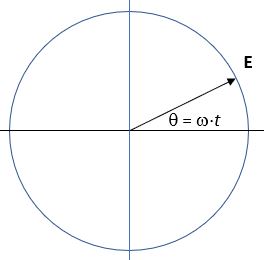



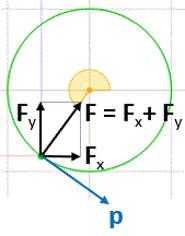
 What are the implications for the assumed centripetal force keeping the elementary charge in motion? The centripetal acceleration is equal to ac = vt2/a = a·ω2. It is probably useful to remind ourselves how we get this result so as to make sure our calculations are relativistically correct. The position vector r (which describes the position of the zbw charge) has a horizontal and a vertical component: x = a·cos(ωt) and y = a·sin(ωt). We can now calculate the two components of the (tangential) velocity vector v = dr/dt as vx = –a·ω·sin(ωt) and vy y = –a· ω·cos(ωt) and, in the next step, the components of the (centripetal) acceleration vector ac: ax = –a·ω2·cos(ωt) and ay = –a·ω2·sin(ωt). The magnitude of this vector is then calculated as follows:
 How should we think of this? In our oscillator model, we think of the centripetal force as a restoring force. This force depends linearly on the displacement from the center and the (linear) proportionality constant is usually written as k. Hence, we can write Fe and Fp as Fe = -kex and Fp = -kpx respectively. Taking the ratio of both so as to have an idea of the respective strength of both forces, we get this:
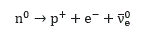 Let’s think about energy first. The neutron’s energy is about 939,565,420 eV. The proton energy is about 938,272,088 eV. The difference is 1,293,332 eV. That’s almost 1.3 MeV.
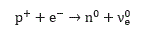 Once again, we have a neutrino providing the nickel-and-dime to ensure energy conservation. It is written as the anti-particle of the neutrino in the neutron decay equation. Neutrinos and anti-neutrinos are neutral, so what’s the difference? The specialists in the matter say they have no idea and that a neutrino and an anti-neutrino might well be one and the same thing.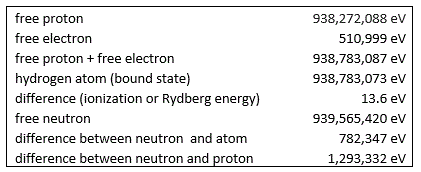
 That’s about 1/4 of the actual radius as measured in scattering experiments. We have a good rationale for calculating the Compton radius of a proton (or a neutron). It is based on the Zitterbewegung model for elementary particles: a pointlike charge whizzing around at the speed of light. For the electron, the charge is electric. For the proton or the neutron, we think of some strong charge and we, therefore, get a very different energy and, hence, a very different Compton radius.
 This is about 3.5 times larger than the proton or neutron radius. It is even larger than the measured radius of the deuteron nucleus, which consists of a proton and a neutron bound together. That radius is about 2.1 fm. As mentioned above, this ‘back-of-the-envelope’ calculation of a Compton radius is encouraging, but a good model for a proton (and for a neutron) will need to explain these 1/4 or 3.5 factors.
 What do we get if we do a similar calculation for a pointlike charge moving around at the speed of light but in a much smaller loop – a loop measured in femtometer rather than picometer? The calculation below shows we get a similar result in terms of structure but note the result is expressed in terms of the nuclear magneton (mN) which uses the proton mass, as opposed to the Bohr magneton, which uses the electron (rest) mass.
 Unsurprisingly, the actually measured value is different, and the difference is much larger than Schwinger’s a/2p fraction. To be precise, μp » 2.8·μN, so the measured value of the proton’s magnetic moment is almost three times that of its theoretical value. It should be no surprise to us – because we use a radius that’s 1/4 of what might be the actual radius of the loop. In fact, the measured value of the proton’s magnetic moment suggests the actual radius of the loop should be 2.8 times the theoretical Compton radius:
 Again, these results are not exact, but they’re encouraging: they encourage us to try to describe the proton in terms of some kind of hybrid model – something that mixes the classical electric charge with some strong charge. No need for QFT or virtual particles. 🙂
 Reading Feynman