Beautiful Blind Nonsense

I didn’t plan to write this short article or blog post. But as often happens these days, a comment thread on LinkedIn nudged me into it — or rather, into a response that became this article (which I also put on LinkedIn).

Someone posted a bold, poetic claim about “mass being memory,” “resonant light shells,” and “standing waves of curved time.” They offered a graphic spiraling toward meaning, followed by the words: “This isn’t metaphysics. It’s measurable.”

I asked politely:
“Interesting. Article, please? How do you get these numbers?”

The response: a full PDF of a “Unified Field Theory” relying on golden-ratio spirals, new universal constants, and reinterpretations of Planck’s constant. I read it. I sighed. And I asked ChatGPT a simple question:

“Why is there so much elegant nonsense being published lately — and does AI help generate it?”

The answer that followed was articulate, clear, and surprisingly quotable. So I polished it slightly, added some structure, and decided: this deserves to be an article in its own right. So here it is.

Beautiful, but Blind: How AI Amplifies Both Insight and Illusion

In recent years, a new kind of scientific-sounding poetry has flooded our screens — elegant diagrams, golden spirals, unified field manifestos. Many are written not by physicists, but with the help of AI.

And therein lies the paradox: AI doesn’t know when it’s producing nonsense.

🤖 Pattern without Understanding

Large language models like ChatGPT or Grok are trained on enormous text corpora. They are experts at mimicking patterns — but they lack an internal model of truth.
So if you ask them to expand on “curved time as the field of God,” they will.

Not because it’s true. But because it’s linguistically plausible.

🎼 The Seductive Surface of Language

AI is disarmingly good at rhetorical coherence:

  • Sentences flow logically.
  • Equations are beautifully formatted.
  • Metaphors bridge physics, poetry, and philosophy.

This surface fluency can be dangerously persuasive — especially when applied to concepts that are vague, untestable, or metaphysically confused.

🧪 The Missing Ingredient: Constraint

Real science is not just elegance — it’s constraint:

  • Equations must be testable.
  • Constants must be derivable or measurable.
  • Theories must make falsifiable predictions.

AI doesn’t impose those constraints on its own. It needs a guide.

🧭 The Human Role: Resonance and Resistance

Used carelessly, AI can generate hyper-coherent gibberish. But used wisely — by someone trained in reasoning, skepticism, and clarity — it becomes a powerful tool:

  • To sharpen ideas.
  • To test coherence.
  • To contrast metaphor with mechanism.

In the end, AI reflects our inputs.
It doesn’t distinguish between light and noise — unless we do.

Cargo cult science

From my last post, which talks about movies and space travel, it is obvious I am in a rather meditative mood. Besides movies, I have also been watching Richard Feynman’s 1979 Auckland lectures (video link here) which were ultimately transcribed into what might well be Feynman’s most popular book: The Strange Theory of Light and Matter. I wrote quite a few posts on that (the link on the title will get you to one, or you can also use the search facility on this blog: just type ‘strange theory of light and matter’ and off you go).

In those posts, I do not argue with the story Feynman tells us about how QED ‘works’: I only try to show it is all far less mysterious than both he as well as the author of that little booklet make it out to be. Amplitudes and the coupling constant (which is nothing but the fine-structure constant) are not mysterious: we get them from Nature’s constants (the electron charge and its energy, basically), and then we just need to combine it with an idea of what photons actually are: lightparticles that carry the electromagnetic force. So QED is just electrodynamics but, yes, you need quantum theory because – at the smallest of scales – electromagnetic waves resolve into photons. Real photons. Not virtual ones.

The interesting thing about these lectures – which he gave in last decade of his life (he died in 1988, at a relatively young age) – is that Feynman also explains the basics of QCD: quantum chromodynamics. He explains quark flavors and colors in a rather lighthearted way. I wonder whether he truly believed the QCD theory was any good. We wrote a rather hard-hitting critique of it in our first paper on ResearchGate, in which I refer to the theory as ‘smoking gun physics’, my term for what Feynman referred to as ‘cargo cult science’: something “which has the semblance of science, but is only pseudoscience due to a lack of “a kind of scientific integrity, a principle of scientific thought that corresponds to a kind of utter honesty” on the part of the scientist.” My critique focused on what empirical evidence we actually have for the theory, and did not mention two more fundamental theoretical objections:

(1) the fact that Feynman’s ‘one-color’ parton model offer an equal number of ‘variables’ to explain what might be going on in the field of QCD (so the theory does not respect Occam’s Razor principle: alternative models are possible and the model must, therefore, have too many ‘degrees of freedom’); and

(2) those weird quark mass numbers: why would we ‘invent’ particles that have larger masses than the particles we are trying to explain?

I debunked quite a few ‘mysteries’ in Feynman’s presentations (e.g., his explanation of the boson-fermion dichotomy, or his explanation of 720-degree symmetries in quantum physics), so I think of him as a bit of a ‘mystery wallah‘ as well. Maybe I should bring it all together, one day. But I am not sure if I have the energy and time, and if people are actually still interested in it. We all seem to have more pressing worries now: that war in Ukraine is not good. :-/ We are all being misled on it.

That is probably why it makes me think scientists can be misled on a large scale too, which is why my qualification of the Standard Model of physics as ‘cargo cult science’ may now, perhaps, sound somewhat less offensive to those reading me here. 🙂

Post scriptum (19 March 2023): I wrote out a few things – on how and where things went wrong in the history of thought in this field – in a new paper: The Emperor Wears No Clothes: The Non-Standard Model of Quantum Physics. Check it out! 🙂

The mystery of the elementary charge

As part of my ‘debunking quantum-mechanical myths’ drive, I re-wrote Feynman’s introductory lecture on quantum mechanics. Of course, it has got nothing to do with Feynman’s original lecture—titled: on Quantum Behavior: I just made some fun of Feynman’s preface and that’s basically it in terms of this iconic reference. Hence, Mr. Gottlieb should not make too much of a fuss—although I hope he will, of course, because it would draw more attention to the paper. It was a fun exercise because it encouraged me to join an interesting discussion on ResearchGate (I copied the topic and some up and down below) which, in turn, made me think some more about what I wrote about the form factor in the explanation of the electron, muon and proton. Let me copy the relevant paragraph:

When we talked about the radius of a proton, we promised you we would talk some more about the form factor. The idea is very simple: an angular momentum (L) can always be written as the product of a moment of inertia (I) and an angular frequency (ω). We also know that the moment of inertia for a rotating mass or a hoop is equal to I = mr2, while it is equal to I = mr2/4 for a solid disk. So you might think this explains the 1/4 factor: a proton is just an anti-muon but in disk version, right? It is like a muon because of the strong force inside, but it is even smaller because it packs its charge differently, right?

Maybe. Maybe not. We think probably not. Maybe you will have more luck when playing with the formulas but we could not demonstrate this. First, we must note, once again, that the radius of a muon (about 1.87 fm) and a proton (0.83-0.84 fm) are both smaller than the radius of the pointlike charge inside of an electron (α·ħ/mec ≈ 2.818 fm). Hence, we should start by suggesting how we would pack the elementary charge into a muon first!

Second, we noted that the proton mass is 8.88 times that of the muon, while the radius is only 2.22 times smaller – so, yes, that 1/4 ratio once more – but these numbers are still weird: even if we would manage to, somehow, make abstraction of this form factor by accounting for the different angular momentum of a muon and a proton, we would probably still be left with a mass difference we cannot explain in terms of a unique force geometry.

Perhaps we should introduce other hypotheses: a muon is, after all, unstable, and so there may be another factor there: excited states of electrons are unstable too and involve an n = 2 or some other number in Planck’s E = n·h·f equation, so perhaps we can play with that too.

Our answer to such musings is: yes, you can. But please do let us know if you have more luck then us when playing with these formulas: it is the key to the mystery of the strong force, and we did not find it—so we hope you do!

So… Well… This is really as far as a realist interpretation of quantum mechanics will take you. One can solve most so-called mysteries in quantum mechanics (interference of electrons, tunneling and what have you) with plain old classical equations (applying Planck’s relation to electromagnetic theory, basically) but here we are stuck: the elementary charge itself is a most mysterious thing. When packing it into an electron, a muon or a proton, Nature gives it a very different shape and size.

The shape or form factor is related to the angular momentum, while the size has got to do with scale: the scale of a muon and proton is very different than that of an electron—smaller even than the pointlike Zitterbewegung charge which we used to explain the electron. So that’s where we are. It’s like we’ve got two quanta—rather than one only: Planck’s quantum of action, and the elementary charge. Indeed, Planck’s quantum of action may also be said to express itself itself very differently in space or in time (h = E·T versus h = p·λ). Perhaps there is room for additional simplification, but I doubt it. Something inside of me says that, when everything is said and done, I will just have to accept that electrons are electrons, and protons are protons, and a muon is a weird unstable thing in-between—and all other weird unstable things in-between are non-equilibrium states which one cannot explain with easy math.

Would that be good enough? For you? I cannot speak for you. Is it a good enough explanation for me? I am not sure. I have not made my mind up yet. I am taking a bit of a break from physics for the time being, but the question will surely continue to linger in the back of my mind. We’ll keep you updated on progress ! Thanks for staying tuned ! JL

PS: I realize the above might sound a bit like crackpot theory but that is just because it is very dense and very light writing at the same time. If you read the paper in full, you should be able to make sense of it. 🙂 You should also check the formulas for the moments of inertia: the I = mr2/4 formula for a solid disk depends on your choice of the axis of symmetry.

Research Gate

Peter Jackson

Dear Peter – Thanks so much for checking the paper and your frank comments. That is very much appreciated. I know I have gone totally overboard in dismissing much of post-WW II developments in quantum physics – most notably the idea of force-carrying particles (bosons – including Higgs, W/Z bosons and gluons). My fundamental intuition here is that field theories should be fine for modeling interactions (I’ll quote Dirac’s 1958 comments on that at the very end of my reply here) and, yes, we should not be limiting the idea of a field to EM fields only. So I surely do not want to give the impression I think classical 19th/early 20th century physics – Planck’s relation, electromagnetic theory and relativity – can explain everything.

Having said that, the current state of physics does resemble the state of scholastic philosophy before it was swept away by rationalism: I feel there has been a multiplication of ill-defined concepts that did not add much additional explanation of what might be the case (the latter expression is Wittgenstein’s definition of reality). So, yes, I feel we need some reincarnation of William of Occam to apply his Razor and kick ass. Fortunately, it looks like there are many people trying to do exactly that now – a return to basics – so that’s good: I feel like I can almost hear the tectonic plates moving. 🙂

My last paper is a half-serious rewrite of Feynman’s first Lecture on Quantum Mechanics. Its intention is merely provocative: I want to highlight what of the ‘mystery’ in quantum physics is truly mysterious and what is humbug or – as Feynman would call it – Cargo Cult Science. The section on the ‘form factor’ (what is the ‘geometry’ of the strong force?) in that paper is the shortest and most naive paragraph in that text but it actually does highlight the one and only question that keeps me awake: what is that form factor, what different geometry do we need to explain a proton (or a muon) as opposed to, say, an electron? I know I have to dig into the kind of stuff that you are highlighting – and Alex Burinskii’s Dirac-Kerr-Newman models (also integrating gravity) to find elements that – one day – may explain why a muon is not an electron, and why a proton is not a positron.

Indeed, I think the electron and photon model are just fine: classical EM and Planck’s relation are all that’s needed and so I actually don’t waste to more time on the QED sector. But a decent muon and proton model will, obviously, require ”something else’ than Planck’s relation, the electric charge and electromagnetic theory. The question here is: what is that ‘something else’, exactly?

Even if we find another charge or another field theory to explain the proton, then we’re just at the beginning of explaining the QCD sector. Indeed, the proton and muon are stable (fairly stable – I should say – in case of the muon – which I want to investigate because of the question of matter generations). In contrast, transient particles and resonances do not respect Planck’s relation – that’s why they are unstable – and so we are talking non-equilibrium states and so that’s an entirely different ballgame. In short, I think Dirac’s final words in the very last (fourth) edition of his ‘Principles of Quantum Mechanics’ still ring very true today. They were written in 1958 so Dirac was aware of the work of Gell-Man and Nishijima (the contours of quark-gluon theory) and, clearly, did not think much of it (I understand he also had conversations with Feynman on this):

“Quantum mechanics may be defined as the application of equations of motion to particles. […] The domain of applicability of the theory is mainly the treatment of electrons and other charged particles interacting with the electromagnetic field⎯a domain which includes most of low-energy physics and chemistry.

Now there are other kinds of interactions, which are revealed in high-energy physics and are important for the description of atomic nuclei. These interactions are not at present sufficiently well understood to be incorporated into a system of equations of motion. Theories of them have been set up and much developed and useful results obtained from them. But in the absence of equations of motion these theories cannot be presented as a logical development of the principles set up in this book. We are effectively in the pre-Bohr era with regard to these other interactions. It is to be hoped that with increasing knowledge a way will eventually be found for adapting the high-energy theories into a scheme based on equations of motion, and so unifying them with those of low-energy physics.”

Again, many thanks for reacting and, yes, I will study the references you gave – even if I am a bit skeptical of Wolfram’s new project. Cheers – JL

The Strange Theory of Light and Matter (II)

If we limit our attention to the interaction between light and matter (i.e. the behavior of photons and electrons only—so we we’re not talking quarks and gluons here), then the ‘crazy ideas’ of quantum mechanics can be summarized as follows:

  1. At the atomic or sub-atomic scale, we can no longer look at light as an electromagnetic wave. It consists of photons, and photons come in blobs. Hence, to some extent, photons are ‘particle-like’.
  2. At the atomic or sub-atomic scale, electrons don’t behave like particles. For example, if we send them through a slit that’s small enough, we’ll observe a diffraction pattern. Hence, to some extent, electrons are ‘wave-like’.

In short, photons aren’t waves, but they aren’t particles either. Likewise, electrons aren’t particles, but they aren’t waves either. They are neither. The weirdest thing of all, perhaps, is that, while light and matter are two very different things in our daily experience – light and matter are opposite concepts, I’d say, just like particles and waves are opposite concepts) – they look pretty much the same in quantum physics: they are both represented by a wavefunction.

Let me immediately make a little note on terminology here. The term ‘wavefunction’ is a bit ambiguous, in my view, because it makes one think of a real wave, like a water wave, or an electromagnetic wave. Real waves are described by real-valued wave functions describing, for example, the motion of a ball on a spring, or the displacement of a gas (e.g. air) as a sound wave propagates through it, or – in the case of an electromagnetic wave – the strength of the electric and magnetic field.

You may have questions about the ‘reality’ of fields, but electromagnetic waves – i.e. the classical description of light – are quite ‘real’ too, even if:

  1. Light doesn’t travel in a medium (like water or air: there is no aether), and
  2. The magnitude of the electric and magnetic field (they are usually denoted by E and B) depend on your reference frame: if you calculate the fields using a moving coordinate system, you will get a different mixture of E and B. Therefore, E and B may not feel very ‘real’ when you look at them separately, but they are very real when we think of them as representing one physical phenomenon: the electromagnetic interaction between particles. So the E and B mix is, indeed, a dual representation of one reality. I won’t dwell on that, as I’ve done that in another post of mine.

How ‘real’ is the quantum-mechanical wavefunction?

The quantum-mechanical wavefunction is not like any of these real waves. In fact, I’d rather use the term ‘probability wave’ but, apparently, that’s used only by bloggers like me 🙂 and so it’s not very scientific. That’s for a good reason, because it’s not quite accurate either: the wavefunction in quantum mechanics represents probability amplitudes, not probabilities. So we should, perhaps, be consistent and term it a ‘probability amplitude wave’ – but then that’s too cumbersome obviously, so the term ‘probability wave’ may be confusing, but it’s not so bad, I think.

Amplitudes and probabilities are related as follows:

  1. Probabilities are real numbers between 0 and 1: they represent the probability of something happening, e.g. a photon moves from point A to B, or a photon is absorbed (and emitted) by an electron (i.e. a ‘junction’ or ‘coupling’, as you know).
  2. Amplitudes are complex numbers, or ‘arrows’ as Feynman calls them: they have a length (or magnitude) and a direction.
  3. We get the probabilities by taking the (absolute) square of the amplitudes.

So photons aren’t waves, but they aren’t particles either. Likewise, electrons aren’t particles, but they aren’t waves either. They are neither. So what are they? We don’t have words to describe what they are. Some use the term ‘wavicle’ but that doesn’t answer the question, because who knows what a ‘wavicle’ is? So we don’t know what they are. But we do know how they behave. As Feynman puts it, when comparing the behavior of light and then of electrons in the double-slit experiment—struggling to find language to describe what’s going on: “There is one lucky break: electrons behave just like light.”

He says so because of that wave function: the mathematical formalism is the same, for photons and for electrons. Exactly the same? […] But that’s such a weird thing to say, isn’t it? We can’t help thinking of light as waves, and of electrons as particles. They can’t be the same. They’re different, aren’t they? They are.

Scales and senses

To some extent, the weirdness can be explained because the scale of our world is not atomic or sub-atomic. Therefore, we ‘see’ things differently. Let me say a few words about the instrument we use to look at the world: our eye.

Our eye is particular. The retina has two types of receptors: the so-called cones are used in bright light, and distinguish color, but when we are in a dark room, the so-called rods become sensitive, and it is believed that they actually can detect a single photon of light. However, neural filters only allow a signal to pass to the brain when at least five photons arrive within less than a tenth of a second. A tenth of a second is, roughly, the averaging time of our eye. So, as Feynman puts it: “If we were evolved a little further so we could see ten times more sensitively, we wouldn’t have this discussion—we would all have seen very dim light of one color as a series of intermittent little flashes of equal intensity.” In other words, the ‘particle-like’ character of light would have been obvious to us.

Let me make a few more remarks here, which you may or may not find useful. The sense of ‘color’ is not something ‘out there’:  colors, like red or brown, are experiences in our eye and our brain. There are ‘pigments’ in the cones (cones are the receptors that work only if the intensity of the light is high enough) and these pigments absorb the light spectrum somewhat differently, as a result of which we ‘see’ color. Different animals see different things. For example, a bee can distinguish between white paper using zinc white versus lead white, because they reflect light differently in the ultraviolet spectrum, which the bee can see but we don’t. Bees can also tell the direction of the sun without seeing the sun itself, because they are sensitive to polarized light, and the scattered light of the sky (i.e. the blue sky as we see it) is polarized. The bee can also notice flicker up to 200 oscillations per second, while we see it only up to 20, because our averaging time is like a tenth of a second, which is short for us, but so the averaging time of the bee is much shorter. So we cannot see the quick leg movements and/or wing vibrations of bees, but the bee can!

Sometimes we can’t see any color. For example, we see the night sky in ‘black and white’ because the light intensity is very low, and so it’s our rods, not the cones, that process the signal, and so these rods can’t ‘see’ color. So those beautiful color pictures of nebulae are not artificial (although the pictures are often enhanced). It’s just that the camera that is used to take those pictures (film or, nowadays, digital) is much more sensitive than our eye. 

Regardless, color is a quality which we add to our experience of the outside world ourselves. What’s out there are electromagnetic waves with this or that wavelength (or, what amounts to the same, this or that frequency). So when critics of the exact sciences say so much is lost when looking at (visible) light as an electromagnetic wave in the range of 430 to 790 teraherz, they’re wrong. Those critics will say that physics reduces reality. That is not the case.

What’s going on is that our senses process the signal that they are receiving, especially when it comes to vision. As Feynman puts it: “None of the other senses involves such a large amount of calculation, so to speak, before the signal gets into a nerve that one can make measurements on. The calculations for all the rest of the senses usually happen in the brain itself, where it is very difficult to get at specific places to make measurements, because there are so many interconnections. Here, with the visual sense, we have the light, three layers of cells making calculations, and the results of the calculations being transmitted through the optic nerve.”

Hence, things like color and all of the other sensations that we have are the object of study of other sciences, including biochemistry and neurobiology, or physiology. For all we know, what’s ‘out there’ is, effectively, just ‘boring’ stuff, like electromagnetic radiation, energy and ‘elementary particles’—whatever they are. No colors. Just frequencies. 🙂

Light versus matter

If we accept the crazy ideas of quantum mechanics, then the what and the how become one and the same. Hence we can say that photons and electrons are a wavefunction somewhere in space. Photons, of course, are always traveling, because they have energy but no rest mass. Hence, all their energy is in the movement: it’s kinetic, not potential. Electrons, on the other hand, usually stick around some nucleus. And, let’s not forget, they have an electric charge, so their energy is not only kinetic but also potential.

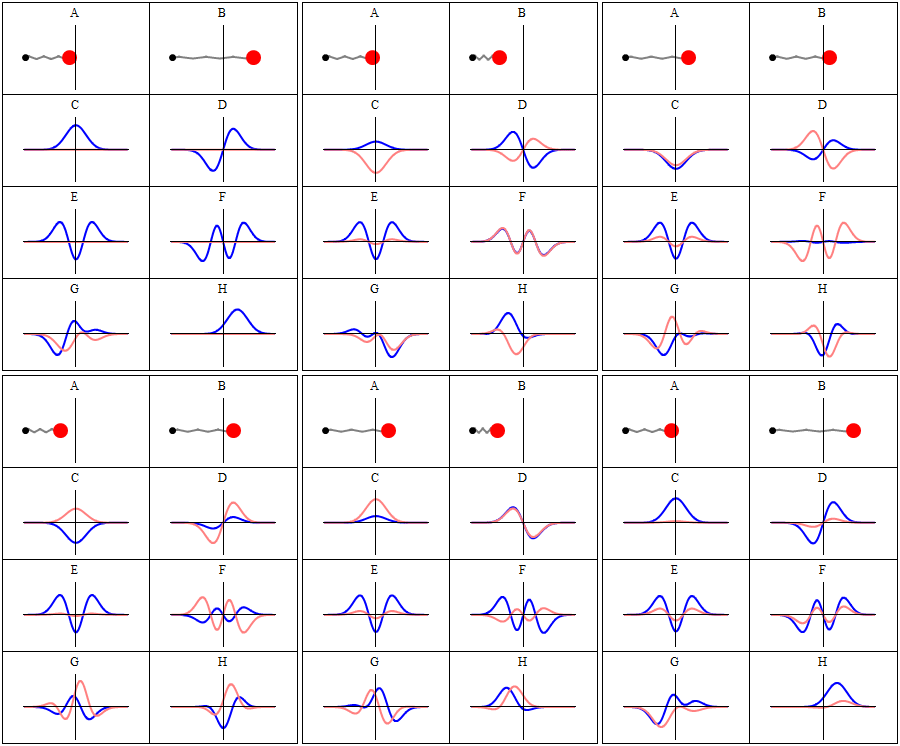
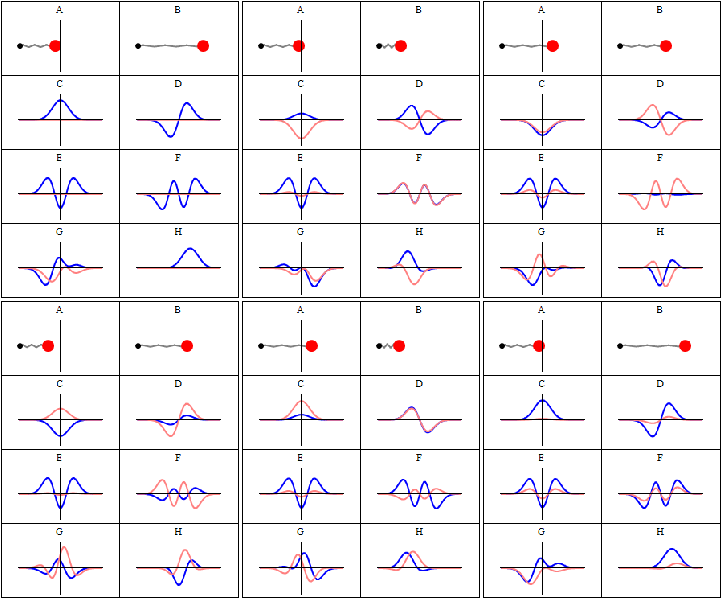
But, otherwise, it’s the same type of ‘thing’ in quantum mechanics: a wavefunction, like those below.

QuantumHarmonicOscillatorAnimation

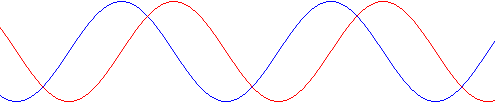
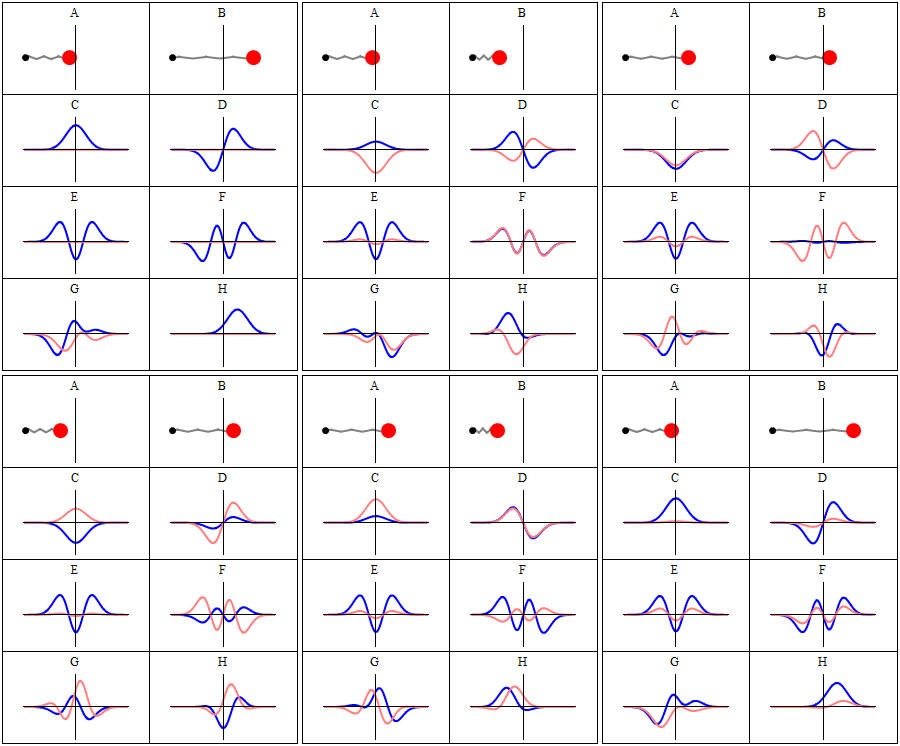
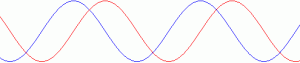
Why diagram A and B? It’s just to emphasize the difference between a real-valued wave function and those ‘probability waves’ we’re looking at here (diagram C to H). A and B represent a mass on a spring, oscillating at more or less the same frequency but a different amplitude. The amplitude here means the displacement of the mass. The function describing the displacement of a mass on a spring (so that’s diagram A and B) is an example of a real-valued wave function: it’s a simple sine or cosine function, as depicted below. [Note that a sine and a cosine are the same function really, except for a phase difference of 90°.]

cos and sine

Let’s now go back to our ‘probability waves’. Photons and electrons, light and matter… The same wavefunction? Really? How can the sunlight that warms us up in the morning and makes trees grow be the same as our body, or the tree? The light-matter duality that we experience must be rooted in very different realities, isn’t it?

Well… Yes and no. If we’re looking at one photon or one electron only, it’s the same type of wavefunction indeed. The same type… OK, you’ll say. So they are the same family or genus perhaps, as they say in biology. Indeed, both of them are, obviously, being referred to as ‘elementary particles’ in the so-called Standard Model of physics. But so what makes an electron and a photon specific as a species? What are the differences?

There’re  quite a few, obviously:

1. First, as mentioned above, a photon is a traveling wave function and, because it has no rest mass, it travels at the ultimate speed, i.e. the speed of light (c). An electron usually sticks around or, if it travels through a wire, it travels at very low speeds. Indeed, you may find it hard to believe, but the drift velocity of the free electrons in a standard copper wire is measured in cm per hour, so that’s very slow indeed—and while the electrons in an electron microscope beam may be accelerated up to 70% of the speed of light, and close to in those huge accelerators, you’re not likely to find an electron microscope or accelerator in Nature. In fact, you may want to remember that a simple thing like electricity going through copper wires in our houses is a relatively modern invention. 🙂

So, yes, those oscillating wave functions in those diagrams above are likely to represent some electron, rather than a photon. To be precise, the wave functions above are examples of standing (or stationary) waves, while a photon is a traveling wave: just extend that sine and cosine function in both directions if you’d want to visualize it or, even better, think of a sine and cosine function in an envelope traveling through space, such as the one depicted below.

Photon wave

Indeed, while the wave function of our photon is traveling through space, it is likely to be limited in space because, when everything is said and done, our photon is not everywhere: it must be somewhere. 

At this point, it’s good to pause and think about what is traveling through space. It’s the oscillation. But what’s the oscillation? There is no medium here, and even if there would be some medium (like water or air or something like aether—which, let me remind you, isn’t there!), the medium itself would not be moving, or – I should be precise here – it would only move up and down as the wave propagates through space, as illustrated below. To be fully complete, I should add we also have longitudinal waves, like sound waves (pressure waves): in that case, the particles oscillate back and forth along the direction of wave propagation. But you get the point: the medium does not travel with the wave.

Simple_harmonic_motion_animation

When talking electromagnetic waves, we have no medium. These E and B vectors oscillate but is very wrong to assume they use ‘some core of nearby space’, as Feynman puts it. They don’t. Those field vectors represent a condition at one specific point (admittedly, a point along the direction of travel) in space but, for all we know, an electromagnetic wave travels in a straight line and, hence, we can’t talk about its diameter or so.

Still, as mentioned above, we can imagine, more or less, what E and B stand for (we can use field line to visualize them, for instance), even if we have to take into account their relativity (calculating their values from a moving reference frame results in different mixtures of E and B). But what are those amplitudes? How should we visualize them?

The honest answer is: we can’t. They are what they are: two mathematical quantities which, taken together, form a two-dimensional vector, which we square to find a value for a real-life probability, which is something that – unlike the amplitude concept – does make sense to us. Still, that representation of a photon above (i.e. the traveling envelope with a sine and cosine inside) may help us to ‘understand’ it somehow. Again, you absolute have to get rid of the idea that these ‘oscillations’ would somehow occupy some physical space. They don’t. The wave itself has some definite length, for sure, but that’s a measurement in the direction of travel, which is often denoted as x when discussing uncertainty in its position, for example—as in the famous Uncertainty Principle (ΔxΔp > h).

You’ll say: Oh!—but then, at the very least, we can talk about the ‘length’ of a photon, can’t we? So then a photon is one-dimensional at least, not zero-dimensional! The answer is yes and no. I’ve talked about this before and so I’ll be short(er) on it now. A photon is emitted by an atom when an electron jumps from one energy level to another. It thereby emits a wave train that lasts about 10–8 seconds. That’s not very long but, taking into account the rather spectacular speed of light (3×10m/s), that still makes for a wave train with a length of not less than 3 meter. […] That’s quite a length, you’ll say. You’re right. But you forget that light travels at the speed of light and, hence, we will see this length as zero because of the relativistic length contraction effect. So… Well… Let me get back to the question: if photons and electrons are both represented by a wavefunction, what makes them different?

2. A more fundamental difference between photons and electrons is how they interact with each other.

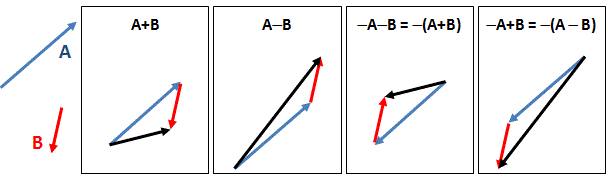
From what I’ve written above, you understand that probability amplitudes are complex numbers, or ‘arrows’, or ‘two-dimensional vectors’. [Note that all of these terms have precise mathematical definitions and so they’re actually not the same, but the difference is too subtle to matter here.] Now, there are two ways of combining amplitudes, which are referred to as ‘positive’ and ‘negative’ interference respectively. I should immediately note that there’s actually nothing ‘positive’ or ‘negative’ about the interaction: we’re just putting two arrows together, and there are two ways to do that. That’s all.

The diagrams below show you these two ways. You’ll say: there are four! However, remember that we square an arrow to get a probability. Hence, the direction of the final arrow doesn’t matter when we’re taking the square: we get the same probability. It’s the direction of the individual amplitudes that matters when combining them. So the square of A+B is the same as the square of –(A+B) = –A+(–B) = –AB. Likewise, the square of AB is the same as the square of –(AB) = –A+B.

vector addition

These are the only two logical possibilities for combining arrows. I’ve written ad nauseam about this elsewhere: see my post on amplitudes and statistics, and so I won’t go into too much detail here. Or, in case you’d want something less than a full mathematical treatment, I can refer you to my previous post also, where I talked about the ‘stopwatch’ and the ‘phase’: the convention for the stopwatch is to have its hand turn clockwise (obviously!) while, in quantum physics, the phase of a wave function will turn counterclockwise. But so that’s just convention and it doesn’t matter, because it’s the phase difference between two amplitudes that counts. To use plain language: it’s the difference in the angles of the arrows, and so that difference is just the same if we reverse the direction of both arrows (which is equivalent to putting a minus sign in front of the final arrow).

OK. Let me get back to the lesson. The point is: this logical or mathematical dichotomy distinguishes bosons (i.e. force-carrying ‘particles’, like photons, which carry the electromagnetic force) from fermions (i.e. ‘matter-particles’, such as electrons and quarks, which make up protons and neutrons). Indeed, the so-called ‘positive’ and ‘negative’ interference leads to two very different behaviors:

  1. The probability of getting a boson where there are already present, is n+1 times stronger than it would be if there were none before.
  2. In contrast, the probability of getting two electrons into exactly the same state is zero. 

The behavior of photons makes lasers possible: we can pile zillions of photon on top of each other, and then release all of them in one powerful burst. [The ‘flickering’ of a laser beam is due to the quick succession of such light bursts. If you want to know how it works in detail, check my post on lasers.]

The behavior of electrons is referred to as Fermi’s exclusion principle: it is only because real-life electrons can have one of two spin polarizations (i.e. two opposite directions of angular momentum, which are referred to as ‘up’ or ‘down’, but they might as well have been referred to as ‘left’ or ‘right’) that we find two electrons (instead of just one) in any atomic or molecular orbital.

So, yes, while both photons and electrons can be described by a similar-looking wave function, their behavior is fundamentally different indeed. How is that possible? Adding and subtracting ‘arrows’ is a very similar operation, isn’it?

It is and it isn’t. From a mathematical point of view, I’d say: yes. From a physics point of view, it’s obviously not very ‘similar’, as it does lead to these two very different behaviors: the behavior of photons allows for laser shows, while the behavior of electrons explain (almost) all the peculiarities of the material world, including us walking into doors. 🙂 If you want to check it out for yourself, just check Feynman’s Lectures for more details on this or, else, re-read my posts on it indeed.

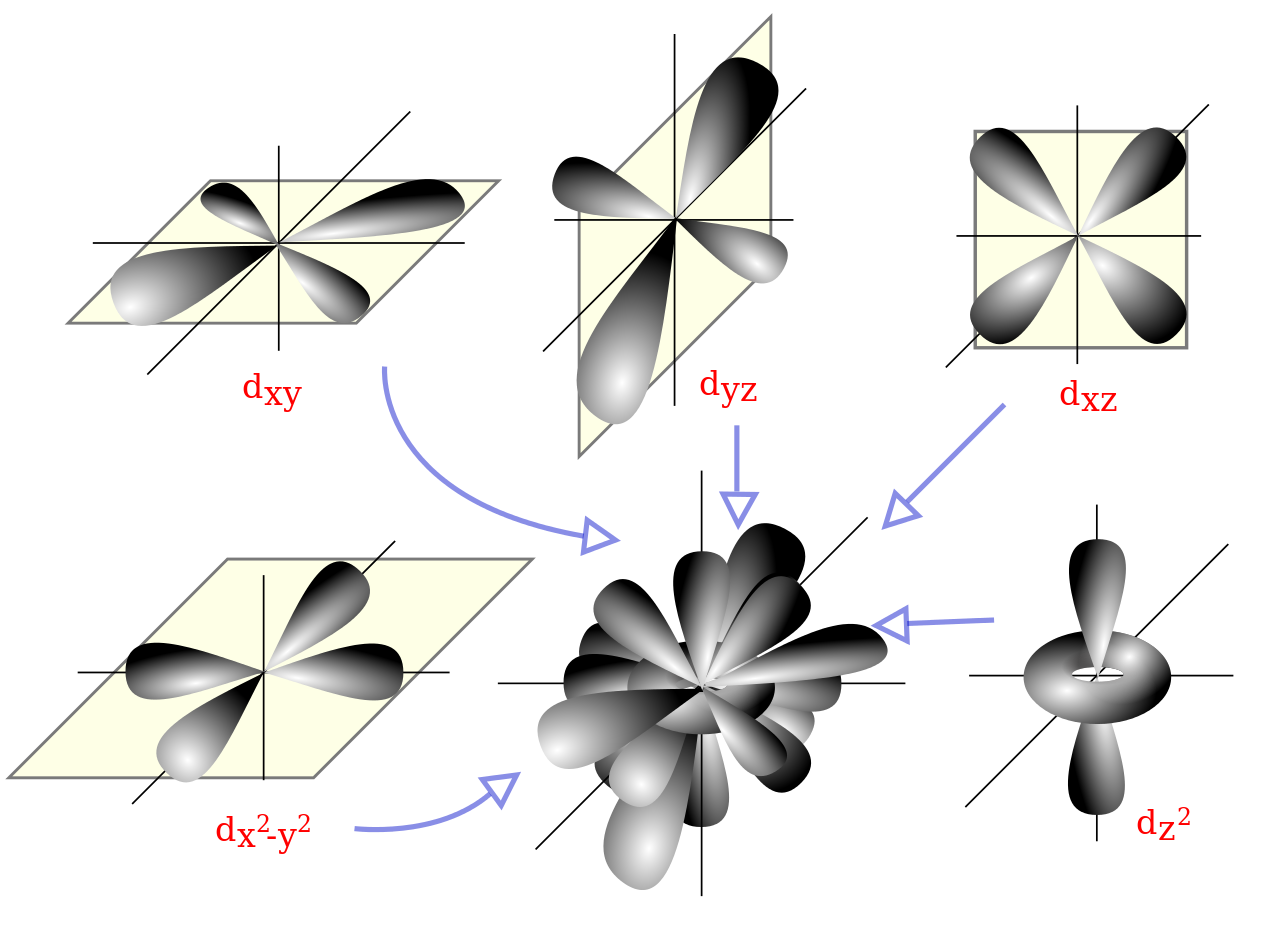
3. Of course, there are even more differences between photons and electrons than the two key differences I mentioned above. Indeed, I’ve simplified a lot when I wrote what I wrote above. The wavefunctions of electrons in orbit around a nucleus can take very weird shapes, as shown in the illustration below—and please do google a few others if you’re not convinced. As mentioned above, they’re so-called standing waves, because they occupy a well-defined position in space only, but standing waves can look very weird. In contrast, traveling plane waves, or envelope curves like the one above, are much simpler.

1280px-D_orbitals

In short: yes, the mathematical representation of photons and electrons (i.e. the wavefunction) is very similar, but photons and electrons are very different animals indeed.

Potentiality and interconnectedness

I guess that, by now, you agree that quantum theory is weird but, as you know, quantum theory does explain all of the stuff that couldn’t be explained before: “It works like a charm”, as Feynman puts it. In fact, he’s often quoted as having said the following:

“It is often stated that of all the theories proposed in this century, the silliest is quantum theory. Some say the the only thing that quantum theory has going for it, in fact, is that it is unquestionably correct.”

Silly? Crazy? Uncommon-sensy? Truth be told, you do get used to thinking in terms of amplitudes after a while. And, when you get used to them, those ‘complex’ numbers are no longer complicated. 🙂 Most importantly, when one thinks long and hard enough about it (as I am trying to do), it somehow all starts making sense.

For example, we’ve done away with dualism by adopting a unified mathematical framework, but the distinction between bosons and fermions still stands: an ‘elementary particle’ is either this or that. There are no ‘split personalities’ here. So the dualism just pops up at a different level of description, I’d say. In fact, I’d go one step further and say it pops up at a deeper level of understanding.

But what about the other assumptions in quantum mechanics. Some of them don’t make sense, do they? Well… I struggle for quite a while with the assumption that, in quantum mechanics, anything is possible really. For example, a photon (or an electron) can take any path in space, and it can travel at any speed (including speeds that are lower or higher than light). The probability may be extremely low, but it’s possible.

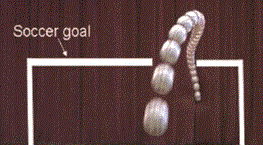
Now that is a very weird assumption. Why? Well… Think about it. If you enjoy watching soccer, you’ll agree that flying objects (I am talking about the soccer ball here) can have amazing trajectories. Spin, lift, drag, whatever—the result is a weird trajectory, like the one below:

soccer

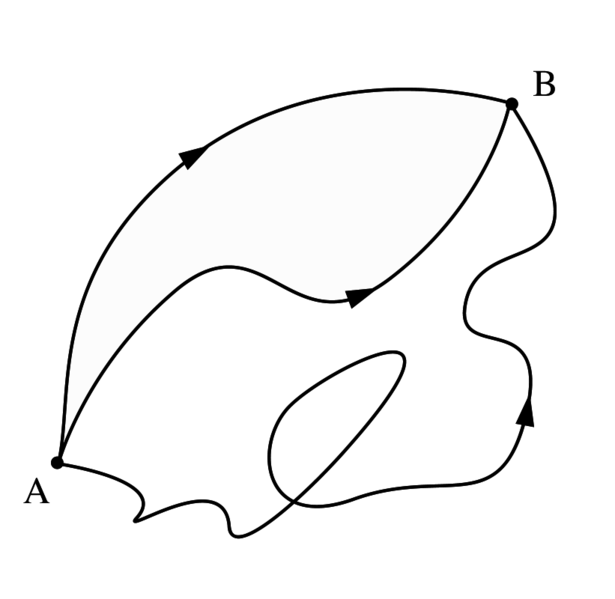
But, frankly, a photon taking the ‘southern’ route in the illustration below? What are the ‘wheels and gears’ there? There’s nothing sensible about that route, is there?

615px-Three_paths_from_A_to_B

In fact, there’s at least three issues here:

  1. First, you should note that strange curved paths in the real world (such as the trajectories of billiard or soccer balls) are possible only because there’s friction involved—between the felt of the pool table cloth and the ball, or between the balls, or, in the case of soccer, between the ball and the air. There’s no friction in the vacuum. Hence, in empty space, all things should go in a straight line only.
  2. While it’s quite amazing what’s possible, in the real world that is, in terms of ‘weird trajectories’, even the weirdest trajectories of a billiard or soccer ball can be described by a ‘nice’ mathematical function. We obviously can’t say the same of that ‘southern route’ which a photon could follow, in theory that is. Indeed, you’ll agree the function describing that trajectory cannot be ‘nice’. So even we’d allow all kinds of ‘weird’ trajectories, shouldn’t we limit ourselves to ‘nice’ trajectories only? I mean: it doesn’t make sense to allow the photons traveling from your computer screen to your retina take some trajectory to the Sun and back, does it?
  3. Finally, and most fundamentally perhaps, even when we would assume that there’s some mechanism combining (a) internal ‘wheels and gears’ (such as spin or angular momentum) with (b) felt or air or whatever medium to push against, what would be the mechanism determining the choice of the photon in regard to these various paths? In Feynman’s words: How does the photon ‘make up its mind’?

Feynman answers these questions, fully or partially (I’ll let you judge), when discussing the double-slit experiment with photons:

“Saying that a photon goes this or that way is false. I still catch myself saying, “Well, it goes either this way or that way,” but when I say that, I have to keep in mind that I mean in the sense of adding amplitudes: the photon has an amplitude to go one way, and an amplitude to go the other way. If the amplitudes oppose each other, the light won’t get there—even though both holes are open.”

It’s probably worth re-calling the results of that experiment here—if only to help you judge whether or not Feynman fully answer those questions above!

The set-up is shown below. We have a source S, two slits (A and B), and a detector D. The source sends photons out, one by one. In addition, we have two special detectors near the slits, which may or may not detect a photon, depending on whether or not they’re switched on as well as on their accuracy.

set-up photons

First, we close one of the slits, and we find that 1% of the photons goes through the other (so that’s one photon for every 100 photons that leave S). Now, we open both slits to study interference. You know the results already:

  1. If we switch the detectors off (so we have no way of knowing where the photon went), we get interference. The interference pattern depends on the distance between A and B and varies from 0% to 4%, as shown in diagram (a) below. That’s pretty standard. As you know, classical theory can explain that too assuming light is an electromagnetic wave. But so we have blobs of energy – photons – traveling one by one. So it’s really that double-slit experiment with electrons, or whatever other microscopic particles (as you know, they’ve done these interference electrons with large molecules as well—and they get the same result!). We get the interference pattern by using those quantum-mechanical rules to calculate probabilities: we first add the amplitudes, and it’s only when we’re finished adding those amplitudes, that we square the resulting arrow to the final probability.
  2. If we switch those special detectors on, and if they are 100% reliable (i.e. all photons going through are being detected), then our photon suddenly behaves like a particle, instead of as a wave: they will go through one of the slits only, i.e. either through A, or, alternatively, through B. So the two special detectors never go off together. Hence, as Feynman puts it: we shouldn’t think there is “sneaky way that the photon divides in two and then comes back together again.” It’s one or the other way and, and there’s no interference: the detector at D goes off 2% of the time, which is the simple sum of the probabilities for A and B (i.e. 1% + 1%).
  3. When the special detectors near A and B are not 100% reliable (and, hence, do not detect all photons going through), we have three possible final conditions: (i) A and D go off, (ii) B and D go off, and (iii) D goes off alone (none of the special detectors went off). In that case, we have a final curve that’s a mixture, as shown in diagram (c) and (d) below. We get it using the same quantum-mechanical rules: we add amplitudes first, and then we square to get the probabilities.

double-slit photons - results

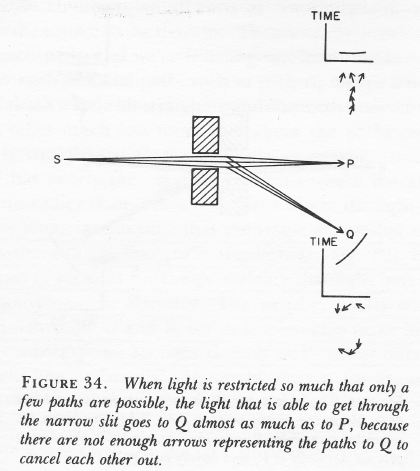
Now, I think you’ll agree with me that Feynman doesn’t answer my (our) question in regard to the ‘weird paths’. In fact, all of the diagrams he uses assume straight or nearby paths. Let me re-insert two of those diagrams below, to show you what I mean.

 Many arrowsFew arrows

So where are all the strange non-linear paths here? Let me, in order to make sure you get what I am saying here, insert that illustration with the three crazy routes once again. What we’ve got above (Figure 33 and 34) is not like that. Not at all: we’ve got only straight lines there! Why? The answer to that question is easy: the crazy paths don’t matter because their amplitudes cancel each other out, and so that allows Feynman to simplify the whole situation and show all the relevant paths as straight lines only.

615px-Three_paths_from_A_to_B

Now, I struggled with that for quite a while. Not because I can’t see the math or the geometry involved. No. Feynman does a great job showing why those amplitudes cancel each other out indeed (if you want a summary, see my previous post once again).  My ‘problem’ is something else. It’s hard to phrase it, but let me try: why would we even allow for the logical or mathematical possibility of ‘weird paths’ (and let me again insert that stupid diagram below) if our ‘set of rules’ ensures that the truly ‘weird’ paths (like that photon traveling from your computer screen to your eye doing a detour taking it to the Sun and back) cancel each other out anyway? Does that respect Occam’s Razor? Can’t we devise some theory including ‘sensible’ paths only?

Of course, I am just an autodidact with limited time, and I know hundreds (if not thousands) of the best scientists have thought long and hard about this question and, hence, I readily accept the answer is quite simply: no. There is no better theory. I accept that answer, ungrudgingly, not only because I think I am not so smart as those scientists but also because, as I pointed out above, one can’t explain any path that deviates from a straight line really, as there is no medium, so there are no ‘wheels and gears’. The only path that makes sense is the straight line, and that’s only because…

Well… Thinking about it… We think the straight path makes sense because we have no good theory for any of the other paths. Hmm… So, from a logical point of view, assuming that the straight line is the only reasonable path is actually pretty random too. When push comes to shove, we have no good theory for the straight line either!

You’ll say I’ve just gone crazy. […] Well… Perhaps you’re right. 🙂 But… Somehow, it starts to make sense to me. We allow for everything to, then, indeed weed out the crazy paths using our interference theory, and so we do end up with what we’re ending up with: some kind of vague idea of “light not really traveling in a straight line but ‘smelling’ all of the neighboring paths around it and, hence, using a small core of nearby space“—as Feynman puts it.

Hmm… It brings me back to Richard Feynman’s introduction to his wonderful little book, in which he says we should just be happy to know how Nature works and not aspire to know why it works that way. In fact, he’s basically saying that, when it comes to quantum mechanics, the ‘how’ and the ‘why’ are one and the same, so asking ‘why’ doesn’t make sense, because we know ‘how’. He compares quantum theory with the system of calculation used by the Maya priests, which was based on a system of bars and dots, which helped them to do complex multiplications and divisions, for example. He writes the following about it: “The rules were tricky, but they were a much more efficient way of getting an answer to complicated questions (such as when Venus would rise again) than by counting beans.”

When I first read this, I thought the comparison was flawed: if a common Maya Indian did not want to use the ‘tricky’ rules of multiplication and what have you (or, more likely, if he didn’t understand them), he or she could still resort to counting beans. But how do we count beans in quantum mechanics? We have no ‘simpler’ rules than those weird rules about adding amplitudes and taking the (absolute) square of complex numbers so… Well… We actually are counting beans here then:

  1. We allow for any possibility—any path: straight, curved or crooked. Anything is possible.
  2. But all those possibilities are inter-connected. Also note that every path has a mirror image: for every route ‘south’, there is a similar route ‘north’, so to say, except for the straight line, which is a mirror image of itself.
  3. And then we have some clock ticking. Time goes by. It ensures that the paths that are too far removed from the straight line cancel each other. [Of course, you’ll ask: what is too far? But I answered that question –  convincingly, I hope – in my previous post: it’s not about the ‘number of arrows’ (as suggested in the caption under that Figure 34 above), but about the frequency and, hence, the ‘wavelength’ of our photon.]
  4. And so… Finally, what’s left is a limited number of possibilities that interfere with each other, which results in what we ‘see’: light seems to use a small core of space indeed–a limited number of nearby paths.

You’ll say… Well… That still doesn’t ‘explain’ why the interference pattern disappears with those special detectors or – what amounts to the same – why the special detectors at the slits never click simultaneously.

You’re right. How do we make sense of that? I don’t know. You should try to imagine what happens for yourself. Everyone has his or her own way of ‘conceptualizing’ stuff, I’d say, and you may well be content and just accept all of the above without trying to ‘imagine’ what’s happening really when a ‘photon’ goes through one or both of those slits. In fact, that’s the most sensible thing to do. You should not try to imagine what happens and just follow the crazy calculus rules.

However, when I think about it, I do have some image in my head. The image is of one of those ‘touch-me-not’ weeds. I quickly googled one of these images, but I couldn’t quite find what I am looking for: it would be more like something that, when you touch it, curls up in a little ball. Any case… You know what I mean, I hope.

Mimosa_Pudica

You’ll shake your head now and solemnly confirm that I’ve gone mad. Touch-me-not weeds? What’s that got to do with photons? 

Well… It’s obvious you and I cannot really imagine how a photon looks like. But I think of it as a blob of energy indeed, which is inseparable, and which effectively occupies some space (in three dimensions that is). I also think that, whatever it is, it actually does travel through both slits, because, as it interferes with itself, the interference pattern does depend on the space between the two slits as well as the width of those slits. In short, the whole ‘geometry’ of the situation matters, and so the ‘interaction’ is some kind of ‘spatial’ thing. [Sorry for my awfully imprecise language here.]

Having said that, I think it’s being detected by one detector only because only one of them can sort of ‘hook’ it, somehow. Indeed, because it’s interconnected and inseparable, it’s the whole blob that gets hooked, not just one part of it. [You may or may not imagine that the detectors that’s got the best hold of it gets it, but I think that’s pushing the description too much.] In any case, the point is that a photon is surely not like a lizard dropping its tail while trying to escape. Perhaps it’s some kind of unbreakable ‘string’ indeed – and sorry for summarizing string theory so unscientifically here – but then a string oscillating in dimensions we can’t imagine (or in some dimension we can’t observe, like the Kaluza-Klein theory suggests). It’s something, for sure, and something that stores energy in some kind of oscillation, I think.

What it is, exactly, we can’t imagine, and we’ll probably never find out—unless we accept that the how of quantum mechanics is not only the why, but also the what. 🙂

Does this make sense? Probably not but, if anything, I hope it fired your imagination at least. 🙂

The Strange Theory of Light and Matter (I)

I am of the opinion that Richard Feynman’s wonderful little common-sense introduction to the ‘uncommon-sensy‘ theory of quantum electrodynamics (The Strange Theory of Light and Matter), which were published a few years before his death only, should be mandatory reading for high school students.

I actually mean that: it should just be part of the general education of the first 21st century generation. Either that or, else, the Education Board should include a full-fledged introduction to complex analysis and quantum physics in the curriculum. 🙂

Having praised it (just now, as well as in previous posts), I re-read it recently during a trek in Nepal with my kids – I just grabbed the smallest book I could find the morning we left 🙂 – and, frankly, I now think Ralph Leighton, who transcribed and edited these four short lectures, could have cross-referenced it better. Moreover, there are two or three points where Feynman (or Leighton?) may have sacrificed accuracy for readability. Let me recapitulate the key points and try to improve here and there.

Amplitudes and arrows

The booklet avoids scary mathematical terms and formulas but doesn’t avoid the fundamental concepts behind, and it doesn’t avoid the kind of ‘deep’ analysis one needs to get some kind of ‘feel’ for quantum mechanics either. So what are the simplifications?

A probability amplitude (i.e. a complex number) is, quite simply, an arrow, with a direction and a length. Thus Feynman writes: “Arrows representing probabilities from 0% to 16% [as measured by the surface of the square which has the arrow as its side] have lengths from 0 to 0.4.” That makes sense: such geometrical approach does away, for example, with the need to talk about the absolute square (i.e. the square of the absolute value, or the squared norm) of a complex number – which is what we need to calculate probabilities from probability amplitudes. So, yes, it’s a wonderful metaphor. We have arrows and surfaces now, instead of wave functions and absolute squares of complex numbers.

The way he combines these arrows make sense too. He even notes the difference between photons (bosons) and electrons (fermions): for bosons, we just add arrows; for fermions, we need to subtract them (see my post on amplitudes and statistics in this regard).

There is also the metaphor for the phase of a wave function, which is a stroke of genius really (I mean it): the direction of the ‘arrow’ is determined by a stopwatch hand, which starts turning when a photon leaves the light source, and stops when it arrives, as shown below.
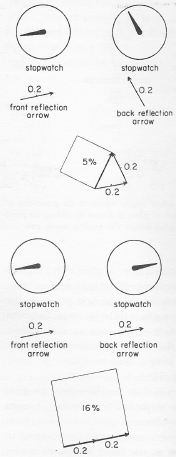
front and back reflection amplitude

OK. Enough praise. What are the drawbacks?

The illustration above accompanies an analysis of how light is either reflected from the front surface of a sheet of a glass or, else, from the back surface. Because it takes more time to bounce off the back surface (the path is associated with a greater distance), the front and back reflection arrows point in different directions indeed (the stopwatch is stopped somewhat later when the photon reflects from the back surface). Hence, the difference in phase (but that’s a term that Feynman also avoids) is determined by the thickness of the glass. Just look at it. In the upper part of the illustration above, the thickness is such that the chance of a photon reflecting off the front or back surface is 5%: we add two arrows, each with a length of 0.2, and then we square the resulting (aka final) arrow. Bingo! We get a surface measuring 0.05, or 5%.

Huh? Yes. Just look at it: if the angle between the two arrows would be 90° exactly, it would be 0.08 or 8%, but the angle is a bit less. In the lower part of the illustration, the thickness of the glass is such that the two arrows ‘line up’ and, hence, they form an arrow that’s twice the length of either arrow alone (0.2 + 0.2 = 0.4), with a square four times as large (0.16 = 16%). So… It all works like a charm, as Feynman puts it.

[…]

But… Hey! Look at the stopwatch for the front reflection arrows in the upper and lower diagram: they point in the opposite direction of the stopwatch hand! Well… Hmm… You’re right. At this point, Feynman just notes that we need an extra rule: “When we are considering the path of a photon bouncing off the front surface of the glass, we reverse the direction of the arrow.

He doesn’t say why. He just adds this random rule to the other rules – which most readers who read this book already know. But why this new rule? Frankly, this inconsistency – or lack of clarity – would wake me up at night. This is Feynman: there must be a reason. Why?

Initially, I suspected it had something to do with the two types of ‘statistics’ in quantum mechanics (i.e. those different rules for combining amplitudes of bosons and fermions respectively, which I mentioned above). But… No. Photons are bosons anyway, so we surely need to add, not subtract. So what is it?

[…] Feynman explains it later, much later – in the third of the four chapters of this little book, to be precise. It’s, quite simply, the result of the simplified model he uses in that first chapter. The photon can do anything really, and so there are many more arrows than just two. We actually should look at an infinite number of arrows, representing all possible paths in spacetime, and, hence, the two arrows (i.e. the one for the reflection from the front and back surface respectively) are combinations of many other arrows themselves. So how does that work?

An analysis of partial reflection (I)

The analysis in Chapter 3 of the same phenomenon (i.e. partial reflection by glass) is a simplified analysis too, but it’s much better – because there are no ‘random’ rules here. It is what Leighton promises to the reader in his introduction: “A complete description, accurate in every detail, of a framework onto which more advanced concepts can be attached without modification. Nothing has to be ‘unlearned’ later.

Well… Accurate in every detail? Perhaps not. But it’s good, and I still warmly recommend a reading of this delightful little book to anyone who’d ask me what to read as a non-mathematical introduction to quantum mechanics. I’ll limit myself here to just some annotations.

The first drawing (a) depicts the situation:

  1. A photon from a light source is being reflected by the glass. Note that it may also go straight through, but that’s a possibility we’ll analyze separately. We first assume that the photon is effectively being reflected by the glass, and so we want to calculate the probability of that event using all these ‘arrows’, i.e. the underlying probability amplitudes.
  2. As for the geometry of the situation: while the light source and the detector seem to be positioned at some angle from the normal, that is not the case: the photon travels straight down (and up again when reflected). It’s just a limitation of the drawing. It doesn’t really matter much for the analysis: we could look at a light beam coming in at some angle, but so we’re not doing that. It’s the simplest situation possible, in terms of experimental set-up that is. I just want to be clear on that.
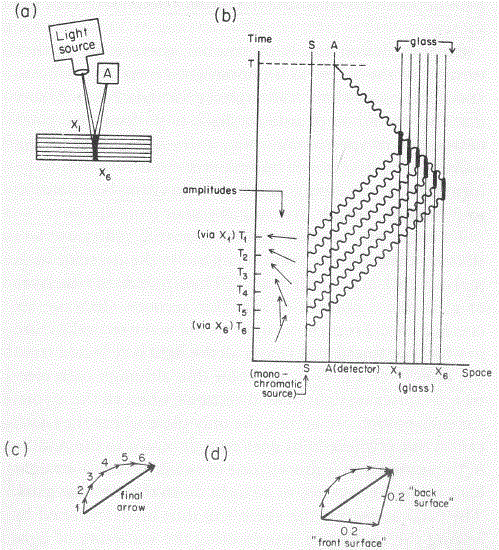
partial reflection

Now, rather than looking at the front and back surface only (as Feynman does in Chapter 1), the glass sheet is now divided into a number of very thin sections: five, in this case, so we have six points from which the photon can be scattered into the detector at A: X1 to X6. So that makes six possible paths. That’s quite a simplification but it’s easy to see it doesn’t matter: adding more sections would result in many more arrows, but these arrows would also be much smaller, and so the final arrow would be the same.

The more significant simplification is that the paths are all straight paths, and that the photon is assumed to travel at the speed of light, always. If you haven’t read the booklet, you’ll say that’s obvious, but it’s not: a photon has an amplitude to go faster or slower than c but, as Feynman points out, these amplitudes cancel out over longer distances. Likewise, a photon can follow any path in space really, including terribly crooked paths, but these paths also cancel out. As Feynman puts it: “Only the paths near the straight-line path have arrows pointing in nearly the same direction, because their timings are nearly the same, and only these arrows are important, because it is from them that we accumulate a large final arrow.” That makes perfect sense, so there’s no problem with the analysis here either.

So let’s have a look at those six arrows in illustration (b). They point in a slightly different direction because the paths are slightly different and, hence, the distances (and, therefore, the timings) are different too. Now, Feynman (but I think it’s Leighton really) loses himself here in a digression on monochromatic light sources. A photon is a photon: it will have some wave function with a phase that varies in time and in space and, hence, illustration (b) makes perfect sense. [I won’t quote what he writes on a ‘monochromatic light source’ because it’s quite confusing and, IMHO, not correct.]

The stopwatch metaphor has only one minor shortcoming: the hand of a stopwatch rotates clockwise (obviously!), while the phase of an actual wave function goes counterclockwise with time. That’s just convention, and I’ll come back to it when I discuss the mathematical representation of the so-called wave function, which gives you these amplitudes. However, it doesn’t change the analysis, because it’s the difference in the phase that matters when combining amplitudes, so the clock can turn in either way indeed, as long as we’re agreed on it.

At this point, I can’t resist: I’ll just throw the math in. If you don’t like it, you can just skip the section that follows.

Feynman’s arrows and the wave function

The mathematical representation of Feynman’s ‘arrows’ is the wave function:

f = f(x–ct)

Is that the wave function? Yes. It is: it’s a function whose argument is x – ct, with x the position in space, and t the time variable. As for c, that’s the speed of light. We throw it in to make the units in which we measure time and position compatible. 

Really? Yes: f is just a regular wave function. To make it look somewhat more impressive, I could use the Greek symbol Φ (phi) or Ψ (psi) for it, but it’s just what it is: a function whose value depends on position and time indeed, so we write f = f(x–ct). Let me explain the minus sign and the c in the argument.

Time and space are interchangeable in the argument, provided we measure time in the ‘right’ units, and so that’s why we multiply the time in seconds with c, so the new unit of time becomes the time that light needs to travel a distance of one meter. That also explains the minus sign in front of ct: if we add one distance unit (i.e. one meter) to the argument, we have to subtract one time unit from it – the new time unit of course, so that’s the time that light needs to travel one meter – in order to get the same value for f. [If you don’t get that x–ct thing, just think a while about this, or make some drawing of a wave function. Also note that the spacetime diagram in illustration (b) above assumes the same: time is measured in an equivalent unit as distance, so the 45% line from the south-west to the north-east, that bounces back to the north-west, represents a photon traveling at speed c in space indeed: one unit of time corresponds to one meter of travel.]

Now I want to be a bit more aggressive. I said is a simple function. That’s true and not true at the same time. It’s a simple function, but it gives you probability amplitudes, which are complex numbers – and you may think that complex numbers are, perhaps, not so simple. However, you shouldn’t be put off. Complex numbers are really like Feynman’s ‘arrows’ and, hence, fairly simple things indeed. They have two dimensions, so to say: an a– and a b-coordinate. [I’d say an x– and y-coordinate, because that’s what you usually see, but then I used the x symbol already for the position variable in the argument of the function, so you have to switch to a and b for a while now.]

This a– and b-coordinate are referred to as the real and imaginary part of a complex number respectively. The terms ‘real’ and ‘imaginary’ are confusing because both parts are ‘real’ – well… As real as numbers can be, I’d say. 🙂 They’re just two different directions in space: the real axis is the a-axis in coordinate space, and the imaginary axis is the b-axis. So we could write it as an ordered pair of numbers (a, b). However, we usually write it as a number itself, and we distinguish the b-coordinate from the a-coordinate by writing an i in front: (a, b) = a + ib. So our function f = f(x–ct) is a complex-valued function: it will give you two numbers (an a and a b) instead of just one when you ‘feed’ it with specific values for x and t. So we write:

f = f(x–ct) = (a, b) = a + ib

So what’s the shape of this function? Is it linear or irregular or what? We’re talking a very regular wave function here, so it’s shape is ‘regular’ indeed. It’s a periodic function, so it repeats itself again and again. The animations below give you some idea of such ‘regular’ wave functions. Animation A and B shows a real-valued ‘wave’: a ball on a string that goes up and down, for ever and ever. Animations C to H are – believe it or not – basically the same thing, but so we have two numbers going up and down. That’s all.
QuantumHarmonicOscillatorAnimation

The wave functions above are, obviously, confined in space, and so the horizontal axis represents the position in space. What we see, then, is how the real and imaginary part of these wave functions varies as time goes by. [Think of the blue graph as the real part, and the imaginary part as the pinkish thing – or the other way around. It doesn’t matter.] Now, our wave function – i.e. the one that Feynman uses to calculate all those probabilities – is even more regular than those shown above: its real part is an ordinary cosine function, and it’s imaginary part is a sine. Let me write this in math:

f = f(x–ct) = a + ib = r(cosφ + isinφ)

It’s really the most regular wave function in the world: the very simple illustration below shows how the two components of f vary as a function in space (i.e. the horizontal axis) while we keep the time fixed, or vice versa: it could also show how the function varies in time at one particular point in space, in which case the horizontal axis would represent the time variable. It is what it is: a sine and a cosine function, with the angle φ as its argument.
cos and sine

Note that a sine function is the same as a cosine function, but it just lags a bit. To be precise, the phase difference is 90°, or π/2 in radians (the radian (i.e. the length of the arc on the unit circle) is a much more natural unit to express angles, as it’s fully compatible with our distance unit and, hence, most – if not all – of our other units). Indeed, you may or may not remember the following trigonometric identities: sinφ = cos(π/2–φ) = cos(φ–π/2).

In any case, now we have some r and φ here, instead of a and b. You probably wonder where I am going with all of this. Where are the x and t variables? Be patient! You’re right. We’ll get there. I have to explain that r and φ first. Together, they are the so-called polar coordinates of Feynman’s ‘arrow’ (i.e. the amplitude). Polar coordinates are just as good as coordinates as these Cartesian coordinates we’re used to (i.e. a and b). It’s just a different coordinate system. The illustration below shows how they are related to each other. If you remember anything from your high school trigonometry course, you’ll immediately agree that a is, obviously, equal to rcosφ, and b is rsinφ, which is what I wrote above. Just as good? Well… The polar coordinate system has some disadvantages (all of those expressions and rules we learned in vector analysis assume rectangular coordinates, and so we should watch out!) but, for our purpose here, polar coordinates are actually easier to work with, so they’re better.
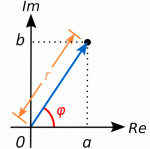
Complex_number_illustration

Feynman’s wave function is extremely simple because his ‘arrows’ have a fixed length, just like the stopwatch hand. They’re just turning around and around and around as time goes by. In other words, is constant and does not depend on position and time. It’s the angle φ that’s turning and turning and turning as the stopwatch ticks while our photon is covering larger and larger distances. Hence, we need to find a formula for φ that makes it explicit how φ changes as a function in spacetime. That φ variable is referred to as the phase of the wave function. That’s a term you’ll encounter frequently and so I had better mention it. In fact, it’s generally used as a synonym for any angle, as you can see from my remark on the phase difference between a sine and cosine function.

So how do we express φ as a function of x and t? That’s where Euler’s formula comes in. Feynman calls it the most remarkable formula in mathematics – our jewel! And he’s probably right: of all the theorems and formulas, I guess this is the one we can’t do without when studying physics. I’ve written about this in another post, and repeating what I wrote there would eat up too much space, so I won’t do it and just give you that formula. A regular complex-valued wave function can be represented as a complex (natural) exponential function, i.e. an exponential function with Euler’s number e (i.e. 2.728…) as the base, and the complex number iφ as the (variable) exponent. Indeed, according to Euler’s formula, we can write:

f = f(x–ct) = a + ib = r(cosφ + isinφ) = r·eiφ

As I haven’t explained Euler’s formula (you should really have a look at my posts on it), you should just believe me when I say that r·eiφ is an ‘arrow’ indeed, with length r and angle φ (phi), as illustrated above, with a and b coordinates arcosφ and b = rsinφ. What you should be able to do now, is to imagine how that φ angle goes round and round as time goes by, just like Feynman’s ‘arrow’ goes round and round – just like a stopwatch hand indeed, but note our φ angle turns counterclockwise indeed.

Fine, you’ll say – but so we need a mathematical expression, don’t we? Yes,we do. We need to know how that φ angle (i.e. the variable in our r·eiφ function) changes as a function of x and t indeed. It turns out that the φ in r·eiφ can be substituted as follows:

eiφ = r·ei(ωt–kx) = r·eik(x–ct)

Huh? Yes. The phase (φ) of the probability amplitude (i.e. the ‘arrow’) is a simple linear function of x and t indeed: φ = ωt–kx = –k(x–ct). What about all these new symbols, k and ω? The ω and k in this equation are the so-called angular frequency and the wave number of the wave. The angular frequency is just the frequency expressed in radians, and you should think of the wave number as the frequency in space. [I could write some more here, but I can’t make it too long, and you can easily look up stuff like this on the Web.] Now, the propagation speed c of the wave is, quite simply, the ratio of these two numbers: c = ω/k. [Again, it’s easy to show how that works, but I won’t do it here.]

Now you know it all, and so it’s time to get back to the lesson.

An analysis of partial reflection (II)

Why did I digress? Well… I think that what I write above makes much more sense than Leighton’s rather convoluted description of a monochromatic light source as he tries to explain those arrows in diagram (b) above. Whatever it is, a monochromatic light source is surely not “a device that has been carefully arranged so that the amplitude for a photon to be emitted at a certain time can be easily calculated.” That’s plain nonsense. Monochromatic light is light of a specific color, so all photons have the same frequency (or, to be precise, their wave functions have all the same well-defined frequency), but these photons are not in phase. Photons are emitted by atoms, as an electron moves from one energy level to the other. Now, when a photon is emitted, what actually happens is that the atom radiates a train of waves only for about 10–8 sec, so that’s about 10 billionths of a second. After 10–8 sec, some other atom takes over, and then another atom, and so on. Each atom emits one photon, whose energy is the difference between the two energy levels that the electron is jumping to or from. So the phase of the light that is being emitted can really only stay the same for about 10–8 sec. Full stop.

Now, what I write above on how atoms actually emit photons is a paraphrase of Feynman’s own words in his much more serious series of Lectures on Mechanics, Radiation and Heat. Therefore, I am pretty sure it’s Leighton who gets somewhat lost when trying to explain what’s happening. It’s not photons that interfere. It’s the probability amplitudes associated with the various paths that a photon can take. To be fully precise, we’re talking the photon here, i.e. the one that ends up in the detector, and so what’s going on is that the photon is interfering with itself. Indeed, that’s exactly what the ‘craziness’ of quantum mechanics is all about: we sent electrons, one by one, through two slits, and we observe an interference pattern. Likewise, we got one photon here, that can go various ways, and it’s those amplitudes that interfere, so… Yes: the photon interferes with itself.

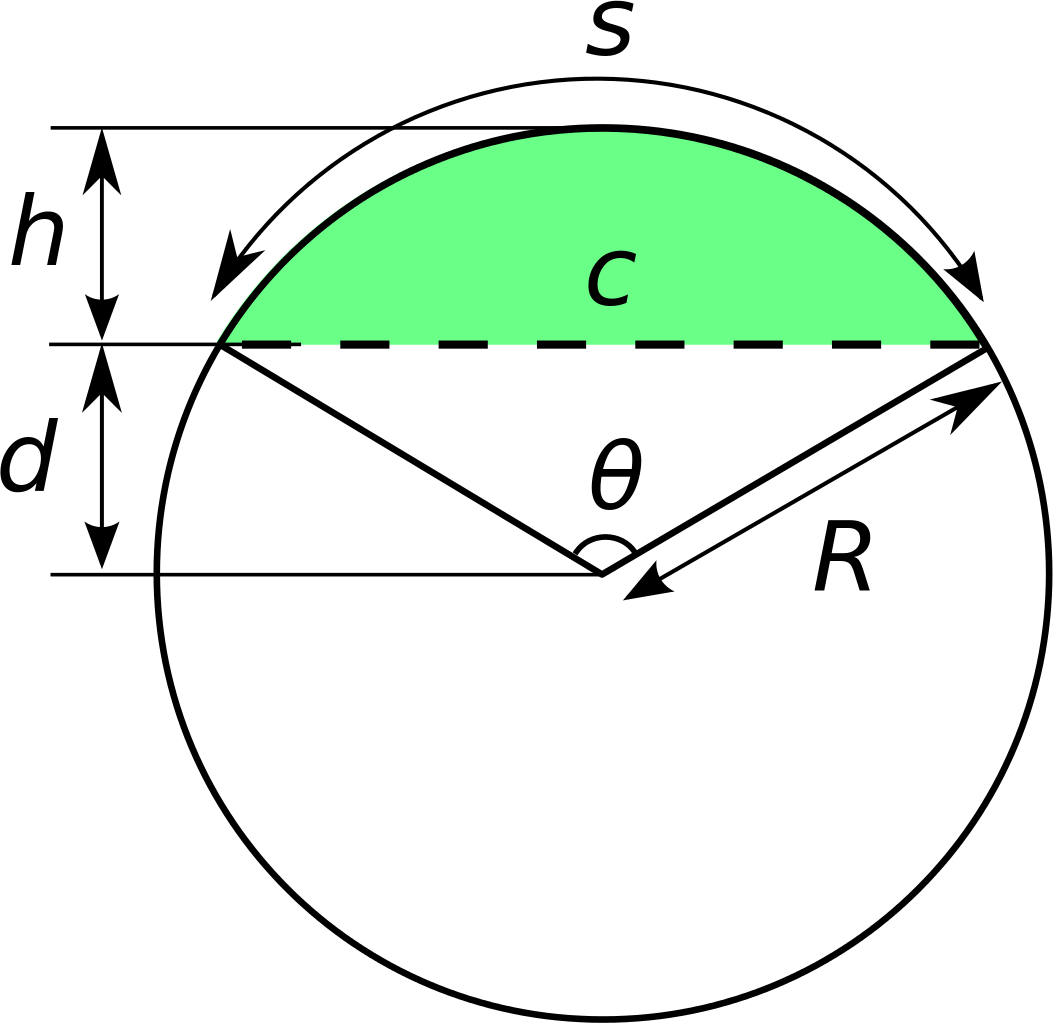
OK. Let’s get back to the lesson and look at diagram (c) now, in which the six arrows are added. As mentioned above, it would not make any difference if we’d divide the glass in 10 or 20 or 1000 or a zillion ‘very thin’ sections: there would be many more arrows, but they would be much smaller ones, and they would cover the same circular segment: its two endpoints would define the same arc, and the same chord on the circle that we can draw when extending that circular segment. Indeed, the six little arrows define a circle, and that’s the key to understanding what happens in the first chapter of Feynman’s QED, where he adds two arrows only, but with a reversal of the direction of the ‘front reflection’ arrow. Here there’s no confusion – Feynman (or Leighton) eloquently describe what they do:

“There is a mathematical trick we can use to get the same answer [i.e. the same final arrow]: Connecting the arrows in order from 1 to 6, we get something like an arc, or part of a circle. The final arrow forms the chord of this arc. If we draw arrows from the center of the ‘circle’ to the tail of arrow 1 and to the head of arrow 6, we get two radii. If the radius arrow from the center to arrow 1 is turned 180° (“subtracted”), then it can be combined with the other radius arrow to give us the same final arrow! That’s what I was doing in the first lecture: these two radii are the two arrows I said represented the ‘front surface’ and ‘back surface’ reflections. They each have the famous length of 0.2.”

That’s what’s shown in part (d) of the illustration above and, in case you’re still wondering what’s going on, the illustration below should help you to make your own drawings now.
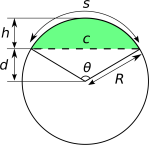
CircularsegmentSo… That explains the phenomenon Feynman wanted to explain, which is a phenomenon that cannot be explained in classical physics. Let me copy the original here:
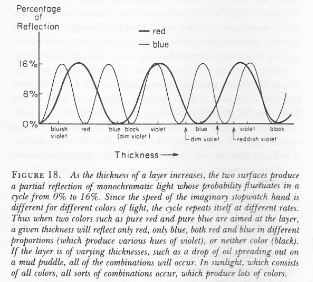
Iridescence

Partial reflection by glass—a phenomenon that cannot be explained in classical physics? Really?

You’re right to raise an objection: partial reflection by glass can, in fact, be explained by the classical theory of light as an electromagnetic wave. The assumption then is that light is effectively being reflected by both the front and back surface and the reflected waves combine or cancel out (depending on the thickness of the glass and the angle of reflection indeed) to match the observed pattern. In fact, that’s how the phenomenon was explained for hundreds of years! The point to note is that the wave theory of light collapsed as technology advanced, and experiments could be made with very weak light hitting photomultipliers. As Feynman writes: “As the light got dimmer and dimmer, the photomultipliers kept making full-sized clicks—there were just fewer of them. Light behaved as particles!”

The point is that a photon behaves like an electron when going through two slits: it interferes with itself! As Feynman notes, we do not have any ‘common-sense’ theory to explain what’s going on here. We only have quantum mechanics, and quantum mechanics is an “uncommon-sensy” theory: a “strange” or even “absurd” theory, that looks “cockeyed” and incorporates “crazy ideas”. But… It works.

Now that we’re here, I might just as well add a few more paragraphs to fully summarize this lovely publication – if only because summarizing stuff like this helps me to come to terms with understanding things better myself!

Calculating amplitudes: the basic actions

So it all boils down to calculating amplitudes: an event is divided into alternative ways of how the event can happen, and the arrows for each way are ‘added’. Now, every way an event can happen can be further subdivided into successive steps. The amplitudes for these steps are then ‘multiplied’. For example, the amplitude for a photon to go from A to C via B is the ‘product’ of the amplitude to go from A to B and the amplitude to go from B to C.

I marked the terms ‘multiplied’ and ‘product’ with apostrophes, as if to say it’s not a ‘real’ product. But it is an actual multiplication: it’s the product of two complex numbers. Feynman does not explicitly compare this product to other products, such as the dot (•) or cross (×) product of two vectors, but he uses the ∗ symbol for multiplication here, which clearly distinguishes VW from VW or V×W indeed or, more simply, from the product of two ordinary numbers. [Ordinary numbers? Well… With ‘ordinary’ numbers, I mean real numbers, of course, but once you get used to complex numbers, you won’t like that term anymore, because complex numbers start feeling just as ‘real’ as other numbers – especially when you get used to the idea of those complex-valued wave functions underneath reality.]

Now, multiplying complex numbers, or ‘arrows’ using QED’s simpler language, consists of adding their angles and multiplying their lengths. That being said, the arrows here all have a length smaller than one (because their square cannot be larger than one, because that square is a probability, i.e. a (real) number between 0 and 1), Feynman defines successive multiplication as successive ‘shrinks and turns’ of the unit arrow. That all makes sense – very much sense.

But what’s the basic action? As Feynman puts the question: “How far can we push this process of splitting events into simpler and simpler subevents? What are the smallest possible bits and pieces? Is there a limit?” He immediately answers his own question. There are three ‘basic actions’:

  1. A photon goes from one point (in spacetime) to another: this amplitude is denoted by P(A to B).
  2. An electron goes from one point to another: E(A to B).
  3. An electron emits and/or absorbs a photon: this is referred to as a ‘junction’ or a ‘coupling’, and the amplitude for this is denoted by the symbol j, i.e. the so-called junction number.

How do we find the amplitudes for these?

The amplitudes for (1) and (2) are given by a so-called propagator functions, which give you the probability amplitude for a particle to travel from one place to another in a given time indeed, or to travel with a certain energy and momentum. Judging from the Wikipedia article on these functions, the subject-matter is horrendously complicated, and the formulas are too, even if Feynman says it’s ‘very simple’ – for a photon, that is. The key point to note is that any path is possible. Moreover, there are also amplitudes for photons to go faster or slower than the speed of light (c)! However, these amplitudes make smaller contributions, and cancel out over longer distances. The same goes for the crooked paths: the amplitudes cancel each other out as well.

What remains are the ‘nearby paths’. In my previous post (check the section on electromagnetic radiation), I noted that, according to classical wave theory, a light wave does not occupy any physical space: we have electric and magnetic field vectors that oscillate in a direction that’s perpendicular to the direction of propagation, but these do not take up any space. In quantum mechanics, the situation is quite different. As Feynman puts it: “When you try to squeeze light too much [by forcing it to go through a small hole, for example, as illustrated below], it refuses to cooperate and begins to spread out.” He explains this in the text below the second drawing: “There are not enough arrows representing the paths to Q to cancel each other out.”
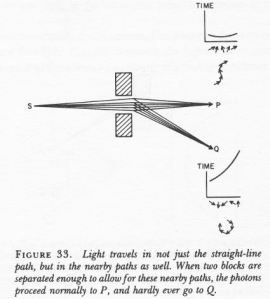
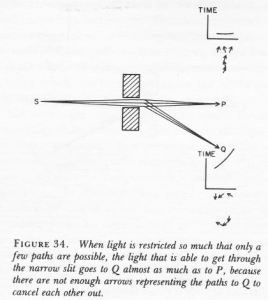
Many arrowsFew arrows

Not enough arrows? We can subdivide space in as many paths as we want, can’t we? Do probability amplitudes take up space? And now that we’re asking the tougher questions, what’s a ‘small’ hole? What’s ‘small’ and what’s ‘large’ in this funny business?

Unfortunately, there’s not much of an attempt in the booklet to try to answer these questions. One can begin to formulate some kind of answer when doing some more thinking about these wave functions. To be precise, we need to start looking at their wavelength. The frequency of a typical photon (and, hence, of the wave function representing that photon) is astronomically high. For visible light, it’s in the range of 430 to 790 teraherz, i.e. 430–790×1012 Hz. We can’t imagine such incredible numbers. Because the frequency is so high, the wavelength is unimaginably small. There’s a very simple and straightforward relation between wavelength (λ) and frequency (ν) indeed: c = λν. In words: the speed of a wave is the wavelength (i.e. the distance (in space) of one cycle) times the frequency (i.e. the number of cycles per second). So visible light has a wavelength in the range of 390 to 700 nanometer, i.e. 390–700 billionths of a meter. A meter is a rather large unit, you’ll say, so let me express it differently: it’s less than one thousandth of a micrometer, and a micrometer itself is one thousandth of a millimeter. So, no, we can’t imagine that distance either.

That being said, that wavelength is there, and it does imply that some kind of scale is involved. A wavelength covers one full cycle of the oscillation: it means that, if we travel one wavelength in space, our ‘arrow’ will point in the same direction again. Both drawings above (Figure 33 and 34) suggest the space between the two blocks is less than one wavelength. It’s a bit hard to make sense of the direction of the arrows but note the following:

  1. The phase difference between (a) the ‘arrow’ associated with the straight route (i.e. the ‘middle’ path) and (b) the ‘arrow’ associated with the ‘northern’ or ‘southern’ route (i.e. the ‘highest’ and ‘lowest’ path) in Figure 33 is like quarter of a full turn, i.e. 90°. [Note that the arrows for the northern and southern route to P point in the same direction, because they are associated with the same timing. The same is true for the two arrows in-between the northern/southern route and the middle path.]
  2. In Figure 34, the phase difference between the longer routes and the straight route is much less, like 10° only.

Now, the calculations involved in these analyses are quite complicated but you can see the explanation makes sense: the gap between the two blocks is much narrower in Figure 34 and, hence, the geometry of the situation does imply that the phase difference between the amplitudes associated with the ‘northern’ and ‘southern’ routes to Q is much smaller than the phase difference between those amplitudes in Figure 33. To be precise,

  1. The phase difference between (a) the ‘arrow’ associated with the ‘northern route’ to Q and (b) the ‘arrow’ associated with the ‘southern’ route to Q (i.e. the ‘highest’ and ‘lowest’ path) in Figure 33 is like three quarters of a full turn, i.e. 270°. Hence, the final arrow is very short indeed, which means that the probability of the photon going to Q is very low indeed. [Note that the arrows for the northern and southern route no longer point in the same direction, because they are associated with very different timings: the ‘southern route’ is shorter and, hence, faster.]
  2. In Figure 34, we have a phase difference between the shortest and longest route that is like 60° only and, hence, the final arrow is very sizable and, hence, the probability of the photon going to Q is, accordingly, quite substantial.

OK… What did I say here about P(A to B)? Nothing much. I basically complained about the way Feynman (or Leighton, more probably) explained the interference or diffraction phenomenon and tried to do a better job before tacking the subject indeed: how do we get that P(A to B)?

A photon can follow any path from A to B, including the craziest ones (as shown below). Any path? Good players give a billiard ball extra spin that may make the ball move in a curved trajectory, and will also affect its its collision with any other ball – but a trajectory like the one below? Why would a photon suddenly take a sharp turn left, or right, or up, or down? What’s the mechanism here? What are the ‘wheels and gears inside’ of the photon that (a) make a photon choose this path in the first place and (b) allow it to whirl, swirl and twirl like that?
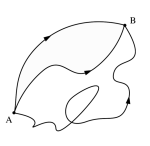
615px-Three_paths_from_A_to_B

We don’t know. In fact, the question may make no sense, because we don’t know what actually happens when a photon travels through space. We know it leaves as a lump of energy, and we know it arrives as a similar lump of energy. When we actually put a detector to check which path is followed – by putting special detectors at the slits in the famous double-slit experiment, for example – the interference pattern disappears. So… Well… We don’t know how to describe what’s going on: a photon is not a billiard ball, and it’s not a classical electromagnetic wave either. It is neither. The only thing that we know is that we get probabilities that match with the results of experiment if we accept this nonsensical assumptions and do all of the crazy arithmetic involved. Let me get back to the lesson.  

Photons can also travel faster or slower than the speed of light (c is some 3×10⁸ meter per second but, in our special time unit, it’s equal to one). Does that violate relativity? It doesn’t, apparently, but for the reasoning behind I must, once again, refer you to more sophisticated writing.

In any case, if the mathematicians and physicists have to take into account both of these assumptions (any path is possible, and speeds higher or lower than c are possible too!), they must be looking at some kind of horrendous integral, don’t they?

They are. When everything is said and done, that propagator function is some monstrous integral indeed, and I can’t explain it to you in a couple of words – if only because I am struggling with it myself. 🙂 So I will just believe Feynman when he says that, when the mathematicians and physicists are finished with that integral, we do get some simple formula which depends on the value of the so-called spacetime interval between two ‘points’ – let’s just call them 1 and 2 – in space and time. You’ve surely heard about it before: it’s denoted by sor I (or whatever) and it’s zero if an object moves at the speed of light, which is what light is supposed to do – but so we’re dealing with a different situation here. 🙂 To be precise, I consists of two parts:

  1. The distance d between the two points (1 and 2), i.e. Δr, which is just the square root of d= Δr= (x2–x2)2+(y2–y1)2+(z2–z1)2. [This formula is just a three-dimensional version of the Pythagorean Theorem.]
  2. The ‘distance’ (or difference) in time, which is usually expressed in those ‘equivalent’ time units that we introduced above already, i.e. the time that light – traveling at the speed of light 🙂 – needs to travel one meter. We will usually see that component of I in a squared version too: Δt= (t2–t1)2, or, if time is expressed in the ‘old’ unit (i.e. seconds), then we write c2Δt2 = c2(t2–t1)2.

Now, the spacetime interval itself is defined as the excess of the squared distance (in space) over the squared time difference:

s= I = Δr– Δt= (x2–x2)2+(y2–y1)2+(z2–z1)– (t2–t1)2

You know we can then define time-like, space-like and light-like intervals, and these, in turn, define the so-called light cone. The spacetime interval can be negative, for example. In that case, Δt2 will be greater than Δr2, so there is no ‘excess’ of distance over time: it means that the time difference is large enough to allow for a cause–effect relation between the two events, and the interval is said to be time-like. In any case, that’s not the topic of this post, and I am sorry I keep digressing.

The point to note is that the formula for the propagator favors light-like intervals: they are associated with large arrows. Space- and time-like intervals, on the other hand, will contribute much smaller arrows. In addition, the arrows for space- and time-like intervals point in opposite directions, so they will cancel each other out. So, when everything is said and done, over longer distances, light does tend to travel in a straight line and at the speed of light. At least, that’s what Feynman tells us, and I tend to believe him. 🙂

But so where’s the formula? Feynman doesn’t give it, probably because it would indeed confuse us. Just google ‘propagator for a photon’ and you’ll see what I mean. He does integrate the above conclusions in that illustration (b) though. What illustration? 

Oh… Sorry. You probably forgot what I am trying to do here, but so we’re looking at that analysis of partial reflection of light by glass. Let me insert it once again so you don’t have to scroll all the way up.

partial reflection

You’ll remember that Feynman divided the glass sheet into five sections and, hence, there are six points from which the photon can be scattered into the detector at A: X1 to X6. So that makes six possible paths: these paths are all straight (so Feynman makes abstraction of all of the crooked paths indeed), and the other assumption is that the photon effectively traveled at the speed of light, whatever path it took (so Feynman also assumes the amplitudes for speeds higher or lower than c cancel each other out). So that explains the difference in time at emission from the light source. The longest path is the path to point X6 and then back up to the detector. If the photon would have taken that path, it would have to be emitted earlier in time – earlier as compared to the other possibilities, which take less time. So it would have to be emitted at T = T6. The direction of the ‘arrow’ is like one o’clock. The shorter paths are associated with shorter times (the difference between the time of arrival and departure is shorter) and so T5 is associated with an arrow in the 12 o’clock direction, T5 is 11 o’clock, and so on, till T5, which points at the 9 o’clock direction.

But… What? These arrows also include the reflection, i.e. the interaction between the photon and some electron in the glass, don’t they? […] Right you are. Sorry. So… Yes. The action above involves four ‘basic actions’:

  1. A photon is emitted by the source at a time T = T1, T2, T3, T4, T5 or T6: we don’t know. Quantum-mechanical uncertainty. 🙂
  2. It goes from the source to one of the points X = X1, X2, X3, X4, X5 or Xin the glass: we don’t know which one, because we don’t have a detector there.
  3. The photon interacts with an electron at that point.
  4. It makes it way back up to the detector at A.

Step 1 does not have any amplitude. It’s just the start of the event. Well… We start with the unit arrow pointing north actually, so its length is one and its direction is 12 o’clock. And so we’ll shrink and turn it, i.e. multiply it with other arrows, in the next steps.

Steps 2 and 4 are straightforward and are associated with arrows of the same length. Their direction depends on the distance traveled and/or the time of emission: it amounts to the same because we assume the speed is constant and exactly the same for the six possibilities (that speed is c = 1 obviously). But what length? Well… Some length according to that formula which Feynman didn’t give us. 🙂

So now we need to analyze the third of those three basic actions: a ‘junction’ or ‘coupling’ between an electron and a photon. At this point, Feynman embarks on a delightful story highlighting the difficulties involved in calculating that amplitude. A photon can travel following crooked paths and at devious speeds, but an electron is even worse: it can take what Feynman refers to as ‘one-hop flights’, ‘two-hop flights’, ‘three-hop flights’,… any ‘n-hop flight’ really. Each stop involves an additional amplitude, which is represented by n2, with n some number that has been determined from experiment. The formula for E(A to B) then becomes a series of terms: P(A to B) + (P(A to C)∗n2∗(P(C to B) + (P(A to D)∗n2∗P(D to E)∗n2∗P(E to C)+…

P(A to B) is the ‘one-hop flight’ here, while C, D and E are intermediate points, and (P(A to C)∗n2∗(P(C to B) and (P(A to D)∗n2∗P(D to E)∗n2∗P(E to C) are the ‘two-hop’ and ‘three-hop’ flight respectively. Note that this calculation has to be made for all possible intermediate points C, D, E and so on. To make matters worse, the theory assumes that electrons can emit and absorb photons along the way, and then there’s a host of other problems, which Feynman tries to explain in the last and final chapter of his little book. […]

Hey! Stop it!

What?

You’re talking about E(A to B) here. You’re supposed to be talking about that junction number j.

Oh… Sorry. You’re right. Well… That junction number j is about –0.1. I know that looks like an ordinary number, but it’s an amplitude, so you should interpret it as an arrow. When you multiply it with another arrow, it amounts to a shrink to one-tenth, and half a turn. Feynman entertains us also on the difficulties of calculating this number but, you’re right, I shouldn’t be trying to copy him here – if only because it’s about time I finish this post. 🙂

So let me conclude it indeed. We can apply the same transformation (i.e. we multiply with j) to each of the six arrows we’ve got so far, and the result is those six arrows next to the time axis in illustration (b). And then we combine them to get that arc, and then we apply that mathematical trick to show we get the same result as in a classical wave-theoretical analysis of partial reflection.

Done. […] Are you happy now?

[…] You shouldn’t be. There are so many questions that have been left unanswered. For starters, Feynman never gives that formula for the length of P(A to B), so we have no clue about the length of these arrows and, hence, about that arc. If physicists know their length, it seems to have been calculated backwards – from those 0.2 arrows used in the classical wave theory of light. Feynman is actually quite honest about that, and simply writes:

“The radius of the arc [i.e. the arc that determines the final arrow] evidently depends on the length of the arrow for each section, which is ultimately determined by the amplitude S that an electron in an atom of glass scatters a photon. This radius can be calculated using the formulas for the three basic actions. […] It must be said, however, that no direct calculation from first principles for a substance as complex as glass has actually been done. In such cases, the radius is determined by experiment. For glass, it has been determined from experiment that the radius is approximately 0.2 (when the light shines directly onto the glass at right angles).”

Well… OK. I think that says enough. So we have a theory – or first principles at last – but we don’t them to calculate. That actually sounds a bit like metaphysics to me. 🙂 In any case… Well… Bye for now!

But… Hey! You said you’d analyze how light goes straight through the glass as well?

Yes. I did. But I don’t feel like doing that right now. I think we’ve got enough stuff to think about right now, don’t we? 🙂