

John Duffield’s comment on my post on a (possible) 3D Lissajous trajectory for the proton zbw charge – as opposed to a helical/toroidial/solenoidal model – makes me think and, therefore, deserves some better answer than my quick reply to it. So, that “better answer” is what I am putting down here. [I am writing from a beach apartment in Castelldefels (Spain), so I will be brief.]
He may disagree, of course, but I see two very different aspects in his question/remark/criticism:
- Why a Lissajous-like trajectory as opposed to, say, a trajectory like that of a trefoil knot or – more generally – a torus knot ?
- What about the spin of the zbw charge itself?
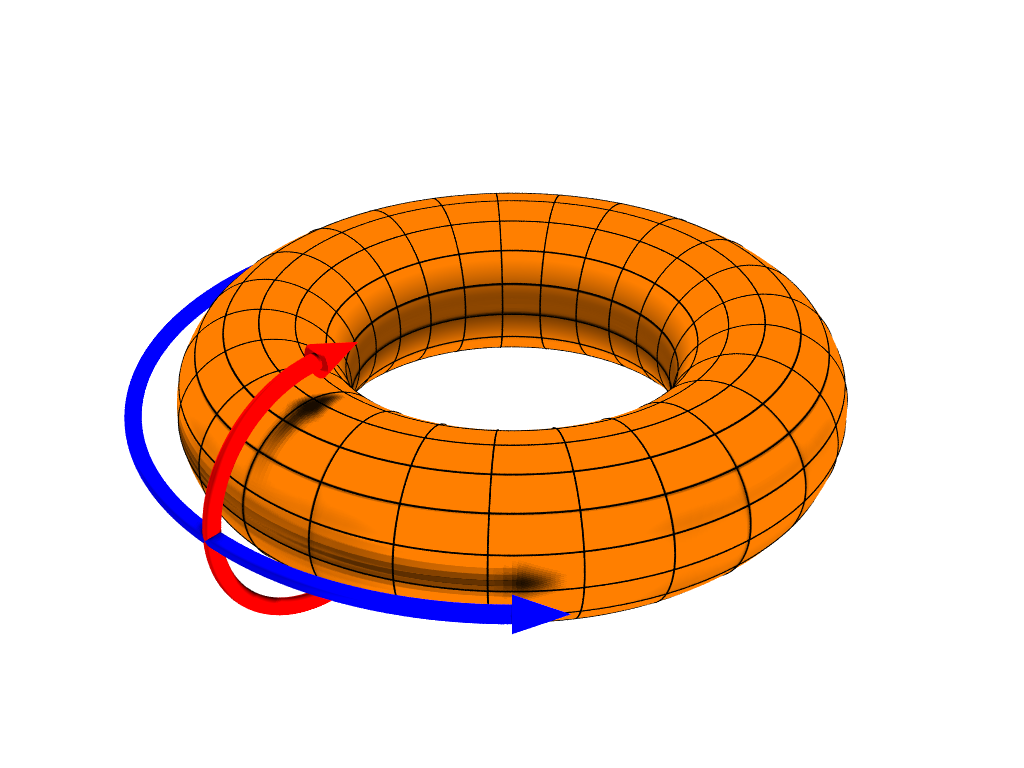
I must answer the first question by explaining what sets me apart from mainstream Zitterbewegung models of elementary particles: any toroidial/helical/solenoidal model comes with two different frequencies and, therefore, two oscillatory modes: toroidal and poloidal (the link is to the Wikipedia article from which I also copy the illustration below).
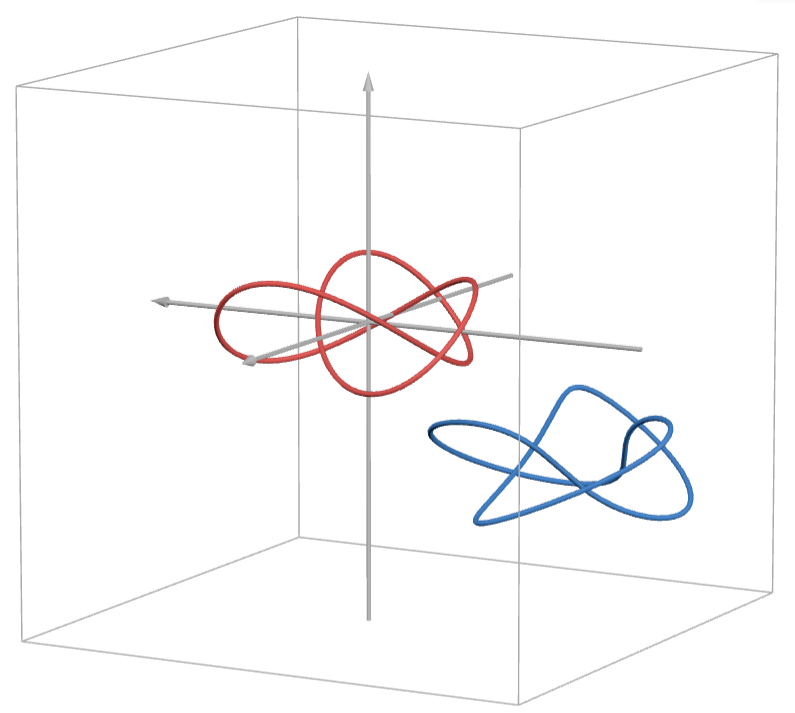
That does not appeal to me. Try to create the trajectories below with Desmos 3D grapher: you will also end up using two or three different frequencies – even if the below trajectories were created using the same base frequency: we have t, 2t, and 3t in the sine and cosine functions here. The Lissajous curve has only one frequency, and it is the one that comes out of the Planck-Einstein relation. So I feel good about that.
The second remark (what about spin of the zbw charge itself?) is more important, and makes me think much more. Would we have a twist in the loop because the zbw charge spins around its own axis? Maybe. However, we must note this:
- The zbw charge is not like some car in a Ferris wheel: there is no force keeping it in the same orientation and it likely rotates around its own axis at the same frequency of the 2D ring current (electron) or 3D Lissajous trajectory (proton). The only thing you need to justify this hypothesis is the idea of inertia to a change in the state of motion of the zbw charge. Indeed, we can think of the zbw charge being symmetrical and acquiring an effective mass as it zips around, and so it will rotate around its own axis as it zips around some center.
- However, should we, perhaps, be even more creative and also consider an extra twist – on top of that rotation of the zbw charge that is due to the inertia from its effective mass (half of the energy of the elementary particle is in its kinetic energy, and the other half in the EM field that causes it to go around in a 2D or 3D ring current)? That would give rise to John Duffield’s Möbius strip concept for modeling elementary particles.
For the time being, I see no need to make such assumption, but he sure got me thinking! The extra spin would probably help to explain the second- or third-order terms in the anomaly of the magnetic moment of an electron (as for now, I only have an approximative theory based on the effective radius (Lorentz or classical electron radius) of the zbw charge).
[…]
I would like to wrap up these musings by acknowledging Dennis P. Whiterell. He is an amateur physicist – just like me – and he sent me a manuscript which, among other interesting things, also talks about the “Ferris wheel analogy”. His arguments are very subtle but fail to convince me: I do not think the “Ferris wheel analogy” is useful in the context of elementary ring currents. Again, that is just for the time being, of course. I will leave it at that, and think some more over the comings weeks or months. 🙂
 Reading Feynman
Jean, IMHO there’s something important to understand about charge. Start with the Williamson / van der Mark toroidal model, wherein an electron is a 511KeV photon trapped in a twisted double-loop path. We create an electron and a positron in gamma-gamma pair production, the electron g factor is circa 2, and the Einstein-de Haas effect says electron spin is a real rotation. So what’s going round and round in the electron? A 511keV photon, which is a sinusoidal electromagnetic field variation with a soliton nature. To emulate this, cut a long thin sinusoidal strip of paper with a flat bottom. Then form it into a Mobius strip. Note that when you do this, you wrap it round twice and slide the ends along to meet each other. What you’re left with is the same width all the way round. If you do the same to a sinusoidal electromagnetic field variation, what you’re left with doesn’t look like a field variation any more, it looks like a standing field. What I’m saying is that charge is the RESULT of the photon being stuck in a twisted double loop with both a toroidal and a poloidal rotation. IMHO the zitterbewegung is a trace of “the join”, as it were.
Hi John – First of all (1), thanks for taking this conversation “on line” and interpreting/commenting/discussing the way Gregory Breit wanted researchers to discuss (that was before he became the head of the Manhattan project, and realized that nuclear research could not be discussed too openly – he was replaced by Oppenheimer in 1942 because of his style, it seems). Second (2), I repeat: I am not quite with you when you talk about strips or widths. The zbw charge is pointlike (not infinitesimally small, but pointlike nevertheless). So we must examine its possible ‘internal’ spin and any ‘twists’ there may be in loops, but my intuition (OK – explanations that start with ‘intuition’ are the worst explanation ever, right?) tells me there’s only one frequency: the one that’s given by the Planck-Einstein relation. Having said that, you did inspire me to look back at “classical electron models” and the “mass-without-mass” issue: https://www.researchgate.net/publication/384292214_Zitterbewegung_particle_models_open_research_topics. Hmm… Why do you keep me from retiring from this physics thing? 🙂