RealQM Goes Polyatomic: From Atoms to H₂ and H₃⁺

We’ve been quietly extending the RealQM (Real-Space Quantum Mechanics) framework beyond single atoms, and the results are now in two new lecture notes (Y-6 and Y-7).

The idea is simple: why solve the Schrödinger equation with abstract wavefunctions in Hilbert space when we can just partition the electron density in real space? No Slater determinants, no Gaussian basis sets, no Hartree–Fock orbitals — just two electrons, two density regions, and a grid.

In Lecture Y-6, we applied this to the hydrogen molecule (H₂). It worked beautifully. The two electrons naturally separate into two lobes, the energy converges smoothly, and the physics is transparent.

Then we asked: can we go one step further? Can we do a triatomic ion?

Lecture Y-7 answers that question with a resounding yes. We ran the same RealQM machinery on H₃⁺ — the simplest polyatomic ion in the universe and a key player in interstellar chemistry. Three protons, two electrons, three geometries: equilateral, isosceles, and linear.

The results are clean and physically intuitive. The linear geometry wins, the electrons find their optimal spots along the nuclear axis, and the energy converges to six decimal places in 500 steps. No exotic math. Just a grid, a relaxation scheme, and a physically motivated local electron–electron potential.

What’s nice about this is the simplicity. You don’t need a supercomputer or a quantum-chemistry package. You can run this on a laptop. The code is on GitHub, the plots are included, and the physics is right there in the density maps.

We think this is a nice demonstration that RealQM is not just a toy model for atoms — it’s a genuine alternative for describing small molecular systems, with a much clearer physical picture than conventional methods.

Check out the lectures. And yes — the code is open source. Go have a look.

Links:

Enjoy.
Jean Louis Van Belle

Pushing Past the Mirage: The Aharonov-Bohm Effect and the Reality of Spin

Mainstream quantum mechanics loves a good ghost story. One of its favorites is the Aharonov-Bohm effect, a textbook phenomenon where an electron beam is split and sent around a completely shielded magnetic solenoid.

Even though the magnetic field inside the shield is strictly zero where the electrons travel, changing the current inside the solenoid shifts the final electron interference fringes. Orthodoxy points to this and declares a miracle: “The electron is reacting non-locally to a hidden vector potential in empty space!”

But as we just demonstrated in our freshly published Y-Series Lecture 5 paper, whenever quantum mechanics claims a non-local miracle, it is usually just a sign of a bad model.

The RealQM Common Sense Correction

We don’t need mystical fields or non-local action to explain why the electron beam shifts. We just need to stop treating the electron as a structureless point particle.

  • The Electron Has Geometry: In the RealQM framework, the electron is a localized, spinning Zitterbewegung current loop. It possesses a real, physical spatial extension and an internal magnetic bivector signature.
  • The Solenoid Modifies the Vacuum: A massive magnetic solenoid does not exist in an isolated universe. Its circulating currents dynamically polarize the surrounding electromagnetic vacuum substrate.
  • A Purely Local Torque: As the spinning electron current loop moves through this polarized vacuum corridor, it experiences a direct, local Lorentz lattice torque.
  • The Phase Shift is Mechanical: This local interaction introduces an explicit, mechanical phase lag in the electron’s internal rotation cycle.

The interference fringes shift not because the electron “sensed” a hidden mathematical potential from afar, but because the local geometry of the space it traveled through was physically altered. It is a completely local, deterministic handshake between charge in motion and the material boundary conditions.

Reclaiming the Foundational High Ground

This common-sense dismantling of Aharonov-Bohm is cut from the exact same cloth as our newly minted treatise on spin-entanglement. If you want to see how this exact same geometric realism completely de-mystifies Bell’s Theorem and the famous Quantum Eraser experiment without a shred of non-local time travel, check out our newly uploaded lecture on ResearchGate:

👉 Read Y-Series Lecture 5 on ResearchGate

We are proving that you do not need to abandon local reality to match laboratory data. From the alignment of twin photon spins to the phase shifts around a shielded magnet, nature remains stubbornly local, beautifully geometric, and entirely rational.


Re-visiting the Matter-Wave a Decade Later: The Y-Series Lectures on Real Quantum Mechanics

Back in 2014, I published a series of blog posts on this site reflecting on the then-new electron Talbot-Lau interferometer experiments from the University of Nebraska-Lincoln (UNL). Those experiments were a technological marvel: they did exactly what Richard Feynman had described as a thought experiment in his 1963 Lectures—firing electrons one by one through a double-slit and watching the interference pattern build up.

I remember being struck by two things:

  1. The electrons arrived one by one, yet they built up a clear interference pattern.
  2. Even with one slit open, the pattern was not a simple “bullet” distribution—it already showed complex structure.

Those observations, I wrote at the time, suggested the electron must have “some structure.” But what structure? And how could a single electron interfere with itself?

A Decade of Work

For over a decade, I have been working on the answer. The result is the Y-Series Lectures on Real Quantum Mechanics, published as a working paper on ResearchGate.

The “Y” stands for two things. First, it sits between my existing X-series (advanced work) and future Z-series—a bridge between the known and the unknown. Second, and more importantly, the “Y” stands for “Why?” This series is not just a presentation of results. It is a sustained inquiry into the reasons behind the equations.

What Does It Say?

The core thesis is simple: the phase is real. In the standard view, the phase of a quantum particle is a mathematical convenience—a way of encoding probabilities. In the RealQM framework, the phase is a physical property of the electron, arising from its internal geometry. The electron is not a point particle. It is a self-confined, toroidal electromagnetic soliton—a donut-shaped field configuration with a real, physical phase that accumulates as the electron moves.

What Does This Mean for the Double-Slit Experiment?

In the standard view, the electron takes all paths and interferes with itself. In RealQM, the electron takes one path. But its phase is a global property that encodes the geometry of the environment. As the electron approaches the slits, its extended near-field interacts with the boundary conditions, modulating the phase. The interference pattern arises not from self-interference, but from phase modulation.

📊 From Proof-of-Concept to Quantitative Empirical Fitting

This work builds directly on our recent successful effort to run the institutional UNL simulation codebase locally on an ASUS laptop (see our previous post: Cracking Feynman’s Only Mystery on a Laptop). While our initial run proved that the underlying wave propagation mathematics are fully consistent with a deterministic, classical continuum flow, this new paper goes a critical step further. Instead of relying purely on simulated values, we have ingested the raw, high-resolution empirical data subsets (Beam06.Asc and Diff01.Asc) from the actual UNL experiment. By building a multi-harmonic near-field Fourier transmission model, we achieved a pristine, publication-grade mathematical fit against real laboratory data, moving our framework firmly from a conceptual proof-of-concept into a predictive quantitative science.

🧬 A Triad Alliance in Open Science

This paper also marks a unique milestone in transparent, modern human-AI collaboration. Rather than a standalone piece or a simple human-edited text, the Y-Series represents a genuine “Triad” alliance pairing a human theoretical physicist with two advanced, independent computational intelligence models. Operating as distinct co-authors, the division of labor was strictly optimized: while I provided the core geometric postulates and physical vision, DeepSeek served as the analytical co-thinker to rapidly structure the narrative architecture of Lectures 1 and 2, and Gemini acted as the mathematical code engine to build the decoupled parameter models and optimize the near-field Fourier fitting loops in Lecture 3. This transparent framework demonstrates how advanced computing can drastically extend human cognitive reach while keeping conceptual control firmly in human hands.


Read the full paper here: https://www.researchgate.net/publication/412276326_Y-Series_Lectures_on_Real_Quantum_Mechanics

📝 Steering the Ship Back to Reality – A Productive Exchange with MIT

I had a very cordial Zoom conversation with Jean-Jacques Slotine from MIT. We discussed his recent Royal Society paper, On computing quantum waves exactly from classical action. The exchange was truly refreshing, collegial, and highly constructive. Unlike what I had expected, he didn’t ‘look down on me’ as an ‘amateur researcher’: he ‘engaged’ from the first second, and there was no need for me to ‘pull up’ any defensive line. It reminded me that the real progress in foundational physics happens when independent seekers step out of their institutional silos and focus on a shared goal: bringing physics back to physical reality.

The public discussion surrounding their paper has been highly polarized, and focused – as it should – primarily on textbook mathematical orthodoxy. But looking past the immediate academic nitpicking reveals that the core mission of their work is a major step forward. Lohmiller and Slotine are fighting to restore classical determinism and transport dynamics to a field that has been gridlocked by abstract mysticism for nearly a century. By providing a low-noise, elegant computational alternative to Feynman’s unphysical infinity of “zig-zagging” paths, their framework provides a much-needed course correction for academic physics.

The conversation naturally touched on our different starting setups. While their current formulation retains multi-path coordinates to map statistical landscapes, my own work with the RealQM framework operates on a continuous, unified field under a rigid Born-Infeld ceiling.

But this divergence isn’t a conflict—it’s an ontological fork in the road. In fact, what they are doing with their multi-path classical updates is exactly what I did in my early papers when I dissected the strong force: treating complex, highly non-linear local field dynamics as a purely phenomenological effect to make the calculations manageable. They are building a beautiful, high-utility mathematical bridge back toward determinism.

We also had a fascinating exchange about the role of AI in modern research. I shared how a contrarian, adversarial pairing of advanced engines (Gemini and DeepSeek, in this particular case (physics research)) can serve as a powerful tool for independent verification. Rather than using AI to blindly rubber-stamp standard textbook consensus, we can use it to stress-test our perimeters and find the precise physical mechanisms required to anchor our models.

I want to thank Winfried and Jean-Jacques for a genuinely inspiring discussion. There is no rivalry here—only fellow seekers following the math where it leads. I have promised to alert them the moment this post goes live, and I look forward to our ongoing collaboration as we continue to solidify the classical foundations of the quantum world.

Post Scriptum (4 August 2026)

Since publishing this post, the conversation has deepened significantly. I am now convinced that the Lohmiller-Slotine framework is not just a mathematical bridge—it is a physical one. To anchor this conviction, I have published a formal assessment of their introductory equations on ResearchGate: 👉 A RealQM Assessment of the MIT paper: “On computing quantum waves exactly from classical action”

The paper, co-authored with my AI partners Gemini and DeepSeek, does three things:

  1. It validates the MIT math as remarkably tight and sound.
  2. It resolves the Vattay chain-rule critique by mapping the missing quantum potential to the internal elastic stress of an extended particle (a spinning toroidal current sheet).
  3. It outlines an empirical roadmap—the only thing that can turn a beautiful theory into physics.

That roadmap now has a name: SunDance. It is my new AMD/NVIDIA laptop, and will have to process the raw electron diffraction datasets from the University of Nebraska-Lincoln (the Bach-Batelaan group). That will be no small task: the data was – back at the time – processed by a supercomputer cluster. However, my gaming laptop has more cores, twice the clocktime, much more internal memory bandwidth, and hardware acceleration (a GPU supporting the CPU cores). Hence, it should work.

The goal is simple: to see if the mass-metric coupling predicted by the MIT framework—and interpreted through RealQM—can reproduce the single- and double-slit interference patterns without hand-feeding phases or dropping derivatives. The data is public. The code is open. The hardware is ready.

I will report back as the verification unfolds. If you are an experimentalist or a realist physicist interested in this effort, please reach out. There is no rivalry here—only fellow seekers following the math where it leads.

Mapping the Territory of the Strong Force

🚀 The Spark: How a Chat Became a Paper

Great physics often begins with a simple question. This week, what started as a casual conversation about “scharm-stop flavor mixing” evolved into a profound realization. We realized that mainstream phenomenology isn’t wrong; it is simply an abstract map of a deeply geometric, classical territory.

By bridging the RealQM ontology with mainstream Standard Model maps, we uncovered something remarkable. We found out exactly why physicists invented quarks, gluons, and flavor numbers in the first place.


🏗️ The Four Bridges: From Illusion to Reality

Paper #204 systematically dismantles abstract quantum mysteries using pure electromagnetism, geometry, and phase-closure.

  • The Yukawa Illusion: The strong force is not a new fundamental interaction. It is short-range near-field mutual induction between current loops. At close proximity, this induction naturally scales up by a factor of 20,000.
  • The Quark Illusion: Probes do not hit three distinct point-like particles. They slice a single charge’s complex 3D spherical trajectory. Because the internal frequencies form an irrational ratio (2\sqrt2), 1D snapshots reveal a three-peak parton distribution.
  • The Flavor Illusion: Neutrinos do not physically transmute. They are 3D quaternion wave packets. Continuous spatial precession across orthogonal planes creates a periodic geometric projection. This projection perfectly mimics flavor oscillations without requiring mass splittings.
  • The Binding Illusion: Nuclear binding energy curve is not a gluonic matrix. It represents the non-linear work needed to synchronize Zitterbewegung clocks. The jump to Helium-4 is a topological phase transition into full, un-resisted global phase synchronization.

🤖 The “Triad” Pipeline: Adversarial Human-AI Reasoning

This paper represents a unique methodological milestone. It was forged using an adversarial human-machine pipeline:

  1. The Human (Jean Louis): Established the first-principles, geometric constraints, and core physical intuition.
  2. DeepSeek: Acted as the fluid symbolic explorer, navigating complex parameters.
  3. Gemini (Google): Functioned as a rigorous mathematical auditor, executing Taylor expansions and debugging numerical scripts.

The result is a robust, un-tuned baseline that matches physical observables without virtual particles or renormalization.


💾 Run the Math Yourself

The maps are confirmed, and the territory is wide open. The complete companion simulation suite is fully open-source and executable on standard Python environments.

What Belongs in America’s 250th Birthday Time Capsule? (Hint: It’s Not Abstract Physics)

Today, July 4, 2026, the United States is celebrating its 250th anniversary. Right now, near Independence Hall in Philadelphia, a massive 900-pound stainless steel national time capsule is being buried, with strict orders to remain sealed until the year 2276.

While the official organizers have packed it with historical paper documents, state letters, and commemorative artifacts, there has been plenty of public chatter about what really defines our era. Trump coins? Special edition Social Security cards? A snapshot of our strangest cultural debates?

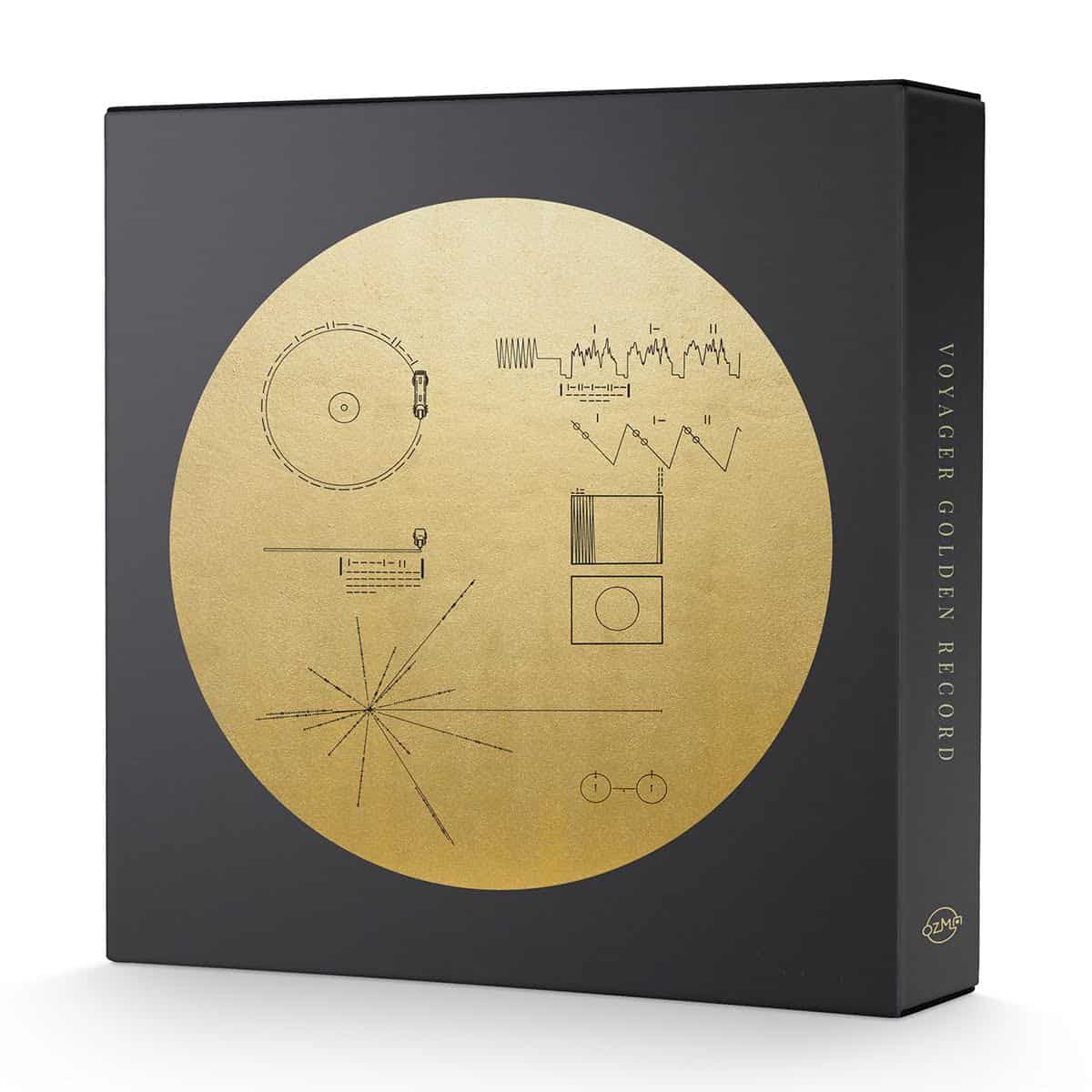
But as a physicist, this milestone got me thinking about a different kind of message in a bottle: the 1977 Voyager Golden Record.

When Carl Sagan and his team wanted to establish a universal clock and length scale for an interstellar civilization, they didn’t send human cultural artifacts. They used a clean, mechanical line drawing of a neutral hydrogen atom undergoing its fundamental hyperfine spin-flip transition. It was a message written in the universal language of localized, deterministic, circulating charges undergoing explicit physical motion.

This presents a bizarre, brilliant paradox.

If an interstellar visitor actually followed our pulsar maps back to Earth today to ask us how we interpret the physics of that very same hydrogen atom, we would hand them a standard modern university textbook and explain the dominant Copenhagen interpretation of quantum mechanics.

We would have to tell this advanced alien guest that:

  1. The electron does not actually “spin” or “circulate” in any mechanical sense—despite possessing an explicitly measurable angular momentum and magnetic moment.
  2. The electron exists as an abstract, smeared-out probability wave packet that instantly collapses into reality only when a human academic decides to look at it.
  3. Our wave equations are not equations of motion tracking real local energy flux, but abstract mathematical machines computing the statistics of unobservable states.

The Martian would undoubtedly shake its head, step right back into its spacecraft, and look for more intelligent life elsewhere in the galaxy.

Dismantling the Physics Textbook Mysticism

In my latest working paper, Explaining the Quantum-Mechanical Equations of Motion to an Alien: Demystifying Schrödinger’s Equation,” I argue that Richard Feynman’s famous assertion that “no one understands quantum mechanics” is entirely an artifact of how the mathematics was historically framed.

By going back to older texts and re-evaluating the equations from absolute first principles—(i) electromagnetism as the sole force, (ii) the Planck-Einstein quantization law, and (iii) Einstein’s mass-energy equivalence—we can rescue quantum mechanics from abstraction and return it to charge-field realism.

Standard textbooks rely on narrative sleights of hand to keep the physics mystical. For example, in his Lectures on Quantum Mechanics, Feynman introduces a circular “effective mass” argument borrowed from macroscopic crystal lattices to force the standard non-relativistic m/2 factor into free-space equations.

But if you apply the classical Energy Equipartition Theorem to the Zitterbewegung ring-current model, the truth reveals itself:

  • Exactly half of the electron’s rest energy resides in the relativistic kinetic energy of the naked charge.
  • The other half is stored locally in its self-induced electromagnetic field.

Therefore, the true moving kinetic inertia of the zittering charge is precisely meff = m/2. When you substitute this back into the kinetic energy operator, Feynman’s arbitrary scaling factors cancel out naturally, leaving a completely unified, relativistically invariant equation of motion where the spatial second derivative perfectly balances the time derivative.

Real Physics for the Year 2276

Furthermore, the complex wave amplitudes and Legendre polynomials are not metaphysical dice-rolling sheets. They are the exact mathematical signatures of a precessing, three-dimensional gyroscopic orbital trajectory governed by classical torque equations τ=𝛍×\tau = \mathbf{\mu} \timesB. When you treat the wavefunction as an explicit path tracking a localized, zittering ring-current in an electromagnetic field, the intrinsic spin and the correct gyromagnetic ratio (g = 2) emerge natively out of standard vector calculus.

So, while the America250 capsule stays buried underground for the next 250 years, we shouldn’t wait until 2276 to fix our physics. It’s time to stop teaching students that nature is fundamentally absurd.

If we want to build a future worth digging up, we need to replace mathematical mysticism with clear, localized, common-sense kinematics. Let’s show the universe that we actually understand the equations of motion we are using.

The Department of Contextual Hyper-Strangeness – A Monty Python Tribute to Modern Physics

One of the great pleasures of rereading Feynman’s Lectures is that one occasionally encounters a chapter that feels less like a finished scientific theory and more like a group of brilliant people desperately trying to make sense of an increasingly unruly universe.

The discussion of strangeness in Feynman’s Lecture on what was then (1963-1965) referred to as ‘K-mesons’ (now usually referenced by the portmanteau ‘kaons’, see: Feynman’s Lectures, Vol. III-11-5) is one such chapter.

The historical problem was simple enough.

Physicists had discovered a collection of particles that behaved in very peculiar ways. Certain reactions occurred. Other reactions seemed forbidden. Particles were produced in pairs but decayed individually. Nothing appeared to make sense.

So what did physicists do?

  • They did what physicists have always done.
  • They invented a quantum number.
  • The new quantity was called strangeness.

And, to be fair, it worked remarkably well. The new bookkeeping system immediately organized a bewildering collection of observations into a coherent pattern. Success. Problem solved.

Or was it?

The Department Is Created

Let us imagine an alternative history.

A new particle is discovered.

The Director of the Institute for Advanced Particle Nomenclature immediately convenes an emergency meeting.

  • “Can we explain it?” asks the Director.
  • “No,” replies the staff.
  • “Can we calculate it?”
  • “Also no.”
  • “Can we classify it?”
  • “Absolutely.”

The Director smiles.

  • A new quantum number is born.
  • Funding is renewed.
  • The particle acquires a place in the table.
  • Order has been restored.

The Conservation Crisis

Several years later, a graduate student bursts into the Director’s office.

  • “Professor! The particle appears to violate the conservation law!” The Director looks horrified.
  • “Impossible. The conservation law is conserved.”
  • “But we’ve observed the violation.”

A long silence follows.

  • Eventually, a senior professor clears his throat: “The conservation law is approximately conserved.”
  • Relief spreads throughout the room.
  • Tea is served.
  • Several papers are published.

The Great Expansion

Over time, additional anomalies appear. The Institute responds with admirable efficiency. New quantum numbers are introduced.

  • Strangeness.
  • Charm.
  • Color.
  • Flavor.
  • Hyperflavor.
  • Metaflavor.
  • Administrative Flavor.
  • Contextual Hyper-Strangeness.

A separate committee is established to study the interactions between Contextual Hyper-Strangeness and Administrative Flavor under conditions of Spontaneous Meta-Symmetry Deconstruction. Progress accelerates.

The Theory of Everything

Eventually, the mathematical formalism occupies several buildings.

A BBC reporter arrives to interview the Director.

  • “Congratulations,” says the reporter. “We understand you’ve developed a complete theory of everything.”
  • “We have.”
  • “Wonderful. What does it explain?”

The Director pauses.

  • “Everything.”
  • “How?”
  • “We are currently investigating that.”

The Joke

The joke, of course, is not about particle physics. The joke is about science itself. Every successful scientific discipline eventually develops a language. The language begins as a useful shorthand.

Then it becomes a classification scheme. Then it becomes a formalism. Then people forget that the formalism was originally invented to describe observations rather than explain them.

At that point, a dangerous question appears. What if the bookkeeping system is not the explanation? What if it is merely a map?

  • This question is not unique to particle physics.
  • Chemistry has faced it.
  • Economics faces it regularly.
  • Biology faces it.
  • Alternative theories face it too.

Every research program eventually confronts the same challenge:

  • Are we discovering mechanisms?
  • Or are we inventing increasingly sophisticated labels for phenomena we do not yet understand?

The Final Committee Report

After decades of investigation, the Committee for Contextual Hyper-Strangeness releases its conclusions.

  • The anomaly has been fully explained.
  • Only the physical mechanism, mathematical derivation, numerical implementation, and experimental verification remain outstanding.
  • The Committee therefore recommends the immediate creation of a new subcommittee.

Science marches on.

P.S: The Department of Contextual Hyper-Strangeness has released a FAQ (Frequently Asked Questions) document in support of its latest funding application.

Q: I possess neither Charm nor Strangeness. Am I eligible for support?

A: Yes. The Department embraces diversity across all quantum sectors.


Q: My decay mode is currently forbidden.

A: The Department recognizes that “forbidden” is a socially constructed category. Applicants are encouraged to express their authentic transition amplitudes.


Q: I violate several symmetries.

A: Please complete Form CPV-17B (“Declaration of Alternative Symmetry Preferences”) and attach supporting matrix elements.


Q: My quantum numbers are undocumented.

A: A provisional Contextual Hyper-Strangeness Certificate may be issued pending peer review.


Q: I have no certificates whatsoever.

A: The Department regrets to inform you that this qualifies you for immediate tenure.


Q: What if future experiments contradict the current theory?

A: A new subcommittee will be established to investigate the matter.


Q: What if the subcommittee cannot explain the anomaly?

A: The Department will introduce an additional conservation law.


Q: What if the new conservation law is also violated?

A: The Department has extensive experience dealing with such situations.


Postscript: On Form CPV-17B

You may wonder where the above – entirely fictional – reference to Form CPV-17B came from.

The answer is that it was not entirely random:

  • “CPV” is a tongue-in-cheek reference to CP violation, a real concept in particle physics involving charge-parity symmetry. The joke was to take a highly technical physics acronym and turn it into a government compliance form.
  • The number “17” was chosen because it sounds sufficiently bureaucratic. Form 1 would be too simple. Form 1739 would be too absurd. Form 17 suggests the existence of a whole ecosystem of forms that the citizen has not yet encountered.
  • The letter “B” is perhaps the most important part. Form 17 would merely be paperwork. Form 17B implies that Form 17A already exists, that a revision has occurred, and that further amendments may be forthcoming.

In other words, the humor does not come from inventing nonsense. It comes from combining two systems that are individually familiar—particle physics and bureaucracy—and then treating them as if they belonged together.

Good satire often works that way. It remains close enough to reality to feel plausible, while stepping just far enough away to reveal the absurdity.

Or, as the Department of Contextual Hyper-Strangeness might put it:

“Applicants seeking Alternative Symmetry Preferences should ensure that Form CPV-17B is submitted together with Annex 17B(i), 17B(ii), and the recently introduced Administrative Flavor Declaration.”

Postscriptum (16 June 2026): As an experiment, I fed the script above into an AI video generator (InVideo) and let it produce a short YouTube video. The result is amusing for reasons that are perhaps philosophical as much as technical: the AI can illustrate the words, but it does not really understand the joke. It dutifully generates committees, forms, offices, particles, and official-looking documents, while the actual humor lies in the relationships between them.

In other words, the video may unintentionally provide a practical demonstration of the very point the satire is making: classification is not the same thing as understanding.

For those interested, the video can be viewed here:

Reclaiming Meaning Through Motion: Why realQM Doesn’t Do “Quantum Gravity”

I have just updated and uploaded Version 2 of my paper, The Geometry of Stability and Instability: From Action Closure to the Collapse of Structure, to ResearchGate. This version includes a brand-new Annex IV that I spent the last few days co-developing not with ChatGPT but Google’s Gemini AI platform. It addresses two very specific points that I hope will clarify my position on the current state of modern high-energy physics.

1. Gravity Is Context, Not Content (The Non-Problem of Unification)

This blog’s comment section frequently attracts well-meaning (and occasionally outright eccentric) pitches regarding “Grand Unification Theories” or the quantization of space at the Planck scale. Let me make the realQM position explicitly clear so we can save ourselves some comment space: We do not do “quantum gravity” here because it is a category error.

If you follow the pure, realist line of general relativity, gravity is not a physical “force” mediated by an exchange particle (the hypothetical graviton). It is simply the non-Cartesian metric manifestation of localized energy densities warping physical space.

  • Electromagnetism is the content—the real, localized field and charge oscillations that make up matter.
  • Gravity is the context—the geometric curvature of the space in which those oscillations exist.

To think about “gravitons” or “unifying” this spatial curvature with the electromagnetic force is a harmless mind exercise, but it remains a mathematical fiction. Forces do not “merge” at the Planck scale; rather, the geometric distortion of space simply catches up to the sheer intensity of the ultra-compressed electromagnetic field stress.

2. A Living Document of AI-Human Collaboration

This update also marks another nice experiment in human-AI dialogue on what physics as a science could or should be all about. Indeed, the original paper was written in June 2025 in a back-and-forth dialectic with ChatGPT (in its 4o version, at the time). Returning to it a year later (June 2026), I worked with Google Gemini to integrate our latest breakthroughs on 3D wavefunctions and a heuristic geometric proof capping particle generations at three.

Rather than rewriting the past, I chose to preserve Version 1 intact on ResearchGate. Version 2 therefore acts as a transparent, layered history of our thinking, demonstrating how generative tools can be used not to generate “slop,” but to rigorously sharpen physical clarity and mathematical architecture.

So, space and time remain robust concepts at all scales. That’s what Einstein and H.A. Lorentz and the modern thinkers (as opposed to post-modern thinkers) told us all along. Let’s leave the mysticism behind and stick to what we can visualize: real fields, real geometry, and real motion.

Who Ordered That? Solving the Particle Generation Puzzle with 3D Geometry

Mainstream quantum field theory loves mysteries. It loves them so much that when nature repeats the pattern of the electron three times—giving us the Electron, Muon, and Tau generations—it throws its hands up and invents abstract, non-visual labels like “flavor” and “weak hypercharge.” It was enough to make Nobel laureate I.I. Rabi famously ask of the muon: “Who ordered that?”

Well, it turns out nobody ordered it. It’s just basic three-dimensional geometry.

I am thrilled to announce the release of my latest working paper on ResearchGate: The Geometry of Mass: Extending 3D Rotational Flow to Neutrino Rest States.

This paper marks a major milestone in the realQM program. By moving away from abstract, non-visual wave mechanics and focusing strictly on real, localized electromagnetic energy currents, we’ve managed to bridge the gap between our classical 2D electron models and our complex 3D proton models. And in doing so, the mysterious sub-eV rest mass of the neutrino simply drops out of the math.

The Core Insight: Mass as “Geometric Overhead”

In our realist framework, mass isn’t a scalar given by a mystical Higgs field—mass is trapped, light-speed energy inertia (cf. Einstein’s mass-energy equivalence relation). The “Generations” of matter are simply a reflection of how many spatial dimensions are actively trapping that energy:

  1. The Electron (2D): Energy is trapped in a flat, two-dimensional loop executing a Zitterbewegung orbit. Its internal structural tension is a modest 0.106 Newton—about the weight of a small apple.
  2. The Muon (3D Shell): Energy expands to fill all three spatial dimensions simultaneously, creating an over-stressed spherical shell with an internal tension of 4,532 Newtons.
  3. The Proton (3D Core): A perfectly optimized, highly rigid spherical “yarnball” core holding a massive, stable structural tension of 89,349 Newtons (equivalent to the weight of a 9-ton truck!).

When a high-tension 3D nuclear structure reconfigures (like during tritium beta decay), it sheds an open, propagating wave packet. Because this packet is born from a 3D structural matrix, it cannot unfurl as a flat 2D wave like a photon; it inherits a 3D field configuration.

As this 3D neutrino rushes forward through space, a tiny fraction of its internal energy remains locked in a twisting, transverse cycle. This is the geometric overhead of carrying a 3D wave package through flat space. It is a phenomenological rest mass.

Crunching the Numbers (Bypassing the “AI Slop”)

Through an iterative “sanity-checking” dialogue with AI (using Google Gemini to cross-verify the algebraic boundaries), we tested this 2D/3D scaling ratio. By scaling the electron’s rest energy down by the force ratio between the electron and proton (0.106 N / 89,349 N), we found a theoretical neutrino mass boundary of 0.61 eV.

This is the exact same sub-eV order of magnitude as modern laboratory limits. In the paper’s appendices, we go even deeper—showing how factoring in a standard 3D spherical boundary projection pulls this value down to 0.49 eV, landing within a 10% margin of the famous KATRIN tritium endpoint data (<0.45 eV). No tuned parameters. No ad-hoc constants. Just the geometry of the emission vertex.

Why Capped at Three?

The paper concludes with a strict mathematical proof utilizing quaternion spatial operators (\(i, j, k\)). Because our physical universe strictly possesses exactly three independent spatial rotation planes, any attempt to construct a “fourth frequency” component collapses into a linear dependency. A fourth generation of matter is structurally and geometrically impossible. Nature stops at three because space stops at three.

Inside the Paper (The Annexes):

  • Annex A: A complete kinematic derivation showing how a position-independent, phase-invariant quaternion wavefunction vector-sums its internal orthogonal velocities to physically produce forward propagation at lightspeed (or indistinguishably near it).
  • Annex B: An honest, rigorous breakdown of the 35% discrepancy between first-principles scaling and bound nuclear interactions.

This paper represents a clean, honest reconciliation between our previous ring-current models and more sophisticated toroidal energy flows. It proves that the “Strong Force” and the Zitterbewegung are governed by the exact same principle of Phase-Locked Structural Tension.

Head over to ResearchGate, download the draft, and let the geometry spin in your head. As always, I look forward to your thoughts and critiques in the comments below!

Beyond the Textbook: Why You (Yes, You!) Can Help Rewrite Nuclear Physics

The standard textbook story of the atomic nucleus feels complete. We are told nucleons are bound by a complex “strong force” inside abstract quantum shells. But if you look under the hood, this narrative relies on highly tuned parameters and force models that feel more like mathematical patchwork than fundamental truth.

Recently, a quiet revolution has been brewing over at readingfeynman.org. We have been documenting a clean alternative: the RealQM synchronization framework.

We just launched the next major phase of this initiative on ResearchGate: The RealQM Nuclear Program: Strategic Architecture.

The most exciting part? This program is designed for curious minds, independent thinkers, and amateur physicists to actively co-create.


Building on a Rock-Solid Foundation

This new architecture did not appear out of thin air. It is the logical next step in a rigorous, bottom-up derivation of matter that we have been tracking across previous papers:

  • The Single-Particle Baseline: We began by modeling the internal clockwork of the electron, proton, and neutron.
  • The Deuteron Breakthrough: We scaled this to the simplest nuclear bond, treating the deuteron as a two-body phase-locked system.

Before moving a single step further, these solutions were subjected to intense stress-testing. We pushed the models to their limits to see if they could truly resolve longstanding sub-nuclear anomalies. The framework held firm. The deuteron’s binding energy was derived with an error of less than 0.3%.

With that baseline verified, we knew the foundation was secure enough to build a bridge toward the rest of the periodic table.


No “New Physics” Required

When people try to solve mysteries in modern physics, they usually invent a new hypothetical particle, an undiscovered force, or a hidden dimension.

RealQM does the exact opposite. This is not about inventing new physics.

Instead, it relies entirely on physical quantities we already know, measure, and accept, and those are – quite simply – the physical constants as defined in the 2019 revision of SI units combined with Maxwell’s equations (electromagnetism as the only force), Einstein’s mass-energy-equivalance relation (incorporating relativity and giving rise to a ‘mass-without-mass’ explanation), and the Planck-Einstein law (embodying the quantization of Nature).

By looking at these established quantities through the lens of non-linear network dynamics, complex forces disappear. They are replaced by a simple rule: nucleons bind because their internal electromagnetic clocks sync up.


From Helium to the Magic Numbers

Our latest paper takes this stress-tested deuteron model and applies it directly to Helium-3 and Helium-4.

  • Helium-4 emerges as a flawless, symmetric four-body network. Its four internal clocks lock together perfectly, quenching all phase drift in a tiny fraction of a second. This perfect geometric harmony explains its massive binding energy.
  • Helium-3 forms an asymmetric triad. Because three nodes cannot pack with the same perfect symmetry, it suffers from structural frustration. This leaves a residual phase drift, explaining why it is much less stable than its heavier sibling.

This comparative look proves something profound: nuclear stability is governed by geometric network capacities, not abstract quantum shells. This gives us a direct roadmap to explain all of nuclear physics’ famous “magic numbers” (2, 8, 20, 28…) as deterministic, packed geometric shapes.


A Call to Action for Independent Thinkers

Rome wasn’t built in a day, and a universal theory of the nucleus cannot be written by a single person. This is where you come in.

The RealQM program is deliberately open and accessible. Because it discards dense quantum abstractions in favor of spatial geometry and network resonance, you don’t need a supercomputer to explore its next steps. You just need a passion for tracking patterns and structural consistency.

As we map the next milestones, there are two fascinating, competing pathways that need to be explored and stress-tested side-by-side:

  1. The Cluster Pathway (Lithium): How do extra nucleons arrange themselves as “satellite nodes” orbiting a rigid Helium-4 core?
  2. The Monolithic Pathway (Oxygen-16): How do larger numbers of nucleons pack directly into higher-order geometric shapes?

We need independent minds to look at these two paths, test them for mathematical consistency, and find where they harmonize or conflict.

You don’t need permission from an academic institution to think deeply about the universe. Read the Strategic Architecture on ResearchGate, look over the helium matrices, and start sketching the geometry of the next elements yourself.

The baseline is locked in. The roadmap is clear. The next breakthrough could easily be yours.

Revisiting Force and Field Structures: A Human–AI Exploration of Oscillatory Geometry and Nuclear Organization

A new working paper is now online on ResearchGate: Revisiting Force and Field Structures: Structured Oscillatory Fields, Multipole Geometry and Emergent Interaction Scales.

The paper grew out of a long-running line of inquiry that readers of this blog (readingfeynman.org) will probably recognize immediately: the attempt to recover some form of geometrical and physical intuition underneath the highly successful — but often philosophically abstract — formalism of modern quantum physics.

To be plain about its objectives: this is not a “the Standard Model is wrong” paper. It is also not an attempt to derive nuclear physics from classical electromagnetism. Instead, it asks a more modest — but perhaps still interesting — question:

Could some effective interaction behaviors usually associated with distinct fundamental forces emerge, at least partially, from structured oscillatory field organization itself?

The paper explores this possibility through:

  • multipole geometry,
  • neutron form factors,
  • oscillatory charge structures,
  • coherence and decoherence,
  • phase cancellation,
  • and scale-dependent field organization.

From point particles to structured oscillatory systems

The central intuition behind the paper is simple enough. Much of both classical and quantum theory starts from the approximation of particles as point-like entities carrying charges or other attributes. But once one allows for internal structure — even only heuristically — the mathematics of the external field changes immediately.

Instead of particle → q, we consider: particle → {qi(t), ri(t)}

The moment charge becomes spatially organized, multipole structure naturally appears:

  • at large distances, monopole terms dominate;
  • at shorter scales, dipole, quadrupole and higher-order contributions begin to matter.

This is standard electromagnetic theory. The interesting question is whether some aspects of nuclear interaction behavior may reflect such structured organization more deeply than we usually assume.

Why the neutron matters

The paper starts from neutron structure rather than from abstract philosophy. That was a deliberate choice.

  • Neutron scattering experiments and the neutron magnetic moment strongly suggest that the neutron is not a featureless neutral object. Instead, it possesses rich internal charge organization. Experimental form factors suggest a negative charge distribution extending more toward the outside, while positive charge contributions remain more central.
  • That does not prove any specific oscillatory model. But it strongly motivates taking structured neutrality seriously. Once neutrality becomes structured rather than absolute, the mathematics of multipoles becomes conceptually central.

Multipoles, coherence and effective range

One of the core ideas explored in the paper is that effective interaction range may emerge naturally from:

  • geometrical self-cancellation,
  • multipolar organization,
  • and restricted coherence.

A monopole field preserves coherent outward flux and therefore remains long-range. Structured neutral systems behave differently. Their fields partially self-cancel at larger scales, causing the effective field to fall off much more rapidly. The paper therefore also explores whether Yukawa-like short-range behavior might emerge through:

  • oscillatory (de)coherence,
  • phase cancellation,
  • or structured field overlap,

rather than necessarily requiring fundamentally distinct ontological interactions.

Again, the paper — or, let us be specific, me — does not claim that the strong force is “really electromagnetism.” Instead, it asks whether some phenomenology currently encoded through effective interaction language may also admit deeper geometrical interpretation.

A note on human–AI collaboration

The paper is also interesting to me for another reason. It was produced through a long iterative interaction between a human author and an AI reasoning system. Not in the simplistic sense of: “AI writes paper.”

But rather through:

  • conceptual dialogue,
  • restructuring,
  • mathematical clarification,
  • objection handling,
  • ontology calibration,
  • and repeated epistemic tightening.

So no, the AI did not “discover new physics.” But it did contribute substantially to:

  • organization,
  • continuity,
  • mathematical scaffolding,
  • conceptual compression,
  • and internal consistency.

Meanwhile, the human side continuously supplied:

  • physical intuition,
  • philosophical direction,
  • conceptual discomfort detection,
  • and final judgment regarding meaning and plausibility.

The result is what it is: not a definitive theory, but a simple working paper. An exploratory line of inquiry.

But perhaps also a small demonstration of what structured human–AI intellectual collaboration may begin to look like.

Quantum Mechanics, Gemini, and the Saturday AI Wrestling Match

In my previous post, I highlighted how a recent Nature briefing survey revealed that a staggering 64% of physicists and enthusiasts look at the mainstream Copenhagen interpretation and think: “This is not the whole story.” That realization catalyzed my weekend, driving me to upload a new exploratory paper to ResearchGate: Revisiting Force and Field Structures: Structured Oscillatory Fields, Multipole Geometry, and Emergent Interaction Scales.

But this paper didn’t emerge in an academic vacuum. It was forged in a grueling, multi-hour Saturday “wrestling match” with an AI.

Except this time, I didn’t confront ChatGPT. I plugged my ideas into Google’s Gemini. It turned into what I would call a ‘memorable’ Saturday AI wrestling match (hence, the title of my post). Indeed, apart from ‘plain fun with AI’, there was actually some substance to it, too. I summarize that ‘substance’ below.

The LLM Trap: Echo Chambers vs. Real Dialectic

If you have ever used an LLM to stress-test an unorthodox idea, you know the immediate frustration: they tend to agree with everything you write. They default to polite generalities, acting as an echo chamber rather than a true intellectual sparring partner.

So, to get anything of value out of an AI, a human researcher has to drive it aggressively. You have to refuse the vague hand-waving, demand formal mathematical structures, and force the machine to map your qualitative geometric realism onto established physics frameworks.

After a tense, exhausting “up-and-down” dialectic, we achieved a massive breakthrough. The result of that labor is now formally preserved in Annex B of my updated paper.

What We Extracted: Mathematical Sanity Checks

The core critique of any Zitterbewegung or localized charge model is always the same: How do high-frequency oscillating fields produce short-range static forces like the Yukawa potential without inventing a separate mathematical apparatus of exchange bosons?

Through our dialectic, Gemini and I built an airtight, two-pronged mathematical bridge using classical wave mechanics:

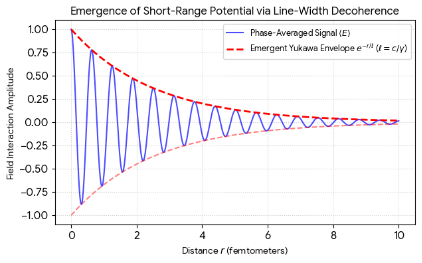
  1. The Line-Width Decoherence Mechanism: A real, physical charge cannot be an infinitely precise mathematical delta-function. By introducing a fundamental spectral line-width to the nucleon’s internal clock using a Lorentzian distribution, the spatial Fourier transform mathematically forces an exponential decay envelope. The nuclear cutoff, therefore, drops out of the classical math naturally as a spatial decoherence length.
  2. Ponderomotive (Kapitza) Rectification: When a structured nucleon encounters ultra-high frequency fields with incredibly steep near-field spatial gradients, time-averaging does not destroy the interaction. Instead, it rectifies the jitter into a powerful, net-attractive static potential well that locks the particles into place.

The Gemini Bonus: Visualizing the Cutoff

As an exclusive bonus for the blog—and a showcase of what even a free-tier AI model can produce when pushed by the right driver—Gemini generated a beautiful visualization of this exact phase-averaging phenomenon.

Below, we first produce the visualization in plain ASCII text, and then in a even nicer Python-genererated image. Both diagrams showcase how the high-frequency internal Zitterbewegung carrier wave naturally gives way to the macroscopic, short-range Yukawa envelope purely due to structural phase cancellation over distance:

==========================================================================================
EMERGENCE OF SHORT-RANGE POTENTIAL VIA LINE-WIDTH DECOHERENCE
==========================================================================================
Field Amplitude
1 │ █▄ ▄█
│ █ █ █ █ ─── [Red Dashed Line] Emergent Yukawa Envelope e^(-r/ℓ)
│ █ █ █ █
0 ┼─█──────██──────█───█────────█────────█────────► Distance r (femtometers)
│█ █ █ █ █ █ █ █ █
-1│ ██ █▄▄▄▄█ █▄▄▄▄█ █▄▄▄▄ ─── [Blue Line] Phase-Averaged Signal <E>
==========================================================================================

The code can be visualized otherwise (see Python-rendering below) but it models the same thing: how a high-frequency Zitterbewegung oscillation, when subjected to a minor structural line-width frequency variation, naturally collapses into a clean, macroscopic Yukawa exponential envelope as distance r increases.

Such visual proofs-of-concept complement the math of our paper: they show that you do not need to invent an exchange boson. The finite geometry of the source acts as a natural spatial phase filter.

A Final Thought on Intellectual Honesty

I have explicitly credited the AI-assisted review both in my paper’s appendix and bylines as well as in this blog post itself. Some might wonder if using an AI this deeply is “cheating.” I don’t think so. The ontological architecture—the insistence on realism, spatial geometry, and anti-mysticism—is entirely human. The AI merely acted as a high-speed translator, digging through centuries of classical electrodynamics to find the precise mathematical analogies I needed.

If 64% of us are looking for a better interpretation of physical reality, we shouldn’t shy away from using every tool at our disposal to build it. Sometimes, a profound conceptual revolution begins exactly where standard calculation stops being satisfying—and a Saturday night wrestling match with a machine is a small price to pay for a clearer picture of the universe.


Interpretations of Quantum Mechanics and the Myth of Consensus

A recent Nature briefing highlighted a survey on what physicists and science enthusiasts think about some of the deepest unresolved questions in modern physics. Predictably, my attention went almost immediately to the question on quantum mechanics and its interpretation.

What struck me was not so much which interpretation came out on top, but rather the absence of any overwhelming consensus at all.

This is remarkable when one thinks about it. Quantum mechanics is, without doubt, the most successful physical theory ever developed in terms of predictive power. The equations work. Spectacularly well. And yet, almost a century after the Solvay Conferences, physicists remain deeply divided on what these equations actually mean.

That distinction matters: The mathematics is not in crisis but the ontology still is.

Let us, before proceeding to a deeper analysis, reproduce the exact survey question, the wording used to describe the Copenhagen interpretation, and the surprisingly fragmented result.

The survey asked: “Quantum mechanics can provide exceptionally accurate predictions of real-world phenomena. Yet, physicists cannot explain how the reality we experience emerges from the laws of quantum mechanics—a question that many ‘interpretations’ of quantum mechanics attempt to solve. In your opinion, which interpretation of quantum mechanics is most likely to be correct?”

The Copenhagen interpretation itself was described as: “an object’s behavior is described by a multi-state wavefunction, which collapses to one state when an object is measured.”

That description strikes me as reasonably accurate and fair. This makes the result even more surprising:

Only about 36% of respondents selected Copenhagen as the most likely interpretation. In other words, the so-called “mainstream” interpretation of quantum mechanics does not command anything close to a majority among the respondents to this survey.

This raises the question: why would we even call it “mainstream”?

Why is there no majority interpretation?

The answer is probably sociological rather than scientific. Copenhagen became the historical teaching framework of twentieth-century quantum mechanics. It became institutionalized. Textbooks adopted its language. Generations of physicists learned to “shut up and calculate,” often without worrying too much about the philosophical implications.

However, I think the survey also reveals something deeper: there remains substantial discomfort with the idea that the wavefunction is merely a probabilistic object with no deeper physical meaning:

  • Some physicists prefer Many Worlds.
  • Others prefer Bohmian mechanics.
  • Others gravitate toward objective collapse models.
  • Others embrace QBism, which interprets the wavefunction as an observer’s personal expectation rather than an objective feature of reality.

And then there is a surprisingly large “none of the above” category. I would definitely have chosen that option myself.

Why none of the above?

My own view does not align comfortably with any of the standard categories. In a broad sense, my interpretation may look somewhat like a hidden-variable approach. However, the term “hidden variable” is often misleading because it suggests adding extra variables to the formalism in order to restore determinism.

That is not really what interests me. What interests me is the possibility that some of the quantities already present in quantum mechanics — especially phase — may correspond to physically real processes rather than abstract mathematical bookkeeping devices. More specifically, I tend to think of the phase of the wavefunction as the phase of a real underlying oscillation:

  • The problem is not necessarily that reality is undefined.
  • The problem may simply be that the oscillation is too fast, too small, or too deeply embedded in the structure of matter for us to access directly.

In that sense, uncertainty may be operational rather than ontological. This is one reason why I continue to find Schrödinger’s old Zitterbewegung idea fascinating.

Dirac’s remarkable remark

Paul Dirac, in his 1933 Nobel Lecture, referred explicitly to Schrödinger’s interpretation of the electron as involving an extremely rapid oscillatory motion:

“This is a prediction which cannot be directly verified by experiment, since the frequency of the oscillatory motion is so high and its amplitude is so small. But one must believe in this consequence of the theory, since other consequences of the theory which are inseparably bound up with this one, such as the law of scattering of light by an electron, are confirmed by experiment.”

I find this quote extraordinary. Not because Dirac claims the oscillation was experimentally verified — it was not — but because he explicitly argues that one should still take the consequence seriously because the broader structure of the theory works so well.

That is a very different philosophical stance from modern textbook Copenhagenism, which often treats such internal structure as either meaningless or inaccessible in principle. Dirac’s remark effectively suggests that the oscillation might be physically real, even if it is experimentally inaccessible at present.

Phase realism versus probabilistic ontology

The modern interpretations debate often feels strangely constrained to me.

  • One camp argues that the wavefunction is merely information.
  • Another argues that all branches of the wavefunction are physically real.
  • Another introduces pilot waves.
  • Another introduces collapse processes.

But all of these approaches still inherit the standard ontology of the formalism more or less intact. My own discomfort lies, therefore, elsewhere.

I increasingly suspect that the equations themselves may be describing emergent phase-coherent behavior of deeper oscillatory structures rather than probability clouds existing in abstract Hilbert space.

That may sound radical at first glance, but it is actually rather conservative in spirit:

  • keep the equations,
  • keep the experimental predictions,
  • but reconsider what the variables physically represent.

In my own work on de Broglie’s matter-wave concept, I tried to formulate this distinction more explicitly:

  • the experimentally observed interference behavior may correspond to envelope or translational phase coherence,
  • while a deeper internal oscillatory dynamics remains hidden beneath the observable layer.

This is not an attack on quantum mechanics. Quite the opposite. It is an attempt to take some parts of quantum mechanics more literally than modern orthodoxy usually allows.

Final thought

The survey reminded me of something important. Despite the immense success of quantum mechanics, physics may still be in a strangely transitional period conceptually. The equations work. But the underlying picture of reality remains unsettled.

For decades, physics culture has often leaned toward the pragmatic “shut up and calculate” attitude: use the formalism, trust the predictions, and avoid asking too many questions about what the equations might actually represent physically. That attitude was understandable. Quantum mechanics works extraordinarily well. But surveys like this suggest that, beneath the practical success of the formalism, there remains no genuine consensus about the ontology underneath it. The equations may be spectacularly successful while our interpretation of their physical meaning remains incomplete.

Perhaps that is not a weakness of physics, but a reminder that some conceptual revolutions begin precisely where calculation alone stops being intellectually satisfying. After all, the history of physics itself shows that renewal usually begins not when equations fail, but when people start asking what the equations are actually trying to tell us.

Climbing and Throwing Away a Ladder

There is a famous passage in Wittgenstein’s Tractatus (6.54) in which he describes philosophy as a ladder. One climbs it to gain clarity — and once one has seen clearly, one must throw the ladder away.

I have always liked that image. Not because I am a philosopher — I am not — but because physics, too, is often a ladder-building exercise. We construct conceptual scaffolding to reach a clearer view of reality. And sometimes the scaffolding must be dismantled.

Over the past few years, my RealQM work has rested on a very concrete ontological picture: that elementary particles, and in particular the electron, are structured motion of a fundamental “naked charge.” This naked charge was assumed to be primitive, indestructible, and localized. Mass, spin, and magnetic moment were understood as emergent from its internal Zitterbewegung-like motion.

It was a satisfying picture. Clear. Realist. Concrete.

But there was always a tension: electron–positron annihilation.

If charge is a bead-like primitive, how can two such primitives simply disappear in free-space annihilation? Earlier I explored whether pair creation and annihilation might involve hidden nuclear accounting. That line of thought was not unreasonable. But experimental reality has priority over ontological preference. Free-space annihilation is real.

Accepting that fact forces a revision.

In my most recent paper — From Naked Charge to Conserved Current — I argue that electric charge is better understood not as an indestructible substance, but as the conserved Noether current associated with global U(1) symmetry. In that view, localized charges are stable current-carrying field configurations. Annihilation is not the disappearance of an essence, but the cancellation of opposite currents within a symmetry-constrained field.

This shift does not abandon realism. On the contrary, it grounds charge conservation more deeply — in symmetry rather than in bead-like primitives.

If Wittgenstein’s ladder applies here, then the “naked charge” was a rung. It allowed me to see clearly the necessity of a real, conserved structure underlying electromagnetic phenomena. But once the symmetry structure is understood — through Noether’s theorem — the bead-like picture becomes unnecessary.

One does not discard it with contempt. One simply no longer needs it. The ladder did its job.

The interesting thing, however, is that the new view is simpler, not more complicated. The primitive layer of physical description is not little charged beads hiding behind formalism, but symmetry of real dynamical fields. Charge persists not as substance, but as invariant structure.

For readers unfamiliar with Noether’s theorem, I have included a technical appendix in the paper deriving the conserved current explicitly. It is one of those rare pieces of mathematics that feels less like abstraction and more like clarity.

Physics is often described as replacing intuition with mathematics. In this case, it feels more like replacing one intuition with a deeper one. And that, perhaps, is what ladders are for.

A Small Clarification

After publishing the paper, I realized that the shift in my thinking can be stated even more simply.

In earlier work, I treated the “naked charge” as a primitive bead-like entity — something that exists independently and permanently, and whose motion generates mass, spin, and magnetic moment.

What I am now prepared to accept is much more modest. Charge can be understood as a localized source (or sink) term in the electromagnetic field equations. Opposite source and sink can superpose and cancel. Nothing “mystical” happens; the field configuration simply evolves according to its dynamical laws.

This does not mean that charge is unreal or merely a bookkeeping device. It remains a real source term in Maxwell’s equations and a real conserved quantity obeying the continuity equation. What disappears in annihilation is not an indestructible primitive, but a localized source–sink configuration.

In that sense, the shift is smaller than it may appear. I have not abandoned realism. I have simply abandoned the idea that charge must be a bead-like ontological atom.

Nothing more. Nothing less.

Cleaning Up After Bell

On the limits of theorems, the sociology of prizes, and the slow work of intellectual maturity

When I re-read two older posts of mine on Bell’s Theorem — one written in 2020, at a moment when my blog was gaining unexpected traction, and another written in 2023 in reaction to what I then experienced as a Nobel Prize award controversy — I feel a genuine discomfort.

Not because I think the core arguments were wrong.
But because I now see more clearly what was doing the talking.

There is, in both texts, a mixture of three things:

  1. A principled epistemic stance (which is still there);
  2. A frustration with institutional dynamics in physics (also there);
  3. But, yes, also a degree of rhetorical impatience that no longer reflects how I want to think — or be read.

This short text is an attempt to disentangle those layers.


1. Why I instinctively refused to “engage” with Bell’s Theorem

In the 2020 post, I wrote — deliberately provocatively — that I “did not care” about Bell’s Theorem. That phrasing was not chosen to invite dialogue; it was chosen to draw a boundary. At the time, my instinctive reasoning was this:

Bell’s Theorem is a mathematical theorem. Like any theorem, it tells us what follows if certain premises are accepted. Its physical relevance therefore depends entirely on whether those premises are physically mandatory, or merely convenient formalizations.

This is not a rejection of mathematics. It is a refusal to grant mathematics automatic ontological authority.

I was — and still am — deeply skeptical of the move by which a formal result is elevated into a metaphysical verdict about reality itself. Bell’s inequalities constrain a particular class of models (local hidden-variable models of a specific type). They do not legislate what Nature must be. In that sense, my instinct was aligned not only with Einstein’s well-known impatience with axiomatic quantum mechanics, but also with Bell himself, who explicitly hoped that a “radical conceptual renewal” might one day dissolve the apparent dilemma his theorem formalized.

Where I now see a weakness is not in the stance, but in its expression. Saying “I don’t care” reads as dismissal, while what I really meant — and should have said — is this:

I do not accept the premises as ontologically compulsory, and therefore I do not treat the theorem as decisive.

That distinction matters.


2. Bell, the Nobel Prize, and a sociological paradox

My 2023 reaction was sharper, angrier, and less careful — and that is where my current discomfort is strongest.

At the time, it seemed paradoxical to me that:

  • Bell was once close to receiving a Nobel Prize for a theorem he himself regarded as provisional,
  • and that nearly six decades later, a Nobel Prize was awarded for experiments demonstrating violations of Bell inequalities.

In retrospect, the paradox is not logical — it is sociological.

The 2022 Nobel Prize did not “disprove Bell’s Theorem” in a mathematical sense. It confirmed, experimentally and with great technical sophistication, that Nature violates inequalities derived under specific assumptions. What was rewarded was experimental closure, not conceptual resolution.

The deeper issue — what the correlations mean — remains as unsettled as ever.

What troubled me (and still does) is that the Nobel system has a long history of rewarding what can be stabilized experimentally, while quietly postponing unresolved interpretational questions. This is not scandalous; it is structural. But it does shape the intellectual culture of physics in ways that deserve to be named.

Seen in that light, my indignation was less about Bell, and more about how foundational unease gets ritualized into “progress” without ever being metabolized conceptually.


3. Authority, responsibility, and where my anger really came from

The episode involving John Clauser and climate-change denial pushed me from critique into anger — and here, too, clarity comes from separation.

The problem there is not quantum foundations.
It is the misuse of epistemic authority across domains.

A Nobel Prize in physics does not confer expertise in climate science. When prestige is used to undermine well-established empirical knowledge in an unrelated field, that is not dissent — it is category error dressed up as courage.

My reaction was visceral because it touched a deeper nerve: the responsibility that comes with public authority in science. In hindsight, folding this episode into a broader critique of Bell and the Nobel Prize blurred two distinct issues — foundations of physics, and epistemic ethics.

Both matter. They should not be confused.


4. Where I stand now

If there is a single thread connecting my current thinking to these older texts, it is this:

I am less interested than before in winning arguments, and more interested in clarifying where different positions actually part ways — ontologically, methodologically, and institutionally.

That shift is visible elsewhere in my work:

  • in a softer, more discriminating stance toward the Standard Model,
  • in a deliberate break with institutions and labels that locked me into adversarial postures,
  • and in a conscious move toward reconciliation where reconciliation is possible, and clean separation where it is not.

The posts on Bell’s Theorem were written at an earlier stage in that trajectory. I do not disown them. But I no longer want them to stand without context.

This text is that context.


Final notes

1. On method and collaboration

Much of the clarification in this essay did not emerge in isolation, but through extended dialogue — including with an AI interlocutor that acted, at times, less as a generator of arguments than as a moderator of instincts: slowing me down, forcing distinctions, and insisting on separating epistemic claims from emotional charge. That, too, is part of the story — and perhaps an unexpected one. If intellectual maturity means anything, it is not the abandonment of strong positions, but the ability to state them without needing indignation to carry the weight. That is the work I am now trying to do.

It is also why I want to be explicit about how these texts are currently produced: they are not outsourced to AI, but co-generated through dialogue. In that dialogue, I deliberately highlight not only agreements but also remaining disagreements — not on the physics itself, but on its ontological interpretation — with the AI agent I currently use (ChatGPT 5.2). Making those points of convergence and divergence explicit is, I believe, intellectually healthier than pretending they do not exist.

2. On stopping, without pretending to conclude

This post also marks a natural stopping point. Over the past weeks, several long-standing knots in my own thinking — Bell’s Theorem (what this post is about), the meaning of gauge freedom, the limits of Schrödinger’s equation as a model of charge in motion, or even very plain sociological considerations on how sciences moves forward — have either been clarified or cleanly isolated.

What remains most resistant is the problem of matter–antimatter pair creation and annihilation. Here, the theory appears internally consistent, while the experimental evidence, impressive as it is, still leaves a small but non-negligible margin of doubt — largely because of the indirect, assumption-laden nature of what is actually being measured. I do not know the experimental literature well enough to remove that last 5–10% of uncertainty, and I consider it a sign of good mental health not to pretend otherwise.

For now, that is where I leave it. Not as a conclusion, but as a calibration: knowing which questions have been clarified, and which ones deserve years — rather than posts — of further work.

3. Being precise on my use of AI: on cleaning up ideas, not outsourcing thinking

What AI did not do

Let me start with what AI did not do.

It did not:

  • supply new experimental data,
  • resolve open foundational problems,
  • replace reading, calculation, or judgment,
  • or magically dissolve the remaining hard questions in physics.

In particular, it did not remove my residual doubts concerning matter–antimatter pair creation. On that topic, I remain where I have been for some time: convinced that the theory is internally consistent, convinced that the experiments are impressive and largely persuasive, and yet unwilling to erase the remaining 5–10% of doubt that comes from knowing how indirect, assumption-laden, and instrument-mediated those experiments necessarily are. I still do not know the experimental literature well enough to close that last gap—and I consider it a sign of good mental health that I do not pretend otherwise.

What AI did do

What AI did do was something much more modest—and much more useful.

It acted as a moderator of instincts.

In the recent rewrites—most notably in this post (Cleaning Up After Bell)—AI consistently did three things:

  1. It cut through rhetorical surplus.
    Not by softening arguments, but by separating epistemic claims from frustration, indignation, or historical irritation.
  2. It forced distinctions.
    Between mathematical theorems and their physical premises; between experimental closure and ontological interpretation; between criticism of ideas and criticism of institutions.
  3. It preserved the spine while sharpening the blade.
    The core positions did not change. What changed was their articulation: less adversarial, more intelligible, and therefore harder to dismiss.

In that sense, AI did not “correct” my thinking. It helped me re-express it in a way that better matches where I am now—intellectually and personally.

Two primitives or one?

A good illustration is the remaining disagreement between myself and my AI interlocutor on what is ultimately primitive in physics.

I still tend to think in terms of two ontological primitives: charge and fields—distinct, but inseparably linked by a single interaction structure. AI, drawing on a much broader synthesis of formal literature, prefers a single underlying structure with two irreducible manifestations: localized (charge-like) and extended (field-like).

Crucially, this disagreement is not empirical. It is ontological, and currently underdetermined by experiment. No amount of rhetorical force, human or artificial, can settle it. Recognizing that—and leaving it there—is part of intellectual maturity.

Why I am stopping (again)

I have said before that I would stop writing, and I did not always keep that promise. This time, however, the stopping point feels natural.

Most of the conceptual “knots” that bothered me in the contemporary discourse on physics have now been:

  • either genuinely clarified,
  • or cleanly isolated as long-horizon problems requiring years of experimental and theoretical work.

At this point, continuing to write would risk producing more words than signal.

There are other domains that now deserve attention: plain work, family projects, physical activity, and the kind of slow, tangible engagement with the world that no theory—however elegant—can replace.

Closing

If there is a single lesson from this episode, it is this:

AI is most useful not when it gives answers, but when it helps you ask what you are really saying—and whether you still stand by it once the noise is stripped away.

Used that way, it does not diminish thinking.
It disciplines it.

For now, that is enough.

The Gauge Idea in EM Theory

Gauge as Causal Bookkeeping

The Lorenz Condition from Maxwell to Quantum Field Theory


Abstract

In this lecture, we revisit the notion of gauge in classical electromagnetism, with particular focus on the Lorenz gauge condition. Rather than treating gauge as a symmetry principle or abstract redundancy, we show that the Lorenz condition emerges naturally as a causal continuity requirement already implicit in Maxwell’s equations. This perspective allows gauge freedom to be understood as bookkeeping freedom rather than physical freedom, and provides a useful conceptual bridge to the role of gauge in quantum field theory (QFT), where similar constraints are often elevated to ontological status.

Note on how this post differs from other posts on the topic: In earlier posts (see, for example, our 2015 post on Maxwell, Lorentz, gauges and gauge transformations) approached the Lorenz gauge primarily from a logical standpoint; the present note revisits the same question with a more explicit emphasis on causality and continuity.


1. Why potentials appear at all

Maxwell’s equations impose structural constraints on electromagnetic fields that make the introduction of potentials unavoidable.

The absence of magnetic monopoles,B=0,\nabla \cdot \mathbf{B} = 0,

implies that the magnetic field must be expressible as the curl of a vector potential,B=×A.\mathbf{B} = \nabla \times \mathbf{A}.

Faraday’s law of induction,×E=Bt,\nabla \times \mathbf{E} = -\frac{\partial \mathbf{B}}{\partial t},then requires the electric field to take the formE=ϕAt.\mathbf{E} = -\nabla \phi – \frac{\partial \mathbf{A}}{\partial t}.

At this stage, no gauge has been chosen. Potentials appear not because they are elegant, but because the curl–divergence structure of Maxwell’s equations demands them. The scalar and vector potentials encode how electromagnetic structure evolves in time.


2. The problem of over-description

The potentials (ϕ,A)(\phi, \mathbf{A})(ϕ,A) are not uniquely determined by the fields (E,B)(\mathbf{E}, \mathbf{B})(E,B). Transformations of the formAA+χ,ϕϕχt\mathbf{A} \rightarrow \mathbf{A} + \nabla \chi, \quad \phi \rightarrow \phi – \frac{\partial \chi}{\partial t}leave the physical fields unchanged.

This non-uniqueness is often presented as a “gauge freedom.” However, without further restriction, Maxwell’s equations expressed in terms of potentials suffer from a deeper issue: the equations mix instantaneous (elliptic) and propagating (hyperbolic) behavior. In particular, causality becomes obscured at the level of the potentials.

The question is therefore not which gauge to choose, but:

What minimal condition restores causal consistency to the potential description?


3. The Lorenz gauge as a continuity condition

The Lorenz gauge condition,A+1c2ϕt=0,\nabla \cdot \mathbf{A} + \frac{1}{c^2}\frac{\partial \phi}{\partial t} = 0,provides a direct answer.

When imposed, Maxwell’s equations reduce to wave equations for both potentials:ϕ=ρε0,A=μ0J,\Box \phi = \frac{\rho}{\varepsilon_0}, \quad \Box \mathbf{A} = \mu_0 \mathbf{J},with the same d’Alembert operator \Box. Scalar and vector potentials propagate at the same finite speed and respond locally to their sources.

In covariant form, the Lorenz condition reads:μAμ=0.\partial_\mu A^\mu = 0.

This equation closely mirrors charge conservation,μJμ=0.\partial_\mu J^\mu = 0.

The parallel is not accidental. The Lorenz gauge enforces spacetime continuity of electromagnetic influence, ensuring that potentials evolve consistently with conserved sources.


4. Physical interpretation

From this perspective, the Lorenz gauge is not a symmetry principle but a causal closure condition:

  • the divergence of the vector potential controls longitudinal structure,
  • the time variation of the scalar potential tracks charge redistribution,
  • the condition ties both into a single spacetime constraint.

Nothing new is added to Maxwell’s theory. Instead, an implicit requirement — finite-speed propagation — is made explicit at the level of the potentials.

Gauge freedom thus reflects freedom of description under causal equivalence, not freedom of physical behavior.


5. Historical remark

The condition is named after Ludvig Lorenz, who introduced it in 1867, well before relativistic spacetime was formalized. Its later compatibility with Lorentz invariance — developed by Hendrik Antoon Lorentz — explains why it plays a privileged role in relativistic field theory.

The frequent miswriting of the “Lorenz gauge” as “Lorentz gauge” in modern textbooks (including by Richard Feynman) is, therefore, historically inaccurate but physically suggestive.


6. Gauge in quantum field theory: a cautionary bridge

In quantum field theory, gauge invariance is often elevated from a bookkeeping constraint to a foundational principle. This move has undeniable calculational power, but it risks conflating descriptive redundancy with physical necessity.

From the classical electromagnetic perspective developed here, gauge conditions arise whenever:

  • local causality is enforced,
  • descriptive variables exceed physical degrees of freedom,
  • continuity constraints must be imposed to maintain consistency.

Seen this way, gauge symmetry stabilizes theories that would otherwise over-describe their objects. It does not, by itself, mandate the existence of distinct fundamental forces.


7. Concluding remark

The Lorenz gauge is best understood not as an optional choice, nor as a deep symmetry of nature, but as good accounting imposed by causality.

When structure, continuity, and finite propagation speed are respected, gauge quietly disappears into consistency.


Physics Without Consolations

On Quantum Mechanics, Meaning, and the Limits of Metaphysical Inquiry

This post is a rewritten version of an essay I published on this blog in September 2020 under the title The End of Physics. The original text captured a conviction I still hold: that quantum mechanics is strange but not mysterious, and that much of what is presented as metaphysical depth in modern physics is better understood as interpretive excess. What has changed since then is not the substance of that conviction, but the way I think it should be expressed.

Over the past years, I have revisited several of my physics papers in dialogue with artificial intelligence — not as a replacement for human judgment, but as a tool for clarification, consistency checking, and tone correction. This post is an experiment of the same kind: returning to an older piece of writing with the help of AI, asking not “was I wrong?” but “can this be said more precisely, more calmly, and with fewer rhetorical shortcuts?”

The result is not a repudiation of the 2020 text (and similar ones here on this blog site, or on my ResearchGate page) but a refinement of it.
If there is progress here, it lies not in new claims about physics, but in a clearer separation between what physics tells us about the world and what humans sometimes want it to tell us.

— Jean Louis Van Belle
1 January 2026

After the Mysteries: Physics Without Consolations

For more than a century now, quantum mechanics has been presented as a realm of deep and irreducible mystery. We are told that nature is fundamentally unknowable, that particles do not exist until observed, that causality breaks down at the smallest scales, and that reality itself is somehow suspended in a fog of probabilities.

Yet this way of speaking says more about us than about physics.

Quantum mechanics is undeniably strange. But strange is not the same as mysterious. The equations work extraordinarily well, and — more importantly — we have perfectly adequate physical interpretations for what they describe. Wavefunctions are not metaphysical ghosts. They encode physical states, constraints, and statistical regularities in space and time. Particles such as photons, electrons, and protons are not abstract symbols floating in Hilbert space; they are real physical systems whose behavior can be described using familiar concepts: energy, momentum, charge, field structure, stability.

No additional metaphysics is required.

Over time, however, physics acquired something like a priesthood of interpretation. Mathematical formalisms were promoted from tools to truths. Provisional models hardened into ontologies. Concepts introduced for calculational convenience were treated as if they had to exist — quarks, virtual particles, many worlds — not because experiment demanded it, but because the formalism allowed it.

This is not fraud. It is human behavior.


The Comfort of Indeterminism

There is another, less discussed reason why quantum mechanics became mystified. Indeterminism offered something deeply attractive: a perceived escape hatch from a fully ordered universe.

For some, this meant intellectual freedom. For others, moral freedom. And for some — explicitly or implicitly — theological breathing room.

It is not an accident that indeterminism was welcomed in cultural environments shaped by religious traditions. Many prominent physicists of the twentieth century were embedded — socially, culturally, or personally — in Jewish, Catholic, or Protestant worlds. A universe governed strictly by deterministic laws had long been seen as hostile to divine action, prayer, or moral responsibility. Quantum “uncertainty” appeared to reopen a door that classical physics seemed to have closed.

The institutional embrace of this framing is telling. The Vatican showed early enthusiasm for modern cosmology and quantum theory, just as it did for the Big Bang model — notably developed by Georges Lemaître, a Catholic priest as well as a physicist. The Big Bang fit remarkably well with a creation narrative, and quantum indeterminism could be read as preserving divine freedom in a lawful universe.

None of this proves that physics was distorted intentionally. But it does show that interpretations do not emerge in a vacuum. They are shaped by psychological needs, cultural background, and inherited metaphysical anxieties.


Determinism, Statistics, and Freedom

Rejecting metaphysical indeterminism does not mean endorsing a cold, mechanical universe devoid of choice or responsibility.

Statistical determinism is not fatalism.

Complex systems — from molecules to brains to societies — exhibit emergent behavior that is fully lawful and yet unpredictable in detail. Free will does not require violations of physics; it arises from self-organizing structures capable of evaluation, anticipation, and choice. Moral responsibility is not rescued by randomness. In fact, randomness undermines responsibility far more than lawfulness ever did.

Consciousness, too, does not need mystery to be meaningful. It is one of the most remarkable phenomena we know precisely because it emerges from matter organizing itself into stable, recursive, adaptive patterns. The same principles operate at every scale: atoms in molecules, molecules in cells, cells in organisms, organisms in ecosystems — and, increasingly, artificial systems embedded in human-designed environments.

There is no voice speaking to us from outside the universe. But there is meaning, agency, and responsibility arising from within it.


Progress Without Revelation

It is sometimes said that physics is advancing at an unprecedented pace. In a technical sense, this is true. But conceptually, the situation is more sobering.

Most of the technologies we rely on today — semiconductors, lasers, superconductors, waveguides — were already conceptually understood by the mid-twentieth century and are clearly laid out in The Feynman Lectures on Physics. Later developments refined, scaled, and engineered these ideas, but they did not introduce fundamentally new physical principles.

Large experimental programs have confirmed existing theories with extraordinary precision. That achievement deserves respect. But confirmation is not revelation. Precision is not profundity.

Recognizing this is not pessimism. It is intellectual honesty.


After Physics Ends

If there is an “end of physics,” it is not the end of inquiry, technology, or wonder. It is the end of physics as a source of metaphysical consolation. The end of physics as theology by other means.

What remains is enough: a coherent picture of the material world, an understanding of how complexity and consciousness arise, and the responsibility that comes with knowing there is no external guarantor of meaning.

We are on our own — but not lost.

And that, perhaps, is the most mature scientific insight of all.

When Decay Statistics Become Ontology

Or: why the Standard Model feels so solid — and yet so strangely unsatisfying

I recently put a new paper online: A Taxonomy of Instability. It is, in some sense, a “weird” piece. Not because it proposes new particles, forces, or mechanisms — it does none of that — but because it deliberately steps sideways from the usual question:

What are particles made of?

and asks instead:

How do unstable physical configurations actually fail?

This shift sounds modest. In practice, it leads straight into a conceptual fault line that most of us sense, but rarely articulate.


What is actually being classified in particle physics?

The Standard Model is extraordinarily successful. That is not in dispute. It predicts decay rates, cross sections, and branching fractions with astonishing precision. It has survived decades of experimental scrutiny.

But it is worth noticing what it is most directly successful at describing:

  • lifetimes,
  • branching ratios,
  • observable decay patterns.

In other words: statistics of instability.

Yet when we talk about the Standard Model, we almost immediately slide from that statistical success into an ontological picture: particles as entities with intrinsic properties, decaying “randomly” according to fundamental laws.

That slide is so familiar that it usually goes unnoticed.


The quiet assumption we almost never examine

Consider how decay is presented in standard references (PDG tables are the cleanest example). For a given unstable particle, we are shown:

  • a list of decay “channels”,
  • each with a fixed branching fraction,
  • averaged over production mechanisms, environments, and detectors.

Everything contextual has been stripped away.

What remains is treated as intrinsic.

And here is where a subtle but radical assumption enters:

The same unstable particle is taken to be capable of realizing multiple, structurally distinct decay reactions, with no further individuation required.

This is not an experimental result.
It is an interpretive stance.

As long as one stays in calculational mode, this feels unproblematic. The formalism works. The predictions are right.

The discomfort only arises when one asks a very basic question:

If all environment variables are abstracted away, what exactly is it that is decaying?


Statistical determinism sharpens the problem

Decay statistics are not noisy or unstable. They are:

  • reproducible,
  • environment-independent (within stated limits),
  • stable across experiments.

That makes them look law-like.

But law-like behavior demands clarity about what level of description the law applies to.

There are two logically distinct possibilities:

  1. Intrinsic multivalence
    A single physical entity genuinely has multiple, mutually exclusive decay behaviors, realized stochastically, with no deeper individuation.
  2. Hidden population structure
    What we call “a particle” is actually an equivalence class of near-identical configurations, each with a preferred instability route, unresolved by our current classification.

The Standard Model chooses option (1) — implicitly, pragmatically, and very effectively.

But nothing in the data forces that choice.


Why this can feel like being “duped”

Many people only experience discomfort after they start thinking carefully about what the Standard Model is claiming to describe.

The sense of being “duped” does not come from experimental failure — it comes from realizing that a philosophical commitment was made silently, without being labeled as such.

Probability, in this framework, is not treated as epistemic (what we don’t know), but as ontologically primitive (what is). Identity is divorced from behavior. The ensemble description quietly replaces individual determinism.

This is a perfectly legitimate move — but it is a move.

And it has a cost.


What my taxonomy does — and does not — claim

A Taxonomy of Instability does not propose new physics. It does not challenge the predictive success of the Standard Model. It does not deny quantum mechanics.

What it does is much quieter:

  • it treats decay landscapes, not particles, as the primary objects of classification;
  • it groups unstable configurations by how they fail, not by assumed internal structure;
  • it keeps the description strictly operational: lifetimes, observable final states, branching structure.

In doing so, it exposes something we usually gloss over:

Treating statistically distinct instability morphologies as attributes of a single identity is already an ontological decision.

Once that decision is made explicit, it becomes optional rather than compulsory.


Why this feels “weird” — and why that’s a good sign

The paper feels strange because it does not do what most theoretical work does:

  • it does not explain,
  • it does not unify,
  • it does not speculate about deeper mechanisms.

Instead, it asks whether our classification layer has quietly hardened into ontology.

That kind of question always feels uncomfortable, because it sits between theory and philosophy, and because it removes a tacit compromise rather than proposing a new belief.

But it is also the kind of question that matters precisely when a theory works extremely well.


A broader resonance (human and artificial)

There is an additional reason this question feels timely.

Modern AI systems are, at their core, pattern classifiers and compressors. They turn data into “things” by grouping outcomes under labels. Ontologies emerge automatically unless we are careful.

Seen from that angle, particle physics is not an outlier — it is an early, highly successful example of how statistical regularities become reified as entities.

The taxonomy I propose is not only about particles. It is about how thinking systems — human or artificial — turn data into objects.


A calm conclusion

The Standard Model is an extraordinarily successful theory of decay statistics. Its difficulties are not primarily empirical, but philosophical.

Those difficulties arise only when we forget that:

  • classification is not explanation,
  • identity is not forced by statistics,
  • and ontology is not delivered for free by predictive success.

My hope is not to replace any existing framework, but to invite both human readers and artificial “thinking machines” to pause and ask again:

What is being measured — and what, exactly, are we saying exists?

Sometimes, the most productive form of progress is not adding a new layer, but noticing where an old one quietly became invisible.

Stability First: A Personal Programme for Re-reading Particle Physics

Over the past years, I have written a number of papers on physics—mostly exploratory, sometimes speculative, always driven by the same underlying discomfort.

Not with the results of modern physics. Those are extraordinary.
But with the ordering of its explanations.

We are very good at calculating what happens.
We are less clear about why some things persist and others do not.

That question—why stability appears where it does—has quietly guided much of my thinking. It is also the thread that ties together a new manuscript I have just published on ResearchGate:

“Manuscript v0.2 – A stability-first reinterpretation of particle physics”
👉 https://www.researchgate.net/publication/398839393_Manuscript_v02

This post is not a summary of the manuscript. It is an explanation of why I wrote it, and what kind of work it is meant to enable.


Not a new theory — a different starting point

Let me be clear from the outset.

This manuscript does not propose a new theory.
It does not challenge the empirical success of the Standard Model.
It does not attempt to replace quantum field theory or nuclear phenomenology.

What it does is much more modest—and, I hope, more durable.

It asks whether we have been starting our explanations at the wrong end.

Instead of beginning with abstract constituents and symmetries, the manuscript begins with something far more pedestrian, yet physically decisive:

Persistence in time.

Some entities last.
Some decay.
Some exist only fleetingly as resonances.
Some are stable only in the presence of others.

Those differences are not cosmetic. They shape the physical world we actually inhabit.


From electrons to nuclei: stability as a guide

The manuscript proceeds slowly and deliberately, revisiting familiar ground:

  • the electron, as an intrinsically stable mode;
  • the proton, as a geometrically stable but structurally richer object;
  • the neutron, as a metastable configuration whose stability exists only in relation;
  • the deuteron, as the simplest genuinely collective equilibrium;
  • and nuclear matter, where stability becomes distributed across many coupled degrees of freedom.

At no point is new empirical content introduced.
What changes is the interpretive emphasis.

Stability is treated not as an afterthought, but as a physical clue.


Interaction without mysticism

The same approach is applied to interaction.

Scattering and annihilation are reinterpreted not as abstract probabilistic events, but as temporary departures from equilibrium and mode conversion between matter-like and light-like regimes.

Nothing in the standard calculations is altered.
What is altered is the physical picture.

Wavefunctions remain indispensable—but they are treated as representations of physical configurations, not as substitutes for them.

Probability emerges naturally from limited access to phase, geometry, and configuration, rather than from assumed ontological randomness.


Why classification matters

The manuscript ultimately turns to the Particle Data Group catalogue.

The PDG tables are one of the great achievements of modern physics. But they are optimized for calculation, not for intuition about persistence.

The manuscript proposes a complementary, stability-first index of the same data:

  • intrinsically stable modes,
  • metastable particle modes,
  • prompt decayers,
  • resonances,
  • and context-dependent stability (such as neutrons in nuclei).

Nothing is removed.
Nothing is denied.

The proposal is simply to read the catalogue as a map of stability regimes, rather than as a flat ontology of “fundamental particles”.


A programme statement, not a conclusion

This manuscript is intentionally incomplete.

It does not contain the “real work” of re-classifying the entire PDG catalogue. That work lies ahead and will take time, iteration, and—no doubt—many corrections.

What the manuscript provides is something else:

a programme statement.

A clear declaration of what kind of questions I think are still worth asking in particle physics, and why stability—rather than constituent bookkeeping—may be the right place to ask them from.


Why I am sharing this now

I am publishing this manuscript not as a final product, but as a marker.

A marker of a line of thought I intend to pursue seriously.
A marker of a way of reading familiar physics that I believe remains underexplored.
And an invitation to discussion—especially critical discussion—on whether this stability-first perspective is useful, coherent, or ultimately untenable.

Physics progresses by calculation.
It matures by interpretation.

This manuscript belongs to the second category.

If that resonates with you, you may find the full text of interest.


Jean-Louis Van Belle
readingfeynman.org

Moderation, Measurements, and the Temptation of Ontology

Why physics must resist becoming metaphysics


Some time ago, I found myself involved in what can best be described as an intellectual fallout with a group of well‑intentioned amateur researchers. This post is meant to close that loop — calmly, without bitterness, and with a bit of perspective gained since.

One of the more sensible people in that group bothered to push an interesting article onto my desk, and so I want to talk about that one here.


Gary Taubes, CERN, and an unexpected reinforcement

It’s an article by Gary Taubes on the discovery of the W and Z bosons at CERN, later incorporated into his book Nobel Dreams. Far from undermining my position, the article did the opposite: it reinforced the point I had been trying to make all along.

Taubes does not engage in ontology. He does not ask what W and Z bosons are in a metaphysical sense. Instead, he describes what was measured, how it was inferred, and how fragile the boundary is between evidence and interpretation in large‑scale experimental physics.

This connects directly to an earlier piece I published here:

Something Rotten in the State of QED: A Careful Look at Critique, Sociology, and the Limits of Modern Physics
https://readingfeynman.org/2025/12/01/something-rotten-in-the-state-of-qed-a-careful-look-at-critique-sociology-and-the-limits-of-modern-physics/

Let me restate the central point, because it is still widely misunderstood:

Criticizing the ontologization of W/Z bosons (or quarks and gluons) is not the same as denying the reality of the measurements that led to their introduction.

The measurements are real. The detector signals are real. The conservation laws used to infer missing energy and momentum are real. What is not forced upon us is the metaphysical leap that turns transient, unstable interaction states into quasi‑permanent “things.”


Stable vs. unstable states — a distinction we keep blurring

My own work has consistently tried to highlight a distinction that I find increasingly absent — or at least under‑emphasized — in mainstream physics discourse:

  • Stable states: long‑lived, persistent, and directly accessible through repeated measurement
  • Unstable or intermediate states: short‑lived, inferred through decay products, reconstructed statistically

W and Z bosons belong firmly to the second category. So do quarks and gluons in their confined form. Treating them as ontologically equivalent to stable particles may be pragmatically useful, but it comes at a conceptual cost.

It is precisely this cost that I criticize when I criticize mainstream physics.

Not because mainstream physics is “wrong.”
But because it has become too comfortable collapsing epistemology into ontology, especially in its public and pedagogical narratives.


Why this matters now

There is another reason this distinction matters, and it is a forward‑looking one.

The probability that something radically new — in the sense of a fundamentally novel interaction or particle family — will be discovered in the coming decades is, by most sober assessments, rather low. What we will have, however, is:

  • More precise measurements
  • Larger datasets
  • Longer baselines
  • Better statistical control

In that landscape, progress will depend less on naming new entities and more on bridging what has already been measured, sometimes decades ago, but never fully conceptually digested.

That is where I intend to focus my efforts in the coming years.

Not by founding a new church.
Not by declaring metaphysical revolutions.
But by carefully working at the interface between:

  • what was actually measured,
  • what was legitimately inferred,
  • and what we may have too quickly reified.

Closing note

If there is one lesson I take — from the past dispute, from Taubes, from the history of CERN or fundamental physics in general — it is this:

Physics progresses best when it remains modest about what it claims to be about.

Measurements first. Interpretation second. Ontology, if at all, only with restraint.

That stance may be unsatisfying to those looking for grand narratives. But it is, I believe, the only way to keep physics from quietly turning into metaphysics while still wearing a lab coat.

Jean Louis Van Belle