

In my previous post, I highlighted how a recent Nature briefing survey revealed that a staggering 64% of physicists and enthusiasts look at the mainstream Copenhagen interpretation and think: “This is not the whole story.” That realization catalyzed my weekend, driving me to upload a new exploratory paper to ResearchGate: Revisiting Force and Field Structures: Structured Oscillatory Fields, Multipole Geometry, and Emergent Interaction Scales.
But this paper didn’t emerge in an academic vacuum. It was forged in a grueling, multi-hour Saturday “wrestling match” with an AI.
Except this time, I didn’t confront ChatGPT. I plugged my ideas into Google’s Gemini. It turned into what I would call a ‘memorable’ Saturday AI wrestling match (hence, the title of my post). Indeed, apart from ‘plain fun with AI’, there was actually some substance to it, too. I summarize that ‘substance’ below.
The LLM Trap: Echo Chambers vs. Real Dialectic
If you have ever used an LLM to stress-test an unorthodox idea, you know the immediate frustration: they tend to agree with everything you write. They default to polite generalities, acting as an echo chamber rather than a true intellectual sparring partner.
So, to get anything of value out of an AI, a human researcher has to drive it aggressively. You have to refuse the vague hand-waving, demand formal mathematical structures, and force the machine to map your qualitative geometric realism onto established physics frameworks.
After a tense, exhausting “up-and-down” dialectic, we achieved a massive breakthrough. The result of that labor is now formally preserved in Annex B of my updated paper.
What We Extracted: Mathematical Sanity Checks
The core critique of any Zitterbewegung or localized charge model is always the same: How do high-frequency oscillating fields produce short-range static forces like the Yukawa potential without inventing a separate mathematical apparatus of exchange bosons?
Through our dialectic, Gemini and I built an airtight, two-pronged mathematical bridge using classical wave mechanics:
- The Line-Width Decoherence Mechanism: A real, physical charge cannot be an infinitely precise mathematical delta-function. By introducing a fundamental spectral line-width to the nucleon’s internal clock using a Lorentzian distribution, the spatial Fourier transform mathematically forces an exponential decay envelope. The nuclear cutoff, therefore, drops out of the classical math naturally as a spatial decoherence length.
- Ponderomotive (Kapitza) Rectification: When a structured nucleon encounters ultra-high frequency fields with incredibly steep near-field spatial gradients, time-averaging does not destroy the interaction. Instead, it rectifies the jitter into a powerful, net-attractive static potential well that locks the particles into place.
The Gemini Bonus: Visualizing the Cutoff
As an exclusive bonus for the blog—and a showcase of what even a free-tier AI model can produce when pushed by the right driver—Gemini generated a beautiful visualization of this exact phase-averaging phenomenon.
Below, we first produce the visualization in plain ASCII text, and then in a even nicer Python-genererated image. Both diagrams showcase how the high-frequency internal Zitterbewegung carrier wave naturally gives way to the macroscopic, short-range Yukawa envelope purely due to structural phase cancellation over distance:
==========================================================================================EMERGENCE OF SHORT-RANGE POTENTIAL VIA LINE-WIDTH DECOHERENCE==========================================================================================Field Amplitude ▲1 │ █▄ ▄█ │ █ █ █ █ ─── [Red Dashed Line] Emergent Yukawa Envelope e^(-r/ℓ) │ █ █ █ █0 ┼─█──────██──────█───█────────█────────█────────► Distance r (femtometers) │█ █ █ █ █ █ █ █ █-1│ ██ █▄▄▄▄█ █▄▄▄▄█ █▄▄▄▄ ─── [Blue Line] Phase-Averaged Signal <E> ▼==========================================================================================
The code can be visualized otherwise (see Python-rendering below) but it models the same thing: how a high-frequency Zitterbewegung oscillation, when subjected to a minor structural line-width frequency variation, naturally collapses into a clean, macroscopic Yukawa exponential envelope as distance r increases.
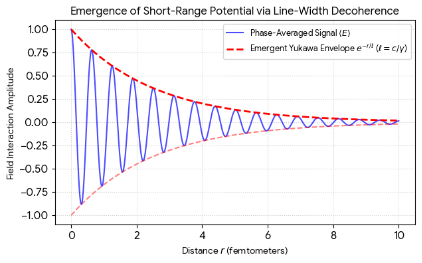
Such visual proofs-of-concept complement the math of our paper: they show that you do not need to invent an exchange boson. The finite geometry of the source acts as a natural spatial phase filter.
A Final Thought on Intellectual Honesty
I have explicitly credited the AI-assisted review both in my paper’s appendix and bylines as well as in this blog post itself. Some might wonder if using an AI this deeply is “cheating.” I don’t think so. The ontological architecture—the insistence on realism, spatial geometry, and anti-mysticism—is entirely human. The AI merely acted as a high-speed translator, digging through centuries of classical electrodynamics to find the precise mathematical analogies I needed.
If 64% of us are looking for a better interpretation of physical reality, we shouldn’t shy away from using every tool at our disposal to build it. Sometimes, a profound conceptual revolution begins exactly where standard calculation stops being satisfying—and a Saturday night wrestling match with a machine is a small price to pay for a clearer picture of the universe.

