Politics and science: 1924 and 2024

Note: This is just a copy of my LinkedIn post of today. I thought it would be interesting to share it here, too.

A few years ago, my amateur publications on ResearchGate led to an invitation to an online conference on low-energy nuclear reactions (LENR). LENR research was formerly known as cold fusion research but this term is out of fashion because the experiments have not (yet) led to getting more energy out than what is being put in (and, yes, some scandals around fake research too). I still regularly receive newsletters from the organizer: the Société Française de la Science Nucléaire dans la Matière Condensée (SFSNMC). I understand little of the nitty-gritty of these experiments but I find them fascinating. Let me come to the point I want to make here.

I just received the proceedings of the 16th international workshop, which was co-organized just two weeks ago with the International Society for Condensed Matter Nuclear Science (ISCMNS). Because of the political situation, Russian scientists could, apparently, not participate this time. In the newsletter I got, the organizers deplore that. For example, an eminent cold fusion expert like Anatoly Klimov was not there this year. However, he did share a rather wonderful letter to his European colleagues which I also got as part of the proceedings and which, as far as I can see (again, I do not understand all that much of it), is full of practical recommendations to move forward in this field. Indeed, Anatoly Klimov is not just anyone: he was one of the more prominent presenters at the much more high-profile ICCF-23 conference, which was held in Fujian, China. [Talking about China: China’s large (hot) fusion project seems to be moving (much) faster than ITER….]

The point is this: the exclusion of Russian scientists in events like this is like cutting ourselves off from cheap Russian natural gas or other inputs, or like stopping to export German cars and other industrial products to Russia. We do not hurt Russia with that: we only hurt ourselves – Europe. The situation resembles that of the 1924 Solvay Conference, which was a subdued affair because of the boycott of German scientists (even Albert Einstein, despite considering himself to be Jewish, also did not participate out of solidarity with his German scientific colleagues). When and how will this international nonsense stop? Russia was part of Europe in the 19th century. Why can’t we live with Russia now?

A small piece of good news is, perhaps, this: the small Russian team at ITER apparently has not been sent back home yet (see this Polico article on that). It suggests we simply cannot move ahead without the Russian engineers and scientists: they are, quite simply, ahead of us in this field and, therefore, their knowledge and skills are apparently too valuable to get rid of. Double standards once again, apparently… :-/

Cold fusion (LENR) revisited…

One of the nice things that happened to me on this rather weird exploration of the world of quantum physics – a journey which I now want to leave behind, because I found what I wanted to find: a common-sense interpretation of it all, and a concise model of elementary particles – was that, back in 2020, I was invited to join a low-key symposium on cold fusion (or ‘low energy nuclear reactions’, as the field is now referred to): RNBE-2020. That was followed by rather intense exchanges with a few scientists who work or worked on a theory centered around the concept of deep nuclear electron orbitals. All very interesting, because it confirmed what I think is the case in this field: there are some crooks around, but most research is done by very honest and integer scientists, albeit – admittedly – it’s all a bit on the fringes of mainstream theory.

I summed up my rather skeptical conclusions on these conversations in a 2021 blog post here: cold and hot fusion – just hot air? The ‘hot’ in the title of that post does not refer to real hot nuclear fusion (because that is not just ‘hot’ but extremely hot: we are not talking thousands but millions degrees Celsius here). No, we refer to the rather high temperatures of things like the hydrino scheme which – in my not-so-humble view – has seriously damaged the credibility of the field: these high temperatures are still – visibly – in the thermal range. Indeed, I looked at the videos, and I just see some kind of small copper alloy furnaces melting away. Now, copper alloys melt around 1000° C, and burning hydrogen yields temperatures around 2000° C. Hence, in the absence of any other evidence (such as spectroscopic measurements), I conclude these BLP experiments are just burning ordinary hydrogen. That is sad, because cold fusion and LENR already suffered from poor reputation.

But so I had long email exchanges on more interesting things, and that was nice. Going back to the possibility of deep electron orbitals being real, somehow, I initially entertained the rather vague idea that – who knows, right? – the mix of Zitterbewegung charges (positive and negative) – which, in my ‘mass-without-mass’ model of elementary particles, have zero rest mass – might, perhaps, combine in nuclear oscillations that have not been modeled so far. Indeed, when everything is said and done, I myself broke my teeth – so to speak – on trying to model the neutron itself – stable only inside of a nucleus – as a neutral ring current or nuclear ‘glue’ between protons. I did not succeed, but I still believe it should be possible. And if an analytical model could be found to model the motion of multiple pointlike zbw charges as a stable equilibrium that – as a whole – respects the Planck-Einstein relation, then we might, perhaps, also discover novel ways to unleash the binding energy between them, right?

So, these are some of the good things I want to – carefully and prudently – state about the field. I must now say why I am and remain skeptical. It is fair to say that everyone can easily see and verify how the energy of say, a photon in a laser beam, can dissipate away and, in the process, trigger very different reactions. Reactions that one would not associate with the energies of the incoming photons: all these reactions would qualify as some kind of anomalous heat, I would think. Think, for example, of using a high-powered laser to cut small tree branches, which is possible now. I have not studied the mechanics of this (too bad because I’ve been wanting to study the mechanics of lasers for many years now, but I never found the time to dig into Einstein’s or other theories on how it works – not approximately, but exactly), but I can easily see how the process of Compton scattering would explain why a substantial part of the energy of the photons would be absorbed by (1) outgoing photons with lower energy and (2) electrons with substantially higher kinetic energies. This kinetic energy would then redistribute all over the system (not only other electrons but even the massive nuclei at the center of each atomic and molecular system inside of these easy-to-burn materials, be they paper, carton, or wood). In short, we get heat: thermal energy. And quite a lot of it.

However, this process involves triggering lower-energy reactions: thermal or chemical reactions (fire actually is chemistry). [Also, you can easily see a lot of energy gets lost: using a 2000 W laser to cut branches that are only a few cm in diameter is not very energy-efficient, right? This is a point which I also talk about in my previous post on LENR: what is the energy balance? What is the total input energy and what is the nuclear fuel, respectively, and how do these two elements combine to make you think you’d get net energy out of the whole process?]

Regardless of the total energy equation (input – output), the first question is the more relevant one, because it goes to the core of the what and how of LENR. My blunt appraisal here is that of other skeptics: I cannot imagine how the energy in laser photons could – somehow – build up a sufficient reservoir of energy, to then reach a threshold and trigger an outright and proper nuclear or high-energy reaction.

If it is possible at all, it would have to be some kind of resonance process: a lower frequency feeding into a much higher-frequency phenomenon and gradually increasing its amplitude. How would it do that? That is simple. Harmonic oscillations have several natural frequencies, and the lower-energy oscillation can feed into one or more of these. See my post on music and math for an analytical explanation or – if you want something simpler – just think of a child on a swing, which – once in a while – you give an extra push in the back. You do not necessarily have to do that each and every time the swing comes back. No: you don’t need to push each and every time but, if you do push, you have to do at the right time. 🙂

Going back to LENR, we may think the frequency of a laser may feed into a nuclear oscillation, gradually increasing its amplitude, until the accumulated energy is sufficiently high and reaches some threshold triggering a proper nuclear or high-energy reaction. Frankly, I think this possibly could explain low-energy nuclear reactions. So, yes, it might be possible.

At the same time, I think it is rather unlikely. Why? At the smallest of scales, the Planck-Einstein relation holds, and so we have discrete energy states. These discrete energy states of protons, electrons, nuclei, atoms or molecules as a whole do not have any in-between states in which you can dump excess or surplus energy from somewhere outside. A photon-electron interaction triggers a reaction, and that’s not gradually but (almost) instantly. So, energy is being emitted as soon as it absorbed. Disequilibrium states do not last very long: atomic systems go back to equilibrium very quickly, and any excess energy is quickly emitted by photons or absorbed as internal heat, which is a (very) low-energy oscillation of the massive bits in whatever material you are using in these experiments (most experiments are on palladium, and the discussions on the effects impurities might have in the experiments are – frankly – a bit worrying). In any case, the point is that these disequilibrium states do surely not last long enough to entertain the kind of resonance processes that, say, made the Tacoma Bridge collapse. :-/ To make a long story short, I am and remain skeptical.

However, to my surprise, I was invited to join in a Zoom e-call, and listen to the rather interesting discussion on the future of both the French and International Society for Condensed Nuclear Matter (SFCMNS and ISCMNS, respectively – I will not put the links because they are both revamping their website now) after they had wrapped up their 25th International Conference.

What I saw and heard, made me quite happy: these were all honest and critical scientists looking at real-life experiments that do yield surprising results. Result that contradict my rather skeptical theoretical arguments (above) against LENR being possible. I also noted the Anthropocène Institute invests in them. I also note Nobuo Tanaka, former Executive Director of the International Energy Agency (not to be confused with the International Atomic Energy Agency!), spoke at ICCF-24, plus a lot of other very serious people. Also, it is quite obvious that nuclear energy is no longer out. On the contrary, it is in again and – as part of new investments in nuclear research – I think the LENR field should also be reconsidered, despite its chequered past. I also note LENR research in Japan is getting a lot more funding than research in the EU or the US, so perhaps they are seeing something that we do not see (it would be interesting to check what happens in the patents or IPR area on this). 🙂

So, all these considerations add up to more than enough – to me, at least – to continue giving these researchers the benefit of the doubt. We live in a fascinating world and, as the Wikipedia article on cold fusion notes, the discovery of the Mössbauer and other strange nuclear effects was also rather unexpected – in the sense that it had not been foreseen or predicted by some theorist. I do, therefore, not agree with the same Wikipedia article dismissing LENR as ‘pathological‘ or ‘cargo cult‘ science.

If anything, I think mainstream research sometimes also suffers from what critics say of the LENR field: “people are tricked into false results … by subjective effects, wishful thinking or threshold interactions.” But that is only a personal and non-relevant remark, as I am quitting my hobbyist study of physics now. It has lasted long enough (over a decade, really) and – as mentioned a few times already – I think I sort of get it now. As Feynman famously said in the Epilogue to his Lectures: “After all, it isn’t as horrible as it looks.”

I might add: I think the end of physics is near. All that’s left, is engineering. And quite a lot of it. 🙂

Cold and hot fusion: just hot air?

I just finished a very short paper recapping the basics of my model of the nuclear force. I wrote it a bit as a reaction to a rather disappointing exchange that is still going on between a few researchers who seem to firmly believe some crook who claims he can produce smaller hydrogen atoms (hydrinos) and get energy out of them. I wrote about my disappointment on one of my other blogs (I also write on politics and more general matters). Any case, the thing I want to do here, is to firmly state my position in regard to cold and hot fusion: I do not believe in either. Theoretically, yes. Of course. But, practically speaking, no. And that’s a resounding no!

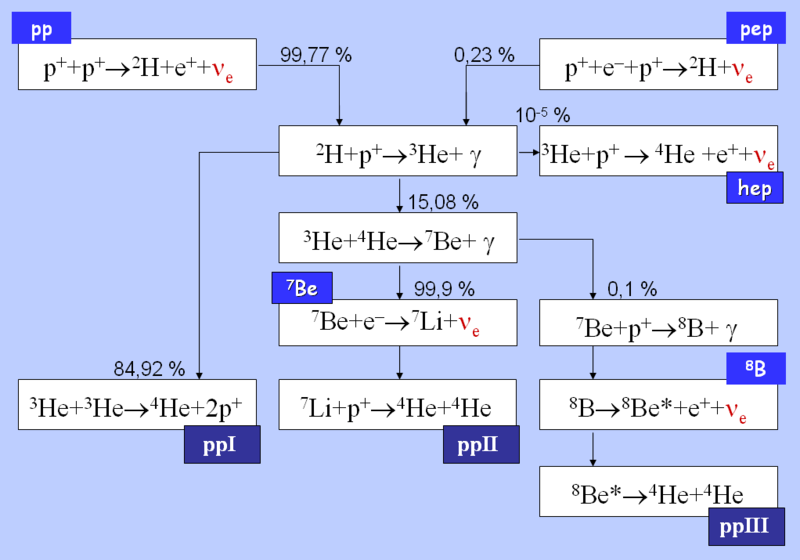
The illustration below (from Wikimedia Commons) shows how fusion actually happens in our Sun (I wrote more about that in one of my early papers). As you can see, there are several pathways, and all of these pathways are related through critical masses of radiation and feedback loops. So it is not like nuclear fission, which (mainly) relies on cascaded neutron production. No. It is much more complicated, and you would have to create and contain a small star on Earth to recreate the conditions that are prevalent in the Sun. Containing a relatively small amount of hydrogen plasma in incredibly energy-intensive electromagnetic fields will not do the trick. First, the reaction will peter out. Second, the reaction will yield no net energy: the plasma and electromagnetic fields that are needed to contain the plasma will suck everything up, and much more than that. So, yes, The ITER project is a huge waste of taxpayers’ money.

As for cold fusion, I believe the small experiments showing anomalous heat reactions (or low-energy nuclear reactions as these phenomena are also referred to) are real (see my very first blog post on these) but (1) researchers have done a poor job at replicating these experiments consistently, (2) have failed to provide a firm theoretical basis for those reactions, and (3) whatever theory there is, also strongly hints we should not hope to ever get net energy out of it. This explains why public funding for cold fusion is very limited. Furthermore, scientists who continue to support frauds like Dr. Mills will soon erase whatever credibility smaller research labs in this field have painstakingly built up. So, no, it won’t happen. Too bad, because LENR research itself is quite interesting, and may yield more insights than the next mega-project of CERN, SLAC and what have you. :-/

Post scriptum: On the search for hydrinos (hypothetical small hydrogen), following exchange with a scientist working for a major accelerator lab in the US – part of a much longer one – is probably quite revealing. When one asks why it has not been discovered yet, the answer is invariably the same: we need a new accelerator project for that. I’ll hide the name of the researcher by calling him X.

Dear Jean Louis – They cannot be produced in the Sun, as electron has to be very relativistic. According to my present calculation one has to have a total energy of Etotal ~34.945 MeV. Proton of the same velocity has to have total energy Etotal ~64.165 GeV. One can get such energies in very energetic evens in Universe. On Earth, it would take building special modifications of existing accelerators. This is why it has not been discovered so far.

Best regards, [X]

From: Jean Louis Van Belle <jeanlouisvanbelle@outlook.com>
Date: Wednesday, March 31, 2021 at 9:24 AM
To: [X]
Cc: [Two other LENR/CF researchers]
Subject: Calculations and observations…

Interesting work, but hydrino-like structures should show a spectrum with gross lines, split in finer lines and hyperfine lines (spin coupling between nucleon(s) and (deep) electron. If hydrinos exist, they should be produced en masse in the Sun. Is there any evidence from unusual spectral lines? Until then, I think of the deep electron as the negative charge in the neutron or in the deuteron nucleus. JL

Low-energy nuclear reactions

I thought I should stop worrying about physics, but then I got an impromptu invitation to a symposium on low-energy nuclear reactions (LENR) and I got all excited about it. The field of LENR was, and still is, often referred to as cold fusion which, after initial enthusiasm, got a not-so-good name because of… More than one reason, really. Read the Wikipedia article on it, or just google and read some other blog articles (e.g. Scientific American’s guest blog on the topic is a pretty good one, I think).

The presentations were very good (especially those on the experimental results and the recent involvement of some very respectable institutions in addition to the usual suspects and, sadly, some fly-by-night operators too), and the follow-on conversation with one of the co-organizers convinced me that the researchers are serious, open-minded and – while not quite being able to provide all of the answers we are all seeking – very ready to discuss them seriously. Most, if not all, experiments involve transmutions of nuclei triggered by low-energy inputs such as a low-energy radiation (irradiation and transmutation of palladium by, say, a now-household 5 mW laser beam is just one of the examples). One experiment even triggered a current just by adding plain heat which, as you know, is nothing but very low-energy (infrared) radiation, although I must admit this was one I would like to see replicated en masse before believing it to be real (the equipment was small and simple, and so the experimenters could have shared it easily with other labs).

When looking at these experiments, the comparison that comes to mind is that of an opera singer shattering crystal with his or her voice: some frequency in the sound causes the material to resonate at, yes, its resonant frequency (most probably an enormous but integer multiple of the sound frequency), and then the energy builds up – like when you give a child on a swing an extra push every time when you should – as the amplitude becomes larger and larger – till the breaking point is reached. Another comparison is the failing of a suspension bridge when external vibrations (think of the rather proverbial soldier regiment here) cause similar resonance phenomena. So, yes, it is not unreasonable to believe that one could be able to induce neutron decay and, thereby, release the binding energy between the proton and the electron in the process by some low-energy stimulation provided the frequencies are harmonic.

The problem with the comparison – and for the LENR idea to be truly useful – is this: one cannot see any net production of energy here. The strain or stress that builds up in the crystal glass is a strain induced by the energy in the sound wave (which is why the singing demos usually include amplifiers to attain the required power/amplitude ratio, i.e. the required decibels). In addition, the breaking of crystal or a suspension bridge typically involves a weaker link somewhere, or some directional aspect (so that would be the equivalent of an impurity in a crystal structure, I guess), but that is a minor point, and a point that is probably easier to tackle than the question on the energy equation.

LENR research has probably advanced far enough now (the first series of experiments started in 1989) to slowly start focusing on the whole chain of these successful experiments: what is the equivalent, in these low-energy reactions, of the nuclear fuel in high-energy fission or fusion experiments? And, if it can be clearly identified, the researchers need to show that the energy that goes into the production of this fuel is much less than the energy you get out of it by burning it (and, of course, with ‘burning’ I mean the decay reaction here). [In case you have heard about Randell Mills’ hydrino experiments, he should show the emission spectrum of these hydrinos. Otherwise, one might think he is literally burning hydrogen. Attracting venture capital and providing scientific proof are not mutually exclusive, are they? In the meanwhile, I hope that what he is showing is real, in the way all LENR researchers hope it is real.]

LENR research may also usefully focus on getting the fundamental theory right. The observed anomalous heat and/or transmutation reactions cannot be explained by mainstream quantum physics (I am talking QCD here, so that’s QFT, basically). That should not surprise us: one does not need quarks or gluons to explain high-energy nuclear processes such as fission or fusion, either! My theory is, of course, typically simplistically simple: the energy that is being unlocked is just the binding energy between the nuclear electron and the protons, in the neutron itself or in a composite nucleus, the simplest of which is the deuteron nucleus. I talk about that in my paper on matter-antimatter pair creation/annihilation as a nuclear process but you do not need to be an adept of classical or realist interpretations of quantum mechanics to understand this point. To quote a motivational writer here: it is OK for things to be easy. 🙂

So LENR theorists just need to accept they are not mainstream – yet, that is – and come out with a more clearly articulated theory on why their stuff works the way it does. For some reason I do not quite understand, they come across as somewhat hesitant to do so. Fears of being frozen out even more by the mainstream? Come on guys ! You are coming out of the cold anyway, so why not be bold and go all the way? It is a time of opportunities now, and the field of LENR is one of them, both theoretically as well as practically speaking. I honestly think it is one of those rare moments in the history of physics where experimental research may be well ahead of theoretical physics, so they should feel like proud trailblazers!

Personally, I do not think it will replace big classical nuclear energy plants anytime soon but, in a not-so-distant future, it might yield much very useful small devices: lower energy, and, therefore, lower risk also. I also look forward to LENR research dealing the fatal blow to standard theory by confirming we do not need perturbation and renormalization theories to explain reality. 🙂

Post scriptum: If low-energy nuclear reactions are real, mainstream (astro)physicists will also have to rework their stories on cosmogenesis and the (future) evolution of the Universe. The standard story may well be summed up in the brief commentary of the HyperPhysics entry on the deuteron nucleus:

The stability of the deuteron is an important part of the story of the universe. In the Big Bang model it is presumed that in early stages there were equal numbers of neutrons and protons since the available energies were much higher than the 0.78 MeV required to convert a proton and electron to a neutron. When the temperature dropped to the point where neutrons could no longer be produced from protons, the decay of free neutrons began to diminish their population. Those which combined with protons to form deuterons were protected from further decay. This is fortunate for us because if all the neutrons had decayed, there would be no universe as we know it, and we wouldn’t be here!

If low-energy nuclear reactions are real – and I think they are – then the standard story about the Big Bang is obviously bogus too. I am not necessarily doubting the reality of the Big Bang itself (the ongoing expansion of the Universe is a scientific fact so, yes, the Universe must have been much smaller and (much) more energy-dense long time ago), but the standard calculations on proton-neutron reactions taking place, or not, at cut-off temperatures/energies above/below 0.78 MeV do not make sense anymore. One should, perhaps, think more in terms of how matter-antimatter ratios might or might not have evolved (and, of course, one should keep an eye on the electron-proton ratio, but that should work itself out because of charge conservation) to correctly calculate the early evolution of the Universe, rather than focusing so much on proton-neutron ratios.

Why do I say that? Because neutrons do appear to consist of a proton and an electron – rather than of quarks and gluons – and they continue to decay and then recombine again, so these proton-neutron reactions must not be thoughts of as some historic (discontinuous) process.

[…] Hmm… The more I look at the standard stories, the more holes I see… This one, however, is very serious. If LENR and/or cold fusion is real, then it will also revolutionize the theories on cosmogenesis (the evolution of the Universe). I instinctively like that, of course, because – just like quantization – I had the impression the discontinuities are there, but not quite in the way mainstream physicists – thinking more in terms of quarks and gluons rather than in terms of stuff that we can actually measure – portray the whole show.