The Strange Theory of Light and Matter (I)

I am of the opinion that Richard Feynman’s wonderful little common-sense introduction to the ‘uncommon-sensy‘ theory of quantum electrodynamics (The Strange Theory of Light and Matter), which were published a few years before his death only, should be mandatory reading for high school students.

I actually mean that: it should just be part of the general education of the first 21st century generation. Either that or, else, the Education Board should include a full-fledged introduction to complex analysis and quantum physics in the curriculum. 🙂

Having praised it (just now, as well as in previous posts), I re-read it recently during a trek in Nepal with my kids – I just grabbed the smallest book I could find the morning we left 🙂 – and, frankly, I now think Ralph Leighton, who transcribed and edited these four short lectures, could have cross-referenced it better. Moreover, there are two or three points where Feynman (or Leighton?) may have sacrificed accuracy for readability. Let me recapitulate the key points and try to improve here and there.

Amplitudes and arrows

The booklet avoids scary mathematical terms and formulas but doesn’t avoid the fundamental concepts behind, and it doesn’t avoid the kind of ‘deep’ analysis one needs to get some kind of ‘feel’ for quantum mechanics either. So what are the simplifications?

A probability amplitude (i.e. a complex number) is, quite simply, an arrow, with a direction and a length. Thus Feynman writes: “Arrows representing probabilities from 0% to 16% [as measured by the surface of the square which has the arrow as its side] have lengths from 0 to 0.4.” That makes sense: such geometrical approach does away, for example, with the need to talk about the absolute square (i.e. the square of the absolute value, or the squared norm) of a complex number – which is what we need to calculate probabilities from probability amplitudes. So, yes, it’s a wonderful metaphor. We have arrows and surfaces now, instead of wave functions and absolute squares of complex numbers.

The way he combines these arrows make sense too. He even notes the difference between photons (bosons) and electrons (fermions): for bosons, we just add arrows; for fermions, we need to subtract them (see my post on amplitudes and statistics in this regard).

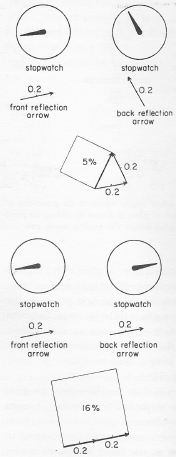
There is also the metaphor for the phase of a wave function, which is a stroke of genius really (I mean it): the direction of the ‘arrow’ is determined by a stopwatch hand, which starts turning when a photon leaves the light source, and stops when it arrives, as shown below.

front and back reflection amplitude

OK. Enough praise. What are the drawbacks?

The illustration above accompanies an analysis of how light is either reflected from the front surface of a sheet of a glass or, else, from the back surface. Because it takes more time to bounce off the back surface (the path is associated with a greater distance), the front and back reflection arrows point in different directions indeed (the stopwatch is stopped somewhat later when the photon reflects from the back surface). Hence, the difference in phase (but that’s a term that Feynman also avoids) is determined by the thickness of the glass. Just look at it. In the upper part of the illustration above, the thickness is such that the chance of a photon reflecting off the front or back surface is 5%: we add two arrows, each with a length of 0.2, and then we square the resulting (aka final) arrow. Bingo! We get a surface measuring 0.05, or 5%.

Huh? Yes. Just look at it: if the angle between the two arrows would be 90° exactly, it would be 0.08 or 8%, but the angle is a bit less. In the lower part of the illustration, the thickness of the glass is such that the two arrows ‘line up’ and, hence, they form an arrow that’s twice the length of either arrow alone (0.2 + 0.2 = 0.4), with a square four times as large (0.16 = 16%). So… It all works like a charm, as Feynman puts it.

[…]

But… Hey! Look at the stopwatch for the front reflection arrows in the upper and lower diagram: they point in the opposite direction of the stopwatch hand! Well… Hmm… You’re right. At this point, Feynman just notes that we need an extra rule: “When we are considering the path of a photon bouncing off the front surface of the glass, we reverse the direction of the arrow.

He doesn’t say why. He just adds this random rule to the other rules – which most readers who read this book already know. But why this new rule? Frankly, this inconsistency – or lack of clarity – would wake me up at night. This is Feynman: there must be a reason. Why?

Initially, I suspected it had something to do with the two types of ‘statistics’ in quantum mechanics (i.e. those different rules for combining amplitudes of bosons and fermions respectively, which I mentioned above). But… No. Photons are bosons anyway, so we surely need to add, not subtract. So what is it?

[…] Feynman explains it later, much later – in the third of the four chapters of this little book, to be precise. It’s, quite simply, the result of the simplified model he uses in that first chapter. The photon can do anything really, and so there are many more arrows than just two. We actually should look at an infinite number of arrows, representing all possible paths in spacetime, and, hence, the two arrows (i.e. the one for the reflection from the front and back surface respectively) are combinations of many other arrows themselves. So how does that work?

An analysis of partial reflection (I)

The analysis in Chapter 3 of the same phenomenon (i.e. partial reflection by glass) is a simplified analysis too, but it’s much better – because there are no ‘random’ rules here. It is what Leighton promises to the reader in his introduction: “A complete description, accurate in every detail, of a framework onto which more advanced concepts can be attached without modification. Nothing has to be ‘unlearned’ later.

Well… Accurate in every detail? Perhaps not. But it’s good, and I still warmly recommend a reading of this delightful little book to anyone who’d ask me what to read as a non-mathematical introduction to quantum mechanics. I’ll limit myself here to just some annotations.

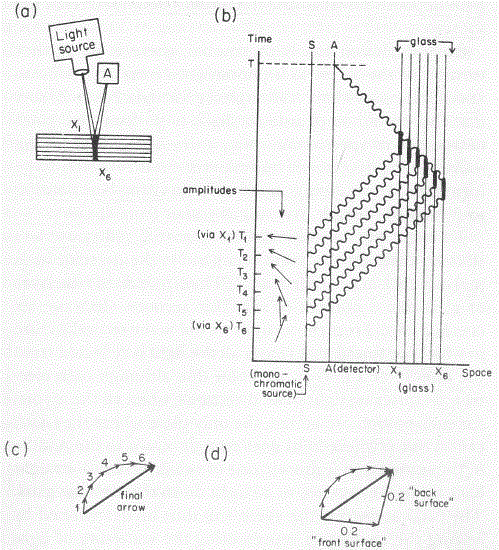
The first drawing (a) depicts the situation:

  1. A photon from a light source is being reflected by the glass. Note that it may also go straight through, but that’s a possibility we’ll analyze separately. We first assume that the photon is effectively being reflected by the glass, and so we want to calculate the probability of that event using all these ‘arrows’, i.e. the underlying probability amplitudes.
  2. As for the geometry of the situation: while the light source and the detector seem to be positioned at some angle from the normal, that is not the case: the photon travels straight down (and up again when reflected). It’s just a limitation of the drawing. It doesn’t really matter much for the analysis: we could look at a light beam coming in at some angle, but so we’re not doing that. It’s the simplest situation possible, in terms of experimental set-up that is. I just want to be clear on that.

partial reflection

Now, rather than looking at the front and back surface only (as Feynman does in Chapter 1), the glass sheet is now divided into a number of very thin sections: five, in this case, so we have six points from which the photon can be scattered into the detector at A: X1 to X6. So that makes six possible paths. That’s quite a simplification but it’s easy to see it doesn’t matter: adding more sections would result in many more arrows, but these arrows would also be much smaller, and so the final arrow would be the same.

The more significant simplification is that the paths are all straight paths, and that the photon is assumed to travel at the speed of light, always. If you haven’t read the booklet, you’ll say that’s obvious, but it’s not: a photon has an amplitude to go faster or slower than c but, as Feynman points out, these amplitudes cancel out over longer distances. Likewise, a photon can follow any path in space really, including terribly crooked paths, but these paths also cancel out. As Feynman puts it: “Only the paths near the straight-line path have arrows pointing in nearly the same direction, because their timings are nearly the same, and only these arrows are important, because it is from them that we accumulate a large final arrow.” That makes perfect sense, so there’s no problem with the analysis here either.

So let’s have a look at those six arrows in illustration (b). They point in a slightly different direction because the paths are slightly different and, hence, the distances (and, therefore, the timings) are different too. Now, Feynman (but I think it’s Leighton really) loses himself here in a digression on monochromatic light sources. A photon is a photon: it will have some wave function with a phase that varies in time and in space and, hence, illustration (b) makes perfect sense. [I won’t quote what he writes on a ‘monochromatic light source’ because it’s quite confusing and, IMHO, not correct.]

The stopwatch metaphor has only one minor shortcoming: the hand of a stopwatch rotates clockwise (obviously!), while the phase of an actual wave function goes counterclockwise with time. That’s just convention, and I’ll come back to it when I discuss the mathematical representation of the so-called wave function, which gives you these amplitudes. However, it doesn’t change the analysis, because it’s the difference in the phase that matters when combining amplitudes, so the clock can turn in either way indeed, as long as we’re agreed on it.

At this point, I can’t resist: I’ll just throw the math in. If you don’t like it, you can just skip the section that follows.

Feynman’s arrows and the wave function

The mathematical representation of Feynman’s ‘arrows’ is the wave function:

f = f(x–ct)

Is that the wave function? Yes. It is: it’s a function whose argument is x – ct, with x the position in space, and t the time variable. As for c, that’s the speed of light. We throw it in to make the units in which we measure time and position compatible. 

Really? Yes: f is just a regular wave function. To make it look somewhat more impressive, I could use the Greek symbol Φ (phi) or Ψ (psi) for it, but it’s just what it is: a function whose value depends on position and time indeed, so we write f = f(x–ct). Let me explain the minus sign and the c in the argument.

Time and space are interchangeable in the argument, provided we measure time in the ‘right’ units, and so that’s why we multiply the time in seconds with c, so the new unit of time becomes the time that light needs to travel a distance of one meter. That also explains the minus sign in front of ct: if we add one distance unit (i.e. one meter) to the argument, we have to subtract one time unit from it – the new time unit of course, so that’s the time that light needs to travel one meter – in order to get the same value for f. [If you don’t get that x–ct thing, just think a while about this, or make some drawing of a wave function. Also note that the spacetime diagram in illustration (b) above assumes the same: time is measured in an equivalent unit as distance, so the 45% line from the south-west to the north-east, that bounces back to the north-west, represents a photon traveling at speed c in space indeed: one unit of time corresponds to one meter of travel.]

Now I want to be a bit more aggressive. I said is a simple function. That’s true and not true at the same time. It’s a simple function, but it gives you probability amplitudes, which are complex numbers – and you may think that complex numbers are, perhaps, not so simple. However, you shouldn’t be put off. Complex numbers are really like Feynman’s ‘arrows’ and, hence, fairly simple things indeed. They have two dimensions, so to say: an a– and a b-coordinate. [I’d say an x– and y-coordinate, because that’s what you usually see, but then I used the x symbol already for the position variable in the argument of the function, so you have to switch to a and b for a while now.]

This a– and b-coordinate are referred to as the real and imaginary part of a complex number respectively. The terms ‘real’ and ‘imaginary’ are confusing because both parts are ‘real’ – well… As real as numbers can be, I’d say. 🙂 They’re just two different directions in space: the real axis is the a-axis in coordinate space, and the imaginary axis is the b-axis. So we could write it as an ordered pair of numbers (a, b). However, we usually write it as a number itself, and we distinguish the b-coordinate from the a-coordinate by writing an i in front: (a, b) = a + ib. So our function f = f(x–ct) is a complex-valued function: it will give you two numbers (an a and a b) instead of just one when you ‘feed’ it with specific values for x and t. So we write:

f = f(x–ct) = (a, b) = a + ib

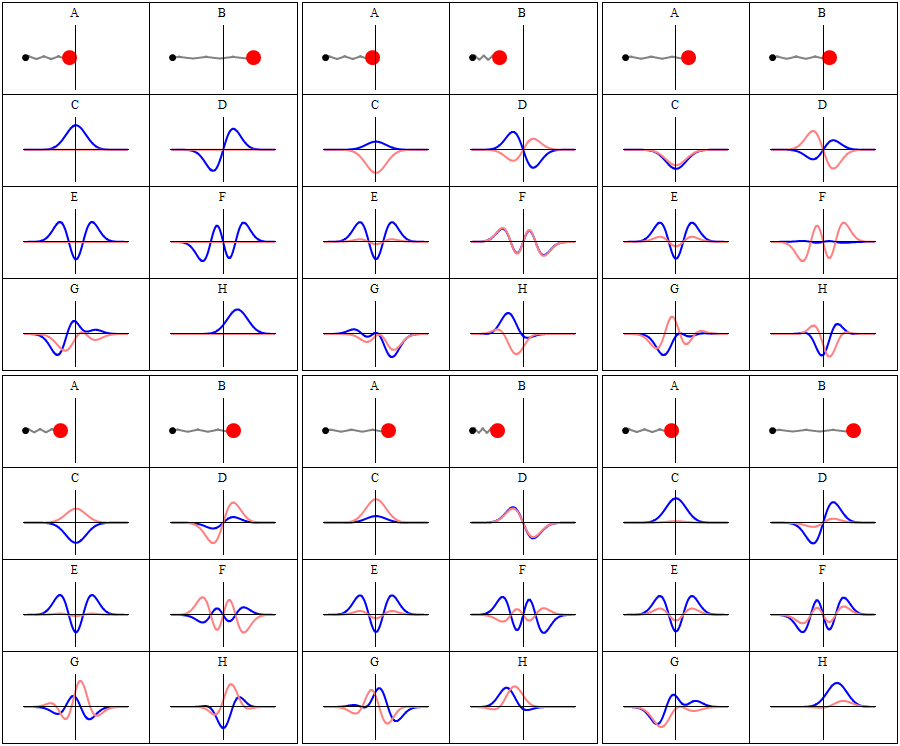
So what’s the shape of this function? Is it linear or irregular or what? We’re talking a very regular wave function here, so it’s shape is ‘regular’ indeed. It’s a periodic function, so it repeats itself again and again. The animations below give you some idea of such ‘regular’ wave functions. Animation A and B shows a real-valued ‘wave’: a ball on a string that goes up and down, for ever and ever. Animations C to H are – believe it or not – basically the same thing, but so we have two numbers going up and down. That’s all.

QuantumHarmonicOscillatorAnimation

The wave functions above are, obviously, confined in space, and so the horizontal axis represents the position in space. What we see, then, is how the real and imaginary part of these wave functions varies as time goes by. [Think of the blue graph as the real part, and the imaginary part as the pinkish thing – or the other way around. It doesn’t matter.] Now, our wave function – i.e. the one that Feynman uses to calculate all those probabilities – is even more regular than those shown above: its real part is an ordinary cosine function, and it’s imaginary part is a sine. Let me write this in math:

f = f(x–ct) = a + ib = r(cosφ + isinφ)

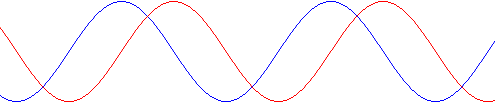
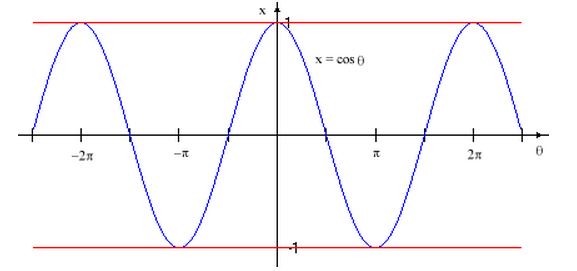
It’s really the most regular wave function in the world: the very simple illustration below shows how the two components of f vary as a function in space (i.e. the horizontal axis) while we keep the time fixed, or vice versa: it could also show how the function varies in time at one particular point in space, in which case the horizontal axis would represent the time variable. It is what it is: a sine and a cosine function, with the angle φ as its argument.

cos and sine

Note that a sine function is the same as a cosine function, but it just lags a bit. To be precise, the phase difference is 90°, or π/2 in radians (the radian (i.e. the length of the arc on the unit circle) is a much more natural unit to express angles, as it’s fully compatible with our distance unit and, hence, most – if not all – of our other units). Indeed, you may or may not remember the following trigonometric identities: sinφ = cos(π/2–φ) = cos(φ–π/2).

In any case, now we have some r and φ here, instead of a and b. You probably wonder where I am going with all of this. Where are the x and t variables? Be patient! You’re right. We’ll get there. I have to explain that r and φ first. Together, they are the so-called polar coordinates of Feynman’s ‘arrow’ (i.e. the amplitude). Polar coordinates are just as good as coordinates as these Cartesian coordinates we’re used to (i.e. a and b). It’s just a different coordinate system. The illustration below shows how they are related to each other. If you remember anything from your high school trigonometry course, you’ll immediately agree that a is, obviously, equal to rcosφ, and b is rsinφ, which is what I wrote above. Just as good? Well… The polar coordinate system has some disadvantages (all of those expressions and rules we learned in vector analysis assume rectangular coordinates, and so we should watch out!) but, for our purpose here, polar coordinates are actually easier to work with, so they’re better.

Complex_number_illustration

Feynman’s wave function is extremely simple because his ‘arrows’ have a fixed length, just like the stopwatch hand. They’re just turning around and around and around as time goes by. In other words, is constant and does not depend on position and time. It’s the angle φ that’s turning and turning and turning as the stopwatch ticks while our photon is covering larger and larger distances. Hence, we need to find a formula for φ that makes it explicit how φ changes as a function in spacetime. That φ variable is referred to as the phase of the wave function. That’s a term you’ll encounter frequently and so I had better mention it. In fact, it’s generally used as a synonym for any angle, as you can see from my remark on the phase difference between a sine and cosine function.

So how do we express φ as a function of x and t? That’s where Euler’s formula comes in. Feynman calls it the most remarkable formula in mathematics – our jewel! And he’s probably right: of all the theorems and formulas, I guess this is the one we can’t do without when studying physics. I’ve written about this in another post, and repeating what I wrote there would eat up too much space, so I won’t do it and just give you that formula. A regular complex-valued wave function can be represented as a complex (natural) exponential function, i.e. an exponential function with Euler’s number e (i.e. 2.728…) as the base, and the complex number iφ as the (variable) exponent. Indeed, according to Euler’s formula, we can write:

f = f(x–ct) = a + ib = r(cosφ + isinφ) = r·eiφ

As I haven’t explained Euler’s formula (you should really have a look at my posts on it), you should just believe me when I say that r·eiφ is an ‘arrow’ indeed, with length r and angle φ (phi), as illustrated above, with a and b coordinates arcosφ and b = rsinφ. What you should be able to do now, is to imagine how that φ angle goes round and round as time goes by, just like Feynman’s ‘arrow’ goes round and round – just like a stopwatch hand indeed, but note our φ angle turns counterclockwise indeed.

Fine, you’ll say – but so we need a mathematical expression, don’t we? Yes,we do. We need to know how that φ angle (i.e. the variable in our r·eiφ function) changes as a function of x and t indeed. It turns out that the φ in r·eiφ can be substituted as follows:

eiφ = r·ei(ωt–kx) = r·eik(x–ct)

Huh? Yes. The phase (φ) of the probability amplitude (i.e. the ‘arrow’) is a simple linear function of x and t indeed: φ = ωt–kx = –k(x–ct). What about all these new symbols, k and ω? The ω and k in this equation are the so-called angular frequency and the wave number of the wave. The angular frequency is just the frequency expressed in radians, and you should think of the wave number as the frequency in space. [I could write some more here, but I can’t make it too long, and you can easily look up stuff like this on the Web.] Now, the propagation speed c of the wave is, quite simply, the ratio of these two numbers: c = ω/k. [Again, it’s easy to show how that works, but I won’t do it here.]

Now you know it all, and so it’s time to get back to the lesson.

An analysis of partial reflection (II)

Why did I digress? Well… I think that what I write above makes much more sense than Leighton’s rather convoluted description of a monochromatic light source as he tries to explain those arrows in diagram (b) above. Whatever it is, a monochromatic light source is surely not “a device that has been carefully arranged so that the amplitude for a photon to be emitted at a certain time can be easily calculated.” That’s plain nonsense. Monochromatic light is light of a specific color, so all photons have the same frequency (or, to be precise, their wave functions have all the same well-defined frequency), but these photons are not in phase. Photons are emitted by atoms, as an electron moves from one energy level to the other. Now, when a photon is emitted, what actually happens is that the atom radiates a train of waves only for about 10–8 sec, so that’s about 10 billionths of a second. After 10–8 sec, some other atom takes over, and then another atom, and so on. Each atom emits one photon, whose energy is the difference between the two energy levels that the electron is jumping to or from. So the phase of the light that is being emitted can really only stay the same for about 10–8 sec. Full stop.

Now, what I write above on how atoms actually emit photons is a paraphrase of Feynman’s own words in his much more serious series of Lectures on Mechanics, Radiation and Heat. Therefore, I am pretty sure it’s Leighton who gets somewhat lost when trying to explain what’s happening. It’s not photons that interfere. It’s the probability amplitudes associated with the various paths that a photon can take. To be fully precise, we’re talking the photon here, i.e. the one that ends up in the detector, and so what’s going on is that the photon is interfering with itself. Indeed, that’s exactly what the ‘craziness’ of quantum mechanics is all about: we sent electrons, one by one, through two slits, and we observe an interference pattern. Likewise, we got one photon here, that can go various ways, and it’s those amplitudes that interfere, so… Yes: the photon interferes with itself.

OK. Let’s get back to the lesson and look at diagram (c) now, in which the six arrows are added. As mentioned above, it would not make any difference if we’d divide the glass in 10 or 20 or 1000 or a zillion ‘very thin’ sections: there would be many more arrows, but they would be much smaller ones, and they would cover the same circular segment: its two endpoints would define the same arc, and the same chord on the circle that we can draw when extending that circular segment. Indeed, the six little arrows define a circle, and that’s the key to understanding what happens in the first chapter of Feynman’s QED, where he adds two arrows only, but with a reversal of the direction of the ‘front reflection’ arrow. Here there’s no confusion – Feynman (or Leighton) eloquently describe what they do:

“There is a mathematical trick we can use to get the same answer [i.e. the same final arrow]: Connecting the arrows in order from 1 to 6, we get something like an arc, or part of a circle. The final arrow forms the chord of this arc. If we draw arrows from the center of the ‘circle’ to the tail of arrow 1 and to the head of arrow 6, we get two radii. If the radius arrow from the center to arrow 1 is turned 180° (“subtracted”), then it can be combined with the other radius arrow to give us the same final arrow! That’s what I was doing in the first lecture: these two radii are the two arrows I said represented the ‘front surface’ and ‘back surface’ reflections. They each have the famous length of 0.2.”

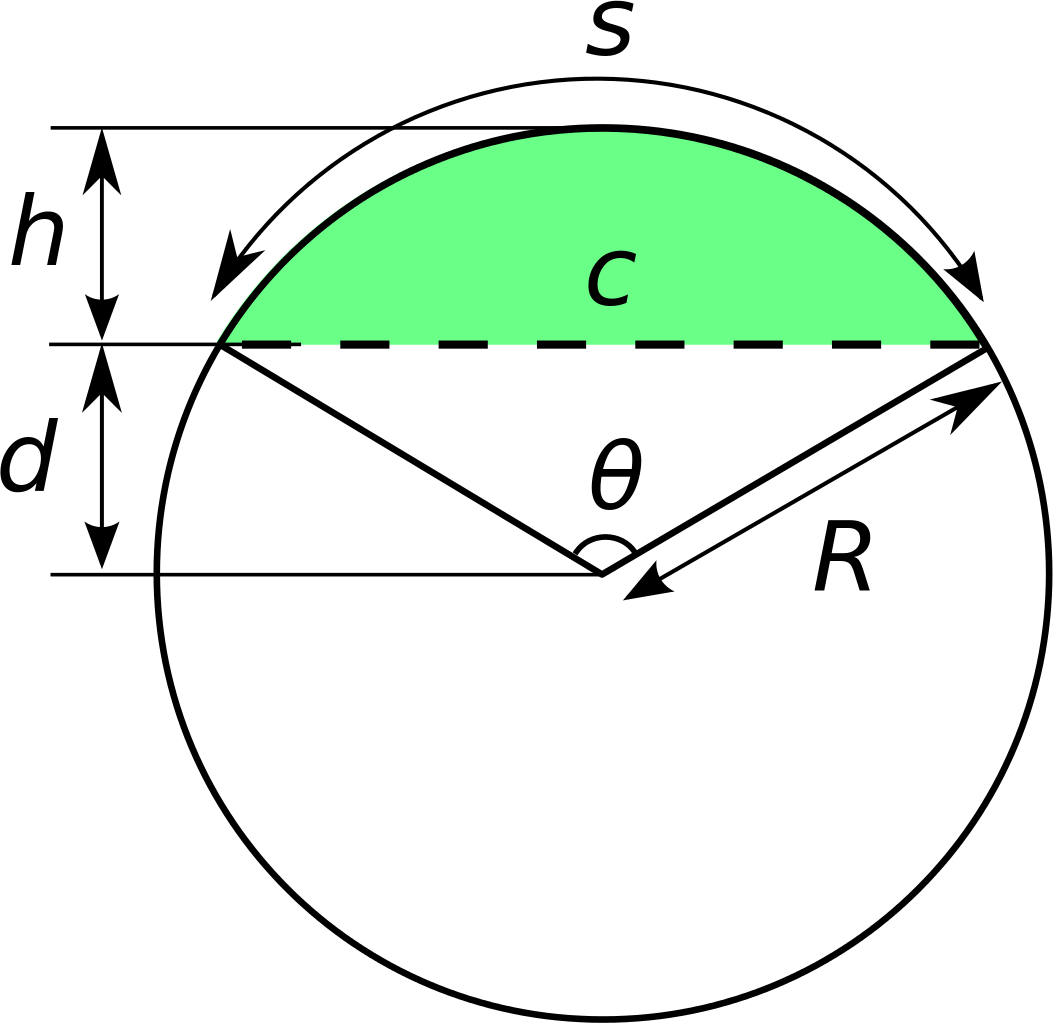
That’s what’s shown in part (d) of the illustration above and, in case you’re still wondering what’s going on, the illustration below should help you to make your own drawings now.

CircularsegmentSo… That explains the phenomenon Feynman wanted to explain, which is a phenomenon that cannot be explained in classical physics. Let me copy the original here:

Iridescence

Partial reflection by glass—a phenomenon that cannot be explained in classical physics? Really?

You’re right to raise an objection: partial reflection by glass can, in fact, be explained by the classical theory of light as an electromagnetic wave. The assumption then is that light is effectively being reflected by both the front and back surface and the reflected waves combine or cancel out (depending on the thickness of the glass and the angle of reflection indeed) to match the observed pattern. In fact, that’s how the phenomenon was explained for hundreds of years! The point to note is that the wave theory of light collapsed as technology advanced, and experiments could be made with very weak light hitting photomultipliers. As Feynman writes: “As the light got dimmer and dimmer, the photomultipliers kept making full-sized clicks—there were just fewer of them. Light behaved as particles!”

The point is that a photon behaves like an electron when going through two slits: it interferes with itself! As Feynman notes, we do not have any ‘common-sense’ theory to explain what’s going on here. We only have quantum mechanics, and quantum mechanics is an “uncommon-sensy” theory: a “strange” or even “absurd” theory, that looks “cockeyed” and incorporates “crazy ideas”. But… It works.

Now that we’re here, I might just as well add a few more paragraphs to fully summarize this lovely publication – if only because summarizing stuff like this helps me to come to terms with understanding things better myself!

Calculating amplitudes: the basic actions

So it all boils down to calculating amplitudes: an event is divided into alternative ways of how the event can happen, and the arrows for each way are ‘added’. Now, every way an event can happen can be further subdivided into successive steps. The amplitudes for these steps are then ‘multiplied’. For example, the amplitude for a photon to go from A to C via B is the ‘product’ of the amplitude to go from A to B and the amplitude to go from B to C.

I marked the terms ‘multiplied’ and ‘product’ with apostrophes, as if to say it’s not a ‘real’ product. But it is an actual multiplication: it’s the product of two complex numbers. Feynman does not explicitly compare this product to other products, such as the dot (•) or cross (×) product of two vectors, but he uses the ∗ symbol for multiplication here, which clearly distinguishes VW from VW or V×W indeed or, more simply, from the product of two ordinary numbers. [Ordinary numbers? Well… With ‘ordinary’ numbers, I mean real numbers, of course, but once you get used to complex numbers, you won’t like that term anymore, because complex numbers start feeling just as ‘real’ as other numbers – especially when you get used to the idea of those complex-valued wave functions underneath reality.]

Now, multiplying complex numbers, or ‘arrows’ using QED’s simpler language, consists of adding their angles and multiplying their lengths. That being said, the arrows here all have a length smaller than one (because their square cannot be larger than one, because that square is a probability, i.e. a (real) number between 0 and 1), Feynman defines successive multiplication as successive ‘shrinks and turns’ of the unit arrow. That all makes sense – very much sense.

But what’s the basic action? As Feynman puts the question: “How far can we push this process of splitting events into simpler and simpler subevents? What are the smallest possible bits and pieces? Is there a limit?” He immediately answers his own question. There are three ‘basic actions’:

  1. A photon goes from one point (in spacetime) to another: this amplitude is denoted by P(A to B).
  2. An electron goes from one point to another: E(A to B).
  3. An electron emits and/or absorbs a photon: this is referred to as a ‘junction’ or a ‘coupling’, and the amplitude for this is denoted by the symbol j, i.e. the so-called junction number.

How do we find the amplitudes for these?

The amplitudes for (1) and (2) are given by a so-called propagator functions, which give you the probability amplitude for a particle to travel from one place to another in a given time indeed, or to travel with a certain energy and momentum. Judging from the Wikipedia article on these functions, the subject-matter is horrendously complicated, and the formulas are too, even if Feynman says it’s ‘very simple’ – for a photon, that is. The key point to note is that any path is possible. Moreover, there are also amplitudes for photons to go faster or slower than the speed of light (c)! However, these amplitudes make smaller contributions, and cancel out over longer distances. The same goes for the crooked paths: the amplitudes cancel each other out as well.

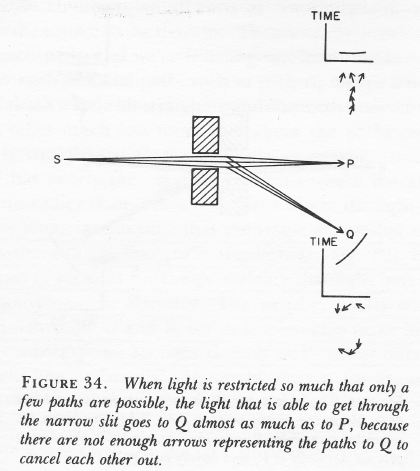
What remains are the ‘nearby paths’. In my previous post (check the section on electromagnetic radiation), I noted that, according to classical wave theory, a light wave does not occupy any physical space: we have electric and magnetic field vectors that oscillate in a direction that’s perpendicular to the direction of propagation, but these do not take up any space. In quantum mechanics, the situation is quite different. As Feynman puts it: “When you try to squeeze light too much [by forcing it to go through a small hole, for example, as illustrated below], it refuses to cooperate and begins to spread out.” He explains this in the text below the second drawing: “There are not enough arrows representing the paths to Q to cancel each other out.”

Many arrowsFew arrows

Not enough arrows? We can subdivide space in as many paths as we want, can’t we? Do probability amplitudes take up space? And now that we’re asking the tougher questions, what’s a ‘small’ hole? What’s ‘small’ and what’s ‘large’ in this funny business?

Unfortunately, there’s not much of an attempt in the booklet to try to answer these questions. One can begin to formulate some kind of answer when doing some more thinking about these wave functions. To be precise, we need to start looking at their wavelength. The frequency of a typical photon (and, hence, of the wave function representing that photon) is astronomically high. For visible light, it’s in the range of 430 to 790 teraherz, i.e. 430–790×1012 Hz. We can’t imagine such incredible numbers. Because the frequency is so high, the wavelength is unimaginably small. There’s a very simple and straightforward relation between wavelength (λ) and frequency (ν) indeed: c = λν. In words: the speed of a wave is the wavelength (i.e. the distance (in space) of one cycle) times the frequency (i.e. the number of cycles per second). So visible light has a wavelength in the range of 390 to 700 nanometer, i.e. 390–700 billionths of a meter. A meter is a rather large unit, you’ll say, so let me express it differently: it’s less than one thousandth of a micrometer, and a micrometer itself is one thousandth of a millimeter. So, no, we can’t imagine that distance either.

That being said, that wavelength is there, and it does imply that some kind of scale is involved. A wavelength covers one full cycle of the oscillation: it means that, if we travel one wavelength in space, our ‘arrow’ will point in the same direction again. Both drawings above (Figure 33 and 34) suggest the space between the two blocks is less than one wavelength. It’s a bit hard to make sense of the direction of the arrows but note the following:

  1. The phase difference between (a) the ‘arrow’ associated with the straight route (i.e. the ‘middle’ path) and (b) the ‘arrow’ associated with the ‘northern’ or ‘southern’ route (i.e. the ‘highest’ and ‘lowest’ path) in Figure 33 is like quarter of a full turn, i.e. 90°. [Note that the arrows for the northern and southern route to P point in the same direction, because they are associated with the same timing. The same is true for the two arrows in-between the northern/southern route and the middle path.]
  2. In Figure 34, the phase difference between the longer routes and the straight route is much less, like 10° only.

Now, the calculations involved in these analyses are quite complicated but you can see the explanation makes sense: the gap between the two blocks is much narrower in Figure 34 and, hence, the geometry of the situation does imply that the phase difference between the amplitudes associated with the ‘northern’ and ‘southern’ routes to Q is much smaller than the phase difference between those amplitudes in Figure 33. To be precise,

  1. The phase difference between (a) the ‘arrow’ associated with the ‘northern route’ to Q and (b) the ‘arrow’ associated with the ‘southern’ route to Q (i.e. the ‘highest’ and ‘lowest’ path) in Figure 33 is like three quarters of a full turn, i.e. 270°. Hence, the final arrow is very short indeed, which means that the probability of the photon going to Q is very low indeed. [Note that the arrows for the northern and southern route no longer point in the same direction, because they are associated with very different timings: the ‘southern route’ is shorter and, hence, faster.]
  2. In Figure 34, we have a phase difference between the shortest and longest route that is like 60° only and, hence, the final arrow is very sizable and, hence, the probability of the photon going to Q is, accordingly, quite substantial.

OK… What did I say here about P(A to B)? Nothing much. I basically complained about the way Feynman (or Leighton, more probably) explained the interference or diffraction phenomenon and tried to do a better job before tacking the subject indeed: how do we get that P(A to B)?

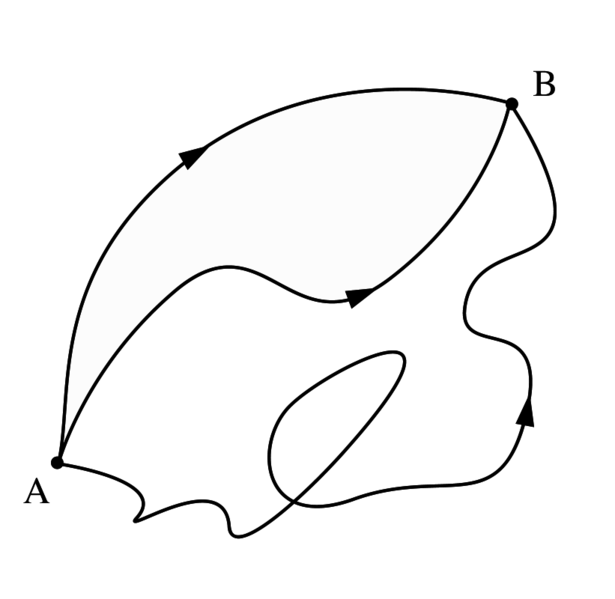
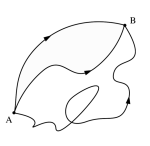
A photon can follow any path from A to B, including the craziest ones (as shown below). Any path? Good players give a billiard ball extra spin that may make the ball move in a curved trajectory, and will also affect its its collision with any other ball – but a trajectory like the one below? Why would a photon suddenly take a sharp turn left, or right, or up, or down? What’s the mechanism here? What are the ‘wheels and gears inside’ of the photon that (a) make a photon choose this path in the first place and (b) allow it to whirl, swirl and twirl like that?

615px-Three_paths_from_A_to_B

We don’t know. In fact, the question may make no sense, because we don’t know what actually happens when a photon travels through space. We know it leaves as a lump of energy, and we know it arrives as a similar lump of energy. When we actually put a detector to check which path is followed – by putting special detectors at the slits in the famous double-slit experiment, for example – the interference pattern disappears. So… Well… We don’t know how to describe what’s going on: a photon is not a billiard ball, and it’s not a classical electromagnetic wave either. It is neither. The only thing that we know is that we get probabilities that match with the results of experiment if we accept this nonsensical assumptions and do all of the crazy arithmetic involved. Let me get back to the lesson.  

Photons can also travel faster or slower than the speed of light (c is some 3×10⁸ meter per second but, in our special time unit, it’s equal to one). Does that violate relativity? It doesn’t, apparently, but for the reasoning behind I must, once again, refer you to more sophisticated writing.

In any case, if the mathematicians and physicists have to take into account both of these assumptions (any path is possible, and speeds higher or lower than c are possible too!), they must be looking at some kind of horrendous integral, don’t they?

They are. When everything is said and done, that propagator function is some monstrous integral indeed, and I can’t explain it to you in a couple of words – if only because I am struggling with it myself. 🙂 So I will just believe Feynman when he says that, when the mathematicians and physicists are finished with that integral, we do get some simple formula which depends on the value of the so-called spacetime interval between two ‘points’ – let’s just call them 1 and 2 – in space and time. You’ve surely heard about it before: it’s denoted by sor I (or whatever) and it’s zero if an object moves at the speed of light, which is what light is supposed to do – but so we’re dealing with a different situation here. 🙂 To be precise, I consists of two parts:

  1. The distance d between the two points (1 and 2), i.e. Δr, which is just the square root of d= Δr= (x2–x2)2+(y2–y1)2+(z2–z1)2. [This formula is just a three-dimensional version of the Pythagorean Theorem.]
  2. The ‘distance’ (or difference) in time, which is usually expressed in those ‘equivalent’ time units that we introduced above already, i.e. the time that light – traveling at the speed of light 🙂 – needs to travel one meter. We will usually see that component of I in a squared version too: Δt= (t2–t1)2, or, if time is expressed in the ‘old’ unit (i.e. seconds), then we write c2Δt2 = c2(t2–t1)2.

Now, the spacetime interval itself is defined as the excess of the squared distance (in space) over the squared time difference:

s= I = Δr– Δt= (x2–x2)2+(y2–y1)2+(z2–z1)– (t2–t1)2

You know we can then define time-like, space-like and light-like intervals, and these, in turn, define the so-called light cone. The spacetime interval can be negative, for example. In that case, Δt2 will be greater than Δr2, so there is no ‘excess’ of distance over time: it means that the time difference is large enough to allow for a cause–effect relation between the two events, and the interval is said to be time-like. In any case, that’s not the topic of this post, and I am sorry I keep digressing.

The point to note is that the formula for the propagator favors light-like intervals: they are associated with large arrows. Space- and time-like intervals, on the other hand, will contribute much smaller arrows. In addition, the arrows for space- and time-like intervals point in opposite directions, so they will cancel each other out. So, when everything is said and done, over longer distances, light does tend to travel in a straight line and at the speed of light. At least, that’s what Feynman tells us, and I tend to believe him. 🙂

But so where’s the formula? Feynman doesn’t give it, probably because it would indeed confuse us. Just google ‘propagator for a photon’ and you’ll see what I mean. He does integrate the above conclusions in that illustration (b) though. What illustration? 

Oh… Sorry. You probably forgot what I am trying to do here, but so we’re looking at that analysis of partial reflection of light by glass. Let me insert it once again so you don’t have to scroll all the way up.

partial reflection

You’ll remember that Feynman divided the glass sheet into five sections and, hence, there are six points from which the photon can be scattered into the detector at A: X1 to X6. So that makes six possible paths: these paths are all straight (so Feynman makes abstraction of all of the crooked paths indeed), and the other assumption is that the photon effectively traveled at the speed of light, whatever path it took (so Feynman also assumes the amplitudes for speeds higher or lower than c cancel each other out). So that explains the difference in time at emission from the light source. The longest path is the path to point X6 and then back up to the detector. If the photon would have taken that path, it would have to be emitted earlier in time – earlier as compared to the other possibilities, which take less time. So it would have to be emitted at T = T6. The direction of the ‘arrow’ is like one o’clock. The shorter paths are associated with shorter times (the difference between the time of arrival and departure is shorter) and so T5 is associated with an arrow in the 12 o’clock direction, T5 is 11 o’clock, and so on, till T5, which points at the 9 o’clock direction.

But… What? These arrows also include the reflection, i.e. the interaction between the photon and some electron in the glass, don’t they? […] Right you are. Sorry. So… Yes. The action above involves four ‘basic actions’:

  1. A photon is emitted by the source at a time T = T1, T2, T3, T4, T5 or T6: we don’t know. Quantum-mechanical uncertainty. 🙂
  2. It goes from the source to one of the points X = X1, X2, X3, X4, X5 or Xin the glass: we don’t know which one, because we don’t have a detector there.
  3. The photon interacts with an electron at that point.
  4. It makes it way back up to the detector at A.

Step 1 does not have any amplitude. It’s just the start of the event. Well… We start with the unit arrow pointing north actually, so its length is one and its direction is 12 o’clock. And so we’ll shrink and turn it, i.e. multiply it with other arrows, in the next steps.

Steps 2 and 4 are straightforward and are associated with arrows of the same length. Their direction depends on the distance traveled and/or the time of emission: it amounts to the same because we assume the speed is constant and exactly the same for the six possibilities (that speed is c = 1 obviously). But what length? Well… Some length according to that formula which Feynman didn’t give us. 🙂

So now we need to analyze the third of those three basic actions: a ‘junction’ or ‘coupling’ between an electron and a photon. At this point, Feynman embarks on a delightful story highlighting the difficulties involved in calculating that amplitude. A photon can travel following crooked paths and at devious speeds, but an electron is even worse: it can take what Feynman refers to as ‘one-hop flights’, ‘two-hop flights’, ‘three-hop flights’,… any ‘n-hop flight’ really. Each stop involves an additional amplitude, which is represented by n2, with n some number that has been determined from experiment. The formula for E(A to B) then becomes a series of terms: P(A to B) + (P(A to C)∗n2∗(P(C to B) + (P(A to D)∗n2∗P(D to E)∗n2∗P(E to C)+…

P(A to B) is the ‘one-hop flight’ here, while C, D and E are intermediate points, and (P(A to C)∗n2∗(P(C to B) and (P(A to D)∗n2∗P(D to E)∗n2∗P(E to C) are the ‘two-hop’ and ‘three-hop’ flight respectively. Note that this calculation has to be made for all possible intermediate points C, D, E and so on. To make matters worse, the theory assumes that electrons can emit and absorb photons along the way, and then there’s a host of other problems, which Feynman tries to explain in the last and final chapter of his little book. […]

Hey! Stop it!

What?

You’re talking about E(A to B) here. You’re supposed to be talking about that junction number j.

Oh… Sorry. You’re right. Well… That junction number j is about –0.1. I know that looks like an ordinary number, but it’s an amplitude, so you should interpret it as an arrow. When you multiply it with another arrow, it amounts to a shrink to one-tenth, and half a turn. Feynman entertains us also on the difficulties of calculating this number but, you’re right, I shouldn’t be trying to copy him here – if only because it’s about time I finish this post. 🙂

So let me conclude it indeed. We can apply the same transformation (i.e. we multiply with j) to each of the six arrows we’ve got so far, and the result is those six arrows next to the time axis in illustration (b). And then we combine them to get that arc, and then we apply that mathematical trick to show we get the same result as in a classical wave-theoretical analysis of partial reflection.

Done. […] Are you happy now?

[…] You shouldn’t be. There are so many questions that have been left unanswered. For starters, Feynman never gives that formula for the length of P(A to B), so we have no clue about the length of these arrows and, hence, about that arc. If physicists know their length, it seems to have been calculated backwards – from those 0.2 arrows used in the classical wave theory of light. Feynman is actually quite honest about that, and simply writes:

“The radius of the arc [i.e. the arc that determines the final arrow] evidently depends on the length of the arrow for each section, which is ultimately determined by the amplitude S that an electron in an atom of glass scatters a photon. This radius can be calculated using the formulas for the three basic actions. […] It must be said, however, that no direct calculation from first principles for a substance as complex as glass has actually been done. In such cases, the radius is determined by experiment. For glass, it has been determined from experiment that the radius is approximately 0.2 (when the light shines directly onto the glass at right angles).”

Well… OK. I think that says enough. So we have a theory – or first principles at last – but we don’t them to calculate. That actually sounds a bit like metaphysics to me. 🙂 In any case… Well… Bye for now!

But… Hey! You said you’d analyze how light goes straight through the glass as well?

Yes. I did. But I don’t feel like doing that right now. I think we’ve got enough stuff to think about right now, don’t we? 🙂

The Complementarity Principle

Pre-script (dated 26 June 2020): This post has become less relevant because my views on all things quantum-mechanical have evolved significantly as a result of my progression towards a more complete realist (classical) interpretation of quantum physics. Hence, we recommend you read our recent papers. I keep blog posts like these mainly because I want to keep track of where I came from. I might review them one day, but I currently don’t have the time or energy for it. 🙂

Original post:

Unlike what you might think when seeing the title of this post, it is not my intention to enter into philosophical discussions here: many authors have been writing about this ‘principle’, most of which–according to eminent physicists–don’t know what they are talking about. So I have no intention to make a fool of myself here too. However, what I do want to do here is explore, in an intuitive way, how the classical and quantum-mechanical explanations of the phenomenon of the diffraction of light are different from each other–and fundamentally so–while, necessarily, having to yield the same predictions. It is in that sense that the two explanations should be ‘complementary’.

The classical explanation

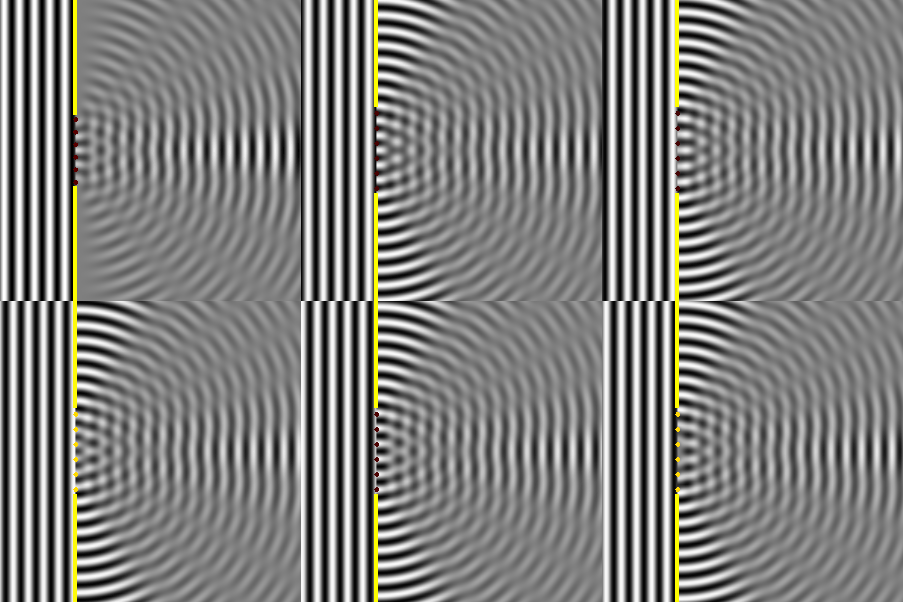
I’ve done a fairly complete analysis of the classical explanation in my posts on Diffraction and the Uncertainty Principle (20 and 21 September), so I won’t dwell on that here. Let me just repeat the basics. The model is based on the so-called Huygens-Fresnel Principle, according to which each point in the slit becomes a source of a secondary spherical wave. These waves then interfere, constructively or destructively, and, hence, by adding them, we get the form of the wave at each point of time and at each point in space behind the slit. The animation below illustrates the idea. However, note that the mathematical analysis does not assume that the point sources are neatly separated from each other: instead of only six point sources, we have an infinite number of them and, hence, adding up the waves amounts to solving some integral (which, as you know, is an infinite sum).

Huygens_Fresnel_Principle

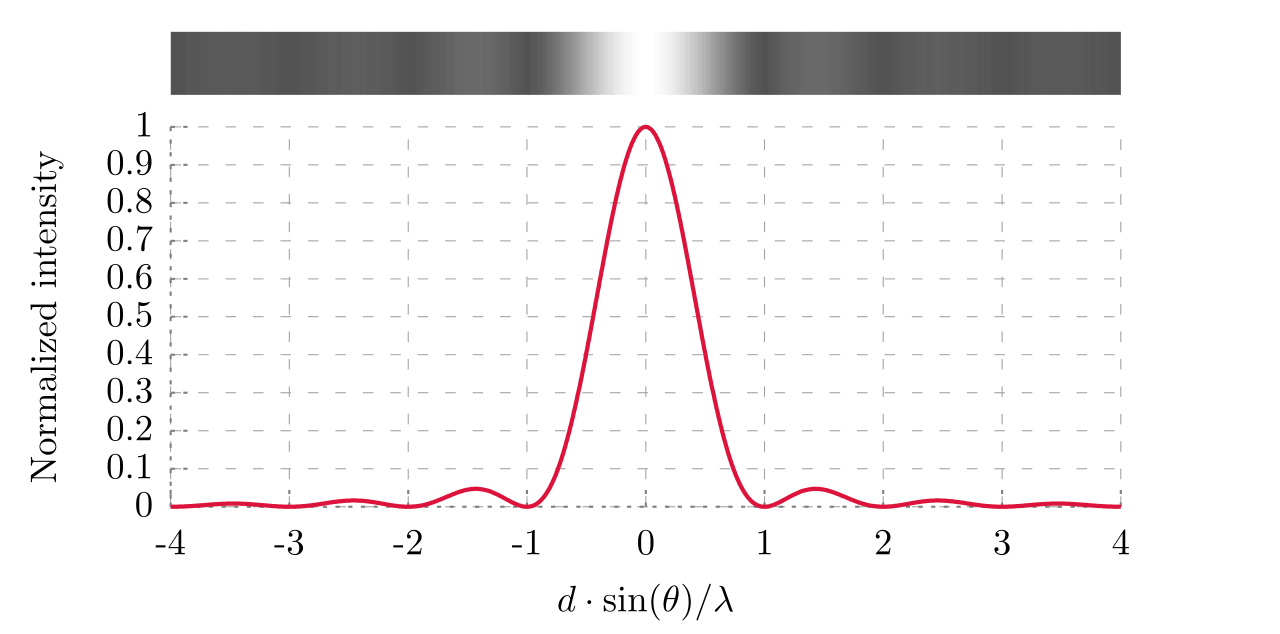
We know what we are supposed to get: a diffraction pattern. The intensity of the light on the screen at the other side depends on (1) the slit width (d), (2) the frequency of the light (λ), and (3) the angle of incidence (θ), as shown below.

Single_Slit_Diffraction_(english)

One point to note is that we have smaller bumps left and right. We don’t get that if we’d treat the slit as a single point source only, like Feynman does when he discusses the double-slit experiment for (physical) waves. Indeed, look at the image below: each of the slits acts as one point source only and, hence, the intensity curves I1 and I2 do not show a diffraction pattern. They are just nice Gaussian “bell” curves, albeit somewhat adjusted because of the angle of incidence (we have two slits above and below the center, instead of just one on the normal itself). So we have an interference pattern on the screen and, now that we’re here, let me be clear on terminology: I am going along with the widespread definition of diffraction being a pattern created by one slit, and the definition of interference as a pattern created by two or more slits. I am noting this just to make sure there’s no confusion.

Water waves

That should be clear enough. Let’s move on the quantum-mechanical explanation.

The quantum-mechanical explanation

There are several formulations of quantum mechanics: you’ve heard about matrix mechanics and wave mechanics. Roughly speaking, in matrix mechanics “we interpret the physical properties of particles as matrices that evolve in time”, while the wave mechanics approach is primarily based on these complex-valued wave functions–one for each physical property (e.g. position, momentum, energy). Both approaches are mathematically equivalent.

There is also a third approach, which is referred to as the path integral formulation, which  “replaces the classical notion of a single, unique trajectory for a system with a sum, or functional integral, over an infinity of possible trajectories to compute an amplitude” (all definitions here were taken from Wikipedia). This approach is associated with Richard Feynman but can also be traced back to Paul Dirac, like most of the math involved in quantum mechanics, it seems. It’s this approach which I’ll try to explain–again, in an intuitive way only–in order to show the two explanations should effectively lead to the same predictions.

The key to understanding the path integral formulation is the assumption that a particle–and a ‘particle’ may refer to both bosons (e.g. photons) or fermions (e.g. electrons)–can follow any path from point A to B, as illustrated below. Each of these paths is associated with a (complex-valued) probability amplitude, and we have to add all these probability amplitudes to arrive at the probability amplitude for the particle to move from A to B.

615px-Three_paths_from_A_to_B

You can find great animations illustrating what it’s all about in the relevant Wikipedia article but, because I can’t upload video here, I’ll just insert two illustrations from Feynman’s 1985 QED, in which he does what I try to do, and that is to approach the topic intuitively, i.e. without too much mathematical formalism. So probability amplitudes are just ‘arrows’ (with a length and a direction, just like a complex number or a vector), and finding the resultant or final arrow is a matter of just adding all the little arrows to arrive at one big arrow, which is the probability amplitude, which he denotes as P(A, B), as shown below.

feynman-qed-1985

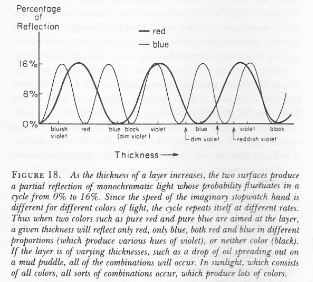
This intuitive approach is great and actually goes a very long way in explaining complicated phenomena, such as iridescence for example (the wonderful patterns of color on an oil film!), or the partial reflection of light by glass (anything between 0 and 16%!). All his tricks make sense. For example, different frequencies are interpreted as slower or faster ‘stopwatches’ and, as such, they determine the final direction of the arrows which, in turn, explains why blue and red light are reflected differently. And so on and son. It all works. […] Up to a point.

Indeed, Feynman does get in trouble when trying to explain diffraction. I’ve reproduced his explanation below. The key to the argument is the following:

  1. If we have a slit that’s very wide, there are a lot of possible paths for the photon to take. However, most of these paths cancel each other out, and so that’s why the photon is likely to travel in a straight line. Let me quote Feynman: “When the gap between the blocks is wide enough to allow many neighboring paths to P and Q, the arrows for the paths to P add up (because all the paths to P take nearly the same time), while the paths to Q cancel out (because those paths have a sizable difference in time). So the photomultiplier at Q doesn’t click.” (QED, p.54)
  2. However, “when the gap is nearly closed and there are only a few neighboring paths, the arrows to Q also add up, because there is hardly any difference in time between them, either (see Fig. 34). Of course, both final arrows are small, so there’s not much light either way through such a small hole, but the detector at Q clicks almost as much as the one at P! So when you try to squeeze light too much to make sure it’s going only in a straight line, it refuses to cooperate and begins to spread out.” (QED, p. 55)

Many arrowsFew arrows

This explanation is as simple and intuitive as Feynman’s ‘explanation’ of diffraction using the Uncertainty Principle in his introductory chapter on quantum mechanics (Lectures, I-38-2), which is illustrated below. I won’t go into the detail (I’ve done that before) but you should note that, just like the explanation above, such explanations do not explain the secondary, tertiary etc bumps in the diffraction pattern.

Diffraction of electrons

So what’s wrong with these explanations? Nothing much. They’re simple and intuitive, but essentially incomplete, because they do not incorporate all of the math involved in interference. Incorporating the math means doing these integrals for

  1. Electromagnetic waves in classical mechanics: here we are talking ‘wave functions’ with some real-valued amplitude representing the strength of the electric and magnetic field; and
  2. Probability waves: these are complex-valued functions, with the complex-valued amplitude representing probability amplitudes.

The two should, obviously, yield the same result, but a detailed comparison between the approaches is quite complicated, it seems. Now, I’ve googled a lot of stuff, and I duly note that diffraction of electromagnetic waves (i.e. light) is conveniently analyzed by summing up complex-valued waves too, and, moreover, they’re of the same familiar type: ψ = Aei(kx–ωt). However, these analyses also duly note that it’s only the real part of the wave that has an actual physical interpretation, and that it’s only because working with natural exponentials (addition, multiplication, integration, derivation, etc) is much easier than working with sine and cosine waves that such complex-valued wave functions are used (also) in classical mechanics. In fact, note the fine print in Feynman’s illustration of interference of physical waves (Fig. 37-2): he calculates the intensities I1 and I2 by taking the square of the absolute amplitudes ĥ1 and ĥ2, and the hat indicates that we’re also talking some complex-valued wave function here.

Hence, we must be talking the same mathematical waves in both explanations, aren’t we? In other words, we should get the same psi functions ψ = Aei(kx–ωt) in both explanations, don’t we? Well… Maybe. But… Probably not. As far as I know–but I must be wrong–we cannot just re-normalize the E and B vectors in these electromagnetic waves in order to establish an equivalence with probability waves. I haven’t seen that being done (but I readily admit I still have a lot of reading to do) and so I must assume it’s not very clear-cut at all.

So what? Well… I don’t know. So far, I did not find a ‘nice’ or ‘intuitive’ explanation of a quantum-mechanical approach to the phenomenon of diffraction yielding the same grand diffraction equation, referred to as the Fresnel-Kirchoff diffraction formula (see below), or one of its more comprehensible (because simplified) representations, such as the Fraunhofer diffraction formula, or the even easier formula which I used in my own post (you can google them: they’re somewhat less monstrous and–importantly–they work with real numbers only, which makes them easier to understand).

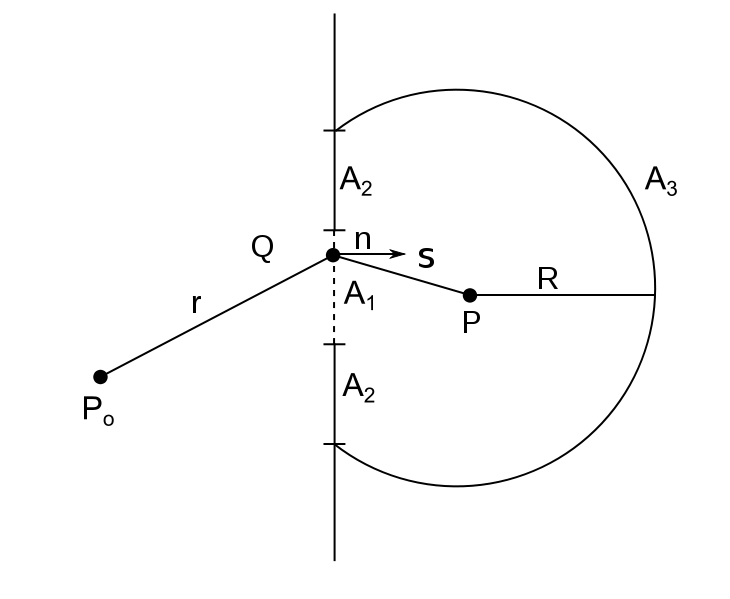
Kirchoff formula[…] That looks pretty daunting, isn’t it? You may start to understand it a bit better by noting that (n, r) and (n, s) are angles, so that’s OK in a cosine function. The other variables also have fairly standard interpretations, as shown below, but… Admit it: ‘easy’ is something else, isn’t it?

730px-Kirchhoff_1

So… Where are we here? Well… As said, I trust that both explanations are mathematically equivalent – just like matrix and wave mechanics 🙂 –and, hence, that a quantum-mechanical analysis will indeed yield the same formula. However, I think I’ll only understand physics truly if I’ve gone through all of the motions here.

Well then… I guess that should be some kind of personal benchmark that should guide me on this journey, isn’t it? 🙂 I’ll keep you posted.

Post scriptum: To be fair to Feynman, and demonstrating his talent as a teacher once again, he actually acknowledges that the double-slit thought experiment uses simplified assumptions that do not include diffraction effects when the electrons go through the slit(s). He does so, however, only in one of the first chapters of Vol. III of the Lectures, where he comes back to the experiment to further discuss the first principles of quantum mechanics. I’ll just quote him: “Incidentally, we are going to suppose that the holes 1 and 2 are small enough that when we say an electron goes through the hole, we don’t have to discuss which part of the hole. We could, of course, split each hole into pieces with a certain amplitude that the electron goes to the top of the hole and the bottom of the hole and so on. We will suppose that the hole is small enough so that we don’t have to worry about this detail. That is part of the roughness involved; the matter can be made more precise, but we don’t want to do so at this stage.” So here he acknowledges that he omitted the intricacies of diffraction. I noted this only later. Sorry.

Some content on this page was disabled on June 17, 2020 as a result of a DMCA takedown notice from Michael A. Gottlieb, Rudolf Pfeiffer, and The California Institute of Technology. You can learn more about the DMCA here:

https://wordpress.com/support/copyright-and-the-dmca/
Some content on this page was disabled on June 20, 2020 as a result of a DMCA takedown notice from Michael A. Gottlieb, Rudolf Pfeiffer, and The California Institute of Technology. You can learn more about the DMCA here:

https://wordpress.com/support/copyright-and-the-dmca/

Diffraction and the Uncertainty Principle (II)

Pre-script (dated 26 June 2020): This post did not suffer too much from the attack on this blog by the the dark force. It remains relevant. 🙂

Original post:

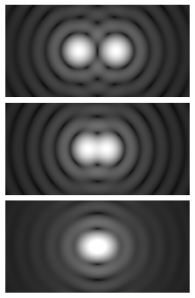
In my previous post, I derived and explained the general formula for the pattern generated by a light beam going through a slit or a circular aperture: the diffraction pattern. For light going through an aperture, this generates the so-called Airy pattern. In practice, diffraction causes a blurring of the image, and may make it difficult to distinguish two separate points, as shown below (credit for the image must go to Wikipedia again, I am afraid).

Airy_disk_spacing_near_Rayleigh_criterion

What’s actually going on is that the lens acts as a slit or, if it’s circular (which is usually the case), as an aperture indeed: the wavefront of the transmitted light is taken to be spherical or plane when it exits the lens and interferes with itself, thereby creating the ring-shaped diffraction pattern that we explained in the previous post.

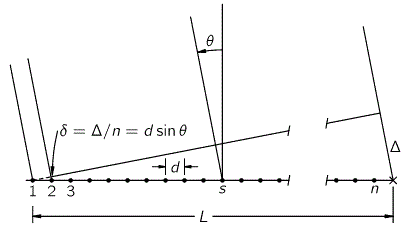
The spatial resolution is also known as the angular resolution, which is quite appropriate, because it refers to an angle indeed: we know the first minimum (i.e. the first black ring) occurs at an angle θ such that sinθ = λ/L, with λ the wavelength of the light and L the lens diameter. It’s good to remind ourselves of the geometry of the situation: below we picture the array of oscillators, and so we know that the first minimum occurs at an angle such that Δ = λ. The second, third, fourth etc minimum occurs at an angle θ such that Δ = 2λ, 3λ, 4λ, etc. However, these secondary minima do not play any role in determining the resolving power of a lens, or a telescope, or an electron microscope, etc, and so you can just forget about them for the time being.

geometry

For small angles (expressed in radians), we can use the so-called small-angle approximation and equate sinθ with θ: the error of this approximation is less than one percent for angles smaller than 0.244 radians (14°), so we have the amazingly simply result that the first minimum occurs at an angle θ such that:

θ = λ/L

Spatial resolution of a microscope: the Rayleigh criterion versus Dawes’ limit 

If we have two point sources right next to each other, they will create two Airy disks, as shown above, which may overlap. That may make it difficult to see them, in a telescope, a microscope, or whatever device. Hence, telescopes, microscopes (using light or electron beams or whatever) have a limited resolving power. How do we measure that?

The so-called Rayleigh criterion regards two point sources as just resolved when the principal diffraction maximum of one image coincides with the first minimum of the other, as shown below. If the distance is greater, the two points are (very) well resolved, and if it is smaller, they are regarded as not resolved. This angle is obviously related to the θ = λ/L angle but it’s not the same: in fact, it’s a slightly wider angle. The analysis involved in calculating the angular resolution in terms of angle, and we use the same symbol θ for it, is quite complicated and so I’ll skip that and just give you the result:

θ = 1.22λ/L

two point sourcesRayleigh criterion

Note that, in this equation, θ stands for the angular resolution, λ for the wavelength of the light being used, and L is the diameter of the (aperture of) the lens. In the first of the three images above, the two points are well separated and, hence, the angle between them is well above the angular resolution. In the second, the angle between just meets the Rayleigh criterion, and in the third the angle between them is smaller than the angular resolution and, hence, the two points are not resolved.

Of course, the Rayleigh criterion is, to some extent, a matter of judgment. In fact, an English 19th century astronomer, named William Rutter Dawes, actually tested human observers on close binary stars of equal brightness, and found they could make out the two stars within an angle that was slightly narrower than the one given by the Rayleigh criterion. Hence, for an optical telescope, you’ll also find the simple θ = λ/L formula, so that’s the formula without the 1.22 factor (of course, λ here is, once again, the wavelength of the observed light or radiation, and L is the diameter of the telescope’s primary lens). This very simple formula allows us, for example, to calculate the diameter of the telescope lens we’d need to build to separate (see) objects in space with a resolution of, for example, 1 arcsec (i.e. 1/3600 of a degree or π/648,000 of a radian). Indeed, if we filter for yellow light only, which has a wavelength of 580 nm, we find L = 580×10−9 m/(π/648,000) = 0.119633×10⁻⁶ m ≈ 12 cm. [Just so you know: that’s about the size of the lens aperture of a good telescope (4 or 6 inches) for amateur astronomers–just in case you’d want one. :-)]

This simplified formula is called Dawes’ limit, and you’ll often see it used instead of Rayleigh’s criterion. However, the fact that it’s exactly the same formula as our formula for the first minimum of the Airy pattern should not confuse you: angular resolution is something different.

Now, after this introduction, let me get to the real topic of this post: Heisenberg’s Uncertainty Principle according to Heisenberg.

Heisenberg’s Uncertainty Principle according to Heisenberg

I don’t know about you but, as a kid, I didn’t know much about waves and fields and all that, and so I had difficulty understanding why the resolving power of a microscope or any other magnifying device depended on the frequency or wavelength. I now know my understanding was limited because I thought the concept of the amplitude of an electromagnetic wave had some spatial meaning, like the amplitude of a water or a sound wave. You know what I mean: this false idea that an electromagnetic wave is something that sort of wriggles through space, just like a water or sound wave wriggle through their medium (water and air respectively). Now I know better: the amplitude of an electromagnetic wave measures field strength and there’s no medium (no aether). So it’s not like a wave going around some object, or making some medium oscillate. I am not ashamed to acknowledge my stupidity at the time: I am just happy I finally got it, because it helps to really understand Heisenberg’s own illustration of his Uncertainty Principle, which I’ll present now.

Heisenberg imagined a gamma-ray microscope, as shown below (I copied this from the website of the American Institute for Physics ). Gamma-ray microscopes don’t exist – they’re hard to produce: you need a nuclear reactor or so 🙂 – but, as Heisenberg saw the development of new microscopes using higher and higher energy beams (as opposed to the 1.5-3 eV light in the visible spectrum) so as to increase the angular resolution and, hence, be able to see smaller things, he imagined one could use, perhaps, gamma-rays for imaging. Gamma rays are the hardest radiation, with frequencies of 10 exaherz and more (or >1019 Hz) and, hence, energies above 100 keV (i.e. 100,000 more than photons in the visible light spectrum, and 1000 times more than the electrons used in an average electron microscope). Gamma rays are not the result of some electron jumping from a higher to a lower energy level: they are emitted in decay processes of atomic nuclei (gamma decay). But I am digressing. Back to the main story line. So Heisenberg imagined we could ‘shine’ gamma rays on an electron and that we could then ‘see’ that electron in the microscope because some of the gamma photons would indeed end up in the microscope after their ‘collision’ with the electron, as shown below.

gammaray

The experiment is described in many places elsewhere but I found these accounts often confusing, and so I present my own here. 🙂

What Heisenberg basically meant to show is that this set-up would allow us to gather precise information on the position of the electron–because we would know where it was–but that, as a result, we’d lose information in regard to its momentum. Why? To put it simply: because the electron recoils as a result of the interaction. The point, of course, is to calculate the exact relationship between the two (position and momentum). In other words: what we want to do is to state the Uncertainty Principle quantitatively, not qualitatively.

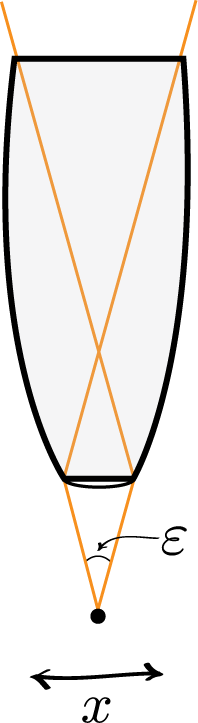
Now, the animation above uses the symbol L for the γ-ray wavelength λ, which is confusing because I used L for the diameter of the aperture in my explanation of diffraction above. The animation above also uses a different symbol for the angular resolution: A instead of θ. So let me borrow the diagram used in the Wikipedia article and rephrase the whole situation.

Heisenberg_Microscope

From the diagram above, it’s obvious that, to be scattered into the microscope, the γ-ray photon must be scattered into a cone with angle ε. That angle is obviously related to the angular resolution of the microscope, which is θ = ε/2 = λ/D, with D the diameter of the aperture (i.e. the primary lens). Now, the electron could actually be anywhere, and the scattering angle could be much larger than ε, and, hence, relating D to the uncertainty in position (Δx) is not as obvious as most accounts of this thought experiment make it out to be. The thing is: if the scattering angle is larger than ε, it won’t reach the light detector at the end of the microscope (so that’s the flat top in the diagram above). So that’s why we can equate D with Δx, so we write Δx = ± D/2 = D. To put it differently: the assumption here is basically that this imaginary microscope ‘sees’ an area that is approximately as large as the lens. Using the small-angle approximation (so we write sin(2ε) ≈ 2ε), we can write:

Δx = 2λ/ε

Now, because of the recoil effect, the electron receives some momentum from the γ-ray photon. How much? Well… The situation is somewhat complicated (much more complicated than the Wikipedia article on this very same topic suggests), because the photon keeps some but also gives some of its original momentum. In fact, what’s happening really is Compton scattering: the electron first absorbs the photon, and then emits another with a different energy and, hence, also with different frequency and wavelength. However, what we do now is that the photon’s original momentum was equal to E/c= p = h/λ. That’s just the Planck relation or, if you’d want to look at the photon as a particle, the de Broglie equation.

Now, because we’re doing an analysis in one dimension only (x), we’re only going to look at the momentum in this direction only, i.e. px, and we’ll assume that all of the momentum of the photon before the interaction (or ‘collision’ if you want) was horizontal. Hence, we can write p= h/λ. After the collision, however, this momentum is spread over the electron and the scattered or emitted photon that’s going into the microscope. Let’s now imagine the two extremes:

  1. The scattered photon goes to the left edge of the lens. Hence, its horizontal momentum is negative (because it moves to the left) and the momentum pwill be distributed over the electron and the photon such that p= p’–h(ε/2)/λ’. Why the ε/2 factor? Well… That’s just trigonometry: the horizontal momentum of the scattered photon is obviously only a tiny fraction of its original horizontal momentum, and that fraction is given by the angle ε/2.
  2. The scattered photon goes to the right edge of the lens. In that case, we write p= p”+ h(ε/2)/λ”.

Now, the spread in the momentum of the electron, which we’ll simply write as Δp, is obviously equal to:

Δp = p”– p’= p+ h(ε/2)/λ” – p+ h(ε/2)/λ’ = h(ε/2)/λ” + h(ε/2)/λ’ = h(ε/2)/λ” + h(ε/2)/λ’

That’s a nice formula, but what can we do with it? What we want is a relationship between Δx and Δp, i.e. the position and the momentum of the electron, and of the electron only. That involves another simplification, which is also dealt with very summarily – too summarily in my view – in most accounts of this experiment. So let me spell it out. The angle ε is obviously very small and, hence, we may equate λ’ and λ”. In addition, while these two wavelengths differ from the wavelength of the incoming photon, the scattered photon is, obviously, still a gamma ray and, therefore, we are probably not too far off when substituting both λ’ and λ” for λ, i.e. the frequency of the incoming γ-ray. Now, we can re-write Δx = 2λ/ε as 1/Δx = ε/(2λ). We then get:

Δp = p”– p’= hε/2λ” + hε/2λ’ = 2hε/2λ = 2h/Δx

Now that yields ΔpΔx = 2h, which is an approximate expression of Heisenberg’s Uncertainty Principle indeed (don’t worry about the factor 2, as that’s something that comes with all of the approximations).

A final moot point perhaps: it is obviously a thought experiment. Not only because we don’t have gamma-ray microscopes (that’s not relevant because we can effectively imagine constructing one) but because the experiment involves only one photon. A real microscope would organize a proper beam, but that would obviously complicate the analysis. In fact, it would defeat the purpose, because the whole point is to analyze one single interaction here.

The interpretation

Now how should we interpret all of this? Is this Heisenberg’s ‘proof’ of his own Principle? Yes and no, I’d say. It’s part illustration, and part ‘proof’, I would say. The crucial assumptions here are:

  1. We can analyze γ-ray photons, or any photon for that matter, as particles having some momentum, and when ‘colliding’, or interacting, with an electron, the photon will impart some momentum to that electron.
  2. Momentum is being conserved and, hence, the total (linear) momentum before and after the collision, considering both particles–i.e. (1) the incoming ray and the electron before the interaction and (2) the emitted photon and the electron that’s getting the kick after the interaction–must be the same.
  3. For the γ-ray photon, we can relate (or associate, if you prefer that term) its wavelength λ with its momentum p through the Planck relation or, what amounts to the same for photons (because they have no mass), the de Broglie relation.

Now, these assumptions are then applied to an analysis of what we know to be true from experiment, and that’s the phenomenon of diffraction, part of which is the observation that the resolving power of a microscope is limited, and that its resolution is given by the θ = λ/D equation.

Bringing it all together, then gives us a theory which is consistent with experiment and, hence, we then assume the theory is true. Why? Well… I could start a long discourse here on the philosophy of science but, when everything is said and done, we should admit we don’t any ‘better’ theory.

But, you’ll say: what’s a ‘better’ theory? Well… Again, the answer to that question is the subject-matter of philosophers. As for me, I’d just refer to what’s known as Occam’s razor: among competing hypotheses, we should select the one with the fewest assumptions. Hence, while more complicated solutions may ultimately prove correct, the fewer assumptions that are made, the better. Now, when I was a kid, I thought quantum mechanics was very complicated and, hence, describing it here as a ‘simple’ theory sounds strange. But that’s what it is in the end: there’s no better (read: simpler) way to describe, for example, why electrons interfere with each other, and with themselves, when sending them through one or two slits, and so that’s what all these ‘illustrations’ want to show in the end, even if you think there must be simpler way to describe reality. As said, as a kid, I thought so too. 🙂

Some content on this page was disabled on June 17, 2020 as a result of a DMCA takedown notice from Michael A. Gottlieb, Rudolf Pfeiffer, and The California Institute of Technology. You can learn more about the DMCA here:

https://wordpress.com/support/copyright-and-the-dmca/
Some content on this page was disabled on June 17, 2020 as a result of a DMCA takedown notice from Michael A. Gottlieb, Rudolf Pfeiffer, and The California Institute of Technology. You can learn more about the DMCA here:

https://wordpress.com/support/copyright-and-the-dmca/

Photons as strings

Pre-script written much later: In the meanwhile, we figured it all out. We found the common-sense interpretation of quantum physics. No ambiguity. No hocus-pocus. I keep posts like the one below online only to, one day, go back to where I went wrong. 🙂

Jean Louis Van Belle, 20 May 2020

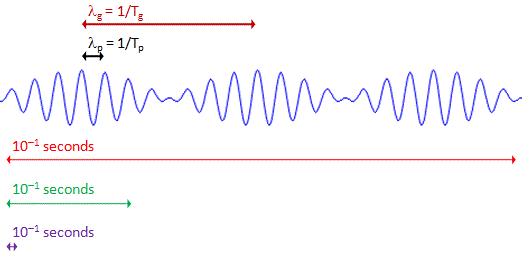
In my previous post, I explored, somewhat jokingly, the grey area between classical physics and quantum mechanics: light as a wave versus light as a particle. I did so by trying to picture a photon as an electromagnetic transient traveling through space, as illustrated below. While actual physicists would probably deride my attempt to think of a photon as an electromagnetic transient traveling through space, the idea illustrates the wave-particle duality quite well, I feel.

Photon wave

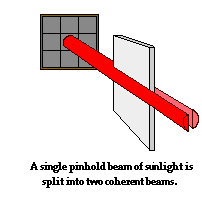
Understanding light is the key to understanding physics. Light is a wave, as Thomas Young proved to the Royal Society of London in 1803, thereby demolishing Newton’s corpuscular theory. But its constituents, photons, behave like particles. According to modern-day physics, both were right. Just to put things in perspective, the thickness of the note card which Young used to split the light – ordinary sunlight entering his room through a pinhole in a window shutter – was 1/30 of an inch, or approximately 0.85 mm. Hence, in essence, this is a double-slit experiment with the two slits being separated by a distance of almost 1 millimeter. That’s enormous as compared to modern-day engineering tolerance standards: what was thin then, is obviously not considered to be thin now. Scale matters. I’ll come back to this.

Young’s experiment (from www.physicsclassroom.com)

Young experiment

The table below shows that the ‘particle character’ of electromagnetic radiation becomes apparent when its frequency is a few hundred terahertz, like the sodium light example I used in my previous post: sodium light, as emitted by sodium lamps, has a frequency of 500×1012 oscillations per second and, therefore (the relation between frequency and wavelength is very straightforward: their product is the velocity of the wave, so for light we have the simple λf = c equation), a wavelength of 600 nanometer (600×10–9 meter).

Electromagnetic spectrum

However, whether something behaves like a particle or a wave also depends on our measurement scale: 0.85 mm was thin in Young’s time, and so it was a delicate experiment then but now, it’s a standard classroom experiment indeed. The theory of light as a wave would hold until more delicate equipment refuted it. Such equipment came with another sense of scale. It’s good to remind oneself that Einstein’s “discovery of the law of the photoelectric effect”, which explained the photoelectric effect as the result of light energy being carried in discrete quantized packets of energy, now referred to as photons, goes back to 1905 only, and that the experimental apparatus which could measure it was not much older. So waves behave like particles if we look at them close enough. Conversely, particles behave like waves if we look at them close enough. So there is this zone where they are neither, the zone for which we invoke the mathematical formalism of quantum mechanics or, to put it more precisely, the formalism of quantum electrodynamics: that “strange theory of light and Matter”, as Feynman calls it.

Let’s have a look at how particles became waves. It should not surprise us that the experimental apparatuses needed to confirm that electrons–or matter in general–can actually behave like a wave is more recent than the 19th century apparatuses which led Einstein to develop his ‘corpuscular’ theory of light (i.e. the theory of light as photons). The engineering tolerances involved are daunting. Let me be precise here. To be sure, the phenomenon of electron diffraction (i.e. electrons going through one slit and producing a diffraction pattern on the other side) had been confirmed experimentally already in 1925, in the famous Davisson-Germer experiment. I am saying because it’s rather famous indeed. First, because electron diffraction was a weird thing to contemplate at the time. Second, because it confirmed the de Broglie hypothesis only two years after Louis de Broglie had advanced it. And, third, because Davisson and Germer had never intended to set it up to detect diffraction: it was pure coincidence. In fact, the observed diffraction pattern was the result of a laboratory accident, and Davisson and Germer weren’t aware of other, conscious, attempts of trying to prove the de Broglie hypothesis. 🙂 […] OK. I am digressing. Sorry. Back to the lesson.

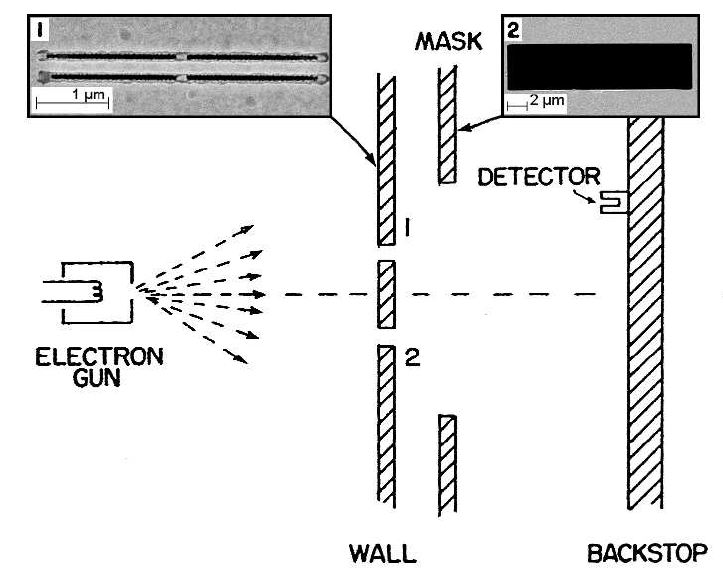
The nanotechnology that was needed to confirm Feynman’s 1965 thought experiment on electron interference (i.e. electrons going through two slits and interfering with each other (rather than producing some diffraction pattern as they go through one slit only) – and, equally significant as an experiment result, with themselves as they go through the slit(s) one by one! – was only developed over the past decades. In fact, it was only in 2008 (and again in 2012) that the experiment was carried out exactly the way Feynman describes it in his Lectures.

It is useful to think of what such experiments entail from a technical point of view. Have a look at the illustration below, which shows the set-up. The insert in the upper-left corner shows the two slits which were used in the 2012 experiment: they are each 62 nanometer wide – that’s 50×10–9 m! – and the distance between them is 272 nanometer, or 0.272 micrometer. [Just to be complete: they are 4 micrometer tall (4×10⁻⁶ m), and the thing in the middle of the slits is just a little support (150 nm) to make sure the slit width doesn’t vary.]

The second inset (in the upper-right corner) shows the mask that can be moved to close one or both slits partially or completely. The mask is 4.5µm wide ×20µm tall. Please do take a few seconds to contemplate the technology behind this feat: a nanometer is a millionth of a millimeter, so that’s a billionth of a meter, and a micrometer is a millionth of a meter. To imagine how small a nanometer is, you should imagine dividing one millimeter in ten, and then one of these tenths in ten again, and again, and once again, again, and again. In fact, you actually cannot imagine that because we live in the world we live in and, hence, our mind is used only to addition (and subtraction) when it comes to comparing sizes and – to a much more limited extent – with multiplication (and division): our brain is, quite simply, not wired to deal with exponentials and, hence, it can’t really ‘imagine’ these incredible (negative) powers. So don’t think you can imagine it really, because one can’t: in our mind, these scales exist only as mathematical constructs. They don’t correspond to anything we can actually make a mental picture of.

Electron double-slit set-up

The electron beam consisted of electrons with an (average) energy of 600 eV. That’s not an awful lot: 8.5 times more than the energy of an electron in orbit in a atom, whose energy would be some 70 eV, so the acceleration before they went through the slits was relatively modest. I’ve calculated the corresponding de Broglie wavelength of these electrons in another post (Re-Visiting the Matter-Wave, April 2014), using the de Broglie equations: f = E/h or λ = p/h. And, of course, you could just google the article on the experiment and read about it, but it’s a good exercise, and actually quite simple: just note that you’ll need to express the energy in joule (not in eV) to get it right. Also note that you need to include the rest mass of the electron in the energy. I’ll let you try it (or else just go to that post of mine). You should find a de Broglie wavelength of 50 picometer for these electrons, so that’s 50×10–12 m. While that wavelength is less than a thousandth of the slit width (62 nm), and about 5,500 times smaller than the space between the two slits (272 nm), the interference effect was unambiguous in the experiment. I advice you to google the results yourself (or read that April 2014 post of mine if you want a summary): the experiment was done at the University of Nebraska-Lincoln in 2012.

Electrons and X-rays

To put everything in perspective: 50 picometer is like the wavelength of X-rays, and you can google similar double-slit experiments for X-rays: they also loose their ‘particle behavior’ when we look at them at this tiny scale. In short, scale matters, and the boundary between ‘classical physics’ (electromagnetics) and quantum physics (wave mechanics) is not clear-cut. If anything, it depends on our perspective, i.e. what we can measure, and we seem to be shifting that boundary constantly. In what direction?

Downwards obviously: we’re devising instruments that measure stuff at smaller and smaller scales, and what’s happening is that we can ‘see’ typical ‘particles’, including hard radiation such as gamma rays, as local wave trains. Indeed, the next step is clear-cut evidence for interference between gamma rays.

Energy levels of photons

We would not associate low-frequency electromagnetic waves, such as radio or radar waves, with photons. But light in the visible spectrum, yes. Obviously. […]

Isn’t that an odd dichotomy? If we see that, on a smaller scale, particles start to look like waves, why would the reverse not be true? Why wouldn’t we analyze radio or radar waves, on a much larger scale, as a stream of very (I must say extremely) low-energy photons? I know the idea sounds ridiculous, because the energies involved would be ridiculously low indeed. Think about it. The energy of a photon is given by the Planck relation: E = h= hc/λ. For visible light, with wavelengths ranging from 800 nm (red) to 400 nm (violet or indigo), the photon energies range between 1.5 and 3 eV. Now, the shortest wavelengths for radar waves are in the so-called millimeter band, i.e. they range from 1 mm to 1 cm. A wavelength of 1 mm corresponds to a photon energy of 0.00124 eV. That’s close to nothing, of course, and surely not the kind of energy levels that we can currently detect.

But you get the idea: there is a grey area between classical physics and quantum mechanics, and it’s our equipment–notably the scale of our measurements–that determine where that grey area begins, and where it ends, and it seems to become larger and larger as the sensitivity of our equipment improves.

What do I want to get at? Nothing much. Just some awareness of scale, as an introduction to the actual topic of this post, and that’s some thoughts on a rather primitive string theory of photons. What !? 

Yes. Purely speculative, of course. 🙂

Photons as strings

I think my calculations in the previous post, as primitive as they were, actually provide quite some food for thought. If we’d treat a photon in the sodium light band (i.e. the light emitted by sodium, from a sodium lamp for instance) just like any other electromagnetic pulse, we would find it’s a pulse of some 10 meter long. We also made sense of this incredibly long distance by noting that, if we’d look at it as a particle (which is what we do when analyzing it as a photon), it should have zero size, because it moves at the speed of light and, hence, the relativistic length contraction effect ensures we (or any observer in whatever reference frame really, because light always moves at the speed of light, regardless of the reference frame) will see it as a zero-size particle.

Having said that, and knowing damn well that we have treat the photon as an elementary particle, I would think it’s very tempting to think of it as a vibrating string.

Huh?

Yes. Let me copy that graph again. The assumption I started with is a standard one in physics, and not something that you’d want to argue with: photons are emitted when an electron jumps from a higher to a lower energy level and, for all practical purposes, this emission can be analyzed as the emission of an electromagnetic pulse by an atomic oscillator. I’ll refer you to my previous post – as silly as it is – for details on these basics: the atomic oscillator has a Q, and so there’s damping involved and, hence, the assumption that the electromagnetic pulse resembles a transient should not sound ridiculous. Because the electric field as a function in space is the ‘reversed’ image of the oscillation in time, the suggested shape has nothing blasphemous.

Photon wave

Just go along with it for a while. First, we need to remind ourselves that what’s vibrating here is nothing physical: it’s an oscillating electromagnetic field. That being said, in my previous post, I toyed with the idea that the oscillation could actually also represent the photon’s wave function, provided we use a unit for the electric field that ensures that the area under the squared curve adds up to one, so as to normalize the probability amplitudes. Hence, I suggested that the field strength over the length of this string could actually represent the probability amplitudes, provided we choose an appropriate unit to measure the electric field.

But then I was joking, right? Well… No. Why not consider it? An electromagnetic oscillation packs energy, and the energy is proportional to the square of the amplitude of the oscillation. Now, the probability of detecting a particle is related to its energy, and such probability is calculated from taking the (absolute) square of probability amplitudes. Hence, mathematically, this makes perfect sense.

It’s quite interesting to think through the consequences, and I hope I will (a) understand enough of physics and (b) find enough time for this—one day! One interesting thing is that the field strength (i.e. the magnitude of the electric field vector) is a real number. Hence, if we equate these magnitudes with probability amplitudes, we’d have real probability amplitudes, instead of complex-valued ones. That’s not a very fundamental issue. It probably indicates we should also take into account the fact that the E vector also oscillates in the other direction that’s normal to the direction of propagation, i.e. the y-coordinate (assuming that the z-axis is the direction of propagation). To put it differently, we should take the polarization of the light into account. The figure below–which I took from Wikipedia again (by far the most convenient place to shop for images and animations: what would I do without it?– shows how the electric field vector moves in the xy-plane indeed, as the wave travels along the z-axis. So… Well… I still have to figure it all out, but the idea surely makes sense.

Circular.Polarization.Circularly.Polarized.Light_Right.Handed.Animation.305x190.255Colors

Another interesting thing to think about is how the collapse of the wave function would come about. If we think of a photon as a string, it must have some ‘hooks’ which could cause it to ‘stick’ or ‘collapse’ into a ‘lump’ as it hits a detector. What kind of hook? What force would come into play?

Well… The interaction between the photon and the photodetector is electromagnetic, but we’re looking for some other kind of ‘hook’ here. What could it be? I have no idea. Having said that, we know that the weakest of all fundamental forces—gravity—becomes much stronger—very much stronger—as the distance becomes smaller and smaller. In fact, it is said that, if we go to the Planck scale, the strength of the force of gravity becomes quite comparable with the other forces. So… Perhaps it’s, quite simply, the equivalent mass of the energy involved that gets ‘hooked’, somehow, as it starts interacting with the photon detector. Hence, when thinking about a photon as an oscillating string of energy, we should also think of that string as having some inseparable (equivalent) mass that, once it’s ‘hooked’, has no other option that to ‘collapse into itself’. [You may note there’s no quantum theory for gravity as yet. I am not sure how, but I’ve got a gut instinct that tells me that may help to explain why a photon consists of one single ‘unbreakable’ lump, although I need to elaborate this argument obviously.]

You must be laughing aloud now. A new string theory–really?

I know… I know… I haven’t reach sophomore level and I am already wildly speculating… Well… Yes. What I am talking about here has probably nothing to do with current string theories, although my proposed string would also replace the point-like photon by a one-dimensional ‘string’. However, ‘my’ string is, quite simply, an electromagnetic pulse (a transient actually, for reasons I explained in my previous post). Naive? Perhaps. However, I note that the earliest version of string theory is referred to as bosonic string theory, because it only incorporated bosons, which is what photons are.

So what? Well… Nothing… I am sure others have thought of this too, and I’ll look into it. It’s surely an idea which I’ll keep in the back of my head as I continue to explore physics. The idea is just too simple and beautiful to disregard, even if I am sure it must be pretty naive indeed. Photons as ten-meter long strings? Let’s just forget about it. 🙂 Onwards !!! 🙂

Post Scriptum: The key to ‘closing’ this discussion is, obviously, to be found in a full-blown analysis of the relativity of fields. So, yes, I have not done all of the required ‘homework’ on this and the previous post. I apologize for that. If anything, I hope it helped you to also try to think somewhat beyond the obvious. I realize I wasted a lot of time trying to understand the pre-cooked ready-made stuff that’s ‘on the market’, so to say. I still am, actually. Perhaps I should first thoroughly digest Feynman’s Lectures. In fact, I think that’s what I’ll try to do in the next year or so. Sorry for any inconvenience caused. 🙂

Some content on this page was disabled on June 17, 2020 as a result of a DMCA takedown notice from Michael A. Gottlieb, Rudolf Pfeiffer, and The California Institute of Technology. You can learn more about the DMCA here:

https://wordpress.com/support/copyright-and-the-dmca/

The shape and size of a photon

Important post script (PS) – dated 22 December 2018: Dear readers of this post, this is one of the more popular posts of my blog but − in the meanwhile − I did move on, and quite a bit, actually! The analysis below is not entirely consistent: I got many questions on it, and I have been thinking differently as a result. The Q&A below sums up everything: I do think of the photon as a pointlike particle now, and Chapter VIII of my book sums up the photon model. At the same time, if you are really interested in this question – how should one think of a photon? – then it’s probably good you also read the original post. If anything, it shows you how easy it is to get confused.

Hi Brian – see section III of this paper: http://vixra.org/pdf/1812.0273v2.pdf

Feynman’s classical idea of an atomic oscillator is fine in the context of the blackbody radiation problem, but his description of the photon as a long wavetrain does not make any sense. A photon has to pack two things: (1) the energy difference between the Bohr orbitals and (2) Planck’s constant h, which is the (physical) action associated with one cycle of an oscillation (so it’s a force over a distance (the loop or the radius – depending on the force you’re looking at) over a cycle time). See section V of the paper for how the fine-structure constant pops up here – it’s, as usual, a sort of scaling constant, but this time it scales a force. In any case, the idea is that we should think of a photon as one cycle – rather than a long wavetrain. The one cycle makes sense: when you calculate field strength and force you get quite moderate values (not the kind of black-hole energy concentrations some people suggest). It also makes sense from a logical point of view: the wavelength is something real, and so we should think of the photon amplitude (the electric field strength) as being real as well – especially when you think of how that photon is going to interact or be absorbed into another atom.

Sorry for my late reply. It’s been a while since I checked the comments. Please let me know if this makes sense. I’ll have a look at your blog in the coming days. I am working on a new paper on the anomalous magnetic moment – which is not anomalous as all if you start to think about how things might be working in reality. After many years of study, I’ve come to the conclusion that quantum mechanics is a nice way of describing things, but it doesn’t help us in terms of understanding anything. When we want to understand something, we need to push the classical framework a lot further than we currently do. In any case, that’s another discussion. :-/

JL


OK. Now you can move on to the post itself. 🙂 Sorry if this is confusing the reader, but it is necessary to warn him. I think of this post now as still being here to document the history of my search for a ‘basic version of truth’, as someone called it. [For an even more recent update, see Chapter 8 of my book, A Realist Interpretation of Quantum Mechanics.

Original post:

Photons are weird. All elementary particles are weird. As Feynman puts it, in the very first paragraph of his Lectures on Quantum Mechanics : “Historically, the electron, for example, was thought to behave like a particle, and then it was found that in many respects it behaved like a wave. So it really behaves like neither. Now we have given up. We say: “It is like neither. There is one lucky break, however—electrons behave just like light. The quantum behavior of atomic objects (electrons, protons, neutrons, photons, and so on) is the same for all, they are all “particle waves,” or whatever you want to call them. So what we learn about the properties of electrons will apply also to all “particles,” including photons of light.” (Feynman’s Lectures, Vol. III, Chapter 1, Section 1)

I wouldn’t dare to argue with Feynman, of course, but… What? Well… Photons are like electrons, and then they are not. Obviously not, I’d say. For starters, photons do not have mass or charge, and they are also bosons, i.e. ‘force-carriers’ (as opposed to matter-particles), and so they obey very different quantum-mechanical rules, which are referred to as Bose-Einstein statistics. I’ve written about that in other post (see, for example, my post on Bose-Einstein and Fermi-Dirac statistics), so I won’t do that again here. It’s probably sufficient to remind the reader that these rules imply that the so-called Pauli exclusion principle does not apply to them: bosons like to crowd together, thereby occupying the same quantum state—unlike their counterparts, the so-called fermions or matter-particles: quarks (which make up protons and neutrons) and leptons (including electrons and neutrinos), which can’t do that. Two electrons, for example, can only sit on top of each other (or be very near to each other, I should say) if their spins are opposite (so that makes their quantum state different), and there’s no place whatsoever to add a third one because there are only two possible ‘directions’ for the spin: up or down.

From all that I’ve been writing so far, I am sure you have some kind of picture of matter-particles now, and notably of the electron: it’s not really point-like, because it has a so-called scattering cross-section (I’ll say more about this later), and we can find it somewhere taking into account the Uncertainty Principle, with the probability of finding it at point x at time t given by the absolute square of a so-called ‘wave function’ Ψ(x, t).

But what about the photon? Unlike quarks or electrons, they are really point-like, aren’t they? And can we associate them with a psi function too? I mean, they have a wavelength, obviously, which is given by the Planck-Einstein energy-frequency relation: E = hν, with h the Planck constant and ν the frequency of the associated ‘light’. But an electromagnetic wave is not like a ‘probability wave’. So… Do they have a de Broglie wavelength as well?

Before answering that question, let me present that ‘picture’ of the electron once again.

The wave function for electrons

The electron ‘picture’ can be represented in a number of ways but one of the more scientifically correct ones – whatever that means – is that of a spatially confined wave function representing a complex quantity referred to as the probability amplitude. The animation below (which I took from Wikipedia) visualizes such wave functions. As mentioned above, the wave function is usually represented by the Greek letter psi (Ψ), and it is often referred to as a ‘probability wave’ – by bloggers like me, that is 🙂 – but that term is quite misleading. Why? You surely know that by now: the wave function represents a probability amplitude, not a probability. [So, to be correct, we should say a ‘probability amplitude wave’, or an ‘amplitude wave’, but so these terms are obviously too long and so they’ve been dropped and everybody talks about ‘the’ wave function now, although that’s confusing too, because an electromagnetic wave is a ‘wave function’ too, but describing ‘real’ amplitudes, not some weird complex numbers referred to as ‘probability amplitudes’.]

StationaryStatesAnimation

Having said what I’ve said above, probability amplitude and probability are obviously related: if we take the (absolute) square of the psi function – i.e. if we take the (absolute) square of all these amplitudes Ψ(x, t) – then we get the actual probability of finding that electron at point x at time t. So then we get the so-called probability density functions, which are shown on the right-hand side of the illustration above. [As for the term ‘absolute’ square, the absolute square is the squared norm of the associated ‘vector’. Indeed, you should note that the square of a complex number can be negative as evidenced, for example, by the definition of i: i= –1. In fact, if there’s only an imaginary part, then its square is always negative. Probabilities are real numbers between 0 and 1, and so they can’t be negative, and so that’s why we always talk about the absolute square, rather than the square as such.]

Below, I’ve inserted another image, which gives a static picture (i.e. one that is not varying in time) of the wave function of a real-life electron. To be precise: it’s the wave function for an electron on the 5d orbital of a hydrogen orbital. You can see it’s much more complicated than those easy things above. However, the idea behind is the same. We have a complex-valued function varying in space and in time. I took it from Wikipedia and so I’ll just copy the explanation here: “The solid body shows the places where the electron’s probability density is above a certain value (0.02), as calculated from the probability amplitude.” What about these colors? Well… The image uses the so-called HSL color system to represent complex numbers: each complex number is represented by a unique color, with a different hue (H), saturation (S) and lightness (L). Just google if you want to know how that works exactly.

Hydrogen_eigenstate_n5_l2_m1

OK. That should be clear enough. I wanted to talk about photons here. So let’s go for it. Well… Hmm… I realize I need to talk about some more ‘basics’ first. Sorry for that.

The Uncertainty Principle revisited (1)

The wave function is usually given as a function in space and time: Ψ = Ψ(x, t). However, I should also remind you that we have a similar function in the ‘momentum space’: if ψ is a psi function, then the function in the momentum space is a phi function, and we’ll write it as Φ = Φ(p, t). [As for the notation, x and p are written with capital letters and, hence, represent (three-dimensional) vectors. Likewise, we use a capital letter for psi and phi so we don’t confuse it with, for example, the lower-case φ (phi) representing the phase of a wave function.]

The position-space and momentum-space wave functions Ψ and Φ are related through the Uncertainty Principle. To be precise: they are Fourier transforms of each other. Huh? Don’t be put off by that statement. In fact, I shouldn’t have mentioned it, but then it’s how one can actually prove or derive the Uncertainty Principle from… Well… From ‘first principles’, let’s say, instead of just jotting it down as some God-given rule. Indeed, as Feynman puts: “The Uncertainty Principle should be seen in its historical context. If you get rid of all of the old-fashioned ideas and instead use the ideas that I’m explaining in these lectures—adding arrows for all the ways an event can happen—there is no need for an uncertainty principle!” However, I must assume you’re, just like me, not quite used to the new ideas as yet, and so let me just jot down the Uncertainty Principle once again, as some God-given rule indeed :-):

σx·σħ/2

This is the so-called Kennard formulation of the Principle: it measures the uncertainty about the exact position (x) as well as the momentum (p), in terms of the standard deviation (so that’s the σ (sigma) symbol) around the mean. To be precise, the assumption is that we cannot know the real x and p: we can only find some probability distribution for x and p, which is usually some nice “bell curve” in the textbooks. While the Kennard formulation is the most precise (and exact) formulation of the Uncertainty Principle (or uncertainty relation, I should say), you’ll often find ‘other’ formulations. These ‘other’ formulates usually write Δx and Δp instead of σand σp, with the Δ symbol indicating some ‘spread’ or a similar concept—surely do not think of Δ as a differential or so! [Sorry for assuming you don’t know this (I know you do!) but I just want to make sure here!] Also, these ‘other’ formulations will usually (a) not mention the 1/2 factor, (b) substitute ħ for h (ħ = h/2π, as you know, so ħ is preferred when we’re talking things like angular frequency or other stuff involving the unit circle), or (c) put an equality (=) sign in, instead of an inequality sign (≥). Niels Bohr’s early formulation of the Uncertainty Principle actually does all of that:

ΔxΔp h

So… Well… That’s a bit sloppy, isn’t it? Maybe. In Feynman’s Lectures, you’ll find an oft-quoted ‘application’ of the Uncertainty Principle leading to a pretty accurate calculation of the typical size of an atom (the so-called Bohr radius), which Feynman starts with an equally sloppy statement of the Uncertainty Principle, so he notes: “We needn’t trust our answer to within factors like 2, π etcetera.” Frankly, I used to think that’s ugly and, hence, doubt the ‘seriousness’ of such kind of calculations. Now I know it doesn’t really matter indeed, as the essence of the relationship is clearly not a 2, π or 2π factor. The essence is the uncertainty itself: it’s very tiny (and multiplying it with 2, π or 2π doesn’t make it much bigger) but so it’s there.

In this regard, I need to remind you of how tiny that physical constant ħ actually is: about 6.58×10⁻¹⁶ eV·s. So that’s a zero followed by a decimal point and fifteen zeroes: only then we get the first significant digits (65812…). And if 10−16 doesn’t look tiny enough for you, then just think about how tiny the electronvolt unit is: it’s the amount of (potential) energy gained (or lost) by an electron as it moves across a potential difference of one volt (which, believe me, is nothing much really): if we’d express ħ in Joule, then we’d have to add nineteen more zeroes, because 1 eV = 1.6×10⁻¹⁹ J. As for such phenomenally small numbers, I’ll just repeat what I’ve said many times before: we just cannot imagine such small number. Indeed, our mind can sort of intuitively deal with addition (and, hence, subtraction), and with multiplication and division (but to some extent only), but our mind is not made to understand non-linear stuff, such as exponentials indeed. If you don’t believe me, think of the Richter scale: can you explain the difference between a 4.0 and a 5.0 earthquake? […] If the answer to that question took you more than a second… Well… I am right. 🙂 [The Richter scale is based on the base-10 exponential function: a 5.0 earthquake has a shaking amplitude that is 10 times that of an earthquake that registered 4.0, and because energy is proportional to the square of the amplitude, that corresponds to an energy release that is 31.6 times that of the lesser earthquake.]

A digression on units

Having said what I said above, I am well aware of the fact that saying that we cannot imagine this or that is what most people say. I am also aware of the fact that they usually say that to avoid having to explain something. So let me try to do something more worthwhile here.

1. First, I should note that ħ is so small because the second, as a unit of time, is so incredibly large. All is relative, of course. 🙂 For sure, we should express time in a more natural unit at the atomic or sub-atomic scale, like the time that’s needed for light to travel one meter. Let’s do it. Let’s express time in a unit that I shall call a ‘meter‘. Of course, it’s not an actual meter (because it doesn’t measure any distance), but so I don’t want to invent a new word and surely not any new symbol here. Hence, I’ll just put apostrophes before and after: so I’ll write ‘meter’ or ‘m’. When adopting the ‘meter’ as a unit of time, we get a value for ‘ħ‘ that is equal to (6.6×10⁻¹⁶ eV·s)(1/3×108 ‘meter’/second) = 2.2×10⁻⁸ eV·’m’. Now, 2.2×10⁻⁸ is a number that is still too tiny to imagine. But then our ‘meter’ is still a rather huge unit at the atomic scale: we should take the ‘millimicron’, aka the ‘nanometer’ (1 nm = 1×10⁻⁹ m), or – even better because more appropriate – the ‘angstrom‘: 1 Å = 0.1 nm = 1×10⁻¹⁰ m. Indeed, the smallest atom (hydrogen) has a radius of 0.25 Å, while larger atoms will have a radius of about 1 or more Å. Now that should work, isn’t it? You’re right, we get a value for ‘ħ‘ equal to (6.6×10⁻¹⁶ eV·s)(1/3×108 ‘m’/s)(1×1010 ‘Å’/m) = 220 eV·’Å’, or 22 220 eV·’nm’. So… What? Well… If anything, it shows ħ is not a small unit at the atomic or sub-atomic level! Hence, we actually can start imagining how things work at the atomic level when using more adequate units.

[Now, just to test your knowledge, let me ask you: what’s the wavelength of visible light in angstrom? […] Well? […] Let me tell you: 400 to 700 nm is 4000 to 7000 Å. In other words, the wavelength of visible light is quite sizable as compared to the size of atoms or electron orbits!]

2. Secondly, let’s do a quick dimension analysis of that ΔxΔp h relation and/or its more accurate expression σx·σħ/2.

A position (and its uncertainty or standard deviation) is expressed in distance units, while momentum… Euh… Well… What? […] Momentum is mass times velocity, so it’s kg·m/s. Hence, the dimension of the product on the left-hand side of the inequality is m·kg·m/s = kg·m2/s. So what about this eV·s dimension on the right-hand side? Well… The electronvolt is a unit of energy, and so we can convert it to joules. Now, a joule is a newton-meter (N·m), which is the unit for both energy and work: it’s the work done when applying a force of one newton over a distance of one meter. So we now have N·m·s for ħ, which is nice, because Planck’s constant (h or ħ—whatever: the choice for one of the two depends on the variables we’re looking at) is the quantum for action indeed. It’s a Wirkung as they say in German, so its dimension combines both energy as well as time.

To put it simply, it’s a bit like power, which is what we men are interested in when looking at a car or motorbike engine. 🙂 Power is the energy spent or delivered per second, so its dimension is J/s, not J·s. However, your mind can see the similarity in thinking here. Energy is a nice concept, be it potential (think of a water bucket above your head) or kinetic (think of a punch in a bar fight), but it makes more  sense to us when adding the dimension of time (emptying a bucket of water over your head is different than walking in the rain, and the impact of a punch depends on the power with which it is being delivered). In fact, the best way to understand the dimension of Planck’s constant is probably to also write the joule in ‘base units’. Again, one joule is the amount of energy we need to move an object over a distance of one meter against a force of one newton. So one J·s is one N·m·s is (1) a force of one newton acting over a distance of (2) one meter over a time period equal to (3) one second.

I hope that gives you a better idea of what ‘action’ really is in physics. […] In any case, we haven’t answered the question. How do we relate the two sides? Simple: a newton is an oft-used SI unit, but it’s not a SI base unit, and so we should deconstruct it even more (i.e. write it in SI base units). If we do that, we get 1 N = 1 kg·m/s2: one newton is the force needed to give a mass of 1 kg an acceleration of 1 m/s per second. So just substitute and you’ll see the dimension on the right-hand side is kg·(m/s2)·m·s = kg·m2/s, so it comes out alright.

Why this digression on units? Not sure. Perhaps just to remind you also that the Uncertainty Principle can also be expressed in terms of energy and time:

ΔE·Δt = h

Here there’s no confusion  in regard to the units on both sides: we don’t need to convert to SI base units to see that they’re the same: [ΔE][Δt] = J·s.

The Uncertainty Principle revisited (2)

The ΔE·Δt = h expression is not so often used as an expression of the Uncertainty Principle. I am not sure why, and I don’t think it’s a good thing. Energy and time are also complementary variables in quantum mechanics, so it’s just like position and momentum indeed. In fact, I like the energy-time expression somewhat more than the position-momentum expression because it does not create any confusion in regard to the units on both sides: it’s just joules (or electronvolts) and seconds on both sides of the equation. So what?

Frankly, I don’t want to digress too much here (this post is going to become awfully long) but, personally, I found it hard, for quite a while, to relate the two expressions of the very same uncertainty ‘principle’ and, hence, let me show you how the two express the same thing really, especially because you may or may not know that there are even more pairs of complementary variables in quantum mechanics. So, I don’t know if the following will help you a lot, but it helped me to note that:

  1. The energy and momentum of a particle are intimately related through the (relativistic) energy-momentum relationship. Now, that formula, E2 = p2c2 – m02c4, which links energy, momentum and intrinsic mass (aka rest mass), looks quite monstrous at first. Hence, you may prefer a simpler form: pc = Ev/c. It’s the same really as both are based on the relativistic mass-energy equivalence: E = mc2 or, the way I prefer to write it: m = E/c2. [Both expressions are the same, obviously, but we can ‘read’ them differently: m = E/c2 expresses the idea that energy has a equivalent mass, defined as inertia, and so it makes energy the primordial concept, rather than mass.] Of course, you should note that m is the total mass of the object here, including both (a) its rest mass as well as (b) the equivalent mass it gets from moving at the speed v. So m, not m0, is the concept of mass used to define p, and note how easy it is to demonstrate the equivalence of both formulas: pc = Ev/c ⇔ mvc = Ev/c ⇔ E = mc2. In any case, the bottom line is: don’t think of the energy and momentum of a particle as two separate things; they are two aspects of the same ‘reality’, involving mass (a measure of inertia, as you know) and velocity (as measured in a particular (so-called inertial) reference frame).
  2. Time and space are intimately related through the universal constant c, i.e. the speed of light, as evidenced by the fact that we will often want to express distance not in meter but in light-seconds (i.e. the distance that light travels (in a vacuum) in one second) or, vice versa, express time in meter (i.e. the time that light needs to travel a distance of one meter).

These relationships are interconnected, and the following diagram shows how.

Uncertainty relations

The easiest way to remember it all is to apply the Uncertainty Principle, in both its ΔE·Δt = h as well as its Δp·Δx = h  expressions, to a photon. A photon has no rest mass and its velocity v is, obviously, c. So the energy-momentum relationship is a very simple one: p = E/c. We then get both expressions of the Uncertainty Principle by simply substituting E for p, or vice versa, and remember that time and position (or distance) are related in exactly the same way: the constant of proportionality is the very same. It’s c. So we can write: Δx = Δt·c and Δt = Δx/c. If you’re confused, think about it in very practical terms: because the speed of light is what it is, an uncertainty of a second in time amounts, roughly, to an uncertainty in position of some 300,000 km (c = 3×10m/s). Conversely, an uncertainty of some 300,000 km in the position amounts to a uncertainty in time of one second. That’s what the 1-2-3 in the diagram above is all about: please check if you ‘get’ it, because that’s ‘essential’ indeed.

Back to ‘probability waves’

Matter-particles are not the same, but we do have the same relations, including that ‘energy-momentum duality’. The formulas are just somewhat more complicated because they involve mass and velocity (i.e. a velocity less than that of light). For matter-particles, we can see that energy-momentum duality not only in the relationships expressed above (notably the relativistic energy-momentum relation), but also in the (in)famous de Broglie relation, which associates some ‘frequency’ (f) to the energy (E) of a particle or, what amounts to the same, some ‘wavelength’ (λ) to its momentum (p):

λ = h/p and f = E/h

These two complementary equations give a ‘wavelength’ (λ) and/or a ‘frequency’ (f) of a de Broglie wave, or a ‘matter wave’ as it’s sometimes referred to. I am using, once again, apostrophes because the de Broglie wavelength and frequency are a different concept—different than the wavelength or frequency of light, or of any other ‘real’ wave (like water or sound waves, for example). To illustrate the differences, let’s start with a very simple question: what’s the velocity of a de Broglie wave? Well… […] So? You thought you knew, didn’t you?

Let me answer the question:

  1. The mathematically (and physically) correct answer involves distinguishing the group and phase velocity of a wave.
  2. The ‘easy’ answer is: the de Broglie wave of a particle moves with the particle and, hence, its velocity is, obviously, the speed of the particle which, for electrons, is usually non-relativistic (i.e. rather slow as compared to the speed of light).

To be clear on this, the velocity of a de Broglie wave is not the speed of light. So a de Broglie wave is not like an electromagnetic wave at all. They have nothing in common really, except for the fact that we refer to both of them as ‘waves’. 🙂

The second thing to note is that, when we’re talking about the ‘frequency’ or ‘wavelength’ of ‘matter waves’ (i.e. de Broglie waves), we’re talking the frequency and wavelength of a wave with two components: it’s a complex-valued wave function, indeed, and so we get a real and imaginary part when we’re ‘feeding’ the function with some values for x and t.

Thirdly and, perhaps, most importantly, we should always remember the Uncertainty Principle when looking at the de Broglie relation. The Uncertainty Principle implies that we can actually not assign any precise wavelength (or, what amounts to the same, a precise frequency) to a de Broglie wave: if there is a spread in p (and, hence, in E), then there will be a spread in λ (and in f). In fact, I tend to think that it would be better to write the de Broglie relation as an ‘uncertainty relation’ in its own right:

Δλ = Δ(h/p) = hΔp and Δf = ΔE/h = hΔE

Besides from underscoring the fact that we have other ‘pairs’ of complementary variables, this ‘version’ of the de Broglie equation would also remind us continually of the fact that a ‘regular’ wave with an exact frequency and/or an exact wavelength (so a Δλ and/or a Δf equal to zero) would not give us any information about the momentum and/or the energy. Indeed, as Δλ and/or Δf go to zero (Δλ → 0 and/or Δf → 0 ), then Δp and ΔE must go to infinity (Δp → ∞ and ΔE → ∞. That’s just the math involved in such expressions. 🙂

Jokes aside, I’ll admit I used to have a lot of trouble understanding this, so I’ll just quote the expert teacher (Feynman) on this to make sure you don’t get me wrong here:

“The amplitude to find a particle at a place can, in some circumstances, vary in space and time, let us say in one dimension, in this manner: Ψ Aei(ωtkx, where ω is the frequency, which is related to the classical idea of the energy through ħω, and k is the wave number, which is related to the momentum through ħk. [These are equivalent formulations of the de Broglie relations using the angular frequency and the wave number instead of wavelength and frequency.] We would say the particle had a definite momentum p if the wave number were exactly k, that is, a perfect wave which goes on with the same amplitude everywhere. The Ψ Aei(ωtkxequation [then] gives the [complex-valued probability] amplitude, and if we take the absolute square, we get the relative probability for finding the particle as a function of position and time. This is a constant, which means that the probability to find a [this] particle is the same anywhere.” (Feynman’s Lectures, I-48-5)

You may say or think: What’s the problem here really? Well… If the probability to find a particle is the same anywhere, then the particle can be anywhere and, for all practical purposes, that amounts to saying it’s nowhere really. Hence, that wave function doesn’t serve the purpose. In short, that nice Ψ Aei(ωtkxfunction is completely useless in terms of representing an electron, or any other actual particle moving through space. So what to do?

The Wikipedia article on the Uncertainty Principle has this wonderful animation that shows how we can superimpose several waves, one on top of each other, to form a wave packet. Let me copy it below:

Sequential_superposition_of_plane_waves

So that’s what the wave we want indeed: a wave packet that travels through space but which is, at the same time, limited in space. Of course, you should note, once again, that it shows only one part of the complex-valued probability amplitude: just visualize the other part (imaginary if the wave above would happen to represent the real part, and vice versa if the wave would happen to represent the imaginary part of the probability amplitude). The animation basically illustrates a mathematical operation. To be precise, it involves a Fourier analysis or decomposition: it separates a wave packet into a finite or (potentially) infinite number of component waves. Indeed, note how, in the illustration above, the frequency of the component waves gradually increases (or, what amounts to the same, how the wavelength gets smaller and smaller) and how, with every wave we ‘add’ to the packet, it becomes increasingly localized. Now, you can easily see that the ‘uncertainty’ or ‘spread’ in the wavelength here (which we’ll denote by Δλ) is, quite simply, the difference between the wavelength of the ‘one-cycle wave’, which is equal to the space the whole wave packet occupies (which we’ll denote by Δx), and the wavelength of the ‘highest-frequency wave’. For all practical purposes, they are about the same, so we can write: Δx ≈ Δλ. Using Bohr’s formulation of the Uncertainty Principle, we can see the expression I used above (Δλ = hΔp) makes sense: Δx = Δλ = h/Δp, so ΔλΔp = h.

[Just to be 100% clear on terminology: a Fourier decomposition is not the same as that Fourier transform I mentioned when talking about the relation between position and momentum in the Kennard formulation of the Uncertainty Principle, although these two mathematical concepts obviously have a few things in common.]

The wave train revisited

All what I’ve said above, is the ‘correct’ interpretation of the Uncertainty Principle and the de Broglie equation. To be frank, it took me quite a while to ‘get’ that—and, as you can see, it also took me quite a while to get ‘here’, of course. 🙂

In fact, I was confused, for quite a few years actually, because I never quite understood whey there had to be a spread in the wavelength of a wave train. Indeed, we can all easily imagine a localized wave train with a fixed frequency and a fixed wavelength, like the one below, which I’ll re-use later. I’ve made this wave train myself: it’s a standard sine and cosine function multiplied with an ‘envelope’ function generating the envelope. As you can see, it’s a complex-valued thing indeed: the blue curve is the real part, and the imaginary part is the red curve.

Photon wave

You can easily make a graph like this yourself. [Just use of one of those online graph tools.] This thing is localized in space and, as mentioned above, it has a fixed frequency and wavelength. So all those enigmatic statements you’ll find in serious or less serious books (i.e. textbooks or popular accounts) on quantum mechanics saying that “we cannot define a unique wavelength for a short wave train” and/or saying that “there is an indefiniteness in the wave number that is related to the finite length of the train, and thus there is an indefiniteness in the momentum” (I am quoting Feynman here, so not one of the lesser gods) are – with all due respect for these authors, especially Feynman – just wrong. I’ve made another ‘short wave train’ below, but this time it depicts the real part of a (possible) wave function only.

graph (1)

Hmm… Now that one has a weird shape, you’ll say. It doesn’t look like a ‘matter wave’! Well… You’re right. Perhaps. [I’ll challenge you in a moment.] The shape of the function above is consistent, though, with the view of a photon as a transient electromagnetic oscillation. Let me come straight to the point by stating the basics: the view of a photon in physics is that photons are emitted by atomic oscillators. As an electron jumps from one energy level to the other, it seems to oscillate back and forth until it’s in equilibrium again, thereby emitting an electromagnetic wave train that looks like a transient.

Huh? What’s a transient? It’s an oscillation like the one above: its amplitude and, hence, its energy, gets smaller and smaller as time goes by. To be precise, its energy level has the same shape as the envelope curve below: E = E0e–t/τ. In this expression, we have τ as the so-called decay time, and one can show it’s the inverse of the so-called decay rate: τ = 1/γ with γE = –dE/dt. In case you wonder, check it out on Wikipedia: it’s one of the many applications of the natural exponential function: we’re talking a so-called exponential decay here indeed, involves a quantity (in this case, the amplitude and/or the energy) decreasing at a rate that is proportional to its current value, with the coefficient of proportionality being γ. So we write that as γE = –dE/dt in mathematical notation. 🙂

decay time

I need to move on. All of what I wrote above was ‘plain physics’, but so what I really want to explore in this post is a crazy hypothesis. Could these wave trains above – I mean the wave trains with the fixed frequency and wavelength – possible represent a de Broglie wave for a photon?

You’ll say: of course not! But, let’s be honest, you’d have some trouble explaining why. The best answer you could probably come up with is: because no physics textbook says something like that. You’re right. It’s a crazy hypothesis because, when you ask a physicist (believe it or not, but I actually went through the trouble of asking two nuclear scientists), they’ll tell you that photons are not to be associated with de Broglie waves. [You’ll say: why didn’t you try looking for an answer on the Internet? I actually did but – unlike what I am used to – I got very confusing answers on this one, so I gave up trying to find some definite answer on this question on the Internet.]

However, these negative answers don’t discourage me from trying to do some more freewheeling. Before discussing whether or not the idea of a de Broglie wave for a photon makes sense, let’s think about mathematical constraints. I googled a bit but I only see one actually: the amplitudes of a de Broglie wave are subject to a normalization condition. Indeed, when everything is said and done, all probabilities must take a value between 0 and 1, and they must also all add up to exactly 1. So that’s a so-called normalization condition that obviously imposes some constraints on the (complex-valued) probability amplitudes of our wave function.

But let’s get back to the photon. Let me remind you of what happens when a photon is being emitted by inserting the two diagrams below, which gives the energy levels of the atomic orbitals of electrons.

Energy Level Diagrams

So an electron absorbs or emits a photon when it goes from one energy level to the other, so it absorbs or emits radiation. And, of course, you will also remember that the frequency of the absorbed or emitted light is related to those energy levels. More specifically, the frequency of the light emitted in a transition from, let’s say, energy level Eto Ewill be written as ν31 = (E– E1)/h. This frequency will be one of the so-called characteristic frequencies of the atom and will define a specific so-called spectral emission line.

Now, from a mathematical point of view, there’s no difference between that ν31 = (E– E1)/h equation and the de Broglie equation, f = E/h, which assigns a de Broglie wave to a particle. But, of course, from all that I wrote above, it’s obvious that, while these two formulas are the same from a math point of view, they represent very different things. Again, let me repeat what I said above: a de Broglie wave is a matter-wave and, as such, it has nothing to do with an electromagnetic wave. 

Let me be even more explicit. A de Broglie wave is not a ‘real’ wave, in a sense (but, of course, that’s a very unscientific statement to make); it’s a psi function, so it represents these weird mathematical quantities–complex probability amplitudes–which allow us to calculate the probability of finding the particle at position x or, if it’s a wave function for the momentum-space, to find a value p for its momentum. In contrast, a photon that’s emitted or absorbed represents a ‘real’ disturbance of the electromagnetic field propagating through space. Hence, that frequency ν is something very different than f, which is why we use another symbol for it (ν is the Greek letter nu, not to be confused with the v symbol we use for velocity). [Of course, you may wonder how ‘real’ or ‘unreal’ an electromagnetic field is but, in the context of this discussion, let me assure you we should look at it as something that’s very real.]

That being said, we also know light is emitted in discrete energy packets: in fact, that’s how photons were defined originally, first by Planck and then by Einstein. Now, when an electron falls from one energy level in an atom to another (lower) energy level, it emits one – and only one – photon with that particular wavelength and energy. The question then is: how should we picture that photon? Does it also have some more or less defined position in space, and some momentum? The answer is definitely yes, on both accounts:

  1. Subject to the constraints of the Uncertainty Principle, we know, more or less indeed, when a photon leaves a source and when it hits some detector. [And, yes, due to the ‘Uncertainty Principle’ or, as Feynman puts it, the rules for adding arrows, it may not travel in a straight line and/or at the speed of light—but that’s a discussion that, believe it or not, is not directly relevant here. If you want to know more about it, check one or more of my posts on it.]
  2. We also know light has a very definite momentum, which I’ve calculated elsewhere and so I’ll just note the result: p = E/c. It’s a ‘pushing momentum’ referred to as radiation pressure, and its in the direction of travel indeed.

In short, it does makes sense, in my humble opinion that is, to associate some wave function with the photon, and then I mean a de Broglie wave. Just think about it yourself. You’re right to say that a de Broglie wave is a ‘matter wave’, and photons aren’t matter but, having said that, photons do behave like like electrons, don’t they? There’s diffraction (when you send a photon through one slit) and interference (when photons go through two slits, altogether or – amazingly – one by one), so it’s the same weirdness as electrons indeed, and so why wouldn’t we associate some kind of wave function with them?

You can react in one of three ways here. The first reaction is: “Well… I don’t know. You tell me.” Well… That’s what I am trying to do here. 🙂

The second reaction may be somewhat more to the point. For example, those who’ve read Feynman’s Strange Theory of Light and Matter, could say: “Of course, why not? That’s what we do when we associate a photon going from point A to B with an amplitude P(A to B), isn’t it?”

Well… No. I am talking about something else here. Not some amplitude associated with a path in spacetime, but a wave function giving an approximate position of the photon.

The third reaction may be the same as the reaction of those two nuclear scientists I asked: “No. It doesn’t make sense. We do not associate photons with a de Broglie wave.” But so they didn’t tell me why because… Well… They didn’t have the time to entertain a guy like me and so I didn’t dare to push the question and continued to explore it more in detail myself.

So I’ve done that, and I thought of one reason why the question, perhaps, may not make all that much sense: a photon travels at the speed of light; therefore, it has no length. Hence, doing what I am doing below, and that’s to associate the electromagnetic transient with a de Broglie wave might not make sense.

Maybe. I’ll let you judge. Before developing the point, I’ll raise two objections to the ‘objection’ raised above (i.e. the statement that a photon has no length). First, if we’re looking at the photon as some particle, it will obviously have no length. However, an electromagnetic transient is just what it is: an electromagnetic transient. I’ve see nothing that makes me think its length should be zero. In fact, if that would be the case, the concept of an electromagnetic wave itself would not make sense, as its ‘length’ would always be zero. Second, even if – somehow – the length of the electromagnetic transient would be reduced to zero because of its speed, we can still imagine that we’re looking at the emission of an electromagnetic pulse (i.e. a photon) using the reference frame of the photon, so that we’re traveling at speed c,’ riding’ with the photon, so to say, as it’s being emitted. Then we would ‘see’ the electromagnetic transient as it’s being radiated into space, wouldn’t we?

Perhaps. I actually don’t know. That’s why I wrote this post and hope someone will react to it. I really don’t know, so I thought it would be nice to just freewheel a bit on this question. So be warned: nothing of what I write below has been researched really, so critical comments and corrections from actual specialists are more than welcome.

The shape of a photon wave

As mentioned above, the answer in regard to the definition of a photon’s position and momentum is, obviously, unambiguous. Perhaps we have to stretch whatever we understand of Einstein’s (special) relativity theory, but we should be able to draw some conclusions, I feel.

Let me say one thing more about the momentum here. As said, I’ll refer you to one of my posts for the detail but, all you should know here is that the momentum of light is related to the magnetic field vector, which we usually never mention when discussing light because it’s so tiny as compared to the electric field vector in our inertial frame of reference. Indeed, the magnitude of the magnetic field vector is equal to the magnitude of the electric field vector divided by c = 3×10⁸, so we write B = E/c. Now, the E here stands for the electric field, so let me use W to refer to the energy instead of E. Using the B = E/equation and a fairly straightforward calculation of the work that can be done by the associated force on a charge that’s being put into this field, we get that famous equation which we mentioned above already: the momentum of a photon is its total energy divided by c, so we write p = W/c. You’ll say: so what? Well… Nothing. I just wanted to note we get the same p = W/c equation indeed, but from a very different angle of analysis here. We didn’t use the energy-momentum relation here at all! In any case, the point to note is that the momentum of a photon is only a tiny fraction of its energy (p = W/c), and that the associated magnetic field vector is also just a tiny fraction of the electric field vector (B = E/c).

But so it’s there and, in fact, when adopting a moving reference frame, the mix of E and B (i.e. the electric and magnetic field) becomes an entirely different one. One of the ‘gems’ in Feynman’s Lectures is the exposé on the relativity of electric and magnetic fields indeed, in which he analyzes the electric and magnetic field caused by a current, and in which he shows that, if we switch our inertial reference frame for that of the moving electrons in the wire, the ‘magnetic’ field disappears, and the whole electromagnetic effect becomes ‘electric’ indeed.

I am just noting this because I know I should do a similar analysis for the E and B ‘mixture’ involved in the electromagnetic transient that’s being emitted by our atomic oscillator. However, I’ll admit I am not quite comfortably enough with the physics nor the math involved to do that, so… Well… Please do bear this in mind as I will be jotting down some quite speculative thoughts in what follows.

So… A photon is, in essence, a electromagnetic disturbance and so, when trying to picture a photon, we can think of some oscillating electric field vector traveling through–and also limited in–space. [Note that I am leaving the magnetic field vector out of the analysis from the start, which is not ‘nice’ but, in light of that B = E/c relationship, I’ll assume it’s acceptable.] In short, in the classical world – and in the classical world only of course – a photon must be some electromagnetic wave train, like the one below–perhaps.

Photon - E

But why would it have that shape? I only suggested it because it has the same shape as Feynman’s representation of a particle (see below) as a ‘probability wave’ traveling through–and limited in–space. Wave train

So, what about it? Let me first remind you once again (I just can’t stress this point enough it seems) that Feynman’s representation – and most are based on his, it seems – is misleading because it suggests that ψ(x) is some real number. It’s not. In the image above, the vertical axis should not represent some real number (and it surely should not represent a probability, i.e. some real positive number between 0 and 1) but a probability amplitude, i.e. a complex number in which both the real and imaginary part are important. Just to be fully complete (in case you forgot), such complex-valued wave function ψ(x) will give you all the probabilities you need when you take its (absolute) square, but so… Well… We’re really talking a different animal here, and the image above gives you only one part of the complex-valued wave function (either the real or the imaginary part), while it should give you both. That’s why I find my graph below much better. 🙂 It’s the same really, but so it shows both the real as well as the complex part of a wave function.

Photon wave

But let me go back to the first illustration: the vertical axis of the first illustration is not ψ but E – the electric field vector. So there’s no imaginary part here: just a real number, representing the strength–or magnitude I should say– of the electric field E as a function of the space coordinate x. [Can magnitudes be negative? The honest answer is: no, they can’t. But just think of it as representing the field vector pointing in the other way .]

Regardless of the shortcomings of this graph, including the fact we only have some real-valued oscillation here, would it work as a ‘suggestion’ of how a real-life photon could look like?

Of course, you could try to not answer that question by mumbling something like: “Well… It surely doesn’t represent anything coming near to a photon in quantum mechanics.” But… Well… That’s not my question here: I am asking you to be creative and ‘think outside of the box’, so to say. 🙂

So you should say ‘No!’ because of some other reason. What reason? Well… If a photon is an electromagnetic transient – in other words, if we adopt a purely classical point of view – it’s going to be a transient wave indeed, and so then it should walk, talk and even look like a transient. 🙂 Let me quickly jot down the formula for the (vertical) component of E as a function of the acceleration of some charge q:

EMR law

The charge q (i.e. the source of the radiation) is, of course, our electron that’s emitting the photon as it jumps from a higher to a lower energy level (or, vice versa, absorbing it). This formula basically states that the magnitude of the electric field (E) is proportional to the acceleration (a) of the charge (with t–r/c the retarded argument). Hence, the suggested shape of E as a function of x as shown above would imply that the acceleration of the electron is (a) initially quite small, (b) then becomes larger and larger to reach some maximum, and then (c) becomes smaller and smaller again to then die down completely. In short, it does match the definition of a transient wave sensu stricto (Wikipedia defines a transient as “a short-lived burst of energy in a system caused by a sudden change of state”) but it’s not likely to represent any real transient. So, we can’t exclude it, but a real transient is much more likely to look like something what’s depicted below: no gradual increase in amplitude but big swings initially which then dampen to zero. In other words, if our photon is a transient electromagnetic disturbance caused by a ‘sudden burst of energy’ (which is what that electron jump is, I would think), then its representation will, much more likely, resemble a damped wave, like the one below, rather than Feynman’s picture of a moving matter-particle.

graph (1)

In fact, we’d have to flip the image, both vertically and horizontally, because the acceleration of the source and the field are related as shown below. The vertical flip is because of the minus sign in the formula for E(t). The horizontal flip is because of the minus sign in the (t – r/c) term, the retarded argument: if we add a little time (Δt), we get the same value for a(tr/cas we would have if we had subtracted a little distance: Δr=cΔt. So that’s why E as a function of r (or of x), i.e. as a function in space, is a ‘reversed’ plot of the acceleration as a function of time.

wave in space

So we’d have something like below.

Photon wave

What does this resemble? It’s not a vibrating string (although I do start to understand the attractiveness of string theory now: vibrating strings are great as energy storage systems, so the idea of a photon being some kind of vibrating string sounds great, doesn’t it?). It’s not resembling a bullwhip effect either, because the oscillation of a whip is confined by a different envelope (see below). And, no, it’s also definitely not a trumpet. 🙂

800px-Bullwhip_effect

It’s just what it is: an electromagnetic transient traveling through space. Would this be realistic as a ‘picture’ of a photon? Frankly, I don’t know. I’ve looked at a lot of stuff but didn’t find anything on this really. The easy answer, of course, is quite straightforward: we’re not interested in the shape of a photon because we know it is not an electromagnetic wave. It’s a ‘wavicle’, just like an electron.

[…] Sure. I know that too. Feynman told me. 🙂 But then why wouldn’t we associate some wave function with it? Please tell me, because I really can’t find much of an answer to that question in the literature, and so that’s why I am freewheeling here. So just go along with me for a while, and come up with another suggestion. As I said above, your bet is as good as mine. All that I know is that there’s one thing we need to explain when considering the various possibilities: a photon has a very well-defined frequency (which defines its color in the visible light spectrum) and so our wave train should – in my humble opinion – also have that frequency. At least for ‘quite a while’—and then I mean ‘most of the time’, or ‘on average’ at least. Otherwise the concept of a frequency – or a wavelength – wouldn’t make much sense. Indeed, if the photon has no defined wavelength or frequency, then we could not perceive it as some color (as you may or may not know, the sense of ‘color’ is produced by our eye and brain, but so it’s definitely associated with the frequency of the light). A photon should have a color (in phyics, that means a frequency) because, when everything is said and done, that’s what the Planck relation is all about.

What would be your alternative? I mean… Doesn’t it make sense to think that, when jumping from one energy level to the other, the electron would initially sort of overshoot its new equilibrium position, to then overshoot it again on the other side, and so on and so on, but with an amplitude that becomes smaller and smaller as the oscillation dies out? In short, if we look at radiation as being caused by atomic oscillators, why would we not go all the way and think of them as oscillators subject to some damping force? Just think about it. 🙂

The size of a photon wave

Let’s forget about the shape for a while and think about size. We’ve got an electromagnetic train here. So how long would it be? Well… Feynman calculated the Q of these atomic oscillators: it’s of the order of 10(see his Lectures, I-33-3: it’s a wonderfully simple exercise, and one that really shows his greatness as a physics teacher) and, hence, this wave train will last about 10–8 seconds (that’s the time it takes for the radiation to die out by a factor 1/e). To give a somewhat more precise example, for sodium light, which has a frequency of 500 THz (500×1012 oscillations per second) and a wavelength of 600 nm (600×10–9 meter), the radiation will lasts about 3.2×10⁻⁸ seconds. [In fact, that’s the time it takes for the radiation’s energy to die out by a factor 1/e, so(i.e. the so-called decay time τ), so the wavetrain will actually last longer, but so the amplitude becomes quite small after that time.]

So that’s a very short time, but still, taking into account the rather spectacular frequency (500 THz) of sodium light, that still makes for some 16 million oscillations and, taking into the account the rather spectacular speed of light (3×10m/s), that makes for a wave train with a length of, roughly, 9.6 meter. Huh? 9.6 meter!?

You’re right. That’s an incredible distance: it’s like infinity on an atomic scale!

So… Well… What to say? Such length surely cannot match the picture of a photon as a fundamental particle which cannot be broken up, can it? So it surely cannot be right because, if this would be the case, then there surely must be some way to break this thing up and, hence, it cannot be ‘elementary’, can it?

Well… Maybe. But think it through. First note that we will not see the photon as a 10-meter long string because it travels at the speed of light indeed and so the length contraction effect ensure its length, as measured in our reference frame (and from whatever ‘real-life’ reference frame actually, because the speed of light will always be c, regardless of the speeds we mortals could ever reach (including speeds close to c), is zero.

So, yes, I surely must be joking here but, as far as jokes go, I can’t help thinking this one is fairly robust from a scientific point of view. Again, please do double-check and correct me, but all what I’ve written so far is not all that speculative. It corresponds to all what I’ve read about it: only one photon is produced per electron in any de-excitation, and its energy is determined by the number of energy levels it drops, as illustrated (for a simple hydrogen atom) below. For those who continue to be skeptical about my sanity here, I’ll quote Feynman once again:

“What happens in a light source is that first one atom radiates, then another atom radiates, and so forth, and we have just seen that atoms radiate a train of waves only for about 10–8 sec; after 10–8 sec, some atom has probably taken over, then another atom takes over, and so on. So the phases can really only stay the same for about 10–8 sec. Therefore, if we average for very much more than 10–8 sec, we do not see an interference from two different sources, because they cannot hold their phases steady for longer than 10–8 sec. With photocells, very high-speed detection is possible, and one can show that there is an interference which varies with time, up and down, in about 10–8 sec.” (Feynman’s Lectures, I-34-4)

600px-Hydrogen_transitions

So… Well… Now it’s up to you. I am going along here with the assumption that a photon in the visible light spectrum, from a classical world perspective, should indeed be something that’s several meters long and packs a few million oscillations. So, while we usually measure stuff in seconds, or hours, or years, and, hence, while we would that think 10–8 seconds is short, a photon would actually be a very stretched-out transient that occupies quite a lot of space. I should also add that, in light of that number of ten meter, the dampening seems to happen rather slowly!

[…]

I can see you shaking your head now, for various reasons.

First because this type of analysis is not appropriate. […] You think so? Well… I don’t know. Perhaps you’re right. Perhaps we shouldn’t try to think of a photon as being something different than a discrete packet of energy. But then we also know it is an electromagnetic waveSo why wouldn’t we go all the way? 

Second, I guess you may find the math involved in this post not to your liking, even if it’s quite simple and I am not doing anything spectacular here. […] Well… Frankly, I don’t care. Let me bulldozer on. 🙂

What about the ‘vertical’ dimension, the y and the z coordinates in space? We’ve got this long snaky  thing: how thick-bodied is it?

Here, we need to watch our language. While it’s fairly obvious to associate a wave with a cross-section that’s normal to its direction of propagation, it is not obvious to associate a photon with the same thing. Not at all actually: as that electric field vector E oscillates up and down (or goes round and round, as shown in the illustration below, which is an image of a circularly polarized wave), it does not actually take any space. Indeed, the electric and magnetic field vectors E and B have a direction and a magnitude in space but they’re not representing something that is actually taking up some small or larger core in space.

Circular.Polarization.Circularly.Polarized.Light_Right.Handed.Animation.305x190.255Colors

Hence, the vertical axis of that graph showing the wave train does not indicate some spatial position: it’s not a y-coordinate but the magnitude of an electric field vector. [Just to underline the fact that the magnitude E has nothing to do with spatial coordinates: note that its value depends on the unit we use to measure field strength (so that’s newton/coulomb, if you want to know), so it’s really got nothing to do with an actual position in space-time.]

So, what can we say about it? Nothing much, perhaps. But let me try.

Cross-sections in nuclear physics

In nuclear physics, the term ‘cross-section’ would usually refer to the so-called Thompson scattering cross-section of an electron (or any charged particle really), which can be defined rather loosely as the target area for the incident wave (i.e. the photons): it is, in fact, a surface which can be calculated from what is referred to as the classical electron radius, which is about 2.82×10⁻¹⁵ m. Just to compare: you may or may not remember the so-called Bohr radius of an atom, which is about 5.29×10⁻¹¹ m, so that’s a length that’s about 20,000 times longer. To be fully complete, let me give you the exact value for the Thompson scattering cross-section of an electron: 6.62×10⁻²⁹ m(note that this is a surface indeed, so we have m squared as a unit, not m).

Now, let me remind you – once again – that we should not associate the oscillation of the electric field vector with something actually happening in space: an electromagnetic field does not move in a medium and, hence, it’s not like a water or sound wave, which makes molecules go up and down as it propagates through its medium. To put it simply: there’s nothing that’s wriggling in space as that photon is flashing through space. However, when it does hit an electron, that electron will effectively ‘move’ (or vibrate or wriggle or whatever you can imagine) as a result of the incident electromagnetic field.

That’s what’s depicted and labeled below: there is a so-called ‘radial component’ of the electric field, and I would say: that’s our photon! [What else would it be?] The illustration below shows that this ‘radial’ component is just E for the incident beam and that, for the scattered beam, it is, in fact, determined by the electron motion caused by the incident beam through that relation described above, in which a is the normal component (i.e. normal to the direction of propagation of the outgoing beam) of the electron’s acceleration.

Thomson_scattering_geometry

Now, before I proceed, let me remind you once again that the above illustration is, once again, one of those illustrations that only wants to convey an idea, and so we should not attach too much importance to it: the world at the smallest scale is best not represented by a billiard ball model. In addition, I should also note that the illustration above was taken from the Wikipedia article on elastic scattering (i.e. Thomson scattering), which is only a special case of the more general Compton scattering that actually takes place. It is, in fact, the low-energy limit. Photons with higher energy will usually be absorbed, and then there will be a re-emission, but, in the process, there will be a loss of energy in this ‘collision’ and, hence, the scattered light will have lower energy (and, hence, lower frequency and longer wavelength). But – Hey! – now that I think of it: that’s quite compatible with my idea of damping, isn’t it? 🙂 [If you think I’ve gone crazy, I am really joking here: when it’s Compton scattering, there’s no ‘lost’ energy: the electron will recoil and, hence, its momentum will increase. That’s what’s shown below (credit goes to the HyperPhysics site).]

compton4

So… Well… Perhaps we should just assume that a photon is a long wave train indeed (as mentioned above, ten meter is very long indeed: not an atomic scale at all!) but that its effective ‘radius’ should be of the same order as the classical electron radius. So what’s that order? If it’s more or less the same radius, then it would be in the order of femtometers (1 fm = 1 fermi = 1×10–15 m). That’s good because that’s a typical length-scale in nuclear physics. For example, it would be comparable with the radius of a proton. So we look at a photon here as something very different – because it’s so incredibly long (at least as measured from its own reference frame) – but as something which does have some kind of ‘radius’ that is normal to its direction of propagation and equal or smaller than the classical electron radius. [Now that I think of it, we should probably think of it as being substantially smaller. Why? Well… An electron is obviously fairly massive as compared to a photon (if only because an electron has a rest mass and a photon hasn’t) and so… Well… When everything is said and done, it’s the electron that absorbs a photon–not the other way around!]

Now, that radius determines the area in which it may produce some effect, like hitting an electron, for example, or like being detected in a photon detector, which is just what this so-called radius of an atom or an electron is all about: the area which is susceptible of being hit by some particle (including a photon), or which is likely to emit some particle (including a photon). What is exactly, we don’t know: it’s still as spooky as an electron and, therefore, it also does not make all that much sense to talk about its exact position in space. However, if we’d talk about its position, then we should obviously also invoke the Uncertainty Principle, which will give us some upper and lower bounds for its actual position, just like it does for any other particle: the uncertainty about its position will be related to the uncertainty about its momentum, and more knowledge about the former, will implies less knowledge about the latter, and vice versa. Therefore, we can also associate some complex wave function with this photon which is – for all practical purposes – a de Broglie wave. Now how should we visualize that wave?

Well… I don’t know. I am actually not going to offer anything specific here. First, it’s all speculation. Second, I think I’ve written too much rubbish already. However, if you’re still reading, and you like this kind of unorthodox application of electromagnetics, then the following remarks may stimulate your imagination.

The first thing to note is that we should not end up with a wave function that, when squared, gives us a constant probability for each and every point in space. No. The wave function needs to be confined in space and, hence, we’re also talking a wave train here, and a very short one in this case. So… Well… What about linking its amplitude to the amplitude of the field for the photon. In other words, the probability amplitude could, perhaps, be proportional to the amplitude of E, with the proportionality factor being determined by (a) the unit in which we measure E (i.e. newton/coulomb) and (b) the normalization condition.

OK. I hear you say it now: “Ha-ha! Got you! Now you’re really talking nonsense! How can a complex number (the probability amplitude) be proportional to some real number (the field strength)?”

Well… Be creative. It’s not that difficult to imagine some linkages. First, the electric field vector has both a magnitude and a direction. Hence, there’s more to E than just its magnitude. Second, you should note that the real and imaginary part of a complex-valued wave function is a simple sine and cosine function, and so these two functions are the same really, except for a phase difference of π/2. In other words, if we have a formula for the real part of a wave function, we have a formula for its imaginary part as well. So… Your remark is to the point and then it isn’t.

OK, you’ll say, but then so how exactly would you link the E vector with the ψ(x, t) function for a photon. Well… Frankly, I am a bit exhausted now and so I’ll leave any further speculation to you. The whole idea of a de Broglie wave of a photon, with the (complex-valued) amplitude having some kind of ‘proportional’ relationship to the (magnitude of) the electric field vector makes sense to me, although we’d have to be innovative about what that ‘proportionality’ exactly is.

Let me conclude this speculative business by noting a few more things about our ‘transient’ electromagnetic wave:

1. First, it’s obvious that the usual relations between (a) energy (W), (b) frequency (f) and (c) amplitude (A) hold. If we increase the frequency of a wave, we’ll have a proportional increase in energy (twice the frequency is twice the energy), with the factor of proportionality being given by the Planck-Einstein relation: W = hf. But if we’re talking amplitudes (for which we do not have a formula, which is why we’re engaging in those assumptions on the shape of the transient wave), we should not forget that the energy of a wave is proportional to the square of its amplitude: W ∼ A2. Hence, a linear increase of the amplitudes results in an exponential (quadratic) increase in energy (e.g. if you double all amplitudes, you’ll pack four times more energy in that wave).

2. Both factors come into play when an electron emits a photon. Indeed, if the difference between the two energy levels is larger, then the photon will not only have a higher frequency (i.e. we’re talking light (or electromagnetic radiation) in the upper ranges of the spectrum then) but one should also expect that the initial overshooting – and, hence, the initial oscillation – will also be larger. In short, we’ll have larger amplitudes. Hence, higher-energy photons will pack even more energy upfront. They will also have higher frequency, because of the Planck relation. So, yes, both factors would come into play.

What about the length of these wave trains? Would it make them shorter? Yes. I’ll refer you to Feynman’s Lectures to verify that the wavelength appears in the numerator of the formula for Q. Hence, higher frequency means shorter wavelength and, hence, lower Q. Now, I am not quite sure (I am not sure about anything I am writing here it seems) but this may or may not be the reason for yet another statement I never quite understood: photons with higher and higher energy are said to become smaller and smaller, and when they reach the Planck scale, they are said to become black holes.

Hmm… I should check on that. 🙂

Conclusion

So what’s the conclusion? Well… I’ll leave it to you to think about this. As said, I am a bit tired now and so I’ll just wrap this up, as this post has become way too long anyway. Let me, before parting, offer the following bold suggestion in terms of finding a de Broglie wave for our photon: perhaps that transient above actually is the wave function.

You’ll say: What !? What about normalization? All probabilities have to add up to one and, surely, those magnitudes of the electric field vector wouldn’t add up to one, would they?

My answer to that is simple: that’s just a question of units, i.e. of normalization indeed. So just measure the field strength in some other unit and it will come all right.

[…] But… Yes? What? Well… Those magnitudes are real numbers, not complex numbers.

I am not sure how to answer that one but there’s two things I could say:

  1. Real numbers are complex numbers too: it’s just that their imaginary part is zero.
  2. When working with waves, and especially with transients, we’ve always represented them using the complex exponential function. For example, we would write a wave function whose amplitude varies sinusoidally in space and time as Aei(ωtr), with ω the (angular) frequency and k the wave number (so that’s the wavelength expressed in radians per unit distance).

So, frankly, think about it: where is the photon? It’s that ten-meter long transient, isn’t it? And the probability to find it somewhere is the (absolute) square of some complex number, right? And then we have a wave function already, representing an electromagnetic wave, for which we know that the energy which it packs is the square of its amplitude, as well as being proportional to its frequency. We also know we’re more likely to detect something with high energy than something with low energy, don’t we? So… Tell me why the transient itself would not make for a good psi function?

But then what about these probability amplitudes being a function of the y and z coordinates?

Well… Frankly, I’ve started to wonder if a photon actually has a radius. If it doesn’t have a mass, it’s probably the only real point-like particle (i.e. a particle not occupying any space) – as opposed to all other matter-particles, which do have mass.

Why?

I don’t know. Your guess is as good as mine. Maybe our concepts of amplitude and frequency of a photon are not very relevant. Perhaps it’s only energy that counts. We know that a photon has a more or less well-defined energy level (within the limits of the Uncertainty Principle) and, hence, our ideas about how that energy actually gets distributed over the frequency, the amplitude and the length of that ‘transient’ have no relation with reality. Perhaps we like to think of a photon as a transient electromagnetic wave, because we’re used to thinking in terms of waves and fields, but perhaps a photon is just a point-like thing indeed, with a wave function that’s got the same shape as that transient. 🙂

Post scriptum: Perhaps I should apologize to you, my dear reader. It’s obvious that, in quantum mechanics, we don’t think of a photon as having some frequency and some wavelength and some dimension in space: it’s just an elementary particle with energy interacting with other elementary particles with energy, and we use these coupling constants and what have you to work with them. So we don’t usually think of photons as ten-meter long transients moving through space. So, when I write that “our concepts of amplitude and frequency of a photon are maybe not very relevant” when trying to picture a photon, and that “perhaps, it’s only energy that counts”, I actually don’t mean “maybe” or “perhaps“. I mean: Of course! […] In the quantum-mechanical world view, that is.

So I apologize for, perhaps, posting what may or may not amount to plain nonsense. However, as all of this nonsense helps me to make sense of these things myself, I’ll just continue. 🙂 I seem to move very slowly on this Road to Reality, but the good thing about moving slowly, is that it will − hopefully − give me the kind of ‘deeper’ understanding I want, i.e. an understanding beyond the formulas and mathematical and physical models. In the end, that’s all that I am striving for when pursuing this ‘hobby’ of mine. Nothing more, nothing less. 🙂 Onwards!

Some content on this page was disabled on June 17, 2020 as a result of a DMCA takedown notice from Michael A. Gottlieb, Rudolf Pfeiffer, and The California Institute of Technology. You can learn more about the DMCA here:

https://wordpress.com/support/copyright-and-the-dmca/
Some content on this page was disabled on June 17, 2020 as a result of a DMCA takedown notice from Michael A. Gottlieb, Rudolf Pfeiffer, and The California Institute of Technology. You can learn more about the DMCA here:

https://wordpress.com/support/copyright-and-the-dmca/
Some content on this page was disabled on June 20, 2020 as a result of a DMCA takedown notice from Michael A. Gottlieb, Rudolf Pfeiffer, and The California Institute of Technology. You can learn more about the DMCA here:

https://wordpress.com/support/copyright-and-the-dmca/

Babushka thinking

Pre-scriptum (dated 26 June 2020): This is an interesting post. I think my thoughts on the relevance of scale – especially the role of the fine-structure constant in this regard – have evolved considerably, so you should probably read my papers instead of these old blog posts.

Original post:

What is that we are trying to understand? As a kid, when I first heard about atoms consisting of a nucleus with electrons orbiting around it, I had this vision of worlds inside worlds, like a set of babushka dolls, one inside the other. Now I know that this model – which is nothing but the 1911 Rutherford model basically – is plain wrong, even if it continues to be used in the logo of the International Atomic Energy Agency, or the US Atomic Energy Commission. 

IAEA logo US_Atomic_Energy_Commission_logo

Electrons are not planet-like things orbiting around some center. If one wants to understand something about the reality of electrons, one needs to familiarize oneself with complex-valued wave functions whose argument represents a weird quantity referred to as a probability amplitude and, contrary to what you may think (unless you read my blog, or if you just happen to know a thing or two about quantum mechanics), the relation between that amplitude and the concept of probability tout court is not very straightforward.

Familiarizing oneself with the math involved in quantum mechanics is not an easy task, as evidenced by all those convoluted posts I’ve been writing. In fact, I’ve been struggling with these things for almost a year now and I’ve started to realize that Roger Penrose’s Road to Reality (or should I say Feynman’s Lectures?) may lead nowhere – in terms of that rather spiritual journey of trying to understand what it’s all about. If anything, they made me realize that the worlds inside worlds are not the same. They are different – very different.

When everything is said and done, I think that’s what’s nagging us as common mortals. What we are all looking for is some kind of ‘Easy Principle’ that explains All and Everything, and we just can’t find it. The point is: scale matters. At the macro-scale, we usually analyze things using some kind of ‘billiard-ball model’. At a smaller scale, let’s say the so-called wave zone, our ‘law’ of radiation holds, and we can analyze things in terms of electromagnetic or gravitational fields. But then, when we further reduce scale, by another order of magnitude really – when trying to get  very close to the source of radiation, or if we try to analyze what is oscillating really – we get in deep trouble: our easy laws do no longer hold, and the equally easy math – easy is relative of course 🙂 – we use to analyze fields or interference phenomena, becomes totally useless.

Religiously inclined people would say that God does not want us to understand all or, taking a somewhat less selfish picture of God, they would say that Reality (with a capital R to underline its transcendental aspects) just can’t be understood. Indeed, it is rather surprising – in my humble view at least – that things do seem to get more difficult as we drill down: in physics, it’s not the bigger things – like understanding thermonuclear fusion in the Sun, for example – but the smallest things which are difficult to understand. Of course, that’s partly because physics leaves some of the bigger things which are actually very difficult to understand – like how a living cell works, for example, or how our eye or our brain works – to other sciences to study (biology and biochemistry for cells, or for vision or brain functionality). In that respect, physics may actually be described as the science of the smallest things. The surprising thing, then, is that the smallest things are not necessarily the simplest things – on the contrary.

Still, that being said, I can’t help feeling some sympathy for the simpler souls who think that, if God exists, he seems to throw up barriers as mankind tries to advance its knowledge. Isn’t it strange, indeed, that the math describing the ‘reality’ of electrons and photons (i.e. quantum mechanics and quantum electrodynamics), as complicated as it is, becomes even more complicated – and, important to note, also much less accurate – when it’s used to try to describe the behavior of  quarks and gluons? Additional ‘variables’ are needed (physicists call these ‘variables’ quantum numbers; however, when everything is said and done, that’s what quantum numbers actually are: variables in a theory), and the agreement between experimental results and predictions in QCD is not as obvious as it is in QED.

Frankly, I don’t know much about quantum chromodynamics – nothing at all to be honest – but when I read statements such as “analytic or perturbative solutions in low-energy QCD are hard or impossible due to the highly nonlinear nature of the strong force” (I just took this one line from the Wikipedia article on QCD), I instinctively feel that QCD is, in fact, a different world as well – and then I mean different from QED, in which analytic or perturbative solutions are the norm. Hence, I already know that, once I’ll have mastered Feynman’s Volume III, it won’t help me all that much to get to the next level of understanding: understanding quantum chromodynamics will be yet another long grind. In short, understanding quantum mechanics is only a first step.

Of course, that should not surprise us, because we’re talking very different order of magnitudes here: femtometers (10–15 m), in the case of electrons, as opposed to attometers (10–18 m) or even zeptometers (10–21 m) when we’re talking quarks. Hence, if past experience (I mean the evolution of scientific thought) is any guidance, we actually should expect an entirely different world. Babushka thinking is not the way forward.

Babushka thinking

What’s babushka thinking? You know what babushkas are, don’t you? These dolls inside dolls. [The term ‘babushka’ is actually Russian for an old woman or grandmother, which is what these dolls usually depict.] Babushka thinking is the fallacy of thinking that worlds inside worlds are the same. It’s what I did as a kid. It’s what many of us still do. It’s thinking that, when everything is said and done, it’s just a matter of not being able to ‘see’ small things and that, if we’d have the appropriate equipment, we actually would find the same doll within the larger doll – the same but smaller – and then again the same doll with that smaller doll. In Asia, they have these funny expression: “Same-same but different.” Well… That’s what babushka thinking all about: thinking that you can apply the same concepts, tools and techniques to what is, in fact, an entirely different ballgame.

First_matryoshka_museum_doll_open

Let me illustrate it. We discussed interference. We could assume that the laws of interference, as described by superimposing various waves, always hold, at every scale, and that it’s just  the crudeness of our detection apparatus that prevents us from seeing what’s going on. Take two light sources, for example, and let’s say they are a billion wavelengths apart – so that’s anything between 400 to 700 meters for visible light (because the wavelength of visible light is 400 to 700 billionths of a meter). So then we won’t see any interference indeed, because we can’t register it. In fact, none of the standard equipment can. The interference term oscillates wildly up and down, from positive to negative and back again, if we move the detector just a tiny bit left or right – not more than the thickness of a hair (i.e. 0.07 mm or so). Hence, the range of angles θ (remember that angle θ was the key variable when calculating solutions for the resultant wave in previous posts) that are being covered by our eye – or by any standard sensor really – is so wide that the positive and negative interference averages out: all that we ‘see’ is the sum of the intensities of the two lights. The terms in the interference term cancel each other out. However, we are still essentially correct assuming there actually is interference: we just cannot see it – but it’s there.

Reinforcing the point, I should also note that, apart from this issue of ‘distance scale’, there is also the scale of time. Our eye has a tenth-of-a-second averaging time. That’s a huge amount of time when talking fundamental physics: remember that an atomic oscillator – despite its incredibly high Q – emits radiation for like 10-8 seconds only, so that’s one-hundred millionths of a second. Then another atom takes over, and another – and so that’s why we get unpolarized light: it’s all the same frequencies (because the electron oscillators radiate at their resonant frequencies), but so there is no fixed phase difference between all of these pulses: the interference between all of these pulses should result in ‘beats’ – as they interfere positively or negatively – but it all cancels out for us, because it’s too fast.

Indeed, while the ‘sensors’ in the retina of the human eye (there are actually four kind of cells there, but so the principal ones are referred to as ‘rod’ and ‘cone’ cells respectively) are, apparently, sensitive enough able to register individual photons, the “tenth-of-a-second averaging” time means that the cells – which are interconnected and ‘pre-process’ light really – will just amalgamate all those individual pulses into one signal of a certain color (frequency) and a certain intensity (energy). As one scientist puts it: “The neural filters only allow a signal to pass to the brain when at least about five to nine photons arrive within less than 100 ms.” Hence, that signal will not keep track of the spacing between those photons.

In short, information gets lost. But so that, in itself, does not invalidate babushka thinking. Let me visualize it by a non-very-mathematically-rigorous illustration. Suppose that we have some very regular wave train coming in, like the one below: one wave train consisting of three ‘groups’ separated between ‘nodes’.

Graph

All will depend on the period of the wave as compared to that one-tenth-of-a-second averaging time. In fact, we have two ‘periods’: the periodicity of the group – which is related to the concept of group velocity – and, hence, I’ll associate a ‘group wavelength’ and a ‘group period’ with that. [In case you haven’t heard of these terms before, don’t worry: I haven’t either. :-)] Now, if one tenth of a second covers like two or all three of the groups between the nodes (so that means that one tenth of a second is a multiple of the group period Tg), then even the envelope of the wave does not matter much in terms of ‘signal’: our brain will just get one pulse that averages it all out. We will see none of the detail of this wave train. Our eye will just get light in (remember that the intensity of the light is the square of the amplitude, so the negative amplitudes make contributions too) but we cannot distinguish any particular pulse: it’s just one signal. This is the most common situation when we are talking about electromagnetic radiation: many photons arrive but our eye just sends one signal to the brain: “Hey Boss! Light of color X and intensity Y coming from direction Z.”

In fact, it’s quite remarkable that our eye can distinguish colors in light of the fact that the wavelengths of various colors (violet, blue, green, yellow, orange and red) differs 30 to 40 billionths of a meter only! Better still: if the signal lasts long enough, we can distinguish shades whose wavelengths differ by 10 or 15 nm only, so that’s a difference of 1% or 2% only. In case you wonder how it works: Feynman devotes not less than two chapters in his Lectures to the physiology of the eye: not something you’ll find in other physics handbooks! There are apparently three pigments in the cells in our eyes, each sensitive to color in a different way and it is “the spectral absorption in those three pigments that produces the color sense.” So it’s a bit like the RGB system in a television – but then more complicated, of course!

But let’s go back to our wave there and analyze the second possibility. If a tenth of a second covers less than that ‘group wavelength’, then it’s different: we will actually see the individual groups as two or  three separate pulses. Hence, in that case, our eye – or whatever detector (another detector will just have another averaging time – will average over a group, but not over the whole wave train. [Just in case you wonder how we humans compare with our living beings: from what I wrote above, it’s obvious we can see ‘flicker’ only if the oscillation is in the range of 10 or 20 Hz. The eye of a bee is made to see the vibrations of feet and wings of other bees and, hence, its averaging time is much shorter, like a hundredth of a second and, hence, it can see flicker up to 200 oscillations per second! In addition, the eye of a bee is sensitive over a much wider range of ‘color’ – it sees UV light down to a wavelength of 300 nm (where as we don’t see light with a wavelength below 400 nm) – and, to top it all off, it has got a special sensitivity for polarized light, so light that gets reflected or diffracted looks different to the bee.]

Let’s go to the third and final case. If a tenth of a second would cover less than the wavelength of the the so-called carrier wave, i.e. the actual oscillation, then we will be able to distinguish the individual peaks and troughs of the carrier wave!

Of course, this discussion is not limited to our eye as a sensor: any instrument will be able to measure individual phenomena only within a certain range, with an upper and a lower range, i.e. the ‘biggest’ thing it can see, and the ‘smallest’. So that explains the so-called resolution of an optical or an electron microscope: whatever the instrument, it cannot really ‘see’ stuff that’s smaller than the wavelength of the ‘light’ (real light or – in the case of an electron microscope – electron beams) it uses to ‘illuminate’ the object it is looking at. [The actual formula for the resolution of a microscope is obviously a bit more complicated, but this statement does reflect the gist of it.]

However, all that I am writing above, suggests that we can think of what’s going on here as ‘waves within waves’, with the wave between nodes not being any different – in substance that is – as the wave as a whole: we’ve got something that’s oscillating, and within each individual oscillation, we find another oscillation. From a math point of view, babushka thinking is thinking we can analyze the world using Fourier’s machinery to decompose some function (see my posts on Fourier analysis). Indeed, in the example above, we have a modulated carrier wave (it is an example of amplitude modulation – the old-fashioned way of transmitting radio signals), and we see a wave within a wave and, hence, just like the Rutherford model of an atom, you may think there will always be ‘a wave within a wave’.

In this regard, you may think of fractals too: fractals are repeating or self-similar patterns that are always there, at every scale. However, the point to note is that fractals do not represent an accurate picture of how reality is actually structured: worlds within worlds are not the same.

Reality is no onion

Reality is not some kind of onion, from which you peel off a layer and then you find some other layer, similar to the first: “same-same but different”, as they’d say in Asia. The Coast of Britain is, in fact, finite, and the grain of sand you’ll pick up at one of its beaches will not look like the coastline when you put it under a microscope. In case you don’t believe me: I’ve inserted a real-life photo below. The magnification factor is a rather modest 300 times. Isn’t this amazing? [The credit for this nice picture goes to a certain Dr. Gary Greenberg. Please do google his stuff. It’s really nice.]

sand-grains-under-microscope-gary-greenberg-1

In short, fractals are wonderful mathematical structures but – in reality – there are limits to how small things get: we cannot carve a babushka doll out of the cellulose and lignin molecules that make up most of what we call wood. Likewise, the atoms that make up the D-glucose chains in the cellulose will never resemble the D-glucose chains. Hence, the babushka doll, the D-glucose chains that make up wood, and the atoms that make up the molecules within those macro-molecules are three different worlds. They’re not like layers of the same onion. Scale matters. The worlds inside words are different, and fundamentally so: not “same-same but different” but just plain different. Electrons are no longer point-like negative charges when we look at them at close range.

In fact, that’s the whole point: we can’t look at them at close range because we can’t ‘locate’ them. They aren’t particles. They are these strange ‘wavicles’ which we described, physically and mathematically, with a complex wave function relating their position (or their momentum) with some probability amplitude, and we also need to remember these funny rules for adding these amplitudes, depending on whether or not the ‘wavicle’ obeys Fermi or Bose statistics.

Weird, but – come to think of it – not more weird, in terms of mathematical description, than these electromagnetic waves. Indeed, when jotting down all these equations and developing all those mathematical argument, one often tends to forget that we are not talking some physical wave here. The field vector E (or B) is a mathematical construct: it tells us what force a charge will feel when we put it here or there. It’s not like a water or sound wave that makes some medium (water or air) actually move. The field is an influence that travels through empty space. But how can something actually through empty space? When it’s truly empty, you can’t travel through it, can you?

Oh – you’ll say – but we’ve got these photons, don’t we? Waves are not actually waves: they come in little packets of energy – photons. Yes. You’re right. But, as mentioned above, these photons aren’t little bullets – or particles if you want. They’re as weird as the wave and, in any case, even a billiard ball view of the world is not very satisfying: what happens exactly when two billiard balls collide in a so-called elastic collision? What are the springs on the surface of those balls – in light of the quick reaction, they must resemble more like little explosive charges that detonate on impact, isn’t it? – that make the two balls recoil from each other?

So any mathematical description of reality becomes ‘weird’ when you keep asking questions, like that little child I was – and I still am, in a way, I guess. Otherwise I would not be reading physics at the age of 45, would I? 🙂

Conclusion

Let me wrap up here. All of what I’ve been blogging about over the past few months concerns the classical world of physics. It consists of waves and fields on the one hand, and solid particles on the other – electrons and nucleons. But so we know it’s not like that when we have more sensitive apparatuses, like the apparatus used in that 2012 double-slit electron interference experiment at the University of Nebraska–Lincoln, that I described at length in one of my earlier posts. That apparatus allowed control of two slits – both not more than 62 nanometer wide (so that’s the difference between the wavelength of dark-blue and light-blue light!), and the monitoring of single-electron detection events. Back in 1963, Feynman already knew what this experiment would yield as a result. He was sure about it, even if he thought such instrument could never be built. [To be fully correct, he did have some vague idea about a new science, for which he himself coined the term ‘nanotechnology’, but what we can do today surpasses, most probably, all his expectations at the time. Too bad he died too young to see his dreams come through.]

The point to note is that this apparatus does not show us another layer of the same onion: it shows an entirely different world. While it’s part of reality, it’s not ‘our’ reality, nor is it the ‘reality’ of what’s being described by classical electromagnetic field theory. It’s different – and fundamentally so, as evidenced by those weird mathematical concepts one needs to introduce to sort of start to ‘understand’ it.

So… What do I want to say here? Nothing much. I just had to remind myself where I am right now. I myself often still fall prey to babushka thinking. We shouldn’t. We should wonder about the wood these dolls are made of. In physics, the wood seems to be math. The models I’ve presented in this blog are weird: what are those fields? And just how do they exert a force on some charge? What’s the mechanics behind? To these questions, classical physics does not have an answer really.

But, of course, quantum mechanics does not have a very satisfactory answer either: what does it mean when we say that the wave function collapses? Out of all of the possibilities in that wonderful indeterminate world ‘inside’ the quantum-mechanical universe, one was ‘chosen’ as something that actually happened: a photon imparts momentum to an electron, for example. We can describe it, mathematically, but – somehow – we still don’t really understand what’s going on.

So what’s going on? We open a doll, and we do not find another doll that is smaller but similar. No. What we find is a completely different toy. However – Surprise ! Surprise ! – it’s something that can be ‘opened’ as well, to reveal even weirder stuff, for which we need even weirder ‘tools’ to somehow understand how it works (like lattice QCD, if you’d want an example: just google it if you want to get an inkling of what that’s about). Where is this going to end? Did it end with the ‘discovery’ of the Higgs particle? I don’t think so.

However, with the ‘discovery’ (or, to be generous, let’s call it an experimental confirmation) of the Higgs particle, we may have hit a wall in terms of verifying our theories. At the center of a set of babushka dolls, you’ll usually have a little baby: a solid little thing that is not like the babushkas surrounding it: it’s young, male and solid, as opposed to the babushkas. Well… It seems that, in physics, we’ve got several of these little babies inside: electrons, photons, quarks, gluons, Higgs particles, etcetera. And we don’t know what’s ‘inside’ of them. Just that they’re different. Not “same-same but different”. No. Fundamentally different. So we’ve got a lot of ‘babies’ inside of reality, very different from the ‘layers’ around them, which make up ‘our’ reality. Hence, ‘Reality’ is not a fractal structure. What is it? Well… I’ve started to think we’ll never know. For all of the math and wonderful intellectualism involved, do we really get closer to an ‘understanding’ of what it’s all about?

I am not sure. The more I ‘understand’, the less I ‘know’ it seems. But then that’s probably why many physicists still nurture an acute sense of mystery, and why I am determined to keep reading. 🙂

Post scriptum: On the issue of the ‘mechanistic universe’ and the (related) issue of determinability and indeterminability, that’s not what I wanted to write about above, because I consider that solved. This post is meant to convey some wonder – on the different models of understanding that we need to apply to different scales. It’s got little to do with determinability or not. I think that issue got solved long time ago, and I’ll let Feynman summarize that discussion:

“The indeterminacy of quantum mechanics has given rise to all kinds of nonsense and questions on the meaning of freedom of will, and of the idea that the world is uncertain. […] Classical physics is also indeterminate. It is true, classically, that if we knew the position and the velocity of every particle in the world, or in a box of gas, we could predict exactly what would happen. And therefore the classical world is deterministic. Suppose, however, we have a finite accuracy and do not know exactly where just one atom is, say to one part in a billion. Then as it goes along it hits another atom, and because we did not know the position better than one part in a billion, we find an even larger error in the position after the collision. And that is amplified, of course, in the next collision, so that if we start with only a tiny error it rapidly magnifies to a very great uncertainty. […] Speaking more precisely, given an arbitrary accuracy, no matter how precise, one can find a time long enough that we cannot make predictions valid for that long a time. That length of time is not very large. It is not that the time is millions of years if the accuracy is one part in a billion. The time goes only logarithmically with the error. In only a very, very tiny time – less than the time it took to state the accuracy – we lose all our information. It is therefore not fair to say that from the apparent freedom and indeterminacy of the human mind, we should have realized that classical ‘deterministic’ physics could not ever hope to understand, and to welcome quantum mechanics as a release from a completely ‘mechanistic’ universe. For already in classical mechanics, there was indeterminability from a practical point of view.” (Feynman, Lectures, 1963, p. 38-10)

That really says it all, I think. I’ll just continue to keep my head down – i.e. stay away from philosophy as for now – and try to find a way to open the toy inside the toy. 🙂

Light: relating waves to photons

Pre-scriptum (dated 26 June 2020): Some of the relevant illustrations in this post were removed as a result of an attack by the dark force. In any case, my ideas on the nature of light and photons have evolved considerably, so you should probably read my papers instead of these old blog posts.

Original post:

This is a concluding note on my ‘series’ on light. The ‘series’ gave you an overview of the ‘classical’ theory: light as an electromagnetic wave. It was very complete, including relativistic effects (see my previous post). I could have added more – there’s an equivalent for four-vectors, for example, when we’re dealing with frequencies and wave numbers: quantities that transform like space and time under the Lorentz transformations – but you got the essence.

One point we never ever touched upon, was that magnetic field vector though. It is there. It is tiny because of that 1/c factor, but it’s there. We wrote it as

magnetic field

All symbols in bold are vectors, of course. The force is another vector vector cross-product: F = qv×B, and you need to apply the usual right-hand screw rule to find the direction of the force. As it turns out, that force – as tiny as it is – is actually oriented in the direction of propagation, and it is what is responsible for the so-called radiation pressure.

So, yes, there is a ‘pushing momentum’. How strong is it? What power can it deliver? Can it indeed make space ships sail? Well… The magnitude of the unit vector er’ is obviously one, so it’s the values of the other vectors that we need to consider. If we substitute and average F, the thing we need to find is:

〈F〉 = q〈vE〉/c

But the charge q times the field is the electric force, and the force on the charge times the velocity is the work dW/dt being done on the charge. So that should equal the energy absorbed that is being absorbed from the light per second. Now, I didn’t look at that much. It’s actually one of the very few things I left – but I’ll refer you to Feynman’s Lectures if you want to find out more: there’s a fine section on light scattering, introducing the notion of the Thompson scattering cross section, but – as said – I think you had enough as for now. Just note that 〈F〉 = [dW/dt]/c and, hence, that the momentum that light delivers is equal to the energy that is absorbed (dW/dt) divided by c.

So the momentum carried is 1/c times the energy. Now, you may remember that Planck solved the ‘problem’ of black-body radiation – an anomaly that physicists couldn’t explain at the end of the 19th century – by re-introducing a corpuscular theory of light: he said light consisted of photons. We all know that photons are the kind of ‘particles’ that the Greek and medieval corpuscular theories of light envisaged but, well… They have a particle-like character – just as much as they have a wave-like character. They are actually neither, and they are physically and mathematically being described by these wave functions – which, in turn, are functions describing probability amplitudes. But I won’t entertain you with that here, because I’ve written about that in other posts. Let’s just go along with the ‘corpuscular’ theory of photons for a while.

Photons also have energy (which we’ll write as W instead of E, just to be consistent with the symbols above) and momentum (p), and Planck’s Law says how much:

W = hf and p = W/c

So that’s good: we find the same multiplier 1/c here for the momentum of a photon. In fact, this is more than just a coincidence of course: the “wave theory” of light and Planck’s “corpuscular theory” must of course link up, because they are both supposed to help us understand real-life phenomena.

There’s even more nice surprises. We spoke about polarized light, and we showed how the end of the electric field vector describes a circular or elliptical motion as the wave travels to space. It turns out that we can actually relate that to some kind of angular momentum of the wave (I won’t go into the details though – because I really think the previous posts have really been too heavy on equations and complicated mathematical arguments) and that we could also relate it to a model of photons carrying angular momentum, “like spinning rifle bullets” – as Feynman puts it.

However, he also adds: “But this ‘bullet’ picture is as incomplete as the ‘wave’ picture.” And so that’s true and that should be it. And it will be it. I will really end this ‘series’ now. It was quite a journey for me, as I am making my way through all of these complicated models and explanations of how things are supposed to work. But a fascinating one. And it sure gives me a much better feel for the ‘concepts’ that are hastily explained in all of these ‘popular’ books dealing with science and physics, hopefully preparing me better for what I should be doing, and that’s to read Penrose’s advanced mathematical theories.

Some content on this page was disabled on June 20, 2020 as a result of a DMCA takedown notice from Michael A. Gottlieb, Rudolf Pfeiffer, and The California Institute of Technology. You can learn more about the DMCA here:

https://wordpress.com/support/copyright-and-the-dmca/
Reflecting on complex numbers (again)

Pre-scriptum (dated 26 June 2020): This post – part of a series of rather simple posts on elementary math and physics – did not suffer much from the attack by the dark force—which is good because I still like it. Enjoy !

Original post:

This will surely be not my most readable post – if only because it’s soooooo long and – at times – quite ‘philosophical’. Indeed, it’s not very rigorous or formal, unlike those posts on complex analysis I wrote last year. At the same time, I think this post digs ‘deeper’, in a sense. Indeed, I really wanted to get to the heart of the ‘magic’ behind complex numbers. I’ll let you judge if I achieved that goal.

Complex numbers: why are they useful?

The previous post demonstrated the power of complex numbers (i.e. why they are used for), but it didn’t say much about what they are really. Indeed, we had a simple differential equation–an expression modeling an oscillator (read: a spring with a mass on it), with two terms only: d2x/dt2 = –ω2x–but so we could not solve it because of the minus sign in front of the term with the x.

Indeed, the so-called characteristic equation for this differential equation is r2 = –ω2 and so we’re in trouble here because there is no real-valued r that solves this. However, allowing complex-valued roots (r = ±iω) to solve the characteristic equation does the trick. Let’s analyze what we did (and don’t worry if you don’t ‘get’ this: it’s not essential to understand what follows):

  • Using those complex roots, we wrote the general solution for the differential equation as Aeiωt+ Beiωt. Now, note that everything is complex in this general solution, not only the eiωt and eiωt  ‘components’ but also the (random) coefficients A and B.
  • However, because we wanted to find a real-valued function in the end (remember: x is a vertical displacement from an equilibrium position x = 0, so that’s ‘real’ indeed), we imposed the condition that Aeiωtand Beiωt had to be each other’s complex conjugate. Hence, B must beequal to A* and our ‘general’ (real-valued) solution was Aeiωt+ A*eiωt. So we only have one complex (but equally random) coefficient now – A – and we get the other one (A*) for free, so to say.
  • Writing A in polar notation, i.e. substituting A for A = x0eiΔ, which implies that A* = x0e–iΔ, yields A0eiΔeiωt + A0e-iΔeiω = A0[ei(ωt + Δ) + ei(ωt + Δ)].
  • Expanding this, using Euler’s formula (and the fact that cos(-α) = cosα but sin(-α) = sinα) then gives us, finally, the following (real-valued) functional form for x:

A0[cos(ωt + Δ) + isin(ωt + Δ) + cos(ωt + Δ) – isin(ωt + Δ)]

= 2A0cos(ωt + Δ) = x0cos(ωt + Δ)

That’s easy enough to follow, I guess (everything is relative of course), but do we really understand what we’re doing here? Let me rephrase what’s going on here:

  • In the initial problem, our dependent variable x(t) was the vertical displacement, so that was a real-valued function of a real-valued (independent) variable (time).
  • Now, we kept the independent variable t real – time is always real, never imaginary 🙂 – but so we made x = x(t) a complex (dependent) variable by equating x(t) with the complex-valued exponential ert. So we’re doing a substitution here really.
  • Now, if ert is complex-valued, it means, of course, that r is complex and so that allows us to equate r with the square root of a negative number (r = ±iω).
  • We then plug these imaginary roots back in and get a general complex-valued solution (as expected).
  • However, we then impose the condition that the imaginary part of our solution should be zero.

In other words, we had a family of complex-valued functions as a general solution for the differential equation, but we limited the solution set to a somewhat less general solution including real-valued functions only.

OK. We all get this. But it doesn’t mean we ‘understand’ complex numbers. Let’s try to take the magic out of those complex numbers.

Complex numbers: what are they?

I’ve devoted two or three posts to this already (October-November 2013) but let’s go back to basics. Let’s start with that imaginary unit i. The essence of– and, yes, I am using the term ‘essence’ in a very ‘philosophical’ sense here I guess: i‘s intrinsic nature, so to speak – is that its square is equal to minus one: i2= –1.

That’s it really. We don’t need more. Of course, we can associate i with lots of other things if we would want to (and we will, of course!), such as Euler’s formula for example, but these associations are not essential – or not as essential as this definition I should say. Indeed, while that ‘rule’ or ‘definition’ is totally weird and – at first sight – totally random, it’s the only one we need: all other arithmetic rules do not change and, in fact, it’s just that one extra rule that allows us to deal with any algebraic equation – so that’s literally every equation involving addition, multiplication and exponentiation (so that’s every polynomial basically). However, stating that i2= –1 still doesn’t answer the question: what is a complex number really?

In order to not get too confused, I’ve started to think we should just take complex numbers at face value: it’s the sum of (i) some real number and (ii) a so-called imaginary part, which consists of another real number multiplied with i. [So the only ‘imaginary’ bit is, once again, i: all the rest is real! ] Now, when I say the ‘sum’, then that’s not some kind of ‘new’ sum. Well… Let me qualify that. It’s not some kind of ‘new’ sum because we’re just adding two things the way we’re used to: two and two apples are four apples, and one orange plus two more is three. However, it is true that we’re adding two separate beasts now, so to say, and so we do keep the things with an i in them separate from the real bits. In short, we do keep the apples and the oranges separate.

Now, I would like to be able to say that multiplication of complex numbers is just as straightforward as adding them, but that’s not true. When we multiply complex numbers, that i2= –1 rule kicks in and produces some ‘effects’ that are logical but not all that ‘straightforward’ I’d say.

Let’s take a simple example–but a significant one (if only because we’ll use the result later): let’s multiply a complex number with itself, i.e. let’s take the square of a complex number. We get (a + bi)2= (a + bi)(a + bi) = a·a + a·(bi) + (bi)·a + (bi)·(bi) = a+ 2abi + b2i= a2 + 2abi – b2. That’s very different as compared to the square of a real sum a + b: (a + b)= a+ 2ab + b2. How? Just look at it: we’ve got a real bit (a2 – b2) and then an imaginary bit (2abi). So what?

Well… The thumbnail graph below illustrates the difference for a = b: it maps x to (a) 4x[i.e. (x + x)2] and to (b) 2x2 [i.e. (x + ix)2] respectively. Indeed, when we’re squaring real numbers, we get (a + b)= 4a2–i.e. a ‘real bit’ only, of course!–but when we’re squaring complex numbers, we need to keep track of two components: the real part and the imaginary part. However, the real part (a2 – b2) is zero in this case (a = b), and so it’s only the imaginary part 2abi = 2a2i that counts!

graph (2)

That’s kids stuff, you’ll say… In fact, when you’re a mathematician, you’ll say it’s a nonsensical graph. Why? Because it compares an apple and an orange really: we want to show 2ixreally, not 2x2.

That’s true. However, that’s why the graph is actually useful. The red graph introduces a new idea, and with a ‘new’ idea I mean something that’s not inherent in the i2= –1 identity: it associates i with the vertical axis in the two-dimensional plane.

Hmm… This is an idea that is ‘nice’ – very nice actually – but, once again, I should note that it’s not part of i‘s essence. Indeed, the Italian mathematicians who first ‘invented’ complex numbers in the early 16th century (Tartaglia (‘the Stammerer’) and da Vinci’s friend Cardano) introduced roots of –1 because they needed them to solve algebraic equations. That’s it. Full stop. It was only much later (some hundred years later that is!) that Euler and Descartes associated imaginary numbers (like 2ix2) with the vertical coordinate axis. To my readers who have managed not to fall asleep while reading this: please continue till the end, and you will understand why I am saying the idea of a geometrical interpretation is ‘not essential’.

To the same readers, I’ll also say the following, however: if we do associate complex numbers with a second dimension, then we can associate the algebraic operations with things we can visualize in space. Most of you–all of you I should say–know that already, obviously, but let’s just have a look at that to make sure we’re on the same page.

A very basic thing in physical mathematics is reversing the direction of something. Things go in one direction, but we should be able to visualize them going in the opposite direction. We may associate this with a variable going from 0 to infinity (+∞): it may be time (t), or a time-dependent variable x, y or z. Of course, we know what we have here: we think of the positive real axis. So, what we do when we multiply with –1 is reversing its direction, and so then we’re talking the negative real axis: a variable going from 0 to minus infinity (-∞). Therefore, we can associate multiplication by –1 with a full rotation around the center (i.e. around the zero point) by 180 degrees (i.e. by π, in radians).imaginary_rotation

You may think that’s a weird way of looking at multiplication by minus one. Well… Yes and no. But think of it: the concept of negative numbers is actually as ‘weird’ as the concept of the imaginary unit in a way. I mean… Think about it: we’re used to use negative numbers because we learned about them when we were very small kids but what are they really? What does it mean to have minus three apples? You know the answer of course: it probably means that you owe someone three apples but that you don’t have any right now. 🙂 […] But that’s not the point here. I hope you see what I mean: negative numbers are weird too, in a sense. Indeed, we should be aware of the fact that we often look at concepts as being ‘weird’ because we weren’t exposed to them early enough: the great mathematician Leonhard Euler thought complex numbers were so ‘essential’ to math and, hence, so ‘natural’ that he thought kids should learn complex numbers as soon as they started learning ‘real’ numbers. In fact, he probably thought we should only be using complex numbers because… Well… They make the arithmetic space complete, so to say. […] But then I guess that’s because Euler understood complex numbers in a way we don’t, which is why I am writing about them here. 🙂

OK. Back to the main story line. In order to understand complex numbers somewhat better, it is actually useful – but, again, not necessarily essential – to think of i as a halfway rotation, i.e. a rotation by 90 degrees only, clockwise or counterclockwise, as illustrated above: multiplication with i means a counterclockwise rotation by 90 degrees (or π/2 radians) and multiplication with –i means a clockwise rotation by the same amount. Again, the minus sign gives the direction here: clockwise or counterclockwise. It works indeed: i·i =(-i)·(-i) = –1.

OK. Let’s wrap this up: we might say that

  • a positive real number is associated with some (absolute) quantity (i.e. a magnitude);
  • a minus sign says: “Go the opposite way! Go back! Subtract!”– so it’s associated with the opposite direction or the opposite of something in general; and, finally,
  • the imaginary unit adds a second dimension: instead of moving on a line only, we can now walk around on a plane.

Once we understand that, it’s easy to understand why, in most applications of complex numbers, you’ll see the polar notation for complex numbers. Indeed, instead of writing a complex number z as z = a+ ib, we’ll usually see it written as:

z = reiθ with eiθ = cosθ + isinθ

Huh? Well… Yes. Let me throw it in here straight away. You know this formula: it’s Euler’s formula. The so-called ‘magical’ formula! Indeed, Feynman calls it ‘our jewel’: the ‘most remarkable formula in mathematics’ as he puts it. Waw ! If he says so, it must be right. 🙂 So let’s try to understand it.

Is it magical really? Well… I guess the answer is ‘Yes’ and ‘No’ at the same time:

  • No. There is no ‘magic’ here. Associating the real part a and the imaginary part b with a magnitude r and an angle θ (a = rcosθ and b = rcosθ) is actually just an application of the Pythagorean theorem, so that’s ‘magic’ you learnt when you were very little and, hence, it does not look like magic anymore. [Although you should try to appreciate its ‘magic’ once again, I feel. Remember that you heard about the Pythagorean theorem because your teacher wanted to tell you what the square root of 2 actually is: a so-called irrational number that we get by taking the ‘one-half power’ of 2, i.e. 21/2 = 20.5, or, what amounts to the same, the square root of 2. Of course, you and I are both used to irrational numbers now, like 21/2, but they are also ‘weird’. As weird as i. In fact, it is said that the Greek mathematician who claimed their existence was exiled, because these irrational numbers did not fit into the (early) Pythagorean school of thought. Indeed, that school of thought wanted to reduce geometry to whole numbers and their ratios only. So there was no place for irrational numbers there!]
  • Yes. It is ‘magical’. Associating eiθ – so that’s a complex exponential function really! – with the unit circle is something you learnt much later in life only, if ever. It’s a strange thing indeed: we have a real (but, I admit, irrational) number here – e is 2.718 followed by an infinite number of decimals as you know, just like π – and then we raise to the power iθ, so that’s i once again multiplied by a real number θ (i.e. the so-called phase or – to put it simply – the angle). By now, we know what it means to multiply something with i, and–of course–we also know what exponentiation is (it’s just a shorthand for repeated multiplication), but we haven’t defined complex exponentials yet.

In fact… That’s what we’re going to do here. But in a rather ‘weird’ way as you will see: we won’t define them really but we’ll calculate them. For the moment, however, we’ll leave it at this and just note that, through Euler’s relation, we can see how a fraction or a multiple of i, e.g. 0.1i or 2.3i, corresponds to a fraction or a multiple of the angle associated with i, i.e. 0.1 times π/2 or 2.3 times π/2. In other words, Euler’s formula shows how the second (spatial) dimension is associated with the concept of the angle.

[…] And then the third (spatial) dimension is, of course, easy to add: it’s just an angle in another direction. What direction? Well… An angle away from the plane that we just formed by introducing that first angle. 🙂 […] So, from our zero point (here and now), we use a ruler to draw lines, and then a compass to measure angles away from that line, and then we create a plane, and then we can just add dimensions as we please by adding more ‘angles’ away from what we already have (a line, or a plane, and any higher-dimensional thing really).

Dimensions

I feel I need to digress briefly here, just to make sure we’re on the same page. Dimensions. What is a dimension in physics or in math? What do we mean if we say that spacetime is a four-dimensional continuum? From what we wrote above, the concept of a spatial dimension should be obvious: we have three dimensions in space (the x, y and z direction), and so we need three numbers indeed to describe the position of an object, from our point of view that is (i.e. in our reference frame).

But so we also have a fourth number: time. By now, you also know that, just like position and/or motion in space, time is relative too: that is relative to some frame of reference indeed. So, yes, we need four numbers, i.e. four dimensions, to describe an event in spacetime. That being said, time is obviously still something different (I mean different than space), despite the fact that Einstein’s relativity theory relates it to space: indeed, we showed in our post on (special) relativity that there’s no such thing as absolute time. However, that actually reinforces the point: a point in time is something fundamentally different than a point in space. Despite the fact that

  1. Time is just like a space dimension in the physical-mathematical meaning of the term ‘dimension’ (a dimension of a space or an object is one of the coordinates that is needed to specify a point within that space, or to ‘locate’ the object – both in time and space that is); and that,
  2. We can express distance and time in the same units because the speed of light is absolute (so that allows us to express time in meter, despite the fact that time is relative or “local”, as Hendrik Lorentz called it); and that, finally,
  3. If we do that (i.e. if we express time and distance in equivalent units), the equations for space and time in the Lorentz transformation equations mirror each other nicely – ‘mixing’ the space and time variables in the same way, so to say – and, therefore, space and time do form a ‘kind of union’, as Minkowski famously said;

Despite all that, time and space are fundamentally different things. Perhaps not for God – because He (or She, or It?) is said to be Everywhere Always – but surely for us, humans. For us, humans, always busy constructing that mental space with our ruler and our compass, time is and remains the one and only truly independent variable. Indeed, for us, mortal beings, the clocks just tick (locally indeed – that’s why I am using a plural: clocks – but that doesn’t change the fact they’re ticking, and in one direction only).

And so things happen and equations such as the one we started with – i.e. the differential equation modeling the behavior of an oscillator – show us how they happen. In one of my previous posts, I also showed why the laws of physics do not allow us to reverse time, but I won’t talk about that here. Let’s get back to complex numbers. Indeed, I am only talking about dimensions here because, despite all I wrote above about the imaginary axis in the complex plane, the thing to note here is that we did not use complex numbers in the physical-mathematical problem above to bring in an extra spatial dimension.

We just did it because we could not solve the equation with one-dimensional numbers only: we needed to take the square root of a negative number and we couldn’t. That was it basically. So there was no intention of bringing in a y- or z-dimension, and we didn’t. If we would have wanted to do that, we would have had to insert another dependent variable in the differential equation, and so it would have become a so-called partial differential equation in two or three dependent variables (x, y and z), with time – once again – as the independent variable (t). [A differential equation in one variable only (real- or complex-valued), like the ones we’re used to now, are referred to as ordinary differential equations, as opposed to… no, not extraordinary, but partial differential equations.]

In fact, if we would have generalized to two- or three-dimensional space, we would have run into the same type of problem (roots of negative numbers) when trying to solve the partial differential equation and so we would have needed complex-valued variables to solve it analytically in this case too. So we would have three ‘dimensions’ but each ‘dimension’ would be associated with complex (i.e. ‘two-dimensional) numbers. Is this getting complicated? I guess so.

The point is that, when studying physics or math, we will have to get used to the fact that these ‘two-dimensional numbers’ which we introduced, i.e. complex numbers, are actually more ‘natural’ ‘numbers’ to work with from a purely analytic point of view (as for the meaning of ‘analytic’, just read it as ‘logical problem-solving’), especially when we write them in their polar form, i.e. as complex exponentials. We can then take advantage of that wonderful property that they already are a functional form (z =reiθ), so to speak, and that their first, second etcetera derivative is easy to calculate because that ‘functional form’ is an exponential, and exponentials come back to themselves when taking the derivative (with the coefficient in the exponent in front). That makes the differential equation a simple algebraic equation (i.e. without derivatives involved), which is easy to solve.

In short, we should just look at complex numbers here (i.e. in the context of my three previous posts, or in the context of differential equations in general) as a computational device, not as an attempt to add an extra spatial dimension to the analysis.

Now, that’s probably the reason why Feynman inserts a chapter on ‘algebra’ that, at first, does not seem to make much sense. As usual, however, I worked through it and then found it to be both instructive as well as intriguing because it makes the point that complex exponentials are, first and foremost, an algebraic thing, not a geometrical thing.

I’ll try to present his argument here but don’t worry if you can’t or don’t want to follow it all the way through because… Well… It’s a bit ‘weird’ indeed, and I must admit I haven’t quite come to terms with it myself. On the other hand, if you’re ready for some thinking ‘outside of the box’, I assure you that I haven’t found anything like this in a math textbook or on the Web. This proves the fact that Feynman was a bit of a maverick… Well… In any case, I’ll let you judge. Now that you’re here, I would really encourage you to read the whole thing, as loooooooong as it is.

Complex exponentials from an algebraic point of view: introduction

Exponentiation is nothing but repeated multiplication. That’s easy to understand when the exponents are integers: a to the power n (an) is a×a×a×a×… etcetera – repeated n times, so we have n factors (all equal to a) in the product. That’s very straightforward.

Now, to understand rational exponents (so that’s an m/n exponent, with m and n integers), we just need to understand one thing more, and that is the inverse operation of exponentiation, i.e. the nth root. We then get am/n = (am)1/n. So, that’s easy too. […] Well… No. Not that easy. In fact, our problems starts right here:

  • If n is even, and a is a positive real number, we have two (real) nth roots a1/n: ± a1/n.
  • However, if a is negative (and n is still even obviously), then we have a problem. There’s no real nth root of a in that case. That’s why Cardano invented i: we’ll associate an even root of a negative real number with two complex-valued roots.
  • What if n is uneven? Then we have only one real root: it’s positive when a is positive, and negative when a is negative. Done.

But let’s not complicate matters from the start. The point here is to do some algebra that should help us to understand complex exponentials. However, I will make one small digression, and that’s on logarithmic functions. It’s not essential but, again, useful. […] Well… Maybe. 🙂 I hope so. 🙂

We know that exponentials are actually associated with two inverse operations:

  1. Given some value y and some number n, we can take the nth root of y (y1/n) to find the original base x for which y = xn.
  2. Given some value y and some number a, we can take the logarithm (to base a) of y to find the original exponent x for which y = ax.

In the first case, the problem is: given n, find x for which y = xn. In the second case, the problem is: given a, find x for which y = ax. Is that complicated? Probably. In order to further confuse you, I’ve inserted a thumbnail graph with y = 2x (so that’s the exponential function with base 2) and y = log2x (so that’s the logarithmic function with base 2). You can see these two functions mirror each other, with the x = y line as the mirror axis.

graph

We usually find logarithms more ‘difficult’ than roots (I do, for sure), but that’s just because we usually learn about them much later in life–like in a senior high school class, for example, as opposed to a junior high school class (I am just guessing, but you know what I mean).

In addition, we have these extra symbols ‘log‘–L-O-G :-)–to express the function. Indeed, we use just two symbols to write the y = 2function: 2 and x – and then the meaning is clear from where we write these: we write 2 in normal script and x as a superscript and so we know that’s exponentiation. But so we’re not so economical for the logarithmic function. Not at all. In fact, we use three symbols for the logarithmic function: (1) ‘log’ (which is quite verbose as a symbol in itself, because it consists of three letters), (2) 2 and (3) x. That’s not economical at all! Indeed, why don’t we just write y = 2x or something? So that’s a subscript in front, instead of a superscript behind. It would work. It’s just a matter of getting used to it, i.e. it’s just a convention in other words.

Of course, I am joking a bit here but you get my point: in essence, the logarithmic function should not come across as being more ‘difficult’ or less ‘natural’ than the exponential function: exponentiation involves two numbers – a base and an exponent – and, hence, it’s logical that we have two inverse operations, rather than one. [You’ll say that a sum or a product involves (at least) two terms or two factors as well, so why don’t they have two inverse operations? Well… Addition and multiplication are commutative operations: a+b = b+a, and a·b = b·a. Exponentiation isn’t: a≠ na. That’s why. Check it: 2×3 = 3×2, but 23 = 8 ≠ 3= 9.]

Now, apart from us ‘liking’ exponential functions more than logarithmic functions because of the non-relevant fact that we learned about log functions only much later in our life, we will usually also have a strong preference for one or the other base for an exponential. The most preferred base is, obviously, ten (10). We use that base in so-called scientific notations for numbers. For example: the elementary charge (i.e. the charge of an electron) is approximately –1.6×10⁻¹⁹ coulombs. […] Oh… We have a minus sign in the exponent here (–19). So what’s that? Sorry. I forgot to mention that. But it’s easy: a–n = (an)–1 = 1/an.

Our most preferred base is 10 because we have a decimal system, and we have a decimal system because we have ten fingers. Indeed, the Maya used a base-20 system because they used their toes to count as well (so they counted in twenties instead of tens), and it also seems that some tribes had octal (base-8) systems because they used the spaces between their fingers, rather than the fingers themselves. And, of course, we all know that computers use a base-2 system because… Well… Because they’re computers. In any case, 10 is called the common base, because… Well… Because it’s common.

However, by now you know that, in physics and mathematics, we prefer that strange numberas a base. However, remember it’s not that strange: it’s just a number like π. Why do we call it ‘natural’? Because of that nice property: the derivative of the exponential function ecomes back to itself: d(ex)/dt = ex. That’s not the case for 10x. In fact, taking the derivative of 10is pretty easy too: we just need to put a coefficient in front. To be specific, we need to put the logarithm (to base e) of the base of our exponential function (i.e. 10) in front: d(10x)/dt = 10xln(10). [Ln(10) is yet another notation that has been introduced, it seems, to confuse young kids and ensure they hate logarithms: ln(10) is just loge(10) or, if I would have had my way in terms of conventions (which would ensure an ‘economic’ use of symbols), we could also write ln(10) = e10. :-)]

Stop! I am going way too fast here. We first need to define what irrational powers are! Indeed, from all that I’ve written so far, you can imagine what am/n is (am/n  = am)1/n, but what if m is not an integer? What if m equals the square root of 2, for example? In other words, what is 10or ex  or 2or whatever for irrational exponents?

We all sort of ‘know’ what irrationals are: it involves limits, infinitesimals, fractions of fractions, Dedekind cuts. Whatever, even if you don’t understand a word of what I am writing here, you do – intuitively: irrationals can be approximated by fractions of fractions. The grand idea is that we divide some number by 2, and then we divide by 2 once again (so we divide by 4), and then once again (so we take 1/8), and again (1/16), and so on and so on. These are Dedekind cuts. Of course, dividing by two is a pretty random way of cutting things up. Why don’t we divide by three, or by four, for example? Well… It’s the same as with those other ‘natural’ numbers: we have to start somewhere and so this  ‘binary’ way of cutting things up is probably the most ‘natural’. 🙂 [Have you noticed how many ‘natural’ numbers we’ve mentioned already: 10, e, π, 2… And one (1) itself of course. :-)]

So we’ll use something like Dedekind cuts for irrational powers as well. We’ll define them as a sort of limit (in fact, that’s exactly what they are) and so we have to find some approximation (or convergence) process that allows us to do so.

We’ll start with base 10 here because, as mentioned above, base 10 comes across as more ‘natural’ (or ‘common’) to us non-mathematicians than the so-called ‘natural’ base e. However, I should note that the base doesn’t matter much because it’s quite easy to switch from one base to another. Indeed, we can always write a= (bk)= bks = bt with a = band t = k·s (as for k, k is obviously equal to logb(a). From this simple formula, you can see that changing base amounts to changing the horizontal scale: we replace s by t = k·s. That’s it. So don’t worry about our choice of base. 🙂

Complex exponentials from an algebraic point of view: well… Not the introduction 🙂

Ouf! So much stuff! But so here we go. We take base 10 and see how such an approximation of an irrational power of 10 (10x) looks like. Of course, we can write any irrational number x as some (positive or negative) integer plus an endless series of decimals after the zero (e.g. e = 2 + 0.7182818284590452… etc). So let’s just focus on numbers between 0 and 1 as for now (so we’ll take the integer out of the total, so to speak). In fact, before we start, I’ll cheat and show you the result, just to make sure you can follow the argument a bit.

graph (3)Yes. That’s how 10x looks like, but so we don’t know that yet because we don’t know what irrational powers are, and so we can’t make a graph like that–yet. We only know very general things right now, such as:

  • 100 = 1 and 101 = 10 etcetera.
  • Most importantly, we know that 10m/n  = (10m)1/n = (101/n)for integer m and n.

In fact, we’ll use the second fact to calculate 10x for x = 1/2, 1/4, 1/8, 1/16, and so on and so on. We’ll go all the way down to where x becomes a fraction very close to zero: that’s the table below. Note that the x values in the table are rational fractions 1/2, 1/4, 1/8 etcetera indeed, so x is not an irrational exponent: x is a real number but rational, so x can be expressed either as a fraction of two integers m and n (m = 1 and n = 1, 4, 8, 16, 32 and so on here), or as a decimal number with a finite number of decimals behind the decimal point (0.5, 0.25, 0.125, 0.0625 etcetera).

Capture

The third column gives the value 10x for these fractions x = 1/2, 1/4, 1/8 etcetera. How do we get these? Hmm… It’s true. I am jumping over another hurdle here. The key assumption behind the table is that we know how to take the square root of a number, so that we can calculate 101/2, to quite some precision indeed, as 101/2 = 3.162278 (and there’s more decimals but we’re not too interested in them right now), and then that we can take the square root of that value (3.162278). That’s quite an assumption indeed.

However, if we don’t want this post to become a book in itself, then I must assume we can do that. In fact, I’ve done it with a calculator here but, before there were calculators, this kind of calculations could and had to be done with a table of logarithms. That’s because of a very convenient property of logarithms: logc(ab) =logc(a) + logc(b). However, as said, I should be writing a post here only, not a book. [Already now, this post beats the record in terms of length and verbosity…] So I’ll just ask you to accept that – at this stage – we know how to calculate the square root of something and, therefore, to accept that we can take the square root not only of 10 but of any number really, including 3.162278, and then the root of that number, and then the root of that result, and so and so on. So that gives us the values in the third column of the table above: they’re successive square roots. [Please do double-check! It will help you to understand what I am writing about here.]

So… Back to the main story. What we are doing in the table above is to take the square root in succession, so that’s (101/2)1/2 = 101/4, and then again: (101/4)1/2 = 101/8 , and then again: (101/8)1/2 = 101/16 , so we get 101/2, 101/4, 101/8, 101/16, 101/32 and so on and so on. All the way down. Well… Not all the way down. In fact, in the table above, we stop after ten iterations already, so that’s when x = 1/1024. [Note that 1/1024 is 2 to the power minus 10: 2–10 = 1/210   = 1/1024. I am just throwing that in here because that little ‘fact’ will come in handy later.]

Why do we stop after ten iterations? Well… Actually, there’s no real good reason to stop at exactly ten iterations. We could have 15 iterations: then x would be 1/215 = 1/32768. Or 20 (x = 1/1048576). Or 39 (x = 1/too many digits to write down). Whatever. However, we start to notice something interesting that actually allows us to stop. We note that 10 to the power x (10x) tends to one as x becomes very small.

Now you’re laughing. Well… Surely ! That’s what we’d expect, isn’t it? 10= 1. Is that the grand conclusion?

No.

The question is how small should x be? That’s where the fourth column of the table above comes in. We’re calculating a number there that converges to some value quite near to 2.3 as x goes to zero and – importantly – it converges rather quickly. In fact, if you’d do the calculations yourself, you’d see that it converges to 2.302585 after a while. [With Excel or some similar application, you can do 20 or more iterations in no time, and so that’s what you’ll find.]

Of course, we can keep going and continue adding zillions of decimals to this number but we don’t want to do that: 2.302585 is fine. We don’t need any more decimals. Why? Well… We’re going to use this number to approximate 10near x = 0: it turns out that we can get a real good approximation of 10x near x = 0 using that 2.302585 factor, so we can write that

10≈ 1 + 2.302585x

That approximation is the last column in the table above. In order to show you how good it is as an ‘approximation’, I’ve plotted the actual values for 10x (blue markers) and the approximated values for 10x (black markers) using that 1 + 2.302585x formula. You can see it’s a pretty good match indeed if x is small. And ‘small’ here is not that small: a ratio like x = 1/8 (i.e. x = 0.125) is good enough already! In fact, the graph below shows that 1/16 = 0.0625 is almost perfect! So we don’t need to ‘go down’ too far: ten iterations is plenty!

Capture

I’ve probably ‘lost’ you by now. What are we doing here really? How did we get that linear approximation formula, and why do we need it? Well… See the last column: we calculate (10x–1)/x, so that’s the difference between 10and 1 divided by the (fractional) exponent x and we see, indeed, that that number converges to a value very near to 2.302585. Why? Well… What we are actually doing is calculating the gradient of 10x, i.e. the slope of the tangent line to the (non-linear) 10x curve. That’s what’s shown in the graph below.

graph (1)

Working backwards, we can then re-write (10x–1)/x ≈ 2.302585 as 10≈ 1 + 2.302585x indeed.

So what we’ve got here is quite standard: we know we can approximate a non-linear curve with a linear curve, using the gradient near the point that we’re observing (and so that’s near the point x = 0 in this case) and so that‘s what we’re doing here.

Of course, you should remember that we cannot actually plot a smooth curve like that, for the moment that is, because we can only calculate 10x for rational real numbers. However, it’s easy to generalize and just ‘fill the gaps’ so to speak, and so that’s how irrational powers are defined really.

Hmm… So what’s the next step? Well… The next step is not to continue and continue and continue and continue etcetera to show that the smooth curve above is, indeed, the graph of 10x. No. The next step is to use that linear approximation to algebraically calculate the value of 10is, so that’s a power of 10 with a complex exponent.

HUH!? 

Yes. That’s the gem I found in Feynman’s 1965 Lectures. [Well… One of the gems, I should say. There are many. :-)]

It’s quite interesting. In his little chapter on ‘algebra’ (Lectures, I-22), Feynman just assumes that this ‘law’ that 10= 1 + 2.302585x is not only ‘correct’ for small real fractions x but also for very small complex fractions, and then he just reverses the procedure above to calculate 10ifor larger values of x. Let’s see how that goes.

However, let’s first switch the variable from x to s, because we’re talking complex numbers now. Indeed, I can’t use the symbol x as I used it above anymore because x is now the real part of some complex number 10is. In addition, I should note that Feynman introduces this delta (Δ). The idea behind is to make things somewhat easier to read by relating s to an integer: Δ = 1024s, so Δ = 1, 2, 4, 8,… 1024 for s = 1/1024, 1/512, 1/256 etcetera (see the second column in the table below). I am not entirely sure why he does that: Feynman must think fractions are harder to ‘read’. [Frankly, the introduction of this Δ makes Feynman’s exposé somewhat harder to ‘read’ IMHO – but that’s just a matter of taste, I guess.] Of course, the approximation then becomes

10= 1 + 2.302585·Δ/1024 = 1 + 0.0022486Δ. 

The table below is the one that Feynman uses. The important thing is that you understand the first line in this table: 10i/1024 = 1 + 0.00225i·Δ1 + 0.00225i·1 = 1 + 0.00225i. And then we go to the second line: 10i/512 = 10i/1024·10i/1024 = 102i/1024 = 10i/512, so we’re doing the reverse thing here: we don’t take square roots but we square what we’ve found already. So we multiply 1 + 0.00225i with itself and get (1+0.00225i)(1+0.00225i) =  1 + 2·0.00225i + 0.002252i2 = 1 – 0.000005 + 0.45i ≈ 0.999995 + 0.45i ≈ 1 + 0.0045i.

Capture 1

Let’s go to the third line now. In fact, what we’re doing here is working our way back up, i.e. all the way from s = 1/1024 to s = 1. And that’s where the ‘magic’ of i (i.e. the fact that i2 = –1) is starting to show: (0.999995+0.0045i)2 =  0.99999 + 2·0.999995·0.0045i + 0.00452i= 0.99997 + 0.009i. So the real part of 10iis changing as well – it is decreasing in fact! Why is that? Because of the term with the ifactor! [I write 0.99997 instead of 0.99996 because I round up here, while Feynman consistently rounds down.]

So now the game is clear: we take larger and larger fractions s (i/512, i/256, i/128, etcetera), and calculate 10iby squaring the previous result. After ten iterations, we get the grand result for s = i/1 = i:

10is = –0.66928 + 0.74332i (more or less that is)

Note the minus sign in front of the real part, and look at the intermediate values for x and y too. Isn’t that remarkable?

OK. Waw ! But… So what? What’s next?

Well… To graph 10is, we should not just keep squaring things because that amounts to doubling the exponent again and again and so that means the argument is just making larger and larger jumps along the positive real axis really (see that graph that I made above: the distance between the successive values of x gets larger and larger, and so that’s a bad recipe for a smooth graph).

So what can we do? Well… We should just take a sufficiently small power, i/8 for example, and multiply that with 1, 2, 3 etcetera so we get something more ‘regular’. That’s what’s done in the table below and what’s represented in the graph underneath (to get the scale of the horizontal axis, note that s = p/8).

Capture 2

Capture 3

Hey! Look at that! There we are! That’s the graph we were looking for: it shows a (complex) exponential (10is) as a periodic (complex-valued) function with the real part behaving like a cosine function and the imaginary part behaving like as a sine function.

Note the upper and lower bounds: +1 and –1. Indeed, it doesn’t seem to matter whether we use 10 or as a base: the x and y part oscillate between −1 and +1. So, whatever the base, we’ll see the same pattern: the base only changes the scale of the horizontal axis (i.e. s). However, that being said, because of this scale factor, I do need to say like a cosine/sine function when discussing that graph above. So I cannot say they are a cosine and a sine function. Feynman calls these functions algebraic sine and cosine functions.

But – remember! – we can always switch base through a clever substitution so 10is = eit and recalculate stuff to whatever number of decimals behind the decimal point we’d want. So let’s do that: let’s switch to base e. WOW! What happens?

We then [Finally! you’ll say!] get values that – Surprise ! Surprise ! – correspond to the real cosine and sine function. That then, in turn, allows us to just substitute the ‘algebraic’ cosine and sine function for the ‘real’ cosine in an equation that – Yes! – is Euler’s formula itself:

ei= cos(t) + isin(t)

So that’s it. End of story.

[…]

You’ll say: So what? Well… Not sure what to say. I think this is rather remarkable. This is not the formal mathematical proof of Euler’s formula (at least not of the kind that you’ll find in a textbook or on Wikipedia). No, we are just calculating the values x and y of ei= x + iy using an approximation process used to calculate real powers and then, well… Just some bold assumption involving infinitesimals really.

I think this is amazing stuff (even if I’ll downplay that statement a bit in my post scriptum). I really don’t understand these things the way I would like to understand them. I guess I just haven’t got the right kind of brain for these things. 😦 Indeed, just think about it: when we have the real exponential ex, then we’ve got that typical ‘rocket’ graph (i.e. the blue one in the graph below): just something blasting away indeed. But when we put in the exponent (eix), then we get two components oscillating up and down like the cosine and sine function. Well… Not only like the cosine and sine function: the green and red line– i.e. the real and imaginary part of eix!– actually are the cosine and sine function!

graph

Do you understand this in an intuitive way? Yes? You do? Waw ! Please write me and tell me how. I don’t. 😦

Oh well… The good thing about it is… Well… At least complex numbers will always stay ‘magical’ to me. 🙂

Post scriptum: When I write, above, that I don’t understand this in an intuitive way, I don’t mean to say it’s not logical. In fact, it is. It has to be, of course, because we’re talking math here! 🙂

The logic is pretty clear indeed. We have an exponential function here (y = 10x) and we’re evaluating that function in the neighborhood of x = 0 (we do it on the positive side only but we could, of course, do the same analysis on the other side as well). So then we use that very general mathematical procedure of calculating approximate values for the (non-linear) 10x curve using the gradient. So we plug in some differential value for x (in differential terms, we’d write Δx – but so the delta symbol here has nothing to do with Feynman’s Δ above) and, of course, we find Δy = 2.302585·Δx. So we add that to 1 (the value of 10at point x = 0) and, then, we go through these iterations, not using that linear equation any more, but the very fundamental property of an exponential function that 102x = (10x)2. So we start with an approximate value, but then the value we plug into these iterative calculations is the square of the previous value. So, to calculate the next points, we do not use an approximation method any more, but we just square the first result, and then the second and so on and so on, and that’s just calculation, not approximation.

[In fact, you may still wonder and think that it’s quite remarkable that the points we calculate using this process are so accurate, but that’s due to the rapid convergence of that value we found for the gradient. Well… Yes and no. Here I must admit that Feynman (and I) cheated a bit because we used a rather precise value for the gradient: 2.302585, so that’s six significant digits after the decimal point. Now, that value is actually calculated based on twenty (rather than 10) iterations when ‘going down’. But that little factoid is not embarrassing because it doesn’t change much: the argument itself is sound. Very sound.]

OK… That’s easy enough to understand. The thing that is not easy to understand – intuitively that is – is that we can just insert some complex differential Δs into that Δy = 2.302585·Δx equation. Isn’t it ‘weird’, indeed, that we can just use a complex fraction s = i/1024 to calculate our first point, instead of a real fraction x = 1/1024? It is. That’s the only thing really. Indeed, once we’ve done that, it’s plain sailing again: we just square the result to get the next result, and then we square that again, and so on and so on. However, that being said, the difference is that the ‘magic’ of i comes into play indeed. When squaring, we do not get a 4a2 result but an (a+bi)= a– b2 + 2abi. So it’s that minus sign and the i that give an entirely different ‘dynamic’ to how the function evolves from there (i.e. different as compared to working with a real base only). It’s all quite remarkable really because we start off with a really tiny value b here: 0.00225 to be precise, so that’s (less than) 1/445 ! [Of course, the real part a, at the point from where we start doing these iterations, is one.]

But so that first step is ‘weird’ indeed. Why is it no problem whatsoever to insert the complex fraction s = i/1024 into 1 + 2.302585o·s, instead of the real fraction 1/1024, and then afterwards, to square these complex numbers that we’re getting, instead of real numbers?

It just doesn’t feel right, does it? I must admit that, at first, I felt that Feynman was doing something ‘illegal’ too. But, obviously, he’s not. It’s plain mathematical logic. We have two functions here: one is linear (y = 1 + 2.302585·x), and the other is quadratic (y = x2) and so what’s happening really is that, at the point x = 0, we change the function. We substitute not x for ix really but y = 10for y = 10ix. So we still have an independent real variable x but, instead of a real-valued y = 10function, we now have a complex-valued y = 10ifunction.

However, the ‘output’ of that function, of course, is a complex y, not a real y. In our case, because we’re plotting a function really–to be precise, we’re calculating the exponential function y = 10through all these iterations–we get a complex-valued function of the shape that, by now, we know so well.

So it is ‘discontinuous’ in a way, and so I can’t say all that much about it. Look at the graph below where, once again, we have the real exponential function ex and then the two components of the complex exponential eix. This time, I’ve plotted them on both sides of the zero point because they’re continuous on both sides indeed. Imagine we’re walking along this blue ex curve from some negative x to zero. We’re familiar with the path. It has, for instance, that property we exploited above: as we doubled the ‘input’ (so from x we went to 2x), the ‘output’ went up not as the double but as the square of the original value: e2x = (ex)2. And then we also know that, around the point x = o, we can approximate it with a linear function. In fact, in this case, the linear approximation is super-simple: y = 1 + x. Indeed, the gradient for ex at point x = 0 is equal to 1! So, yes, we know and understand that blue curve. But then we arrive at point x = 0 and we decide something radical: we change the function!

graph (5)

Yes. That’s what we’re really doing in that very lengthy story above: ei is a complex-valued function of the real variable x. That’s something different. However, we continue to say that the approximation y = 1 + x must also be valid for complex x and y. So we say that ei= 1 + ix. Is that wrong? No. Not at all. Functional forms are functional forms and gradients are gradients: d(eix)/dx = ieix, and ieix at x = 0 is equal to ie0 = i! Hence, ei= 1 + ix is a perfectly legitimate linear approximation. And then it’s just the same thing again: we use that iteration mechanism to calculate successive squares of complex numbers because, for complex exponentials as well, we have e2(ix) = (eix)2.

So. The ‘magic’ is a lot of ‘confusion’ really. The point to note is that we do have a different function here: eiand e‘look’ similar–it’s just that i, right?but, in fact, when we replace x by ix in the exponent of e, that’s quite a radical change. We can use the same linear approximation at x = ix = 0 but then it’s over. Our blue graph stops: we’re no longer walking along it. I can’t even say it bifurcates, so to say, into the red and the green one, because it doesn’t. We’re talking apples and oranges indeed, and so the comparison is quickly done: they’re different. Full stop.

Is there any geometrical relationship between all these curves? Well… Yes and no. I can see one, at the very start: the gradient of our ex function at x = 0 is equal to unity (i.e. 1), and so that’s the same gradient as the gradient of the imaginary part of our new eifunction (the gradient of the real part is zero, before it becomes negative). But that’s just… I mean… That just comes out of Euler’s formula: e= cos(0) + isin(0). Honestly, it’s no use to try to be smart here and think about stuff like that. We’re no longer walking on the blue curve. We’re looking at a new function: a complex-valued function eix (instead of a real-valued function ex) of a real variable (x). That’s it. Just don’t try to relate the two too much: you switched functions. Full stop. It’s like changing trains! 🙂

So… What’s the conclusion? Well… I’d say: “Complex numbers can be analyzed as extensions of real numbers, so to say, but – frankly – they are different.

[…]

I’ll probably never understand complex numbers in the way I would like to understand them–that is like I understand that one plus one is two. However, this rather lengthy forage in the complex forest has helped me somewhat. I hope it helped you too.

Some content on this page was disabled on June 16, 2020 as a result of a DMCA takedown notice from The California Institute of Technology. You can learn more about the DMCA here:

https://wordpress.com/support/copyright-and-the-dmca/
Some content on this page was disabled on June 16, 2020 as a result of a DMCA takedown notice from The California Institute of Technology. You can learn more about the DMCA here:

https://wordpress.com/support/copyright-and-the-dmca/
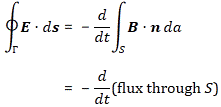
Some content on this page was disabled on June 16, 2020 as a result of a DMCA takedown notice from The California Institute of Technology. You can learn more about the DMCA here:

https://wordpress.com/support/copyright-and-the-dmca/
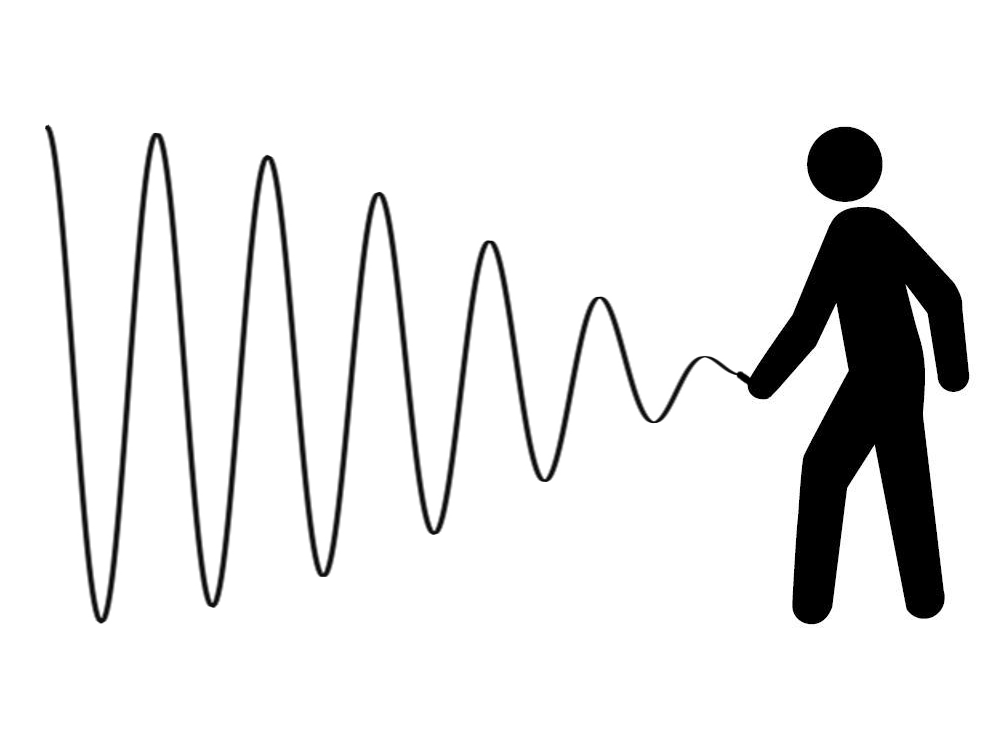
Time reversal and CPT symmetry (III)

Pre-scriptum (dated 26 June 2020): While my posts on symmetries (and why they may or may be broken) are somewhat mutilated (removal of illustrations and other material) as a result of an attack by the dark force, I am happy to see a lot of it survived more or less intact. While my views on the true nature of light, matter and the force or forces that act on them – all of the stuff that explains symmetries or symmetry-breaking, in other words – have evolved significantly as part of my explorations of a more realist (classical) explanation of quantum mechanics, I think most (if not all) of the analysis in this post remains valid and fun to read. 🙂

Original post:

Although I concluded my previous post by saying that I would not write anything more about CPT symmetry, I feel like I have done an injustice to Val Fitch, James Cronin, and all those other researchers who spent many man-years to painstakingly demonstrate how the weak force does not always respect the combined charge-parity (C-P) symmetry. Indeed, I did not want to denigrate their efforts when I noted that:

  1. These decaying kaons (i.e. the particles that are used to demonstrate the CP symmetry-breaking phenomenon) are rather exotic and very short-lived particles; and
  2. Researchers have not been able to find many other traces of non-respect of CP symmetry, except when studying a heavier version of these kaons (the so-called B- and D-mesons) as soon as these could be produced in higher volumes in newer (read: higher-energy) particle colliders (so that’s in the last ten or fifteen years only), but so these B- and D-mesons are even more rare and even less stable.

CP violation is CP violation: it’s plain weird, especially when Fermilab and CERN experiments observed direct CP violation in kaon decay processes. [Remember that the original 1964 Fitch-Cronin experiment could not directly observe CP violation: in their experiment, CP violation in neutral kaon decay processes could only be deduced from other (unexpected) decay processes.]

Why? When one reverses all of the charges and other variables (such as parity which – let me remind you – has to do with ‘left-handedness’ and ‘right-handedness’ of particles), then the process should go in the other direction in an exactly symmetric way. Full stop. If not, there’s some kind of ‘leakage’ so to say, and such ‘leakage’ would be ‘kind-of-OK’ when we’d be talking some kind of chemical or biological process, but it’s obviously not ‘kind-of-OK’ when we’re talking one of the fundamental forces. It’s just not ‘logical’.

Feynman versus ‘t Hooft: pro and contra CP-symmetry breaking

A remark that is much more relevant than the two comments above is that one of the most brilliant physicists of the 20th century, Richard Feynman, seemed to have refused to entertain the idea of CP-symmetry breaking. Indeed, while, in his 1965 Lectures, he devotes quite a bit of attention to Chien-Shiung Wu’s 1956 experiment with decaying cobalt-60 nuclei (i.e. the experiment which first demonstrated parity violation, i.e. the breaking of P-symmetry), he does not mention the 1964 Fitch-Cronin experiment, and all of his writing in these Lectures makes it very clear that he not only strongly believes that the combined CP symmetry holds, but that it’s also the only ‘symmetry’ that matters really, and the only one that Nature truly respects–always.

So Feynman was wrong. Of course, these Lectures were published less than a year after the 1964 Fitch-Cronin experiment and, hence, you might think he would have changed his ideas on the possibility of Nature not respecting CP-symmetry–just like Wolfgang Pauli, who could only accept the reality of Nature not respecting reflection symmetry (P-symmetry) after repeated experiments re-confirmed the results of Wu’s original 1956 experiment.

But – No! – Feynman’s 1985 book on quantum electrodynamics (QED) –so that’s five years after Fitch and Cronin got a Nobel Prize for their discovery– is equally skeptical on this point: he basically states that the weak force is “not well understood” and that he hopes that “a more beautiful and, hence, more accurate understanding” of things will emerge.

OK, you will say, but Feynman passed away shortly after (he died from a rare form of cancer in 1988) and, hence, we should now listen to the current generation of physicists.

You’re obviously right, so let’s look around. Hmm… Gerard ‘t Hooft? Yes ! He is 67 now but – despite his age – it is obvious that he surely qualifies as a ‘next-generation’ physicist. He got his Nobel Prize for “elucidating the quantum structure of electroweak interactions” (read: for clarifying how the weak force actually works) and he is also very enthusiastic about all these Grand Unified Theories (most notably string and superstring theory) and so, yes, he should surely know, shouldn’t he?

I guess so. However, even ‘t Hooft writes that these experiments with these ‘crazy kaons’ – as he calls them – show ‘violation’ indeed, but that it’s marginal: the very same experiments also show near-symmetry. What’s near-symmetry? Well… Just what the term says: the weak force is almost symmetrical. Hence, CP-symmetry is the norm and CP-asymmetry is only a marginal phenomenon. That being said, it’s there and, hence, it should be explained. How?

‘t Hooft himself writes that one could actually try to interpret the results of the experiment by adding some kind of ‘fifth’ force to our world view – a “super-weak force” as he calls it, which would interfere with the weak force only.

To be fair, he immediately adds that introducing such ‘fifth force’ doesn’t really solve the “mystery” of CP asymmetry, because, while we’d restore the principle of CP symmetry for the weak force interactions, we would then have to explain why this ‘super-weak’ force does not respect it. In short, we cannot just reason the problem away. Hence, ‘t Hooft’s conclusion in his 1996 book on The Ultimate Building Blocks of the universe is quite humble: “The deeper cause [of CP asymmetry] is likely to remain a mystery.” (‘t Hooft, 1996, Chapter 7: The crazy kaons)

What about other explanations? For example, you might be tempted to think these two or three exceptions to a thousand cases respecting the general rule must have something to do with quantum-mechanical uncertainty: when everything is said and done, we’re dealing with probabilities in quantum mechanics, aren’t we? Hence, exceptions do occur and are actually expected to occur.

No. Quantum indeterminism is not applicable here. While working with probability amplitudes and probabilities is effectively equivalent to stating some general rules involving some average or mean value and then some standard deviation from that average, we’ve got something else going on here: Fitch and Cronin took a full six months indeed–repeating the experiment over and over and over again–to firmly establish a statistically significant bias away from the theoretical average. Hence, even if the bias is only 0.2% or 0.3%, it is a statistically significant difference between the probability of a process going one way, and the probability of that very same process going the other way.

So what? There are so many non-reversible processes and asymmetries in this world: why don’t we just accept this?Well… I’ll just refer to my previous post on this one: we’re talking a fundamental force here – not some chemical reaction – and, hence, if we reverse all of the relevant charges (including things such as left-handed or right-handed spin), the reaction should go the other way, and with exactly the same probability. If it doesn’t, it’s plain weird. Full stop.

OK. […] But… Perhaps there is some external phenomenon affecting these likelihoods, like these omnipresent solar neutrinos indeed, which I mentioned in a previous post and which are all left-handed. So perhaps we should allow these to enter the equation as well. […] Well… I already said that would make sense–to some extent at least– because there is some flimsy evidence of solar flares affecting radioactive decay rates (solar flares and neutrino outbursts are closely related, so if solar flares impact radioactive decay, we could or should expect them to meddle with any beta decay process really). That being said, it would not make sense from other, more conventional, points of view: we cannot just ‘add’ neutrinos to the equation because then we’d be in trouble with the conservation laws, first and foremost the energy conservation law! So, even if we would be able to work out some kind of theoretical mechanism involving these left-handed solar neutrinos (which are literally all over the place, bombarding us constantly even if they’re very hard to detect), thus explaining the observed P-asymmetry, we would then have to explain why it violates the energy conservation law! Well… Good luck with that, I’d say!

So it is a conundrum really. Let me sum up the above discussion in two bullet points:

  1. While kaons are short-lived particles because of the presence of the second-generation (and, hence, unstable) s-quark, they are real particles (so they are not some resonance or some so-called virtual particle). Hence, studying their behavior in interactions with any force field (and, most notably, their behavior in regard to the weak force) is extremely relevant, and the observed CP asymmetry–no matter how small–is something which should really grab our attention.
  2. The philosophical implications of any form of non-respect of the combined CP symmetry for our common-sense notion of time are truly profound and, therefore, the Fitch-Cronin experiment rightly deserves a lot of accolades.

So let’s analyze these ‘philosophical implications’ (which is just a somewhat ‘charged’ term for the linkage between CP- and time-symmetry which I want to discuss here) somewhat more in detail.

Time reversal and CPT symmetry

In the previous posts, I said it’s probably useful to distinguish (a) time-reversal as a (loosely defined) philosophical concept from (b) the mathematical definition of time-reversal, which is much more precise and unambiguous. It’s the latter which is generally used in physics, and it amounts to putting a minus sign in front of all time variables in any equation describing some situation, process or system in physics. That’s it really. Nothing more.

The point that I wanted to make is that true time reversal – i.e. time-reversal in the ‘philosophical’ or ‘common-sense’ interpretation – also involves a reversal of the forces, and that’s done through reversing all charges causing those forces. I used the example of the movie as a metaphor: most movies, when played backwards, do not make sense, unless we reverse the forces. For example, seeing an object ‘fall back’ to where it was (before it started falling) in a movie playing backwards makes sense only if we would assume that masses repel, instead of attract, each other. Likewise, any static or dynamic electromagnetic phenomena we would see in that backwards playing movie would make sense only if we would assume that the charges of the protons and electrons causing the electromagnetic fields involved would be reversed. How? Well… I don’t know. Just imagine some magic.

In such world view–i.e. a world view which connects the arrow of time with real-life forces that cause our world to change– I also looked at the left- and right-handedness of particles as some kind of ‘charge’, because it co-determines how the weak force plays out. Hence, any phenomenon in the movie having to do with the weak force (such as beta decay) could also be time-reversed by making left-handed particles right-handed, and right-handed particles left-handed. In short, I said that, when it comes to time reversal, only a full CPT-transformation makes sense–from a philosophical point of view that is.

Now, reversing left- and right-handedness amounts to a P-transformation (and don’t interrupt me now by asking why physicists use this rather awkward word ‘parity’ for what’s left- and right-handedness really), just like a C-transformation amounts to reversing electric and ‘color’ charges (‘color’ charges are the charges involved in the strong nuclear force).

Now, if only a full CPT transformation makes sense, then CP-reversal should also mean T-reversal, and vice versa. Feynman’s story about “the guy in the ‘other’ universe” (see my previous post) was quite instructive in that regard, and so let’s look at the finer points of that story once again.

Is ‘another’ world possible at all?

Feynman’s assumption was that we’ve made contact (don’t ask how: somehow) with some other intelligent being living in some ‘other’ world somewhere ‘out there’, and that there are no visual or other common references. That’s all rather vague, you’ll say, but just hang in there and try to see where we’re going with this story. Most notably, the other intelligent being – but let’s call ‘it’ a she instead of ‘a guy’ or ‘a Martian’ – cannot see the universe as we see it: we can’t describe, for instance, the Big and Small Dipper and explain to her what ‘left’ and ‘right’ is referring to such constellations, because she’s sealed off somehow from it (so she lives in a totally different corner of the universe really).

In contrast, we would be able, most probably, to explain and share the concept of ‘upward’ and ‘downwards’ by assuming that she is also attracted by some center of gravity nearby, just like we are attracted downwards by our Earth. Then, after many more hours and days, weeks, months or even years of tedious ‘discussions’, we would probably be able to describe electric currents and explain electromagnetic phenomena, and then, hopefully, she would find out that the laws in her corner of the universe are exactly the same, and so we could thus explain and share the notion of a ‘positive’ and a ‘negative’ charge, and the notion of a magnetic ‘north’ and ‘south’ pole.

However, at this point the story becomes somewhat more complicated, because – as I tried to explain in my previous post – her ‘positive’ electric charge (+) and her magnetic ‘north’ might well be our ‘negative’ electric charge (–) and our magnetic ‘south’. Why? It’s simple: the electromagnetic force does respect charge and also parity symmetry and so there is no way of defining any absolute sense of ‘left’ and ‘right’ or (magnetic) ‘north’ and (magnetic) ‘south’ with reference to the electromagnetic force alone. [If you don’t believe, just look at my previous post and study the examples.]

Talking about the strong force wouldn’t help either, because it also fully respects charge symmetry.

Huh? Yes. Just go through my previous post which – I admit – was probably quite confusing but made the point that a ‘mirror-image’ world would work just as well… except when it comes to the weak force. Indeed, atomic decay processes (beta decay) do distinguish between ‘left-handed’ and ‘right-handed’ particles (as measured by their spin) in an absolute sense that is (see the illustration of decaying muons and their mirror-image in the previous post) and, hence, it’s simple: in order to make sure her ‘left’ and her ‘right’ is the same as ours, we should just ask her to perform those beta decay experiments demonstrating that parity (or P-symmetry) is not being conserved and, then, based on our common definition of what’s ‘up’ and ‘down’ (the commonality of these notions being based on the effects of gravity which, we assume, are the same in both worlds), we could agree that ‘right’ is ‘right’ indeed, and that ‘left’ is ‘left’ indeed.

Now, you will remember there was one ‘catch’ here: if ever we would want to set up an actual meeting with her (just assume that we’ve finally figured out where she is and so we (or she) are on our way to meet each other), we would have to ask her to respect protocol and put out her right hand to greet us, not her left. The reason is the following: while ‘right-handed’ and ‘left-handed’ matter behave differently when it comes to weak force interactions (read: atomic decay processes)–which is how we can distinguish between ‘left’ and ‘right’ in the first place, in some kind of absolute sense that is–the combined CP symmetry implies that right-handed matter and left-handed anti-matter behave just the same–and, of course, the same goes for ‘left-handed’ matter and ‘right-handed’ anti-matter. Hence, after we would have had a painstakingly long exchange on broken P-symmetry to ensure we are talking about the same thing, we would still not know for sure: she might be living in a world of anti-matter indeed, in which case her ‘right’ would actually be ‘left’ for us, and her ‘left’ would be ‘right’.

Hence, if, after all that talk on P-symmetry and doing all those experiments involving P-asymmetry, she actually would put out her left hand when meeting us physically–instead of the agreed-upon right hand… Then… Well… Don’t touch it. 🙂

There is a way out of course. And, who knows, perhaps she was just trying to be humorous and so perhaps she smiled and apologized for the confusion in the meanwhile. But then… […] Hmm… I am not sure if such bad joke would make for a good start of a relationship, even if it would obviously demonstrate superior intelligence. 🙂

Indeed, the Fitch-Cronin experiment brings an additional twist to this potentially romantic story between two intelligent beings from two ‘different’ worlds. In fact, the Fitch-Cronin experiment actually rules out this theoretical possibility of mutual destruction and, therefore, the possibility of two ‘different’ worlds.

The argument goes straight to the heart of our philosophical discussion on time reversal. Indeed, whatever you may or may not have understood from this and my previous posts on CPT symmetry, the key point is that the combined CPT symmetry cannot be violated.

Why? Well… That’s plain logic: the real world does not care about our conventions, so reversing all of our conventions, i.e.

  1. Changing all particles to antiparticles by reversing all charges (C),
  2. Turning all right-handed particles into left-handed particles and vice versa (P), and
  3. Changing the sign of time (T),

describes a world truly going back in time.

Now, ‘her’ world is not going back in time. Why? Well… Because we can actually talk to her, it is obvious that her ‘arrow of time’ points in the same direction as ours, so she is not living in a world that is going back in time. Full stop. Therefore, any experiment involving a combined CP asymmetry (i.e. C-P violation) should yield the same results and, hence, she should find the same bias, i.e. a bias going in the very same direction of the equation, i.e. from left to right, or from right to left – whatever (what we label it, depends on our conventions, which we ‘re-set’ as we talked to her, and, hence, which we share, based on the results of all these beta decay experiments we did to ensure we’re really talking about the ‘same’ direction, and not its opposite).

Is this confusing? It sure is. But let me rephrase the logic. Perhaps it helps.

  1. Combined CPT symmetry implies that if the combined CP-symmetry is broken, then T-symmetry is also broken. Hence, the experimentally established fact of broken CP symmetry (even if it’s only 2 or 3 times per thousand) ensures that the ‘arrow of time’ points in one direction, and in one direction only. To put it simply: we cannot reverse time in a world which does not (fully) respect the principle of CP symmetry.
  2. Now, if you and I can exchange meaningful signals (i.e. communicate), then your and my ‘arrow of time’ obviously point in the same direction. To put it simply, we’re actors in the same movie, and whether or not it is being played backwards doesn’t matter anymore: the point is that the two of us share the same arrow of time. In other words, God did not do any combined CPT-transformation trick on your world as compared to mine, and vice versa.
  3. Hence, ‘your’ world is ‘my’ world and vice versa. So we live in the same world with the very same symmetries and asymmetries.

Now apply this logic to our imaginary new friend (‘she’) and (I hope) you’ll get the point.

To make a long story short, and also to conclude our philosophical digressions here on a pleasant (romantic) note: the fact that we would be able to communicate with her, implies that she’d be living in the same world as ours. We know that now, for sure, because of the broken CP symmetry: indeed, if her ‘time arrow’ points in the same direction, then CP symmetry will be broken in just the very same way in ‘her’ world (i.e. the ‘bias’ will have the same direction, in an absolute sense) as it it is broken in ‘our’ world.

In short, there are only two possible worlds: (1) this world and (2) one and only one ‘other’ world. This ‘other’ world is our world under a full CPT-transformation: the whole movie played backwards in other words, but with all ‘charges’ affecting forces – in whatever form and shape they come (electric charge, color charge, spin, and what have you) reversed or – using that awful mathematical term – ‘negated’.

In case you’d wonder (1): I consider the many-worlds interpretation of quantum mechanics as… Well… Nonsense. CPT symmetry allows for two worlds only. Maximum two. 🙂

In case you’d wonder (2): An oscillating-universe theory, or some kind of cyclic thing (so Big Bangs followed by Big Crunches) are not incompatible with my ‘two-possible-worlds’ view of things. However, this ‘oscillations’ would all take place in the same world really, because the arrow of time isn’t being reversed really, as Big Bangs and Big Crunches do not reverse charges and parities–at least not to my knowledge.

But, of course, who knows?

Postscripts:

1. You may wonder what ‘other’ asymmetries I am hinting at in this post here. It’s quite simple. It’s everything you see around you, including the works of the increasing entropy law. However, if I would have to choose one asymmetry in this world (the real world), as an example of a very striking and/or meaningful asymmetry, it’s the the preponderance of matter over anti-matter, including the preponderance of (left-handed) neutrinos over (right-handed) antineutrinos. Indeed, I can’t shake off that feeling that neutrino physics is going to spring some surprises in the coming decades.

[When you’d google a bit in order to get some more detail on neutrinos (and solar neutrinos in particular, which are the kind of neutrinos that are affecting us right now and right here), you’ll probably get confused by a phenomenon referred to as neutrino oscillation (which refers to a process in which neutrinos change ‘flavor’) but so the basic output of the Sun’s nuclear reactor is neutrinos, not anti-neutrinos. Indeed, the (general) reaction involves two protons combining to form one (heavy) hydrogen atom (i.e. deuterium, which consists of one neutron, one proton and one electron), thereby ejecting one positron (e+) and one (electron) neutrino (ve). In any case, this is not the place to develop the point. I’ll leave that for my next post.]

2. Whether or not you like the story about ‘her’ above, you should have noticed something that we could loosely refer to as ‘degrees of freedom’ is playing some role:

  1. We know that T-symmetry has not been broken: ‘her’ arrow of time points in the same direction.
  2. Therefore, the combined CP-symmetry of ‘her’ world is broken in the same way as in our world.
  3. If the combined CP-symmetry in ‘her’ world is broken in the same way as in ‘our’ world, the individual C and P symmetries have to be broken in the very same way. In other words, it’s the same world indeed. Not some anti-matter world.

As I am neither a physicist nor a mathematician, and not a philosopher either, please do feel free to correct any logical errors you may identify in this piece. Personally, I feel the logic connecting CP violation and individual C- and P-violation needs further ‘flesh on the bones’, but the core argument is pretty solid I think. 🙂

3. What about the increasing entropy law in this story? What happens to it if we reverse time, charge and parity? Well… Nothing. It will remain valid, as always. So that’s why an actual movie being played backwards with charges and parities reversed will still not make any sense to us: things that are broken don’t repair themselves and, hence, at the system level, there’s another type of irreducible ‘arrow of time’ it seems. But you’ll have to admit that the character of that entropy ‘law’ is very different from these ‘fundamental’ force laws. And then just think about it, isn’t it extremely improbable how we human beings have evolved in this universe? And how we are seemingly capable to understand ourselves and this universe? We don’t violate the entropy law obviously (on the contrary: we’re obviously messing up our planet), but I feel we do negate it in a way that escapes the kind of logical thinking that underpins the story I wrote above. But such remarks have nothing to do with math or physics and, hence, I will refrain from them.

4. Finally, for those who’d feel like some kind of ‘feminist’ remark on my use of ‘us’ and ‘her’, I think the use of ‘her’ is explained to underline the idea of ‘other’ and, hence, as a male writer, using ‘her’ to underscore the ‘other’ dimension comes naturally and shouldn’t be criticized. The element which could/should bother a female reader of such ‘through experiments’ is that we seem to assume that the ‘other’ intelligent being is actually somewhat ‘dumber’ than us, because the story above assumes we are actually explaining the experiments of the Wu and Fitch-Cronin team to ‘her’, instead of the other way around. That’s why I inserted the possibility of ‘her’ pulling a practical joke on us by offering us her left hand: if ‘she’ is equally or even more intelligent than us, then she’d surely have figured out that there’s no need to be worried about the ‘other’ being made of anti-matter. 🙂

Time reversal and CPT symmetry (II)

Pre-scriptum (dated 26 June 2020): While my posts on symmetries (and why they may or may be broken) are somewhat mutilated (removal of illustrations and other material) as a result of an attack by the dark force, I am happy to see a lot of it survived more or less intact. While my views on the true nature of light, matter and the force or forces that act on them – all of the stuff that explains symmetries or symmetry-breaking, in other words – have evolved significantly as part of my explorations of a more realist (classical) explanation of quantum mechanics, I think most (if not all) of the analysis in this post remains valid and fun to read. 🙂

Original post:

My previous post touched on many topics and, hence, I feel I was not quite able to exhaust the topic of parity violation (let’s just call it mirror asymmetry: that’s more intuitive). Indeed, I was rather casual in stating that:

  1. We have ‘right-handed’ and ‘left-handed’ matter, and they behave differently–at least with respect to the weak force–and, hence, we have some kind of absolute distinction between left and right in the real world.
  2. If ‘right-handed’ matter and ‘left-handed’ matter are not the same, then ‘right-handed’ antimatter and ‘left-handed’ antimatter are not the same either.
  3. CP symmetry connects the two: right-handed matter behaves just like left-handed antimatter, and right-handed antimatter behaves just like left-handed matter.

There are at least two problems with this:

  1. In previous posts, I mentioned the so-called Fitch-Cronin experiment which, back in 1964, provided evidence that ‘Nature’ also violated the combined CP-symmetry. In fact, I should be precise here and say the weak force, instead of ‘Nature’, because all these experiments investigate the behavior of the weak force only. Having said that, it’s true I mentioned this experiment in a very light-hearted manner–too casual really: I just referred to my simple diagrams illustrating what true time reversal entails (a reversal of the forces and, hence, of the charges causing those forces) and that was how I sort of shrugged it all of.
  2. In such simplistic world view, the question is not so much why the weak force violates mirror symmetry, but why gravity, electromagnetism and the strong force actually respect it!

Indeed, you don’t get a Nobel Prize for stating the obvious and, hence, if Val Fitch and James Cronin got one for that CP-violation experiment, C/P or CP violation cannot be trivial matters.

P-symmetry revisited

So let’s have another look at mirror symmetry–also known as reflection symmetry– by following Feynman’s example: let us actually build a ‘left-hand’ clock, and let’s do it meticulously, as Feynman describes it: “Every time there is a screw with a right-hand thread in one, we use a screw with a left-hand thread in the corresponding place of the other; where one is marked ‘IV’ on the face, we mark a ‘VI’ on the face of the other; each coiled spring is twisted one way in one clock and the other way in the mirror-image clock; when we are all finished, we have two clocks, both physical, which bear to each other the relation of an object and its mirror image, although they are both actual, material objects. Now the question is: If the two clocks are started in the same condition, the springs wound to corresponding tightnesses, will the two clocks tick and go around, forever after, as exact mirror images?”

The answer seems to be obvious: of course they will! Indeed, we do observe that P symmetry is being respected, as shown below:

P symmetry

You may wonder why we have to go through the trouble of building another clock. Why can’t we just take one of these transparent ‘mystery clocks’ and just go around it and watch its hand(s) move standing behind it? The answer is simple: that’s not what mirror symmetry is about. As Feynman puts its: a mirror reflection “turns the whole space inside out.” So it’s not like a simple translation or a rotation of space. Indeed, when we would move around the clock to watch it from behind, then all we do is rotating our reference frame (with a rotation angle equal to 180 degrees). That’s all. So we just change the orientation of the clock (and, hence, we watch it from behind indeed), but we are not changing left for right and right for left.

Rotational symmetry is a symmetry as well, and the fact that the laws of Nature are invariant under rotation is actually less obvious than you may think (because you’re used to the idea). However, that’s not the point here: rotational symmetry is something else than reflection (mirror) symmetry. Let me make that clear by showing how the clock might run when it would not respect P-symmetry.

P asymmetry

You’ll say: “That’s nonsense.” If we build that mirror-image clock and also wind it up in the ‘other’ direction (‘other’ as compared to our original clock), then the mirror-image clock can’t run that way. Is that nonsense? Nonsensical is actually the word that Wolfgang Pauli used when he heard about Chien-Shiung Wu’s 1956 experiment (i.e. the first experiment that provided solid evidence for the fact that the weak force – in beta decay for instance – does not respect P-symmetry), but so he had to retract his words when repeated beta decay experiments confirmed Wu’s findings.

Of course, the mirror-image clock above (i.e. the one running clockwise) breaks P-symmetry in a very ‘symmetric’ way. In fact, you’ll agree that the hands of that mirror-image clock might actually turn ‘clockwise’ if its machinery would be completely reversible, so we could wind up its springs in the same way as the original clock. But that’s cheating obviously. However, it’s a relevant point and, hence, to be somewhat more precise I should add that Wu’s experiment (and the other beta decay experiments which followed after hers) actually only found a strong bias in the direction of decay: not all of the beta rays (beta rays consist of electrons really – check the illustration in my previous post for more details) went ‘up’ (or ‘down’ in the mirror-reversed arrangement), but most of them did. 

Wu_experiment

OK. We got that. Now how do we explain it? The key to explaining the phenomenon observed by Wu and her team, is the spin of the cobalt-60 nuclei or, in the muon decay experiment described in my previous post, the spin of the muons. It’s the spin of these particles that makes them ‘left-handed’ or ‘right-handed’ and the decay direction is (mostly) in the direction of the axial vector that’s associated with the spin direction (this axial vector is the thick black arrow in the illustration below).

Axial vector

Hmm… But we’ve got spinning things in (mechanical) clocks as well, don’t we? Yes. We have flywheels and balance wheels and lots of other spinning stuff in a mechanical clock, but these wheels are not equivalent to spinning muons or other elementary particles: the wheels in a clock preserve and transfer angular momentum.

OK… But… […] But isn’t that what we are talking about here? Angular momentum?

No. Electrons spinning around a nucleus have angular momentum as well – referred to as orbital angular momentum – but it’s not the same thing as spin which, somewhat confusingly, is often referred to as intrinsic angular momentum. In short, we could make a detailed analysis of how our clock and its mirror image actually work, and we would find that all of the axial vectors associated with flywheels, balance wheels and springs in a clock would effectively be reversed in the mirror-image clock but, in contrast with the weak decay example, their reversed directions would actually explain why the mirror-image clock is turning counter-clockwise (from our point of view that is), just like the image of the original clock in the mirror does, and, therefore, why a ‘left-handed’ mechanical clock actually respects P-symmetry, instead of breaking it.

Axial and polar vectors in physics

In physics, we encounter such axial vectors everywhere. They show the axis of spin, and their direction is determined by the direction of spin through one of two conventions: the ‘right-hand screw rule’, or the ‘left-hand screw rule’. Physicists have settled on the former, so let’s work with that for the time being.

The other type of vector is a polar vector. That’s an ‘honest’ vector as Feynman calls it–depicting ‘real’ things such as, for example, a step in space, or some force acting in some direction. The figures below (which I took from Feynman’s Lectures) illustrate the idea (and please do note the care with which Feynman reversed the direction of the arrows above the r and ω in the mirror image):

  1. When mirrored, a polar vector “changes its head, just as the whole space turns inside out.”
  2. An axial vector behaves differently when mirrored. It changes too, but in a very different way: it is usually reversed in respect to the geometry of the whole space, as illustrated in the muon decay image above. However, in the illustration below, that is not the case, because the angular velocity ‘vector’ is not reversed when mirrored. So it’s all quite subtle and one has to carefully watch what’s going on really when we do such mirror reflections.

Axial vectors

What’s the third figure about? Well… While it’s not that difficult to visualize all of the axial vectors in a mechanical clock, it’s a different matter when discussing electromagnetic forces, and then to explain why these electromagnetic forces also respect mirror symmetry, just like the mechanical clock. But let’s me try.

When an electric current goes through a solenoid, the solenoid becomes a magnet, especially when wrapped around an iron core. The direction and strength of the magnetic field is given by the magnetic field vector B, and the force on an electrically charged particle moving through such magnetic field will be equal to F = qv×B. That’s a so-called vector cross product and we’ve seen it before: a×b = na││b│sinθ, so we take (1) the magnitudes of a and b, (2) the sinus of the angle between them, and (3) the unit vector (n) perpendicular to (the plane containing) a and b; multiply it all; and there we are: that’s the result. But – Hey! Wait a minute! – there are two unit vectors perpendicular to a and b. So how does that work out?

Well… As you might have guessed, there is another right-hand rule here, as shown below.

2000px-Right_hand_rule_cross_product

Now how does that work out for our magnetic field? If we mirror the set-up and let an electron move through the field? Well… Let’s do the math for an electron moving into this screen, so in the direction that you are watching.

In the first set-up, the B vector points upwards and, hence, the electron will deviate in the direction given by that cross product above: qv×B. In other words, it will move sideways as it moves away from you, into the field. In which direction? Well… Just turn that hand above about 90 degrees and you have the answer: right. Oh… No. It’s left, because q is negative. Right.

In the mirror-image set-up, we have a B’ vector pointing in the opposite direction so… Hey ! Mirror symmetry is not being respected, is it?

Well… No. Remember that we must change everything, including our conventions, so the ‘right-hand rules’ above becomes ‘left-hand rules’, as shown below for example. Surely you’re joking, Mr. Feynman!

P-parity for screw rules

Well… No. F and v are polar vectors and, hence, “their head might change, just as the whole space turns inside out”, but that’s not the case now, because they’re parallel to the mirror. In short, the force F on the electron will still be the same: it will deviate leftwards. I tried to draw that below, but it’s hard to make that red line look like it’s a line going away from you.

Capture

But that can’t be true, you’ll say. The field lines go from north to south, and so we have that B’ vector pointing downwards now.

No, we don’t. Or… Well… Yes. It all depends on our conventions. 🙂  

Feynman’s switch to ‘left-hand rules’ also involves renaming the magnetic poles, so all magnetic north poles are now referred to as ‘south’ poles, and all magnetic south poles are now referred to as ‘north’ poles, and so that’s why he has a B’ vector pointing downwards. Hence, he does not change the convention that magnetic field lines go from north to south, but his ‘north’ pole (in the mirror-image drawing) is actually a ‘south’ pole. Capito? 🙂

[…] OK. Let me try to explain it once again. In reality, it does not matter whether or not a solenoid is wound clockwise or counterclockwise (or, to use the terminology introduced above, whether our solenoid is left-handed or right-handed). The important thing is that the current through the solenoid flows from the top to the bottom. We can only reverse the poles – in reality – if we reverse the electric current, but so we don’t do that in our mirror-image set-up. Therefore, the force F on our charged particle will not change, and B’ is an axial vector alright but this axial vector does not represent the actual magnetic field.

[…] But… If we change these conventions, it should represent the magnetic field, shouldn’t it? And how do we calculate that force then?

OK. If you insist. Here we go:

  1. So we change ‘right’ to ‘left’ and ‘left’ to ‘right’, and our cross-product rule becomes a ‘left-hand’ rule.
  2. But our electrons still go from ‘top’ to ‘bottom’. Hence, the (magnetic) force on a charged particle won’t change.
  3. But if the result has to be the same, then B needs to become –B, or so that’s B’ in our ‘left-handed’ coordinate system.
  4. We can now calculate F using the ‘left-handed’ cross product rule and – because we did not change the convention that field lines go from north to south, we’ll also rename our poles.
  5. Yippee ! All comes out all right: our electron goes left. Sorry. Right. Huh? Yes. Because we’ve agreed to replace ‘left’ by ‘right’, remember? 🙂

[…]

If you didn’t get anything of this, don’t worry. There is actually a much more comprehensible illustration of the mirror symmetry of electromagnetic forces. If we would hang two wires next to each other, as below, and we send a current through them, they will attract if the two currents are in the same direction, and they will repel when the currents are opposite. However, it doesn’t matter if the current goes from left to right or from right to left. As long as the two currents have the same direction (left or right), it’s fine: there will be attraction. That’s all it takes to demonstrate P-symmetry for electromagnetism.

Wires attracting

The Fitch-Cronin experiment

I guess I caused an awful lot of confusion above. Just forget about it all and take one single message home: the electromagnetic force does not care about the axial vector of spinning particles, but the weak force does.

Is that shocking?

No. There are plenty of examples in the real world showing that the direction of ‘spin’ does matter. For instance, to unlock a right-hinged door, you turn the key to the right (i.e. clockwise). The other direction doesn’t work. While I am sure physicists won’t like such simplistic statements, I think that accepting that Nature has similar ‘left-handed’ and ‘right-handed’ mechanisms is not the kind of theoretical disaster that Wolfgang Pauli thought it was. If anything, we just should marvel at the fact that gravity, electromagnetism and the strong force are P- and C-symmetric indeed, and further investigate why the weak force does not have such nice symmetries. Indeed, it respects the combined CPT symmetry, but that amounts to saying that our world sort of makes sense, so that ain’t much.

In short, our understanding of that weak force is probably messy and, as Feynman points out: “At the present level of understanding, you can still see the “seams” in the theories; they have not yet been smoothed out so that the connection becomes more beautiful and, therefore, probably more correct.” (QED, 1985, p. 142). However, let’s stop complaining about our ‘limited understanding’ and so let’s work with what we do understand right now. Hence, let’s have a look at that Fitch-Cronin experiment now and see how ‘weird’ or, on the contrary, how ‘understandable’ it actually is.

To situate the Fitch-Cronin experiment, we first need to say something more about that larger family of mesons, of which the kaons are just one of the branches. In fact, in case you’d not be interested in this story as such, then I’d suggest you just read it as a very short introduction to the Standard Model as such, as it gives a nice short overview of all matter-particles–which is always useful I’d think.

Hadrons, mesons and baryons

You may or may not remember that mesons are unstable particles consisting of one quark and one anti-quark (so mesons consist of two quarks, but one of them should be an anti-quark). As such, mesons are to be distinguished from the ‘other’ group within the larger group of hadrons, i.e. the baryons, which are made of three quarks. [The term ‘hadrons’ itself is nothing but a catch-all for all particles consisting of quarks.]

The most prominent representatives of the baryon family are the (stable) neutron and proton, i.e. the nucleons, which consist of u and d quarks. However, there are unstable baryons as well. These unstable baryons involve the heavier (second-generation) or quarks, or the super-heavy (third-generation) b quark. [As for the top quark (t), that’s so high-energy (and, hence, so short-lived) that baryons made of a t quark (so-called ‘top-baryons’) are not expected to exist but, then, who knows really?]

But kaons are mesons, and so I won’t say anything more about baryons The two illustrations below should be sufficient to situate the discussion.

98E-pic-first-classification-particles

Standard_Model_of_Elementary_Particles

Kaons are just one branch of the meson family. There are, for instance, heavier versions of the kaons, referred to as B- and D-mesons. Let me quickly introduce these:

  1. The ‘B’ in ‘B-meson’ refers to the fact that one of the quarks in a B-meson is a b-quark: a b (bottom) quark is a much heavier (third-generation) version of the (second-generation) s-quark.
  2. As for the ‘D’ in D-meson, I have no idea. D-mesons will always consist of a c-quark or anti-quark, combined with a lighter d, u or s (anti-)quark, but so there’s no obvious relationship between a D-meson and a d-quark. Sorry.
  3. If you look at the quark table above, you’ll wonder whether there are any top-mesons, i.e. mesons consisting of a t quark or anti-quark. The answer to that question seems to be negative: t quarks disintegrate too fast, it is said. [So that resembles the remark on the possiblity of t-baryons.] If you’d google a bit on this, you’ll find that, in essence, we haven’t found any t-mesons as yet but their potential existence should not be excluded.

Anything else? Yes. There’s a lot more around actually. Besides (1) kaons, (2) B-mesons and (3) D-mesons, we also have (4) pions (i.e. a combination of a u and a d, or their anti-matter counterpart), (5) rho-mesons (ρ-mesons can be thought of as excited (higher-energy) pions(6) eta-mesons (η-mesons a rapidly decaying mixture of ud and s quarks or their anti-matter counterparts), as well as a whole bunch of (temporary) particles consisting of a quark and its own anti-matter counterpart, notably the (7) phi (a φ consists of a s and an anti-s), psi (a ψ consists of an c and an anti-c) and upsilon (a φ consists of a b and an anti-b) particles (so all these particles are their own anti-particles).

So it’s quite a zoo indeed, but let’s zoom in on those ‘crazy’ kaons. [‘Crazy kaons’ is the epithet that Gerard ‘t Hooft reserved for them in his In Search of the Ultimate Building Blocks (1996).] What are they really? 

Crazy kaons

Kaons, also know as K-mesons, are, first of all, mesons, i.e. particles made of one quark and one anti-quark (as opposed to baryons, which are made of three quarks, e.g. protons and neutrons). All mesons are unstable: at best, they last a few hundredths of a microsecond, but kaons have much shorter lifetimes than that. Where do we find them? We usually create them in those particle colliders and other sophisticated machinery (the experiment used kaon beams) but we can also find them as a decay product in (secondary) cosmic rays (cosmic rays consist of very high-energy particles and they produce ‘showers’ of secondary particles as they hit our atmosphere).

They come in three varieties: neutral and positively or negatively charged, so we have a K0, a K+, and a K, in principle that is (the story will become more complicated later). What they have in common is that one of the quarks is the rather heavy s-quark (s stands for ‘strange’ but you know what Feynman – and others – think of that name: it’s just a strange name indeed, and so don’t worry too much about it). An s-quark is a so-called second-generation matter-particle and that’s why the kaon is unstable: all second-generation matter-particles are unstable. The second quark is just an ordinary u- or d-quark, i.e. the type of quark you’d find in the (stable) proton or neutron.

But what about the electric charge? Well… I should be complete. The quarks might be anti-quarks as well. That’s nothing to worry about as you’ll remember: anti-matter is just matter but with the charges reversed. So a Kconsists of an s quark and an anti-d quark or –and this is the key to understanding the experiment actually– a K0 can also consist of an anti-s quark and a (normal) d-quark. Note that the s and d quarks have a charge of 1/3 and so the total charge comes out alright. [As for the other kaons, a Kconsists of a u and anti-s quark (the u quark has charge 2/3 and so we have +1 as the total charge), and the K– consists of an anti-u and an s quark (and, hence, we have –1 as the charge), but we actually don’t need them any more for our story.]

So that’s simple enough. Well… No. Unfortunately, the story is, indeed, more complicated than that. The actual kaons in a neutral kaon beam come in two varieties that are a mix of the two above-mentioned neutral K states: a K-long (KL) has a lifetime of about 9×10–11 s, while a K-short (KS) has a lifetime of about 5.2×10⁻⁸ s. Hence, at the end of the beam, we’re sure to find Kkaons only.

Huh? mix of two particle states… You’re talking superposition here? Well… Yes. Sort of. In fact, as for what KL and Kactually are, that’s a long and complex story involving what is referred to as a neutral particle oscillation process. In essence, neutral particle oscillation occurs when a (neutral) particle and its antiparticle are different but decay into the same final state. It is then possible for the decay and its time reversed process to contribute to oscillations indeed, that turn the one into the other, and vice versa, so we can write A → Δ → B → Δ → A → etcetera, where A is the particle, B is the antiparticle, and Δ is the common set of particles into which both can decay. So there’s an oscillation phenomenon from one state to the other here, and all the things I noted about interference obviously come into play.

In any case, to make a very long and complicated story short, I’ll summarize it as follows: if CP symmetry holds, then one can show that this oscillation process should result in a very clear-cut situation: a mixed beam of long-lived and short-lived kaons, i.e. a mix of KL and KS. Both decay differently: a K-short particle decays into two pions only, while a K-long particle decays into three pions.

That is illustrated below: at the end of the 17.4 m beam, one should only see three-pion decay events. However, that’s not what Fitch and Cronin measured: the actually saw a one two-pion decay event into every 500 (on average that is)! [I have introduced the pion species in the more general discussion on mesons: you’ll remember they consist of first-generation quarks only, but so don’t worry about it: just note the K-long and K-short particles decay differently. Don’t be confused by the π notation below: it has nothing to do with a circle or so, so 2π just means two pions.]

Kaon beam

That means that the kaon decay processes involved do not observe the assumed CP symmetry and, because it’s the weak force that’s causing those decays, it means that the weak force itself does not respect CP symmetry.

Why is that so?

You may object that these lifetimes are just averages and, hence, perhaps we see these two-pion decays at the end of the beam because some of the K-short particles actually survived much longer !

No. That’s to be ruled out. The short-lived particle cannot be observable more than a few centimeters down the beam line. To show that, one can calculate the time required to drop to 1/500 of the original population of K-short particles. With the stated lifetime (9×10–11 s), the half-life calculation gives a time of 5.5 x 10⁻¹⁰ seconds. At nearly the speed of light, this would give a distance of about 17 centimeters, and so that’s only 1/100 the length of Cronin and Fitch’s beam tube.

But what about the fact that particles live longer when they’re going fast? You are right: the number above ignores relativistic time dilation: the lifetime as seen in the laboratory frame is ‘dilated’ indeed by the relativity factor γ. At 0.98c (i.e. the speed of these kaons, γ =5, and, hence, this “time dilation effect” is very substantial. However, re-calculating the distance gives a revised distance equal to 17γ cm, i.e. 85 cm. Hence, even with kaons speeding at 0.98c, the population would be down by a factor of 500 by the time they got a meter down the beam tube. So for any particle velocity really, all of these K-short particles should have decayed long before they get to the end of the beam line.

Fitch and Cronin did not see that, however: they saw one two-pion decay event for every 500 decay events, so that’s two per thousand (0.2%) and, hence, that is very significant. While the reasoning is complex (these oscillations and the quantum-mechanical calculations involved are not easy to understand), the results clearly shows the kaon decay process does not observe CP symmetry.

OK. So what? How does this violate charge and parity symmetry? Well… That’s a complicated story which involves a deeper understanding of how initial and final states of such processes incorporate CP values, and then showing how these values differ. That’s a story that requires a master’s degree in physics, I must assume, and so I don’t have that. But I can sort of sense the point and I would suggest we just accept it here. [To be precise, the Fitch-Cronin experiment is an indirect ‘proof’ of CP violation only: as mentioned below, only in 1999 would experiments be able to demonstrate direct CP violation.]

OK. So what? Do we see it somewhere else? Well… Fitch and Cronin got a Nobel Prize for this only sixteen years later, i.e. in 1980, and then it took researchers another twenty years to find CP violation in some other process. To be very precise, only in 1999 (i.e. 35 years after the Fitch-Cronin findings), Fermilab and CERN could conclude a series of experiments demonstrating direct CP violation in (neutral) kaon decay processes (as mentioned above, the Fitch-Cronin experiment only shows indirect CP violation), and that then set the stage for a ‘new’ generation of experiments involving B-mesons and D-mesons, i.e. mesons consisting of even heavier quarks (c or b quarks)–so these are things that are even less stable than kaons. So… Well… Perhaps you’re right. There’s not all that many examples really.

Aha ! So what?

Well… Nothing. That’s it. These ‘broken symmetries’ exist, without any doubt, but–you’re right–they are a marginal phenomenon in Nature it seems. I’ll just conclude with quoting Feynman once again (Vol. I-52-9):

“The marvelous thing about it all is that for such a wide range of important phenomena–nuclear forces, electrical phenomena, and gravitation–over a tremendous range of physics, all the laws for these seem to be symmetrical. On the other hand, this little extra piece says, “No, the laws are not symmetrical!” How is it that Nature can be almost symmetrical, but not perfectly symmetrical? […] No one has any idea why. […] Perhaps God made the laws only nearly symmetrical so that we should not be jealous of His perfection.”

Hmm… That’s the last line of the first volume of his Lectures (there are three of them), and so that should end the story really.

However, I would personally not like to involve God in such discussions. When everything is said and done, we are talking atomic decay processes here. Now, I’ve already said that I am not a physicist (my only ambition is to understand some of what they are investigating), but I cannot accept that these decay processes are entirely random. I am not saying there are some ‘inner variables’ here. No. That would amount to challenging the Copenhagen interpretation of quantum mechanics, which I won’t.

But when it comes to the weak force, I’ve got a feeling that neutrino physics may provide the answer: the Earth is being bombarded with neutrinos, and their ‘intrinsic parity’ is all the same: all of them are left-handed. In fact, that’s why weak interactions which emit neutrinos or antineutrinos violate P-symmetry! It’s a very primitive statement – and not backed up by anything I have read so far – but I’ve got a feeling that the weak force does not only involve emission of neutrinos or antineutrinos: I think they enter the equation as well.

That’s preposterous and totally random statement, you’ll say.

Yes. […] But I feel I am onto something and I’ll explore it as good as I can–if only to find out why I am so damn wrong. I can only say that, if and when neutrino physics would allow us to tentatively confirm this random and completely uninformed hypothesis, then we would have an explanation which would be much more in line with the answers that astrophysicists give to questions related to other observable asymmetries such as, for example, the imbalance between matter and anti-matter.

However, I know that I am just babbling now, and that nobody takes this seriously anyway and, hence, I will conclude my series on CPT symmetry right here and now. 🙂

Some content on this page was disabled on June 16, 2020 as a result of a DMCA takedown notice from The California Institute of Technology. You can learn more about the DMCA here:

https://wordpress.com/support/copyright-and-the-dmca/
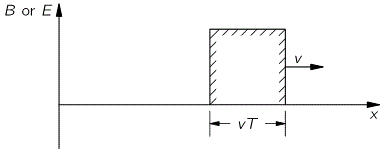
Some content on this page was disabled on June 16, 2020 as a result of a DMCA takedown notice from The California Institute of Technology. You can learn more about the DMCA here:

https://wordpress.com/support/copyright-and-the-dmca/
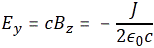
Some content on this page was disabled on June 20, 2020 as a result of a DMCA takedown notice from Michael A. Gottlieb, Rudolf Pfeiffer, and The California Institute of Technology. You can learn more about the DMCA here:

https://wordpress.com/support/copyright-and-the-dmca/

Time reversal and CPT symmetry (I)

Pre-scriptum (dated 26 June 2020): While my posts on symmetries (and why they may or may be broken) are somewhat mutilated (removal of illustrations and other material) as a result of an attack by the dark force, I am happy to see a lot of it survived more or less intact. While my views on the true nature of light, matter and the force or forces that act on them – all of the stuff that explains symmetries or symmetry-breaking, in other words – have evolved significantly as part of my explorations of a more realist (classical) explanation of quantum mechanics, I think most (if not all) of the analysis in this post remains valid and fun to read. 🙂

Original post:

In my previous posts, I introduced the concept of time symmetry, and parity and charge symmetry as well. However, let’s try to explore T-symmetry first. It’s not an easy concept – contrary to what one might think at first.

The arrow of time

Let me start with a very ‘common-sense’ introduction. What do we see when we play a movie backwards? […]

We reverse time. When playing some movie backwards, we look at where things are coming from. And we see phenomena that don’t make sense, such as: (i) cars racing backwards, (ii) old people becoming younger (and dead people coming back to life), (iii) shattered glass assembling itself back into some man-made shape, and (iv) falling objects defying gravity to get back to where they were. Let’s briefly say something about these unlikely or even impossible phenomena before a more formal treatment of the matter:

  1. The first phenomenon – cars racing backwards – is unlikely to happen in real life but quite possible, and some crazies actually do organize such races.
  2. The last example – objects defying gravity – is plain impossible because of Newton’s universal law of gravitation.
  3. The other examples – the old becoming young (and the dead coming back to life), and glass shards coming back together into one piece – are also plain impossible because of some other ‘law’: the law of ever increasing entropy.

However, there’s a distinct difference between the two ‘laws’ (gravity versus increasing entropy). As one entry on Physics Stack Exchange notes, the entropy law – better known as the second law of thermodynamics – “only describes what is most likely to happen in macroscopic systems, rather than what has to happen”, but then the author immediately qualifies this apparent lack of determinism, and rightly so: “It is true that a system may spontaneously decrease its entropy over some time period, with a small but non-zero probability. However, the probability of this happening over and over again tends to zero over long times, so is completely impossible in the limit of very long times.” Hence, while one will find some people wondering whether this entropy law is a ‘real law’ of Nature – in the sense that they would question that it’s always true no matter what – there is actually no room for such doubts.

That being said, the character of the entropy law and the universal law of gravitation is obviously somewhat different – because they describe different realities: the entropy law is a law at the level of a system (a room full of air, for example), while the law of gravitation describes one of the four fundamental forces.

I will now be a bit more formal. What’s time symmetry in physics? The Wikipedia definition is the following: “T-symmetry is the theoretical symmetry (invariance) of physical laws under a time reversal (T) transformation.” Huh?

A ‘time reversal transformation’ amounts to inserting –t (minus t) instead of t in all of our equations describing trajectories or physical laws. Such transformation is illustrated below. The blue curve might represent a car or a rocket accelerating (in this particular example, we have a constant acceleration a = 2). The vertical axis measures the displacement (x) as a function of time (t). , and the red curve is its T-transformation. The two curves are each other’s mirror image, with the vertical axis (i.e. the axis measuring the displacement x) as the mirror axis.

Time reversal 2

This view of things is quite static and, hence, somewhat primitive I should say. However, we can make a number of remarks already. For example, we can see that the slope (of the tangent) of the red curve is negative. This slope is the velocity (v) of the particle: v = dx/dt. Hence, a T-transformation is said to negate the velocity variable (in classical physics that is), just like it negates the time variable. [The verb ‘to negate’ is used here in its mathematical sense: it means ‘to take the additive inverse of a number’ — but you’ll agree that’s too lengthy to be useful as an expression.]
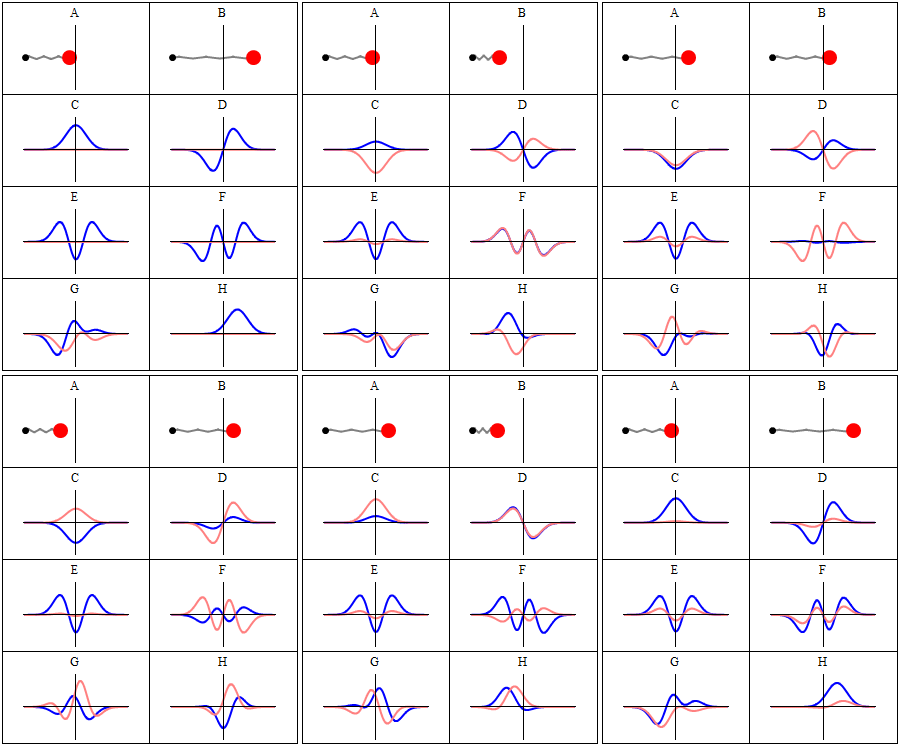
Note that velocity (and mass) determines (linear and angular) momentum and, hence, a T-transformation will also negate p and l, i.e. the linear and angular momentum of a particle.

Such variables – i.e. variables that are negated by the T-transformation – are referred to as odd variables, as opposed to even variables, which are not impacted by the T-transformation: the position of the particle or object (x) is an example of an even variable, and the force acting on a particle (F) is not being negated either: it just remains what it is, i.e. an external force acting on some mass or some charge. The acceleration itself is another ‘even’ variable.

This all makes sense: why would the force or acceleration change? When we put a minus sign in front of the time variable, we are basically just changing the direction of an axis measuring an independent variable. In a way, the only thing that we are doing is introducing some non-standard way of measuring time, isn’t it? Instead of counting from 0 to T, we count from 0 to minus T.

Well… No. In this post, I want to discuss actual time reversal. Can we go back in time? Can we put a genie back into a bottle? Can we reverse all processes in Nature and, if not, why not?

Time reversal and time symmetry are two different things: doing a T-transformation is a mathematical operation; trying to reverse time is something real. Let’s take an example from kinematics to illustrate the matter.

Kinematics

Kinematics can be summed up in one equation, best known as Newton’s Second Law: F = ma = m(dv/dt) = d(mv)/dt.  In words: the time-rate-of-change of a quantity called momentum (mv) is proportional to the force on an object. In other words: the acceleration (a) of an object is proportional to the force (F), and the factor of proportionality is the mass of the object (m). Hence, the mass of an object is nothing but a measure of its inertia.

The numbering of laws (first, second, etcetera) – usually combining some name of a scientist – is often quite arbitrary but, in this case (Newton’s Laws), one can really learn something from listing and discussing them in the right order:

  1. Newton’s First Law is the principle of inertia: if there’s no (other) force acting on an object, it will just continue doing what it does–i.e. nothing or, else, move in some straight line according to the direction of its momentum (i.e. the product of its mass and its velocity)–or further engage with the force it was already engaged with.
  2. Newton’s Second Law is the law of kinematics. In kinematics, we analyze the motion of an object without caring about the origin of the force causing the motion. So we just describe how some force impacts the motion of the object on which it is acting without asking any questions about the force itself. We’ve written this law above: F = ma.
  3. Finally, Newton’s Third Law is the law of gravitation, which describes the origin, the nature and the strength of the gravitational force. That’s part of dynamics, i.e. the study of the forces themselves – as opposed to kinematics, which only looks at the motion caused by those forces.

With these definitions and clarifications, we are now well armed to tackle the subject of T-symmetry in kinematics (we’ll discuss dynamics later). Suppose some object – perhaps an elementary particle but it could also be a car or a rocket indeed – is moving through space with some constant acceleration a (so we can write a(t) = a). This means that v(t) – the velocity as a function of time – will not be constant: v(t) = at. [Note that we make abstraction of the direction here and, hence, our notation does not use any bold letters (which would denote vector quantities): v(t) and a(t) are just simple scalar quantities in this example.]

Of course, when we – i.e. you and me right here and right now – are talking time reversal, we obviously do it from some kind of vantage point. That vantage point will usually be the “now” (and quite often also the “here”), and so let’s use that as our reference frame indeed and we will refer to it as the zero time point: t = 0. So it’s not the origin of time: it’s just ‘now’–the start of our analysis.

Now, the idea of going back in time also implies the idea of looking forward – and vice versa. Let’s first do what we’re used to do and so that’s to look forward.

At some point in the future, let’s call it t = T, the velocity of our object will be equal to v(T) = v(0) + aT. Why the v(0)? Well… We defined the zero time point (t = 0) in a totally random way and, hence, our object is unlikely to stop for that. On the contrary: it is likely to already have some velocity and so that’s why we’re adding this v(0) here. As for the space coordinate, our object may also not be at the exact same spot as we are (we don’t want to be to close to a departing rocket I would assume), so we can also not assume that x(0) = 0 and so we will also incorporate that term somehow. It’s not essential to the analysis though.

OK. Now we are ready to calculate the distance that our object will have traveled at point T. Indeed, you’ll remember that the distance traveled is an infinite sum of infinitesimally small products vΔt: the velocity at each point of time multiplied by an infinitesimally small interval of time. You’ll remember that we write such infinite sum as an integral:

Eq 1

[In case you wonder why we use the letter ‘s’ for distance traveled: it’s because the ‘d’ symbol is already used to denote a differential and, hence, ‘s’ is supposed to stand for ‘spatium’, which is the Latin word for distance or space. As for the integral sign, you know that’s an elongated S really, don’t you? So its stands for an infinite sum indeed. But lets go back to the main story.]

We have a functional form for v(t), namely v(t) = v(0) + at, and so we can easily work out this integral to find s as a function of time. We get the following equation:

Eq 2

When we re-arrange this equation, we get the position of our object as a function of time:

Eq 3

Let us now reverse time by inserting –T everywhere:

Eq 4

Does that still make sense? Yes, of course, because we get the same result when doing our integral:

Eq 5

So that ‘makes sense’. However, I am not talking mathematical consistency when I am asking if it still ‘makes sense’. Let us interpret all of this by looking at what’s happening with the velocity. At t = 0, the velocity of the object is v(0), but T seconds ago, i.e. at point t = -T, the velocity of the object was v(-T) = v(0) – aT. This velocity is less than v(0) and, depending on the value of -T, it might actually be negative. Hence, when we’re looking back in time, we see the object decelerating (and we should immediately add that the deceleration is – just like the acceleration – a constant). In fact, it’s the very same constant a which determines when the velocity becomes zero and then, when going even further back in time, when it becomes negative.
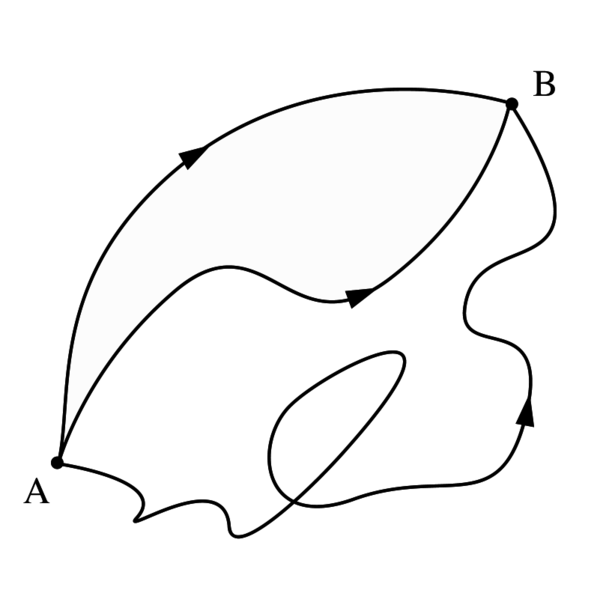
Huh? Negative velocity? Here’s the difference with the movie: in that movie that we are playing backwards, our car, our rocket, or the glass falling from a table or a pedestal would come to rest at some point back in time. We can calculate that point from our velocity equation v(t) = v(0) + at. In the example below, our object started accelerating 2.5 seconds ago, at point t = –2.5. But, unlike what we would see happening in our backwards-playing movie, we see that object not only stopping but also reversing its direction, to go in the same direction as we saw it going when we’re watching the movie before we hit the ‘Play Backwards’ button. So, yes, the velocity of our object changes sign as it starts following the trajectory on the left side of the graph.

time reversal

What’s going on here? Well… Rest assured: it’s actually quite simple: because the car or that rocket in our movie are real-life objects which were actually at rest before t = –2.5, the left side of the graph above is – quite simply – not relevant: it’s just a mathematical thing. So it does not depict the real-life trajectory of an accelerating car or rocket. The real-life trajectory of that car or rocket is depicted below.

real-life car

So we also have a ‘left side’ here: a horizontal line representing no movement at all. Our movie may or may not have included this status quo. If it did, you should note that we would not be able to distinguish whether or not it would be playing forward or backwards. In fact, we wouldn’t be able to tell whether the movie was playing at all: we might just as well have hit the ‘pause’ button and stare at a frozen screenshot.

Does that make sense? Yes. There are no forces acting on this object here and, hence, there is no arrow of time.

Dynamics

The numerical example above is confusing because our mind is not only thinking about the trajectory as such but also about the force causing the particle—or the car or the rocket in the example above—to move in this or that direction. When it’s a rocket, we know it ignited its boosters 2.5 seconds ago (because that’s what we saw – in reality or in a movie of the event) and, hence, seeing that same rocket move backwards – both in time as well as in space – while its boosters operate at full thrust does not make sense to us. Likewise, an obstacle escaping gravity with no other forces acting on it does not make sense either.

That being said, reversing the trajectory and, hence, actually reversing the effects of time, should not be a problem—from a purely theoretical point at least: we should just apply twice the force produced by the boosters to give that rocket the same acceleration in the reverse direction. That would obviously means we would force it to crash back into the Earth. Because that would be rather complicated (we’d need twice as many boosters but mounted in the opposite direction), and because it would also be somewhat evil from a moral point of view, let us consider some less destructive examples.

Let’s take gravity, or electrostatic attraction or repulsion. These two forces also cause uniform acceleration or deceleration on objects. Indeed, one can describe the force field of a large mass (e.g. the Earth)—or, in electrostatics, some positive or negative charge in space— using field vectors. The field vectors for the electric field are denoted by E, and, in his famous Lectures on Physics, Feynman uses a C for the gravitational field. The forces on some other mass m and on some other charge q can then be written as F = mC and F = qE respectively. The similarity with the F = ma equation – Newton’s Second Law in other words – is obvious, except that F = mC and F = qE are an expression of the origin, the nature and the strength of the force:
  1. In the case of the electrostatic force (remember that likes repel and opposites attract), the magnitude of E is equal to E = qc/4πε0r2. In this equation, εis the electric constant, which we’ve encountered before, and r is the distance between the charge q and the charge qcausing the field).
  2. For the gravitational field we have something similar, except that there’s only attraction between masses, no repulsion. The magnitude of C will be equal to C = –GmE/r2, with mE the mass causing the gravitational field (e.g. the mass of the Earth) and G the universal gravitational constant. [Note that the minus sign makes the direction of the force come out alright taking the existing conventions: indeed, it’s repulsion that gets the positive sign – but that should be of no concern to us here.]

So now we’ve explained the dynamics behind that x(t) = x(0) + v(0)·t + (a/2)·tcurve above, and it’s these dynamics that explain why looking back in time does not make sense—not in a mathematical way but in philosophical way. Indeed, it’s the nature of the force that gives time (or the direction of motion, which is the very same ‘arrow of time’) one–and only one–logical direction.

OK… But so what is time reversibility then – or time symmetry as it’s referred to? Let me defer an answer to this question by first introducing another topic.

Even and odd functions

I already introduced the concept of even and odd variables above. It’s obviously linked to some symmetry/asymmetry. The x(t) curve above is symmetric. It is obvious that, if we would change our coordinate system to let x(0) equal x(0) = 0, and also choose the origin of time such that v(0) = 0, then we’d have a nice symmetry with respect to the vertical axis. The graph of the quadratic function below illustrates such symmetry.

Even functionFunctions with a graph such as the one above are called even functions. A (real-valued) function f(t) of a (real) variable t is defined as even if, for all t and –t in the domain of f, we find that f(t) = f(–t).

We also have odd functions, such as the one depicted below. An odd function is a function for which f(-t) = –f(t).

Odd function

The function below gives the velocity as a function of time, and it’s clear that this would be an odd function if we would choose the zero time point such that v(0) = 0. In that case, we’d have a line through the origin and the graph would show an odd function. So that’s why we refer to v as an odd variable under time reversal.

Velocity curve

A very particular and very interesting example of an even function is the cosine function – as illustrated below.

Cosine functionNow, we said that the left side of the graph of the trajectory of our car or our rocket (i.e. the side with a negative slope and, hence, negative velocity) did not make much sense, because – as we play our movie backwards – it would depict a car or a rocket accelerating in the absence of a force. But let’s look at another situation here: a cosine function like the one above could actually represent the trajectory of a mass oscillating on a spring, as illustrated below.

oscillating springIn the case of a spring, the force causing the oscillation pulls back when the spring is stretched, and it pushes back when it’s compressed, so the mechanism is such that the direction of the force is being reversed continually. According to Hooke’s Law, this force is proportional to the amount of stretch. If x is the displacement of the mass m, and k that factor of proportionality, then the following equality must hold at all times:

F = ma = m(d2x/dt2) = –kx ⇔ d2x/dt= –(k/m)x

Is there also a logical arrow of time here? Look at the illustration below. If we follow the green arrow, we can readily imagine what’s happening: the spring gets stretched and, hence, the mass on the spring (at maximum speed as it passes the equilibrium position) encounters resistance: the spring pulls it back and, hence, it slows down and then reverses direction. In the reverse direction – i.e. the direction of the red arrow – we have the reverse logic: the spring gets compressed (x is negative), the mass slows down (as evidence by the curvature of the graph), and – at some point – it also reverses its direction of movement. [I could note that the force equation above is actually a second-order linear differential equation, and that the cosine function is its solution, but that’s a rather pedantic and, hence, totally superfluous remark here.]

temp

What’s important is that, in this case, the ‘arrow of time’ could point either way, and both make sense. In other words, when we would make a movie of this oscillating movement, we could play it backwards and it would still make sense. 

Huh? Yes. Just in case you would wonder whether this conclusion depends on our starting point, it doesn’t. Just look at the illustration below, in which I assume we are starting to watch that movie (which is being played backwards without us knowing it is being played backwards) of the oscillating spring when the mass is not in the equilibrium position. It makes perfect sense: the spring is stretched, and we see the mass accelerating to the equilibrium position, as it should.

temp2

What’s going on here? Why can we reverse the arrow of time in the case of the spring, and why can’t we do that in the case of that particle being attracted or repelled by another? Are there two realities here? No. There’s only. I’ve been playing a trick on you. Just think about what is actually happening and then think about that so-called ‘time reversal’:

  1. At point A, the spring is still being stretched further, in reality that is, and so the mass is moving away from the equilibrium position. Hence, in reality, it will not move to point B but further away from the equilibrium position.
  2. However, we could imagine it moving from point A to B if we would reverse the direction of the force. Indeed, the force is equal to –kx and reversing its direction is equivalent to flipping our graph around the horizontal axis (i.e. the time axis), or to shifting the time axis left or right with an amount equal to π (note that the ‘time’ axis is actually represented by the phase, but that’s a minor technical detail and it does not change the analysis: we just measure time in radians here instead of seconds).

It’s a visual trick. There is no ‘real’ symmetry. The flipped graph corresponds to another situation (i.e. some other spring that started oscillating a bit earlier or later than ours here). Hence, our conclusion that it is the force that gives time direction, still holds.

Hmm… Let’s think about this. What makes our ‘trick’ work is that the force is allowed to change direction. Well… If we go back to our previous example of an object falling towards the center of some gravitational field, or a charge being attracted by some other (opposite) charge, then you’ll note that we can make sense of the ‘left side’ of the graph if we would change the sign of the force.

Huh? Yes, I know. This is getting complicated. But think about it. The graph below might represent a charged particle being repelled by another (stationary) particle: that’s the green arrow. We can then go back in time (i.e. we reverse the green arrow) if we reverse the direction of the force from repulsion to attraction. Now, that would usually lead to a dramatic event—the end of the story to be precise. Indeed, once the two particles get together, they’re glued together and so we’d have to draw another horizontal line going in the minus t direction (i.e. to the left side of our time axis) representing the status quo. Indeed, if the two particles sit right on top of each other, or if they would literally fuse or annihilate each other (like a particle and an anti-particle), then there’s no force or anything left at all… except ifwe would alter the direction of the force once again, in which case the two particles would fly apart again (OK. OK. You’re right in noting that’s not true in the annihilation case – but that’s a minor detail).

arrow of time

Is this story getting too complicated? It shouldn’t. The point to note is that reversibility – i.e. time reversal in the philosophical meaning of the word (not that mathematical business of inserting negative variables instead of positive ones) – is all about changing the direction of the force: going back in time implies that we reverse the effects of time, and reversing the effects of time, requires forces acting in the opposite direction.

Now, when it’s only kinetic energy that is involved, then it should be easy but when charges are involved, which is the case for all fundamental forces, then it’s not so easy. That’s when charge (C) and parity (P) symmetry come into the picture.

CP symmetry

Hooke’s ‘Law’ – i.e. the law describing the force on a mass on a stretched or compressed spring – is not a fundamental law: eventually the spring will stop. Yes. It will stop even if when it’s in a horizontal position and with the mass moving on a frictionless surface, as assumed above: the forces between the atoms and/or molecules in the spring give the spring the elasticity which causes the mass to oscillate around some equilibrium position, but some of the energy of that continuous movement gets lost in heat energy (yes, an oscillating spring does actually get warmer!) and, hence, eventually the movement will peter out and stop.

Nevertheless, the lesson we learned above is a valuable one: when it comes to the fundamental forces, we can reverse the arrow of time and still make sense of it all if we also reverse the ‘charges’. The term ‘charges’ encompasses anything measuring a propensity to interact through one of the four fundamental forces here. That’s where CPT symmetry comes in: if we reverse time, we should also reverse the charges.

But how can we change the ‘sign’ of mass: mass is always positive, isn’t it? And what about the P-symmetry – this thing about left-handed and right-handed neutrinos?

Well… I don’t know. That’s the kind of stuff I am currently exploring in my quest. I’ll just note the following:

1. Gravity might be a so-called pseudo force – because it’s proportional to mass. I won’t go into the details of that – if only because I don’t master them as yet – but Einstein’s gut instinct that gravity is not a ‘real’ fundamental force (we just have to adjust our reference frame and work with curved spacetime) – and, hence, that ‘mass’ is not like the other force ‘charges’ – is something I want to further explore. [Apart from being a measure for inertia, you’ll remember that (rest) mass can also be looked at as equivalent to a very dense chunk of energy, as evidenced by Einstein’s energy-mass equivalence formula: E = mc2.]

As for now, I can only note that the particles in an ‘anti-world’ would have the same mass. In that sense, anti-matter is not ‘anti’-matter: it just carries opposite electromagnetic, strong and weak charges. Hence, our C-world (so the world we get when applying a charge transformation) would have all ‘charges’ reversed, but mass would still be mass.

2. As for parity symmetry (i.e. left- and right-handedness, aka as mirror symmetry), I note that it’s raised primarily in relation to the so-called weak force and, hence, it’s also a ‘charge’ of sorts—in my primitive view of the world at least. The illustration below shows what P symmetry is all about really and may or may not help you to appreciate the point.

muon decay

OK. What is this? Let’s just go step by step here.

The ‘cylinder’ (both in (a), the upper part of the illustration, and in (b), the lower part) represents a muon—or a bunch of muons actually. A muon is an unstable particle in the lepton family. Think of it as a very heavy electron for all practical purposes: it’s about 200 times the mass of an electron indeed. Its lifetime is fairly short from our (human) point of view–only 2.2 microseconds on average–but that’s actually an eternity when compared to other unstable particles.

In any case, the point to note is that it usually decays into (i) two neutrinos (one muon-neutrino and one electron-antineutrino to be precise) and – importantly – (ii) one electron, so electric charge is preserved (indeed, neutrinos got the name they have because they carry no electric charge).

Now, we have left- and right-handed muons, and we can actually line them up in one of these two directions. I would need to check how that’s done, but muons do have a magnetic moment (just like electrons) and so I must assume it’s done in the same way as in Wu’s cobalt-60 experiment: through a uniform magnetic field. In other words, we know their spin directions in an experiment like this.

Now, if the weak force would respect mirror symmetry (but we already know it doesn’t), we would not be able to distinguish (i) the muon decay process in the ‘mirror world’ (i.e. the reflection of what’s going on in the (imaginary) mirror in the illustration above) from (ii) the decay process in ‘our’ (real) world. So that would be situation (a): the number of decay electrons being emitted in an upward direction would be the same (more or less) as the amount of decay electrons being emitted in a downward direction.

However, the actual laboratory experiments show that situation (b) is actually the case: most of the electrons are being emitted in only one direction (i.e. the upward direction in the illustration above) and, hence, the weak force does not respect mirror symmetry.

So what? Is that a problem?

For eminent physicists such as Feynman, it is. As he writes in his concluding Lecture on mechanics, radiation and heat (Vol. I, Chapter 52: Symmetry in Physical Laws): “It’s like seeing small hairs growing on the north pole of a magnet but not on its south pole.” [He means it allows us to distinguish the north and the south pole of a magnet in some absolute sense. Indeed, if we’re not able to tell right from left, we’re also not able to tell north from south – in any absolute sense that is. But so the experiment shows we actually can distinguish the two in some kind of absolute sense.]

I should also note that Wolfgang Pauli, one of the pioneers of quantum mechanics, said that it was “total nonsense” when he was informed about Wu’s experimental results, and that repeated experiments were needed to actually convince him that we cannot just create a mirror world out of ours. 

For me, it is not a problem.I like to think of left- and right-handedness as some charge itself, and of the combined CPT symmetry as the only symmetry that matters really. That should be evident from my rather intuitive introduction on time symmetry above.

Consider it and decide for yourself how logical or illogical it is. We could define what Feynman refers to as an axial vector: watching that muon ‘from below’, we see that its spin is clockwise, and let’s use that fact to define an axial vector pointing in the same direction as the thick black arrow (it’s the so-called ‘right-hand screw rule’ really), as shown below.

Axial vector

Now, let’s suppose that mirror world actually exists, in some corner in the universe, and that a guy living in that ‘mirror world’ would use that very same ‘right-hand-screw rule’: his axial vector when doing this experiment would point in the opposite direction (see the thick black arrow in the mirror, which points in the opposite direction indeed). So what’s wrong with that?

Nothing – in my modest view at least. Left- and right-handedness can just be looked at as any other ‘charge’ – I think – and, hence, if we would be able to communicate with that guy in the ‘mirror world’, the two experiments would come out the same. So the other guy would also notice that the weak force does not respect mirror symmetry but so there’s nothing wrong with that: he and I should just get over it and continue to do business as usual, wouldn’t you agree?

After all, there could be a zillion reasons for the experiment giving the results it does: perhaps the ‘right-handed’ spin of the muon is sort of transferred to the electron as the muon decays, thereby giving it the same type of magnetic moment as the one that made the muon line up in the first place. Or – in a much wilder hypothesis which no serious physicist would accept – perhaps we actually do not yet understand everything of the weak decay process: perhaps we’ve got all these solar neutrinos (which all share the same spin direction) interfering in the process.

Whatever it is: Nature knows the difference between left and right, and I think there’s nothing wrong with that. Full stop.

But then what is ‘left’ and ‘right’ really? As the experiment pointed out, we can actually distinguish between the two in some kind of absolute sense. It’s not just a convention. As Feynman notes, we could decide to label ‘right’ as ‘left’, and ‘left’ as ‘right’ right here and right now – and impose the new convention everywhere – but then these physics experiments will always yield the same physical results, regardless of our conventions. So, while we’d put different stickers on the results, the laws of physics would continue to distinguish between left and right in the same absolute sense as Wu’s cobalt-60 decay experiment did back in 1956.

The really interesting thing in this rather lengthy discussion–in my humble opinion at least–is that imaginary ‘guy in the mirror world’. Could such mirror world exist? Why not? Let’s suppose it does really exist and that we can establish some conversation with that guy (or whatever other intelligent life form inhabiting that world).

We could then use these beta decay processes to make sure his ‘left’ and ‘right’ definitions are equal to our ‘left’ and ‘right’ definitions. Indeed, we would tell him that the muons can be left- or right-handed, and we would ask him to check his definition of ‘right-handed’ by asking him to repeat Wu’s experiment. And, then, when finally inviting him over and preparing to physically meet with him, we should tell him he should use his “right” hand to greet us. Yes. We should really do that.

Why? Well… As Feynman notes, he (or she or whatever) might actually be living in an anti-matter world, i.e. a world in which all charges are reversed, i.e. a world in which protons carry negative charge and electrons carry positive charge, and in which the quarks have opposite color charge. In that case, we would have been updating each other on all kinds of things in a zillion exchanges, and we would have been trying hard to assure each other that our worlds are not all that different (including that crucial experiment to make sure his left and right are the same as ours), but – if he would happen to live in an anti-matter world – then he would put out his left hand – not his right – when getting out of his spaceship. Touching it would not be wise. 🙂

[Let me be much more pedantic than Feynman is and just point out that his spaceship would obviously have been annihilated by ‘our’ matter long before he would have gotten to the meeting place. As soon as he’d get out of his ‘anti-matter’ world, we’d see a big flash of light and that would be it.]

Symmetries and conservation laws

A final remark should be made on the relation between all those symmetries and conservation laws. When everything is said and done, all that we’ve got is some nice graphs and then some axis or plane of symmetry (in two and three dimensions respectively). Is there anything more to it? There is.

There’s a “deep connection”, it seems, between all these symmetries and the various ‘laws of conservation’. In our examples of ‘time symmetry’, we basically illustrated the law of energy conservation:

  1. When describing a particle traveling through an electrostatic or gravitation field, we basically just made the case that potential energy is converted into kinetic energy, or vice versa.
  2. When describing an oscillating mass on a spring, we basically looked at the spring as a reservoir of energy – releasing and absorbing kinetic energy as the mass oscillates around its zero energy point – but, once again, all we described was a system in which the total amount of energy – kinetic and elastic – remained the same.

In fact, the whole discussion on CPT symmetry above has been quite simplistic and can be summarized as follows:

Energy is being conserved. Therefore, if you want to reverse time, you’ll need to reverse the forces as well. And reversing the forces implies a change of sign of the charges causing those forces.

In short, one should not be fascinated by T-symmetry alone. Combined CPT symmetry is much more intuitive as a concept and, hence, much more interesting. So, what’s left?

Quite a lot. I know you have many more questions at this point. At least I do:

  1. What does it mean in quantum mechanics? How does the Uncertainty Principle come into play?
  2. How does it work exactly for the strong force, or for the weak force? [I guess I’d need to find out more about neutrino physics here…]
  3. What about the other ‘conservation laws’ (such as the conservation of linear or angular momentum, for example)? How are they related to these ‘symmetries’.

Well… That’s complicated business it seems, and even Feynman doesn’t explore these topics in the above-mentioned final Lecture on (classical) mechanics. In any case, this post has become much too long already so I’ll just say goodbye for the moment. I promise I’ll get back to you on all of this.

Post scriptum:

If you have read my previous post (The Weird Force), you’ll wonder why – in the example of how a mirror world would relate to ours – I assume that the combined CP symmetry holds. Indeed, when discussing the ‘weird force’ (i.e. the weak force), I mentioned that it does not respect any of the symmetries, except for the combined CPT symmetry. So it does not respect (i) C symmetry, (ii) P symmetry and – importantly – it also does not respect the combined CP symmetry. This is a deep philosophical point which I’ll talk about in my next post. However, I needed this post as an ‘introduction’ to the next one.