Bose and Fermi

Pre-scriptum (dated 26 June 2020): This post suffered from the DMCA take-down of material from Feynman’s Lectures, so some graphs are lacking and the layout was altered as a result. In any case, I now think the distinction between bosons and fermions is one of the most harmful scientific myths in physics. I deconstructed quite a few myths in my realist interpretation of QM, but I focus on this myth in particular in this paper: Feynman’s Worst Jokes and the Boson-Fermion Theory.

Original post:

Probability amplitudes: what are they?

Instead of reading Penrose, I’ve started to read Richard Feynman again. Of course, reading the original is always better than whatever others try to make of that, so I’d recommend you read Feynman yourself – instead of this blog. But then you’re doing that already, aren’t you? 🙂

Let’s explore those probability amplitudes somewhat more. They are complex numbers. In a fine little book on quantum mechanics (QED, 1985), Feynman calls them ‘arrows’ – and that’s what they are: two-dimensional vectors, aka complex numbers. So they have a direction and a length (or magnitude). When talking amplitudes, the direction and length are known as the phase and the modulus (or absolute value) respectively and you also know by now that the modulus squared represents a probability or probability density, such as the probability of detecting some particle (a photon or an electron) at some location x or some region Δx, or the probability of some particle going from A to B, or the probability of a photon being emitted or absorbed by an electron (or a proton), etcetera. I’ve inserted two illustrations below to explain the matter.

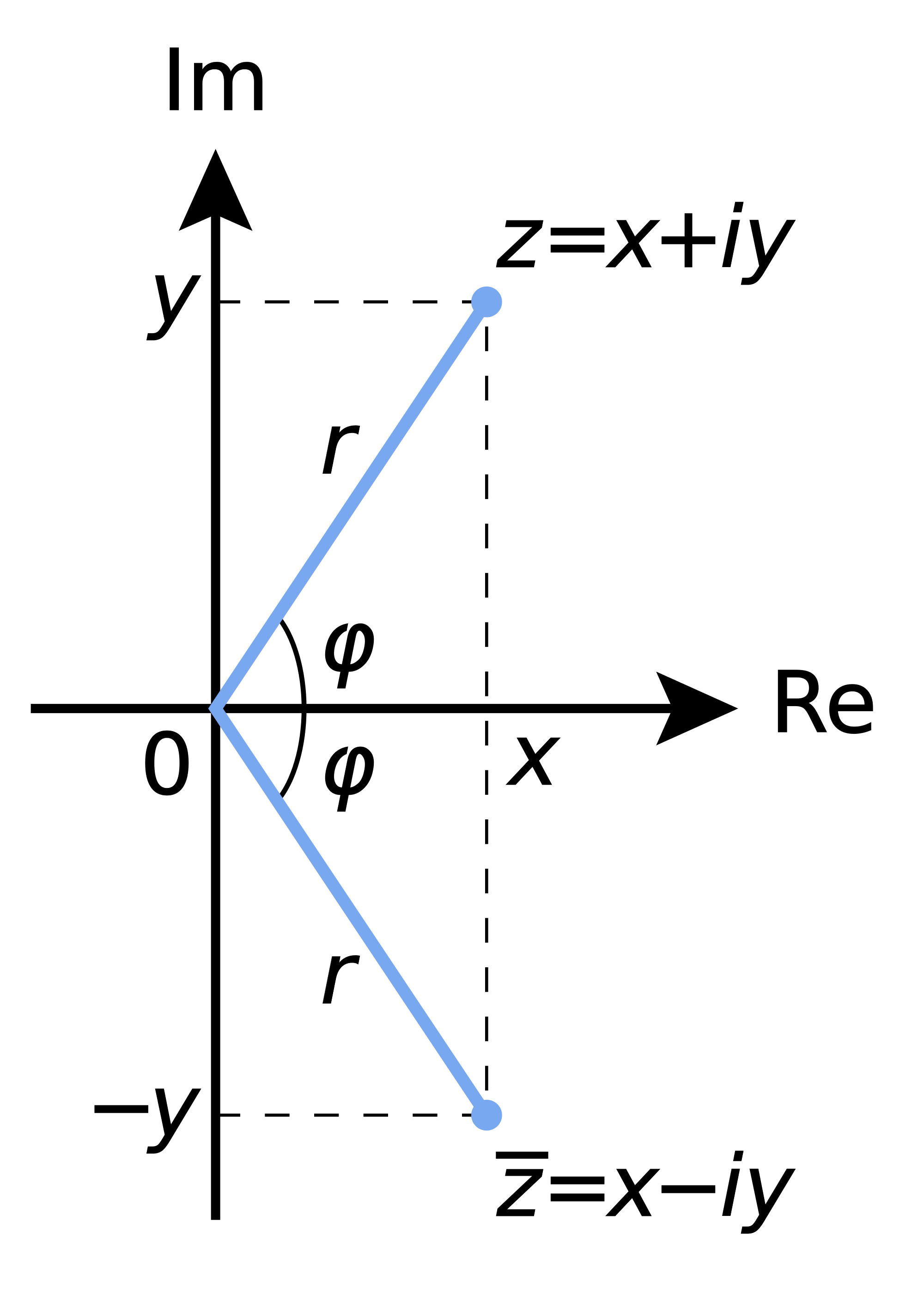
The first illustration just shows what a complex number really is: a two-dimensional number (z) with a real part (Re(z) = x) and an imaginary part (Im(z) = y). We can represent it in two ways: one uses the (x, y) coordinate system (z = x + iy), and the other is the so-called polar form: z = reiφ. The (real) number e in the latter equation is just Euler’s number, so that’s a mathematical constant (just like π). The little i is the imaginary unit, so that’s the thing we introduce to add a second (vertical) dimension to our analysis: i can be written as 0+= (0, 1) indeed, and so it’s like a (second) basis vector in the two-dimensional (Cartesian or complex) plane.
polar form of complex number

I should not say much more about this, but I must list some essential properties and relationships:

  • The coordinate and polar form are related through Euler’s formula: z = x + iy = reiφ = r(cosφ + isinφ).
  • From this, and the fact that cos(-φ) = cosφ and sin(-φ) = –sinφ, it follows that the (complex) conjugate z* = x – iy of a complex number z = x + iy is equal to z* = reiφ. [I use z* as a symbol, instead of z-bar, because I can’t find a z-bar in the character set here.]  This equality is illustrated above.
  • The length/modulus/absolute value of a complex number is written as |z| and is equal to |z| = (x2 + y2)1/2 = |reiφ| = r (so r is always a positive (real) number).
  • As you can see from the graph, a complex number z and its conjugate z* have the same absolute value: |z| = |x+iy| = |z*| = |x-iy|.
  • Therefore, we have the following: |z||z|=|z*||z*|=|z||z*|=|z|2, and we can use this result to calculate the (multiplicative) inverse: z-1 = 1/z = z*/|z|2.
  • The absolute value of a product of complex numbers equals the product of the absolute values of those numbers: |z1z2| = |z1||z2|.
  • Last but not least, it is important to be aware of the geometric interpretation of the sum and the product of two complex numbers:
    • The sum of two complex numbers amounts to adding vectors, so that’s the familiar parallelogram law for vector addition: (a+ib) + (c+id) = (a+b) + i(c+d).
    • Multiplying two complex numbers amounts to adding the angles and multiplying their lengths – as evident from writing such product in its polar form: reiθseiΘ = rsei(θ+Θ). The result is, quite obviously, another complex number. So it is not the usual scalar or vector product which you may or may not be familiar with.

[For the sake of completeness: (i) the scalar product (aka dot product) of two vectors (ab) is equal to the product of is the product of the magnitudes of the two vectors and the cosine of the angle between them: ab = |a||b|cosα; and (ii) the result of a vector product (or cross product) is a vector which is perpendicular to both, so it’s a vector that is not in the same plane as the vectors we are multiplying: a×b = |a||b| sinα n, with n the unit vector perpendicular to the plane containing a and b in the direction given by the so-called right-hand rule. Just be aware of the difference.]

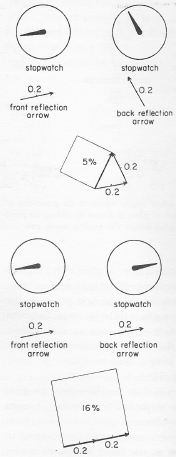
The second illustration (see below) comes from that little book I mentioned above already: Feynman’s exquisite 1985 Alix G. Mautner Memorial Lectures on Quantum Electrodynamics, better known as QED: the Strange Theory of Light and Matter. It shows how these probability amplitudes, or ‘arrows’ as he calls them, really work, without even mentioning that they are ‘probability amplitudes’ or ‘complex numbers’. That being said, these ‘arrows’ are what they are: probability amplitudes.

To be precise, the illustration below shows the probability amplitude of a photon (so that’s a little packet of light) reflecting from the front surface (front reflection arrow) and the back (back reflection arrow) of a thin sheet of glass. If we write these vectors in polar form (reiφ), then it is obvious that they have the same length (r = 0.2) but their phase φ is different. That’s because the photon needs to travel a bit longer to reach the back of the glass: so the phase varies as a function of time and space, but the length doesn’t. Feynman visualizes that with the stopwatch: as the photon is emitted from a light source and travels through time and space, the stopwatch turns and, hence, the arrow will point in a different direction.

[To be even more precise, the amplitude for a photon traveling from point A to B is a (fairly simple) function (which I won’t write down here though) which depends on the so-called spacetime interval. This spacetime interval (written as I or s2) is equal to I = [(x-x1)2+(y-y1)2+(z-z1)2] – (t-t1)2. So the first term in this expression is the square of the distance in space, and the second term is the difference in time, or the ‘time distance’. Of course, we need to measure time and distance in equivalent units: we do that either by measuring spatial distance in light-seconds (i.e. the distance traveled by light in one second) or by expressing time in units that are equal to the time it takes for light to travel one meter (in the latter case we ‘stretch’ time (by multiplying it with c, i.e. the speed of light) while in the former, we ‘stretch’ our distance units). Because of the minus sign between the two terms, the spacetime interval can be negative, zero, or positive, and we call these intervals time-like (I < 0), light-like (I = 0) or space-like (I > 0). Because nothing travels faster than light, two events separated by a space-like interval cannot have a cause-effect relationship. I won’t go into any more detail here but, at this point, you may want to read the article on the so-called light cone relating past and future events in Wikipedia, because that’s what we’re talking about here really.]
front and back reflection amplitude

Feynman adds the two arrows, because a photon may be reflected either by the front surface or by the back surface and we can’t know which of the two possibilities was the case. So he adds the amplitudes here, not the probabilities. The probability of the photon bouncing off the front surface is the modulus of the amplitude squared, (i.e. |reiφ|2 = r2), and so that’s 4% here (0.2·0.2). The probability for the back surface is the same: 4% also. However, the combined probability of a photon bouncing back from either the front or the back surface – we cannot know which path was followed – is not 8%, but some value between 0 and 16% (5% only in the top illustration, and 16% (i.e. the maximum) in the bottom illustration). This value depends on the thickness of the sheet of glass. That’s because it’s the thickness of the sheet that determines where the hand of our stopwatch stops. If the glass is just thick enough to make the stopwatch make one extra half turn as the photon travels through the glass from the front to the back, then we reach our maximum value of 16%, and so that’s what shown in the bottom half of the illustration above.

For the sake of completeness, I need to note that the full explanation is actually a bit more complex. Just a little bit. 🙂 Indeed, there is no such thing as ‘surface reflection’ really: a photon has an amplitude for scattering by each and every layer of electrons in the glass and so we have actually have many more arrows to add in order to arrive at a ‘final’ arrow. However, Feynman shows how all these arrows can be replaced by two so-called ‘radius arrows’: one for ‘front surface reflection’ and one for ‘back surface reflection’. The argument is relatively easy but I have no intention to fully copy Feynman here because the point here is only to illustrate how probabilities are calculated from probability amplitudes. So just remember: probabilities are real numbers between 0 and 1 (or between 0 and 100%), while amplitudes are complex numbers – or ‘arrows’ as Feynman calls them in this popular lectures series.

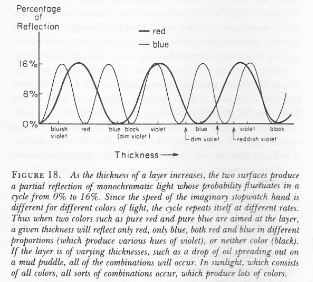
In order to give somewhat more credit to Feynman – and also to be somewhat more complete on how light really reflects from a sheet of glass (or a film of oil on water or a mud puddle), I copy one more illustration here – with the text – which speaks for itself: “The phenomenon of colors produced by the partial reflection of white light by two surfaces is called iridescence, and can be found in many places. Perhaps you have wondered how the brilliant colors of hummingbirds and peacocks are produced. Now you know.” The iridescence phenomenon is caused by really small variations in the thickness of the reflecting material indeed, and it is, perhaps, worth noting that Feynman is also known as the father of nanotechnology… 🙂
Iridescence

Light versus matter

So much for light – or electromagnetic waves in general. They consist of photons. Photons are discrete wave-packets of energy, and their energy (E) is related to the frequency of the light (f) through the Planck relation: E = hf. The factor h in this relation is the Planck constant, or the quantum of action in quantum mechanics as this tiny number (6.62606957×10⁻³⁴) is also being referred to. Photons have no mass and, hence, they travel at the speed of light indeed. But what about the other wave-like particles, like electrons?

For these, we have probability amplitudes (or, more generally, a wave function) as well, the characteristics of which are given by the de Broglie relations. These de Broglie relations also associate a frequency and a wavelength with the energy and/or the momentum of the ‘wave-particle’ that we are looking at: f = E/h and λ = h/p. In fact, one will usually find those two de Broglie relations in a slightly different but equivalent form: ω = E/ħ and k = p/ħ. The symbol ω stands for the angular frequency, so that’s the frequency expressed in radians. In other words, ω is the speed with which the hand of that stopwatch is going round and round and round. Similarly, k is the wave number, and so that’s the wavelength expressed in radians (or the spatial frequency one might say). We use k and ω in wave functions because the argument of these wave functions is the phase of the probability amplitude, and this phase is expressed in radians. For more details on how we go from distance and time units to radians, I refer to my previous post. [Indeed, I need to move on here otherwise this post will become a book of its own! Just check out the following: λ = 2π/k and f = ω/2π.]

How should we visualize a de Broglie wave for, let’s say, an electron? Well, I think the following illustration (which I took from Wikipedia) is not too bad.    

2000px-Quantum_mechanics_travelling_wavefunctions_wavelength

Let’s first look at the graph on the top of the left-hand side of the illustration above. We have a complex wave function Ψ(x) here but only the real part of it is being graphed. Also note that we only look at how this function varies over space at some fixed point of time, and so we do not have a time variable here. That’s OK. Adding the complex part would be nice but it would make the graph even more ‘complex’ :-), and looking at one point in space only and analyzing the amplitude as a function of time only would yield similar graphs. If you want to see an illustration with both the real as well as the complex part of a wave function, have a look at my previous post.

We also have the probability – that’s the red graph – as a function of the probability amplitude: P = |Ψ(x)|2 (so that’s just the modulus squared). What probability? Well, the probability that we can actually find the particle (let’s say an electron) at that location. Probability is obviously always positive (unlike the real (or imaginary) part of the probability amplitude, which oscillate around the x-axis). The probability is also reflected in the opacity of the little red ‘tennis ball’ representing our ‘wavicle’: the opacity varies as a function of the probability. So our electron is smeared out, so to say, over the space denoted as Δx.

Δx is the uncertainty about the position. The question mark next to the λ symbol (we’re still looking at the graph on the top left-hand side of the above illustration only: don’t look at the other three graphs now!) attributes this uncertainty to uncertainty about the wavelength. As mentioned in my previous post, wave packets, or wave trains, do not tend to have an exact wavelength indeed. And so, according to the de Broglie equation λ = h/p, if we cannot associate an exact value with λ, we will not be able to associate an exact value with p. Now that’s what’s shown on the right-hand side. In fact, because we’ve got a relatively good take on the position of this ‘particle’ (or wavicle we should say) here, we have a much wider interval for its momentum : Δpx. [We’re only considering the horizontal component of the momentum vector p here, so that’s px.] Φ(p) is referred to as the momentum wave function, and |Φ(p)|2 is the corresponding probability (or probability density as it’s usually referred to).

The two graphs at the bottom present the reverse situation: fairly precise momentum, but a lot of uncertainty about the wavicle’s position (I know I should stick to the term ‘particle’ – because that’s what physicists prefer – but I think ‘wavicle’ describes better what it’s supposed to be). So the illustration above is not only an illustration of the de Broglie wave function for a particle, but it also illustrates the Uncertainty Principle.

Now, I know I should move on to the thing I really want to write about in this post – i.e. bosons and fermions – but I feel I need to say a few things more about this famous ‘Uncertainty Principle’ – if only because I find it quite confusing. According to Feynman, one should not attach too much importance to it. Indeed, when introducing his simple arithmetic on probability amplitudes, Feynman writes the following about it: “The uncertainty principle needs to be seen in its historical context. When the revolutionary ideas of quantum physics were first coming out, people still tried to understand them in terms of old-fashioned ideas (such as, light goes in straight lines). But at a certain point, the old-fashioned ideas began to fail, so a warning was developed that said, in effect, ‘Your old-fashioned ideas are no damn good when…’ If you get rid of all the old-fashioned ideas and instead use the ideas that I’m explaining in these lectures – adding arrows for all the ways an event can happen – there is no need for the uncertainty principle!” So, according to Feynman, wave function math deals with all and everything and therefore we should, perhaps, indeed forget about this rather mysterious ‘principle’.

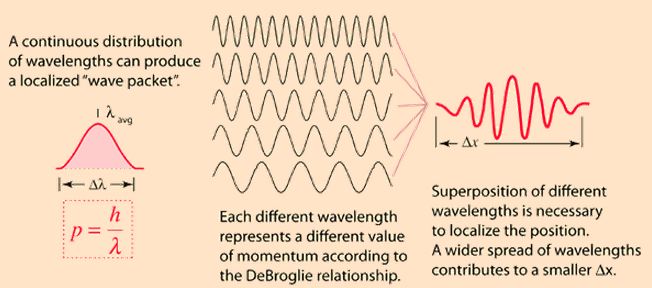
However, because it is mentioned so much (especially in the more popular writing), I did try to find some kind of easy derivation of its standard formulation: ΔxΔp ≥ ħ (ħ = h/2π, i.e. the quantum of angular momentum in quantum mechanics). To my surprise, it’s actually not easy to derive the uncertainty principle from other basic ‘principles’. As mentioned above, it follows from the de Broglie equation  λ = h/p that momentum (p) and wavelength (λ) are related, but so how do we relate the uncertainty about the wavelength (Δλ) or the momentum (Δp) to the uncertainty about the position of the particle (Δx)? The illustration below, which analyzes a wave packet (aka a wave train), might provide some clue. Before you look at the illustration and start wondering what it’s all about, remember that a wave function with a definite (angular) frequency ω and wave number k (as described in my previous post), which we can write as Ψ = Aei(ωt-kx), represents the amplitude of a particle with a known momentum p = ħ/at some point x and t, and that we had a big problem with such wave, because the squared modulus of this function is a constant: |Ψ|2 = |Aei(ωt-kx)|= A2. So that means that the probability of finding this particle is the same at all points. So it’s everywhere and nowhere really (so it’s like the second wave function in the illustration above, but then with Δx infinitely long and the same wave shape all along the x-axis). Surely, we can’t have this, can we? Now we cannot – if only because of the fact that if we add up all of the probabilities, we would not get some finite number. So, in reality, particles are effectively confined to some region Δor – if we limit our analysis to one dimension only (for the sake of simplicity) – Δx (remember that bold-type symbols represent vectors). So the probability amplitude of a particle is more likely to look like something that we refer to as a wave packet or a wave train. And so that’s what’s explained more in detail below.

Now, I said that localized wave trains do not tend to have an exact wavelength. What do I mean with that? It doesn’t sound very precise, does it? In fact, we actually can easily sketch a graph of a wave packet with some fixed wavelength (or fixed frequency), so what am I saying here? I am saying that, in quantum physics, we are only looking at a very specific type of wave train: they are a composite of a (potentially infinite) number of waves whose wavelengths are distributed more or less continuously around some average, as shown in the illustration below, and so the addition of all of these waves – or their superposition as the process of adding waves is usually referred to – results in a combined ‘wavelength’ for the localized wave train that we cannot, indeed, equate with some exact number. I have not mastered the details of the mathematical process referred to as Fourier analysis (which refers to the decomposition of a combined wave into its sinusoidal components) as yet, and, hence, I am not in a position to quickly show you how Δx and Δλ are related exactly, but the point to note is that a wider spread of wavelengths results in a smaller Δx. Now, a wider spread of wavelengths corresponds to a wider spread in p too, and so there we have the Uncertainty Principle: the more we know about Δx, the less we know about Δx, and so that’s what the inequality ΔxΔp ≥ h/2π represents really.
Explanation of uncertainty principle

[Those who like to check things out may wonder why a wider spread in wavelength implies a wider spread in momentum. Indeed, if we just replace λ and p with Δλ and Δp  in the de Broglie equation λ = h/p, we get Δλ = h/Δp and so we have an inversely proportional relationship here, don’t we? No. We can’t just write that Δλ = Δ(h/p) but this Δ is not some mathematical operator than you can simply move inside of the brackets. What is Δλ? Is it a standard deviation? Is it the spread and, if so, what’s the spread? We could, for example, define it as the difference between some maximum value λmax and some minimum value λmin, so as Δλ = λmax – λmin. These two values would then correspond with pmax =h/λmin and pmin =h/λmax and so the corresponding spread in momentum would be equal to Δp = pmax – pmin =  h/λmin – h/λmax = h(λmax – λmin)/(λmaxλmin). So a wider spread in wavelength does result in a wider spread in momentum, but the relationship is more subtle than you might think at first. In fact, in a more rigorous approach, we would indeed see the standard deviation (represented by the sigma symbol σ) from some average as a measure of the ‘uncertainty’. To be precise, the more precise formulation of the Uncertainty Principle is: σxσ≥ ħ/2, but don’t ask me where that 2 comes from!]

I really need to move on now, because this post is already way too lengthy and, hence, not very readable. So, back to that very first question: what’s that wave function math? Well, that’s obviously too complex a topic to be fully exhausted here. 🙂 I just wanted to present one aspect of it in this post: Bose-Einstein statistics. Huh? Yes.

When we say Bose-Einstein statistics, we should also say its opposite: Fermi-Dirac statistics. Bose-Einstein statistics were ‘discovered’ by the Indian scientist Satyanendra Nath Bose (the only thing Einstein did was to give Bose’s work on this wider recognition) and they apply to bosons (so they’re named after Bose only), while Fermi-Dirac statistics apply to fermions (‘Fermi-Diraqions’ doesn’t sound good either obviously). Any particle, or any wavicle I should say, is either a fermion or a boson. There’s a strict dichotomy: you can’t have characteristics of both. No split personalities. Not even for a split second.

The best-known examples of bosons are photons and the recently experimentally confirmed Higgs particle. But, in case you have heard of them, gluons (which mediate the so-called strong interactions between particles), and the W+, W and Z particles (which mediate the so-called weak interactions) are bosons too. Protons, neutrons and electrons, on the other hand, are fermions.

More complex particles, such as atomic nuclei, are also either bosons or fermions. That depends on the number of protons and neutrons they consist of. But let’s not get ahead of ourselves. Here, I’ll just note that bosons – unlike fermions – can pile on top of one another without limit, all occupying the same ‘quantum state’. This explains superconductivity, superfluidity and Bose-Einstein condensation at low temperatures. Indeed, these phenomena usually involve (bosonic) helium. You can’t do it with fermions. Superfluid helium has very weird properties, including zero viscosity – so it flows without dissipating energy and it creeps up the wall of its container, seemingly defying gravity: just Google one of the videos on the Web! It’s amazing stuff! Bose statistics also explain why photons of the same frequency can form coherent and extremely powerful laser beams, with (almost) no limit as to how much energy can be focused in a beam.

Fermions, on the other hand, avoid one another. Electrons, for example, organize themselves in shells around a nucleus stack. They can never collapse into some kind of condensed cloud, as bosons can. If electrons would not be fermions, we would not have such variety of atoms with such great range of chemical properties. But, again, let’s not get ahead of ourselves. Back to the math.

Bose versus Fermi particles

When adding two probability amplitudes (instead of probabilities), we are adding complex numbers (or vectors or arrows or whatever you want to call them), and so we need to take their phase into account or – to put it simply – their direction. If their phase is the same, the length of the new vector will be equal to the sum of the lengths of the two original vectors. When their phase is not the same, then the new vector will be shorter than the sum of the lengths of the two amplitudes that we are adding. How much shorter? Well, that obviously depends on the angle between the two vectors, i.e. the difference in phase: if it’s 180 degrees (or π radians), then they will cancel each other out and we have zero amplitude! So that’s destructive or negative interference. If it’s less than 90 degrees, then we will have constructive or positive interference.

It’s because of this interference effect that we have to add probability amplitudes first, before we can calculate the probability of an event happening in one or the other (indistinguishable) way (let’s say A or B) – instead of just adding probabilities as we would do in the classical world. It’s not subtle. It makes a big difference: |ΨA + ΨB|2 is the probability when we cannot distinguish the alternatives (so when we’re in the world of quantum mechanics and, hence, we have to add amplitudes), while |ΨA|+ |ΨB|is the probability when we can see what happens (i.e. we can see whetheror B was the case). Now, |ΨA + ΨB|is definitely not the same as |ΨA|+ |ΨB|– not for real numbers, and surely not for complex numbers either. But let’s move on with the argument – literally: I mean the argument of the wave function at hand here.

That stopwatch business above makes it easier to introduce the thought experiment which Feynman also uses to introduce Bose versus Fermi statistics (Feynman Lectures (1965), Vol. III, Lecture 4). The experimental set-up is shown below. We have two particles, which are being referred to as particle a and particle b respectively (so we can distinguish the two), heading straight for each other and, hence, they are likely to collide and be scattered in some other direction. The experimental set-up is designed to measure where they are likely to end up, i.e. to measure probabilities. [There’s no certainty in the quantum-mechanical world, remember?] So, in this experiment, we have a detector (or counter) at location 1 and a detector/counter at location 2 and, after many many measurements, we have some value for the (combined) probability that particle a goes to detector 1 and particle b goes to counter 2. This amplitude is a complex number and you may expect it will depend on the angle θ as shown in the illustration below.

scattering identical particles

So this angle θ will obviously show up somehow in the argument of our wave function. Hence, the wave function, or probability amplitude, describing the amplitude of particle a ending up in counter 1 and particle b ending up in counter 2 will be some (complex) function Ψ1= f(θ). Please note, once again, that θ is not some (complex) phase but some real number (expressed in radians) between 0 and 2π that characterizes the set-up of the experiment above. It is also worth repeating that f(θ) is not the amplitude of particle a hitting detector 1 only but the combined amplitude of particle a hitting counter 1 and particle b hitting counter 2! It makes a big difference and it’s essential in the interpretation of this argument! So, the combined probability of a going to 1 and of particle b going to 2, which we will write as P1, is equal to |Ψ1|= |f(θ)|2.

OK. That’s obvious enough. However, we might also find particle a in detector 2 and particle b in detector 1. Surely, the probability amplitude probability for this should be equal to f(θ+π)? It’s just a matter of switching counter 1 and 2 – i.e. we rotate their position over 180 degrees, or π (in radians) – and then we just insert the new angle of this experimental set-up (so that’s θ+π) into the very same wave function and there we are. Right?

Well… Maybe. The probability of a going to 2 and b going to 1, which we will write as P2, will be equal to |f(θ+π)|indeed. However, our probability amplitude, which I’ll write as Ψ2may not be equal to f(θ+π). It’s just a mathematical possibility. I am not saying anything definite here. Huh? Why not? 

Well… Think about the thing we said about the phase and the possibility of a phase shift: f(θ+π) is just one of the many mathematical possibilities for a wave function yielding a probability P=|Ψ2|= |f(θ+π)|2. But any function eiδf(θ+π) will yield the same probability. Indeed, |z1z2| = |z1||z2| and so |eiδ f(θ+π)|2 = (|eiδ||f(θ+π)|)= |eiδ|2|f(θ+π)|= |f(θ+π)|(the square of the modulus of a complex number on the unit circle is always one – because the length of vectors on the unit circle is equal to one). It’s a general thing: if Ψ is some wave function (i.e. it describes some complex amplitude in space and time, then eiδΨ is the same wave function but with a phase shift equal to δ. Huh? Yes. Think about it: we’re multiplying complex numbers here, so that’s adding angles and multiplying lengths. Now the length of eiδ is 1 (because it’s a complex number on the unit circle) but its phase is δ. So multiplying Ψ with eiδ does not change the length of Ψ but it does shift its phase by an amount (in radians) equal to δ. That should be easy enough to understand.

You probably wonder what I am being so fussy, and what that δ could be, or why it would be there. After all, we do have a well-behaved wave function f(θ) here, depending on x, t and θ, and so the only thing we did was to change the angle θ (we added π radians to it). So why would we need to insert a phase shift here? Because that’s what δ really is: some random phase shift. Well… I don’t know. This phase factor is just a mathematical possibility as for now. So we just assume that, for some reason which we don’t understand right now, there might be some ‘arbitrary phase factor’ (that’s how Feynman calls δ) coming into play when we ‘exchange’ the ‘role’ of the particles. So maybe that δ is there, but maybe not. I admit it looks very ugly. In fact, if the story about Bose’s ‘discovery’ of this ‘mathematical possibility’ (in 1924) is correct, then it all started with an obvious ‘mistake’ in a quantum-mechanical calculation – but a ‘mistake’ that, miraculously, gave predictions that agreed with experimental results that could not be explained without introducing this ‘mistake’. So let the argument go full circle – literally – and take your time to appreciate the beauty of argumentation in physics.

Let’s swap detector 1 and detector 2 a second time, so we ‘exchange’ particle a and b once again. So then we need to apply this phase factor δ once again and, because of symmetry in physics, we obviously have to use the same phase factor δ – not some other value γ or something. We’re only rotating our detectors once again. That’s it. So all the rest stays the same. Of course, we also need to add π once more to the argument in our wave function f. In short, the amplitude for this is:

eiδ[eiδf(θ+π+π)] = (eiδ)f(θ) = ei2δ f(θ)

Indeed, the angle θ+2π is the same as θ. But so we have twice that phase shift now: 2δ. As ugly as that ‘thing’ above: eiδf(θ+π). However, if we square the amplitude, we get the same probability: P= |Ψ1|= |ei2δ f(θ)| = |f(θ)|2. So it must be right, right? Yes. But – Hey! Wait a minute! We are obviously back at where we started, aren’t we? We are looking at the combined probability – and amplitude – for particle a going to counter 1 and particle b going to counter 2, and the angle is θ! So it’s the same physical situation, and – What the heck! – reality doesn’t change just because we’re rotating these detectors a couple of times, does it? [In fact, we’re actually doing nothing but a thought experiment here!] Hence, not only the probability but also the amplitude must be the same.  So (eiδ)2f(θ) must equal f(θ) and so… Well… If (eiδ)2f(θ) = f(θ), then (eiδ)2 must be equal to 1. Now, what does that imply for the value of δ?

Well… While the square of the modulus of all vectors on the unit circle is always equal to 1, there are only two cases for which the square of the vector itself yields 1: (I) eiδ = eiπ =  eiπ = –1 (check it: (eiπ)= (–1)ei2π = ei0 = +1), and (II) eiδ = ei2π eie= +1 (check it: ei2π)= (+1)ei4π = ei0 = +1). In other words, our phase factor δ is either δ = 0 (or 0 ± 2nπ) or, else, δ = π (or π ± 2nπ). So eiδ = ± 1 and Ψ2 is either +f(θ+π) or, else, –f(θ+π). What does this mean? It means that, if we’re going to be adding the amplitudes, then the ‘exchanged case’ may contribute with the same sign or, else, with the opposite sign.

But, surely, there is no need to add amplitudes here, is there? Particle a can be distinguished from particle b and so the first case (particle a going into counter 1 and particle b going into counter 2) is not the same as the ‘exchanged case’ (particle a going into counter 2 and b going into counter 1). So we can clearly distinguish or verify which of the two possible paths are followed and, hence, we should be adding probabilities if we want to get the combined probability for both cases, not amplitudes. Now that is where the fun starts. Suppose that we have identical particles here – so not some beam of α-particles (i.e. helium nuclei) bombarding beryllium nuclei for instance but, let’s say, electrons on electrons, or photons on photons indeed – then we do have to add the amplitudes, not the probabilities, in order to calculate the combined probability of a particle going into counter 1 and the other particle going into counter 2, for the simple reason that we don’t know which is which and, hence, which is going where.

Let me immediately throw in an important qualifier: defining ‘identical particles’ is not as easy as it sounds. Our ‘wavicle’ of choice, for example, an electron, can have its spin ‘up’ or ‘down’ – and so that’s two different things. When an electron arrives in a counter, we can measure its spin (in practice or in theory: it doesn’t matter in quantum mechanics) and so we can distinguish it and, hence, an electron that’s ‘up’ is not identical to one that’s ‘down’. [I should resist the temptation but I’ll quickly make the remark: that’s the reason why we have two electrons in one atomic orbital: one is ‘up’ and the other one is ‘down’. Identical particles need to be in the same ‘quantum state’ (that’s the standard expression for it) to end up as ‘identical particles’ in, let’s say, a laser beam or so. As Feynman states it: in this (theoretical) experiment, we are talking polarized beams, with no mixture of different spin states.]

The wonderful thing in quantum mechanics is that mathematical possibility usually corresponds with reality. For example, electrons with positive charge, or anti-matter in general, is not only a theoretical possibility: they exist. Likewise, we effectively have particles which interfere with positive sign – these are called Bose particles – and particles which interfere with negative sign – Fermi particles.

So that’s reality. The factor eiδ = ± 1 is there, and it’s a strict dichotomy: photons, for example, always behave like Bose particles, and protons, neutrons and electrons always behave like Fermi particles. So they don’t change their mind and switch from one to the other category, not for a short while, and not for a long while (or forever) either. In fact, you may or may not be surprised to hear that there are experiments trying to find out if they do – just in case. 🙂 For example, just Google for Budker and English (2010) from the University of California at Berkeley. The experiments confirm the dichotomy: no split personalities here, not even for a nanosecond (10−9 s), or a picosecond (10−12 s). [A picosecond is the time taken by light to travel 0.3 mm in a vacuum. In a nanosecond, light travels about one foot.]

In any case, does all of this really matter? What’s the difference, in practical terms that is? Between Bose or Fermi, I must assume we prefer the booze.

It’s quite fundamental, however. Hang in there for a while and you’ll see why.

Bose statistics

Suppose we have, once again, some particle a and b that (i) come from different directions (but, this time around, not necessarily in the experimental set-up as described above: the two particles may come from any direction really), (ii) are being scattered, at some point in space (but, this time around, not necessarily the same point in space), (iii) end up going in one and the same direction and – hopefully – (iv) arrive together at some other point in space. So they end up in the same state, which means they have the same direction and energy (or momentum) and also whatever other condition that’s relevant. Again, if the particles are not identical, we can catch both of them and identify which is which. Now, if it’s two different particles, then they won’t take exactly the same path. Let’s say they travel along two infinitesimally close paths referred to as path 1 and 2 and so we should have two infinitesimally small detectors: one at location 1 and the other at location 2. The illustration below (credit to Feynman once again!) is for n particles, but here we’ll limit ourselves to the calculations for just two.

Boson particles

Let’s denote the amplitude of a to follow path 1 (and end up in counter 1) as a1, and the amplitude of b to follow path 2 (and end up in counter 2) as b1. Then the amplitude for these two scatterings to occur at the same time is the product of these two amplitudes, and so the probability is equal to |a1b1|= [|a1||b1|]= |a1|2|b1|2. Similarly, the combined amplitude of a following path 2 (and ending up in counter 2) and b following path 1 (etcetera) is |a2|2|b2|2. But so we said that the directions 1 and 2 were infinitesimally close and, hence, the values for aand a2, and for band b2, should also approach each other, so we can equate them with a and b respectively and, hence, the probability of some kind of combined detector picking up both particles as they hit the counter is equal to P = 2|a|2|b|2 (just substitute and add). [Note: For those who would think that separate counters and ‘some kind of combined detector’ radically alter the set-up of this thought experiment (and, hence, that we cannot just do this kind of math), I refer to Feynman (Vol. III, Lecture 4, section 4): he shows how it works using differential calculus.]

Now, if the particles cannot be distinguished – so if we have ‘identical particles’ (like photons, or polarized electrons) – and if we assume they are Bose particles (so they interfere with a positive sign – i.e. like photons, but not like electrons), then we should no longer add the probabilities but the amplitudes, so we get a1b+ a2b= 2ab for the amplitude and – lo and behold! – a probability equal to P = 4|a|2|b|2So what? Well… We’ve got a factor 2 difference here: 4|a|2|b|is two times 2|a|2|b|2.

This is a strange result: it means we’re twice as likely to find two identical Bose particles scattered into the same state as you would assuming the particles were different. That’s weird, to say the least. In fact, it gets even weirder, because this experiment can easily be extended to a situation where we have n particles present (which is what the illustration suggests), and that makes it even more interesting (more ‘weird’ that is). I’ll refer to Feynman here for the (fairly easy but somewhat lengthy) calculus in case we have n particles, but the conclusion is rock-solid: if we have n bosons already present in some state, then the probability of getting one extra boson is n+1 times greater than it would be if there were none before.

So the presence of the other particles increases the probability of getting one more: bosons like to crowd. And there’s no limit to it: the more bosons you have in one space, the more likely it is another one will want to occupy the same space. It’s this rather weird phenomenon which explains equally weird things such as superconductivity and superfluidity, or why photons of the same frequency can form such powerful laser beams: they don’t mind being together – literally on the same spot – in huge numbers. In fact, they love it: a laser beam, superfluidity or superconductivity are actually quantum-mechanical phenomena that are visible at a macro-scale.

OK. I won’t go into any more detail here. Let me just conclude by showing how interference works for Fermi particles. Well… That doesn’t work or, let me be more precise, it leads to the so-called (Pauli) Exclusion Principle which, for electrons, states that “no two electrons can be found in exactly the same state (including spin).” Indeed, we get a1b– a2b1= ab – ab = 0 (zero!) if we let the values of aand a2, and band b2, come arbitrarily close to each other. So the amplitude becomes zero as the two directions (1 and 2) approach each other. That simply means that it is not possible at all for two electrons to have the same momentum, location or, in general, the same state of motion – unless they are spinning opposite to each other (in which case they are not ‘identical’ particles). So what? Well… Nothing much. It just explains all of the chemical properties of atoms. 🙂

In addition, the Pauli exclusion principle also explains the stability of matter on a larger scale: protons and neutrons are fermions as well, and so they just “don’t get close together with one big smear of electrons around them”, as Feynman puts it, adding: “Atoms must keep away from each other, and so the stability of matter on a large scale is really a consequence of the Fermi particle nature of the electrons, protons and neutrons.”

Well… There’s nothing much to add to that, I guess. 🙂

Post scriptum:

I wrote that “more complex particles, such as atomic nuclei, are also either bosons or fermions”, and that this depends on the number of protons and neutrons they consist of. In fact, bosons are, in general, particles with integer spin (0 or 1), while fermions have half-integer spin (1/2). Bosonic Helium-4 (He4) has zero spin. Photons (which mediate electromagnetic interactions), gluons (which mediate the so-called strong interactions between particles), and the W+, W and Z particles (which mediate the so-called weak interactions) all have spin one (1). As mentioned above, Lithium-7 (Li7) has half-integer spin (3/2). The underlying reason for the difference in spin between He4 and Li7 is their composition indeed: He4  consists of two protons and two neutrons, while Liconsists of three protons and four neutrons.

However, we have to go beyond the protons and neutrons for some better explanation. We now know that protons and neutrons are not ‘fundamental’ any more: they consist of quarks, and quarks have a spin of 1/2. It is probably worth noting that Feynman did not know this when he wrote his Lectures in 1965, although he briefly sketches the findings of Murray Gell-Man and Georg Zweig, who published their findings in 1961 and 1964 only, so just a little bit before, and describes them as ‘very interesting’. I guess this is just another example of Feynman’s formidable intellect and intuition… In any case, protons and neutrons are so-called baryons: they consist of three quarks, as opposed to the short-lived (unstable) mesons, which consist of one quark and one anti-quark only (you may not have heard about mesons – they don’t live long – and so I won’t say anything about them). Now, an uneven number of quarks result in half-integer spin, and so that’s why protons and neutrons have half-integer spin. An even number of quarks result in integer spin, and so that’s why mesons have spin zero 0 or 1. Two protons and two neutrons together, so that’s He4, can condense into a bosonic state with spin zero, because four half-integer spins allows for an integer sum. Seven half-integer spins, however, cannot be combined into some integer spin, and so that’s why Li7 has half-integer spin (3/2). Electrons also have half-integer spin (1/2) too. So there you are.

Now, I must admit that this spin business is a topic of which I understand little – if anything at all. And so I won’t go beyond the stuff I paraphrased or quoted above. The ‘explanation’ surely doesn’t ‘explain’ this fundamental dichotomy between bosons and fermions. In that regard, Feynman’s 1965 conclusion still stands: “It appears to be one of the few places in physics where there is a rule which can be stated very simply, but for which no one has found a simple and easy explanation. The explanation is deep down in relativistic quantum mechanics. This probably means that we do not have a complete understanding of the fundamental principle involved. For the moment, you will just have to take it as one of the rules of the world.”

Some content on this page was disabled on June 20, 2020 as a result of a DMCA takedown notice from Michael A. Gottlieb, Rudolf Pfeiffer, and The California Institute of Technology. You can learn more about the DMCA here:

https://wordpress.com/support/copyright-and-the-dmca/
Some content on this page was disabled on June 20, 2020 as a result of a DMCA takedown notice from Michael A. Gottlieb, Rudolf Pfeiffer, and The California Institute of Technology. You can learn more about the DMCA here:

https://wordpress.com/support/copyright-and-the-dmca/

An easy piece: introducing quantum mechanics and the wave function

Pre-scriptum (dated 26 June 2020): A quick glance at this piece – so many years after I have written it – tells me it is basically OK. However, it is quite obvious that, in terms of interpreting the math, I have come a very long way. However, I would recommend you go through the piece so as to get the basic math, indeed, and then you may or may not be ready for the full development of my realist or classical interpretation of QM. My manuscript may also be a fun read for you.

Original post:

After all those boring pieces on math, it is about time I got back to physics. Indeed, what’s all that stuff on differential equations and complex numbers good for? This blog was supposed to be a journey into physics, wasn’t it? Yes. But wave functions – functions describing physical waves (in classical mechanics) or probability amplitudes (in quantum mechanics) – are the solution to some differential equation, and they will usually involve complex-number notation. However, I agree we have had enough of that now. Let’s see how it works. By the way, the title of this post – An Easy Piece – is an obvious reference to (some of) Feynman’s 1965 Lectures on Physics, some of which were re-packaged in 1994 (six years after his death that is) in ‘Six Easy Pieces’ indeed – but, IMHO, it makes more sense to read all of them as part of the whole series.

Let’s first look at one of the most used mathematical shapes: the sinusoidal wave. The illustration below shows the basic concepts: we have a wave here – some kind of cyclic thing – with a wavelength λ, an amplitude (or height) of (maximum) A0, and a so-called phase shift equal to φ. The Wikipedia definition of a wave is the following: “a wave is a disturbance or oscillation that travels through space and matter, accompanied by a transfer of energy.” Indeed, a wave transports energy as it travels (oh – I forgot to mention the speed or velocity of a wave (v) as an important characteristic of a wave), and the energy it carries is directly proportional to the square of the amplitude of the wave: E ∝ A2 (this is true not only for waves like water waves, but also for electromagnetic waves, like light).

Cosine wave concepts

Let’s now look at how these variables get into the argument – literally: into the argument of the wave function. Let’s start with that phase shift. The phase shift is usually defined referring to some other wave or reference point (in this case the origin of the x and y axis). Indeed, the amplitude – or ‘height’ if you want (think of a water wave, or the strength of the electric field) – of the wave above depends on (1) the time t (not shown above) and (2) the location (x), but so we will need to have this phase shift φ in the argument of the wave function because at x = 0 we do not have a zero height for the wave. So, as we can see, we can shift the x-axis left or right with this φ. OK. That’s simple enough. Let’s look at the other independent variables now: time and position.

The height (or amplitude) of the wave will obviously vary both in time as well as in space. On this graph, we fixed time (t = 0) – and so it does not appear as a variable on the graph – and show how the amplitude y = A varies in space (i.e. along the x-axis). We could also have looked at one location only (x = 0 or x1 or whatever other location) and shown how the amplitude varies over time at that location only. The graph would be very similar, except that we would have a ‘time distance’ between two crests (or between two troughs or between any other two points separated by a full cycle of the wave) instead of the wavelength λ (i.e. a distance in space). This ‘time distance’ is the time needed to complete one cycle and is referred to as the period of the wave (usually denoted by the symbol T or T– in line with the notation for the maximum amplitude A0). In other words, we will also see time (t) as well as location (x) in the argument of this cosine or sine wave function. By the way, it is worth noting that it does not matter if we use a sine or cosine function because we can go from one to the other using the basic trigonometric identities cos θ = sin(π/2 – θ) and sin θ = cos(π/2 – θ). So all waves of the shape above are referred to as sinusoidal waves even if, in most cases, the convention is to actually use the cosine function to represent them.

So we will have x, t and φ in the argument of the wave function. Hence, we can write A = A(x, t, φ) = cos(x + t + φ) and there we are, right? Well… No. We’re adding very different units here: time is measured in seconds, distance in meter, and the phase shift is measured in radians (i.e. the unit of choice for angles). So we can’t just add them up. The argument of a trigonometric function (like this cosine function) is an angle and, hence, we need to get everything in radians – because that’s the unit we use to measure angles. So how do we do that? Let’s do it step by step.

First, it is worth noting that waves are usually caused by something. For example, electromagnetic waves are caused by an oscillating point charge somewhere, and radiate out from there. Physical waves – like water waves, or an oscillating string – usually also have some origin. In fact, we can look at a wave as a way of transmitting energy originating elsewhere. In the case at hand here – i.e. the nice regular sinusoidal wave illustrated above – it is obvious that the amplitude at some time t = tat some point x = x1 will be the same as the amplitude of that wave at point x = 0 some time ago. How much time ago? Well… The time (t) that was needed for that wave to travel from point x = 0 to point x = xis easy to calculate: indeed, if the wave originated at t = 0 and x = 0, then x1 (i.e. the distance traveled by the wave) will be equal to its velocity (v) multiplied by t1, so we have x1= v.t1 (note that we assume the wave velocity is constant – which is a very reasonable assumption). In other words, inserting x1and t1 in the argument of our cosine function should yield the same value as inserting zero for x and t. Distance and time can be substituted so to say, and that’s we will have something like x – vt or vt – x in the argument in that cosine function: we measure both time and distance in units of distance so to say. [Note that x – vt and –(x-vt) = vt – x are equivalent because cos θ = cos (-θ)]

Does this sound fishy? It shouldn’t. Think about it. In the (electric) field equation for electromagnetic radiation (that’s one of the examples of a wave which I mentioned above), you’ll find the so-called retarded acceleration a(t – x/c) in the argument: that’s the acceleration (a)of the charge causing the electric field at point x to change not at time t but at time t – x/c. So that’s the retarded acceleration indeed: x/c is the time it took for the wave to travel from its origin (the oscillating point charge) to x and so we subtract that from t. [When talking electromagnetic radiation (e.g. light), the wave velocity v is obviously equal to c, i.e. the speed of light, or of electromagnetic radiation in general.] Of course, you will now object that t – x/c is not the same as vt – x, and you are right: we need time units in the argument of that acceleration function, not distance. We can get to distance units if we would multiply the time with the wave velocity v but that’s complicated business because the velocity of that moving point charge is not a constant.

[…] I am not sure if I made myself clear here. If not, so be it. The thing to remember is that we need an input expressed in radians for our cosine function, not time, nor distance. Indeed, the argument in a sine or cosine function is an angle, not some distance. We will call that angle the phase of the wave, and it is usually denoted by the symbol θ  – which we also used above. But so far we have been talking about amplitude as a function of distance, and we expressed time in distance units too – by multiplying it with v. How can we go from some distance to some angle? It is simple: we’ll multiply x – vt with 2π/λ.

Huh? Yes. Think about it. The wavelength will be expressed in units of distance – typically 1 m in the SI International System of Units but it could also be angstrom (10–10 m = 0.1 nm) or nano-meter (10–9 m = 10 Å). A wavelength of two meter (2 m) means that the wave only completes half a cycle per meter of travel. So we need to translate that into radians, which – once again – is the measure used to… well… measure angles, or the phase of the wave as we call it here. So what’s the ‘unit’ here? Well… Remember that we can add or subtract 2π (and any multiple of 2π, i.e. ± 2nπ with n = ±1, ±2, ±3,…) to the argument of all trigonometric functions and we’ll get the same value as for the original argument. In other words, a cycle characterized by a wavelength λ corresponds to the angle θ going around the origin and describing one full circle, i.e. 2π radians. Hence, it is easy: we can go from distance to radians by multiplying our ‘distance argument’ x – vt with 2π/λ. If you’re not convinced, just work it out for the example I gave: if the wavelength is 2 m, then 2π/λ equals 2π/2 = π. So traveling 6 meters along the wave – i.e. we’re letting x go from 0 to 6 m while fixing our time variable – corresponds to our phase θ going from 0 to 6π: both the ‘distance argument’ as well as the change in phase cover three cycles (three times two meter for the distance, and three times 2π for the change in phase) and so we’re fine. [Another way to think about it is to remember that the circumference of the unit circle is also equal to 2π (2π·r = 2π·1 in this case), so the ratio of 2π to λ measures how many times the circumference contains the wavelength.]

In short, if we put time and distance in the (2π/λ)(x-vt) formula, we’ll get everything in radians and that’s what we need for the argument for our cosine function. So our sinusoidal wave above can be represented by the following cosine function:

A = A(x, t) = A0cos[(2π/λ)(x-vt)]

We could also write A = A0cosθ with θ = (2π/λ)(x-vt). […] Both representations look rather ugly, don’t they? They do. And it’s not only ugly: it’s not the standard representation of a sinusoidal wave either. In order to make it look ‘nice’, we have to introduce some more concepts here, notably the angular frequency and the wave number. So let’s do that.

The angular frequency is just like the… well… the frequency you’re used to, i.e. the ‘non-angular’ frequency f,  as measured in cycles per second (i.e. in Hertz). However, instead of measuring change in cycles per second, the angular frequency (usually denoted by the symbol ω) will measure the rate of change of the phase with time, so we can write or define ω as ω = ∂θ/∂t. In this case, we can easily see that ω = –2πv/λ. [Note that we’ll take the absolute value of that derivative because we want to work with positive numbers for such properties of functions.] Does that look complicated? In doubt, just remember that ω is measured in radians per second and then you can probably better imagine what it is really. Another way to understand ω somewhat better is to remember that the product of ω and the period T is equal to 2π, so that’s a full cycle. Indeed, the time needed to complete one cycle multiplied with the phase change per second (i.e. per unit time) is equivalent to going round the full circle: 2π = ω.T. Because f = 1/T, we can also relate ω to f and write ω = 2π.f = 2π/T.

Likewise, we can measure the rate of change of the phase with distance, and that gives us the wave number k = ∂θ/∂x, which is like the spatial frequency of the wave. So it is just like the wavelength but then measured in radians per unit distance. From the function above, it is easy to see that k = 2π/λ. The interpretation of this equality is similar to the ω.T = 2π equality. Indeed, we have a similar equation for k: 2π = k.λ, so the wavelength (λ) is for k what the period (T) is for ω. If you’re still uncomfortable with it, just play a bit with some numerical examples and you’ll be fine.

To make a long story short, this, then, allows us to re-write the sinusoidal wave equation above in its final form (and let me include the phase shift φ again in order to be as complete as possible at this stage):

A(x, t) = A0cos(kx – ωt + φ)

You will agree that this looks much ‘nicer’ – and also more in line with what you’ll find in textbooks or on Wikipedia. 🙂 I should note, however, that we’re not adding any new parameters here. The wave number k and the angular frequency ω are not independent: this is still the same wave (A = A0cos[(2π/λ)(x-vt)]), and so we are not introducing anything more than the frequency and – equally important – the speed with which the wave travels, which is usually referred to as the phase velocity. In fact, it is quite obvious from the ω.T = 2π and the k = 2π/λ identities that kλ = ω.T and, hence, taking into account that λ is obviously equal to λ = v.T (the wavelength is – by definition – the distance traveled by the wave in one period), we find that the phase (or wave) velocity v is equal to the ratio of ω and k, so we have that v = ω/k. So x, t, ω and k could be re-scaled or so but their ratio cannot change: the velocity of the wave is what it is. In short, I am introducing two new concepts and symbols (ω and k) but there are no new degrees of freedom in the system so to speak.

[At this point, I should probably say something about the difference between the phase velocity and the so-called group velocity of a wave. Let me do that in as brief a way as I can manage. Most real-life waves travel as a wave packet, aka a wave train. So that’s like a burst, or an “envelope” (I am shamelessly quoting Wikipedia here…), of “localized wave action that travels as a unit.” Such wave packet has no single wave number or wavelength: it actually consists of a (large) set of waves with phases and amplitudes such that they interfere constructively only over a small region of space, and destructively elsewhere. The famous Fourier analysis (or infamous if you have problems understanding what it is really) decomposes this wave train in simpler pieces. While these ‘simpler’ pieces – which, together, add up to form the wave train – are all ‘nice’ sinusoidal waves (that’s why I call them ‘simple’), the wave packet as such is not. In any case (I can’t be too long on this), the speed with which this wave train itself is traveling through space is referred to as the group velocity. The phase velocity and the group velocity are usually very different: for example, a wave packet may be traveling forward (i.e. its group velocity is positive) but the phase velocity may be negative, i.e. traveling backward. However, I will stop here and refer to the Wikipedia article on group and phase velocity: it has wonderful illustrations which are much and much better than anything I could write here. Just one last point that I’ll use later: regardless of the shape of the wave (sinusoidal, sawtooth or whatever), we have a very obvious relationship relating wavelength and frequency to the (phase) velocity: v = λ.f, or f = v/λ. For example, the frequency of a wave traveling 3 meter per second and wavelength of 1 meter will obviously have a frequency of three cycles per second (i.e. 3 Hz). Let’s go back to the main story line now.]

With the rather lengthy ‘introduction’ to waves above, we are now ready for the thing I really wanted to present here. I will go much faster now that we have covered the basics. Let’s go.

From my previous posts on complex numbers (or from what you know on complex numbers already), you will understand that working with cosine functions is much easier when writing them as the real part of a complex number A0eiθ = A0ei(kx – ωt + φ). Indeed, A0eiθ = A0(cosθ + isinθ) and so the cosine function above is nothing else but the real part of the complex number A0eiθ. Working with complex numbers makes adding waves and calculating interference effects and whatever we want to do with these wave functions much easier: we just replace the cosine functions by complex numbers in all of the formulae, solve them (algebra with complex numbers is very straightforward), and then we look at the real part of the solution to see what is happening really. We don’t care about the imaginary part, because that has no relationship to the actual physical quantities – for physical and electromagnetic waves that is, or for any other problem in classical wave mechanics. Done. So, in classical mechanics, the use of complex numbers is just a mathematical tool.

Now, that is not the case for the wave functions in quantum mechanics: the imaginary part of a wave equation – yes, let me write one down here – such as Ψ = Ψ(x, t) = (1/x)ei(kx – ωt) is very much part and parcel of the so-called probability amplitude that describes the state of the system here. In fact, this Ψ function is an example taken from one of Feynman’s first Lectures on Quantum Mechanics (i.e. Volume III of his Lectures) and, in this case, Ψ(x, t) = (1/x)ei(kx – ωt) represents the probability amplitude of a tiny particle (e.g. an electron) moving freely through space – i.e. without any external forces acting upon it – to go from 0 to x and actually be at point x at time t. [Note how it varies inversely with the distance because of the 1/x factor, so that makes sense.] In fact, when I started writing this post, my objective was to present this example – because it illustrates the concept of the wave function in quantum mechanics in a fairly easy and relatively understandable way. So let’s have a go at it.

First, it is necessary to understand the difference between probabilities and probability amplitudes. We all know what a probability is: it is a real number between o and 1 expressing the chance of something happening. It is usually denoted by the symbol P. An example is the probability that monochromatic light (i.e. one or more photons with the same frequency) is reflected from a sheet of glass. [To be precise, this probability is anything between 0 and 16% (i.e. P = 0 to 0.16). In fact, this example comes from another fine publication of Richard Feynman – QED (1985) – in which he explains how we can calculate the exact probability, which depends on the thickness of the sheet.]

A probability amplitude is something different. A probability amplitude is a complex number (3 + 2i, or 2.6ei1.34, for example) and – unlike its equivalent in classical mechanics – both the real and imaginary part matter. That being said, probabilities and probability amplitudes are obviously related: to be precise, one calculates the probability of an event actually happening by taking the square of the modulus (or the absolute value) of the probability amplitude associated with that event. Huh? Yes. Just let it sink in. So, if we denote the probably amplitude by Φ, then we have the following relationship:

P =|Φ|2

P = probability

Φ = probability amplitude

In addition, where we would add and multiply probabilities in the classical world (for example, to calculate the probability of an event which can happen in two different ways – alternative 1 and alternative 2 let’s say – we would just add the individual probabilities to arrive at the probably of the event happening in one or the other way, so P = P1+ P2), in the quantum-mechanical world we should add and multiply probability amplitudes, and then take the square of the modulus of that combined amplitude to calculate the combined probability. So, formally, the probability of a particle to reach a given state by two possible routes (route 1 or route 2 let’s say) is to be calculated as follows:

Φ = Φ1+ Φ2

and P =|Φ|=|Φ1+ Φ2|2

Also, when we have only one route, but that one route consists of two successive stages (for example: to go from A to C, the particle would have first have to go from A to B, and then from B to C, with different probabilities of stage AB and stage BC actually happening), we will not multiply the probabilities (as we would do in the classical world) but the probability amplitudes. So we have:

Φ = ΦAB ΦBC

and P =|Φ|=|ΦAB ΦBC|2

In short, it’s the probability amplitudes (and, as mentioned, these are complex numbers, not real numbers) that are to be added and multiplied etcetera and, hence, the probability amplitudes act as the equivalent, so to say, in quantum mechanics, of the conventional probabilities in classical mechanics. The difference is not subtle. Not at all. I won’t dwell too much on this. Just re-read any account of the double-slit experiment with electrons which you may have read and you’ll remember how fundamental this is. [By the way, I was surprised to learn that the double-slit experiment with electrons has apparently only been done in 2012 in exactly the way as Feynman described it. So when Feynman described it in his 1965 Lectures, it was still very much a ‘thought experiment’ only – even a 1961 experiment (not mentioned by Feynman) had clearly established the reality of electron interference.]

OK. Let’s move on. So we have this complex wave function in quantum mechanics and, as Feynman writes, “It is not like a real wave in space; one cannot picture any kind of reality to this wave as one does for a sound wave.” That being said, one can, however, get pretty close to ‘imagining’ what it actually is IMHO. Let’s go by the example which Feynman gives himself – on the very same page where he writes the above actually. The amplitude for a free particle (i.e. with no forces acting on it) with momentum p = m to go from location rto location ris equal to

Φ12 = (1/r12)eip.r12/ħ with r12 = rr

I agree this looks somewhat ugly again, but so what does it say? First, be aware of the difference between bold and normal type: I am writing p and v in bold type above because they are vectors: they have a magnitude (which I will denote by p and v respectively) as well as a direction in space. Likewise, r12 is a vector going from r1 to r2 (and rand r2 themselves are space vectors themselves obviously) and so r12 (non-bold) is the magnitude of that vector. Keeping that in mind, we know that the dot product p.r12 is equal to the product of the magnitudes of those vectors multiplied by cosα, with α the angle between those two vectors. Hence, p.r12  .= p.r12.cosα. Now, if p and r12 have the same direction, the angle α will be zero and so cosα will be equal to one and so we just have p.r12 = p.r12 or, if we’re considering a particle going from 0 to some position x, p.r12 = p.r12 = px.

Now we also have Planck’s constant there, in its reduced form ħ = h/2π. As you can imagine, this 2π has something to do with the fact that we need radians in the argument. It’s the same as what we did with x in the argument of that cosine function above: if we have to express stuff in radians, then we have to absorb a factor of 2π in that constant. However, here I need to make an additional digression. Planck’s constant is obviously not just any constant: it is the so-called quantum of action. Indeed, it appears in what may well the most fundamental relations in physics.

The first of these fundamental relations is the so-called Planck relation: E = hf. The Planck relation expresses the wave-particle duality of light (or electromagnetic waves in general): light comes in discrete quanta of energy (photons), and the energy of these ‘wave particles’ is directly proportional to the frequency of the wave, and the factor of proportionality is Planck’s constant.

The second fundamental relation, or relations – in plural – I should say, are the de Broglie relations. Indeed, Louis-Victor-Pierre-Raymond, 7th duc de Broglie, turned the above on its head: if the fundamental nature of light is (also) particle-like, then the fundamental nature of particles must (also) be wave-like. So he boldly associated a frequency f and a wavelength λ with all particles, such as electrons for example – but larger-scale objects, such as billiard balls, or planets, also have a de Broglie wavelength and frequency! The de Broglie relation determining the de Broglie frequency is – quite simply – the re-arranged Planck relation: f = E/h. So this relation relates the de Broglie frequency with energy. However, in the above wave function, we’ve got momentum, not energy. Well… Energy and momentum are obviously related, and so we have a second de Broglie relation relating momentum with wavelength: λ = h/p.

We’re almost there: just hang in there. 🙂 When we presented the sinusoidal wave equation, we introduced the angular frequency (ω)  and the wave number (k), instead of working with f and λ. That’s because we want an argument expressed in radians. Here it’s the same. The two de Broglie equations have a equivalent using angular frequency and wave number: ω = E/ħ and k = p/ħ. So we’ll just use the second one (i.e. the relation with the momentum in it) to associate a wave number with the particle (k = p/ħ).

Phew! So, finally, we get that formula which we introduced a while ago already:  Ψ(x) = (1/x)eikx, or, including time as a variable as well (we made abstraction of time so far):

Ψ(x, t) = (1/x)ei(kx – ωt)

The formula above obviously makes sense. For example, the 1/x factor makes the probability amplitude decrease as we get farther away from where the particle started: in fact, this 1/x or 1/r variation is what we see with electromagnetic waves as well: the amplitude of the electric field vector E varies as 1/r and, because we’re talking some real wave here and, hence, its energy is proportional to the square of the field, the energy that the source can deliver varies inversely as the square of the distance. [Another way of saying the same is that the energy we can take out of a wave within a given conical angle is the same, no matter how far away we are: the energy flux is never lost – it just spreads over a greater and greater effective area. But let’s go back to the main story.]

We’ve got the math – I hope. But what does this equation mean really? What’s that de Broglie wavelength or frequency in reality? What wave are we talking about? Well… What’s reality? As mentioned above, the famous de Broglie relations associate a wavelength λ and a frequency f to a particle with momentum p and energy E, but it’s important to mention that the associated de Broglie wave function yields probability amplitudes. So it is, indeed, not a ‘real wave in space’ as Feynman would put it. It is a quantum-mechanical wave equation.

Huh? […] It’s obviously about time I add some illustrations here, and so that’s what I’ll do. Look at the two cases below. The case on top is pretty close to the situation I described above: it’s a de Broglie wave – so that’s a complex wave – traveling through space (in one dimension only here). The real part of the complex amplitude is in blue, and the green is the imaginary part. So the probability of finding that particle at some position x is the modulus squared of this complex amplitude. Now, this particular wave function ignores the 1/x variation and, hence, the squared modulus of Aei(kx – ωt) is equal to a constant. To be precise, it’s equal to A2 (check it: the squared modulus of a complex number z equals the product of z and its complex conjugate, and so we get Aas a result indeed). So what does this mean? It means that the probability of finding that particle (an electron, for example) is the same at all points! In other words, we don’t know where it is! In the illustration below (top part), that’s shown as the (yellow) color opacity: the probability is spread out, just like the wave itself, so there is no definite position of the particle indeed.

2000px-Propagation_of_a_de_broglie_wave

[Note that the formula in the illustration above (which I took from Wikipedia once again) uses p instead of k as the factor in front of x. While it does not make a big difference from a mathematical point of view (ħ is just a factor of proportionality: k = p/ħ), it does make a big difference from a conceptual point of view and, hence, I am puzzled as to why the author of this article did this. Also, there is some variation in the opacity of the yellow (i.e. the color of our tennis (or ping pong) ball representing our ‘wavicle’) which shouldn’t be there because the probability associated with this particular wave function is a constant indeed: so there is no variation in the probability (when squaring the absolute value of a complex number, the phase factor does not come into play). Also note that, because all probabilities have to add up to 100% (or to 1), a wave function like this is quite problematic. However, don’t worry about it just now: just try to go with the flow.]

By now, I must assume you shook your head in disbelief a couple of time already. Surely, this particle (let’s stick to the example of an electron) must be somewhere, yes? Of course.

The problem is that we gave an exact value to its momentum and its energy and, as a result, through the de Broglie relations, we also associated an exact frequency and wavelength to the de Broglie wave associated with this electron.  Hence, Heisenberg’s Uncertainty Principle comes into play: if we have exact knowledge on momentum, then we cannot know anything about its location, and so that’s why we get this wave function covering the whole space, instead of just some region only. Sort of. Here we are, of course, talking about that deep mystery about which I cannot say much – if only because so many eminent physicists have already exhausted the topic. I’ll just state Feynman once more: “Things on a very small scale behave like nothing that you have any direct experience with. […] It is very difficult to get used to, and it appears peculiar and mysterious to everyone – both to the novice and to the experienced scientist. Even the experts do not understand it the way they would like to, and it is perfectly reasonable that they should not because all of direct, human experience and of human intuition applies to large objects. We know how large objects will act, but things on a small scale just do not act that way. So we have to learn about them in a sort of abstract or imaginative fashion and not by connection with our direct experience.” And, after describing the double-slit experiment, he highlights the key conclusion: “In quantum mechanics, it is impossible to predict exactly what will happen. We can only predict the odds [i.e. probabilities]. Physics has given up on the problem of trying to predict exactly what will happen. Yes! Physics has given up. We do not know how to predict what will happen in a given circumstance. It is impossible: the only thing that can be predicted is the probability of different events. It must be recognized that this is a retrenchment in our ideal of understanding nature. It may be a backward step, but no one has seen a way to avoid it.”

[…] That’s enough on this I guess, but let me – as a way to conclude this little digression – just quickly state the Uncertainty Principle in a more or less accurate version here, rather than all of the ‘descriptions’ which you may have seen of it: the Uncertainty Principle refers to any of a variety of mathematical inequalities asserting a fundamental limit (fundamental means it’s got nothing to do with observer or measurement effects, or with the limitations of our experimental technologies) to the precision with which certain pairs of physical properties of a particle (these pairs are known as complementary variables) such as, for example, position (x) and momentum (p), can be known simultaneously. More in particular, for position and momentum, we have that σxσp ≥ ħ/2 (and, in this formulation, σ is, obviously the standard symbol for the standard deviation of our point estimate for x and p respectively).

OK. Back to the illustration above. A particle that is to be found in some specific region – rather than just ‘somewhere’ in space – will have a probability amplitude resembling the wave equation in the bottom half: it’s a wave train, or a wave packet, and we can decompose it, using the Fourier analysis, in a number of sinusoidal waves, but so we do not have a unique wavelength for the wave train as a whole, and that means – as per the de Broglie equations – that there’s some uncertainty about its momentum (or its energy).

I will let this sink in for now. In my next post, I will write some more about these wave equations. They are usually a solution to some differential equation – and that’s where my next post will connect with my previous ones (on differential equations). Just to say goodbye – as for now that is – I will just copy another beautiful illustration from Wikipedia. See below: it represents the (likely) space in which a single electron on the 5d atomic orbital of a hydrogen atom would be found. The solid body shows the places where the electron’s probability density (so that’s the squared modulus of the probability amplitude) is above a certain value – so it’s basically the area where the likelihood of finding the electron is higher than elsewhere. The hue on the colored surface shows the complex phase of the wave function.

Hydrogen_eigenstate_n5_l2_m1

It is a wonderful image, isn’t it? At the very least, it increased my understanding of the mystery surround quantum mechanics somewhat. I hope it helps you too. 🙂

Post scriptum 1: On the need to normalize a wave function

In this post, I wrote something about the need for probabilities to add up to 1. In mathematical terms, this condition will resemble something like

probability amplitude adding up to some constant

In this integral, we’ve got – once again – the squared modulus of the wave function, and so that’s the probability of find the particle somewhere. The integral just states that all of the probabilities added all over space (Rn) should add up to some finite number (a2). Hey! But that’s not equal to 1 you’ll say. Well… That’s a minor problem only: we can create a normalized wave function ψ out of ψ0 by simply dividing ψ by a so we have ψ = ψ0/a, and then all is ‘normal’ indeed. 🙂

Post scriptum 2: On using colors to represent complex numbers

When inserting that beautiful 3D graph of that 5d atomic orbital (again acknowledging its source: Wikipedia), I wrote that “the hue on the colored surface shows the complex phase of the wave function.” Because this kind of visual representation of complex numbers will pop up in other posts as well (and you’ve surely encountered it a couple of times already), it’s probably useful to be explicit on what it represents exactly. Well… I’ll just copy the Wikipedia explanation, which is clear enough: “Given a complex number z = reiθ, the phase (also known as argument) θ can be represented by a hue, and the modulus r =|z| is represented by either intensity or variations in intensity. The arrangement of hues is arbitrary, but often it follows the color wheel. Sometimes the phase is represented by a specific gradient rather than hue.” So here you go…

Unit circle domain coloring.png

Post scriptum 3: On the de Broglie relations

The de Broglie relations are a wonderful pair. They’re obviously equivalent: energy and momentum are related, and wavelength and frequency are obviously related too through the general formula relating frequency, wavelength and wave velocity: fλ = v (the product of the frequency and the wavelength must yield the wave velocity indeed). However, when it comes to the relation between energy and momentum, there is a little catch. What kind of energy are we talking about? We were describing a free particle (e.g. an electron) traveling through space, but with no (other) charges acting on it – in other words: no potential acting upon it), and so we might be tempted to conclude that we’re talking about the kinetic energy (K.E.) here. So, at relatively low speeds (v), we could be tempted to use the equations p = mv and K.E. = p2/2m = mv2/2 (the one electron in a hydrogen atom travels at less than 1% of the speed of light, and so that’s a non-relativistic speed indeed) and try to go from one equation to the other with these simple formulas. Well… Let’s try it.

f = E/h according to de Broglie and, hence, substituting E with p2/2m and f with v/λ, we get v/λ = m2v2/2mh. Some simplification and re-arrangement should then yield the second de Broglie relation: λ = 2h/mv = 2h/p. So there we are. Well… No. The second de Broglie relation is just λ = h/p: there is no factor 2 in it. So what’s wrong? The problem is the energy equation: de Broglie does not use the K.E. formula. [By the way, you should note that the K.E. = mv2/2 equation is only an approximation for low speeds – low compared to c that is.] He takes Einstein’s famous E = mc2 equation (which I am tempted to explain now but I won’t) and just substitutes c, the speed of light, with v, the velocity of the slow-moving particle. This is a very fine but also very deep point which, frankly, I do not yet fully understand. Indeed, Einstein’s E = mcis obviously something much ‘deeper’ than the formula for kinetic energy. The latter has to do with forces acting on masses and, hence, obeys Newton’s laws – so it’s rather familiar stuff. As for Einstein’s formula, well… That’s a result from relativity theory and, as such, something that is much more difficult to explain. While the difference between the two energy formulas is just a factor of 1/2 (which is usually not a big problem when you’re just fiddling with formulas like this), it makes a big conceptual difference.

Hmm… Perhaps we should do some examples. So these de Broglie equations associate a wave with frequency f and wavelength λ with particles with energy E, momentum p and mass m traveling through space with velocity v: E = hf and p = h/λ. [And, if we would want to use some sine or cosine function as an example of such wave function – which is likely – then we need an argument expressed in radians rather than in units of time or distance. In other words, we will need to convert frequency and wavelength to angular frequency and wave number respectively by using the 2π = ωT = ω/f and 2π = kλ relations, with the wavelength (λ), the period (T) and the velocity (v) of the wave being related through the simple equations f = 1/T and λ = vT. So then we can write the de Broglie relations as: E = ħω and p =  ħk, with ħ = h/2π.]

In these equations, the Planck constant (be it h or ħ) appears as a simple factor of proportionality (we will worry about what h actually is in physics in later posts) – but a very tiny one: approximately 6.626×10⁻³⁴ J·s (Joule is the standard SI unit to measure energy, or work: 1 J = 1 kg·m2/s2), or 4.136×10⁻¹⁵ eV·s when using a more appropriate (i.e. larger) measure of energy for atomic physics: still, 10–15 is only 0.000 000 000 000 001. So how does it work? First note, once again, that we are supposed to use the equivalent for slow-moving particles of Einstein’s famous E = mcequation as a measure of the energy of a particle: E = mv2. We know velocity adds mass to a particle – with mass being a measure for inertia. In fact, the mass of so-called massless particles,  like photons, is nothing but their energy (divided by c2). In other words, they do not have a rest mass, but they do have a relativistic mass m = E/c2, with E = hf (and with f the frequency of the light wave here). Particles, such as electrons, or protons, do have a rest mass, but then they don’t travel at the speed of light. So how does that work out in that E = mvformula which – let me emphasize this point once again – is not the standard formula (for kinetic energy) that we’re used to (i.e. E = mv2/2)? Let’s do the exercise.

For photons, we can re-write E = hf as E = hc/λ. The numerator hc in this expression is 4.136×10⁻¹⁵ eV·s (i.e. the value of the Planck constant h expressed in eV·s) multiplied with 2.998×10⁸ m/s (i.e. the speed of light c) so that’s (more or less) hc ≈ 1.24×10⁻⁶ eV·m. For visible light, the denominator will range from 0.38 to 0.75 micrometer (1 μm = 10–6 m), i.e. 380 to 750 nanometer (1 nm = 10–6 m), and, hence, the energy of the photon will be in the range of 3.263 eV to 1.653 eV. So that’s only a few electronvolt (an electronvolt (eV) is, by definition, the amount of energy gained (or lost) by a single electron as it moves across an electric potential difference of one volt). So that’s 2.6 to 5.2 Joule (1 eV = 1.6×10⁻¹⁹ Joule) and, hence, the equivalent relativistic mass of these photons is E/cor 2.9 to 5.8×10⁻³⁴ kg. That’s tiny – but not insignificant. Indeed, let’s look at an electron now.

The rest mass of an electron is about 9.1×10⁻³¹ kg (so that’s a scale factor of a thousand as compared to the values we found for the relativistic mass of photons). Also, in a hydrogen atom, it is expected to speed around the nucleus with a velocity of about 2.2×10m/s. That’s less than 1% of the speed of light but still quite fast obviously: at this speed (2,200 km per second), it could travel around the earth in less than 20 seconds (a photon does better: it travels not less than 7.5 times around the earth in one second). In any case, the electron’s energy – according to the formula to be used as input for calculating the de Broglie frequency – is 9.1×10⁻³¹ kg multiplied with the square of 2.2×10⁶ m/s, and so that’s about 44×10–19 Joule or about 70 eV (1 eV = 1.6×10⁻¹⁹ Joule). So that’s – roughly – 35 times more than the energy associated with a photon.

The frequency we should associate with 70 eV can be calculated from E = hv/λ (we should, once again, use v instead of c), but we can also simplify and calculate directly from the mass: λ = hv/E = hv/mv2 = h/m(however, make sure you express h in J·s in this case): we get a value for λ equal to 0.33 nanometer, so that’s more than one thousand times shorter than the above-mentioned wavelengths for visible light. So, once again, we have a scale factor of about a thousand here. That’s reasonable, no? [There is a similar scale factor when moving to the next level: the mass of protons and neutrons is about 2000 times the mass of an electron.] Indeed, note that we would get a value of 0.510 MeV if we would apply the E = mc2, equation to the above-mentioned (rest) mass of the electron (in kg): MeV stands for mega-electronvolt, so 0.510 MeV is 510,000 eV. So that’s a few hundred thousand times the energy of a photon and, hence, it is obvious that we are not using the energy equivalent of an electron’s rest mass when using de Broglie’s equations. No. It’s just that simple but rather mysterious E = mvformula. So it’s not mcnor mv2/2 (kinetic energy). Food for thought, isn’t it? Let’s look at the formulas once again.

They can easily be linked: we can re-write the frequency formula as λ = hv/E = hv/mv2 = h/mand then, using the general definition of momentum (p = mv), we get the second de Broglie equation: p = h/λ. In fact, de Broglie‘s rather particular definition of the energy of a particle (E = mv2) makes v a simple factor of proportionality between the energy and the momentum of a particle: v = E/p or E = pv. [We can also get this result in another way: we have h = E/f = pλ and, hence, E/p = fλ = v.]

Again, this is serious food for thought: I have not seen any ‘easy’ explanation of this relation so far. To appreciate its peculiarity, just compare it to the usual relations relating energy and momentum: E =p2/2m or, in its relativistic form, p2c2 = E2 – m02c4 . So these two equations are both not to be used when going from one de Broglie relation to another. [Of course, it works for massless photons: using the relativistic form, we get p2c2 = E2 – 0 or E = pc, and the de Broglie relation becomes the Planck relation: E = hf (with f the frequency of the photon, i.e. the light beam it is part of). We also have p = h/λ = hf/c, and, hence, the E/p = c comes naturally. But that’s not the case for (slower-moving) particles with some rest mass: why should we use mv2 as a energy measure for them, rather than the kinetic energy formula?

But let’s just accept this weirdness and move on. After all, perhaps there is some mistake here and so, perhaps, we should just accept that factor 2 and replace λ = h/p by λ = 2h/p. Why not? 🙂 In any case, both the λ = h/mv and λ = 2h/p = 2h/mv expressions give the impression that both the mass of a particle as well as its velocity are on a par so to say when it comes to determining the numerical value of the de Broglie wavelength: if we double the speed, or the mass, the wavelength gets shortened by half. So, one would think that larger masses can only be associated with extremely short de Broglie wavelengths if they move at a fairly considerable speed. But that’s where the extremely small value of h changes the arithmetic we would expect to see. Indeed, things work different at the quantum scale, and it’s the tiny value of h that is at the core of this. Indeed, it’s often referred to as the ‘smallest constant’ in physics, and so here’s the place where we should probably say a bit more about what h really stands for.

Planck’s constant h describes the tiny discrete packets in which Nature packs energy: one cannot find any smaller ‘boxes’. As such, it’s referred to as the ‘quantum of action’. But, surely, you’ll immediately say that it’s cousin, ħ = h/2π, is actually smaller. Well… Yes. You’re actually right: ħ = h/2π is actually smaller. It’s the so-called quantum of angular momentum, also (and probably better) known as spin. Angular momentum is a measure of… Well… Let’s call it the ‘amount of rotation’ an object has, taking into account its mass, shape and speed. Just like p, it’s a vector. To be precise, it’s the product of a body’s so-called rotational inertia (so that’s similar to the mass m in p = mv) and its rotational velocity (so that’s like v, but it’s ‘angular’ velocity), so we can write L = Iω but we’ll not go in any more detail here. The point to note is that angular momentum, or spin as it’s known in quantum mechanics, also comes in discrete packets, and these packets are multiples of ħ. [OK. I am simplifying here but the idea or principle that I am explaining here is entirely correct.]

But let’s get back to the de Broglie wavelength now. As mentioned above, one would think that larger masses can only be associated with extremely short de Broglie wavelengths if they move at a fairly considerable speed. Well… It turns out that the extremely small value of h upsets our everyday arithmetic. Indeed, because of the extremely small value of h as compared to the objects we are used to ( in one grain of salt alone, we will find about 1.2×10¹⁸ atoms – just write a 1 with 18 zeroes behind and you’ll appreciate this immense numbers somewhat more), it turns out that speed does not matter all that much – at least not in the range we are used to. For example, the de Broglie wavelength associated with a baseball weighing 145 grams and traveling at 90 mph (i.e. approximately 40 m/s) would be 1.1×10⁻³⁴ m. That’s immeasurably small indeed – literally immeasurably small: not only technically but also theoretically because, at this scale (i.e. the so-called Planck scale), the concepts of size and distance break down as a result of the Uncertainty Principle. But, surely, you’ll think we can improve on this if we’d just be looking at a baseball traveling much slower. Well… It does not much get better for a baseball traveling at a snail’s pace – let’s say 1 cm per hour, i.e. 2.7×10⁻⁶ m/s. Indeed, we get a wavelength of 17×10–28 m, which is still nowhere near the nanometer range we found for electrons.  Just to give an idea: the resolving power of the best electron microscope is about 50 picometer (1 pm = ×10–12 m) and so that’s the size of a small atom (the size of an atom ranges between 30 and 300 pm). In short, for all practical purposes, the de Broglie wavelength of the objects we are used to does not matter – and then I mean it does not matter at all. And so that’s why quantum-mechanical phenomena are only relevant at the atomic scale.

Ordinary Differential Equations (II)

Pre-scriptum (dated 26 June 2020): In pre-scriptums for my previous posts on math, I wrote that the material in posts like this remains interesting but that one, strictly speaking, does not need it to understand quantum mechanics. This post is a little bit different: one has to understand the basic concept of a differential equation as well as the basic solution methods. So, yes, it is a prerequisite. :-/

Original post:

According to the ‘What’s Physics All About?’ title in Usborne Children’s Books series, physics is all about ‘discovering why things fall to the ground, how sound travels through walls and how many wonderful inventions exist thanks to physics.’

The Encyclopædia Britannica rephrases that definition of physics somewhat and identifies physics with ‘the science that deals with the structure of matter and the interactions between the fundamental constituents of the observable universe.’

[…]

Now, if I would have to define physics at this very moment, I’d say that physics is all about solving differential equations and complex integration. Let’s be honest: is there any page in any physics textbook that does not have any ∫ or ∂ symbols on it?

When everything is said and done, I guess that’s the Big Lie behind all these popular books, including Penrose’s Road to Reality. You need to learn how to write and speak in the language of physics to appreciate them and, for all practical purposes, the language of physics is math. Period.

I am also painfully aware of the fact that the type of differential equations I had to study as a student in economics (even at the graduate or Master’s level) are just a tiny fraction of what’s out there. The variety of differential equations that can be solved is truly intimidating and, because each and every type comes with its own step-by-step methodology, it’s not easy to remember what needs to be done.

Worse, I actually find it quite difficult to remember what ‘type’ this or that equation actually is. In addition, one often needs to reduce or rationalize the equation or – more complicated – substitute variables to get the equation in a form which can then be used to apply a certain method. To top if all off, there’s also this intimidating fact that – despite all these mathematical acrobatics – the vast majority of differential equations can actually not be solved analytically. Hence, in order to penetrate that area of darkness, one has to resort to numerical approaches, which I have yet to learn (the oldest of such numerical methods was apparently invented by the great Leonhard Euler, an 18th century mathematician and physicist from Switzerland).

So where am I actually in this mathematical Wonderland?

I’ve looked at ordinary differential equations only so far, i.e. equations involving one dependent variable (usually written as y) and one independent variable (usually written as x or t), and at equations of the first order only. So that means that (a) we don’t have any ∂ symbols in these differential equations (let me use the DE abbreviation from now on) but just the differential symbol d (so that’s what makes them ordinary DEs, as opposed to partial DEs), and that (b) the highest-order derivative in them is the first derivative only (i.e. y’ = dy/dx). Hence, the only ‘lower-order derivative’ is the function y itself (remember that there’s this somewhat odd mathematical ‘convention’ identifying a function with the zeroth derivative of itself).

Such first-order DEs will usually not be linear things and, even if they look like linear things, don’t jump to conclusions because the term linear (first-order) differential equation is very specific: it means that the (first) derivative and the function itself appear in a linear combination. To be more specific, the term linear differential equation (for the first-order case) is reserved for DEs of the form

a1(t) y'(t) + a0(t) y(t) = q(t).

So, besides y(t) and y'(t) – whose functional form we don’t know because (don’t forget!) finding y(t) is the objective of solving these DEs 🙂 – we have three other random functions of the independent variable t here, namely  a1(t), a0(t) and q(t). Now, these functions may or may not be linear functions of t (they’re probably not) but that doesn’t matter: the important thing – to qualify as ‘linear’ – is that (1) y(t) and y'(t), i.e. the dependent variable and its derivative, appear in a linear combination and have these ‘coefficients’ a1(t) and a0(t) (which, I repeat, may be constants but, more likely, will probably be functions of t themselves), and (2) that, on the other side of the equation, we’ve got this q(t) function, which also may or – more likely – may not be a constant.

Are you still with me? [If not, read again. :-)]

This type of equation – of which the example in my previous post was a specimen – can be solved by introducing a so-called integrating factor. Now, I won’t explain that here – not because the explanation is too easy (it’s not), but because it’s pretty standard and, much more importantly, because it’s too lengthy to copy here. [If you’d be looking for an ‘easy’ explanation, I’d recommend Paul’s Online Math Notes once again.]

So I’ll continue with my ‘typology’ of first-order DEs. However, I’ll do so only after noting that, before letting that integrating factor loose (OK, let me say something about it: in essence, the integrating factor is some function λ(x) which we’ll multiply with the whole equation and which, because of a clever choice of λ(x) obviously, helps us to solve the equation), you’ll have to rewrite these linear first-order DEs as y'(t) + (a0(t)/a1(t)) y(t) = q(t)/a1(t) (so just divide both sides by this a1(t) function) or, using the more prevalent notation x for the independent variable (instead of t) and equating a0(x)/a1(x) with F(x) and q(x)/a1(x) with G(x), as:

dy/dx + F(x) y = G(x), or y‘ + F(x) y = G(x)

So, that’s one ‘type’ of first-order differential equations: linear DEs. [We’re only dealing with first-order DEs here but let me note that the general form of a linear DE of the nth order is an(x) y(n) + an-1(x) y(n-1) + … + a1(x) y’ + a0(x) y = q(x), and that most standard texts on higher-order DEs focus on linear DEs only, so they are important – even if they are only a tiny fraction of the DE universe.]

The second major ‘exam-type’ of DEs which you’ll encounter is the category of so-called separable DEs. Separable (first-order) differential equations are equations of the form:

P(xdx + Q(ydy = 0, which can also be written as G(y) y‘ = F(x)

or dy/dx = F(x)/G(y)

The notion of ‘separable’ refers to the fact that we can neatly separate out the terms involving y and x respectively, in order to then bring them on the left- and right-hand side of the equation respectively (cf. the G(yy‘ = F(x) form), which is what we’ll need to do to solve the equation.

I’ve been rather vague on that ‘integrating factor’ we use to solve linear equations – for the obvious reason that it’s not all that simple – but, in contrast, solving separable equations is very straightforward. We don’t need to use an integrating factor or substitute something. We actually don’t need any mathematical acrobatics here at all! We can just ‘separate’ the variables indeed and integrate both sides.

Indeed, if we write the equation as G(y)y’ = G(y)[dy/dx] = F(x), we can integrate both sides over xbut use the fact that ∫G(y)[dy/dx]dx = ∫G(y)dy. So the equation becomes ∫G(y)dy = ∫F(x)dx, and so we’re actually integrating a function of y over y on the left-hand side, and the other function (of x), on the right-hand side, over x. We then get an implicit function with y and x as variables and, usually, we can solve that implicit equation and find y in terms of x (i.e. we can solve the implicit equation for y(x) – which is the solution for our problem). [I do say ‘usually’ here. That means: not always. In fact, for most implicit functions, there’s no formula which defines them explicitly. But that’s OK and I won’t dwell on that.]

So that’s what meant with ‘separation’ of variables: we put all the things with y on one side, and all the things with x on the other, and then we integrate both sides. Sort of. 🙂

OK. You’re with me. In fact, you’re ahead of me and you’ll say: Hey! Hold it! P(x)dx + Q(y)dy is a linear combination as well, isn’t it? So we can look at this as a linear DE as well, isn’t it? And so why wouldn’t we use the other method – the one with that factor thing?

Well… No. Go back and read again. We’ve got a linear combination of the differentials dx and dy here, but so that’s obviously not a linear combination of the derivative y’ and the function y. In addition, the coefficient in front of dy is a function in y, i.e. a function of the dependent variable, not a function in x, so it’s not like these an(x) coefficients which we would need to see in order to qualify the DE as a linear one. So it’s not linear. It’s separable. Period.

[…] Oh. I see. But are these non-linear things allowed really?

Of course. Linear differential equations are only a tiny little fraction of the DE universe: first, we can have these ‘coefficients’, which can be – and usually will be – a function of both x and y, and then, secondly, the various terms in the DE do not need to constitute a nice linear combination. In short, most DEs are not linear – in the context-specific definitional sense of the word ‘linear’ that is (sorry for my poor English). 🙂

[…] OK. Got it. Please carry on.

That brings us to the third type of first-order DEs: these are the so-called exact DEs. Exact DEs have the same ‘shape’ as separable equations but the ‘coefficients’ of the dx and dy terms are a function of both x and y indeed. In other words, we can write them as:

P(x, y) dx + Q(x, y) dy = 0, or as A(x, y) dx + B(x, y) dy = 0,

or, as you will also see it, dy/dx = M(x, y)/N(x, y) (use whatever letter you want).

However, in order to solve this type of equation, an additional condition will need to be fulfilled, and that is that ∂P/∂y = ∂Q/∂x (or ∂A/∂y = ∂B/∂x if you use the other representation). Indeed, if that condition is fulfilled – which you have to verify by checking these derivatives for the case at hand – then this equation is a so-called exact equation and, then… Well… Then we can find some function U(x, y) of which P(x, y) and Q(x, y) are the partial derivatives, so we’ll have that ∂U(x, y)/∂x = P(x, y) and ∂U(x, y)/∂y = Q(x, y). [As for that condition we need to impose, that’s quite logical if you write down the second-order cross-partials, ∂P(x, y)/∂y and ∂Q(x, y)/∂x and remember that such cross-partials are equal to each other, i.e. Uxy = Uyx.]

We can then find U(x, y), of course, by integrating P or Q. And then we just write that dU = P(x, y) dx + Q(x, y) dy = Ux dx + Uy dy = 0 and, because we’ve got the functional form of U, we’ll get, once again, an implicit function in y and x, which we may or may not be able to solve for y(x).

Are you still with me? [If not, read again. :-)]

So, we’ve got three different types of first-order DEs here: linear, separable, and exact. Are there any other types? Well… Yes.

Yes of course! Just write down any random equation with a first-order derivative in it – don’t think: just do it – and then look at what you’ve jotted down and compare its form with the form of the equations above: the probability that it will not fit into any of the three mentioned categories is ‘rather high’, as the Brits would say – euphemistically. 🙂

That being said, it’s also quite probable that a good substitution of the variable could make it ‘fit’. In addition, we have not exhausted our typology of first-order DEs as yet and, hence, we’ve not exhausted our repertoire of methods to solve them either.

For example, if we would find that the conditions for exactness for the equation P(x, y) dx + Q(x, y) dy = 0 are not fulfilled, we could still solve that equation if another condition would turn out to be true: if the functions P(x, y) and Q(x, y) would happen to be homogeneous, i.e. P(x, y) and Q(x, y) would both happen to satisfy the equality P(ax, ay) = ar P(x, y) and Q(ax, ay) = ar Q(x, y) (i.e. they are both homogeneous functions of degree r), then we can use the substitution v(x) = y/x (i.e. y = vx) and transform the equation into a separable one, which we can then solve for v.

Indeed, the substitution yields dv/dx = [F(v)-v]/x, and so that’s nicely separable. We can then find y, after we’ve solved the equation, by substituting v for y/x again. I’ll refer to the Wikipedia article on homogeneous functions for the proof that, if P(x, y) and Q(x, y) are homogeneous indeed, we can write the differential equation as:

dy/dx = M(x, y)/N(x, y) = F(y/x) or, in short, y’ = F(y/x)

[…]

Hmm… OK. What’s next? That condition of homogeneity which we are imposing here is quite restrictive too, isn’t it?

It is: the vast majority of M(x, y) and N(x, y) functions will not be homogeneous and so then we’re stuck once again. But don’t worry, the mathematician’s repertoire of substitutions is vast, and so there’s plenty of other stuff out there which we can try – if we’d remember it at least 🙂 .

Indeed, another nice example of a type of equation which can be made separable through the use of a substitution are equations of the form y’ = G(ax + by), which can be rewritten as a separable equation by substituting ax + by for v. If we do this substitution, we can then rewrite the equation – after some re-arranging of the terms at least – as dv/dx = a + b G(v), and so that’s, once again, an equation which is separable and, hence, solvable. Tick! 🙂

Finally, we can also solve DEs which come in the form of a so-called Bernoulli equation through another clever substitution. A Bernoulli equation is a non-linear differential equation in the form:

y’ + F(x) y = G(x) yn

The problem here is, obviously, that exponent n in the right-hand side of the equation (i.e. the exponent of y), which makes the equation very non-linear indeed. However, it turns out that, if one substitutes y for v = y1-n, we are back at the linear situation and so we can then use the method for the linear case (i.e. the use of an integrating factor). [If you want to try this without consulting a math textbook, then don’t forget that v’ will be equal to v’ = (1-n)y-ny’ (so y-ny’ = v’/(1-n), and also that you’ll need to rewrite the equation as y-ny’ + f(x) y1-n = g(x) before doing that substitution. Of course, also remember that, after the substitution, you’ll still have to solve the linear equation, so then you need to know how to use that integrating factor. Good luck! :-)]

OK. I understand you’ve had enough by now. So what’s next? Well, frankly, this is not so bad as far as first-order differential equations go. I actually covered a lot of terrain here, although Mathews and Walker go much and much further (so don’t worry: I know what to do in the days ahead!).

The thing now is to get good at solving these things, and to understand how to model physical systems using such equations. But so that’s something which is supposed to be fun: it should be all about “discovering why things fall to the ground, how sound travels through walls and how many wonderful inventions exist thanks to physics” indeed.

Too bad that, in order to do that, one has to do quite some detour!

Post Scriptum: The term ‘homogeneous’ is quite confusing: there is also the concept of linear homogeneous differential equations and it’s not the same thing as a homogeneous first-order differential equation. I find it one of the most striking examples of how the same word can mean entirely different things even in mathematics. What’s the difference?

Well… A homogeneous first-order DE is actually not linear. See above: a homogeneous first-order DE is an equation in the form dy/dx = M(x, y)/N(x, y). In addition, there’s another requirement, which is as important as the form of the DE, and that is that M(x, y) and N(x, y) should be homogeneous functions, i.e. they should have that F(ax, ay) = ar F(x, y) property. In contrast, a linear homogeneous DE is, in the first place, a linear DE, so it’s general form must be L(y) = an(x) y(n) + an-1(x) y(n-1) + … + a1(x) y’ + a0(x) y = q(x) (so L(y) must be a linear combination whose terms have coefficients which may be constants but, more often than not, will be functions of the variable x). In addition, it must be homogeneous, and this means – in this context at least – that q(x) is equal to zero (so q(x) is equal to the constant 0). So we’ve got L(y) = 0 or, if we’d use the y’ + F(x) y = G(x) formulation, we have y’ + F(xy = 0 (so that G(x) function in the more general form of a linear first-order DE is equal to zero).

So is this yet another type of differential equation? No. A linear homogeneous DE is, in the first place, linear, 🙂 so we can solve it with that method I mentioned above already, i.e. we should introduce an integrating factor. An integrating factor is a new function λ(x), which helps us – after we’ve multiplied the whole equation with this λ(x) – to solve the equation. However, while the procedure is not difficult at all, its explanation is rather lengthy and, hence, I’ll skip that and just refer my imaginary readers here to the Web.

But, now that we’re here, let me quickly complete my typology of first-order DEs and introduce a generalization of the (first) notion of homogeneity, and that’s isobaric differential equations.

An isobaric DE is an equation which has the same general form as the homogeneous (first-order) DE, so an isobaric DE looks like dy/dx = F(x, y), but we have a more general condition than homogeneity applying to F(x, y), namely the property of isobarity (which is another word with multiple meanings but let us not be bothered by that). An isobaric function F(x, y) satisfies the following equality: F(ax, ary) = ar-1F(x, y), and it can be shown that the isobaric differential equation dy/dx = F(x, y), i.e. a DE of this form with F(x, y) being isobaric, becomes separable when using the y = vxr substitution.

OK. You’ll say: So what? Well… Nothing much I guess. 🙂

Let me wrap up by noting that we also have the so-called Clairaut equations as yet another type of first-order DEs. Clairaut equations are first-order DEs in the form y – xy’ = F(y’). When we differentiate both sides, we get y”(F'(y’) + x) = 0.

Now, this equation holds if (i) y” = 0 or (ii) F'(y’) + x = 0 (or both obviously). Solving (i), so solving for y” = 0, yields a family of (infinitely many) straight-line functions y = ax + b as the general solution, while solving (ii) yields only one solution, the so-called singular solution, whose graph is the envelope of the graphs of the general solution. The graph below shows these solutions for the square and cube functional forms respectively (so the solutions for y – xy’ = [y’]2 and y – xy’ = [y’]3 respectively).

Clairaut f(t)=t^2Clairaut equation f(t)=t^3

For the F(y’) = [y’]functional form, you have a parabola (i.e. the graph of a quadratic function indeed) as the envelope of all of the straight lines. As for the F(y’) = [y’]function, well… I am not sure. It reminds me of those plastic French curves we used as little kids to make all kinds of silly drawings. It also reminds me of those drawings we had to make in high school on engineering graph paper using an expensive 0.1 or 0.05 mm pen. 🙂

In any case, we’ve got quite a collection of first-order DEs now – linear, separable, exact, homogeneous, Bernouilli-type, isobaric, Clairaut-type, … – and so I think I should really stop now. Remember I haven’t started talking about higher-order DEs (e.g. second-order DEs) as yet, and I haven’t talked about partial differential equations either, and so you can imagine that the universe of differential equations is much and much larger than what this brief overview here suggests. Expect much more to come as I’ll dig into it!

Post Scriptum 2: There is a second thing I wanted to jot down somewhere, and this post may be the appropriate place. Let me ask you something: have you never wondered why the same long S symbol (i.e. the summation or integration symbol ∫) is used to denote both definite and indefinite integrals? I did. I mean the following: when we write ∫f(x)dx or ∫[a, b] f(x)dx, we refer to two very different things, don’t we? Things that, at first sight, have nothing to do with each other.

Huh? 

Well… Think about it. When we write ∫f(x)dx, then we actually refer to infinitely many functions F1(x), F2(x), F3(x), etcetera (we generally write them as F(x) + c, because they differ by a constant only) which all belong to the same ‘family’ because they all have the same derivative, namely that function f(x) in the integrand. So we have F1‘(x) = F2‘(x) = F3‘(x) = … = F'(x) = f(x). The graphs of these functions cover the whole plane, and we can say all kinds of things about them, but it is not obvious that these functions can be related to some sum, finite or infinite. Indeed, when we look for those functions by solving, for example, an integral such as ∫(xe6x+x5/3+√x)dx, we use a lot of rules and various properties of functions (this one will involve integration by parts for example) but nothing of that reminds us, not even remotely, of doing some kind of finite or infinite sum.

On the other hand, ∫[a, b] f(x)dx, i.e. the definite integral of f(x) over the interval [a, b], yields a real number with a very specific meaning: it’s the area between point a and point b under the graph y = f(x), and the long S symbol (i.e. the summation symbol ∫) is particularly appropriate because the expression ∫[a, b] f(x)dx stands for an infinite sum indeed. That’s why Leibniz chose the symbol back in 1675!

Let me give an example here. Let x be the distance which an object has traveled since we started observing it. Now, that distance is equal to an infinite sum which we can write as ∑v(t)Δt, . What we do here amounts to multiplying the speed v at time t, i.e. v(t), with (the length of) the time interval Δt over an infinite number of little time intervals, and then we sum all those products to get the total distance. If we use the differential notation (d) for infinitesimally small quantities (dv, dx, dt etcetera), then this distance x will be equal to the sum of all little distances dx = v(t)dt. So we have an infinite sum indeed which, using the long S (i.e. Leibniz’s summation symbol), we can write as ∑v(t)dt  = ∑dx = ∫[0, t]v(t)dt  = ∫[0, t]dx = x(t).

The illustration below gives an idea of how this works. The black curve is the v(t) function, so velocity (vertical axis) as a function of time (horizontal axis). Don’t worry about the function going negative: negative velocity would mean that we allow our object to reverse direction. As you can see, the value of v(t) is the (approximate) height of each of these rectangles (note that we take irregular partitions here, but that doesn’t matter), and then just imagine that the time intervals Δt (i.e. the width of the rectangular areas) become smaller and smaller – infinitesimally small in fact.

600px-Integral_Riemann_sum

I guess I don’t need to be more explicit here. The point is that we have such infinite sum interpretation for the definite integral only, not for an indefinite one. So why would we use the same summation symbol ∫ for the indefinite integral? Why wouldn’t we use some other symbol for it (because it is something else, isn’t it?)? Or, if we wouldn’t want to introduce any new symbols (because we’ve got quite a bunch already here), then why wouldn’t we combine the common inverse function symbol (i.e. f-1) and the differentiation operator DDx or d/dx, so we would write D-1f(x) or Dx-1 instead of ∫f(x)dx? If we would do that, we would write the Fundamental Theorem of Calculus, which you obviously know (as you need it to solve definite integrals), as:

Capture

You have seen this formula, haven’t you? Except for the D-1f(x) notation of course. This Theorem tells us that, to solve the definite integral on the left-hand side, we should just (i) take an antiderivative of f(x) (and it really doesn’t matter which one because the constant c will appear two times in the F(b) – F(a) equation,  as c — c = 0 to be precise, and, hence, this constant just vanishes, regardless of its value), (ii) plug in the values a and b, (iii) subtract one from the other (i.e. F(a) from F(b), not the other way around—otherwise we’ll have the sign of the integral wrong), and there we are: we’ve got the answer—for our definite integral that is.

But so I am not using the standard ∫ symbol for the antiderivative above. I am using… well… a new symbol, D-1, which, in my view, makes it clear what we have to do, and that is to find an antiderivative of f(x) so we can solve that definite integral. [Note that, if we’d want to keep track of what variable we’re integrating over (in case we’d be dealing with partial differential equations for instance, or if it would not be sufficiently clear from the context), we should use the Dx-1 notation, rather than just D.]

OK. You may think this is hairsplitting. What’s in a name after all? Or in a symbol in this case? Well… In math, you need to make sure that your notations make perfect sense and that you don’t write things that may be confusing.

That being said, there’s actually a very good reason to re-use the long S symbol for indefinite integrals also.

Huh? Why? You just said the definite and indefinite integral are two very different things and so that’s why you’d rather see that new D-1f(x) notation instead of ∫f(x)dx !? 

Well… Yes and no. You may or may not remember from your high school course in calculus or analysis that, in order to get to that fundamental theorem of calculus, we need the following ‘intermediate’ result: IF we define a function F(x) in some interval [a, b] as F(x) = ∫[a, xf(t)dt (so a ≤ x ≤ b and a ≤ t ≤ x) — so, in other words, we’ve got a definite integral here with some fixed value a as the lower boundary but with the variable x itself as the upper boundary (so we have x instead of the fixed value b, and b now only serves as the upper limit of the interval over which we’re defining this new function F(x) here) — THEN it’s easy to show that the derivative of this F(x) function will be equal to f(x), so we’ll find that F'(x) = f(x).

In other words, F(x) = ∫[a, xf(t)dt is, quite obviously, one of the (infinitely many) antiderivatives of f(x), and if you’d wonder which one, well… That obviously depends on the value of a that we’d be picking. So there actually is a pretty straightforward relationship between the definite and indefinite integral: we can find an antiderivative F(x) + c of a function f(x) by evaluating a definite integral from some fixed point a to the variable x itself, as illustrated below.

Relation between definite and indefinite integral

Now, remember that we just need one antiderivative to solve a definite integral, not the whole family, and which one we’ll get will depend on that value a (or x0as that fixed point is being referred to in the formula used the illustration above), so it will depend on what choice we make there for the lower boundary. Indeed, you can work that out for yourself by just solving ∫[x0xf(t)dt for two different values of x0 (i.e. a and b in the example below):

Capture

The point is that we can get all of the antiderivatives of f(x) through that definite integral: it just depends on a judicious choice of x0 but so you’ll get the same family of functions F(x) + c. Hence, it is logical to use the same summation symbol, but with no bounds mentioned, to designate the whole family of antiderivatives. So, writing the Fundamental Theorem of Calculus as

Capture

instead of that alternative with the D-1f(x) notation does make sense. 🙂

Let me wrap up this conversation by noting that the above-mentioned ‘intermediate’ result (I mean F(x) = ∫[a, xf(t)dt with F'(x) = f(x) here) is actually not ‘intermediate’ at all: it is equivalent to the fundamental theorem of calculus itself (indeed, the author of the Wikipedia article of the fundamental theorem of calculus presents the expression above as a ‘corollary’ to the F(x) = ∫[a, xf(t)dt result, which he or she presents as the theorem itself). So, if you’ve been able to prove the ‘intermediate’ result, you’ve also proved the theorem itself. One can easily see that by verifying the identities below:

Capture

Huh? Is this legal? It is. Just jot down a graph with some function f(t) and the values a, x and b, and you’ll see it all makes sense. 🙂



