I had been wanting to update my paper on matter-antimatter pair creation and annihilation for a long time, and I finally did it: here is the new version of it. It was one of my early papers on ResearchGate and, somewhat surprising, it got quite a few downloads (all is relative: I am happy with a few thousand). I actually did not know why, but now I understand: it does take down the last defenses of QCD- and QFT-theorists. As such, I now think this paper is at least as groundbreaking as my paper on de Broglie’s matter-wave (which gets the most reads), or my paper on the proton radius (which gets the most recommendations).
My paper on de Broglie’s matter-wave is important because it explains why and how de Broglie’s bright insight (matter having some frequency and wavelength) was correct, but got the wrong interpretation: the frequencies and wavelengths are orbital frequencies, and the wavelengths are are not to be interpreted as linear distances (not like wavelengths of light) but the quantum-mechanical equivalent of the circumferences of orbital radii. The paper also shows why spin (in this or the opposite direction) should be incorporated into any analysis straight from the start: you cannot just ignore spin and plug it in back later. The paper on the proton radius shows how that works to yield short and concise explanations of the measurable properties of elementary particles (the electron and the proton). The two combined provide the framework: an analysis of matter in terms of pointlike particles does not get us anywhere. We must think of matter as charge in motion, and we must analyze the two- or three-dimensional structure of these oscillations, and use it to also explain interactions between matter-particles (elementary or composite) and light-particles (photons and neutrinos, basically). I have explained these mass-without-mass models too many times now, so I will not dwell on it.
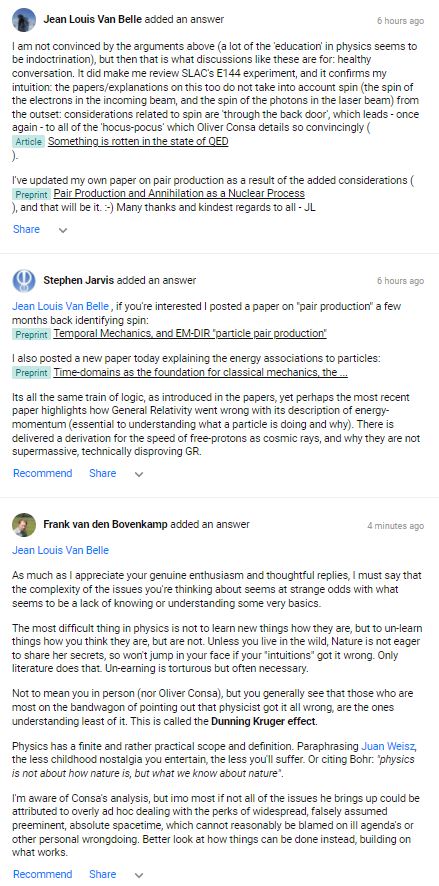
So, how that paper on matter-antimatter pair creation and annihilation fit in? The revision resulted in a rather long and verbose thing, so I will refer you to it and just summarize it very briefly. Let me start by copying the abstract: “The phenomenon of matter-antimatter pair creation and annihilation is usually taken as confirmation that, somehow, fields can condense into matter-particles or, conversely, that matter-particles can somehow turn into lightlike particles (photons and/or neutrinos, which are nothing but traveling fields: electromagnetic or, in the case of the neutrino, some strong field, perhaps). However, pair creation usually involves the presence of a nucleus or other charged particles (such as electrons in experiment #E144). We, therefore, wonder whether pair creation and annihilation cannot be analyzed as part of some nuclear process. To be precise, we argue that the usual nuclear reactions involving protons and neutrons can effectively account for the processes of pair creation and annihilation. We therefore argue that the need to invoke some quantum field theory (QFT) to explain these high-energy processes would need to be justified much better than it currently is.”
Needless to say, the last line above is a euphemism: we think our explanation is complete, and that QFT is plain useless. We wrote the following rather scathing appreciation of it in a footnote of the paper: “We think of Aitchison & Hey’s presentation of [matter-antimatter pair creation and annihilation] in their Gauge Theories in Particle Physics (2012) – or presentations (plural), we should say. It is considered to be an advanced but standard textbook on phenomena like this. However, one quickly finds oneself going through the index and scraping together various mathematical treatments – wondering what they explain, and also wondering how all of the unanswered questions or hypotheses (such as, for example, the particularities of flavor mixing, helicity, the Majorana hypothesis, etcetera) contribute to understanding the nature of the matter at hand. I consider it a typical example of how – paraphrasing Sabine Hossenfelder’s judgment on the state of advanced physics research – physicist do indeed tend to get lost in math.”
That says it all. Our thesis is that charge cannot just appear or disappear: it is not being created out of nothing (or out of fields, we should say). The observations (think of pion production and decay from cosmic rays here) and the results of the experiments (the mentioned #E144 experiment or other high-energy experiments) cannot be disputed, but the mainstream interpretation of what actually happens or might be happening in those chain reactions suffers from what, in daily life, we would refer to as ‘very sloppy accounting’. Let me quote or paraphrase a few more lines from my paper to highlight the problem, and to also introduce my interpretation of things which, as usual, are based on a more structural analysis of what matter actually is:
“Pair creation is most often observed in the presence of a nucleus. The role of the nucleus is usually reduced to that of a heavy mass only: it only appears in the explanation to absorb or provide some kinetic energy in the overall reaction. We instinctively feel the role of the nucleus must be far more important than what is usually suggested. To be specific, we suggest pair creation should (also) be analyzed as being part of a larger nuclear process involving neutron-proton interactions. […]”
“Charge does not get ‘lost’ or is ‘created’, but [can] switch its ‘spacetime’ or ‘force’ signature [when interacting with high-energy (anti)photons or (anti)neutrinos].”
“[The #E144 experiment or other high-energy experiments involving electrons] accounts for the result of the experiment in terms of mainstream QED analysis, and effectively thinks of the pair production being the result of the theoretical ‘Breit-Wheeler’ pair production process from photons only. However, this description of the experiment fails to properly account for the incoming beam of electrons. That, then, is the main weakness of the ‘explanation’: it is a bit like making abstraction of the presence of the nucleus in the pair creation processes that take place near them (which, as mentioned above, account for the bulk of those).”
We will say nothing more about it here because we want to keep our blog post(s) short: read the paper! 🙂 To wrap this up for you, the reader(s) of this post, we will only quote or paraphrase some more ontological or philosophical remarks in it:
“The three-layered structure of the electron (the classical, Compton and Bohr radii of the electron) suggest that charge may have some fractal structure and – moreover – that such fractal structure may be infinite. Why do we think so? If the fractal structure would not be infinite, we would have to acknowledge – logically – that some kind of hard core charge is at the center of the oscillations that make up these particles, and it would be very hard to explain how this can actually disappear.” [Note: This is a rather novel new subtlety in our realist interpretation of quantum physics, so you may want to think about it. Indeed, we were initially not very favorable to the idea of a fractal charge structure because such fractal structure is, perhaps, not entirely consistent with the idea of a Zitterbewegung charge with zero rest mass), we think much more favorably of the hypothesis now.]
“The concept of charge is and remains mysterious. However, in philosophical or ontological terms, I do not think of it as a mystery: at some point, we must, perhaps, accept that the essence of the world is charge, and that:
- There is also an antiworld, and that;
- It consists of an anticharge that we can fully define in terms of the signature of the force(s) that keep it together, and that;
- The two worlds can, quite simply, not co-exist or – at least – not interact with each other without annihilating each other.
Such simple view of things must, of course, feed into cosmological theories: how, then, came these two worlds into being? We offered some suggestions on that in a rather simple paper on cosmology (our one and only paper on the topic), but it is not a terrain that we have explored (yet).”
So, I will end this post in pretty much the same way as the old Looney Tunes or Merrie Melodies cartoons used to end, and that’s by saying: “That’s all Folks.” 🙂
Enjoy life and do not worry too much. It is all under control and, if it is not, then that is OK too. 🙂


 Reading Feynman