Mr. Feynman and boson-fermion theory

I’ve been looking at chapter 4 of Feynman’s Lectures on Quantum Mechanics (the chapter on identical particles) for at least a dozen times now—probably more. This and the following chapters spell out the mathematical framework and foundations of mainstream quantum mechanics: the grand distinction between fermions and bosons, symmetric and asymmetric wavefunctions, Bose-Einstein versus Maxwell-Boltzmann statistics, and whatever else comes out of that—including the weird idea that (force) fields should also come in lumps (think of quantum field theory here). These ‘field lumps’ are then thought of as ‘virtual’ particles that, somehow, ‘mediate’ the force.

The idea that (kinetic and/or potential) energy and (linear and/or angular) momentum are being continually transferred – somehow, and all over space – by these ‘messenger’ particles sounds like medieval philosophy to me. However, to be fair, Feynman does actually not present these more advanced medieval ideas in his Lectures on Quantum Physics. I have always found that somewhat strange: he was about to receive a Nobel Prize for his path integral formulation of quantum mechanics and other contributions to what has now become the mainstream interpretation of quantum mechanics, so why wouldn’t he talk about it to his students, for which he wrote these lectures? In contrast, he does include a preview of Gell-Mann’s quark theory, although he does say – in a footnote – that “the material of this section is longer and harder than is appropriate at this point” and he, therefore, suggests to skip it and move to the next chapter.

[As for the path integral formulation of QM, I would think the mere fact that we have three alternative formulations of QM (matrix, wave-mechanical and path integral) would be sufficient there’s something wrong with these theories: reality is one, so we should have one unique (mathematical) description of it).]

Any case. I am probably doing too much Hineininterpretierung here. Let us return to the basic stuff that Feynman wanted his students to accept as a truthful description of reality: two kinds of statistics. Two different ways of interaction. Two kinds of particles. That’s what post-WW II gurus such as Feynman – all very much inspired by the ‘Club of Copenhagen’—aka known as the ‘Solvay Conference Club‘ – want us to believe: interactions with ‘Bose particles’ – this is the term Feynman uses in this text of 1963  – involve adding amplitudes with a + (plus) sign. In contrast, interactions between ‘Fermi particles’ involve a minus (−) sign when ‘adding’ the amplitudes.

The confusion starts early on: Feynman makes it clear he actually talks about the amplitude for an event to happen or not. Two possibilities are there: two ‘identical’ particles either get ‘swapped’ after the collision or, else, they don’t. However, in the next sections of this chapter – where he ‘proves’ or ‘explains’ the principle of Bose condensation for bosons and then the Pauli exclusion principle for fermions – it is very clear the amplitudes are actually associated with the particles themselves.

So his argument starts rather messily—conceptually, that is. Feynman also conveniently skips the most basic ontological or epistemological question here: how would a particle ‘know‘ how to choose between this or that kind of statistics? In other words, how does it know it should pick the plus or the minus sign when combining its amplitude with the amplitude of the other particle? It makes one think of Feynman’s story of the Martian in his Lecture on symmetries in Nature: what handshake are we going to do here? Left or right? And who sticks out his hand first? The Martian or the Earthian? A diplomat would ask: who has precedence when the two particles meet?

The question also relates to the nature of the wavefunction: if it doesn’t describe anything real, then where is it? In our mind only? But if it’s in our mind only, how comes we get real-life probabilities out of them, and real-life energy levels, or real-life momenta, etcetera? The core question (physical, epistemological, philosophical, esoterical or whatever you’d want to label it) is this: what’s the connection between these concepts and whatever it is that we are trying to describe? The only answer mainstream physicists can provide here is blabber. That’s why the mainstream interpretation of physics may be acceptable to physicists, but not to the general public. That’s why the debate continues to rage: no one believes the Standard Model. Full stop. The intuition of the masses here is very basic and, therefore, probably correct: if you cannot explain something in clear and unambiguous terms, then you probably do not understand it.

Hence, I suspect mainstream academic physicists probably do not understand whatever it is they are talking about. Feynman, by the way, admitted as much when writing – in the very first lines of the introduction to his Lectures on Quantum Mechanics – that “even the experts do not understand it the way they would like to.”

I am actually appalled by all of this. Worse, I am close to even stop talking or writing about it. I only kept going because a handful of readers send me a message of sympathy from time to time. I then feel I am actually not alone in what often feels like a lonely search in what a friend of mine refers to as ‘a basic version of truth.’ I realize I am getting a bit emotional here – or should I say: upset? – so let us get back to Feynman’s argument again.

Feynman starts by introducing the idea of a ‘particle’—a concept he does not define – not at all, really – but, as the story unfolds, we understand this concept somehow combines the idea of a boson and a fermion. He doesn’t motivate why he feels like he should lump photons and electrons together in some more general category, which he labels as ‘particles’. Personally, I really do not see the need to do that: I am fine with thinking of a photon as an electromagnetic oscillation (a traveling field, that is), and of electrons, protons, neutrons and whatever composite particle out there that is some combination of the latter as matter-particles. Matter-particles carry charge: electric charge and – who knows – perhaps some strong charge too. Photons don’t. So they’re different. Full stop. Why do we want to label everything out there as a ‘particle’?

Indeed, when everything is said and done, there is no definition of fermions and bosons beyond this magical spin-1/2 and spin-1 property. That property is something we cannot measure: we can only measure the magnetic moment of a particle: any assumption on their angular momentum assumes you know the mass (or energy) distribution of the particle. To put it more plainly: do you think of a particle as a sphere, a disk, or what? Mainstream physicists will tell you that you shouldn’t think that way: particles are just pointlike. They have no dimension whatsoever – in their mathematical models, that is – because all what experimentalists is measuring scattering or charge radii, and these show the assumption of an electron or a proton being pointlike is plain nonsensical.

Needless to say, besides the perfect scattering angle, Feynman also assumes his ‘particles’ have no spatial dimension whatsoever: he’s just thinking in terms of mathematical lines and points—in terms of mathematical limits, not in terms of the physicality of the situation.

Hence, Feynman just buries us under a bunch of tautologies here: weird words are used interchangeably without explaining what they actually mean. In everyday language and conversation, we’d think of that as ‘babble’. The only difference between physicists and us commoners is that physicists babble using mathematical language.

[…]

I am digressing again. Let us get back to Feynman’s argument. So he tells us we should just accept this theoretical ‘particle’, which he doesn’t define: he just thinks about two of these discrete ‘things’ going into some ‘exchange’ or ‘interaction’ and then coming out of it and going into one of the two detectors. The question he seeks to answer is this: can we still distinguish what is what after the ‘interaction’?

The level of abstraction here is mind-boggling. Sadly, it is actually worse than that: it is also completely random. Indeed, the only property of this mystical ‘particle’ in this equally mystical thought experiment of Mr. Feynman is that it scatters elastically with some other particle. However, that ‘other’ particle is ‘of the same kind’—so it also has no other property than that it scatters equally elastically from the first particle. Hence, I would think the question of whether the two particles are identical or not is philosophically empty.

To be rude, I actually wonder what Mr. Feynman is actually talking about here. Every other line in the argument triggers another question. One should also note, for example, that this elastic scattering happens in a perfect angle: the whole argument of adding or subtracting amplitudes effectively depends on the idea of a perfectly measurable angle here. So where is the Uncertainty Principle here, Mr. Feynman? It all makes me think that Mr. Feynman’s seminal lecture may well be the perfect example of what Prof. Dr. John P. Ralston wrote about his own profession:

“Quantum mechanics is the only subject in physics where teachers traditionally present haywire axioms they don’t really believe, and regularly violate in research.” (1)

Let us continue exposing Mr. Feynman’s argument. After this introduction of this ‘particle’ and the set-up with the detectors and other preconditions, we then get two or three paragraphs of weird abstract reasoning. Please don’t get me wrong: I am not saying the reasoning is difficult (it is not, actually): it is just weird and abstract because it uses complex number logic. Hence, Feynman implicitly requests the reader to believe that complex numbers adequately describes whatever it is that he is thinking of (I hope – but I am not so sure – he was trying to describe reality). In fact, this is the one point I’d agree with him: I do believe Euler’s function adequately describes the reality of both photons and electrons (see our photon and electron models), but then I also think +i and −i are two very different things. Feynman doesn’t, clearly.

It is, in fact, very hard to challenge Feynman’s weird abstract reasoning here because it all appears to be mathematically consistent—and it is, up to the point of the tricky physical meaning of the imaginary unit: Feynman conveniently forgets the imaginary unit represents a rotation of 180 degrees and that we, therefore, need to distinguish between these two directions so as to include the idea of spin. However, that is my interpretation of the wavefunction, of course, and I cannot use it against Mr. Feynman’s interpretation because his and mine are equally subjective. One can, therefore, only credibly challenge Mr. Feynman’s argument by pointing out what I am trying to point out here: the basic concepts don’t make any sense—none at all!

Indeed, if I were a student of Mr. Feynman, I would have asked him questions like this:

“Mr. Feynman, I understand your thought experiment applies to electrons as well as to photons. In fact, the argument is all about the difference between these two very different ‘types’ of ‘particles’. Can you please tell us how you’d imagine two photons scattering off each other elastically? Photons just pile on top of each other, don’t they? In fact, that’s what you prove next. So they don’t scatter off each other, do they? Your thought experiment, therefore, seems to apply to fermions only. Hence, it would seem we should not use it to derive properties for bosons, isn’t it?”

“Mr. Feynman, how should an electron (a fermion – so you say we should ‘add’ amplitudes using a minus sign) ‘think’ about what sign to use for interaction when a photon is going to hit it? A photon is a boson – so its sign for exchange is positive – so should we have an ‘exchange’ or ‘interaction’ with the plus or the minus sign then? More generally, who takes the ‘decisions’ here? Do we expect God – or Maxwell’s demon – to be involved in every single quantum-mechanical event?”

Of course, Mr. Feynman might have had trouble answering the first question, but he’d probably would not hesitate to produce some kind of rubbish answer to the second: “Mr. Van Belle, we are thinking of identical particles here. Particles of the same kind, if you understand what I mean.”

Of course, I obviously don’t understand what he  means but so I can’t tell him that. So I’d just ask the next logical question to try to corner him:

“Of course, Mr. Feynman. Identical particles. Yes. So, when thinking of fermion-on-fermion scattering, what mechanism do you have in mind? At the very least, we should be mindful of the difference between Compton versus Thomson scattering, shouldn’t we? How does your ‘elastic’ scattering relate to these two very different types of scattering? What is your theoretical interaction mechanism here?”

I can actually think of some more questions, but I’ll leave it at this. Well… No… Let me add another one:

“Mr. Feynman, this theory of interaction between ‘identical’ or ‘like’ particles (fermions and bosons) looks great but, in reality, we will also have non-identical particles interacting with each other—or, more generally speaking, particles that are not ‘of the same kind’. To be very specific, reality sees many electrons and many photons interacting with each other—not just once, at the occasion of some elastic collision, but all of the time, really. So could we, perhaps, generalize this to some kind of ‘three- or n-particle problem’?”

This sounds like a very weird question, which even Mr. Feynman might not immediately understand. So, if he didn’t shut me up already, he may have asked me to elaborate: “What do you mean, Mr. Van Belle? What kind of three- or n-particle problem are you talking about?” I guess I’d say something like this:

“Well… Already in classical physics, we do not have an analytical solution for the ‘three-body problem’, but at least we have the equations. So we have the underlying mechanism. What are the equations here? I don’t see any. Let us suppose we have three particles colliding or scattering or interacting or whatever it is we are trying to think of. How does any of the three particles know what the other two particles are going to be: a boson or a fermion? And what sign should they then use for the interaction? In fact, I understand you are talking amplitudes of events here. If three particles collide, how many events do you count: one, two, three, or six?”

One, two, three or six? Yes. Do we think of the interaction between three particles as one event, or do we split it up as a triangular thing? Or is it one particle interacting, somehow, with the two other, in which case we’re having two events, taking into account this weird plus or minus sign rule for interaction.

Crazy? Yes. Of course. But the questions are logical, aren’t they? I can think of some more. Here is one that, in my not-so-humble view, shows how empty these discussions on the theoretical properties of theoretical bosons and theoretical fermions actually are:

“Mr. Feynman, you say a photon is a boson—a spin-one particle, so its spin state is either 1, 0 or −1. How comes photons – the only boson that we actually know to exist from real-life experiments – do not have a spin-zero state? Their spin is always up or down. It’s never zero. So why are we actually even talking about spin-one particles, if the only boson we know – the photon – does not behave like it should behave according to your boson-fermion theory?” (2)

Am I joking? I am not. I like to think I am just asking very reasonable questions here—even if all of this may sound like a bit of a rant. In fact, it probably is, but so that’s why I am writing this up in a blog rather than in a paper. Let’s continue.

The subsequent chapters are about the magical spin-1/2 and spin-1 properties of fermions and bosons respectively. I call them magical, because – as mentioned above – all we can measure is the magnetic moment. Any assumption that the angular momentum of a particle – a ‘boson’ or a ‘fermion’, whatever it is – is ±1 or ±1/2, assumes we have knowledge of some form factor, which is determined by the shape of that particle and which tells us how the mass (or the energy) of a particle is distributed in space.

Again, that may sound sacrilegious: according to mainstream physicists, particles are supposed to be pointlike—which they interpret as having no spatial dimension whatsoever. However, as I mentioned above, that sounds like a very obvious oxymoron to me.

Of course, I know I would never have gotten my degree. When I did the online MIT course, the assistants of Prof. Dr. Zwieback also told me I asked too many questions: I should just “shut up and calculate.” You may think I’m joking again but, no: that’s the feedback I got. Needless to say, I went through the course and did all of the stupid exercises, but I didn’t bother doing the exams. I don’t mind calculating. I do a lot of calculations as a finance consultant. However, I do mind mindless calculations. Things need to make sense to me. So, yes, I will always be an ‘amateur physicist’ and a ‘blogger’—read: someone whom you shouldn’t take very seriously. I just hope my jokes are better than Feynman’s.

I’ve actually been thinking that getting a proper advanced degree in physics might impede understanding, so it’s good I don’t have one. I feel these mainstream courses do try to ‘brainwash’ you. They do not encourage you to challenge received wisdom. On the contrary, it all very much resembles rote learning: memorization based on repetition. Indeed, more modern textbooks – I looked at the one of my son, for example – immediately dive into the hocus-pocus—totally shamelessly. They literally start by saying you should not try to understand and that you just get through the math and accept the quantum-mechanical dogmas and axioms! Despite the appalling logic in the introductory chapters, Mr. Feynman, in contrast, at least has the decency to try to come up with some classical arguments here and there (although he also constantly adds that the student should just accept the hocus-pocus approach and the quantum-mechanical dogmas and not think too much about what it might or might not represent).

My son got high marks on his quantum mechanics exam: a 19/20, to be precise, and so I am really proud of him—and I also feel our short discussions on this or that may have helped him to get through it. Fortunately, he was doing it as part of getting a civil engineering degree (Bachelor’s level), and he was (also) relieved he would never have to study the subject-matter again. Indeed, we had a few discussions and, while he (also) thinks I am a bit of a crackpot theorist, he does agree “the math must describe something real” and that “therefore, something doesn’t feel right in all of that math.” I told him that I’ve got this funny feeling that, 10 or 20 years from now, 75% (more?) of post-WW II research in quantum physics – most of the theoretical research, at least (3) – may be dismissed as some kind of collective psychosis or, worse, as ‘a bright shining lie’ (title of a book I warmly recommend – albeit on an entirely different topic). Frankly, I think many academics completely forgot Boltzmann’s motto for the physicist:

“Bring forward what is true. Write it so that it is clear. Defend it to your last breath.”

[…]

OK, you’ll say: get real! So what is the difference between bosons and fermions, then? I told you already: I think it’s a useless distinction. Worse, I think it’s not only useless but it’s also untruthful. It has, therefore, hampered rather than promoted creative thinking. I distinguish matter-particles – electrons, protons, neutrons – from photons (and neutrinos). Matter-particles carry charge. Photons (and neutrinos) do not. (4) Needless to say, I obviously don’t believe in ‘messenger particles’ and/or ‘Higgs’ or other ‘mechanisms’ (such as the ‘weak force’ mechanism). That sounds too much like believing in God or some other non-scientific concept. [I don’t mind you believing in God or some other non-scientific concept – I actually do myself – but we should not confuse it with doing physics.]

And as for the question on what would be my theory of interaction? It’s just the classical theory: charges attract or repel, and one can add electromagnetic fields—all in respect of the Planck-Einstein law, of course. Charges have some dimension (and some mass), so they can’t take up the same space. And electrons, protons and neutrons have some structure, and physicists should focus on modeling those structures, so as to explain the so-called intrinsic properties of these matter-particles. As for photons, I think of them as an oscillating electromagnetic field (respecting the Planck-Einstein law, of course), and so we can simply add them. What causes them to lump together? Not sure: the Planck-Einstein law (being in some joint excited state, in other words) or gravity, perhaps. In any case: I am confident it is something real—i.e. not Feynman’s weird addition or subtraction rules for amplitudes.

However, this is not the place to re-summarize all of my papers. I’d just sum them up by saying this: not many physicists seem to understand Planck’s constant or, what amounts to the same, the concept of an elementary cycle. And their unwillingness to even think about the possible structure of photons, electrons and protons is… Well… I’d call it criminal. :-/

[…]

I will now conclude my rant with another down-to-earth question: would I recommend reading Feynman’s Lectures? Or recommend youngsters to take up physics as a study subject?

My answer in regard to the first question is ambiguous: yes, and no. When you’d push me on this, I’d say: more yes than no. I do believe Feynman’s Lectures are much better than the modern-day textbook that was imposed on my son during his engineering studies and so, yes, I do recommend the older textbooks. But please be critical as you go through them: do ask yourself the same kind of questions that I’ve been asking myself while building up this blog: think for yourself. Don’t go by ‘authority’. Why not? Because the possibility that a lot of what labels itself as science may be nonsensical. As nonsensical as… Well… All what goes on in national and international politics for the moment, I guess. 🙂

In regard to the second question – should youngsters be encouraged to study physics? – I’d say what my father told me when I was hesitating to pick a subject for study: “Do what earns respect and feeds your family. You can do philosophy and other theoretical things on the side.”

With the benefit of hindsight, I can say he was right. I’ve done the stuff I wanted to do—on the side, indeed. So I told my son to go for engineering – rather than pure math or pure physics. 🙂 And he’s doing great, fortunately !

Jean Louis Van Belle

Notes:

(1) Dr. Ralston’s How To Understand Quantum Mechanics is fun for the first 10 pages or so, but I would not recommend it. We exchanged some messages, but then concluded that our respective interpretations of quantum mechanics are very different (I feel he replaces hocus-pocus by other hocus-pocus) and, hence, that we should not “waste any electrons” (his expression) on trying to convince each other.

(2) It is really one of the most ridiculous things ever. Feynman spends several chapters on explaining spin-one particles to, then, in some obscure footnote, suddenly write this: “The photon is a spin-one particle which has, however, no “zero” state.” From all of his jokes, I think this is his worst. It just shows how ‘rotten’ or ‘random’ the whole conceptual framework of mainstream QM really is. There is, in fact, another glaring inconsistency in Feynman’s Lectures: in the first three chapters of Volume III, he talks about adding wavefunctions and the basic rules of quantum mechanics, and it all happens with a plus sign. In this chapter, he suddenly says the amplitudes of fermions combine with a minus sign. If you happen to know a physicist who can babble his way of out this inconsistency, please let me know.

(3) There are exceptions, of course. I mentioned very exciting research in various posts, but most of it is non-mainstream. The group around Herman Batalaan at the University of Nebraska and various ‘electron modellers’ are just one of the many examples. I contacted a number of these ‘particle modellers’. They’re all happy I show interest, but puzzled themselves as to why their research doesn’t get all that much attention. If it’s a ‘historical accident’ in mankind’s progress towards truth, then it’s a sad one.

(4) We believe a neutron is neutral because it has both positive and negative charge in it (see our paper on protons and neutrons). as for neutrinos, we have no idea what they are, but our wild guess is that they may be the ‘photons’ of the strong force: if a photon is nothing but an oscillating electromagnetic field traveling in space, then a neutrino might be an oscillating strong field traveling in space, right? To me, it sounds like a reasonable hypothesis, but who am I, right? 🙂 If I’d have to define myself, it would be as one of Feynman’s ideal students: someone who thinks for himself. In fact, perhaps I would have been able to entertain him as much as he entertained me— and so, who knows, I like to think he might actually have given me some kind of degree for joking too ! 🙂

(5) There is no (5) in the text of my blog post, but I just thought I would add one extra note here. 🙂 Herman Batelaan and some other physicists wrote a Letter to the Physical Review Journal back in 1997. I like Batelaan’s research group because – unlike what you might think – most of Feynman’s thought experiments have actually never been done. So Batelaan – and some others – actually did the double-slit experiment with electrons, and they are doing very interesting follow-on research on it.

However, let me come to the point I want to mention here. When I read these lines in that very serious Letter, I didn’t know whether to laugh or to cry:

“Bohr’s assertion (on the impossibility of doing a Stern-Gerlach experiment on electrons or charged particles in general) is thus based on taking the classical limit for ħ going to 0. For this limit not only the blurring, but also the Stern-Gerlach splitting vanishes. However, Dehmelt argues that ħ is a nonzero constant of nature.”

I mean… What do you make of this? Of course, ħ is a nonzero constant, right? If it was zero, the Planck-Einstein relation wouldn’t make any sense, would it? What world were Bohr, Heisenberg, Pauli and others living in? A different one than ours, I guess. But that’s OK. What is not OK, is that these guys were ignoring some very basic physical laws and just dreamt up – I am paraphrasing Ralston here – “haywire axioms they did not really believe in, and regularly violated themselves.” And they didn’t know how to physically interpret the Planck-Einstein relation and/or the mass-energy equivalence relation. Sabine Hossenfelder would say they were completely lost in math. 🙂
Maxwell-Boltzmann, Bose-Einstein and Fermi-Dirac statistics

Pre-scriptum added much later: We have advanced much in our understanding since we wrote this post. If you are reading it because you want to understand more about the boson-fermion distinction, then you shouldn’t be here. The general distinction between bosons and fermions is a useless theoretical generalization which actually prevents you from understanding what is really going on. I am keeping this post online for documentation purposes only. It is interesting from a math point of view but you are not here to learn math, are you?

Jean Louis Van Belle, 20 May 2020

Original post:

I’ve discussed statistics, in the context of quantum mechanics, a couple of times already (see, for example, my post on amplitudes and statistics). However, I never took the time to properly explain those distribution functions which are referred to as the Maxwell-Boltzmann, Bose-Einstein and Fermi-Dirac distribution functions respectively. Let me try to do that now—without, hopefully, getting lost in too much math! It should be a nice piece, as it connects quantum mechanics with statistical mechanics, i.e. two topics I had nicely separated so far. 🙂

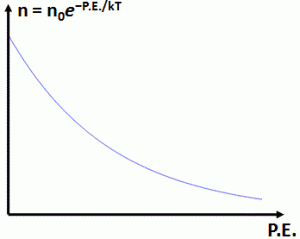
You know the Boltzmann Law now, which says that the probabilities of different conditions of energy are given by e−energy/kT = 1/eenergy/kT. Different ‘conditions of energy’ can be anything: density, molecular speeds, momenta, whatever. The point is: we have some probability density function f, and it’s a function of the energy E, so we write:

f(E) = C·e−energy/kT = C/eenergy/kT

C is just a normalization constant (all probabilities have to add up to one, so the integral of this function over its domain must be one), and k and T are also usual suspects: T is the (absolute) temperature, and k is the Boltzmann constant, which relates the temperate to the kinetic energy of the particles involved. We also know the shape of this function. For example, when we applied it to the density of the atmosphere at various heights (which are related to the potential energy, as P.E. = m·g·h), assuming constant temperature, we got the following graph. The shape of this graph is that of an exponential decay function (we’ll encounter it again, so just take a mental note of it).

graph

A more interesting application is the quantum-mechanical approach to the theory of gases, which I introduced in my previous post. To explain the behavior of gases under various conditions, we assumed that gas molecules are like oscillators but that they can only take on discrete levels of energy. [That’s what quantum theory is about!] We denoted the various energy levels, i.e. the energies of the various molecular states, by E0, E1, E2,…, Ei,…, and if Boltzmann’s Law applies, then the probability of finding a molecule in the particular state Ei is proportional to e−Ei /kT. We can then calculate the relative probabilities, i.e. the probability of being in state Ei, relative to the probability of being in state E0, is:

Pi/P0 = e−Ei /kT/e−E0 /kT = e−(Ei–E0)/kT = 1/e(Ei–E0)/kT

Now, Pi obviously equals ni/N, so it is the ratio of the number of molecules in state Ei (ni) and the total number of molecules (N). Likewise, P0 = n0/N and, therefore, we can write:

ni/ne−(Ei−E0)/kT = 1/e(Ei–E0)/kT

This formulation is just another Boltzmann Law, but it’s nice in that it introduces the idea of a ground state, i.e. the state with the lowest energy level. We may or may not want to equate E0 with zero. It doesn’t matter really: we can always shift all energies by some arbitrary constant because we get to choose the reference point for the potential energy.

So that’s the so-called Maxwell-Boltzmann distribution. Now, in my post on amplitudes and statistics, I had jotted down the formulas for the other distributions, i.e. the distributions when we’re not talking classical particles but fermions and/or bosons. As you know, fermions are particles governed by the Fermi exclusion principle: indistinguishable particles cannot be together in the same state. For bosons, it’s the other way around: having one in some quantum state actually increases the chance of finding another one there, and we can actually have an infinite number of them in the same state.

We also know that fermions and bosons are the real world: fermions are the matter-particles, bosons are the force-carriers, and our ‘Boltzmann particles’ are nothing but a classical approximation of the real world. Hence, even if we can’t see them in the actual world, the Fermi-Dirac and Bose-Einstein distributions are the real-world distributions. 🙂 Let me jot down the equations once again:

Fermi-Dirac (for fermions): f(E) = 1/[Ae(E − EF)/kT + 1]

Bose-Einstein (for bosons):  f(E) = 1/[AeE/kT − 1]

We’ve got some other normalization constant here (A), which we shouldn’t be too worried about—for the time being, that is. Now, to see how these distributions are different from the Maxwell-Boltzmann distribution (which we should re-write as f(E) = C·e−E/kT = 1/[A·eE/kT] so as to make all formulas directly comparable), we should just make a graph. Please go online to find a graph tool (I found a new one recently—really easy to use), and just do it. You’ll see they are all like that exponential decay function. However, in order to make a proper comparison, we would actually need to calculate the normalization coefficients and, for the Fermi energy, we would also need the Fermi energy E(note that, for simplicity, we did equate E0 with zero). Now, we could give it a try, but it’s much easier to google and find an example online.

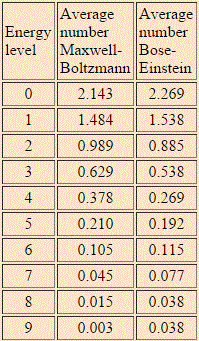
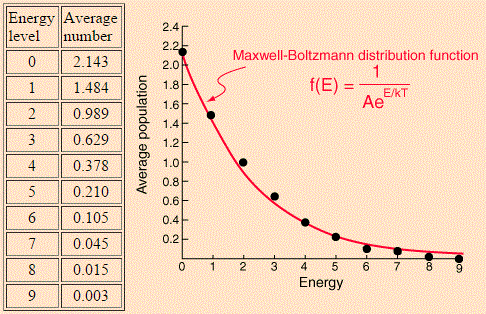
The HyperPhysics website of Georgia State University gives us one: the example assumes 6 particles and 9 energy levels, and the table and graph below compare the Maxwell-Boltzmann and Bose-Einstein distributions for the model.

Graph Table

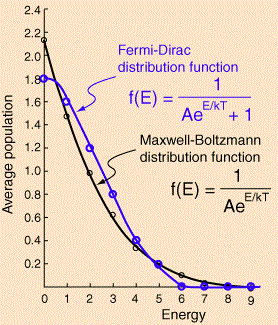
Now that is an interesting example, isn’t it? In this example (but all depends on its assumptions, of course), the Maxwell-Boltzmann and Bose-Einstein distributions are almost identical. Having said that, we can clearly see that the lower energy states are, indeed, more probable with Bose-Einstein statistics than with the Maxwell-Boltzmann statistics. While the difference is not dramatic at all in this example, the difference does become very dramatic, in reality, with large numbers (i.e. high matter density) and, more importantly, at very low temperatures, at which bosons can condense into the lowest energy state. This phenomenon is referred to as Bose-Einstein condensation: it causes superfluidity and superconductivity, and it’s real indeed: it has been observed with supercooled He-4, which is not an everyday substance, but real nevertheless!

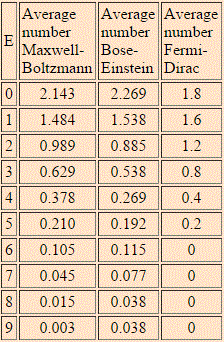
What about the Fermi-Dirac distribution for this example? The Fermi-Dirac distribution is given below: the lowest energy state is now less probable, the mid-range energies much more, and none of the six particles occupy any of the four highest energy levels. Again, while the difference is not dramatic in this example, it can become very dramatic, in reality, with large numbers (read: high matter density) and very low temperatures: at absolute zero, all of the possible energy states up to the Fermi energy level will be occupied, and all the levels above the Fermi energy will be vacant.

graph 2 Table 2

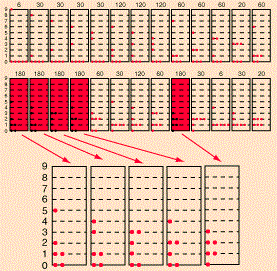
What can we make out of all of this? First, you may wonder why we actually have more than one particle in one state above: doesn’t that contradict the Fermi exclusion principle? No. We need to distinguish micro- and macro-states. In fact, the example assumes we’re talking electrons here, and so we can have two particles in each energy state—with opposite spin, however. At the same time, it’s true we cannot have three, or more, in any state. That results, in the example we’re looking at here, in five possible distributions only, as shown below.

Table 3

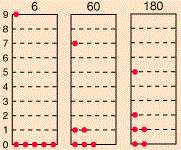
The diagram is an interesting one: if the particles were to be classical particles, or bosons, then 26 combinations are possible, including the five Fermi-Dirac combinations, as shown above. Note the little numbers above the 26 possible combinations (e.g. 6, 20, 30,… 180): they are proportional to the likelihood of occurring under the Maxwell-Boltzmann assumption (so if we assume the particles are ‘classical’ particles). Let me introduce you to the math behind the example by using the diagram below, which shows three possible distributions/combinations (I know the terminology is quite confusing—sorry for that!).

table 4

If we could distinguish the particles, then we’d have 2002 micro-states, which is the total of all those little numbers on top of the combinations that are shown (6+60+180+…). However, the assumption is that we cannot distinguish the particles. Therefore, the first combination in the diagram above, with five particles in the zero energy state and one particle in state 9, occurs 6 times into 2002 and, hence, it has a probability of 6/2002 ≈ 0.003 only. In contrast, the second combination is 10 times more likely, and the third one is 30 times more likely! In any case, the point is, in the classical situation (and in the Bose-Einstein hypothesis as well), we have 26 possible macro-states, as opposed to 5 only for fermions, and so that leads to a very different density function. Capito?

No? Well, this blog is not a textbook on physics and, therefore, I should refer you to the mentioned site once again, which references a 1992 textbook on physics (Frank Blatt, Modern Physics, 1992) as the source of this example. However, I won’t do that: you’ll find the details in the Post Scriptum to this post. 🙂

Let’s first focus on the fundamental stuff, however. The most burning question is: if the real world consists of fermions and bosons, why is that that we only see the Maxwell-Boltzmann distribution in our actual (non-real?) world? 🙂 The answer is that both the Fermi-Dirac and Bose-Einstein distribution approach the Maxwell–Boltzmann distribution if higher temperatures and lower particle densities are involved. In other words, we cannot see the Fermi-Dirac distributions (all matter is fermionic, except for weird stuff like superfluid helium-4 at 1 or 2 degrees Kelvin), but they are there!

Let’s approach it mathematically: the most general formula, encompassing both Fermi-Dirac and Bose-Einstein statistics, is:

Ni(Ei) ∝ 1/[e(Ei − μ)/kT ± 1]

If you’d google, you’d find a formula involving an additional coefficient, gi, which is the so-called degeneracy of the energy level Ei. I included it in the formula I used in the above-mentioned post of mine. However, I don’t want to make it any more complicated than it already is and, therefore, I omitted it this time. What you need to look at are the two terms in the denominator: e(Ei − μ)/kT and ± 1.

From a math point of view, it is obvious that the values of e(Ei − μ)/kT + 1 (Fermi-Dirac) and e(Ei − μ)/kT − 1 (Bose-Einstein) will approach each other if e(Ei − μ)/kT is much larger than ±1, so if e(Ei − μ)/kT >> 1. That’s the case, obviously, if the (Ei − μ)/kT ratio is large, so if (Ei − μ) >> kT. In fact, (Ei − μ) should, obviously, be much larger than kT for the lowest energy levels too! Now, the conditions under which that is the case are associated with the classical situation (such as a cylinder filled with gas, for example). Why?

Well… […] Again, I have to say that this blog can’t substitute for a proper textbook. Hence, I am afraid I have to leave it to you to do the necessary research to see why. 🙂 The non-mathematical approach is to simple note that quantum effects, i.e. the ±1 term, only apply if the concentration of particles is high enough. Indeed, quantum effects appear if the concentration of particles is higher than the so-called quantum concentration. Only when the quantum concentration is reached, particles will start interacting according to what they are, i.e. as bosons or as fermions. At higher temperature, that concentration will not be reached, except in massive objects such as a white dwarf (white dwarfs are stellar remnants with the mass like that of the Sun but a volume like that of the Earth). So, in general, we can say that at higher temperatures and at low concentration we will not have any quantum effects. That should settle the matter—as for now, at least.

You’ll have one last question: we derived Boltzmann’s Law from the kinetic theory of gases, but how do we derive that Ni(Ei) = 1/[Ae(Ei − μ)/kT ± 1] expression? Good question but, again, we’d need more than a few pages to explain that! The answer is: quantum mechanics, of course! Go check it out in Feynman’s third Volume of Lectures! 🙂

Post scriptum: combinations, permutations and multiplicity

The mentioned example from HyperPhysics is really interesting, if only because it shows you also need to master a bit of combinatorics to get into quantum mechanics. Let’s go through the basics. If we have n distinct objects, we can order hem in n! ways, with n! (read: n factorial) equal to n·(n–1)·(n–2)·…·3·2·1. Note that 0! is equal to 1, per definition. We’ll need that definition.

For example, a red, blue and green ball can be ordered in 3·2·1 = 6 ways. Each way is referred to as a permutation.

Besides permutations, we also have the concept of a k-permutation, which we can denote in a number of ways but let’s choose P(n, k). [The P stands for permutation here, not for probability.] P(n, k) is the number of ways to pick k objects out of a set of n objects. Again, the objects are supposed to be distinguishable. The formula is P(n, k) = n·(n–1)·(n–2)·…·(n–k+1) = n!/(n–k)!. That’s easy to understand intuitively: on your first pick you have n choices; on your second, n–1; on your third, n–2, etcetera. When n = k, we obviously get n! again.

There is a third concept: the k-combination (as opposed to the k-permutation), which we’ll denote by C(n, k). That’s when the order within our subset doesn’t matter: an ace, a queen and a jack taken out of some card deck are a queen, a jack, and an ace: we don’t care about the order. If we have k objects, there are k! ways of ordering them and, hence, we just have to divide P(n, k) by k! to get C(n, k). So we write: C(n, k) = P(n, k)/k! = n!/[(n–k)!k!]. You recognize C(n, k): it’s the binomial coeficient.

Now, the HyperPhysics example illustrating the three mentioned distributions (Maxwell-Boltzmann, Bose-Einstein and Fermi-Dirac) is a bit more complicated: we need to associate q energy levels with N particles. Every possible configuration is referred to as a micro-state, and the total number of possible micro-states is referred to as the multiplicity of the system, denoted by Ω(N, q). The formula for Ω(N, q) is another binomial coefficient: Ω(N, q) = (q+N–1)!/[q!(N–1)!]. Ω(N, q) = Ω(6, 9) = (9+6–1)!/[9!(6–1)!] = 2002.

In our example, however, we do not have distinct particles and, therefore, we only have 26 macro-states (as opposed to 2002 micro-states), which are also referred to, confusingly, as distributions or combinations.

Now, the number of micro-states associated with the same macro-state is given by yet another formula: it is equal to N!/[n1!·n2!·n3!·…·nq!], with ni! the number of particles in level i. [See why we need the 0! = 1 definition? It ensures unoccupied states do not affect the calculation.] So that’s how we get those numbers 6, 60 and 180 for those three macro-states.

But how do we calculate those average numbers of particles for each energy level? In other words, how do we calculate the probability densities under the Maxwell-Boltzmann, Fermi-Dirac and Bose-Einstein hypothesis respectively?

For the Maxwell-Boltzmann distribution, we proceed as follows: for each energy level j (or Ej, I should say), we calculate n= ∑nij·Pi over all macro-states i. In this summation, we have nij, which is the number of particles in energy level j in micro-state i, while Pi is the probability of macro-state i as calculated by the ratio of (i) the number of micro-states associated with macro-state i and (ii) the total number of micro-states. For Pi, we gave the example of 3/2002 ≈ 0.3%. For 60 and 180, we get 60/2002 ≈ 3% and 180/2002 ≈ 9%. Calculating all the nj‘s for j ranging from 1 to 9 should yield the numbers and the graph below indeed.

M-B graphOK. That’s how it works for Maxwell-Boltzmann. Now, it is obvious that the Fermi-Dirac and the Bose-Einstein distribution should not be calculated in the same way because, if they were, they would not be different from the Maxwell-Boltzmann distribution! The trick is as follows.

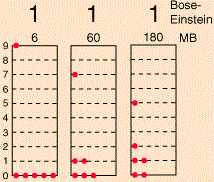
For the Bose-Einstein distribution, we give all macro-states equal weight—so that’s a weight of one, as shown below. Hence, the probability Pi  is, quite simply, 1/26 ≈ 3.85% for all 26 macro-states. So we use the same n= ∑nij·Pformula but with Pi = 1/26.

BE

Finally, I already explained how we get the Fermi-Dirac distribution: we can only have (i) one, (ii) two, or (iii) zero fermions for each energy level—not more than two! Hence, out of the 26 macro-states, only five are actually possible under the Fermi-Dirac hypothesis, as illustrated below once more. So it’s a very different distribution indeed!

Table 3

Now, you’ll probably still have questions. For example, why does the assumption, for the Bose-Einstein analysis, that macro-states have equal probability favor the lower energy states? The answer is that the model also integrates other constraints: first, when associating a particle with an energy level, we do not favor one energy level over another, so all energy levels have equal probability. However, at the same time, the whole system has some fixed energy level, and so we cannot put the particles in the higher energy levels only! At the same time, we know that, if we have q particles, and the probability of a particle having some energy level j is the same for all j, then they are likely not to be all at the same energy level: they’ll be distributed, effectively, as evidenced by the very low chance (0.3% only) of having 5 particles in the ground state and 1 particle at a higher level, as opposed to the 3% and 9% chance of the other two combinations shown in that diagram with three possible Maxwell-Boltzmann (MB) combinations.

So what happens when assigning an equal probability to all 26 possible combinations (with value 1/26) is that the combinations that were previously rather unlikely – because they did have a rather heavy concentration of particles in the ground state only – are now much more likely. So that’s why the Bose-Einstein distribution, in this example at least, is skewed towards the lowest energy level—as compared to the Maxwell-Boltzmann distribution, that is.

So that’s what’s behind, and that should also answer the other question you surely have when looking at those five acceptable Fermi-Dirac configurations: why don’t we have the same five configurations starting from the top down, rather than from the bottom up? Now you know: such configuration would have much higher energy overall, and so that’s not allowed under this particular model.

There’s also this other question: we said the particles were indistinguishable, but so then we suddenly say there can be two at any energy level, because their spin is opposite. It’s obvious this is rather ad hoc as well. However, if we’d allow only one particle at any energy level, we’d have no allowable combinations and, hence, we’d have no Fermi-Dirac distribution at all in this example.

In short, the example is rather intuitive, which is actually why I like it so much: it shows how bosonic and fermionic behavior appear rather gradually, as a consequence of variables that are defined at the system level, such as density, or temperature. So, yes, you’re right if you think the HyperPhysics example lacks rigor. That’s why I think it’s such wonderful pedagogic device. 🙂

Amplitudes and statistics

Pre-script (dated 26 June 2020): This post has become less relevant (even irrelevant, perhaps) because my views on all things quantum-mechanical have evolved significantly as a result of my progression towards a more complete realist (classical) interpretation of quantum physics. In addition, some of the material was removed by a dark force (that also created problems with the layout, I see now). In any case, we recommend you read our recent papers. I keep blog posts like these mainly because I want to keep track of where I came from. I might review them one day, but I currently don’t have the time or energy for it. 🙂

Original post:

When re-reading Feynman’s ‘explanation’ of Bose-Einstein versus Fermi-Dirac statistics (Lectures, Vol. III, Chapter 4), and my own March 2014 post summarizing his argument, I suddenly felt his approach raises as many questions as it answers. So I thought it would be good to re-visit it, which is what I’ll do here. Before you continue reading, however, I should warn you: I am not sure I’ll manage to do a better job now, as compared to a few months ago. But let me give it a try.

Setting up the experiment

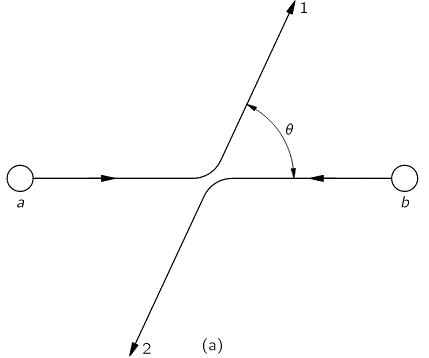
The (thought) experiment is simple enough: what’s being analyzed is the (theoretical) behavior of two particles, referred to as particle a and particle b respectively that are being scattered into  two detectors, referred to as 1 and 2. That can happen in two ways, as depicted below: situation (a) and situation (b). [And, yes, it’s a bit confusing to use the same letters a and b here, but just note the brackets and you’ll be fine.] It’s an elastic scattering and it’s seen in the center-of-mass reference frame in order to ensure we can analyze it using just one variable, θ, for the angle of incidence. So there is no interaction between those two particles in a quantum-mechanical sense: there is no exchange of spin (spin flipping) nor is there any exchange of energy–like in Compton scattering, in which a photon gives some of its energy to an electron, resulting in a Compton shift (i.e. the wavelength of the scattered photon is different than that of the incoming photon). No, it’s just what it is: two particles deflecting each other. […] Well… Maybe. Let’s fully develop the argument to see what’s going on.

Identical particles-aIdentical particles-b

First, the analysis is done for two non-identical particles, say an alpha particle (i.e. a helium nucleus) and then some other nucleus (e.g. oxygen, carbon, beryllium,…). Because of the elasticity of the ‘collision’, the possible outcomes of the experiment are binary: if particle a gets into detector 1, it means particle b will be picked up by detector 2, and vice versa. The first situation (particle a gets into detector 1 and particle b goes into detector 2) is depicted in (a), i.e. the illustration on the left above, while the opposite situation, exchanging the role of the particles, is depicted in (b), i.e. the illustration on the right-hand side. So these two ‘ways’ are two different possibilities which are distinguishable not only in principle but also in practice, for non-identical particles that is (just imagine a detector which can distinguish helium from oxygen, or whatever other substance the other particle is). Therefore, strictly following the rules of quantum mechanics, we should add the probabilities of both events to arrive at the total probability of some particle (and with ‘some’, I mean particle a or particle b) ending up in some detector (again, with ‘some’ detector, I mean detector 1 or detector 2).

Now, this is where Feynman’s explanation becomes somewhat tricky. The whole event (i.e. some particle ending up in some detector) is being reduced to two mutually exclusive possibilities that are both being described by the same (complex-valued) wave function f, which has that angle of incidence as its argument. To be precise: the angle of incidence is θ for the first possibility and it’s π–θ for the second possibility. That being said, it is obvious, even if Feynman doesn’t mention it, that both possibilities actually represent a combination of two separate things themselves:

  1. For situation (a), we have particle a going to detector 1 and particle b going to detector 2. Using Dirac’s so-called bra-ket notation, we should write 〈1|a〉〈2|b〉 = f(θ), with f(θ) a probability amplitude, which should yield a probability when taking its absolute square: P(θ) = |f(θ)|2.
  2. For situation (b), we have particle b going to detector 1 and particle a going to 2, so we have 〈1|b〉〈2|a〉, which Feynman equates with f(π–θ), so we write 〈1|b〉〈2|a〉 = 〈2|a〉〈1|b〉 = f(π–θ).

Now, Feynman doesn’t dwell on this–not at all, really–but this casual assumption–i.e. the assumption that situation (b) can be represented by using the same wave function f–merits some more reflection. As said, Feynman is very brief on it: he just says situation (b) is the same situation as (a), but then detector 1 and detector 2 being switched (so we exchange the role of the detectors, I’d say). Hence, the relevant angle is π–θ and, of course, it’s a center-of-mass view again so if a goes to 2, then b has to go to 1. There’s no Third Way here. In short, a priori it would seem to be very obvious indeed to associate only one wave function (i.e. that (complex-valued) f(θ) function) with the two possibilities: that wave function f yields a probability amplitude for θ and, hence, it should also yield some (other) probability amplitude for π–θ, i.e. for the ‘other’ angle. So we have two probability amplitudes but one wave function only.

You’ll say: Of course! What’s the problem? Why are you being fussy? Well… I think these assumptions about f(θ) and f(π–θ) representing the underlying probability amplitudes are all nice and fine (and, yes, they are very reasonable indeed), but I also think we should take them for what they are at this moment: assumptions.

Huh? Yes. At this point, I would like to draw your attention to the fact that the only thing we can measure are real-valued possibilities. Indeed, when we do this experiment like a zillion times, it will give us some real number P for the probability that a goes to 1 and b goes to 2 (let me denote this number as P(θ) = Pa→1 and b→2), and then, when we change the angle of incidence by switching detector 1 and 2, it will also give us some (other) real number for the probability that a goes to 2 and b goes to 1 (i.e. a number which we can denote as P(π–θ) = Pa→2 and b→1). Now, while it would seem to be very reasonable that the underlying probability amplitudes are the same, we should be honest with ourselves and admit that the probability amplitudes are something we cannot directly measure.

At this point, let me quickly say something about Dirac’s bra-ket notation, just in case you haven’t heard about it yet. As Feynman notes, we have to get away from thinking too much in terms of wave functions traveling through space because, in quantum mechanics, all sort of stuff can happen (e.g. spin flipping) and not all of it can be analyzed in terms of interfering probability amplitudes. Hence, it’s often more useful to think in terms of a system being in some state and then transitioning to some other state, and that’s why that bra-ket notation is so helpful. We have to read these bra-kets from right to left: the part on the right, e.g. |a〉, is the ket and, in this case, that ket just says that we’re looking at some particle referred to as particle a, while the part on the left, i.e. 〈1|, is the bra, i.e. a shorthand for particle a having arrived at detector 1. If we’d want to be complete, we should write:

〈1|a〉 = 〈particle a arrives at detector 1|particle a leaves its source〉

Note that 〈1|a〉 is some complex-valued number (i.e. a probability amplitude) and so we multiply it here with some other complex number, 〈2|b〉, because it’s two things happening together. As said, don’t worry too much about it. Strictly speaking, we don’t need wave functions and/or probability amplitudes to analyze this situation because there is no interaction in the quantum-mechanical sense: we’ve got a scattering process indeed (implying some randomness in where those particles end up, as opposed to what we’d have in a classical analysis of two billiard balls colliding), but we do not have any interference between wave functions (probability amplitudes) here. We’re just introducing the wave function f because we want to illustrate the difference between this situation (i.e. the scattering of non-identical particles) and what we’d have if we’d be looking at identical particles being scattered.

At this point, I should also note that this bra-ket notation is more in line with Feynman’s own so-called path integral formulation of quantum mechanics, which is actually implicit in his line of argument: rather than thinking about the wave function as representing the (complex) amplitude of some particle to be at point x in space at point t in time, we think about the amplitude as something that’s associated with a path, i.e. one of the possible itineraries from the source (its origin) to the detector (its destination). That explains why this f(θ) function doesn’t mention the position (x) and space (t) variables. What x and t variables would we use anyway? Well… I don’t know. It’s true the position of the detectors is fully determined by θ, so we don’t need to associate any x or t with them. Hence, if we’d be thinking about the space-time variables, then we should be talking the position in space and time of both particle a and particle b. Indeed, it’s easy to see that only a slight change in the horizontal (x) or vertical position (y) of either particle would ensure that both particles do not end up in the detectors. However, as mentioned above, Feynman doesn’t even mention this. Hence, we must assume that any randomness in any x or t variable is captured by that wave function f, which explains why this is actually not a classical analysis: so, in short, we do not have two billiard balls colliding here.

Hmm… You’ll say I am a nitpicker. You’ll say that, of course, any uncertainty is indeed being incorporated in the fact that we represent what’s going on by a wave function f which we cannot observe directly but whose absolute square represents a probability (or, to use precise statistical terminology, a probability density), which we can measure: P = |f(θ)|2 = f(θ)·f*(θ), with f* the complex conjugate of the complex number f. So… […] What? Well… Nothing. You’re right. This thought experiment describes a classical situation (like two billiard balls colliding) and then it doesn’t, because we cannot predict the outcome (i.e. we can’t say where the two billiard balls are going to end up: we can only describe the likely outcome in terms of probabilities Pa→1 and b→2 = |f(θ)|and Pa→2 and b→1 = |f(π–θ)|2. Of course, needless to say, the normalization condition should apply: if we add all probabilities over all angles, then we should get 1, we can write: ∫|f(θ)|2dθ = ∫f(θ)·f*(θ)dθ = 1. So that’s it, then?

No. Let this sink in for a while. I’ll come back to it. Let me first make a bit of a detour to illustrate what this thought experiment is supposed to yield, and that’s a more intuitive explanation of Bose-Einstein statistics and Fermi-Dirac statistics, which we’ll get out of the experiment above if we repeat it using identical particles. So we’ll introduce the terms Bose-Einstein statistics and Fermi-Dirac statistics. Hence, there should also be some term for the reference situation described above, i.e a situation in which we non-identical particles are ‘interacting’, so to say, but then with no interference between their wave functions. So, when everything is said and done, it’s a term we should associate with classical mechanics. It’s called Maxwell-Boltzmann statistics.

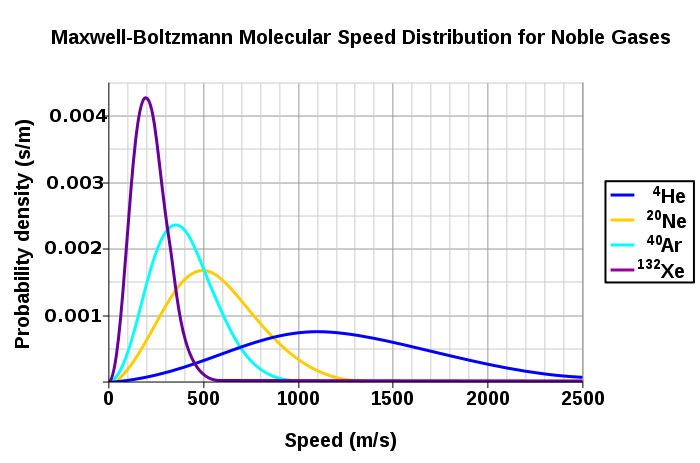
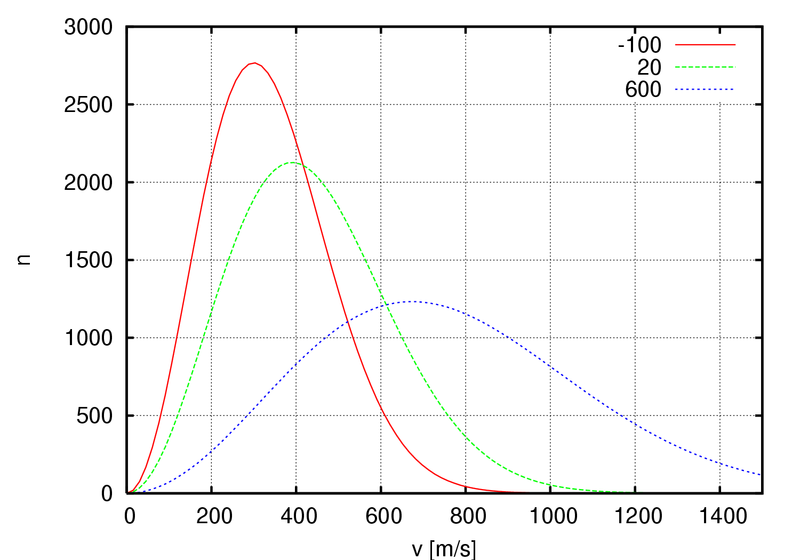
Huh? Why would we need ‘statistics’ here? Well… We can imagine many particles engaging like this–just colliding elastically and, thereby, interacting in a classical sense, even if we don’t know where exactly they’re going to end up, because of uncertainties in initial positions and what have you. In fact, you already know what this is about: it’s the behavior of particles as described by the kinetic theory of gases (often referred to as statististical mechanics) which, among other things, yields a very elegant function for the distribution of the velocities of gas molecules, as shown below for various gases (helium, neon, argon and xenon) at one specific temperature (25º C), i.e. the graph on the left-hand side, or for the same gas (oxygen) at different temperatures (–100º C, 20º C and 600º C), i.e. the graph on the right-hand side.

Now, all these density functions and what have you are, indeed, referred to as Maxwell-Boltzmann statistics, by physicists and mathematicians that is (you know they always need some special term in order to make sure other people (i.e. people like you and me, I guess) have trouble understanding them).

700px-MaxwellBoltzmann-en 800px-Maxwell-Boltzmann_distribution_1

In fact, we get the same density function for other properties of the molecules, such as their momentum and their total energy. It’s worth elaborating on this, I think, because I’ll later compare with Bose-Einstein and Fermi-Dirac statistics.

Maxwell-Boltzmann statistics

Kinetic gas theory yields a very simple and beautiful theorem. It’s the following: in a gas that’s in thermal equilibrium (or just in equilibrium, if you want), the probability (P) of finding a molecule with energy E is proportional to e–E/kT, so we have:

P ∝ e–E/kT

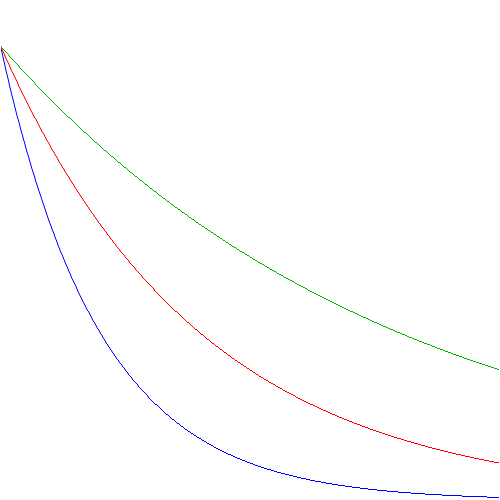
Now that’s a simple function, you may think. If we treat E as just a continuous variable, and T as some constant indeed – hence, if we just treat (the probability) P as a function of (the energy) E – then we get a function like the one below (with the blue, red and green using three different values for T).

graph

So how do we relate that to the nice bell-shaped curves above? The very simple graphs above seem to indicate the probability is greatest for E = 0, and then just goes down, instead of going up initially to reach some maximum around some average value and then drop down again. Well… The fallacy here, of course, is that the constant of proportionality is itself dependent on the temperature. To be precise, the probability density function for velocities is given by:

Boltzmann distribution

The function for energy is similar. To be precise, we have the following function:

Boltzmann distribution-energy

This (and the velocity function too) is a so-called chi-squared distribution, and ϵ is the energy per degree of freedom in the system. Now these functions will give you such nice bell-shaped curves, and so all is alright. In any case, don’t worry too much about it. I have to get back to that story of the two particles and the two detectors.

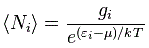
However, before I do so, let me jot down two (or three) more formulas. The first one is the formula for the expected number 〈Ni〉 of particles occupying energy level ε(and the brackets here, 〈Ni〉, have nothing to do with the bra-ket notation mentioned above: it’s just a general notation for some expected value):

Boltzmann distribution-no of particlesThis formula has the same shape as the ones above but we brought the exponential function down, into the denominator, so the minus sign disappears. And then we also simplified it by introducing that gi factor, which I won’t explain here, because the only reason why I wanted to jot this down is to allow you to compare this formula with the equivalent formula when (a) Fermi-Dirac and (b) Bose-Einstein statistics apply:

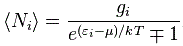
B-E and F-D distribution-no of particles

Do you see the difference? The only change in the formula is the ±1 term in the denominator: we have a minus one (–1) for Fermi-Dirac statistics and a plus one (+1) for Bose-Einstein statistics indeed. That’s all. That’s the difference with Maxwell-Boltzmann statistics.

Huh? Yes. Think about it, but don’t worry too much. Just make a mental note of it, as it will be handy when you’d be exploring related articles. [And, of course, please don’t think I am bagatellizing the difference between Maxwell-Boltzmann, Bose-Einstein and Fermi-Dirac statistics here: that ±1 term in the denominator is, obviously, a very important difference, as evidenced by the consequences of formulas like the one above: just think about the crowding-in effect in lasers as opposed to the Pauli exclusion principle, for example. :-)]

Setting up the experiment (continued)

Let’s get back to our experiment. As mentioned above, we don’t really need probability amplitudes in the classical world: ordinary probabilities, taking into account uncertainties about initial conditions only, will do. Indeed, there’s a limit to the precision with which we can measure the position in space and time of any particle in the classical world as well and, hence, we’d expect some randomness (as captured in the scattering phenomenon) but, as mentioned above, ordinary probabilities would do to capture that. Nevertheless, we did associate probability amplitudes with the events described above in order to illustrate the difference with the quantum-mechanical world. More specifically, we distinguished:

  1. Situation (a): particle a goes to detector 1 and b goes to 2, versus
  2. Situation (b): particle a goes to 2 and b goes to 1.

In our bra-ket notation:

  1. 〈1|a〉〈2|b〉 = f(θ), and
  2. 〈1|b〉〈2|a〉 = f(π–θ).

The f(θ) function is a quantum-mechanical wave function. As mentioned above, while we’d expect to see some space (x) and time (t) variables in it, these are, apparently, already captured by the θ variable. What about f(π–θ)? Well… As mentioned above also, that’s just the same function as f(θ) but using the angle π–θ as the argument. So, the following remark is probably too trivial to note but let me do it anyway (to make sure you understand what we’re modeling here really): while it’s the same function f, the values f(θ) and f(π–θ) are, of course, not necessarily equal and, hence, the corresponding probabilities are also not necessarily the same. Indeed, some angles of scattering may be more likely than others. However, note that we assume that the function f itself is  exactly the same for the two situations (a) and (b), as evidenced by that normalization condition we assume to be respected: if we add all probabilities over all angles, then we should get 1, so ∫|f(θ)|2dθ = ∫f(θ)·f*(θ)dθ = 1.

So far so good, you’ll say. However, let me ask the same critical question once again: why would we use the same wave function f for the second situation? 

Huh? You’ll say: why wouldn’t we? Well… Think about it. Again, how do we find that f(θ) function? The assumption here is that we just do the experiment a zillion times while varying the angle θ and, hence, that we’ll find some average corresponding to P(θ), i.e. the probability. Now, the next step then is to equate that average value to |f(θ)|obviously, because we have this quantum-mechanical theory saying probabilities are the absolute square of probability amplitudes. And,  so… Well… Yes. We then just take the square root of the P function to find the f(θ) function, isn’t it?

Well… No. That’s where Feynman is not very accurate when it comes to spelling out all of the assumptions underpinning this thought experiment. We should obviously watch out here, as there’s all kinds of complications when you do something like that. To a large extent (perhaps all of it), the complications are mathematical only.

First, note that any number (real or complex, but note that |f(θ)|2 is a real number) has two distinct real square roots: a positive and a negative one: x = ± √x2. Secondly, we should also note that, if f(θ) is a regular complex-valued wave function of x and t and θ (and with ‘regular’, we mean, of course, that’s it’s some solution to a Schrödinger (or Schrödinger-like) equation), then we can multiply it with some random factor shifting its phase Θ (usually written as Θ = kx–ωt+α) and the square of its absolute value (i.e. its squared norm) will still yield the same value. In mathematical terms, such factor is just a complex number with a modulus (or length or norm–whatever terminology you prefer) equal to one, which we can write as a complex exponential: eiα, for example. So we should note that, from a mathematical point of view, any function eiαf(θ) will yield the same probabilities as f(θ). Indeed,

|f(θ)|= |eiαf(θ)|= (|eiα||f(θ)|)= |eiα|2|f(θ)|= 12|f(θ)|2

Likewise, while we assume that this function f(π–θ) is the same function f as that f(θ) function, from a mathematical point of view, the function eiβf(π–θ) would do just as well, because its absolute square yields the very same (real) probability |f(π–θ)|2. So the question as to what wave function we should take for the probability amplitude is not as easy to answer as you may think. Huh? So what function should we take then? Well… We don’t know. Fortunately, it doesn’t matter, for non-identical particles that is. Indeed, when analyzing the scattering of non-identical particles, we’re interested in the probabilities only and we can calculate the total probability of particle a ending up in detector 1 or 2 (and, hence, particle b ending up in detector 2 or 1) as the following sum:

|eiαf(θ)|2 +|eiβf(π–θ)|= |f(θ)|2 +|f(π–θ)|2.

In other words, for non-identical particles, these phase factors (eiα or eiβ) don’t matter and we can just forget about them.

However, and that’s the crux of the matter really, we should mention them, of course, in case we’d have to add the probability amplitudeswhich is exactly what we’ll have to do when we’re looking at identical particles, of course. In fact, in that case (i.e. when these phase factors eiα and eiβ will actually matter), you should note that what matters really is the phase difference, so we could replace α and β with some δ (which is what we’ll do below).

However, let’s not put the cart before the horse and conclude our analysis of what’s going on when we’re considering non-identical parties: in that case, this phase difference doesn’t matter. And the remark about the positive and negative square root doesn’t matter either. In fact, if you want, you can subsume it under the phase difference story by writing eiα as eiα = ± 1. To be more explicit: we could say that –f(θ) is the probability amplitude, as |–f(θ)|is also equal to that very same real number |f(θ)|2. OK. Done.

Bose-Einstein and Fermi-Dirac statistics

As I mentioned above, the story becomes an entirely different one when we’re doing the same experiment with identical particles. At this point, Feynman’s argument becomes rather fuzzy and, in my humble opinion, that’s because he refused to be very explicit about all of those implicit assumptions I mentioned above. What I can make of it, is the following:

1. We know that we’ll have to add probability amplitudes, instead of probabilities, because we’re talking one event that can happen in two indistinguishable ways. Indeed, for non-identical particles, we can, in principle (and in practice) distinguish situation (a) and (b) – and so that’s why we only have to add some real-valued numbers representing probabilities – but so we cannot do do that for identical particles.

2. Situation (a) is still being described by some probability amplitude f(θ). We don’t know what function exactly, but we assume there is some unique wave function f(θ) out there that accurately describes the probability amplitude of particle a going to 1 (and, hence, particle b going to 2), even if we can’t tell which is a and which is b. What about the phase factor? Well… We just assume we’ve chosen our t such that α = 0. In short, the assumption is that situation (a) is represented by some probability amplitude (or wave function, if you prefer that term) f(θ).

3. However, a (or some) particle (i.e. particle a or particle b) ending up in a (some) detector (i.e. detector 1 or detector 2) may come about in two ways that cannot be distinguished one from the other. One is the way described above, by that wave function f(θ). The other way is by exchanging the role of the two particles. Now, it would seem logical to associate the amplitude f(π–θ) with the second way. But we’re in the quantum-mechanical world now. There’s uncertainty, in position, in momentum, in energy, in time, whatever. So we can’t be sure about the phase. That being said, the wave function will still have the same functional form, we must assume, as it should yield the same probability when squaring. To account for that, we will allow for a phase factor, and we know it will be important when adding the amplitudes. So, while the probability for the second way (i.e. the square of its absolute value) should be the same, its probability amplitude does not necessarily have to be the same: we have to allow for positive and negative roots or, more generally, a possible phase shift. Hence, we’ll write the probability amplitude as eiδf(π–θ) for the second way. [Why do I use δ instead of β? Well… Again: note that it’s the phase difference that matters. From a mathematical point of view, it’s the same as inserting an eiβ factor: δ can take on any value.]

4. Now it’s time for the Big Trick. Nature doesn’t matter about our labeling of particles. If we have to multiply the wave function (i.e. f(π–θ), or f(θ)–it’s the same: we’re talking a complex-valued function of some variable (i.e. the angle θ) here) with a phase factor eiδ when exchanging the roles of the particles (or, what amounts to the same, exchanging the role of the detectors), we should get back to our point of departure (i.e. no exchange of particles, or detectors) when doing that two times in a row, isn’t it? So we exchange the role of particle a and b in this analysis (or the role of the detectors), and then we’d exchange their roles once again, then there’s no exchange of roles really and we’re back at the original situation. So we must have eiδeiδf(θ) = f(θ) (and eiδeiδf(π–θ) = f(π–θ) of course, which is exactly the same statement from a mathematical point of view).

5. However, that means (eiδ)= +1, which, in turn, implies that eiδ is plus or minus one: eiδ = ± 1. So that means the phase difference δ must be equal to 0 or π (or –π, which is the same as +π).

In practical terms, that means we have two ways of combining probability amplitudes for identical particles: we either add them or, else, we subtract them. Both cases exist in reality, and lead to the dichotomy between Bose and Fermi particles:

  1. For Bose particles, we find the total probability amplitude for this scattering event by adding the two individual amplitudes: f(θ) + f(π–θ).
  2. For Fermi particles, we find the total probability amplitude for this scattering event by subtracting the two individual amplitudes: f(θ) – f(π–θ).

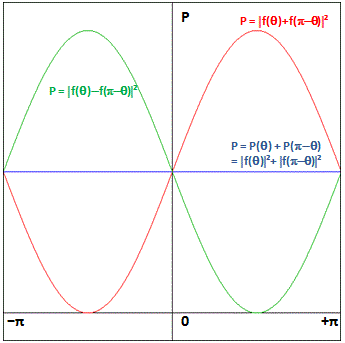
As compared to the probability for non-identical particles which, you’ll remember, was equal to |f(θ)|2 +|f(π–θ)|2, we have the following Bose-Einstein and Fermi-Dirac statistics:

  1. For Bose particles: the combined probability is equal to |f(θ) + f(π–θ)|2. For example, if θ is 90°, then we have a scattering probability that is exactly twice the probability for non-identical particles. Indeed, if θ is 90°, then f(θ) = f(π–θ), and then we have |f(π/2) + f(π/2)|2 = |2f(π/2)|2 = 4|f(π/2)|2. Now, that’s two times |f(π/2)|2 +|f(π/2)|2 = 2|f(π/2)|2 indeed.
  2. For Fermi particles (e.g. electrons), we have a combined probability equal to |f(θ) – f(π–θ)|2. Again, if θ is 90°, f(θ) = f(π–θ), and so it would mean that we have a combined probability which is equal to zero ! Now, that‘s a strange result, isn’t it? It is. Fortunately, the strange result has to be modified because electrons will also have spin and, hence, in half of the cases, the two electrons will actually not be identical but have opposite spin. That changes the analysis substantially (see Feynman’s Lectures, III-3-12). To be precise, if we take the spin factor into, we’ll find a total probability (for θ = 90°) equal to |f(π/2)|2, so that’s half of the probability for non-identical particles.

Hmm… You’ll say: Now that was a complicated story! I fully agree. Frankly, I must admit I feel like I still don’t quite ‘get‘ the story with that phase shift eiδ, in an intuitive way that is (and so that’s the reason for going through the trouble of writing out this post). While I think it makes somewhat more sense now (I mean, more than when I wrote a post on this in March), I still feel I’ve only brought some of the implicit assumptions to the fore. In essence, what we’ve got here is a mathematical dichotomy (or a mathematical possibility if you want) corresponding to what turns out to be an actual dichotomy in Nature: in quantum-mechanics, particles are either bosons or fermions. There is no Third Way, in quantum-mechanics that is (there is a Third Way in reality, of course: that’s the classical world!).

I guess it will become more obvious as I’ll get somewhat more acquainted with the real arithmetic involved in quantum-mechanical calculations over the coming weeks. In short, I’ve analyzed this thing over and over again, but it’s still not quite clear me. I guess I should just move on and accept that:

  1. This explanation ‘explains’ the experimental evidence, and that’s different probabilities for identical particles as compared to non-identical particles.
  2. This explanation ‘complements’ analyses such as that 1916 analysis of blackbody radiation by Einstein (see my post on that), which approaches interference from an angle that’s somewhat more intuitive.

A numerical example

I’ve learned that, when some theoretical piece feels hard to read, an old-fashioned numerical example often helps. So let’s try one here. We can experiment with many functional forms but let’s keep things simple. From the illustration (which I copy below for your convenience), that angle θ can take any value between −π and +π, so you shouldn’t think detector 1 can only be ‘north’ of the collision spot: it can be anywhere.

Identical particles-a

Now, it may or may not make sense (and please work out other examples than this one here), but let’s assume particle a and b are more likely to go in a line that’s more or less straight. In other words, the assumption is that both particles deflect each other only slightly, or even not at all. After all, we’re talking ‘point-like’ particles here and so, even when we try hard, it’s hard to make them collide really.

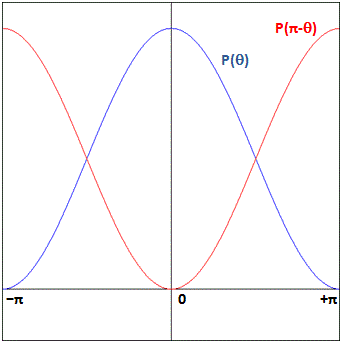
That would amount to a typical bell-shaped curve for that probability density curve P(θ): one like the blue curve below. That one shows that the probability of particle a and b just bouncing back (i.e. θ ≈ ±π) is (close to) zero, while it’s highest for θ ≈ 0, and some intermediate value for anything angle in-between. The red curve shows P(π–θ), which can be found by mirroring the P(θ) around the vertical axis, which yields the same function because the function is symmetrical: P(θ) = P(–θ), and then shifting it by adding the vertical distance π. It should: it’s the second possibility, remember? Particle a ending up in detector 2. But detector 2 is positioned at the angle π–θ and, hence, if π–θ is close to ±π (so if θ ≈ 0), that means particle 1 is basically bouncing back also, which we said is unlikely. On the other hand, if detector 2 is positioned at an angle π–θ ≈ 0, then we have the highest probability of particle a going right to it. In short, the red curve makes sense too, I would think. [But do think about yourself: you’re the ultimate judge!]

Example - graph

The harder question, of course, concerns the choice of some wave function f(θ) to match those P curves above. Remember that these probability densities P are real numbers and any real number is the absolute square (aka the squared norm) of an infinite number of complex numbers! So we’ve got l’embarras du choix, as they say in French. So… What do to? Well… Let’s keep things simple and stupid and choose a real-valued wave function f(θ), such as the blue function below. Huh? You’ll wonder if that’s legitimate. Frankly, I am not 100% sure, but why not? The blue f(θ) function will give you the blue P(θ) above, so why not go along with it? It’s based on a cosine function but it’s only half of a full cycle. Why? Not sure. I am just trying to match some sinusoidal function with the probability density function here, so… Well… Let’s take the next step.

Example 2

The red graph above is the associated f(π–θ) function. Could we choose another one? No. There’s no freedom of choice here, I am afraid: if we choose a functional form for f(θ), then our f(π–θ) function is fixed too. So it is what it is: negative between –π and 0, and positive between 0 and +π and 0. Now that is definitely not good, because f(π–θ) for θ = –π is not equal to f(π–θ) for θ = +π: they’re opposite values. That’s nonsensical, isn’t it? Both the f(θ) and the f(π–θ) should be something cyclical… But, again, let’s go along with it as for now: note that the green horizontal line is the sum of the squared (absolute) values of f(θ) and f(π–θ), and note that it’s some constant.

Now, that’s a funny result, because I assumed both particles were more likely to go in some straight line, rather than recoil with some sharp angle θ. It again indicates I must be doing something wrong here. However, the important thing for me here is to compare with the Bose-Einstein and Fermi-Dirac statistics. What’s the total probability there if we take that blue f(θ) function? Well… That’s what’s shown below. The horizontal blue line is the same as the green line in the graph above: a constant probability for some particle (a or b) ending up in some detector (1 or 2). Note that the surface, when added, of the two rectangles above the x-axis (i.e. the θ-axis) should add up to 1. The red graph gives the probability when the experiment is carried out for (identical) bosons (or Bose particles as I like to call them). It’s weird: it makes sense from a mathematical point of view (the surface under the curve adds up to the same surface under the blue line, so it adds up to 1) but, from a physics point of view, what does this mean? A maximum at θ = π/2 and a minimum at θ = –π/2? Likewise, how to interpret the result for fermions?

final

Is this OK? Well… To some extent, I guess. It surely matches the theoretical results I mentioned above: we have twice the probability for bosons for θ = 90° (red curve), and a probability equal to zero for the same angle when we’re talking fermions (green curve). Still, this numerical example triggers more questions than it answers. Indeed, my starting hypothesis was very symmetrical: both particle a and b are likely to go in a straight line, rather than being deflected in some sharp(er) angle. Now, while that hypothesis gave a somewhat unusual but still understandable probability density function in the classical world (for non-identical particles, we got a constant for P(θ) + P(π–θ)), we get this weird asymmetry in the quantum-mechanical world: we’re much more likely to catch boson in a detector ‘north’ of the line of firing than ‘south’ of it, and vice versa for fermions.

That’s weird, to say the least. So let’s go back to the drawing board and take another function for f(θ) and, hence, for f(π–θ). This time, the two graphs below assume that (i) f(θ) and f(π–θ) have a real as well as an imaginary part and (ii) that they go through a full cycle, instead of a half-cycle only. This is done by equating the real part of the two functions with cos(θ) and cos(π–θ) respectively, and their imaginary part with sin(θ) and sin(π–θ) respectively. [Note that we conveniently forget about the normalization condition here.]

classical

What do we see? Well… The imaginary part of f(θ) and f(π–θ) is the same, because sin(π–θ) = sin(θ). We also see that the real part of f(θ) and f(π–θ) are the same except for a phase difference equal to π: cos(π–θ) = cos[–(θ–π)] = cos(θ–π). More importantly, we see that the absolute square of both f(θ) and f(π–θ) yields the same constant, and so their sum P = |f(θ)|2 +|f(π–θ)|= 2|f(θ)|2 = 2|f(π–θ)|= 2P(θ) = 2P(π–θ). So that’s another constant. That’s actually OK because, this time, I did not favor one angle over the other (so I did not assume both particles were more likely to go in some straight line rather than recoil).

Now, how does this compare to Bose-Einstein and Fermi-Dirac statistics? That’s shown below. For Bose-Einstein (left-hand side), the sum of the real parts of f(θ) and f(π–θ) yields zero (blue line), while the sum of their imaginary parts (i.e. the red graph) yields a sine-like function but it has double the amplitude of sin(θ). That’s logical: sin(θ) + sin(π–θ) = 2sin(θ). The green curve is the more interesting one, because that’s the total probability we’re looking for. It has two maxima now, at +π/2 and at –π/2. That’s good, as it does away with that ‘weird asymmetry’ we got when we used a ‘half-cycle’ f(θ) function.

B-E and F-D

Likewise, the Fermi-Dirac probability density function looks good as well (right-hand side). We have the imaginary parts of f(θ) and f(π–θ) that ‘add’ to zero: sin(θ) – sin(π–θ) = 0 (I put ‘add’ between brackets because, with Fermi-Dirac, we’re subtracting of course), while the real parts ‘add’ up to a double cosine function: cos(θ) – cos(π–θ) = cos(θ) – [–cos(θ)] = 2cos(θ). We now get a minimum at +π/2 and at –π/2, which is also in line with the general result we’d expect. The (final) graph below summarizes our findings. It gives the three ‘types’ of probabilities, i.e. the probability of finding some particle in some detector as a function of the angle –π < θ < +π using:

  1. Maxwell-Boltzmann statistics: that’s the green constant (non-identical particles, and probability does not vary with the angle θ).
  2. Bose-Einstein: that’s the blue graph below. It has two maxima, at +π/2 and at –π/2, and two minima, at 0 and at ±π (+π and –π are the same angle obviously), with the maxima equal to twice the value we get under Maxwell-Boltzmann statistics.
  3. Finally, the red graph gives the Fermi-Dirac probabilities. Also two maxima and minima, but at different places: the maxima are at θ = 0 and  θ = ±π, while the minima are at at +π/2 and at –π/2.

summary

Funny, isn’t it? These probability density functions are all well-behaved, in the sense that they add up to the same total (which should be 1 when applying the normalization condition). Indeed, the surfaces under the green, blue and red lines are obviously the same. But so we get these weird fluctuations for Bose-Einstein and Fermi-Dirac statistics, favoring two specific angles over all others, while there’s no such favoritism when the experiment involves non-identical particles. This, of course, just follows from our assumption concerning f(θ). What if we double the frequency of f(θ), i.e. from one cycle to two cycles between –π and +π? Well… Just try it: take f(θ) = cos(2·θ) + isin(2·θ) and do the calculations. You should get the following probability graphs: we have the same green line for non-identical particles, but interference with four maxima (and four minima) for the Bose-Einstein and Fermi-Dirac probabilities.

summary 2

Again… Funny, isn’t it? So… What to make of this? Frankly, I don’t know. But one last graph makes for an interesting observation: if the angular frequency of f(θ) takes on larger and larger values, the Bose-Einstein and Fermi-Dirac probability density functions also start oscillating wildly. For example, the graphs below are based on a f(θ) function equal to f(θ) = cos(25·θ) + isin(25·θ). The explosion of color hurts the eye, doesn’t it? 🙂 But, apart from that, do you now see why physicists say that, at high frequencies, the interference pattern gets smeared out? Indeed, if we move the detector just a little bit (i.e. we change the angle θ just a little bit) in the example below, we hit a maximum instead of a minimum, and vice versa. In short, the granularity may be such that we can only measure that green line, in which case we’d think we’re dealing with Maxwell-Boltzmann statistics, while the underlying reality may be different.

summary 4

That explains another quote in Feynman’s famous introduction to quantum mechanics (Lectures, Vol. III, Chapter 1): “If the motion of all matter—as well as electrons—must be described in terms of waves, what about the bullets in our first experiment? Why didn’t we see an interference pattern there? It turns out that for the bullets the wavelengths were so tiny that the interference patterns became very fine. So fine, in fact, that with any detector of finite size one could not distinguish the separate maxima and minima. What we saw was only a kind of average, which is the classical curve. In the Figure below, we have tried to indicate schematically what happens with large-scale objects. Part (a) of the figure shows the probability distribution one might predict for bullets, using quantum mechanics. The rapid wiggles are supposed to represent the interference pattern one gets for waves of very short wavelength. Any physical detector, however, straddles several wiggles of the probability curve, so that the measurements show the smooth curve drawn in part (b) of the figure.”

Interference with bullets

But that should really conclude this post. It has become way too long already. One final remark, though: the ‘smearing out’ effect also explains why those three equations for 〈Ni〉 sometimes do amount to more or less the same thing: the Bose-Einstein and Fermi-Dirac formulas may approximate the Maxwell-Boltzmann equation. In that case, the ±1 term in the denominator does not make much of a difference. As we said a couple of times already, it all depends on scale. 🙂

Concluding remarks

1. The best I can do in terms of interpreting the above, is to tell myself that we cannot fully ‘fix’ the functional form of the wave function for the second or ‘other’ way the event can happen if we’re ‘fixing’ the functional form for the first of the two possibilities. We have to allow for a phase shift eiδ indeed, which incorporates all kinds of considerations of uncertainty in regard to both time and position and, hence, in regard to energy and momentum also (using both the ΔEΔt = ħ/2 and ΔxΔp = ħ/2 expressions)–I assume (but that’s just a gut instinct). And then the symmetry of the situation then implies eiδ can only take on one of two possible values: –1 or +1 which, in turn, implies that δ is equal to 0 or π.

2. For those who’d think I am basically doing nothing but re-write a chapter out of Feynman’s Lectures, I’d refute that. One point to note is that Feynman doesn’t seem to accept that we should introduce a phase factor in the analysis for non-identical particles as well. To be specific: just switching the detectors (instead of the particles) also implies that one should allow for the mathematical possibility of the phase of that f function being shifted by some random factor δ. The only difference with the quantum-mechanical analysis (i.e. the analysis for identical particles) is that the phase factor doesn’t make a difference as to the final result, because we’re not adding amplitudes but their absolute squares and, hence, a phase shift doesn’t matter.

3. I think all of the reasoning above makes not only for a very fine but also a very beautiful theoretical argument, even I feel like I don’t fully ‘understand’ it, in an intuitive way that is. I hope this post has made you think. Isn’t it wonderful to see that the theoretical or mathematical possibilities of the model actually correspond to realities, both in the classical as well as in the quantum-mechanical world? In fact, I can imagine that most physicists and mathematicians would shrug this whole reflection off like… Well… Like: “Of course! It’s obvious, isn’t it?” I don’t think it’s obvious. I think it’s deep. I would even qualify it as mysterious, and surely as beautiful. 🙂

Some content on this page was disabled on June 17, 2020 as a result of a DMCA takedown notice from Michael A. Gottlieb, Rudolf Pfeiffer, and The California Institute of Technology. You can learn more about the DMCA here:

https://wordpress.com/support/copyright-and-the-dmca/
Some content on this page was disabled on June 17, 2020 as a result of a DMCA takedown notice from Michael A. Gottlieb, Rudolf Pfeiffer, and The California Institute of Technology. You can learn more about the DMCA here:

https://wordpress.com/support/copyright-and-the-dmca/
Some content on this page was disabled on June 20, 2020 as a result of a DMCA takedown notice from Michael A. Gottlieb, Rudolf Pfeiffer, and The California Institute of Technology. You can learn more about the DMCA here:

https://wordpress.com/support/copyright-and-the-dmca/