Ferroelectrics and ferromagnetics

Ferroelectricity and ferromagnetism are two different things, but they are analogous. Materials are ferroelectric if they have a spontaneous electric polarization that can be changed or reversed by the application of an external electric field. Ferromagnetism, in contrast, refers to materials which exhibit a permanent magnetic moment.

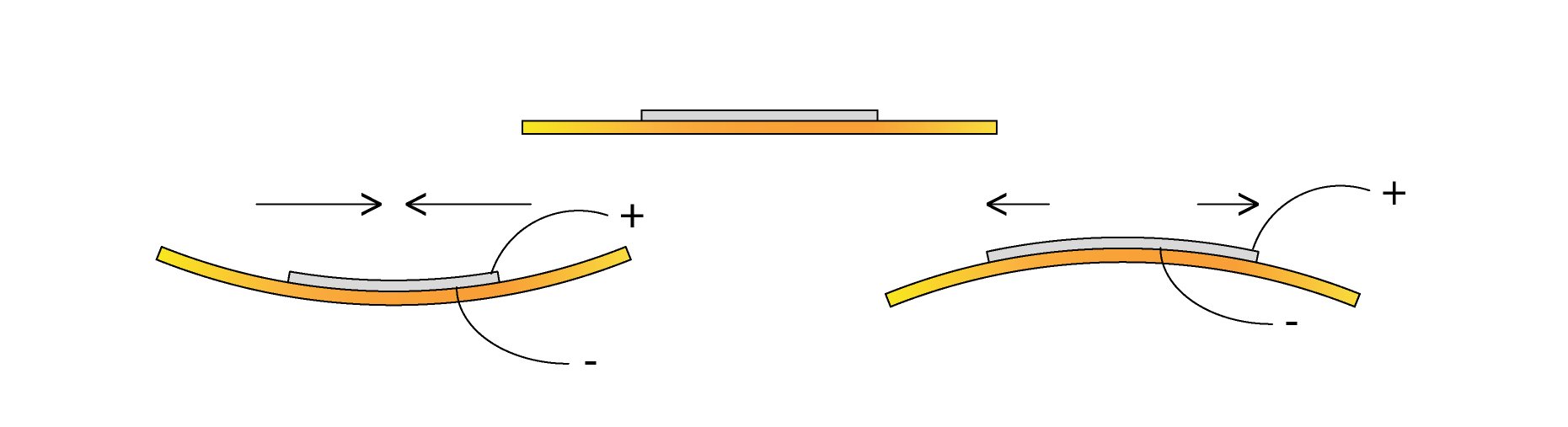
The materials are very different. In fact, most ferroelectric materials do not contain any iron and, hence, the ferro in the term is somewhat misleading. Ferroelectric materials are a special class of crystals, like barium or lead titanate (BaTiOor PbTiO3). Lead zirconate titanate (LZT) is another example. These materials are also piezoelectric: when applying some mechanical stress, they will generate some voltage. In fact, the process goes both ways: when applying some voltage to them, it will also create mechanical deformation, as illustrated below (credit for this illustration goes to Wikipedia).

Piezo_bending_principle

Ferroelectricity has to do with electric dipoles, while ferromagnetism has to do with magnetic dipoles. We’ve only discussed electric dipoles so far (see the section on dielectrics in my post on capacitors) and so we’re only in a position to discuss ferroelectricity right now, which is what I’ll do here. However, before doing so, let me briefly quote from the Wikipedia article on ferromagnetism, because that’s really concise and to the point on this:

“One of the fundamental properties of an electron (besides that it carries charge) is that it has a magnetic dipole moment, i.e. it behaves like a tiny magnet. This dipole moment comes from the more fundamental property of the electron that it has quantum mechanical spin. Due to its quantum nature, the spin of the electron can be in one of only two states; with the magnetic field either pointing “up” or “down” (for any choice of up and down). The spin of the electrons in atoms is the main source of ferromagnetism, although there is also a contribution from the orbital angular momentum of the electron about the nucleus.”

In short, ferromagnetism was discovered and known much before ferroelectricity was discovered and studied, but it’s actually more complicated, because it’s a quantum-mechanical thing really, unlike ferroelectricity, which we’ll discuss now. Before we start, let me note that, in many ways, this post is a continuation of the presentation on dielectrics, which I referred to above already, so you may want to check that discussion in that post I referred to if you have trouble following the arguments below.

Molecular dipoles

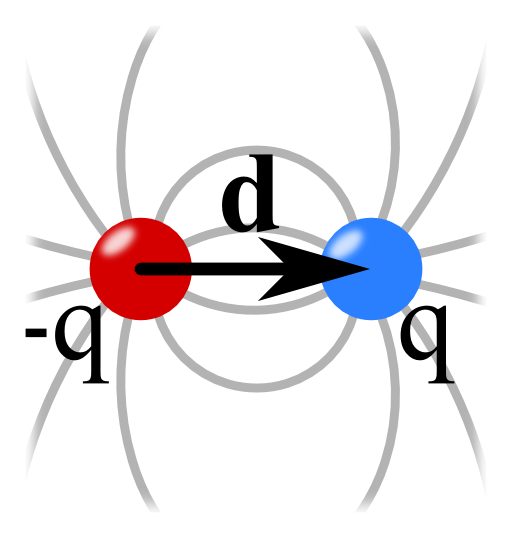
Let me first remind you of the basics. The (electric) dipole moment is the product of the distance between two equal but opposite charges q+ and q. Usually, it’s written as a vector so as to also keep track of its direction and use it in vector equations, so we write p = qd, with d the vector going from the negative to the positive charge, as shown below.

dipole_limit256

Now, molecules like water molecules have a permanent dipole moment, as illustrated below. It’s because the center of ‘gravity’ of the positive and negative charges do not coincide, so that’s what makes the H2O molecule polar, as opposed to the O2 molecule, which is non-polar.

molecular dipoles

Now, if we place polar molecules in some electric field, we’d expect them to line up, to some extent at least, as shown below (the second illustration has more dipoles pointing vaguely north).

Capture a

Capture b

However, at ordinary temperatures and electric fields, the collisions of the molecules in their thermal motion keeps them from lining up too much. In fact, we can apply the principles of statistics mechanics to calculate how much exactly. You can check out the details in Feynman’s Lecture on it, but the result is that the net dipole moment per unit volume (so that’s the polarization) is equal to:

polarization

So the polarization is proportional to the number of molecules per unit volume (N), the square of their dipole moment (p0) and, as we’d might expect, the electric field E, and inversely proportional to the temperature (T). In fact, the formula above is a sort of first-order approximation, in line with what we wrote on the electric susceptibility χ (chi) in our post on capacitors, where we also assumed the relation between P and E was linear, so we wrote: P = ε0·χ·E. Now, engineers and physicists often use different symbols and definitions and so you may of may not have heard about another concept saying essentially the same thing: the dielectric constant, which is denoted by κ (kappa) and is, quite simply, equal to κ = 1 + χ. Combining the expression for P above, and the P = ε0·χ·E = ε0·(κ−1)·E expression, we get:

susceptibility

This doesn’t say anything new: it just states the dependence of χ on the temperature. Now, you can imagine this linear relationship has been verified experimentally. As it turns out, it’s sort of valid, but it is not as straightforward as you might imagine. There’s a nice post on this on the University of Cambridge’s Materials Science site. But this blog is about physics, not about materials science, so let’s move on. The only thing I should add to this section is a remark on the energy of dipoles.

You know charges in a field have energy, potential energy. You can look up the detail behind the formulas in one of my other posts on electromagnetism, so I’ll just remind you of them: the energy of a charge is, quite simply, the product of the charge (q) and the electric potential (Φ) at the location of the charge. Why? Well… The potential is the amount of work we’d do when bringing the unit charge there from some other (reference) point where Φ = 0. In short, the energy of the positive charge is q·Φ(1) and the energy of the negative charge is −q·Φ(2), with 1 and 2 denoting their respective location, as illustrated below.

energy dipole

So we have U = q·Φ(1) − q·Φ(2) = q·[Φ(1)−Φ(2)]. Now, we’re talking tiny little dipoles here, so we can approximate ΔΦ = Φ(1)−Φ(2) by ΔΦ = dΦ = Δx·(∂Φ/∂x) + Δy·(∂Φ/∂y). Hence, also noting that E = −Φ and qd = p0, we get:

U = q·Φ(1) − q·Φ(2) = qdΦ =  −p0E = −p0·E·cosθ, with θ the angle between pand E

So the energy is lower when the dipoles are lined up with the field, which is what we would expect, of course. However, it’s an interesting thing so I just wanted to show you that. 🙂

Electrets, piezoelectricity and ferroelectricity

The analysis above was very general, so we actually haven’t started our discussion on ferroelectricity yet! All of the above is just a necessary introduction to the topic. So let’s move on. Ferroelectrics are solids, so let’s look at solids. Let me just copy Feynman’s introduction here, as it’s perfectly phrased:

“The first interesting fact about solids is that there can be a permanent polarization built in—which exists even without applying an electric field. An example occurs with a material like wax, which contains long molecules having a permanent dipole moment. If you melt some wax and put a strong electric field on it when it is a liquid, so that the dipole moments get partly lined up, they will stay that way when the liquid freezes. The solid material will have a permanent polarization which remains when the field is removed. Such a solid is called an electret. An electret has permanent polarization charges on its surface. It is the electrical analog of a magnet. It is not as useful, though, because free charges from the air are attracted to its surfaces, eventually cancelling the polarization charges. The electret is “discharged” and there are no visible external fields.”

Another example (i.e. other than wax) of an electret is the crystal lattice below. As you can see, all the dipoles are pointing in the same direction even with no applied electric field. Many crystals have such polarization but, again, we do not normally notice it because the external fields are discharged, just as for the electrets.

crystalNow, this gives rise to the phenomena of pyroelectricity and piezoelectricity. Indeed, as Feynman explains: “If these internal dipole moments of a crystal are changed, external fields appear because there is not time for stray charges to gather and cancel the polarization charges. If the dielectric is in a condenser, free charges will be induced on the electrodes. The moments can also change when a dielectric is heated, because of thermal expansion. The effect is called pyroelectricity. Similarly, if we change the stresses in a crystal—for instance, if we bend it—again the moment may change a little bit, and a small electrical effect, called piezoelectricity, can be detected.”

But, still, piezoelectricity is not the same as ferroelectricity. In fact, there’s a hierarchy here:

  1. Out of all crystals, some will be piezoelectric.
  2. Among all piezoelectric crystals, some will also be pyroelectric.
  3. Among the pyroelectric crystals, we can find some ferroelectric crystals.

The defining characteristic of ferroelectricity is that the built-in permanent moment can be reversed by the application of an external electric field. Feynman defines them as “nearly cubic crystals, whose moments can be turned in different directions, so we can detect a large change in the moment when an applied electric field is changed: all the moments flip over and we get a large effect.”

Because this is a blog, not a physics handbook, I’ll refer you to Feynman and/or the Wikipedia article on ferroelectricity for an explanation of the mechanism. Indeed, the objective of this post is to explain what it is, and so I don’t want to go off into the weeds. The two diagrams below, which I took from the mentioned Wikipedia article, illustrate the difference between your average dielectric material as opposed to a ferroelectric material. The first diagram shows you the linear relationship between P and E we discussed above: if we reverse the field, so E becomes negative, then the polarization will be reversed as well, but gradually, as shown below.

160px-Dielectric_polarisation

In contrast, the illustration below shows a hysteresis effect, which can be used as a memory function, and ferroelectric materials are indeed used for ferroelectric RAM (FeRAM) memory chips for computers! I’ll let you google that for yourself − it’s fun: just have a look at the following link, for example − because it’s about time I start wrapping up this post. 🙂

160px-Ferroelectric_polarisationOK. That’s it for today. More tomorrow. 🙂

Some content on this page was disabled on June 16, 2020 as a result of a DMCA takedown notice from The California Institute of Technology. You can learn more about the DMCA here:

https://wordpress.com/support/copyright-and-the-dmca/
Some content on this page was disabled on June 16, 2020 as a result of a DMCA takedown notice from The California Institute of Technology. You can learn more about the DMCA here:

https://wordpress.com/support/copyright-and-the-dmca/
Some content on this page was disabled on June 16, 2020 as a result of a DMCA takedown notice from The California Institute of Technology. You can learn more about the DMCA here:

https://wordpress.com/support/copyright-and-the-dmca/
Some content on this page was disabled on June 16, 2020 as a result of a DMCA takedown notice from The California Institute of Technology. You can learn more about the DMCA here:

https://wordpress.com/support/copyright-and-the-dmca/
Some content on this page was disabled on June 16, 2020 as a result of a DMCA takedown notice from The California Institute of Technology. You can learn more about the DMCA here:

https://wordpress.com/support/copyright-and-the-dmca/
Some content on this page was disabled on June 16, 2020 as a result of a DMCA takedown notice from The California Institute of Technology. You can learn more about the DMCA here:

https://wordpress.com/support/copyright-and-the-dmca/
Some content on this page was disabled on June 16, 2020 as a result of a DMCA takedown notice from The California Institute of Technology. You can learn more about the DMCA here:

https://wordpress.com/support/copyright-and-the-dmca/
Some content on this page was disabled on June 20, 2020 as a result of a DMCA takedown notice from Michael A. Gottlieb, Rudolf Pfeiffer, and The California Institute of Technology. You can learn more about the DMCA here:

https://wordpress.com/support/copyright-and-the-dmca/
Some content on this page was disabled on June 20, 2020 as a result of a DMCA takedown notice from Michael A. Gottlieb, Rudolf Pfeiffer, and The California Institute of Technology. You can learn more about the DMCA here:

https://wordpress.com/support/copyright-and-the-dmca/

Magnetostatics

Pre-script (dated 26 June 2020): This post got mutilated by the removal of some material by the dark force. You should be able to follow the main story line, however. If anything, the lack of illustrations might actually help you to think things through for yourself.

Original post:

Not all is exciting when studying physics. In fact, electromagnetism is, most of the time, a extremely boring subject-matter. But so we need to get through it, because we need the math and the formulas. So… Here we go… :-/

When going from electrostatics to electrodynamics, one first needs to have a look at magnetostatics, to get familiar with (steady) electric currents. So let’s have a look at what they are. Of course, you already know what steady currents are. In that case, you should, perhaps, stop reading. But I’d recommend you go through it anyway. It’s always good to be explicit, so let’s be explicit.

Let me first make a very pedantic note. There are a couple of sections in Feynman’s Lectures in which he assumes that a steady current in a wire is uniformly distributed throughout the cross-section of the current-carrying wire: that assumption amounts to saying that the current density j is uniform. He uses that assumption, for example, when calculating the force per unit length of a current-carrying wire in a magnetic field (see Vol. II, section 13-3). He also uses it when calculating the magnetic field it creates itself (see Vol. II, section 14-3). This raises two questions:

  1. Is the assumption true?
  2. Does it matter?

My impression is that it’s a simplification that doesn’t matter. So the answer to both question would be negative. But let’s examine them. First note that, in previous posts, we repeatedly said that, if we place a charge Q on any conductor, all charges will spread out in some way on the surface, so we have an equipotential on the surface and no electric field inside of the conductor. The physics behind are easy to understand: if there were an electric field inside of the conductor, and the surface were not an equipotential, the charges would keep moving until it became zero.

Does it matter? Maybe. Maybe not. I discussed the electric field from a conductor in a previous post, so let me just recall some formulas here, first and foremost Gauss’ Law, which says that the electric flux from any closed surface S is equal to Qinside0. Now, Qinside is, obviously, the sum of the charges inside the volume enclosed by the surface, and the most remarkable thing about Gauss’ Law is that the charge distribution inside of the volume doesn’t matter. So if we’re talking a uniformly charged sphere or a thin spherical shell of charge, it’s the same. The illustration below shows the field for a uniformly charged sphere: E is proportional to r (to be precise: E = (ρ·r)/(3ε0) for r ≤ R) inside the sphere, and outside E is proportional to 1/r2 (to be precise: E = Qinside/(4πε0r2) for r ≥ R).

Field of a sphere

However, Gauss’ Law is a law that gives us the electric flux only, so we’re talking E only. We also have the magnetic field, i.e. the field vector B. So what’s the equivalent of Gauss’ Law for B? That’s Ampère’s Law, obviously, so let’s have a look at how Feynman derives that law.

Ampère’s Law

Feynman starts by defining the current through some surface S as the following integral:

Integral for I

The illustration below explains the logic behind. The vector j is like the heat flow vector which we used when explaining the basics of vector calculus: it is some amount passing expressed per unit time and per unit area. As for the use of n, that’s the same normal unit vector we used for h as well: we then wrote that h·= |h|·|n|·cosθ = h·cosθ was the component of the heat flow that’s perpendicular or normal (as mathematicians prefer to say) to the surface. So here we’ve got the same: j·n·dS is the amount of charge flowing across an infinitesimally small area dS in a unit time. So to get the electric current I, which is the total charge passing per unit time through a surface S, we need to integrate the normal component of the flow through all the surface elements, which is what the integral above is doing.

Illustration INote that I is not a vector but a scalar. We could, however, include the idea of the direction of flow by making I a vector, so then we write it in boldface: I. It is measured in coulomb per second, aka as ampere: 1 A = 1 C/s. Also note we don’t have any wires here: just surfaces and volumes. 🙂 Onwards!

The equations of magnetostatics are Maxwell’s third and fourth equation and, as we used Maxwell’s first and second equation to derive Gauss’ Law, we’ll use these two to derive Ampère’s Law: (1) B = 0 and (2) c2×B = j0.

You know these equations: the first one basically says there’s no flux of B: there’s no such thing as magnetic charges, in other words. The second one says that a current produces some circulation of B. You also know these equations are valid only for static fields: all electric charge densities are constant, and all currents are steady, so the electric and magnetic fields are not changing with time: ∂E/∂t = 0 = ∂B/∂t. Forget about c2 for a moment (it’s just a constant) and note that ×is referred to as the curl of B.

Now, as I pointed out in one of my posts on vector analysis, the divergence of the curl of a vector is always equal to zero, so •(×B) = 0. However, because ×B = j0c2, that means •(j0c2) must also be equal to zero (we’re just taking the divergence of both sides of the equation here), and so we find that j must be equal to zero. What does that mean?Well… From the same post, you may or may not remember that the divergence of some vector field C (so that’s ∇•C) is the (net) flux out of an (infinitesimal) volume around the point we’re considering, so j = 0 implies that as much charge must be coming in as it going out, always and everywhere. So that means that, because of the charge conservation law (no charges are created or lost), we can only look at charges flowing in paths that close back on themselves, so we can only consider closed circuits. It’s a minor point – so don’t worry too much about it – but it does imply that we’re not looking at condensers, for example. Just remember: magnetostatics is about circulation, we have no flux, not of B, and not of j: our field, and our charges, circulate. 🙂

OK. Let’s get back to the lesson. We need to find Ampère’s Law, so we’d better get on with it. 🙂 To find Gauss’ Law, we used Gauss’ Theorem. To find Ampère’s Law, we’ll use… Stokes’ Theorem. [Sorry!] I need to refer you, once again, to that post on vector analysis for it. Here I can only remind you of the Theorem itself. It says that the line integral of the tangential component of a vector (field) around a closed loop is equal to the surface integral of the normal component of the curl of that vector over any surface which is bounded by the loop. […] I know that’s quite a mouthful, so let me jot down the equation:

Stokes Theorem-2

Applying it to the magnetic field vector B, we get:

Stokes Theorem for B

This is the illustration which goes with it.

Stokes Theorem for B graph

Now, using our ×B = j0c2 equation, we get:

Integral 2

Finally, we just plug in our I = ∫ j·dS integral and we’re done. This is Ampère’s Law:

Ampere's Law

It basically says that the circulation of B around any closed curve is equal to the current I through the loop, divided by ε0c2. So what can we do with it? Well… We used Gauss’ Law to find the electric field in various circumstances, so let’s now use Ampère’s Law to find the magnetic field in various circumstances. 🙂

Before doing so, however, let me note that Ampère’s Law does not depend on any particular assumption in regard to the distribution of the charge densities j. So, frankly speaking, don’t worry too much about that assumption about a steady current in a wire: a current is a current in Ampère’s Law. 🙂

Wires

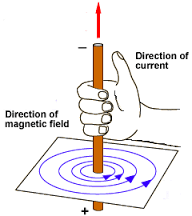
You know the magnetic field around a wire, as you’ll surely remember that right-hand rule for it from your high-school physics classes. Note, however, that it assumes you apply the usual convention: charge flows from positive to negative, because our unit of electric charge is obviously +1, not –1. So the electron flow actually goes the other way. 🙂

right-hand rule

But so we’re past our high school days and we need to apply Ampère’s Law. The symmetry of the situation implies that that line integral of B·ds, taken along some closed circle around the wire, is, quite simply, the magnitude of B times the circumference r of our circle. Indeed, the symmetry of the situation implies that B at some distance r should be of the same magnitude everywhere, so we have:

B

But from Ampère’s Law we know that integral is equal to I/ε0c2 and, therefore, B·2π·r must equal I/ε0c2, and so we get the grand result we were looking for. The magnetic field outside of a (long) wire carrying the current I is:

B formula

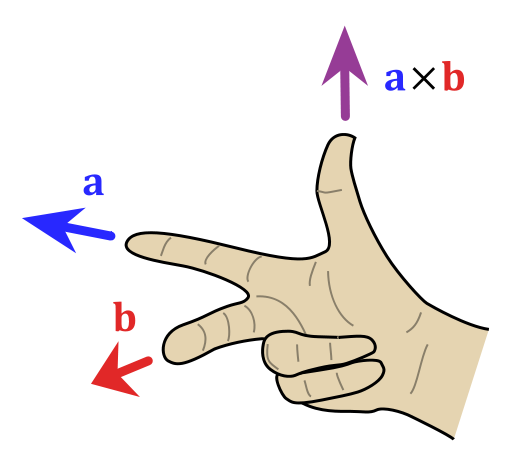
As Feynman notes, we can write this in vector form to include the directions, remembering that B is at right angles both to I as well as to r, and remembering that the order matters, of course, because of the right-hand rule for a vector cross product. 🙂

Wire formula 507px-right_hand_rule_cross_product

Solenoids

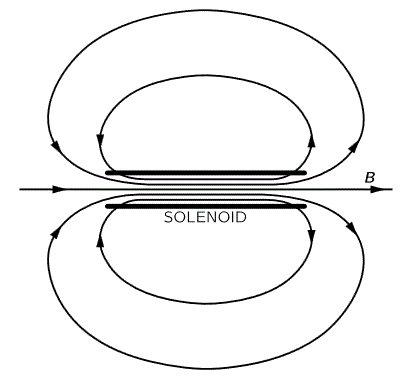
Coils of wire, and solenoids, pop up almost everywhere when studying electromagnetism. Indeed, transformers, inductances, electrical motors: it’s all coils. So, yes, we can’t escape them. 😦 So let’s get on with it. As you know, a solenoid is a long coil of wire wound in a tight spiral. The illustrations below show a cross-section and its magnetic field.

solenoid 2 solenoid 1

Now, this is probably one of Feynman’s most intuitive arguments. Read: he’s cutting an awful lot of corners here. 🙂 I’ll just copy him:

We observe experimentally that when a solenoid is very long compared with its diameter, the field outside is very small compared with the field inside. Using just that fact, together with Ampère’s law, we can find the size of the field inside. Since the field stays inside (and has zero divergence), its lines must go along parallel to the axis, as shown above. That being the case, we can use Ampère’s law with the rectangular ‘curve’ Γ shown in the figure. This loop goes the distance L inside the solenoid, where the field is, say, B0, then goes at right angles to the field, and returns along the outside, where the field is negligible. The line integral of B for this curve is just B0·L, and it must be 1/ε0c2 times the total current through Γ, which is N·I if there are N turns of the solenoid in the length L. We have:

solenoid formula 1

Or, letting n be the number of turns per unit length of the solenoid (that is, n=N/L), we get:

solenoid formula 2

Oh… What happens to the lines of B when they get to the end of the solenoid? Well… They just spread out in some way and return to enter the solenoid at the other end. Hmm… He’s really cutting corners here, isn’t he? But the formula is right, and I’d rather keep it short—just like he seems to want to do here. 🙂 I’ll just insert an illustration showing another right-hand rule—the right-hand rule for solenoids: if the direction of the fingers of your right hand is the direction of current, then your thumb gives the direction of the magnetic field inside.

helix1

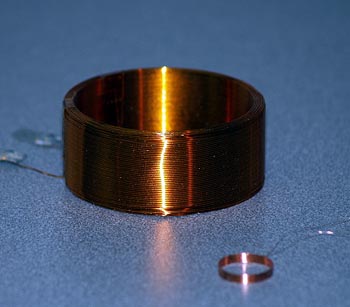
You may wonder: does it matter where the + and − ends of the coil are? Good question because, in practice, we’ll have something that’s very tightly wound, like the coil below, so when making an actual coil (click on this link for a nice video), we’ll have several rows and so we wind from right to left and then back from left to right and so on and so on. So if we’d have two rows of wire, the two ends of the wire would come out on the same side, and that’s OK.

OLYMPUS DIGITAL CAMERA

Of course, the wire needs to be insulated. What you see on the picture (and in the video) is the use of so-called magnet wire, which has a polymer film insulation. So when making the electrical connections at both ends, after winding the coil, you need to get rid of the insulation, but then it often melts just by the heat of soldering. And now that we’re talking practical stuff, let me say something about the magnetic core you see in the illustration above.

A magnetic core is a material with high magnetic permeability as compared to the surrounding air, and this high permeability will cause the magnetic field to be concentrated in the core material. Now, there’s a phenomenon that’s called hysteresis, which means that the core material will tend to retain its magnetization when the applied field is removed. This is not very desirable in many applications, such as transformers or electric engines. That’s why so-called ‘soft’ magnetic materials with low hysteresis are often preferred. The so-called soft iron is such material: it’s literally softer because of a heat treatment increasing its ductility and reducing its hardness. Of course, for permanent magnets, a so-called ‘hard’ magnetic material will be used. But here we’re getting into engineering and that’s not what I want to write about in this blog.

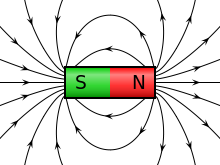
I’ll just end by noting that a magnetic field has a so-called north (N) and south (S) pole. That convention refers to the Earth’s north and south pole, of course. However, since opposite poles (north and south) attract, the North Magnetic Pole is actually the south pole of the Earth’s magnetic field, and the South is the north. 🙂 So it’s better not to think too much of the Earth’s poles when discussing the poles of a magnet. By convention, a magnet’s north pole is where the field lines of a magnet emerge, and the south pole is where they enter, as shown below.

220px-VFPt_cylindrical_magnet_thumb

In any case… Folks: that’s it for today. I’ll continue tomorrow. 🙂

Some content on this page was disabled on June 16, 2020 as a result of a DMCA takedown notice from The California Institute of Technology. You can learn more about the DMCA here:

https://wordpress.com/support/copyright-and-the-dmca/
Some content on this page was disabled on June 16, 2020 as a result of a DMCA takedown notice from The California Institute of Technology. You can learn more about the DMCA here:

https://wordpress.com/support/copyright-and-the-dmca/
Some content on this page was disabled on June 16, 2020 as a result of a DMCA takedown notice from The California Institute of Technology. You can learn more about the DMCA here:

https://wordpress.com/support/copyright-and-the-dmca/
Some content on this page was disabled on June 16, 2020 as a result of a DMCA takedown notice from The California Institute of Technology. You can learn more about the DMCA here:

https://wordpress.com/support/copyright-and-the-dmca/
Some content on this page was disabled on June 16, 2020 as a result of a DMCA takedown notice from The California Institute of Technology. You can learn more about the DMCA here:

https://wordpress.com/support/copyright-and-the-dmca/
Some content on this page was disabled on June 16, 2020 as a result of a DMCA takedown notice from The California Institute of Technology. You can learn more about the DMCA here:

https://wordpress.com/support/copyright-and-the-dmca/
Some content on this page was disabled on June 16, 2020 as a result of a DMCA takedown notice from The California Institute of Technology. You can learn more about the DMCA here:

https://wordpress.com/support/copyright-and-the-dmca/
Some content on this page was disabled on June 16, 2020 as a result of a DMCA takedown notice from The California Institute of Technology. You can learn more about the DMCA here:

https://wordpress.com/support/copyright-and-the-dmca/
Some content on this page was disabled on June 16, 2020 as a result of a DMCA takedown notice from The California Institute of Technology. You can learn more about the DMCA here:

https://wordpress.com/support/copyright-and-the-dmca/
Some content on this page was disabled on June 16, 2020 as a result of a DMCA takedown notice from The California Institute of Technology. You can learn more about the DMCA here:

https://wordpress.com/support/copyright-and-the-dmca/
Some content on this page was disabled on June 16, 2020 as a result of a DMCA takedown notice from The California Institute of Technology. You can learn more about the DMCA here:

https://wordpress.com/support/copyright-and-the-dmca/
Some content on this page was disabled on June 16, 2020 as a result of a DMCA takedown notice from The California Institute of Technology. You can learn more about the DMCA here:

https://wordpress.com/support/copyright-and-the-dmca/
Some content on this page was disabled on June 20, 2020 as a result of a DMCA takedown notice from Michael A. Gottlieb, Rudolf Pfeiffer, and The California Institute of Technology. You can learn more about the DMCA here:

https://wordpress.com/support/copyright-and-the-dmca/

A post for Vincent: on the math of waves

Pre-scriptum (dated 26 June 2020): These posts on elementary math and physics for my kids (they are 21 and 23 now and no longer need such explanations) have not suffered much the attack by the dark force—which is good because I still like them. While my views on the true nature of light, matter and the force or forces that act on them have evolved significantly as part of my explorations of a more realist (classical) explanation of quantum mechanics, I think most (if not all) of the analysis in this post remains valid and fun to read. In fact, I find the simplest stuff is often the best. 🙂

Original post:

I wrote this post to just briefly entertain myself and my teenage kids. To be precise, I am writing this for Vincent, as he started to study more math this year (eight hours a week!), and as he also thinks he might go for engineering studies two years from now. So let’s see if he gets this and − much more importantly − if he likes the topic. If not… Well… Then he should get even better at golf than he already is, so he can make a living out of it. 🙂

To be sure, nothing what I write below requires an understanding of stuff you haven’t seen yet, like integrals, or complex numbers. There’s no derivatives, exponentials or logarithms either: you just need to know what a sine or a cosine is, and then it’s just a bit of addition and multiplication. So it’s just… Well… Geometry and waves as I would teach it to an interested teenager. So let’s go for it. And, yes, I am talking to you now, Vincent! 🙂

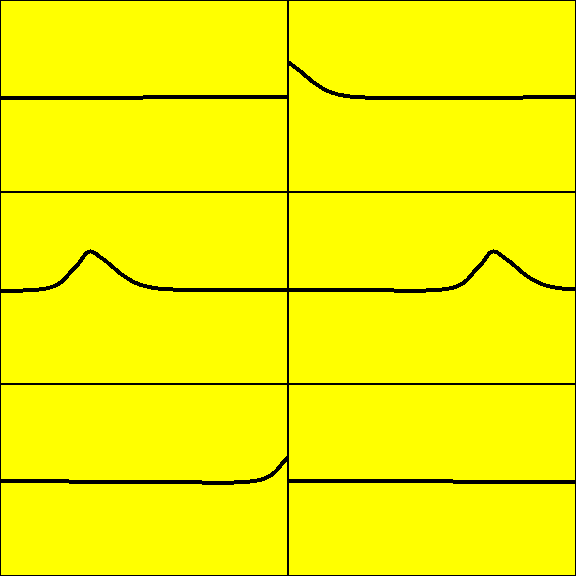
The animation below shows a repeating pulse. It is a periodic function: a traveling wave. It obviously travels in the positive x-direction, i.e. from left to right as per our convention. As you can see, the amplitude of our little wave varies as a function of time (t) and space (x), so it’s a function in two variables, like y = F(u, v). You know what that is, and you also know we’d refer to y as the dependent variable and to u and v as the independent variables.
pulse

Now, because it’s a wave, and because it travels in the positive x-direction, the argument of the wave function F will be x−ct, so we write:

y = F(x−ct)

Just to make sure: c is the speed of travel of this particular wave, so don’t think it’s the speed of light. This wave can be any wave: a water wave, a sound wave,… Whatever. Our dependent variable y is the amplitude of our wave, so it’s the vertical displacement − up or down − of whatever we’re looking at. As it’s a repeating pulse, y is zero most of the time, except when that pulse is pulsing. 🙂

So what’s the wavelength of this thing?

[…] Come on, Vincent. Think! Don’t just look at this! 

[…] I got it, daddy! It’s the distance between two peaks, or between the center of two successive pulses— obviously! 🙂

[…] Good! 🙂 OK. That was easy enough. Now look at the argument of this function once again:

F = F(x−ct)

We are not merely acknowledging here that F is some function of x and t, i.e. some function varying in space and time. Of course, F is that too, so we can write: y = F = F(x, t) = F(x−ct), but it’s more than just some function: we’ve got a very special argument here, x−ct, and so let’s start our little lesson by explaining it.

The x−ct argument is there because we’re talking waves, so that is something moving through space and time indeed. Now, what are we actually doing when we write x−ct? Believe it or not, we’re basically converting something expressed in time units into something expressed in distance units. So we’re converting time into distance, so to speak. To see how this works, suppose we add some time Δt to the argument of our function y = F, so we’re looking at F[x−c(t+Δt)] now, instead of F(x−ct). Now, F[x−c(t+Δt)] = F(x−ct−cΔt), so we’ll get a different value for our function—obviously! But it’s easy to see that we can restore our wave function F to its former value by also adding some distance Δx = cΔt to the argument. Indeed, if we do so, we get F[x+Δx−c(t+Δt)] = F(x+cΔt–ct−cΔt) = F(x–ct). For example, if = 3 m/s, then 2 seconds of time correspond to (2 s)×(3 m/s) = 6 meters of distance.

The idea behind adding both some time Δt as well as some distance Δx is that you’re traveling with the waveform itself, or with its phase as they say. So it’s like you’re riding on its crest or in its trough, or somewhere hanging on to it, so to speak. Hence, the speed of a wave is also referred to as its phase velocity, which we denote by vp = c. Now, let me make some remarks here.

First, there is the direction of travel. The pulses above travel in the positive x-direction, so that’s why we have x minus ct in the argument. For a wave traveling in the negative x-direction, we’ll have a wave function y = F(x+ct). [And, yes, don’t be lazy, Vincent: please go through the Δx = cΔt math once again to double-check that.]

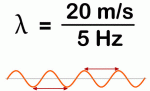
The second thing you should note is that the speed of a regular periodic wave is equal to to the product of its wavelength and its frequency, so we write: vp = c = λ·f, which we can also write as λ = c/f or f = c/λ. Now, you know we express the frequency in oscillations or cycles per second, i.e. in hertz: one hertz is, quite simply, 1 s−1, so the unit of frequency is the reciprocal of the second. So the m/s and the Hz units in the fraction below give us a wavelength λ equal to λ = (20 m/s)/(5/s) = 4 m. You’ll say that’s too simple but I just want to make sure you’ve got the basics right here.
Capture

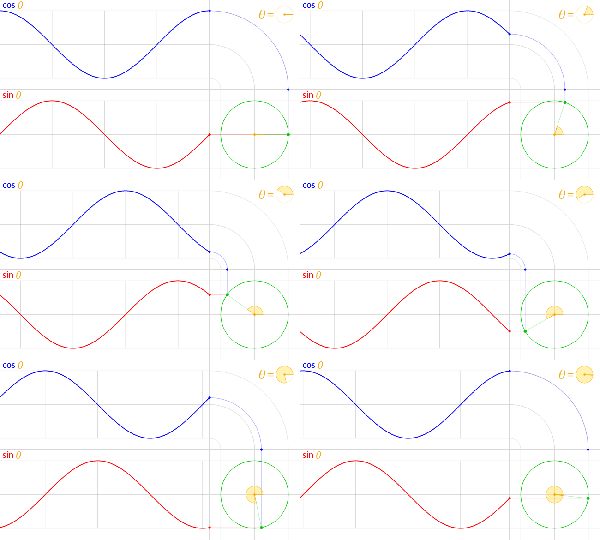
The third thing is that, in physics, and in math, we’ll usually work with nice sinusoidal functions, i.e. sine or cosine functions. A sine and a cosine function are the same function but with a phase difference of 90 degrees, so that’s π/2 radiansThat’s illustrated below: cosθ = sin(θ+π/2).
Circle_cos_sin

Now, when we converted time to distance by multiplying it with c, what we actually did was to ensure that the argument of our wavefunction F was expressed in one unit only: the meter, so that’s the distance unit in the international SI system of units. So that’s why we had to convert time to distance, so to speak.

The other option is to express all in seconds, so that’s in time units. So then we should measure distance in seconds, rather than meters, so to speak, and the corresponding argument is t–x/c, and our wave function would be written as y = G(t–x/c). Just go through the same Δx = cΔt math once more: G[t+Δt–(x+Δx)/c] = G(t+Δt–x/ccΔt/c) = G(t–x/c).

In short, we’re talking the same wave function here, so F(x−ct) = G(t−x/c), but the argument of F is expressed in distance units, while the argument of G is expressed in time units. If you’d want to double-check what I am saying here, you can use the same 20 m/s wave example again: suppose the distance traveled is 100 m, so x = 100 m and x/c = (100 m)/(20 m/s) = 5 seconds. It’s always important to check the units, and you can see they come out alright in both cases! 🙂

Now, to go from F or G to our sine or cosine function, we need to do yet another conversion of units, as the argument of a sinusoidal function is some angle θ, not meters or seconds. In physics, we refer to θ as the phase of the wave function. So we need degrees or, more common now, radians, which I’ll explain in a moment. Let me first jot it down:

y = sin(2π(x–ct)/λ)

So what are we doing here? What’s going on? Well… First, we divide x–ct by the wavelength λ, so that’s the (x–ct)/λ in the argument of our sine function. So our ‘distance unit’ is no longer the meter but the wavelength of our wave, so we no longer measure in meter but in wavelengths. For example, if our argument x–ct was 20 m, and the wavelength of our wave is 4 m, we get (x–ct)/λ = 5 between the brackets. It’s just like comparing our length: ten years ago you were about half my size. Now you’re the same: one unit. 🙂 When we’re saying that, we’re using my length as the unit – and so that’s also your length unit now 🙂 – rather than meters or centimeters.

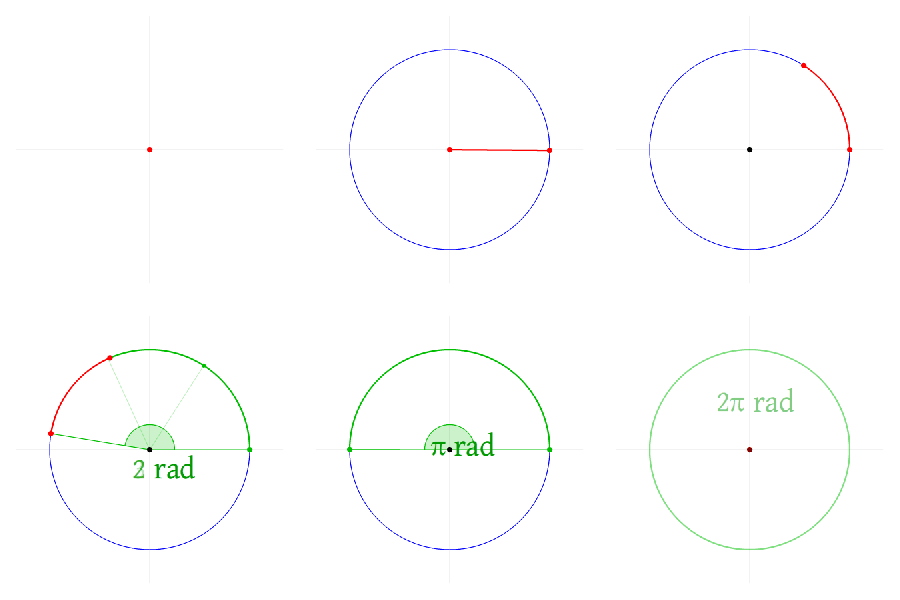
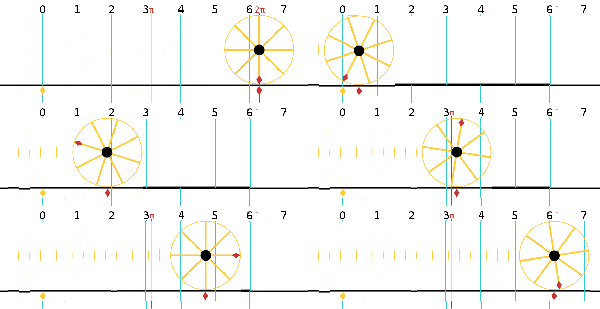
Now I need to explain the 2π factor, which is only slightly more difficult. Think about it: one wavelength corresponds to one full cycle, so that’s the full 360° of the circle below. In fact, we’ll express angles in radians, and the two animations below illustrate what a radian really is: an angle of 1 rad defines an arc whose length, as measured on the circle, is equal to the radius of that circle. […] Oh! Please look at the animations as two separate things: they illustrate the same idea, but they’re not synchronized, unfortunately! 🙂
2pi-unrolledCircle_radians

So… I hope it all makes sense now: if we add one wavelength to the argument of our wave function, we should get the same value, and so it’s equivalent to adding 2π to the argument of our sine function. Adding half a wavelength, or 35% of it, or a quarter, or two wavelengths, or e wavelengths, etc is equivalent to adding π, or 35%·2π ≈ 2.2, or 2π/4 = π/2, or 2·2π = 4π, or e·2π, etc to it. So… Well… Think about it: to go from the argument of our wavefunction expressed as a number of wavelengths − so that’s (x–ct)/λ – to the argument of our sine function, which is expressed in radians, we need to multiply by 2π.

[…] OK, Vincent. If it’s easier for you, you may want to think of the 1/λ and 2π factors in the argument of the sin(2π(x–ct)/λ) function as scaling factors: you’d use a scaling factor when you go from one measurement scale to another indeed. It’s like using vincents rather than meter. If one vincent corresponds to 1.8 m, then we need to re-scale all lengths by dividing them by 1.8 so as to express them in vincents. Vincent ten year ago was 0.9 m, so that’s half a vincent: 0.9/1.8 = 0.5. 🙂

[…] OK. […] Yes, you’re right: that’s rather stupid and makes nobody smile. Fine. You’re right: it’s time to move on to more complicated stuff. Now, read the following a couple of times. It’s my one and only message to you:

If there’s anything at all that you should remember from all of the nonsense I am writing about in this physics blog, it’s that any periodic phenomenon, any motion really, can be analyzed by assuming that it is the sum of the motions of all the different modes of what we’re looking at, combined with appropriate amplitudes and phases.

It really is a most amazing thing—it’s something very deep and very beautiful connecting all of physics with math.

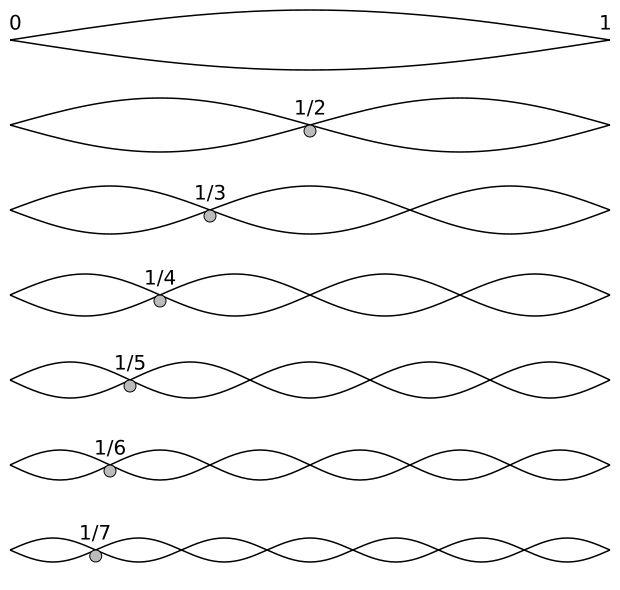
We often refer to these modes as harmonics and, in one of my posts on the topic, I explained how the wavelengths of the harmonics of a classical guitar string – it’s just an example – depended on the length of the string only. Indeed, if we denote the various harmonics by their harmonic number n = 1, 2, 3,… n,… and the length of the string by L, we have λ1 = 2L = (1/1)·2L, λ2 = L = (1/2)·2L, λ3 = (1/3)·2L,… λn = (1/n)·2L. So they look like this:

620px-Harmonic_partials_on_strings

etcetera (1/8, 1/9,…,1/n,… 1/∞)

The diagram makes it look like it’s very obvious, but it’s an amazing fact: the material of the string, or its tension, doesn’t matter. It’s just the length: simple geometry is all that matters! As I mentioned in my post on music and physics, this realization led to a somewhat misplaced fascination with harmonic ratios, which the Greeks thought could explain everything. For example, the Pythagorean model of the orbits of the planets would also refer to these harmonic ratios, and it took intellectual giants like Galileo and Copernicus to finally convince the Pope that harmonic ratios are great, but that they cannot explain everything. 🙂 [Note: When I say that the material of the string, or its tension, doesn’t matter, I should correct myself: they do come into play when time becomes the variable. Also note that guitar strings are not the same length when strung on a guitar: the so-called bridge saddle is not in an exact right angle to the strings: this is a link to some close-up pictures of a bridge saddle on a guitar, just in case you don’t have a guitar at home to check.]

Now, I already explained the need to express the argument of a wave function in radians – because we’re talking periodic functions and so we want to use sinusoidals − and how it’s just a matter of units really, and so how we can go from meter to wavelengths to radians. I also explained how we could do the same for seconds, i.e. for time. The key to converting distance units to time units, and vice versa, is the speed of the wave, or the phase velocity, which relates wavelength and frequency: c = λ·f. Now, as we have to express everything in radians anyway, we’ll usually substitute the wavelength and frequency by the wavenumber and the angular frequency so as to convert these quantities too to something expressed in radians. Let me quickly explain how it works:

  1. The wavenumber k is equal to k = 2π/λ, so it’s some number expressed in radians per unit distance, i.e. radians per meter. In the example above, where λ was 4 m, we have k = 2π/(4 m) = π/2 radians per meter. To put it differently, if our wave travels one meter, its phase θ will change by π/2.
  2. Likewise, the angular frequency is ω = 2π·f = 2π/T. Using the same example once more, so assuming a frequency of 5 Hz, i.e. a period of one fifth of a second, we have ω = 2π/[(1/5)·s] = 10π per second. So the phase of our wave will change with 10 times π in one second. Now that makes sense because, in one second, we have five cycles, and so that corresponds to 5 times 2π.

Note that our definition implies that λ = 2π/k, and that it’s also easy to figure out that our definition of ω, combined with the = c/λ relation, implies that ω = 2π·c/λ and, hence, that c = ω·λ/(2π) = (ω·2π/k)/(2π) = ω/k. OK. Let’s move on.

Using the definitions and explanations above, it’s now easy to see that we can re-write our y = sin(2π(x–ct)/λ) as:

y = sin(2π(x–ct)/λ) = sin[2π(x–(ω/k)t)/(2π/k)] = sin[(x–(ω/k)t)·k)] = sin(kx–ωt)

Remember, however, that we were talking some wave that was traveling in the positive x-direction. For the negative x-direction, the equation becomes:

y = sin(2π(x+ct)/λ) = sin(kx+ωt)

OK. That should be clear enough. Let’s go back to our guitar string. We can go from λ to k by noting that λ = 2L and, hence, we get the following for all of the various modes:

k = k1 = 2π·1/(2L) = π/L, k2 = 2π·2/(2L) = 2k, k3 = 2π·3/(2L) = 3k,,… kn = 2π·3/(2L) = nk,…

That gives us our grand result, and that’s that we can write some very complicated waveform Ψ(x) as the sum of an infinite number of simple sinusoids, so we have:

Ψ(x) = a1sin(kx) + a2sin(2kx) + a3sin(3kx) + … + ansin(nkx) + … = ∑ ansin(nkx)

The equation above assumes we’re looking at the oscillation at some fixed point in time. If we’d be looking at the oscillation at some fixed point in space, we’d write:

Φ(t) = a1sin(ωt) + a2sin(2ωt) + a3sin(3ωt) + … + ansin(nωt) + … = ∑ ansin(nωt)

Of course, to represent some very complicated oscillation on our guitar string, we can and should combine some Ψ(x) as well as some Φ(t) function, but how do we do that, exactly? Well… We’ll obviously need both the sin(kx–ωt) as well as those sin(kx+ωt) functions, as I’ll explain in a moment. However, let me first make another small digression, so as to complete your knowledge of wave mechanics. 🙂

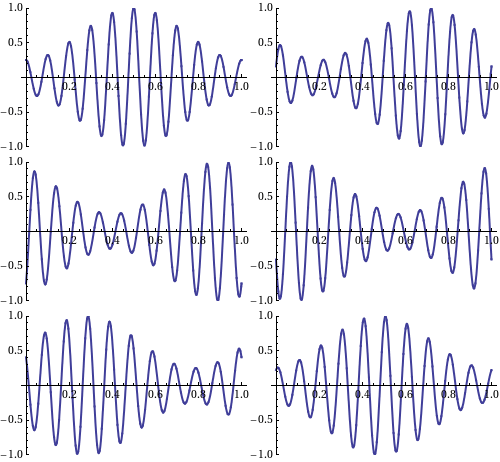
We look at a wave as something that’s traveling through space and time at the same time. In that regard, I told you that the speed of the wave is its so-called phase velocity, which we denoted as vp = c and which, as I explained above, is equal to vp = c = λ·= (2π/k)·(ω/2π) = ω/k. The animation below (credit for it must go to Wikipedia—and sorry I forget to acknowledge the same source for the illustrations above) illustrates the principle: the speed of travel of the red dot is the phase velocity. But you can see that what’s going on here is somewhat more complicated: we have a series of wave packets traveling through space and time here, and so that’s where the concept of the so-called group velocity comes in: it’s the speed of travel of the green dot.

Wave_group

Now, look at the animation below. What’s going on here? The wave packet (or the group or the envelope of the wave—whatever you want to call it) moves to the right, but the phase goes to the left, as the peaks and troughs move leftward indeed. Huh? How is that possible? And where is this wave going? Left or right? Can we still associate some direction with the wave here? It looks like it’s traveling in both directions at the same time!
Wave_opposite-group-phase-velocity

The wave actually does travel in both directions at the same time. Well… Sort of. The point is actually quite subtle. When I started this post by writing that the pulses were ‘obviously’ traveling in the positive x-direction… Well… That’s actually not so obvious. What is it that is traveling really? Think about an oscillating guitar string: nothing travels left or right really. Each point on the string just moves up and down. Likewise, if our repeated pulse is some water wave, then the water just stays where it is: it just moves up and down. Likewise, if we shake up some rope, the rope is not going anywhere: we just started some motion that is traveling down the rope. In other words, the phase velocity is just a mathematical concept. The peaks and troughs that seem to be traveling are just mathematical points that are ‘traveling’ left or right.

What about the group velocity? Is that a mathematical notion too? It is. The wave packet is often referred to as the envelope of the wave curves, for obviously reasons: they’re enveloped indeed. Well… Sort of. 🙂 However, while both the phase and group velocity are velocities of mathematical constructs, it’s obvious that, if we’re looking at wave packets, the group velocity would be of more interest to us than the phase velocity. Think of those repeated pulses as real water waves, for example: while the water stays where it is (as mentioned, the water molecules just go up and down—more or less, at least), we’d surely be interested to know how fast these waves are ‘moving’, and that’s given by the group velocity, not the phase velocity. Still, having said that, the group velocity is as ‘unreal’ as the phase velocity: both are mathematical concepts. The only thing that’s ‘real’ is the up and down movement. Nothing travels in reality. Now, I shouldn’t digress too much here, but that’s why there’s no limit on the phase velocity: it can exceed the speed of light. In fact, in quantum mechanics, some real-life particle − like an electron, for instance – will be represented by a complex-valued wave function, and there’s no reason to put some limit on the phase velocity. In contrast, the group velocity will actually be the speed of the electron itself, and that speed can, obviously, approach the speed of light – in particle accelerators, for example – but it can never exceed it. [If you’re smart, and you are, you’ll wonder: what about photons? Well…The classical and quantum-mechanical view of an electromagnetic wave are surely not the same, but they do have a lot in common: both photons and electromagnetic radiation travel at the speed c. Photons can do so because their rest mass is zero. But I can’t go into any more detail here, otherwise this thing will become way too long.]

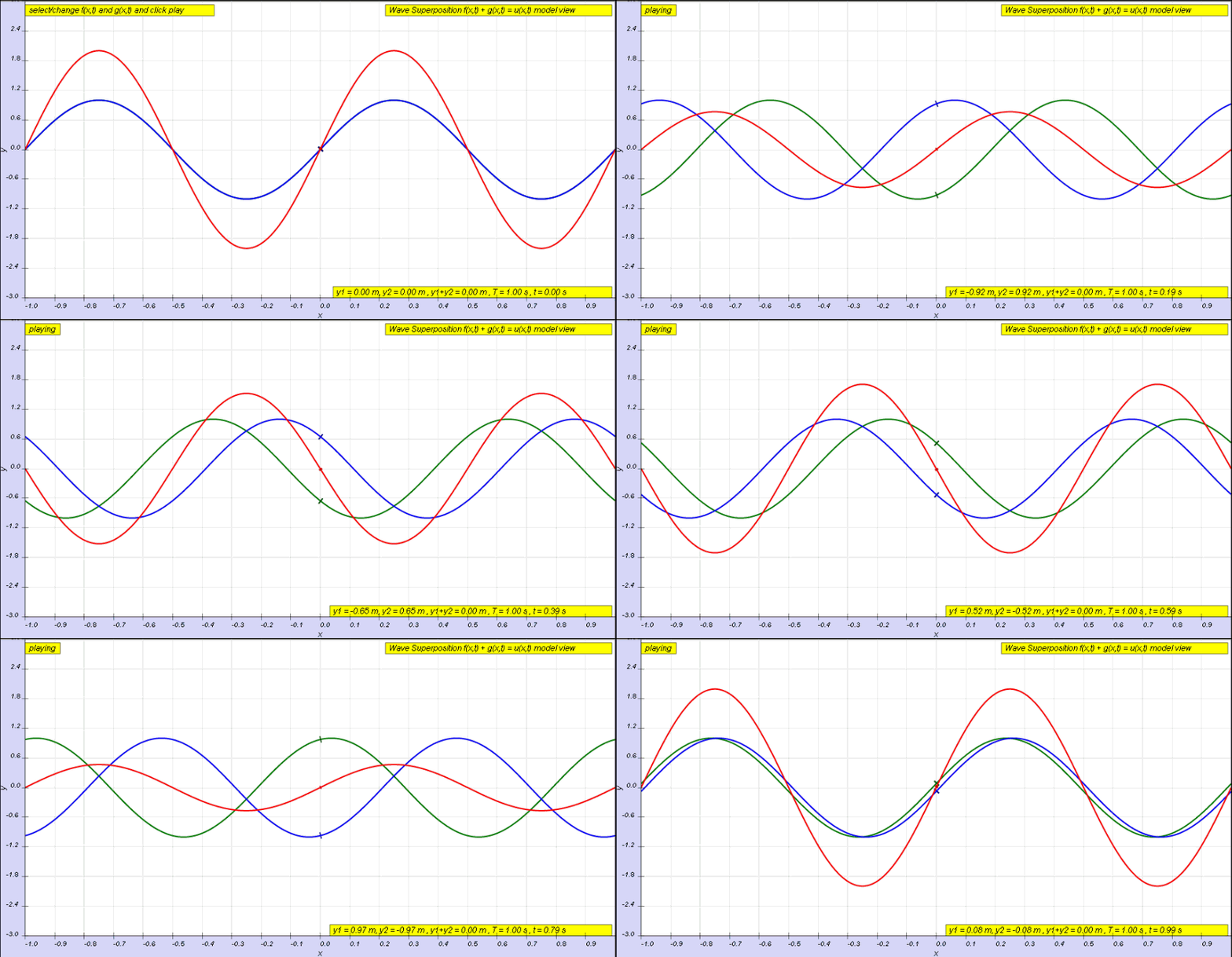
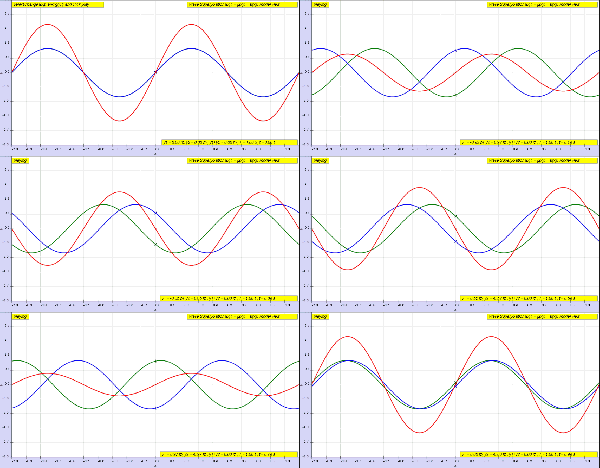
OK. Let me get back to the issue at hand. So I’ll now revert to the simpler situation we’re looking at here, and so that’s these harmonic waves, whose form is a simple sinusoidal indeed. The animation below (and, yes, it’s also from Wikipedia) is the one that’s relevant for this situation. You need to study it for a while to understand what’s going on. As you can see, the green wave travels to the right, the blue one travels to the left, and the red wave function is the sum of both.
Superpositionprinciple

Of course, after all that I wrote above, I should use quotation marks and write ‘travel’ instead of travel, so as to indicate there’s nothing traveling really, except for those mathematical points, but then no one does that, and so I won’t do it either. Just make sure you always think twice when reading stuff like this! Back to the lesson: what’s going on here?

As I explained, the argument of a wave traveling towards the negative x-direction will be x+ct. Conversely, the argument of a wave traveling in the positive x-direction will be x–ct. Now, our guitar string is going nowhere, obviously: it’s like the red wave function above. It’s a so-called standing wave. The red wave function has nodes, i.e. points where there is no motion—no displacement at all! Between the nodes, every point moves up and down sinusoidally, but the pattern of motion stays fixed in space. So that’s the kind of wave function we want, and the animation shows us how we can get it.

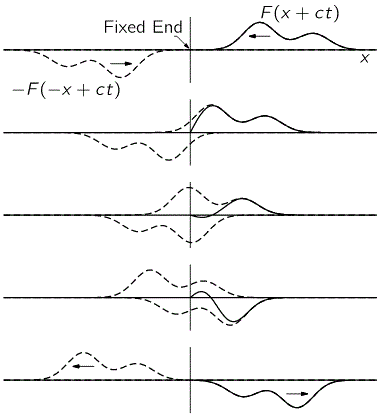
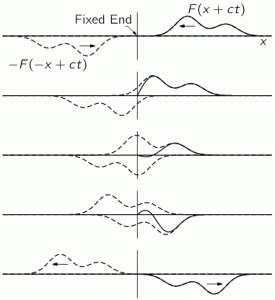
Indeed, there’s a funny thing with fixed strings: when a wave reaches the clamped end of a string, it will be reflected with a change in sign, as illustrated below: we’ve got that F(x+ct) wave coming in, and then it goes back indeed, but with the sign reversed.
Capture

The illustration above speaks for itself but, of course, once again I need to warn you about the use of sentences like ‘the wave reaches the end of the string’ and/or ‘the wave gets reflected back’. You know what it really means now: it’s some movement that travels through space. […] In any case, let’s get back to the lesson once more: how do we analyze that?

Easy: the red wave function is the sum of two waves: one traveling to the right, and one traveling to the left. We’ll call these component waves F and G respectively, so we have y = F(x, t) + G(x, t). Let’s go for it.

Let’s first assume the string is not held anywhere, so that we have an infinite string along which waves can travel in either direction. In fact, the most general functional form to capture the fact that a waveform can travel in any direction is to write the displacement y as the sum of two functions: one wave traveling one way (which we’ll denote by F, indeed), and the other wave (which, yes, we’ll denote by G) traveling the other way. From the illustration above, it’s obvious that the F wave is traveling towards the negative x-direction and, hence, its argument will be x+ct. Conversely, the G wave travels in the positive x-direction, so its argument is x–ct. So we write:

y = F(x, t) + G(x, t) = F(x+ct) + G(x–ct)

So… Well… We know that the string is actually not infinite, but that it’s fixed to two points. Hence, y is equal to zero there: y = 0. Now let’s choose the origin of our x-axis at the fixed end so as to simplify the analysis. Hence, where y is zero, x is also zero. Now, at x = 0, our general solution above for the infinite string becomes  y = F(ct) + G(−ct) = 0, for all values of t. Of course, that means G(−ct) must be equal to –F(ct). Now, that equality is there for all values of t. So it’s there for all values of ct and −ct. In short, that equality is valid for whatever value of the argument of G and –F. As Feynman puts it: “of anything must be –of minus that same thing.” Now, the ‘anything’ in G is its argument: x – ct, so ‘minus that same thing’ is –(x–ct) = −x+ct. Therefore, our equation becomes:

y = F(x+ct) − F(−x+ct)

So that’s what’s depicted in the diagram above: the F(x+ct) wave ‘vanishes’ behind the wall as the − F(−x+ct) wave comes out of it. Now, of course, so as to make sure our guitar string doesn’t stop its vibration after being plucked, we need to ensure F is a periodic function, like a sin(kx+ωt) function. 🙂 Why? Well… If this F and G function would simply disappear and ‘serve’ only once, so to speak, then we only have one oscillation and that’s it! So the waves need to continue and so that’s why it needs to be periodic.

OK. Can we just take sin(kx+ωt) and −sin(−kx+ωt) and add both? It makes sense, doesn’t it? Indeed, −sinα = sin(−α) and, therefore, −sin(−kx+ωt) = sin(kx−ωt). Hence, y = F(x+ct) − F(−x+ct) would be equal to:

y = sin(kx+ωt) + sin(kx–ωt) = sin(2π(x+ct)/λ) + sin(2π(x−ct)/λ)

Done! Let’s use specific values for k and ω now. For the first harmonic, we know that k = 2π/2L = π/L. What about ω? Hmm… That depends on the wave velocity and, therefore, that actually does depend on the material and/or the tension of the string! The only thing we can say is that ω = c·k, so ω = c·2π/λ = c·π/L. So we get:

sin(kx+ωt) = sin(π·x/L + π·c·t/L) = sin[(π/L)·(x+ct)]

But this is our F function only. The whole oscillation is y = F(x+ct) − F(−x+ct), and − F(−x+ct) is equal to:

 –sin[(π/L)·(−x+ct)] = –sin(−π·x/L+π·c·t/L) = −sin(−kx+ωt) = sin(kx–ωt) = sin[(π/L)·(x–ct)]

So, yes, we should add both functions to get:

y = sin[π(x+ct)/L] + sin[π(x−ct)/L]

Now, we can, of course, apply our trigonometric formulas for the addition of angles, which say that sin(α+β) = sinαcosβ + sinβcosα and sin(α–β) = sinαcosβ – sinβcosα. Hence, y = sin(kx+ωt) + sin(kx–ωt) is equal to sin(kx)cos(ωt) + sin(ωt)cos(kx) + sin(kx)cos(ωt) – sin(ωt)cos(kx) = 2sin(kx)cos(ωt). Now, that’s a very interesting result, so let’s give it some more prominence by writing it in boldface:

y = sin(kx+ωt) + sin(kx–ωt) = 2sin(kx)cos(ωt) = 2sin(π·x/L)cos(π·c·t/L)

The sin(π·x/L) factor gives us the nodes in space. Indeed, sin(π·x/L) = 0 if x is equal to 0 or L (values of x outside of the [0, L] interval are obviously not relevant here). Now, the other factor cos(π·c·t/L) can be re-written cos(2π·c·t/λ) = cos(2π·f·t) = cos(2π·t/T), with T the period T = 1/f = λ/c, so the amplitude reaches a maximum (+1 or −1 or, including the factor 2, +2 or −2) if 2π·t/T is equal to a multiple of π, so that’s if t = n·T/2 with n = 0, 1, 2, etc. In our example above, for f = 5 Hz, that means the amplitude reaches a maximum (+2 or −2) every tenth of a second.

The analysis for the other modes is as easy, and I’ll leave it you, Vincent, as an exercise, to work it all out and send me the y = 2·sin[something]·cos[something else] formula (with the ‘something’ and ‘something else’ written in terms of L and c, of course) for the higher harmonics. 🙂

[…] You’ll say: what’s the point, daddy? Well… Look at that animation again: isn’t it great we can analyze any standing wave, or any harmonic indeed, as the sum of two component waves with the same wavelength and frequency but ‘traveling’ in opposite directions? 

Superpositionprinciple

Yes, Vincent. I can hear you sigh: “Daddy, I really do not see why I should be interested in this.”

Well… Your call… What can I say? Maybe one day you will. In fact, if you’re going to go for engineering studies, you’ll have to. 🙂

To conclude this post, I’ll insert one more illustration. Now that you know what modes are, you can start thinking about those more complicated Ψ and Φ functions. The illustration below shows how the first and second mode of our guitar string combine to give us some composite wave traveling up and down the very same string.

composite wave

Think about it. We have one physical phenomenon here: at every point in time, the string is somewhere, but where exactly, depends on the mathematical shape of its components. If this doesn’t illustrate the beauty of Nature, the fact that, behind every simple physical phenomenon − most of which are some sort of oscillation indeed − we have some marvelous mathematical structure, then… Well… Then I don’t know how to explain why am absolutely fascinated by this stuff.

Addendum 1: On actual waves

My examples of waves above were all examples of so-called transverse waves, i.e. oscillations at a right angle to the direction of the wave. The other type of wave is longitudinal. I mentioned sound waves above, but they are essentially longitudinal. So there  the displacement of the medium is in the same direction of the wave, as illustrated below.Onde_compression_impulsion_1d_30_petit
Real-life waves, like water waves, may be neither of the two. The illustration below shows how water molecules actually move as a wave passes. They move in little circles, with a systemic phase shift from circle to circle.

Water waves

Why is this so? I’ll let Feynman answer, as he also provided the illustration above:

“Although the water at a given place is alternately trough or hill, it cannot simply be moving up and down, by the conservation of water. That is, if it goes down, where is the water going to go? The water is essentially incompressible. The speed of compression of waves—that is, sound in the water—is much, much higher, and we are not considering that now. Since water is incompressible on this scale, as a hill comes down the water must move away from the region. What actually happens is that particles of water near the surface move approximately in circles. When smooth swells are coming, a person floating in a tire can look at a nearby object and see it going in a circle. So it is a mixture of longitudinal and transverse, to add to the confusion. At greater depths in the water the motions are smaller circles until, reasonably far down, there is nothing left of the motion.”

So… There you go… 🙂

Addendum 2: On non-periodic waves, i.e. pulses

A waveform is not necessarily periodic. The pulse we looked at could, perhaps, not repeat itself. It is not possible, then, to describe its wavelength. However, it’s still a wave and, hence, its functional form would still be some y = F(x−ct) or y = F(x+ct) form, depending on its direction of travel.

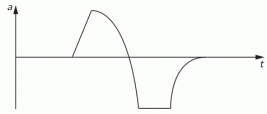
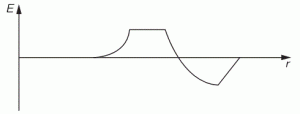
The example below also comes out of Feynman’s Lectures: electromagnetic radiation is caused by some accelerating electric charge – an electron, usually, because its mass is small and, hence, it’s much easier to move than a proton 🙂 – and then the electric field travels out in space. So the two diagrams below show (i) the acceleration (a) as a function of time (t) and (ii) the electric field strength (E) as a function of the distance (r). [To be fully precise, I should add he ignores the 1/r variation, but that’s a fine point which doesn’t matter much here.]
EM 1EM 2    

He basically uses this illustration to explain why we can use a y = G(t–x/c) functional form to describe a wave. The point is: he actually talks about one pulse only here. So the F(x±ct) or G(t±x/c) or sin(kx±ωt) form has nothing to do with whether or not we’re looking at a periodic or non-periodic waveform. The gist of the matter is that we’ve got something moving through space, and it doesn’t matter whether it’s periodic or not: the periodicity or non-periodicity, of a wave has nothing to do with the x±ct, t±x/c or kx±ωt shape of the argument of our wave function. The functional form of our argument is just the result of what I said about traveling along with our wave.

So what is it about periodicity then? Well… If periodicity kicks it, you’ll talk sinusoidal functions, and so the circle will be needed once more. 🙂   

Now, I mentioned we cannot associate any particular wavelength with such non-periodic wave. Having said that, it’s still possible to analyze this pulse as a sum of sinusoids through a mathematical procedure which is referred to as the Fourier transform. If you’re going for engineer, you’ll need to learn how to master this technique. As for now, however, you can just have a look at the Wikipedia article on it. 🙂

Some content on this page was disabled on June 16, 2020 as a result of a DMCA takedown notice from The California Institute of Technology. You can learn more about the DMCA here:

https://wordpress.com/support/copyright-and-the-dmca/
Some content on this page was disabled on June 16, 2020 as a result of a DMCA takedown notice from The California Institute of Technology. You can learn more about the DMCA here:

https://wordpress.com/support/copyright-and-the-dmca/

Magnetism and relativity

Pre-script (dated 26 June 2020): This post got mutilated by the removal of some material by the dark force. You should be able to follow the main story line, however. If anything, the lack of illustrations might actually help you to think things through for yourself.

Original post:

The magnetic force is a strange animal. The F = q(E+v×B) = qE+qv×formula implies that both its direction as well as its magnitude depend on the direction and the magnitude of the motion of the charge. The magnetic force is, just like the electric force, still proportional to the amount of charge (q), but then we have not one but two vectors co-determining its direction and magnitude, as expressed by the vector product v×B = |v|·|B|·sinθ = v·B·sinθ.

B and FThe presence of the velocity vector in the F = q(E+v×B) formula implies both the magnetic as well as the electric field are relative, as we wonder: “What velocity? With respect to which reference frame?” The (a) and (b) below illustrate the same interaction between some current-carrying wire and some negative charge q from two perspectives:

Diagram (a) below represents frame S, in which the wire is at rest, and the charge moves along the wire with velocity v0, while

Diagram (b) below represents frame S’, which coincides with the reference frame of the charge, so now it’s the wire that’s moving past the particle, instead of the other way around.

Relativity 1

Because of relativity, all of our variables transform: we have time dilation, length contraction, and relativistic mass, as I explained in my posts on special relativity. So we cannot take any of the variables for granted and so we prime all of them: in S’, we have I’, v’, etcetera, and so we need to calculate their values using the Lorentz transformation rules.

Now, we know that the absolute speed of light connects both pictures, but that’s not enough to explain what’s going on. We need some other anchoring principle as well. We have such anchor: charges are always the same, moving or not. They are indestructible. They are never lost or created: they move from place to place but never appear from nowhere. In short, charge is conserved. So we also need to look at charge densities and see what happens to them.

The illustration above shows the current I going in the conventional direction, so that’s opposite to the actual direction of travel of the free drifting electrons. It’s a convention that makes sense because of all our other conventions, such as the right-hand rule for our vector cross-product v×B above, so we won’t touch it. Having said that, the illustration shows what’s going on in S: the positive charges in the wire don’t move, so we have some charge density ρ+ and a velocity v+ = 0. The electrons, on the other hand, do move, and so we have some charge density ρ and a velocity v = v. Now, we’re looking at an uncharged wire, so ρ+ must be equal to −ρ. So the situation is rather simple: we have a current causing a magnetic field, and the force on our moving charge q(−) is Fv0×B.

However, the same situation looks very different from the S’ perspective: our q(−) charge is not moving and, therefore, there can be no magnetic force. Hence, if there’s any force on the particle, it must come from an electric field. But what electric field? If the wire is neutral, there can be no electric flux from it.

You’ll say: why should there be a force on it? Forces also look different in different reference frames, don’t they? They do: they’re subject to the same Lorentz transformation rules: F’ = γF with γ = (1−v2/c2)−1/2. So, yes, the force looks different, but they surely do not disappear! Especially not because the typical drift velocity of electrons in a conductor is exceedingly slow. In fact, it’s usually measured in centimeter per hour and, hence, the Lorentz factor γ is extremely close to 1. 🙂 So the forces in the two reference frames should be nearly identical. Hence, the conclusion must be that the electromagnetic force in the S’ reference frame appears as some electric force, which implies that… Well… The bold conclusion is that our wire must be charged in S’ and, therefore, causes an electric field, rather than a magnetic field!

Huh? How is that possible?

To simplify the calculations involved, Feynman analyzes a special case: he equates v with v0. So that gives us the variables in diagram (b) above: in reference frame S’, we have some charge density ρ’+ and a velocity v’+ = –v= −v, while the electrons don’t seem to move: we have some charge density ρ’ but the velocity v’ = 0. As mentioned above, we cannot assume that ρ’+ = ρ+ or that ρ’ = ρ− and, therefore, we cannot assume that I = I’.

[…] OK. Now that we’ve explained all the variables involved, we’re ready to actually do the calculation. The crux of the matter is that a charge density is some number expressed per unit volume, and that the volume changes because of the relativistic contraction of distances. That’s what’s shown below.

Relativity 2

As I mentioned in my posts on relativity, of all of the effects of relativity, length contraction is probably the most difficult to grasp. How comes the same amount of charge is suddenly spread over a smaller volume? Well… It is what it is, and I cannot say more about it than what I already said in the mentioned posts, so let’s get on with it. The (a) and (b) situations above describe the same piece of wire: its length and area, as measured in the stationary reference frame S, is L0 and A0 respectively, so its volume is L0·A0. If we denote the total charge in this volume as Q, then the charge density ρ0 will be measured as ρ= Q/(L0·A0).

Now what changes if we change the reference frame, so we look at this piece of wire moving past at velocity v? The dimensions that are transverse to the direction of motion don’t change, so the area A0 remains what it is. What about Q? Well… Q doesn’t change either. As mentioned above, there’s no such thing as relativistic charge, so there’s no equivalent for the mv = γm(or, multiplied with c2, Ev = γE0) formula when charges are involved. How do we know that? Feynman answers that question appealing to common sense:

“Suppose that we take a block of material, say a conductor, which is initially uncharged. Now we heat it up. Because the electrons have a different mass than the protons, the velocities of the electrons and of the protons will change by different amounts. If the charge of a particle depended on the speed of the particle carrying it, in the heated block the charge of the electrons and protons would no longer balance. A block would become charged when heated. As we have seen earlier, a very small fractional change in the charge of all the electrons in a block would give rise to enormous electric fields. No such effect has ever been observed. Also, we can point out that the mean speed of the electrons in matter depends on its chemical composition. If the charge on an electron changed with speed, the net charge in a piece of material would be changed in a chemical reaction. Again, a straightforward calculation shows that even a very small dependence of charge on speed would give enormous fields from the simplest chemical reactions. No such effect is observed, and we conclude that the electric charge of a single particle is independent of its state of motion. So the charge q on a particle is an invariant scalar quantity, independent of the frame of reference. That means that in any frame the charge density of a distribution of electrons is just proportional to the number of electrons per unit volume. We need only worry about the fact that the volume can change because of the relativistic contraction of distances.”

OK. That’s clear enough. Let’s get back to the lesson. The upshot here is that we don’t need to worry about the charge but about the charge density. To be specific, the charge density, as measured in the reference frame S’, will be equal to:

charge density

Why? If the total charge Q is the same in both S and S’, then Q = ρ0·L0·A0 must be equal to ρ·L·A0, with L the measured length in the S’ reference frame. Now, because of the relativistic length contraction effect, we know that L = L0·(1−v2/c2)1/2 and, therefore, ρ must be equal to ρ = ρ0·(1−v2/c2)−1/2Capito?

We’re almost there. Now we need to apply this more general result to the ρ’ and ρ+/ρ’density ‘pairs’ that we mentioned at the start. Let me copy the illustration once again so you can see what we are talking about:

Relativity 1

The analysis is straightforward but a bit tricky. For the positive charges, you should note that they are at rest in (a), so that’s in reference frame S and, therefore, we can just write:

charge density positive

However, for the negative charges, we see they’re at rest in (b), and so that’s in reference frame S’, so the ρ0 in our general formula is not ρ but ρ’! So you should be careful when applying the same formula. However, if you are careful, you’ll agree we can write:

charge density negative

Now, the total charge density ρ’ in reference frame S’ is, of course, the sum of ρ’ and ρ’+. Now, also noting that we were looking at an uncharged wire in reference frame S, so ρ+ = − ρ, we get the following grand result:

formula

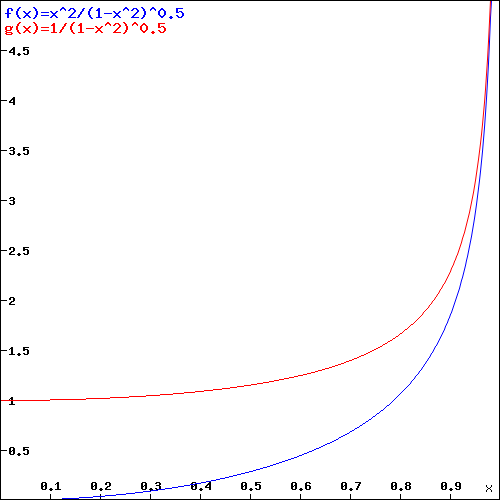
So our wire appears to be positively charged in the S’ frame, with a charge that’s equal to the product of the positive charge density and a β2/(1−β2)1/2 factor. So that’s our Lorentz factor γ multiplied by β2 = (v/c)2. The graph below compares how that factor increases as β = v/c goes from 0 to 1. We’ve also inserted the graph of the Lorentz factor itself, so you can compare both. Interesting, isn’t it? 🙂

graph

Now, because the wire is electrically charged in reference frame S’, we have an electric field E’ which, using the formula for the field of a uniformly charged cylinder, can be calculated as:

field in S'

Now, as far as I am concerned, that’s it. But… Well… Of course, we should generalize the analysis for v ≠ v0. However, I’ll refer you to Feynman for that. He also takes care of the remainder of the calculations you’d probably want to see, like a formula which show that the force on the charge in S’ is indeed what we would expect it to be. Feynman also shows that all other variables we can possibly calculate in the S’ reference frame, such as the momentum of the charged particle after the force has acted on it for some time all turn out be what we’d expect them to be according to special relativity.

However, I have to limit this post and, hence, I’ll just copy Feynman’s grand conclusion:

“We have found that we get the same physical result whether we analyze the motion of a particle moving along a wire in a coordinate system at rest with respect to the wire, or in a system at rest with respect to the particle. In the first instance, the force was purely “magnetic,” in the second, it was purely “electric. If we had chosen still another coordinate system, we would have found a different mixture of E and B fields. Electric and magnetic forces are part of one physical phenomenon—the electromagnetic interactions of particles. The separation of this interaction into electric and magnetic parts depends very much on the reference frame chosen for the description. But a complete electromagnetic description is invariant; electricity and magnetism taken together are consistent with Einstein’s relativity.”

So… That’s basically it for today’s lesson. 🙂 I should just add one more thing so as to be as complete as I should be in regard to the issue on hand here. You know the Lorentz transformation rules for the space and time coordinates, and you may or may not remember we had similar relativistic four-vectors for energy and momentum. Now, it turns out that we also have similar equations to relate charges and currents in one reference frame to those in another. More in particular, to transform ρ and j to a coordinate system moving with velocity in the x-direction, you should use the following rules:

Lorentz transformation

But that’s really it for today. Have fun reflecting upon it all! 🙂

Some content on this page was disabled on June 16, 2020 as a result of a DMCA takedown notice from The California Institute of Technology. You can learn more about the DMCA here:

https://wordpress.com/support/copyright-and-the-dmca/
Some content on this page was disabled on June 16, 2020 as a result of a DMCA takedown notice from The California Institute of Technology. You can learn more about the DMCA here:

https://wordpress.com/support/copyright-and-the-dmca/
Some content on this page was disabled on June 16, 2020 as a result of a DMCA takedown notice from The California Institute of Technology. You can learn more about the DMCA here:

https://wordpress.com/support/copyright-and-the-dmca/
Some content on this page was disabled on June 16, 2020 as a result of a DMCA takedown notice from The California Institute of Technology. You can learn more about the DMCA here:

https://wordpress.com/support/copyright-and-the-dmca/
Some content on this page was disabled on June 16, 2020 as a result of a DMCA takedown notice from The California Institute of Technology. You can learn more about the DMCA here:

https://wordpress.com/support/copyright-and-the-dmca/
Some content on this page was disabled on June 16, 2020 as a result of a DMCA takedown notice from The California Institute of Technology. You can learn more about the DMCA here:

https://wordpress.com/support/copyright-and-the-dmca/
Some content on this page was disabled on June 16, 2020 as a result of a DMCA takedown notice from The California Institute of Technology. You can learn more about the DMCA here:

https://wordpress.com/support/copyright-and-the-dmca/
Some content on this page was disabled on June 16, 2020 as a result of a DMCA takedown notice from The California Institute of Technology. You can learn more about the DMCA here:

https://wordpress.com/support/copyright-and-the-dmca/
Some content on this page was disabled on June 20, 2020 as a result of a DMCA takedown notice from Michael A. Gottlieb, Rudolf Pfeiffer, and The California Institute of Technology. You can learn more about the DMCA here:

https://wordpress.com/support/copyright-and-the-dmca/