Riemann surfaces (II)

Pre-scriptum (dated 26 June 2020): the material in this post remains interesting but is, strictly speaking, not a prerequisite to understand quantum mechanics. It’s yet another example of how one can get lost in math when studying or teaching physics. :-/

Original post:

This is my second post on Riemann surfaces, so they must be important. [At least I hope so, because it takes quite some time to understand them. :-)]

From my first post on this topic, you may or may not remember that a Riemann surface is supposed to solve the problem of multivalued complex functions such as, for instance, the complex logarithmic function (log z = ln r + i(θ + 2nπ) or the complex exponential function (zc = ec log z). [Note that the problem of multivaluedness for the (complex) exponential function is a direct consequence of its definition in terms of the (complex) logarithmic function.]

In that same post, I also wrote that it all looked somewhat fishy to me: we first use the function causing the problem of multivaluedness to construct a Riemann surface, and then we use that very same surface as a domain for the function itself to solve the problem (i.e. to reduce the function to a single-valued (analytic) one). Penrose does not have any issues with that though. In Chapter 8 (yes, that’s where I am right now: I am moving very slowly on his Road to Reality, as it’s been three months of reading now, and there are 34 chapters!), he writes that  “Complex (analytic) functions have a mind of their own, and decide themselves what their domain should be, irrespective of the region of the complex plane which we ourselves may initially have allotted to it. While we may regard the function’s domain to be represented by the Riemann surface associated with the function, the domain is not given ahead of time: it is the explicit form of the function itself that tells us which Riemann surface the domain actually is.” 

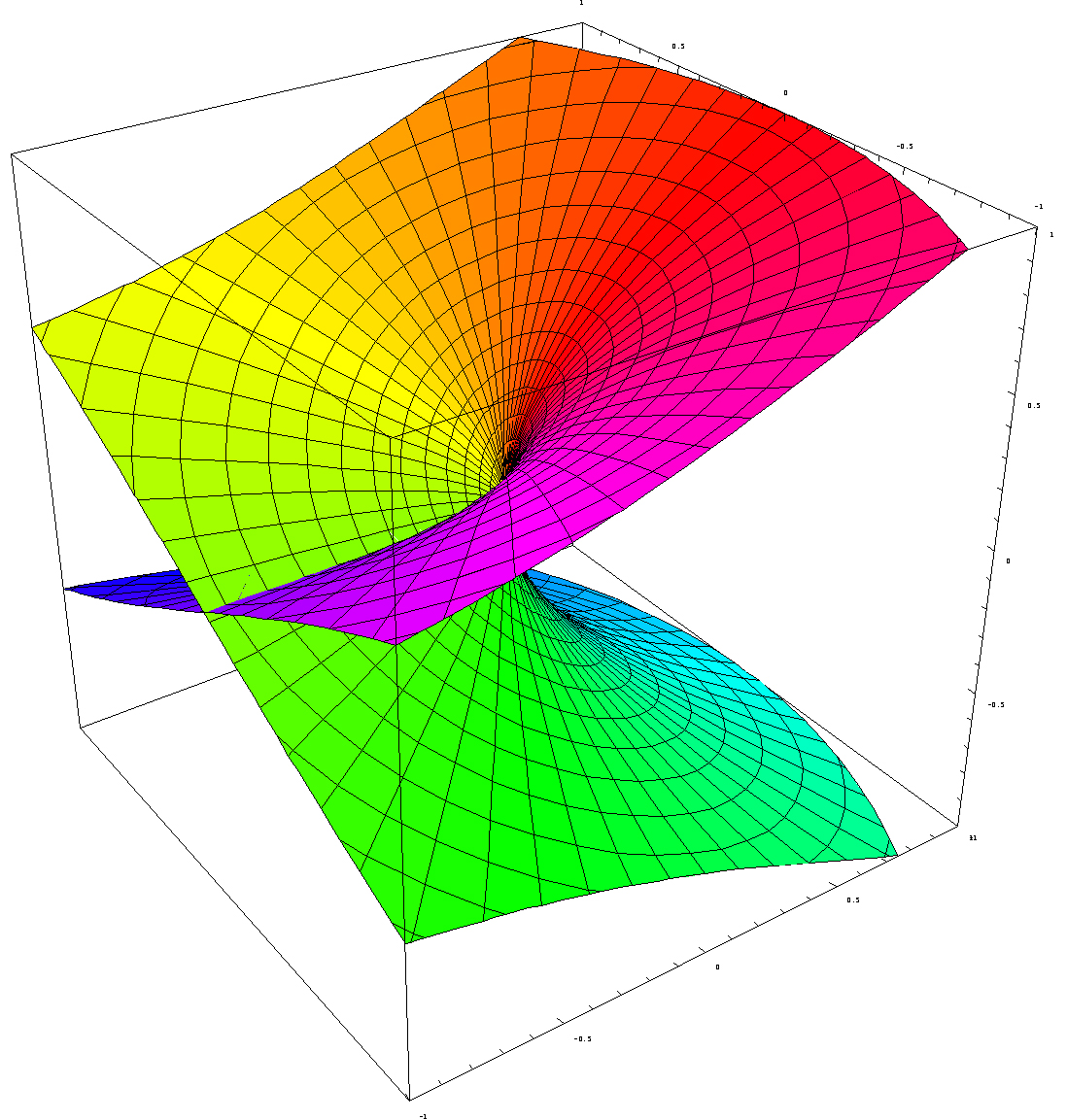
Let me retrieve the graph of the Riemannian domain for the log z function once more:

Riemann_surface_log

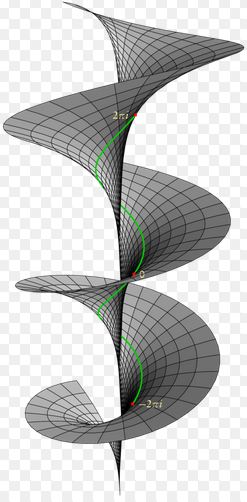
For each point z in the complex plane (and we can represent z both with rectangular as well as polar coordinates: z = x + iy = reiθ), we have an infinite number of log z values: one for each value of n in the log z = ln r + i(θ + 2nπ) expression (n = 0, ±1, ±2, ±3,…, ±∞). So what we do when we promote this Riemann surface as a domain for the log z function is equivalent to saying that point z is actually not one single point z with modulus r and argument θ + 2nπ, but an infinite collection of points: these points all have the same modulus ¦z¦ = r but we distinguish the various ‘representations’ of z by treating θ, θ ± 2π, θ ±+ 4π, θ ± 6π, etcetera, as separate argument values as we go up or down on that spiral ramp. So that is what is represented by that infinite number of sheets, which are separated from each other by a vertical distance of 2π. These sheets are all connected at or through the origin (at which the log z function is undefined: therefore, the origin is not part of the domain), which is the branch point for this function. Let me copy some formal language on the construction of that surface here:

“We treat the z plane, with the origin deleted, as a thin sheet Rwhich is cut along the positive half of the real axis. On that sheet, let θ range from 0 to 2π. Let a second sheet  Rbe cut in the same way and placed in front of the sheet R0. The lower edge of the slit in Ris then joined to the upper edge of the slit in R1. On  R1, the angle θ ranges from 2π to 4π; so, when z is represented by a point on R1, the imaginary component of log z ranges from 2π to 4π.” And then we repeat the whole thing, of course: “A sheet Ris then cut in the same way and placed in front of R1. The lower edge of the slit in R1. is joined to the upper edge of the slit in this new sheet, and similarly for sheets R3R4… A sheet R-1R-2, R-3,… are constructed in like manner.” (Brown and Churchill, Complex Variables and Applications, 7th edition, p. 335-336)

The key phrase above for me is this “when z is represented by a point on R1“, because that’s what it is really: we have an infinite number of representations of z here, namely one representation of z for each branch of the log z function. So, as n = 0, ±1, , ±2, ±3 etcetera, we have an infinite number of them indeed. You’ll also remember that each branch covers a range from some random angle α to α + 2π. Imagine a continuous curve around the origin on this Riemann surface: as we move around, the angle of z changes from 0 to 2θ on sheet R0, and then from 2π to 4π on sheet Rand so on and so on.

The illustration above also illustrates the meaning of a branch point. Imagine yourself walking on that surface and approaching the origin, from any direction really. At the origin itself, you can choose what to do: either you take the elevator up or down to some other level or, else, the elevator doesn’t work and so then you have to walk up or down that ramp to get to another level. If you choose to walk along the ramp, the angle θ changes gradually or, to put it in mathematical terms, in a continuous way. However, if you took the elevator and got out at some other level, you’ll find that you’ve literally ‘jumped’ one or more levels. Indeed, remember that log z = ln r + i(θ + 2nπ) and so ln r, the horizontal distance from the origin didn’t change, but you did add some multiple of 2π to the vertical distance, i.e. the imaginary part of the log z value. 

Let us now construct a Riemann surface for some other multiple-valued functions. Let’s keep it simple and start with the square root of z, so c = 1/2, which is nothing else than a specific example of the complex exponential function zc = zc = ec log z: we just take a real number for c here. In fact, we’re taking a very simple rational number value for c: 1/2 = 0.5. Taking the square, cube, fourth or  nth root of a complex number is indeed nothing but a special case of the complex exponential function. The illustration below (taken from Wikipedia) shows us the Riemann surface for the square root function.

Riemann_sqrt

As you can see, the spiraling surface turns back into itself after two turns. So what’s going on here? Well… Our multivalued function here does not have an infinite number of values for each z: it has only two, namely √r ei(θ/2) and √r ei(θ/2 + π). But what’s that? We just said that the log function – of which this function is a special case – had an infinite number of values? Well… To be somewhat more precise:  z1/2 actually does have an infinite number of values for each z (just like any other complex exponential function), but it has only two values that are different from each other. All the others coincide with one of the two principal ones. Indeed, we can write the following:

w = √z = z1/2 =  e(1/2) log z e(1/2)[ln r + i(θ + 2nπ)] = r1/2 ei(θ/2 + nπ) = √r ei(θ/2 + nπ) 

(n = 0, ±1,  ±2,  ±3,…)

For n = 0, this expression reduces to z1/2 = √r eiθ/2. For n = ±1, we have  z1/2 = √r ei(θ/2 + π), which is different than the value we had for n = 0. In fact, it’s easy to see that this second root is the exact opposite of the first root: √r ei(θ/2 + π) = √r eiθ/2eiπ = – √r eiθ/2). However, for n = 2, we have  z1/2 = √r ei(θ/2 + 2π), and so that’s the same value (z1/2 = √r eiθ/2) as for n = 0. Indeed, taking the value of n = 2 amounts to adding 2π to the argument of w and so get the same point as the one we found for n = 0. [As for the plus or minus sign, note that, for n = -1, we have  z1/2 = √r ei(θ/2 -π) = √r ei(θ/2 -π+2π) =  √r ei(θ/2 +π) and, hence, the plus or minus sign for n does not make any difference indeed.]

In short, as mentioned above, we have only two different values for w = √z = z1/2 and so we have to construct two sheets only, instead of an infinite number of them, like we had to do for the log z function. To be more precise, because the sheet for n = ±2 will be the same sheet as for n = 0, we need to construct one sheet for n = 0 and one sheet for n = ±1, and so that’s what shown above: the surface has two sheets (one for each branch of the function) and so if we make two turns around the origin (one on each sheet), we’re back at the same point, which means that, while we have a one-to-two relationship between each point z on the complex plane and the two values z1/2 for this point, we’ve got a one-on-one relationship between every value of z1/2 and each point on this surface.

For ease of reference in future discussions, I will introduce a personal nonsensical convention here: I will refer to (i) the n = 0 case as the ‘positive’ root, or as w1, i.e. the ‘first’ root, and to (ii) the n = ± 1 case as the ‘negative’ root, or w2, i.e. the ‘second’ root. The convention is nonsensical because there is no such thing as positive or negative complex numbers: only their real and imaginary parts (i.e. real numbers) have a sign. Also, these roots also do not have any particular order: there are just two of them, but neither of the two is like the ‘principal’ one or so. However, you can see where it comes from: the two roots are each other’s exact opposite w= u2 + iv= —w= -u1 – iv1. [Note that, of course, we have w1w = w12 = w2w = w2= z, but that the product of the two distinct roots is equal to —z. Indeed, w1w2 = w2w1 = √rei(θ/2)√rei(θ/2 + π) = rei(θ+π) = reiθeiπ = -reiθ = -z.]

What’s the upshot? Well… As I mentioned above already, what’s happening here is that we treat z = rei(θ+2π) as a different ‘point’ than z = reiθ. Why? Well… Because of that square root function. Indeed, we have θ going from 0 to 2π on the first ‘sheet’, and then from 2π0 to 4π on the second ‘sheet’. Then this second sheet turns back into the first sheet and so then we’re back at normal and, hence, while θ going from 0π  to 2π is not the same as θ going from 2π  to 4π, θ going from 4π  to 6π  is the same as θ going from 0 to 2π (in the sense that it does not affect the value of w = z1/2). That’s quite logical indeed because, if we denote w as w = √r eiΘ (with Θ = θ/2 + nπ, and n = 0 or ± 1), then it’s clear that arg w = Θ will range from 0 to 2π if (and only if) arg z = θ ranges from 0 to 4π. So as the argument of w makes one loop around the origin – which is what ‘normal’ complex numbers do – the argument of z makes two loops. However, once we’re back at Θ = 2π, then we’ve got the same complex number w again and so then it’s business as usual.

So that will help you to understand why this Riemann surface is said to have two complex dimensions, as opposed to the plane, which has only one complex dimension.

OK. That should be clear enough. Perhaps one question remains: how do you construct a nice graph like the one above?

Well, look carefully at the shape of it. The vertical distance reflects the real part of √z for n = 0, i.e. √r cos(θ/2). Indeed, the horizontal plane is the the complex z plane and so the horizontal axes are x and y respectively (i.e. the x and y coordinates of z = x + iy). So this vertical distance equals 1 when x = 1 and y = 0 and that’s the highest point on the upper half of the top sheet on this plot (i.e. the ‘high-water mark’ on the right-hand (back-)side of the cuboid (or rectangular prism) in which this graph is being plotted). So the argument of z is zero there (θ = 0). The value on the vertical axis then falls from one to zero as we turn counterclockwise on the surface of this first sheet, and that’s consistent with a value for θ being equal to π there (θ = π), because then we have cos(π/2) = 0. Then we go underneath the z plane and make another half turn, so we add another π radians to the value θ and we arrive at the lowest point on the lower half of the bottom sheet on this plot, right under the point where we started, where θ = 2π and, hence, Re(√z) = √r cos(θ/2) (for n = 0) = cos(2π/2) = cos(2π/2) = -1.

We can then move up again, counterclockwise on the bottom sheet, to arrive once again at the spot where the bottom sheet passes through the top sheet: the value of θ there should be equal to θ = 3π, as we have now made three half turns around the origin from our original point of departure (i.e. we added three times π to our original angle of departure, which was θ = 0) and, hence, we have Re(√z) = √r cos(3θ/2) = 0 again. Finally, another half turn brings us back to our point of departure, i.e. the positive half of the real axis, where θ has now reached the value of θ = 4π, i.e. zero plus two times 2π. At that point, the argument of w (i.e. Θ) will have reached the value of 2π, i.e. 4π/2, and so we’re talking the same w = z1/2 as when we started indeed, where we had Θ = θ/2 = 0.

What about the imaginary part? Well… Nothing special really (as for now at least): a graph of the imaginary part of √z would be equally easy to establish: Im(√z) = √r sin(θ/2) and, hence, rotating this plot 180 degrees around the vertical axis will do the trick.

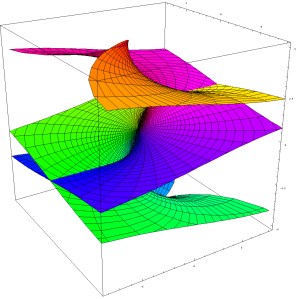
Hmm… OK. What’s next? Well… The graphs below show the Riemann surfaces for the third and fourth root of z respectively, i.e. z1/3 and z1/4 respectively. It’s easy to see that we now have three and four sheets respectively (instead of two only), and that we have to take three and four full turns respectively to get back at our starting point, where we should find the same values for z1/3 and z1/4 as where we started. That sounds logical, because we always have three cube roots of any (complex) numbers, and four fourth roots, so we’d expect to need the same number of sheets to differentiate between these three or four values respectively.
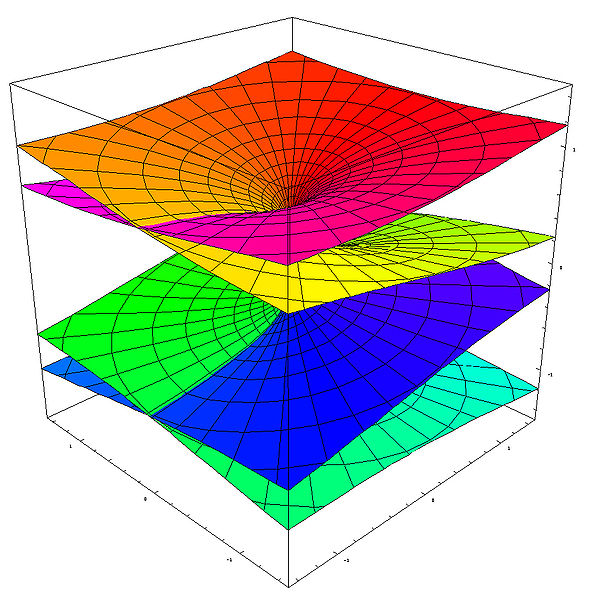
Riemann_surface_cube_rootRiemann_surface_4th_root

In fact, the table below may help to interpret what’s going on for the cube root function. We have three cube roots of z: w1, wand w3. These three values are symmetrical though, as indicated be the red, green and yellow colors in the table below: for example, the value of w for θ ranging from 4π to 6π for the n = 0 case (i.e. w1) is the same as the value of w for θ ranging from 0 to 2π for the n = 1 case (or the n = -2 case, which is equivalent to the n = 1 case).

Cube roots

So the origin (i.e. the point zero) for all of the above surfaces is referred to as the branch point, and the number of turns one has to make to get back at the same point determines the so-called order of the branch point. So, for w = z1/2, we have a branch point of order 2; for for w = z1/3, we have a branch point of order 3; etcetera. In fact, for the log z function, the branch point does not have a finite order: it is said to have infinite order.

After a very brief discussion of all of this, Penrose then proceeds and transforms a ‘square root Riemann surface’ into a torus (i.e. a donut shape). The correspondence between a ‘square root Riemann surface’ and a torus does not depend on the number of branch points: it depends on the number of sheets, i.e. the order of the branch point. Indeed, Penrose’s example of a square root function is w = (1 – z3)1/2, and so that’s a square root function with three branch points (the three roots of unity), but so these branch points are all of order two and, hence, there are two sheets only and, therefore, the torus is the appropriate shape for this kind of ‘transformation’. I will come back to that in the next post.

OK… But I still don’t quite get why this Riemann surfaces are so important. I must assume it has something to do with the mystery of rolled-up dimensions and all that (so that’s string theory), but I guess I’ll be able to shed some more light on that question only once I’ve gotten through that whole chapter on them (and the chapters following that one).  I’ll keep you posted. 🙂

Post scriptum: On page 138 (Fig. 8.3), Penrose shows us how to construct the spiral ramp for the log z function. He insists on doing this by taking overlapping patches of space, such as the L(z) and Log z branch of the log z function, with θ going from 0 to 2π for the L(z) branch) and from -π to +π for the Log z branch (so we have an overlap here from 0 to +π). Indeed, one cannot glue or staple patches together if the patch surfaces don’t overlap to some extent… unless you use sellotape of course. 🙂 However, continuity requires some overlap and, hence, just joining the edges of patches of space with sellotape, instead of gluing overlapping areas together, is not allowed. 🙂

So, constructing a model of that spiral ramp is not an extraordinary intellectual challenge. However, constructing a model of the Riemann surfaces described above (i.e. z1/2, z1/3, z1/4 or, more in general, constructing a Riemann surface for any rational power of z, i.e. any function w = zn/m, is not all that easy: Brown and Churchill, for example, state that is actually ‘physically impossible’ to model that (see Brown and Churchill, Complex Variables and Applications (7th ed.), p. 337).

Huh? But so we just did that for z1/2, z1/3 and z1/4, didn’t we? Well… Look at that plot for w = z1/2 once again. The problem is that the two sheets cut through each other. They have to do that, of course, because, unlike the sheets of the log z function, they have to join back together again, instead of just spiraling endlessly up or down. So we just let these sheets cross each other. However, at that spot (i.e. the line where the sheets cross each other), we would actually need two representations of z. Indeed, as the top sheet cuts through the bottom sheet (so as we’re moving down on that surface), the value of θ will be equal to π, and so that corresponds to a value for w equal to w = z1/2 = √r eiπ/2 (I am looking at the n = 0 case here). However, when the bottom sheet cuts through the top sheet (so if we’re moving up instead of down on that surface), θ’s value will be equal to 3π (because we’ve made three half-turns now, instead of just one) and, hence, that corresponds to a value for w equal to w = z1/2 = √r e3iπ/2, which is obviously different from √r eiπ/2. I could do the same calculation for the n = ±1 case: just add ±π to the argument of w.

Huh? You’ll probably wonder what I am trying to say here. Well, what I am saying here is that plot of the surface gives us the impression that we do not have two separate roots w1 and won the (negative) real axis. But so that’s not the case: we do have two roots there, but we can’t distinguish them with that plot of the surface because we’re only looking at the real part of w.

So what?

Well… I’d say that shouldn’t worry us all that much. When building a model, we just need to be aware that it’s a model only and, hence, we need to be aware of the limitations of what we’re doing. I actually build a paper model of that surface by taking two paper disks: one for the top sheet, and one for the bottom sheet. Then I cut those two disks along the radius and folded and glued both of them like a Chinese hat (yes, like the one the girl below is wearing). And then I took those two little paper Chinese hats, put one of them upside down, and ‘connected’ them (or should I say, ‘stitched’ or ‘welded’ perhaps? :-)) with the other one along the radius where I had cut into these disks. [I could go through the trouble of taking a digital picture of it but it’s better you try it yourself.]

ChineseHat

Wow! I did not expect to be used as an illustration in a blog on math and physics! 🙂

🙂 OK. Let’s get somewhat more serious again. The point to note is that, while these models (both the plot as well as the two paper Chinese hats :-)) look nice enough, Brown and Churchill are right when they note that ‘the points where two of the edges are joined are distinct from the points where the two other edges are joined’. However, I don’t agree with their conclusion in the next phrase, which states that it is ‘thus physically impossible to build a model of that Riemann surface.’ Again, the plot above and my little paper Chinese hats are OK as a model – as long as we’re aware of how we should interpret that line where the sheets cross each other: that line represents two different sets of points.

Let me go one step further here (in an attempt to fully exhaust the topic) and insert a table here with the values of both the real and imaginary parts of √z for both roots (i.e. the n = 0 and n = ± 1 case). The table shows what is to be expected: the values for the n = ± 1 case are the same as for n = 0 but with the opposite sign. That reflects the fact that the two roots are each other’s opposite indeed, so when you’re plotting the two square roots of a complex number z = reiθ, you’ll see they are on opposite sides on a circle with radius √r. Indeed, rei(θ/2 + π) = rei(θ/2)eiπ = –rei(θ/2). [If the illustration below is too small to read the print, then just click on it and it should expand.]
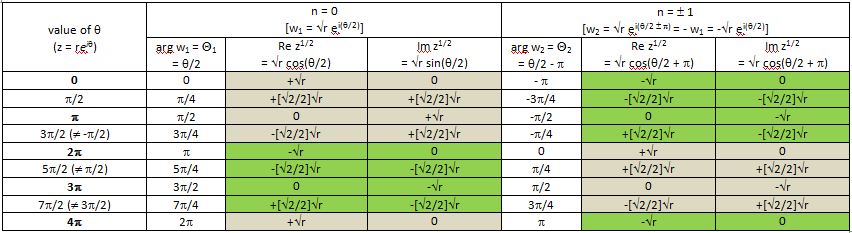
values of square root of z

The grey and green colors in the table have the same role as the red, green and yellow colors I used to illustrated how the cube roots of z come back periodically. We have the same thing here indeed: the values we get for the n = 0 case are exactly the same as for the n = ± 1 case but with a difference in ‘phase’ I’d say of one turn around the origin, i.e. a ‘phase’ difference of 2π. In other words, the value of √z in the n = 0 case for θ going from 0 to 2π is equal to the value of √z in the n = ± 1 case but for θ going from 2π to 4π and, vice versa, the value of √z in the n = ±1 case for θ going from 0 to 2π is equal to the value of √z in the n = 0 case for θ going from 2π to 4π. Now what’s the meaning of that? 

It’s quite simple really. The two different values of n mark the different branches of the w function, but branches of functions always overlap of course. Indeed, look at the value of the argument of w, i.e. Θ: for the n = 0 case, we have 0 < Θ < 2π, while for the n = ± 1 case, we have -π < Θ < +π. So we’ve got two different branches here indeed, but they overlap for all values Θ between 0 and π and, for these values, where Θ1 = Θ2, we will obviously get the same value for w, even if we’re looking at two different branches (Θ1 is the argument of w1, and Θ2 is the argument of w2). 

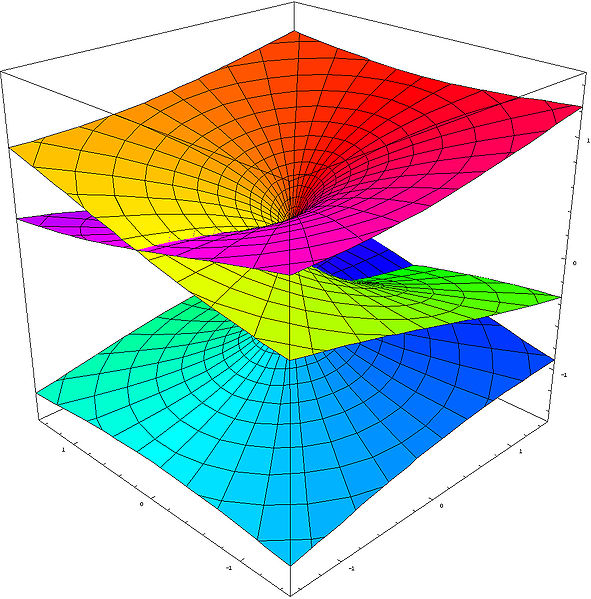
OK. I guess that’s all very self-evident and so I should really stop here. However, let me conclude by noting the following: to understand the ‘fully story’ behind the graph, we should actually plot both the surface of the imaginary part of √z as well as the surface of the real part of of √z, and superimpose both. We’d obviously get something that would much more complicated than the ‘two Chinese hats’ picture. I haven’t learned how to master math software (such as Maple for instance), as yet, and so I’ll just copy a plot which I found on the web: it’s a plot of both the real and imaginary part of the function w = z2. That’s obviously not the same as the w = z1/2 function, because w = z2 is a single-valued function and so we don’t have all these complications. However, the graph is illustrative because it shows how two surfaces – one representing the real part and the other the imaginary part of a function value – cut through each other thereby creating four half-lines (or rays) which join at the origin. 
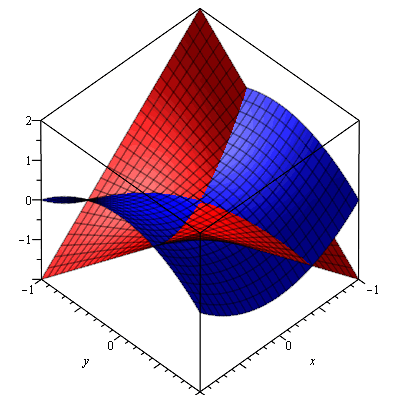
complex parabola w = z^2

So we could have something similar for the w = z1/2 function if we’d have one surface representing the imaginary part of z1/2 and another representing the  real part of z1/2. The sketch below illustrates the point. It is a cross-section of the Riemann surface along the x-axis (so the imaginary part of z is zero there, as the values of θ are limited to 0, π, 2π, 3π, back to 4π = 0), but with both the real as well as the imaginary part of  z1/2 on it. It is obvious that, for the w = z1/2 function, two of the four half-lines marking where the two surfaces are crossing each other coincide with the positive and negative real axis respectively: indeed, Re( z1/2) = 0 for θ = π and 3π (so that’s the negative real axis), and Im(z1/2) = 0 for θ = 0, 2π and 4π (so that’s the positive real axis).
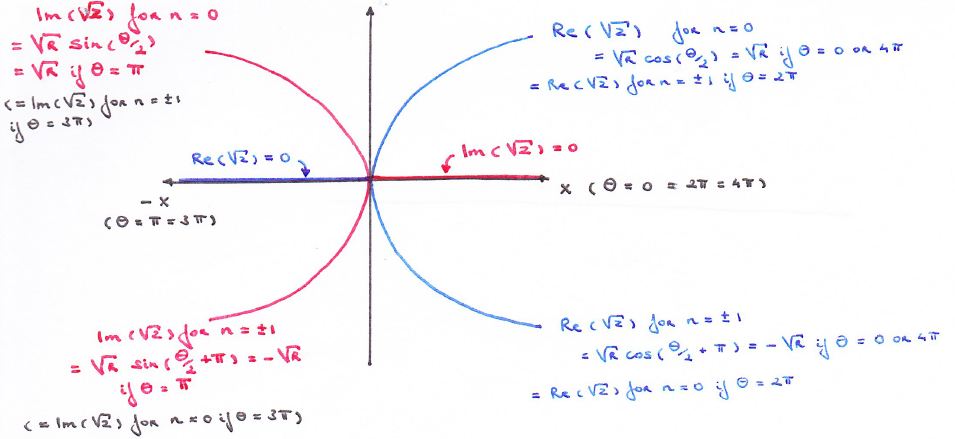
branch point

The other two half-lines are orthogonal to the real axis. They follow a curved line, starting from the origin, whose orthogonal projection on the z plane coincides with the y axis. The shape of these two curved lines (i.e. the place where the two sheets intersect above and under the axis) is given by the values for the real and imaginary parts of the √z function, i.e. the vertical distance from the y axis is equal to ± (√2√r)/2.

Hmm… I guess that, by now, you’re thinking that this is getting way too complicated. In addition, you’ll say that the representation of the Riemann surface by just one number (i.e. either the real or the imaginary part) makes sense, because we want one point to represent one value of w only, don’t we? So we want one point to represent one point only, and that’s not what we’re getting when plotting both the imaginary as well as the real part of w in a combined graph. Well… Yes and no. Insisting that we shouldn’t forget about the imaginary part of the surface makes sense in light of the next post, in which I’ll say a think or two about ‘compactifying’ surfaces (or spaces) like the one above. But so that’s for the next post only and, yes, you’re right: I should stop here.

Analytic continuation

Pre-scriptum (dated 26 June 2020): the material in this post remains interesting but is, strictly speaking, not a prerequisite to understand quantum mechanics. It’s yet another example of how one can get lost in math when studying or teaching physics. :-/

Original post:

In my previous post, I promised to say something about analytic continuation. To do so, let me first recall Taylor’s theorem: if we have some function f(z) that is analytic in some domain D, then we can write this function as an infinite power series:

f(z) = ∑ an(z-z0)n

with n = 0, 1, 2,… going all the way to infinity (n = 0 → ∞) and the successive coefficients an equal to  an = [f(n)(z0)]/n! (with f(n)(z0) denoting the derivative of the nth order, and n! the factorial function n! = 1 x 2 x 3 x … x n).

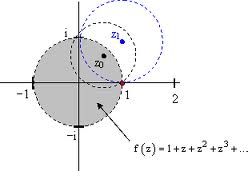
I should immediately add that this domain D will always be an open disk, as illustrated below. The term ‘open’ means that the boundary points (i.e. the circle itself) are not part of the domain. This open disk is the so-called circle of convergence for the complex function f(z) = 1/(1-z), which is equivalent to the (infinite) power series f(z) = 1 + z + z+ z3 + z4 +… [A clever reader will probably try to check this using Taylor’s theorem above, but I should note the exercise involves some gymnastics. Indeed, the development involves the use of the identity 1 + z + z+ z3 + … + zn = (1 – zn+1)/(1 – z).]

singularity

This power series converges only when the absolute value of z is (strictly) smaller than 1, so only when ¦z¦ < 1. Indeed, the illustration above shows the singularity at the point 1 (or the point (1, 0) if you want) on the real axis: the denominator of the function 1/(1-z) effectively becomes zero there. But so that’s one point only and, hence, we may ask ourselves why this domain should be bounded a circle going through this one point. Why not some square or rectangle or some other weird shape avoiding this point? That question takes a few theorems to answer, and so I’ll just say that this is just one of the many remarkable things about analytic functions: if a power series such as the one above converges to f(z) within some circle whose radius is the distance from z(in this case, zis the origin and so we’re actually dealing with a so-called Maclaurin expansion here, i.e. an oft-used special case of the Taylor expansion) to the nearest point zwhere f fails to be analytic (that point zis equal to 1 in this case), then this circle will actually be the largest circle centered at zsuch that the series converges to f(z) for all z interior to it.

PuffThat’s quite a mouthful so let me rephrase it. What is being said here is that there’s usually a condition of validity for the power series expansion of a function: if that condition of validity is not fulfilled, then the function cannot be represented by the power series. In this particular case, the expansion of f(z) = 1/(1-z) = 1 + z + z+ z3 + z4 +… is only valid when ¦z¦ < 1, and so there is no larger circle about  z0 (i.e. the origin in this particular case) such that at each point interior to it, the Taylor series (or the Maclaurin series in this case) converges to f(z).

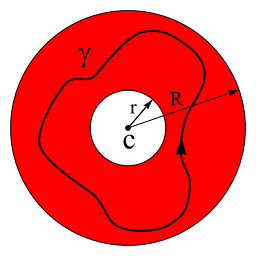
That being said, we can usually work our way around such singularities, especially when they are isolated, such as in this example (there is only this one point 1 that is causing trouble), and that is where the concept of analytic continuation comes in. However, before I explain this, I should first introduce Laurent’s theorem, which is like Taylor’s theorem but it applies to functions which are not as ‘nice’ as the functions for which Taylor’s theorem holds (i.e. functions that are not analytic everywhere), such as this 1/(1-z) function indeed. To be more specific, Laurent’s theorem says that, if we have a function f which is analytic in an annular domain (i.e. the red area in the illustration below) centered at some point z(in the illustration below, that’s point c) then f(z) will have a series representation involving both positive and negative powers of the term (z – z0).

256px-Laurent_series

More in particular, f(z) will be equal to f(z) = ∑ [an(z – z0)n] + ∑ [bn/(z-z0)n], with n = 0, 1,…, ∞ and with an and  bn coefficients involving complex integrals which I will not write them down here because WordPress lacks a good formula editor and so it would look pretty messy. An alternative representation of the Laurent series is to write f(z) as f(z) = ∑ [cn(z – z0)n], with c= (1/2πi) ∫C [f(z)/(z – z0)n+1]dz (n = 0, ±1, ±2,…, ±∞). Well – so here I actually did write down the integral. I hope it’s not too messy 🙂 .

It’s relatively easy to verify that this Laurent series becomes the Taylor series if there would be no singularities, i.e. if the domain would cover the whole disk (so if there would be red everywhere, even at the origin point). In that case, the cn coefficient becomes (1/2πi) ∫C [f(z)/(z – z0)-1+1]dz for n = -1 and we can use the fact that, if f(z) is analytic everywhere, the integral ∫C [f(z)dz will be zero along any contour in the domain of f(z). For n = -2, the integrand becomes f(z)/(z – z0)-2+1 = f(z)(z – z0) and that’s an analytic function as well because the function z – zis analytic everywhere and, hence, the product of this (analytic) function with f(z) will also be analytic everywhere (sums, products and compositions of analytic functions are also analytic). So the integral will be zero once again. Similarly, for n = -3, the integrand f(z)/(z – z0)-3+1 = f(z)(z – z0)2 is analytic and, hence, the integral is again zero. In short, all bn coefficients (i.e. all ‘negative’ powers) in the Laurent series will be zero, except for n = 0, in which case bn = b0 = a0. As for the acoefficients, one can see they are equal to the Taylor coefficients by using what Penrose refers to as the ‘higher-order’ version of the Cauchy integral formula: f(n)(z0)/n! = (1/2πi) ∫C [f(z)/(z – z0)n+1]dz.

It is also easy to verify that this expression also holds for the special case of a so-called punctured disk, i.e. an annular domain for which the ‘hole’ at the center is limited to the center point only, so this ‘annular domain’ then consists of all points z around z0 for which 0 < ¦z – z0¦ < R. We can then write the Laurent series as f(z) = ∑ an(z-z0)+ b1/(z – z0) + b2/(z – z0)+…+ bn/(z – z0)+… with n = 0, 1, 2,…, ∞.

OK. So what? Well… The point to note is that we can usually deal with singularities. That’s what the so-called theory of residues and poles is for. The term pole is a more illustrious term for what is, in essence, an isolated singular point: it has to do with the shape of the (modulus) surface of f(z) near this point, which is, well… shaped like a tent on a (vertical) pole indeed. As for the term residue, that’s a term used to denote this coefficient b1 in this power series above. The value of the residue at one or more isolated singular points can be used to evaluate integrals (so residues are used for solving integrals), but we won’t go into any more detail here, especially because, despite my initial promise, I still haven’t explained what analytic continuation actually is. Let me do that now.

For once, I must admit that Penrose’s explanation here is easier to follow than other texts (such as the Wikipedia article on analytic continuation, which I looked at but which, for once, seems to be less easy to follow than Penrose’s notes on it), so let me closely follow his line of reasoning here.

If, instead of the origin, we would use a non-zero point z0 for our expansion of this function f(z) = 1/(1-z) = 1 + z + z+ z3 + z4 +… (i.e. a proper Taylor expansion, instead of the Maclaurin expansion around the origin), then we would, once again, find a circle of convergence for this function which would, once again, be bounded by the singularity at point (1, 0), as illustrated below. In fact, we can move even further out and expand this function around the (non-zero) point zand so on and so on. See the illustration: it is essential that the successive circles of convergence around the origin, z0, zetcetera overlap when ‘moving out’ like this.

analytic continuation

So that’s this concept of ‘analytic continuation’. Paraphrasing Penrose, what’s happening here is that the domain D of the analytic function f(z) is being extended to a larger region D’ in which the function f(z) will also be analytic (or holomorphic – as this is the term which Penrose seems to prefer over ‘analytic’ when it comes to complex-valued functions).

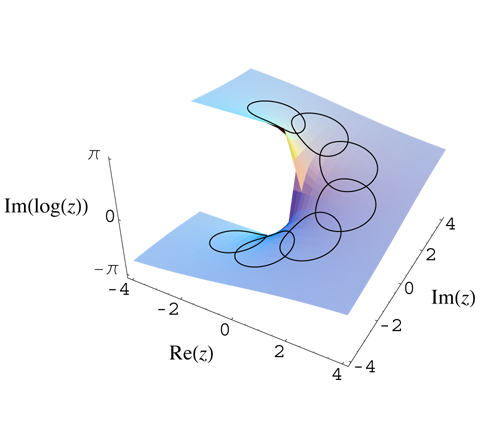
Now, we should note something that, at first sight, seems to be incongruent: as we wander around a singularity like that (or, to use the more mathematically correct term, a pole of the function) to then return to our point of departure, we may get (in fact, we are likely to get) different function values ‘back at base’. Indeed, the illustration below shows what happens when we are ‘wandering’ around the origin for the log z function. You’ll remember (if not, see the previous posts) that, if we write z using polar coordinates (so we write z as z = reiθ), then log z is equal to log z = lnr + i(θ + 2nπ). So we have a multiple-valued function here and we dealt with that by using branches, i.e. we limited the values which the argument of z (arg z = θ) could take to some range α < θ < α + 2π. However, when we are wandering around the origin, we don’t limit the range of θ. In fact, as we are wandering around the origin, we are effectively constructing this Riemann surface (which we introduced in one of our previous posts also), thereby effectively ‘gluing’ successive branches of the log z function together, and adding 2πto the value of our log z function as we go around. [Note that the vertical axis in the illustration below keeps track of the imaginary part of log z only, i.e. the part with θ in it only. If my imaginary reader would like to see the real part of log z, I should refer him to the post with the entry on Riemann surfaces.]

Imaginary_log_analytic_continuation

But what about the power series? Well… The log z function is just like any other analytic function and so we can and do expand it as we go. For example, if we expand the log z function about the point (1, 0), we get log z = (z – 1) – (1/2)(z – 1)+ (1/3)(z – 1)– (1/4)(z – 1)+… etcetera. But as we wonder around, we’ll move into a different branch of the log z function and, hence, we’ll get a different value when we get back to that point. However, I will leave the details of figuring that one out to you 🙂 and end this post, because the intention here is just to illustrate the principle, and not to copy some chapter out of a math course (or, at least, not to copy all of it let’s say :-)).

If you can’t work out it out, you can always try to read the Wikipedia article on analytic continuation. While less ‘intuitive’ than Penrose’s notes on it, it’s definitely more complete, even if does not quite exhaust the topic. Wikipedia defines analytic continuation as “a technique to extend the domain of a given analytic function by defining further values of that function, for example in a new region where an infinite series representation in terms of which it is initially defined becomes divergent.” The Wikipedia article also notes that, “in practice, this continuation is often done by first establishing some functional equation on the small domain and then using this equation to extend the domain: examples are the Riemann zeta function and the gamma function.” But so that’s sturdier stuff which Penrose does not touch upon – for now at least, but I expect him to develop such things in later Road to Reality chapters).

Post scriptum: Perhaps this is an appropriate place to note that, at first sight, singularities may look like no big deal: so we have a infinitesimally small hole in the domain of function log z or 1/z s or whatever, so what? Well… It’s probably useful to note that, if we wouldn’t have that ‘hole’ (i.e. the singulariy), any integral of this function (I mean the integral of this function along any closed contour around that point, i.e. ∫C f(z)dz, would be equal to zero, but when we do have that little hole, like for f(z) = 1/z, we don’t have that result. In this particular case (i.e. f(z) = 1/z), you should note that the integral ∫C (1/z)dz, for any closed contour around the origin, equals 2πi, or that, just to give one more example here, that the value of the integral ∫C [f(z)/(z – z0)]dz is equal to 2πf(z0). Hence, even if f(z) would be analytic over the whole open disk, including the origin, the ‘quotient function’ f(z)/z will not be analytic at the origin and, hence, the value of the integral of this ‘quotient function’ f(z)/z around the origin will not be zero but equal to 2πi times the value of the original f(z) function at the origin, i.e. 2πi times f(0). Vice versa, if we find that the value of the integral of some function around a closed contour – and I mean any closed contour really – is not equal to zero, we know we’ve got a problem somewhere and so we should look out for one or more infinitesimally small little ‘holes’ somewhere in the domain. Hence, singularities, and this complex theory of poles and residues which shows us how we can work with them, is extremely relevant indeed: it’s surely not a matter of just trying to get some better approximation for this or that value or formula or so. 🙂

In light of the above, it is now also clear that the term ‘residue’ is well chosen: this coefficient bis equal to ∫C f(z)dz divided by 2π(I take the case of a Maclaurin expansion here) and, hence, there would be no singularity, this integral (and, hence, the coefficient b1) would be equal to zero. Now, because of the singularity, we have a coefficient b≠ 0 and, hence, using the term ‘residue’ for this ‘remnant’ is quite appropriate.

Complex integrals

Pre-scriptum (dated 26 June 2020): the material in this post remains interesting but is, strictly speaking, not a prerequisite to understand quantum mechanics. It’s yet another example of how one can get lost in math when studying or teaching physics. :-/

Original post:

Roger Penrose packs a lot in his chapter on complex-number calculus (Road to Reality, Chapter 7). He summarily introduces the concept of contour integration and then proceeds immediately to discuss power series representations of complex functions as well as fairly advanced ways to deal with singularities (see the section on analytic continuation). Brown and Churchill use not less than three chapters to develop this (Integrals (chapter 4), Series (chapter 5), and Residues and Poles (chapter 6)), and that’s probably what is needed for some kind of understanding of it all. Let’s start with integrals. However, let me first note here that Wordpress does not seem to have a formula editor (so it is not like MS Word) and, hence, I have to keep the notation simple: I’ll use the symbol ∫for a contour (or line) integral along a curve C, and the symbol ∫[a, b] for an integral on a (closed) interval [a, b].

OK. Here we go. First, it is important to note that Penrose, and Brown and Churchill, are talking about complex integrals, i.e. integrals of complex-valued functions, whose value itself is (usually) a complex number too. That is very different from the line integrals I was exposed to when reading Feynman’s Lectures on Physics. Indeed, Feynman’s Lectures (Volume II, on Electromagnetism) offer a fine introduction to contour integrals, where the function to be integrated is either a scalar field (e.g. electric potential) or, else, some vector field (e.g. magnetic field, gravitational field). Now, vector fields are two-dimensional things: they have an x- and a y-coordinate and, hence, we may think the functions involving vectors are complex too. They are but, that being said, the integrals involved all yield real-number values because the integrand is likely to be a dot product of vectors (and dot products of vectors, as opposed to cross products, yield a real number). I won’t go into the details here but, for those who’d want to have such details, the Wikipedia article offers a fine description (including some very nice animations) of what integration over a line or a curve in such fields actually means. So I won’t repeat that here. I can only note what Brown and Churchill say about them: these (real-valued) integrals can be interpreted as areas under the curve, and they would usually also have one or the other obvious physical meaning, but complex integrals do usually not have such ‘helpful geometric or physical interpretation.’

So what are they then? Let’s first start with some examples of curves.

curve examples

The illustration above makes it clear that, in practice, the curves which we are dealing with are usually parametric curves. In other words, the coordinates of all points z of the curve C can be represented as some function of a real-number parameter: z(t) = x(t) + iy(t). We can then define a complex integral as the integral of a complex-valued function f(z) of a complex variable z along a curve C from point zto point zand write such integral as ∫f(z)dz.

Moreover, if C can be parametrized as z(t), we will have some (real) number a and b such that  z1= z(a) and z2= z(b) and, taking into account that dz = z'(t)dt with z'(t)=dz/dt (i.e. the derivative of the (complex-valued) function z(t) with respect to the (real) parameter t), we can write ∫f(z)dz as:

f(z)dz = ∫[a, b] f[z(t)]z'(t)dt 

OK, so what? Well, there are a lot of interesting things to be said about this, but let me just summarize some of the main theorems. The first important theorem does not seem to associated with any particular mathematician (unlike Cauchy or Goursat, which I’ll introduce in a minute) but is quite central: if we have some (complex-valued) function f(z) which would happen to be continuous in some domain D, then all of the following statements will be true if one of them is true:

(I) f(z) has an antiderivative F(z) in D ; (II) the integrals of f(z) along contours lying entirely in D and extending from any fixed point z1to any fixed point zall have the same value; and, finally, (III) the integrals of f(z) around closed contours lying entirely in D all have value zero.

This basically means that the integration of f(z) from z1to z2 is not dependent on the path that is taken. But so when do we have such path independence? Well… You may already have guessed the answer to that question: it’s when the function is analytic or, in other words, when these Cauchy-Riemann equations u= vy and u= – vare satisfied (see my other post on analytic (or holomorphic) complex-valued functions). That’s, in a nutshell, what’s stated in the so-called Cauchy-Goursat theorem, and it should be noted that it is an equivalence really, so we also have the vice versa statement: if the integrals of f(z) around closed contours in some domain D are zero, then we know that f(z) is holomorphic.

In short, we’ll always be dealing with ‘nice’ functions and then we can show that the s0-called ‘fundamental’ theorem of calculus (i.e. the one that links integrals with derivatives, or – to be somewhat more precise – with the antiderivative of the integrand) also applies to complex-valued valued functions. We have:

f(z)dz = ∫[a, b] f[z(t)]z'(t)dt = F[z(b)] – F[z(a)]

or, more in general: ∫f(z)dz = F(z2) – F(z1)

We also need to note the Cauchy integral formula: if we have a function f that is analytic inside and on a closed contour C, then the value of this function for any point zwill be equal to:

f(z0) = (1/2πi) ∫C [f(z)/(z – z0)]dz

This may look like just another formula, but it’s quite spectacular really: it basically says that the function value of any point zwithin a region enclosed by a curve is completely determined by the values of this function on this curve. Moreover, integrating both sides of this equation repeatedly leads to similar formulas for the derivatives of the first, second, third, and higher order of f: f'(z0) = (1/2πi) ∫[f(z)/(z – z0)2]dz, f”(z0) = (1/2πi) ∫[f(z)/(z – z0)3]dz or, more in general:

f(n)(z0) = (n!/2πi) ∫[f(z)/(z – z0)n+1]dz (n = 1, 2, 3,…)

This formula is also known as Cauchy’s differentiation formula. It is a central theorem in complex analysis really, as it leads to many other interesting theorems, including Gauss’s mean value theorem, Liouville’s theorem, the maximum (and miniumum) modulus principle It is also essential for the next chapter in Brown and Churchill’s course: power series representations of complex functions. However, I will stop here because I guess this ‘introduction’ to complex integrals is already confusing enough.

Post scriptum: I often wondered why one would label one theorem as ‘fundamental’, as it implies that all the other theorems may be important but, obviously, somewhat less fundamental. I checked it out and it turns out there is some randomness here. The Wikipedia article boldly states that the fundamental theorem of algebra (which states that every non-constant single-variable polynomial with complex coefficients has at least one complex roots) is not all that ‘fundamental’ for modern algebra: its title just reflects the fact that there was a time when algebra focused almost exclusively on studying polynomials. The same might be true for the fundamental theorem of arithmetic (i.e. the unique(-prime)-factorization theorem), which states that every integer greater than 1 is either a prime itself or the product of prime numbers, e.g. 1200 = (24)(31)(52).

That being said, the fundamental theorem of calculus is obviously pretty ‘fundamental’ indeed. It leads to many results that are indeed key to understanding and solving problems in physics. One of these is the Divergence Theorem (or Gauss’s Theorem), which states that the outward flux of a vector field through a closed surface is equal to the volume integral of the divergence over the region inside the surface. Huh? Well… Yes. It pops up in any standard treatment of electromagnetism. There are others (like Stokes’ Theorem) but I’ll leave it at that for now, especially because these are theorems involving real-valued integrals.

Riemann surfaces (I)

Pre-scriptum (dated 26 June 2020): the material in this post remains interesting but is, strictly speaking, not a prerequisite to understand quantum mechanics. It’s yet another example of how one can get lost in math when studying or teaching physics. :-/

Original post:

In my previous post on this blog, I once again mentioned the issue of multiple-valuedness. It is probably time to deal with the issue once and for all by introducing Riemann surfaces.

Penrose attaches a lot of importance to these Riemann surfaces (so I must assume they are very important). In contrast, in their standard textbook on complex analysis, Brown and Churchill note that the two sections on Riemann surfaces are not essential reading, as it’s just ‘a geometric device’ to deal with multiple-valuedness. But so let’s go for it.

I already signaled that complex powers w = zc are multiple-valued functions of z and so that causes all kinds of problems, because we can’t do derivatives and integrals and all that. In fact,  zc = ec log z and so we have two components on the right-hand side of this equation. The first one is the (complex) exponential function ec, i.e. the real number e raised to a complex power c. We already know (see the other posts below) that this is a periodic function with (imaginary) period 2πie= ec+2πi eiec = 1ec. While this periodic component of zc is somewhat special (as compared to exponentiation in real analysis), it is not this periodic component but the log z component which is causing the problem of multiple-valuedness. [Of course, it’s true that the problem of multiple-valuedness of the log function is, in fact, a logical consequence of the periodicity of the complex power function, but so you can figure that out yourself I guess.] So let’s look at that log z function once again.

If we write z in its polar form z = reiθ, then log z will be equal to log z = ln r + i(θ+2nπ) with n = 0, ±1, ±2,… Hence, if we write log z in rectangular coordinates (i.e. log z = x + iy) , then we note that the x component (i.e.the real part) of log z is equal to ln r and, hence, x is just an ordinary real number with some fixed value (x = ln r). However, the y component (i.e. the imaginary part of log z) does not have any fixed value: θ is just one of the values, but so are θ+2π and θ – 2π and θ+4π etcetera. In short, we have an infinite number of values for y, and so that’s the issue: what do we do with all these values? It’s not a proper function anymore.

Now, this problem of multiple-valuedness is usually solved by just picking a so-called principal value for log z, which is written as Log z = ln r + iθ, and which is defined by mathematicians by imposing the condition that θ takes a value in the interval between -π and +π only (hence, -π < θ < π). In short, the mathematicians usually just pretend that the 2nπthing doesn’t matter.

However, this is not trivial: as we are imposing these restrictions on the value of Θ, we are actually defining some new single-valued function Log z = ln r + iθ. This Log z function, then, is a complex-valued analytic function with two real-valued components: x = ln r and y = θ. So, while x = ln r can take any value on the real axis, we let θ range from -π to +π only (in the usual counterclockwise or ‘positive’ direction, because that happens to be the convention). If we do this, we get a principal value for zas well: P.V. zc = ec Log z, and so we’ve ‘solved’ the problem of multiple values for the function ztoo in this way.

What we are doing here has a more general significance: we are taking a so-called branch out of a multiple-valued function, in order to make it single-valued and, hence, analytic. To illustrate what is really going on here, let us go back to the original multiple-valued log z = ln r + i(θ+2nπ) function and let’s do away with this integer n by writing log z in the more general form log z = ln r + iΘ. Of course, Θ is equal to θ+2nπ but so we’ll just forget about the θ and, most importantly, about the n, and allow the y component (i.e. the imaginary part) of the imaginary number log z = x + iy to take on any value Θ in the real field. In other words, we treat this angle Θ just like any other ordinary real number. We can now define branches of log z again, but in a more general way: we can pick any value α and say that’s a branch point, as it will define a range α <  Θ < α + 2π in which, once again, we limit the possible values of log z to just one.

For example, if we choose α = -π, then Θ will range from -π to +π and so then we’re back to log z’s principal branch, i.e. Log z. However, let us now, instead of taking this Log z branch, define another branch – we’ll call it the L(z) branch – by choosing α = 0 and, hence, letting Θ range from 0 to 2π. So we have 0 < Θ < 2π and, of course, you’ll note that this range overlaps with the range that is being used for the principal branch of log z (i.e. Log z). It does, and it’s not a problem. Indeed, for values 0 < Θ < π (i.e. the overlapping half-plane) we get the same set of values Log z = L(z) for log z, and so we are talking the same function indeed.

OK. I guess we understand that. So what? Well… The fact is that we have found a very very nice way of illustrating the multiple-valuedness of the log z function and – more importantly – a nice way of ‘solving’ it too. Have a look at the beautiful 3D graph below. It represents the log z function. [Well… Let me be correct and note that, strictly speaking, this particular surface seems to represent the imaginary part of the log z function only, but that’s OK at this stage.]

Riemann_surface_log

Huh? What’s happening here? Well, this spiral surface represents the log z function by ‘gluing’ successive log z branches together. I took the illustration from Wikipedia’s article on the complex logarithm and, to explain how this surface has been constructed, let’s start at the origin, which is located right in the center of this graph, between the yellow-green and the red-pinkish sheets (so the horizontal (x, y) plane we start from is not the bottom of this rectangular prism: you should imagine it at its center).

From there, we start building up the first ‘level’ of this graph (i.e. the yellowish level above the origin) as the angle Θ sweeps around the origin,  in counterclockwise direction, across the upper half of the complex z plane. So it goes from 0 to π and, when Θ crosses the negative side of the real axis, it has added π to its original value. With ‘original value’, I mean its value when it crossed the positive real axis the previous time. As we’ve just started, Θ was equal to 0. We then go from π to 2π, across the lower half of the complex plane, back to the positive real axis: that gives us the first ‘level’ of this spiral staircase (so the vertical distance reflects the value of Θ indeed, which is the imaginary part of log z) . Then we can go around the origin once more, and so Θ goes from 2π to 4π, and so that’s how we get the second ‘level’ above the origin – i.e. the greenish one. But – hey! – how does that work? The angle 2π is the same as zero, isn’t it? And 4π as well, no?Well… No. Not here. It is the same angle in the complex plane, but is not the same ‘angle’ if we’re using it here in this log z = ln r + iΘ function.

Let’s look at the first two levels (so the yellow-green ones) of this 3D graph once again. Let’s start with Θ = 0 and keep Θ fixed at this zero value for a while. The value of log z is then just the real component of this log z = ln r + iΘ function, and so we have log z = ln r + i0 = ln r. This ln r function (or ln(x) as it is written below) is just the (real) logarithmic function, which has the familiar form shown below. I guess there is no need to elaborate on that although I should, perhaps, remind you that r (or x in the graph below) is always some positive real number, as it’s the modulus of a vector – or a vector length if that’s easier to understand. So, while ln(r) can take on any (real-number) value between -∞ and +∞, the argument r is always a positive real number.

375px-Logarithm_derivative

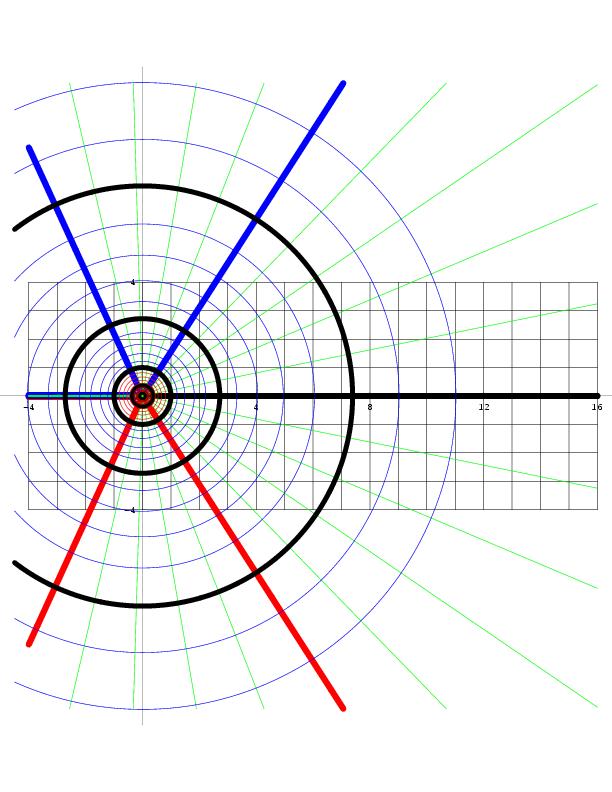
Let us now look at what happens with this log z function as Θ moves from 0 to 2π, first through the upper half of the complex z plane, to Θ = π first, and then further to 2π through the lower half of the complex plane. That’s less easy to visualize, but the illustration below might help. The circles in the plane below (which is the z plane) represent the real part of log z: the parametric representation of these circles is: Re(log z) = ln r = constant. In short, when we’re on these circles, going around the origin, we keep r fixed in the z plane (and, hence, ln r is constant indeed) but we let the argument of z (i.e. Θ) vary from 0 to 2π and, hence, the imaginary part of log z (which is equal to Θ)  will also vary. On the rays it is the other way around: we let r vary but we keep the argument Θ of the complex number z = reiθ fixed. Hence, each ray is the parametric representation of Im(log z) = Θ = constant, so Θ is some fixed angle in the interval 0 < π < 2π.

Logez02

Let’s now go back to that spiral surface and construct the first level of that surface (or the first ‘sheet’ as it’s often referred to) once again. In fact, there is actually more than way to construct such spiral surface: while the spiral ramp above seems to depict the imaginary part of log z only, the vertical distance on the illustration below includes both the real as well as the imaginary part of log z (i.e. Re log z + Im log z = ln r + Θ).

Final graph of log z

Again, we start at the origin, which is, again, the center of this graph (there is a zero (0) marker nearby, but that’s actually just the value of Θ on that ray (Θ = 0), not a marker for the origin point). If we move outwards from the center, i.e. from the origin, on the horizontal two-dimensional z = x + iy = (x,y) plane but along the ray Θ = 0, then we again have log z = ln r + i0 = ln r. So, looking from above, we would see an image resembling the illustration above: we move on a circle around the origin if we keep r constant, and we move on rays if we keep Θ constant. So, in this case, we fix the value of Θ at 0 and move out on a ray indeed and, in three dimensions, the shape of that ray reflects the ln r function. As we then become somewhat more adventurous and start moving around the origin, rather than just moving away from it, the iΘ term in this ln r + iΘ function kicks in and the imaginary part of w (i.e. Im(log z) = y = Θ) grows. To be precise, the value 2π gets added to y with every loop around the origin as we go around it. You can actually ‘measure’ this distance 2π ≈ 6.3 between the various ‘sheets’ on the spiral surface along the vertical coordinate axis (that is if you could read the tiny little figures along the vertical coordinate axis in these 3D graphs, which you probably can’t).

So, by now you should get what’s going on here. We’re looking at this spiral surface and combining both movements now. If we move outwards, away from this center, keeping Θ constant, we can see that the shape of this spiral surface reflects the shape of the ln r function, going to -∞ as we are close to the center of the spiral, and taking on more moderate (positive) values further away from it. So if we move outwards from the center, we get higher up on this surface. We can also see that we also move higher up this surface as we move (counterclockwise) around the origin, rather than away from it. Indeed, as mentioned above, the vertical coordinate in the graph above (i.e. the measurements along the vertical axis of the spiral surface) is equal to the sum of Re(log) and Im(log z). In other words, the ‘z’ coordinate in the Euclidean three-dimensional (x, y, z) space which the illustrations above are using is equal to ln r + Θ, and, hence, as 2π gets added to the previous value of Θ with every turn we’re making around the origin, we get to the next ‘level’ of the spiral, which is exactly 2π higher than the previous level. Vice versa, 2π gets subtracted from the previous value of Θ as we’re going down the spiral, i.e. as we are moving clockwise (or in the ‘negative’ direction as it is aptly termed).

OK. This has been a very lengthy explanation but so I just wanted to make sure you got it. The horizontal plane is the z plane, so that’s all the points z = x + iy = reiθ, and so that’s the domain of the log z function. And then we have the image of all these points z under the log z function, i.e. the points w = ln r + iΘ right above or right below the z points on the horizontal plane through the origin.

Fine. But so how does this ‘solve’ the problem of multiple-valuedness, apart from ‘illustrating’ it? Well… From the title of this post, you’ll have inferred – and rightly so – that the spiral surface which we have just constructed is one of these so-called Riemann surfaces.

We may look at this Riemann surface as just another complex surface because, just like the complex plane, it is a two-dimensional manifold. Indeed, even if we have represented it in 3D, it is not all that different from a sphere as a non-Euclidean two-dimensional surface: we only need two real numbers (r and Θ) to identify any point on this surface and so it’s two-dimensional only indeed (although it has more ‘structure’ than the ‘flat’ complex plane we are used to) . It may help to note that there are other surfaces like this, such as the ones below, which are Riemann surfaces for other multiple-valued functions: in this case, the surfaces below are Riemann surfaces for the (complex) square root function (f(z) = z1/2) and the (complex) arcsin(z) function.

Riemann_surface_sqrtRiemann_surface_arcsin

Nice graphs, you’ll say but, again, what is this all about? These graphs surely illustrate the problem of multiple-valuedness but so how do they help to solve it? Well… The trick is to use such Riemann surface as a domain really: now that we’ve got this Riemann surface, we can actually use it as a domain and then log z (or z1/2 or arcsin(z) if we use these other Riemann surfaces) will be a nice single-valued (and analytic) function for all points on that surface. 

Huh? What? […] Hmm… I agree that it looks fishy: we first use the function itself to construct a ‘Riemannian’ surface, and then we use that very same surface as a ‘Riemannian’ domain for the function itself? Well… Yes. As Penrose puts it: “Complex (analytic) functions have a mind of their own, and decide themselves what their domain should be, irrespective of the region of the complex plane which we ourselves may initially have allotted to it. While we may regard the function’s domain to be represented by the Riemann surface associated with the function, the domain is not given ahead of time: it is the explicit form of the function itself that tells us which Riemann surface the domain actually is.”

I guess we’ll have to judge the value of this bright Riemannian idea (Bernhardt Riemann had many bright ideas during his short lifetime it seems) when we understand somewhat better why we’d need these surfaces for solving physics problems. Back to Penrose. 🙂

Post scriptum: Brown and Churchill seem to approach the matter of how to construct a Riemann surface somewhat less rigorously than I do, as they do not provide any 3D illustrations but just talk about joining thin sheets, by cutting them along the positive half of the real axis and then joining the lower edge of the slit of the first sheet to the upper edge of the slit in the second sheet. This should be done, obviously, by making sure there is no (additional) tearing of the original sheet surfaces and all that (so we’re talking ‘continuous deformations’ I guess), but so that could be done, perhaps, without creating that ‘tornado vortex’ around the vertical axis, which you can clearly see in that gray 3D graph above. If we don’t include the ln r term in the definition of the ‘z’ coordinate in the Euclidean three-dimensional (x, y, z) space which the illustrations above are using, then we’d have a spiral ramp without a ‘hole’ in the center. However, that being said, in order to construct a ‘proper’ two-dimensional manifold, we would probably need some kind function of r in the definition of ‘z’. In fact, we would probably need to write r as some function of Θ in order to make sure we’ve got a proper analytic mapping. I won’t go into detail here (because I don’t know the detail) but leave it to you to check it out on the Web: just check on various parametric representations of spiral ramps: there’s usually (and probably always) a connection between Θ and how, and also how steep, spiral ramps climb around their vertical axis.

Complex functions and power series

Pre-scriptum (dated 26 June 2020): the material in this post remains interesting but is, strictly speaking, not a prerequisite to understand quantum mechanics. It’s yet another example of how one can get lost in math when studying or teaching physics. :-/

Original post:

As I am going back and forth between this textbook on complex analysis (Brown and Churchill, Complex Variables and Applications) and Roger Penrose’s Road to Reality, I start to wonder how complete Penrose’s ‘Complete Guide to the Laws of the Universe actually is or, to be somewhat more precise, how (in)accessible. I guess the advice of an old friend – a professor emeritus in nuclear physics, so he should know! – might have been appropriate. He basically said I should not try to take any shortcuts (because he thinks there aren’t any), and that I should just go for some standard graduate-level courses on physics and math, instead of all these introductory texts that I’ve been trying to read (such as Roger Penrose’s books – but it’s true I’ve tried others too). The advice makes sense, if only because such standard courses are now available on-line. Better still: they are totally free. One good example is the Physics OpenCourseWare (OCW) from MIT: I just went on their website (ocw.mit.edu/courses/physics) and I was truly amazed.

Roger Penrose is not easy to read indeed: he also takes almost 200 pages to explain complex analysis, i.e. as many pages as the Brown and Churchill textbook,  but I find the more formal treatment of the subject-matter in the math handbook easier to read than Penrose’s prose. So, while I won’t drop Penrose as yet (this time I really do not want to give up), I will probably to (continue to) invest more time in other books – proper textbooks really – than in reading Penrose. In fact, I’ve started to look at Penrose’s prose as a more creative approach, but one that makes sense only after you’ve gone through all of the ‘basics’. And so these ‘basics’ are probably easier to grasp by reading some tried and tested textbooks on math and physics first.

That being said, let me get back to the matter on hand by making good on at least one of the promises I made in the previous posts, and that is to say something more about the Taylor expansion of analytic functions. I wrote in one of these posts that this Taylor expansion is something truly amazing. It is, in my humble view at least. We have all these (complex-valued) functions of complex variables out there – such as ez, log z, zc, complex polynomials, complex trigonometric and hyperbolic functions, and all of the possible combinations of the aforementioned – and so all of these functions can be represented by a (infinite) sum of powers f(z) = Σ an(z-z0)n (with n going from 0 to infinity and with zbeing some arbitrary point in the function’s domain). So that’s the Taylor power series.

All complex functions? Well… Yes. Or no. All analytic functions. I won’t go into the details (if only because it is hard to integrate mathematical formulas with the XML editor I am using here) but so it is an amazing result, which leads to many other amazing results. In fact, the proof of Taylor’s Theorem is, in itself, rather marvelous (yes, I went through it) as it involves other spectacular formulas (such as the Cauchy integral formula). However, I won’t go into this here. Just take it for granted:  Taylor’s Theorem is great stuff!

But so the function has to be analytic – or well-behaved as I’d say. Otherwise we can’t use Taylor’s Theorem and, hence, this power series expansion doesn’t work. So let’s define (complex) analyticity: a function w = f(z) = f(x+iy) = u(x) + i(y) is analytic (a often-used synonym is holomorphic) if its partial derivatives ux, uy, vand vy exist and respect the so-called Cauchy-Riemann equations: ux = vy and u= -vx.

These conditions are restrictive (much more restrictive than the conditions for analyticity for real-valued functions). Indeed, there are many complex functions which look good at first sight – if only because there’s no problem whatsoever with their real-valued components u(x,y) and v(x,y) in real analysis/calculus – but which do not satisfy these Cauchy-Riemann conditions. Hence, they are not ‘well-behaved’ in the complex space (in Penrose’s words: they do not conform to the ‘Eulerian notion’ of a function), and so they are of relatively little use – for solving complex problems that is!

A function such as f(z) = 2x + ixy2 is an example: there are no complex numbers for which the Cauchy-Riemann conditions hold (check it out: the Cauchy-Riemann conditions are xy = 1 and y = 0, and these two equations contradict each other). Hence, we can’t do much with this function really. For other functions, such as x2 + iy2, the Cauchy-Riemann conditions are only satisfied in very limited subsets of the functions’ domain: in this particular case, the Cauchy-Riemann conditions only hold when y = x. We also have functions for which the Cauchy-Riemann conditions hold everywhere except in one or more singularities. The very simple function f(z) = 1/z is an example of this: it is easy to see we have a problem when z = 0, because the function value is not determined there.

As for the last category of functions, one would expect there is an easy way out, using limits or something. And there is. Singularities are not a big problem and we can work our way around them. I found out that ‘working our way around them’ usually involves a so-called Laurent series representation of the function, which is a more generalized version of the Taylor expansion involving not only positive but also negative powers.

One of the other things I learned is how to solve contour integrals. Solving contour integrals is the equivalent, in the complex world, of integrating a real-valued function over an interval [a, b] on the real line. Contours are curves in the complex plane. They can be simple and closed (like a circle or an ellipse for instance), and usually they are, but then they don’t have to be simple and closed: they can self-intersect, for example, or they can go around some point or around some other curve more than once (and, yes, that makes a big difference: when you go around twice or more, you’re talking a different curve really).

But so these things can all be solved relatively easily – everything is relative of course 🙂 – if (and only if) the functions involved are analytic and/or if the singularities involved are isolated. In fact, we can extend the definition of analytic functions somewhat and define meromorphic functions: meromorphic functions are functions that are analytic throughout their domain except for one or more isolated singular points (also referred to as poles for some strange reason).

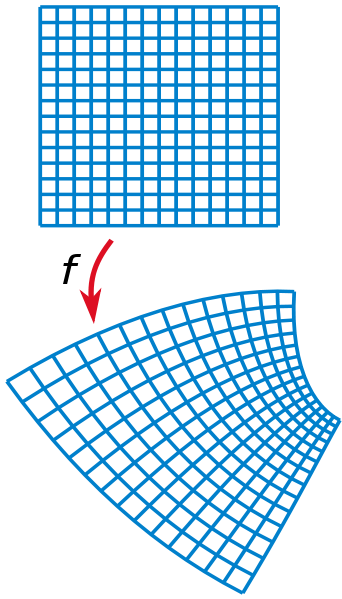
Holomorphic (and meromorphic) functions w = f(z) can be looked at as transformations: they map some domain D in the (complex) z plane to some region (referred to as the image of D) in the (complex) w plane. What makes them holomorphic is the fact that they preserve angles – as illustrated below.

342px-Conformal_map.svg

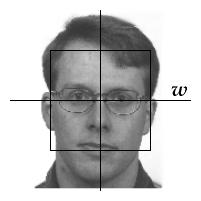
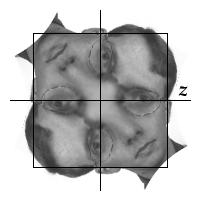
If you have read the first post on this blog, then you have seen this illustration already. Let me therefore present something better. The image below illustrates the function w = f(z) = z2 or, vice versa, the function z = √w = w1/2 (i.e. the square root of w). Indeed, that’s a very well-behaved function in the complex plane: every complex number (including negative real numbers) has two square roots in the complex plane, and so that’s what is shown below.   

hans squaredhans_squared-2

Huh? What’s this?

It’s simple: the illustration above uses color (in this case, a simple gray scale only really) to connect the points in the square region of the domain (i.e. the z plane) with an equally square region in the w plane (i.e. the image of the square region in the z plane). You can verify the properties of the z = w1/2 function indeed. At z=i we easily recognize a spot on the right ear of this person: it’s the w=−1 point in the w plane. Now, the same spot is found at z=−i. This reflects the fact that i2 = (-i)=−1. Similarly, this guy’s mouth, which represents the region near w=−i, is found near the two square roots of −in the z plane, which are z=±(1−i )/√2. In fact, every part of this man’s face is found at two places in the z plane, except for the spot between his eyes, which corresponds to w=0, and also to z=0 under this transformation. Finally, you can see that this transformation is holomorphic: all (local) angles are preserved. In that sense, it’s just like a conformal map of the Earth indeed. [Note, however, that I am glossing over the fact that z = w1/2 is multiple-valued: for each value of w, we have two square roots in the z-plane. That actually creates a bit of a problem when interpreting the image above. See the post scriptum at the bottom of this post for more text on this.]

[…] OK. This is fun. [And, no, it’s not me: I found this picture on the site of a Swedish guy called Hans Lundmark, and so I give him credit for making complex analysis so much fun: just Google him to find out more.] However, let’s get somewhat more serious again and ask ourselves why we’d need holomorphism?

Well… To be honest, I am not quite sure because I haven’t gone through the rest of the course material yet – or through all these other chapters in Penrose’s book (I’ve done 10 now, so there’s 24 left). That being said, I do note that, besides all of the niceties I described above (like easy solutions for contour integrals), it is also ‘nice’ that the real and imaginary parts of an analytic function automatically satisfy the Laplace equation.

Huh? Yes. Come on! I am sure you have heard about the Laplace equation in college: it is that partial differential equation which we encounter in most physics problems. In two dimensions (i.e. in the complex plane), it’s the condition that δ2f/δx+ δ2f/δyequals zero. It is a condition which pops us in electrostatics, fluid dynamics and many other areas of physical research, and I am sure you’ve seen simple examples of it. 

So, this fact alone (i.e. the fact that analytic functions pop up everywhere in physics) should be justification enough in itself I guess. Indeed, the first nine chapters of Brown and Churchill’s course are only there because of the last three, which focus on applications of complex analysis in physics. But is there anything more to it? 

Of course there is. Roger Penrose would not dedicate more than 200 pages to all of the above if it was not for more serious stuff than some college-level problems in physics, or to explain fluid dynamics or electrostatics. Indeed, after explaining why hypercomplex numbers (such as quaternions) are less useful than one might expect (Chapter 11 of his Road to Reality is about hypercomplex numbers and why they are useful/not useful), he jumps straight into the study of higher-dimensional manifolds (Chapter 12) and symmetry groups (Chapter 13). Now I don’t understand anything of that, as yet that is, but I sure do understand I’ll need to work my way through it if I ever want to understand what follows after: spacetime and Minkowskian geometry, quantum algebra and quantum field theory, and then the truly exotic stuff, such as supersymmetry and string theory. [By the way, from what I just gathered from the Internet, string theory has not been affected by the experimental confirmation of the existence of the Higgs particle, as it is said to be compatible with the so-called Standard Model.]

So, onwards we go! I’ll keep you posted. However, as I look at that (long) list of MIT courses, it may take some time before you hear from me again. 🙂

Post scriptum:

The nice picture of this Swedish guy is also useful to illustrate the issue of multiple-valuedness, which is an issue that pops up almost everywhere when you’re dealing with complex functions. Indeed, if we write w in its polar form w = reiθ, then its square root can be written as z = w1/2 = (√r)ei(θ/2+kπ), with k equal to either 0 or 1. So we have two square roots indeed for each w: each root has a length (i.e. its modulus or absolute value) equal to √r (i.e the positive square root of r) but their arguments are θ/2 and θ/2 + π respectively, and so that’s not the same. It means that, if z is a square root of some w in the w plane, then -z will also be a square root of w. Indeed, if the argument of z is equal to θ/2, then the argument of -z will be π/2 + π = π/2 + π – 2π = π/2 – π (we just rotate the vector by 180 degrees, which corresponds to a reflection through the origin). It means that, as we let the vector w = reiθ move around the origin – so if we let θ make a full circle starting from, let’s say, -π/2 (take the value w = –i for instance, i.e. near the guy’s mouth) – then the argument of the image of w will only go from (1/2)(-π/2) = -π/4 to (1/2)(-π/2 + 2π) = 3π/4. These two angles, i.e. -π/4 and 3π/4, correspond to the diagonal y=-x in the complex plane, and you can see that, as we go from -π/4 to 3π/4 in the z-plane, the image over this 180 degree swoop does cover every feature of this guy’s face – and here I mean not half of the guy’s face, but all of it. Continuing in the same direction (i.e. counterclockwise) from 3π/4 back to -π/4 just repeats the image. I will leave it to you to find out what happens with the angles on the two symmetry axes (y = x and y = -x).

Spaces

Pre-scriptum (added on 26 June 2020): The main problem with contemporary physics – all what Paul Ehrenfest referred to as the ‘unendlicher Heisenberg-Born-Dirac-Schrödinger Wurstmachinen-Physik-Betrieb’ – is that it stopped analyzing the physicality of the situation. One should, therefore, probably distinguishing physical from mathematical space. H.A. Lorentz said some useful things about that at the 1927 Solvay Conference. I wrote about that in a more recent paper.

Original post:

The term ‘space’ is all over the place when reading math. There are are all kinds of spaces in mathematics and the terminology is quite confusing. Let’s first start with the definition of a space: a space (in mathematics) is, quite simply, just a set of things (elements or objects) with some kind of structure (and, yes, there is also a definition for the extremely general notion of ‘structure’: a structure on a set consists of ‘additional mathematical objects’ that relate to the set in some manner attach – I am not sure that helps but so there you go).

The elements of the set can be anything. From what I read, I understand that a topological space might be the most general notion of a mathematical space. The Wikipedia article on it defines a topological space as “a set of points, along with a set of neighborhoods for each points, that satisfies a set of axioms relating points and neighborhoods.” It also states that “other spaces, such as manifolds and metric spaces, are (nothing but) specializations of topological spaces with extra structures or constraints.” However, the symbolism involved in explaining the concept is complex and probably prevents me from understanding the finer points. I guess I’d need to study topology for that – but so I am only doing a course in complex analysis right now. 🙂

Let’s go to something something more familiar: the metric spaces. A metric space is a set where a notion of distance (i.e a metric) between elements of the set is defined. That makes sense, doesn’t it?

We have Euclidean and non-Euclidean metric spaces. We all know Euclidean spaces as that is what use for the simple algebra and calculus we all had to learn as a teenager. They can have two, three or more dimensions, but there is only one Euclidean space in any dimension (a line, the plane or, more in general, the Cartesian multidimensional coordinate system). In Euclidean geometry, we have the parallel postulate: within a two-dimensional plane, for any given line L and a point p which is not on that line, there is only one line through that point – the parallel line –which does not intersect with the given line. Euclidean geometry is flat – well… Kind of.

Non-Euclidean metric spaces are a study object in their own but – to put it simply – in non-Euclidean geometry, we do not have the parallel postulate. If we do away with that, then there are two broad possibilities: either we have more than one parallel line or, else, we have none. Let’s start with the latter, i.e. no parallels. The most often quoted example of this is the sphere. A sphere is a two-dimensional surface where lines are actually great circles which divide the sphere in two equal hemispheres, like the equator or the meridians through the poles. They are the shortest path between the two points and so that corresponds to the definition of a line on a sphere indeed. Now, any ‘line’ (any geodesic that is) through a point p off a ‘line’ (geodesic) L will intersect with L, and so there are no parallel lines on a sphere – at least not as per the mathematical definition of a parallel line. Indeed, parallel lines do not intersect. I have to note that it is all a bit confusing because the so-called parallels of latitude on a globe are small circles, not great circles, and, hence, they are not the equivalent of a line in spherical geometry. In short, the parallels of latitude are not parallel lines – in the mathematical sense of the word that is. Does that make sense? For me it makes sense enough, so I guess I should move on.

Other Euclidean geometric facts, such as the angles of a triangle summing up to 180°, cannot be observed on a sphere either: the angles of a triangle on a sphere add up to more than 180° (for the big triangle illustrated below, they add up to 90 + 90 + 50 = 230°). That’s typical of Riemannian or elliptic geometry in general and so, yes, the sphere is an example of Riemannian or elliptic geometry.

Triangles_(spherical_geometry)

Of course, it is probably useful to remind ourselves that a sphere is a two-dimensional surface in elliptic geometry, even if we’re visualizing it in a three-dimensional space when we’re discussing its properties. Think about the flatlander walking on the surface on the globe: for him, the sphere is two-dimensional indeed, and so it’s not us – our world is not flat: we think in 3D – but the flatlander who is living in a spherically geometric world. It’s probably useful to introduce the term ‘manifold’ here. Spheres – and other surfaces, like the saddle-shaped surfaces we will introduce next – are (two-dimensional) manifolds. Now what’s that? I won’t go into the etymology of the term because that doesn’t help I feel: apparently, it has nothing to do with the verb to fold so it’s not something with many folds or so – although a two-dimensional manifold can look like something folded. A manifold is, quite simply, a topological space that near each point resembles Euclidean space, so we can define a metric on them indeed and do all kinds of things with that metric – locally that is. If the flatlander does these things – like measuring angles and lengths and what have you – close enough to where he is, then he won’t notice he’s living in a non-Euclidean space. That ‘fact’ is also shown above: the angles of a small (i.e. a local) triangle do add up to 180° – approximately that is.

Fine. Let’s move on again.

The other type of non-Euclidean geometry is hyperbolic or Lobachevskian geometry. Hyperbolic geometry is the geometry of saddle-shaped surfaces. Many lines (in fact, an infinite number of them) can be drawn parallel to a given line through a given point (the illustration below shows just one), and the angles of a triangle add up to less than 180°.

2000px-Hyperbolic_triangle

OK… Enough about metric spaces perhaps – except for noting that, when physicists talk about curved space, they obviously mean that the the space we are living in (i.e. the universe) is non-Euclidean: gravity curves it. And let’s add one or two other points as well. Anyone who has read something about Einstein’s special relativity theory will remember that the mathematician Hermann Minkowski added a time dimension to the three ordinary dimensions of space, creating a so-called Minkowski space, which is actually four-dimensional spacetime. So what’s that in mathematical terms? The ‘points’ in Minkowski’s four-dimensional spacetime are referred to as ‘events’. They are also referred to as four-vectors. The important thing to note here is that it’s not an Euclidean space: it is pseudo-Euclidean. Huh?

Let’s skip that for now and not make it any more complicated than it already. Let us just note that the Minkowski space is not only a metric space (and a manifold obviously, which resembles Euclidean space locally, which is why we don’t notice its curvature really): a Minkowski space is also a vector space. So what’s a vector space? The formal definition is clear: a vector space V over a (scalar) field F is a set of elements (vectors) together with two binary operations: addition and scalar multiplication. So we can add the vectors (that is the elements of the vector space) and scale them with a scalar, i.e. an element of the field F (that’s actually where the word ‘scalar’ comes from: something that scales vectors). The addition and scalar multiplication operations need to satisfy a number of axioms but these are quite straightforward (like associativity, commutativity, distributivity, the existence of an additive and multiplicative inverse, etcetera). The scalars are usually real numbers: in that case, the field F is equal to R, the set of real numbers (sorry I can’t use blackboard bold here for symbols so I am just using a bold capital R for the set of the real numbers), and the vector space is referred to as a real vector space. However, they can also be complex numbers: in that case, the field F is equal to C, the set of complex numbers, and the vector space is, obviously, referred to as a complex vector space.

N-tuples of elements of F itself (a1, a2,…, an) are a very straightforward example of a vector space: Euclidean spaces can be denoted as R (the real line), R(the Euclidean plane), R3 (Euclidean three-dimensional space), etcetera. Another example, is the set C of complex numbers: that’s a vector space too, and not only over the real numbers (F = R), but also over itself (F = C). OK. Fair enough, I’d say. What’s next?

It becomes somewhat more complicated when the ‘vectors’ (i.e. the elements in the vector space) are mathematical functions: indeed, a space can consists of functions (a function is just another object, isn’t it?), and function spaces can also be vector spaces because we can perform (pointwise) addition and scalar multiplication on functions. Vector spaces can consist of other mathematical objects too. In short, the notion of a ‘vector’ as some kind of arrow defined by some point in space does not cover the true mathematical notion of a vector, which is very general (an element of a ‘vector field’ as defined above). The same goes for fields: we usually think a field consists of numbers (real, complex, or whatever other number one can think of), but a field can also consist of vectors. In fact, vector fields are as common as scalar fields in in physics (think of vectors representing the speed and direction of a moving fluid for example, as opposed to its local temperature – which is a scalar quantity).

Quite confusing, isn’t it? Can we have a vector space over a vector field?

Tricky question. From what I read so far, I am not sure actually. I guess the answer is both yes and no. The second binary operation on the vector space is scalar multiplication, so the field F needs to be a scalar field – not a vector field. Indeed, the formal definition of a vector field is quite formal: F has to be a scalar field. But then complex numbers z can be looked at not only as scalars in their own right (that’s the focus of the complex analysis course that I am currently reading) but also as vectors in their own right. OK, we’re talking a special kind of vectors here (vectors from the origin to the point z) but so what? And then we already noted that C is a vector field over itself, didn’t we?

So how do we define scalar multiplication in this case? Can we use the ‘scalar’ product (aka as the dot product, or the inner product) between two vectors here (as opposed to the cross-product, aka as the vector product tout court)? I am not sure. Not at all actually. Perhaps it is the usual product between two complex numbers – (x+iy)(u+iv) = (xu-yv) + i(xv+yu) – which, unlike the standard ‘scalar’ product between two vectors, returns another complex number as a result (as opposed to the dot product (x,y)·(u,v), which is equal to the real number xu + yv). The Brown & Churchill course on complex analysis which I am reading just notes that “this product [of two complex numbers] is, evidently, neither the scalar nor the vector product used in ordinary vector analysis”. However, because the ‘scalar’ product returns a single (real) number as a result, while the product of two complex numbers is – quite obviously – a complex number in itself, I must assume it’s the above-mentioned ‘usual product between two complex numbers’ that is to be used for ‘scalar’ multiplication in this case (i.e. the case of defining C as a vector field over itself). In addition, the geometric interpretation of multiplying two complex numbers show that it actually is a matter of scaling: the ‘length’ of the complex number zw (i.e. its absolute value) is equal to the product of the absolute value of z and w respectively and, as for its argument (i.e. the angle from the real line), the argument of zw is equal to the sum of the arguments of z and w respectively. In short, this looks very much like what scalar multiplication is supposed to do.

Let’s see if we can confirm the above (i.e. C being a vector field over itself, with scalar multiplication being defined as the product between two complex numbers) at some later point in time. For the moment, I think I’ve had quite enough on – for the moment at least. Indeed, while I note there are many other unexplored spaces, I will not attempt to penetrate these as for now. For example, I note the frequent reference to Hilbert spaces but, from what I understand, this is also some kind of vector space, but then with even more additional structure and/or a more general definition of the ‘objects’ which make up its elements. Its definition involves Cauchy sequences of vectors – and that’s a concept I haven’t studied as yet. To make things even more complicated, there are also Banach spaces – and lots of other things really. So I will need to look at that but, again, for the moment I’ll just leave the matter alone and get back into the nitty-gritty of complex analysis. Doing so will probably clarify all of the more subtle points mentioned above.

[…] Wow! It’s been quite a journey so far, and I am still in the first chapters of the course only!

PS: I did look it up just now (i.e. a few days later than when I wrote the text above) and my inference is correct: C is a complex vector space over itself, and the formula to be used for scalar multiplication is the standard formula for multiplying complex numbers: (x+iy)(u+iv) = (xu-yv) + i(xv+yu). C2, or Cn in general, are other examples of complex vector spaces (i.e. a vector space over C).

Euler’s formula

I went trekking (to the Annapurna Base Camp this time) and, hence, left the math and physics books alone for a week or two. When I came back, it was like I had forgotten everything, and I wasn’t able to re-do the exercises. Back to the basics of complex numbers once again. Let’s start with Euler’s formula:

eix = cos(x) + isin(x)

In his Lectures on Physics, Richard Feynman calls this equation ‘one of the most remarkable, almost astounding, formulas in all of mathematics’, so it’s probably no wonder I find it intriguing and, indeed, difficult to grasp. Let’s look at it. So we’ve got the real (but irrational) number e in it. That’s a fascinating number in itself because it pops up in different mathematical expressions which, at first sight, have nothing in common with each other. For example, e can be defined as the sum of the infinite series e = 1/0! + 1/2! + + 1/3! + 1/4! + … etcetera (n! stands for the factorial of n in this formula), but one can also define it as that unique positive real number for which d(et)/dt = et (in other words, as the base of an exponential function which is its own derivative). And, last but not least, there are also some expressions involving limits which can be used to define e. Where to start? More importantly, what’s the relation between all these expressions and Euler’s formula?

First, we should note that eix is not just any number: it is a complex number – as opposed to the more simple ex expression, which denotes the real exponential function (as opposed to the complex exponential function ez). Moreover, we should note that eix is a complex number on the unit circle. So, using polar coordinates, we should say that eix  is a complex number with modulus 1 (the modulus is the absolute value of the complex number (i.e. the distance from 0 to the point we are looking at) or, alternatively, we could say it is the magnitude of the vector defined by the point we are looking at) and argument x (the argument is the angle (expressed in radians) between the positive real axis and the line from 0 to the point we are looking at).

Now, it is self-evident that cos(x) + isin(x) represents exactly the same: a point on the unit circle defined by the angle x. But so that doesn’t prove Euler’s formula: it only illustrates it. So let’s go to one or the other proof of the formula to try to understand it somewhat better. I’ll refer to Wikipedia for proving Euler’s formula in extenso but let me just summarize it. The Wikipedia article (as I looked at it today) gives three proofs.

The first proof uses the power series expansion (yes, the Taylor/Maclaurin series indeed – more about that later) for the exponential function: eix = 1 + ix + (ix)2/2! + (ix)3/3! +… etcetera. We then substitute using i2 = -1, i3 = –i etcetera and so, when we then re-arrange the terms, we find the Maclaurin series for the cos(x) and sin(x) functions indeed. I will come back to these power series in another post.

The second proof uses one of the limit definitions for ex but applies it to the complex exponential function. Indeed, one can write ez (with z = x+iy) as ez = lim(1 + z/n)n for n going to infinity. The proof substitutes ix for z and then calculates the limit for very large (or infinite) n indeed. This proof is less obvious than it seems because we are dealing with power series here and so one has to take into account issues of convergence and all that.

The third proof also looks complicated but, in fact, is probably the most intuitive of the three proofs given because it uses the derivative definition of e. To be more precise, it takes the derivative of both sides of Euler’s formula using the polar coordinates expression for complex numbers. Indeed, eix is a complex number and, hence, can be written as some number z = r(cosθ+ isinθ), and so the question to solve here is: what’s r and θ? We need to write these two values as a function of x. How do we do that? Well… If we take the derivative of both sides, we get d(eix)/dx = ieix = (cosθ + isinθ)dr/dx + r[d(cosθ + isinθ)/dθ]dθ/dx. That’s just the chain rule for derivatives of course. Now, writing it all out and equating the real and imaginary parts on both sides of the expression yields following: dr/dx = 0 and dθ/dx = 1. In addition, we must have that, for x = 0, ei0 = [ei]0 = 1, so we have r(0) = 1 (the modulus of the complex number (1,0) is one) and θ(0) = 0 (the argument of (1,0) is zero). It follows that the functions r and θ are equal to r = 1 and θ = x, which proves the formula.

While these proofs are (relatively) easy to understand, the formula remains weird, as evidenced also from its special cases, like ei0 = ei = 1 = – eiπ = – eiπ or, equivalently, eiπ + 1 = 0, which is a formula which combines the five most basic quantities in mathematics: 0, 1, i, e and π. It is an amazing formula because we have two irrational numbers here, e and π, which have definitions which do not refer to each other at all (last time I checked, π was still being defined as the simple ratio of a circle’s circumference to its diameter, while the various definitions of e have nothing to do with circles), and so we combine these two seemingly unrelated numbers, also inserting the imaginary unit i (using iπ as an exponent for e) and we get minus 1 as a result (eiπ = – 1). Amazing indeed, isn’t it?

[…] Well… I’d say at least as amazing as the Taylor or Maclaurin expansion of a function – but I’ll save my thoughts on these for another post (even if I am using the results of these expansions in this post). In my view, what Euler’s formula shows is the amazing power of mathematical notation really – and the creativity behind. Indeed, let’s look at what we’re doing with complex numbers: we start from one or two definitions only and suddenly all kinds of wonderful stuff starts popping up. It goes more or less like this really:

We start off with these familiar x and y coordinates of points in a plane. Now we call the x-axis the real axis and then, just to distinguish them from the real numbers, we call the numbers on the y-axis imaginary numbers. Again, it is just to distinguish them from the real numbers because, in fact, imaginary numbers are not imaginary at all: they are as real as the real numbers – or perhaps we should say that the real numbers are as imaginary as the imaginary numbers because, when everything is said and done, the real numbers are mental constructs as well, aren’t they? Imaginary numbers just happen to lie on another line, perpendicular to our so-called real line, and so that’s why we add a little symbol i (the so-called imaginary unit) when we write them down. So we write 1i (or i tout court), 2i, 3i etcetera, or i/2 or whatever (it doesn’t matter if we write i before the real number or after – as long as we’re consistent).

Then we combine these two numbers – the real and imaginary numbers – to form a so-called complex number, which is nothing but a point (x, y) in this Cartesian plane. Indeed, while complex numbers are somewhat more complex than the numbers we’re used to in daily life, they are not out of this world I’d say: they’re just points in space, and so we can also represent them as vectors (‘arrows’) from the origin to (x, y).

But so this is what we are doing really: we combine the real and imaginary numbers by using the very familiar plus (+) sign, so we write z = x + iy. Now that is actually where the magic starts: we are not adding the same things here, like we would do when we are counting apples or so, or when we are adding integers or rational or real numbers in general. No, we are adding here two different things here – real and imaginary numbers – which, in fact, we cannot really add. Indeed, your mommy told you that you cannot compare apples with oranges, didn’t she? Well… That’s exactly what we do here really, and so we will keep these real and imaginary numbers separate in our calculations indeed: we will add the real parts of complex numbers with each other only, and the imaginary parts of them also with each other only.

Addition is quite straightforward: we just add the two vectors. Multiplication is somewhat more tricky but (geometrically) easy to interpret as well: the product of two complex numbers is a vector with a length which is equal to the sum of the lengths of the two vectors we are multiplying (i.e. the two complex numbers which make up the product) , and its angle with the real axis is the sum of the angles of the two original vectors. From this definition, many things follow, all equally amazing indeed, but one of these amazing facts is that i2 = -1, i3 = –i, i4 = 1, i5 = i, etcetera. Indeed: multiplying a complex number z = x + iy = (x, y) with the imaginary unit i amounts to rotating it 90° (counterclockwise) about the origin. So we are not defining i2 as being equal to minus 1 (many textbooks treat this equality as a definition indeed): it just comes as a fact which we can derive from the earlier definition of a complex product. Sweet, isn’t it?

So we have addition and multiplication now. We want to do much more of course. After defining addition and multiplication, we want to do complex powers, and so it’s here that this business with e pops up.

We first need to remind ourselves of the simple fact that the number e is just a real number: it’s equal to 2.718281828459045235360287471 etcetera. We have to write ‘etcetera’ because e is an irrational number, which – whatever the term ‘irrational’ may suggest in everyday language – simply means that e is not a fraction of any integer numbers (so irrational means ‘not rational’). e is also a transcendental number – a word which suggest all kinds of mystical properties but which, in mathematics, only means we cannot write it as a root of some polynomial (a polynomial with rational coefficients that is). So it’s a weird number. That being said, it is also the so-called ‘natural’ base for the exponential function. Huh? Why would mathematicians take such a strange number as a so-called ‘natural’ base? They must be irrational, no? Well… No. If we take e as the base for the exponential function ex (so that’s just this real (but irrational) number e to the power x, with x being the variable running along the x-axis: hence, we have a function here which takes a value from the set of real numbers and which yields some other real number), then we have a function here which is its own derivative: d(ex)/dx = ex. It is also the natural base for the logarithmic function and, as mentioned above, it kind of ‘pops up’ – quite ‘naturally’ indeed I’d say – in many other expressions, such as compound interest calculations for example or the general exponential function ax = ex lna. In other words, we need this and exp(x) and ln(x) functions to define powers of real numbers in general. So that’s why mathematicians call it ‘natural’.

While the example of compound interest calculations does not sound very exciting, all these formulas with e and exponential functions and what have you did inspire all these 18th century mathematicians – like Euler – who were in search of a logical definition of complex powers.

Let’s state the problem once again: we can do addition and multiplication of complex numbers but so the question is how to do complex powers. When trying to figure that one out, Euler obviously wanted to preserve the usual properties of powers, like axay = ax+y and, effectively, this property of the so-called ‘natural’ exponential function that d(ex)/dx = ex. In other words, we also want the complex exponential function to be its own derivative so d(ez)/dz should give us ez once again.

Now, while Euler was thinking of that (and of many other things too of course), he was well aware of the fact that you can expand ex into that power series which I mentioned above: ex = 1/0! + x/1! + (x)2/2! + (x)3/3! +… etcetera. So Euler just sat down, substituted the real number x with the imaginary number ix and looked at it: eix = 1 + ix + (ix)2/2! + (ix)3/3! +… etcetera. Now lo and behold! Taking into account that i2 = -1, i3 = –i, i4 = 1, i5 = i, etcetera, we can put that in and re-arrange the terms indeed and so Euler found that this equation becomes eix = (1 – x2/2! + x4/4! – -x6/6! +…) + i(x – x3/3! + x5/5! -… ). Now these two terms do correspond to the Maclaurin series for the cosine and sine function respectively, so there he had it: eix = cos(x) + isin(x). His formula: Euler’s formula!

From there, there was only one more step to take, and that was to write ez = ex+iy as exeiy, and so there we have our definition of a complex power: it is a product of two factors – ex and ei– both of which we have effectively defined now. Note that the ex factor is just a real number, even if we write it as ex: it acts as a sort of scaling factor for eiwhich, you will remember (as we pointed it out above already), is a point on the unit circle. More generally, it can be shown that eis the absolute value of ez (or the modulus or length or magnitude of the vector – whatever term you prefer: they all refer to the same), while y is the argument of the complex number ez (i.e. the angle of the vector ez with the real axis). [And, yes, for those who would still harbor some doubts here: eis just another complex number and, hence, a two-dimensional vector, i.e. just a point in the Cartesian plane, so we have a function which goes from the set of complex numbers here (it takes z as input) and which yields another complex number.]

Of course, you will note that we don’t have something like zw here, i.e. a complex base (i.e. z) with a complex exponent (i.e. w), or even a formula for complex powers of real numbers in general, i.e. a formula for aw with a any real number (so not only e but any real number indeed) and w a complex exponent. However, that’s a problem which can be solved easily through writing z and w in their so-called polar form, so we write z as z = ¦z¦eiθ = ¦z¦(cosθ + isinθ) and w as ¦w¦ eiσ =  ¦w¦(cosσ + isinσ) and then we can take it further from there. [Note that ¦z¦ and ¦w¦represent the modulus (i.e. the length) of z and w respectively, and the angles θ and σ are obviously the arguments of the same z and w respectively.] Of course, if z is a real number (so if y = 0), then the angle θ will obviously be zero (i.e. the angle of the real axis with itself) and so z will be equal to a real number (i.e. its real part only, as its imaginary part is zero) and then we are back to the case of a real base and a complex exponent. In other words, that covers the aw case.

[…] Wel… Easily? OK. I am simplifying a bit here – as I need to keep the length of this post manageable – but, in fact, it actually really is a matter of using these common properties of powers (such as ea+biec = e(a+c)+bi and it actually does all work out. And all of this magic did actually start with simply ‘adding’ the so-called ‘real’ numbers x on the x-axis with the so-called ‘imaginary’ numbers on the y-axis. 🙂

Post scriptum:

Penrose’s Road to Reality dedicates a whole chapter to complex exponentiation (Chapter 5). However, the development is not all that simple and straightforward indeed. The first step in the process is to take integer powers – and integer roots – of complex numbers, so that’s zn for n = 0, ±1, ±2, ±3… etcetera (or z1/2, z1/3, z1/4 if we’re talking integer roots). That’s easy because it can be solved through using the old formula of Abraham de Moivre: (cosθ + sinθ)n = cos(nθ) + isin(nθ) (de Moivre penned this down in 1707 already, more than 40 years before Euler looked at the matter). However, going from there to full-blown complex powers is, unfortunately, not so straightforward, as it involves a bit of a detour: we need to work with the inverse of the (complex) exponential function ez, i.e. the (complex) natural logarithm.

Now that is less easy than it sounds. Indeed, while the definition of a complex logarithm is as straightforward as the definition of real logarithms (lnz is a function for which elnz = z), the function itself is a bit more… well… complex I should say. For starters, it is a multiple-valued function: if we write the solution w = lnz as w = u+iv, then it is obvious that ew will be equal to eu+iv = eueiv and this complex number ew can then be written in its polar form ew = reiθ with r = eu and v = θ + 2nπ. Of course, ln(eu+iv) = u + iv and so the solution of w will look like w = lnr + i(θ + 2nπ) with n = 0, ±1, ±2, ±3 etcetera. In short, we have an infinite number of solutions for w (one for every n we choose) and so we have this problem of multiple-valuedness indeed. We will not dwell on this here (at least not in this post) but simply note that this problem is linked to the properties of the complex exponential function ez itself. Indeed, the complex exponential function ez has very different properties than the real exponential function ex. First, we should note that, unlike e(which, as we know goes from zero at the far end of the negative side of the real axis to infinity as x goes big on the positive side), eis a periodic function – so it oscillates and yields the same values after some time – with this ‘after some time’ being the periodicity of the function. Indeed, e= e+2πi and so its period 2πi (note that this period is an imaginary number – but so it’s a ‘real’ period, if you know what I mean :-)). In addition, and this is also very much unlike the real exponential function ex, ecan be negative (as well as assume all kinds of other complex values). For example, eiπ = -1, as we noted above already.

That being said, the problem of multiple-valuedness can be solved through the definition of a principal value of lnz and that, then, leads us to what we want here: a consistent definition of a complex power of a complex base (or the definition of a true complex exponential (and logarithmic) function in other words). To those who would want to see the details of this (i.e. my imaginary readers :-)), I would say that Penrose’s treatment of the matter in the above-mentioned Chapter 5 of The Road to Reality is rather cryptic – presumably because he has to keep his book around 1000 pages only (not a lot to explain all of the Laws of the Universe) and, hence, Brown & Churchill’s course (or whatever other course dealing with complex analysis) probably makes for easier reading.

[As for the problem of multiple-valuedness, we should probably also note the following: when taking the nth root of a complex number (i.e. z1/n with n = 2, 3, etcetera), we also obtain a set of n values ck (with k = 0, 1, 2,… n-1), rather than one value only. However, once we have one of these values, we have all of them as we can write these cas ck = r1/nei(θ/n+2kπ/n), (with the original complex number z equal to z = reiθ) then so we could also just consider the principal value c0 and, as such, consider the function as a single-valued one. In short, the problem of multiple-valued functions pops up almost everywhere in the complex space, but it is not an issue really. In fact, we encounter the problem of multiple-valuedness as soon as we extend the exponential function in the space of the real numbers and also allow rational and real exponents, instead of positive integers only. For example, 41/2 is equal to ±2, so we have two results here too and, hence, multiple values. Another example would be the 4th root of 16: we have four 4th roots of 16: +2, -2 and then two complex roots +2i and -2i. However, standard practice is that we only take the positive value into account in order to ensure a ‘well-behaved’ exponential function. Indeed, the standard definition of a real exponential function is bx = (elnb)x = elnbex, and so, if x = 1/n, we’ll only assign the positive 4th root to ex. Standard practice will also restrict the value of b to a positive real number (b > 0). These conventions not only ensures a positive result but also continuity of the function and, hence, the existence of a derivative which we can then use to do other things. By the way, the definition also shows – once again – why e is such a nice (or ‘natural’) number: we can use it to calculate the value for any exponential function (for any real base b > 0). But so we had mentioned that already, and it’s now really time to stop writing. I think the point is clear.]

No royal road to reality

Pre-scriptum dated 19 May 2020: The entry below shows how easy it is to get ‘lost in math’ when studying physics. One doesn’t really need this stuff.

Text: I got stuck in Penrose’s Road to Reality—at chapter 5. That is not very encouraging: the book has 34 chapters, and every chapter seems to be getting more difficult.

In Chapter 5, Penrose introduces complex algebra. As I tried to get through it, I realized I had to do some more self-study. Indeed, while Penrose claims no other books or courses are needed to get through his, I do not find this to be the case. So I bought a fairly standard course in complex analysis (James Ward Brown and Ruel V. Churchill, Complex variables and applications) and I’ve done chapter 1 and 2 now. Although these first two chapters do not nothing else than introduce the subject-matter, I find the matter rather difficult and the terminology confusing. Examples:

1. The term ‘scalar’ is used to denote real numbers. So why use the term ‘scalar’ if the word ‘real’ is available as well? And why not use the term ‘real field’ instead of ‘scalar field’? Well… The term ‘real field’ actually means something else. A scalar field associates a (real) number to every point in space. So that’s simple: think of temperature or pressure. The term ‘scalar’ is said to be derived from ‘scaling’: a scalar is that what scales vectors. Indeed, scalar multiplication of a vector and a real number multiplies the magnitude of the vector without changing its direction. So what is a real field then? Well… A (formally) real field is a field that can be extended with a (not necessarily unique) ordering which makes it an ordered field. Does that help? Somewhat, I guess. But why the qualifier ‘formally real’? I checked and there is no such thing as an ‘informally real’ field. I guess it’s just to make sure we know what we are talking about, because ‘real’ is a word with many meanings.

2. So what’s a field in mathematics? It is an algebraic structure: a set of ‘things’ (like numbers) with operations defined on it, including the notions of addition, subtraction, multiplication, and division. As mentioned above, we have scalar fields and vector fields. In addition, we also have fields of complex numbers. We also have fields with some less likely candidates for addition and multiplication, such as functions (one can add and multiply functions with each other). In short, anything which satisfies the formal definition of a field – and here I should note that the above definition of a field is not formal – is a field. For example, the set of rational numbers satisfies the definition of a field too. So what is the formal definition? First of all, a field is a ring. Huh? Here we are in this abstract classification of algebraic structures: commutative groups, rings, fields, etcetera (there are also modules – a type of algebraic structure which I had never ever heard of before). To put it simply – because we have to move on, of course – a ring (no one seems to know where that word actually comes from) has addition and multiplication only, while a field has division too. In other words, a ring does not need to have multiplicative inverses. Huh?  It’s simply, really: the integers form a ring, but the equation 2·x = 1 does not have a solution in integers (x = ½) and, hence, the integers do not form a field. The same example shows why rational numbers do.

3. But what about a vector field? Can we do division with vectors? Yes, but not by zero – but that is not a problem as that is understood in the definition of a field (or in the general definition of division for that matter). In two-dimensional space, we can represent vectors by complex numbers: z = (x,y), and we have a formula for the so-called multiplicative inverse of a complex number: z-1 = (x/x2+y2, -y/x2+y2). OK. That’s easy. Let’s move on to more advanced stuff.

4. In logic, we have the concept of well-formed formulas (wffs). In math, we have the concept of ‘well-behaved’: we have well-behaved sets, well-behaved spaces and lots of other well-behaved things, including well-behaved functions, which are, of course, those of interest to engineers and scientists (and, hence, in light of the objective of understanding Penrose’s Road to Reality, to me as well). I must admit that I was somewhat surprised to learn that ‘well-behaved’ is one of the very few terms in math that have no formal definition. Wikipedia notes that its definition, in the science of mathematics that is, depends on ‘mathematical interest, fashion, and taste’. Let me quote in full here: “To ensure that an object is ‘well-behaved’ mathematicians introduce further axioms to narrow down the domain of study. This has the benefit of making analysis easier, but cuts down on the generality of any conclusions reached. […] In both pure and applied mathematics (optimization, numerical integration, or mathematical physics, for example), well-behaved means not violating any assumptions needed to successfully apply whatever analysis is being discussed. The opposite case is usually labeled pathological.” Wikipedia also notes that “concepts like non-Euclidean geometry were once considered ill-behaved, but are now common objects of study.”

5. So what is a well-behaved function? There is actually a whole hierarchy, with varying degrees of ‘good’ behavior, so one function can be more ‘well-behaved’ than another. First, we have smooth functions: a smooth function has derivatives of all orders (as for its name, it’s actually well chosen: the graph of a smooth function is actually, well, smooth). Then we have analytic functions: analytic functions are smooth but, in addition to being smooth, an analytic function is a function that can be locally given by a convergent power series. Huh? Let me try an alternative definition: a function is analytic if and only if its Taylor series about x0 converges to the function in some neighborhood for every x0 in its domain. That’s not helping much either, is it? So… Well… Let’s just leave that one for now.

In fact, it may help to note that the authors of the course I am reading (J.W. Brown and R.V. Churchill, Complex Variables and Applications) use the terms analytic, regular and holomorphic as interchangeable, and they define an analytic function simply as a function which has a derivative everywhere. While that’s helpful, it’s obviously a bit loose (what’s the thing about the Taylor series?) and so I checked on Wikipedia, which clears the confusion and also defines the terms ‘holomorphic’ and ‘regular’:

“A holomorphic function is a complex-valued function of one or more complex variables that is complex differentiable in a neighborhood of every point in its domain. The existence of a complex derivative in a neighborhood is a very strong condition, for it implies that any holomorphic function is actually infinitely differentiable and equal to its own Taylor series. The term analytic function is often used interchangeably with ‘holomorphic function’ although the word ‘analytic’ is also used in a broader sense to describe any function (real, complex, or of more general type) that can be written as a convergent power series in a neighborhood of each point in its domain. The fact that the class of complex analytic functions coincides with the class of holomorphic functions is a major theorem in complex analysis.”

Wikipedia also adds following: “Holomorphic functions are also sometimes referred to as regular functions or as conformal maps. A holomorphic function whose domain is the whole complex plane is called an entire function. The phrase ‘holomorphic at a point z0’ means not just differentiable at z0, but differentiable everywhere within some neighborhood of z0 in the complex plane.”

6. What to make of all this? Differentiability is obviously the key and, although there are many similarities between real differentiability and complex differentiability (both are linear and obey the product rule, quotient rule, and chain rule), real-valued functions and complex-valued functions are different animals. What are the conditions for differentiability? For real-valued functions, it is a matter of checking whether or not the limit defining the derivative exists and, of course, a necessary (but not sufficient) condition is continuity of the function.

For complex-valued functions, it is a bit more sophisticated because we’ve got so-called Cauchy-Riemann conditions applying here. How does that work? Well… We write f(z) as the sum of two functions: f(z) = u(x,y) + iv(x,y). So the real-valued function u(x,y) yields the real part of f(z), while v(x,y) yields the imaginary part of f(z). The Cauchy-Riemann equations (to be interpreted as conditions really) are the following: ux = vy and uy = -v(note the minus sign in the second equation).

That looks simple enough, doesn’t it? However, as Wikipedia notes (see the quote above), differentiability at a point z0 is not enough (to ensure the existence of the derivative of f(z) at that point). We need to look at some neighborhood of the point z0 and see if these first-order derivatives (ux, uy, vx and vy) exist everywhere in that neighborhood and satisfy these Cauchy-Riemann equations. So we need to look beyond the point z0 itself hen doing our analysis: we need to  ‘approach’ it from various directions before making any judgment. I know this sounds like Chinese but it became clear to me when doing the exercises.

7. OK. Phew!  I got this far – but so that’s only chapter 1 and 2 of Brown & Churchill’s course !  In fact, chapter 2 also includes a few sections on so-called harmonic functions and harmonic conjugates. Let’s first talk about harmonic functions. Harmonic functions are even better behaved than holomorphic or analytic functions. Well… That’s not the right way to put it really. A harmonic function is a real-valued analytic function (its value could represent temperature, or pressure – just as an example) but, for a function to qualify as ‘harmonic’, an additional condition is imposed. That condition is known as Laplace’s equation: if we denote the harmonic function as H(x,y), then it has to have second-order derivatives which satisfies Hxx(x,y) + Hyy(x,y) = 0.

Huh? Laplace’s equation, or harmonic functions in general, plays an important role in physics, as the condition that is being imposed (the Laplace equation) often reflects a real-life physical constraint and, hence, the function H would describe real-life phenomena, such as the temperature of a thin plate (with the points on the plate defined by the (x,y) coordinates), or electrostatic potential. More about that later. Let’s conclude this first entry with the definition of harmonic conjugates.

8. As stated above, a harmonic function is a real-valued function. However, we also noted that a complex function f(z) can actually be written as a sum of a real and imaginary part using two real-valued functions u(x,y) and v(x,y). More in particular, we can write f(z) = u(x,y) + iv(x,y), with i the imaginary number (0,1). Now, if u and v would happen to be harmonic functions (but so that’s an if of course – see the Laplace condition imposed on their second-order derivatives in order to qualify for the ‘harmonic’ label) and, in addition to that, if their first-order derivatives would happen to satisfy the Cauchy-Riemann equations (in other  words, f(z) should be a well-behaved analytic function), then (and only then) we can label v as the harmonic conjugate of u.

What does that mean? First, one should note that when v is a harmonic conjugate of u in some domain, it is not generally true that u is a harmonic conjugate of v. So one cannot just switch the functions. Indeed, the minus sign in the Cauchy–Riemann equations makes the relationship asymmetric. But so what’s the relevance of this definition of a harmonic conjugate? Well… There is a theorem that turns the definition around: ‘A function f(z) = u(x,y) + iv(x,y) is analytic (or holomorphic to use standard terminology) in a domain D if and only if v is a harmonic conjugate of u. In other words, introducing the definition of a harmonic conjugate (and the conditions which their first- and second-order derivatives have to satisfy), allows us to check whether or not we have a well-behaved complex-valued function (and with ‘well-behaved’ I mean analytic or holomorphic).    

9. But, again, why do we need holomorphic functions? What’s so special about them? I am not sure for the moment, but I guess there’s something deeper in that one phrase which I quoted from Wikipedia above: “holomorphic functions are also sometimes referred to as regular functions or as conformal maps.” A conformal mapping preserves angles, as you can see on the illustration below, which shows a rectangular grid and its image under a conformal map: f maps pairs of lines intersecting at 90° to pairs of curves still intersecting at 90°. I guess that’s very relevant, although I do not know why exactly as for now. More about that in later posts.

342px-Conformal_map.svg