Reflecting on complex numbers (again)

Pre-scriptum (dated 26 June 2020): This post – part of a series of rather simple posts on elementary math and physics – did not suffer much from the attack by the dark force—which is good because I still like it. Enjoy !

Original post:

This will surely be not my most readable post – if only because it’s soooooo long and – at times – quite ‘philosophical’. Indeed, it’s not very rigorous or formal, unlike those posts on complex analysis I wrote last year. At the same time, I think this post digs ‘deeper’, in a sense. Indeed, I really wanted to get to the heart of the ‘magic’ behind complex numbers. I’ll let you judge if I achieved that goal.

Complex numbers: why are they useful?

The previous post demonstrated the power of complex numbers (i.e. why they are used for), but it didn’t say much about what they are really. Indeed, we had a simple differential equation–an expression modeling an oscillator (read: a spring with a mass on it), with two terms only: d2x/dt2 = –ω2x–but so we could not solve it because of the minus sign in front of the term with the x.

Indeed, the so-called characteristic equation for this differential equation is r2 = –ω2 and so we’re in trouble here because there is no real-valued r that solves this. However, allowing complex-valued roots (r = ±iω) to solve the characteristic equation does the trick. Let’s analyze what we did (and don’t worry if you don’t ‘get’ this: it’s not essential to understand what follows):

  • Using those complex roots, we wrote the general solution for the differential equation as Aeiωt+ Beiωt. Now, note that everything is complex in this general solution, not only the eiωt and eiωt  ‘components’ but also the (random) coefficients A and B.
  • However, because we wanted to find a real-valued function in the end (remember: x is a vertical displacement from an equilibrium position x = 0, so that’s ‘real’ indeed), we imposed the condition that Aeiωtand Beiωt had to be each other’s complex conjugate. Hence, B must beequal to A* and our ‘general’ (real-valued) solution was Aeiωt+ A*eiωt. So we only have one complex (but equally random) coefficient now – A – and we get the other one (A*) for free, so to say.
  • Writing A in polar notation, i.e. substituting A for A = x0eiΔ, which implies that A* = x0e–iΔ, yields A0eiΔeiωt + A0e-iΔeiω = A0[ei(ωt + Δ) + ei(ωt + Δ)].
  • Expanding this, using Euler’s formula (and the fact that cos(-α) = cosα but sin(-α) = sinα) then gives us, finally, the following (real-valued) functional form for x:

A0[cos(ωt + Δ) + isin(ωt + Δ) + cos(ωt + Δ) – isin(ωt + Δ)]

= 2A0cos(ωt + Δ) = x0cos(ωt + Δ)

That’s easy enough to follow, I guess (everything is relative of course), but do we really understand what we’re doing here? Let me rephrase what’s going on here:

  • In the initial problem, our dependent variable x(t) was the vertical displacement, so that was a real-valued function of a real-valued (independent) variable (time).
  • Now, we kept the independent variable t real – time is always real, never imaginary 🙂 – but so we made x = x(t) a complex (dependent) variable by equating x(t) with the complex-valued exponential ert. So we’re doing a substitution here really.
  • Now, if ert is complex-valued, it means, of course, that r is complex and so that allows us to equate r with the square root of a negative number (r = ±iω).
  • We then plug these imaginary roots back in and get a general complex-valued solution (as expected).
  • However, we then impose the condition that the imaginary part of our solution should be zero.

In other words, we had a family of complex-valued functions as a general solution for the differential equation, but we limited the solution set to a somewhat less general solution including real-valued functions only.

OK. We all get this. But it doesn’t mean we ‘understand’ complex numbers. Let’s try to take the magic out of those complex numbers.

Complex numbers: what are they?

I’ve devoted two or three posts to this already (October-November 2013) but let’s go back to basics. Let’s start with that imaginary unit i. The essence of– and, yes, I am using the term ‘essence’ in a very ‘philosophical’ sense here I guess: i‘s intrinsic nature, so to speak – is that its square is equal to minus one: i2= –1.

That’s it really. We don’t need more. Of course, we can associate i with lots of other things if we would want to (and we will, of course!), such as Euler’s formula for example, but these associations are not essential – or not as essential as this definition I should say. Indeed, while that ‘rule’ or ‘definition’ is totally weird and – at first sight – totally random, it’s the only one we need: all other arithmetic rules do not change and, in fact, it’s just that one extra rule that allows us to deal with any algebraic equation – so that’s literally every equation involving addition, multiplication and exponentiation (so that’s every polynomial basically). However, stating that i2= –1 still doesn’t answer the question: what is a complex number really?

In order to not get too confused, I’ve started to think we should just take complex numbers at face value: it’s the sum of (i) some real number and (ii) a so-called imaginary part, which consists of another real number multiplied with i. [So the only ‘imaginary’ bit is, once again, i: all the rest is real! ] Now, when I say the ‘sum’, then that’s not some kind of ‘new’ sum. Well… Let me qualify that. It’s not some kind of ‘new’ sum because we’re just adding two things the way we’re used to: two and two apples are four apples, and one orange plus two more is three. However, it is true that we’re adding two separate beasts now, so to say, and so we do keep the things with an i in them separate from the real bits. In short, we do keep the apples and the oranges separate.

Now, I would like to be able to say that multiplication of complex numbers is just as straightforward as adding them, but that’s not true. When we multiply complex numbers, that i2= –1 rule kicks in and produces some ‘effects’ that are logical but not all that ‘straightforward’ I’d say.

Let’s take a simple example–but a significant one (if only because we’ll use the result later): let’s multiply a complex number with itself, i.e. let’s take the square of a complex number. We get (a + bi)2= (a + bi)(a + bi) = a·a + a·(bi) + (bi)·a + (bi)·(bi) = a+ 2abi + b2i= a2 + 2abi – b2. That’s very different as compared to the square of a real sum a + b: (a + b)= a+ 2ab + b2. How? Just look at it: we’ve got a real bit (a2 – b2) and then an imaginary bit (2abi). So what?

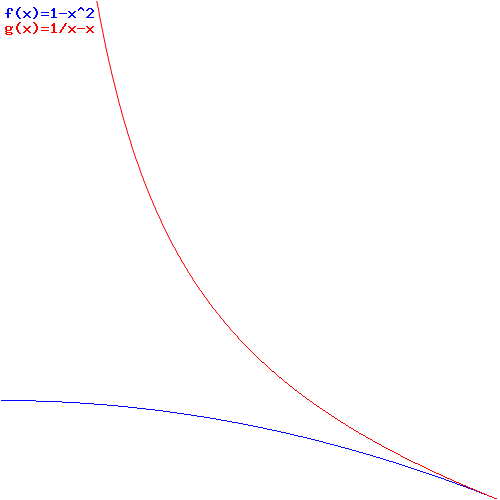
Well… The thumbnail graph below illustrates the difference for a = b: it maps x to (a) 4x[i.e. (x + x)2] and to (b) 2x2 [i.e. (x + ix)2] respectively. Indeed, when we’re squaring real numbers, we get (a + b)= 4a2–i.e. a ‘real bit’ only, of course!–but when we’re squaring complex numbers, we need to keep track of two components: the real part and the imaginary part. However, the real part (a2 – b2) is zero in this case (a = b), and so it’s only the imaginary part 2abi = 2a2i that counts!

graph (2)

That’s kids stuff, you’ll say… In fact, when you’re a mathematician, you’ll say it’s a nonsensical graph. Why? Because it compares an apple and an orange really: we want to show 2ixreally, not 2x2.

That’s true. However, that’s why the graph is actually useful. The red graph introduces a new idea, and with a ‘new’ idea I mean something that’s not inherent in the i2= –1 identity: it associates i with the vertical axis in the two-dimensional plane.

Hmm… This is an idea that is ‘nice’ – very nice actually – but, once again, I should note that it’s not part of i‘s essence. Indeed, the Italian mathematicians who first ‘invented’ complex numbers in the early 16th century (Tartaglia (‘the Stammerer’) and da Vinci’s friend Cardano) introduced roots of –1 because they needed them to solve algebraic equations. That’s it. Full stop. It was only much later (some hundred years later that is!) that Euler and Descartes associated imaginary numbers (like 2ix2) with the vertical coordinate axis. To my readers who have managed not to fall asleep while reading this: please continue till the end, and you will understand why I am saying the idea of a geometrical interpretation is ‘not essential’.

To the same readers, I’ll also say the following, however: if we do associate complex numbers with a second dimension, then we can associate the algebraic operations with things we can visualize in space. Most of you–all of you I should say–know that already, obviously, but let’s just have a look at that to make sure we’re on the same page.

A very basic thing in physical mathematics is reversing the direction of something. Things go in one direction, but we should be able to visualize them going in the opposite direction. We may associate this with a variable going from 0 to infinity (+∞): it may be time (t), or a time-dependent variable x, y or z. Of course, we know what we have here: we think of the positive real axis. So, what we do when we multiply with –1 is reversing its direction, and so then we’re talking the negative real axis: a variable going from 0 to minus infinity (-∞). Therefore, we can associate multiplication by –1 with a full rotation around the center (i.e. around the zero point) by 180 degrees (i.e. by π, in radians).imaginary_rotation

You may think that’s a weird way of looking at multiplication by minus one. Well… Yes and no. But think of it: the concept of negative numbers is actually as ‘weird’ as the concept of the imaginary unit in a way. I mean… Think about it: we’re used to use negative numbers because we learned about them when we were very small kids but what are they really? What does it mean to have minus three apples? You know the answer of course: it probably means that you owe someone three apples but that you don’t have any right now. 🙂 […] But that’s not the point here. I hope you see what I mean: negative numbers are weird too, in a sense. Indeed, we should be aware of the fact that we often look at concepts as being ‘weird’ because we weren’t exposed to them early enough: the great mathematician Leonhard Euler thought complex numbers were so ‘essential’ to math and, hence, so ‘natural’ that he thought kids should learn complex numbers as soon as they started learning ‘real’ numbers. In fact, he probably thought we should only be using complex numbers because… Well… They make the arithmetic space complete, so to say. […] But then I guess that’s because Euler understood complex numbers in a way we don’t, which is why I am writing about them here. 🙂

OK. Back to the main story line. In order to understand complex numbers somewhat better, it is actually useful – but, again, not necessarily essential – to think of i as a halfway rotation, i.e. a rotation by 90 degrees only, clockwise or counterclockwise, as illustrated above: multiplication with i means a counterclockwise rotation by 90 degrees (or π/2 radians) and multiplication with –i means a clockwise rotation by the same amount. Again, the minus sign gives the direction here: clockwise or counterclockwise. It works indeed: i·i =(-i)·(-i) = –1.

OK. Let’s wrap this up: we might say that

  • a positive real number is associated with some (absolute) quantity (i.e. a magnitude);
  • a minus sign says: “Go the opposite way! Go back! Subtract!”– so it’s associated with the opposite direction or the opposite of something in general; and, finally,
  • the imaginary unit adds a second dimension: instead of moving on a line only, we can now walk around on a plane.

Once we understand that, it’s easy to understand why, in most applications of complex numbers, you’ll see the polar notation for complex numbers. Indeed, instead of writing a complex number z as z = a+ ib, we’ll usually see it written as:

z = reiθ with eiθ = cosθ + isinθ

Huh? Well… Yes. Let me throw it in here straight away. You know this formula: it’s Euler’s formula. The so-called ‘magical’ formula! Indeed, Feynman calls it ‘our jewel’: the ‘most remarkable formula in mathematics’ as he puts it. Waw ! If he says so, it must be right. 🙂 So let’s try to understand it.

Is it magical really? Well… I guess the answer is ‘Yes’ and ‘No’ at the same time:

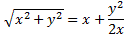
  • No. There is no ‘magic’ here. Associating the real part a and the imaginary part b with a magnitude r and an angle θ (a = rcosθ and b = rcosθ) is actually just an application of the Pythagorean theorem, so that’s ‘magic’ you learnt when you were very little and, hence, it does not look like magic anymore. [Although you should try to appreciate its ‘magic’ once again, I feel. Remember that you heard about the Pythagorean theorem because your teacher wanted to tell you what the square root of 2 actually is: a so-called irrational number that we get by taking the ‘one-half power’ of 2, i.e. 21/2 = 20.5, or, what amounts to the same, the square root of 2. Of course, you and I are both used to irrational numbers now, like 21/2, but they are also ‘weird’. As weird as i. In fact, it is said that the Greek mathematician who claimed their existence was exiled, because these irrational numbers did not fit into the (early) Pythagorean school of thought. Indeed, that school of thought wanted to reduce geometry to whole numbers and their ratios only. So there was no place for irrational numbers there!]
  • Yes. It is ‘magical’. Associating eiθ – so that’s a complex exponential function really! – with the unit circle is something you learnt much later in life only, if ever. It’s a strange thing indeed: we have a real (but, I admit, irrational) number here – e is 2.718 followed by an infinite number of decimals as you know, just like π – and then we raise to the power iθ, so that’s i once again multiplied by a real number θ (i.e. the so-called phase or – to put it simply – the angle). By now, we know what it means to multiply something with i, and–of course–we also know what exponentiation is (it’s just a shorthand for repeated multiplication), but we haven’t defined complex exponentials yet.

In fact… That’s what we’re going to do here. But in a rather ‘weird’ way as you will see: we won’t define them really but we’ll calculate them. For the moment, however, we’ll leave it at this and just note that, through Euler’s relation, we can see how a fraction or a multiple of i, e.g. 0.1i or 2.3i, corresponds to a fraction or a multiple of the angle associated with i, i.e. 0.1 times π/2 or 2.3 times π/2. In other words, Euler’s formula shows how the second (spatial) dimension is associated with the concept of the angle.

[…] And then the third (spatial) dimension is, of course, easy to add: it’s just an angle in another direction. What direction? Well… An angle away from the plane that we just formed by introducing that first angle. 🙂 […] So, from our zero point (here and now), we use a ruler to draw lines, and then a compass to measure angles away from that line, and then we create a plane, and then we can just add dimensions as we please by adding more ‘angles’ away from what we already have (a line, or a plane, and any higher-dimensional thing really).

Dimensions

I feel I need to digress briefly here, just to make sure we’re on the same page. Dimensions. What is a dimension in physics or in math? What do we mean if we say that spacetime is a four-dimensional continuum? From what we wrote above, the concept of a spatial dimension should be obvious: we have three dimensions in space (the x, y and z direction), and so we need three numbers indeed to describe the position of an object, from our point of view that is (i.e. in our reference frame).

But so we also have a fourth number: time. By now, you also know that, just like position and/or motion in space, time is relative too: that is relative to some frame of reference indeed. So, yes, we need four numbers, i.e. four dimensions, to describe an event in spacetime. That being said, time is obviously still something different (I mean different than space), despite the fact that Einstein’s relativity theory relates it to space: indeed, we showed in our post on (special) relativity that there’s no such thing as absolute time. However, that actually reinforces the point: a point in time is something fundamentally different than a point in space. Despite the fact that

  1. Time is just like a space dimension in the physical-mathematical meaning of the term ‘dimension’ (a dimension of a space or an object is one of the coordinates that is needed to specify a point within that space, or to ‘locate’ the object – both in time and space that is); and that,
  2. We can express distance and time in the same units because the speed of light is absolute (so that allows us to express time in meter, despite the fact that time is relative or “local”, as Hendrik Lorentz called it); and that, finally,
  3. If we do that (i.e. if we express time and distance in equivalent units), the equations for space and time in the Lorentz transformation equations mirror each other nicely – ‘mixing’ the space and time variables in the same way, so to say – and, therefore, space and time do form a ‘kind of union’, as Minkowski famously said;

Despite all that, time and space are fundamentally different things. Perhaps not for God – because He (or She, or It?) is said to be Everywhere Always – but surely for us, humans. For us, humans, always busy constructing that mental space with our ruler and our compass, time is and remains the one and only truly independent variable. Indeed, for us, mortal beings, the clocks just tick (locally indeed – that’s why I am using a plural: clocks – but that doesn’t change the fact they’re ticking, and in one direction only).

And so things happen and equations such as the one we started with – i.e. the differential equation modeling the behavior of an oscillator – show us how they happen. In one of my previous posts, I also showed why the laws of physics do not allow us to reverse time, but I won’t talk about that here. Let’s get back to complex numbers. Indeed, I am only talking about dimensions here because, despite all I wrote above about the imaginary axis in the complex plane, the thing to note here is that we did not use complex numbers in the physical-mathematical problem above to bring in an extra spatial dimension.

We just did it because we could not solve the equation with one-dimensional numbers only: we needed to take the square root of a negative number and we couldn’t. That was it basically. So there was no intention of bringing in a y- or z-dimension, and we didn’t. If we would have wanted to do that, we would have had to insert another dependent variable in the differential equation, and so it would have become a so-called partial differential equation in two or three dependent variables (x, y and z), with time – once again – as the independent variable (t). [A differential equation in one variable only (real- or complex-valued), like the ones we’re used to now, are referred to as ordinary differential equations, as opposed to… no, not extraordinary, but partial differential equations.]

In fact, if we would have generalized to two- or three-dimensional space, we would have run into the same type of problem (roots of negative numbers) when trying to solve the partial differential equation and so we would have needed complex-valued variables to solve it analytically in this case too. So we would have three ‘dimensions’ but each ‘dimension’ would be associated with complex (i.e. ‘two-dimensional) numbers. Is this getting complicated? I guess so.

The point is that, when studying physics or math, we will have to get used to the fact that these ‘two-dimensional numbers’ which we introduced, i.e. complex numbers, are actually more ‘natural’ ‘numbers’ to work with from a purely analytic point of view (as for the meaning of ‘analytic’, just read it as ‘logical problem-solving’), especially when we write them in their polar form, i.e. as complex exponentials. We can then take advantage of that wonderful property that they already are a functional form (z =reiθ), so to speak, and that their first, second etcetera derivative is easy to calculate because that ‘functional form’ is an exponential, and exponentials come back to themselves when taking the derivative (with the coefficient in the exponent in front). That makes the differential equation a simple algebraic equation (i.e. without derivatives involved), which is easy to solve.

In short, we should just look at complex numbers here (i.e. in the context of my three previous posts, or in the context of differential equations in general) as a computational device, not as an attempt to add an extra spatial dimension to the analysis.

Now, that’s probably the reason why Feynman inserts a chapter on ‘algebra’ that, at first, does not seem to make much sense. As usual, however, I worked through it and then found it to be both instructive as well as intriguing because it makes the point that complex exponentials are, first and foremost, an algebraic thing, not a geometrical thing.

I’ll try to present his argument here but don’t worry if you can’t or don’t want to follow it all the way through because… Well… It’s a bit ‘weird’ indeed, and I must admit I haven’t quite come to terms with it myself. On the other hand, if you’re ready for some thinking ‘outside of the box’, I assure you that I haven’t found anything like this in a math textbook or on the Web. This proves the fact that Feynman was a bit of a maverick… Well… In any case, I’ll let you judge. Now that you’re here, I would really encourage you to read the whole thing, as loooooooong as it is.

Complex exponentials from an algebraic point of view: introduction

Exponentiation is nothing but repeated multiplication. That’s easy to understand when the exponents are integers: a to the power n (an) is a×a×a×a×… etcetera – repeated n times, so we have n factors (all equal to a) in the product. That’s very straightforward.

Now, to understand rational exponents (so that’s an m/n exponent, with m and n integers), we just need to understand one thing more, and that is the inverse operation of exponentiation, i.e. the nth root. We then get am/n = (am)1/n. So, that’s easy too. […] Well… No. Not that easy. In fact, our problems starts right here:

  • If n is even, and a is a positive real number, we have two (real) nth roots a1/n: ± a1/n.
  • However, if a is negative (and n is still even obviously), then we have a problem. There’s no real nth root of a in that case. That’s why Cardano invented i: we’ll associate an even root of a negative real number with two complex-valued roots.
  • What if n is uneven? Then we have only one real root: it’s positive when a is positive, and negative when a is negative. Done.

But let’s not complicate matters from the start. The point here is to do some algebra that should help us to understand complex exponentials. However, I will make one small digression, and that’s on logarithmic functions. It’s not essential but, again, useful. […] Well… Maybe. 🙂 I hope so. 🙂

We know that exponentials are actually associated with two inverse operations:

  1. Given some value y and some number n, we can take the nth root of y (y1/n) to find the original base x for which y = xn.
  2. Given some value y and some number a, we can take the logarithm (to base a) of y to find the original exponent x for which y = ax.

In the first case, the problem is: given n, find x for which y = xn. In the second case, the problem is: given a, find x for which y = ax. Is that complicated? Probably. In order to further confuse you, I’ve inserted a thumbnail graph with y = 2x (so that’s the exponential function with base 2) and y = log2x (so that’s the logarithmic function with base 2). You can see these two functions mirror each other, with the x = y line as the mirror axis.

graph

We usually find logarithms more ‘difficult’ than roots (I do, for sure), but that’s just because we usually learn about them much later in life–like in a senior high school class, for example, as opposed to a junior high school class (I am just guessing, but you know what I mean).

In addition, we have these extra symbols ‘log‘–L-O-G :-)–to express the function. Indeed, we use just two symbols to write the y = 2function: 2 and x – and then the meaning is clear from where we write these: we write 2 in normal script and x as a superscript and so we know that’s exponentiation. But so we’re not so economical for the logarithmic function. Not at all. In fact, we use three symbols for the logarithmic function: (1) ‘log’ (which is quite verbose as a symbol in itself, because it consists of three letters), (2) 2 and (3) x. That’s not economical at all! Indeed, why don’t we just write y = 2x or something? So that’s a subscript in front, instead of a superscript behind. It would work. It’s just a matter of getting used to it, i.e. it’s just a convention in other words.

Of course, I am joking a bit here but you get my point: in essence, the logarithmic function should not come across as being more ‘difficult’ or less ‘natural’ than the exponential function: exponentiation involves two numbers – a base and an exponent – and, hence, it’s logical that we have two inverse operations, rather than one. [You’ll say that a sum or a product involves (at least) two terms or two factors as well, so why don’t they have two inverse operations? Well… Addition and multiplication are commutative operations: a+b = b+a, and a·b = b·a. Exponentiation isn’t: a≠ na. That’s why. Check it: 2×3 = 3×2, but 23 = 8 ≠ 3= 9.]

Now, apart from us ‘liking’ exponential functions more than logarithmic functions because of the non-relevant fact that we learned about log functions only much later in our life, we will usually also have a strong preference for one or the other base for an exponential. The most preferred base is, obviously, ten (10). We use that base in so-called scientific notations for numbers. For example: the elementary charge (i.e. the charge of an electron) is approximately –1.6×10⁻¹⁹ coulombs. […] Oh… We have a minus sign in the exponent here (–19). So what’s that? Sorry. I forgot to mention that. But it’s easy: a–n = (an)–1 = 1/an.

Our most preferred base is 10 because we have a decimal system, and we have a decimal system because we have ten fingers. Indeed, the Maya used a base-20 system because they used their toes to count as well (so they counted in twenties instead of tens), and it also seems that some tribes had octal (base-8) systems because they used the spaces between their fingers, rather than the fingers themselves. And, of course, we all know that computers use a base-2 system because… Well… Because they’re computers. In any case, 10 is called the common base, because… Well… Because it’s common.

However, by now you know that, in physics and mathematics, we prefer that strange numberas a base. However, remember it’s not that strange: it’s just a number like π. Why do we call it ‘natural’? Because of that nice property: the derivative of the exponential function ecomes back to itself: d(ex)/dt = ex. That’s not the case for 10x. In fact, taking the derivative of 10is pretty easy too: we just need to put a coefficient in front. To be specific, we need to put the logarithm (to base e) of the base of our exponential function (i.e. 10) in front: d(10x)/dt = 10xln(10). [Ln(10) is yet another notation that has been introduced, it seems, to confuse young kids and ensure they hate logarithms: ln(10) is just loge(10) or, if I would have had my way in terms of conventions (which would ensure an ‘economic’ use of symbols), we could also write ln(10) = e10. :-)]

Stop! I am going way too fast here. We first need to define what irrational powers are! Indeed, from all that I’ve written so far, you can imagine what am/n is (am/n  = am)1/n, but what if m is not an integer? What if m equals the square root of 2, for example? In other words, what is 10or ex  or 2or whatever for irrational exponents?

We all sort of ‘know’ what irrationals are: it involves limits, infinitesimals, fractions of fractions, Dedekind cuts. Whatever, even if you don’t understand a word of what I am writing here, you do – intuitively: irrationals can be approximated by fractions of fractions. The grand idea is that we divide some number by 2, and then we divide by 2 once again (so we divide by 4), and then once again (so we take 1/8), and again (1/16), and so on and so on. These are Dedekind cuts. Of course, dividing by two is a pretty random way of cutting things up. Why don’t we divide by three, or by four, for example? Well… It’s the same as with those other ‘natural’ numbers: we have to start somewhere and so this  ‘binary’ way of cutting things up is probably the most ‘natural’. 🙂 [Have you noticed how many ‘natural’ numbers we’ve mentioned already: 10, e, π, 2… And one (1) itself of course. :-)]

So we’ll use something like Dedekind cuts for irrational powers as well. We’ll define them as a sort of limit (in fact, that’s exactly what they are) and so we have to find some approximation (or convergence) process that allows us to do so.

We’ll start with base 10 here because, as mentioned above, base 10 comes across as more ‘natural’ (or ‘common’) to us non-mathematicians than the so-called ‘natural’ base e. However, I should note that the base doesn’t matter much because it’s quite easy to switch from one base to another. Indeed, we can always write a= (bk)= bks = bt with a = band t = k·s (as for k, k is obviously equal to logb(a). From this simple formula, you can see that changing base amounts to changing the horizontal scale: we replace s by t = k·s. That’s it. So don’t worry about our choice of base. 🙂

Complex exponentials from an algebraic point of view: well… Not the introduction 🙂

Ouf! So much stuff! But so here we go. We take base 10 and see how such an approximation of an irrational power of 10 (10x) looks like. Of course, we can write any irrational number x as some (positive or negative) integer plus an endless series of decimals after the zero (e.g. e = 2 + 0.7182818284590452… etc). So let’s just focus on numbers between 0 and 1 as for now (so we’ll take the integer out of the total, so to speak). In fact, before we start, I’ll cheat and show you the result, just to make sure you can follow the argument a bit.

graph (3)Yes. That’s how 10x looks like, but so we don’t know that yet because we don’t know what irrational powers are, and so we can’t make a graph like that–yet. We only know very general things right now, such as:

  • 100 = 1 and 101 = 10 etcetera.
  • Most importantly, we know that 10m/n  = (10m)1/n = (101/n)for integer m and n.

In fact, we’ll use the second fact to calculate 10x for x = 1/2, 1/4, 1/8, 1/16, and so on and so on. We’ll go all the way down to where x becomes a fraction very close to zero: that’s the table below. Note that the x values in the table are rational fractions 1/2, 1/4, 1/8 etcetera indeed, so x is not an irrational exponent: x is a real number but rational, so x can be expressed either as a fraction of two integers m and n (m = 1 and n = 1, 4, 8, 16, 32 and so on here), or as a decimal number with a finite number of decimals behind the decimal point (0.5, 0.25, 0.125, 0.0625 etcetera).

Capture

The third column gives the value 10x for these fractions x = 1/2, 1/4, 1/8 etcetera. How do we get these? Hmm… It’s true. I am jumping over another hurdle here. The key assumption behind the table is that we know how to take the square root of a number, so that we can calculate 101/2, to quite some precision indeed, as 101/2 = 3.162278 (and there’s more decimals but we’re not too interested in them right now), and then that we can take the square root of that value (3.162278). That’s quite an assumption indeed.

However, if we don’t want this post to become a book in itself, then I must assume we can do that. In fact, I’ve done it with a calculator here but, before there were calculators, this kind of calculations could and had to be done with a table of logarithms. That’s because of a very convenient property of logarithms: logc(ab) =logc(a) + logc(b). However, as said, I should be writing a post here only, not a book. [Already now, this post beats the record in terms of length and verbosity…] So I’ll just ask you to accept that – at this stage – we know how to calculate the square root of something and, therefore, to accept that we can take the square root not only of 10 but of any number really, including 3.162278, and then the root of that number, and then the root of that result, and so and so on. So that gives us the values in the third column of the table above: they’re successive square roots. [Please do double-check! It will help you to understand what I am writing about here.]

So… Back to the main story. What we are doing in the table above is to take the square root in succession, so that’s (101/2)1/2 = 101/4, and then again: (101/4)1/2 = 101/8 , and then again: (101/8)1/2 = 101/16 , so we get 101/2, 101/4, 101/8, 101/16, 101/32 and so on and so on. All the way down. Well… Not all the way down. In fact, in the table above, we stop after ten iterations already, so that’s when x = 1/1024. [Note that 1/1024 is 2 to the power minus 10: 2–10 = 1/210   = 1/1024. I am just throwing that in here because that little ‘fact’ will come in handy later.]

Why do we stop after ten iterations? Well… Actually, there’s no real good reason to stop at exactly ten iterations. We could have 15 iterations: then x would be 1/215 = 1/32768. Or 20 (x = 1/1048576). Or 39 (x = 1/too many digits to write down). Whatever. However, we start to notice something interesting that actually allows us to stop. We note that 10 to the power x (10x) tends to one as x becomes very small.

Now you’re laughing. Well… Surely ! That’s what we’d expect, isn’t it? 10= 1. Is that the grand conclusion?

No.

The question is how small should x be? That’s where the fourth column of the table above comes in. We’re calculating a number there that converges to some value quite near to 2.3 as x goes to zero and – importantly – it converges rather quickly. In fact, if you’d do the calculations yourself, you’d see that it converges to 2.302585 after a while. [With Excel or some similar application, you can do 20 or more iterations in no time, and so that’s what you’ll find.]

Of course, we can keep going and continue adding zillions of decimals to this number but we don’t want to do that: 2.302585 is fine. We don’t need any more decimals. Why? Well… We’re going to use this number to approximate 10near x = 0: it turns out that we can get a real good approximation of 10x near x = 0 using that 2.302585 factor, so we can write that

10≈ 1 + 2.302585x

That approximation is the last column in the table above. In order to show you how good it is as an ‘approximation’, I’ve plotted the actual values for 10x (blue markers) and the approximated values for 10x (black markers) using that 1 + 2.302585x formula. You can see it’s a pretty good match indeed if x is small. And ‘small’ here is not that small: a ratio like x = 1/8 (i.e. x = 0.125) is good enough already! In fact, the graph below shows that 1/16 = 0.0625 is almost perfect! So we don’t need to ‘go down’ too far: ten iterations is plenty!

Capture

I’ve probably ‘lost’ you by now. What are we doing here really? How did we get that linear approximation formula, and why do we need it? Well… See the last column: we calculate (10x–1)/x, so that’s the difference between 10and 1 divided by the (fractional) exponent x and we see, indeed, that that number converges to a value very near to 2.302585. Why? Well… What we are actually doing is calculating the gradient of 10x, i.e. the slope of the tangent line to the (non-linear) 10x curve. That’s what’s shown in the graph below.

graph (1)

Working backwards, we can then re-write (10x–1)/x ≈ 2.302585 as 10≈ 1 + 2.302585x indeed.

So what we’ve got here is quite standard: we know we can approximate a non-linear curve with a linear curve, using the gradient near the point that we’re observing (and so that’s near the point x = 0 in this case) and so that‘s what we’re doing here.

Of course, you should remember that we cannot actually plot a smooth curve like that, for the moment that is, because we can only calculate 10x for rational real numbers. However, it’s easy to generalize and just ‘fill the gaps’ so to speak, and so that’s how irrational powers are defined really.

Hmm… So what’s the next step? Well… The next step is not to continue and continue and continue and continue etcetera to show that the smooth curve above is, indeed, the graph of 10x. No. The next step is to use that linear approximation to algebraically calculate the value of 10is, so that’s a power of 10 with a complex exponent.

HUH!? 

Yes. That’s the gem I found in Feynman’s 1965 Lectures. [Well… One of the gems, I should say. There are many. :-)]

It’s quite interesting. In his little chapter on ‘algebra’ (Lectures, I-22), Feynman just assumes that this ‘law’ that 10= 1 + 2.302585x is not only ‘correct’ for small real fractions x but also for very small complex fractions, and then he just reverses the procedure above to calculate 10ifor larger values of x. Let’s see how that goes.

However, let’s first switch the variable from x to s, because we’re talking complex numbers now. Indeed, I can’t use the symbol x as I used it above anymore because x is now the real part of some complex number 10is. In addition, I should note that Feynman introduces this delta (Δ). The idea behind is to make things somewhat easier to read by relating s to an integer: Δ = 1024s, so Δ = 1, 2, 4, 8,… 1024 for s = 1/1024, 1/512, 1/256 etcetera (see the second column in the table below). I am not entirely sure why he does that: Feynman must think fractions are harder to ‘read’. [Frankly, the introduction of this Δ makes Feynman’s exposé somewhat harder to ‘read’ IMHO – but that’s just a matter of taste, I guess.] Of course, the approximation then becomes

10= 1 + 2.302585·Δ/1024 = 1 + 0.0022486Δ. 

The table below is the one that Feynman uses. The important thing is that you understand the first line in this table: 10i/1024 = 1 + 0.00225i·Δ1 + 0.00225i·1 = 1 + 0.00225i. And then we go to the second line: 10i/512 = 10i/1024·10i/1024 = 102i/1024 = 10i/512, so we’re doing the reverse thing here: we don’t take square roots but we square what we’ve found already. So we multiply 1 + 0.00225i with itself and get (1+0.00225i)(1+0.00225i) =  1 + 2·0.00225i + 0.002252i2 = 1 – 0.000005 + 0.45i ≈ 0.999995 + 0.45i ≈ 1 + 0.0045i.

Capture 1

Let’s go to the third line now. In fact, what we’re doing here is working our way back up, i.e. all the way from s = 1/1024 to s = 1. And that’s where the ‘magic’ of i (i.e. the fact that i2 = –1) is starting to show: (0.999995+0.0045i)2 =  0.99999 + 2·0.999995·0.0045i + 0.00452i= 0.99997 + 0.009i. So the real part of 10iis changing as well – it is decreasing in fact! Why is that? Because of the term with the ifactor! [I write 0.99997 instead of 0.99996 because I round up here, while Feynman consistently rounds down.]

So now the game is clear: we take larger and larger fractions s (i/512, i/256, i/128, etcetera), and calculate 10iby squaring the previous result. After ten iterations, we get the grand result for s = i/1 = i:

10is = –0.66928 + 0.74332i (more or less that is)

Note the minus sign in front of the real part, and look at the intermediate values for x and y too. Isn’t that remarkable?

OK. Waw ! But… So what? What’s next?

Well… To graph 10is, we should not just keep squaring things because that amounts to doubling the exponent again and again and so that means the argument is just making larger and larger jumps along the positive real axis really (see that graph that I made above: the distance between the successive values of x gets larger and larger, and so that’s a bad recipe for a smooth graph).

So what can we do? Well… We should just take a sufficiently small power, i/8 for example, and multiply that with 1, 2, 3 etcetera so we get something more ‘regular’. That’s what’s done in the table below and what’s represented in the graph underneath (to get the scale of the horizontal axis, note that s = p/8).

Capture 2

Capture 3

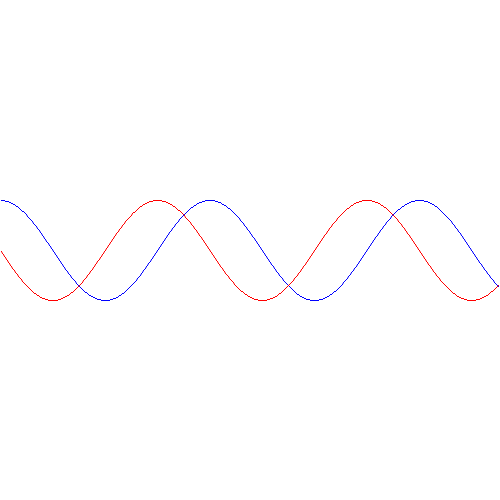
Hey! Look at that! There we are! That’s the graph we were looking for: it shows a (complex) exponential (10is) as a periodic (complex-valued) function with the real part behaving like a cosine function and the imaginary part behaving like as a sine function.

Note the upper and lower bounds: +1 and –1. Indeed, it doesn’t seem to matter whether we use 10 or as a base: the x and y part oscillate between −1 and +1. So, whatever the base, we’ll see the same pattern: the base only changes the scale of the horizontal axis (i.e. s). However, that being said, because of this scale factor, I do need to say like a cosine/sine function when discussing that graph above. So I cannot say they are a cosine and a sine function. Feynman calls these functions algebraic sine and cosine functions.

But – remember! – we can always switch base through a clever substitution so 10is = eit and recalculate stuff to whatever number of decimals behind the decimal point we’d want. So let’s do that: let’s switch to base e. WOW! What happens?

We then [Finally! you’ll say!] get values that – Surprise ! Surprise ! – correspond to the real cosine and sine function. That then, in turn, allows us to just substitute the ‘algebraic’ cosine and sine function for the ‘real’ cosine in an equation that – Yes! – is Euler’s formula itself:

ei= cos(t) + isin(t)

So that’s it. End of story.

[…]

You’ll say: So what? Well… Not sure what to say. I think this is rather remarkable. This is not the formal mathematical proof of Euler’s formula (at least not of the kind that you’ll find in a textbook or on Wikipedia). No, we are just calculating the values x and y of ei= x + iy using an approximation process used to calculate real powers and then, well… Just some bold assumption involving infinitesimals really.

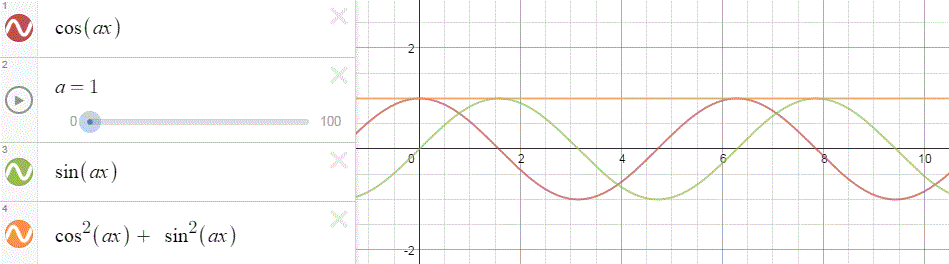
I think this is amazing stuff (even if I’ll downplay that statement a bit in my post scriptum). I really don’t understand these things the way I would like to understand them. I guess I just haven’t got the right kind of brain for these things. 😦 Indeed, just think about it: when we have the real exponential ex, then we’ve got that typical ‘rocket’ graph (i.e. the blue one in the graph below): just something blasting away indeed. But when we put in the exponent (eix), then we get two components oscillating up and down like the cosine and sine function. Well… Not only like the cosine and sine function: the green and red line– i.e. the real and imaginary part of eix!– actually are the cosine and sine function!

graph

Do you understand this in an intuitive way? Yes? You do? Waw ! Please write me and tell me how. I don’t. 😦

Oh well… The good thing about it is… Well… At least complex numbers will always stay ‘magical’ to me. 🙂

Post scriptum: When I write, above, that I don’t understand this in an intuitive way, I don’t mean to say it’s not logical. In fact, it is. It has to be, of course, because we’re talking math here! 🙂

The logic is pretty clear indeed. We have an exponential function here (y = 10x) and we’re evaluating that function in the neighborhood of x = 0 (we do it on the positive side only but we could, of course, do the same analysis on the other side as well). So then we use that very general mathematical procedure of calculating approximate values for the (non-linear) 10x curve using the gradient. So we plug in some differential value for x (in differential terms, we’d write Δx – but so the delta symbol here has nothing to do with Feynman’s Δ above) and, of course, we find Δy = 2.302585·Δx. So we add that to 1 (the value of 10at point x = 0) and, then, we go through these iterations, not using that linear equation any more, but the very fundamental property of an exponential function that 102x = (10x)2. So we start with an approximate value, but then the value we plug into these iterative calculations is the square of the previous value. So, to calculate the next points, we do not use an approximation method any more, but we just square the first result, and then the second and so on and so on, and that’s just calculation, not approximation.

[In fact, you may still wonder and think that it’s quite remarkable that the points we calculate using this process are so accurate, but that’s due to the rapid convergence of that value we found for the gradient. Well… Yes and no. Here I must admit that Feynman (and I) cheated a bit because we used a rather precise value for the gradient: 2.302585, so that’s six significant digits after the decimal point. Now, that value is actually calculated based on twenty (rather than 10) iterations when ‘going down’. But that little factoid is not embarrassing because it doesn’t change much: the argument itself is sound. Very sound.]

OK… That’s easy enough to understand. The thing that is not easy to understand – intuitively that is – is that we can just insert some complex differential Δs into that Δy = 2.302585·Δx equation. Isn’t it ‘weird’, indeed, that we can just use a complex fraction s = i/1024 to calculate our first point, instead of a real fraction x = 1/1024? It is. That’s the only thing really. Indeed, once we’ve done that, it’s plain sailing again: we just square the result to get the next result, and then we square that again, and so on and so on. However, that being said, the difference is that the ‘magic’ of i comes into play indeed. When squaring, we do not get a 4a2 result but an (a+bi)= a– b2 + 2abi. So it’s that minus sign and the i that give an entirely different ‘dynamic’ to how the function evolves from there (i.e. different as compared to working with a real base only). It’s all quite remarkable really because we start off with a really tiny value b here: 0.00225 to be precise, so that’s (less than) 1/445 ! [Of course, the real part a, at the point from where we start doing these iterations, is one.]

But so that first step is ‘weird’ indeed. Why is it no problem whatsoever to insert the complex fraction s = i/1024 into 1 + 2.302585o·s, instead of the real fraction 1/1024, and then afterwards, to square these complex numbers that we’re getting, instead of real numbers?

It just doesn’t feel right, does it? I must admit that, at first, I felt that Feynman was doing something ‘illegal’ too. But, obviously, he’s not. It’s plain mathematical logic. We have two functions here: one is linear (y = 1 + 2.302585·x), and the other is quadratic (y = x2) and so what’s happening really is that, at the point x = 0, we change the function. We substitute not x for ix really but y = 10for y = 10ix. So we still have an independent real variable x but, instead of a real-valued y = 10function, we now have a complex-valued y = 10ifunction.

However, the ‘output’ of that function, of course, is a complex y, not a real y. In our case, because we’re plotting a function really–to be precise, we’re calculating the exponential function y = 10through all these iterations–we get a complex-valued function of the shape that, by now, we know so well.

So it is ‘discontinuous’ in a way, and so I can’t say all that much about it. Look at the graph below where, once again, we have the real exponential function ex and then the two components of the complex exponential eix. This time, I’ve plotted them on both sides of the zero point because they’re continuous on both sides indeed. Imagine we’re walking along this blue ex curve from some negative x to zero. We’re familiar with the path. It has, for instance, that property we exploited above: as we doubled the ‘input’ (so from x we went to 2x), the ‘output’ went up not as the double but as the square of the original value: e2x = (ex)2. And then we also know that, around the point x = o, we can approximate it with a linear function. In fact, in this case, the linear approximation is super-simple: y = 1 + x. Indeed, the gradient for ex at point x = 0 is equal to 1! So, yes, we know and understand that blue curve. But then we arrive at point x = 0 and we decide something radical: we change the function!

graph (5)

Yes. That’s what we’re really doing in that very lengthy story above: ei is a complex-valued function of the real variable x. That’s something different. However, we continue to say that the approximation y = 1 + x must also be valid for complex x and y. So we say that ei= 1 + ix. Is that wrong? No. Not at all. Functional forms are functional forms and gradients are gradients: d(eix)/dx = ieix, and ieix at x = 0 is equal to ie0 = i! Hence, ei= 1 + ix is a perfectly legitimate linear approximation. And then it’s just the same thing again: we use that iteration mechanism to calculate successive squares of complex numbers because, for complex exponentials as well, we have e2(ix) = (eix)2.

So. The ‘magic’ is a lot of ‘confusion’ really. The point to note is that we do have a different function here: eiand e‘look’ similar–it’s just that i, right?but, in fact, when we replace x by ix in the exponent of e, that’s quite a radical change. We can use the same linear approximation at x = ix = 0 but then it’s over. Our blue graph stops: we’re no longer walking along it. I can’t even say it bifurcates, so to say, into the red and the green one, because it doesn’t. We’re talking apples and oranges indeed, and so the comparison is quickly done: they’re different. Full stop.

Is there any geometrical relationship between all these curves? Well… Yes and no. I can see one, at the very start: the gradient of our ex function at x = 0 is equal to unity (i.e. 1), and so that’s the same gradient as the gradient of the imaginary part of our new eifunction (the gradient of the real part is zero, before it becomes negative). But that’s just… I mean… That just comes out of Euler’s formula: e= cos(0) + isin(0). Honestly, it’s no use to try to be smart here and think about stuff like that. We’re no longer walking on the blue curve. We’re looking at a new function: a complex-valued function eix (instead of a real-valued function ex) of a real variable (x). That’s it. Just don’t try to relate the two too much: you switched functions. Full stop. It’s like changing trains! 🙂

So… What’s the conclusion? Well… I’d say: “Complex numbers can be analyzed as extensions of real numbers, so to say, but – frankly – they are different.

[…]

I’ll probably never understand complex numbers in the way I would like to understand them–that is like I understand that one plus one is two. However, this rather lengthy forage in the complex forest has helped me somewhat. I hope it helped you too.

Some content on this page was disabled on June 16, 2020 as a result of a DMCA takedown notice from The California Institute of Technology. You can learn more about the DMCA here:

https://wordpress.com/support/copyright-and-the-dmca/
Some content on this page was disabled on June 16, 2020 as a result of a DMCA takedown notice from The California Institute of Technology. You can learn more about the DMCA here:

https://wordpress.com/support/copyright-and-the-dmca/
Some content on this page was disabled on June 16, 2020 as a result of a DMCA takedown notice from The California Institute of Technology. You can learn more about the DMCA here:

https://wordpress.com/support/copyright-and-the-dmca/
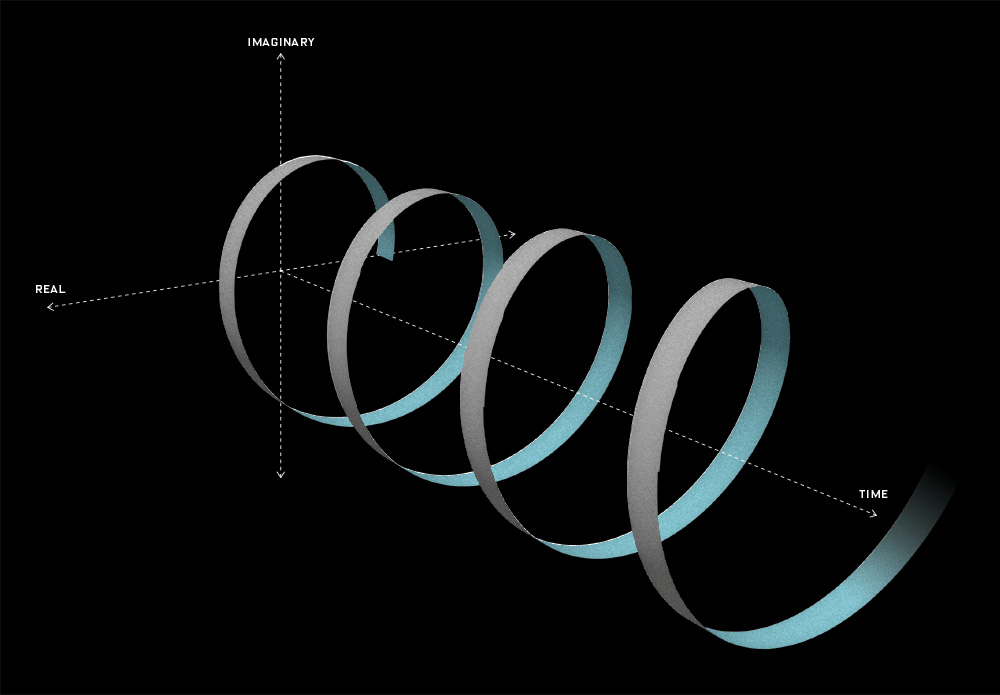
Time reversal and CPT symmetry (III)

Pre-scriptum (dated 26 June 2020): While my posts on symmetries (and why they may or may be broken) are somewhat mutilated (removal of illustrations and other material) as a result of an attack by the dark force, I am happy to see a lot of it survived more or less intact. While my views on the true nature of light, matter and the force or forces that act on them – all of the stuff that explains symmetries or symmetry-breaking, in other words – have evolved significantly as part of my explorations of a more realist (classical) explanation of quantum mechanics, I think most (if not all) of the analysis in this post remains valid and fun to read. 🙂

Original post:

Although I concluded my previous post by saying that I would not write anything more about CPT symmetry, I feel like I have done an injustice to Val Fitch, James Cronin, and all those other researchers who spent many man-years to painstakingly demonstrate how the weak force does not always respect the combined charge-parity (C-P) symmetry. Indeed, I did not want to denigrate their efforts when I noted that:

  1. These decaying kaons (i.e. the particles that are used to demonstrate the CP symmetry-breaking phenomenon) are rather exotic and very short-lived particles; and
  2. Researchers have not been able to find many other traces of non-respect of CP symmetry, except when studying a heavier version of these kaons (the so-called B- and D-mesons) as soon as these could be produced in higher volumes in newer (read: higher-energy) particle colliders (so that’s in the last ten or fifteen years only), but so these B- and D-mesons are even more rare and even less stable.

CP violation is CP violation: it’s plain weird, especially when Fermilab and CERN experiments observed direct CP violation in kaon decay processes. [Remember that the original 1964 Fitch-Cronin experiment could not directly observe CP violation: in their experiment, CP violation in neutral kaon decay processes could only be deduced from other (unexpected) decay processes.]

Why? When one reverses all of the charges and other variables (such as parity which – let me remind you – has to do with ‘left-handedness’ and ‘right-handedness’ of particles), then the process should go in the other direction in an exactly symmetric way. Full stop. If not, there’s some kind of ‘leakage’ so to say, and such ‘leakage’ would be ‘kind-of-OK’ when we’d be talking some kind of chemical or biological process, but it’s obviously not ‘kind-of-OK’ when we’re talking one of the fundamental forces. It’s just not ‘logical’.

Feynman versus ‘t Hooft: pro and contra CP-symmetry breaking

A remark that is much more relevant than the two comments above is that one of the most brilliant physicists of the 20th century, Richard Feynman, seemed to have refused to entertain the idea of CP-symmetry breaking. Indeed, while, in his 1965 Lectures, he devotes quite a bit of attention to Chien-Shiung Wu’s 1956 experiment with decaying cobalt-60 nuclei (i.e. the experiment which first demonstrated parity violation, i.e. the breaking of P-symmetry), he does not mention the 1964 Fitch-Cronin experiment, and all of his writing in these Lectures makes it very clear that he not only strongly believes that the combined CP symmetry holds, but that it’s also the only ‘symmetry’ that matters really, and the only one that Nature truly respects–always.

So Feynman was wrong. Of course, these Lectures were published less than a year after the 1964 Fitch-Cronin experiment and, hence, you might think he would have changed his ideas on the possibility of Nature not respecting CP-symmetry–just like Wolfgang Pauli, who could only accept the reality of Nature not respecting reflection symmetry (P-symmetry) after repeated experiments re-confirmed the results of Wu’s original 1956 experiment.

But – No! – Feynman’s 1985 book on quantum electrodynamics (QED) –so that’s five years after Fitch and Cronin got a Nobel Prize for their discovery– is equally skeptical on this point: he basically states that the weak force is “not well understood” and that he hopes that “a more beautiful and, hence, more accurate understanding” of things will emerge.

OK, you will say, but Feynman passed away shortly after (he died from a rare form of cancer in 1988) and, hence, we should now listen to the current generation of physicists.

You’re obviously right, so let’s look around. Hmm… Gerard ‘t Hooft? Yes ! He is 67 now but – despite his age – it is obvious that he surely qualifies as a ‘next-generation’ physicist. He got his Nobel Prize for “elucidating the quantum structure of electroweak interactions” (read: for clarifying how the weak force actually works) and he is also very enthusiastic about all these Grand Unified Theories (most notably string and superstring theory) and so, yes, he should surely know, shouldn’t he?

I guess so. However, even ‘t Hooft writes that these experiments with these ‘crazy kaons’ – as he calls them – show ‘violation’ indeed, but that it’s marginal: the very same experiments also show near-symmetry. What’s near-symmetry? Well… Just what the term says: the weak force is almost symmetrical. Hence, CP-symmetry is the norm and CP-asymmetry is only a marginal phenomenon. That being said, it’s there and, hence, it should be explained. How?

‘t Hooft himself writes that one could actually try to interpret the results of the experiment by adding some kind of ‘fifth’ force to our world view – a “super-weak force” as he calls it, which would interfere with the weak force only.

To be fair, he immediately adds that introducing such ‘fifth force’ doesn’t really solve the “mystery” of CP asymmetry, because, while we’d restore the principle of CP symmetry for the weak force interactions, we would then have to explain why this ‘super-weak’ force does not respect it. In short, we cannot just reason the problem away. Hence, ‘t Hooft’s conclusion in his 1996 book on The Ultimate Building Blocks of the universe is quite humble: “The deeper cause [of CP asymmetry] is likely to remain a mystery.” (‘t Hooft, 1996, Chapter 7: The crazy kaons)

What about other explanations? For example, you might be tempted to think these two or three exceptions to a thousand cases respecting the general rule must have something to do with quantum-mechanical uncertainty: when everything is said and done, we’re dealing with probabilities in quantum mechanics, aren’t we? Hence, exceptions do occur and are actually expected to occur.

No. Quantum indeterminism is not applicable here. While working with probability amplitudes and probabilities is effectively equivalent to stating some general rules involving some average or mean value and then some standard deviation from that average, we’ve got something else going on here: Fitch and Cronin took a full six months indeed–repeating the experiment over and over and over again–to firmly establish a statistically significant bias away from the theoretical average. Hence, even if the bias is only 0.2% or 0.3%, it is a statistically significant difference between the probability of a process going one way, and the probability of that very same process going the other way.

So what? There are so many non-reversible processes and asymmetries in this world: why don’t we just accept this?Well… I’ll just refer to my previous post on this one: we’re talking a fundamental force here – not some chemical reaction – and, hence, if we reverse all of the relevant charges (including things such as left-handed or right-handed spin), the reaction should go the other way, and with exactly the same probability. If it doesn’t, it’s plain weird. Full stop.

OK. […] But… Perhaps there is some external phenomenon affecting these likelihoods, like these omnipresent solar neutrinos indeed, which I mentioned in a previous post and which are all left-handed. So perhaps we should allow these to enter the equation as well. […] Well… I already said that would make sense–to some extent at least– because there is some flimsy evidence of solar flares affecting radioactive decay rates (solar flares and neutrino outbursts are closely related, so if solar flares impact radioactive decay, we could or should expect them to meddle with any beta decay process really). That being said, it would not make sense from other, more conventional, points of view: we cannot just ‘add’ neutrinos to the equation because then we’d be in trouble with the conservation laws, first and foremost the energy conservation law! So, even if we would be able to work out some kind of theoretical mechanism involving these left-handed solar neutrinos (which are literally all over the place, bombarding us constantly even if they’re very hard to detect), thus explaining the observed P-asymmetry, we would then have to explain why it violates the energy conservation law! Well… Good luck with that, I’d say!

So it is a conundrum really. Let me sum up the above discussion in two bullet points:

  1. While kaons are short-lived particles because of the presence of the second-generation (and, hence, unstable) s-quark, they are real particles (so they are not some resonance or some so-called virtual particle). Hence, studying their behavior in interactions with any force field (and, most notably, their behavior in regard to the weak force) is extremely relevant, and the observed CP asymmetry–no matter how small–is something which should really grab our attention.
  2. The philosophical implications of any form of non-respect of the combined CP symmetry for our common-sense notion of time are truly profound and, therefore, the Fitch-Cronin experiment rightly deserves a lot of accolades.

So let’s analyze these ‘philosophical implications’ (which is just a somewhat ‘charged’ term for the linkage between CP- and time-symmetry which I want to discuss here) somewhat more in detail.

Time reversal and CPT symmetry

In the previous posts, I said it’s probably useful to distinguish (a) time-reversal as a (loosely defined) philosophical concept from (b) the mathematical definition of time-reversal, which is much more precise and unambiguous. It’s the latter which is generally used in physics, and it amounts to putting a minus sign in front of all time variables in any equation describing some situation, process or system in physics. That’s it really. Nothing more.

The point that I wanted to make is that true time reversal – i.e. time-reversal in the ‘philosophical’ or ‘common-sense’ interpretation – also involves a reversal of the forces, and that’s done through reversing all charges causing those forces. I used the example of the movie as a metaphor: most movies, when played backwards, do not make sense, unless we reverse the forces. For example, seeing an object ‘fall back’ to where it was (before it started falling) in a movie playing backwards makes sense only if we would assume that masses repel, instead of attract, each other. Likewise, any static or dynamic electromagnetic phenomena we would see in that backwards playing movie would make sense only if we would assume that the charges of the protons and electrons causing the electromagnetic fields involved would be reversed. How? Well… I don’t know. Just imagine some magic.

In such world view–i.e. a world view which connects the arrow of time with real-life forces that cause our world to change– I also looked at the left- and right-handedness of particles as some kind of ‘charge’, because it co-determines how the weak force plays out. Hence, any phenomenon in the movie having to do with the weak force (such as beta decay) could also be time-reversed by making left-handed particles right-handed, and right-handed particles left-handed. In short, I said that, when it comes to time reversal, only a full CPT-transformation makes sense–from a philosophical point of view that is.

Now, reversing left- and right-handedness amounts to a P-transformation (and don’t interrupt me now by asking why physicists use this rather awkward word ‘parity’ for what’s left- and right-handedness really), just like a C-transformation amounts to reversing electric and ‘color’ charges (‘color’ charges are the charges involved in the strong nuclear force).

Now, if only a full CPT transformation makes sense, then CP-reversal should also mean T-reversal, and vice versa. Feynman’s story about “the guy in the ‘other’ universe” (see my previous post) was quite instructive in that regard, and so let’s look at the finer points of that story once again.

Is ‘another’ world possible at all?

Feynman’s assumption was that we’ve made contact (don’t ask how: somehow) with some other intelligent being living in some ‘other’ world somewhere ‘out there’, and that there are no visual or other common references. That’s all rather vague, you’ll say, but just hang in there and try to see where we’re going with this story. Most notably, the other intelligent being – but let’s call ‘it’ a she instead of ‘a guy’ or ‘a Martian’ – cannot see the universe as we see it: we can’t describe, for instance, the Big and Small Dipper and explain to her what ‘left’ and ‘right’ is referring to such constellations, because she’s sealed off somehow from it (so she lives in a totally different corner of the universe really).

In contrast, we would be able, most probably, to explain and share the concept of ‘upward’ and ‘downwards’ by assuming that she is also attracted by some center of gravity nearby, just like we are attracted downwards by our Earth. Then, after many more hours and days, weeks, months or even years of tedious ‘discussions’, we would probably be able to describe electric currents and explain electromagnetic phenomena, and then, hopefully, she would find out that the laws in her corner of the universe are exactly the same, and so we could thus explain and share the notion of a ‘positive’ and a ‘negative’ charge, and the notion of a magnetic ‘north’ and ‘south’ pole.

However, at this point the story becomes somewhat more complicated, because – as I tried to explain in my previous post – her ‘positive’ electric charge (+) and her magnetic ‘north’ might well be our ‘negative’ electric charge (–) and our magnetic ‘south’. Why? It’s simple: the electromagnetic force does respect charge and also parity symmetry and so there is no way of defining any absolute sense of ‘left’ and ‘right’ or (magnetic) ‘north’ and (magnetic) ‘south’ with reference to the electromagnetic force alone. [If you don’t believe, just look at my previous post and study the examples.]

Talking about the strong force wouldn’t help either, because it also fully respects charge symmetry.

Huh? Yes. Just go through my previous post which – I admit – was probably quite confusing but made the point that a ‘mirror-image’ world would work just as well… except when it comes to the weak force. Indeed, atomic decay processes (beta decay) do distinguish between ‘left-handed’ and ‘right-handed’ particles (as measured by their spin) in an absolute sense that is (see the illustration of decaying muons and their mirror-image in the previous post) and, hence, it’s simple: in order to make sure her ‘left’ and her ‘right’ is the same as ours, we should just ask her to perform those beta decay experiments demonstrating that parity (or P-symmetry) is not being conserved and, then, based on our common definition of what’s ‘up’ and ‘down’ (the commonality of these notions being based on the effects of gravity which, we assume, are the same in both worlds), we could agree that ‘right’ is ‘right’ indeed, and that ‘left’ is ‘left’ indeed.

Now, you will remember there was one ‘catch’ here: if ever we would want to set up an actual meeting with her (just assume that we’ve finally figured out where she is and so we (or she) are on our way to meet each other), we would have to ask her to respect protocol and put out her right hand to greet us, not her left. The reason is the following: while ‘right-handed’ and ‘left-handed’ matter behave differently when it comes to weak force interactions (read: atomic decay processes)–which is how we can distinguish between ‘left’ and ‘right’ in the first place, in some kind of absolute sense that is–the combined CP symmetry implies that right-handed matter and left-handed anti-matter behave just the same–and, of course, the same goes for ‘left-handed’ matter and ‘right-handed’ anti-matter. Hence, after we would have had a painstakingly long exchange on broken P-symmetry to ensure we are talking about the same thing, we would still not know for sure: she might be living in a world of anti-matter indeed, in which case her ‘right’ would actually be ‘left’ for us, and her ‘left’ would be ‘right’.

Hence, if, after all that talk on P-symmetry and doing all those experiments involving P-asymmetry, she actually would put out her left hand when meeting us physically–instead of the agreed-upon right hand… Then… Well… Don’t touch it. 🙂

There is a way out of course. And, who knows, perhaps she was just trying to be humorous and so perhaps she smiled and apologized for the confusion in the meanwhile. But then… […] Hmm… I am not sure if such bad joke would make for a good start of a relationship, even if it would obviously demonstrate superior intelligence. 🙂

Indeed, the Fitch-Cronin experiment brings an additional twist to this potentially romantic story between two intelligent beings from two ‘different’ worlds. In fact, the Fitch-Cronin experiment actually rules out this theoretical possibility of mutual destruction and, therefore, the possibility of two ‘different’ worlds.

The argument goes straight to the heart of our philosophical discussion on time reversal. Indeed, whatever you may or may not have understood from this and my previous posts on CPT symmetry, the key point is that the combined CPT symmetry cannot be violated.

Why? Well… That’s plain logic: the real world does not care about our conventions, so reversing all of our conventions, i.e.

  1. Changing all particles to antiparticles by reversing all charges (C),
  2. Turning all right-handed particles into left-handed particles and vice versa (P), and
  3. Changing the sign of time (T),

describes a world truly going back in time.

Now, ‘her’ world is not going back in time. Why? Well… Because we can actually talk to her, it is obvious that her ‘arrow of time’ points in the same direction as ours, so she is not living in a world that is going back in time. Full stop. Therefore, any experiment involving a combined CP asymmetry (i.e. C-P violation) should yield the same results and, hence, she should find the same bias, i.e. a bias going in the very same direction of the equation, i.e. from left to right, or from right to left – whatever (what we label it, depends on our conventions, which we ‘re-set’ as we talked to her, and, hence, which we share, based on the results of all these beta decay experiments we did to ensure we’re really talking about the ‘same’ direction, and not its opposite).

Is this confusing? It sure is. But let me rephrase the logic. Perhaps it helps.

  1. Combined CPT symmetry implies that if the combined CP-symmetry is broken, then T-symmetry is also broken. Hence, the experimentally established fact of broken CP symmetry (even if it’s only 2 or 3 times per thousand) ensures that the ‘arrow of time’ points in one direction, and in one direction only. To put it simply: we cannot reverse time in a world which does not (fully) respect the principle of CP symmetry.
  2. Now, if you and I can exchange meaningful signals (i.e. communicate), then your and my ‘arrow of time’ obviously point in the same direction. To put it simply, we’re actors in the same movie, and whether or not it is being played backwards doesn’t matter anymore: the point is that the two of us share the same arrow of time. In other words, God did not do any combined CPT-transformation trick on your world as compared to mine, and vice versa.
  3. Hence, ‘your’ world is ‘my’ world and vice versa. So we live in the same world with the very same symmetries and asymmetries.

Now apply this logic to our imaginary new friend (‘she’) and (I hope) you’ll get the point.

To make a long story short, and also to conclude our philosophical digressions here on a pleasant (romantic) note: the fact that we would be able to communicate with her, implies that she’d be living in the same world as ours. We know that now, for sure, because of the broken CP symmetry: indeed, if her ‘time arrow’ points in the same direction, then CP symmetry will be broken in just the very same way in ‘her’ world (i.e. the ‘bias’ will have the same direction, in an absolute sense) as it it is broken in ‘our’ world.

In short, there are only two possible worlds: (1) this world and (2) one and only one ‘other’ world. This ‘other’ world is our world under a full CPT-transformation: the whole movie played backwards in other words, but with all ‘charges’ affecting forces – in whatever form and shape they come (electric charge, color charge, spin, and what have you) reversed or – using that awful mathematical term – ‘negated’.

In case you’d wonder (1): I consider the many-worlds interpretation of quantum mechanics as… Well… Nonsense. CPT symmetry allows for two worlds only. Maximum two. 🙂

In case you’d wonder (2): An oscillating-universe theory, or some kind of cyclic thing (so Big Bangs followed by Big Crunches) are not incompatible with my ‘two-possible-worlds’ view of things. However, this ‘oscillations’ would all take place in the same world really, because the arrow of time isn’t being reversed really, as Big Bangs and Big Crunches do not reverse charges and parities–at least not to my knowledge.

But, of course, who knows?

Postscripts:

1. You may wonder what ‘other’ asymmetries I am hinting at in this post here. It’s quite simple. It’s everything you see around you, including the works of the increasing entropy law. However, if I would have to choose one asymmetry in this world (the real world), as an example of a very striking and/or meaningful asymmetry, it’s the the preponderance of matter over anti-matter, including the preponderance of (left-handed) neutrinos over (right-handed) antineutrinos. Indeed, I can’t shake off that feeling that neutrino physics is going to spring some surprises in the coming decades.

[When you’d google a bit in order to get some more detail on neutrinos (and solar neutrinos in particular, which are the kind of neutrinos that are affecting us right now and right here), you’ll probably get confused by a phenomenon referred to as neutrino oscillation (which refers to a process in which neutrinos change ‘flavor’) but so the basic output of the Sun’s nuclear reactor is neutrinos, not anti-neutrinos. Indeed, the (general) reaction involves two protons combining to form one (heavy) hydrogen atom (i.e. deuterium, which consists of one neutron, one proton and one electron), thereby ejecting one positron (e+) and one (electron) neutrino (ve). In any case, this is not the place to develop the point. I’ll leave that for my next post.]

2. Whether or not you like the story about ‘her’ above, you should have noticed something that we could loosely refer to as ‘degrees of freedom’ is playing some role:

  1. We know that T-symmetry has not been broken: ‘her’ arrow of time points in the same direction.
  2. Therefore, the combined CP-symmetry of ‘her’ world is broken in the same way as in our world.
  3. If the combined CP-symmetry in ‘her’ world is broken in the same way as in ‘our’ world, the individual C and P symmetries have to be broken in the very same way. In other words, it’s the same world indeed. Not some anti-matter world.

As I am neither a physicist nor a mathematician, and not a philosopher either, please do feel free to correct any logical errors you may identify in this piece. Personally, I feel the logic connecting CP violation and individual C- and P-violation needs further ‘flesh on the bones’, but the core argument is pretty solid I think. 🙂

3. What about the increasing entropy law in this story? What happens to it if we reverse time, charge and parity? Well… Nothing. It will remain valid, as always. So that’s why an actual movie being played backwards with charges and parities reversed will still not make any sense to us: things that are broken don’t repair themselves and, hence, at the system level, there’s another type of irreducible ‘arrow of time’ it seems. But you’ll have to admit that the character of that entropy ‘law’ is very different from these ‘fundamental’ force laws. And then just think about it, isn’t it extremely improbable how we human beings have evolved in this universe? And how we are seemingly capable to understand ourselves and this universe? We don’t violate the entropy law obviously (on the contrary: we’re obviously messing up our planet), but I feel we do negate it in a way that escapes the kind of logical thinking that underpins the story I wrote above. But such remarks have nothing to do with math or physics and, hence, I will refrain from them.

4. Finally, for those who’d feel like some kind of ‘feminist’ remark on my use of ‘us’ and ‘her’, I think the use of ‘her’ is explained to underline the idea of ‘other’ and, hence, as a male writer, using ‘her’ to underscore the ‘other’ dimension comes naturally and shouldn’t be criticized. The element which could/should bother a female reader of such ‘through experiments’ is that we seem to assume that the ‘other’ intelligent being is actually somewhat ‘dumber’ than us, because the story above assumes we are actually explaining the experiments of the Wu and Fitch-Cronin team to ‘her’, instead of the other way around. That’s why I inserted the possibility of ‘her’ pulling a practical joke on us by offering us her left hand: if ‘she’ is equally or even more intelligent than us, then she’d surely have figured out that there’s no need to be worried about the ‘other’ being made of anti-matter. 🙂

Time reversal and CPT symmetry (II)

Pre-scriptum (dated 26 June 2020): While my posts on symmetries (and why they may or may be broken) are somewhat mutilated (removal of illustrations and other material) as a result of an attack by the dark force, I am happy to see a lot of it survived more or less intact. While my views on the true nature of light, matter and the force or forces that act on them – all of the stuff that explains symmetries or symmetry-breaking, in other words – have evolved significantly as part of my explorations of a more realist (classical) explanation of quantum mechanics, I think most (if not all) of the analysis in this post remains valid and fun to read. 🙂

Original post:

My previous post touched on many topics and, hence, I feel I was not quite able to exhaust the topic of parity violation (let’s just call it mirror asymmetry: that’s more intuitive). Indeed, I was rather casual in stating that:

  1. We have ‘right-handed’ and ‘left-handed’ matter, and they behave differently–at least with respect to the weak force–and, hence, we have some kind of absolute distinction between left and right in the real world.
  2. If ‘right-handed’ matter and ‘left-handed’ matter are not the same, then ‘right-handed’ antimatter and ‘left-handed’ antimatter are not the same either.
  3. CP symmetry connects the two: right-handed matter behaves just like left-handed antimatter, and right-handed antimatter behaves just like left-handed matter.

There are at least two problems with this:

  1. In previous posts, I mentioned the so-called Fitch-Cronin experiment which, back in 1964, provided evidence that ‘Nature’ also violated the combined CP-symmetry. In fact, I should be precise here and say the weak force, instead of ‘Nature’, because all these experiments investigate the behavior of the weak force only. Having said that, it’s true I mentioned this experiment in a very light-hearted manner–too casual really: I just referred to my simple diagrams illustrating what true time reversal entails (a reversal of the forces and, hence, of the charges causing those forces) and that was how I sort of shrugged it all of.
  2. In such simplistic world view, the question is not so much why the weak force violates mirror symmetry, but why gravity, electromagnetism and the strong force actually respect it!

Indeed, you don’t get a Nobel Prize for stating the obvious and, hence, if Val Fitch and James Cronin got one for that CP-violation experiment, C/P or CP violation cannot be trivial matters.

P-symmetry revisited

So let’s have another look at mirror symmetry–also known as reflection symmetry– by following Feynman’s example: let us actually build a ‘left-hand’ clock, and let’s do it meticulously, as Feynman describes it: “Every time there is a screw with a right-hand thread in one, we use a screw with a left-hand thread in the corresponding place of the other; where one is marked ‘IV’ on the face, we mark a ‘VI’ on the face of the other; each coiled spring is twisted one way in one clock and the other way in the mirror-image clock; when we are all finished, we have two clocks, both physical, which bear to each other the relation of an object and its mirror image, although they are both actual, material objects. Now the question is: If the two clocks are started in the same condition, the springs wound to corresponding tightnesses, will the two clocks tick and go around, forever after, as exact mirror images?”

The answer seems to be obvious: of course they will! Indeed, we do observe that P symmetry is being respected, as shown below:

P symmetry

You may wonder why we have to go through the trouble of building another clock. Why can’t we just take one of these transparent ‘mystery clocks’ and just go around it and watch its hand(s) move standing behind it? The answer is simple: that’s not what mirror symmetry is about. As Feynman puts its: a mirror reflection “turns the whole space inside out.” So it’s not like a simple translation or a rotation of space. Indeed, when we would move around the clock to watch it from behind, then all we do is rotating our reference frame (with a rotation angle equal to 180 degrees). That’s all. So we just change the orientation of the clock (and, hence, we watch it from behind indeed), but we are not changing left for right and right for left.

Rotational symmetry is a symmetry as well, and the fact that the laws of Nature are invariant under rotation is actually less obvious than you may think (because you’re used to the idea). However, that’s not the point here: rotational symmetry is something else than reflection (mirror) symmetry. Let me make that clear by showing how the clock might run when it would not respect P-symmetry.

P asymmetry

You’ll say: “That’s nonsense.” If we build that mirror-image clock and also wind it up in the ‘other’ direction (‘other’ as compared to our original clock), then the mirror-image clock can’t run that way. Is that nonsense? Nonsensical is actually the word that Wolfgang Pauli used when he heard about Chien-Shiung Wu’s 1956 experiment (i.e. the first experiment that provided solid evidence for the fact that the weak force – in beta decay for instance – does not respect P-symmetry), but so he had to retract his words when repeated beta decay experiments confirmed Wu’s findings.

Of course, the mirror-image clock above (i.e. the one running clockwise) breaks P-symmetry in a very ‘symmetric’ way. In fact, you’ll agree that the hands of that mirror-image clock might actually turn ‘clockwise’ if its machinery would be completely reversible, so we could wind up its springs in the same way as the original clock. But that’s cheating obviously. However, it’s a relevant point and, hence, to be somewhat more precise I should add that Wu’s experiment (and the other beta decay experiments which followed after hers) actually only found a strong bias in the direction of decay: not all of the beta rays (beta rays consist of electrons really – check the illustration in my previous post for more details) went ‘up’ (or ‘down’ in the mirror-reversed arrangement), but most of them did. 

Wu_experiment

OK. We got that. Now how do we explain it? The key to explaining the phenomenon observed by Wu and her team, is the spin of the cobalt-60 nuclei or, in the muon decay experiment described in my previous post, the spin of the muons. It’s the spin of these particles that makes them ‘left-handed’ or ‘right-handed’ and the decay direction is (mostly) in the direction of the axial vector that’s associated with the spin direction (this axial vector is the thick black arrow in the illustration below).

Axial vector

Hmm… But we’ve got spinning things in (mechanical) clocks as well, don’t we? Yes. We have flywheels and balance wheels and lots of other spinning stuff in a mechanical clock, but these wheels are not equivalent to spinning muons or other elementary particles: the wheels in a clock preserve and transfer angular momentum.

OK… But… […] But isn’t that what we are talking about here? Angular momentum?

No. Electrons spinning around a nucleus have angular momentum as well – referred to as orbital angular momentum – but it’s not the same thing as spin which, somewhat confusingly, is often referred to as intrinsic angular momentum. In short, we could make a detailed analysis of how our clock and its mirror image actually work, and we would find that all of the axial vectors associated with flywheels, balance wheels and springs in a clock would effectively be reversed in the mirror-image clock but, in contrast with the weak decay example, their reversed directions would actually explain why the mirror-image clock is turning counter-clockwise (from our point of view that is), just like the image of the original clock in the mirror does, and, therefore, why a ‘left-handed’ mechanical clock actually respects P-symmetry, instead of breaking it.

Axial and polar vectors in physics

In physics, we encounter such axial vectors everywhere. They show the axis of spin, and their direction is determined by the direction of spin through one of two conventions: the ‘right-hand screw rule’, or the ‘left-hand screw rule’. Physicists have settled on the former, so let’s work with that for the time being.

The other type of vector is a polar vector. That’s an ‘honest’ vector as Feynman calls it–depicting ‘real’ things such as, for example, a step in space, or some force acting in some direction. The figures below (which I took from Feynman’s Lectures) illustrate the idea (and please do note the care with which Feynman reversed the direction of the arrows above the r and ω in the mirror image):

  1. When mirrored, a polar vector “changes its head, just as the whole space turns inside out.”
  2. An axial vector behaves differently when mirrored. It changes too, but in a very different way: it is usually reversed in respect to the geometry of the whole space, as illustrated in the muon decay image above. However, in the illustration below, that is not the case, because the angular velocity ‘vector’ is not reversed when mirrored. So it’s all quite subtle and one has to carefully watch what’s going on really when we do such mirror reflections.

Axial vectors

What’s the third figure about? Well… While it’s not that difficult to visualize all of the axial vectors in a mechanical clock, it’s a different matter when discussing electromagnetic forces, and then to explain why these electromagnetic forces also respect mirror symmetry, just like the mechanical clock. But let’s me try.

When an electric current goes through a solenoid, the solenoid becomes a magnet, especially when wrapped around an iron core. The direction and strength of the magnetic field is given by the magnetic field vector B, and the force on an electrically charged particle moving through such magnetic field will be equal to F = qv×B. That’s a so-called vector cross product and we’ve seen it before: a×b = na││b│sinθ, so we take (1) the magnitudes of a and b, (2) the sinus of the angle between them, and (3) the unit vector (n) perpendicular to (the plane containing) a and b; multiply it all; and there we are: that’s the result. But – Hey! Wait a minute! – there are two unit vectors perpendicular to a and b. So how does that work out?

Well… As you might have guessed, there is another right-hand rule here, as shown below.

2000px-Right_hand_rule_cross_product

Now how does that work out for our magnetic field? If we mirror the set-up and let an electron move through the field? Well… Let’s do the math for an electron moving into this screen, so in the direction that you are watching.

In the first set-up, the B vector points upwards and, hence, the electron will deviate in the direction given by that cross product above: qv×B. In other words, it will move sideways as it moves away from you, into the field. In which direction? Well… Just turn that hand above about 90 degrees and you have the answer: right. Oh… No. It’s left, because q is negative. Right.

In the mirror-image set-up, we have a B’ vector pointing in the opposite direction so… Hey ! Mirror symmetry is not being respected, is it?

Well… No. Remember that we must change everything, including our conventions, so the ‘right-hand rules’ above becomes ‘left-hand rules’, as shown below for example. Surely you’re joking, Mr. Feynman!

P-parity for screw rules

Well… No. F and v are polar vectors and, hence, “their head might change, just as the whole space turns inside out”, but that’s not the case now, because they’re parallel to the mirror. In short, the force F on the electron will still be the same: it will deviate leftwards. I tried to draw that below, but it’s hard to make that red line look like it’s a line going away from you.

Capture

But that can’t be true, you’ll say. The field lines go from north to south, and so we have that B’ vector pointing downwards now.

No, we don’t. Or… Well… Yes. It all depends on our conventions. 🙂  

Feynman’s switch to ‘left-hand rules’ also involves renaming the magnetic poles, so all magnetic north poles are now referred to as ‘south’ poles, and all magnetic south poles are now referred to as ‘north’ poles, and so that’s why he has a B’ vector pointing downwards. Hence, he does not change the convention that magnetic field lines go from north to south, but his ‘north’ pole (in the mirror-image drawing) is actually a ‘south’ pole. Capito? 🙂

[…] OK. Let me try to explain it once again. In reality, it does not matter whether or not a solenoid is wound clockwise or counterclockwise (or, to use the terminology introduced above, whether our solenoid is left-handed or right-handed). The important thing is that the current through the solenoid flows from the top to the bottom. We can only reverse the poles – in reality – if we reverse the electric current, but so we don’t do that in our mirror-image set-up. Therefore, the force F on our charged particle will not change, and B’ is an axial vector alright but this axial vector does not represent the actual magnetic field.

[…] But… If we change these conventions, it should represent the magnetic field, shouldn’t it? And how do we calculate that force then?

OK. If you insist. Here we go:

  1. So we change ‘right’ to ‘left’ and ‘left’ to ‘right’, and our cross-product rule becomes a ‘left-hand’ rule.
  2. But our electrons still go from ‘top’ to ‘bottom’. Hence, the (magnetic) force on a charged particle won’t change.
  3. But if the result has to be the same, then B needs to become –B, or so that’s B’ in our ‘left-handed’ coordinate system.
  4. We can now calculate F using the ‘left-handed’ cross product rule and – because we did not change the convention that field lines go from north to south, we’ll also rename our poles.
  5. Yippee ! All comes out all right: our electron goes left. Sorry. Right. Huh? Yes. Because we’ve agreed to replace ‘left’ by ‘right’, remember? 🙂

[…]

If you didn’t get anything of this, don’t worry. There is actually a much more comprehensible illustration of the mirror symmetry of electromagnetic forces. If we would hang two wires next to each other, as below, and we send a current through them, they will attract if the two currents are in the same direction, and they will repel when the currents are opposite. However, it doesn’t matter if the current goes from left to right or from right to left. As long as the two currents have the same direction (left or right), it’s fine: there will be attraction. That’s all it takes to demonstrate P-symmetry for electromagnetism.

Wires attracting

The Fitch-Cronin experiment

I guess I caused an awful lot of confusion above. Just forget about it all and take one single message home: the electromagnetic force does not care about the axial vector of spinning particles, but the weak force does.

Is that shocking?

No. There are plenty of examples in the real world showing that the direction of ‘spin’ does matter. For instance, to unlock a right-hinged door, you turn the key to the right (i.e. clockwise). The other direction doesn’t work. While I am sure physicists won’t like such simplistic statements, I think that accepting that Nature has similar ‘left-handed’ and ‘right-handed’ mechanisms is not the kind of theoretical disaster that Wolfgang Pauli thought it was. If anything, we just should marvel at the fact that gravity, electromagnetism and the strong force are P- and C-symmetric indeed, and further investigate why the weak force does not have such nice symmetries. Indeed, it respects the combined CPT symmetry, but that amounts to saying that our world sort of makes sense, so that ain’t much.

In short, our understanding of that weak force is probably messy and, as Feynman points out: “At the present level of understanding, you can still see the “seams” in the theories; they have not yet been smoothed out so that the connection becomes more beautiful and, therefore, probably more correct.” (QED, 1985, p. 142). However, let’s stop complaining about our ‘limited understanding’ and so let’s work with what we do understand right now. Hence, let’s have a look at that Fitch-Cronin experiment now and see how ‘weird’ or, on the contrary, how ‘understandable’ it actually is.

To situate the Fitch-Cronin experiment, we first need to say something more about that larger family of mesons, of which the kaons are just one of the branches. In fact, in case you’d not be interested in this story as such, then I’d suggest you just read it as a very short introduction to the Standard Model as such, as it gives a nice short overview of all matter-particles–which is always useful I’d think.

Hadrons, mesons and baryons

You may or may not remember that mesons are unstable particles consisting of one quark and one anti-quark (so mesons consist of two quarks, but one of them should be an anti-quark). As such, mesons are to be distinguished from the ‘other’ group within the larger group of hadrons, i.e. the baryons, which are made of three quarks. [The term ‘hadrons’ itself is nothing but a catch-all for all particles consisting of quarks.]

The most prominent representatives of the baryon family are the (stable) neutron and proton, i.e. the nucleons, which consist of u and d quarks. However, there are unstable baryons as well. These unstable baryons involve the heavier (second-generation) or quarks, or the super-heavy (third-generation) b quark. [As for the top quark (t), that’s so high-energy (and, hence, so short-lived) that baryons made of a t quark (so-called ‘top-baryons’) are not expected to exist but, then, who knows really?]

But kaons are mesons, and so I won’t say anything more about baryons The two illustrations below should be sufficient to situate the discussion.

98E-pic-first-classification-particles

Standard_Model_of_Elementary_Particles

Kaons are just one branch of the meson family. There are, for instance, heavier versions of the kaons, referred to as B- and D-mesons. Let me quickly introduce these:

  1. The ‘B’ in ‘B-meson’ refers to the fact that one of the quarks in a B-meson is a b-quark: a b (bottom) quark is a much heavier (third-generation) version of the (second-generation) s-quark.
  2. As for the ‘D’ in D-meson, I have no idea. D-mesons will always consist of a c-quark or anti-quark, combined with a lighter d, u or s (anti-)quark, but so there’s no obvious relationship between a D-meson and a d-quark. Sorry.
  3. If you look at the quark table above, you’ll wonder whether there are any top-mesons, i.e. mesons consisting of a t quark or anti-quark. The answer to that question seems to be negative: t quarks disintegrate too fast, it is said. [So that resembles the remark on the possiblity of t-baryons.] If you’d google a bit on this, you’ll find that, in essence, we haven’t found any t-mesons as yet but their potential existence should not be excluded.

Anything else? Yes. There’s a lot more around actually. Besides (1) kaons, (2) B-mesons and (3) D-mesons, we also have (4) pions (i.e. a combination of a u and a d, or their anti-matter counterpart), (5) rho-mesons (ρ-mesons can be thought of as excited (higher-energy) pions(6) eta-mesons (η-mesons a rapidly decaying mixture of ud and s quarks or their anti-matter counterparts), as well as a whole bunch of (temporary) particles consisting of a quark and its own anti-matter counterpart, notably the (7) phi (a φ consists of a s and an anti-s), psi (a ψ consists of an c and an anti-c) and upsilon (a φ consists of a b and an anti-b) particles (so all these particles are their own anti-particles).

So it’s quite a zoo indeed, but let’s zoom in on those ‘crazy’ kaons. [‘Crazy kaons’ is the epithet that Gerard ‘t Hooft reserved for them in his In Search of the Ultimate Building Blocks (1996).] What are they really? 

Crazy kaons

Kaons, also know as K-mesons, are, first of all, mesons, i.e. particles made of one quark and one anti-quark (as opposed to baryons, which are made of three quarks, e.g. protons and neutrons). All mesons are unstable: at best, they last a few hundredths of a microsecond, but kaons have much shorter lifetimes than that. Where do we find them? We usually create them in those particle colliders and other sophisticated machinery (the experiment used kaon beams) but we can also find them as a decay product in (secondary) cosmic rays (cosmic rays consist of very high-energy particles and they produce ‘showers’ of secondary particles as they hit our atmosphere).

They come in three varieties: neutral and positively or negatively charged, so we have a K0, a K+, and a K, in principle that is (the story will become more complicated later). What they have in common is that one of the quarks is the rather heavy s-quark (s stands for ‘strange’ but you know what Feynman – and others – think of that name: it’s just a strange name indeed, and so don’t worry too much about it). An s-quark is a so-called second-generation matter-particle and that’s why the kaon is unstable: all second-generation matter-particles are unstable. The second quark is just an ordinary u- or d-quark, i.e. the type of quark you’d find in the (stable) proton or neutron.

But what about the electric charge? Well… I should be complete. The quarks might be anti-quarks as well. That’s nothing to worry about as you’ll remember: anti-matter is just matter but with the charges reversed. So a Kconsists of an s quark and an anti-d quark or –and this is the key to understanding the experiment actually– a K0 can also consist of an anti-s quark and a (normal) d-quark. Note that the s and d quarks have a charge of 1/3 and so the total charge comes out alright. [As for the other kaons, a Kconsists of a u and anti-s quark (the u quark has charge 2/3 and so we have +1 as the total charge), and the K– consists of an anti-u and an s quark (and, hence, we have –1 as the charge), but we actually don’t need them any more for our story.]

So that’s simple enough. Well… No. Unfortunately, the story is, indeed, more complicated than that. The actual kaons in a neutral kaon beam come in two varieties that are a mix of the two above-mentioned neutral K states: a K-long (KL) has a lifetime of about 9×10–11 s, while a K-short (KS) has a lifetime of about 5.2×10⁻⁸ s. Hence, at the end of the beam, we’re sure to find Kkaons only.

Huh? mix of two particle states… You’re talking superposition here? Well… Yes. Sort of. In fact, as for what KL and Kactually are, that’s a long and complex story involving what is referred to as a neutral particle oscillation process. In essence, neutral particle oscillation occurs when a (neutral) particle and its antiparticle are different but decay into the same final state. It is then possible for the decay and its time reversed process to contribute to oscillations indeed, that turn the one into the other, and vice versa, so we can write A → Δ → B → Δ → A → etcetera, where A is the particle, B is the antiparticle, and Δ is the common set of particles into which both can decay. So there’s an oscillation phenomenon from one state to the other here, and all the things I noted about interference obviously come into play.

In any case, to make a very long and complicated story short, I’ll summarize it as follows: if CP symmetry holds, then one can show that this oscillation process should result in a very clear-cut situation: a mixed beam of long-lived and short-lived kaons, i.e. a mix of KL and KS. Both decay differently: a K-short particle decays into two pions only, while a K-long particle decays into three pions.

That is illustrated below: at the end of the 17.4 m beam, one should only see three-pion decay events. However, that’s not what Fitch and Cronin measured: the actually saw a one two-pion decay event into every 500 (on average that is)! [I have introduced the pion species in the more general discussion on mesons: you’ll remember they consist of first-generation quarks only, but so don’t worry about it: just note the K-long and K-short particles decay differently. Don’t be confused by the π notation below: it has nothing to do with a circle or so, so 2π just means two pions.]

Kaon beam

That means that the kaon decay processes involved do not observe the assumed CP symmetry and, because it’s the weak force that’s causing those decays, it means that the weak force itself does not respect CP symmetry.

Why is that so?

You may object that these lifetimes are just averages and, hence, perhaps we see these two-pion decays at the end of the beam because some of the K-short particles actually survived much longer !

No. That’s to be ruled out. The short-lived particle cannot be observable more than a few centimeters down the beam line. To show that, one can calculate the time required to drop to 1/500 of the original population of K-short particles. With the stated lifetime (9×10–11 s), the half-life calculation gives a time of 5.5 x 10⁻¹⁰ seconds. At nearly the speed of light, this would give a distance of about 17 centimeters, and so that’s only 1/100 the length of Cronin and Fitch’s beam tube.

But what about the fact that particles live longer when they’re going fast? You are right: the number above ignores relativistic time dilation: the lifetime as seen in the laboratory frame is ‘dilated’ indeed by the relativity factor γ. At 0.98c (i.e. the speed of these kaons, γ =5, and, hence, this “time dilation effect” is very substantial. However, re-calculating the distance gives a revised distance equal to 17γ cm, i.e. 85 cm. Hence, even with kaons speeding at 0.98c, the population would be down by a factor of 500 by the time they got a meter down the beam tube. So for any particle velocity really, all of these K-short particles should have decayed long before they get to the end of the beam line.

Fitch and Cronin did not see that, however: they saw one two-pion decay event for every 500 decay events, so that’s two per thousand (0.2%) and, hence, that is very significant. While the reasoning is complex (these oscillations and the quantum-mechanical calculations involved are not easy to understand), the results clearly shows the kaon decay process does not observe CP symmetry.

OK. So what? How does this violate charge and parity symmetry? Well… That’s a complicated story which involves a deeper understanding of how initial and final states of such processes incorporate CP values, and then showing how these values differ. That’s a story that requires a master’s degree in physics, I must assume, and so I don’t have that. But I can sort of sense the point and I would suggest we just accept it here. [To be precise, the Fitch-Cronin experiment is an indirect ‘proof’ of CP violation only: as mentioned below, only in 1999 would experiments be able to demonstrate direct CP violation.]

OK. So what? Do we see it somewhere else? Well… Fitch and Cronin got a Nobel Prize for this only sixteen years later, i.e. in 1980, and then it took researchers another twenty years to find CP violation in some other process. To be very precise, only in 1999 (i.e. 35 years after the Fitch-Cronin findings), Fermilab and CERN could conclude a series of experiments demonstrating direct CP violation in (neutral) kaon decay processes (as mentioned above, the Fitch-Cronin experiment only shows indirect CP violation), and that then set the stage for a ‘new’ generation of experiments involving B-mesons and D-mesons, i.e. mesons consisting of even heavier quarks (c or b quarks)–so these are things that are even less stable than kaons. So… Well… Perhaps you’re right. There’s not all that many examples really.

Aha ! So what?

Well… Nothing. That’s it. These ‘broken symmetries’ exist, without any doubt, but–you’re right–they are a marginal phenomenon in Nature it seems. I’ll just conclude with quoting Feynman once again (Vol. I-52-9):

“The marvelous thing about it all is that for such a wide range of important phenomena–nuclear forces, electrical phenomena, and gravitation–over a tremendous range of physics, all the laws for these seem to be symmetrical. On the other hand, this little extra piece says, “No, the laws are not symmetrical!” How is it that Nature can be almost symmetrical, but not perfectly symmetrical? […] No one has any idea why. […] Perhaps God made the laws only nearly symmetrical so that we should not be jealous of His perfection.”

Hmm… That’s the last line of the first volume of his Lectures (there are three of them), and so that should end the story really.

However, I would personally not like to involve God in such discussions. When everything is said and done, we are talking atomic decay processes here. Now, I’ve already said that I am not a physicist (my only ambition is to understand some of what they are investigating), but I cannot accept that these decay processes are entirely random. I am not saying there are some ‘inner variables’ here. No. That would amount to challenging the Copenhagen interpretation of quantum mechanics, which I won’t.

But when it comes to the weak force, I’ve got a feeling that neutrino physics may provide the answer: the Earth is being bombarded with neutrinos, and their ‘intrinsic parity’ is all the same: all of them are left-handed. In fact, that’s why weak interactions which emit neutrinos or antineutrinos violate P-symmetry! It’s a very primitive statement – and not backed up by anything I have read so far – but I’ve got a feeling that the weak force does not only involve emission of neutrinos or antineutrinos: I think they enter the equation as well.

That’s preposterous and totally random statement, you’ll say.

Yes. […] But I feel I am onto something and I’ll explore it as good as I can–if only to find out why I am so damn wrong. I can only say that, if and when neutrino physics would allow us to tentatively confirm this random and completely uninformed hypothesis, then we would have an explanation which would be much more in line with the answers that astrophysicists give to questions related to other observable asymmetries such as, for example, the imbalance between matter and anti-matter.

However, I know that I am just babbling now, and that nobody takes this seriously anyway and, hence, I will conclude my series on CPT symmetry right here and now. 🙂

Some content on this page was disabled on June 16, 2020 as a result of a DMCA takedown notice from The California Institute of Technology. You can learn more about the DMCA here:

https://wordpress.com/support/copyright-and-the-dmca/
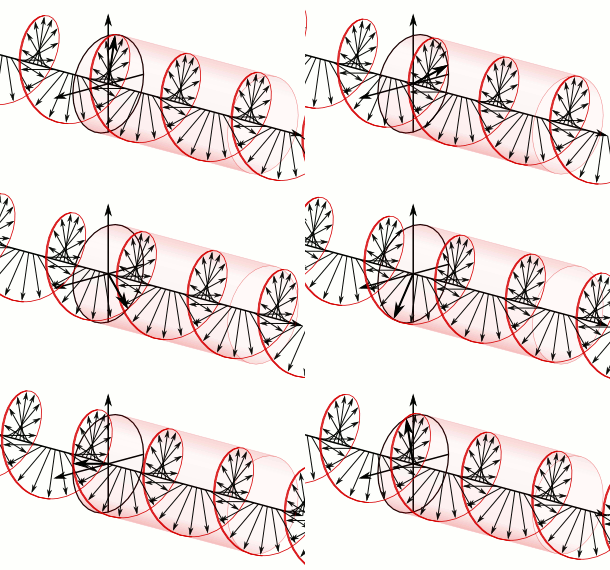
Some content on this page was disabled on June 16, 2020 as a result of a DMCA takedown notice from The California Institute of Technology. You can learn more about the DMCA here:

https://wordpress.com/support/copyright-and-the-dmca/
Some content on this page was disabled on June 20, 2020 as a result of a DMCA takedown notice from Michael A. Gottlieb, Rudolf Pfeiffer, and The California Institute of Technology. You can learn more about the DMCA here:

https://wordpress.com/support/copyright-and-the-dmca/
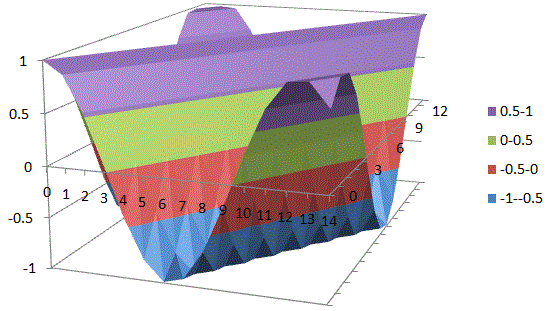
Time reversal and CPT symmetry (I)

Pre-scriptum (dated 26 June 2020): While my posts on symmetries (and why they may or may be broken) are somewhat mutilated (removal of illustrations and other material) as a result of an attack by the dark force, I am happy to see a lot of it survived more or less intact. While my views on the true nature of light, matter and the force or forces that act on them – all of the stuff that explains symmetries or symmetry-breaking, in other words – have evolved significantly as part of my explorations of a more realist (classical) explanation of quantum mechanics, I think most (if not all) of the analysis in this post remains valid and fun to read. 🙂

Original post:

In my previous posts, I introduced the concept of time symmetry, and parity and charge symmetry as well. However, let’s try to explore T-symmetry first. It’s not an easy concept – contrary to what one might think at first.

The arrow of time

Let me start with a very ‘common-sense’ introduction. What do we see when we play a movie backwards? […]

We reverse time. When playing some movie backwards, we look at where things are coming from. And we see phenomena that don’t make sense, such as: (i) cars racing backwards, (ii) old people becoming younger (and dead people coming back to life), (iii) shattered glass assembling itself back into some man-made shape, and (iv) falling objects defying gravity to get back to where they were. Let’s briefly say something about these unlikely or even impossible phenomena before a more formal treatment of the matter:

  1. The first phenomenon – cars racing backwards – is unlikely to happen in real life but quite possible, and some crazies actually do organize such races.
  2. The last example – objects defying gravity – is plain impossible because of Newton’s universal law of gravitation.
  3. The other examples – the old becoming young (and the dead coming back to life), and glass shards coming back together into one piece – are also plain impossible because of some other ‘law’: the law of ever increasing entropy.

However, there’s a distinct difference between the two ‘laws’ (gravity versus increasing entropy). As one entry on Physics Stack Exchange notes, the entropy law – better known as the second law of thermodynamics – “only describes what is most likely to happen in macroscopic systems, rather than what has to happen”, but then the author immediately qualifies this apparent lack of determinism, and rightly so: “It is true that a system may spontaneously decrease its entropy over some time period, with a small but non-zero probability. However, the probability of this happening over and over again tends to zero over long times, so is completely impossible in the limit of very long times.” Hence, while one will find some people wondering whether this entropy law is a ‘real law’ of Nature – in the sense that they would question that it’s always true no matter what – there is actually no room for such doubts.

That being said, the character of the entropy law and the universal law of gravitation is obviously somewhat different – because they describe different realities: the entropy law is a law at the level of a system (a room full of air, for example), while the law of gravitation describes one of the four fundamental forces.

I will now be a bit more formal. What’s time symmetry in physics? The Wikipedia definition is the following: “T-symmetry is the theoretical symmetry (invariance) of physical laws under a time reversal (T) transformation.” Huh?

A ‘time reversal transformation’ amounts to inserting –t (minus t) instead of t in all of our equations describing trajectories or physical laws. Such transformation is illustrated below. The blue curve might represent a car or a rocket accelerating (in this particular example, we have a constant acceleration a = 2). The vertical axis measures the displacement (x) as a function of time (t). , and the red curve is its T-transformation. The two curves are each other’s mirror image, with the vertical axis (i.e. the axis measuring the displacement x) as the mirror axis.

Time reversal 2

This view of things is quite static and, hence, somewhat primitive I should say. However, we can make a number of remarks already. For example, we can see that the slope (of the tangent) of the red curve is negative. This slope is the velocity (v) of the particle: v = dx/dt. Hence, a T-transformation is said to negate the velocity variable (in classical physics that is), just like it negates the time variable. [The verb ‘to negate’ is used here in its mathematical sense: it means ‘to take the additive inverse of a number’ — but you’ll agree that’s too lengthy to be useful as an expression.]

Note that velocity (and mass) determines (linear and angular) momentum and, hence, a T-transformation will also negate p and l, i.e. the linear and angular momentum of a particle.

Such variables – i.e. variables that are negated by the T-transformation – are referred to as odd variables, as opposed to even variables, which are not impacted by the T-transformation: the position of the particle or object (x) is an example of an even variable, and the force acting on a particle (F) is not being negated either: it just remains what it is, i.e. an external force acting on some mass or some charge. The acceleration itself is another ‘even’ variable.

This all makes sense: why would the force or acceleration change? When we put a minus sign in front of the time variable, we are basically just changing the direction of an axis measuring an independent variable. In a way, the only thing that we are doing is introducing some non-standard way of measuring time, isn’t it? Instead of counting from 0 to T, we count from 0 to minus T.

Well… No. In this post, I want to discuss actual time reversal. Can we go back in time? Can we put a genie back into a bottle? Can we reverse all processes in Nature and, if not, why not?

Time reversal and time symmetry are two different things: doing a T-transformation is a mathematical operation; trying to reverse time is something real. Let’s take an example from kinematics to illustrate the matter.

Kinematics

Kinematics can be summed up in one equation, best known as Newton’s Second Law: F = ma = m(dv/dt) = d(mv)/dt.  In words: the time-rate-of-change of a quantity called momentum (mv) is proportional to the force on an object. In other words: the acceleration (a) of an object is proportional to the force (F), and the factor of proportionality is the mass of the object (m). Hence, the mass of an object is nothing but a measure of its inertia.

The numbering of laws (first, second, etcetera) – usually combining some name of a scientist – is often quite arbitrary but, in this case (Newton’s Laws), one can really learn something from listing and discussing them in the right order:

  1. Newton’s First Law is the principle of inertia: if there’s no (other) force acting on an object, it will just continue doing what it does–i.e. nothing or, else, move in some straight line according to the direction of its momentum (i.e. the product of its mass and its velocity)–or further engage with the force it was already engaged with.
  2. Newton’s Second Law is the law of kinematics. In kinematics, we analyze the motion of an object without caring about the origin of the force causing the motion. So we just describe how some force impacts the motion of the object on which it is acting without asking any questions about the force itself. We’ve written this law above: F = ma.
  3. Finally, Newton’s Third Law is the law of gravitation, which describes the origin, the nature and the strength of the gravitational force. That’s part of dynamics, i.e. the study of the forces themselves – as opposed to kinematics, which only looks at the motion caused by those forces.

With these definitions and clarifications, we are now well armed to tackle the subject of T-symmetry in kinematics (we’ll discuss dynamics later). Suppose some object – perhaps an elementary particle but it could also be a car or a rocket indeed – is moving through space with some constant acceleration a (so we can write a(t) = a). This means that v(t) – the velocity as a function of time – will not be constant: v(t) = at. [Note that we make abstraction of the direction here and, hence, our notation does not use any bold letters (which would denote vector quantities): v(t) and a(t) are just simple scalar quantities in this example.]

Of course, when we – i.e. you and me right here and right now – are talking time reversal, we obviously do it from some kind of vantage point. That vantage point will usually be the “now” (and quite often also the “here”), and so let’s use that as our reference frame indeed and we will refer to it as the zero time point: t = 0. So it’s not the origin of time: it’s just ‘now’–the start of our analysis.

Now, the idea of going back in time also implies the idea of looking forward – and vice versa. Let’s first do what we’re used to do and so that’s to look forward.

At some point in the future, let’s call it t = T, the velocity of our object will be equal to v(T) = v(0) + aT. Why the v(0)? Well… We defined the zero time point (t = 0) in a totally random way and, hence, our object is unlikely to stop for that. On the contrary: it is likely to already have some velocity and so that’s why we’re adding this v(0) here. As for the space coordinate, our object may also not be at the exact same spot as we are (we don’t want to be to close to a departing rocket I would assume), so we can also not assume that x(0) = 0 and so we will also incorporate that term somehow. It’s not essential to the analysis though.

OK. Now we are ready to calculate the distance that our object will have traveled at point T. Indeed, you’ll remember that the distance traveled is an infinite sum of infinitesimally small products vΔt: the velocity at each point of time multiplied by an infinitesimally small interval of time. You’ll remember that we write such infinite sum as an integral:

Eq 1

[In case you wonder why we use the letter ‘s’ for distance traveled: it’s because the ‘d’ symbol is already used to denote a differential and, hence, ‘s’ is supposed to stand for ‘spatium’, which is the Latin word for distance or space. As for the integral sign, you know that’s an elongated S really, don’t you? So its stands for an infinite sum indeed. But lets go back to the main story.]

We have a functional form for v(t), namely v(t) = v(0) + at, and so we can easily work out this integral to find s as a function of time. We get the following equation:

Eq 2

When we re-arrange this equation, we get the position of our object as a function of time:

Eq 3

Let us now reverse time by inserting –T everywhere:

Eq 4

Does that still make sense? Yes, of course, because we get the same result when doing our integral:

Eq 5

So that ‘makes sense’. However, I am not talking mathematical consistency when I am asking if it still ‘makes sense’. Let us interpret all of this by looking at what’s happening with the velocity. At t = 0, the velocity of the object is v(0), but T seconds ago, i.e. at point t = -T, the velocity of the object was v(-T) = v(0) – aT. This velocity is less than v(0) and, depending on the value of -T, it might actually be negative. Hence, when we’re looking back in time, we see the object decelerating (and we should immediately add that the deceleration is – just like the acceleration – a constant). In fact, it’s the very same constant a which determines when the velocity becomes zero and then, when going even further back in time, when it becomes negative.

Huh? Negative velocity? Here’s the difference with the movie: in that movie that we are playing backwards, our car, our rocket, or the glass falling from a table or a pedestal would come to rest at some point back in time. We can calculate that point from our velocity equation v(t) = v(0) + at. In the example below, our object started accelerating 2.5 seconds ago, at point t = –2.5. But, unlike what we would see happening in our backwards-playing movie, we see that object not only stopping but also reversing its direction, to go in the same direction as we saw it going when we’re watching the movie before we hit the ‘Play Backwards’ button. So, yes, the velocity of our object changes sign as it starts following the trajectory on the left side of the graph.

time reversal

What’s going on here? Well… Rest assured: it’s actually quite simple: because the car or that rocket in our movie are real-life objects which were actually at rest before t = –2.5, the left side of the graph above is – quite simply – not relevant: it’s just a mathematical thing. So it does not depict the real-life trajectory of an accelerating car or rocket. The real-life trajectory of that car or rocket is depicted below.

real-life car

So we also have a ‘left side’ here: a horizontal line representing no movement at all. Our movie may or may not have included this status quo. If it did, you should note that we would not be able to distinguish whether or not it would be playing forward or backwards. In fact, we wouldn’t be able to tell whether the movie was playing at all: we might just as well have hit the ‘pause’ button and stare at a frozen screenshot.

Does that make sense? Yes. There are no forces acting on this object here and, hence, there is no arrow of time.

Dynamics

The numerical example above is confusing because our mind is not only thinking about the trajectory as such but also about the force causing the particle—or the car or the rocket in the example above—to move in this or that direction. When it’s a rocket, we know it ignited its boosters 2.5 seconds ago (because that’s what we saw – in reality or in a movie of the event) and, hence, seeing that same rocket move backwards – both in time as well as in space – while its boosters operate at full thrust does not make sense to us. Likewise, an obstacle escaping gravity with no other forces acting on it does not make sense either.

That being said, reversing the trajectory and, hence, actually reversing the effects of time, should not be a problem—from a purely theoretical point at least: we should just apply twice the force produced by the boosters to give that rocket the same acceleration in the reverse direction. That would obviously means we would force it to crash back into the Earth. Because that would be rather complicated (we’d need twice as many boosters but mounted in the opposite direction), and because it would also be somewhat evil from a moral point of view, let us consider some less destructive examples.

Let’s take gravity, or electrostatic attraction or repulsion. These two forces also cause uniform acceleration or deceleration on objects. Indeed, one can describe the force field of a large mass (e.g. the Earth)—or, in electrostatics, some positive or negative charge in space— using field vectors. The field vectors for the electric field are denoted by E, and, in his famous Lectures on Physics, Feynman uses a C for the gravitational field. The forces on some other mass m and on some other charge q can then be written as F = mC and F = qE respectively. The similarity with the F = ma equation – Newton’s Second Law in other words – is obvious, except that F = mC and F = qE are an expression of the origin, the nature and the strength of the force:

  1. In the case of the electrostatic force (remember that likes repel and opposites attract), the magnitude of E is equal to E = qc/4πε0r2. In this equation, εis the electric constant, which we’ve encountered before, and r is the distance between the charge q and the charge qcausing the field).
  2. For the gravitational field we have something similar, except that there’s only attraction between masses, no repulsion. The magnitude of C will be equal to C = –GmE/r2, with mE the mass causing the gravitational field (e.g. the mass of the Earth) and G the universal gravitational constant. [Note that the minus sign makes the direction of the force come out alright taking the existing conventions: indeed, it’s repulsion that gets the positive sign – but that should be of no concern to us here.]

So now we’ve explained the dynamics behind that x(t) = x(0) + v(0)·t + (a/2)·tcurve above, and it’s these dynamics that explain why looking back in time does not make sense—not in a mathematical way but in philosophical way. Indeed, it’s the nature of the force that gives time (or the direction of motion, which is the very same ‘arrow of time’) one–and only one–logical direction.

OK… But so what is time reversibility then – or time symmetry as it’s referred to? Let me defer an answer to this question by first introducing another topic.

Even and odd functions

I already introduced the concept of even and odd variables above. It’s obviously linked to some symmetry/asymmetry. The x(t) curve above is symmetric. It is obvious that, if we would change our coordinate system to let x(0) equal x(0) = 0, and also choose the origin of time such that v(0) = 0, then we’d have a nice symmetry with respect to the vertical axis. The graph of the quadratic function below illustrates such symmetry.

Even functionFunctions with a graph such as the one above are called even functions. A (real-valued) function f(t) of a (real) variable t is defined as even if, for all t and –t in the domain of f, we find that f(t) = f(–t).

We also have odd functions, such as the one depicted below. An odd function is a function for which f(-t) = –f(t).

Odd function

The function below gives the velocity as a function of time, and it’s clear that this would be an odd function if we would choose the zero time point such that v(0) = 0. In that case, we’d have a line through the origin and the graph would show an odd function. So that’s why we refer to v as an odd variable under time reversal.

Velocity curve

A very particular and very interesting example of an even function is the cosine function – as illustrated below.

Cosine functionNow, we said that the left side of the graph of the trajectory of our car or our rocket (i.e. the side with a negative slope and, hence, negative velocity) did not make much sense, because – as we play our movie backwards – it would depict a car or a rocket accelerating in the absence of a force. But let’s look at another situation here: a cosine function like the one above could actually represent the trajectory of a mass oscillating on a spring, as illustrated below.

oscillating springIn the case of a spring, the force causing the oscillation pulls back when the spring is stretched, and it pushes back when it’s compressed, so the mechanism is such that the direction of the force is being reversed continually. According to Hooke’s Law, this force is proportional to the amount of stretch. If x is the displacement of the mass m, and k that factor of proportionality, then the following equality must hold at all times:

F = ma = m(d2x/dt2) = –kx ⇔ d2x/dt= –(k/m)x

Is there also a logical arrow of time here? Look at the illustration below. If we follow the green arrow, we can readily imagine what’s happening: the spring gets stretched and, hence, the mass on the spring (at maximum speed as it passes the equilibrium position) encounters resistance: the spring pulls it back and, hence, it slows down and then reverses direction. In the reverse direction – i.e. the direction of the red arrow – we have the reverse logic: the spring gets compressed (x is negative), the mass slows down (as evidence by the curvature of the graph), and – at some point – it also reverses its direction of movement. [I could note that the force equation above is actually a second-order linear differential equation, and that the cosine function is its solution, but that’s a rather pedantic and, hence, totally superfluous remark here.]

temp

What’s important is that, in this case, the ‘arrow of time’ could point either way, and both make sense. In other words, when we would make a movie of this oscillating movement, we could play it backwards and it would still make sense. 

Huh? Yes. Just in case you would wonder whether this conclusion depends on our starting point, it doesn’t. Just look at the illustration below, in which I assume we are starting to watch that movie (which is being played backwards without us knowing it is being played backwards) of the oscillating spring when the mass is not in the equilibrium position. It makes perfect sense: the spring is stretched, and we see the mass accelerating to the equilibrium position, as it should.

temp2

What’s going on here? Why can we reverse the arrow of time in the case of the spring, and why can’t we do that in the case of that particle being attracted or repelled by another? Are there two realities here? No. There’s only. I’ve been playing a trick on you. Just think about what is actually happening and then think about that so-called ‘time reversal’:

  1. At point A, the spring is still being stretched further, in reality that is, and so the mass is moving away from the equilibrium position. Hence, in reality, it will not move to point B but further away from the equilibrium position.
  2. However, we could imagine it moving from point A to B if we would reverse the direction of the force. Indeed, the force is equal to –kx and reversing its direction is equivalent to flipping our graph around the horizontal axis (i.e. the time axis), or to shifting the time axis left or right with an amount equal to π (note that the ‘time’ axis is actually represented by the phase, but that’s a minor technical detail and it does not change the analysis: we just measure time in radians here instead of seconds).

It’s a visual trick. There is no ‘real’ symmetry. The flipped graph corresponds to another situation (i.e. some other spring that started oscillating a bit earlier or later than ours here). Hence, our conclusion that it is the force that gives time direction, still holds.

Hmm… Let’s think about this. What makes our ‘trick’ work is that the force is allowed to change direction. Well… If we go back to our previous example of an object falling towards the center of some gravitational field, or a charge being attracted by some other (opposite) charge, then you’ll note that we can make sense of the ‘left side’ of the graph if we would change the sign of the force.

Huh? Yes, I know. This is getting complicated. But think about it. The graph below might represent a charged particle being repelled by another (stationary) particle: that’s the green arrow. We can then go back in time (i.e. we reverse the green arrow) if we reverse the direction of the force from repulsion to attraction. Now, that would usually lead to a dramatic event—the end of the story to be precise. Indeed, once the two particles get together, they’re glued together and so we’d have to draw another horizontal line going in the minus t direction (i.e. to the left side of our time axis) representing the status quo. Indeed, if the two particles sit right on top of each other, or if they would literally fuse or annihilate each other (like a particle and an anti-particle), then there’s no force or anything left at all… except ifwe would alter the direction of the force once again, in which case the two particles would fly apart again (OK. OK. You’re right in noting that’s not true in the annihilation case – but that’s a minor detail).

arrow of time

Is this story getting too complicated? It shouldn’t. The point to note is that reversibility – i.e. time reversal in the philosophical meaning of the word (not that mathematical business of inserting negative variables instead of positive ones) – is all about changing the direction of the force: going back in time implies that we reverse the effects of time, and reversing the effects of time, requires forces acting in the opposite direction.

Now, when it’s only kinetic energy that is involved, then it should be easy but when charges are involved, which is the case for all fundamental forces, then it’s not so easy. That’s when charge (C) and parity (P) symmetry come into the picture.

CP symmetry

Hooke’s ‘Law’ – i.e. the law describing the force on a mass on a stretched or compressed spring – is not a fundamental law: eventually the spring will stop. Yes. It will stop even if when it’s in a horizontal position and with the mass moving on a frictionless surface, as assumed above: the forces between the atoms and/or molecules in the spring give the spring the elasticity which causes the mass to oscillate around some equilibrium position, but some of the energy of that continuous movement gets lost in heat energy (yes, an oscillating spring does actually get warmer!) and, hence, eventually the movement will peter out and stop.

Nevertheless, the lesson we learned above is a valuable one: when it comes to the fundamental forces, we can reverse the arrow of time and still make sense of it all if we also reverse the ‘charges’. The term ‘charges’ encompasses anything measuring a propensity to interact through one of the four fundamental forces here. That’s where CPT symmetry comes in: if we reverse time, we should also reverse the charges.

But how can we change the ‘sign’ of mass: mass is always positive, isn’t it? And what about the P-symmetry – this thing about left-handed and right-handed neutrinos?

Well… I don’t know. That’s the kind of stuff I am currently exploring in my quest. I’ll just note the following:

1. Gravity might be a so-called pseudo force – because it’s proportional to mass. I won’t go into the details of that – if only because I don’t master them as yet – but Einstein’s gut instinct that gravity is not a ‘real’ fundamental force (we just have to adjust our reference frame and work with curved spacetime) – and, hence, that ‘mass’ is not like the other force ‘charges’ – is something I want to further explore. [Apart from being a measure for inertia, you’ll remember that (rest) mass can also be looked at as equivalent to a very dense chunk of energy, as evidenced by Einstein’s energy-mass equivalence formula: E = mc2.]

As for now, I can only note that the particles in an ‘anti-world’ would have the same mass. In that sense, anti-matter is not ‘anti’-matter: it just carries opposite electromagnetic, strong and weak charges. Hence, our C-world (so the world we get when applying a charge transformation) would have all ‘charges’ reversed, but mass would still be mass.

2. As for parity symmetry (i.e. left- and right-handedness, aka as mirror symmetry), I note that it’s raised primarily in relation to the so-called weak force and, hence, it’s also a ‘charge’ of sorts—in my primitive view of the world at least. The illustration below shows what P symmetry is all about really and may or may not help you to appreciate the point.

muon decay

OK. What is this? Let’s just go step by step here.

The ‘cylinder’ (both in (a), the upper part of the illustration, and in (b), the lower part) represents a muon—or a bunch of muons actually. A muon is an unstable particle in the lepton family. Think of it as a very heavy electron for all practical purposes: it’s about 200 times the mass of an electron indeed. Its lifetime is fairly short from our (human) point of view–only 2.2 microseconds on average–but that’s actually an eternity when compared to other unstable particles.

In any case, the point to note is that it usually decays into (i) two neutrinos (one muon-neutrino and one electron-antineutrino to be precise) and – importantly – (ii) one electron, so electric charge is preserved (indeed, neutrinos got the name they have because they carry no electric charge).

Now, we have left- and right-handed muons, and we can actually line them up in one of these two directions. I would need to check how that’s done, but muons do have a magnetic moment (just like electrons) and so I must assume it’s done in the same way as in Wu’s cobalt-60 experiment: through a uniform magnetic field. In other words, we know their spin directions in an experiment like this.

Now, if the weak force would respect mirror symmetry (but we already know it doesn’t), we would not be able to distinguish (i) the muon decay process in the ‘mirror world’ (i.e. the reflection of what’s going on in the (imaginary) mirror in the illustration above) from (ii) the decay process in ‘our’ (real) world. So that would be situation (a): the number of decay electrons being emitted in an upward direction would be the same (more or less) as the amount of decay electrons being emitted in a downward direction.

However, the actual laboratory experiments show that situation (b) is actually the case: most of the electrons are being emitted in only one direction (i.e. the upward direction in the illustration above) and, hence, the weak force does not respect mirror symmetry.

So what? Is that a problem?

For eminent physicists such as Feynman, it is. As he writes in his concluding Lecture on mechanics, radiation and heat (Vol. I, Chapter 52: Symmetry in Physical Laws): “It’s like seeing small hairs growing on the north pole of a magnet but not on its south pole.” [He means it allows us to distinguish the north and the south pole of a magnet in some absolute sense. Indeed, if we’re not able to tell right from left, we’re also not able to tell north from south – in any absolute sense that is. But so the experiment shows we actually can distinguish the two in some kind of absolute sense.]

I should also note that Wolfgang Pauli, one of the pioneers of quantum mechanics, said that it was “total nonsense” when he was informed about Wu’s experimental results, and that repeated experiments were needed to actually convince him that we cannot just create a mirror world out of ours. 

For me, it is not a problem.I like to think of left- and right-handedness as some charge itself, and of the combined CPT symmetry as the only symmetry that matters really. That should be evident from my rather intuitive introduction on time symmetry above.

Consider it and decide for yourself how logical or illogical it is. We could define what Feynman refers to as an axial vector: watching that muon ‘from below’, we see that its spin is clockwise, and let’s use that fact to define an axial vector pointing in the same direction as the thick black arrow (it’s the so-called ‘right-hand screw rule’ really), as shown below.

Axial vector

Now, let’s suppose that mirror world actually exists, in some corner in the universe, and that a guy living in that ‘mirror world’ would use that very same ‘right-hand-screw rule’: his axial vector when doing this experiment would point in the opposite direction (see the thick black arrow in the mirror, which points in the opposite direction indeed). So what’s wrong with that?

Nothing – in my modest view at least. Left- and right-handedness can just be looked at as any other ‘charge’ – I think – and, hence, if we would be able to communicate with that guy in the ‘mirror world’, the two experiments would come out the same. So the other guy would also notice that the weak force does not respect mirror symmetry but so there’s nothing wrong with that: he and I should just get over it and continue to do business as usual, wouldn’t you agree?

After all, there could be a zillion reasons for the experiment giving the results it does: perhaps the ‘right-handed’ spin of the muon is sort of transferred to the electron as the muon decays, thereby giving it the same type of magnetic moment as the one that made the muon line up in the first place. Or – in a much wilder hypothesis which no serious physicist would accept – perhaps we actually do not yet understand everything of the weak decay process: perhaps we’ve got all these solar neutrinos (which all share the same spin direction) interfering in the process.

Whatever it is: Nature knows the difference between left and right, and I think there’s nothing wrong with that. Full stop.

But then what is ‘left’ and ‘right’ really? As the experiment pointed out, we can actually distinguish between the two in some kind of absolute sense. It’s not just a convention. As Feynman notes, we could decide to label ‘right’ as ‘left’, and ‘left’ as ‘right’ right here and right now – and impose the new convention everywhere – but then these physics experiments will always yield the same physical results, regardless of our conventions. So, while we’d put different stickers on the results, the laws of physics would continue to distinguish between left and right in the same absolute sense as Wu’s cobalt-60 decay experiment did back in 1956.

The really interesting thing in this rather lengthy discussion–in my humble opinion at least–is that imaginary ‘guy in the mirror world’. Could such mirror world exist? Why not? Let’s suppose it does really exist and that we can establish some conversation with that guy (or whatever other intelligent life form inhabiting that world).

We could then use these beta decay processes to make sure his ‘left’ and ‘right’ definitions are equal to our ‘left’ and ‘right’ definitions. Indeed, we would tell him that the muons can be left- or right-handed, and we would ask him to check his definition of ‘right-handed’ by asking him to repeat Wu’s experiment. And, then, when finally inviting him over and preparing to physically meet with him, we should tell him he should use his “right” hand to greet us. Yes. We should really do that.

Why? Well… As Feynman notes, he (or she or whatever) might actually be living in an anti-matter world, i.e. a world in which all charges are reversed, i.e. a world in which protons carry negative charge and electrons carry positive charge, and in which the quarks have opposite color charge. In that case, we would have been updating each other on all kinds of things in a zillion exchanges, and we would have been trying hard to assure each other that our worlds are not all that different (including that crucial experiment to make sure his left and right are the same as ours), but – if he would happen to live in an anti-matter world – then he would put out his left hand – not his right – when getting out of his spaceship. Touching it would not be wise. 🙂

[Let me be much more pedantic than Feynman is and just point out that his spaceship would obviously have been annihilated by ‘our’ matter long before he would have gotten to the meeting place. As soon as he’d get out of his ‘anti-matter’ world, we’d see a big flash of light and that would be it.]

Symmetries and conservation laws

A final remark should be made on the relation between all those symmetries and conservation laws. When everything is said and done, all that we’ve got is some nice graphs and then some axis or plane of symmetry (in two and three dimensions respectively). Is there anything more to it? There is.

There’s a “deep connection”, it seems, between all these symmetries and the various ‘laws of conservation’. In our examples of ‘time symmetry’, we basically illustrated the law of energy conservation:

  1. When describing a particle traveling through an electrostatic or gravitation field, we basically just made the case that potential energy is converted into kinetic energy, or vice versa.
  2. When describing an oscillating mass on a spring, we basically looked at the spring as a reservoir of energy – releasing and absorbing kinetic energy as the mass oscillates around its zero energy point – but, once again, all we described was a system in which the total amount of energy – kinetic and elastic – remained the same.

In fact, the whole discussion on CPT symmetry above has been quite simplistic and can be summarized as follows:

Energy is being conserved. Therefore, if you want to reverse time, you’ll need to reverse the forces as well. And reversing the forces implies a change of sign of the charges causing those forces.

In short, one should not be fascinated by T-symmetry alone. Combined CPT symmetry is much more intuitive as a concept and, hence, much more interesting. So, what’s left?

Quite a lot. I know you have many more questions at this point. At least I do:

  1. What does it mean in quantum mechanics? How does the Uncertainty Principle come into play?
  2. How does it work exactly for the strong force, or for the weak force? [I guess I’d need to find out more about neutrino physics here…]
  3. What about the other ‘conservation laws’ (such as the conservation of linear or angular momentum, for example)? How are they related to these ‘symmetries’.

Well… That’s complicated business it seems, and even Feynman doesn’t explore these topics in the above-mentioned final Lecture on (classical) mechanics. In any case, this post has become much too long already so I’ll just say goodbye for the moment. I promise I’ll get back to you on all of this.

Post scriptum:

If you have read my previous post (The Weird Force), you’ll wonder why – in the example of how a mirror world would relate to ours – I assume that the combined CP symmetry holds. Indeed, when discussing the ‘weird force’ (i.e. the weak force), I mentioned that it does not respect any of the symmetries, except for the combined CPT symmetry. So it does not respect (i) C symmetry, (ii) P symmetry and – importantly – it also does not respect the combined CP symmetry. This is a deep philosophical point which I’ll talk about in my next post. However, I needed this post as an ‘introduction’ to the next one.