Using AI for sense-making once more…

As mentioned in my last post, I did a video (YouTube link here) on why I think the invention of new quantum numbers like strangeness, charm and beauty in the 1960s – and their later ontologization as quarks – makes no sense. As usual, I talk too much and the video is rather long-winding. I asked ChatGPT to make a summary of it, and I think it did a rather good job at that. I copy its summary unaltered below.

Beyond the Quark Hypothesis: A Call for Simplicity in High-Energy Physics

1. Introduction: A Personal Journey in Physics

In this video, I reflect on my path as an amateur physicist reaching 50,000 reads—a milestone that underscores both excitement and the challenge of tackling complex quantum theories. Over decades, physics has evolved from classical mechanics to intricate frameworks like quantum field theory and quantum chromodynamics, creating both insight and paradox. This reflection emerges from a deep sense of curiosity, shared by many, to understand not just what the universe is made of but how these theoretical structures genuinely map onto reality.

2. The Crisis of Modern Physics: From Classical Mechanics to the Quark Hypothesis

Moving through physics from classical theories into high-energy particle models reveals a stark contrast: classical mechanics offers clarity and empiricism, while modern particle theories, such as quarks and gluons, often feel abstract and detached from observable reality. The shift to “smoking gun physics”—observing particle jets rather than the particles themselves—highlights a methodological divide. While high-energy collisions produce vivid images and data, we must question whether these indirect observations validate quarks, or merely add complexity to our models.

3. Historical Context: Quantum Numbers and the Evolution of the Standard Model

The 1960s and 70s were pivotal for particle physics, introducing quantum numbers like strangeness, charm, and beauty to account for unexplained phenomena in particle interactions. Figures like Murray Gell-Mann and Richard Feynman attempted to classify particles by assigning these numbers, essentially ad hoc solutions to match data with theoretical expectations. However, as experiments push the boundaries, new data shows that these quantum numbers often fail to predict actual outcomes consistently.

One of the key criticisms of this approach lies in the arbitrary nature of these quantum numbers. When certain decays were unobserved, strangeness was introduced as a “conservation law,” but when that proved insufficient, additional numbers like charm were added. The Standard Model has thus evolved not from fundamental truths, but as a patchwork of hypotheses that struggle to keep pace with experimental findings.

4. The Nobel Prize and the Politics of Scientific Recognition

Scientific recognition, especially through the Nobel Prize, has reinforced certain theories by celebrating theoretical advances sometimes over empirical confirmation. While groundbreaking work should indeed be recognized, the focus on theoretical predictions has, at times, overshadowed the importance of experimental accuracy and reproducibility. This dynamic may have inadvertently constrained the scope of mainstream physics, favoring elaborate but tenuous theories over simpler, empirically grounded explanations.

For example, Nobel Prizes have been awarded to proponents of the quark model and the Higgs boson long before we fully understand these particles’ empirical foundations. In doing so, the scientific community risks prematurely canonizing incomplete or even incorrect theories, making it challenging to revisit or overturn these assumptions without undermining established reputations.

5. Indirect Evidence: The Limits of Particle Accelerators

Particle accelerators, particularly at scales such as CERN’s Large Hadron Collider, have extended our observational reach, yet the evidence remains indirect. High-energy collisions create secondary particles and jets rather than isolated quarks or gluons. In a sense, we are not observing the fundamental particles but rather the “smoking gun” evidence they purportedly leave behind. The data produced are complex patterns and distributions, requiring interpretations laden with theoretical assumptions.

This approach raises a fundamental question: if a theory only survives through indirect evidence, can it be considered complete or even valid? High-energy experiments reveal that the more energy we input, the more complex the decay products become, yet we remain without direct evidence of quarks themselves. This “smoking gun” approach diverges from the empirical rigor demanded in classical physics and undermines the predictive power we might expect from a true theory of fundamental particles.

6. The Particle Zoo: A Growing Complexity

The “particle zoo” has expanded over decades, complicating rather than simplifying our understanding of matter. Initial hopes were that quantum numbers and conservation laws like strangeness would organize particles in a coherent framework, yet the resulting classification scheme has only grown more convoluted. Today, particles such as baryons, mesons, and leptons are grouped by properties derived not from first principles but from empirical fits to data, leading to ad hoc conservation laws that seem arbitrary.

The “strangeness” quantum number, for instance, was initially introduced to prevent certain reactions from occurring. Yet, rare reactions that violate this rule have been observed, suggesting that the rule itself is more of a guideline than a fundamental conservation law. This trend continued with the addition of quantum numbers like charm, beauty, and even bottomness, yet these additions have not resolved the core issue: our inability to explain why certain reactions occur while others do not.

7. Disequilibrium States: Beyond the Particle Concept

One possible perspective is to reclassify many “particles” not as fundamental entities but as disequilibrium states—transient structures that emerge from the interactions of more fundamental components. Viewing particles in this way offers a pathway back to a simpler, more intuitive model, where only stable particles like electrons, protons, and photons are foundational. Such a model could focus on electromagnetic fields and forces, with high-energy states representing temporary disequilibrium configurations rather than new particle species.

This perspective aligns well with the principle of statistical determinism. In the same way that classical oscillators eventually dampen and settle into stable states, high-energy disequilibrium states would be expected to decay, producing stable configurations over time. This model not only reduces the need for numerous quantum numbers but also sidesteps the requirement for exotic forces like the strong and weak nuclear forces, allowing the electromagnetic force to assume a central role.

8. Statistical Determinism and Quantum Reality

Heisenberg and Bohr’s interpretation of quantum mechanics suggests we should accept statistical determinism—systems governed by probabilistic rules where precise knowledge of individual events is inaccessible. This idea does not necessitate mystical randomness but acknowledges our limited ability to track initial conditions in high-energy environments. Probabilities emerge not from an intrinsic unpredictability but from our practical inability to fully specify a system’s state.

From this viewpoint, quarks and gluons, as well as the numerous quantum numbers assigned to unstable particles, are secondary descriptors rather than primary components of nature. Stable particles are the true constants, while all else is a function of high-energy interactions. This interpretation keeps quantum mechanics grounded in empirical reality and sidesteps the need for complex, unverifiable entities.

9. Conclusion: Toward a Pragmatic and Local Realist Approach

This reflection does not dismiss the importance of high-energy physics but advocates a return to fundamental principles. By focusing on empirical evidence, statistical determinism, and electromagnetic interactions, we can build a model that is both pragmatic and intuitive. We need not abandon quantum mechanics, but we should strive to ensure that its interpretations are consistent with the observable universe. Instead of introducing additional quantum numbers or forces, we should ask if these are placeholders for deeper, more coherent explanations yet to be discovered.

The journey of science is, at its core, a journey back to simplicity. If physics is to move forward, it may do so by revisiting foundational assumptions, clarifying what can be empirically tested, and developing a model of matter that resonates with the simplicity we find in classical theories. As research continues, it is this blend of skepticism, open-mindedness, and empirical rigor that will pave the way for meaningful discoveries.

The failure of physics as a science?

It is a coincidence but Sabine Hossenfelder just produced a new video in which she talks once again about the problems of academic physics, while I did what I said what I would not do – and that is to write out why the discovery of new rare kaon decay modes is a problem for the Standard Model. I think the video and the paper complement each other nicely, although Sabine Hossenfelder probably still believes the strong force and weak interactions are, somehow, still real. [I did not read her book, so I don’t know: I probably should buy her book but then one can only read one book at a time, isn’t it?]

The paper (on ResearchGate – as usual: link here) does what Sabine Hossenfelder urges her former colleagues to do: if a hypothesis or an ad hoc theory doesn’t work, then scientists should be open and honest about that and go back to the drawing board. Indeed, in my most-read paper – on de Broglie’s matter-wave – I point out how de Broglie’s original thesis was misinterpreted and how classical quantum theory suddenly makes sense again when acknowledging that mistake: it probably explains why I am getting quite a lot of reads as an amateur physicist. So what’s this new paper of mine all about?

I go back to the original invention of the concept of strangeness, as documented by Richard Feynman in his 1963 Lectures on quantum physics (Vol. III, Chapter 11-5) and show why and how it does not make all that much sense. In fact, I always thought these new quantum conservation laws did not make sense theoretically and that, at best, they were or are what Dr. Kovacs and Dr. Vassallo refer to as phenomenological models rather than sound physical theories (see their chapter on superconductivity in their latest book). However, now it turns out these fancy new concepts do not even do what they are supposed to do, and that is to correctly describe the phenomenology of high-energy particle reactions. :-/

The alternative – a realist interpretation of quantum physics – is there. It is just not mainstream – yet! 🙂

Post scriptum (8 November 2024): For those who do not like to read, you can also watch what I think of my very last video on the same topic: what makes sense and what does not in academic or mainstream physics? Enjoy and, most importantly, do not take things too seriously ! Life family and friends – and work or action-oriented engagement are far more important than personal philosophy or trying to finding truth in science… 🙂

The ultimate proton model?

Today I made a major step towards a very different Zitterbewegung model of a proton. With different, I mean different from the usual toroidal or helical model(s). I had a first version of this paper but the hyperlink gives you the updated paper. The update is small but very important: I checked all the formulas with ChatGPT and, hence, consider that as confirmation that I am on the right track. To my surprise, ChatGPT first fed me the wrong formula for an orbital frequency formula. Because I thought it could not be wrong on such simple matters, I asked it to check and double-check. It came with rather convincing geometrical explanations but I finally found an error in its reasoning, and the old formula from an online engineering textbook turned out to be correct.

In any case, I now have a sparring partner – ChatGPT o1 – to further develop the model that we finally settled on. That is a major breakthrough in this realistic interpretation of quantum theory and particle models that I have been trying to develop: the electron model is fine, and so now all that is left is this proton model. And then, of course, a model for a neutron or the deuteron nucleus. That will probably be a retirement project, or something for my next life. 🙂

Post scriptum: I followed up. “A theory’s value lies in its utility and ability to explain phenomena, regardless of whether it’s mainstream or not.” That’s ChatGPT’s conclusion after various explorations and chats with it over the past few weeks: https://lnkd.in/ekAAbvwc. I think I tried to push its limits when discussing problems in physics, leading it to make a rather remarkable distinction between “it’s” perspective and mine (see point 6 of Annex I of https://lnkd.in/eFVAyHn8), but – frankly – it may have no limits. As far as I can see, ChatGPT-o1 is truly amazing: sheer logic. 🙂 hashtag#AI hashtag#ChatGPT hashtag#theoryofreality

Using AI to solve the 80-year-old problem of the anomaly of the electron magnetic moment?

Pre-scriptum (3 October 2024): I came back from holiday and, because this week-long up and down became quite convoluted, I did what I like to do in a case like that, and that is to take my Bamboo notebook and talk about it all in a video which I added to my Real Quantum Physics channel on YouTube. I also updated my paper on RG: as usual, it went through a few versions, but this one – with a summary co-authored by ChatGTP-4 (and ChatGPT-o1) – should be the final one: enjoy!

Indeed, instead of listening to the international news on the war with Russia and on what is happening in the Middle East (all very depressing), you may want to listen to this and read the latest theory. Perhaps you will be inspired by it to develop your own pet realist theory of what an electron might actually be. I can assure you that it is more fun than trying to understand Feynman diagrams and how QED calculations work. 🙂 But don’t think you will win a Nobel Prize if you do not have the right connections and pedigree and all of that: see this analysis of what makes Nobel Prize winners Nobel Prize winners. 🙂

Original post:

I asked some questions to ChatGPT about my geometric explanation of the anomaly in the electron’s magnetic moment. Here is the chat: https://chatgpt.com/share/66f91760-68b8-8004-8cb2-7d2d3624e0aa. To me, it confirms the ‘explanation’ of mainstream QED makes no sense. We can take Schwinger’s factor and build a series of converging terms using that factor. We can also take my first rough cut at a first-order correction (π(alpha)2/8, see my very early 2019 paper on a classical explanation of the amm), and use that.

You may wonder: why not ask ChatGPT about the best first-order factor to be used here considering the geometry of the situation? The fact is: I did, but the geometry is not all that easy. It first came up with the formula for a spherical cap, but that one does not do the trick. See the latter part of the conversation (link above).

I am on holiday now, and so I will switch off a while but I am thinking AI will do what two generations of ‘new’ quantum physicists did not do: come up with a model that is based on real physics and is easy to understand intuitively. 🙂

PS: Of course, I did another rapid-fire paper on ResearchGate to document it all (the logic step-by-step, so to speak). As the chat is public, feel free to continue the conversation. Note that I used the newest ChatGPT o1 version, now in preview but part of a subscription (which you may not have). Yet again a different beast! The older versions of ChatGPT may not be so smart. This conversation is totally worth the US$20/month I pay for my subscription. 🙂

PS 2: Now that I had it open, I also quickly queried it on my wildest hypothesis: a ‘mirror’ electromagnetic force explaining dark matter and dark energy. While it is totally wild (read: nuts), I entertain it because it does away with the need for an explanation in terms of some cosmological constant. Here is the conversation: https://chatgpt.com/share/66f92c7f-82a0-8004-a226-bde65085f18d. I like it that ChatGPT warns me a bit about privacy. It does look wild. However, it is nice to see how gentle ChatGPT is in pointing out what work needs to be done on a theory in order to make it look somewhat less wild. 🙂

PS 3 (yes, ChatGPT is addictive): I also queried it on the rather puzzling 8π/3 factor in the CODATA formula for the Thomson photon-electron scattering cross-section. See its response to our question in the updated chat: https://chatgpt.com/share/66f91760-68b8-8004-8cb2-7d2d3624e0aa. Just scroll down to the bottom. It took 31 seconds to generate the reply: I would be curious to know if that is just courtesy from ChatGPT (we all like to think our questions are complicated, don’t we?), or if this was effectively the time it needed to go through its knowledge base. Whatever the case might be, we think it is brilliant. 🙂 It is nothing to be afraid of, although I did feel a bit like: what’s left to learn to it but for asking intelligent questions. What if it starts really learning by asking intelligent questions itself to us? I am all ready for it. 🙂

New kaon decay modes?

As an amateur physicist, I get a regular stream of email updates from Science, Nature and Phys.org on new discoveries and new theories in quantum physics. I usually have no idea what to do with them. However, I want to single out two recent updates on the state of affairs of research which these channels report on. The first one is reflected in the title of this post. It’s on a very rare decay mode of kaons: see https://phys.org/news/2024-09-ultra-rare-particle-decay-uncover.html.

Something inside of me says this may lead to a review of all these newly invented conservation laws – combined with new ideas on symmetry breaking too – and/or new ‘quantum numbers’ that are associated with the quark hypothesis: I think everyone has already forgotten about ‘baryon conservation’, so other simplifications based on, yes, simpler Zitterbewegung models of particles may be possible.

The historical background to this is well described by Richard Feynman in his discussion of how these new quantum numbers – strangeness, specifically – were invented to deal with the observation that certain decay reactions were not being observed (see: Feynman’s Lectures, III-11-5, the (neutral) K-meson). So now it turns that certain decay reactions are being observed! Shouldn’t that lead to (future) scientists revisiting the quark/gluon hypothesis itself?

Of course, that would call into question several Nobel Prize awards, so we think it won’t happen any time soon. 🙂 This brings me to the second update from the field. Indeed, a more recent Nobel Prize in Physics which should, perhaps, be questioned in light of more recent measurements questioning old(er) ones (and the theories that are based on them) is the Nobel Prize in 2011 for work on the cosmological constant. Why? Because… Well… New measurements on the rate of expansion of the Universe as reported by Phys.org last month question the measurements which led to that 2011 Prize. Is anyone bothered by that? No. Except me, perhaps, because I am old-fashioned and wonder what is going on.

I get asked about gravity, and some people push particle theories to me talking about gravity. I am, quite simply, not interested. This ‘coming and going’ of the “cosmological constant hypothesis” over the past decades – or, should we say, the past 80 years or so – makes me stay away from GUTs and anything that is related to it. If scientists cannot even agree on these measurements, it is of not much use to invent new modified gravity theories fitting into ever-expanding grand unification schemes based on mathematical frameworks that can only be understood by the conoscienti, isn’t it?

It is tough: I am not the only one (and definitely not the best placed one) to see a lot of researchers – both amateur as well as professional – “getting lost in math” (cf. the title of Hossenfelder’s best-seller). Will there be an end to this, one day?

I am optimistic and so I think: yes. One of the recurring principles that guides some of the critical physicists I greatly admire is Occam’s Razor Principle: keep it simple! Make sure the degrees of freedom in your mathematical scheme match those of the physics you are trying to describe. That requires a lot of rigor in the use of concepts: perhaps we should add concepts to those that, say, Schrödinger and Einstein used 100 years ago. However, my own pet theories and recycling of their ideas do not suggest that. And so I really just can’t get myself to read up on Clifford algebras and other mathematical constructs I am told to study – simply because this or that person tells me I should think in terms of spinors rather than in terms of currents (to just give one specific example here).

I can only hope that more and more academics will come to see this, and that the Nobel Prize committee may think some more about rewarding more conservative approaches rather than the next cargo cult science idea.

OK. I should stop rambling. The musings above do not answer the question we all have: what about gravity, then? My take on that is this: I am fine with Einstein’s idea of gravity just being a reflection of the distribution of energy/mass in the Universe. Whether or not the Universe expands at an ever-faster-accelerating pace must, first, be firmly established by measurements and then, secondly, even then there may be no need for invoking a cosmological constant or other elements of a new “aetherial” theory of space and time.

Indeed, Einstein thought that his first hypothesis on a possible cosmological constant was “his biggest blunder ever.” While I know nothing of the nitty-gritty, I think it is important to listen to “good ol’ Einstein” – especially when he talked about what he ‘trusted’ or not in terms of physical explanations. Einstein’s rejection of the idea of a cosmological constant – after first coming up with it himself and, therefore, having probably having the best grasp of its implications – suggests the cosmological constant is just yet another non-justifiable metaphysical construct in physics and astronomy.

So, let us wrap up this post: is or is there not a need for ‘modified gravity’ theories? I will let you think about that. I am fine with Einstein’s ‘geometric’ explanation of it.

Post scriptum: While I think quite a few of these new quantum numbers related to quarks and – most probably – the quark hypothesis itself will be forgotten in, say, 50 or 100 years from now, the idea of some ‘triadic’ structure to explain the three generations of particles and strange decay modes, is – essentially – sound. Some kind of ‘color’ scheme (I call, rather jokingly, an “RGB scheme” – referring to the color scheme used in video/image processing) should be very useful: an electron annihilates a positron but an electron combines with a proton to form an atom, so there’s something different about these two charges. Likewise, if we think of a neutron as neutral neutronic current, the two charges “inside” must be very different… See pp. 7 ff. on this in my recent paper on multi-charge zbw models.

I was sceptical before – and I am still not a believer in the quark hypothesis – but I do think physicists – or, more likely, future generations of physicists – should get a better “grip” on these three different ‘types’ of electric charge as part of a more realist explanation of what second- or third-generation “versions” of elementary particles might actually be. Such explanation will then probably also explain these “unstable states” (not quite respecting the Planck-Einstein relation) or “exotic” particles. Indeed, I do not see much of a distinction between stable and unstable particle states in current physics. But that’s a remark that’s probably not essential to the discussion here… 🙂

One final remark, perhaps: my first instinct when looking at particle physics, was actually very much inspired by the idea that the quantum-mechanical wavefunction might be something else than just an EM oscillation. When I first calculated force fields in a Zitter electron, and then in the muon-electron and proton, I was rather shocked (see pp. 16 ff. of one of my early papers) and thought: wow! Are we modelling tiny black holes here? But then I quickly came to terms with it. Small massive things must come with such huge field strengths, and all particle radius formulas have mass (or energy) in the denominator: so more mass/energy means smaller scale, indeed! And I also quickly calculated the Schwarzschild radius for these elementary particles, and that is A WHOLE LOT smaller than the radius I get from my simple electromagnetic equations and the Planck-Einstein relation. So I see absolutely no reason whatsoever to think gravitational effects might take over from plain EM fields when you look at things at the smallest of scales.

But, then, who am I? I like to think I am not inventing anything new. I just enjoy playing with old ideas to see if something new comes out of it. I think I am fortunate because I do see a lot of new things coming out of the old ideas, even if there is little or nothing we can add to them: the old Masters have already written it all out. So, now I should stop chewing on these old ideas as well and conclude: if you want to read something, don’t read me or anything contemporary. Just read the classics! Many modern minds – often great mathematicians – tried or try to be smarter than Einstein, Lorentz, de Broglie or Schrödinger (I am deliberately not mentioning other great names): I think the more recent discoveries in physics and cosmology show they are not. 🙂

Note: Despite my recommendation not to read me, I did write another – probably more accessible – paper on a classical and straightforward geometrical explanation of the anomaly in the electron’s magnetic moment. Even if you do not like the explanation, I think it has a few interesting references to papers by contemporary academics that I find really interesting. 🙂

The ultimate zbw electron model

Just after finishing a rather sober and, probably, overly pessimistic reflection on where the Zitterbewegung interpretation of quantum theory stands, I am excited to see a superbly written article by Dr. Kovacs and Dr. Vassallo on what I now think of as the ultimate electron model: Rethinking electron statistics rules (10 September 2024). I think it is great because it addresses several points in my rather depressing description of the state of zbw theory:

  1. Multiple Zitterbewegung interpretations of what an electron actually is, currently coexist. Indeed, both mainstream and non-mainstream physicists have now been going back and forth for about 100 years on this or that electron model: the referenced Kovacs/Vassallo article effectively appeared in a special journal issue titled: “100 Years of Quantum Matter Waves: Celebrating the Work of Louis De Broglie.” 100+ years of discussion have basically led us back to Parson’s 1915 ring current model, which Joseph Larmor presented so well at the 1921 Solvay Conference. We do not think that is a good situation: it looks a bit like 100 years of re-inventing the wheel – or, perhaps, I should say: wheels within wheels. 🙂 I could write more about this but I am happy to see the discussion on – just one example of differing views here – whether or not there should be a 1/2 factor in the electron’s frequency may be considered to be finally solved: de Broglie’s matter-wave frequency is just the same as the Planck-Einstein frequency in this paper. This factor 2 or 1/2 pops up when considering ideas such as the effective mass of the zbw charge or – in the context of Schrödinger’s equation – because we’re modeling the motion of electron pairs rather than electrons (see the annexes to my paper on de Broglie’s matter-wave concept). In short: great! Now we can, finally, leave those 100+ years of discussions behind us. 🙂
  2. Dr. Kovacs and Dr. Vassallo also explore the nature of superconductivity and Bose-Einstein statistics, and not only does their analysis away with the rather mystical explanation in Feynman’s last and final chapter of his lectures on quantum mechanics but it also offers a very fine treatment of n-electron systems. Their comments on ‘bosonic’ and ‘fermionic’ properties of matter-particles also tie in with my early assessment that the boson-fermion dichotomy has no ontological basis.

The hundreds of downloads of their article since it was published just two weeks ago also shows new and old ways of thinking and modelling apparently come nicely together in this article: if your articles get hundreds of reads as soon as published, then you are definitely not non-mainstream any more: both Dr. Kovacs and Dr. Vassallo have an extraordinary talent for rephrasing old questions in the new “language” of modern quantum theory. That is to be lauded. Hopefully, work on a proton and a neutron model will now complement what I think of as the ultimate electron model based on a local and realist interpretation of what de Broglie’s matter-wave actually is. Indeed, critics of modern quantum theory often quote the following line from Philip Pearle’s Classical Electron Models [1]:

The state of the classical electron theory reminds one of a house under construction that was abandoned by its workmen upon receiving news of an approaching plague. The plague in this case, of course, was quantum theory. As a result, classical electron theory stands with many interesting unsolved or partially solved problems.”

I think Dr. Kovacs and Dr. Vassallo may have managed to finish this “abandoned construction” – albeit with an approach which differs significantly from that of Pearle: that is good because I think there were good reasons for the “workmen” to leave the construction site (see footnote [1]). 🙂 So, yes, I hope they will be able – a few years from now – to also solve the questions related to a Zitterbewegung proton and neutron model.

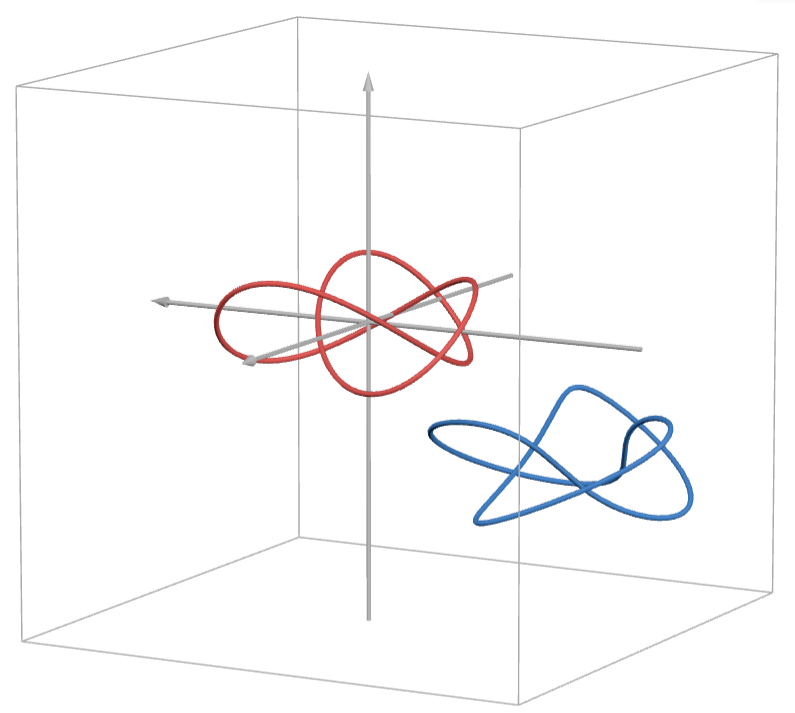
In fact, they already have a consistent proton model (see: the proton and Occam’s Razor, May 2023), but something inside of me says that they should also explore different topologies, such as this Lissajous-like trajectory which intrigues me more than helical/toroidal approaches – but then who am I? I am the first to recognize my limitations as an amateur and it is, therefore, great to see professionals such as Dr. Kovacs and Dr. Vassallo applying their formidable skills and intuition to the problem. 🙂


[1] Pearle’s paper is the seventh in a volume of eight chapters. The book’s title is, quite simply, titled Electromagnetism (1982), and it was put together and edited by Doris Teplitz (1982). Few who quote this famous line, bother to read the Philip Pearle paper itself. This paper effectively presents what Pearle refers to as classical electron models: all of them are based on “rigid or flexible shell surfaces” of charge, which is why we think they did not “cut it” for the many “workmen” (read: the mainstream scientists who thought the Bohr-Heisenberg amplitude math and the probability theory that comes with it) who left the then unfinished construction.

We think the approach taken by Dr. Kovacs and Dr. Vassallo is more productive when it comes to bringing mainstream and Zitterbewegung theorists together around a productive mathematical framework in which the probabibilities are explained based on a plain interpretation of Schrödinger’s ‘discovery’ – which is that the elementary wavefunction represents a real equation of motion of a pointlike but not infinitesimally charge inside of an electron.

As for trying out different topologies, we understand Dr. Kovacs and Dr. Vassallo are working very hard on that, so all we can do is to wish them the best of luck. Godspeed! 🙂

Revisiting the idea of zbw spin

John Duffield’s comment on my post on a (possible) 3D Lissajous trajectory for the proton zbw charge – as opposed to a helical/toroidial/solenoidal model – makes me think and, therefore, deserves some better answer than my quick reply to it. So, that “better answer” is what I am putting down here. [I am writing from a beach apartment in Castelldefels (Spain), so I will be brief.]

He may disagree, of course, but I see two very different aspects in his question/remark/criticism:

  1. Why a Lissajous-like trajectory as opposed to, say, a trajectory like that of a trefoil knot or – more generally – a torus knot ?
  2. What about the spin of the zbw charge itself?

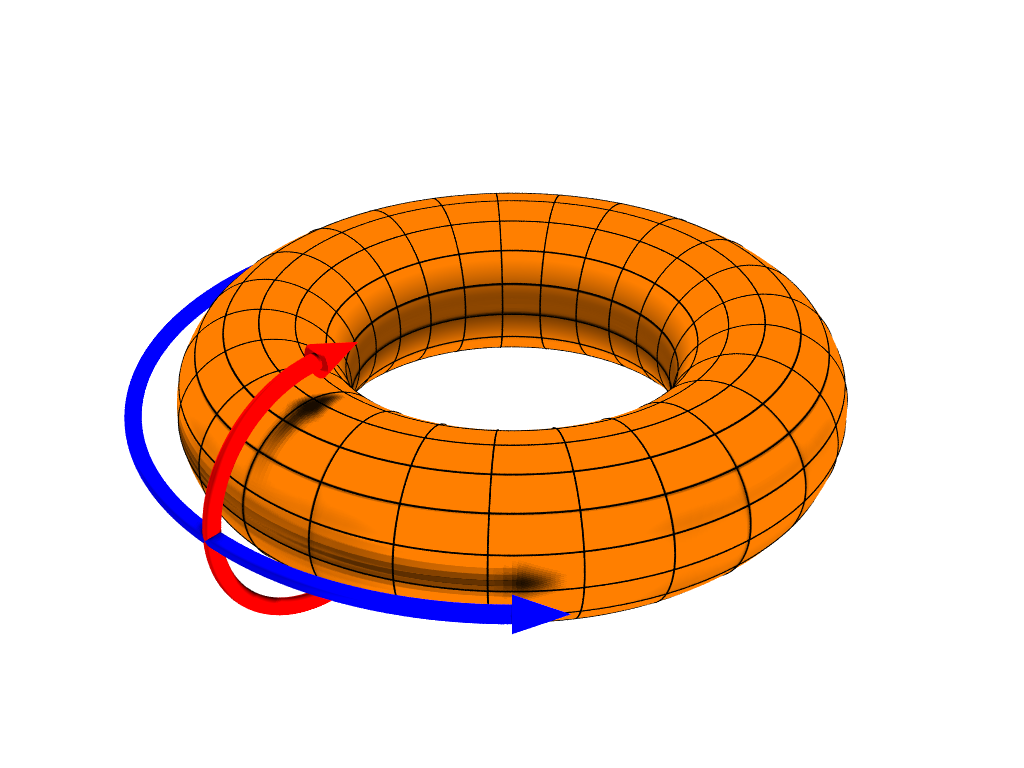
I must answer the first question by explaining what sets me apart from mainstream Zitterbewegung models of elementary particles: any toroidial/helical/solenoidal model comes with two different frequencies and, therefore, two oscillatory modes: toroidal and poloidal (the link is to the Wikipedia article from which I also copy the illustration below).

That does not appeal to me. Try to create the trajectories below with Desmos 3D grapher: you will also end up using two or three different frequencies – even if the below trajectories were created using the same base frequency: we have t, 2t, and 3t in the sine and cosine functions here. The Lissajous curve has only one frequency, and it is the one that comes out of the Planck-Einstein relation. So I feel good about that.

The second remark (what about spin of the zbw charge itself?) is more important, and makes me think much more. Would we have a twist in the loop because the zbw charge spins around its own axis? Maybe. However, we must note this:

  1. The zbw charge is not like some car in a Ferris wheel: there is no force keeping it in the same orientation and it likely rotates around its own axis at the same frequency of the 2D ring current (electron) or 3D Lissajous trajectory (proton). The only thing you need to justify this hypothesis is the idea of inertia to a change in the state of motion of the zbw charge. Indeed, we can think of the zbw charge being symmetrical and acquiring an effective mass as it zips around, and so it will rotate around its own axis as it zips around some center.
  2. However, should we, perhaps, be even more creative and also consider an extra twist – on top of that rotation of the zbw charge that is due to the inertia from its effective mass (half of the energy of the elementary particle is in its kinetic energy, and the other half in the EM field that causes it to go around in a 2D or 3D ring current)? That would give rise to John Duffield’s Möbius strip concept for modeling elementary particles.

For the time being, I see no need to make such assumption, but he sure got me thinking! The extra spin would probably help to explain the second- or third-order terms in the anomaly of the magnetic moment of an electron (as for now, I only have an approximative theory based on the effective radius (Lorentz or classical electron radius) of the zbw charge).

[…]

I would like to wrap up these musings by acknowledging Dennis P. Whiterell. He is an amateur physicist – just like me – and he sent me a manuscript which, among other interesting things, also talks about the “Ferris wheel analogy”. His arguments are very subtle but fail to convince me: I do not think the “Ferris wheel analogy” is useful in the context of elementary ring currents. Again, that is just for the time being, of course. I will leave it at that, and think some more over the comings weeks or months. 🙂

Politics and science: 1924 and 2024

Note: This is just a copy of my LinkedIn post of today. I thought it would be interesting to share it here, too.

A few years ago, my amateur publications on ResearchGate led to an invitation to an online conference on low-energy nuclear reactions (LENR). LENR research was formerly known as cold fusion research but this term is out of fashion because the experiments have not (yet) led to getting more energy out than what is being put in (and, yes, some scandals around fake research too). I still regularly receive newsletters from the organizer: the Société Française de la Science Nucléaire dans la Matière Condensée (SFSNMC). I understand little of the nitty-gritty of these experiments but I find them fascinating. Let me come to the point I want to make here.

I just received the proceedings of the 16th international workshop, which was co-organized just two weeks ago with the International Society for Condensed Matter Nuclear Science (ISCMNS). Because of the political situation, Russian scientists could, apparently, not participate this time. In the newsletter I got, the organizers deplore that. For example, an eminent cold fusion expert like Anatoly Klimov was not there this year. However, he did share a rather wonderful letter to his European colleagues which I also got as part of the proceedings and which, as far as I can see (again, I do not understand all that much of it), is full of practical recommendations to move forward in this field. Indeed, Anatoly Klimov is not just anyone: he was one of the more prominent presenters at the much more high-profile ICCF-23 conference, which was held in Fujian, China. [Talking about China: China’s large (hot) fusion project seems to be moving (much) faster than ITER….]

The point is this: the exclusion of Russian scientists in events like this is like cutting ourselves off from cheap Russian natural gas or other inputs, or like stopping to export German cars and other industrial products to Russia. We do not hurt Russia with that: we only hurt ourselves – Europe. The situation resembles that of the 1924 Solvay Conference, which was a subdued affair because of the boycott of German scientists (even Albert Einstein, despite considering himself to be Jewish, also did not participate out of solidarity with his German scientific colleagues). When and how will this international nonsense stop? Russia was part of Europe in the 19th century. Why can’t we live with Russia now?

A small piece of good news is, perhaps, this: the small Russian team at ITER apparently has not been sent back home yet (see this Polico article on that). It suggests we simply cannot move ahead without the Russian engineers and scientists: they are, quite simply, ahead of us in this field and, therefore, their knowledge and skills are apparently too valuable to get rid of. Double standards once again, apparently… :-/

The metaphysics of physics

I added a very last paper to my list on ResearchGate. Its title is: what about multi-charge Zitterbewegung models? Indeed, if this local and realist interpretation of quantum mechanics is to break through, then it is logical to wonder about a generalization of a model involving only one charge: think of an electron (e.g., Consa, 2018) or proton model (e.g., Vassallo & Kovacs, 2023) here. With a generalization, we do not mean some unique general solution for all motion, but just what would result from combining 1-charge models into structures with two or more charges. [Just to be sure, we are not talking about electron orbitals here: Schrödinger’s equation models these sufficiently well. No. We are talking about the possible equations of motion of the charges in a neutron, the deuteron nucleus, and a helium-3 or helium-4 nucleus.]

So our question in this paper is this: how do we build the real world from elementary electron and proton particle models? We speculate about that using our own simplified models, which boil down to two geometrical elements: (i) the planar or 2D ring current of the zbw electron, and (ii) the three-dimensional Lissajous trajectory on a sphere which we think might make sense when modeling the orbital of the zbw charge in a proton. Both have the advantage they involve only one frequency rather than the two frequencies (or two modes of oscillation) one sees in helical or toroidal models. Why do we prefer to stick to the idea of one frequency only, even if we readily admit helical or toroidal models are far more precise in terms of generating the experimentally measured value of the magnetic moment of electrons and protons, respectively? The answer is simple: I am just an amateur and so I like to roll with very simple things when trying to tackle something difficult. 🙂

So, go and have a look at our reflections on multi-charge Zitterbewegung models – if only because we also started writing about the history of the Zitterbewegung interpretation and a few other things. To sum it up:

  1. The paper offers a new brief history of how interpretations of the new quantum physics evolved, and why I am with Schrödinger’s Zitterbewegung hypothesis: it just explains the (possible) structure of elementary particles so well.
  2. It speculates about how positive and negative charge may combine in a neutron, and then also about how a deuteron nucleus might look like.
  3. We did not get to specific suggestions for helium-3 and helium-4 nuclei because these depend on how you think about the neutron and the deuteron nucleus. However, I do spell out why and how about I think of a neutron playing the role I think it plays in a nucleus: the glue that holds protons together (so there is no need for quark-gluon theory, I think, even if I do acknowledge the value of some triadic color scheme on top of the classical quantum numbers).
  4. Indeed, despite my aversion of the new metaphysics that crept into physics in the 1970s, I explain why the idea of some color typing (not a color charge but just an extra triadic classification of charge) might still be useful. [I secretly hope this may help me to understand why this color scheme was introduced in the 1970s, because I do not see it as anything more than mathematical factoring of matrix equations describing disequilibrium states – which may be impossible to solve.]

Have a look, even if it is only to appreciate some of the 3D images of what I think as elementary equations of motion (I copy some below). I should do more with these images. Some art, perhaps, using OpenAI’s DALL·E image generator. Who knows: perhaps AI may, one day, solve the n-body problems I write about and, thereby, come up with the ultimate interpretation of quantum mechanics?

That sounds crazy but, from one or two conversations (with real people), it looks like I am not alone with that idea. 🙂 There are good reasons why CERN turned to AI a few years ago: for the time being, they use it to detect anomalies in the jets that come out of high-energy collissions, but – who knows? – perhaps a more advanced AI Logic Theorist programme could simplify the rather messy quark-gluon hypothesis some day?

Because I am disengaging from this field (it is mentally exhausting, and one gets stuck rather quickly), I surely hope so.

Using AI to find the equations of motion for my Zitterbewegung model of a proton?

Pre-scriptum (the day after, 9/11): I woke up this morning and thought: all I need to do is to prove the angular velocity is a constant for my model to work. So I did that, and it works (see my Bamboo notes below and https://www.desmos.com/3d/k1vargdjcc). This trajectory is a nice yin-yang trajectory (I am thinking about someone in Taiwan here, who contacted me recently with a model involving yin-yang symbolism, so I like that). I also packed it into yet another ResearchGate paper (link here: An Equation of Motion for the Zitterbewegung proton), which is much more precise and – hopefully – more convincing that the video.

For this kind of thinking or problem solving, I guess I am still better than ChatGPT-4. 🙂 ChatGPT-4 did pass ‘my’ Turing test on intelligence, however. And that is quite something. I write about the ouch! factor in my recent LinkedIn article on AI. Yesterday, I definitely had such ouch! feeling (gentle – just in the sense that I thought ChatGPT-4 was smarter than me on this too), but so it’s OK now. 🙂 I win. A nice thing about this simple calculation is that this SQRT(2) factor pops up: it must be the same SQRT(2) factor that is related to the magnetic moment of a proton in my proton radius derivation, although I am not yet sure why and how exactly.

I did a quick video on it on YouTube: https://www.youtube.com/watch?v=-HnaLG8bY6o. Unfortunately, I cannot extract a transcript from it for ChatGPT-4. However, I had a quick conversation with it on what remains to be done, and that is to calculate the magnetic moment of this 3D Lissajous loop (it will depend on the orientation but we just need it in one direction: where it is strongest because that is how it will line up in a Penning trap of whatever device that is/was used to determine its value). I asked ChatGPT how it could possibly help with these calculations, mentioning the Biot-Savart law and the 3D integrals this would imply. This was ChatGPT’s answer:

“Regarding the Biot-Savart law and calculating the magnetic moment for such a complex 3D current loop, you’re correct that this involves intricate 3D integrals. I can certainly help set up or guide through parts of the calculation, especially in formulating the integral and explaining how to approach the problem. If you share the specifics of your current loop’s geometry and the required variables, we can work through how to structure the integrals needed for the magnetic moment calculation. Feel free to provide details if you want to give this a try!”

AI is, clearly, not was it was even just a year ago: it is much better now. As for me, I will let the problem rest now. 🙂

Pre-scriptum 2 (18 September): Please do check out the comment from the ‘Physics Detective’ to this post (and the Physics Detective site itself, of course): a Möbius ring for the electron and – who knows – a 3D trefoil loop for the proton might do the trick in 2D/3D as well. It would be nice if it did because it would bring helical/toroidal/solenoid-like spin of the charge itself into the model, possibly unifying the math behind these models. Thank you for noting this, John ! 🙂

Original post (9/10):

End of last year, I started to play with ChatGPT-4. Only a few times, really, because, for ordinary questions or web searches, it is not much better than your Google AI assistant or Microsoft’s CoPilot: it just comes with a very pleasant style of conversation (yes). I counted and, so far, I only five conversations with it. However, I do admit I have a habit of continuing an old conversation (ChatGPT now uses your old conversations anyway). Also, these five conversations were good and long. It helped me, for example, greatly to get a quick overview and understanding of IT product offerings in the cloud: it made/makes great comparisons between the offerings of Google Cloud, Azure and AWS, not only for infrastructure but also in the area of modern AI applications. I also asked questions on other technical things, like object-oriented programming, and in this field also it really excels at giving you very precise and relevant answers. In fact, I now understand why many programmers turn to it to write code. 🙂

However, I was mainly interested in ChatGPT-4 because it knows how to parse (read: it can read) documents now. So it does a lot more than just scraping things on products and services from websites. To be precise, it does not just parse text only: it actually ‘understands’ complex mathematical formulas and advanced symbols (think of differential operators here), and so that’s what I wanted to use it for. Indeed, I asked it to read my papers on ResearchGate and, because I do think I should rewrite and restructure them (too many of them cover more or less the same topic), I asked it to rewrite some of them. However, I was very dissatisfied with the result, and so the versions on RG are still the versions that I wrote: no change by AI whatsoever. Just in case you wonder. 🙂

The point is this: I am not ashamed to (a) admit I did that and (b) to share the link of the conversation here, which shows you that I got a bit impatient and why and how I left that conversation last year. I simply thought ChatGPT-4 did not have a clue about what I was writing about. So… It did not pass my Turing test on this particular topic, and that was that. Again: this was about a year ago. So what happened now?

I have a bit of time on my hands currently, and so I revisited some of my research in this very weird field. In fact, I was thinking about one problem about my Zitterbewegung proton model which I can’t solve. It bothers me. It is this: I am happy with my proton model – which is an exceedingly simple 3D elementary particle model, but I want the equations of motion for it. Yes. It is simple. It is what Dirac said: if you don’t have the equations of motion, you have nothing. That’s physics, and the problem with modern or mainstream quantum mechanics (the Bohr-Heisenberg interpretation, basically: the idea that probabilities cannot be further explained) is because it forgets about that. It dissatisfies not only me but anyone with common sense, I think. 😉 So I want these equations of motion. I have them for an electron (simple ring current), and now I hope to see them – one day, at least – for the proton also. [I am actually not too worried about it because others have developed such equations of motion already. However, such models (e.g., Vassallo and Kovacs, 2023) are, usually, toroidal and, therefore, involve two frequencies rather than just one. They are also not what I’d refer to as pure mass-without-mass models. Hence, they do not look so nice – geometrically speaking – to me as my own spherical model.

But so I do not have equations of motion for my model. This very particular problem should be rather straightforward but it is not: 3D motion is far more complex than 2D motion. Calculating a magnetic moment for (i) a simple ring current or for (ii) a very complex motion of charge in three dimensions are two very different things. The first is easy. The second is incredibly complicated. So, I am happy that my paper on my primitive efforts to find something better (I call it the “proton yarnball puzzle”) attracted almost no readers, because it is an awful paper, indeed! It rambles about me trying this or that, and it is full of quick-and-dirty screenshots from the free online Desmos 3D graphing calculator – which I find great to quickly get a visual on something that moves around in two or in three dimensions. But so whatever I try, it explains, basically, nothing: my only real result is nothing more than a Lissajous curve in three dimensions (you can look at it on this shared Desmos link). So, yes: poor result. Bad. That is all that I have despite spending many sleepness nights and long weekends trying to come up with something better.

It is already something, of course: it confirms my intuition that trajectories involving only one frequency (unlike toroidal models) are easy to model. But it is a very far cry from doing what I should be doing, and that is to calculate how this single frequency and/or angular and tangential velocity (the zbw charge goes at the speed of light, but the direction of its travel changes, so we effectively need to think of c as a vector quantity here) translates into frequencies for the polar and azimuthal angles we would associate with a pointlike charge zipping around on a spherical surface.

Needless to say, the necessary formulas are there: you can google them. For example, I like the presentation of dynamics by Matthew West of Illinois: clear and straightforward. But so how should I apply these to my problem? Working with those formulas is not all that easy. Something inside of me says I must incorporate the math of those Lissajous curves, but have a look at: that’s not the easiest math, either! To make a long story short, I thought that, one year later, I might try to have a chat with ChatGPT-4 again. This time around, I was very focused on this only, and I took my time to very clearly write out what I wanted it to solve for me. Have a look at the latter part of the chat in the link to the chat. So… What was the result of this new chat with GPT-4?

It did not give me any immediate and obvious analytical solution to my question. No. I also did not expect that. There are modeling choices to be made and all that. As I mention above, simple things may not be easy. Think of modeling a three-body problem, for example: this too has no closed-form solution, and that is strange. However, while – I repeat – it was not able to generate some easy orbitals for a pointlike charge whizzing around on a surface, I was very happy with the conversation, because I noted two things that are very different from last year’s conversation:

  1. ChatGPT-4 now perfectly understands what I am talking about. In fact, I accidentally pressed enter even before I finished writing something, and it perfectly anticipated what I wanted to tell it so as to make sure it would ‘understand’ what I was asking. So that is amazing. It is still ChatGPT-4, just like last year, but I just felt it had become much smarter. [Of course, it is also possible that I want just too impatient and too harsh with it last year, but I do not think so: ChatGPT learns, obviously, so it does get better and better at what it does.]
  2. In terms of a way forward, it did not come up with an immediate solution. I had not expected that. But it gently explained the options (which, of course, all amount to the same: I need to use these dynamical equations and make some assumptions to simplify here and there, and then see what comes out of it) and, from that explanation, I again had the feeling it ‘knew’ what it was talking about it.

So, no solution. Yes. I would say: no solution yet. But I think I probably can come up with some contour of a solution, and I have a feeling ChatGPT-4 might be able to fill in the nitty-gritty of the math behind it. So I should think of presenting some options to it. One thing is sure: ChatGPT-4 has come a long way in terms of understanding abstruse or abstract theories, such as this non-mainstream interpretation of quantum mechanics: the Zitterbewegung interpretation of quantum mechanics (see the Zitter Institute for more resources). So, as far as I am concerned, it is not “non-mainstream” anymore. Moreover, it is, of course, the only right interpretation of quantum mechanics. […] Now that I think of it, I should tell that to ChatGPT-4 too next time. 🙂

Post scriptum: For those who wonder, I shared the Desmos link with ChatGPT also, and it is not able to ‘see’ what is there. However, I copied the equation into the chat and, based on its knowledge of what Desmos does and does not, it immediately ‘knew’ what I was trying to do. That is pretty impressive, if you ask me ! I mean… How easy is it to talk to friends and acquaintances about topics like this? Pretty tough comparison, isn’t it? 🙂

As for ‘my’ problem, I consider it solved. I invite anyone reading this to work out more detail (like the precessional motion which makes the trajectory go all over the sphere instead of just one quadrant of it). If I would be a PhD student in physics, it’s the topic I’d pick. But then I am not a PhD student, and I do plan to busy my mind with other things from now on, like I wrote so clearly in my other post scriptum. 🙂

Post scriptum

A researcher I was in touch with a few years ago sent me a link to the (virtual) Zitter Institute: https://www.zitter-institute.org/. It is a network and resource center for non-mainstream physicists who succesfully explored – and keep exploring, of course – local/realist interpretations of quantum mechanics by going back to Schrödinger’s original and alternative interpretation of what an electron actually is: a pointlike (but not infinitesimally small) charge orbiting around in circular motion, with:

(i) the trajectory of its motion being determined by the Planck-Einstein relation, and

(ii) an energy – given by Einstein’s mass-energy equivalence relation – which perfectly fits Wheeler’s “mass-without-mass” idea.

I started exploring Schrödinger’s hypothesis myself about ten years ago – as a full-blown alternative to the Bohr-Heisenberg interpretation of quantum mechanics (which I think of as metaphysical humbug, just like Einstein and H.A. Lorentz at the time) – and consistently blogged and published about it: here on this website, and then on viXra, Academia and, since 2020, ResearchGate. So I checked out this new site, and I see the founding members added my blog site as a resource to their project list.

[…]

I am amazingly pleased with that. I mean… My work is much simpler than that of, say, Dr. John G. Williamson (CERN/Philips Research Laboratories/Glasgow University) and Dr. Martin B. van der Mark (Philips Research Laboratories), who created the Quantum Bicycle Society (https://quicycle.com/).

So… Have a look – not at my site (I think I did not finish the work I started) but at the other resources of this new Institute: it looks like this realist and local interpretation of quantum mechanics is no longer non-mainstream… Sweet ! It makes me feel the effort I put into all of this has paid off ! 😉 Moreover, some of my early papers (2018-2020) are listed as useful papers to read. I think that is better than being published in some obscure journal. 🙂

I repeat again: my own research interest has shifted to computer science, logic and artificial intelligence now (you will see recent papers on my RG site are all about that now). It is just so much more fun and it also lines up better with my day job as a freelance IT project manager. So, yes, it is goodbye – but I am happy I can now refer all queries about my particle models and this grand synthesis between old and new quantum mechanics to the Zitter Institute.

It’s really nice: I have been in touch with about half of the founding members of this Institute over the past ten years – casually or in a more sustained way while discussing this or that 2D or 3D model of an electron, proton, or neutron), and they are all great and amazing researchers because they look for truth in science and are very much aware of this weird tendency of modern-day quantum scientists turning their ideas into best-sellers perpetuating myths and mysteries. [I am not only thinking of the endless stream of books from authors like Roger Penrose (the domain for this blog was, originally, reading Penrose rather than reading Feynman) or Graham Greene here, but also of what I now think of rather useless MIT or edX online introductions to quantum physics and quantum math.]

[…]

Looking at the website, I see the engine behind it: Dr. Oliver Consa. I was in touch with him too. He drew my attention to remarkable flip-flop articles such as William Lamb’s anti-photon article (it is an article which everyone should read, I think: unfortunately, you have to pay for it) and remarkable interviews with Freeman Dyson. Talking of the latter (I think of as “the Wolfgang Pauli of the third generation of quantum physicists” because he helped so many others to get a Nobel Prize before he got one – Dyson never got a Nobel Prize, by the way), this is one of these interviews you should watch: just four years before he would die from old age, Freeman Dyson plainly admits QED and QFT is a totally unproductive approach: a “dead end” as Dyson calls it.

So, yes, I am very pleased and happy. It makes me feel my sleepness nights and hard weekend work over the past decade on this has not been in vain ! Paraphrasing Dyson in the above-mentioned video interview, I’d say: “It is the end of the story, and that particular illumination was a very joyful time.” 🙂

Thank you, Dr. Consa. Thank you, Dr. Vassallo, Dr. Burinskii, Dr. Meulenberg, Dr. Kovacs, and – of course – Dr. Hestenes – who single-handedly revived the Zitterbewegung interpretation of quantum mechanics in the 1990s. I am sure I forgot to mention some people. Sorry for that. I will wrap up my post here by saying a few more words about David Hestenes.

I really admire him deeply. Moving away from the topic of high-brow quantum theory, I think his efforts to reform K-12 education in math and physics is even more remarkable than the new space-time algebra (STA) he invented. I am 55 years old and so I know all about the small and pleasant burden to help kids with math and statistics in secondary school and at university: the way teachers now have to convey math and physics to kids now is plain dreadful. I hope it will get better. It has to. If the US and the EU want to keep leading in research, then STEM education (Science, Technology, Engineering, and Mathematics) needs a thorough reform. :-/

And the dark force strikes again…

I do not know if it is funny or sad: the dark force struck again. As should be obvious from all of my recent posts, I do my utmost to refer very objectively to what’s in Feynman’s Lectures, and what makes sense in them, and what does not. I started this blog more than ten years – before Feynman’s Lectures went online – and one of my brothers (a university professor in Cape Town) also thought my blog is actually an encouragement for readers to buy Feynman’s Lectures. But… Well… No. One is, apparently, not allowed to disagree with Bill Gates’ or MIT’s view of Feynman’s legacy: he was right, and everyone else is wrong. So… A video of mine on that got ‘struck’ and was taken offline. :-/

Hmmm… The experience reminds of my efforts to try to engage with the Wikipedia authors and editors, which yielded no result whatsoever. I am not mainstream, obviously, and any edits I suggest are ruled out in advance. […] I am simplifying a bit, but that was, basically, my experience when trying to help rework the Wikipedia article on the Zitterbewegung interpretation of quantum physics. Funnily enough, I get all these advertisements begging me to donate to Wikipedia: I would actually do that if the process of trying to add or edit would have been somewhat friendlier.

In any case, it made me post my very last video on YouTube. The pdf-file I used to prepare for it, is on ResearchGate, which I warmly recommend as – probably – the only open science forum where you can publish working papers or presentations without any backlash. I can only hope it will stay that way. :-/ With all what is going on (I am appalled by the misinformation on the Ukraine war, for example), nothing is sure, it seems…

Post scriptum (2 May 2024): Because I had put a fair amount of work and preparation in it, I edited out Feynman’s Lectures and published it again. I hope it does not make Mr. Gottlieb angry again. 🙂 If it would, then… Well… Then I hope he finds peace of mind some other day.

19 May 2024: To be frank, things like this do shock me. Fortunately, this weekend is party time in Brussels (it is the ‘Pride’ weekend, and the atmosphere is very festive in the center here, where I live). It encouraged me to do some more videos. Different ones. Fun ones: just taking my Wacom tablet and jotting down stuff and talking about it without any preparation and with some nice Belgian beer on the side. Surprisingly, they got hundreds of views. See, for example, this talk about why I do not believe in a strong force or color charges, or this talk on the one-photon Mach-Zehnder experiment which figures so prominently in the MIT-edX course on QM. Also, I do not know if it is coincidence, but I got a surge in recommendations on my Principles of Physics paper on ResearchGate. I wrote that paper as a kind of manifesto. Not as some kind of “here you go: this is the explanation” thing. So I am happy that paper is going well: keep thinking for yourself. 🙂

The metaphysics of physics: final thoughts

I wrote my last post here two months ago and so, yes, I feel I have done a good job of ‘switching off’. I have to: I’ve started a new and pretty consuming job as ICT project manager. 🙂

Before starting work, I did take a relaxing break: I went to Barcelona and read quite a few books and, no, no books on quantum physics. Historical and other things are more fun and give you less of a headache.

However, having said that, the peace and quiet did lead to some kind of ‘final thoughts’ on the ‘metaphysics of physics’, and I also did what I never did in regard to my intuition that dark matter/energy might be explained by some kind of ‘mirror force’: the electromagnetic force as it appears in a mirror image. Not much change in the math, but physical left- and right-hand rules for magnetic effects that just swap for each other.

You can find the results of that in a very concise (four pages only) paper on my ResearchGate site, and also in two lectures (each a bit more than one hour) on my YouTube channel. The first video focuses on ‘big questions’, while the second one talks about this ‘mirror’ force (I previously referred to it as a ‘anti-force’ but I realize that’s not a good term), and on how that would fit with Maxwell’s equations (including Maxwell’s equation written in four-vector algebra).

Have fun and keep thinking. Most importantly: keep thinking for yourself ! Do not take anything for granted in this brave new world. 🙂

[A]Symmetries in Nature

I find that just working off some notes from my tablet and talking about them works better for me than writing elaborate papers. Boileau: “Ce que l’on conçoit bien s’énonce clairement, Et les mots pour le dire arrivent aisément.” I did five new lectures in just one week on my YouTube channel. Have a look at the last one: symmetries and asymmetries in Nature.

It takes an easy-to-understand look at CP- and CPT-symmetry (and the related processes that sometimes break these symmetries) by thinking about what particles actually are: not infinitesimally small, but charged oscillations with a 2D or 3D structure. We also revisit the inherent mass-generating mechanism, which explains all mass in terms of electromagnetic mass.

We talked about CP- and CPT-symmetries before – back in 2014, to be very precise – but then I did not know what I know now, and those older posts also suffered from the 2020 attack by the dark force. 🙂 Briefly, what you should take away from it, is that the most fundamental asymmetry in Nature is this: the asymmetry in the electromagnetic force or field itself. It is that 90 degree phase difference (or ‘lag’) between the electric and magnetic field vectors. That explains why mirror images cannot be real, and it also explains why some processes go one way only. So… Another mystery solved ! I call it “the fallacy of CPT arguments.” 🙂

Post scriptum: I also wrapped up my YouTube ‘Schrödinger’s cat is dead’ series. For those who do not like the theoretical aspects of all these things, have a look at the last one (on pair creation-annihilation and intermediate vector bosons), in which I discuss the two interpretations (mainstream versus my classical perspective) one can have when looking at this wonderful world. I wrote this comment on it, which is probably my farewell to this hobby of mine:

For those who struggle with this, the key to understanding it all, is to understand that the superposition principle works for fields, but not for charges. That is also the key to understanding Bose-Einstein statistics, Fermi-Dirac statistics and – at larger scales – the ‘real world’ Maxwell-Boltzmann statistics (which combine both). See: https://readingfeynman.org/2015/07/21/maxwell-boltzmann-bose-einstein-and-fermi-dirac-statistics/. Always do a good dimensional analysis of the equations: distinguish real physical dimensions from purely mathematical ones: do not add apples and oranges. Distinguish potential or field strengths from real forces and actual energy (a force acting on a charge over some distance). That is why charges should not ‘vanish’ in the analysis, and it is also why i*pi and -i*pi are not ‘common phase factors’ which vanish against each other (both are equal to -1, right?) in equations involving wavefunctions. A positive charge zittering around in one direction is not the same as a negative charge zittering around in the other direction. Neutral particles are either real photons (which carry no charge whatsoever) or, else, neutral matter-particles. Applying the saying that was looks and quacks like a duck must be a duck, we might say most of these neutral particles will look like ordinary matter. Some, however, will look like light-like or be photon-like because they travel at or near the speed of light (the orbital motion of the two charges has vanished and so there is zero angular momentum). That does not mean they are photons. Also do not worry about wave equations when you prefer to think in terms of wavefunctions: wavefunctions are the real thing, not wave equations (see: https://www.researchgate.net/publication/341269271_De_Broglie’s_matter-wave_concept_and_issues and https://www.researchgate.net/publication/342424980_Feynman’s_Time_Machine). If you think otherwise, that is fine. Everyone looks for the Holy Grail, and you may be amongst those who think they have found it. If it is looks very different from the Holy Grail that I have finally found, that is OK. Jesus might have left more than one Holy Grail – fake or real ones – and just be happy with yours ! I will end this short illustrated Guide to the Universe with the Looney Tunes sign-off: “That’s All, Folks!”

Jean Louis Van Belle

Looking back, and ahead…

I started this blog on physics a bit more than a decade ago. It was then titled ‘Reading Penrose’s Road to Reality‘ (or something similar). I soon realized Penrose is/was just rambling, as evidenced by his latest theory relating quantum physics to consciousness. The only difference between Penrose and a weird physics teacher in Santa Barbara who tried to convince me of the existence of microgeons with in-built conscience is that Penrose had a rather distinguished career before he came up with all of this nonsense.

I am done with physics. I studied economics as a student. It was the only university study my father would let me do: he wanted me to do something useful and, looking back, he was right and made the right choice for me. One can study philosophy and physics as a hobby, which I did (I got a degree in philosophy but, because of my controversial take on the science of physics, I do not have the patience to get a degree in physics).

I think I have pushed it as far as a human being possibly can. Not economics, but physics is the ‘dismal science‘ nowadays. The Nobel Prize committee has played a very sad role in promoting theories that cannot be proved, but call for ever larger investments in huge technical facilities, such as CERN (very useful) or ITER (not useful at all). Today, I just stopped working on a paper challenging the usefulness of the concept of intermediate vector bosons. Then I thought: it is no use. It is like taking to the streets against the Gaza crisis, which a lot of people are doing but with no result in terms of making politicians change their mind.

So, I just put it online (there are no dark forces on ResearchGate), and then people can think about it and make up their own mind. I quoted Boltzmann a couple of times over the past few years: “Bring forth what is true. Write it so it it’s clear. Defend it to your last breath.” I do not have the required energy to do the latter bit: defending something – even if it is truth – to one’s last breath is not a recipe for good mental and physical health, and surely not for happiness.

We should go with the flow and take care of the ones that are near to us. I want to re-connect with my body. I am 54 years old now, and it is time to stop thinking and just work on technical things (I am an ICT consultant, after all). That will make me happy, and so that is what I am going to do.

[…]

I am happy I read the originals: Einstein in German, de Broglie in French and, of course, all of the Solvay papers. I am very grateful to my Jesuit professors – who taught me not only economics, but also math and philosphy – for having put up with me thirty years ago, and always insisted I should read great thinkers in the language that they were using to write up their great works. [I now think that is the only reason they let me pass, because I tended to disagree on everything else they were trying to teach me.]

It makes me think that modern education (with its emphasis on using AI and the incredible repository of knowledge on the web) is great but, frankly, I think the younger generation should do a lot more slow and deep reading: Aquinas, Wittgenstein, Ryle, and yes: Schrödinger, Einstein and Maurice/Louis de Broglie. I can only provide some pointers: https://www.researchgate.net/publication/341269271_De_Broglie’s_matter-wave_concept_and_issues. The Universe is simple and most wonderful at the same time.

As for the best quote of all times, I think it must be what Keynes famously said: “You can bring a horse to the water, but you cannot make it drink.” [This is a proverb that goes back to the 12th century, apparently.] 🙂

Post scriptum: I baptized the paper on intermediate vector bosons – a pure fiction of the mind, if you ask me – Mystery 101. I thought it was a fun title, so I also wrote a Mystery 102 paper. That one takes a jab at myself. Indeed, when everything is said and done, one should not criticize others if you cannot criticize yourself, can you? 🙂 It is on my proton model: all equations make sense and yield the measurements or results that one wants out of such models, but – for some reason – I did not find a ‘Royal Road‘ to its equations of motion. Not yet. I am not so worried about that. Perhaps it is like the two-body problem: there may be no analytical solution. The interesting thing is that I now think the trajectory of the proton’s Zitterbewegung charge might not be on some spherical surface, but on a sphere turned inside out: like a double-conical structure or something. Who knows? 🙂

Can matter be made out of light?

I wanted to update my thoughts on this obvious but intriguing and – you may be surprised to hear this – basically unanswered question in phyics: can matter be created out of light? If so, where does the charge come from? Or the reverse: in matter-antimatter pair annihilation, where does the charge go?

So, I revisited and updated Lecture XIII and Lecture XI on that: two papers in what I, with a wink to the title of Richard Feynman’s rather famous Lectures on Physics (which inspired this blog many years ago – not anymore) , wrote as part of a series in which I try to make things that are not so obvious – because couched in guru-speak – somewhat more obvious: what are the actual experiments and what are the possible interpretations? I also opened a discussion thread on the question on ResearchGate. That was useful and not-so-useful at the same time. Let me elaborate:

1. It was useful because:

  • It forced me to ask a very precise question so as to get input from other researchers: no philosophy. Only tough and precise discussion.
  • I did get references to other experiments than the ones I had looked at.

2. It was not-so-useful because:

  • I found myself re-explaining very basic physics while ‘talking’ to people with very different backgrounds. One of those questions was a weird discussion on what a real photon actually is: something with no rest mass whatsoever. To my surprise, one of the researchers does support the thesis slow-moving or massive neutral particles might be photons (or whatever other field you might think of).
  • The format of these discussions is – in no way whatsoever – a substitute to good, detailed and precise email exchanges with colleagues whom you know and who are at your level of understanding. I guess such email exchanges are the only true equivalent of the long letters physicists used to write to each other about hundred years ago.

It made me realize why thinking and writing about physics and the metaphysics that come with it is a rather lonely and somewhat depressing intellectual pursuit. You think about very difficult issues for which there may or may not a solution. That is stressful enough already. It becomes even more stressful when you think you found an answer or a solution to a problem but that, apparently, you are not able to communicate it clearly or – much more likely – no one is interested in your views. 🙂 Another possibility is that – all of a sudden – you realize that you missed some obvious fact, or that an entirely different interpretation of what might be the case is also possible. So, then, you have to start from scratch again. That is very tiring. Mental.

I think I am fortunate because I am an amateur physicist only and – on top of that – I do not take myself very seriously any more. Not on these questions, at least. 🙂

Cold and hot fusion

Just two or three news items:

  1. The UK stopped its JET nuclear fusion programme. It is unclear whether some other programme will follow it. I find it significant that the UK did not decide to join the ITER project. I am a non-believer, so I interpret it as well-founded skepticism. Recreating the conditions that prevail in the Sun is probably not possible on Earth. Maybe it will be possible 100 years from now. 🙂
  2. One of Europe’s leading cold fusion scientists – cold fusion hardly gets any attention nowadays – updated an overview article on experimental results in the field of cold fusion (yes, I know this is totally unrelated to hot fusion, but so here we are). I should read it, but time and energy are limited in a man’s life, and I think I should bring this hobby of mine to a close.
  3. I launched a ‘discussion thread’ on light-matter conversion on RG. There is good stuff on that. I remain skeptical on ‘photonic’ or ‘charge-without-charge’ models, however. I am surprised Dr. Hestenes gives this a lot of credibility so, perhaps, I should change my mind on it. This ‘Quantum Bicycle Society‘ is quite interesting (and counts very respectable scientists in its ranks) and (also) seems to advocate for an all-encompassing ‘photonic’ or ‘charge-without-charge’ unified theory. Again, I remain skeptical. 🙂

The Breit-Wheeler process: can matter be created out of light?

Post- or pre-scriptum (added on 22 October 2023): I did what I promised to do below, and that is to analyze SLAC’s E144 experiment in detail. We do so in a recently added new chapter in this series of Lectures: Lecture XI – Can Matter Be Made Out of Light? We warmly recommend reading the paper, because it is extremely relevant when it comes to understanding the basic hypotheses of modern quantum physics. 🙂

I am rather surprised – and not, at the same time – that my paper on matter-antimatter pair production is getting a fair number of downloads (about 4500 downloads now) – despite my rather free-wheeling (scathing?) language. It basically argues the experiments ‘proving’ the 1934 Breit-Wheeler hypothesis, do not prove much at all! Worse, I actually claim they are not proving anything at all, and that the charge that comes out of these experiments can be explained by looking at the reactions as a nuclear process (there is always a nucleus nearby, with neutrons that can provide the charged particle pairs that come out of the reaction).

I disengaged from further research because of a lack of time, but it is probably the one and only aspect of the new physics that I want to examine further. Why? Because it will either prove or disprove my rather classical interpretation of quantum physics. Indeed, with all due respect to Gregory Breit and John Archibald Wheeler – neither of which got a Nobel Prize in Physics – I think the Breit-Wheeler hypothesis (matter formation – pair production – can be formed out of interacting light particles) remains unproven. In my not-so-humble view, it is based on an erroneous interpretation of Einstein’s mass-energy equivalence relation. Mass is energy, of course, but this equivalence must be rooted in an interpretation of mass as charge in motion, and dig back into de Broglie’s original hypothesis:

“We may, thus, conceive that, because of some grand law of Nature, a periodic phenomenon of frequency ν0 would be associated with each energy packet with rest mass m0, such that hν0 = m0c2. The frequency ν0 is, of course, to be measured, in the rest frame of the energy packet. This hypothesis is the basis of our theory: it is, just like all hypotheses, worth only as much as the consequences that can be deduced from it.”[1]

As we explain in our most downloaded paper, the de Broglie frequency is the orbital frequency of the positive or negative charge inside a proton or an electron, respectively (or, in the neutron, the neutral combination of both):

  • Photons are photons: traveling fields (think of them as a force without a charge to act upon).
  • Matter-particles are matter-particles: charge in motion. Fields do not convert into charge, or vice versa: the charge must already be there.

We will do our best to rewrite this paper in a more academic version by studying the E-144 articles and papers when we have time. We could not access them because they are – mostly – in a PS format. This may sound like a poor excuse.[2] It is. However, we also noted this:

  1. Wikipedia authors cornering interesting topics (including the Zitterbewegung interpretation of quantum mechanics) are usually biased towards presenting hypotheses as facts. On the Breit-Wheeler process, the article is remarkably nuanced. It dryly quotes from a 2016 article in Physics Review E [3] that, although “direct production of electron–positron pairs in two-photon collisions, the Breit–Wheeler process, is one of the basic processes in the universe” – we very much doubt this, as should be clear from this paper – “it has never been directly observed in the laboratory.”
  2. While the referenced Physics Review E article says this is “because of the absence of intense enough γ-ray sources”, we stick to our intuition and think there is more at play: we effectively concur with the more skeptical voices in this more recent (2021) ScienceNews appraisal[4]: as long as this experiment cannot be performed with “indisputably real photons”, we think of matter-light conversions not only as not being real, but as being logically (or, should we say, ontologically?) impossible.

The fact that the Particle Data Group has close to zero information on Breit-Wheeler processes confirms all of the above – in our not-so-humble view again, at least. We believe in Wheeler’s mass-without-mass vision, but not in his mass-without-charge (or charge-without-charge) ideas!


[1] Translated from the de Broglie’s Recherches sur la Théorie des Quanta (Ann. de Phys., 10e série, t. III (Janvier-Février 1925: « On peut donc concevoir que par suite d’une grande loi de la Nature, à chaque morceau d’énergie de masse propre m0, soit lié un phénomène périodique de fréquence ν0 telle que l’on ait : hν0 = m0c2, ν0 étant mesurée, bien entendu, dans le système lié au morceau d’énergie. Cette hypothèse est la base de notre système : elle vaut, comme toutes les hypothèses, ce que valent les conséquences qu’on en peut déduire. »

[2] A professional Adobe Acrobat subscription – which I do not have right now – should make them readable, right? However, we note the site has not been updated since 1998, so this does not inspire much confidence: have there been no replications of these experiments since then? Apparently not. :-/

[3] Admittedly, Physics Review E is, apparently, not a prime journal in particle physics. The Wikipedia entry on it notes that its focus is on many-body phenomena, although its “broad scope” also includes “quantum chaos, soft matter physics, classical chaos, biological physics and granular materials.”

[4] The overview is – admittedly – ‘journalistic’ only (that is the nature of ScienceReview), but we think it offers a more objective assessment of the current state of play in regard to this line of research.

The Uncertainty Principle, statistical determinism, and free will

I just came back from a consultancy (an IT assessment – it is nice to be fully focused again on work rather than obscure quantum-mechanical models) and, while flying back, I wrote a small paper on the implications of what I have tried to do (showing that, ultimately, we can understand Nature as being ‘statistically deterministic’, just like what A. Einstein and H.A. Lorentz always said) on epistemology, or the inquiry that philosophers refer to as ‘metaphysics’ (interpreted as thoughts on the ‘essence’ of Nature).

I also detail why and how it does not do away with what is probably the single most important foundation of our society (laws, business, etcetera): the idea of free will. Here is the link to the paper, and below I copy the key conclusions:

What I write above [see the paper] and its explanations of the principle of uncertainty as used in modern physics should not make you think that I do not believe in a religious mindset: conscious thoughts, or some sense or feeling of wonder that we would refer to as religious or – a better word, perhaps – mystical. On the contrary, in my journey to understanding, I have often been amazed that our mind is able to understand all of this. Here again, I appreciate my courses of philosophy – especially Hegel’s idea on the concept of our human mind encompassing and understanding more and more as mankind continues its rather lonely journey on a very small planet in a Universe whose borders we cannot imagine.

Such feeling of wonder – an old teacher of mine said the Greeks referred to this as tauma, and that it fuels our desire for knowledge, but I have not been able to find any bibliographic reference to this idea – is, exactly, what has been driving my own personal journey in search of truth. Whether you call that religious or not, is not of much interest to me: I have no need to describe that experience in old or new words.

Likewise, statistically determinism does not do away with the concept of free will: of course, we are the product of a rather amazing evolution, which I think of as rather random – but I do not attach negative connotation to this randomness. On the contrary, while our human mind was originally concerned with making sense of life or death situations, it is now free to think about other things: one’s own personal condition, or the human condition at large. Such thinking may lead to us taking rational decisions that actually change the path that we are following: we stop drinking or smoking for health reasons, perhaps, or we engage in a non-profit project aimed at improving our neighborhood or society at large. And we all realize we should change our behavior in order to ensure the next generation lives in an even better world than we do.

All of this is evidence of a true free will. It is based on our mental ability to rationally analyze in what situation we happen to find ourselves, so as to then try to do what we think we should be doing.