The failure of physics as a science?

It is a coincidence but Sabine Hossenfelder just produced a new video in which she talks once again about the problems of academic physics, while I did what I said what I would not do – and that is to write out why the discovery of new rare kaon decay modes is a problem for the Standard Model. I think the video and the paper complement each other nicely, although Sabine Hossenfelder probably still believes the strong force and weak interactions are, somehow, still real. [I did not read her book, so I don’t know: I probably should buy her book but then one can only read one book at a time, isn’t it?]

The paper (on ResearchGate – as usual: link here) does what Sabine Hossenfelder urges her former colleagues to do: if a hypothesis or an ad hoc theory doesn’t work, then scientists should be open and honest about that and go back to the drawing board. Indeed, in my most-read paper – on de Broglie’s matter-wave – I point out how de Broglie’s original thesis was misinterpreted and how classical quantum theory suddenly makes sense again when acknowledging that mistake: it probably explains why I am getting quite a lot of reads as an amateur physicist. So what’s this new paper of mine all about?

I go back to the original invention of the concept of strangeness, as documented by Richard Feynman in his 1963 Lectures on quantum physics (Vol. III, Chapter 11-5) and show why and how it does not make all that much sense. In fact, I always thought these new quantum conservation laws did not make sense theoretically and that, at best, they were or are what Dr. Kovacs and Dr. Vassallo refer to as phenomenological models rather than sound physical theories (see their chapter on superconductivity in their latest book). However, now it turns out these fancy new concepts do not even do what they are supposed to do, and that is to correctly describe the phenomenology of high-energy particle reactions. :-/

The alternative – a realist interpretation of quantum physics – is there. It is just not mainstream – yet! 🙂

Post scriptum (8 November 2024): For those who do not like to read, you can also watch what I think of my very last video on the same topic: what makes sense and what does not in academic or mainstream physics? Enjoy and, most importantly, do not take things too seriously ! Life family and friends – and work or action-oriented engagement are far more important than personal philosophy or trying to finding truth in science… 🙂

Using AI to solve the 80-year-old problem of the anomaly of the electron magnetic moment?

Pre-scriptum (3 October 2024): I came back from holiday and, because this week-long up and down became quite convoluted, I did what I like to do in a case like that, and that is to take my Bamboo notebook and talk about it all in a video which I added to my Real Quantum Physics channel on YouTube. I also updated my paper on RG: as usual, it went through a few versions, but this one – with a summary co-authored by ChatGTP-4 (and ChatGPT-o1) – should be the final one: enjoy!

Indeed, instead of listening to the international news on the war with Russia and on what is happening in the Middle East (all very depressing), you may want to listen to this and read the latest theory. Perhaps you will be inspired by it to develop your own pet realist theory of what an electron might actually be. I can assure you that it is more fun than trying to understand Feynman diagrams and how QED calculations work. 🙂 But don’t think you will win a Nobel Prize if you do not have the right connections and pedigree and all of that: see this analysis of what makes Nobel Prize winners Nobel Prize winners. 🙂

Original post:

I asked some questions to ChatGPT about my geometric explanation of the anomaly in the electron’s magnetic moment. Here is the chat: https://chatgpt.com/share/66f91760-68b8-8004-8cb2-7d2d3624e0aa. To me, it confirms the ‘explanation’ of mainstream QED makes no sense. We can take Schwinger’s factor and build a series of converging terms using that factor. We can also take my first rough cut at a first-order correction (π(alpha)2/8, see my very early 2019 paper on a classical explanation of the amm), and use that.

You may wonder: why not ask ChatGPT about the best first-order factor to be used here considering the geometry of the situation? The fact is: I did, but the geometry is not all that easy. It first came up with the formula for a spherical cap, but that one does not do the trick. See the latter part of the conversation (link above).

I am on holiday now, and so I will switch off a while but I am thinking AI will do what two generations of ‘new’ quantum physicists did not do: come up with a model that is based on real physics and is easy to understand intuitively. 🙂

PS: Of course, I did another rapid-fire paper on ResearchGate to document it all (the logic step-by-step, so to speak). As the chat is public, feel free to continue the conversation. Note that I used the newest ChatGPT o1 version, now in preview but part of a subscription (which you may not have). Yet again a different beast! The older versions of ChatGPT may not be so smart. This conversation is totally worth the US$20/month I pay for my subscription. 🙂

PS 2: Now that I had it open, I also quickly queried it on my wildest hypothesis: a ‘mirror’ electromagnetic force explaining dark matter and dark energy. While it is totally wild (read: nuts), I entertain it because it does away with the need for an explanation in terms of some cosmological constant. Here is the conversation: https://chatgpt.com/share/66f92c7f-82a0-8004-a226-bde65085f18d. I like it that ChatGPT warns me a bit about privacy. It does look wild. However, it is nice to see how gentle ChatGPT is in pointing out what work needs to be done on a theory in order to make it look somewhat less wild. 🙂

PS 3 (yes, ChatGPT is addictive): I also queried it on the rather puzzling 8π/3 factor in the CODATA formula for the Thomson photon-electron scattering cross-section. See its response to our question in the updated chat: https://chatgpt.com/share/66f91760-68b8-8004-8cb2-7d2d3624e0aa. Just scroll down to the bottom. It took 31 seconds to generate the reply: I would be curious to know if that is just courtesy from ChatGPT (we all like to think our questions are complicated, don’t we?), or if this was effectively the time it needed to go through its knowledge base. Whatever the case might be, we think it is brilliant. 🙂 It is nothing to be afraid of, although I did feel a bit like: what’s left to learn to it but for asking intelligent questions. What if it starts really learning by asking intelligent questions itself to us? I am all ready for it. 🙂

Post scriptum

A researcher I was in touch with a few years ago sent me a link to the (virtual) Zitter Institute: https://www.zitter-institute.org/. It is a network and resource center for non-mainstream physicists who succesfully explored – and keep exploring, of course – local/realist interpretations of quantum mechanics by going back to Schrödinger’s original and alternative interpretation of what an electron actually is: a pointlike (but not infinitesimally small) charge orbiting around in circular motion, with:

(i) the trajectory of its motion being determined by the Planck-Einstein relation, and

(ii) an energy – given by Einstein’s mass-energy equivalence relation – which perfectly fits Wheeler’s “mass-without-mass” idea.

I started exploring Schrödinger’s hypothesis myself about ten years ago – as a full-blown alternative to the Bohr-Heisenberg interpretation of quantum mechanics (which I think of as metaphysical humbug, just like Einstein and H.A. Lorentz at the time) – and consistently blogged and published about it: here on this website, and then on viXra, Academia and, since 2020, ResearchGate. So I checked out this new site, and I see the founding members added my blog site as a resource to their project list.

[…]

I am amazingly pleased with that. I mean… My work is much simpler than that of, say, Dr. John G. Williamson (CERN/Philips Research Laboratories/Glasgow University) and Dr. Martin B. van der Mark (Philips Research Laboratories), who created the Quantum Bicycle Society (https://quicycle.com/).

So… Have a look – not at my site (I think I did not finish the work I started) but at the other resources of this new Institute: it looks like this realist and local interpretation of quantum mechanics is no longer non-mainstream… Sweet ! It makes me feel the effort I put into all of this has paid off ! 😉 Moreover, some of my early papers (2018-2020) are listed as useful papers to read. I think that is better than being published in some obscure journal. 🙂

I repeat again: my own research interest has shifted to computer science, logic and artificial intelligence now (you will see recent papers on my RG site are all about that now). It is just so much more fun and it also lines up better with my day job as a freelance IT project manager. So, yes, it is goodbye – but I am happy I can now refer all queries about my particle models and this grand synthesis between old and new quantum mechanics to the Zitter Institute.

It’s really nice: I have been in touch with about half of the founding members of this Institute over the past ten years – casually or in a more sustained way while discussing this or that 2D or 3D model of an electron, proton, or neutron), and they are all great and amazing researchers because they look for truth in science and are very much aware of this weird tendency of modern-day quantum scientists turning their ideas into best-sellers perpetuating myths and mysteries. [I am not only thinking of the endless stream of books from authors like Roger Penrose (the domain for this blog was, originally, reading Penrose rather than reading Feynman) or Graham Greene here, but also of what I now think of rather useless MIT or edX online introductions to quantum physics and quantum math.]

[…]

Looking at the website, I see the engine behind it: Dr. Oliver Consa. I was in touch with him too. He drew my attention to remarkable flip-flop articles such as William Lamb’s anti-photon article (it is an article which everyone should read, I think: unfortunately, you have to pay for it) and remarkable interviews with Freeman Dyson. Talking of the latter (I think of as “the Wolfgang Pauli of the third generation of quantum physicists” because he helped so many others to get a Nobel Prize before he got one – Dyson never got a Nobel Prize, by the way), this is one of these interviews you should watch: just four years before he would die from old age, Freeman Dyson plainly admits QED and QFT is a totally unproductive approach: a “dead end” as Dyson calls it.

So, yes, I am very pleased and happy. It makes me feel my sleepness nights and hard weekend work over the past decade on this has not been in vain ! Paraphrasing Dyson in the above-mentioned video interview, I’d say: “It is the end of the story, and that particular illumination was a very joyful time.” 🙂

Thank you, Dr. Consa. Thank you, Dr. Vassallo, Dr. Burinskii, Dr. Meulenberg, Dr. Kovacs, and – of course – Dr. Hestenes – who single-handedly revived the Zitterbewegung interpretation of quantum mechanics in the 1990s. I am sure I forgot to mention some people. Sorry for that. I will wrap up my post here by saying a few more words about David Hestenes.

I really admire him deeply. Moving away from the topic of high-brow quantum theory, I think his efforts to reform K-12 education in math and physics is even more remarkable than the new space-time algebra (STA) he invented. I am 55 years old and so I know all about the small and pleasant burden to help kids with math and statistics in secondary school and at university: the way teachers now have to convey math and physics to kids now is plain dreadful. I hope it will get better. It has to. If the US and the EU want to keep leading in research, then STEM education (Science, Technology, Engineering, and Mathematics) needs a thorough reform. :-/

The metaphysics of physics: final thoughts

I wrote my last post here two months ago and so, yes, I feel I have done a good job of ‘switching off’. I have to: I’ve started a new and pretty consuming job as ICT project manager. 🙂

Before starting work, I did take a relaxing break: I went to Barcelona and read quite a few books and, no, no books on quantum physics. Historical and other things are more fun and give you less of a headache.

However, having said that, the peace and quiet did lead to some kind of ‘final thoughts’ on the ‘metaphysics of physics’, and I also did what I never did in regard to my intuition that dark matter/energy might be explained by some kind of ‘mirror force’: the electromagnetic force as it appears in a mirror image. Not much change in the math, but physical left- and right-hand rules for magnetic effects that just swap for each other.

You can find the results of that in a very concise (four pages only) paper on my ResearchGate site, and also in two lectures (each a bit more than one hour) on my YouTube channel. The first video focuses on ‘big questions’, while the second one talks about this ‘mirror’ force (I previously referred to it as a ‘anti-force’ but I realize that’s not a good term), and on how that would fit with Maxwell’s equations (including Maxwell’s equation written in four-vector algebra).

Have fun and keep thinking. Most importantly: keep thinking for yourself ! Do not take anything for granted in this brave new world. 🙂

Another tainted Nobel Prize…

Last year’s (2022) Nobel Prize in Physics went to Alain Aspect, John Clauser, and Anton Zeilinger for “for experiments with entangled photons, establishing the violation of Bell inequalities and pioneering quantum information science.”

I did not think much of that award last year. Proving that Bell’s No-Go Theorem cannot be right? Great. Finally! I think many scientists – including Bell himself – already knew this theorem was a typical GIGO argument: garbage in, garbage out. As the young Louis de Broglie famously wrote in the introduction of his thesis: hypotheses are worth only as much as the consequences that can be deduced from it, and the consequences of Bell’s Theorem did not make much sense. As I wrote in my post on it, Bell himself did not think much of his own theorem until, of course, he got nominated for a Nobel Prize: it is a bit hard to say you got nominated for a Nobel Prize for a theory you do not believe in yourself, isn’t it? In any case, Bell’s Theorem has now been experimentally disproved. That is – without any doubt – a rather good thing. 🙂 To save the face of the Nobel committee here (why award something that disproves something else that you would have given an award a few decades ago?): Bell would have gotten a Nobel Prize, but he died from brain hemorrhage before, and Nobel Prizes reward the living only.

As for entanglement, I repeat what I wrote many times already: the concept of entanglement – for which these scientists got a Nobel Prize last year – is just a fancy word for the simultaneous conservation of energy, linear and angular momentum (and – if we are talking matter-particles – charge). There is ‘no spooky action at a distance’, as Einstein would derogatorily describe it when the idea was first mentioned to him. So, I do not see why a Nobel Prize should be awarded for rephrasing a rather logical outcome of photon experiments in metamathematical terms.

Finally, the Nobel Prize committee writes that this has made a significant contribution to quantum information science. I wrote a paper on the quantum computing hype, in which I basically ask this question: qubits may or may not be better devices than MOSFETs to store data – they are not, and they will probably never be – but that is not the point. How does quantum information change the two-, three- or n-valued or other rule-based logic that is inherent to the processing of information? I wish the Nobel Prize committee could be somewhat more explicit on that because, when everything is said and done, one of the objectives of the Prize is to educate the general public about the advances of science, isn’t it? :-/

However, all this ranting of mine is, of course, unimportant. We know that it took the distinguished Royal Swedish Science Academy more than 15 years to even recognize the genius of an Einstein, so it was already clear then that their selection criteria were not necessarily rational. [Einstein finally got a well-deserved Nobel Prize, not for relativity theory (strangely enough: if there is one thing on which all physicist are agreed, it is that relativity theory is the bedrock of all of physics, isn’t it?), but for a much less-noted paper on the photoelectric effect – in 1922: 17 years after his annus mirabilis papers had made a killing not only in academic circles but in the headlines of major newspapers as well, and 10 years after a lot of fellow scientists had nominated him for it (1910).]

Again, Mahatma Gandhi never got a Nobel Price for Peace (so Einstein should consider himself lucky to get some Nobel Prize, right?), while Ursula von der Leyen might be getting one for supporting the war with Russia, so I must remind myself of the fact that we do live in a funny world and, perhaps, we should not be trying to make sense of these rather weird historical things. 🙂

Let me turn to the main reason why I am writing this indignant post. It is this: I am utterly shocked by what Dr. John Clauser has done with his newly gained scientific prestige: he joined the CO2 coalition! For those who have never heard of it, it is a coalition of climate change deniers. A bunch of people who:

(1) vehemently deny the one and only consensus amongst all climate scientists, and that is the average temperature on Earth has risen with about two degrees Celsius since the Industrial Revolution, and

(2) say that, if climate change would be real (God forbid!), then we can reverse the trend by easy geo-engineering. We just need to use directed energy or whatever to create more white clouds. If that doesn’t work, then… Well… CO2 makes trees and plants grow, so it will all sort itself out by itself.

[…]

Yes. That is, basically, what Dr. Clauser and all the other scientific advisors of this lobby group – none of which have any credentials in the field they are criticizing (climate science) – are saying, and they say it loud and clearly. That is weird enough, already. What is even weirder, is that – to my surprise – a lot of people are actually buying such nonsense.

Frankly, I have not felt angry for a while, but this thing triggered an outburst of mine on YouTube, in which I state clearly what I think of Dr. Clauser and other eminent scientists who abuse their saint-like Nobel Prize status in society to deceive the general public. Watch my video rant, and think about it for yourself. Now, I am not interested in heated discussions on it: I know the basic facts. If you don’t, I listed them here. Look at the basic graphs and measurements before you would want to argue with me on this, please! To be clear on this: I will not entertain violent or emotional reactions to this post or my video. Moreover, I will delete them here on WordPress and also on my YouTube channel. Yes. For the first time in 10 years or so, I will exercise my right as a moderator of my channels, which is something I have never done before. 🙂

[…]

I will now calm down and write something about the mainstream interpretation of quantum physics again. 🙂 In fact, this morning I woke up with a joke in my head. You will probably think the joke is not very good, but then I am not a comedian and so it is what it is and you can judge for yourself. The idea is that you’d learn something from it. Perhaps. 🙂 So, here we go.

Imagine shooting practice somewhere. A soldier fires at some target with a fine gun, and then everyone looks at the spread of the hits around the bullseye. The quantum physicist says: “See: this is the Uncertainty Principle at work! What is the linear momentum of these bullets, and what is the distance to the target? Let us calculate the standard error.” The soldier looks astonished and says: “No. This gun is no good. One of the engineers should check it.” Then the drill sergeant says this: “The gun is fine. From this distance, all bullets should have hit the bullseye. You are a miserable shooter and you should really practice a lot more.” He then turns to the academic and says: “How did you get in here? I do not understand a word of what you just said and, if I do, it is of no use whatsoever. Please bugger off asap!

This is a stupid joke, perhaps, but there is a fine philosophical point to it: uncertainty is not inherent to Nature, and it also serves no purpose whatsoever in the science of engineering or in science in general. All in Nature is deterministic. Statistically deterministic, but deterministic nevertheless. We do not know the initial conditions of the system, perhaps, and that translates into seemingly random behavior, but if there is a pattern in that behavior (a diffraction pattern, in the case of electron or photon diffraction), then the conclusion should be that there is no such thing as metaphysical ‘uncertainty’. In fact, if you abandon that principle, then there is no point in trying to discover the laws of the Universe, is there? Because if Nature is uncertain, then there are no laws, right? 🙂

To underscore this point, I will, once again, remind you of what Heisenberg originally wrote about uncertainty. He wrote in German and distinguished three very different ideas of uncertainty:

(1) The precision of our measurements may be limited: Heisenberg originally referred to this as an Ungenauigkeit.

(2) Our measurement might disturb the position and, as such, cause the information to get lost and, as a result, introduce an uncertainty in our knowledge, but not in reality. Heisenberg originally referred to such uncertainty as an Unbestimmtheit.

(3) One may also think the uncertainty is inherent to Nature: that is what Heisenberg referred to as Ungewissheit. There is nothing in Nature – and also nothing in Heisenberg’s writings, really – that warrants the elevation of this Ungewissheit to a dogma in modern physics. Why? Because it is the equivalent of a religious conviction, like God exists or He doesn’t (both are theses we cannot prove: Ryle labeled such hypotheses as ‘category mistakes’).

Indeed, when one reads the proceedings of the Solvay Conferences of the late 1920s, 1930s and immediately after WW II (see my summary of it in https://www.researchgate.net/publication/341177799_A_brief_history_of_quantum-mechanical_ideas), then it is pretty clear that none of the first-generation quantum physicists believed in such dogma and – if they did – that they also thought what I am writing here: that it should not be part of science but part of one’s personal religious beliefs.

So, once again, I repeat that this concept of entanglement – for which John Clauser got a Nobel Prize last year – is in the same category: it is just a fancy word for the simultaneous conservation of energy, linear and angular momentum, and charge. There is ‘no spooky action at a distance’, as Einstein would derogatorily describe it when the idea was first mentioned to him.

Let me end by noting the dishonor of Nobel Prize winner John Clauser once again. Climate change is real: we are right in the middle of it, and it is going to get a lot worse before it gets any better – if it is ever going to get better (which, in my opinion, is a rather big ‘if‘…). So, no matter how many Nobel Prize winners deny it, they cannot change the fact that average temperature on Earth has risen by about 2 degrees Celsius since 1850 already. The question is not: is climate change happening? No. The question now is: how do we adapt to it – and that is an urgent question – and, then, the question is: can we, perhaps, slow down the trend, and how? In short, if these scientists from physics or the medical field or whatever other field they excel in are true and honest scientists, then they would do a great favor to mankind not by advocating geo-engineering schemes to reverse a trend they actually deny is there, but by helping to devise and promote practical measures to allow communities that are affected by natural disaster to better recover from them.

So, I’ll conclude this rant by repeating what I think of all of this. Loud and clear: John Clauser and the other scientific advisors of the CO2 coalition are a disgrace to what goes under the name of ‘science’, and this umpteenth ‘incident’ in the history of science or logical thinking makes me think that it is about time that the Royal Swedish Academy of Sciences does some serious soul-searching when, amongst the many nominations, it selects its candidates for a prestigious award like this. Alfred Nobel – one of those geniuses who regretted his great contribution to science and technology was (also) (ab)used to increase the horrors of war – must have turned too many times in his grave now… :-/

The End of Physics

I wrote a post with this title already, but this time I mean it in a rather personal way: my last paper – with the same title – on ResearchGate sums up rather well whatever I achieved, and also whatever I did not explore any further because time and energy are lacking: I must pay more attention to my day job nowadays. 🙂

I am happy with the RG score all of my writing generated, the rare but heartfelt compliments I got from researchers with far more credentials than myself (such as, for example, Dr. Emmanouil Markoulakis of Nikolaos, which led me to put a paper on RG with a classical explanation of the Lamb shift), various friendly but not necessarily always agreeing commentators (one of them commenting here on this post: a good man!), and, yes, the interaction on my YouTube channel. But so… Well… That is it, then! 🙂

As a farewell, I will just quote from the mentioned paper – The End of Physics (only as a science, of course) – hereunder, and I hope that will help you to do what all great scientists would want you to do, and that is to think things through for yourself. 🙂

Brussels, 22 July 2023

Bohr, Heisenberg, and other famous quantum physicists – think of Richard Feynman, John Stewart Bell, Murray Gell-Mann, and quite a few other Nobel Prize winning theorists[1] – have led us astray. They swapped a rational world view – based on classical electromagnetic theory and statistical determinism – for a mystery world in which anything is possible, but nothing is real.

They invented ‘spooky action at a distance’ (as Einstein derogatorily referred to it), for example. So, what actually explains that long-distance interaction, then? It is quite simple. There is no interaction, and so there is nothing spooky or imaginary or unreal about it: if by measuring the spin state of one photon, we also know the spin state of its twin far away, then it is – quite simply – because physical quantities such as energy and momentum (linear or angular) will be conserved if no other interference is there after the two matter- or light-particles were separated.

Plain conservation laws explain many other things that are being described as ‘plain mysteries’ in quantum physics. The truth is this: there are no miracles or mysteries: everything has a physical cause and can be explained.[2] For example, there is also nothing mysterious about the interference pattern and the trajectory of an electron going through a slit, or one of two nearby slits. An electron is pointlike, but it is not infinitesimally small: it has an internal structure which explains its wave-like properties. Likewise, Mach-Zehnder one-photon interference can easily be explained when thinking of its polarization structure: a circularly polarized photon can be split in two linearly polarized electromagnetic waves, which are photons in their own right. Everything that you have been reading about mainstream quantum physics is, perhaps, not wrong, but it is highly misleading because it is all couched in guru language and mathematical gibberish.

Why is that mainstream physicists keep covering up? I am not sure: it is a strange mix of historical accident and, most probably, the human desire to be original or special, or the need to mobilize money for so-called fundamental research. I also suspect there is a rather deceitful intention to hide truths about what nuclear science should be all about, and that is to understand the enormous energies packed into elementary particles.[3]

The worst of all is that none of the explanations in mainstream quantum physics actually works: mainstream theory does not have a sound theory of signal propagation, for example (click the link to my paper on that or – better, perhaps – this link to our paper on signal propagation), and Schrödinger’s hydrogen model is a model of a hypothetical atom modelling orbitals of equally hypothetical zero-spin electron pairs. Zero-spin electrons do not exist, and real-life hydrogen only has one proton at its center, and one electron orbiting around it. Schrödinger’s equation is relativistically correct – even if all mainstream physicists think it is not – but the equation includes two mistakes that cancel each other out: it confuses the effective mass of an electron in motion with its total mass[4], and the 1/2 factor which is introduced by the m = 2meff substitution also takes care of the doubling of the potential that is needed to make the electron orbitals come out alright.

The worst thing of all is that mainstream quantum physicists never accurately modeled what they should have modeled: the hydrogen atom as a system of a real proton and a real electron (no hypothetical infinitesimally and structureless spin-zero particles). If they had done that, they would also be able to explain why hydrogen atoms come in molecular H2 pairs, and they would have a better theory of why two protons need a neutron to hold together in a helium nucleus. Moreover, they would have been able to explain what a neutron actually is.[5]


[1] James Stewart Bell was nominated for a Nobel Prize, but died from a brain hemorrhage before he could accept the prize for his theorem.

[2] The world of physics – at the micro-scale – is already fascinating enough: why should we invent mysteries?

[3] We do not think these energies can be exploited any time soon. Even nuclear energy is just binding energy between protons and neutrons: a nuclear bomb does not release the energy that is packed into protons. These elementary particles survive the blast: they are the true ‘atoms’ of this world (in the Greek sense of ‘a-tom’, which means indivisible).

[4] Mass is a measure of the inertia to a change in the state of motion of an oscillating charge. We showed how this works by explaining Einstein’s mass-energy equivalence relation and clearly distinguishing the kinetic and potential energy of an electron. Feynman first models an electron in motion correctly, with an equally correct interpretation of the effective mass of an electron in motion, but then substitutes this effective mass by half the electron mass (meff = m/2) in an erroneous reasoning process based on the non-relativistic kinetic energy concept. The latter reasoning also leads to the widespread misconception that Schrödinger’s equation would not be relativistically correct (see the Annexes to my paper on the matter-wave). For the trick it has to do, Schrödinger’s wave equation is correct – and then I mean also relativistically correct. 🙂

[5] A neutron is unstable outside of its nucleus. We, therefore, think it acts as the glue between protons, and it must be a composite particle.

On the quantum computing hype

1. The Wikipedia article on quantum computing describes a quantum computer as “a computer that exploits quantum -mechanical phenomena.” The rest of the article then tries to explain what these quantum-mechanical phenomena actually are.

Unfortunately, the article limits itself to the mainstream interpretation of these and, therefore, suffers from what I perceive to be logical and philosophical errors. Indeed, in the realistic interpretation of quantum mechanics that I have been developing, system wavefunctions are only useful to model our own uncertainty about the system. I subscribe to Hendrik Antoon Lorentz’s judgment at the last Solvay Conference under his leadership: there is no need whatsoever to elevate indeterminism to a philosophical principle. Not in science in general, and not in quantum mechanics in particular. I, therefore, think quantum mechanics cannot offer a substantially new computing paradigm.

Of course, one may argue that, for specific problems, some kind of three- or more-valued logic – rather than the binary or Boolean true/false dichotomy on which most logic circuits are based – may come in handy. However, such logic has already been worked out, and can be accessed using appropriate programming languages. Python and the powerful mathematical tools that come with it (Pandas, NumPy and SciPy) work great with ternary logic using a {true, false, unknown} or a {-1, 0, +1} set of logical values rather than the standard {0, 1} Boolean set. The Wikipedia article on three-valued logic is worth a read and, despite the rather arcane nature of the topic, much better written than the mentioned article: have a look at how operators are used on these three-valued sets in meaningful algebras or logical models, such as that of Kleene, Priest or Lukasiewicz.

2. One may, of course, argue that, even when there is probably no such thing as a new logical quantum computing model or logic, quantum technology may offer distinct advantages when it comes to storage of data about this or that state or, one day, lead to devices with faster clock and/or bus speeds. That appears to be a pipedream too:

  • To keep, say, an electron in this or that spin state, one must create and steady an electromagnetic field – usually one does so in a superconducting environment, which makes actual mechanical devices used for quantum computing (qubits) look like the modern-day equivalent of Babbage’s analytical machine. In my not-so-humble view, such devices will never ever achieve the sheer material performance offered by current nanometer-scale MOSFETs.  

  • As for bus or transmission speeds, quantum theory does not come with a new theory of charge propagation and, most importantly, is fundamentally flawed in its analysis of how signals actually propagate in, say, a lattice structure. I refer to one of my papers here (on electron propagation in a lattice), in which I deconstruct Feynman’s analysis of the concept of the free and effective mass of an electron. Hence, for long-distance transmission of signals, optical fiber cannot be beaten. For short-distance transmission of signals (say, within an electrical circuit, I refer to the above-mentioned nano-technology which continues to revolutionize the chip industry.

Brussels, 4 July 2023

Epilogue: an Easter podcast

I have been thinking on my explanation of dark matter/energy, and I think it is sound. It solves the last asymmetry in my models, and explains all. So, after a hiatus of two years, I bothered to make a podcast on my YouTube channel once again. It talks about everything. Literally everything !

It makes me feel my quest for understanding of matter and energy – in terms of classical concepts and measurements (as depicted below) – has ended. Perhaps I will write more but that would only be to promote the material, which should promote itself if it is any good (which I think it is).

I should, by way of conclusion, say a few final words about Feynman’s 1963 Lectures now. When everything is said and done, it is my reading of them which had triggered this blog about ten years ago. I would now recommend Volume I and II (classical physics and electromagnetic theory) – if only because it gives you all the math you need to understand all of physics – but not Volume III (the lectures on quantum mechanics). They are outdated, and I do find Feynman guilty of promoting rather than explaining the hocus-pocus around all of the so-called mysteries in this special branch of physics.

Quantum mechanics is special, but I do conclude now that it can all be explained in terms of classical concepts and quantities. So, Gell-Mann’s criticism of Richard Feynman is, perhaps, correct: Mr. Feynman did, perhaps, make too many jokes – and it gets annoying because he must have known some of what he suggests does not make sense – even if I would not go as far as Gell-Mann, who says “Feynman was only concerned about himself, his ego, and his own image !” :-/

So, I would recommend my own alternative series of ‘lectures’. Not only are they easier to read, but they also embody a different spirit of writing. Science is not about you, it is about thinking for oneself and deciding on what is truthful and useful, and what is not. So, to conclude, I will end by quoting Ludwig Boltzmann once more:

Bring forward what is true.

Write it so that it is clear.

Defend it to your last breath.”

Ludwig Boltzmann (1844 – 1906)

Post scriptum: As for the ‘hocus-pocus’ in Feynman’s Lectures, we should, perhaps, point once again to some of our early papers on the flaws in his arguments. We effectively put our finger on the arbitrary wavefunction convention, or the (false) boson-fermion dichotomy, or the ‘time machine’ argument that is inherent to his explanation of the Hamiltonian, and so on. We published these things on Academia.edu before (also) putting our (later) papers ResearchGate, so please check there for the full series. 🙂

Post scriptum (23 April 2023): Also check out this video, which was triggered by someone who thought my models amount to something like a modern aether theory, which it is definitely not the case: https://www.youtube.com/watch?v=X38u2-nXoto. 🙂 I really think it is my last reflection on these topics. I need to focus on my day job, sports, family, etcetera again ! 🙂

Onwards !

It has been ages since I last wrote something here. Regular work took over. I did do an effort, though, to synchronize and reorganize some stuff. And I am no longer shy about it. My stats on ResearchGate and academia.edu show that I am no longer a ‘crackpot theorist’. This is what I wrote about it on my LinkedIn account:

QUOTE

With good work-life balance now, I picked up one of my hobbies again: research into quantum theories. As for now, I only did a much-needed synchronization of papers on academia.edu and ResearchGate. When logging on the former network (which I had not done for quite a while), I found many friendly messages on it. One of them was from a researcher on enzymes: “I have been studying about these particles for around four years. All of the basics. But wat are they exactly? This though inspired me… Thank u so much!” I smiled and relaxed when I read that, telling myself that all those sleepless nights I spent on this were not the waste of time and energy that most of my friends thought it would be. 🙂

Another one was even more inspiring. It was written by another ‘independent’ researcher. Nelda Evans. No further detail in her profile. From the stats, I could see that she had downloaded an older manuscript of mine (https://lnkd.in/ecRKJwxQ). This is what she wrote about it to me: “I spoke to Richard Feynman in person at the Hughes Research Lab in Malibu California in 1967 where the first pulsed laser was invented when some of the students from the UCLA Physics Dept. went to hear him. Afterward I went to talk to him and said “Dr. Feynman, I’ve learned that some unknown scientists were dissatisfied with probability as a final description of Quantum Mechanics, namely Planck, Einstein, Schrodinger, de Broglie, Bohm,…” When I finished my list he immediately said “And Feynman”. We talked about it a little, and he told me “I like what you pick on.”
My guess is that he might have told you something similar.”

That message touched me deeply, because I do feel – from reading his rather famous Lectures on Physics somewhat ‘between the lines’ – that Richard Feynman effectively knew all but that he, somehow, was not allowed to clearly say what it was all about. I wrote a few things about that rather strange historical bias in the interpretation of ‘uncertainty’ and other ‘metaphysical’ concepts that infiltrated the science of quantum mechanics in my last paper: https://lnkd.in/ewZBcfke.

So… Well… I am not a crackpot scientist anymore ! 🙂 The bottom-line is to always follow your instinct when trying to think clearly about some problem or some issue. We should do what Ludwig Boltzmann (1844-1906) told us to do: “Bring forward what is true. Write it so that it is clear. Defend it to your last breath.”

[…] Next ‘thing to do’, is to chat with ChatGPT about my rather straightforward theories. I want to see how ‘intelligent’ it is. I wonder where it will hit its limit in terms of ‘abstract thinking.’ The models I worked on combine advanced geometrical thinking (building ‘realistic’ particle models requires imagining ‘rotations within rotations’, among other things) and formal math (e.g. quaternion algebra). ChatGPT is excellent in both, I was told, but can it combine the two intelligently? 🙂

UNQUOTE

On we go. When the going gets tough, the tough get going. 🙂 For those who want an easy ‘introduction’ to the work (at a K-12 level of understanding of mathematics), I wrote the first pages of what could become a very new K-12 level textbook on physics. Let us see. I do want to see some interest from a publisher first. 🙂

Dirac’s wave equation and particle models

Introduction

I had not touched physics since April last year, as I was struggling with cancer, and finally went in for surgery. It solved the problem but physical and psychological recovery was slow, and so I was in no mood to work on mathematical and physical questions. Now I am going through my ResearchGate papers again. I start with those that get a fair amount of downloads and – I am very pleased to see that happen – those are the papers that deal with very fundamental questions, and lay out the core of an intuition that is more widely shared now: physicists are lost in contradictions and will not get out of this fuzzy situation until they solve them.

[Skeptical note here: I note that those physicists who bark loudest about the need for a scientific revolution are, unfortunately, often those who obscure things even more. For example, I quickly went through Hossenfelder’s Lost in Math (and I also emailed her to highlight all that zbw theory can bring) but she did not even bother to reply and, more in general, shows no signs of being willing to go back to the roots, which are the solutions that were presented during the early Solvay conferences but, because of some weird tweak of the history of science, and despite the warnings of intellectual giants such as H.A. Lorentz, Ehrenfest, or Einstein (and also Dirac or Bell in the latter half of their lifes), were discarded. I have come to the conclusion that modern-day scientists cannot be fashionable when admitting all mysteries have actually been solved long time ago.]

The key observation or contradiction is this: the formalism of modern quantum mechanics deals with all particles – stable or unstable – as point objects: they are supposed to have no internal structure. At the same time, a whole new range of what used to be thought of as intermediate mental constructs or temporary classifications – think of quarks here, or of the boson-fermion dichotomy – acquired ontological status. We lamented that in one of very first papers (titled: the difference between a theory, a calculation and an explanation), which has few formulas and is, therefore, a much easier read than the others.

Some of my posts on this blog here were far more scathing and, therefore, not suitable to write out in papers. See, for example, my Smoking Gun Physics post, in which I talk much more loudly (but also more unscientifically) about the ontologicalization of quarks and all these theoretical force-carrying particles that physicists have invented over the past 50 years or so.

My point of view is clear and unambiguous: photons and neutrinos (both of which can be observed and measured) will do. The rest (the analysis of decay and the chain of reactions after high-energy collisions, mainly) can be analyzed using scattering matrices and other classical techniques (on that, I did write a paper highlighting the proposals of more enlightened people than me, like Bombardelli, 2016, even if I think researchers like Bombardelli should push back to basics even more than they do). By the way, I should probably go much further in my photon and neutrino models, but time prevented me from doing so. In any case, I did update and put an older paper of mine online, with some added thoughts on recent experiments that seem to confirm neutrinos have some rest mass. That is only what is to be expected, I would think. Have a look at it.

[…]

This is a rather lengthy introduction to the topic I want to write about for my public here, which is people like you and me: (amateur) physicists who want to make sense of all that is out there. So I will make a small summary of an equation I was never interested in: Dirac’s wave equation. Why my lack of interest before, and my renewed interest now?

The reason is this: Feynman clearly never believed Dirac’s equation added anything to Schrödinger’s, because he does not even mention it in his rather Lectures which, I believe, are, today still, truly seminal even if they do not go into all of the stuff mainstream quantum physicists today believe to be true (which is, I repeat, all of the metaphysics around quarks and gluons and force-carrying bosons and all that). So I did not bother to dig into it.

However, when revising my paper on de Broglie’s matter-wave, I realized that I should have analyzed Dirac’s equation too, because I do analyze Schrödinger’s wave equation there (which makes sense), and also comment on the Klein-Gordon wave equation (which, just like Dirac’s, does not make much of an impression on me). Hence, I would say my renewed interest is only there because I wanted to tidy up a little corner in this kitchen of mine. 🙂

I will stop rambling now, and get on with it.

Dirac’s wave equation: concepts and issues

We should start by reminding ourselves what a wave equation actually is: it models how waves – sound waves, or electromagnetic waves, or – in this particular case – a ‘wavicle’ or wave-particle – propagate in space and in time. As such, it is often said they model the properties of the medium (think of properties such as elasticity, density, permittivity or permeability here) but, because we do no longer think of spacetime as an aether, quantum-mechanical wave equations are far more abstract.

I should insert a personal note here. I do have a personal opinion on the presumed reality of spacetime. It is not very solid, perhaps, because I oscillate between (1) Kant’s intuition, thinking that space and time are mental constructs only, which our mind uses to structure its impressions (we are talking science here, so I should say: our measurements) versus (2) the idea that the 2D or 3D oscillations of pointlike charges within, say, an electron, a proton or a muon-electron must involve some kind of elasticity of the ‘medium’ that we commonly refer to as spacetime (I’d say that is more in line with Wittgenstein’s philosophy of reality). I should look it up but I think I do talk about the elasticity of spacetime at one or two occasions in my papers that talk about internal forces in particles, or papers in which I dig deep into the potentials that may or may not drive these oscillations. I am not sure how far I go there. Probably too far. But if properties such as vacuum permittivity or permeability are generally accepted, then why not think of elasticity? However, I did try to remain very cautious when it comes to postulating properties of the so-called spacetime vacuum, as evidenced from what I write in one of the referenced papers above:

“Besides proving that the argument of the wavefunction is relativistically invariant, this [analysis of the argument of the wavefunction] also demonstrates the relativistic invariance of the Planck-Einstein relation when modelling elementary particles.[1] This is why we feel that the argument of the wavefunction (and the wavefunction itself) is more real – in a physical sense – than the various wave equations (Schrödinger, Dirac, or Klein-Gordon) for which it is some solution. In any case, a wave equation usually models the properties of the medium in which a wave propagates. We do not think the medium in which the matter-wave propagates is any different from the medium in which electromagnetic waves propagate. That medium is generally referred to as the vacuum and, whether or not you think of it as true nothingness or some medium, we think Maxwell’s equations – which establishes the speed of light as an absolute constant – model the properties of it sufficiently well! We, therefore, think superluminal phase velocities are not possible, which is why we think de Broglie’s conceptualization of a matter particle as a wavepacket – rather than one single wave – is erroneous.[2]

The basic idea is this: if the vacuum is true nothingness, then it cannot have any properties, right? 🙂 That is why I call the spacetime vacuum, as it is being modelled in modern physics, a so-called vacuum. 🙂

[…] I guess I am rambling again, and so I should get back to the matter at hand, and quite literally so, because we are effectively talking about real-life matter here. To be precise, we are talking about Dirac’s view of an electron moving in free space. Let me add the following clarification, just to make sure we understand exactly what we are talking about: free space is space without any potential in it: no electromagnetic, gravitational or other fields you might think of.

In reality, such free space does not exist: it is just one of those idealizations which we need to model reality. All of real-life space – the Universe we live in, in other words – has potential energy in it: electromagnetic and/or gravitational potential energy (no other potential energy has been convincingly demonstrated so far, so I will not add to the confusion by suggesting there might be more). Hence, there is no such thing as free space.

What am I saying here? I am just saying that it is not bad that we remind ourselves of the fact that Dirac’s construction is theoretical from the outset. To me, it feels like trying to present electromagnetism by making full abstraction of the magnetic side of the electromagnetic force. That is all that I am saying here. Nothing more, nothing less. No offense to the greatness of a mind like Dirac’s.

[…] I may have lost you as a reader just now, so let me try to get you back: Dirac’s wave equation. Right. Dirac develops it in two rather dense sections of his Principles of Quantum Mechanics, which I will not try to summarize here. I want to make it easy for the reader, so I will limit myself to an analysis of the very first principle(s) which Dirac develops in his Nobel Prize Lecture. It is this (relativistically correct) energy equation:

E2 = m02c4 + p2c2

This equation may look unfamiliar to you but, frankly, if you are familiar with the basics of relativity theory, it should not come across as weird or unfathomable. It is one of the many basic ways of expressing relativity theory, as evidenced from the fact that Richard Feynman introduces this equation as part of his very first volume of his Lectures on Physics, and in one of the more basic chapters of it: just click on the link and work yourself through it: you will see it is just another rendering of Einstein’s mass-equivalence relation (E = mc2).

The point is this: it is very easy now to understand Dirac’s basic energy equation: the one he uses to then go from variables to quantum-mechanical operators and all of the other mathematically correct hocus-pocus that result in his wave equation. Just substitute E = mc2 for W, and then divide all by c2:

So here you are. All the rest is the usual hocus-pocus: we substitute classical variables by operators, and then we let them operate on a wavefunction (wave equations may or may not describe the medium, but wavefunctions surely do describe real-life particles), and then we have a complicated differential equation to solve and – as we made abundantly clear in this and other papers (one that you may want to read is my brief history of quantum-mechanical ideas, because I had a lot of fun writing that one, and it is not technical at all) – when you do that, you will find non-sensical solutions, except for the one that Schrödinger pointed out: the Zitterbewegung electron, which we believe corresponds to the real-life electron.

I will wrap this up (although you will say I have not done my job yet) by quoting quotes and comments from my de Broglie paper:

Prof. H. Pleijel, then Chairman of the Nobel Committee for Physics of the Royal Swedish Academy of Sciences, dutifully notes this rather inconvenient property in the ceremonial speech for the 1933 Nobel Prize, which was awarded to Heisenberg for nothing less than “the creation of quantum mechanics[1]:

“Matter is formed or represented by a great number of this kind of waves which have somewhat different velocities of propagation and such phase that they combine at the point in question. Such a system of waves forms a crest which propagates itself with quite a different velocity from that of its component waves, this velocity being the so-called group velocity. Such a wave crest represents a material point which is thus either formed by it or connected with it, and is called a wave packet. […] As a result of this theory, one is forced to the conclusion to conceive of matter as not being durable, or that it can have definite extension in space. The waves, which form the matter, travel, in fact, with different velocity and must, therefore, sooner or later separate. Matter changes form and extent in space. The picture which has been created, of matter being composed of unchangeable particles, must be modified.”

This should sound very familiar to you. However, it is, obviously, not true: real-life particles – electrons or atoms traveling in space – do not dissipate. Matter may change form and extent in space a little bit – such as, for example, when we are forcing them through one or two slits[2] – but not fundamentally so![3]

We repeat again, in very plain language this time: Dirac’s wave equation is essentially useless, except for the fact that it actually models the electron itself. That is why only one of its solutions make sense, and that is the very trivial solution which Schrödinger pointed out: the Zitterbewegung electron, which we believe corresponds to the real-life electron. 🙂 It just goes through space and time like any ordinary particle would do, but its trajectory is not given by Dirac’s wave equation. In contrast, Schrödinger’s wave equation (with or without a potential being present: in free or non-free space, in other words) does the trick and – against mainstream theory – I dare say, after analysis of its origins, that it is relativistically correct. Its only drawback is that it does not incorporate the most essential property of an elementary particle: its spin. That is why it models electron pairs rather than individual electrons.

We can easily generalize to protons or other elementary or non-elementary particles. For a deeper discussion of Dirac’s wave equation (which is what you probably expected), I must refer, once again, to Annex II of my paper on the interpretation of de Broglie’s matter-wave: it is all there, really, and – glancing at it all once again – the math is actually quite basic. In any case, paraphrasing Euclid in his reply to King Ptolemy’s question, I would say that there is no royal road to quantum mechanics. One must go through its formalism and, far more important, its history of thought. 🙂

To conclude, I would like to return to one of the remarks I made in the introduction. What about the properties of the vacuum? I will remain cautious and, hence, not answer that question. I prefer to let you think about this rather primitive classification of what is relative and not, and how the equations in physics mix both of it. 🙂


[1] To be precise, Heisenberg got a postponed prize from 1932. Erwin Schrödinger and Paul A.M. Dirac jointly got the 1933 prize. Prof. Pleijel acknowledges all three in more or less equal terms in the introduction of his speech: “This year’s Nobel Prizes for Physics are dedicated to the new atomic physics. The prizes, which the Academy of Sciences has at its disposal, have namely been awarded to those men, Heisenberg, Schrödinger, and Dirac, who have created and developed the basic ideas of modern atomic physics.”

[2] The wave-particle duality of the ring current model should easily explain single-electron diffraction and interference (the electromagnetic oscillation which keeps the charge swirling would necessarily interfere with itself when being forced through one or two slits), but we have not had the time to engage in detailed research here.

[3] We will slightly nuance this statement later but we will not fundamentally alter it. We think of matter-particles as an electric charge in motion. Hence, as it acts on a charge, the nature of the centripetal force that keeps the particle together must be electromagnetic. Matter-particles, therefore, combine wave-particle duality. Of course, it makes a difference when this electromagnetic oscillation, and the electric charge, move through a slit or in free space. We will come back to this later. The point to note is: matter-particles do not dissipate. Feynman actually notes that at the very beginning of his Lectures on quantum mechanics, when describing the double-slit experiment for electrons: “Electrons always arrive in identical lumps.”


[1] The relativistic invariance of the Planck-Einstein relation emerges from other problems, of course. However, we see the added value of the model here in providing a geometric interpretation: the Planck-Einstein relation effectively models the integrity of a particle here.

[2] See our paper on matter-waves, amplitudes, and signals.

Deep electron orbitals and the essence of quantum physics

After a long break (more than six months), I have started to engage again in a few conversations. I also looked at the 29 papers on my ResearchGate page, and I realize some of them would need to be re-written or re-packaged so as to ensure a good flow. Also, some of the approaches were more productive than others (some did not lead anywhere at all, actually), and I would need to point those out. I have been thinking about how to approach this, and I think I am going to produce an annotated version of these papers, with comments and corrections as mark-ups. Re-writing or re-structuring all of them would require to much work.

The mark-up of those papers is probably going to be based on some ‘quick-fire’ remarks (a succession of thoughts triggered by one and the same question) which come out of the conversation below, so I thank these thinkers for having kept me in the loop of a discussion I had followed but not reacted to. It is an interesting one – on the question of ‘deep electron orbitals’ (read: the orbitals of negative charge inside of a nucleus exist and, if so, how one can model them. If one could solve that question, one would have a theoretical basis for what is referred to as low-energy nuclear reactions. That was known formerly as cold fusion, but that got a bit of a bad name because of a number of crooks spoiling the field, unfortunately.

PS: I leave the family names of my correspondents in the exchange below out so they cannot be bothered. One of them, Jerry, is a former American researcher at SLAC. Andrew – the key researcher on DEPs – is a Canadian astrophysicist, and the third one – Jean-Luc – is a rather prominent French scientist in LENR.]

From: Jean Louis Van Belle
Sent: 18 November 2021 22:51
Subject: Staying engaged (5)

Oh – and needless to say, Dirac’s basic equation can, of course, be expanded using the binomial expansion – just like the relativistic energy-momentum relation, and then one can ‘cut off’ the third-, fourth-, etc-order terms and keep the first and second-order terms only. Perhaps it is equations like that kept you puzzled (I should check your original emails). In any case, this way of going about energy equations for elementary particles is a bit the same as those used in perturbation equations in which – as Dirac complained – one randomly selects terms that seem to make sense and discard others because they do not seem to make sense. Of course, Dirac criticized perturbation theory much more severely than this – and rightly so. 😊 😊 JL

From: Jean Louis Van Belle
Sent: 18 November 2021 22:10
Subject: Staying engaged (4)

Also – I remember you had some questions on an energy equation – not sure which one – but so I found Dirac’s basic equation (based on which he derives the ‘Dirac’ wave equation) is essentially useless because it incorporates linear momentum only. As such, it repeats de Broglie’s mistake, and that is to interpret the ‘de Broglie’ wavelength as something linear. It is not: frequencies, wavelengths are orbital frequencies and orbital circumferences. So anything you would want to do with energy equations that are based on that, lead nowhere – in my not-so-humble opinion, of course. To illustrate the point, compare the relativistic energy-momentum relation and Dirac’s basic equation in his Nobel Prize lecture (I hope the subscripts/superscripts get through your email system so they display correctly):

m02c4 = E2 – p2c2 (see, for example, Feynman-I-16, formula 16-3)

Divide the above by c2 and re-arrange and you get Dirac’s equation: W2/c2 – pr2 – m2/c2 = 0 (see his 1933 Nobel Prize Lecture)

So that cannot lead anywhere. It’s why I totally discard Dirac’s wave equation (it has never yielded any practical explanation of a real-life phenomenon anyway, if I am not mistaken).

Cheers – JL

From: Jean Louis Van Belle
Sent: 18 November 2021 21:49
Subject: Staying engaged (3)

Just on ‘retarded sources’ and ‘retarded fields’ – I have actually tried to think of the ‘force mechanism’ inside of an electron or a proton (what keeps the pointlike charge in this geometric orbit around a center of mass?). I thought long and hard about some kind of model in which we have the charge radiate out a sub-Planck field, and that its ‘retarded effects’ might arrive ‘just in time’ to the other side of the orbital (or whatever other point on the orbital) so as to produce the desired ‘course correction’ might explain it. I discarded it completely: I am now just happy that we have ‘reduced’ the mystery to this ‘Planck-scale quantum-mechanical oscillation’ (in 2D or 3D orbitals) without the need for an ‘aether’, or quantized spacetime, or ‘virtual particles’ actually ‘holding the thing together’.

Also, a description in terms of four-vectors (scalar and vector potential) does not immediately call for ‘retarded time’ variables and all that, so that is another reason why I think one should somehow make the jump from E-B fields to scalar and vector potential, even if the math is hard to visualize. If we want to ‘visualize’ things, Feynman’s discussion of the ‘energy’ and ‘momentum’ flow in https://www.feynmanlectures.caltech.edu/II_27.html might make sense, because I think analyses in terms of Poynting vectors are relativistically current, aren’t they? It is just an intuitive idea…

Cheers – JL

From: Jean Louis Van Belle
Sent: 18 November 2021 21:28
Subject: Staying engaged (2)

But so – in the shorter run – say, the next three-six months, I want to sort out those papers on ResearchGate. The one on the de Broglie’s matter-wave (interpreting the de Broglie wavelength as the circumference of a loop rather than as a linear wavelength) is the one that gets most downloads, and rightly so. The rest is a bit of a mess – mixing all kinds of things I tried, some of which worked, but other things did not. So I want to ‘clean’ that up… 😊 JL

From: Jean Louis Van Belle
Sent: 18 November 2021 21:21
Subject: Staying engaged…

Please do include me in the exchanges, Andrew – even if I do not react, I do read them because I do need some temptation and distraction. As mentioned, I wanted to focus on building a credible n = p + e model (for free neutrons but probably more focused on a Schrodinger-like D = p + e + p Platzwechsel model, because the deuteron nucleus is stable). But so I will not do that the way I studied the zbw model of the electron and proton (I believe that is sound now) – so that’s with not putting in enough sleep. I want to do it slowly now. I find a lot of satisfaction in the fact that I think there is no need for complicated quantum field theories (fields are quantized, but in a rather obvious way: field oscillations – just like matter-particles – pack Planck’s quantum of (physical) action which – depending on whether you freeze time or positions as a variable, expresses itself as a discrete amount of energy or, alternatively, as a discrete amount of momentum), nor is there any need for this ‘ontologization’ of virtual field interactions (sub-Planck scale) – the quark-gluon nonsense.

Also, it makes sense to distinguish between an electromagnetic and a ‘strong’ or ‘nuclear’ force: the electron and proton have different form factors (2D versus 3D oscillations, but that is a bit of a non-relativistic shorthand for what might be the case) but, in addition, there is clearly a much stronger force at play within the proton – whose strength is the same kind of ‘scale’ as the force that gives the muon-electron its rather enormous mass. So that is my ‘belief’ and the ‘heuristic’ models I build (a bit of ‘numerology’ according to Dr Pohl’s rather off-hand remarks) support it sufficiently for me to make me feel at peace about all these ‘Big Questions’.

I am also happy I figured out these inconsistencies around 720-degree symmetries (just the result of a non-rigorous application of Occam’s Razor: if you use all possible ‘signs’ in the wavefunction, then the wavefunction may represent matter as well as anti-matter particles, and these 720-degree weirdness dissolves). Finally, the kind of ‘renewed’ S-matrix programme for analyzing unstable particles (adding a transient factor to wavefunctions) makes sense to me, but even the easiest set of equations look impossible to solve – so I may want to dig into the math of that if I feel like having endless amounts of time and energy (which I do not – but, after this cancer surgery, I know I will only die on some ‘moral’ or ‘mental’ battlefield twenty or thirty years from now – so I am optimistic).

So, in short, the DEP question does intrigue me – and you should keep me posted, but I will only look at it to see if it can help me on that deuteron model. 😊 That is the only ‘deep electron orbital’ I actually believe in. Sorry for the latter note.

Cheers – JL   

From: Andrew
Sent: 16 November 2021 19:05
To: Jean-Luc; Jerry; Jean Louis
Subject: Re: retarded potential?

Dear Jean-Louis,

Congratulations on your new position. I understand your present limitations, despite your incredible ability to be productive. They must be even worse than those imposed by my young kids and my age. Do you wish for us to not include you in our exchanges on our topic? Even with no expectation of your contributing at this point, such emails might be an unwanted temptation and distraction.

Dear Jean-Luc,

Thank you for the Wiki-Links. They are useful. I agree that the 4-vector potential should be considered. Since I am now considering the nuclear potentials as well as the deep orbits, it makes sense to consider the nuclear vector potentials to have an origin in the relativistic Coulomb potentials. I am facing this in my attempts to calculate the deep orbits from contributions to the potential energies that have a vector component, which non-rel Coulomb potentials do not have.

For examples: do we include the losses in Vcb (e.g., from the binding energy BE) when we make the relativistic correction to the potential; or, how do we relativistically treat pseudo potentials such as that of centrifugal force? We know that for equilibrium, the average forces must cancel. However, I’m not sure that it is possible to write out a proper expression for “A” to fit such cases.

Best regards to all,

Andrew

_ _ _

On Fri, Nov 12, 2021 at 1:42 PM Jean-Luc wrote:

Dear all,

I totally agree with the sentence of Jean-Louis, which I put in bold in his message, about vector potential and scalar potential, combined into a 4-vector
potential A
, for representing EM field in covariant formulation. So EM representation by 4-vector A has been very developed, as wished by JL,
in the framework of QED.

We can note the simplicity of Lorentz gauge written by using A.
   https://en.wikipedia.org/wiki/Lorenz_gauge_condition

We can see the reality of vector potential
in the Aharonov-Bohm effect:
    https://en.wikipedia.org/wiki/Aharonov-Bohm_effect.
In fact, we can see that vector potential contains more information than E,B fields.
Best regards

   Jean-Luc
Le 12/11/2021 à 05:43, Jean Louis Van Belle a écrit :

Hi All – I’ve been absent in the discussion, and will remain absent for a while. I’ve been juggling a lot of work – my regular job at the Ministry of Interior (I got an internal promotion/transfer, and am working now on police and security sector reform) plus consultancies on upcoming projects in Nepal. In addition, I am still recovering from my surgery – I got a bad flue (not C19, fortunately) and it set back my auto-immune system, I feel. I have a bit of a holiday break now (combining the public holidays of 11 and 15 November in Belgium with some days off to bridge so I have a rather nice super-long weekend – three in one, so to speak).

As for this thread, I feel like it is not ‘phrasing’ the discussion in the right ‘language’. Thinking of E-fields and retarded potential is thinking in terms of 3D potential, separating out space and time variables without using the ‘power’ of four-vectors (four-vector potential, and four-vector space-time). It is important to remind ourselves that we are measuring fields in continuous space and time (but, again, this is relativistic space-time – so us visualizing a 3D potential at some point in space is what it is: we visualize something because our mind needs that – wants that). The fields are discrete, however: a field oscillation packs one unit of Planck – always – and Planck’s quantum of action combines energy and momentum: we should not think of energy and momentum as truly ‘separate’ (discrete) variables, just like we should not think of space and time as truly ‘separate’ (continuous) variables.

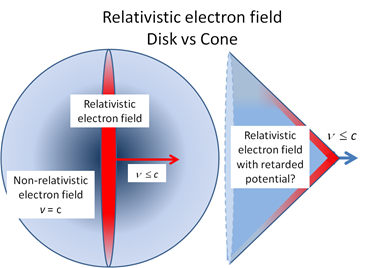
I do not quite know what I want to say here – or how I should further work it out. I am going to re-read my papers. I think I should further develop the last one (https://www.researchgate.net/publication/351097421_The_concepts_of_charge_elementary_ring_currents_potential_potential_energy_and_field_oscillations), in which I write that the vector potential is more real than the electric field and the scalar potential should be further developed, and probably it is the combined scalar and vector potential that are the ’real’ things. Not the electric and magnetic field. Hence, illustrations like below – in terms of discs and cones in space – do probably not go all that far in terms of ‘understanding’ what it is going on… It’s just an intuition…

Cheers – JL

From: Andrew
Sent: 23 September 2021 17:17
To: Jean-Luc; Jerry; Jean Louis
Subject: retarded potential?

Dear Jean-Luc,

Becasue of the claim that gluons are tubal, I have been looking at the disk-shaped E-field lines of the highly-relativistic electron and comparing it to the retarded potential, which, based on timing, would seem to give a cone rather than a disk (see figure). This makes a difference when we consider a deep-orbiting electron. It even impacts selection of the model for impact of an electron when considering diffraction and interference.

Even if the field appears to be spreading out as a cone, the direction of the field lines are that of a disk from the retarded source. However, how does it interact with the radial field of a stationary charge?

Do you have any thoughts on the matter.

Best regards,

Andrew

_ _ _

On Thu, Sep 23, 2021 at 5:05 AM Jean-Luc wrote:

Dear Andrew, Thank you for the references. Best regards, Jean-Luc

Le 18/09/2021 à 17:32, Andrew a écrit :
> This might have useful thoughts concerning the question of radiation
> decay to/from EDOs.
>
> Quantum Optics Electrons see the quantum nature of light
> Ian S. Osborne
> We know that light is both a wave and a particle, and this duality
> arises from the classical and quantum nature of electromagnetic
> excitations. Dahan et al. observed that all experiments to date in
> which light interacts with free electrons have been described with
> light considered as a wave (see the Perspective by Carbone). The
> authors present experimental evidence revealing the quantum nature of
> the interaction between photons and free electrons. They combine an
> ultrafast transmission electron microscope with a silicon-photonic
> nanostructure that confines and strengthens the interaction between
> the light and the electrons. The “quantum” statistics of the photons
> are imprints onto the propagating electrons and are seen directly in
> their energy spectrum.
> Science, abj7128, this issue p. 1324; see also abl6366, p. 1309

Feynman’s Lectures: A Survivor’s Guide

A few days ago, I mentioned I felt like writing a new book: a sort of guidebook for amateur physicists like me. I realized that is actually fairly easy to do. I have three very basic papers – one on particles (both light and matter), one on fields, and one on the quantum-mechanical toolbox (amplitude math and all of that). But then there is a lot of nitty-gritty to be written about the technical stuff, of course: self-interference, superconductors, the behavior of semiconductors (as used in transistors), lasers, and so many other things – and all of the math that comes with it. However, for that, I can refer you to Feynman’s three volumes of lectures, of course. In fact, I should: it’s all there. So… Well… That’s it, then. I am done with the QED sector. Here is my summary of it all (links to the papers on Phil Gibbs’ site):

Paper I: Quantum behavior (the abstract should enrage the dark forces)

Paper II: Probability amplitudes (quantum math)

Paper III: The concept of a field (why you should not bother about QFT)

Paper IV: Survivor’s guide to all of the rest (keep smiling)

Paper V: Uncertainty and the geometry of the wavefunction (the final!)

The last paper is interesting because it shows statistical indeterminism is the only real indeterminism. We can, therefore, use Bell’s Theorem to prove our theory is complete: there is no need for hidden variables, so why should we bother about trying to prove or disprove they can or cannot exist?

Jean Louis Van Belle, 21 October 2020

Note: As for the QCD sector, that is a mess. We might have to wait another hundred years or so to see the smoke clear up there. Or, who knows, perhaps some visiting alien(s) will come and give us a decent alternative for the quark hypothesis and quantum field theories. One of my friends thinks so. Perhaps I should trust him more. 🙂

As for Phil Gibbs, I should really thank him for being one of the smartest people on Earth – and for his site, of course. Brilliant forum. Does what Feynman wanted everyone to do: look at the facts, and think for yourself. 🙂

Bell’s No-Go Theorem

I’ve been asked a couple of times: “What about Bell’s No-Go Theorem, which tells us there are no hidden variables that can explain quantum-mechanical interference in some kind of classical way?” My answer to that question is quite arrogant, because it’s the answer Albert Einstein would give when younger physicists would point out that his objections to quantum mechanics (which he usually expressed as some new  thought experiment) violated this or that axiom or theorem in quantum mechanics: “Das ist mir wur(sch)t.

In English: I don’t care. Einstein never lost the discussions with Heisenberg or Bohr: he just got tired of them. Like Einstein, I don’t care either – because Bell’s Theorem is what it is: a mathematical theorem. Hence, it respects the GIGO principle: garbage in, garbage out. In fact, John Stewart Bell himself – one of the third-generation physicists, we may say – had always hoped that some “radical conceptual renewal”[1] might disprove his conclusions. We should also remember Bell kept exploring alternative theories – including Bohm’s pilot wave theory, which is a hidden variables theory – until his death at a relatively young age. [J.S. Bell died from a cerebral hemorrhage in 1990 – the year he was nominated for the Nobel Prize in Physics. He was just 62 years old then.]

So I never really explored Bell’s Theorem. I was, therefore, very happy to get an email from Gerard van der Ham, who seems to have the necessary courage and perseverance to research this question in much more depth and, yes, relate it to a (local) realist interpretation of quantum mechanics. I actually still need to study his papers, and analyze the YouTube video he made (which looks much more professional than my videos), but this is promising.

To be frank, I got tired of all of these discussions – just like Einstein, I guess. The difference between realist interpretations of quantum mechanics and the Copenhagen dogmas is just a factor 2 or π in the formulas, and Richard Feynman famously said we should not care about such factors (Feynman’s Lectures, III-2-4). Modern physicists fudge them away consistently. They’ve done much worse than that, actually. :-/ They are not interested in truth. Convention, dogma, indoctrination – – non-scientific historical stuff – seems to prevent them from that. And modern science gurus – the likes of Sean Carroll or Sabine Hossenfelder etc. – play the age-old game of being interesting: they pretend to know something you do not know or – if they don’t – that they are close to getting the answers. They are not. They have them already. They just don’t want to tell you that because, yes, it’s the end of physics.


[1] See: John Stewart Bell, Speakable and unspeakable in quantum mechanics, pp. 169–172, Cambridge University Press, 1987.

Mental categories versus reality

Pre-scriptum: For those who do not like to read, I produced a very short YouTube presentation/video on this topic. About 15 minutes – same time as it will take you to read this post, probably. Check it out: https://www.youtube.com/watch?v=sJxAh_uCNjs.

Text:

We think of space and time as fundamental categories of the mind. And they are, but only in the sense that the famous Dutch physicist H.A. Lorentz conveyed to us: we do not seem to be able to conceive of any idea in physics without these two notions. However, relativity theory tells us these two concepts are not absolute and we may, therefore, say they cannot be truly fundamental. Only Nature’s constants – the speed of light, or Planck’s quantum of action – are absolute: these constants seem to mix space and time into something that is, apparently, more fundamental.

The speed of light (c) combines the physical dimensions of space and time, and Planck’s quantum of action (h) adds the idea of a force. But time, distance, and force are all relative. Energy (force over a distance), momentum (force times time) are, therefore, also relative. In contrast, the speed of light, and Planck’s quantum of action, are absolute. So we should think of distance, and of time, as some kind of projection of a deeper reality: the reality of light or – in case of Planck’s quantum of action – the reality of an electron or a proton. In contrast, time, distance, force, energy, momentum and whatever other concept we would derive from them exist in our mind only.

We should add another point here. To imagine the reality of an electron or a proton (or the idea of an elementary particle, you might say), we need an additional concept: the concept of charge. The elementary charge (e) is, effectively, a third idea (or category of the mind, one might say) without which we cannot imagine Nature. The ideas of charge and force are, of course, closely related: a force acts on a charge, and a charge is that upon which a force is acting. So we cannot think of charge without thinking of force, and vice versa. But, as mentioned above, the concept of force is relative: it incorporates the idea of time and distance (a force is that what accelerates a charge). In contrast, the idea of the elementary charge is absolute again: it does not depend on our frame of reference.

So we have three fundamental concepts: (1) velocity (or motion, you might say: a ratio of distance and time); (2) (physical) action (force times distance times time); and (3) charge. We measure them in three fundamental units: c, h, and e. Che. 🙂 So that’s reality, then: all of the metaphysics of physics are here. In three letters. We need three concepts: three things that we think of as being real, somehow. Real in the sense that we do not think they exist in our mind only. Light is real, and elementary particles are equally real. All other concepts exist in our mind only.

So were Kant’s ideas about space and time wrong? Maybe. Maybe not. If they are wrong, then that’s quite OK: Immanuel Kant lived in the 18th century, and had not ventured much beyond the place where he was born. Less exciting times. I think he was basically right in saying that space and time exist in our mind only. But he had no answer(s) to the question as to what is real: if some things exist in our mind only, something must exist in what is not our mind, right? So that is what we refer to as reality then: that which does not exist in our mind only.

Modern physics has the answers. The philosophy curriculum at universities should, therefore, adapt to modern times: Maxwell first derived the (absolute) speed of light in 1862, and Einstein published the (special) theory of relativity back in 1905. Hence, philosophers are 100-150 years behind the curve. They are probably even behind the general public. Philosophers should learn about modern physics as part of their studies so they can (also) think about real things rather than mental constructs only.

The mystery of the elementary charge

As part of my ‘debunking quantum-mechanical myths’ drive, I re-wrote Feynman’s introductory lecture on quantum mechanics. Of course, it has got nothing to do with Feynman’s original lecture—titled: on Quantum Behavior: I just made some fun of Feynman’s preface and that’s basically it in terms of this iconic reference. Hence, Mr. Gottlieb should not make too much of a fuss—although I hope he will, of course, because it would draw more attention to the paper. It was a fun exercise because it encouraged me to join an interesting discussion on ResearchGate (I copied the topic and some up and down below) which, in turn, made me think some more about what I wrote about the form factor in the explanation of the electron, muon and proton. Let me copy the relevant paragraph:

When we talked about the radius of a proton, we promised you we would talk some more about the form factor. The idea is very simple: an angular momentum (L) can always be written as the product of a moment of inertia (I) and an angular frequency (ω). We also know that the moment of inertia for a rotating mass or a hoop is equal to I = mr2, while it is equal to I = mr2/4 for a solid disk. So you might think this explains the 1/4 factor: a proton is just an anti-muon but in disk version, right? It is like a muon because of the strong force inside, but it is even smaller because it packs its charge differently, right?

Maybe. Maybe not. We think probably not. Maybe you will have more luck when playing with the formulas but we could not demonstrate this. First, we must note, once again, that the radius of a muon (about 1.87 fm) and a proton (0.83-0.84 fm) are both smaller than the radius of the pointlike charge inside of an electron (α·ħ/mec ≈ 2.818 fm). Hence, we should start by suggesting how we would pack the elementary charge into a muon first!

Second, we noted that the proton mass is 8.88 times that of the muon, while the radius is only 2.22 times smaller – so, yes, that 1/4 ratio once more – but these numbers are still weird: even if we would manage to, somehow, make abstraction of this form factor by accounting for the different angular momentum of a muon and a proton, we would probably still be left with a mass difference we cannot explain in terms of a unique force geometry.

Perhaps we should introduce other hypotheses: a muon is, after all, unstable, and so there may be another factor there: excited states of electrons are unstable too and involve an n = 2 or some other number in Planck’s E = n·h·f equation, so perhaps we can play with that too.

Our answer to such musings is: yes, you can. But please do let us know if you have more luck then us when playing with these formulas: it is the key to the mystery of the strong force, and we did not find it—so we hope you do!

So… Well… This is really as far as a realist interpretation of quantum mechanics will take you. One can solve most so-called mysteries in quantum mechanics (interference of electrons, tunneling and what have you) with plain old classical equations (applying Planck’s relation to electromagnetic theory, basically) but here we are stuck: the elementary charge itself is a most mysterious thing. When packing it into an electron, a muon or a proton, Nature gives it a very different shape and size.

The shape or form factor is related to the angular momentum, while the size has got to do with scale: the scale of a muon and proton is very different than that of an electron—smaller even than the pointlike Zitterbewegung charge which we used to explain the electron. So that’s where we are. It’s like we’ve got two quanta—rather than one only: Planck’s quantum of action, and the elementary charge. Indeed, Planck’s quantum of action may also be said to express itself itself very differently in space or in time (h = E·T versus h = p·λ). Perhaps there is room for additional simplification, but I doubt it. Something inside of me says that, when everything is said and done, I will just have to accept that electrons are electrons, and protons are protons, and a muon is a weird unstable thing in-between—and all other weird unstable things in-between are non-equilibrium states which one cannot explain with easy math.

Would that be good enough? For you? I cannot speak for you. Is it a good enough explanation for me? I am not sure. I have not made my mind up yet. I am taking a bit of a break from physics for the time being, but the question will surely continue to linger in the back of my mind. We’ll keep you updated on progress ! Thanks for staying tuned ! JL

PS: I realize the above might sound a bit like crackpot theory but that is just because it is very dense and very light writing at the same time. If you read the paper in full, you should be able to make sense of it. 🙂 You should also check the formulas for the moments of inertia: the I = mr2/4 formula for a solid disk depends on your choice of the axis of symmetry.

Research Gate

Peter Jackson

Dear Peter – Thanks so much for checking the paper and your frank comments. That is very much appreciated. I know I have gone totally overboard in dismissing much of post-WW II developments in quantum physics – most notably the idea of force-carrying particles (bosons – including Higgs, W/Z bosons and gluons). My fundamental intuition here is that field theories should be fine for modeling interactions (I’ll quote Dirac’s 1958 comments on that at the very end of my reply here) and, yes, we should not be limiting the idea of a field to EM fields only. So I surely do not want to give the impression I think classical 19th/early 20th century physics – Planck’s relation, electromagnetic theory and relativity – can explain everything.

Having said that, the current state of physics does resemble the state of scholastic philosophy before it was swept away by rationalism: I feel there has been a multiplication of ill-defined concepts that did not add much additional explanation of what might be the case (the latter expression is Wittgenstein’s definition of reality). So, yes, I feel we need some reincarnation of William of Occam to apply his Razor and kick ass. Fortunately, it looks like there are many people trying to do exactly that now – a return to basics – so that’s good: I feel like I can almost hear the tectonic plates moving. 🙂

My last paper is a half-serious rewrite of Feynman’s first Lecture on Quantum Mechanics. Its intention is merely provocative: I want to highlight what of the ‘mystery’ in quantum physics is truly mysterious and what is humbug or – as Feynman would call it – Cargo Cult Science. The section on the ‘form factor’ (what is the ‘geometry’ of the strong force?) in that paper is the shortest and most naive paragraph in that text but it actually does highlight the one and only question that keeps me awake: what is that form factor, what different geometry do we need to explain a proton (or a muon) as opposed to, say, an electron? I know I have to dig into the kind of stuff that you are highlighting – and Alex Burinskii’s Dirac-Kerr-Newman models (also integrating gravity) to find elements that – one day – may explain why a muon is not an electron, and why a proton is not a positron.

Indeed, I think the electron and photon model are just fine: classical EM and Planck’s relation are all that’s needed and so I actually don’t waste to more time on the QED sector. But a decent muon and proton model will, obviously, require ”something else’ than Planck’s relation, the electric charge and electromagnetic theory. The question here is: what is that ‘something else’, exactly?

Even if we find another charge or another field theory to explain the proton, then we’re just at the beginning of explaining the QCD sector. Indeed, the proton and muon are stable (fairly stable – I should say – in case of the muon – which I want to investigate because of the question of matter generations). In contrast, transient particles and resonances do not respect Planck’s relation – that’s why they are unstable – and so we are talking non-equilibrium states and so that’s an entirely different ballgame. In short, I think Dirac’s final words in the very last (fourth) edition of his ‘Principles of Quantum Mechanics’ still ring very true today. They were written in 1958 so Dirac was aware of the work of Gell-Man and Nishijima (the contours of quark-gluon theory) and, clearly, did not think much of it (I understand he also had conversations with Feynman on this):

“Quantum mechanics may be defined as the application of equations of motion to particles. […] The domain of applicability of the theory is mainly the treatment of electrons and other charged particles interacting with the electromagnetic field⎯a domain which includes most of low-energy physics and chemistry.

Now there are other kinds of interactions, which are revealed in high-energy physics and are important for the description of atomic nuclei. These interactions are not at present sufficiently well understood to be incorporated into a system of equations of motion. Theories of them have been set up and much developed and useful results obtained from them. But in the absence of equations of motion these theories cannot be presented as a logical development of the principles set up in this book. We are effectively in the pre-Bohr era with regard to these other interactions. It is to be hoped that with increasing knowledge a way will eventually be found for adapting the high-energy theories into a scheme based on equations of motion, and so unifying them with those of low-energy physics.”

Again, many thanks for reacting and, yes, I will study the references you gave – even if I am a bit skeptical of Wolfram’s new project. Cheers – JL

Paul Ehrenfest and the search for truth

On 25 September 1933, Paul Ehrenfest took his son Wassily, who was suffering from Down syndrome, for a walk in the park. He shot him, and then killed himself. He was only 53. That’s my age bracket. From the letters he left (here is a summary in Dutch), we know his frustration of not being able to arrive at some kind of common-sense interpretation of the new quantum physics played a major role in the anxiety that had brought him to this point. He had taken courses from Ludwig Boltzmann as an aspiring young man. We, therefore, think Boltzmann’s suicide – for similar reasons – might have troubled him too.

His suicide did not come unexpectedly: he had announced it. In one of his letters to Einstein, he complains about ‘indigestion’ from the ‘unendlicher Heisenberg-Born-Dirac-Schrödinger Wurstmachinen-Physik-Betrieb.’ I’ll let you google-translate that. :-/ He also seems to have gone through the trouble of summarizing all his questions on the new approach in an article in what was then one of the top journals for physics: Einige die Quantenmechanik betreffende Erkundigungsfrage, Zeitschrift für Physik 78 (1932) 555-559 (quoted in the above-mentioned review article). This I’ll translate: Some Questions about Quantum Mechanics.

Ehrenfest

Paul Ehrenfest in happier times (painting by Harm Kamerlingh Onnes in 1920)

A diplomat-friend of mine once remarked this: “It is good you are studying physics only as a pastime. Professional physicists are often troubled people—miserable.” It is an interesting observation from a highly intelligent outsider. To be frank, I understand this strange need to probe things at the deepest level—to be able to explain what might or might not be the case (I am using Wittgenstein’s definition of reality here). Even H.A. Lorentz, who – fortunately, perhaps – died before his successor did what he did, was becoming quite alarmist about the sorry state of academic physics near the end of his life—and he, Albert Einstein, and so many others were not alone. Not then, and not now. All of the founding fathers of quantum mechanics ended up becoming pretty skeptical about the theory they had created. We have documented that elsewhere so we won’t talk too much about it here. Even John Stewart Bell himself – one of the third generation of quantum physicists, we may say – did not like his own ‘No Go Theorem’ and thought that some “radical conceptual renewal”[1] might disprove his conclusions.

The Born-Heisenberg revolution has failed: most – if not all – of contemporary high-brow physicist are pursuing alternative theories—in spite, or because, of the academic straitjackets they have to wear. If a genius like Ehrenfest didn’t buy it, then I won’t buy it either. Furthermore, the masses surely don’t buy it and, yes, truth – in this domain too – is, fortunately, being defined more democratically nowadays. The Nobel Prize Committee will have to do some serious soul-searching—if not five years from now, then ten.

We feel sad for the physicists who died unhappily—and surely for those who took their life out of depression—because the common-sense interpretation they were seeking is so self-evident: de Broglie’s intuition in regard to matter being wavelike was correct. He just misinterpreted its nature: it is not a linear but a circular wave. We quickly insert the quintessential illustration (courtesy of Celani, Vassallo and Di Tommaso) but we refer the reader for more detail to our articles or – more accessible, perhaps – our manuscript for the general public.

aa 2

The equations are easy. The mass of an electron – any matter-particle, really – is the equivalent mass of the oscillation of the charge it carries. This oscillation is, most probably, statistically regular only. So we think it’s chaotic, actually, but we also think the words spoken by Lord Pollonius in Shakespeare’s Hamlet apply to it: “Though this be madness, yet there is method in ‘t.” This means we can meaningfully speak of a cycle time and, therefore, of a frequency. Erwin Schrödinger stumbled upon this motion while exploring solutions to Dirac’s wave equation for free electrons, and Dirac immediately grasped the significance of Schrödinger’s discovery, because he mentions Schrödinger’s discovery rather prominently in his Nobel Prize Lecture:

“It is found that an electron which seems to us to be moving slowly, must actually have a very high frequency oscillatory motion of small amplitude superposed on the regular motion which appears to us. As a result of this oscillatory motion, the velocity of the electron at any time equals the velocity of light. This is a prediction which cannot be directly verified by experiment, since the frequency of the oscillatory motion is so high and its amplitude is so small. But one must believe in this consequence of the theory, since other consequences of the theory which are inseparably bound up with this one, such as the law of scattering of light by an electron, are confirmed by experiment.” (Paul A.M. Dirac, Theory of Electrons and Positrons, Nobel Lecture, December 12, 1933)

Unfortunately, Dirac confuses the concept of the electron as a particle with the concept of the (naked) charge inside. Indeed, the idea of an elementary (matter-)particle must combine the idea of a charge and its motion to account for both the particle- as well as the wave-like character of matter-particles. We do not want to dwell on all of this because we’ve written too many papers on this already. We just thought it would be good to sum up the core of our common-sense interpretation of physics. Why? To honor Boltzmann and Ehrenfest: I think of their demise as a sacrifice in search for truth.

[…]

OK. That sounds rather tragic—sorry for that! For the sake of brevity, we will just describe the electron here.

I. Planck’s quantum of action (h) and the speed of light (c) are Nature’s most fundamental constants. Planck’s quantum of action relates the energy of a particle to its cycle time and, therefore, to its frequency:

(1) h = E·T = E/f ⇔ ħ = E/ω

The charge that is whizzing around inside of the electron has zero rest mass, and so it whizzes around at the speed of light: the slightest force on it gives it an infinite acceleration. It, therefore, acquires a relativistic mass which is equal to mγ = me/2 (we refer to our paper(s) for a relativistically correct geometric argument). The momentum of the pointlike charge, in its circular or orbital motion, is, therefore, equal to p = mγ·c = me·c/2.

The (angular) frequency of the oscillation is also given by the formula for the (angular) velocity:

(2) c = a·ω ⇔ ω = c/a

While Eq. (1) is a fundamental law of Nature, Eq. (2) is a simple geometric or mathematical relation only.

II. From (1) and (2), we can now calculate the radius of this tiny circular motion as:

(3a) ħ = E/ω = E·a/c a = (ħ·c)/E

Because we know the mass of the electron is the inertial mass of the state of motion of the pointlike charge, we may use Einstein’s mass-energy equivalence relation to rewrite this as the Compton radius of the electron:

(3b) a = (ħ·c)/E = (ħ·c)/(me·c2) = ħ/(me·c)

Note that we only used two fundamental laws of Nature so far: the Planck-Einstein relation and Einstein’s mass-energy equivalence relation.

III. We must also be able to express the Planck-Einstein quantum as the product of the momentum (p) of the pointlike charge and some length λ:

(4) h = p·λ

The question here is: what length? The circumference of the loop, or its radius? The same geometric argument we used to derive the effective mass of the pointlike charge as it whizzes around at lightspeed around its center, tells us the centripetal force acts over a distance that is equal to two times the radius. Indeed, the relevant formula for the centripetal force is this:

(5) F = (mγ/me)·(E/a) = E/2a

We can therefore reduce Eq. (4) by dividing it by 2π. We then get reduced, angular or circular (as opposed to linear) concepts:

(6) ħ = (p·λ)/(2π) = (me·c/2)·(λ/π) = (me·c/2)·(2a) = me·c·a ⇔ ħ/a = me·c

We can verify the logic of our reasoning by substituting for the Compton radius:

ħ = p·λ = me·c·= me·c·a = me·c·ħ/(me·c) = ħ

IV. We can, finally, re-confirm the logic of our reason by re-deriving Einstein’s mass-energy equivalence relation as well as the Planck-Einstein relation using the ω = c/a and the ħ/a = me·c relations:

(7) ħ·ω = ħ·c/a = (ħ/ac = (me·cc = me·c2 = E

Of course, we note all of the formulas we have derived are interdependent. We, therefore, have no clear separation between axioms and derivations here. If anything, we are only explaining what Nature’s most fundamental laws (the Planck-Einstein relation and Einstein’s mass-energy equivalence relation) actually mean or represent. As such, all we have is a simple description of reality itself—at the smallest scale, of course! Everything that happens at larger scales involves Maxwell’s equations: that’s all electromagnetic in nature. No need for strong or weak forces, or for quarks—who invented that? Ehrenfest, Lorentz and all who suffered with truly understanding the de Broglie’s concept of the matter-wave might have been happier physicists if they would have seen these simple equations!

The gist of the matter is this: the intuition of Einstein and de Broglie in regard to the wave-nature of matter was, essentially, correct. However, de Broglie’s modeling of it as a wave packet was not: modeling matter-particles as some linear oscillation does not do the trick. It is extremely surprising no one thought of trying to think of some circular oscillation. Indeed, the interpretation of the elementary wavefunction as representing the mentioned Zitterbewegung of the electric charge solves all questions: it amounts to interpreting the real and imaginary part of the elementary wavefunction as the sine and cosine components of the orbital motion of a pointlike charge. We think that, in our 60-odd papers, we’ve shown such easy interpretation effectively does the trick of explaining all of the quantum-mechanical weirdness but, of course, it is up to our readers to judge that. 🙂

[1] See: John Stewart Bell, Speakable and unspeakable in quantum mechanics, pp. 169–172, Cambridge University Press, 1987 (quoted from Wikipedia). J.S. Bell died from a cerebral hemorrhage in 1990 – the year he was nominated for the Nobel Prize in Physics and which he, therefore, did not receive (Nobel Prizes are not awarded posthumously). He was just 62 years old then.

Re-writing Feynman’s Lectures?

I have a crazy new idea: a complete re-write of Feynman’s Lectures. It would be fun, wouldn’t it? I would follow the same structure—but start with Volume III, of course: the lectures on quantum mechanics. We could even re-use some language—although we’d need to be careful so as to keep Mr. Michael Gottlieb happy, of course. 🙂 What would you think of the following draft Preface, for example?

The special problem we try to get at with these lectures is to maintain the interest of the very enthusiastic and rather smart people trying to understand physics. They have heard a lot about how interesting and exciting physics is—the theory of relativity, quantum mechanics, and other modern ideas—and spend many years studying textbooks or following online courses. Many are discouraged because there are really very few grand, new, modern ideas presented to them. The problem is whether or not we can make a course which would save them by maintaining their enthusiasm.

The lectures here are not in any way meant to be a survey course, but are very serious. I thought it would be best to re-write Feynman’s Lectures to make sure that most of the above-mentioned enthusiastic and smart people would be able to encompass (almost) everything that is in the lectures. 🙂

This is the link to Feynman’s original Preface, so you can see how my preface compares to his: same-same but very different, they’d say in Asia. 🙂

[…]

Doesn’t that sound like a nice project? 🙂

Jean Louis Van Belle, 22 May 2020

Post scriptum: It looks like we made Mr. Gottlieb and/or MIT very unhappy already: the link above does not work for us anymore (see what we get below). That’s very good: it is always nice to start a new publishing project with a little controversy. 🙂 We will have to use the good old paper print edition. We recommend you buy one too, by the way. 🙂 I think they are just a bit over US$100 now. Well worth it!

To put the historical record straight, the reader should note we started this blog before Mr. Gottlieb brought Feynman’s Lectures online. We actually wonder why he would be bothered by us referring to it. That’s what classical textbooks are for, aren’t they? They create common references to agree or disagree with, and why put a book online if you apparently don’t want it to be read or discussed? Noise like this probably means I am doing something right here. 🙂

Post scriptum 2: Done ! Or, at least, the first chapter is done ! Have a look: here is the link on ResearchGate and this is the link on Phil Gibbs’ site. Please do let me know what you think of it—whether you like it or not or, more importantly, what logic makes sense and what doesn’t. 🙂

Gottlieb

Joseph Larmor and the ring current model of an electron


Joseph Larmor is surely not among the more famous participants in the Solvay Conferences. He only joined the 1921 Conference, together with Charles Glover Barkla and others, and his one and only substantial intervention there is limited to some remarks and questions following a presentation by H.A. Lorentz on the Theory of Electrons, during which Lorentz highlights all of the issues in regard to what was then supposed to be the understanding of what an electron actually is (which, in my not-so-humble-view, is still pretty much the state of our current understanding of it).

I find his one intervention (and Lorentz’ reply to it) very interesting though, and so that’s why I am writing about it here. I am not aware of any free online English translations of the proceedings of the Solvay Conferences (nor of any translation of Lorentz’ paper in particular) but you may be luckier than me when googling: if you find it, please do let me know. In the meanwhile, I am happy to freely translate part of Larmor’s rather short intervention after Lorentz’ presentation from French to English:

“I understand that Mr. Lorentz was given the task to give an overview of how electrons behave inside of an atom. That requires an overview of all possible theories of the electron. That is a highly worthwhile endeavor which, in itself, would already justify the holding of this Conference. However, Mr. Lorentz might have paid more attention to the viewpoint that the electron has some structure, and that its representation as a simple distribution of electric charge can only be provisional: electrons explain electricity, but electricity does not explain electrons. However, the description of an electron in terms of a charge distribution is, for the time being, all we can imagine. In the past, we thought of the atom as an indivisible unit – a fundamental building block – and we imagined it as a swirling ring. That idea is gone now, and the electron has now taken the place of the atom as an indestructible unit. All we can know about it, is how it influences other bodies. If this influence is transmitted all across the aether, we need to be able to express the relations between the electron and the aether[1], or its force field in the space that surrounds it. It may have other properties, of course, but physics is the science that should analyze the influence or force of one body upon others.

The question we should raise here is whether or not an electron formed by a perfectly uniform current ring can grab onto the aether in a physical sense, and how it does so if its configuration does not change.” (Joseph Larmor, 1921, boldface and italics added)

Larmor then talks about the (possible) use of the energy-momentum tensor to address the latter question, which is a very technical discussion which is of no concern to us here. Indeed, the question on how to use tensors to model how an electron would interact with other charges or how it would create an electromagnetic field is, effectively, a rather standard textbook topic now and, in case you’d be interested, you can check  my blog on it or, else, (re-)read Chapters 25, 26 and 27 of Feynman’s Lectures on electromagnetism.

What grabbed my attention here was, effectively, not the technicality of the question in regard to the exact machinery of the electromagnetic force or field. It was Larmor’s description of the electron as a perpetual or persistent current ring (the French reference to it is this: un electron formé par un courant annulaire parfaitement uniforme), and his language on it, which indicates he thought of it as a rather obvious and natural idea! Hence, Parson’s 1915 toroidal ring model – the precursor to Schrödinger’s Zitterbewegung model and modern-day ring current models – was apparently pretty well established at the time! In fact, Rutherford’s lecture on the Structure of the Atom at the 1921 Conference further confirms this, as he also talks about Parson’s électron annulaire (ring electron) and the apparent magnetic properties of the electron (I will talk about Rutherford’s 1921 Solvay lecture in my next post).

Larmor’s belief that the electron was not pointlike should, of course, not surprise us in light of his rather famous work on the quantum-mechanical precession of the magnetic moment of an electron, but I actually wasn’t aware of Joseph Larmor’s own views in regard to its possible reality. In fact, I am only guessing here but his rather strong views on its reality may explain why the scientific committee − which became increasingly dominated by scientists in favor of the Bohr-Heisenberg interpretation of physical reality (basically saying we will never be able to understand it)  − did not extend an invitation to Larmor to attend the all-important Solvay conferences that would follow the 1921 Conference and, most notably, the 1927 Conference that split physicists between realists and… Well… Non-realists, I guess. 🙂

Lorentz’ immediate reaction to Larmor mentioning the idea of a swirling ring (in French: un anneau tourbillon), which is part of his reply to Larmor’s remarks, is equally interesting:

“There is a lot to be said for your view that electrons are discontinuities in the aether. […] The energy-momentum formulas that I have developed should apply to all particles, with or without structure. The idea of a rotating ring [in French: anneau tournant] has a great advantage when trying to explain some issues [in the theory of an electron]: it would not emit any electromagnetic radiation. It would only produce a magnetic field in the immediate space that surrounds it. […]” (H.A. Lorentz, 1921, boldface and italics added)

Isn’t that just great? Lorentz’ answer to Larmor’s question surely does not solve all of the problems relating to the interpretation of the electron as a current ring, but it sure answers that very basic question which proponents of modern quantum mechanics usually advance when talking about the so-called failure of classical physics: electrons in some electron orbital in an atom should radiate their energy out, but so they do not. Let me actually quote from Feynman’s Lectures on Quantum Mechanics here: “Classically, the electrons would radiate light and spiral in until they settle down right on top of the nucleus. That cannot be right.”

Surely You’re Joking, Mr. Feynman! Here is the answer of the classical quantum theorists: superconducting rings of electric current do not radiate their energy out either, do they?

[1] Larmor believed an aether should exist. We will re-quote Robert B. Laughlin here: “The word ‘ether’ has extremely negative connotations in theoretical physics because of its past association with opposition to relativity. This is unfortunate because, stripped of these connotations, it rather nicely captures the way most physicists actually think about the vacuum. […] The modern concept of the vacuum of space, confirmed every day by experiment, is a relativistic ether. But we do not call it this because it is taboo.”

On the concept of the aether, we can also usefully translate part of Lorentz’ answer to Larmor: “As for the aether, even the physicists who still talk about it have stripped the concept of anything it might have in common with matter. I was a believer in an immobile aether myself but I realize that, because of relativity, we cannot talk about any force acting on the aether. However, I still think of the aether as the seat of electromagnetic energy (in French, le siège de l’énergie électromagnétique). Now, we can all think of the components of the energy-momentum tensor like we want, but if we think of some of them being real in some sense, then all of them should be real in the same sense.”

Post scriptum: I should really stop duplicating posts between this and my other blog site on physics. Hence, I beg the readers who want to keep following me to do so on my ideez.org site. I think I’ll devote it a historical analysis of how useful and not-so-useful ideas in physics have evolved over the past hundred years or so, using the proceedings of the Solvay Conferences as the material for analysis.

The last words of H.A. Lorentz

I talked about the Solvay Conferences in my previous post(s). The Solvay Conference proceedings are a real treasury trove. Not only are they very pleasant to read, but they also debunk more than one myth or mystery in quantum physics!

It is part of scientific lore, for example, that the 1927 Solvay Conference was a sort of battlefield on new physics between Heisenberg and Einstein. Surprisingly, the papers and write-up of discussions reveal that Einstein hardly intervened. They also reveal that ‘battlefield stories’ such as Heisenberg telling Einstein to “stop telling God what to do” or – vice versa – Einstein declaring “God doesn’t play dice” are what they are: plain gossip or popular hear-say. Neither Heisenberg nor Einstein ever said that—or not at the occasion of the 1927 Solvay Conference, at least! Instead, we see very nuanced and very deep philosophical statements—on both sides of the so-called ‘divide’ or ‘schism’.

From all interventions, the intervention of the Dutch scientist Hendrik Antoon Lorentz stands out. I know (most of) my readers don’t get French, and so I might translate it into English one of these days. In the meanwhile, you may want to google-translate it yourself!

It is all very weird, emotional and historical. H.A. Lorentz – clearly the driving force behind those pre-WW II Solvay Conferences – died a few months after the 1927 Conference. In fact, the 1927 conference proceedings have both the sad announcement of his demise as well his interventions—such was the practice of actually physically printing stuff at the time.

For those who do read French, here you go:

DISCUSSION GENERALE DES IDEES NOUVELLES EMISES.

Causalité, Déterminisme. Probabilité.

Intervention de M. Lorentz:

“Je voudrais attirer l ’attention sur les difficultés qu’on rencontre dans les anciennes théories. Nous voulons nous faire une représentation des phénomènes, nous en former une image dans notre esprit. Jusqu’ici, nous avons toujours voulu former ces images au moyen des notions ordinaires de temps et d’espace. Ces notions sont peut-être innées; en tout cas, elles se sont développées par notre expérience personnelle, par nos observations journalières. Pour moi, ces notions sont claires et j ’avoue que je ne puis me faire une idée de la physique sans ces notions. L ’image que je veux me former des phénomènes doit être absolument nette et définie et il me semble que nous ne pouvons nous former une pareille image que dans ce système d’espace et de temps.

Pour moi, un électron est un corpuscule qui, a un instant donne, se trouve en un point détermine de l ’espace, et si j ’ai eu l ’idée qu’a un moment suivant ce corpuscule se trouve ailleurs, je dois songer à sa trajectoire, qui est une ligne dans l’espace. Et si cet électron rencontre un atome et y pénètre, et qu’après plusieurs aventures il quitte cet atome, je me forge une théorie dans laquelle cet électron conserve son individualité; c’est-à-dire que j ’imagine une ligne suivant laquelle cet électron passe à travers cet atome. Il se peut, évidemment, que cette théorie soit bien difficile à développer, mais a priori cela ne me parait pas impossible.

Je me figure que, dans la nouvelle théorie, on a encore de ces électrons. Il est possible, évidemment, que dans la nouvelle théorie, bien développée, il soit nécessaire de supposer que ces électrons subissent des transformations. Je veux bien admettre que l’électron se fond en un nuage. Mais alors je chercherai à quelle occasion cette transformation se produit. Si l’on voulait m’interdire une pareille recherche en invoquant un principe, cela me gênerait beaucoup. Il me semble qu’on peut toujours espérer qu’on fera plus tard ce que nous ne pouvons pas encore faire en ce moment. Même si l’on abandonne les anciennes idées, on peut toujours conserver les anciennes dénominations. Je voudrais conserver cet idéal d’autrefois, de décrire tout ce qui se passe dans le monde par des images nettes. Je suis prêt à admettre d’autres théories, à condition qu’on puisse les traduire par des images claires et nettes.

Pour ma part, bien que n’étant pas encore familiarisé avec les nouvelles idées que j’entends exprimer maintenant, je pourrais me représenter ces idées ainsi. Prenons le cas d’un électron qui rencontre un atome; supposons que cet électron quitte cet atome et qu’en même temps il y ait émission d’un quantum de lumière. Il faut considérer, en premier lieu, les systèmes d’ondes qui correspondent à l ’électron et à l’atome avant le choc. Après le choc, nous aurons de nouveaux systèmes d’ondes. Ces systèmes d’ondes pourront etre décrits par une fonction ψ définie dans un espace a un grand nombre de dimensions qui satisfait une équation différentielle. La nouvelle mécanique ondulatoire opèrera avec cette équation et établira la fonction ψ avant et après le choc.

Or, il y a des phénomènes qui apprennent qu’ il y a autre chose encore que ces ondes, notamment des corpuscules; on peut faire, par exemple, une expérience avec un cylindre de Faraday; il y a donc à tenir compte de l’individualité des électrons et aussi des photons. Je pense que je trouverais que, pour expliquer les phénomènes, il suffit d’admettre que l’expression ψψ* donne la probabilité que ces électrons et ces photons existent dans un volume détermine; cela me suffirait pour expliquer les expériences.

Mais les exemples donnes par M. Heisenberg m’apprennent que j’aurais atteint ainsi tout ce que l’expérience me permet d’atteindre. Or, je pense que cette notion de probabilité serait à mettre à la fin, et comme conclusion, des considérations théoriques, et non pas comme axiome a priori, quoique je veuille bien admettre que cette indétermination correspond aux possibilités expérimentales. Je pourrais toujours garder ma foi déterministe pour les phénomènes fondamentaux, dont je n’ai pas parlé. Est-ce qu’un esprit plus profond ne pourrait pas se rendre compte des mouvements de ces électrons. Ne pourrait-on pas garder le déterminisme en en faisant l’objet d’une croyance ? Faut-il nécessairement ériger l’ indéterminisme en principe?

I added the bold italics above. A free translation of this phrase is this:

Why should we elevate determinism or  – as Born en Heisenberg do – its opposite (indeterminism) to a philosophical principle?

What a beautiful statement ! Lorentz died of a very trivial cause: erysipelas, commonly known as St Anthony’s fire. :-/