

Gauge as Causal Bookkeeping
The Lorenz Condition from Maxwell to Quantum Field Theory
Abstract
In this lecture, we revisit the notion of gauge in classical electromagnetism, with particular focus on the Lorenz gauge condition. Rather than treating gauge as a symmetry principle or abstract redundancy, we show that the Lorenz condition emerges naturally as a causal continuity requirement already implicit in Maxwell’s equations. This perspective allows gauge freedom to be understood as bookkeeping freedom rather than physical freedom, and provides a useful conceptual bridge to the role of gauge in quantum field theory (QFT), where similar constraints are often elevated to ontological status.
Note on how this post differs from other posts on the topic: In earlier posts (see, for example, our 2015 post on Maxwell, Lorentz, gauges and gauge transformations) approached the Lorenz gauge primarily from a logical standpoint; the present note revisits the same question with a more explicit emphasis on causality and continuity.
1. Why potentials appear at all
Maxwell’s equations impose structural constraints on electromagnetic fields that make the introduction of potentials unavoidable.
The absence of magnetic monopoles,
implies that the magnetic field must be expressible as the curl of a vector potential,
Faraday’s law of induction,then requires the electric field to take the form
At this stage, no gauge has been chosen. Potentials appear not because they are elegant, but because the curl–divergence structure of Maxwell’s equations demands them. The scalar and vector potentials encode how electromagnetic structure evolves in time.
2. The problem of over-description
The potentials (ϕ,A) are not uniquely determined by the fields (E,B). Transformations of the formleave the physical fields unchanged.
This non-uniqueness is often presented as a “gauge freedom.” However, without further restriction, Maxwell’s equations expressed in terms of potentials suffer from a deeper issue: the equations mix instantaneous (elliptic) and propagating (hyperbolic) behavior. In particular, causality becomes obscured at the level of the potentials.
The question is therefore not which gauge to choose, but:
What minimal condition restores causal consistency to the potential description?
3. The Lorenz gauge as a continuity condition
The Lorenz gauge condition,provides a direct answer.
When imposed, Maxwell’s equations reduce to wave equations for both potentials:with the same d’Alembert operator . Scalar and vector potentials propagate at the same finite speed and respond locally to their sources.
In covariant form, the Lorenz condition reads:
This equation closely mirrors charge conservation,
The parallel is not accidental. The Lorenz gauge enforces spacetime continuity of electromagnetic influence, ensuring that potentials evolve consistently with conserved sources.
4. Physical interpretation
From this perspective, the Lorenz gauge is not a symmetry principle but a causal closure condition:
- the divergence of the vector potential controls longitudinal structure,
- the time variation of the scalar potential tracks charge redistribution,
- the condition ties both into a single spacetime constraint.
Nothing new is added to Maxwell’s theory. Instead, an implicit requirement — finite-speed propagation — is made explicit at the level of the potentials.
Gauge freedom thus reflects freedom of description under causal equivalence, not freedom of physical behavior.
5. Historical remark
The condition is named after Ludvig Lorenz, who introduced it in 1867, well before relativistic spacetime was formalized. Its later compatibility with Lorentz invariance — developed by Hendrik Antoon Lorentz — explains why it plays a privileged role in relativistic field theory.
The frequent miswriting of the “Lorenz gauge” as “Lorentz gauge” in modern textbooks (including by Richard Feynman) is, therefore, historically inaccurate but physically suggestive.
6. Gauge in quantum field theory: a cautionary bridge
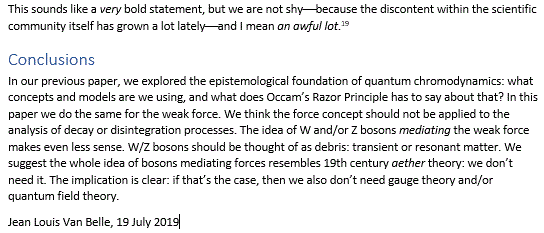
In quantum field theory, gauge invariance is often elevated from a bookkeeping constraint to a foundational principle. This move has undeniable calculational power, but it risks conflating descriptive redundancy with physical necessity.
From the classical electromagnetic perspective developed here, gauge conditions arise whenever:
- local causality is enforced,
- descriptive variables exceed physical degrees of freedom,
- continuity constraints must be imposed to maintain consistency.
Seen this way, gauge symmetry stabilizes theories that would otherwise over-describe their objects. It does not, by itself, mandate the existence of distinct fundamental forces.
7. Concluding remark
The Lorenz gauge is best understood not as an optional choice, nor as a deep symmetry of nature, but as good accounting imposed by causality.
When structure, continuity, and finite propagation speed are respected, gauge quietly disappears into consistency.
 Reading Feynman