Wavefunctions as gravitational waves

This is the paper I always wanted to write. It is there now, and I think it is good – and that‘s an understatement. šŸ™‚ It is probably best to download it as a pdf-file from the viXra.org site because this was a rather fast ‘copy and paste’ job from the Word version of the paper, so there may be issues with boldface notation (vector notation), italics and, most importantly, with formulas – which I, sadly, have to ‘snip’ into this WordPress blog, as they don’t have an easy copy function for mathematical formulas.

It’s great stuff. If you have been following my blog – and many of you have – you will want to digest this. šŸ™‚

Abstract : This paper explores the implications of associating the components of the wavefunction with a physical dimension: force per unit mass – which is, of course, the dimension of acceleration (m/s2) and gravitational fields. The classical electromagnetic field equations for energy densities, the Poynting vector and spin angular momentum are then re-derived by substituting the electromagnetic N/C unit of field strength (mass per unit charge) by the new N/kg = m/s2 dimension.

The results are elegant and insightful. For example, the energy densities are proportional to the square of the absolute value of the wavefunction and, hence, to the probabilities, which establishes a physical normalization condition. Also, Schrƶdinger’s wave equation may then, effectively, be interpreted as a diffusion equation for energy, and the wavefunction itself can be interpreted as a propagating gravitational wave. Finally, as an added bonus, concepts such as the Compton scattering radius for a particle, spin angular momentum, and the boson-fermion dichotomy, can also be explained more intuitively.

While the approach offers a physical interpretation of the wavefunction, the author argues that the core of the Copenhagen interpretations revolves around the complementarity principle, which remains unchallenged because the interpretation of amplitude waves as traveling fields does not explain the particle nature of matter.

Introduction

This is not another introduction to quantum mechanics. We assume the reader is already familiar with the key principles and, importantly, with the basic math. We offer an interpretation of wave mechanics. As such, we do not challenge the complementarity principle: the physical interpretation of the wavefunction that is offered here explains the wave nature of matter only. It explains diffraction and interference of amplitudes but it does not explain why a particle will hit the detector not as a wave but as a particle. Hence, the Copenhagen interpretation of the wavefunction remains relevant: we just push its boundaries.

The basic ideas in this paper stem from a simple observation: the geometric similarity between the quantum-mechanical wavefunctions and electromagnetic waves is remarkably similar. The components of both waves are orthogonal to the direction of propagation and to each other. Only the relative phase differs : the electric and magnetic field vectors (E and B) have the same phase. In contrast, the phase of the real and imaginary part of the (elementary) wavefunction (ψ = aĀ·eāˆ’iāˆ™Īø = aāˆ™cosĪø – aāˆ™sinĪø) differ by 90 degrees (Ļ€/2).[1] Pursuing the analogy, we explore the following question: if the oscillating electric and magnetic field vectors of an electromagnetic wave carry the energy that one associates with the wave, can we analyze the real and imaginary part of the wavefunction in a similar way?

We show the answer is positive and remarkably straightforward.  If the physical dimension of the electromagnetic field is expressed in newton per coulomb (force per unit charge), then the physical dimension of the components of the wavefunction may be associated with force per unit mass (newton per kg).[2] Of course, force over some distance is energy. The question then becomes: what is the energy concept here? Kinetic? Potential? Both?

The similarity between the energy of a (one-dimensional) linear oscillator (E = mĀ·a2·ω2/2) and Einstein’s relativistic energy equation E = māˆ™c2 inspires us to interpret the energy as a two-dimensional oscillation of mass. To assist the reader, we construct a two-piston engine metaphor.[3] We then adapt the formula for the electromagnetic energy density to calculate the energy densities for the wave function. The results are elegant and intuitive: the energy densities are proportional to the square of the absolute value of the wavefunction and, hence, to the probabilities. Schrƶdinger’s wave equation may then, effectively, be interpreted as a diffusion equation for energy itself.

As an added bonus, concepts such as the Compton scattering radius for a particle and spin angular, as well as the boson-fermion dichotomy can be explained in a fully intuitive way.[4]

Of course, such interpretation is also an interpretation of the wavefunction itself, and the immediate reaction of the reader is predictable: the electric and magnetic field vectors are, somehow, to be looked at as real vectors. In contrast, the real and imaginary components of the wavefunction are not. However, this objection needs to be phrased more carefully. First, it may be noted that, in a classical analysis, the magnetic force is a pseudovector itself.[5] Second, a suitable choice of coordinates may make quantum-mechanical rotation matrices irrelevant.[6]

Therefore, the author is of the opinion that this little paper may provide some fresh perspective on the question, thereby further exploring Einstein’s basic sentiment in regard to quantum mechanics, which may be summarized as follows: there must be some physical explanation for the calculated probabilities.[7]

We will, therefore, start with Einstein’s relativistic energy equation (E = mc2) and wonder what it could possibly tell us. 

I. Energy as a two-dimensional oscillation of mass

The structural similarity between the relativistic energy formula, the formula for the total energy of an oscillator, and the kinetic energy of a moving body, is striking:

  1. E = mc2
  2. E = mω2/2
  3. E = mv2/2

In these formulas, ω, v and c all describe some velocity.[8] Of course, there is the 1/2 factor in the E = mω2/2 formula[9], but that is exactly the point we are going to explore here: can we think of an oscillation in two dimensions, so it stores an amount of energy that is equal to E = 2Ā·m·ω2/2 = m·ω2?

That is easy enough. Think, for example, of a V-2 engine with the pistons at a 90-degree angle, as illustrated below. The 90° angle makes it possible to perfectly balance the counterweight and the pistons, thereby ensuring smooth travel at all times. With permanently closed valves, the air inside the cylinder compresses and decompresses as the pistons move up and down and provides, therefore, a restoring force. As such, it will store potential energy, just like a spring, and the motion of the pistons will also reflect that of a mass on a spring. Hence, we can describe it by a sinusoidal function, with the zero point at the center of each cylinder. We can, therefore, think of the moving pistons as harmonic oscillators, just like mechanical springs.

Figure 1: Oscillations in two dimensionsV-2 engine

If we assume there is no friction, we have a perpetuum mobile here. The compressed air and the rotating counterweight (which, combined with the crankshaft, acts as a flywheel[10]) store the potential energy. The moving masses of the pistons store the kinetic energy of the system.[11]

At this point, it is probably good to quickly review the relevant math. If the magnitude of the oscillation is equal to a, then the motion of the piston (or the mass on a spring) will be described by x = aĀ·cos(ω·t + Ī”).[12] Needless to say, Ī” is just a phase factor which defines our t = 0 point, and ω is the natural angular frequency of our oscillator. Because of the 90° angle between the two cylinders, Ī” would be 0 for one oscillator, and –π/2 for the other. Hence, the motion of one piston is given by x = aĀ·cos(ω·t), while the motion of the other is given by x = aĀ·cos(ω·t–π/2) = aĀ·sin(ω·t).

The kinetic and potential energy of one oscillator (think of one piston or one spring only) can then be calculated as:

  1. K.E. = T = mĀ·v2/2 = (1/2)Ā·m·ω2Ā·a2Ā·sin2(ω·t + Ī”)
  2. P.E. = U = kĀ·x2/2 = (1/2)Ā·kĀ·a2Ā·cos2(ω·t + Ī”)

The coefficient k in the potential energy formula characterizes the restoring force: F = āˆ’kĀ·x. From the dynamics involved, it is obvious that k must be equal to m·ω2. Hence, the total energy is equal to:

E = T + U = (1/2)Ā· m·ω2Ā·a2Ā·[sin2(ω·t + Ī”) + cos2(ω·t + Ī”)] = mĀ·a2·ω2/2

To facilitate the calculations, we will briefly assume k = m·ω2 and a are equal to 1. The motion of our first oscillator is given by the cos(ω·t) = cosĪø function (Īø = ω·t), and its kinetic energy will be equal to sin2Īø. Hence, the (instantaneous) change in kinetic energy at any point in time will be equal to:

d(sin2Īø)/dĪø = 2āˆ™sinĪøāˆ™d(sinĪø)/dĪø = 2āˆ™sinĪøāˆ™cosĪø

Let us look at the second oscillator now. Just think of the second piston going up and down in the V-2 engine. Its motion is given by the sinĪø function, which is equal to cos(Īøāˆ’Ļ€ /2). Hence, its kinetic energy is equal to sin2(Īøāˆ’Ļ€ /2), and how it changes ā€“ as a function of Īø – will be equal to:

2āˆ™sin(Īøāˆ’Ļ€ /2)āˆ™cos(Īøāˆ’Ļ€ /2) = = āˆ’2āˆ™cosĪøāˆ™sinĪø = āˆ’2āˆ™sinĪøāˆ™cosĪø

We have our perpetuum mobile! While transferring kinetic energy from one piston to the other, the crankshaft will rotate with a constant angular velocity: linear motion becomes circular motion, and vice versa, and the total energy that is stored in the system is T + U = ma2ω2.

We have a great metaphor here. Somehow, in this beautiful interplay between linear and circular motion, energy is borrowed from one place and then returns to the other, cycle after cycle. We know the wavefunction consist of a sine and a cosine: the cosine is the real component, and the sine is the imaginary component. Could they be equally real? Could each represent half of the total energy of our particle? Should we think of the c in our E = mc2 formula as an angular velocity?

These are sensible questions. Let us explore them. 

II. The wavefunction as a two-dimensional oscillation

The elementary wavefunction is written as:

ψ = aĀ·eāˆ’i[EĀ·t āˆ’ pāˆ™x]/ħaĀ·eāˆ’i[EĀ·t āˆ’ pāˆ™x]/ħ = aĀ·cos(pāˆ™x/ħ Eāˆ™t/ħ) + iĀ·aĀ·sin(pāˆ™x/ħ Eāˆ™t/ħ)

When considering a particle at rest (p = 0) this reduces to:

ψ = aĀ·eāˆ’iāˆ™EĀ·t/ħ = aĀ·cos(Eāˆ™t/ħ) + iĀ·aĀ·sin(Eāˆ™t/ħ) = aĀ·cos(Eāˆ™t/ħ) iĀ·aĀ·sin(Eāˆ™t/ħ) 

Let us remind ourselves of the geometry involved, which is illustrated below. Note that the argument of the wavefunction rotates clockwise with time, while the mathematical convention for measuring the phase angle (Ļ•) is counter-clockwise.

Figure 2: Euler’s formula760px-eulers_formula

If we assume the momentum p is all in the x-direction, then the p and x vectors will have the same direction, and pāˆ™x/ħ reduces to pāˆ™x/ħ. Most illustrations – such as the one below – will either freeze x or, else, t. Alternatively, one can google web animations varying both. The point is: we also have a two-dimensional oscillation here. These two dimensions are perpendicular to the direction of propagation of the wavefunction. For example, if the wavefunction propagates in the x-direction, then the oscillations are along the y– and z-axis, which we may refer to as the real and imaginary axis. Note how the phase difference between the cosine and the sine  – the real and imaginary part of our wavefunction – appear to give some spin to the whole. I will come back to this.

Figure 3: Geometric representation of the wavefunction5d_euler_f

Hence, if we would say these oscillations carry half of the total energy of the particle, then we may refer to the real and imaginary energy of the particle respectively, and the interplay between the real and the imaginary part of the wavefunction may then describe how energy propagates through space over time.

Let us consider, once again, a particle at rest. Hence, p = 0 and the (elementary) wavefunction reduces to ψ = aĀ·eāˆ’iāˆ™EĀ·t/ħ. Hence, the angular velocity of both oscillations, at some point x, is given by ω = -E/ħ. Now, the energy of our particle includes all of the energy – kinetic, potential and rest energy – and is, therefore, equal to E = mc2.

Can we, somehow, relate this to the mĀ·a2·ω2 energy formula for our V-2 perpetuum mobile? Our wavefunction has an amplitude too. Now, if the oscillations of the real and imaginary wavefunction store the energy of our particle, then their amplitude will surely matter. In fact, the energy of an oscillation is, in general, proportional to the square of the amplitude: E µ a2. We may, therefore, think that the a2 factor in the E = mĀ·a2·ω2 energy will surely be relevant as well.

However, here is a complication: an actual particle is localized in space and can, therefore, not be represented by the elementary wavefunction. We must build a wave packet for that: a sum of wavefunctions, each with their own amplitude ak, and their own ωi = -Ei/ħ. Each of these wavefunctions will contribute some energy to the total energy of the wave packet. To calculate the contribution of each wave to the total, both ai as well as Ei will matter.

What is Ei? Ei varies around some average E, which we can associate with some average mass m: m = E/c2. The Uncertainty Principle kicks in here. The analysis becomes more complicated, but a formula such as the one below might make sense:F1We can re-write this as:F2What is the meaning of this equation? We may look at it as some sort of physical normalization condition when building up the Fourier sum. Of course, we should relate this to the mathematical normalization condition for the wavefunction. Our intuition tells us that the probabilities must be related to the energy densities, but how exactly? We will come back to this question in a moment. Let us first think some more about the enigma: what is mass?

Before we do so, let us quickly calculate the value of c2ħ2: it is about 1Ā“1051 N2āˆ™m4. Let us also do a dimensional analysis: the physical dimensions of the E = mĀ·a2·ω2 equation make sense if we express m in kg, a in m, and ω in rad/s. We then get: [E] = kgāˆ™m2/s2 = (Nāˆ™s2/m)āˆ™m2/s2 = Nāˆ™m = J. The dimensions of the left- and right-hand side of the physical normalization condition is N3āˆ™m5. 

III. What is mass?

We came up, playfully, with a meaningful interpretation for energy: it is a two-dimensional oscillation of mass. But what is mass? A new aether theory is, of course, not an option, but then what is it that is oscillating? To understand the physics behind equations, it is always good to do an analysis of the physical dimensions in the equation. Let us start with Einstein’s energy equation once again. If we want to look at mass, we should re-write it as m = E/c2:

[m] = [E/c2] = J/(m/s)2 = NĀ·māˆ™s2/m2 = NĀ·s2/m = kg

This is not very helpful. It only reminds us of Newton’s definition of a mass: mass is that what gets accelerated by a force. At this point, we may want to think of the physical significance of the absolute nature of the speed of light. Einstein’s E = mc2 equation implies we can write the ratio between the energy and the mass of any particle is always the same, so we can write, for example:F3This reminds us of the ω2= C1/L or ω2 = k/m of harmonic oscillators once again.[13] The key difference is that the ω2= C1/L and ω2 = k/m formulas introduce two or more degrees of freedom.[14] In contrast, c2= E/m for any particle, always. However, that is exactly the point: we can modulate the resistance, inductance and capacitance of electric circuits, and the stiffness of springs and the masses we put on them, but we live in one physical space only: our spacetime. Hence, the speed of light c emerges here as the defining property of spacetime – the resonant frequency, so to speak. We have no further degrees of freedom here.

 

The Planck-Einstein relation (for photons) and the de Broglie equation (for matter-particles) have an interesting feature: both imply that the energy of the oscillation is proportional to the frequency, with Planck’s constant as the constant of proportionality. Now, for one-dimensional oscillations – think of a guitar string, for example – we know the energy will be proportional to the square of the frequency. It is a remarkable observation: the two-dimensional matter-wave, or the electromagnetic wave, gives us two waves for the price of one, so to speak, each carrying half of the total energy of the oscillation but, as a result, we get a proportionality between E and f instead of between E and f2.

However, such reflections do not answer the fundamental question we started out with: what is mass? At this point, it is hard to go beyond the circular definition that is implied by Einstein’s formula: energy is a two-dimensional oscillation of mass, and mass packs energy, and c emerges us as the property of spacetime that defines how exactly.

When everything is said and done, this does not go beyond stating that mass is some scalar field. Now, a scalar field is, quite simply, some real number that we associate with a position in spacetime. The Higgs field is a scalar field but, of course, the theory behind it goes much beyond stating that we should think of mass as some scalar field. The fundamental question is: why and how does energy, or matter, condense into elementary particles? That is what the Higgs mechanism is about but, as this paper is exploratory only, we cannot even start explaining the basics of it.

What we can do, however, is look at the wave equation again (Schrƶdinger’s equation), as we can now analyze it as an energy diffusion equation. 

IV. Schrƶdinger’s equation as an energy diffusion equation

The interpretation of Schrƶdinger’s equation as a diffusion equation is straightforward. Feynman (Lectures, III-16-1) briefly summarizes it as follows:

ā€œWe can think of Schrƶdinger’s equation as describing the diffusion of the probability amplitude from one point to the next. […] But the imaginary coefficient in front of the derivative makes the behavior completely different from the ordinary diffusion such as you would have for a gas spreading out along a thin tube. Ordinary diffusion gives rise to real exponential solutions, whereas the solutions of Schrƶdinger’s equation are complex waves.ā€[17]

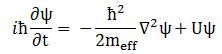
Let us review the basic math. For a particle moving in free space – with no external force fields acting on it – there is no potential (U = 0) and, therefore, the Uψ term disappears. Therefore, Schrƶdinger’s equation reduces to:

āˆ‚Ļˆ(x, t)/āˆ‚t = iĀ·(1/2)Ā·(ħ/meff)Ā·āˆ‡2ψ(x, t)

The ubiquitous diffusion equation in physics is:

āˆ‚Ļ†(x, t)/āˆ‚t = DĀ·āˆ‡2φ(x, t)

The structural similarity is obvious. The key difference between both equations is that the wave equation gives us two equations for the price of one. Indeed, because ψ is a complex-valued function, with a real and an imaginary part, we get the following equations[18]:

  1. Re(āˆ‚Ļˆ/āˆ‚t) = āˆ’(1/2)Ā·(ħ/meff)Ā·Im(āˆ‡2ψ)
  2. Im(āˆ‚Ļˆ/āˆ‚t) = (1/2)Ā·(ħ/meff)Ā·Re(āˆ‡2ψ)

These equations make us think of the equations for an electromagnetic wave in free space (no stationary charges or currents):

  1. āˆ‚B/āˆ‚t = ā€“āˆ‡Ć—E
  2. āˆ‚E/āˆ‚t = c2āˆ‡Ć—B

The above equations effectively describe a propagation mechanism in spacetime, as illustrated below.

Figure 4: Propagation mechanismspropagation

The Laplacian operator (āˆ‡2), when operating on a scalar quantity, gives us a flux density, i.e. something expressed per square meter (1/m2). In this case, it is operating on ψ(x, t), so what is the dimension of our wavefunction ψ(x, t)? To answer that question, we should analyze the diffusion constant in Schrƶdinger’s equation, i.e. the (1/2)Ā·(ħ/meff) factor:

  1. As a mathematical constant of proportionality, it will quantify the relationship between both derivatives (i.e. the time derivative and the Laplacian);
  2. As a physical constant, it will ensure the physical dimensions on both sides of the equation are compatible.

Now, the ħ/meff factor is expressed in (NĀ·mĀ·s)/(NĀ· s2/m) = m2/s. Hence, it does ensure the dimensions on both sides of the equation are, effectively, the same: āˆ‚Ļˆ/āˆ‚t is a time derivative and, therefore, its dimension is s1 while, as mentioned above, the dimension of āˆ‡2ψ is m2. However, this does not solve our basic question: what is the dimension of the real and imaginary part of our wavefunction?

At this point, mainstream physicists will say: it does not have a physical dimension, and there is no geometric interpretation of Schrƶdinger’s equation. One may argue, effectively, that its argument, (pāˆ™x – Eāˆ™t)/ħ, is just a number and, therefore, that the real and imaginary part of ψ is also just some number.

To this, we may object that ħ may be looked as a mathematical scaling constant only. If we do that, then the argument of ψ will, effectively, be expressed in action units, i.e. in N·m·s. It then does make sense to also associate a physical dimension with the real and imaginary part of ψ. What could it be?

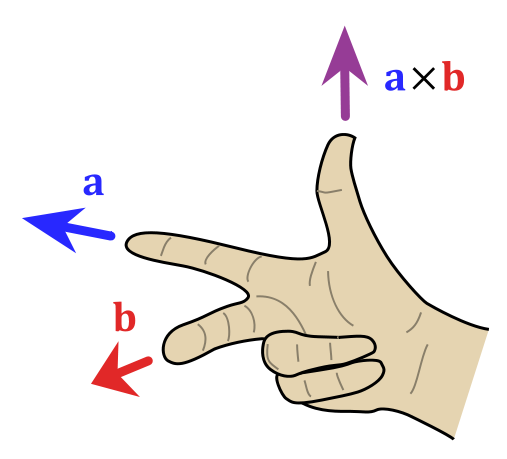
We may have a closer look at Maxwell’s equations for inspiration here. The electric field vector is expressed in newton (the unit of force) per unit of charge (coulomb). Now, there is something interesting here. The physical dimension of the magnetic field is N/C divided by m/s.[19] We may write B as the following vector cross-product: B = (1/c)āˆ™exƗE, with ex the unit vector pointing in the x-direction (i.e. the direction of propagation of the wave). Hence, we may associate the (1/c)āˆ™exƗ operator, which amounts to a rotation by 90 degrees, with the s/m dimension. Now, multiplication by i also amounts to a rotation by 90° degrees. Hence, we may boldly write: B = (1/c)āˆ™exƗE = (1/c)āˆ™iāˆ™E. This allows us to also geometrically interpret Schrƶdinger’s equation in the way we interpreted it above (see Figure 3).[20]

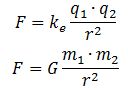
Still, we have not answered the question as to what the physical dimension of the real and imaginary part of our wavefunction should be. At this point, we may be inspired by the structural similarity between Newton’s and Coulomb’s force laws:F4Hence, if the electric field vector E is expressed in force per unit charge (N/C), then we may want to think of associating the real part of our wavefunction with a force per unit mass (N/kg). We can, of course, do a substitution here, because the mass unit (1 kg) is equivalent to 1 NĀ·s2/m. Hence, our N/kg dimension becomes:
N/kg = N/(NĀ·s2/m)= m/s2

What is this: m/s2? Is that the dimension of the aĀ·cosĪø term in the aĀ·eāˆ’iĪø aĀ·cosĪø āˆ’ iĀ·aĀ·sinĪø wavefunction?

My answer is: why not? Think of it: m/s2 is the physical dimension of acceleration: the increase or decrease in velocity (m/s) per second. It ensures the wavefunction for any particle – matter-particles or particles with zero rest mass (photons) – and the associated wave equation (which has to be the same for all, as the spacetime we live in is one) are mutually consistent.

In this regard, we should think of how we would model a gravitational wave. The physical dimension would surely be the same: force per mass unit. It all makes sense: wavefunctions may, perhaps, be interpreted as traveling distortions of spacetime, i.e. as tiny gravitational waves.

V. Energy densities and flows

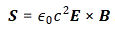
Pursuing the geometric equivalence between the equations for an electromagnetic wave and Schrƶdinger’s equation, we can now, perhaps, see if there is an equivalent for the energy density. For an electromagnetic wave, we know that the energy density is given by the following formula:F5E and B are the electric and magnetic field vector respectively. The Poynting vector will give us the directional energy flux, i.e. the energy flow per unit area per unit time. We write:F6Needless to say, the āˆ‡āˆ™ operator is the divergence and, therefore, gives us the magnitude of a (vector) field’s source or sink at a given point. To be precise, the divergence gives us the volume density of the outward flux of a vector field from an infinitesimal volume around a given point. In this case, it gives us the volume density of the flux of S.
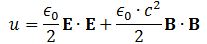
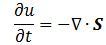
We can analyze the dimensions of the equation for the energy density as follows:

  1. E is measured in newton per coulomb, so [Eāˆ™E] = [E2] = N2/C2.
  2. B is measured in (N/C)/(m/s), so we get [Bāˆ™B] = [B2] = (N2/C2)Ā·(s2/m2). However, the dimension of our c2 factor is (m2/s2) and so we’re also left with N2/C2.
  3. The ϵ0 is the electric constant, aka as the vacuum permittivity. As a physical constant, it should ensure the dimensions on both sides of the equation work out, and they do: [ε0] = C2/(NĀ·m2) and, therefore, if we multiply that with N2/C2, we find that is expressed in J/m3.[21]

Replacing the newton per coulomb unit (N/C) by the newton per kg unit (N/kg) in the formulas above should give us the equivalent of the energy density for the wavefunction. We just need to substitute ϵ0 for an equivalent constant. We may to give it a try. If the energy densities can be calculated – which are also mass densities, obviously – then the probabilities should be proportional to them.

Let us first see what we get for a photon, assuming the electromagnetic wave represents its wavefunction. Substituting B for (1/c)āˆ™iāˆ™E or for āˆ’(1/c)āˆ™iāˆ™E gives us the following result:F7Zero!? An unexpected result! Or not? We have no stationary charges and no currents: only an electromagnetic wave in free space. Hence, the local energy conservation principle needs to be respected at all points in space and in time. The geometry makes sense of the result: for an electromagnetic wave, the magnitudes of E and B reach their maximum, minimum and zero point simultaneously, as shown below.[22] This is because their phase is the same.

Figure 5: Electromagnetic wave: E and BEM field

Should we expect a similar result for the energy densities that we would associate with the real and imaginary part of the matter-wave? For the matter-wave, we have a phase difference between aĀ·cosĪø and aĀ·sinĪø, which gives a different picture of the propagation of the wave (see Figure 3).[23] In fact, the geometry of the suggestion suggests some inherent spin, which is interesting. I will come back to this. Let us first guess those densities. Making abstraction of any scaling constants, we may write:F8We get what we hoped to get: the absolute square of our amplitude is, effectively, an energy density !

|ψ|2  = |aĀ·eāˆ’iāˆ™EĀ·t/ħ|2 = a2 = u

This is very deep. A photon has no rest mass, so it borrows and returns energy from empty space as it travels through it. In contrast, a matter-wave carries energy and, therefore, has some (rest) mass. It is therefore associated with an energy density, and this energy density gives us the probabilities. Of course, we need to fine-tune the analysis to account for the fact that we have a wave packet rather than a single wave, but that should be feasible.

As mentioned, the phase difference between the real and imaginary part of our wavefunction (a cosine and a sine function) appear to give some spin to our particle. We do not have this particularity for a photon. Of course, photons are bosons, i.e. spin-zero particles, while elementary matter-particles are fermions with spin-1/2. Hence, our geometric interpretation of the wavefunction suggests that, after all, there may be some more intuitive explanation of the fundamental dichotomy between bosons and fermions, which puzzled even Feynman:

ā€œWhy is it that particles with half-integral spin are Fermi particles, whereas particles with integral spin are Bose particles? We apologize for the fact that we cannot give you an elementary explanation. An explanation has been worked out by Pauli from complicated arguments of quantum field theory and relativity. He has shown that the two must necessarily go together, but we have not been able to find a way of reproducing his arguments on an elementary level. It appears to be one of the few places in physics where there is a rule which can be stated very simply, but for which no one has found a simple and easy explanation. The explanation is deep down in relativistic quantum mechanics. This probably means that we do not have a complete understanding of the fundamental principle involved.ā€ (Feynman, Lectures, III-4-1)

The physical interpretation of the wavefunction, as presented here, may provide some better understanding of ā€˜the fundamental principle involved’: the physical dimension of the oscillation is just very different. That is all: it is force per unit charge for photons, and force per unit mass for matter-particles. We will examine the question of spin somewhat more carefully in section VII. Let us first examine the matter-wave some more. 

VI. Group and phase velocity of the matter-wave

The geometric representation of the matter-wave (see Figure 3) suggests a traveling wave and, yes, of course: the matter-wave effectively travels through space and time. But what is traveling, exactly? It is the pulse – or the signal – only: the phase velocity of the wave is just a mathematical concept and, even in our physical interpretation of the wavefunction, the same is true for the group velocity of our wave packet. The oscillation is two-dimensional, but perpendicular to the direction of travel of the wave. Hence, nothing actually moves with our particle.

Here, we should also reiterate that we did not answer the question as to what is oscillating up and down and/or sideways: we only associated a physical dimension with the components of the wavefunction – newton per kg (force per unit mass), to be precise. We were inspired to do so because of the physical dimension of the electric and magnetic field vectors (newton per coulomb, i.e. force per unit charge) we associate with electromagnetic waves which, for all practical purposes, we currently treat as the wavefunction for a photon. This made it possible to calculate the associated energy densities and a Poynting vector for energy dissipation. In addition, we showed that Schrƶdinger’s equation itself then becomes a diffusion equation for energy. However, let us now focus some more on the asymmetry which is introduced by the phase difference between the real and the imaginary part of the wavefunction. Look at the mathematical shape of the elementary wavefunction once again:

ψ = aĀ·eāˆ’i[EĀ·t āˆ’ pāˆ™x]/ħaĀ·eāˆ’i[EĀ·t āˆ’ pāˆ™x]/ħ = aĀ·cos(pāˆ™x/ħ āˆ’ Eāˆ™t/ħ) + iĀ·aĀ·sin(pāˆ™x/ħ āˆ’ Eāˆ™t/ħ)

The minus sign in the argument of our sine and cosine function defines the direction of travel: an F(xāˆ’vāˆ™t) wavefunction will always describe some wave that is traveling in the positive x-direction (with the wave velocity), while an F(x+vāˆ™t) wavefunction will travel in the negative x-direction. For a geometric interpretation of the wavefunction in three dimensions, we need to agree on how to define i or, what amounts to the same, a convention on how to define clockwise and counterclockwise directions: if we look at a clock from the back, then its hand will be moving counterclockwise. So we need to establish the equivalent of the right-hand rule. However, let us not worry about that now. Let us focus on the interpretation. To ease the analysis, we’ll assume we’re looking at a particle at rest. Hence, p = 0, and the wavefunction reduces to:

ψ = aĀ·eāˆ’iāˆ™EĀ·t/ħ = aĀ·cos(āˆ’Eāˆ™t/ħ) + iĀ·aĀ·sin(āˆ’E0āˆ™t/ħ) = aĀ·cos(E0āˆ™t/ħ) āˆ’ iĀ·aĀ·sin(E0āˆ™t/ħ)

E0 is, of course, the rest mass of our particle and, now that we are here, we should probably wonder whose time we are talking about: is it our time, or is the proper time of our particle? Well… In this situation, we are both at rest so it does not matter: t is, effectively, the proper time so perhaps we should write it as t0. It does not matter. You can see what we expect to see: E0/ħ pops up as the natural frequency of our matter-particle: (E0/ħ)āˆ™t = Ļ‰āˆ™t. Remembering the ω = 2π·f = 2Ļ€/T and T = 1/formulas, we can associate a period and a frequency with this wave, using the ω = 2π·f = 2Ļ€/T. Noting that ħ = h/2Ļ€, we find the following:

T = 2π·(ħ/E0) = h/E0 ā‡” = E0/h = m0c2/h

This is interesting, because we can look at the period as a natural unit of time for our particle. What about the wavelength? That is tricky because we need to distinguish between group and phase velocity here. The group velocity (vg) should be zero here, because we assume our particle does not move. In contrast, the phase velocity is given by vp = Ī»Ā·= (2Ļ€/k)Ā·(ω/2Ļ€) = Ļ‰/k. In fact, we’ve got something funny here: the wavenumber k = p/ħ is zero, because we assume the particle is at rest, so p = 0. So we have a division by zero here, which is rather strange. What do we get assuming the particle is not at rest? We write:

vp = Ļ‰/k = (E/ħ)/(p/ħ) = E/p = E/(mĀ·vg) = (mĀ·c2)/(mĀ·vg) = c2/vg

This is interesting: it establishes a reciprocal relation between the phase and the group velocity, with as a simple scaling constant. Indeed, the graph below shows the shape of the function does not change with the value of c, and we may also re-write the relation above as:

vp/= βp = c/vp = 1/βg = 1/(c/vp)

Figure 6: Reciprocal relation between phase and group velocitygraph

We can also write the mentioned relationship as vpĀ·vg = c2, which reminds us of the relationship between the electric and magnetic constant (1/ε0)Ā·(1/μ0) = c2. This is interesting in light of the fact we can re-write this as (c·ε0)Ā·(c·μ0) = 1, which shows electricity and magnetism are just two sides of the same coin, so to speak.[24]

Interesting, but how do we interpret the math? What about the implications of the zero value for wavenumber k = p/ħ. We would probably like to think it implies the elementary wavefunction should always be associated with some momentum, because the concept of zero momentum clearly leads to weird math: something times zero cannot be equal to c2! Such interpretation is also consistent with the Uncertainty Principle: if Ī”xĀ·Ī”p ā‰„ ħ, then neither Ī”x nor Ī”p can be zero. In other words, the Uncertainty Principle tells us that the idea of a pointlike particle actually being at some specific point in time and in space does not make sense: it has to move. It tells us that our concept of dimensionless points in time and space are mathematical notions only. Actual particles – including photons – are always a bit spread out, so to speak, and – importantly – they have to move.

For a photon, this is self-evident. It has no rest mass, no rest energy, and, therefore, it is going to move at the speed of light itself. We write: p = mĀ·c = mĀ·c2/= E/c. Using the relationship above, we get:

vp = Ļ‰/k = (E/ħ)/(p/ħ) = E/p = c ⇒ vg = c2/vp = c2/c = c

This is good: we started out with some reflections on the matter-wave, but here we get an interpretation of the electromagnetic wave as a wavefunction for the photon. But let us get back to our matter-wave. In regard to our interpretation of a particle having to move, we should remind ourselves, once again, of the fact that an actual particle is always localized in space and that it can, therefore, not be represented by the elementary wavefunction ψ = aĀ·eāˆ’i[EĀ·t āˆ’ pāˆ™x]/ħ or, for a particle at rest, the ψ = aĀ·eāˆ’iāˆ™EĀ·t/ħ function. We must build a wave packet for that: a sum of wavefunctions, each with their own amplitude ai, and their own ωi = āˆ’Ei/ħ. Indeed, in section II, we showed that each of these wavefunctions will contribute some energy to the total energy of the wave packet and that, to calculate the contribution of each wave to the total, both ai as well as Ei matter. This may or may not resolve the apparent paradox. Let us look at the group velocity.

To calculate a meaningful group velocity, we must assume the vg = āˆ‚Ļ‰i/āˆ‚ki = āˆ‚(Ei/ħ)/āˆ‚(pi/ħ) = āˆ‚(Ei)/āˆ‚(pi) exists. So we must have some dispersion relation. How do we calculate it? We need to calculate ωi as a function of ki here, or Ei as a function of pi. How do we do that? Well… There are a few ways to go about it but one interesting way of doing it is to re-write Schrƶdinger’s equation as we did, i.e. by distinguishing the real and imaginary parts of the āˆ‚Ļˆ/āˆ‚t =iĀ·[ħ/(2m)]Ā·āˆ‡2ψ wave equation and, hence, re-write it as the following pair of two equations:

  1. Re(āˆ‚Ļˆ/āˆ‚t) = āˆ’[ħ/(2meff)]Ā·Im(āˆ‡2ψ) ā‡” Ļ‰Ā·cos(kx āˆ’ ωt) = k2Ā·[ħ/(2meff)]Ā·cos(kx āˆ’ ωt)
  2. Im(āˆ‚Ļˆ/āˆ‚t) = [ħ/(2meff)]Ā·Re(āˆ‡2ψ) ā‡” ω·sin(kx āˆ’ ωt) = k2Ā·[ħ/(2meff)]Ā·sin(kx āˆ’ ωt)

Both equations imply the following dispersion relation:

ω = Ä§Ā·k2/(2meff)

Of course, we need to think about the subscripts now: we have ωi, ki, but… What about meff or, dropping the subscript, m? Do we write it as mi? If so, what is it? Well… It is the equivalent mass of Ei obviously, and so we get it from the mass-energy equivalence relation: mi = Ei/c2. It is a fine point, but one most people forget about: they usually just write m. However, if there is uncertainty in the energy, then Einstein’s mass-energy relation tells us we must have some uncertainty in the (equivalent) mass too. Here, I should refer back to Section II: Ei varies around some average energy E and, therefore, the Uncertainty Principle kicks in. 

VII. Explaining spin

The elementary wavefunction vector – i.e. the vector sum of the real and imaginary component – rotates around the x-axis, which gives us the direction of propagation of the wave (see Figure 3). Its magnitude remains constant. In contrast, the magnitude of the electromagnetic vector – defined as the vector sum of the electric and magnetic field vectors – oscillates between zero and some maximum (see Figure 5).

We already mentioned that the rotation of the wavefunction vector appears to give some spin to the particle. Of course, a circularly polarized wave would also appear to have spin (think of the E and B vectors rotating around the direction of propagation – as opposed to oscillating up and down or sideways only). In fact, a circularly polarized light does carry angular momentum, as the equivalent mass of its energy may be thought of as rotating as well. But so here we are looking at a matter-wave.

The basic idea is the following: if we look at Ļˆ = aĀ·eāˆ’iāˆ™EĀ·t/ħ as some real vector – as a two-dimensional oscillation of mass, to be precise – then we may associate its rotation around the direction of propagation with some torque. The illustration below reminds of the math here.

Figure 7: Torque and angular momentum vectorsTorque_animation

A torque on some mass about a fixed axis gives it angular momentum, which we can write as the vector cross-product L = rƗp or, perhaps easier for our purposes here as the product of an angular velocity (ω) and rotational inertia (I), aka as the moment of inertia or the angular mass. We write:

L = I·ω

Note we can write L and Ļ‰ in boldface here because they are (axial) vectors. If we consider their magnitudes only, we write L = I·ω (no boldface). We can now do some calculations. Let us start with the angular velocity. In our previous posts, we showed that the period of the matter-wave is equal to T = 2π·(ħ/E0). Hence, the angular velocity must be equal to:

ω = 2Ļ€/[2π·(ħ/E0)] = E0/ħ

We also know the distance r, so that is the magnitude of r in the LrƗp vector cross-product: it is just a, so that is the magnitude of Ļˆ = aĀ·eāˆ’iāˆ™EĀ·t/ħ. Now, the momentum (p) is the product of a linear velocity (v) – in this case, the tangential velocity – and some mass (m): p = mĀ·v. If we switch to scalar instead of vector quantities, then the (tangential) velocity is given by v = r·ω. So now we only need to think about what we should use for m or, if we want to work with the angular velocity (ω), the angular mass (I). Here we need to make some assumption about the mass (or energy) distribution. Now, it may or may not sense to assume the energy in the oscillation – and, therefore, the mass – is distributed uniformly. In that case, we may use the formula for the angular mass of a solid cylinder: I = mĀ·r2/2. If we keep the analysis non-relativistic, then m = m0. Of course, the energy-mass equivalence tells us that m0 = E0/c2. Hence, this is what we get:

L = I·ω = (m0Ā·r2/2)Ā·(E0/ħ) = (1/2)Ā·a2Ā·(E0/c2)Ā·(E0/ħ) = a2Ā·E02/(2·ħ·c2)

Does it make sense? Maybe. Maybe not. Let us do a dimensional analysis: that won’t check our logic, but it makes sure we made no mistakes when mapping mathematical and physical spaces. We have m2Ā·J2 = m2Ā·N2Ā·m2 in the numerator and NĀ·mĀ·sĀ·m2/s2 in the denominator. Hence, the dimensions work out: we get NĀ·mĀ·s as the dimension for L, which is, effectively, the physical dimension of angular momentum. It is also the action dimension, of course, and that cannot be a coincidence. Also note that the E = mc2 equation allows us to re-write it as:

L = a2·E02/(2·ħ·c2)

Of course, in quantum mechanics, we associate spin with the magnetic moment of a charged particle, not with its mass as such. Is there way to link the formula above to the one we have for the quantum-mechanical angular momentum, which is also measured in NĀ·mĀ·s units, and which can only take on one of two possible values: J = +ħ/2 and āˆ’ħ/2? It looks like a long shot, right? How do we go from (1/2)Ā·a2Ā·m02/ħ to ± (1/2)āˆ™Ä§? Let us do a numerical example. The energy of an electron is typically 0.510 MeV Ā» 8.1871Ɨ10āˆ’14 Nāˆ™m, and a… What value should we take for a?

We have an obvious trio of candidates here: the Bohr radius, the classical electron radius (aka the Thompon scattering length), and the Compton scattering radius.

Let us start with the Bohr radius, so that is about 0.Ɨ10āˆ’10 Nāˆ™m. We get L = a2Ā·E02/(2·ħ·c2) = 9.9Ɨ10āˆ’31 Nāˆ™māˆ™s. Now that is about 1.88Ɨ104 times ħ/2. That is a huge factor. The Bohr radius cannot be right: we are not looking at an electron in an orbital here. To show it does not make sense, we may want to double-check the analysis by doing the calculation in another way. We said each oscillation will always pack 6.626070040(81)Ɨ10āˆ’34 joule in energy. So our electron should pack about 1.24Ɨ10āˆ’20 oscillations. The angular momentum (L) we get when using the Bohr radius for a and the value of 6.626Ɨ10āˆ’34 joule for E0 and the Bohr radius is equal to 6.49Ɨ10āˆ’59 Nāˆ™māˆ™s. So that is the angular momentum per oscillation. When we multiply this with the number of oscillations (1.24Ɨ10āˆ’20), we get about 8.01Ɨ10āˆ’51 Nāˆ™māˆ™s, so that is a totally different number.

The classical electron radius is about 2.818Ɨ10āˆ’15 m. We get an L that is equal to about 2.81Ɨ10āˆ’39 Nāˆ™māˆ™s, so now it is a tiny fraction of ħ/2! Hence, this leads us nowhere. Let us go for our last chance to get a meaningful result! Let us use the Compton scattering length, so that is about 2.42631Ɨ10āˆ’12 m.

This gives us an L of 2.08Ɨ10āˆ’33 Nāˆ™māˆ™s, which is only 20 times ħ. This is not so bad, but it is good enough? Let us calculate it the other way around: what value should we take for a so as to ensure L = a2Ā·E02/(2·ħ·c2) = ħ/2? Let us write it out:F9

In fact, this is the formula for the so-called reduced Compton wavelength. This is perfect. We found what we wanted to find. Substituting this value for a (you can calculate it: it is about 3.8616Ɨ10āˆ’33 m), we get what we should find:F10

This is a rather spectacular result, and one that would – a priori – support the interpretation of the wavefunction that is being suggested in this paper. 

VIII. The boson-fermion dichotomy

Let us do some more thinking on the boson-fermion dichotomy. Again, we should remind ourselves that an actual particle is localized in space and that it can, therefore, not be represented by the elementary wavefunction ψ = aĀ·eāˆ’i[EĀ·t āˆ’ pāˆ™x]/ħ or, for a particle at rest, the ψ = aĀ·eāˆ’iāˆ™EĀ·t/ħ function. We must build a wave packet for that: a sum of wavefunctions, each with their own amplitude ai, and their own ωi = āˆ’Ei/ħ. Each of these wavefunctions will contribute some energy to the total energy of the wave packet. Now, we can have another wild but logical theory about this.

Think of the apparent right-handedness of the elementary wavefunction: surely, Nature can’t be bothered about our convention of measuring phase angles clockwise or counterclockwise. Also, the angular momentum can be positive or negative: J = +ħ/2 or āˆ’ħ/2. Hence, we would probably like to think that an actual particle – think of an electron, or whatever other particle you’d think of – may consist of right-handed as well as left-handed elementary waves. To be precise, we may think they either consist of (elementary) right-handed waves or, else, of (elementary) left-handed waves. An elementary right-handed wave would be written as:

ψ(Īøi= aiĀ·(cosĪøi + iĀ·sinĪøi)

In contrast, an elementary left-handed wave would be written as:

ψ(Īøi= aiĀ·(cosĪøi āˆ’ iĀ·sinĪøi)

How does that work out with the E0Ā·t argument of our wavefunction? Position is position, and direction is direction, but time? Time has only one direction, but Nature surely does not care how we count time: counting like 1, 2, 3, etcetera or like āˆ’1, āˆ’2, āˆ’3, etcetera is just the same. If we count like 1, 2, 3, etcetera, then we write our wavefunction like:

ψ = aĀ·cos(E0āˆ™t/ħ) āˆ’ iĀ·aĀ·sin(E0āˆ™t/ħ)

If we count time like āˆ’1, āˆ’2, āˆ’3, etcetera then we write it as:

 Ļˆ = aĀ·cos(āˆ’E0āˆ™t/ħ) āˆ’ iĀ·aĀ·sin(āˆ’E0āˆ™t/ħ)= aĀ·cos(E0āˆ™t/ħ) + iĀ·aĀ·sin(E0āˆ™t/ħ)

Hence, it is just like the left- or right-handed circular polarization of an electromagnetic wave: we can have both for the matter-wave too! This, then, should explain why we can have either positive or negative quantum-mechanical spin (+ħ/2 or āˆ’Ä§/2). It is the usual thing: we have two mathematical possibilities here, and so we must have two physical situations that correspond to it.

It is only natural. If we have left- and right-handed photons – or, generalizing, left- and right-handed bosons – then we should also have left- and right-handed fermions (electrons, protons, etcetera). Back to the dichotomy. The textbook analysis of the dichotomy between bosons and fermions may be epitomized by Richard Feynman’s Lecture on it (Feynman, III-4), which is confusing and – I would dare to say – even inconsistent: how are photons or electrons supposed to know that they need to interfere with a positive or a negative sign? They are not supposed to know anything: knowledge is part of our interpretation of whatever it is that is going on there.

Hence, it is probably best to keep it simple, and think of the dichotomy in terms of the different physical dimensions of the oscillation: newton per kg versus newton per coulomb. And then, of course, we should also note that matter-particles have a rest mass and, therefore, actually carry charge. Photons do not. But both are two-dimensional oscillations, and the point is: the so-called vacuum – and the rest mass of our particle (which is zero for the photon and non-zero for everything else) – give us the natural frequency for both oscillations, which is beautifully summed up in that remarkable equation for the group and phase velocity of the wavefunction, which applies to photons as well as matter-particles:

(vphaseĀ·c)Ā·(vgroupĀ·c) = 1 ā‡” vpĀ·vg = c2

The final question then is: why are photons spin-zero particles? Well… We should first remind ourselves of the fact that they do have spin when circularly polarized.[25] Here we may think of the rotation of the equivalent mass of their energy. However, if they are linearly polarized, then there is no spin. Even for circularly polarized waves, the spin angular momentum of photons is a weird concept. If photons have no (rest) mass, then they cannot carry any charge. They should, therefore, not have any magnetic moment. Indeed, what I wrote above shows an explanation of quantum-mechanical spin requires both mass as well as charge.[26] 

IX. Concluding remarks

There are, of course, other ways to look at the matter – literally. For example, we can imagine two-dimensional oscillations as circular rather than linear oscillations. Think of a tiny ball, whose center of mass stays where it is, as depicted below. Any rotation – around any axis – will be some combination of a rotation around the two other axes. Hence, we may want to think of a two-dimensional oscillation as an oscillation of a polar and azimuthal angle.

Figure 8: Two-dimensional circular movementoscillation-of-a-ball

The point of this paper is not to make any definite statements. That would be foolish. Its objective is just to challenge the simplistic mainstream viewpoint on the reality of the wavefunction. Stating that it is a mathematical construct only without physical significance amounts to saying it has no meaning at all. That is, clearly, a non-sustainable proposition.

The interpretation that is offered here looks at amplitude waves as traveling fields. Their physical dimension may be expressed in force per mass unit, as opposed to electromagnetic waves, whose amplitudes are expressed in force per (electric) charge unit. Also, the amplitudes of matter-waves incorporate a phase factor, but this may actually explain the rather enigmatic dichotomy between fermions and bosons and is, therefore, an added bonus.

The interpretation that is offered here has some advantages over other explanations, as it explains the how of diffraction and interference. However, while it offers a great explanation of the wave nature of matter, it does not explain its particle nature: while we think of the energy as being spread out, we will still observe electrons and photons as pointlike particles once they hit the detector. Why is it that a detector can sort of ā€˜hook’ the whole blob of energy, so to speak?

The interpretation of the wavefunction that is offered here does not explain this. Hence, the complementarity principle of the Copenhagen interpretation of the wavefunction surely remains relevant.

Appendix 1: The de Broglie relations and energy

The 1/2 factor in Schrƶdinger’s equation is related to the concept of the effective mass (meff). It is easy to make the wrong calculations. For example, when playing with the famous de Broglie relations – aka as the matter-wave equations – one may be tempted to derive the following energy concept:

  1. E = hĀ·f and p = h/Ī». Therefore, f = E/h and Ī» = p/h.
  2. v = fĀ·Ī» = (E/h)āˆ™(p/h) = E/p
  3. p = mĀ·v. Therefore, E = vĀ·p = mĀ·v2

E = mĀ·v2? This resembles the E = mc2 equation and, therefore, one may be enthused by the discovery, especially because the mĀ·v2 also pops up when working with the Least Action Principle in classical mechanics, which states that the path that is followed by a particle will minimize the following integral:F11Now, we can choose any reference point for the potential energy but, to reflect the energy conservation law, we can select a reference point that ensures the sum of the kinetic and the potential energy is zero throughout the time interval. If the force field is uniform, then the integrand will, effectively, be equal to KE āˆ’ PE = mĀ·v2.[27]
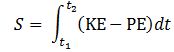
However, that is classical mechanics and, therefore, not so relevant in the context of the de Broglie equations, and the apparent paradox should be solved by distinguishing between the group and the phase velocity of the matter wave.

Appendix 2: The concept of the effective mass

The effective mass – as used in Schrƶdinger’s equation – is a rather enigmatic concept. To make sure we are making the right analysis here, I should start by noting you will usually see Schrƶdinger’s equation written as:F12This formulation includes a term with the potential energy (U). In free space (no potential), this term disappears, and the equation can be re-written as:

āˆ‚Ļˆ(x, t)/āˆ‚t = iĀ·(1/2)Ā·(ħ/meff)Ā·āˆ‡2ψ(x, t)

We just moved the i·ħ coefficient to the other side, noting that 1/i = –i. Now, in one-dimensional space, and assuming ψ is just the elementary wavefunction (so we substitute aĀ·eāˆ’iāˆ™[EĀ·t āˆ’ pāˆ™x]/ħ for ψ), this implies the following:

āˆ’aĀ·iĀ·(E/ħ)Ā·eāˆ’iāˆ™[EĀ·t āˆ’ pāˆ™x]/ħ = āˆ’iĀ·(ħ/2meff)Ā·aĀ·(p2/ħ2)Ā· eāˆ’iāˆ™[EĀ·t āˆ’ pāˆ™x]/ħ 

⇔ E = p2/(2meff) ⇔ meff = māˆ™(v/c)2/2 = māˆ™Ī²2/2

It is an ugly formula: it resembles the kinetic energy formula (K.E. = māˆ™v2/2) but it is, in fact, something completely different. The β2/2 factor ensures the effective mass is always a fraction of the mass itself. To get rid of the ugly 1/2 factor, we may re-define meff as two times the old meff (hence, meffNEW = 2āˆ™meffOLD), as a result of which the formula will look somewhat better:

meff = māˆ™(v/c)2 = māˆ™Ī²2

We know β varies between 0 and 1 and, therefore, meff will vary between 0 and m. Feynman drops the subscript, and just writes meff as m in his textbook (see Feynman, III-19). On the other hand, the electron mass as used is also the electron mass that is used to calculate the size of an atom (see Feynman, III-2-4). As such, the two mass concepts are, effectively, mutually compatible. It is confusing because the same mass is often defined as the mass of a stationary electron (see, for example, the article on it in the online Wikipedia encyclopedia[28]).

In the context of the derivation of the electron orbitals, we do have the potential energy term – which is the equivalent of a source term in a diffusion equation – and that may explain why the above-mentioned meff = māˆ™(v/c)2 = māˆ™Ī²2 formula does not apply.

References

This paper discusses general principles in physics only. Hence, references can be limited to references to physics textbooks only. For ease of reading, any reference to additional material has been limited to a more popular undergrad textbook that can be consulted online: Feynman’s Lectures on Physics (http://www.feynmanlectures.caltech.edu). References are per volume, per chapter and per section. For example, Feynman III-19-3 refers to Volume III, Chapter 19, Section 3.

Notes

[1] Of course, an actual particle is localized in space and can, therefore, not be represented by the elementary wavefunction ψ = aĀ·eāˆ’iāˆ™ĪøaĀ·eāˆ’i[EĀ·t āˆ’ pāˆ™x]/ħ = aĀ·(cosĪø iĀ·aĀ·sinĪø). We must build a wave packet for that: a sum of wavefunctions, each with its own amplitude ak and its own argument Īøk = (Ekāˆ™t – pkāˆ™x)/ħ. This is dealt with in this paper as part of the discussion on the mathematical and physical interpretation of the normalization condition.

[2] The N/kg dimension immediately, and naturally, reduces to the dimension of acceleration (m/s2), thereby facilitating a direct interpretation in terms of Newton’s force law.

[3] In physics, a two-spring metaphor is more common. Hence, the pistons in the author’s perpetuum mobile may be replaced by springs.

[4] The author re-derives the equation for the Compton scattering radius in section VII of the paper.

[5] The magnetic force can be analyzed as a relativistic effect (see Feynman II-13-6). The dichotomy between the electric force as a polar vector and the magnetic force as an axial vector disappears in the relativistic four-vector representation of electromagnetism.

[6] For example, when using Schrƶdinger’s equation in a central field (think of the electron around a proton), the use of polar coordinates is recommended, as it ensures the symmetry of the Hamiltonian under all rotations (see Feynman III-19-3)

[7] This sentiment is usually summed up in the apocryphal quote: ā€œGod does not play dice.ā€The actual quote comes out of one of Einstein’s private letters to Cornelius Lanczos, another scientist who had also emigrated to the US. The full quote is as follows: “You are the only person I know who has the same attitude towards physics as I have: belief in the comprehension of reality through something basically simple and unified… It seems hard to sneak a look at God’s cards. But that He plays dice and uses ‘telepathic’ methods… is something that I cannot believe for a single moment.” (Helen Dukas and Banesh Hoffman, Albert Einstein, the Human Side: New Glimpses from His Archives, 1979)

[8] Of course, both are different velocities: ω is an angular velocity, while v is a linear velocity: ω is measured in radians per second, while v is measured in meter per second. However, the definition of a radian implies radians are measured in distance units. Hence, the physical dimensions are, effectively, the same. As for the formula for the total energy of an oscillator, we should actually write: E = mĀ·a2āˆ™Ļ‰2/2. The additional factor (a) is the (maximum) amplitude of the oscillator.

[9] We also have a 1/2 factor in the E = mv2/2 formula. Two remarks may be made here. First, it may be noted this is a non-relativistic formula and, more importantly, incorporates kinetic energy only. Using the Lorentz factor (γ), we can write the relativistically correct formula for the kinetic energy as K.E. = E āˆ’ E0 = mvc2 āˆ’ m0c2 = m0γc2 āˆ’ m0c2 = m0c2(γ āˆ’ 1). As for the exclusion of the potential energy, we may note that we may choose our reference point for the potential energy such that the kinetic and potential energy mirror each other. The energy concept that then emerges is the one that is used in the context of the Principle of Least Action: it equals E = mv2. Appendix 1 provides some notes on that.

[10] Instead of two cylinders with pistons, one may also think of connecting two springs with a crankshaft.

[11] It is interesting to note that we may look at the energy in the rotating flywheel as potential energy because it is energy that is associated with motion, albeit circular motion. In physics, one may associate a rotating object with kinetic energy using the rotational equivalent of mass and linear velocity, i.e. rotational inertia (I) and angular velocity ω. The kinetic energy of a rotating object is then given by K.E. = (1/2)Ā·I·ω2.

[12] Because of the sideways motion of the connecting rods, the sinusoidal function will describe the linear motion only approximately, but you can easily imagine the idealized limit situation.

[13] The ω2= 1/LC formula gives us the natural or resonant frequency for a electric circuit consisting of a resistor (R), an inductor (L), and a capacitor (C). Writing the formula as ω2= C1/L introduces the concept of elastance, which is the equivalent of the mechanical stiffness (k) of a spring.

[14] The resistance in an electric circuit introduces a damping factor. When analyzing a mechanical spring, one may also want to introduce a drag coefficient. Both are usually defined as a fraction of the inertia, which is the mass for a spring and the inductance for an electric circuit. Hence, we would write the resistance for a spring as γm and as R = γL respectively.

[15] Photons are emitted by atomic oscillators: atoms going from one state (energy level) to another. Feynman (Lectures, I-33-3) shows us how to calculate the Q of these atomic oscillators: it is of the order of 108, which means the wave train will last about 10–8 seconds (to be precise, that is the time it takes for the radiation to die out by a factor 1/e). For example, for sodium light, the radiation will last about 3.2Ɨ10–8 seconds (this is the so-called decay time Ļ„). Now, because the frequency of sodium light is some 500 THz (500Ɨ1012 oscillations per second), this makes for some 16 million oscillations. There is an interesting paradox here: the speed of light tells us that such wave train will have a length of about 9.6 m! How is that to be reconciled with the pointlike nature of a photon? The paradox can only be explained by relativistic length contraction: in an analysis like this, one need to distinguish the reference frame of the photon – riding along the wave as it is being emitted, so to speak – and our stationary reference frame, which is that of the emitting atom.

[16] This is a general result and is reflected in the K.E. = T = (1/2)Ā·m·ω2Ā·a2Ā·sin2(ω·t + Ī”) and the P.E. = U = kĀ·x2/2 = (1/2)Ā· m·ω2Ā·a2Ā·cos2(ω·t + Ī”) formulas for the linear oscillator.

[17] Feynman further formalizes this in his Lecture on Superconductivity (Feynman, III-21-2), in which he refers to Schrƶdinger’s equation as the ā€œequation for continuity of probabilitiesā€. The analysis is centered on the local conservation of energy, which confirms the interpretation of Schrƶdinger’s equation as an energy diffusion equation.

[18] The meff is the effective mass of the particle, which depends on the medium. For example, an electron traveling in a solid (a transistor, for example) will have a different effective mass than in an atom. In free space, we can drop the subscript and just write meff = m. Appendix 2 provides some additional notes on the concept. As for the equations, they are easily derived from noting that two complex numbers a + iāˆ™b and c + iāˆ™d are equal if, and only if, their real and imaginary parts are the same. Now, the āˆ‚Ļˆ/āˆ‚t = iāˆ™(ħ/meff)āˆ™āˆ‡2ψ equation amounts to writing something like this: a + iāˆ™b = iāˆ™(c + iāˆ™d). Now, remembering that i2 = āˆ’1, you can easily figure out that iāˆ™(c + iāˆ™d) = iāˆ™c + i2āˆ™d = āˆ’ d + iāˆ™c.

[19] The dimension of B is usually written as N/(māˆ™A), using the SI unit for current, i.e. the ampere (A). However, 1 C = 1 Aāˆ™s and, hence, 1 N/(māˆ™A) = 1 (N/C)/(m/s).     

[20] Of course, multiplication with i amounts to a counterclockwise rotation. Hence, multiplication by –i also amounts to a rotation by 90 degrees, but clockwise. Now, to uniquely identify the clockwise and counterclockwise directions, we need to establish the equivalent of the right-hand rule for a proper geometric interpretation of Schrƶdinger’s equation in three-dimensional space: if we look at a clock from the back, then its hand will be moving counterclockwise. When writing B = (1/c)āˆ™iāˆ™E, we assume we are looking in the negative x-direction. If we are looking in the positive x-direction, we should write: B = -(1/c)āˆ™iāˆ™E. Of course, Nature does not care about our conventions. Hence, both should give the same results in calculations. We will show in a moment they do.

[21] In fact, when multiplying C2/(NĀ·m2) with N2/C2, we get N/m2, but we can multiply this with 1 = m/m to get the desired result. It is significant that an energy density (joule per unit volume) can also be measured in newton (force per unit area.

[22] The illustration shows a linearly polarized wave, but the obtained result is general.

[23] The sine and cosine are essentially the same functions, except for the difference in the phase: sinĪø = cos(Īøāˆ’Ļ€ /2).

[24] I must thank a physics blogger for re-writing the 1/(ε0·μ0) = c2 equation like this. See: http://reciprocal.systems/phpBB3/viewtopic.php?t=236 (retrieved on 29 September 2017).

[25] A circularly polarized electromagnetic wave may be analyzed as consisting of two perpendicular electromagnetic plane waves of equal amplitude and 90° difference in phase.

[26] Of course, the reader will now wonder: what about neutrons? How to explain neutron spin? Neutrons are neutral. That is correct, but neutrons are not elementary: they consist of (charged) quarks. Hence, neutron spin can (or should) be explained by the spin of the underlying quarks.

[27] We detailed the mathematical framework and detailed calculations in the following online article: https://readingfeynman.org/2017/09/15/the-principle-of-least-action-re-visited.

[28] https://en.wikipedia.org/wiki/Electron_rest_mass (retrieved on 29 September 2017).
The energy of fields and the Poynting vector

For some reason, I always thought that Poynting was a Russian physicist, like Minkowski. He wasn’t. I just looked it up. Poynting was anĀ Englishman, born near Manchester, and he teached in Birmingham. I should have known. Poynting is a very English name, isn’t it? My confusion probably stems from the fact that it was someĀ Russian physicist,Ā Nikolay Umov, who first proposed the basic concepts we are going to discuss here, i.e. the speed and direction of energy itself, or its movement. And as I am double-checking, I just learned that Hermann Minkowski is generally considered to be German-Jewish, not Russian. Makes sense. With Einstein and all that. His personal life story is actually quite interesting. You should check it out. šŸ™‚

Let’s go for it. We’ve done a few posts on the energy in the fields already, but all in the contexts of electrostatics. Let me first walk you through the ideas we presented there.

The basic concepts: force, work, energy and potential

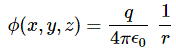
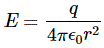
1.Ā A charge q causes an electric field E, and E‘sĀ magnitude E is a simple function of the charge (q) and its distance (r) from the point that we’re looking at, which we usually write as P = (x, y, z). Of course, the origin of our reference frame here is q. The formula is the simple inverse-square law that you (should) know: E ∼ q/r2, and the proportionality constant is just Coulomb’s constant, which I think you wrote as keĀ in your high-school days and which, as you know, is there so as to make sure the units come out alright. So we could just writeĀ E = keĀ·q/r2. However, just to makeĀ sure it doesĀ notĀ look like a piece of cake šŸ™‚ physicists writeĀ the proportionality constant as 1/4πε0, so we get:

E 3

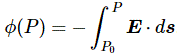
Now, the field is the force on any unit charge (+1) we’d bring to P. This led us to think of energy,Ā potentialĀ energy, because… Well… You know: energy is measured by work, so that’s some force acting over some distance. The potential energy of a charge increases if we move it againstĀ the field, so we wrote:

formula 1

Well… We actually gave the formula below in that post, so that’s the work done per unit charge.Ā To interpret it, you just need to remember that F = qE, which is equivalent to saying that E is the force per unit charge.

unit chage

As for the F•ds or E•ds product in the integrals, that’s a vector dot product, which we need because it’s only the tangential component of the force that’s doing work, as evidenced by the formula F•ds =Ā |F|Ā·|ds|Ā·cosĪø = FtĀ·ds, and as depicted below.

illustration 1

Now, thisĀ allowed us to describe the field in terms of the (electric)Ā potential Φ and the potential differencesĀ between two points, like the points a and b in the integral above. We have to chose some reference point, of course, someĀ P0Ā defining zero potential, which is usually infinitely far away. So we wrote our formula for the work that’s being done on a unit charge, i.e. W(unit) as:

potential

2.Ā The world is full of charges, of course, and so we need to add all of their fields. But so now you need a bit of imagination. Let’s reconstruct the world by moving all charges out, and then we bring them back one by one. So we take q1Ā now, and we bring it back into the now-empty world. NowĀ that does notĀ require any energy, because there’s no field to start with. However, when we take our second chargeĀ q2, we will be doing work as we move it against the field or, if it’s an opposite charge, we’ll be taking energy out of the field.Ā Huh?Ā Yes. Think about it. All is symmetric.Ā Just to make sure you’re comfortable with every step we take, let me jot down the formula for the force that’s involved. It’s just theĀ CoulombĀ force of course:

Coulomb's law

F1Ā is the force on charge q1, andĀ F2Ā is the force on charge q2. Now, q1Ā and q2. may attract or repel each other but the forces will alwaysĀ be equal and opposite. The e12Ā vector makes sure the directions and signs come out alright, as it’s the unit vector from q2Ā to q1Ā (not from q1Ā to q2, as you might expect when looking at the order of the indices). So we would need to integrate this forĀ rĀ going from infinity to… Well… The distance betweenĀ q1Ā and q2 – wherever they end up as we put them back into the world – so that’s what’s denoted by r12. Now I hate integrals too, but this is an easy one. Just note that ∫ rāˆ’2dr = 1/r and you’ll be able to figure out that what I’ll write now makes sense (if not, I’ll do a similar integral in a moment): the work done in bringing two charges together from a large distance (infinity) is equal to:

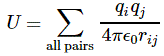
U 1So now we should bring in q3Ā and then q4, of course. That’s easy enough.Ā Bringing the first two charges into that world we had emptied took a lot of time, but now we can automate processes. Trust me: we’ll be done in no time. šŸ™‚ We just need to sum over all of theĀ pairsĀ of chargesĀ qiĀ andĀ qj. So we writeĀ the total electrostatic energy UĀ as the sum of the energies of all possible pairs of charges:

U 3

Huh?Ā Can we do that?Ā I mean… Every new charge that we’re bringing in here changes the field, doesn’t it? It does. But it’s the magic of the superposition principle at work here. Our third charge q3Ā is associated with two pairs in this formula. Think of it: we’ve got theĀ q1q3Ā and theĀ q2q3Ā combination, indeed. Likewise, our fourh chargeĀ q4Ā is to be paired up withĀ three charges now: q1,Ā q1Ā andĀ q3. This formula takes care of it, and theĀ ‘all pairs’ mentionĀ under the summationĀ sign (Ī£) reminds us we should watch we don’t double-count pairs:Ā theĀ q1q3Ā and q3q1Ā combination, for example, count for one pair only, obviously. So, yes, we write ‘all pairs’ instead of the usual i, j subscripts. But then, yes, this formula takes care of it. We’re done!

Well… Not really, of course. We’ve still got some way to go before I can introduce the Poynting vector. šŸ™‚ However, to make sure you ‘get’ the energy formula above, let me insert an extremely simple diagram so you’ve got a bit of a visual of what we’re talking about.

U system

3.Ā Now, let’s take a step back. We just calculated the (potential)Ā energy of the world (U), which is great. But perhaps we should also be interested in the world’sĀ potential Φ, rather than its potential energy U. Why? Well, we’ll want to know what happens when we bring yet another charge in—from outer space or so. šŸ™‚ And so then it’s easier to know the world’s potential, rather than its energy, because we can calculate the field from it using the E =Ā āˆ’āˆ‡Ī¦ formula.Ā So let’s de- and re-construct the world once again šŸ™‚ but now we’ll look at what happens with the field and the potential.

We know our first charge created a field with a field strength we calculated as:

E 3

So, when bringing in our second charge, we can use our Φ(P) integral to calculate the potential:

potential

[Let me make a note here, just for the record. You probablyĀ think I am being pretty childish when talking about my re-construction of the world in terms of bringing all charges out and then back in again but, believe me, there will be a lot of confusion when we’ll start talking about the energy of oneĀ charge, and that confusion can be avoided, to a large extent, when you realize that the idea (I mean the concept itself, really—not its formula)Ā of a potential involves two charges really. Just remember: it’s theĀ firstĀ charge that causes the field (and, of course, anyĀ charge causes a field),Ā but calculating a potential only makes sense when we’re talking someĀ other charge.Ā Just make a mental note of it. You’ll be grateful to me later.]

Let’s nowĀ combine the integral and the formula for E above. Because you hate integrals as much as I do, I’ll spell it out: the antiderivative of the Φ(P) integral is ∫ q/(4πε0r2)Ā·dr. Now, let’s bring q/4πε0 out for a while so we can focus on solving ∫(1/r2)dr. Now, ∫(1/r2)drĀ is equal to –1/r + k, and so the whole antiderivative is –q/4πε0rĀ + k. Now, we integrate from r = āˆž to r, and so the definite integral is [–q/(4πε0)]Ā·[1/āˆž āˆ’ 1/r] = [–q/(4πε0)]Ā·[0 āˆ’ 1/r]Ā = q/(4πε0r). Let me present this somewhat nicer:

E 4

You’ll say: so what? Well… We’re done! The only thing we need to do now is add up the potentials of all of the charges in the world. So the formula for the potential Φ at a point which we’ll simply refer to as point 1, is:

P 1

Note that our index jĀ starts at 2, otherwise it doesn’t make sense: we’d have a division by zero for the q1/r11Ā term. Again, it’s an obvious remark, butĀ notĀ thinking about it can cause a lot of confusion down the line.

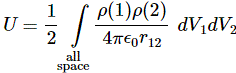
4.Ā Now, I am veryĀ sorry but I have to inform you that we’ll be talking charge densitiesĀ and all that shortly, rather than discreteĀ charges, so I have to give you the continuumĀ version of this formula, i.e. the formula we’ll use when we’ve got charge densities rather than individual charges. That sum above then becomes an infinite sum (i.e. an integral), and qjĀ becomes a variable which we write as ρ(2). [That’s totally in line with our index jĀ starts at 2, rather than from 1.] We get:

U 2

Just look at this integral, and try to understand it: we’re integrating over all of space – so we’re integrating the whole world, really šŸ™‚Ā ā€“ and the ρ(2)Ā·dV2Ā product in the integral is just the charge of an infinitesimally small volumeĀ of our world. So the whole integral is just the (infinite) sum of the contributions to the potential (at point 1) of all (infinitesimally small) charges that are around indeed. Now, there’s something funny here. It’s just a mathematical thing: we don’t need to worry about double-counting here. Why? We’re not having products of volumes here. Just make a mental note of it because it will be different in a moment.

Now we’re going to look at the continuum version for our energy formula indeed. Which energy formula? That electrostatic energy formula, which said thatĀ the total electrostatic energy UĀ as the sum of the energies of all possible pairs of charges:

U 3

Its continuum version is the following monster:

U 4

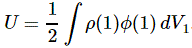
Hmm… What kind of integral is that? We’ve gotĀ two variables here: dV2Ā and dV1. Yes. And we’ve also got a 1/2 factor now, because we do notĀ want to double-count and, unfortunately, there is no convenient way of writing an integral like this that keeps track of the pairs. It’s a so-called double integral, but I’ll let you look up the math yourself. In any case, we can simplify this integral so you don’t need to worry about it too much. How do we simplify it? Well… Just look at that integral we got for Φ(1): we calculated the potential at point 1 by integratingĀ the ρ(2)Ā·dV2Ā product over all of space, so the integral above can be written as:

U 5But so thisĀ integral integrates the ρ(1)·Φ(1)Ā·dV1Ā product over all of space, so that’s over all points in space. So we can just drop the index and write the whole thing as the integral of ρ·Φ·dVĀ over all of space:

U 6

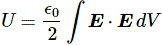
5. It’s time for the hat-trick now. The equation above is mathematically equivalent to the following equation:

U 7

Huh?Ā Yes. Let me make two remarks here. First on the math, the E =Ā āˆ’āˆ‡Ī¦ formula allows you to the integrand of the integral above asĀ E•EĀ =Ā (āˆ’āˆ‡Ī¦)•(āˆ’āˆ‡Ī¦) = (āˆ‡Ī¦)•(āˆ‡Ī¦). And then you may or may not remember that, when substitutingĀ E =Ā āˆ’āˆ‡Ī¦ in Maxwell’s first equation (āˆ‡ā€¢E = ρ/ε0), we got the following equality: ρ = ε0Ā·āˆ‡ā€¢(āˆ‡Ī¦) = ε0Ā·āˆ‡2Φ, so we can write ρΦ as ε0Ā·Ī¦Ā·āˆ‡2Φ. However, that still doesn’t show the two integrals are the same thing. The proof is actually rather involved, and so I’ll refer to that post I referred to, so you can check the proof there.

The second remark is much more fundamental. The two integrals are mathematically equivalent, but are they also physically? What do I mean with that? Well… Look at it. The second integral implies that we can look at (ε0/2)Ā·E•E = ε0E2/2 as an energy density, which we’ll denote by u, so we write:

D 6

Just to make sure you ā€˜get’ what we’re talking about here: u is the energy density in the little cube dV in the rather simplistic (and, therefore, extremely useful) illustration below (which, just like most of what I write above, I got from Feynman).

Capture

Now the question: what is theĀ realityĀ of that formula? Indeed, what we did when calculating U amounted to calculating theĀ Universe with some numberĀ U – and that’s kinda nice, of course! – but then what? Is u = ε0E2/2 anything real? Well… That’s what this post is about. So we’re finished with the introduction now. šŸ™‚

Energy density and energy flow in electrodynamics

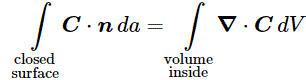
Before giving you any more formulas, let me answer the question: there is no doubt, in the classical theory of electromagnetism at least, that the energy density u is somethingĀ very real. ItĀ hasĀ to be because of the charge conservation law. Charges cannot just disappear in space, to then re-appear somewhere else. The charge conservation law is written asĀ āˆ‡ā€¢j =Ā āˆ’āˆ‚Ļ/āˆ‚t, and that makes it clear it’s aĀ localĀ conservation law. Therefore, charges can only disappear and re-appear through some current. We write dQ1/dt = ∫ (j•n)Ā·da = āˆ’dQ2/dt, and here’s the simple illustration that comes with it:

charge flow

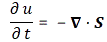
So we doĀ notĀ allow for any ‘non-local’ interactions here! Therefore, we say that, if energy goes away from a region, it’s because itĀ flowsĀ away through the boundaries of that region.Ā So that’s what the Poynting formulas are all about, and so I want to be clear on that from the outset.

Now, to get going with the discussion, I need to give you the formula for the energy density inĀ electrodynamics. Its shape won’t surprise you:

energy density

However, it’s just like the electrostatic formula: it takes quite a bit of juggling to get this from our electrodynamic equations, so, if you want to see how it’s done, I’ll refer you to Feynman. Indeed, I feel the derivation doesn’t matter all that much, because the formula itself is veryĀ intuitive: it’s really the thing everyone knows about a wave, electromagnetic or not: the energy in it is proportional to the square of its amplitude, and so that’s E•EĀ =Ā E2Ā and B•BĀ = B2. Now, you also know that the magnitudeĀ of B is 1/c of that of E, so cB = E, and so that explains the extra c2Ā factor in the second term.

The second formula is also very intuitive. Let me write it down:

energy flux

Just look at it: uĀ is the energy density, so that’s the amount of energy per unit volumeĀ at a given point, and so whatever flows out of that point must represent itsĀ time rate of change. As for the ā€“āˆ‡ā€¢S expression… Well… Sorry, I can’t keep re-explaining things: theĀ āˆ‡ā€¢ operator is the divergence, and so it give us the magnitude of a (vector) field’s source or sinkĀ at a given point. āˆ‡ā€¢CĀ is a scalar, and if it’sĀ positive in a region, then that region is a source. Conversely, if it’s negative, then it’s a sink. To be precise, the divergence represents the volume density of the outward fluxĀ of a vector field from an infinitesimal volume around a given point. So, in this case, it gives us the volume density of the flux of S. As you can see, the formula has exactly the same shape asĀ āˆ‡ā€¢j =Ā āˆ’āˆ‚Ļ/āˆ‚t.

So what is S? Well… Think about the more general formula for the flux out of some closed surface, which we get from integrating over the volume enclosed. It’s just Gauss’ Theorem:

Gauss Theorem

Just replace C by E, and think about what it meant: the flux of E was the field strength multiplied by the surface area, so it was the totalĀ flow of E. Likewise, SĀ represents the flow of (field) energy. Let me repeat this, because it’s an important result:

SĀ represents the flow of field energy.

Huh?Ā What flow? Per unit area? Per second? How do you define such ‘flow’? Good question. Let’s do a dimensional analysis:

  1. E is measured inĀ newton per coulomb, so [E•E] = [E2] = N2/C2.
  2. B is measured in (N/C)/(m/s). [Huh?Ā Well… Yes. I explained that a couple of times already. Just check it in my introduction to electric circuits.] So we get [B•B] = [B2] = (N2/C2)Ā·(s2/m2) but the dimension of ourĀ c2Ā factor is (m2/s2) so we’re left with N2/C2. That’s nice, because we need to add in the same units.
  3. Now we need to look at ε0. That constant usually ‘fixes’ our units, but can we trust it to do the same now? Let’s see… One of the many ways in which we can express its dimension is [ε0] =Ā C2/(NĀ·m2), so if we multiply that with N2/C2, we find that u is expressed inĀ N/m2.Ā Wow!Ā That’sĀ kindaĀ neat. Why? Well… Just multiply with m/m and its dimension becomes NĀ·m/m3Ā = J/m3, so that’s Ā joule per cubic meter, so… Yes: uĀ has got the right unit for something that’s supposed to measure energy density!
  4. OK. Now, we take the time rate of change of u, and so both the right and left of our āˆ‚u/āˆ‚t = āˆ’āˆ‡ā€¢SĀ formula are expressed in (J/m3)/s, which means that the dimension ofĀ S itself mustĀ be J/(m2Ā·s). Just check it by writing it all out: āˆ‡ā€¢SĀ = āˆ‚Sx/āˆ‚x + āˆ‚Sy/āˆ‚x + āˆ‚Sz/āˆ‚z, and so that’s something per meterĀ so, to get the dimension of S itself, we need to go from cubic meter to square meter. Done! Let me highlight the grand result:

S is the energy flow per unit area and per second.

Now we’ve got its magnitude and its dimension, but what is its direction? Indeed, we’ve been writing S as a vector, but… Well… What’s its direction indeed?

Well… Hmm… I referred you to FeynmanĀ for that derivation of that u = ε0E2/2 + ε0c2B2/2 formula energy forĀ u, and so the direction of S – I should actually say, its complete definition – comes out of that derivation as well. So… Well… I think you should just believe what I’ll be writing here for S:

S formula

So it’s the vector cross product of E and B with ε0c2Ā thrown in. It’s a simple formula really, and because I didn’t drag you through the whole argument, you should just quickly do a dimensional analysis again—just to make sure I am not talking too much nonsense. šŸ™‚ So what’s the direction? Well… You just need to apply the usual right-hand rule:

right hand rule

OK. We’re done! This S vector, which – let me repeat it – represents the energy flow per unit area and per second, is what is referred to as Poynting’s vector, and it’s a most remarkable thing, as I’ll show now. Let’s think about theĀ implicationsĀ of this thing.

Poynting’s vector in electrodynamics

The S vector is actually quite similar to the heat flow vectorĀ h, which we presented when discussing vector analysis and vector operators. The heat flow out of a surface element daĀ is the area times the component ofĀ hĀ perpendicular to da, so that’s (h•n)Ā·da = hnĀ·da. Likewise, we can writeĀ (S•n)Ā·da = SnĀ·da. The units of S and h are also the same:Ā joule per second and per square meterĀ or, using the definition of theĀ wattĀ (1 W = 1 J/s), in watt per square meter.Ā In fact, if you google a bit, you’ll find that both hĀ and S are referred to as aĀ flux density:

  1. The heat flow vector hĀ is the heat flux densityĀ vector, from which we get the heat flux through an area through the (h•n)Ā·da = hnĀ·daĀ product.
  2. The energy flow SĀ is the energy flux density vector, from which we get the energy flux through the (S•n)Ā·da = SnĀ·daĀ product.

The big difference, of course, is that we getĀ hĀ from a simpler vector equation:

h =Ā āˆ’Īŗāˆ‡T ⇔ (hx,Ā hy,Ā hz) =Ā āˆ’Īŗ(āˆ‚Tx/āˆ‚x,Ā āˆ‚Ty/āˆ‚y,āˆ‚Tz/āˆ‚x)

The vector equation for SĀ is more complicated:

S formula

So it’s a vector product. Note that S will be zero if E = 0 and/or if B = 0. So S = 0 in electrostatics, i.e. when there are no moving charges and only steady currents. Let’s examine Feynman’s examples.

The illustration below shows the geometry of theĀ E, B and SĀ vectors for a light wave. It’s neat, and totally in line with what we wrote on theĀ radiation pressure, or the momentum of light. So I’ll refer you to that post for an explanation, and to Feynman himself, of course.

light wave

OK. The situation here is rather simple. Feynman gives a few others examples that are notĀ so simple, like that ofĀ a charging capacitor, which is depicted below.

capacitor

The Poynting vector points inwards here, toward the axis. What does it mean?Ā It means the energy isn’t actually coming down the wires, but from the space surrounding the capacitor.Ā 

What?Ā I know. It’s completely counter-intuitive, at first that is. You’d think it’s the charges. But it actually makes sense. The illustration below shows how we should think of it. The charges outside of the capacitor are associated with a weak, enormously spread-out field that surrounds the capacitor. So if we bring them to the capacitor, that field gets weaker, and the field between the plates gets stronger. So the field energy which is way out moves into the space between the capacitor plates indeed, and so that’s what Poynting’s vector tells us here.

capacitor 2

Hmm… Yes. You can be skeptic. You should be. But that’s how it works. The next illustration looks at a current-carrying wire itself. Let’s first look at the B and E vectors. You’re familiar with the magnetic field around a wire, so the B vector makes sense, but what about the electric field? Aren’t wires supposed to be electrically neutral? It’s a tricky question, and we handled it in our post on the relativity of fields. The positive and negative charges in a wire should cancel out, indeed, but then it’s the negative charges that move and, because of their movement, we have the relativistic effect of length contraction, so the volumes are different, and theĀ positive andĀ negative charge density do notĀ cancel out: the wire appears to be charged, so we do have a mix of E and B! Let me quickly give you the formula: E = (2πε0)Ā·(Ī»/r), withĀ Ī» the (apparent) charge per unit length, so it’s the same formula as for a long line of charge, or for a long uniformly charged cylinder.

So we have a non-zeroĀ E and B and, hence, a non-zero Poynting vector S, whose direction isĀ radially inward, so there is a flow of energy into the wire, all around. What the hell?Ā Where does it go? Well… There’s a few possibilities here: the charges need kineticĀ energy to move, or as they increaseĀ theirĀ potentialĀ energy when moving towards the terminals of our capacitor to increase the charge on the plates or, much more mundane, the energy may be radiated out again in the form of heat. It looks crazy, but that’s how it is really. In fact, the more you think about, the more logical it all starts to sound. EnergyĀ mustĀ be conserved locally, and so it’s just field energy going in and re-appearing in some other form. So itĀ doesĀ make sense. But, yes, it’s weird, because no one bothered to teach us thisĀ in school. šŸ™‚

wire

The ‘craziest’ example is the one below: we’ve got a charge and a magnet here. All is at rest. Nothing is moving… Well… I’ll correct that in a moment. šŸ™‚ The charge (q) causes a (static) Coulomb field, while our magnet produces the usual magnetic field, whose shape we (should) recognize: it’s the usual dipole field. So E and B are not changing. But so when we calculate our Poynting vector, we see there is a circulation of S. TheĀ EƗBĀ product is notĀ zero.Ā So what’s going on here?

crazy

Well… There is no netĀ change in energy with time: the energy just circulates around and around. Everything which flows into one volume flows out again. As Feynman puts it: “It is like incompressible water flowing around.” What’s the explanation? Well… Let me copy Feynman’s explanation of this ‘craziness’:

“Perhaps it isn’t so terribly puzzling, though, when you remember that what we called a ā€œstaticā€ magnet is really a circulating permanent current. In a permanent magnet the electrons are spinning permanently inside. So maybe a circulation of the energy outside isn’t so queer after all.”

So… Well… It looks like we do need to revise some of our ‘intuitions’ here. I’ll conclude this post by quoting Feynman on it once more:

“You no doubt get the impression that the Poynting theory at least partially violates your intuition as to where energy is located in an electromagnetic field. You might believe that you must revamp all your intuitions, and, therefore have a lot of things to study here. But it seems really not necessary. You don’t need to feel that you will be in great trouble if you forget once in a while that the energy in a wire is flowing into the wire from the outside, rather than along the wire. It seems to be only rarely of value, when using the idea of energy conservation, to notice in detail what path the energy is taking. The circulation of energy around a magnet and a charge seems, in most circumstances, to be quite unimportant. It is not a vital detail, but it is clear that our ordinary intuitions are quite wrong.”

Well… That says it all, I guess. As far as I am concerned, I feel the Poyning vector makes things actuallyĀ easierĀ to understand. Indeed, the E and B vectors were quite confusing, because we had twoĀ of them, and the magnetic field is, frankly, a weirdĀ thing. Just think about the units in which we’re measuring B: (N/C)/(m/s). IĀ can’t imagine what a unit like that could possible represent, so I must assume you can’t either.Ā But so now we’ve got this Poynting vector that combines both E and B, and which represents the flow of the field energy. Frankly, I think that makes a lot of sense, and it’s surely much easier to visualize than EĀ and/or B. [Having said that, of course, you should note that E and B do have their value, obviously, if only because they represent theĀ lines of force, and so that’s something very physical too, of course.Ā I guess it’s a matter of taste, to some extent, but so I’d tend to soften Feynman’s comments on the supposed ‘craziness’ of S.

In any case… The next thing I should discuss isĀ field momentum. Indeed, if we’ve got flow, we’ve got momentum. But I’ll leave that for my next post. This topic can’t be exhausted in one post only, indeed. šŸ™‚ So let me conclude this post. I’ll do with a very nice illustration I got from the Wikipedia article on the Poynting vector. It shows the Poynting vector around a voltage source and a resistor, as well as what’s going on in-between. [Note that the magnetic field is given by the field vector H, which is related to B as follows: B = μ0(H + M), with M the magnetization of the medium. B and H are obviously just proportional in empty space, with μ0Ā as the proportionality constant.]

Poynting_vectors_of_DC_circuit

Some content on this page was disabled on June 16, 2020 as a result of a DMCA takedown notice from The California Institute of Technology. You can learn more about the DMCA here:

https://wordpress.com/support/copyright-and-the-dmca/
Some content on this page was disabled on June 16, 2020 as a result of a DMCA takedown notice from The California Institute of Technology. You can learn more about the DMCA here:

https://wordpress.com/support/copyright-and-the-dmca/
Some content on this page was disabled on June 16, 2020 as a result of a DMCA takedown notice from The California Institute of Technology. You can learn more about the DMCA here:

https://wordpress.com/support/copyright-and-the-dmca/
Some content on this page was disabled on June 16, 2020 as a result of a DMCA takedown notice from The California Institute of Technology. You can learn more about the DMCA here:

https://wordpress.com/support/copyright-and-the-dmca/
Some content on this page was disabled on June 16, 2020 as a result of a DMCA takedown notice from The California Institute of Technology. You can learn more about the DMCA here:

https://wordpress.com/support/copyright-and-the-dmca/
Some content on this page was disabled on June 16, 2020 as a result of a DMCA takedown notice from The California Institute of Technology. You can learn more about the DMCA here:

https://wordpress.com/support/copyright-and-the-dmca/
Some content on this page was disabled on June 16, 2020 as a result of a DMCA takedown notice from The California Institute of Technology. You can learn more about the DMCA here:

https://wordpress.com/support/copyright-and-the-dmca/
Some content on this page was disabled on June 16, 2020 as a result of a DMCA takedown notice from The California Institute of Technology. You can learn more about the DMCA here:

https://wordpress.com/support/copyright-and-the-dmca/
Some content on this page was disabled on June 16, 2020 as a result of a DMCA takedown notice from The California Institute of Technology. You can learn more about the DMCA here:

https://wordpress.com/support/copyright-and-the-dmca/
Some content on this page was disabled on June 16, 2020 as a result of a DMCA takedown notice from The California Institute of Technology. You can learn more about the DMCA here:

https://wordpress.com/support/copyright-and-the-dmca/
Some content on this page was disabled on June 16, 2020 as a result of a DMCA takedown notice from The California Institute of Technology. You can learn more about the DMCA here:

https://wordpress.com/support/copyright-and-the-dmca/
Some content on this page was disabled on June 16, 2020 as a result of a DMCA takedown notice from The California Institute of Technology. You can learn more about the DMCA here:

https://wordpress.com/support/copyright-and-the-dmca/
Some content on this page was disabled on June 16, 2020 as a result of a DMCA takedown notice from The California Institute of Technology. You can learn more about the DMCA here:

https://wordpress.com/support/copyright-and-the-dmca/
Some content on this page was disabled on June 16, 2020 as a result of a DMCA takedown notice from The California Institute of Technology. You can learn more about the DMCA here:

https://wordpress.com/support/copyright-and-the-dmca/
Some content on this page was disabled on June 16, 2020 as a result of a DMCA takedown notice from The California Institute of Technology. You can learn more about the DMCA here:

https://wordpress.com/support/copyright-and-the-dmca/
Some content on this page was disabled on June 17, 2020 as a result of a DMCA takedown notice from Michael A. Gottlieb, Rudolf Pfeiffer, and The California Institute of Technology. You can learn more about the DMCA here:

https://wordpress.com/support/copyright-and-the-dmca/
Some content on this page was disabled on June 20, 2020 as a result of a DMCA takedown notice from Michael A. Gottlieb, Rudolf Pfeiffer, and The California Institute of Technology. You can learn more about the DMCA here:

https://wordpress.com/support/copyright-and-the-dmca/

Fields and charges (I)

Pre-script (dated 26 June 2020): This post has become less relevant (even irrelevant, perhaps) because my views on all things quantum-mechanical have evolved significantly as a result of my progression towards a more complete realist (classical) interpretation of quantum physics. In addition, some of the material was removed by a dark force (that also created problems with the layout, I see now). In any case, we recommend you read our recent papers. I keep blog posts like these mainly because I want to keep track of where I came from. I might review them one day, but I currently don’t have the time or energy for it. šŸ™‚

Original post:

My previous posts focused mainly on photons, so this one should be focused more on matter-particles, things that have a massĀ and aĀ charge.Ā However, I will use it more as an opportunity to talk about fieldsĀ andĀ present some results fromĀ electrostaticsĀ using our new vector differential operators (see my posts on vector analysis).

Before I do so, let me note something that is obvious but… Well… Think about it: photons carry the electromagnetic force, but have no electric charge themselves. Likewise, electromagnetic fields have energy and are causedĀ by charges,Ā but so they alsoĀ carryĀ no charge. So…Ā FieldsĀ actĀ on a charge, and photonsĀ interactĀ with electrons, but it’s only matter-particles (notably the electron and the proton, which is made of quarks) that actually carry electric charge. Does that make sense? It should. šŸ™‚

Another thing I want to remind you of, before jumping into it all head first, are the basic units and relations that are valid always, regardless of what we are talking about. They are represented below:

Capture

Let me recapitulate the main points:

  • The speed of light is always the same, regardless of the reference frame (inertial or moving), and nothing can travel faster than light (except mathematical points, such as the phase velocity of a wavefunction).
  • This universal rule is the basis of relativity theory and the mass-energy equivalence relation E = mc2.
  • The constant speed of light also allows us to redefine the units of time and/orĀ distance such that c = 1. For example, if we re-define the unit of distance as the distance traveled by light in one second, or the unit of time as the time light needs to travel one meter, then c = 1.
  • Newton’s laws of motion define a force as the product of a mass and its acceleration: F = mĀ·a. Hence, mass is a measure of inertia, and the unit of force is 1 newton (N) = 1 kgĀ·m/s2.
  • The momentum of an object is the product of its mass and its velocity: p = mĀ·v. Hence, its unit is 1 kgĀ·m/s = 1 NĀ·s. Therefore, the concept of momentum combines force (N) as well as time (s).
  • Energy is defined in terms of work: 1 Joule (J) is theĀ work done when applying a force of one newton over a distance of one meter: 1 J = 1 NĀ·m. Hence, the concept of energy combines force (N) and distance (m).
  • Relativity theory establishes the relativistic energy-momentum relation pc = Ev/c, which can also be written asĀ E2Ā = p2c2Ā + m02c4, with m0Ā the restĀ mass of an object (i.e. its mass when the object would be at rest, relative to the observer, of course). These equations reduce to m = E and E2Ā = p2Ā + m02Ā when choosing time and/or distance units such thatĀ c = 1. The massĀ mĀ is the total mass of the object, including its inertial mass as well as the equivalent mass of its kinetic energy.
  • The relationships above establish (a) energy and time and (b) momentum and position asĀ complementaryĀ variables and, hence, the Uncertainty Principle can be expressed in terms of both. The Uncertainty Principle, as well as the Planck-Einstein relation and theĀ de BroglieĀ relation (not shown on the diagram), establish aĀ quantum of action, h, whose dimension combines force, distance and time (h ā‰ˆĀ 6.626Ɨ10āˆ’34Ā NĀ·mĀ·s). This quantum of action (Wirkung)Ā can be defined in various ways, as it pops up in more than one fundamental relation, but one of the more obvious approaches is to define h as the proportionality constant between the energy of a photon (i.e. the ‘light particle’) and its frequency: h = E/ν.

Note that we talked about forces and energy above, but we didn’t say anything about the originĀ of these forces. That’s what we are going to do now, even if we’ll limit ourselves to the electromagnetic force only.

Electrostatics

According to Wikipedia, electrostatics deals with the phenomena and properties of stationary or slow-moving electric charges with no acceleration. Feynman usually uses the term when talking about stationaryĀ charges only. If a current is involved (i.e. slow-moving charges with no acceleration), the termĀ magnetostatics is preferred. However, the distinction does not matter all that much becauseĀ  – remarkably! – with stationary charges and steady currents, the electric and magnetic fields (E and B) can be analyzed as separate fields: there is no interconnection whatsoever!Ā That shows, mathematically, as a neat separation between (1) Maxwell’s first and second equation and (2) Maxwell’s third and fourth equation:

  1. Electrostatics: (i)Ā āˆ‡ā€¢EĀ = ρ/ε0Ā and (ii) āˆ‡Ć—EĀ = 0.
  2. Magnetostatics: (iii) c2āˆ‡Ć—BĀ = j/ε0Ā and (iv) āˆ‡ā€¢BĀ = 0.

Electrostatics: The ρ in equation (i) is the so-called charge density, which describes the distribution of electric charges in space: ρ = ρ(x, y, z). To put it simply: ρ is the ā€˜amount of charge’ (which we’ll denote byĀ Ī”q) per unit volumeĀ at a given point. As for ε0, that’s a constant which ensures all units are ā€˜compatible’. Equation (i) basically says we have some flux of E, the exact amount of which is determined by the charge density ρ or, more in general, by the charge distribution in space. As for equation (ii), i.e. āˆ‡Ć—EĀ = 0, we can sort of forget about that. It means theĀ curlĀ of E is zero: everywhere, and always. So there’s no circulation of E. Hence, E is a so-calledĀ curl-free field, in this case at least, i.e. when only stationary charges and steady currents are involved.

Magnetostatics: TheĀ j in (iii) represents a steady current indeed, causing someĀ circulation ofĀ B. TheĀ c2Ā factor is related to the fact that magnetism is actually only a relativistic effect of electricity, but I can’t dwell on that here. I’ll just refer you to what Feynman writes about this in his Lectures, and warmly recommend to read it. Oh… Equation (iv),Ā āˆ‡ā€¢BĀ = 0, means that the divergenceĀ of B is zero: everywhere, and always. So there’s no flux of B. None. So B is a divergence-free field.

Because of the neat separation, we’ll just forget about B and talk about E only.

The electric potential

OK. Let’s try to go through the motions as quickly as we can. As mentioned in my introduction, energy is defined in terms of work done. So we should just multiply the force and the distance, right? 1 Joule = 1 newton Ɨ 1 meter, right? Well… Yes and no. In discussions like this, we talk potentialĀ energy, i.e. energy stored in the system, so to say. That means that we’re looking at work done against the force, like when we carry a bucket of water up to the third floor or, to use a somewhat more scientific description of what’s going on, when we are separatingĀ two masses. Because we’re doing work againstĀ the force, we putĀ a minus sign in front of our integral:

formula 1

Now, the electromagnetic force works pretty much like gravity, except that, when discussing gravity, we only have positive ‘charges’ (the mass of some object is always positive). In electromagnetics, we have positive as well as negative charge, and please note that two like charges repel (that’s not the case with gravity). Hence, doingĀ work against the electromagnetic force may involve bringing like charges together or, alternatively, separating opposite charges.Ā We can’t say. Fortunately, when it comes to the math of it, it doesn’t matter: we will have the same minus sign in front of our integral. The point is: we’re doing work againstĀ the force, and so that’s what the minus sign stands for. So it has nothing to do with the specifics of the law of attraction and repulsion in this case (electromagnetism as opposed to gravity) and/or the fact that electrons carry negative charge. No.

Let’s get back to the integral. Just in case you forgot,Ā the integral sign ∫ stands for an S: the S of summa, i.e. sum in Latin, and we’re using these integrals because we’re adding an infinite number of infinitesimally small contributions to the total effort here indeed.Ā You should recognize it, because it’s a general formula for energy or work. It is, once again, a so-calledĀ line integral, so it’s a bit different than the ∫f(x)dx stuff you learned from high school. Not very different, but different nevertheless. What’s different is that weĀ have a vector dot product F•ds after the integral sign here, so that’s notĀ like f(x)dx. In case you forgot, that f(x)dx product represents the surface of an infinitesimally rectangle, as shown below: we make the base of the rectangle smaller and smaller, so dx becomes an infinitesimal indeed. And then we add them all up and get the area under the curve. If f(x) is negative, then the contributions will be negative.

Ā 420px-Integral_approximationsIntegral_example

But so we don’t have little rectangles here. We have two vectors, F and ds, and their vector dot product,Ā F•ds, which will give you… Well… I am tempted to write: the tangential component of the force along the path, but that’s not quite correct: if ds was a unit vector, it would be true—because then it’s just like that h•n product I introduced in our first vector calculus class. However, ds isĀ notĀ a unit vector: it’s an infinitesimal vector, and, hence, if we write the tangential component of the force along the path as Ft, thenĀ F•dsĀ =Ā |F||ds|cosĪø = FĀ·cosĪøĀ·ds =Ā FtĀ·ds. So thisĀ F•ds is a tangential component over an infinitesimally small segment of the curve. In short, it’s an infinitesimally small contribution to the total amount of work done indeed. You can make sense of this by looking at the geometrical representation of the situation below.

illustration 1

I am just saying this so you know what that integral stands for. Note that we’reĀ notĀ adding arrows once again, like we did when calculating amplitudes or so. It’s allĀ muchĀ more straightforward really: a vector dot product is a scalar, so it’s just some real number—just like any component of a vector (tangential, normal, in the direction of one of the coordinates axes, or in whatever direction) is not a vector but a real number. Hence, W is also just some real number. It can be positive or negative because… Well… When we’d be going downĀ the stairsĀ with our bucket of water, our minus sign doesn’t disappear. Indeed, our convention to put that minus sign there should obviously notĀ depend on whatĀ point a and b we’re talking about, so we may actually be going alongĀ the direction of the forceĀ when going from a to b.

As a matter of fact, you should note that’s actually the situation which is depicted above. So then we get a negativeĀ number for W. Does that make sense? Of courseĀ itĀ does: we’re obviously not doing any work here as we’re moving along the direction, so we’re surelyĀ not adding any (potential) energy to the system. On the contrary, we’re taking energyĀ out of the system. Hence, we are reducing its (potential) energy and, hence, we shouldĀ have a negativeĀ value for W indeed. So, just think of the minus sign being there to ensure we add potential energy to the system when going against the force, and reducing it when going with the force.

OK. You get this. You probably also know we’ll re-define W as a difference in potential between two points, which we’ll write as Φ(b) – Φ(a). Now that should remind you of your high school integral ∫f(x)dx once again. For a definite integral over a line segment [a, b], you’d have to find the antiderivative of f(x), which you’d write as F(x), and then you’d take the difference F(b) – F(a) too. Now, you may or may not remember that this antiderivative was actually a familyĀ of functions F(x) + k, and k could be any constant – 5/9, 6Ļ€, 3.6Ɨ10124, 0.86, whatever! – because such constant vanishes when taking the derivative.

Here we have the same, we can define an infinite number of functions Φ(r) + k, of which the gradientĀ will yield… Stop! I am going too fast here. First, we need to re-write that W function above in order to ensure we’re calculating stuff in terms of the unitĀ charge,Ā so we write:

unit chage

Huh?Ā Well… Yes. I am using theĀ definitionĀ of the fieldĀ EĀ here really: E is the force (F) when putting aĀ unit charge in the field. Hence, if we want the work done per unit charge, i.e. W(unit), then we have to integrate theĀ vector dot product EĀ·dsĀ over the path from a to b. But so now you see what I want to do. It makes theĀ comparison with our high school integral complete. Instead of taking a derivative in regard to one variable only, i.e. dF(x)/dx) = f(x), we have a function Φ here not in one but in three variables: Φ = Φ(x, y, z) = Φ(r) and, therefore, we have to take the vector derivativeĀ (orĀ gradientĀ as it’s called) of Φ to get E:

āˆ‡Ī¦(x, y, z) = (āˆ‚Ī¦/āˆ‚x, āˆ‚Ī¦/āˆ‚y, āˆ‚Ī¦/āˆ‚z) = –E(x, y, z)

But so it’s the same principle as what you learned how to use to solve your high school integral.Ā Now, you’ll usually see the expression above written as:

E =Ā ā€“āˆ‡Ī¦

Why so short? Well… We all just love these mysterious abbreviations, don’t we? šŸ™‚ Jokes aside, it’s true some of those vector equations pack an awful lot of information. Just take Feynman’s advice here: “If it helps to write out the components to be sure you understand what’s going on, just do it. There is nothing inelegant about that. In fact, there is often a certain cleverness in doing just that.” So… Let’s move on.

I should mention that we can only apply this more sophisticated version of the ‘high school trick’ because Φ and E are like temperature (T) and heat flow (h): they are fields. T is a scalar field and h is a vector field, and so that’s why we can and should apply our new trick: if we have the scalar field, we can derive the vector field.Ā In case you want more details, I’ll just refer you to our firstĀ vector calculus class. Indeed, our so-called First TheoremĀ in vector calculus was just about the more sophisticated version of the ‘high school trick’: if we have someĀ scalar field ψ (like temperature or potential, for example: just substitute the ψ in the equation below for T or Φ), then we’ll always find that:

First theorem

TheĀ Ī“ here is the curve between point 1 and 2, so that’s the path along which we’re going, and āˆ‡ĻˆĀ must represent some vector field.

Let’s go back to our W integral. I should mention that it doesn’t matterĀ what path we take: we’ll always get the same value for W, regardless of what path we take. That’s why the illustration above showed two possible paths: it doesn’t matter which one we take. Again, that’s only because E is a vector field. To be precise, the electrostatic field is a so-called conservative vector field, which means that we can’t get energy out of the field by first carrying some charge along one path, and then carrying it back along another. You’ll probably find that’s obvious, Ā and it is. Just note it somewhere in the back of your mind.

So we’re done. We should just substitute E forĀ āˆ‡Ī¦, shouldn’t we? Well… Yes. For minus āˆ‡Ī¦, that is. Another minus sign. Why? Well… It makes that W(unit) integral come out alright. Indeed, we want a formula like W = Φ(b) – Φ(a), not like Φ(a) – Φ(b). Look at it. We could, indeed, define EĀ as the (positive) gradient of some scalar field ψ = –Φ, and so we could writeĀ E = āˆ‡Ļˆ, but then we’d find that W = –[ψ(b) – ψ(a)] = ψ(a) – ψ(b).

You’ll say: so what? Well… Nothing much. It’s just that our field vectors would point from lowerĀ to higherĀ values of ψ, so they would be flowing uphill, so to say. Now,Ā we don’t want that in physics. Why? It just doesn’t look good. We want our field vectorsĀ to be directed from higher potential to lower potential, always. Just think of it: heat (h) flows from higher temperature (T) to lower, and Newton’s apple falls from greater to lower height. Likewise, when putting a unit charge in the field, we want to see it move from higher to lower electric potential. Now, we can’t change the direction of E, because that’s the direction of the force and Nature doesn’t care about our conventions and so we can’t choose the direction of the force. But we can choose our convention. So that’s why we put a minus sign in front of āˆ‡Ī¦ when writing E = ā€“āˆ‡Ī¦. It makes everything come out alright. šŸ™‚Ā That’s why we also have a minus sign in the differential heat flow equation: h =Ā ā€“Īŗāˆ‡T.

So now we have the easy W(unit) = Φ(b) – Φ(a) formula that we wanted all along. Now, note that, when we say a unit charge, we mean a plus oneĀ charge. Yes: +1. So that’s the charge of the proton (it’s denoted by e) so you should stop thinking about moving electrons around! [I am saying this because I used to confuse myself by doing that. You end up with the same formulas for W and Φ but it just takes you longer to get there, so let me save you some time here. :-)]

But… Yes? In reality, it’s electrons going through a wire, isn’t? Not protons. Yes. But it doesn’t matter. Units are units in physics, and they’re always +1, for whatever (time, distance, charge, mass, spin, etcetera). Always.Ā For whatever. Also note that in laboratory experiments, or particle accelerators, we often use protons instead of electrons, so there’s nothing weird about it. Finally, and most fundamentally, if we have a –e charge moving through a neutral wire in one direction, then that’s exactly the same as a +e charge moving in the other way.

Just to make sure you get the point, let’s look at that illustration once again. We already said that we have F and, hence, EĀ pointing from a to b and we’ll be reducing the potential energy of the system when moving our unit charge from a to b, so W was some negative value. Now, taking into account we want field lines to point from higher to lower potential, Φ(a) should be largerĀ than Φ(b), and so… Well.. Yes. It all makes sense: we have aĀ negative difference Φ(b) – Φ(a) = W(unit), which amounts, of course, to the reduction in potential energy.

The last thing we need to take care of now, is the reference point. Indeed, any Φ(r) + k function will do, so which one do we take? The approach here is to take aĀ reference pointĀ P0Ā at infinity. What’s infinity? Well… Hard to say. It’s a place that’s very far away from all of the charges we’ve got lying around here. Very far away indeed. So far away we can say there is nothing there really. No charges whatsoever. šŸ™‚ Something like that. šŸ™‚ In any case. I need to move on. So Φ(P0) is zeroĀ and so we can finally jot down the grand result for theĀ electric potential Φ(P) (aka as the electrostatic or electric field potential):

potential

So now we can calculate all potentials, i.e. when we know where the charges are at least. I’ve shown an example below. As you can see, besides having zero potential at infinity, we will usually also have one or more equipotentialĀ surfaces with zero potential. One could say these zero potential lines sort of ‘separate’ the positive and negative space. That’s not a very scientifically accurate description but you know what I mean.

potential

Let me make a few final notes about the units. First, let me, once again, note that our unit charge is plusĀ one, and it will flow from positive to negative potential indeed, as shown below, even if we know that, in an actual electric circuit, and so now I am talking about a copper wire or something similar,Ā that means the (free) electrons will move in the other direction.

1280px-Current_notationIf you’re smart (and you are), you’ll say: what about the right-hand rule for the magnetic force? Well… We’re not discussing the magnetic force here but, because you insist, rest assured it comes out alright. Look at the illustration below of the magnetic force on a wire with a current, which is a pretty standard one.

terminalSo we have a givenĀ B, because of the bar magnet, and then v, the velocity vector for the… Electrons? No. You need to be consistent. It’s the velocity vector for the unit charges, which are positiveĀ (+e). Now just calculate the force F = qvƗB = evƗB using the right-hand rule for the vector cross product, as illustrated below. So v is the thumb and B is the index finger in this case.Ā All you need to do is tilt your hand, and it comes out alright.

507px-Right_hand_rule_cross_product

But… We knowĀ it’s electrons going the other way.Ā Well… If you insist. But then you have to put a minus sign in front of the q, because we’re talking minusĀ e (–e). So now v is in the other direction and so vƗB is in the other direction indeed, but our force F = qvƗB = –evƗBĀ is not. Fortunately not, because physical reality should not depend on our conventions. šŸ™‚ So… What’s the conclusion. Nothing. You may or may not want to remember that, when we say that our currentĀ j current flows in this or that direction, we actually might be talking electrons (with chargeĀ minusĀ one) flowing in the opposite direction, but then it doesn’t matter. In addition, as mentioned above, in laboratory experiments or accelerators, we may actually be talking protons instead of electrons, so don’t assume electromagnetism is the business of electrons only.

To conclude this disproportionately long introduction (we’re finally ready to talk more difficult stuff), I should just make a note on the units. Electric potential is measured in volts, as you know. However, it’s obvious from all that I wrote above that it’s theĀ differenceĀ in potential that matters really. From theĀ definition above, it should be measured in the same unit as our unit for energy, or for work, so that’s theĀ joule. To be precise, it should be measured inĀ jouleĀ per unit charge. But here we have one of the very few inconsistencies in physics when it comes to units. The proton is said to be the unit charge (e), but its actual value is measured inĀ coulombĀ (C). To be precise: +1 e =Ā 1.602176565(35)Ɨ10āˆ’19 C. So we doĀ notĀ measure voltage – sorry, potential difference šŸ™‚Ā ā€“ in joule but in joule per coulomb (J/C).

Now, we usually use another term for the joule/coulomb unit. You guessed it (because I said it): it’s the voltĀ (V). One volt is one joule/coulomb: 1 V = 1 J/C. That’s not fair, you’ll say. You’re right, but so the proton charge e is not a so-called SI unit. Is the Coulomb an SI unit? Yes. It’s derived from the ampereĀ (A) which, believe it or not, is actually an SI baseĀ unit. One ampere isĀ 6.241Ɨ1018 electrons (i.e. one coulomb) per second. You may wonder how the ampere (or the coulomb) can be a base unit. Can they be expressed in terms of kilogram, meter and second, like all other base units. The answer is yes but, as you can imagine, it’s a bit of a complex description and so I’ll refer you to the Web for that.

The Poisson equation

I started this post by saying that I’d talk about fields andĀ present some results fromĀ electrostaticsĀ using our ‘new’ vector differential operators, so it’s about time I do that. The first equation is a simple one. Using ourĀ E = ā€“āˆ‡Ī¦ formula, we can re-write theĀ āˆ‡ā€¢EĀ = ρ/ε0Ā equation as:

āˆ‡ā€¢E =Ā āˆ‡ā€¢āˆ‡Ī¦Ā = āˆ‡2Φ = –ρ/ε0

This is a so-called Poisson equation. TheĀ āˆ‡2Ā operator is referred to as the Laplacian and is sometimes also written as Ī”, but I don’t like that because it’s also the symbol for the total differential, and that’s definitely not the same thing. The formula for the Laplacian is given below. Note that it acts on a scalar field (i.e. the potential function Φ in this case).

LaplacianAs Feynman notes: “The entire subject of electrostatics is merely the study of the solutions of this one equation.” However, I should note that this doesn’t prevent Feynman from devoting at least a dozen of his LecturesĀ on it, and they’re not the easiest ones to read. [In case you’d doubt this statement, just have a look at his lecture on electric dipoles, for example.]Ā In short: don’t think the ‘study of this one equation’ is easy. All I’ll do is just note some of the most fundamental results of this ‘study’.

Also note thatĀ āˆ‡ā€¢E is one of our ‘new’ vector differential operators indeed: it’s the vector dot product of our del operator (āˆ‡) with E. That’s somethingĀ veryĀ different than, let’s say,Ā āˆ‡Ī¦. A little dot and some bold-face type make an enormous difference here. šŸ™‚ You may or may remember that we referred to theĀ āˆ‡ā€¢ operator as the divergence (div) operator (see my post on that).

Gauss’ Law

Gauss’ Law is not to be confused with Gauss’ Theorem, about which I wrote elsewhere. It gives the flux of E through a closed surface S,Ā anyĀ closed surface S really, as theĀ sum of all charges inside the surfaceĀ divided by the electric constant ε0Ā (but then you know that constant is just there to make the units come out alright).

Gauss' Law

The derivation of Gauss’ Law is a bit lengthy, which is why I won’t reproduce it here, but you should note its derivation is based, mainly, on the fact that (a) surface areas are proportional to r2Ā (so if we double the distance from the source, the surface area will quadruple), and (b) the magnitude of E is given by an inverse-square law, so it decreases as 1/r2.Ā That explains why, if the surface S describes a sphere, the number we get from Gauss’ Law is independent of the radius of the sphere. The diagram below (credit goes to Wikipedia) illustrates the idea.

flux

The diagram can be used to show how a field and its flux can be represented. Indeed, the lines represent the flux of E emanating from a charge. Now, the total number of flux lines depends on the charge but is constant with increasing distance because the force is radial and spherically symmetric. A greater density of flux lines (lines per unit area) means a stronger field, with the density of flux lines (i.e. the magnitude of E) following an inverse-square law indeed, because the surface area of a sphere increases with the square of the radius. Hence, in Gauss’ Law, the two effect cancel out: the two factors vary with distance, but their product is a constant.

Now, if we describe the location of charges in terms of charge densities (ρ), then we can write Qint as:

Q int

Now, Gauss’ Law also applies to an infinitesimal cubical surface and, in one of my posts on vector calculus, I showed that the flux of E out of such cube is given by āˆ‡ā€¢EĀ·dV. At this point, it’s probably a good idea to remind you of what this ‘new’ vector differential operatorĀ āˆ‡ā€¢, i.e. ourĀ ‘divergence’ operator,Ā stands for: the divergence of EĀ (i.e. āˆ‡ā€¢ applied to E, so that’s āˆ‡ā€¢E) represents theĀ volume density of the flux of E out of an infinitesimal volume around a given point. Hence, it’s the flux per unit volume, as opposed to the flux out of the infinitesimal cube itself, which is the product ofĀ āˆ‡ā€¢EĀ and dV, i.e. āˆ‡ā€¢EĀ·dV.

So what? Well… Gauss’ Law applied to our infinitesimal volume gives us the following equality:

ES 1

That, in turn, simplifies to:

ES 2

So that’s Maxwell’s first equation once again, which is equivalent to our Poisson equation:Ā āˆ‡ā€¢E =Ā āˆ‡2Φ = –ρ/ε0. So what are we doing here? Just listing equivalent formulas? Yes. I should also note they can be derived from Coulomb’s law of force, which is probably the one you learned in high school. So… Yes. It’s all consistent. But then that’s what we should expect, of course. šŸ™‚

The energy in a field

All these formulas look very abstract. It’s about time we use them for something. A lot of what’s written in Feynman’sĀ LecturesĀ on electrostatics is applied stuff indeed: it focuses, among other things, on calculating the potential in various circumstances and for various distributions of charge. Now, funnily enough, while that āˆ‡ā€¢E = –ρ/ε0Ā equation is equivalent to Coulomb’s law and, obviously, much more compact to write down, Coulomb’s law is easier to start with for basic calculations. Let me first write Coulomb’s law. You’ll probably recognize it from your high school days:

Coulomb's law

F1Ā is the force on charge q1, andĀ F2Ā is the force on charge q2. Now, q1Ā and q2. may attract or repel each other but, in both cases, the forces will be equal and opposite. [In case you wonder, yes, that’s basically the law of action and reaction.] TheĀ e12Ā vector is the unit vector from q2Ā to q1, not from q1Ā to q2, as one might expect. That’s because we’re notĀ talking gravity here: like charges do not attract but repel and, hence, we have to switch the order here. Having said that, that’s basically the only peculiar thing about the equation. All the rest is standard:

  1. The force is inverselyĀ proportional to the square of the distance and so we have an inverse-square law here indeed.
  2. The force is proportional to the charge(s).
  3. Finally, we haveĀ a proportionality constant,Ā 1/4πε0, which makes the units come out alright. You may wonder why it’s written the way it’s written, i.e. with thatĀ 4Ļ€ factor, but that factor (4Ļ€ or 2Ļ€) actually disappears in a number of calculations, so then we will be left with just aĀ 1/ε0Ā or a 1/2ε0Ā factor. So don’t worry about it.

We want to calculate potentials and all that, so the first thing we’ll do is calculate the force on a unit charge. So we’ll divide that equation byĀ q1, to calculate E(1) =Ā F1/q1:

E 1

Piece of cake. But… What’s E(1) really? Well… It’s the force on the unit charge (+e), but so it doesn’t matter whether or not that unit charge is actually there, so it’s the field EĀ caused by a charge q2. [If that doesn’t make sense to you, think again.] So we can drop the subscripts and just write:

E 3

What a relief, isn’t it? The simplest formula ever: the (magnitude) of the field as a simple function of the charge qĀ and its distance (r) from the point that we’re looking at, which we’ll write as P = (x, y, z). But what origin are we using to measure x, y and z. Don’t be surprised: the origin isĀ q.

Now that’s a formula we can use in the Φ(P) integral. Indeed, the antiderivative is ∫(q/4πε0r2)dr. Now, we can bring q/4πε0 out and so we’re left with ∫(1/r2)dr. Now ∫(1/r2)drĀ is equal to –1/r + k, and so the whole antiderivative is –q/4πε0rĀ + k. However, the minus sign cancels out with the minus sign in front of the Φ(P) = Φ(x, y, z)Ā  integral, and so we get:

E 4

You should just do the integral to check this result. It’s the same integral but withĀ P0 (infinity) as point a and P as point b in the integral, so we have āˆž as start value and r as end value. The integral then yields Φ(P) – Φ(P0) = –q/4πε0[1/r – 1/āˆž). [The k constant falls away when subtracting Φ(P0) from Φ(P).] But 1/āˆž = 0, and we had a minus sign in front of the integral, which cancels the sign of –q/4πε0. So, yes, we get the wonderfully simple result above. Also please do quickly check if it makes sense in terms of sign: the unit charge is +e, so that’s a positive charge. Hence, Φ(x, y, z) will be positive if the sign of q is also positive, but negative if q would happen to be negative. So that’s OK.

Also note that the potential – which, remember, represents the amount of work to be done when bringing a unit charge (e) from infinity to some distance r from a charge q – is proportional to the charge of q. We also know that the force and, hence, the work is proportional to the charge that we are bringing in (that’s how we calculated the work per unit in the first place: by dividing the total amount of work by the charge). Hence, if we’d notĀ bring some unit charge but some other chargeĀ q2, the work done would also be proportional to q2. Now, we need to make sure we understand what we’re writing and so let’s tidy up and re-label our first charge once again as q1, and the distance r asĀ r12, because that’s what r is: the distance between the two charges. We then have another obvious but nice result: the work done in bringing two charges together from a large distance (infinity) is

U 1Now, one of the many nice properties of fields (scalar or vector fields) and the associated energies (because that’s what we are talking about here) is that we can simply add up contributions. For example, if we’d have many charges and we’d want to calculate the potential Φ at a point which we call 1, we can use the same Φ(r) =Ā q/4πε0r formula which we had derived for oneĀ charge only, for all charges, and then we simply add the contributions of each to get the total potential:

P 1

Now that we’re here, I should, of course, also give the continuum version of this formula, i.e. the formula used when we’re talking charge densities rather than individual charges. The sum then becomes an infinite sum (i.e. an integral), and qjĀ (note that j goes from 2 to n) becomes a variable which we write as ρ(2). We get:

U 2

Going back to the discrete situation, we get the same type of sum when bringing multiple pairs of chargesĀ qiĀ andĀ qjĀ together. Hence, the total electrostatic energy UĀ is the sum of the energies of all possible pairs of charges:

U 3It’s been a while since you’ve seen any diagram or so, so let me insert one just to reassure you it’s as simple as that indeed:

U system

Now, we have to be aware of the risk of double-counting, of course. We should notĀ be adding qiqj/4πε0rijĀ twice. That’s why we write ‘all pairs’ under the āˆ‘ summation sign, instead of the usual i, j subscripts. The continuum version of this equation below makes that 1/2 factor explicit:

U 4

Hmm… What kind of integral is that? It’s a so-called double integral because we have two variables here. Not easy. However, there’s a lucky break. We can use the continuum version of our formula for Φ(1) to get rid of the ρ(2) and dV2Ā variables and reduce the whole thing to a more standard ‘single’ integral. Indeed, we can write:

U 5Now, because our point (2) no longer appears, we can actually write that more elegantly as:

U 6That looks nice, doesn’t it? But do we understand it? Just to make sure. Let me explain it.Ā The potential energy of the charge ρdV is the product of this charge and the potential at the same point. The total energy is therefore the integral over ϕρdV, but then we are counting energies twice, so that’s why we need the 1/2 factor. Now, we can write this even more beautifully as:

U 7

Isn’t this wonderful? We have an expression for the energy of a field, not in terms of the charges or the charge distribution, but in terms of the field they produce.

I am pretty sure that, by now, you must be suffering from ‘formula overload’, so you probably are just gazing at this without even bothering to try to understand. Too bad, and you should take a break then or just go do something else, like biking or so. šŸ™‚

First, you should note that you know this E•E expression already: E•E is just the square of the magnitude of the field vector E, so E•E =Ā E2. That makes sense because we know, from what we know about waves, that the energy is always proportional to the square of an amplitude, and so we’re just writing the same here but with a little proportionality constant (ε0).

OK, you’ll say. But you probably still wonder what useĀ this formula could possibly have. What is that number we get from some integration over all space? So we associate the Universe with some numberĀ UĀ and then what? Well… Isn’t that justĀ nice? šŸ™‚ Jokes aside, we’re actually looking at that E•E = E2Ā product insideĀ of the integral as representing anĀ energy densityĀ (i.e. the energy per unit volume). We’ll denote that with a lower-caseĀ uĀ symbol and so we write:

D 6

Just to make sure you ‘get’ what we’re talking about here: u is the energy density in the little cube dV in the rather simplistic (and, therefore, extremely useful) illustration below (which, just like most of what I write above, I got from Feynman).

Capture

Now thatĀ should make sense to you—I hope. šŸ™‚ In any case, if you’re still with me, and if you’re notĀ all formula-ed outĀ you may wonder how we get that ε0E•E = ε0E2Ā expression from that ρΦ expression. Of course, you know that E =Ā ā€“āˆ‡Ī¦, and we also have the Poisson equation āˆ‡2Φ = –ρ/ε0, but that doesn’t get you very far. It’s one of those examples where an easy-looking formula requires a lot of gymnastics. However, as the objective of this post is to do some of that, let me take you through the derivation.

Let’s do something with that Poisson equation first, so we’ll re-write it as ρ = –ε0āˆ‡2Φ, and then we can substitute ρ in the integral with the ρΦ product. So we get:

U 8

Now, you should check out those fancy formulas with our new vector differential operators which we listed in our second class on vector calculus, but, unfortunately, none of them apply. So we have to write it all out and see what we get:

D 1

NowĀ thatĀ looks horrendous and so you’ll surely think we won’t get anywhere with that. Well… Physicists don’t despair as easily as we do, it seems, and so they do substitute it in the integral which, of course, becomes an even more monstrous expression, because we now have two volume integrals instead of one! Indeed, we get:

D 2But ifĀ āˆ‡Ī¦ is a vector field (it’s minus E, remember!), then Ī¦āˆ‡Ī¦ is a vector field too, and we can then apply Gauss’ Theorem, which we mentioned in our first class on vector calculus, and which – mind you! – has nothing to do with Gauss’ Law. Indeed, Gauss produced so much it’s difficult to keep track of it all. šŸ™‚ So let me remind you of this theorem. [I should also show why Ī¦āˆ‡Ī¦ still yieldsĀ a field, but I’ll assume you believe me.] Gauss’ TheoremĀ basically shows how we can go from a volume integral to a surface integral:

Gauss Theorem-2If we apply this to the second integral in our U expression, we get:

D 4

So what? Where are we going with this? Relax. Be patient. What volume and surface are we talking about here? To make sure we have all charges and influences, we should integrate over all space and, hence, the surface goes to infinity. So we’re talking a (spherical) surface of enormous radius R whose center is the origin of our coordinate system. I know that sounds ridiculous but, from a math point of view, it is just the same like bringing a charge in from infinity, which is what we did to calculate the potential. So if we don’t difficulty with infinite line integrals, we should not have difficulty with infinite surface and infinite volumes. That’s all I can, so… Well… Let’s do it.

Let’s look at that product Ī¦āˆ‡Ī¦ā€¢n in the surface integral. Φ is a scalar and āˆ‡Ī¦ is a vector, and so… Well… āˆ‡Ī¦ā€¢nĀ is a scalar too: it’s the normal component of āˆ‡Ī¦ = –E.Ā [Just to make sure, you should note that the way we define the normal unit vector n isĀ such that āˆ‡Ī¦ā€¢n is some positive number indeed! SoĀ n will point in the same direction, more or less, as āˆ‡Ī¦ = –E. So the Īø angle Ā between āˆ‡Ī¦ = –E and nĀ is surely less than ± 90° and, hence, the cosine factor in the āˆ‡Ī¦ā€¢nĀ = |āˆ‡Ī¦||n|cosĪø = |āˆ‡Ī¦|cosĪø is positive, and so the whole vector dot product is positive.]

So, we have a product of two scalars here. Ā What happens with them if R goes to infinity? Well… The potentialĀ varies as 1/r as we’re going to infinity. That’s obvious from that Φ = (q/4πε0)(1/r) formula: just think of q as some kind of average now, which works because we assume all charges are located within some finite distance, while we’re going to infinity. What about āˆ‡Ī¦ā€¢n?Ā Well… Again assuming that we’re reasonably far away from the charges, we’re talking theĀ density of flux lines here (i.e. the magnitude of E) which, as shown above, follows an inverse-square law, because the surface area of a sphere increases with the square of the radius. So āˆ‡Ī¦ā€¢n varies not as 1/r but as 1/r2. To make a long story short, the whole product Ī¦āˆ‡Ī¦ā€¢nĀ falls of as 1/rĀ goes to infinity. Now, we shouldn’t forget we’re integrating a surface integral here, with r = R, and so it’s R going to infinity. So that surface integralĀ has to go to zero when we include all space. The volume integral still stands however, so our formula for U now consists of one term only, i.e. the volume integral, and so we now have:

D 5

Done !

What’s left?

In electrostatics? Lots. Electric dipoles (like polar molecules), electrolytes, plasma oscillations, ionic crystals, electricity in the atmosphere (like lightning!), dielectrics and polarization (including condensers), ferroelectricity,… As soon as we try to apply our theory to matter, things become hugely complicated. But the theory works. Fortunately! šŸ™‚ I have to refer you to textbooks, though, in case you’d want to know more about it. [I am sure you don’t, but then one never knows.]

What I wanted to do is to give you some feelĀ for those vector and field equations in theĀ electrostaticĀ case. We now need to bring magnetic field back into the picture and, most importantly, move toĀ electrodynamics, in which the electric and magnetic field do not appear as completely separate things. No! In electrodynamics, they are fully interconnected through the time derivatives āˆ‚E/āˆ‚t and āˆ‚B/āˆ‚t. That shows they’re part and parcel of the same thing really: electromagnetism.Ā 

But we’ll try to tackle that in future posts. Goodbye for now!

Some content on this page was disabled on June 16, 2020 as a result of a DMCA takedown notice from The California Institute of Technology. You can learn more about the DMCA here:

https://wordpress.com/support/copyright-and-the-dmca/
Some content on this page was disabled on June 16, 2020 as a result of a DMCA takedown notice from The California Institute of Technology. You can learn more about the DMCA here:

https://wordpress.com/support/copyright-and-the-dmca/
Some content on this page was disabled on June 16, 2020 as a result of a DMCA takedown notice from The California Institute of Technology. You can learn more about the DMCA here:

https://wordpress.com/support/copyright-and-the-dmca/
Some content on this page was disabled on June 16, 2020 as a result of a DMCA takedown notice from The California Institute of Technology. You can learn more about the DMCA here:

https://wordpress.com/support/copyright-and-the-dmca/
Some content on this page was disabled on June 16, 2020 as a result of a DMCA takedown notice from The California Institute of Technology. You can learn more about the DMCA here:

https://wordpress.com/support/copyright-and-the-dmca/
Some content on this page was disabled on June 16, 2020 as a result of a DMCA takedown notice from The California Institute of Technology. You can learn more about the DMCA here:

https://wordpress.com/support/copyright-and-the-dmca/
Some content on this page was disabled on June 16, 2020 as a result of a DMCA takedown notice from The California Institute of Technology. You can learn more about the DMCA here:

https://wordpress.com/support/copyright-and-the-dmca/
Some content on this page was disabled on June 16, 2020 as a result of a DMCA takedown notice from The California Institute of Technology. You can learn more about the DMCA here:

https://wordpress.com/support/copyright-and-the-dmca/
Some content on this page was disabled on June 16, 2020 as a result of a DMCA takedown notice from The California Institute of Technology. You can learn more about the DMCA here:

https://wordpress.com/support/copyright-and-the-dmca/
Some content on this page was disabled on June 17, 2020 as a result of a DMCA takedown notice from Michael A. Gottlieb, Rudolf Pfeiffer, and The California Institute of Technology. You can learn more about the DMCA here:

https://wordpress.com/support/copyright-and-the-dmca/
Some content on this page was disabled on June 17, 2020 as a result of a DMCA takedown notice from Michael A. Gottlieb, Rudolf Pfeiffer, and The California Institute of Technology. You can learn more about the DMCA here:

https://wordpress.com/support/copyright-and-the-dmca/
Some content on this page was disabled on June 17, 2020 as a result of a DMCA takedown notice from Michael A. Gottlieb, Rudolf Pfeiffer, and The California Institute of Technology. You can learn more about the DMCA here:

https://wordpress.com/support/copyright-and-the-dmca/
Some content on this page was disabled on June 17, 2020 as a result of a DMCA takedown notice from Michael A. Gottlieb, Rudolf Pfeiffer, and The California Institute of Technology. You can learn more about the DMCA here:

https://wordpress.com/support/copyright-and-the-dmca/
Some content on this page was disabled on June 17, 2020 as a result of a DMCA takedown notice from Michael A. Gottlieb, Rudolf Pfeiffer, and The California Institute of Technology. You can learn more about the DMCA here:

https://wordpress.com/support/copyright-and-the-dmca/
Some content on this page was disabled on June 17, 2020 as a result of a DMCA takedown notice from Michael A. Gottlieb, Rudolf Pfeiffer, and The California Institute of Technology. You can learn more about the DMCA here:

https://wordpress.com/support/copyright-and-the-dmca/
Some content on this page was disabled on June 17, 2020 as a result of a DMCA takedown notice from Michael A. Gottlieb, Rudolf Pfeiffer, and The California Institute of Technology. You can learn more about the DMCA here:

https://wordpress.com/support/copyright-and-the-dmca/
Some content on this page was disabled on June 17, 2020 as a result of a DMCA takedown notice from Michael A. Gottlieb, Rudolf Pfeiffer, and The California Institute of Technology. You can learn more about the DMCA here:

https://wordpress.com/support/copyright-and-the-dmca/
Some content on this page was disabled on June 17, 2020 as a result of a DMCA takedown notice from Michael A. Gottlieb, Rudolf Pfeiffer, and The California Institute of Technology. You can learn more about the DMCA here:

https://wordpress.com/support/copyright-and-the-dmca/
Some content on this page was disabled on June 17, 2020 as a result of a DMCA takedown notice from Michael A. Gottlieb, Rudolf Pfeiffer, and The California Institute of Technology. You can learn more about the DMCA here:

https://wordpress.com/support/copyright-and-the-dmca/
Some content on this page was disabled on June 17, 2020 as a result of a DMCA takedown notice from Michael A. Gottlieb, Rudolf Pfeiffer, and The California Institute of Technology. You can learn more about the DMCA here:

https://wordpress.com/support/copyright-and-the-dmca/
Some content on this page was disabled on June 17, 2020 as a result of a DMCA takedown notice from Michael A. Gottlieb, Rudolf Pfeiffer, and The California Institute of Technology. You can learn more about the DMCA here:

https://wordpress.com/support/copyright-and-the-dmca/
Some content on this page was disabled on June 17, 2020 as a result of a DMCA takedown notice from Michael A. Gottlieb, Rudolf Pfeiffer, and The California Institute of Technology. You can learn more about the DMCA here:

https://wordpress.com/support/copyright-and-the-dmca/
Some content on this page was disabled on June 20, 2020 as a result of a DMCA takedown notice from Michael A. Gottlieb, Rudolf Pfeiffer, and The California Institute of Technology. You can learn more about the DMCA here:

https://wordpress.com/support/copyright-and-the-dmca/