Logarithms: a bit of history (and the main rules)

Pre-scriptum (dated 26 June 2020): This post did not suffer much – if at all – from the attack by the dark force—which is good because I still like it. Enjoy !

Original post:

This post will probably be of little or no interest to you. I wrote it to get somewhat more acquainted with logarithms myself. Indeed, I struggle with them. I think they come across as difficult because we don’t learn about the logarithmic function when we learn about the exponential function: we only learn logarithms later – much later. And we don’t use them a lot: exponential functions pop up everywhere, but logarithms not so much. Therefore, we are not as familiar with them as we should be.

The second point issue is notation: x = loga(y) looks more terrifying than y = ax because… Well… Too many letters. It would be more logical to apply the same economy of symbols. We could just write x = ay instead of loga(y), for example, using a subscript in front of the variable–as opposed to a superscript behind the variable, as we do for the exponential function. Or, else, we could be equally verbose for the exponential function and write y = expa(x) instead of y = ax. In fact, you’ll find such more explicit expressions in spreadsheets and other software, because these don’t take subscripts or superscripts. And then, of course, we also have the use of the Euler number e in eand ln(x). While it’s just a real number, is not as familiar to us as π, and that’s again because we learned trigonometry before we learned advanced calculus.

Historically, however, the exponential and logarithmic functions were ‘invented’, so to say, around the same time and by the same people: they are associated with John Napier, a Scot (1550–1617), and Henry Briggs, an Englishman (1561–1630). Briggs is best known for the so-called common (i.e. base 10) logarithm tables, which he published in 1624 as the Arithmetica Logarithmica. It is logical that the mathematical formalism needed to deal with both was invented around the same time, because they are each other’s inverse: if y = ax, then x = loga(y).

These Briggs tables were used, in their original format more or less, until computers took over. Indeed, it’s funny to read what Feynman writes about these tables in 1965: “We are all familiar with the way to multiply numbers if we have a table of logarithms.” (Feynman’s Lectures, p. 22-4). Well… Not any more. And those slide rules, or slipsticks as they were called in the US, have disappeared as well, although you can still find circular slide rules on some expensive watches, like the one below.

It’s a watch for aviators, and it allows them to rapidly multiply numbers indeed: the time multiplied by the speed will give a pilot the distance covered. Of course, there’s all kinds of intricacies here because we’ll measure time in minutes (or even seconds), and speed in knots or miles per hour, and so that explains all the other fancy markings on it. 🙂 In case you have one, now you know what you’re paying for! A real aviator watch! 🙂

Captureasset-version-16f0646efa-navitimer-01-1

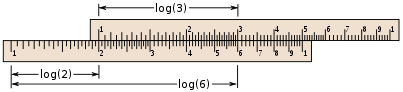
How does it work? Well… These slide rules can be used for a number of things but their most basic function is to multiply numbers indeed, and that function is based on the logb(ac) = logb(a) + logb(c). In fact, this works for any base so we can just write log(ac) = log(a) + log(c). So the numbers on the slide rule below are the a, b and c. Note that the slides start with 1 because we’re working with positive numbers only and log(1) = 0, so that corresponds with the zero point indeed. The example below is simple (2 times 3 is six, obviously): it would have been better to demonstrate 1.55×2.35 or something. But you see how it goes: we add log(2) and log(3) to get log(6) = log(2×3). For 1.55×2.35, the slider would show a position between 3.6 and 3.7. The calculator on my $30 Nokia phone gives me 3.6425. So, yes, it’s not far off. However, it’s hard to imagine that engineers and scientists actually used these slide rules over the past 300 years or so, if not longer.

403px-Slide_rule_example2_with_labels

Of course, Briggs’ tables are more accurate. It’s quite amazing really: he calculated the logarithms of 30,000 (natural) numbers to to fourteen decimal places. It’s quite instructive to check how he did that: all he did, basically, was to calculate successive square roots of 10.

Huh?

Yes. The secret behind is the basic rule of exponentiation: exponentiation is repeated multiplication, and so we can write: am+n =aman and, more importantly, am–n = ama–n = am/an. Because Briggs used the common base 10, we should write 10m–n = 10m/10n. Now Briggs had a table with the successive square roots of 10, like the one below (it’s only six significant digits behind the decimal point, not fourteen, but I just want to demonstrate the principle here), and so that’s basically what he used to calculate the logarithm (to base 10) of 30,000 numbers! Talking patience ! Can you imagine him doing that, day after day, week after week, month after month, year after year? Waw !

Capture

So how did he do it? Well… Let’s do it for x = log10(2) = log(2). So we need to find some x for which 10x = 2. From the table above, it’s obvious that log(2) cannot be 1/2 (= 0.5), because 101/2 = 3.162278, so that’s too big (bigger than 2). Hence, x = log(2) must be smaller than 0.5 = 1/2. On the other hand, we can see that x will be bigger than 1/4 = 0.25 because 101/4 = 1.778279, and so that’s less than 2.

In short, x = log(2) will be between 0.25 (= 1/4) and 0.5. What Briggs did then, is to take that 101/4 factor out using the 10m–n = 10m/10n formula indeed:

10x–0.25 = 10x/100.25 = 2/1.778279 = 1.124683

If you’re panicking already, relax. Just sit back. What we’re doing here, in this first step, is to write 2 as

2 = 10x = 10[0.25 + (x–0.25)] = 101/410x–0.25 = (1.778279)(1.124683)

[If you’re in doubt, just check using your calculator.] We now need log(10x–0.25) = log(1.124683). Now, 1.124683 is between 1.154782 and 1.074608 in the table. So we’ll use the lowest value (101/32) to take another factor out. Hence, we do another division: 1.124683/1.074608 = 1.046598. So now we have 2 = 10x = 10[1/4 + 1/32 + (x – 1/4 – 1/32)] = (1.778279)(1.074608)(1.046598).

We now need log(10x–1/4–1/32) = log(1.046598). We check the table once again, and see that 1.046598 is bigger than the value for 101/64, so now we can take that 101/64 value out by doing another division. (10x–1/4–1/32)/101/64 = 1.046598/1.036633 = 1.009613. Waw, this is getting small! However, we can still take an additional factor out because it’s larger than the 1.009035 value in the table. So we can do another division: 1.009613/1.009035 = 1.000573. So now we have 2 = 10x = 10[1/4 + 1/32 + 1/64 + 1/256 + (x – 1/4 –1/32 – 1/64 –1/256)] = 101/4101/32101/64101/25610x–1/4–1/32–1/64–1/256 = (1.778279)(1.074608)(1.036633)(1.009035)(1.000573).

Now, the last factor is outside of the range of our table: it’s too small to find a fraction. However, we had a linear approximation based on the gradient for very small fractions x: 10= 1 + 2.302585·r. So, in this case, we have 1.000573 = 1 + 2.302585·r and, hence, we can calculate r as 0.000248. [I can shown where this approximation comes from: just check my previous posts if you want to know. It’s not difficult.] So, now, we can finally write the result of our iterations:

2 = 10x ≈ 10(1/4 + 1/32 + 1/64 + 1/256 + 0.000248)

So log(2) is approximated by 0.25 + 0.03125 + 0.015625 + 0.00390625 + 0.000248 = 0.30103. Now, you can check this easily: it’s essentially correct, to an accuracy of six digits that is!

Hmm… But how did Briggs calculate these square roots of 10? Well… That was done ‘by cut and try’ apparently! Pf-ff ! Talk of patience indeed ! I think it’s amazing ! And I am sure he must have kept this table with the square roots of 10 in a very safe place ! 🙂

So, why did I show this? Well… I don’t know. Just to pay homage to those 17th century mathematicians, I guess. 🙂 But there’s another point as well. While the argument above basically demonstrated the am+n = amaformula or, to be more precise, the am–n = am/an formula, it also shows the so-called product rule for logarithms:

logb(ac) = logb(a) + logb(c)

Indeed, we wrote 2 as a product of individual factors 10and then we could see the exponents r in all of these individual factors add up to 2. However, the more formal proof is interesting, and much shorter too: 🙂

  1. Let m = loga(x) and n = loga(y)
  2. Write in exponent form: x = aand y = an
  3. Multiply x and y: xy = aman = am+n
  4. Now take loga of both sides: loga(xy) = loga(am+n) = (m+n)loga(a) = m+n = loga(x) + loga(y)

You’ll notice that we used another rule in this proof, and that’s the so-called power rule for logarithms:

loga(xn)= nloga(x)

This power rule is proved as follows:

  1. Let m = loga(x)
  2. Write in exponent form: x = am
  3. Raise both sides to the power of n: xn = (am)n
  4. Convert back to a logarithmic equation: loga(xn)= mn
  5. Substitute for m = loga(x): loga(xn)= n loga(x)

Are there any other rules?

Yes. Of course, we have the quotient rule:

loga(x/y) = loga(x) – loga(y)

The proof of this follows the proof of the product rule, and so I’ll let you work on that.

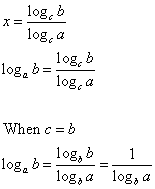
Finally, we have the ‘change-of-base’ rule, which shows us how we can easily switch from one base to another indeed:

The proof is as follows:

  1. Let x = loga b
  2. Write in exponent form: a= b
  3. Take log c of both sides and evaluate:

log c ax = log c b
x
log c a = log c b

[I copied these rules and proofs from onlinemathlearning.com, so let me acknowledge that here. :-)]

Is that it? Well… Yes. Or no. Let me add a few more lines on these logarithmic scales that you often encounter in various graphs. It the same scale as those logarithmic scales used for that slide that we showed above but it covers several orders of magnitude, all equally spaced: 1, 10, 100, 1000, etcetera, instead of 0, 1, 2, 3, etcetera. So each unit increase on the scale corresponds to a unit increase of the exponent for a given base (base 10 in this case): 101, 102, 103, etcetera. The illustration below (which I took from Wikipedia) compares logarithmic scales to linear ones, for one or both axes.

Logarithmic_Scales

So, on a logarithmic scale, the distance from 1 to 100 is the same as the distance from 10 to 1000, or the distance from 0.1 to 10, or the distance between any point that’s 100 (= 102) times another point. This is easily explained by the product rule, or the quotient rule rather:

log(10) – log(0.1) = log(101/1–1) = log(102) = 2

= log(1000) – log(10) = log(103/11) = log(102/) = 2

= log(100) – log(1) = log(102/100) = log(102) = 2

And, of course, we could say the same for the distance between 1 and 1000, and 0.1 and 100. The distance on the scale is 3 units here, while the point is 1000 = 10the other point.

Why would we use logarithmic scales? Well… Large quantities are often better expressed like that. For example, the Richter scale used to measure the magnitude of an earthquake is just a base–10 logarithmic scale. With magnitude, we mean the amplitude of the seismic waves here. So an earthquake that registers 5.0 units on the Richter scale has a ‘shaking amplitude’ that is 10 times greater than that of an earthquake that registers 4.0. Both are fairly light earthquakes, however: magnitude 7, 8 or 9 are the big killers. Note that, theoretically, we could have earthquakes of a magnitude higher than 10 on the Richter scale: scientists think that the asteroid that created the Chicxulub crater created a cataclysm that would have measured 13 on Richter’s scale, and they associate it with the extinction of the dinosaurs.

The decibel, measuring the level of sound, is another logarithmic unit, so the power associated with 40 decibel is not two times but one hundred times that of 20 decibel!

Now that we’re talking sound, it seems that logarithmic scales are more ‘natural’ when it comes to human perception in general, but I’ll let you have fun googling some more stuff on that! 🙂

Real exponentials and double roots: a post for my kids

Pre-scriptum (dated 26 June 2020): This post did not suffer much – if at all – from the attack by the dark force—which is good because I still like it. Enjoy !

Original post:

There is one loose end related to exponentials that I want to tie up here. It’s the issue of multiple roots (or multiple-valuedness as it’s called in the context of inverse functions).

Introduction

You’ll remember that, for integer exponents n, we had two inverse operations for an:

  1. The logarithm: the instruction here is to find n (i.e. the exponent) given the value an and given a (i.e. the base).
  2. The ‘nth root’ function: the instruction here is find a (i.e. the base) given the value an and given n (i.e. the exponent).

We have two inverse operations because the exponentiation operation is not commutative: while a + b = b + a (and, therefore, a×b = b×a, so multiplication is commutative as well), an is surely not the same as na (except if a = n, of course).

Having two inverse operations is somewhat confusing, of course. However, when we expand the domain of the exponential function to also include rational exponents, the ‘nth root’ function becomes an exponential function itself: a1/n. That’s nice, because it tidies things up. We only have one inverse operation now: the logarithm.

Now, my kids understand exponentials, but they find logarithms weird. There are two reasons for that. The most important one is that we don’t learn about the logarithm function when we learn about the exponential function. We only learn logarithms later – much later. Therefore, we are not as familiar with them as we should be. There is no good reason for that but that’s what it is. [I guess I am like Euler here: I’d suggest logarithms and complex numbers should be taught earlier in life. Then we would have less trouble understanding them.]

The second one is notation, I think. Indeed, x = loga(y) looks much more frightening than y = abecause… Well… Too many letters. It would be more logical to apply the same economy of symbols. We could just write x = ay instead of loga(y), for example, using a subscript in front of the variable–as opposed to a superscript behind the variable, as we do for the exponential function. Or, else, we could be equally verbose for the exponential function and write y = expa(x) instead of y = ax. In fact, you’ll find such more explicit expressions in spreadsheets and other software, because these don’t take subscripts or superscripts.

In any case, that’s not the point here. I will come back to the logarithmic function later. The point that I want to discuss here is that, while we sort of merged our ‘nth root function’ with our exponential function as we allowed for rational exponents as well (as opposed to integers only), we’re actually still taking roots, so to say, and then we note another problem: the square root function yields not one but two numbers when the base (a) is real and positive: ± a1/2.

In fact, that’s a more general problem.

Odd and even rational exponents 

You’ll remember the following rules for exponentiation:

1. For a positive real number a, we have always have two real nth roots when n is even: a1/n: ± a1/n. That’s obviously a consequence of having two real square roots ± a1/2, because the definition of even parity is that n can be written as n = 2k with k any integer, i.e. k ∈ Z (so k can be negative). Hence, a1/n can then be written as a1/2k = a1/2k = (a1/k)1/2. Hence, whatever the value of a1/k (if k is even, then we have two kth roots once again, but that doesn’t matter), we will have two real roots: plus (a1/k)1/2 and minus (a1/k)1/2

2. If n is uneven (or odd I should say), so n ∈ {2k+1: k ∈ Z}, we have only one real root a1/2k+1: that root is positive when a is positive and negative when a is negative.

3. For the sake of completeness, let me add the third case: a is negative and n is even. We know there’s no real nth root of a in that case. That’s why mathematicians invented i: we’ll associate an even root of a negative real number with two complex-valued roots: a1/n: ± ia1/n.

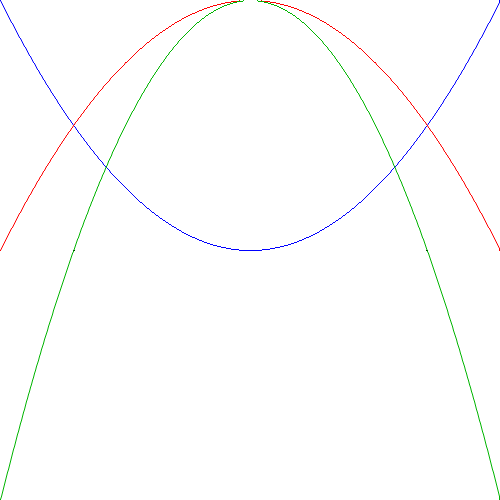
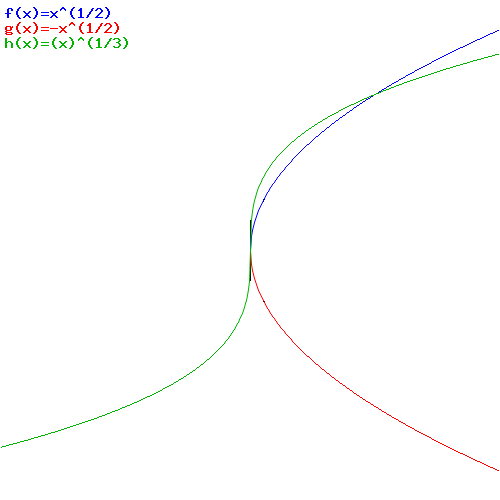
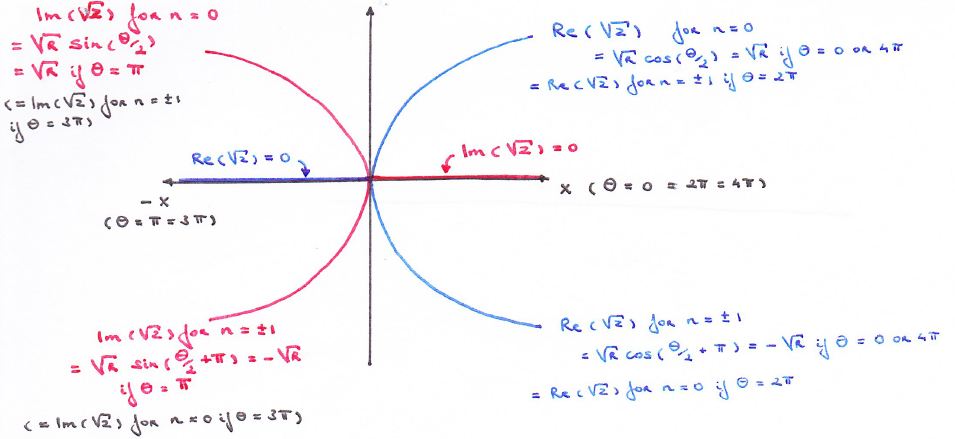
The first and second case are illustrated below for n = 2 and n = 3 respectively. The complex roots of the third case cannot be visualized because y is a real axis. Of course, we could imagine the complex-roots ± ia1/n if we would flip or mirror the blue and red graph (i.e. the graphs for n = 2) along the vertical axis and re-label that axis as the iy-axis, i.e. the imaginary axis. But so I’ll leave that to your imagination indeed. 

graph

How does this parity business turn out for rational exponents?

If r is a rational number r = m/n, we’ll have to express it as an irreducible fraction first, so the numerator m and denominator n have no other common divisors than 1, or –1 when considering negative numbers. But let’s look at positive numbers first. If we write r as an irreducible fraction m/n, then m and n cannot both be even. Why not? Because m and n can then both be divided by 2 and m/n is not an irreducible fraction in that case. Let’s assume m is even. Hence, n must be odd in that case. We can then write a2k/n as (ak/n)2. This number will always be positive, because we are squaring something. So it doesn’t matter if ak/n has one or two roots: we’ll square them and so the result will always be positive.

Now let’s assume the second possibility: m is odd. We can then write am/n as (a1/n)m. So now it will depend on whether or not n is even. If n is even, we have two real roots, if n is uneven, then we have only one. Let’s work a few examples:

  • 82/3 = (81/3)= 2= 4
  • 43/2 = (41/2)= (±2)=±2=±23 = ±8
  • 161/4 = (161/2)1/2 = (±4)1/2 =±41/2 =±2 = ±2
  • (–8)5/3 = (–81/3)= (–2)= 32

So we have two roots if m is odd and n is even, and only one root in all other cases. However, we said that m and n cannot both be even, hence, if n is even, m must be odd. In short, we can say that a rational exponent m/n is even (i.e. there will be two roots), if n is even. Does that work for complex roots as well? Let’s work that out with an example:

(–4)3/2 = (–41/2)= (±2i)=(±2)3i=±8i

So, yes! It works for complex roots as well. 🙂

OK. But let’s ask the obvious question now: where are these even numbers on the real line?

Well… They are everywhere: we can start from 1/2 and then change the numerator: 3/2, 5/2, etcetera. It’s all fine, as long as we use an odd number. However, we can also go down and change the denominator: 1/4, 1/6, 1/8 etcetera. And then we can, of course, take odd multiples of these fractions once again, such as 1025/1024 = 1.0009765625, for example, or on the other side, 1023/1024 = 0.9990234375. So we have two even numbers here right next to the odd number 1. We may increase the precision: we could take ± 1/3588 for example. 🙂

Of course, you may have noticed something here. The first thing, of course, is that we’ve defined these two even numbers 1.0009765625 and 0.9990234375 with a precision of 10 digits behind the decimal point, i.e. 1/1024 = 1/210 = 0.0009765625. The second point to note is that the last digit of these two rational coefficients, when expressed as a decimal, was 5. Now, you may think that should always be the case because of that 1/2 factor. But it’s not true: 1/6, for example, is a rational number that, written in decimal form, will yield 0.166666… This is an expression with a recurring decimal. And 1/10, of course, just yields 0.1. So there’s no easy rule here. You need to look at the fraction itself, and rational numbers are either as a finite decimal or an infinite repeating decimal. Of course, there are rules for that, but this is not a post on number theory, so I won’t write anything more on this: you can Google some more stuff yourself if you’re interested in this.

Irrational exponents

How does the business of parity work for irrational exponents? The gist of the rather long story above can be summarized easily. We can write am/n as am/n = am·(1/n) =(a1/n)m = a1/n·a1/n·a1/n·a1/n =·… (m times) and so whether or not we have multiple roots (two instead of one) depends on whether or not n is even. Indeed, remember – once again – that exponentiation is repeated multiplication, and so for the sign of the result, what matters is whether or not the number of times that we do that multiplication is even or odd, not only for integer but for rational exponents as well.

For irrational exponents, we also have repeated multiplication, but now we have an infinite expression, not a finite one:

a= ar(1/Δ + 1/Δ + 1/Δ + 1/Δ +…) = ar/Δ·ar/Δ·ar/Δ·ar/Δ

I explained this expression in my previous post: 1/Δ is an infinitesimally small fraction. In fact, I calculated rational powers of using the fraction 1/Δ = 1/1024 = 1/210. I used that fraction because I had started backwards, taking successive square roots of e, so e1/2, and then  e1/4, e1/8e1/16, etcetera.

However, as I mentioned when I started doing that, there was no compelling reason to cut things up by dividing them in 2. We could use 1/3 as the fraction to start with and, then, of course, or fraction 1/Δ would have been equal to 1/310 = 1/59049, so we have an odd number in the denominator here. So that’s one problem: we cannot say if Δ is even or odd. And the the second problem, of course, is that it’s an infinite expression and, hence, we cannot say if we multiplied 1/Δ an even or an odd number of times.

That leads to the third problem: we cannot say if r itself is even or uneven, which is basically what we were looking at: can we define irrational exponents as even or odd?

In short, the answer is no. In practice, that means that we will associate awith one ‘rth root’ only.

Hmm… That obviously makes a lot of sense but how do we ‘justify’ it from a more formal point of view? Where do these negative roots (for even powers) go? I am not sure. I guess there must be some more formal argument but I’ll leave that to you to look it up. I am fairly happy with what Wikipedia writes on that:

“[Real] Powers of a positive real number are always positive real numbers. […]  If the definition of exponentiation of real numbers is extended to allow negative results then the result is no longer well behaved.”

In fact, the article actually does give a somewhat more formal argument, as it writes:

  • Neither the logarithm method nor the rational exponent method can be used to define br as a real number for a negative real number b and an arbitrary real number r. Indeed, eris positive for every real number r, so ln(b) is not defined as a real number for b ≤ 0.
  • As for the rational exponent method, that cannot be used for negative values of b because it relies on continuity. The function f(r) = br has a unique continuous extension from the rational numbers to the real numbers for each b > 0. But when b < 0, the function f is not even continuous on the set of rational numbers r for which it is defined.

I am not quite sure I fully understand the last line, but I guess this refers to what I pointed out above: all these even and odd numbers that are so close to each other. When we go from rational to irrational exponents, we can no longer define odd or even.

The bottom line

The bottom line is that, in practice, we will only work with positive real bases. Hence, if b is negative, then we will define br as –(–b)r. Huh?

Yes. Think about it. If b is negative, we’ll just multiply it with –1 to ensure that the base is a positive real number. And then we just put a minus in front to get a graph such as, for example, that x1/3 function for the negative side of the x-axis as well.

You should also note that most applications, like the one I use to draw simple graphs like the ones above (rechneronline.de/function-graphs) are not capable of showing you both roots. They do check whether the exponent is even or odd though, because it plots the function x1/3 on both sides of the zero point, and the  x1/2 graph on the positive side only: it’s just not capable to associate more than one y value with one x value indeed. [In case you’re curious to see what it does with an irrational exponent, go and check it yourself: you can put in x^pi or x^e. Will it give function values for negative values of x as well? What’s your guess? :-)]

You’ll wonder why I am emphasizing this point. Well… I just wanted to note that we should be aware of the fact that, as we go from rational to irrational exponents, we sort of deliberately ‘forget’ about the second (negative) root. The point to note is that the issue of multiple-valued functions – such as discussed in the context of, for example, Riemann surfaces – is not necessarily related to complex-valued functions. We have it here (double roots), and we also have it, in general, for periodic functions.

But that’s for a next post. And there we’ll use our ‘natural’ exponential ex, and its inverse function, ln(x), an awful lot. So I’ll just conclude here with their graphs, noting, as Wikipedia does, that, nowadays, the term ‘exponential function’ is almost exclusively used as a shortcut for describing the natural exponential function ex. But, to my kids, I say: it’s good that you know where it comes from. 🙂

graph (6)

Post scriptum:

When thinking about such minor things, it’s always to good to think about why we are manipulating all these symbols. Exponentiation is repeated multiplication. What does it mean to multiply something with a negative number? A minus sign is an instruction to reverse direction, to turn around, 180 degrees. So we multiply the magnitudes of both numbers a and b, but we change the direction: if we’re walking down the positive real axis, then now we’re walking down the negative axis.

So repeated multiplication with a negative real number means we’re switching back and forth, wildly jumping from the positive to the negative side of the zero point and then back again. You’ll admit you would appreciate being told in advance how many times we need to do the multiplication if the multiplier is negative: if n is even, then we’ll end up going in the same direction:  (–1)= 1. No sign reversal. If n is uneven, then we know that, besides the ‘booster’ effect (i.e. the exponentiation operation), we’re expected to speed in the opposite direction: (–1)= –1.

Hence, if b would happen to be a negative real number, then defining br as –(–b)r, or assuming that, in general, our base will be a positive real number makes sense. Of course, the math has to keep track of the theoretical possibility that, if the exponent would happen to be even, b might be a negative number, but you can see it’s more of a theoretical possibility indeed. Not something we’d associate with something happening in real life.

In that sense, I should note that multiplication with a complex multiplier is much more ‘real-life’, so to say. Multiplying something with a complex number does the same to the magnitude of both numbers as real multiplication: it multiplies the magnitudes, thereby changing the scale. So the product of a vector that’s 2 units long and a vector that’s 3 units long will still be 6 units long. However, complex numbers also allow for a more gradual change of direction. Instead of just a gear to move forward and backward, we also get a steering wheel so to say: multiplying two complex numbers also adds their angles (as measured from some kind of zero direction obviously), besides multiplying their magnitudes. For example, suppose that the zero direction is east, and we have a vector pointing east indeed (that means its imaginary part is zero) that we need to multiply with a vector pointing north (so that’s a vector with a zero real part, along the imaginary axis), then the final vector will be pointing north.

However, with that subtlety comes complexity as well. With real numbers, you can go in the same direction by reversing direction two times, and so that’s why we have two 2nd roots (i.e. two square roots) of 1: (a) +1, so then we just stay where we are, and (b) –1, so then we rotate two times a full 180 degrees around the zero point: indeed, (–1)(–1) corresponds to two successive rotations by 180 degrees (or π in radians)–clockwise or counterclockwise, it doesn’t matter: one full loop around the zero point will get us back to square one, or point 1, I should say. 🙂

imaginary_rotation

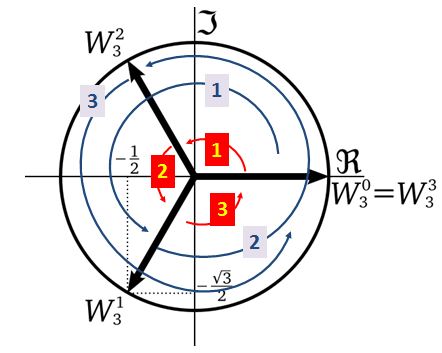
With complex numbers, it all depends. The 3rd root (i.e. the cube root) of 1 was only 1 in the real space but, in the complex space, we have three 3 cube roots of unity. The first one (W= W3) is the root we’re used to: unity itself, so the angle here is zero, i.e. straight ahead. In fact, with 1, we just stay where we are: 1×1×1 = 1= 1 indeed. But that’s not the only way. The illustration below shows two other ways to end up where we are (i.e. at point 1):

  • The second cube root is W2: 120 degrees. You can see we get back at 1 by making three successive turns of 120 degrees indeed, so that’s one full loop around the or<igin. Using complex numbers (in polar notation), we write e2π/3×e2π/3×e2π/3 = e6π/3 = e2π e= 1.
  • The third cube root is W1: that’s 240 degrees ! Indeed, here we get back at square one by making three successive turns of 4π/3 radians, i.e .by making two loops, in total, around the origin: e4π/3×e4π/3×e4π/3 = e12π/3 = e4π e= 1.

In short, we gain flexibility (of course, we have four 4th roots (with which we make 0, 1, 2 and 3 loops around the origin respectively), 5th roots, and so on), and the great Leonhard Euler was obviously fully right: complex numbers are more ‘natural’ numbers as they allow us to model real-life situations much better.

However, if you think that double roots are a problem… Well… Think again ! With complex numbers, the problem of multiple-valuedness is much more ‘real’, I’d say. 🙂

Capture

P.S: As mentioned in my previous post, I talk about that problem of multiple-valuedness when talking about Riemann surfaces in my October-November 2013 posts, so I won’t repeat what I wrote there. It’s about time I get back to both Feynman as well Penrose. 🙂

Just one last (philosophical) question to test your understanding. Negative real numbers have no real square root. That includes –1 obviously. Why is that? Why do we have two square real roots for +1 and no (none!) (real) square roots for –1?

[…] No? Come on!

[…] OK. Let me tell you: it’s all a question of definition. What’s implicit here is that we have only one real direction: from zero to infinity along the positive axis, and then –1 is nothing but a reversal of direction. So it’s an operation really, not a ‘real’ number. In a philosophical sense, of course: negative numbers don’t exist, so to say! Indeed, ask yourself: what is a negative number? It’s an operation: we subtract things when we use the minus sign, and we reverse direction when multiplying numbers with –1. So, if we multiply something with –1 two times in succession, we are back where we are.

Of course, we could say that the negative direction is the ‘real’ direction and, hence, that it’s the positive numbers that don’t ‘really’ exist. Indeed, math doesn’t care about what we say, so let’s say that the negative axis is the ‘real’ one, in a physical sense. What happens then? Well… Let’s see… Let’s do what we did before. We still define –1 as a reversal of direction, or a rotation by 180 degrees and, hence, doing that two times should bring us back where we want to be, so that’s –1 now. OK. So we have (–1)(–1)(–1) = (–1). But so that means that (–1)(–1) = 1, and… How can we write something like that for –1? What number a gives us the result that a×a = –1. Hmm… Only this imaginary number: i×i = i2 = –1. So, no matter how hard you try: the way we use symbols is pretty consequent, and so you will find that (–1)(–1) = 1×1 = 1 (so we have two square roots of 1), but we will not find that 1×1 = –1. If you would want to do that, you’d have to define +1 as a reversal of direction, so that basically means that the + sign would take the function of the – sign. Huh?

🙂 You must think I’ve gone crazy. I don’t think so. The idea I want to convey here is that, no matter how abstract math may seem to be – when everything is said and done – it’s intimately connected to our most basic notions of space, and our motion in that space. We go from here to there, or backwards, we change direction, we count things, we measure lengths or distances,… All that math does is to capture that in a non-ambiguous and consistent way. That also results in terse ‘truths’ such as: 1 has two real square roots, +1 and –1, but the square roots of –1 are only imaginary: ± i.

However, that terse statement hides another fun ‘truth’: +i and −i are as real as –1. Indeed, they are a rotation by 90 degrees, counterclockwise (+i) or clockwise (−i), as opposed to, for example, a rotation by 180 degrees (–1), or a full loop (1). 🙂

Euler’s formula revisited

Pre-scriptum (dated 26 June 2020): This post – part of a series of rather simple posts on elementary math and physics – did not suffer much from the attack by the dark force—which is good because I still like it. Enjoy !

Original post:

This post intends to take some of the magic out of Euler’s formula. In fact, I started doing that in my previous post but I think that, in this post, I’ve done a better job at organizing the chain of thought. [Just to make sure: with ‘Euler’s formula’, I mean ei= cos(x) + isin(x). Euler produced a lot of formulas, indeed, but this one is, for math, what E = mcis for physics. :-)]

The grand idea is to start with an initial linear approximation for the value of the complex exponential eis near s = 0 (to be precise, we’ll use the eiε = 1 + iε formula) and then show how the ‘magic’ of i – through the i= –1 factor – gives us the sine and cosine functions. What we are going to do, basically, is to construct the sine and cosine functions algebraically.

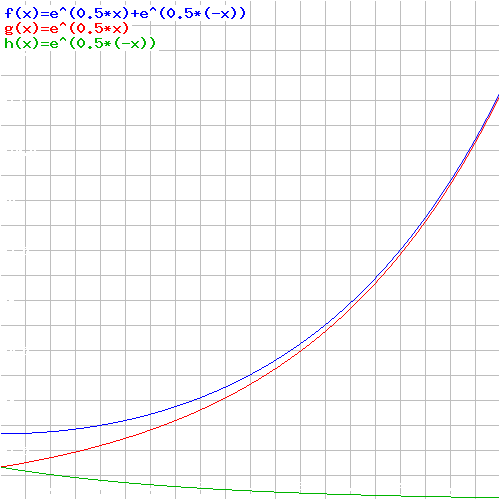
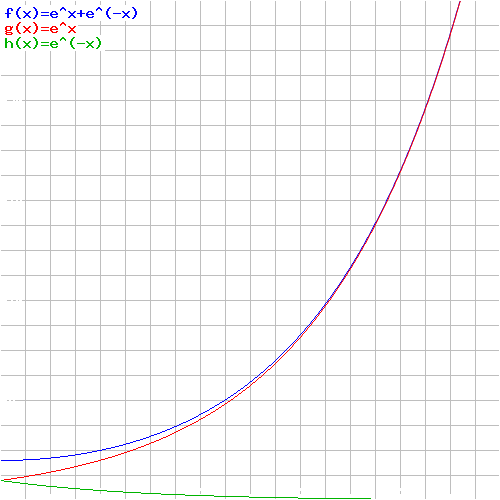
Let us, as a starting point – just to get us focused – graph (i) the real exponential function ex, i.e. the blue graph, and (ii) the real and imaginary part of the complex exponential function ei= cos(x) + isin(x), i.e. the red and green graph—the cosine and sine function.   graph (5)From these graphs, it’s clear that ex and eiare two very different beasts.

1. eis just a real-valued function of x, so it ‘maps’ the real number x to some other real number y = ex. That y value ‘rockets’ away, thereby demonstrating the power of exponential growth. There’s nothing really ‘special’ about ex. Indeed, writing einstead of 10obviously looks better when you’re doing a blog on math or physics but, frankly, there’s no real reason to use that strange number e ≈ 2.718 when all you need is just a standard real exponential. In fact, if you’re a high school student and you want to attract attention with some paper involving something that grows or shrinks, I’d recommend the use of πx. 🙂

2. eiis something that’s very different. It’s a complex-valued function of x and it’s not about exponential growth (though it obviously is about exponentiation, i.e. repeated multiplication): y = eidoes not ‘explode’. On the contrary: y is just a periodic ‘thing’ with two components: a sine and a cosine. [Note that we could also change the base, to 10, for example: then we write 10ix. We’d also get something periodic, but let’s not get lost before we even start.]

Two different beasts, indeed. How can the addition of one tiny symbol – the little i in ei– can make such big difference?

The two beasts have one thing in common: the value of the function near x = 0 can be approximated by the same linear formula:

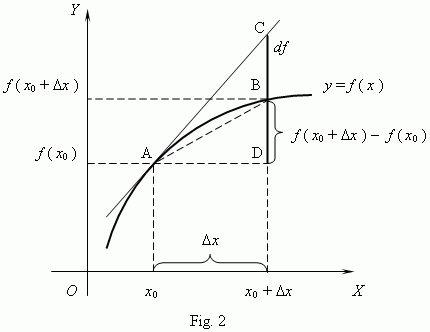
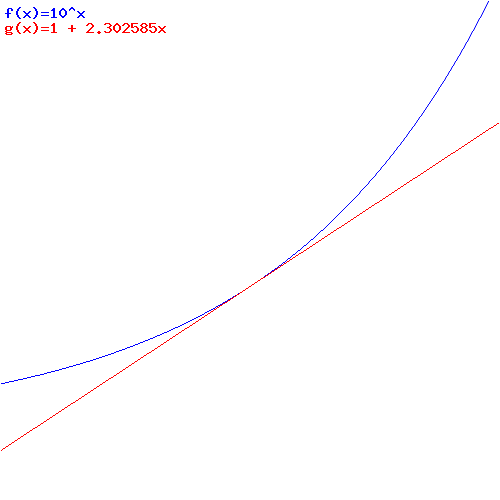
FormulaIn case you wonder where this comes from, it’s basically the definition of the derivative of a function, as illustrated below. izvodThis is nothing special. It’s a so-called first-order approximation of a function. The point to note is that we have a similar-looking formula for the complex-valued eifunction. Indeed, its derivative is d(eix)/dx = ieiand when we evaluate that derivative at x = 0, then we get ie= i. So… Yes, the grand result is that we can effectively write:

eiε ≈ 1 + iε for small ε

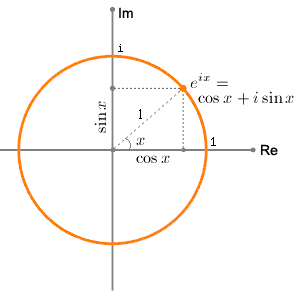
Of course, 1 + iε is also a different ‘beast’ than 1 +  ε. Indeed, 1 + ε is just a continuation of our usual walk along the real axis, but 1 +  iε points in a different direction (see below). This post will show you where it’s headed.

Capture

Let’s first work with eagain, and think about a value for ε. We could take any value, of course, like 0.1 or some fraction 1/n. We’ll use a fraction—for reasons that will become clear in a moment. So the question now is: what value should we use for n in that 1/n fraction? Well… Because we are going to use this approximation as the initial value in a series of calculations—be patient: I’ll explain in a moment—we’d like to have a sufficiently small fraction, so our subsequent calculations based on that initial value are not too far off. But what’s sufficiently small? Is it 1/10, or 1/100,000, or 1/10100? What gives us ‘good enough’ results? In fact, how do we define ‘good enough’?

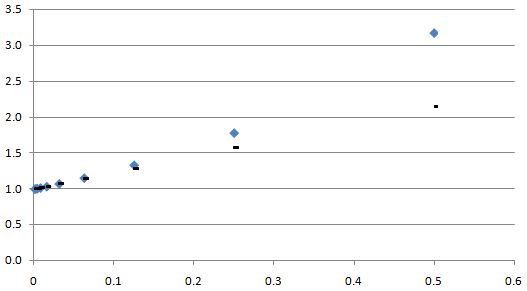
Good question! In order to try to define what’s ‘good enough’, I’ll turn the whole thing on its head. In the table below, I calculate backwards from e= e by taking successive square roots of eHuh? What? Patience, please! Just go along with me for a while. First, I calculate e1/2, so our fraction ε, which I’ll just write as  x, is equal to 1/2 here, so the approximation for e1/2 is 1 + 1/2 = 1.5. That’s off. How much? Well… The actual value of e1/2 is about 1.648721 (see the table below (or use a calculator or spreadsheet yourself): note that, because I copied the table from Excel, ex is shown as e^x). Now, 1.648721 is 1.5 + 0.148721, so our approximation (1.5) is about 9% off (as compared to the actual value). Not all that much, but let’s see how we can improve. Let’s take the square root once again: (e1/2)1/2 e1/4, so x = 1/4. And then I do that again, so I get e1/8, and so on and so on. All the way down to x = 1/1024 = 1/210, so that’s ten iterations. Our approximation 1 + x (see the fifth/last column in the table below is then equal to 1 + 1/1024 = 1 + 0.0009765625, which we rounded to 1.000977 in the table.

e calculation

The actual value of e1/1024 is also about 1.000977, as you can see in the third column of the table. Not exactly, of course, but… Well… The accuracy of our approximation here is six digits behind the decimal point, so that’s equivalent to one part in a millionth. That’s not bad, but is it ‘good enough’? Hmm… Let’s think about it, but let’s first calculate some other things. The fourth column in the table above calculates the slope of that AB line in the illustration above: its value converges to one, as we would expect, because that’s the slope of the tangent line at x = 0. [So that’s the value of the derivative of eat x = 0. Just check it: dex/dx = ex, obviously, and e= 1.] Note that our 1 + x approximation also converges to 1—as it should!

So… Well… Let’s now just assume we’re happy with with that approximation that’s accurate to one part in a million, so let’s just continue to work with this fraction 1/1024 for x. Hence, we will write that e1/1024 ≈ 1 + 1/1024 and now we will use that value also for the complex exponentialHuh? What? Why? Just hang in here for a while. Be patient. 🙂 So we’ll just add the again and, using that eiε ≈ 1 + iε expression, we write:

ei/1024 ≈ 1 + i/1024

It’s quite obvious that 1 + i/1024 is a complex number: its real part is 1, and its imaginary part is 1/1024 = 0.0009765625.

Let’s now work our way up again by using that complex number 1 + i/1024 = 1 + i·0.0009765625 to calculate ei/512, ei/256, ei/128 etcetera. All the way back up to x = 1, i.e. ei. I’ll just use a different symbol for x: in the table below, I’ll substitute x for s because I’ll refer to the real part of our complex numbers as ‘x’ from time to time (even if I write a and b in the table below), and so I can’t use the symbol x to denote the fraction. [I could have started with s, but then… Well… Real numbers are usually denoted by x, and so it was easier to start that way.] In any case…

The thing to note is how I calculate those values ei/512, ei/256, ei/128 etcetera. I am doing it by squaring, i.e. I just multiply the (complex) number by itself. To be very explicit, note that ei/512 = (ei/1024)= ei·2/1024 = (ei/1024)(ei/1024). So all that I am doing in the table below is multiply the complex number that I have with itself, and then I have a new result, and then I square that once again, and then again, and again, and again etcetera. In other words, when going back up, I am just taking the square of a (complex) number. Of course, you know how to multiply a number with itself but, because we’re talking complex numbers here, we should actually write it out:

(a + i·b)= a– b2 + i·2ab = a– b2 + 2abi

[It would be good to always separate the imaginary unit from real numbers like a, b, or ab, but then I am lazy and so I hope you’ll always recognize that is the imaginary unit.] In any case… When we’re going back up (by squaring), the real part of the next number (i.e. the ‘x’ in x + iy) is a– b2 and the complex part (the ‘y’) is 2abi. So that’s what’s shown below—in the fourth and fifth column, that is.

Capture

Look at what happens. The x goes to zero and then becomes negative, and the y increases to one. Now, we went down from e1/n = e1 = e1/1 to e1/n = e1/1024, but we could have started with e2, or e4/n, or whatever. Hence, I should actually continue the calculations above so you can see what happens when s goes to 2, and then to 3, and then to 4, and so on and so on. What you’d see is that the value of the real and imaginary part of this complex exponential goes up and down between –1 and +1. You’d see both are periodic functions, like the sine and cosine functions, which I added in the last two columns of the table above. Now compare those a and b values (i.e. the second and third column) with the cosine and sine values (i.e. the last two columns). […] Do you see it? Do you see how close they are? Only a few parts in a million, indeed.

You need to let this sink it for a while. And I’d recommend you make a spreadsheet yourself, so you really ‘get’ what’s going on here. It’s all there is to the so-called ‘magic’ of Euler’s formula. That simple (a + ib)= a– b2 + 2abformula shows us why (and how) the real and imaginary part oscillate between –1 and +1, just like the cosine and sine function. In fact, the values are so close that it’s easy to understand what follows. They are the same—in the limit, of course

Indeed, these values a– b2 and 2ab, i.e. the real and imaginary part of the next complex number in our series, are what Feynman refers to as the algebraic cosine and sine functions, because we calculate them as (a + ib)= a– b2 + 2abi. These algebraic cosine and sine values are close to the real cosine and sine values, especially for small fractions s. Of course, there is a discrepancy becomes – when everything is said and done – we do carry a little error with us from the start, because we stopped at 1/n = 1/1024, before going back up.

There’s actually a much more obvious way to appreciate the error: we know that e1/1024 should be some point on the unit circle itself. Therefore, we should not equate a with 1 if we have some value b > 0. Or – what amounts to saying the same – if if b is slightly bigger than 0, then a should be slightly smaller than 1. So the eiε ≈ 1 + iε is an approximation only. It cannot be exact for positive values of ε. It’s only exact when ε = 0.

So we’re off—but not far off as you can see. In addition, you should note that the error becomes bigger and bigger for larger s. For example, in the line for s = 1, we calculated the values of the algebraic cosine and sine for s = 2 (see the a^2 – b^2 and 2ab column) as –0.416553 and 0.910186, but the actual values are cos(2) = –0.416146 and sin(2) = 0.909297, which shows our algebraic cosine and sine function is gradually losing accuracy indeed (we’re off like one part in a thousand here, instead of one part in a million). That’s what we’d expect, of course, as we’re multiplying the errors as we move ‘back up’.

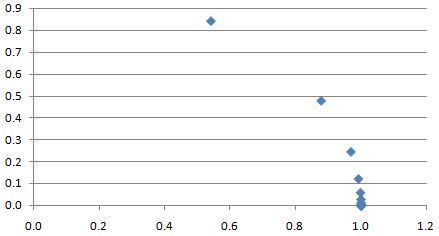
The graph below plots the values of the table.

Capture

This graph also shows that, as we’re doubling our ratio r all the time, the data points are being spaced out more and more. This ‘spacing out’ gets a lot worse when further increasing s: from s = 1 (that’s the ‘highest’ point in the graph above), we’d go to s = 2, and then to s = 4, s = 8, etcetera. Now, these values are not shown above but you can imagine where they are: for s = 2, we’re somewhere in the second quadrant, for s = 4, we’re in the third, etcetera. So that does not make for a smooth graph. We need points in-between. So let’s ‘fix’ this problem by taking just one value for s out of the table (s = 1/4, for example) and we’ll continue to use that value as a multiplier.

That’s what’s done in the table below. It looks somewhat daunting at first but it’s simple really. First, we multiply the value we got for e1/4 with itself once again, so that gives us a real and an imaginary part for e1/8 (we had that already in the table above and you can check: we get the same here). We then take that value (i.e. e1/8) not to multiply it with itself but with e1/4 once again. Of course, because the complex numbers are not the same, we cannot use the (a + ib)= a– b2 + 2abi rule any more. We must now use the more general rule for multiplying different complex numbers: (a + ib)(c + id) = (ac – bd) + i(ad + bc). So that’s why I have an a, b, c and d column in this table: a and b are the components of the first number, and c and d of the second (i.e. e1/4 = 0.969031 + 0.247434i)

e calculation 4

In the table above, I let s range from zero (0) to seven (7) in steps of 0.25 (= 1/4). Once again, I’ve added the real cosine and sine values for these angles (they are, of course, expressed in radians), because that’s what s is here: an angle, aka as the phase of the complex number. So you can compare.

The table confirms, once again, that we’re slowly losing accuracy (we’re now 3 to 4 parts in a thousand off), but it is very slowly only indeed: we’d need to do many ‘loops’ around the center before we could actually see the difference on a graph. Hey! Let’s do a graph. [Excel is such a great tool, isn’t it?] Here we are: the thick black line describing a circle on the graph below connects the actual cosine and sine values associated with an angle of 1/4, 1/2, 3/8 etcetera, all the way up to 7 (7 is about 2.3π, so we’re some 40 degrees past our original point after the ‘loop’), while the little ‘+‘ marks are the data points for the algebraic cosine and sine. They match perfectly because our eye cannot see the little discrepancy.

graph with sine and cosine

So… That’s it. End of story.

What?

Yes. That’s it. End of story. I’ve done what I promised to do. I constructed the sine and cosine functions algebraically. No compass. 🙂 Just plain arithmetic, including one extra rule only: i= –1. That’s it.

So I hope I succeeded. The goal was to take some of the magic out of Euler’s formula by showing how that eiε = 1 + iε approximation and the definition of i= –1 gives us the cosine and sine function itself as we move around the unit circle starting from the unity point on the real axis, as shown in that little graph:

Capture

Of course, the ε we were working with was much smaller than the size of the arrow suggests (it was equal to 1/1024 ≈ 0.000977 to be precise) but that’s just to show how differentials work. 🙂 Pretty good, isn’t it? 🙂

Post scriptum:

I. If anything, all this post did was to demonstrate multiplication of complex numbers. Indeed, when everything is said and done, exponentiation is repeated multiplication–both for real as well as for complex exponents. The only difference is–well… Complex exponents give us these oscillating things, because a complex exponent effectively throws a sine and cosine function in.

Now, we can do all kinds of things with that. In this post, we constructed a circle without a compass. Now, that’s not as good as squaring the circle 🙂 but, still, it would have awed Pythagoras. Below, I construct a spiral doing the same kind of math: I start off with a complex number again but now it’s somewhat more off the unit circle (1 + 0.247434i). In fact, I took the same sine value as the one we had for ei/4 but I replaced the cosine value (0.969031) with 1 exactly). In other words, my ε is a lot bigger here.

Then I multiply that complex number 1 + 0.247434with itself to get the next number (0.938776 + 0.494868i), and then I multiply that result once again with my first number (1 + 0.247434i), just like we did when we were constructing the circle. And then it goes on and on and on. So the only difference is the initial value: that’s a bit more off the unit circle. [When we constructed the circle, our initial value was also a bit off but much less. Here we go for a much larger difference.]

Capture

graph

So you can see what happens: multiplying complex numbers amounts to adding angles and multiplying magnitudes: αeiβ·γeiδ = αγei(β+δ) =|αeiβ|·|γeiδ|ei(β+δ)| = |α||γ|ei(β+δ). So, because we started off with a complex number with magnitude slightly bigger than 1 (you calculate it using Pythagoras’ theorem: it’s 1.03, more or less, which is 3% off, as opposed less than one part in a million for the 1 + 0.000977i number), the next point is, of course, slightly off the unit circle too, and some more than 3% actually. And so that goes on and on and on and the ‘some more’ becomes bigger and bigger in the process.

Constructing a graph like this one is like doing the kind of silly stuff I did when programming little games with our Commodore 64 in the 1980s, so I shouldn’t dwell too much on this. In fact, now that I think of it: I should have started near –i, then my spiral would have resembled an e. 🙂 And, yes – for family reading this – this is also like the favorite hobby of our dad: calculating a better value for π. 🙂

However… The only thing I should note, perhaps, is that this kind of iterative process resembles – to some extent – the kind of process that iterative function systems (IFSs) use to create fractals. So… Well… It’s just nice, I guess. [OK. That’s just an excuse. Sorry.]

II. The other thing that I demonstrated in this post may seem to be trivial but I’ll emphasize it here because it helped me (not sure about you though) to understand the essence of real exponentials much better than I did before. So, what is it?

Well… It’s that rather remarkable fact that calculating (real) irrational powers amounts to doing some infinite iteration. What do I mean with that?

Well… Remember that we kept on taking the square root of e, so we calculated e1/2, and then (e1/2)1/2 = e1/4, and then (e1/4)1/2 e1/8, and then we went on: e1/16e1/32e1/64, all the way down to e1/1024, where we stopped. That was 10 iterations only. However, it was clear we could go on and on and on, to find that limit we know so well: e1/Δ tends to 1 (not to zero (0), and not to either!) for Δ → ∞.

Now, e = e1 is an exponential itself and so we can switch to another base, base-10 for example, using the general a= (bk)= bks = bt formula, with k = logb(a). Let’s do base-10: we get e1 = [10log10(e)]=  100.434294…etcetera. Now, because is an irrational number, log10(e) is irrational too, so we indeed have an infinite number of decimals behind the decimal point in 0.434294…etcetera. In fact, e is not only irrational but transcendental: we can’t calculate it algebraically, i.e. as the root of some polynomial with rational coefficients. Most irrational numbers are like that, by the way, so don’t think that being ‘transcendental’ is very special. In any case… That’s a finer point that doesn’t matter much here. You get the idea, I hope. It’s the following:

  1. When we have a rational power am/n , it helps to think of it as a product of m factors a1/n (and surely if we would want to calculate am/n without using a calculator, which, I admit, is not very fashionable anymore and so nobody ever does that: too bad, because the manual work involved does help to better understand things). Let’s write it down: am/n = am·(1/n) =(a1/n)m = a1/n·a1/n·a1/n·a1/n =·… (m times). That’s simple indeed: exponentiation is repeated multiplication. [Of course, if m is negative, then we just write am/n as 1/(am/n), but so that doesn’t change the general idea of exponentiation.]
  2. However, it is much more difficult to see why, and how, exponentiation with irrational powers amounts to repeated multiplication too. The rather lengthy exposé above shows… Well, perhaps not why, but surely how. [And in math, if we can show how, that usually amounts to showing why also, isn’t it? :-)] Indeed, when we think of ar (i.e. an irrational power of some (real) number a), we can think of it as a product of an infinite number of factors ar/Δ. Indeed, we can write aas:

a= ar(1/Δ + 1/Δ + 1/Δ + 1/Δ +…) = ar/Δ·ar/Δ·ar/Δ·ar/Δ

Not convinced? Let’s work an example: 10π = [eln10]π = [eln10]π = eln10·π = eln10·π = e7.233784… Of course, if you take your calculator, you’ll find something like 1385.455731, both for 10π  and e7.233784 (hopefully!), but so that’s not the point here. We’ve shown that is an infinite product e1/Δ·e1/Δ·e1/Δ·e1/Δ·… =e(1/Δ+1/Δ+1/Δ+1/Δ+…) eΔ/Δ with Δ some infinitely large (but integer) number. In our example, we stopped the calculation at Δ = 1024, but you see the logic: we could have gone on forever. Therefore, we can write e7.233784… as

e7.233784… = e7.233784…(1/Δ+1/Δ+1/Δ+1/Δ+…) = e7.233784…/Δ·e7.233784…/Δ·e7.233784…/Δ

Still not convinced? Let’s revert back to base 10. We can write the factors e7.233784…/Δ as e(ln10·π)/Δ = [eln10]π/Δ = 10π/Δ. So our original power 10π is equal to: 10π = 10π/Δ·10π/Δ·10π/Δ·10π/Δ·10π/Δ·10π/Δ… = 10π(Δ/Δ), and of course, 101/Δ also tends to 1 as Δ goes to infinity (not to zero, and not to 10 either). 🙂 So, yes, we can do this for any real number a and for any r really.

Again, this may look very trivial to the trained mathematical eye but, as a novice in Mathematical Wonderland, I felt I had to go through this to truly understand irrational powers. So it may or may not help you, depending on where you are in MW.

[Proving that the limit for Δ/Δ goes to 1 as Δ goes to ∞ should not be necessary, I hope? 🙂 But, just in case you wonder how the formula for rational and irrational powers could possibly be related, we can just write am/n = a(m/n)(1/Δ + 1/Δ + 1/Δ + 1/Δ +…) = am/nΔ·am/nΔ·am/nΔ·am/nΔ·…= (a1/Δ + 1/Δ + 1/Δ + 1/Δ +…)m/n = am/n, as we would expect. :-)]

III. So how does that a= ar/Δ·ar/Δ·ar/Δ·ar/Δ… formula work for complex exponentials? We just add the i, so we write air but we know what effect that has: we have a different beast now. A complex-valued function of r, or… Well… If we keep the exponent fixed, then it’s a complex-valued function of a! Indeed, do remember we have a choice here (and two inverse functions as well!).

However, note that we can write air in two slightly different ways. We have two interpretations here really:

A. The first interpretation is the easiest one: we write air as air =  (ar)i = (ar/Δ + r/Δ + r/Δ + r/Δ +…)i.

So we have a real power here, ar, and so that’s some real number, and then we raise it to the power i to create that new beast: a complex-valued function with two components, one imaginary and one real. And then we know how to relate these to the sine and cosine function: we just change the base to e and then we’re done.

In fact, now that we’re here, let’s go all the way and do it. As mentioned in my previous post  – it follows out of that a= (ek)= eks = eformula, with k = ln(a) – the only effect of a change of base is a change of scale of the horizontal axis: the graph of as is fully identical to the graph of et indeed: we just we need to substitute s by t = ks = ln(a)·s. That’s all. So we actually have our ‘Euler formula for aihere. For example, for base 10, we have 10i= cos[ln(a)·s] + isin[ln(a)·s].

But let’s not get lost in the nitty-gritty here. The idea here is that we let ‘act’ on ar, so to say. And then, of course, we can write ar as we want, but that doesn’t change the essence of what we’re dealing with.

B. The second interpretation is somewhat more tricky: we write air as air = air/Δ·air/Δ·air/Δ·air/Δ·…

So that’s a product of an (infinite) number of complex factors air/Δ. Now, that is a very different interpretation than the one above, even if the mathematical result when putting real numbers in for a and r will – obviously – have to be the same. If the result is the same, then what am I saying really? Well… Nothing much, I guess. Just that the interpretation of an exponentiation as repeated multiplication makes sense for complex exponentials as well:

  • For rational r, we’ll have a finite number of complex factors: aim/n = ai/n·ai/n·ai/n·ai/n·… (m times).
  • For irrational r, we’ll have an infinite number of complex factors air = air/Δ·air/Δ·air/Δ·air/Δ… etcetera.

So the difference with the first interpretation is that, instead of looking at aias a real number ar that’s being raised to the complex power i, we’re looking at aias a complex number ai that’s being raised to the real power r. As said, the mathematical result when putting real numbers in for a and r will – obviously – have to be the same. [Otherwise we’d be in serious trouble of course: math is math. We can’t have the same thing being associated with two different results.] But, as said, we can effectively interpret air in two ways.

[…]

What I am doing here, of course, is contemplating all kinds of mathematical operations here – including exponentiation – on the complex space, rather on the real space. So the first step is to raise a complex number to a real power (as opposed to raising a real number to a complex power). The next step will be to raise a complex number to a complex power. So then we’re talking complex-valued functions of complex variables.

Now, that’s what complex analysis is all about, and I’ve written very extensively about that in my October-November 2013 post. So I would encourage you to re-read those, now that you’ve got, hopefully, a bit more of an ‘intuitive’ understanding of complex numbers with the background given in this and my previous post.

Complex analysis involves mapping (i.e. mapping from one complex space to another) and that, in turn, involves the concept of so-called analytic and/or holomorphic functions. Understanding those advanced concepts is, in turn, essential to understanding the kind of things that Penrose is writing about in Chapter 9 to 12 of his Road to Reality. […] I’ll probably re-visit these chapters myself in the coming weeks, as I realize I might understand them somewhat better now. If I could get through these, I’d be at page 250 or so, so that’s only one quarter of the total volume. Just an indication of how long that Road to Reality really is. 🙂

And then I am still not sure if it really leads to ‘reality’ because, when everything is said and done, those new theories (supersymmetry, M-theory, or string theory in general) are quite speculative, aren’t they? 🙂

Reflecting on complex numbers (again)

Pre-scriptum (dated 26 June 2020): This post – part of a series of rather simple posts on elementary math and physics – did not suffer much from the attack by the dark force—which is good because I still like it. Enjoy !

Original post:

This will surely be not my most readable post – if only because it’s soooooo long and – at times – quite ‘philosophical’. Indeed, it’s not very rigorous or formal, unlike those posts on complex analysis I wrote last year. At the same time, I think this post digs ‘deeper’, in a sense. Indeed, I really wanted to get to the heart of the ‘magic’ behind complex numbers. I’ll let you judge if I achieved that goal.

Complex numbers: why are they useful?

The previous post demonstrated the power of complex numbers (i.e. why they are used for), but it didn’t say much about what they are really. Indeed, we had a simple differential equation–an expression modeling an oscillator (read: a spring with a mass on it), with two terms only: d2x/dt2 = –ω2x–but so we could not solve it because of the minus sign in front of the term with the x.

Indeed, the so-called characteristic equation for this differential equation is r2 = –ω2 and so we’re in trouble here because there is no real-valued r that solves this. However, allowing complex-valued roots (r = ±iω) to solve the characteristic equation does the trick. Let’s analyze what we did (and don’t worry if you don’t ‘get’ this: it’s not essential to understand what follows):

  • Using those complex roots, we wrote the general solution for the differential equation as Aeiωt+ Beiωt. Now, note that everything is complex in this general solution, not only the eiωt and eiωt  ‘components’ but also the (random) coefficients A and B.
  • However, because we wanted to find a real-valued function in the end (remember: x is a vertical displacement from an equilibrium position x = 0, so that’s ‘real’ indeed), we imposed the condition that Aeiωtand Beiωt had to be each other’s complex conjugate. Hence, B must beequal to A* and our ‘general’ (real-valued) solution was Aeiωt+ A*eiωt. So we only have one complex (but equally random) coefficient now – A – and we get the other one (A*) for free, so to say.
  • Writing A in polar notation, i.e. substituting A for A = x0eiΔ, which implies that A* = x0e–iΔ, yields A0eiΔeiωt + A0e-iΔeiω = A0[ei(ωt + Δ) + ei(ωt + Δ)].
  • Expanding this, using Euler’s formula (and the fact that cos(-α) = cosα but sin(-α) = sinα) then gives us, finally, the following (real-valued) functional form for x:

A0[cos(ωt + Δ) + isin(ωt + Δ) + cos(ωt + Δ) – isin(ωt + Δ)]

= 2A0cos(ωt + Δ) = x0cos(ωt + Δ)

That’s easy enough to follow, I guess (everything is relative of course), but do we really understand what we’re doing here? Let me rephrase what’s going on here:

  • In the initial problem, our dependent variable x(t) was the vertical displacement, so that was a real-valued function of a real-valued (independent) variable (time).
  • Now, we kept the independent variable t real – time is always real, never imaginary 🙂 – but so we made x = x(t) a complex (dependent) variable by equating x(t) with the complex-valued exponential ert. So we’re doing a substitution here really.
  • Now, if ert is complex-valued, it means, of course, that r is complex and so that allows us to equate r with the square root of a negative number (r = ±iω).
  • We then plug these imaginary roots back in and get a general complex-valued solution (as expected).
  • However, we then impose the condition that the imaginary part of our solution should be zero.

In other words, we had a family of complex-valued functions as a general solution for the differential equation, but we limited the solution set to a somewhat less general solution including real-valued functions only.

OK. We all get this. But it doesn’t mean we ‘understand’ complex numbers. Let’s try to take the magic out of those complex numbers.

Complex numbers: what are they?

I’ve devoted two or three posts to this already (October-November 2013) but let’s go back to basics. Let’s start with that imaginary unit i. The essence of– and, yes, I am using the term ‘essence’ in a very ‘philosophical’ sense here I guess: i‘s intrinsic nature, so to speak – is that its square is equal to minus one: i2= –1.

That’s it really. We don’t need more. Of course, we can associate i with lots of other things if we would want to (and we will, of course!), such as Euler’s formula for example, but these associations are not essential – or not as essential as this definition I should say. Indeed, while that ‘rule’ or ‘definition’ is totally weird and – at first sight – totally random, it’s the only one we need: all other arithmetic rules do not change and, in fact, it’s just that one extra rule that allows us to deal with any algebraic equation – so that’s literally every equation involving addition, multiplication and exponentiation (so that’s every polynomial basically). However, stating that i2= –1 still doesn’t answer the question: what is a complex number really?

In order to not get too confused, I’ve started to think we should just take complex numbers at face value: it’s the sum of (i) some real number and (ii) a so-called imaginary part, which consists of another real number multiplied with i. [So the only ‘imaginary’ bit is, once again, i: all the rest is real! ] Now, when I say the ‘sum’, then that’s not some kind of ‘new’ sum. Well… Let me qualify that. It’s not some kind of ‘new’ sum because we’re just adding two things the way we’re used to: two and two apples are four apples, and one orange plus two more is three. However, it is true that we’re adding two separate beasts now, so to say, and so we do keep the things with an i in them separate from the real bits. In short, we do keep the apples and the oranges separate.

Now, I would like to be able to say that multiplication of complex numbers is just as straightforward as adding them, but that’s not true. When we multiply complex numbers, that i2= –1 rule kicks in and produces some ‘effects’ that are logical but not all that ‘straightforward’ I’d say.

Let’s take a simple example–but a significant one (if only because we’ll use the result later): let’s multiply a complex number with itself, i.e. let’s take the square of a complex number. We get (a + bi)2= (a + bi)(a + bi) = a·a + a·(bi) + (bi)·a + (bi)·(bi) = a+ 2abi + b2i= a2 + 2abi – b2. That’s very different as compared to the square of a real sum a + b: (a + b)= a+ 2ab + b2. How? Just look at it: we’ve got a real bit (a2 – b2) and then an imaginary bit (2abi). So what?

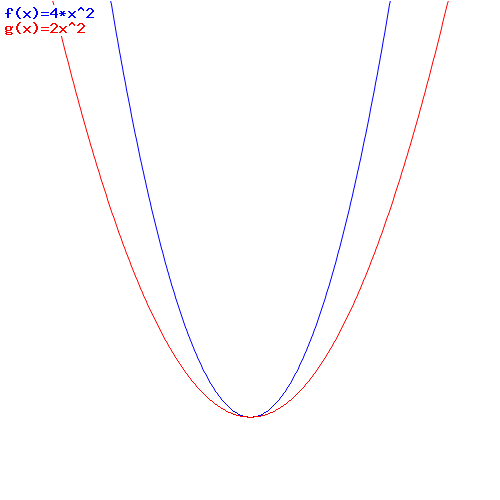
Well… The thumbnail graph below illustrates the difference for a = b: it maps x to (a) 4x[i.e. (x + x)2] and to (b) 2x2 [i.e. (x + ix)2] respectively. Indeed, when we’re squaring real numbers, we get (a + b)= 4a2–i.e. a ‘real bit’ only, of course!–but when we’re squaring complex numbers, we need to keep track of two components: the real part and the imaginary part. However, the real part (a2 – b2) is zero in this case (a = b), and so it’s only the imaginary part 2abi = 2a2i that counts!

graph (2)

That’s kids stuff, you’ll say… In fact, when you’re a mathematician, you’ll say it’s a nonsensical graph. Why? Because it compares an apple and an orange really: we want to show 2ixreally, not 2x2.

That’s true. However, that’s why the graph is actually useful. The red graph introduces a new idea, and with a ‘new’ idea I mean something that’s not inherent in the i2= –1 identity: it associates i with the vertical axis in the two-dimensional plane.

Hmm… This is an idea that is ‘nice’ – very nice actually – but, once again, I should note that it’s not part of i‘s essence. Indeed, the Italian mathematicians who first ‘invented’ complex numbers in the early 16th century (Tartaglia (‘the Stammerer’) and da Vinci’s friend Cardano) introduced roots of –1 because they needed them to solve algebraic equations. That’s it. Full stop. It was only much later (some hundred years later that is!) that Euler and Descartes associated imaginary numbers (like 2ix2) with the vertical coordinate axis. To my readers who have managed not to fall asleep while reading this: please continue till the end, and you will understand why I am saying the idea of a geometrical interpretation is ‘not essential’.

To the same readers, I’ll also say the following, however: if we do associate complex numbers with a second dimension, then we can associate the algebraic operations with things we can visualize in space. Most of you–all of you I should say–know that already, obviously, but let’s just have a look at that to make sure we’re on the same page.

A very basic thing in physical mathematics is reversing the direction of something. Things go in one direction, but we should be able to visualize them going in the opposite direction. We may associate this with a variable going from 0 to infinity (+∞): it may be time (t), or a time-dependent variable x, y or z. Of course, we know what we have here: we think of the positive real axis. So, what we do when we multiply with –1 is reversing its direction, and so then we’re talking the negative real axis: a variable going from 0 to minus infinity (-∞). Therefore, we can associate multiplication by –1 with a full rotation around the center (i.e. around the zero point) by 180 degrees (i.e. by π, in radians).imaginary_rotation

You may think that’s a weird way of looking at multiplication by minus one. Well… Yes and no. But think of it: the concept of negative numbers is actually as ‘weird’ as the concept of the imaginary unit in a way. I mean… Think about it: we’re used to use negative numbers because we learned about them when we were very small kids but what are they really? What does it mean to have minus three apples? You know the answer of course: it probably means that you owe someone three apples but that you don’t have any right now. 🙂 […] But that’s not the point here. I hope you see what I mean: negative numbers are weird too, in a sense. Indeed, we should be aware of the fact that we often look at concepts as being ‘weird’ because we weren’t exposed to them early enough: the great mathematician Leonhard Euler thought complex numbers were so ‘essential’ to math and, hence, so ‘natural’ that he thought kids should learn complex numbers as soon as they started learning ‘real’ numbers. In fact, he probably thought we should only be using complex numbers because… Well… They make the arithmetic space complete, so to say. […] But then I guess that’s because Euler understood complex numbers in a way we don’t, which is why I am writing about them here. 🙂

OK. Back to the main story line. In order to understand complex numbers somewhat better, it is actually useful – but, again, not necessarily essential – to think of i as a halfway rotation, i.e. a rotation by 90 degrees only, clockwise or counterclockwise, as illustrated above: multiplication with i means a counterclockwise rotation by 90 degrees (or π/2 radians) and multiplication with –i means a clockwise rotation by the same amount. Again, the minus sign gives the direction here: clockwise or counterclockwise. It works indeed: i·i =(-i)·(-i) = –1.

OK. Let’s wrap this up: we might say that

  • a positive real number is associated with some (absolute) quantity (i.e. a magnitude);
  • a minus sign says: “Go the opposite way! Go back! Subtract!”– so it’s associated with the opposite direction or the opposite of something in general; and, finally,
  • the imaginary unit adds a second dimension: instead of moving on a line only, we can now walk around on a plane.

Once we understand that, it’s easy to understand why, in most applications of complex numbers, you’ll see the polar notation for complex numbers. Indeed, instead of writing a complex number z as z = a+ ib, we’ll usually see it written as:

z = reiθ with eiθ = cosθ + isinθ

Huh? Well… Yes. Let me throw it in here straight away. You know this formula: it’s Euler’s formula. The so-called ‘magical’ formula! Indeed, Feynman calls it ‘our jewel’: the ‘most remarkable formula in mathematics’ as he puts it. Waw ! If he says so, it must be right. 🙂 So let’s try to understand it.

Is it magical really? Well… I guess the answer is ‘Yes’ and ‘No’ at the same time:

  • No. There is no ‘magic’ here. Associating the real part a and the imaginary part b with a magnitude r and an angle θ (a = rcosθ and b = rcosθ) is actually just an application of the Pythagorean theorem, so that’s ‘magic’ you learnt when you were very little and, hence, it does not look like magic anymore. [Although you should try to appreciate its ‘magic’ once again, I feel. Remember that you heard about the Pythagorean theorem because your teacher wanted to tell you what the square root of 2 actually is: a so-called irrational number that we get by taking the ‘one-half power’ of 2, i.e. 21/2 = 20.5, or, what amounts to the same, the square root of 2. Of course, you and I are both used to irrational numbers now, like 21/2, but they are also ‘weird’. As weird as i. In fact, it is said that the Greek mathematician who claimed their existence was exiled, because these irrational numbers did not fit into the (early) Pythagorean school of thought. Indeed, that school of thought wanted to reduce geometry to whole numbers and their ratios only. So there was no place for irrational numbers there!]
  • Yes. It is ‘magical’. Associating eiθ – so that’s a complex exponential function really! – with the unit circle is something you learnt much later in life only, if ever. It’s a strange thing indeed: we have a real (but, I admit, irrational) number here – e is 2.718 followed by an infinite number of decimals as you know, just like π – and then we raise to the power iθ, so that’s i once again multiplied by a real number θ (i.e. the so-called phase or – to put it simply – the angle). By now, we know what it means to multiply something with i, and–of course–we also know what exponentiation is (it’s just a shorthand for repeated multiplication), but we haven’t defined complex exponentials yet.

In fact… That’s what we’re going to do here. But in a rather ‘weird’ way as you will see: we won’t define them really but we’ll calculate them. For the moment, however, we’ll leave it at this and just note that, through Euler’s relation, we can see how a fraction or a multiple of i, e.g. 0.1i or 2.3i, corresponds to a fraction or a multiple of the angle associated with i, i.e. 0.1 times π/2 or 2.3 times π/2. In other words, Euler’s formula shows how the second (spatial) dimension is associated with the concept of the angle.

[…] And then the third (spatial) dimension is, of course, easy to add: it’s just an angle in another direction. What direction? Well… An angle away from the plane that we just formed by introducing that first angle. 🙂 […] So, from our zero point (here and now), we use a ruler to draw lines, and then a compass to measure angles away from that line, and then we create a plane, and then we can just add dimensions as we please by adding more ‘angles’ away from what we already have (a line, or a plane, and any higher-dimensional thing really).

Dimensions

I feel I need to digress briefly here, just to make sure we’re on the same page. Dimensions. What is a dimension in physics or in math? What do we mean if we say that spacetime is a four-dimensional continuum? From what we wrote above, the concept of a spatial dimension should be obvious: we have three dimensions in space (the x, y and z direction), and so we need three numbers indeed to describe the position of an object, from our point of view that is (i.e. in our reference frame).

But so we also have a fourth number: time. By now, you also know that, just like position and/or motion in space, time is relative too: that is relative to some frame of reference indeed. So, yes, we need four numbers, i.e. four dimensions, to describe an event in spacetime. That being said, time is obviously still something different (I mean different than space), despite the fact that Einstein’s relativity theory relates it to space: indeed, we showed in our post on (special) relativity that there’s no such thing as absolute time. However, that actually reinforces the point: a point in time is something fundamentally different than a point in space. Despite the fact that

  1. Time is just like a space dimension in the physical-mathematical meaning of the term ‘dimension’ (a dimension of a space or an object is one of the coordinates that is needed to specify a point within that space, or to ‘locate’ the object – both in time and space that is); and that,
  2. We can express distance and time in the same units because the speed of light is absolute (so that allows us to express time in meter, despite the fact that time is relative or “local”, as Hendrik Lorentz called it); and that, finally,
  3. If we do that (i.e. if we express time and distance in equivalent units), the equations for space and time in the Lorentz transformation equations mirror each other nicely – ‘mixing’ the space and time variables in the same way, so to say – and, therefore, space and time do form a ‘kind of union’, as Minkowski famously said;

Despite all that, time and space are fundamentally different things. Perhaps not for God – because He (or She, or It?) is said to be Everywhere Always – but surely for us, humans. For us, humans, always busy constructing that mental space with our ruler and our compass, time is and remains the one and only truly independent variable. Indeed, for us, mortal beings, the clocks just tick (locally indeed – that’s why I am using a plural: clocks – but that doesn’t change the fact they’re ticking, and in one direction only).

And so things happen and equations such as the one we started with – i.e. the differential equation modeling the behavior of an oscillator – show us how they happen. In one of my previous posts, I also showed why the laws of physics do not allow us to reverse time, but I won’t talk about that here. Let’s get back to complex numbers. Indeed, I am only talking about dimensions here because, despite all I wrote above about the imaginary axis in the complex plane, the thing to note here is that we did not use complex numbers in the physical-mathematical problem above to bring in an extra spatial dimension.

We just did it because we could not solve the equation with one-dimensional numbers only: we needed to take the square root of a negative number and we couldn’t. That was it basically. So there was no intention of bringing in a y- or z-dimension, and we didn’t. If we would have wanted to do that, we would have had to insert another dependent variable in the differential equation, and so it would have become a so-called partial differential equation in two or three dependent variables (x, y and z), with time – once again – as the independent variable (t). [A differential equation in one variable only (real- or complex-valued), like the ones we’re used to now, are referred to as ordinary differential equations, as opposed to… no, not extraordinary, but partial differential equations.]

In fact, if we would have generalized to two- or three-dimensional space, we would have run into the same type of problem (roots of negative numbers) when trying to solve the partial differential equation and so we would have needed complex-valued variables to solve it analytically in this case too. So we would have three ‘dimensions’ but each ‘dimension’ would be associated with complex (i.e. ‘two-dimensional) numbers. Is this getting complicated? I guess so.

The point is that, when studying physics or math, we will have to get used to the fact that these ‘two-dimensional numbers’ which we introduced, i.e. complex numbers, are actually more ‘natural’ ‘numbers’ to work with from a purely analytic point of view (as for the meaning of ‘analytic’, just read it as ‘logical problem-solving’), especially when we write them in their polar form, i.e. as complex exponentials. We can then take advantage of that wonderful property that they already are a functional form (z =reiθ), so to speak, and that their first, second etcetera derivative is easy to calculate because that ‘functional form’ is an exponential, and exponentials come back to themselves when taking the derivative (with the coefficient in the exponent in front). That makes the differential equation a simple algebraic equation (i.e. without derivatives involved), which is easy to solve.

In short, we should just look at complex numbers here (i.e. in the context of my three previous posts, or in the context of differential equations in general) as a computational device, not as an attempt to add an extra spatial dimension to the analysis.

Now, that’s probably the reason why Feynman inserts a chapter on ‘algebra’ that, at first, does not seem to make much sense. As usual, however, I worked through it and then found it to be both instructive as well as intriguing because it makes the point that complex exponentials are, first and foremost, an algebraic thing, not a geometrical thing.

I’ll try to present his argument here but don’t worry if you can’t or don’t want to follow it all the way through because… Well… It’s a bit ‘weird’ indeed, and I must admit I haven’t quite come to terms with it myself. On the other hand, if you’re ready for some thinking ‘outside of the box’, I assure you that I haven’t found anything like this in a math textbook or on the Web. This proves the fact that Feynman was a bit of a maverick… Well… In any case, I’ll let you judge. Now that you’re here, I would really encourage you to read the whole thing, as loooooooong as it is.

Complex exponentials from an algebraic point of view: introduction

Exponentiation is nothing but repeated multiplication. That’s easy to understand when the exponents are integers: a to the power n (an) is a×a×a×a×… etcetera – repeated n times, so we have n factors (all equal to a) in the product. That’s very straightforward.

Now, to understand rational exponents (so that’s an m/n exponent, with m and n integers), we just need to understand one thing more, and that is the inverse operation of exponentiation, i.e. the nth root. We then get am/n = (am)1/n. So, that’s easy too. […] Well… No. Not that easy. In fact, our problems starts right here:

  • If n is even, and a is a positive real number, we have two (real) nth roots a1/n: ± a1/n.
  • However, if a is negative (and n is still even obviously), then we have a problem. There’s no real nth root of a in that case. That’s why Cardano invented i: we’ll associate an even root of a negative real number with two complex-valued roots.
  • What if n is uneven? Then we have only one real root: it’s positive when a is positive, and negative when a is negative. Done.

But let’s not complicate matters from the start. The point here is to do some algebra that should help us to understand complex exponentials. However, I will make one small digression, and that’s on logarithmic functions. It’s not essential but, again, useful. […] Well… Maybe. 🙂 I hope so. 🙂

We know that exponentials are actually associated with two inverse operations:

  1. Given some value y and some number n, we can take the nth root of y (y1/n) to find the original base x for which y = xn.
  2. Given some value y and some number a, we can take the logarithm (to base a) of y to find the original exponent x for which y = ax.

In the first case, the problem is: given n, find x for which y = xn. In the second case, the problem is: given a, find x for which y = ax. Is that complicated? Probably. In order to further confuse you, I’ve inserted a thumbnail graph with y = 2x (so that’s the exponential function with base 2) and y = log2x (so that’s the logarithmic function with base 2). You can see these two functions mirror each other, with the x = y line as the mirror axis.

graph

We usually find logarithms more ‘difficult’ than roots (I do, for sure), but that’s just because we usually learn about them much later in life–like in a senior high school class, for example, as opposed to a junior high school class (I am just guessing, but you know what I mean).

In addition, we have these extra symbols ‘log‘–L-O-G :-)–to express the function. Indeed, we use just two symbols to write the y = 2function: 2 and x – and then the meaning is clear from where we write these: we write 2 in normal script and x as a superscript and so we know that’s exponentiation. But so we’re not so economical for the logarithmic function. Not at all. In fact, we use three symbols for the logarithmic function: (1) ‘log’ (which is quite verbose as a symbol in itself, because it consists of three letters), (2) 2 and (3) x. That’s not economical at all! Indeed, why don’t we just write y = 2x or something? So that’s a subscript in front, instead of a superscript behind. It would work. It’s just a matter of getting used to it, i.e. it’s just a convention in other words.

Of course, I am joking a bit here but you get my point: in essence, the logarithmic function should not come across as being more ‘difficult’ or less ‘natural’ than the exponential function: exponentiation involves two numbers – a base and an exponent – and, hence, it’s logical that we have two inverse operations, rather than one. [You’ll say that a sum or a product involves (at least) two terms or two factors as well, so why don’t they have two inverse operations? Well… Addition and multiplication are commutative operations: a+b = b+a, and a·b = b·a. Exponentiation isn’t: a≠ na. That’s why. Check it: 2×3 = 3×2, but 23 = 8 ≠ 3= 9.]

Now, apart from us ‘liking’ exponential functions more than logarithmic functions because of the non-relevant fact that we learned about log functions only much later in our life, we will usually also have a strong preference for one or the other base for an exponential. The most preferred base is, obviously, ten (10). We use that base in so-called scientific notations for numbers. For example: the elementary charge (i.e. the charge of an electron) is approximately –1.6×10⁻¹⁹ coulombs. […] Oh… We have a minus sign in the exponent here (–19). So what’s that? Sorry. I forgot to mention that. But it’s easy: a–n = (an)–1 = 1/an.

Our most preferred base is 10 because we have a decimal system, and we have a decimal system because we have ten fingers. Indeed, the Maya used a base-20 system because they used their toes to count as well (so they counted in twenties instead of tens), and it also seems that some tribes had octal (base-8) systems because they used the spaces between their fingers, rather than the fingers themselves. And, of course, we all know that computers use a base-2 system because… Well… Because they’re computers. In any case, 10 is called the common base, because… Well… Because it’s common.

However, by now you know that, in physics and mathematics, we prefer that strange numberas a base. However, remember it’s not that strange: it’s just a number like π. Why do we call it ‘natural’? Because of that nice property: the derivative of the exponential function ecomes back to itself: d(ex)/dt = ex. That’s not the case for 10x. In fact, taking the derivative of 10is pretty easy too: we just need to put a coefficient in front. To be specific, we need to put the logarithm (to base e) of the base of our exponential function (i.e. 10) in front: d(10x)/dt = 10xln(10). [Ln(10) is yet another notation that has been introduced, it seems, to confuse young kids and ensure they hate logarithms: ln(10) is just loge(10) or, if I would have had my way in terms of conventions (which would ensure an ‘economic’ use of symbols), we could also write ln(10) = e10. :-)]

Stop! I am going way too fast here. We first need to define what irrational powers are! Indeed, from all that I’ve written so far, you can imagine what am/n is (am/n  = am)1/n, but what if m is not an integer? What if m equals the square root of 2, for example? In other words, what is 10or ex  or 2or whatever for irrational exponents?

We all sort of ‘know’ what irrationals are: it involves limits, infinitesimals, fractions of fractions, Dedekind cuts. Whatever, even if you don’t understand a word of what I am writing here, you do – intuitively: irrationals can be approximated by fractions of fractions. The grand idea is that we divide some number by 2, and then we divide by 2 once again (so we divide by 4), and then once again (so we take 1/8), and again (1/16), and so on and so on. These are Dedekind cuts. Of course, dividing by two is a pretty random way of cutting things up. Why don’t we divide by three, or by four, for example? Well… It’s the same as with those other ‘natural’ numbers: we have to start somewhere and so this  ‘binary’ way of cutting things up is probably the most ‘natural’. 🙂 [Have you noticed how many ‘natural’ numbers we’ve mentioned already: 10, e, π, 2… And one (1) itself of course. :-)]

So we’ll use something like Dedekind cuts for irrational powers as well. We’ll define them as a sort of limit (in fact, that’s exactly what they are) and so we have to find some approximation (or convergence) process that allows us to do so.

We’ll start with base 10 here because, as mentioned above, base 10 comes across as more ‘natural’ (or ‘common’) to us non-mathematicians than the so-called ‘natural’ base e. However, I should note that the base doesn’t matter much because it’s quite easy to switch from one base to another. Indeed, we can always write a= (bk)= bks = bt with a = band t = k·s (as for k, k is obviously equal to logb(a). From this simple formula, you can see that changing base amounts to changing the horizontal scale: we replace s by t = k·s. That’s it. So don’t worry about our choice of base. 🙂

Complex exponentials from an algebraic point of view: well… Not the introduction 🙂

Ouf! So much stuff! But so here we go. We take base 10 and see how such an approximation of an irrational power of 10 (10x) looks like. Of course, we can write any irrational number x as some (positive or negative) integer plus an endless series of decimals after the zero (e.g. e = 2 + 0.7182818284590452… etc). So let’s just focus on numbers between 0 and 1 as for now (so we’ll take the integer out of the total, so to speak). In fact, before we start, I’ll cheat and show you the result, just to make sure you can follow the argument a bit.

graph (3)Yes. That’s how 10x looks like, but so we don’t know that yet because we don’t know what irrational powers are, and so we can’t make a graph like that–yet. We only know very general things right now, such as:

  • 100 = 1 and 101 = 10 etcetera.
  • Most importantly, we know that 10m/n  = (10m)1/n = (101/n)for integer m and n.

In fact, we’ll use the second fact to calculate 10x for x = 1/2, 1/4, 1/8, 1/16, and so on and so on. We’ll go all the way down to where x becomes a fraction very close to zero: that’s the table below. Note that the x values in the table are rational fractions 1/2, 1/4, 1/8 etcetera indeed, so x is not an irrational exponent: x is a real number but rational, so x can be expressed either as a fraction of two integers m and n (m = 1 and n = 1, 4, 8, 16, 32 and so on here), or as a decimal number with a finite number of decimals behind the decimal point (0.5, 0.25, 0.125, 0.0625 etcetera).

Capture

The third column gives the value 10x for these fractions x = 1/2, 1/4, 1/8 etcetera. How do we get these? Hmm… It’s true. I am jumping over another hurdle here. The key assumption behind the table is that we know how to take the square root of a number, so that we can calculate 101/2, to quite some precision indeed, as 101/2 = 3.162278 (and there’s more decimals but we’re not too interested in them right now), and then that we can take the square root of that value (3.162278). That’s quite an assumption indeed.

However, if we don’t want this post to become a book in itself, then I must assume we can do that. In fact, I’ve done it with a calculator here but, before there were calculators, this kind of calculations could and had to be done with a table of logarithms. That’s because of a very convenient property of logarithms: logc(ab) =logc(a) + logc(b). However, as said, I should be writing a post here only, not a book. [Already now, this post beats the record in terms of length and verbosity…] So I’ll just ask you to accept that – at this stage – we know how to calculate the square root of something and, therefore, to accept that we can take the square root not only of 10 but of any number really, including 3.162278, and then the root of that number, and then the root of that result, and so and so on. So that gives us the values in the third column of the table above: they’re successive square roots. [Please do double-check! It will help you to understand what I am writing about here.]

So… Back to the main story. What we are doing in the table above is to take the square root in succession, so that’s (101/2)1/2 = 101/4, and then again: (101/4)1/2 = 101/8 , and then again: (101/8)1/2 = 101/16 , so we get 101/2, 101/4, 101/8, 101/16, 101/32 and so on and so on. All the way down. Well… Not all the way down. In fact, in the table above, we stop after ten iterations already, so that’s when x = 1/1024. [Note that 1/1024 is 2 to the power minus 10: 2–10 = 1/210   = 1/1024. I am just throwing that in here because that little ‘fact’ will come in handy later.]

Why do we stop after ten iterations? Well… Actually, there’s no real good reason to stop at exactly ten iterations. We could have 15 iterations: then x would be 1/215 = 1/32768. Or 20 (x = 1/1048576). Or 39 (x = 1/too many digits to write down). Whatever. However, we start to notice something interesting that actually allows us to stop. We note that 10 to the power x (10x) tends to one as x becomes very small.

Now you’re laughing. Well… Surely ! That’s what we’d expect, isn’t it? 10= 1. Is that the grand conclusion?

No.

The question is how small should x be? That’s where the fourth column of the table above comes in. We’re calculating a number there that converges to some value quite near to 2.3 as x goes to zero and – importantly – it converges rather quickly. In fact, if you’d do the calculations yourself, you’d see that it converges to 2.302585 after a while. [With Excel or some similar application, you can do 20 or more iterations in no time, and so that’s what you’ll find.]

Of course, we can keep going and continue adding zillions of decimals to this number but we don’t want to do that: 2.302585 is fine. We don’t need any more decimals. Why? Well… We’re going to use this number to approximate 10near x = 0: it turns out that we can get a real good approximation of 10x near x = 0 using that 2.302585 factor, so we can write that

10≈ 1 + 2.302585x

That approximation is the last column in the table above. In order to show you how good it is as an ‘approximation’, I’ve plotted the actual values for 10x (blue markers) and the approximated values for 10x (black markers) using that 1 + 2.302585x formula. You can see it’s a pretty good match indeed if x is small. And ‘small’ here is not that small: a ratio like x = 1/8 (i.e. x = 0.125) is good enough already! In fact, the graph below shows that 1/16 = 0.0625 is almost perfect! So we don’t need to ‘go down’ too far: ten iterations is plenty!

Capture

I’ve probably ‘lost’ you by now. What are we doing here really? How did we get that linear approximation formula, and why do we need it? Well… See the last column: we calculate (10x–1)/x, so that’s the difference between 10and 1 divided by the (fractional) exponent x and we see, indeed, that that number converges to a value very near to 2.302585. Why? Well… What we are actually doing is calculating the gradient of 10x, i.e. the slope of the tangent line to the (non-linear) 10x curve. That’s what’s shown in the graph below.

graph (1)

Working backwards, we can then re-write (10x–1)/x ≈ 2.302585 as 10≈ 1 + 2.302585x indeed.

So what we’ve got here is quite standard: we know we can approximate a non-linear curve with a linear curve, using the gradient near the point that we’re observing (and so that’s near the point x = 0 in this case) and so that‘s what we’re doing here.

Of course, you should remember that we cannot actually plot a smooth curve like that, for the moment that is, because we can only calculate 10x for rational real numbers. However, it’s easy to generalize and just ‘fill the gaps’ so to speak, and so that’s how irrational powers are defined really.

Hmm… So what’s the next step? Well… The next step is not to continue and continue and continue and continue etcetera to show that the smooth curve above is, indeed, the graph of 10x. No. The next step is to use that linear approximation to algebraically calculate the value of 10is, so that’s a power of 10 with a complex exponent.

HUH!? 

Yes. That’s the gem I found in Feynman’s 1965 Lectures. [Well… One of the gems, I should say. There are many. :-)]

It’s quite interesting. In his little chapter on ‘algebra’ (Lectures, I-22), Feynman just assumes that this ‘law’ that 10= 1 + 2.302585x is not only ‘correct’ for small real fractions x but also for very small complex fractions, and then he just reverses the procedure above to calculate 10ifor larger values of x. Let’s see how that goes.

However, let’s first switch the variable from x to s, because we’re talking complex numbers now. Indeed, I can’t use the symbol x as I used it above anymore because x is now the real part of some complex number 10is. In addition, I should note that Feynman introduces this delta (Δ). The idea behind is to make things somewhat easier to read by relating s to an integer: Δ = 1024s, so Δ = 1, 2, 4, 8,… 1024 for s = 1/1024, 1/512, 1/256 etcetera (see the second column in the table below). I am not entirely sure why he does that: Feynman must think fractions are harder to ‘read’. [Frankly, the introduction of this Δ makes Feynman’s exposé somewhat harder to ‘read’ IMHO – but that’s just a matter of taste, I guess.] Of course, the approximation then becomes

10= 1 + 2.302585·Δ/1024 = 1 + 0.0022486Δ. 

The table below is the one that Feynman uses. The important thing is that you understand the first line in this table: 10i/1024 = 1 + 0.00225i·Δ1 + 0.00225i·1 = 1 + 0.00225i. And then we go to the second line: 10i/512 = 10i/1024·10i/1024 = 102i/1024 = 10i/512, so we’re doing the reverse thing here: we don’t take square roots but we square what we’ve found already. So we multiply 1 + 0.00225i with itself and get (1+0.00225i)(1+0.00225i) =  1 + 2·0.00225i + 0.002252i2 = 1 – 0.000005 + 0.45i ≈ 0.999995 + 0.45i ≈ 1 + 0.0045i.

Capture 1

Let’s go to the third line now. In fact, what we’re doing here is working our way back up, i.e. all the way from s = 1/1024 to s = 1. And that’s where the ‘magic’ of i (i.e. the fact that i2 = –1) is starting to show: (0.999995+0.0045i)2 =  0.99999 + 2·0.999995·0.0045i + 0.00452i= 0.99997 + 0.009i. So the real part of 10iis changing as well – it is decreasing in fact! Why is that? Because of the term with the ifactor! [I write 0.99997 instead of 0.99996 because I round up here, while Feynman consistently rounds down.]

So now the game is clear: we take larger and larger fractions s (i/512, i/256, i/128, etcetera), and calculate 10iby squaring the previous result. After ten iterations, we get the grand result for s = i/1 = i:

10is = –0.66928 + 0.74332i (more or less that is)

Note the minus sign in front of the real part, and look at the intermediate values for x and y too. Isn’t that remarkable?

OK. Waw ! But… So what? What’s next?

Well… To graph 10is, we should not just keep squaring things because that amounts to doubling the exponent again and again and so that means the argument is just making larger and larger jumps along the positive real axis really (see that graph that I made above: the distance between the successive values of x gets larger and larger, and so that’s a bad recipe for a smooth graph).

So what can we do? Well… We should just take a sufficiently small power, i/8 for example, and multiply that with 1, 2, 3 etcetera so we get something more ‘regular’. That’s what’s done in the table below and what’s represented in the graph underneath (to get the scale of the horizontal axis, note that s = p/8).

Capture 2

Capture 3

Hey! Look at that! There we are! That’s the graph we were looking for: it shows a (complex) exponential (10is) as a periodic (complex-valued) function with the real part behaving like a cosine function and the imaginary part behaving like as a sine function.

Note the upper and lower bounds: +1 and –1. Indeed, it doesn’t seem to matter whether we use 10 or as a base: the x and y part oscillate between −1 and +1. So, whatever the base, we’ll see the same pattern: the base only changes the scale of the horizontal axis (i.e. s). However, that being said, because of this scale factor, I do need to say like a cosine/sine function when discussing that graph above. So I cannot say they are a cosine and a sine function. Feynman calls these functions algebraic sine and cosine functions.

But – remember! – we can always switch base through a clever substitution so 10is = eit and recalculate stuff to whatever number of decimals behind the decimal point we’d want. So let’s do that: let’s switch to base e. WOW! What happens?

We then [Finally! you’ll say!] get values that – Surprise ! Surprise ! – correspond to the real cosine and sine function. That then, in turn, allows us to just substitute the ‘algebraic’ cosine and sine function for the ‘real’ cosine in an equation that – Yes! – is Euler’s formula itself:

ei= cos(t) + isin(t)

So that’s it. End of story.

[…]

You’ll say: So what? Well… Not sure what to say. I think this is rather remarkable. This is not the formal mathematical proof of Euler’s formula (at least not of the kind that you’ll find in a textbook or on Wikipedia). No, we are just calculating the values x and y of ei= x + iy using an approximation process used to calculate real powers and then, well… Just some bold assumption involving infinitesimals really.

I think this is amazing stuff (even if I’ll downplay that statement a bit in my post scriptum). I really don’t understand these things the way I would like to understand them. I guess I just haven’t got the right kind of brain for these things. 😦 Indeed, just think about it: when we have the real exponential ex, then we’ve got that typical ‘rocket’ graph (i.e. the blue one in the graph below): just something blasting away indeed. But when we put in the exponent (eix), then we get two components oscillating up and down like the cosine and sine function. Well… Not only like the cosine and sine function: the green and red line– i.e. the real and imaginary part of eix!– actually are the cosine and sine function!

graph

Do you understand this in an intuitive way? Yes? You do? Waw ! Please write me and tell me how. I don’t. 😦

Oh well… The good thing about it is… Well… At least complex numbers will always stay ‘magical’ to me. 🙂

Post scriptum: When I write, above, that I don’t understand this in an intuitive way, I don’t mean to say it’s not logical. In fact, it is. It has to be, of course, because we’re talking math here! 🙂

The logic is pretty clear indeed. We have an exponential function here (y = 10x) and we’re evaluating that function in the neighborhood of x = 0 (we do it on the positive side only but we could, of course, do the same analysis on the other side as well). So then we use that very general mathematical procedure of calculating approximate values for the (non-linear) 10x curve using the gradient. So we plug in some differential value for x (in differential terms, we’d write Δx – but so the delta symbol here has nothing to do with Feynman’s Δ above) and, of course, we find Δy = 2.302585·Δx. So we add that to 1 (the value of 10at point x = 0) and, then, we go through these iterations, not using that linear equation any more, but the very fundamental property of an exponential function that 102x = (10x)2. So we start with an approximate value, but then the value we plug into these iterative calculations is the square of the previous value. So, to calculate the next points, we do not use an approximation method any more, but we just square the first result, and then the second and so on and so on, and that’s just calculation, not approximation.

[In fact, you may still wonder and think that it’s quite remarkable that the points we calculate using this process are so accurate, but that’s due to the rapid convergence of that value we found for the gradient. Well… Yes and no. Here I must admit that Feynman (and I) cheated a bit because we used a rather precise value for the gradient: 2.302585, so that’s six significant digits after the decimal point. Now, that value is actually calculated based on twenty (rather than 10) iterations when ‘going down’. But that little factoid is not embarrassing because it doesn’t change much: the argument itself is sound. Very sound.]

OK… That’s easy enough to understand. The thing that is not easy to understand – intuitively that is – is that we can just insert some complex differential Δs into that Δy = 2.302585·Δx equation. Isn’t it ‘weird’, indeed, that we can just use a complex fraction s = i/1024 to calculate our first point, instead of a real fraction x = 1/1024? It is. That’s the only thing really. Indeed, once we’ve done that, it’s plain sailing again: we just square the result to get the next result, and then we square that again, and so on and so on. However, that being said, the difference is that the ‘magic’ of i comes into play indeed. When squaring, we do not get a 4a2 result but an (a+bi)= a– b2 + 2abi. So it’s that minus sign and the i that give an entirely different ‘dynamic’ to how the function evolves from there (i.e. different as compared to working with a real base only). It’s all quite remarkable really because we start off with a really tiny value b here: 0.00225 to be precise, so that’s (less than) 1/445 ! [Of course, the real part a, at the point from where we start doing these iterations, is one.]

But so that first step is ‘weird’ indeed. Why is it no problem whatsoever to insert the complex fraction s = i/1024 into 1 + 2.302585o·s, instead of the real fraction 1/1024, and then afterwards, to square these complex numbers that we’re getting, instead of real numbers?

It just doesn’t feel right, does it? I must admit that, at first, I felt that Feynman was doing something ‘illegal’ too. But, obviously, he’s not. It’s plain mathematical logic. We have two functions here: one is linear (y = 1 + 2.302585·x), and the other is quadratic (y = x2) and so what’s happening really is that, at the point x = 0, we change the function. We substitute not x for ix really but y = 10for y = 10ix. So we still have an independent real variable x but, instead of a real-valued y = 10function, we now have a complex-valued y = 10ifunction.

However, the ‘output’ of that function, of course, is a complex y, not a real y. In our case, because we’re plotting a function really–to be precise, we’re calculating the exponential function y = 10through all these iterations–we get a complex-valued function of the shape that, by now, we know so well.

So it is ‘discontinuous’ in a way, and so I can’t say all that much about it. Look at the graph below where, once again, we have the real exponential function ex and then the two components of the complex exponential eix. This time, I’ve plotted them on both sides of the zero point because they’re continuous on both sides indeed. Imagine we’re walking along this blue ex curve from some negative x to zero. We’re familiar with the path. It has, for instance, that property we exploited above: as we doubled the ‘input’ (so from x we went to 2x), the ‘output’ went up not as the double but as the square of the original value: e2x = (ex)2. And then we also know that, around the point x = o, we can approximate it with a linear function. In fact, in this case, the linear approximation is super-simple: y = 1 + x. Indeed, the gradient for ex at point x = 0 is equal to 1! So, yes, we know and understand that blue curve. But then we arrive at point x = 0 and we decide something radical: we change the function!

graph (5)

Yes. That’s what we’re really doing in that very lengthy story above: ei is a complex-valued function of the real variable x. That’s something different. However, we continue to say that the approximation y = 1 + x must also be valid for complex x and y. So we say that ei= 1 + ix. Is that wrong? No. Not at all. Functional forms are functional forms and gradients are gradients: d(eix)/dx = ieix, and ieix at x = 0 is equal to ie0 = i! Hence, ei= 1 + ix is a perfectly legitimate linear approximation. And then it’s just the same thing again: we use that iteration mechanism to calculate successive squares of complex numbers because, for complex exponentials as well, we have e2(ix) = (eix)2.

So. The ‘magic’ is a lot of ‘confusion’ really. The point to note is that we do have a different function here: eiand e‘look’ similar–it’s just that i, right?but, in fact, when we replace x by ix in the exponent of e, that’s quite a radical change. We can use the same linear approximation at x = ix = 0 but then it’s over. Our blue graph stops: we’re no longer walking along it. I can’t even say it bifurcates, so to say, into the red and the green one, because it doesn’t. We’re talking apples and oranges indeed, and so the comparison is quickly done: they’re different. Full stop.

Is there any geometrical relationship between all these curves? Well… Yes and no. I can see one, at the very start: the gradient of our ex function at x = 0 is equal to unity (i.e. 1), and so that’s the same gradient as the gradient of the imaginary part of our new eifunction (the gradient of the real part is zero, before it becomes negative). But that’s just… I mean… That just comes out of Euler’s formula: e= cos(0) + isin(0). Honestly, it’s no use to try to be smart here and think about stuff like that. We’re no longer walking on the blue curve. We’re looking at a new function: a complex-valued function eix (instead of a real-valued function ex) of a real variable (x). That’s it. Just don’t try to relate the two too much: you switched functions. Full stop. It’s like changing trains! 🙂

So… What’s the conclusion? Well… I’d say: “Complex numbers can be analyzed as extensions of real numbers, so to say, but – frankly – they are different.

[…]

I’ll probably never understand complex numbers in the way I would like to understand them–that is like I understand that one plus one is two. However, this rather lengthy forage in the complex forest has helped me somewhat. I hope it helped you too.

Some content on this page was disabled on June 16, 2020 as a result of a DMCA takedown notice from The California Institute of Technology. You can learn more about the DMCA here:

https://wordpress.com/support/copyright-and-the-dmca/
Some content on this page was disabled on June 16, 2020 as a result of a DMCA takedown notice from The California Institute of Technology. You can learn more about the DMCA here:

https://wordpress.com/support/copyright-and-the-dmca/
Some content on this page was disabled on June 16, 2020 as a result of a DMCA takedown notice from The California Institute of Technology. You can learn more about the DMCA here:

https://wordpress.com/support/copyright-and-the-dmca/
Differential equations revisited: the math behind oscillators

Pre-scriptum (dated 26 June 2020): This post – part of a series of rather simple posts on elementary math and physics – does not seem to have been targeted in the the attack by the dark force—which is good because I still like it. While my views on the true nature of light, matter and the force or forces that act on them have evolved significantly as part of my explorations of a more realist (classical) explanation of quantum mechanics, I think most (if not all) of the analysis in this post remains valid and fun to read. In fact, I would dare to say the whole Universe consists of oscillators!

Original post:

When wrapping up my previous post, I said that I might be tempted to write something about how to solve these differential equations. The math behind them is pretty essential indeed. So let’s revisit the oscillator from a formal-mathematical point of view.

Modeling the problem

The simplest equation we used was the one for a hypothetical ‘ideal’ oscillator without friction and without any external driving force. The equation for a mechanical oscillator (i.e. a mass on a spring) is md2x/dt2 = –kx. The k in this equation is a factor of proportionality: the force pulling back is assumed to be proportional to the amount of stretch, and the minus sign is there because the force is pulling back indeed. As for the equation itself, it’s just Newton’s Law: the mass times the acceleration equals the force: ma = F.

You’ll remember we preferred to write this as d2x/dt2 = –(k/m)x = –ω02x with ω0= k/m. You’ll also remember that ωis an angular frequency, which we referred to as the natural frequency of the oscillator (because it determines the natural motion of the spring indeed). We also gave the general solution to the differential equation: x(t) = x0cos(ω0t + Δ). That solution basically states that, if we just let go of that spring, it will oscillate with frequency ω0 and some (maximum) amplitude x0, the value of which depends on the initial conditions. As for the Δ term, that’s just a phase shift depending on where x is when we start counting time: if x would happen to pass through the equilibrium point at time t = 0, then Δ would be π/2. So Δ allows us to shift the beginning of time, so to speak.

In my previous posts, I just presented that general equation as a fait accompli, noting that a cosine (or sine) function does indeed have that ‘nice’ property of come back to itself with a minus sign in front after taking the derivative two times: d2[cos(ω0t)]/dt2 = –ω02cos(ω0t). We could also write x(t) as a sine function because the sine and cosine function are basically the same except for a phase shift: x0cos(ω0t + Δ) = x0sin(ω0t + Δ + π/2).

Now, the point to note is that the sine or cosine function actually has two properties that are ‘nice’ (read ‘essential’ in the context of this discussion):

  1. Sinusoidal functions are periodic functions and so that’s why they represent an oscillation–because that’s something periodic too!
  2. Sinusoidal functions come back to themselves when we derive them two times and so that’s why it effectively solves our second-order differential equation.

However, in my previous post, I also mentioned in passing that sinusoidal functions share that second property with exponential functions: d2et/dt= d[det/dt]/dt = det/dt = et. So, if it we would not have had that minus sign in our differential equation, our solution would have been some exponential function, instead of a sine or a cosine function. So what’s going on here?

Solving differential equations using exponentials

Let’s scrap that minus sign and assume our problem would indeed be to solve the d2x/dt2 = ω02x equation. So we know we should use some exponential function, but we have that coefficient ω02. Well… That’s actually easy to deal with: we know that, when deriving an exponential function, we should bring the exponent down as a coefficient: d[eω0t]/dt = ω0eω0t. If we do it two times, we get d2[eω0t]/dt2 = ω02eω0t, so we can immediately see that eω0is a solution indeed.

But it’s not the only one: e–ω0t is a solution too: d2[e–ω0t]/dt2 = (–ω0)(–ω0)e–ω0t = ω02e–ω0t. So e–ω0solves the equation too. It is easy to see why: ω02 has two square roots–one positive, and one negative.

But we have more: in fact, every linear combination c1eω0+ c2e–ω0is also a solution to that second-order differential equation. Just check it by writing it all out: you’ll find that d2[c1eω0+ c2e–ω0t]/dt2 = ω02[c1eω0+c2e–ω0t] and so, yes, we have a whole family of functions here, that are all solutions to our differential equation.

Now, you may or may not remember that we had the same thing with first-order differential equations: we would find a whole family of functions, but only one would be the actual solution or the ‘real‘ solution I should say. So what’s the real solution here?

Well… That depends on the initial conditions: we need to know the value of x at time t= 0 (or some other point t = t1). And that’s not enough: we have two coefficients (cand c2), and, therefore, we need one more initial condition (it takes two equations to solve for two variables). That could be another value for x at some other point in time (e.g. t2) but, when solving problems like this, you’ll usually get the other ‘initial condition’ expressed in terms of the first derivative, so that’s in terms of dx/dt = v. For example, it is not illogical to assume that the initial velocity v0 would be zero. Indeed, we can imagine we pull or push the spring and then let it go. In fact, that’s what we’ve been assuming here all along in our example! Assuming that v0 = 0 is equivalent to writing that

d[c1eω0+ c2e–ω0t]/dt = 0 for t = 0

⇒ ω0c1 – ω0c2 = 0 (e= 1) ⇔  c1 = c2

Now we need the other initial condition. Let’s assume the initial value of x is equal to x0 = 2 (it’s just an example: we could take any value, including negative values). Then we get:

c1eω0+ c2e–ω0t = 2 for t = 0 ⇔ c1 + c= 2 (again, note that e= 1)

Combining the two gives us the grand result that c1 = c= 1 and, hence, the ‘real’ or actual solution is x = eω0e–ω0t. The graph below plots that function for ω= 1 and ω= 0.5 respectively. We could take other values for ω0 but, whatever the value, we’ll always get an exponential function like the ones below. It basically graphs what we expect to happen: the mass just accelerates away from its equilibrium point. Indeed, the differential equation is just a description of an accelerating object. Indeed, the e–ω0t term quickly goes to zero, and then it’s the eω0term that rockets that object sky-high – literally. [Note that the acceleration is actually not constant: the force is equal to kx and, hence, the force (and, therefore, the acceleration) actually increases as the mass goes further and further away from its equilibrium point. Also note that if the initial position would have been minus 2, i.e. x= –2, then the object would accelerate away in the other direction, i.e. downwards. Just check it to make sure you understand the equations.]

graph 2 graph

The point to note is our general solution. More formally, and more generally, we get it as follows:

  • If we have a linear second-order differential equation ax” + bx’ + cx = 0 (because of the zero on the right-hand side, we call such equation homogeneous, so it’s quite a mouthful: a linear and homogeneous DE of the second order), then we can find an exponential function ert that will be a solution for it.
  • If such function is a solution, then plugging in it yields ar2ert + brert + cert = 0 or (ar2 + br + c)ert = 0.
  • Now, we can read that as a condition, and the condition amounts to ar2 + br + c = 0. So that’s a quadratic equation we need to solve for r to find two specific solutions r1 and r2, which, in turn, will then yield our general solution:

 x(t) = c1er1+ c2er2t

Note that the general solution is based on the principle of superposition: any linear combination of two specific solutions will be a solution as well. I am mentioning this here because we’ll use that principle more than once.

Complex roots

The steps as described above implicitly assume that the quadratic equation above (i.e. ar2ert + brert + cert = 0), which is better known as the characteristic equation, does yield two real and distinct roots r1 and r2. In fact, it amounts to assuming that that exponential ert is a real-valued exponential function. We know how to find these real roots from our high school math classes: r = (–b ± [b– 4ac]1/2)/2a. However, what happens if the discrimant b– 4ac is negative?

If the disciminant is negative, we will still have two roots, but they will be complex roots. In fact, we can write these two complex roots as r = α ± βi, with i the imaginary unit. Hence, the two complex roots are each other’s complex conjugate and our er1and er2t can be written as:

er1= e(α+βi)t and er2e(α–βi)t

Also, the general solution based on these two particular solutions will be c1e(α+βi)t + c2e(α–βi)t.

[You may wonder why complex roots have to be complex conjugates from each other. Indeed, that’s not so obvious from the raw r = (–b ± [b– 4ac]1/2)/2a formula. But you can re-write it as r = –b/2a ± [b– 4ac]1/2)/2a and, if b– 4ac is negative, as r = –b/2a ± [(−b2+4ac)1/2/2a]. So that gives you the α and β and shows that the two roots are, in effect, each other’s complex conjugate.]

We should briefly pause here to think about what we are doing here really: if we allow r to be complex, then what we’re doing really is allow a complex-valued function (to be precise: we’re talking the complex exponential functions e(λ±μi)t, or any linear combination of the two) of a real variable (the time variable t) to be part of our ‘solution set’ as well.

Now, we’ve analyzed complex exponential functions before–long time ago: you can check out some of my posts last year (November 2013). In fact, we analyzed even more complex – in fact, I should say more complicated rather than more complex here: complex numbers don’t need to be complicated! 🙂 – because we were talking complex-valued functions of complex variables there! That’s not the case here: the argument t (i.e. the input into our function) is real, not complex, but the output – or the function itself – is complex-valued. Now, any complex exponential e(α+βi)t can be written as eαteiβt, and so that’s easy enough to understand:

1. The first factor (i.e. eαt) is just a real-valued exponential function and so we should be familiar with that. Depending on the value of α (negative or positive: see the graph below), it’s a factor that will create an envelope for our function. Indeed, when α is negative, the damping will cause the oscillation to stop after a while. When α is positive, we’ll have a solution resembling the second graph below: we have an amplitude that’s getting bigger and bigger, despite the friction factor (that’s obviously possible only because we keep reinforcing the movement, so we’re not switching off the force in that case). When α is equal to zero, then eαt is equal to unity and so the amplitude will not change as the spring goes up and down over time: we have no friction in that case.

graph 4

Envelope

2. The second factor (i.e. eiβt) is our periodic function. Indeed, eiβt is the same as eiθ and so just remember Euler’s formula to see what it is really:

eiθ = cos(θ) + isin(θ)

The two graphs below represent the idea: as the phase θ = ωt + Δ (the angular frequency or velocity times the time is equal to the phase, plus or minus some phase shift) goes round and round and round (i.e. increases with time), the two components of eiθ, i.e. the real and imaginary part eiθ, oscillate between –1 and 1 because they are both sinusoidal functions (cosine and sine respectively). Now, we could amplify the amplitude by putting another (real) factor in front (a magnitude different than 1) and write reiθ = r·cos(θ) + r·sin(θ) but that wouldn’t change the nature of this thing.

euler13 slkL9

But so how does all of this relate to that other ‘general’ solution which we’ve found for our oscillator, i.e. the one we got without considering these complex-valued exponential functions as solutions. Indeed, what’s the relation between that x = x0cos(ω0t + Δ) equation and that rather frightening c1e(α+βi)t + c2e(α–βi)t equation? Perhaps we should look at x = x0cos(ω0t + Δ) as the real part of that monster? Yes and no. More no than yes actually. Actually… No. We are not going to have some complex exponential and then forget about the imaginary part. What we will do, though, is to find that general solution – i.e. a family of complex-valued functions – but then we’ll only consider those functions for which the imaginary part is zero, so that’s the subset of real-valued functions only.

I guess this must sound like Chinese. Let’s go step by step.

Using complex roots to find real-valued functions

If we re-write d2x/dt2 = –ω02x in the more general ax” + bx’ + cx = 0 form, then we get x” + ω02x = 0 and so the discriminant b– 4ac is equal to –4ω02, and so that’s a negative number. So we need to go for these complex roots. However, before solving this, let’s first restate what we’re actually doing. We have a differential equation that, ultimately, depends on a real variable (the time variable t), but so now we allow complex-valued functions er1e(α+βi)t and er2e(α–βi)t as solutions. To be precise: these are complex-valued functions x of the real variable t.

That being said, it’s fine to note that real numbers are a subset of the complex numbers and so we can just shrug our shoulders and say all that we’re doing is switch to complex-valued functions because we got stuck with that negative determinant and so we had to allow for complex roots. However, in the end, we do want a real-valued solution x(t). So our x(t) = c1e(α+βi)t + c2e(α–βi)t has to be a real-valued function, not a complex-valued function.

That means that we have to take a subset of the family of functions that we’ve found. In other words, the imaginary part of  c1e(α+βi)t + c2e(α–βi)t has to be zero. How can it be zero? Well… It basically means that c1e(α+βi)t and c2e(α–βi)t have to be complex conjugates.

OK… But how do we do that? We need to find a way to write that c1e(α+βi)t + c2e(α–βi)t sum in a more manageable ζ + η form. We can do that by using Euler’s formula once again to re-write those two complex exponentials as follows:

  • e(α+βi)t = eαteiβt = eαt[cos(βt) + isin(βt)]
  • e(α–βi)t = eαte–iβt = eαt[cos(–βt) + isin(–βt)] = eαt[cos(βt) – isin(βt)]

Note that, for the e(α–βi)t expression, we’ve used the fact that cos(–θ) = cos(θ) and that sin(–θ) = –sin(θ). Also note that α and β are real numbers, so they do not have an imaginary part–unlike cand c2, which may or may not have an imaginary part (i.e. they could be pure real numbers, but they could be complex as well).

We can then re-write that c1e(α+βi)t + c2e(α–βi)t sum as:

c1e(α+βi)t + c2e(α–βi)t = c1eαt[cos(βt) + isin(βt)] + c2eαt[cos(βt) – isin(βt)]

= (c1 + c2)eαtcos(βt) + (c1 – c2)ieαtsin(βt)

So what? Well, we want that imaginary part in our solution to disappear and so it’s easy to see that the imaginary part will indeed disappear if c1 – c2 = 0, i.e. if c1 = c= c. So we have a fairly general real-valued solution x(t) = 2c·eαtcos(βt) here, with c some real number. [Note that c has to be some real number because, if we would assume that cand c(and, therefore, c) would be equal complex numbers, then the c1 – c2 factor would also disappear, but then we would have a complex c1 + c2 sum in front of the eαtcos(βt) factor, so that would defeat the purpose of finding real-valued function as a solution because (c1 + c2)eαtcos(βt) would still be complex! […] Are you still with me? :-)]

So, OK, we’ve got the solution and so that should be it, isn’t it? Well… No. Wait. Not yet. Because these coefficients  c1 and c2 may be complex, there’s another solution as well. Look at that formula above. Let us suppose that c1 would be equal to some (real) number c divided by i (so c= c/i), and that cwould be its opposite, so c= –c(i.e. minus c1). Then we would have two complex numbers consisting of an imaginary part only: c= c/i and c= –c= –c/i, and they would be each other’s complex conjugate. Indeed, note that 1/i = i–1= –i and so we can write c= –c·and c= c·i. Then we’d get the following for that c1e(α+βi)t + c2e(α–βi)t sum:

 (c1 + c2)eαtcos(βt) + (c1 – c2)ieαtsin(βt)

= (c/i – c/i)eαtcos(βt) + (c/i + c/i)ieαtsin(βt) = 2c·eαtsin(βt)

So, while cand c2 are complex, our grand result is a real-valued function once again or – to be precise – another family of real-valued functions (that’s because c can take on any value).

Are we done? Yes. There are no other possibilities. So now we just need to remember to apply the principle of superposition: any (real) linear combination of 2c·eαtcos(μt) and 2c·eαtsin(μt) will also be a (real-valued) solution, so the general (real-valued) solution for our problem is:

x(t) = a·2c·eαtcos(βt) + b·2c·eαtsin(βt) = Aeαtcos(βt) + Beαtsin(βt)

eαt[Acos(βt) + Bsin(βt)]

So what do we have here? Well, the first factor is, once again, an ‘envelope’ function: depending on the value of α, (i) negative, (ii) positive or (iii) zero, we have an oscillation that (i) damps out, (ii) goes out of control, or (iii) keeps oscillating in the same steady way forever.

The second part is equivalent to our ‘general’ x(t) = x0cos(ω0t + Δ) solution. Indeed, that x(t) = x0cos(ω0t + Δ) solution is somewhat less ‘general’ than the one above because it does not have the eαt factor. However, x(t) = x0cos(ω0t + Δ) solution is equivalent to the Acos(βt) + Bsin(βt) factor. How’s that? We can show how they are related by using the trigonometric formula for adding angles: cos(α + β) = cos(α)cos(β) – sin(α)sin(β). Indeed, we can write:

x0cos(ω0t + Δ) = x0cos(Δ)cos(ω0t) – x0sin(Δ)sin(ω0t) = Acos(βt) + Bsin(βt)

with A = x0cos(Δ), B = – x0sin(Δ) and, finally, μ = ω0

Are you convinced now? If not… Well… Nothing much I can do, I feel. In that case, I can only encourage you to do a full ‘work-out’ by reading the excellent overview of all possible situations in Paul’s Online MathNotes (tutorial.math.lamar.edu/Classes/DE/Vibrations.aspx).

Feynman’s treatment of second-order differential equations

Feynman takes a somewhat different approach in his Lectures. He solves them in a much more general way. At first, I thought his treatment was too confusing and, hence, I would not have mentioned it. However, I like the logic behind, even if his approach is somewhat more messy in terms of notations and all that. Let’s first look at the differential equation once again. Let’s take a system with a friction factor that’s proportional to the speed: Ff = –c·dx/dt. [See my previous post for some comments on that assumption: the assumption is, generally speaking, too much of a simplification but it makes for a ‘nice’ linear equation and so that’s why physicists present it that way.] To ease the math, c is usually written as c = mγ. Hence, γ = c/m is the friction per unit of mass. That makes sense, I’d think. In addition, we need to remember that ω02 = k/m, so k = mω02. Our differential equation then becomes m·d2x/dt2 = –γm·dx/dt – kx (mass times acceleration is the sum of the forces) or m·d2x/dt2 + γm·dx/dt + mω02·x = 0. Dividing the mass factor away gives us an even simpler form:

d2x/dt2 + γdx/dt + ω02x = 0

You’ll remember this differential equation from the previous post: we used it to calculate the (stored) energy and the Q of a mechanical oscillator. However, we didn’t show you how. You now understand why: the stuff above is not easy–the length of the arguments involved is why I am devoting an entire post to it!

Now, instead of assuming some exponential ert as a solution, real- or complex-valued, Feynman assumes a much more general complex-valued function as solution: he substitutes x for x = Aeiαt, with A a complex number as well so we can write A as A = A0eiΔ. That more general assumption allows for the inclusion of a phase shift straight from the start. Indeed, we can write x as x = A0eiΔeiαt = = A0ei(αt+Δ). Does that look complicated? It probably does, because we also have to remember that α is a complex number! So we’ve got a very general complex-valued exponential function indeed here!

However, let’s not get ahead of ourselves and follow Feynman. So he plugs in that complex-valued x = Aeiαt and we get:

(–α+ iγα + ω02)Aeiαt = 0

So far, so good. The logic now is more or less the same as the logic we developed above. We’ve got two factors here: (1) a quadratic equation –αiγα + ω02 (with one complex coefficient iγ) and (2) a complex exponential function Aeiαt. The second factor (Aeiαt) cannot be zero, because that’s x and we assume our oscillator is not standing still. So it’s the first factor (i.e. the quadratic equation in α with a complex coefficient iγ) which has to be zero. So we solve for the roots α and find

α = –iγ/(–2) ± [(–(iγ)2–4ω02)1/2/(-2)] = iγ/2 ± [(γ2–4ω02)1/2/(-2)]

= iγ/2 ± (ω0– γ2/4)1/2 iγ/2 ± ωγ

[We get this by bringing i and –2 inside of the square root expression. It’s not very straightforward but you should be able to figure it out.]

So that’s an interesting expression: the imaginary part of α is iγ/2 and its real part is (ω0– γ2/4)1/2, which we denoted as ωγ in the expression above. [Note that we assume there’s no problem with the square root expression: γ2/4 should be smaller than ω02 so ωγ is supposed to be some real positive number.] And so we’ve got the two solutions xand x2:

x= Aei(iγ/2 + ωγ)t =  Ae–γt/2+iωγ= Ae–γt/2eiωγ

x= Bei(iγ/2 – ωγ)t =  Be–γt/2–iωγ= Be–γt/2e–iωγt

Note, once again, that A and B can be any (complex) number and that, because of the principle of superposition, any linear combination of these two solutions will also be a solution. So the general solution is

x = Ae–γt/2eiωγ+ Be–γt/2e–iωγ= e–γt/2(Aeiωγ+ Be–iωγt) 

Now, we recognize the shape of this: a (real-valued) envelope function e–γt/2 and then a linear combination of two exponentials. But so we want something real-valued in the end so, once again, we need to impose the condition that Aeiωγand Be–iωγare complex conjugates of each other. Now, we can see that eiωγand e–iωγare complex conjugates but what does this say about A and B? Well… The complex conjugate of a product is the product of the complex conjugates of the factors involved: (z1z2)* = (z1*)(z1*). That implies that B has to be the complex conjugate of A: B = A*. So the final (real-valued) solution becomes:

x = e–γt/2(Aeiωγ+ A*e–iωγt) 

Now, I’ll leave it to you to prove that the second factor in the product above (Aeiωγ+ A*e–iωγt) is a real-valued function of the real variable t. It should be the same as x0cos(Δ)cos(ω0t) – x0sin(Δ)sin(ω0t), and that gives you a graph like the one below. However, I can readily imagine that, by now, you’re just thinking: Oh well… Whatever! 🙂

Transient

So the difference between Feynman’s approach and the one I presented above (which is the one you’ll find in most textbooks) is the assumption in terms of the specific solution: instead of substituting x for ert, with allowing r to take on complex values, Feynman substitutes x for Aeiαt, and allows both A and α  to take on complex values. It makes the calculations more complicated but, when everything is said and done, I think Feynman’s approach is more consistent because more encompassing. However, that’s subject to taste, and I gather, from comments on the Web, that many people think that this chapter in Feynman’s Lectures is not his best. So… Well… I’ll leave it to you to make the final judgment.

Note: The one critique that is relevant, in regard to Feynman’s treatment of the matter, is that he devotes quite a bit of time and space to explain how these oscillatory or periodic displacements can be viewed as being the real part of a complex exponential. Indeed, cos(ωt) is the real part of eiωt. But so that’s something different than (1) expanding the realm of possible solutions to a second-order differential equation from real-valued functions to complex-valued functions in order to (2) then, once we’ve found the general solution, consider only real-valued functions once again as ‘allowable’ solutions to that equation. I think that’s the gist of the matter really. It took me a while to fully ‘get’ this. I hope this post helps you to understand it somewhat quicker than I did. 🙂

Conclusion

I guess the only thing that I should do now is to work some examples. However, I’ll refer you Paul’s Online Math Notes for that once again (see the reference above). Indeed, it is about time I end my rather lengthy exposé (three posts on the same topic!) on oscillators and resonance. I hope you enjoyed it, although I can readily imagine that it’s hard to appreciate the math involved.

It is not easy indeed: I actually struggled with it, despite the fact that I think I understand complex analysis somewhat. However, the good thing is that, once we’re through it, we can really solve a lot of problems. As Feynman notes: “Linear (differential) equations are so important that perhaps fifty percent of the time we are solving linear equations in physics and engineering.” So, bearing in that mind, we should move on to the next.

Some content on this page was disabled on June 16, 2020 as a result of a DMCA takedown notice from The California Institute of Technology. You can learn more about the DMCA here:

https://wordpress.com/support/copyright-and-the-dmca/
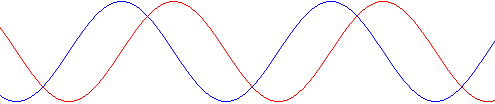
Resonance phenomena

Pre-scriptum (dated 26 June 2020): This post – part of a series of rather simple posts on elementary math and physics – has suffered only a little bit from the attack by the dark force—which is good because I still like it. A few illustrations were removed because of perceived ‘unfair use’, but you will be able to google equivalent stuff. While my views on the true nature of light, matter and the force or forces that act on them have evolved significantly as part of my explorations of a more realist (classical) explanation of quantum mechanics, I think most (if not all) of the analysis in this post remains valid and fun to read. In fact, I would dare to say the whole Universe is all about resonance!

Original post:

One of the most common behaviors of physical systems is the phenomenon of resonance: a body (not only a tuning fork but any body really, such as a body of water, such as the ocean for example) or a system (e.g. an electric circuit) will have a so-called natural frequency, and an external driving force will cause it to oscillate. How it will behave, then, can be modeled using a simple differential equation, and the so-called resonance curve will usually look the same, regardless of what we are looking at. Besides the standard example of an electric circuit consisting of (i) a capacitor, (ii) a resistor and (iii) an inductor, Feynman also gives the following non-standard examples:

1. When the Earth’s atmosphere was disturbed as a result of the Krakatoa volcano explosion in 1883, it resonated at its own natural frequency, and its period was measured to be 10 hours and 20 minutes.

[In case you wonder how one can measure that, an explosion such as that one creates all kinds of waves, but the so-called infrasonic waves are the one we  are talking about here. They circled the globe at least seven times, shattering windows hundreds of miles away. They did not only shatter windows in a radius , but they were also recorded worldwide. That’s how they could be measured a second, third, etc time. How? There was no wind or so, but the infrasonic waves (i.e. ‘sounds’ beneath the lowest limits of human hearing (about 16 or 17 Hz), down to 0.001 Hz) of such oscillation cause minute changes in the atmospheric pressure which can be measured by microbarometers. So the ‘ringing’ of the atmosphere was measurable indeed. A nice article on infrasound waves is journal.borderlands.com/1997/infrasound. Of course, the surface of the Earth was ‘ringing’ as well, and such seismic shocks then produce tsunami waves, which can also be analyzed in terms of natural frequencies.]

2. Crystals can be made to oscillate in response to a changing external electric field, and this crystal resonance phenomenon is used in quartz clocks: the quartz crystal resonator in a basic quartz wristwatch is usually in the shape of a very small tuner fork. Literally: there’s a tiny tuning fork in your wristwatch, made of quartz, that has been laser-trimmed to vibrate at exactly 32,768 Hz, i.e. 215 cycles per second.

3. Some quantum-mechanical phenomena can be analyzed in terms of resonance as well, but then it’s the energy of the interfering particles that assumes the role of the frequency of the external driving force when analyzing the response of the system. Feynman gives the example of gamma radiation from lithium as a function of the energy of protons bombarding the lithium nuclei to provoke the reaction. Indeed, when graphing the intensity of the gamma radiation emitted as a function of the energy, one also gets a resonance curve, as shown below. [Don’t you just love the fact it’s so old? A Physical Review article of 1948! There’s older stuff as well, because this journal actually started in 1893.]

Resonance curve gamma rays

However, let us analyze the phenomenon first in its most classical appearance: an oscillating spring.

Basics

We’ve seen the equation for an oscillating spring before. From a math point of view, it’s a differential equation (because one of the terms is a derivative of the dependent variable x) of the second order (because the derivative involved is of the second order):

m(d2x/dt2) = –kx

What’s written here is simply Newton’s Law: the force is –kx (the minus sign is there because the force is directed opposite to the displacement from the equilibrium position), and the force has to equal the oscillating mass on the spring times its acceleration: F = ma.

Now, this can be written as d2x/dt2 = –(k/m)x = –ω02x with ω0= k/m. This ωsymbol uses the Greek omega once again, which we used for the angular velocity of a rotating body. While we do not have anything that’s rotating here, ωis still an angular velocity or, to be more precise, it’s an angular frequency. Indeed, the solution to the differential equation above is

x = x0cos(ω0t + Δ)

The xfactor is the maximum amplitude and that’s, quite simply, determined by how far we pulled or pushed the spring when we started the motion. Now, ω0t + Δ = θ is referred to as the phase of the motion, and it’s easy to see that ωis an angular frequency indeed, because ωequals the time derivative dθ/dt. Hence, ωis the phase change, measured in radians, per second, and that’s the definition of angular frequency or angular velocity. Finally, we have Δ. That’s just a phase shift, and it basically depends on our t = 0 point.

Something on the math

I’ll do a separate post on the math that’s associated with this (second-order differential equations) but, in this case, we can solve the equation in a simple and intuitive way. Look at it: d2x/dt2 = –ω02x. It’s obvious that x has to be a function that comes back to itself after two derivations, but with a minus sign in front, and then we also have that coefficient –ω02. Hmm… What can we think of? An exponential function comes back to itself, and if there’s a coefficient in the exponent, then it will end up as a coefficient in front too: d(eat)/dt = aeat and, hence, d2(eat)/dt2 = a2eat. Waw ! That’s close. In fact, that’s the same equation as the one above, except for the minus sign.

In fact, if you’d quickly look at Paul’s Online Math Notes, you’ll see that we can indeed get the general solution for such second-order differential equation (to be precise: it’s a so-called linear and homogeneous second-order DE with constant coefficients) using that remarkable property of exponentials indeed. However, because of the minus sign, our solution for the equation above will involve complex exponentials, and so we’ll get a general function in a complex variable. However, we’ll then impose that our solution has to be real only and, hence, we’ll take a subset of our more general solution. However, don’t worry about that here now. There’s an easier way.

Apart from the exponential function, there are two other functions that come back to themselves after two derivatives: the sine and cosine functions. Indeed, d2cos(t)/dt2 = –cos(t) and d2sin(t)/dt2 = –sin(t). In fact, the sine and cosine function are obviously the same except for a phase shift equal π/2: cos(t) = sin(t + π/2), so we can choose either. Let’s work with the cosine as for now (we can always convert it to a sine function using that cos(t) = sin(t + π/2) identity). The nice thing about the cosine (and sine) function is that we do get that minus sign when deriving it two times, and we also get that coefficient in front. Indeed: d2cos(ω0t)/dt2 = –ω02cos(ω0t). In short, cos(ω0t) is the right function. The only thing we need to add is that xand Δ, i.e. the amplitude and some phase shift but, as mentioned above, it is easy to understand these will depend on the initial conditions (i.e. the value of x at point t = 0 and the initial pull or push on the spring). In short, x = x0cos(ω0t + Δ) is the complete general solution of the  simple (differential) equation we started with (i.e. m(d2x/dt2) = –kx).

Introducing a driving force

Now, most real-life oscillating systems will be driven by an external force, permanently or just for a short while, and they will also lose some of their energy in a so-called dissipative process: friction or, in an electric circuit, electrical resistance will cause the oscillation to slowly lose amplitude, thereby damping it.

Let’s look at the friction coefficient first. The friction will often be proportional to the speed with which the object moves. Indeed, in the case of a mass on a spring, the drag (i.e. the force that acts on a body as it travels through air or a fluid) is dependent on a lot of things: first and foremost, there’s the fluid itself (e.g. a thick liquid will create more drag than water), and then there’s also the size, shape and velocity of the object. I am following the treatment you’ll find in most textbooks here and so that includes an assumption that the resistance force is proportional to the velocity: Ff = –cv = –c(dx/dt). Furthermore, the constant of proportionality c will usually be written as a product of the mass and some other coefficient γ, so we have Ff = –cv = –mγ(dx/dt). That makes sense because we can look at γ = c/m as the friction per unit of mass.

That being said, the simplification as a whole (i.e. the assumption of proportionality with speed) is rather strange in light of the fact that drag forces are actually proportional to the square of the velocity. If you look it up, you’ll find a formula resembling FD = ρCDAv2/2, with ρ the fluid density, CD the drag coefficient of drag (determined by the shape of the object and a so-called Reynolds number, which is determined from experiments), and A the cross-section area. It’s also rather strange to relate drag to mass by writing c as c = mγ because drag has nothing to do with mass. What about dry friction? So that would be kinetic friction between two surfaces, like when the mass is sliding on a surface? Well… In that case, mass would play a role but velocity wouldn’t, because kinetic friction is independent of the sliding velocity.

So why do physicists use this simplification? One reason is that it works for electric circuits: the equivalent of the velocity in electrical resonance is the current I = dq/dt, so that’s the time derivative of the charge on the capacitor. Now, I is proportional to the voltage difference V, and the proportionality coefficient is the resistance R, so we have V = RI = R(dq/dt). So, in short, the resistance curve we’re actually going to derive below is one for electric circuits. The other reason is that this assumption makes it easier to solve the differential equation that’s involved: it makes for a linear differential equation indeed. In fact, that’s the main reason. After all, professors are professors and so they have to give their students stuff that’s not too difficult to solve. In any case, let’s not be bothered too much and so we’ll just go along with it.

Modeling the driving force is easy: we’ll just assume it’s a sinusoidal force with angular frequency ω (and ω is, obviously, more likely than not somewhat different than the natural frequency ω0). If F is sinusoidal force, we can write it as F = F0cos(ωt + Δ). [So we also assume there is some phase shift Δ.] So now we can write the full equation for our oscillating spring as:

m(d2x/dt2) + γm(dx/dt) + kx = F ⇔ (d2x/dt2)+ γ(dx/dt) + ω02x = F

How do  we solve something like that for x? Well, it’s a differential equation once again. In fact, it’s, once again, a linear differential equation with constant coefficients, and so there’s a general solution method for that. As I mentioned above, that general solution method will involve exponentials and, in general, complex exponentials. I won’t walk you through that. Indeed, I’ll just write the solution because this is not an exercise in solving differential equations. I just want you to understand the solution:

x = ρF0cos(ωt + Δ + θ)

ρ in this equation has nothing to do with some density or so. It’s a factor which depends on m, ω and ω0, in a fairly complicated way in fact:

Formula 1

As we can see from the equation above, the (maximum) amplitude of the oscillation is equal to ρF0. So we have the magnitude of the force F here multiplied by ρ. Hence, ρ is a magnification factor which, multiplied with F0, gives us the ‘amount’ of oscillation.  

As for the θ in the equation above, we’re using this Greek letter (theta) not to refer to the phase, as we usually do, because the phase here is the whole ωt + Δ + θ expression, not just theta! The theta (θ) here is a phase shift as compared to the original force phase ωt + Δ, and θ also depends on ω and ω0. Again, I won’t show how we derived this solution but just accept it as for now:

Formula 2

These three equations, taken together, should allow you to understand what’s going on really. We’ve got an oscillation x = ρF0cos(ωt + Δ + θ), so that’s an equation with this amplification or magnification factor ρ and some phase shift θ. Both depend on the difference between ωand ω, and the two graphs below show how exactly.

Graph 1 Graph 2

The first graph shows the resonance phenomenon and, hence, it’s what’s referred to as the resonance curve: if the difference between ωand ω is small, we get an enormous amplification effect. It would actually go to infinity if it weren’t for the frictional force (but, of course, if the frictional force was not there, the spring would just break as the oscillation builds up and the swings get bigger and bigger).

The second graph shows the phase shift θ. It is interesting to note that the lag θ is equal –π/2 when ω0 is equal to ω, but I’ll let you figure out why this makes sense. [It’s got something to do with that cos(t) = sin(t + π/2) identity, so it’s nothing ‘deep’ really.]

I guess I should, perhaps, also write something about the energy that gets stored in an oscillator like this because, in that resonance curve above, we actually have ρ squared on the vertical axis, and that’s because energy is proportional to the square of the amplitude: E ∝ A2. I should also explain a concept that’s closely related to energy: the so-called Q of an oscillator. It’s an interesting topic, if only because it helps us to understand why, for instance, the waves of the sea are such tremendous stores of energy! Furthermore, I should also write something about transients, i.e. oscillations that dampen because the driving force was turned off so to say. However, I’ll leave that for you to look it up if you’re interested in this topic. Here, I just wanted to present the essentials.

[…] Hey ! I managed to keep this post quite short for a change. Isn’t that good? 🙂

Some content on this page was disabled on June 16, 2020 as a result of a DMCA takedown notice from The California Institute of Technology. You can learn more about the DMCA here:

https://wordpress.com/support/copyright-and-the-dmca/
Some content on this page was disabled on June 16, 2020 as a result of a DMCA takedown notice from The California Institute of Technology. You can learn more about the DMCA here:

https://wordpress.com/support/copyright-and-the-dmca/
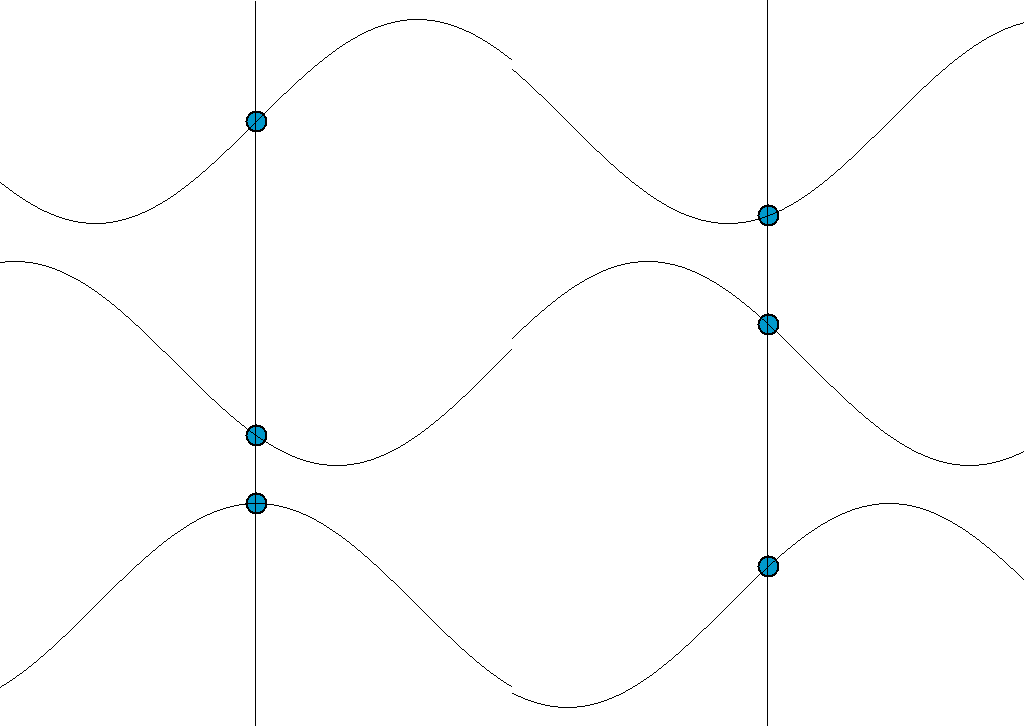
Some content on this page was disabled on June 16, 2020 as a result of a DMCA takedown notice from The California Institute of Technology. You can learn more about the DMCA here:

https://wordpress.com/support/copyright-and-the-dmca/
Understanding gyroscopes

Pre-scriptum (dated 26 June 2020): This post – part of a series of rather simple posts on elementary math and physics – has suffered only a little bit from the attack by the dark force—which is good because I still like it. Only one or two illustrations were removed because of perceived ‘unfair use’, but you will be able to google equivalent stuff. While my views on the true nature of light, matter and the force or forces that act on them have evolved significantly as part of my explorations of a more realist (classical) explanation of quantum mechanics, I think most (if not all) of the analysis in this post remains valid and fun to read. Understanding the dynamics of rotations is extremely important in any realist interpretation of quantum physics. In fact, I would dare to say it is all about rotation!

Original post:

You know a gyroscope: it’s a spinning wheel or disk mounted in a frame that itself is free to alter in direction, so the axis of rotation is not affected as the mounting tilts or moves about. Therefore, gyroscopes are used to provide stability or maintain a reference direction in navigation systems. Understanding a gyroscope itself is simple enough: it only involves a good understanding of the so-called moment of inertia. Indeed, in the previous post, we introduced a lot of concepts related to rotational motion, notably the concepts of torque and angular momentum but, because that post was getting too long, I did not talk about the moment of inertia and gyroscopes. Let me do that now. However, I should warn you: you will not be able to understand this post if you haven’t read or didn’t understand the previous post. So, if you can’t follow, please go back: it’s probably because you didn’t get the other post.

The moment of inertia and angular momentum are related but not quite the same. Let’s first recapitulate angular momentum. Angular momentum is the equivalent of linear momentum for rotational motion:

  1. If we want to change the linear motion of an object, as measured by its momentum p = mv, we’ll need to apply a force. Changing the linear motion means changing either (a) the speed (v), i.e. the magnitude of the velocity vector v, (b) the direction, or (c) both. This is expressed in Newton’s Law, F = m(dv/dt), and so we note that the mass is just a factor of proportionality measuring the inertia to change.
  2. The same goes for angular momentum (denoted by L): if we want to change it, we’ll need to apply a force, or a torque as it’s referred to when talking rotational motion, and such torque can change either (a) L’s magnitude (L), (b) L’s direction or (c) both.

Just like linear momentum, angular momentum is also a product of two factors: the first factor is the angular velocity ω, and the second factor is the moment of inertia. The moment of inertia is denoted by I so we write L = Iω. But what is I? If we’re analyzing a rigid body (which is what we usually do), then it will be calculated as follows:

formula 1

This is easy enough to understand: the inertia for turning will depend not just on the masses of all of the particles that make up the object, but also on their distance from the axis of rotation–and note that we need to square these distances. The L = Iω formula, combined with the formula for I above, explains why a spinning skater doing a ‘scratch spin’ speeds up tremendously when drawing in his or her arms and legs. Indeed, the total angular momentum has to remain the same, but I becomes much smaller as a result of that r2 factor in the formula. Hence, if I becomes smaller, then ω has to go up significantly in order to conserve angular momentum.

Finally, we note that angular momentum and linear momentum can be easily related through the following equation:

Formula 2

That’s all kids stuff. To understand gyroscopes, we’ll have to go beyond that and do some vector analysis. In the previous post, we explained that rotational motion is usually analyzed in terms of torques than forces, and we detailed the relations between force and torque. More in particular, we introduced a torque vector τ with the following components:

τ = (τyz, τzx, τxy) = (τx, τy, τz) with

τx = τyz = yFz – zFy

τy = τzx = zFx – xFz

τz = τxy = xFy – yFx.

We also noted that this torque vector could be written as a cross product of a radius vector and the force: τ = F. Finally, we also pointed out the relation between the x-, y- and z-components of the torque vector and the plane of rotation:

(1) τx = τyz is rotational motion about the x-axis (i.e. motion in the yz-plane)

(2) τy = τzx is rotational motion about the y-axis (i.e. motion in the zx plane)

(3) τz = τxy is rotational motion about the z-axis (i.e. motion in the xy-plane)

The angular momentum vector L will have the same direction as the torque vector, but it’s the cross product of the radius vector and the momentum vector: L = p. For clarity, I reproduce the animation I used in my previous post once again.

Torque_animation

How do we get that cross vector product for L? We noted that τ (i.e. the Greek tau) = dL/dt. So we need to take the time derivative of all three components of L. What are the components of L? They look very similar to those of τ:

L = (Lyz, Lzx, Lxy) = (Lx, Ly, Lz) with

Lx = Lyz = ypz – zpy

Ly = Lzx = zpx – xpz

Lz = Lxy = xpy – ypx.

Now, just check the time derivatives of Lx, Ly, and Lz and you’ll find the components of the torque vector τ. Together with the formulas above, that should be sufficient to convince you that L is, indeed, a vector cross product of r and p: L = p.

Again, if you feel this is too difficult, please read or re-read my previous post. But if you do understand everything, then you are ready for a much more difficult analysis, and that’s an explanation of why a spinning top does not fall as it rotates about.

In order to understand that explanation, we’ll first analyze the situation below. It resembles the experiment with the swivel chair that’s often described on ‘easy physics’ websites: the man below holds a spinning wheel with its axis horizontal, and then turns this axis into the vertical. As a result, the man starts to turn himself in the opposite direction.

Rotating angular momentum

Let’s now look at the forces and torques involved. These are shown below.

Angular vectors in gyroscope

This looks very complicated–you’ll say! You’re right: it is quite complicated–but not impossible to understand. First note the vectors involved in the starting position: we have an angular momentum vector L0 and an angular velocity vector ω0. These are both axial vectors, as I explained in my previous post: their direction is perpendicular to the plane of motion, i.e. they are arrows along the axis of rotation. This is in line with what we wrote above: if an object is rotating in the zx-plane (which is the case here), then the angular momentum vector will have a y-component only, and so it will be directed along the y-axis. Which side? That’s determined by the right-hand screw rule. [Again, please do read my previous post for more details if you’d need them.]

So now we have explained L0 and ω0. What about all the other vectors? First note that there would be no torque if the man would not try to turn the axis. In that case, the angular momentum would just remain what it is, i.e. dL/dt = 0, and there would be no torque. Indeed, remember that τ = dL/dt, just like F = dp/dt, so dL/dt = 0, then τ = 0. But so the man is turning the axis of rotation and, hence, τ = dL/dt ≠ 0. What’s changing here is not the magnitude of the angular momentum but its direction. As usual, the analysis is in terms of differentials.

As the man turns the spinning wheel, the directional change of the angular momentum is defined by the angle Δθ, and we get a new angular momentum vector L1. The difference between L1 and L0 is given by the vector ΔL. This ΔL vector is a tiny vector in the L0L1 plane and, because we’re looking at a differential displacement only, we can say that, for all practical purposes, this ΔL is orthogonal to L0 (as we move from L0 to L1, we’re actually moving along an arc and, hence, ΔL is a tangential vector). Therefore, simple trigonometry allows us to say that its magnitude ΔL will be equal to L0Δθ. [We should actually write sin(Δθ) but, because we’re talking differentials and measuring angles in radians (so the value reflects arc lengths), we can equate sin(Δθ) with Δθ).]

Now, the torque vector τ has the same direction as the ΔL vector (that’s obvious from their definitions), but what is its magnitude? That’s an easy question to answer: τ = ΔL/Δt = L0Δθ/Δt = L0 (Δθ/Δt). Now, this result induces us to define another axial vector which we’ll denote using the same Greek letter omega, but written as a capital letter instead of in lowercase: Ω. The direction of Ω is determined by using that right-hand screw rule which we’ve always been using, and Ω‘s magnitude is equal to Ω = Δθ/Δt. So, in short, Ω is an angular velocity vector just like ω: its magnitude is the speed with which the man is turning the axis of rotation of the spinning wheel, and its direction is determined using the same rules. If we do that, we get the rather remarkable result that we can write the torque vector τ as the cross product of Ω and L0:

τ = Ω×L0

Now, this is not an obvious result, so you should check it yourself. When doing that, you’ll note that the two vectors are orthogonal and so we have τ = Ω×L0 = Ω×L0 =|Ω||L0|sin(π/2)n = ΩL0n with n the normal unit vector given, once again, by the right-hand screw rule. [Note how the order of the two factors in a cross product matters: b = –a.]

You’re probably tired of this already, and so you’ll say: so what?

Well… We have a torque. A torque is produced by forces, and a torque vector along the z-axis is associated with rotation about the z-axis, i.e. rotation in the xy-plane. Such rotation is caused by the forces F and –F that produce the torque, as shown in the illustration. [Again, their direction is determined by the right-hand screw rule – but I’ll stop repeating that from now on.] But… Wait a minute. First, the direction is wrong, isn’t it? The man turns the other way in reality. And, second, where do these forces come from? Well… The man produces them, and the direction of the forces is not wrong: as the man applies these forces, with his hands, as he holds the spinning wheel and turns it into the vertical direction, equal and opposite forces act on him (cf. the action-reaction principle), and so he starts to turn in the opposite direction.

So there we are: we have explained this complex situation fully in terms of torques and forces now. So that’s good. [If you don’t believe the thing about those forces, just get one of your wheels out of your mountainbike, let it spin, and try to change the plane in which it is spinning: you’ll see you’ll need a bit of force. Not much, but enough, and it’s exactly the kind of force that the man in the illustration is experiencing.]

Now, what if we would not be holding the spinning wheel? What if we would let it pivot, for example? Well… It would just pivot, as shown below.

 gyroscope_diagram

But… Why doesn’t it fall? Hah! There we are! Now we are finally ready for the analysis we really want to do, i.e. explaining why these spinning tops (or gyros as they’re referred to in physics) don’t fall.

Such spinning top is shown in the illustration below. It’s similar to the spinning wheel: there’s a rotational axis, and we have the force of gravity trying to change the direction of that axis, so it’s like the man turning that spinning wheel indeed, but so now it’s gravity exerting the force that’s needed to change the angular momentum. Let’s associate the vertical direction with the z-axis, and the horizontal place with the xy-axis, and let’s go step-by-step:

  1. The gravitational force wants to pull that spinning top down. So the ΔL vector points downward this time, not upward. Hence, the torque vector will point downward too. But so it’s a torque pointing along the z-axis.
  2. Such torque along the z-axis is associated with a rotation in the xy-plane, so that’s why the spinning top will slowly revolve about the z-axis, parallel to the xy-plane. This process is referred to as precession, and so there’s a precession torque and a precession angular velocity.

spinning top

So that explains precession and so that’s all there is to it. Now you’ll complain, and rightly so: what I write above, does not explain why the spinning top does not actually fall. I only explained that precession movement. So what’s going on? That spinning top should fall as it precesses, shouldn’t it?

It actually does fall. The point to note, however, is that the precession movement itself changes the direction of the angular momentum vector as well. So we have a new ΔL vector pointing sideways, i.e. a vector in the horizontal plane–so not along the z axis. Hence, we should have a torque in the horizontal plane, and so that implies that we should have two equal and opposite forces acting along the z-axis.

In fact, the right-hand screw rule gives us the direction of those forces: if these forces were effectively applied to the spinning top, it would fall even faster! However, the point to note is that there are no such forces. Indeed, it is not like the man with the spinning wheel: no one (or nothing) is pushing or applying the forces that should produce the torque associated with this change in angular momentum. Hence, because these forces are absent, the spinning top begins to ‘fall’ in the opposite direction of the lacking force, thereby counteracting the gravitational force in such a way that the spinning top just spins about the z-axis without actually falling.

Now, this is, most probably, very difficult to understand in the way you would like to understand it, so just let it sink in and think about it for a while. In this regard, and to help the understanding, it’s probably worth noting that the actual process of reaching equilibrium is somewhat messy. It is illustrated below: if we hold a spinning gyro for a while and then, suddenly, we let it fall (yes, just let it go), it will actually fall. However, as it’s falling, it also starts turning and then, because it starts turning, it also starts ‘falling’ upwards, as explained in that story of the ‘missing force’ above. Initially, the upward movement will overshoot the equilibrium position, thereby slowing the gyro’s speed in the horizontal plane. And so then, because its horizontal speed becomes smaller, it stops ‘falling upward’, and so that means it’s falling down again. But then it starts turning again, and so on and so on. I hope you grasp this–more or less at least. Note that frictional effects will cause the up-and-down movement to dampen out, and so we get a so-called cycloidal motion dampening down to the steady motion we associate with spinning tops and gyros.

Actual gyroscope motion

That, then, is the ‘miracle’ of a spinning top explained. Is it less of a ‘miracle’ now that we have explained it in terms of torques and missing forces? That’s an appreciation which each of us has to make for him- or herself. I actually find it all even more wonderful now that I can explain it more or less using the kind of math I used above–but then you may have a different opinion.

In any case, let us – to wrap it all up – ask some simple questions about some other spinning objects. What about the Earth for example? It has an axis of rotation too, and it revolves around the Sun. Is there anything like precession going on?

The first answer is: no, not really. The axis of rotation of the Earth changes little with respect to the stars. Indeed, why would it change? Changing it would require a torque, and where would the required force for such torque come from? The Earth is not like a gyro on a pivot being pulled down by some force we cannot see. The Sun attracts the Earth as a whole indeed. It does not change its axis of rotation. That’s why we have a fairly regular day and night cycle.

The more precise answer is: yes, there actually is a very slow axial precession. The whole precessional cycle takes approximately 26,000 years, and it causes the position of stars – as perceived by us, earthlings, that is – to slowly change. Over this cycle, the Earth’s north axial pole moves from where it is now, in a circle with an angular radius of about 23.5 degrees, as illustrated below.

640px-Earth_precession

What is this precession caused by? There must be some torque. There is. The Earth is not perfectly spherical: it bulges outward at the equator, and the gravitational tidal forces of the Moon and Sun apply some torque here, attempting to pull the equatorial bulge into the plane of the ecliptic, but instead causing it to precess. So it’s a quite subtle motion, but it’s there, and it’s got also something to do with the gravitational force. However, it’s got nothing to do with the way gravitation makes a spinning top do what it does. [The most amazing thing about this, in my opinion, is that, despite the fact that the precessional movement is so tiny, the Greeks had already discovered it: indeed, the Greek astronomer and mathematician Hipparchus of Nicaea gave a pretty precise figure for this so-called ‘precession of the equinoxes’ in 127 BC.]

What about electrons? Are they like gyros rotating around some pivot? Here the answer is very simple and very straightforward: No, not at all! First, there are no pivots in an atom. Second, the current understanding of an electron – i.e. the quantum-mechanical understanding of a electron – is not compatible with the classical notion of spin. Let me just copy an explanation from Georgia State University’s HyperPhyics website. It basically says it all:

“Experimental evidence like the hydrogen fine structure and the Stern-Gerlach experiment suggest that an electron has an intrinsic angular momentum, independent of its orbital angular momentum. These experiments suggest just two possible states for this angular momentum, and following the pattern of quantized angular momentum, this requires an angular momentum quantum number of 1/2. With this evidence, we say that the electron has spin 1/2. An angular momentum and a magnetic moment could indeed arise from a spinning sphere of charge, but this classical picture cannot fit the size or quantized nature of the electron spin. The property called electron spin must be considered to be a quantum concept without detailed classical analogy.

So… I guess this should conclude my exposé on rotational motion. I am not sure what I am going to write about next, but I’ll see. 🙂

Post scriptum:

The above treatment is largely based on Feynman’s Lectures.(Vol. I, Chapter 18, 19 and 20). The subject could also be discussed using the concept of a force couple, aka pure moment. A force couple is a system of forces with a resultant moment but no resultant force. Hence, it causes rotation without translation or, more generally, without any acceleration of the centre of mass. In such analysis, we can say that gravity produces a force couple on the spinning top. The two forces of this couple are equal and opposite, and they pull at opposite ends. However, because one end of the top is fixed (friction forces keep the tip fixed to the ground), the force at the other end makes the top go about the vertical axis.

The situation we have is that gravity causes such force couple to appear, just like the man tilting the spinning wheel causes such force couple to appear. Now, the analysis above shows that the direction of the new force is perpendicular to the plane in which the axis of rotation changes, or wants to change in the case of our spinning top. So gravity wants to pull the top down and causes it to move sideways. This horizontal movement will, in turn, create another force couple. The direction of the resultant force, at the free end of the axis of rotation of the top, will, once again, be vertical, but it will oppose the gravity force. So, in a very simplified explanation of things, we could say:

  1. Gravity pulls the top downwards, and causes a force that will make the top move sideways. So the new force, which causes the precession movement, is orthogonal to the gravitation force, i.e. it’s a horizontal force.
  2. That horizontal force will, in turn, cause another force to appear. That force will also be orthogonal to the horizontal force. As we made two 90 degrees turns, so to say, i.e. 180 degrees in total, it means that this third force will be opposite to the gravitational force.
  3. In equilibrium, we have three forces: gravity, the force causing the precession and, finally, a force neutralizing gravity as the spinning top precesses about the vertical axis.

This approach allows for a treatment that is somewhat more intuitive than Feynman’s concept of the ‘missing force.’

Some content on this page was disabled on June 16, 2020 as a result of a DMCA takedown notice from The California Institute of Technology. You can learn more about the DMCA here:

https://wordpress.com/support/copyright-and-the-dmca/
Some content on this page was disabled on June 16, 2020 as a result of a DMCA takedown notice from The California Institute of Technology. You can learn more about the DMCA here:

https://wordpress.com/support/copyright-and-the-dmca/
Some content on this page was disabled on June 16, 2020 as a result of a DMCA takedown notice from The California Institute of Technology. You can learn more about the DMCA here:

https://wordpress.com/support/copyright-and-the-dmca/
Some content on this page was disabled on June 16, 2020 as a result of a DMCA takedown notice from The California Institute of Technology. You can learn more about the DMCA here:

https://wordpress.com/support/copyright-and-the-dmca/

Spinning: the essentials

Pre-scriptum (dated 26 June 2020): These posts on elementary math and physics have not suffered much (if at all) from the attack by the dark force—which is good because I still like them. While my views on the true nature of light, matter and the force or forces that act on them have evolved significantly as part of my explorations of a more realist (classical) explanation of quantum mechanics, I think most (if not all) of the analysis in this post remains valid and fun to read. In fact, I find the simplest stuff is often the best. 🙂

Original post:

When introducing mirror symmetry (P-symmetry) in one of my older posts (time reversal and CPT-symmetry), I also introduced the concept of axial and polar vectors in physics. Axial vectors have to do with rotations, or spinning objects. Because spin – i.e. turning motion – is such an important concept in physics, I’d suggest we re-visit the topic here.

Of course, I should be clear from the outset that the discussion below is entirely classical. Indeed, as Wikipedia puts it: “The intrinsic spin of elementary particles (such as electrons) is quantum-mechanical phenomenon that does not have a counterpart in classical mechanics, despite the term spin being reminiscent of classical phenomena such as a planet spinning on its axis.” Nevertheless, if we don’t understand what spin is in the classical world – i.e. our world for all practical purposes – then we won’t get even near to appreciating what it might be in the quantum-mechanical world. Besides, it’s just plain fun: I am sure you have played, as a kid of as an adult even, with one of those magical spinning tops or toy gyroscopes and so you probably wonder how it really works in physics. So that’s what this post is all about.

The essential concept is the concept of torque. For rotations in space (i.e. rotational motion), the torque is what the force is for linear motion:

  • It’s the torque (τ) that makes an object spin faster or slower, just like the force would accelerate or decelerate that very same object when it would be moving along some curve (as opposed to spinning around some axis).
  • There’s also a similar ‘law of Newton’ for torque: you’ll remember that the force equals the time rate-of-change of a vector quantity referred to as (linear) momentum: F = dp/dt = d(mv)/dt = ma (the mass times the acceleration). Likewise, we have a vector quantity that is referred to as angular momentum (L), and we can write: τ (i.e. the Greek tau) = dL/dt.
  • Finally, instead of linear velocity, we’ll have an angular velocity ω (omega), which is the time rate-of-change of the angle θ defining how far the object has gone around (as opposed to the distance in linear dynamics, describing how far the object has gone along). So we have ω = dθ/dt. This is actually easy to visualize because we know that θ is the length of the corresponding arc on the unit circle. Hence, the equivalence with the linear distance traveled is easily ascertained.

There are numerous other equivalences. For example, we also have an angular acceleration: α = dω/dt = d2θ/dt2; and we should also note that, just like the force, the torque is doing work – in its conventional definition as used in physics – as it turns an object:

ΔW = τ·Δθ

However, we also need to point out the differences. The animation below does that very well, as it relates the ‘new’ concepts – i.e. torque and angular momentum – to the ‘old’ concepts – i.e. force and linear momentum.

Torque_animation

So what do we have here? We have vector quantities once again, denoted by symbols in bold-face. However, τ, L and ω are special vectors: axial vectors indeed, as opposed to the polar vectors F, p and v. Axial vectors are directed along the axis of spin – so that is, strangely enough, at right angles to the direction of spin, or perpendicular to the ‘plane of the twist’ as Feynman calls it – and the direction of the axial vector is determined by the direction of spin through one of two conventions: the ‘right-hand screw rule’ or the ‘left-hand screw rule’. Physicists have settled on the former.

If you feel very confused now (I did when I first looked at it), just step back and go through the full argument as I develop it here. It helps to think of torque (also known, for some obscure reason, as the moment of the force) as a twist on an object or a plane indeed: the torque’s magnitude is equal to the tangential component of the force, i.e. F·sin(Δθ), times the distance between the object and the axis of rotation (we’ll denote this distance by r). This quantity is also equal to the product of the magnitude of the force itself and the length of the so-called lever arm, i.e. the perpendicular distance from the axis to the line of action of the force (this lever arm length is denoted by r0). So we can write τ as:

  1. The product of the tangential component of the force times the distance r: τ = r·Ft = r·F·sin(Δθ)
  2. The product of the length of the lever arm times the force: τ = r0·F
  3. The torque is the work done per unit of distance traveled: τ = ΔW/Δθ or τ = dW/dθ in the limit.

So… These are actually only the basics, which you should remember from your high-school physics course. If not, have another look at it. We now need to go from scalar quantities to vector quantities to understand that animation above. Torque is not a vector like force or velocity, not a priori at least. However, we can associate torque with a vector of a special type, an axial vector. Feynman calls vectors such as force or (linear) velocity ‘honest’ or ‘real’ vectors. The mathematically correct term for such ‘honest’ or ‘real’ vectors is polar vector. Hence, axial vectors are not ‘honest’ or ‘real’ in some sense: we derive them from the polar vectors. They are, in effect, a so-called cross product of two ‘honest’ vectors. Here we need to explain the difference between a dot and a cross product between two vectors once again:

(1) A dot product, which we denoted by a little dot (·), yields a scalar quantity: b = |a||b|cosα = a·b·cosα with α the angle between the two vectors a and b. Note that the dot product of two orthogonal vectors is equal to zero, so take care:  τ = r·Ft = r·F·sin(Δθ) is not a dot product of two vectors. It’s a simple product of two scalar quantities: we only use the dot as a mark of separation, which may be quite confusing. In fact, some authors use ∗ for a product of scalars to avoid confusion: that’s not a bad idea, but it’s not a convention as yet. Omitting the dot when multiplying scalars (as I do when I write |a||b|cosα) is also possible, but it makes it a bit difficult to read formulas I find. Also note, once again, how important the difference between bold-face and normal type is in formulas like this: it distinguishes vectors from scalars – and these are two very different things indeed.

(2) A cross product, which we denote by using a cross (×), yields another vector: τ = r×F =|r|·|F|·sinα·n = r·F·sinα·n with n the normal unit vector given by the right-hand rule. Note how a cross product involves a sine, not a cosine – as opposed to a dot product. Hence, if r and F are orthogonal vectors (which is not unlikely), then this sine term will be equal to 1. If the two vectors are not perpendicular to each other, then the sine function will assure that we use the tangential component of the force.

But, again, how do we go from torque as a scalar quantity (τ = r·Ft) to the vector τ = r×F? Well… Let’s suppose, first, that, in our (inertial) frame of reference, we have some object spinning around the z-axis only. In other words, it spins in the xy-plane only. So we have a torque around (or about) the z-axis, i.e. in the xy-plane. The work that will be done by this torque can be written as:

ΔW = FxΔx + FyΔy = (xFy – yFx)Δθ

Huh? Yes. This results from a simple two-dimensional analysis of what’s going on in the xy-plane: the force has an x- and a y-component, and the distance traveled in the x- and y-direction is Δx = –yΔθ and Δy = xΔθ respectively. I won’t go into the details of this (you can easily find these elsewhere) but just note the minus sign for Δx and the way the x and y get switched in the expressions.

So the torque in the xy-plane is given by τxy = ΔW/Δθ = xFy – yFx. Likewise, if the object would be spinning about the x-axis – or, what amounts to the same, in the yz-plane – we’d get τyz = yFz – zFy. Finally, for some object spinning about the y-axis (i.e. in the zx-plane – and please note I write zx, not xz, so as to be consistent as we switch the order of the x, y and z coordinates in the formulas), then we’d get τzx = zFx – xFz. Now we can appreciate the fact that a torque in some other plane, at some angle with our Cartesian planes, would be some combination of these three torques, so we’d write:

(1)    τxy = xFy – yFx

(2)    τyz = yFz – zFy and

(3)    τzx = zFx – xFz.

Another observer with his Cartesian x’, y’ and z’ axes in some other direction (we’re not talking some observer moving away from us but, quite simply, a reference frame that’s being rotated itself around some axis not necessarily coinciding with any of the x-, y- z- or x’-, y’- and z’-axes mentioned above) would find other values as he calculates these torques, but the formulas would look the same:

(1’) τx’y’ = x’Fy’ – y’Fx’

(2’) τy’z’ = y’Fz’ – z’Fy’ and

(3’) τz’x’ = z’Fx’ – x’Fz’.

Now, of course, there must be some ‘nice’ relationship that expresses the τx’y’, τy’z’ and τz’x’ values in terms of τxy, τyz, just like there was some ‘nice’ relationship between the x’, y’ and z’ components of a vector in one coordination system (the x’, y’ and z’ coordinate system) and the x, y, z components of that same vector in the x, y and z coordinate system. Now, I won’t go into the details but that ‘nice’ relationship is, in fact, given by transformation expressions involving a rotation matrix. I won’t write that one down here, because it looks pretty formidable, but just google ‘axis-angle representation of a rotation’ and you’ll get all the details you want.

The point to note is that, in both sets of equations above, we have an x-, y- and z-component of some mathematical vector that transform just like a ‘real’ vector. Now, if it behaves like a vector, we’ll just call it a vector, and that’s how, in essence, we define torque, angular momentum (and angular velocity too) as axial vectors. We should note how it works exactly though:

(1) τxy and τx’y’ will transform like the z-component of a vector (note that we were talking rotational motion about the z-axis when introducing this quantity);

(2) τyz and τy’z’ will transform like the x-component of a vector (note that we were talking rotational motion about the x-axis when introducing this quantity);

(3) τzx and τz’x’ will transform like the y-component of a vector (note that we were talking rotation motion when introducing this quantity). So we have

τ = (τyz, τzx, τxy) = (τx, τy, τz) with

τx = τyz = yFz – zFy

τy = τzx = zFx – xFz

τz = τxy = xFy – yFx.

[This may look very difficult to remember but just look at the order: all we do is respect the clockwise order x, y, z, x, y, z, x, etc. when jotting down the x, y and z subscripts.]

Now we are, finally, well equipped to once again look at that vector representation of rotation. I reproduce it once again below so you don’t have to scroll back to that animation:

Torque_animation

We have rotation in the zx-plane here (i.e. rotation about the y-axis) driven by an oscillating force F, and so, yes, we can see that the torque vector oscillates along the y-axis only: its x- and z-components are zero. We also have L here, the angular momentum. That’s a vector quantity as well. We can write it as

L = (Lyz, Lzx, Lxy) = (Lx, Ly, Lz) with

Lx = Lyz = ypz – zpy (i.e. the angular momentum about the x-axis)

Ly = Lzx = zpx – xpz (i.e. the angular momentum about the y-axis)

Lz = Lxy = xpy – ypx (i.e. the angular momentum about the z-axis),

And we note, once again, that only the y-component is non-zero in this case, because the rotation is about the y-axis.

We should now remember the rules for a cross product. Above, we wrote that τ = r´F =|r|×|F|×sina×n = = r×F×sina×n with n the normal unit vector given by the right-hand rule. However, a vector product can also be written in terms of its components: c = a´b if and only

cx = aybz – azby,

cy = azbx – axbz, and

cz = axby – aybx.

Again, if this looks difficult, remember the trick above: respect the clockwise order when jotting down the x, y and z subscripts. I’ll leave it to you to work out r´F and r´p in terms of components but, when you write it all out, you’ll see it corresponds to the formulas above. In addition, I will also leave it to you to show that the velocity of some particle in a rotating body can be given by a similar vector product: v = ω´r, with ω being defined as another axial vector (aka pseudovector) pointing along the direction of the axis of rotation, i.e. not in the direction of motion. [Is that strange? No. As it’s rotational motion, there is no ‘direction of motion’ really: the object, or any particle in that object, goes round and round and round indeed and, hence, defining some normal vector using the right-hand rule to denote angular velocity makes a lot of sense.]

I could continue to write and write and write, but I need to stop here. Indeed, I actually wanted to tell you how gyroscopes work, but I notice that this introduction has already taken several pages. Hence, I’ll leave the gyroscope for a separate post. So, be warned, you’ll need to read and understand this one before reading my next one.

A not so easy piece: introducing the wave equation (and the Schrödinger equation)

Pre-scriptum (dated 26 June 2020): This post did not suffer from the DMCA take-down of some material. It is, therefore, still quite readable—even if my views on these  matters have evolved quite a bit as part of my realist interpretation of QM.

Original post:

The title above refers to a previous post: An Easy Piece: Introducing the wave function.

Indeed, I may have been sloppy here and there – I hope not – and so that’s why it’s probably good to clarify that the wave function (usually represented as Ψ – the psi function) and the wave equation (Schrödinger’s equation, for example – but there are other types of wave equations as well) are two related but different concepts: wave equations are differential equations, and wave functions are their solutions.

Indeed, from a mathematical point of view, a differential equation (such as a wave equation) relates a function (such as a wave function) with its derivatives, and its solution is that function or – more generally – the set (or family) of functions that satisfies this equation. 

The function can be real-valued or complex-valued, and it can be a function involving only one variable (such as y = y(x), for example) or more (such as u = u(x, t) for example). In the first case, it’s a so-called ordinary differential equation. In the second case, the equation is referred to as a partial differential equation, even if there’s nothing ‘partial’ about it: it’s as ‘complete’ as an ordinary differential equation (the name just refers to the presence of partial derivatives in the equation). Hence, in an ordinary differential equation, we will have terms involving dy/dx and/or d2y/dx2, i.e. the first and second derivative of y respectively (and/or higher-order derivatives, depending on the degree of the differential equation), while in partial differential equations, we will see terms involving ∂u/∂t and/or ∂u2/∂x(and/or higher-order partial derivatives), with ∂ replacing d as a symbol for the derivative.

The independent variables could also be complex-valued but, in physics, they will usually be real variables (or scalars as real numbers are also being referred to – as opposed to vectors, which are nothing but two-, three- or more-dimensional numbers really). In physics, the independent variables will usually be x – or let’s use r = (x, y, z) for a change, i.e. the three-dimensional space vector – and the time variable t. An example is that wave function which we introduced in our ‘easy piece’.

Ψ(r, t) = Aei(p·r – Et)ħ

[If you read the Easy Piece, then you might object that this is not quite what I wrote there, and you are right: I wrote Ψ(r, t) = Aei(p/ħr – ωt). However, here I am just introducing the other de Broglie relation (i.e. the one relating energy and frequency): E = hf =ħω and, hence, ω = E/ħ. Just re-arrange a bit and you’ll see it’s the same.]

From a physics point of view, a differential equation represents a system subject to constraints, such as the energy conservation law (the sum of the potential and kinetic energy remains constant), and Newton’s law of course: F = d(mv)/dt. A differential equation will usually also be given with one or more initial conditions, such as the value of the function at point t = 0, i.e. the initial value of the function. To use Wikipedia’s definition: “Differential equations arise whenever a relation involving some continuously varying quantities (modeled by functions) and their rates of change in space and/or time (expressed as derivatives) is known or postulated.”

That sounds a bit more complicated, perhaps, but it means the same: once you have a good mathematical model of a physical problem, you will often end up with a differential equation representing the system you’re looking at, and then you can do all kinds of things, such as analyzing whether or not the actual system is in an equilibrium and, if not, whether it will tend to equilibrium or, if not, what the equilibrium conditions would be. But here I’ll refer to my previous posts on the topic of differential equations, because I don’t want to get into these details – as I don’t need them here.

The one thing I do need to introduce is an operator referred to as the gradient (it’s also known as the del operator, but I don’t like that word because it does not convey what it is). The gradient – denoted by ∇ – is a shorthand for the partial derivatives of our function u or Ψ with respect to space, so we write:

∇ = (∂/∂x, ∂/∂y, ∂/∂z)

You should note that, in physics, we apply the gradient only to the spatial variables, not to time. For the derivative in regard to time, we just write ∂u/∂t or ∂Ψ/∂t.

Of course, an operator means nothing until you apply it to a (real- or complex-valued) function, such as our u(x, t) or our Ψ(r, t):

∇u = ∂u/∂x and ∇Ψ = (∂Ψ/∂x, ∂Ψ/∂y, ∂Ψ/∂z)

As you can see, the gradient operator returns a vector with three components if we apply it to a real- or complex-valued function of r, and so we can do all kinds of funny things with it combining it with the scalar or vector product, or with both. Here I need to remind you that, in a vector space, we can multiply vectors using either (i) the scalar product, aka the dot product (because of the dot in its notation: ab) or (ii) the vector product, aka as the cross product (yes, because of the cross in its notation: b).

So we can define a whole range of new operators using the gradient and these two products, such as the divergence and the curl of a vector field. For example, if E is the electric field vector (I am using an italic bold-type E so you should not confuse E with the energy E, which is a scalar quantity), then div E = ∇•E, and curl E =∇×E. Taking the divergence of a vector will yield some number (so that’s a scalar), while taking the curl will yield another vector. 

I am mentioning these operators because you will often see them. A famous example is the set of equations known as Maxwell’s equations, which integrate all of the laws of electromagnetism and from which we can derive the electromagnetic wave equation:

(1) ∇•E = ρ/ε(Gauss’ law)

(2) ∇×E = –∂B/∂t (Faraday’s law)

(3) ∇•B = 0

(4) c2∇×B =  j+  ∂E/∂t  

I should not explain these but let me just remind you of the essentials:

  1. The first equation (Gauss’ law) can be derived from the equations for Coulomb’s law and the forces acting upon a charge q in an electromagnetic field: F = q(E + v×B) – with B the magnetic field vector (F is also referred to as the Lorentz force: it’s the combined force on a charged particle caused by the electric and magnetic fields; v the velocity of the (moving) charge;  ρ the charge density (so charge is thought of as being distributed in space, rather than being packed into points, and that’s OK because our scale is not the quantum-mechanical one here); and, finally, ε0 the electric constant (some 8.854×10⁻¹² farads per meter).
  2. The second equation (Faraday’s law) gives the electric field associated with a changing magnetic field.
  3. The third equation basically states that there is no such thing as a magnetic charge: there are only electric charges.
  4. Finally, in the last equation, we have a vector j representing the current density: indeed, remember than magnetism only appears when (electric) charges are moving, so if there’s an electric current. As for the equation itself, well… That’s a more complicated story so I will leave that for the post scriptum.

We can do many more things: we can also take the curl of the gradient of some scalar, or the divergence of the curl of some vector (both have the interesting property that they are zero), and there are many more possible combinations – some of them useful, others not so useful. However, this is not the place to introduce differential calculus of vector fields (because that’s what it is).

The only other thing I need to mention here is what happens when we apply this gradient operator twice. Then we have an new operator ∇•∇ = ∇which is referred to as the Laplacian. In fact, when we say ‘apply ∇ twice’, we are actually doing a dot product. Indeed, ∇ returns a vector, and so we are going to multiply this vector once again with a vector using the dot product rule: a= ∑aib(so we multiply the individual vector components and then add them). In the case of our functions u and Ψ, we get:

∇•(∇u) =∇•∇u = (∇•∇)u = ∇u =∂2u/∂x2

∇•(∇Ψ) = ∇Ψ = ∂2Ψ/∂x+ ∂2Ψ/∂y+ ∂2Ψ/∂z2

Now, you may wonder what it means to take the derivative (or partial derivative) of a complex-valued function (which is what we are doing in the case of Ψ) but don’t worry about that: a complex-valued function of one or more real variables,  such as our Ψ(x, t), can be decomposed as Ψ(x, t) =ΨRe(x, t) + iΨIm(x, t), with ΨRe and ΨRe two real-valued functions representing the real and imaginary part of Ψ(x, t) respectively. In addition, the rules for integrating complex-valued functions are, to a large extent, the same as for real-valued functions. For example, if z is a complex number, then dez/dz = ez and, hence, using this and other very straightforward rules, we can indeed find the partial derivatives of a function such as Ψ(r, t) = Aei(p·r – Et)ħ with respect to all the (real-valued) variables in the argument.

The electromagnetic wave equation  

OK. That’s enough math now. We are ready now to look at – and to understand – a real wave equation – I mean one that actually represents something in physics. Let’s take Maxwell’s equations as a start. To make it easy – and also to ensure that you have easy access to the full derivation – we’ll take the so-called Heaviside form of these equations:

Heaviside form of Maxwell's equations

This Heaviside form assumes a charge-free vacuum space, so there are no external forces acting upon our electromagnetic wave. There are also no other complications such as electric currents. Also, the c2 (i.e. the square of the speed of light) is written here c2 = 1/με, with μ and ε the so-called permeability (μ) and permittivity (ε) respectively (c0, μand ε0 are the values in a vacuum space: indeed, light travels slower elsewhere (e.g. in glass) – if at all).

Now, these four equations can be replaced by just two, and it’s these two equations that are referred to as the electromagnetic wave equation(s):

electromagnetic wave equation

The derivation is not difficult. In fact, it’s much easier than the derivation for the Schrödinger equation which I will present in a moment. But, even if it is very short, I will just refer to Wikipedia in case you would be interested in the details (see the article on the electromagnetic wave equation). The point here is just to illustrate what is being done with these wave equations and why – not so much howIndeed, you may wonder what we have gained with this ‘reduction’.

The answer to this very legitimate question is easy: the two equations above are second-order partial differential equations which are relatively easy to solve. In other words, we can find a general solution, i.e. a set or family of functions that satisfy the equation and, hence, can represent the wave itself. Why a set of functions? If it’s a specific wave, then there should only be one wave function, right? Right. But to narrow our general solution down to a specific solution, we will need extra information, which are referred to as initial conditions, boundary conditions or, in general, constraints. [And if these constraints are not sufficiently specific, then we may still end up with a whole bunch of possibilities, even if they narrowed down the choice.]

Let’s give an example by re-writing the above wave equation and using our function u(x, t) or, to simplify the analysis, u(x, t) – so we’re looking at a plane wave traveling in one dimension only:

Wave equation for u

There are many functional forms for u that satisfy this equation. One of them is the following:

general solution for wave equation

This resembles the one I introduced when presenting the de Broglie equations, except that – this time around – we are talking a real electromagnetic wave, not some probability amplitude. Another difference is that we allow a composite wave with two components: one traveling in the positive x-direction, and one traveling in the negative x-direction. Now, if you read the post in which I introduced the de Broglie wave, you will remember that these Aei(kx–ωt) or Be–i(kx+ωt) waves give strange probabilities. However, because we are not looking at some probability amplitude here – so it’s not a de Broglie wave but a real wave (so we use complex number notation only because it’s convenient but, in practice, we’re only considering the real part), this functional form is quite OK.

That being said, the following functional form, representing a wave packet (aka a wave train) is also a solution (or a set of solutions better):

Wave packet equation

Huh? Well… Yes. If you really can’t follow here, I can only refer you to my post on Fourier analysis and Fourier transforms: I cannot reproduce that one here because that would make this post totally unreadable. We have a wave packet here, and so that’s the sum of an infinite number of component waves that interfere constructively in the region of the envelope (so that’s the location of the packet) and destructively outside. The integral is just the continuum limit of a summation of n such waves. So this integral will yield a function u with x and t as independent variables… If we know A(k) that is. Now that’s the beauty of these Fourier integrals (because that’s what this integral is). 

Indeed, in my post on Fourier transforms I also explained how these amplitudes A(k) in the equation above can be expressed as a function of u(x, t) through the inverse Fourier transform. In fact, I actually presented the Fourier transform pair Ψ(x) and Φ(p) in that post, but the logic is same – except that we’re inserting the time variable t once again (but with its value fixed at t=0):

Fourier transformOK, you’ll say, but where is all of this going? Be patient. We’re almost done. Let’s now introduce a specific initial condition. Let’s assume that we have the following functional form for u at time t = 0:

u at time 0

You’ll wonder where this comes from. Well… I don’t know. It’s just an example from Wikipedia. It’s random but it fits the bill: it’s a localized wave (so that’s a a wave packet) because of the very particular form of the phase (θ = –x2+ ik0x). The point to note is that we can calculate A(k) when inserting this initial condition in the equation above, and then – finally, you’ll say – we also get a specific solution for our u(x, t) function by inserting the value for A(k) in our general solution. In short, we get:

A

and

u final form

As mentioned above, we are actually only interested in the real part of this equation (so that’s the e with the exponent factor (note there is no in it, so it’s just some real number) multiplied with the cosine term).

However, the example above shows how easy it is to extend the analysis to a complex-valued wave function, i.e. a wave function describing a probability amplitude. We will actually do that now for Schrödinger’s equation. [Note that the example comes from Wikipedia’s article on wave packets, and so there is a nice animation which shows how this wave packet (be it the real or imaginary part of it) travels through space. Do watch it!]

Schrödinger’s equation

Let me just write it down:

Schrodinger's equation

That’s it. This is the Schrödinger equation – in a somewhat simplified form but it’s OK.

[…] You’ll find that equation above either very simple or, else, very difficult depending on whether or not you understood most or nothing at all of what I wrote above it. If you understood something, then it should be fairly simple, because it hardly differs from the other wave equation.

Indeed, we have that imaginary unit (i) in front of the left term, but then you should not panic over that: when everything is said and done, we are working here with the derivative (or partial derivative) of a complex-valued function, and so it should not surprise us that we have an i here and there. It’s nothing special. In fact, we had them in the equation above too, but they just weren’t explicit. The second difference with the electromagnetic wave equation is that we have a first-order derivative of time only (in the electromagnetic wave equation we had 2u/∂t2, so that’s a second-order derivative). Finally, we have a -1/2 factor in front of the right-hand term, instead of c2. OK, so what? It’s a different thing – but that should not surprise us: when everything is said and done, it is a different wave equation because it describes something else (not an electromagnetic wave but a quantum-mechanical system).

To understand why it’s different, I’d need to give you the equivalent of Maxwell’s set of equations for quantum mechanics, and then show how this wave equation is derived from them. I could do that. The derivation is somewhat lengthier than for our electromagnetic wave equation but not all that much. The problem is that it involves some new concepts which we haven’t introduced as yet – mainly some new operators. But then we have introduced a lot of new operators already (such as the gradient and the curl and the divergence) so you might be ready for this. Well… Maybe. The treatment is a bit lengthy, and so I’d rather do in a separate post. Why? […] OK. Let me say a few things about it then. Here we go:

  • These new operators involve matrix algebra. Fine, you’ll say. Let’s get on with it. Well… It’s matrix algebra with matrices with complex elements, so if we write a n×m matrix A as A = (aiaj), then the elements aiaj (i = 1, 2,… n and j = 1, 2,… m) will be complex numbers.
  • That allows us to define Hermitian matrices: a Hermitian matrix is a square matrix A which is the same as the complex conjugate of its transpose.
  • We can use such matrices as operators indeed: transformations acting on a column vector X to produce another column vector AX.
  • Now, you’ll remember – from your course on matrix algebra with real (as opposed to complex) matrices, I hope – that we have this very particular matrix equation AX = λX which has non-trivial solutions (i.e. solutions X ≠ 0) if and only if the determinant of A-λI is equal to zero. This condition (det(A-λI) = 0) is referred to as the characteristic equation.
  • This characteristic equation is a polynomial of degree n in λ and its roots are called eigenvalues or characteristic values of the matrix A. The non-trivial solutions X ≠ 0 corresponding to each eigenvalue are called eigenvectors or characteristic vectors.

Now – just in case you’re still with me – it’s quite simple: in quantum mechanics, we have the so-called Hamiltonian operator. The Hamiltonian in classical mechanics represents the total energy of the system: H = T + V (total energy H = kinetic energy T + potential energy V). Here we have got something similar but different. 🙂 The Hamiltonian operator is written as H-hat, i.e. an H with an accent circonflexe (as they say in French). Now, we need to let this Hamiltonian operator act on the wave function Ψ and if the result is proportional to the same wave function Ψ, then Ψ is a so-called stationary state, and the proportionality constant will be equal to the energy E of the state Ψ. These stationary states correspond to standing waves, or ‘orbitals’, such as in atomic orbitals or molecular orbitals. So we have:

E\Psi=\hat H \Psi

I am sure you are no longer there but, in fact, that’s it. We’re done with the derivation. The equation above is the so-called time-independent Schrödinger equation. It’s called like that not because the wave function is time-independent (it is), but because the Hamiltonian operator is time-independent: that obviously makes sense because stationary states are associated with specific energy levels indeed. However, if we do allow the energy level to vary in time (which we should do – if only because of the uncertainty principle: there is no such thing as a fixed energy level in quantum mechanics), then we cannot use some constant for E, but we need a so-called energy operator. Fortunately, this energy operator has a remarkably simple functional form:

\hat{E} \Psi = i\hbar\dfrac{\partial}{\partial t}\Psi = E\Psi  Now if we plug that in the equation above, we get our time-dependent Schrödinger equation  

i \hbar \frac{\partial}{\partial t}\Psi = \hat H \Psi

OK. You probably did not understand one iota of this but, even then, you will object that this does not resemble the equation I wrote at the very beginning: i(u/∂t) = (-1/2)2u.

You’re right, but we only need one more step for that. If we leave out potential energy (so we assume a particle moving in free space), then the Hamiltonian can be written as:

\hat{H} = -\frac{\hbar^2}{2m}\nabla^2

You’ll ask me how this is done but I will be short on that: the relationship between energy and momentum is being used here (and so that’s where the 2m factor in the denominator comes from). However, I won’t say more about it because this post would become way too lengthy if I would include each and every derivation and, remember, I just want to get to the result because the derivations here are not the point: I want you to understand the functional form of the wave equation only. So, using the above identity and, OK, let’s be somewhat more complete and include potential energy once again, we can write the time-dependent wave equation as:

 i\hbar\frac{\partial}{\partial t}\Psi(\mathbf{r},t) = -\frac{\hbar^2}{2m}\nabla^2\Psi(\mathbf{r},t) + V(\mathbf{r},t)\Psi(\mathbf{r},t)

Now, how is the equation above related to i(u/∂t) = (-1/2)2u? It’s a very simplified version of it: potential energy is, once again, assumed to be not relevant (so we’re talking a free particle again, with no external forces acting on it) but the real simplification is that we give m and ħ the value 1, so m = ħ = 1. Why?

Well… My initial idea was to do something similar as I did above and, hence, actually use a specific example with an actual functional form, just like we did for that the real-valued u(x, t) function. However, when I look at how long this post has become already, I realize I should not do that. In fact, I would just copy an example from somewhere else – probably Wikipedia once again, if only because their examples are usually nicely illustrated with graphs (and often animated graphs). So let me just refer you here to the other example given in the Wikipedia article on wave packets: that example uses that simplified i(u/∂t) = (-1/2)2u equation indeed. It actually uses the same initial condition:

u at time 0

However, because the wave equation is different, the wave packet behaves differently. It’s a so-called dispersive wave packet: it delocalizes. Its width increases over time and so, after a while, it just vanishes because it diffuses all over space. So there’s a solution to the wave equation, given this initial condition, but it’s just not stable – as a description of some particle that is (from a mathematical point of view – or even a physical point of view – there is no issue).

In any case, this probably all sounds like Chinese – or Greek if you understand Chinese :-). I actually haven’t worked with these Hermitian operators yet, and so it’s pretty shaky territory for me myself. However, I felt like I had picked up enough math and physics on this long and winding Road to Reality (I don’t think I am even halfway) to give it a try. I hope I succeeded in passing the message, which I’ll summarize as follows:

  1. Schrödinger’s equation is just like any other differential equation used in physics, in the sense that it represents a system subject to constraints, such as the relationship between energy and momentum.
  2. It will have many general solutions. In other words, the wave function – which describes a probability amplitude as a function in space and time – will have many general solutions, and a specific solution will depend on the initial conditions.
  3. The solution(s) can represent stationary states, but not necessary so: a wave (or a wave packet) can be non-dispersive or dispersive. However, when we plug the wave function into the wave equation, it will satisfy that equation.

That’s neither spectacular nor difficult, is it? But, perhaps, it helps you to ‘understand’ wave equations, including the Schrödinger equation. But what is understanding? Dirac once famously said: “I consider that I understand an equation when I can predict the properties of its solutions, without actually solving it.”

Hmm… I am not quite there yet, but I am sure some more practice with it will help. 🙂

Post scriptum: On Maxwell’s equations

First, we should say something more about these two other operators which I introduced above: the divergence and the curl. First on the divergence.

The divergence of a field vector E (or B) at some point r represents the so-called flux of E, i.e. the ‘flow’ of E per unit volume. So flux and divergence both deal with the ‘flow’ of electric field lines away from (positive) charges. [The ‘away from’ is from positive charges indeed – as per the convention: Maxwell himself used the term ‘convergence’ to describe flow towards negative charges, but so his ‘convention’ did not survive. Too bad, because I think convergence would be much easier to remember.]

So if we write that ∇•ρ/ε0, then it means that we have some constant flux of E because of some (fixed) distribution of charges.

Now, we already mentioned that equation (2) in Maxwell’s set meant that there is no such thing as a ‘magnetic’ charge: indeed, ∇•B = 0 means there is no magnetic flux. But, of course, magnetic fields do exist, don’t they? They do. A current in a wire, for example, i.e. a bunch of steadily moving electric charges, will induce a magnetic field according to Ampère’s law, which is part of equation (4) in Maxwell’s set: c2∇×B =  j0, with j representing the current density and ε0 the electric constant.

Now, at this point, we have this curl: ∇×B. Just like divergence (or convergence as Maxwell called it – but then with the sign reversed), curl also means something in physics: it’s the amount of ‘rotation’, or ‘circulation’ as Feynman calls it, around some loop.

So, to summarize the above, we have (1) flux (divergence) and (2) circulation (curl) and, of course, the two must be related. And, while we do not have any magnetic charges and, hence, no flux for B, the current in that wire will cause some circulation of B, and so we do have a magnetic field. However, that magnetic field will be static, i.e. it will not change. Hence, the time derivative ∂B/∂t will be zero and, hence, from equation (2) we get that ∇×E = 0, so our electric field will be static too. The time derivative ∂E/∂t which appears in equation (4) also disappears and we just have c2∇×B =  j0. This situation – of a constant magnetic and electric field – is described as electrostatics and magnetostatics respectively. It implies a neat separation of the four equations, and it makes magnetism and electricity appear as distinct phenomena. Indeed, as long as charges and currents are static, we have:

[I] Electrostatics: (1) ∇•E = ρ/εand (2) ∇×E = 0

[II] Magnetostatics: (3) c2∇×B =  jand (4) ∇•B = 0

The first two equations describe a vector field with zero curl and a given divergence (i.e. the electric field) while the third and fourth equations second describe a seemingly separate vector field with a given curl but zero divergence. Now, I am not writing this post scriptum to reproduce Feynman’s Lectures on Electromagnetism, and so I won’t say much more about this. I just want to note two points:

1. The first point to note is that factor cin the c2∇×B =  jequation. That’s something which you don’t have in the ∇•E = ρ/εequation. Of course, you’ll say: So what? Well… It’s weird. And if you bring it to the other side of the equation, it becomes clear that you need an awful lot of current for a tiny little bit of magnetic circulation (because you’re dividing by c , so that’s a factor 9 with 16 zeroes after it (9×10¹⁶):  an awfully big number in other words). Truth be said, it reveals something very deep. Hmm? Take a wild guess. […] Relativity perhaps? Well… Yes!

It’s obvious that we buried v somewhere in this equation, the velocity of the moving charges. But then it’s part of j of course: the rate at which charge flows through a unit area per second. But – Hey! – velocity as compared to what? What’s the frame of reference? The frame of reference is us obviously or – somewhat less subjective – the stationary charges determining the electric field according to equation (1) in the set above: ∇•E = ρ/ε0. But so here we can ask the same question: stationary in what reference frame? As compared to the moving charges? Hmm… But so how does it work with relativity? I won’t copy Feynman’s 13th Lecture here, but so, in that lecture, he analyzes what happens to the electric and magnetic force when we look at the scene from another coordinate system – let’s say one that moves parallel to the wire at the same speed as the moving electrons, so – because of our new reference frame – the ‘moving electrons’ now appear to have no speed at all but, of course, our stationary charges will now seem to move.

What Feynman finds – and his calculations are very easy and straightforward – is that, while we will obviously insert different input values into Maxwell’s set of equations and, hence, get different values for the E and B fields, the actual physical effect – i.e. the final Lorentz force on a (charged) particle – will be the same. To be very specific, in a coordinate system at rest with respect to the wire (so we see charges move in the wire), we find a ‘magnetic’ force indeed, but in a coordinate system moving at the same speed of those charges, we will find an ‘electric’ force only. And from yet another reference frame, we will find a mixture of E and B fields. However, the physical result is the same: there is only one combined force in the end – the Lorentz force F = q(E + v×B) – and it’s always the same, regardless of the reference frame (inertial or moving at whatever speed – relativistic (i.e. close to c) or not).

In other words, Maxwell’s description of electromagnetism is invariant or, to say exactly the same in yet other words, electricity and magnetism taken together are consistent with relativity: they are part of one physical phenomenon: the electromagnetic interaction between (charged) particles. So electric and magnetic fields appear in different ‘mixtures’ if we change our frame of reference, and so that’s why magnetism is often described as a ‘relativistic’ effect – although that’s not very accurate. However, it does explain that cfactor in the equation for the curl of B. [How exactly? Well… If you’re smart enough to ask that kind of question, you will be smart enough to find the derivation on the Web. :-)]

Note: Don’t think we’re talking astronomical speeds here when comparing the two reference frames. It would also work for astronomical speeds but, in this case, we are talking the speed of the electrons moving through a wire. Now, the so-called drift velocity of electrons – which is the one we have to use here – in a copper wire of radius 1 mm carrying a steady current of 3 Amps is only about 1 m per hour! So the relativistic effect is tiny  – but still measurable !

2. The second thing I want to note is that  Maxwell’s set of equations with non-zero time derivatives for E and B clearly show that it’s changing electric and magnetic fields that sort of create each other, and it’s this that’s behind electromagnetic waves moving through space without losing energy. They just travel on and on. The math behind this is beautiful (and the animations in the related Wikipedia articles are equally beautiful – and probably easier to understand than the equations), but that’s stuff for another post. As the electric field changes, it induces a magnetic field, which then induces a new electric field, etc., allowing the wave to propagate itself through space. I should also note here that the energy is in the field and so, when electromagnetic waves, such as light, or radiowaves, travel through space, they carry their energy with them.

Let me be fully complete here, and note that there’s energy in electrostatic fields as well, and the formula for it is remarkably beautiful. The total (electrostatic) energy U in an electrostatic field generated by charges located within some finite distance is equal to:

Energy of electrostatic field

This equation introduces the electrostatic potential. This is a scalar field Φ from which we can derive the electric field vector just by applying the gradient operator. In fact, all curl-free fields (such as the electric field in this case) can be written as the gradient of some scalar field. That’s a universal truth. See how beautiful math is? 🙂

End of the Road to Reality?

Pre-scriptum (dated 26 June 2020): This post did not suffer from the DMCA take-down of some material. It is, therefore, still quite readable—even if my views on these  matters have evolved quite a bit as part of my realist interpretation of QM. I now think the idea of force-carrying particles (bosons) is quite medieval. Moreover, I think the Higgs particle and other bosons (except for the photon and the neutrino) are just short-lived transients or resonances. Disequilibrium states, in other words. One should not refer to them as particles.

Original post:

Or the end of theoretical physics?

In my previous post, I mentioned the Goliath of science and engineering: the Large Hadron Collider (LHC), built by the European Organization for Nuclear Research (CERN) under the Franco-Swiss border near Geneva. I actually started uploading some pictures, but then I realized I should write a separate post about it. So here we go.

The first image (see below) shows the LHC tunnel, while the other shows (a part of) one of the two large general-purpose particle detectors that are part of this Large Hadron Collider. A detector is the thing that’s used to look at those collisions. This is actually the smallest of the two general-purpose detectors: it’s the so-called CMS detector (the other one is the ATLAS detector), and it’s ‘only’ 21.6 meter long and 15 meter in diameter – and it weighs about 12,500 tons. But so it did detect a Higgs particle – just like the ATLAS detector. [That’s actually not 100% sure but it was sure enough for the Nobel Prize committee – so I guess that should be good enough for us common mortals :-)]

LHC tunnelLHC - CMS detector

image of collision

The picture above shows one of these collisions in the CMS detector. It’s not the one with the trace of the Higgs particle though. In fact, I have not found any image that actually shows the Higgs particle: the closest thing to such image are some impressionistic images on the ATLAS site. See http://atlas.ch/news/2013/higgs-into-fermions.html

In case you wonder what’s being scattered here… Well… All kinds of things – but so the original collision is usually between protons (so these are hydrogen ions: Hnuclei), although the LHC can produce other nucleon beams as well (collectively referred to as hadrons). These protons have energy levels of 4 TeV (tera-electronVolt: 1 TeV = 1000 GeV = 1 trillion eV = 1×10¹² eV).

Now, let’s think about scale once again. Remember (from that same previous post) that we calculated a wavelength of 0.33 nanometer (1 nm = 1×10⁻⁹ m, so that’s a billionth of a meter) for an electron. Well, this LHC is actually exploring the sub-femtometer (fm) frontier. One femtometer (fm) is 1×10–15 m so that’s another million times smaller. Yes: so we are talking a millionth of a billionth of a meter. The size of a proton is an estimated 1.7 femtometer indeed and, as you surely know, a proton is a point-like thing occupying a very tiny space, so it’s not like an electron ‘cloud’ swirling around: it’s much smaller. In fact, quarks – three of them make up a proton (or a neutron) – are usually thought of as being just a little bit less than half that size – so that’s about 0.7 fm.

It may also help you to use the value I mentioned for high-energy electrons when I was discussing the LEP (the Large Electron-Positron Collider, which preceded the LHC) – so that was 104.5 GeV – and calculate the associated de Broglie wavelength using E = hf and λ = v/f. The velocity is close to and, hence, if we plug everything in, we get a value close to 1.2×10⁻¹⁵ m indeed, so that’s the femtometer scale indeed. [If you don’t want to calculate anything, then just note we’re going from eV to giga-eV energy levels here, and so our wavelength decreases accordingly: one billion times smaller. Also remember (from the previous posts) that we calculated a wavelength of 0.33×10⁻⁶ m and an associated energy level of 70 eV for a slow-moving electron – i.e. one going at 2200 km per second ‘only’, i.e. less than 1% of the speed of light.]  Also note that, at these energy levels, it doesn’t matter whether or not we include the rest mass of the electron: 0.511 MeV is nothing as compared to the GeV realm. In short, we are talking very very tiny stuff here.

But so that’s the LEP scale. I wrote that the LHC is probing things at the sub-femtometer scale. So how much sub-something is that? Well… Quite a lot: the LHC is looking at stuff at a scale that’s more than a thousand times smaller. Indeed, if collision experiments in the giga-electronvolt (GeV) energy range correspond to probing stuff at the femtometer scale, then tera-electronvolt (TeV) energy levels correspond to probing stuff that’s, once again, another thousand times smaller, so we’re looking at distances of less than a thousandth of a millionth of a billionth of a meter. Now, you can try to ‘imagine’ that, but you can’t really.

So what do we actually ‘see’ then? Well… Nothing much one could say: all we can ‘see’ are traces of point-like ‘things’ being scattered, which then disintegrate or just vanish from the scene – as shown in the image above. In fact, as mentioned above, we do not even have such clear-cut ‘trace’ of a Higgs particle: we’ve got a ‘kinda signal’ only. So that’s it? Yes. But then these images are beautiful, aren’t they? If only to remind ourselves that particle physics is about more than just a bunch of formulas. It’s about… Well… The essence of reality: its intrinsic nature so to say. So… Well…

Let me be skeptical. So we know all of that now, don’t we? The so-called Standard Model has been confirmed by experiment. We now know how Nature works, don’t we? We observe light (or, to be precise, radiation: most notably that cosmic background radiation that reaches us from everywhere) that originated nearly 14 billion years ago  (to be precise: 380,000 years after the Big Bang – but what’s 380,000 years  on this scale?) and so we can ‘see’ things that are 14 billion light-years away. In fact, things that were 14 billion light-years away: indeed, because of the expansion of the universe, they are further away now and so that’s why the so-called observable universe is actually larger. So we can ‘see’ everything we need to ‘see’ at the cosmic distance scale and now we can also ‘see’ all of the particles that make up matter, i.e. quarks and electrons mainly (we also have some other so-called leptons, like neutrinos and muons), and also all of the particles that make up anti-matter of course (i.e. antiquarks, positrons etcetera). As importantly – or even more – we can also ‘see’ all of the ‘particles’ carrying the forces governing the interactions between the ‘matter particles’ – which are collectively referred to as fermions, as opposed to the ‘force carrying’ particles, which are collectively referred to as bosons (see my previous post on Bose and Fermi). Let me quickly list them – just to make sure we’re on the same page:

  1. Photons for the electromagnetic force.
  2. Gluons for the so-called strong force, which explains why positively charged protons ‘stick’ together in nuclei – in spite of their electric charge, which should push them away from each other. [You might think it’s the neutrons that ‘glue’ them together but so, no, it’s the gluons.]
  3. W+, W, and Z bosons for the so-called ‘weak’ interactions (aka as Fermi’s interaction), which explain how one type of quark can change into another, thereby explaining phenomena such as beta decay. [For example, carbon-14 will – through beta decay – spontaneously decay into nitrogen-14. Indeed, carbon-12 is the stable isotope, while carbon-14 has a life-time of 5,730 ± 40 years ‘only’ 🙂 and, hence, measuring how much carbon-14 is left in some organic substance allows us to date it (that’s what (radio)carbon-dating is about). As for the name, a beta particle can refer to an electron or a positron, so we can have β decay (e.g. the above-mentioned carbon-14 decay) as well as βdecay (e.g. magnesium-23 into sodium-23). There’s also alpha and gamma decay but that involves different things. In any case… Let me end this digression within the digression.]
  4. Finally, the existence of the Higgs particle – and, hence, of the associated Higgs field – has been predicted since 1964 already, but so it was only experimentally confirmed (i.e. we saw it, in the LHC) last year, so Peter Higgs – and a few others of course – got their well-deserved Nobel prize only 50 years later. The Higgs field gives fermions, and also the W+, W, and Z bosons, mass (but not photons and gluons, and so that’s why the weak force has such short range – as compared to the electromagnetic and strong forces).

So there we are. We know it all. Sort of. Of course, there are many questions left – so it is said. For example, the Higgs particle does actually not explain the gravitational force, so it’s not the (theoretical) graviton, and so we do not have a quantum field theory for the gravitational force. [Just Google it and you’ll see why: there’s theoretical as well as practical (experimental) reasons for that.] Secondly, while we do have a quantum field theory for all of the forces (or ‘interactions’ as physicists prefer to call them), there are a lot of constants in them (much more than just that Planck constant I introduced in my posts!) that seem to be ‘unrelated and arbitrary.’ I am obviously just quoting Wikipedia here – but it’s true.

Just look at it: three ‘generations’ of matter with various strange properties, four force fields (and some ‘gauge theory’ to provide some uniformity), bosons that have mass (the W+, W, and Z bosons, and then the Higgs particle itself) but then photons and gluons don’t… It just doesn’t look good, and then Feynman himself wrote, just a few years before his death (QED, 1985, p. 128), that the math behind calculating some of these constants (the coupling constant j for instance, or the rest mass n of an electron), which he actually invented (it makes use of a mathematical approximation method called perturbation theory) and for which he got a Nobel Prize, is a “dippy process” and that “having to resort to such hocus-pocus has prevented us from proving that the theory of quantum electrodynamics is mathematically self-consistent“. He adds: “It’s surprising that the theory still hasn’t been proved self-consistent one way or the other by now; I suspect that renormalization [“the shell game that we play to find n and j” as he calls it]  is not mathematically legitimate.” And so he writes this about quantum electrodynamics, not about “the rest of physics” (and so that’s quantum chromodynamics (QCD) – the theory of the strong interactions – and quantum flavordynamics (QFD) – the theory of weak interactions) which, he adds, “has not been checked anywhere near as well as electrodynamics.”

Waw ! That’s a pretty damning statement, isn’t it? In short, all of the celebrations around the experimental confirmation of the Higgs particle cannot hide the fact that it all looks a bit messy. There are other questions as well – most of which I don’t understand so I won’t mention them. To make a long story short, physicists and mathematicians alike seem to think there must be some ‘more fundamental’ theory behind. But – Hey! – you can’t have it all, can you? And, of course, all these theoretical physicists and mathematicians out there do need to justify their academic budget, don’t they? And so all that talk about a Grand Unification Theory (GUT) is probably just what is it: talk. Isn’t it? Maybe.

The key question is probably easy to formulate: what’s beyond this scale of a thousandth of a proton diameter (0.001×10⁻¹⁵ m) – a thousandth of a millionth of a billionth of a meter that is. Well… Let’s first note that this so-called ‘beyond’ is a ‘universe’ which mankind (or let’s just say ‘we’) will never see. Never ever. Why? Because there is no way to go substantially beyond the 4 TeV energy levels that were reached last year – at great cost – in the world’s largest particle collider (the LHC). Indeed, the LHC is widely regarded not only as “the most complex and ambitious scientific project ever accomplished by humanity” (I am quoting a CERN scientist here) but – with a cost of more than 7.5 billion Euro – also as one of the most expensive ones. Indeed, taking into account inflation and all that, it was like the Manhattan project indeed (although scientists loathe that comparison). So we should not have any illusions: there will be no new super-duper LHC any time soon, and surely not during our lifetime: the current LHC is the super-duper thing!

Indeed, when I write ‘substantially‘ above, I really mean substantially. Just to put things in perspective: the LHC is currently being upgraded to produce 7 TeV beams (it was shut down for this upgrade, and it should come back on stream in 2015). That sounds like an awful lot (from 4 to 7 is +75%), and it is: it amounts to packing the kinetic energy of seven flying mosquitos (instead of four previously :-)) into each and every particle that makes up the beam. But that’s not substantial, in the sense that it is very much below the so-called GUT energy scale, which is the energy level above which, it is believed (by all those GUT theorists at least), the electromagnetic force, the weak force and the strong force will all be part and parcel of one and the same unified force. Don’t ask me why (I’ll know when I finished reading Penrose, I hope) but that’s what it is (if I should believe what I am reading currently that is). In any case, the thing to remember is that the GUT energy levels are in the 1016 GeV range, so that’s – sorry for all these numbers – a trillion TeV. That amounts to pumping more than 160,000 Joule in each of those tiny point-like particles that make up our beam. So… No. Don’t even try to dream about it. It won’t happen. That’s science fiction – with the emphasis on fiction. [Also don’t dream about a trillion flying mosquitos packed into one proton-sized super-mosquito either. :-)]

So what?

Well… I don’t know. Physicists refer to the zone beyond the above-mentioned scale (so things smaller than 0.001×10⁻¹⁵ m) as the Great Desert. That’s a very appropriate name I think – for more than one reason. And so it’s this ‘desert’ that Roger Penrose is actually trying to explore in his ‘Road to Reality’. As for me, well… I must admit I have great trouble following Penrose on this road. I’ve actually started to doubt that Penrose’s Road leads to Reality. Maybe it takes us away from it. Huh? Well… I mean… Perhaps the road just stops at that 0.001×10⁻¹⁵ m frontier? 

In fact, that’s a view which one of the early physicists specialized in high-energy physics, Raoul Gatto, referred to as the zeroth scenarioI am actually not quoting Gatto here, but another theoretical physicist: Gerard ‘t Hooft, another Nobel prize winner (you may know him better because he’s a rather fervent Mars One supporter, but so here I am referring to his popular 1996 book In Search of the Ultimate Building Blocks). In any case, Gatto, and most other physicists, including ‘T Hooft (despite the fact ‘T Hooft got his Nobel prize for his contribution to gauge theory – which, together with Feynman’s application of perturbation theory to QED, is actually the backbone of the Standard Model) firmly reject this zeroth scenario. ‘T Hooft himself thinks superstring theory (i.e. supersymmetric string theory – which has now been folded into M-theory or – back to the original term – just string theory – the terminology is quite confusing) holds the key to exploring this desert.

But who knows? In fact, we can’t – because of the above-mentioned practical problem of experimental confirmation. So I am likely to stay on this side of the frontier for quite a while – if only because there’s still so much to see here and, of course, also because I am just at the beginning of this road. 🙂 And then I also realize I’ll need to understand gauge theory and all that to continue on this road – which is likely to take me another six months or so (if not more) and then, only then, I might try to look at those little strings, even if we’ll never see them because… Well… Their theoretical diameter is the so-called Planck length. So what? Well… That’s equal to 1.6×10⁻³⁵ m. So what? Well… Nothing. It’s just that 1.6×10⁻³⁵ m is 1/10 000 000 000 000 000 of that sub-femtometer scale. I don’t even want to write this in trillionths of trillionths of trillionths etcetera because I feel that’s just not making any sense. And perhaps it doesn’t. One thing is for sure: that ‘desert’ that GUT theorists want us to cross is not just ‘Great’: it’s ENORMOUS!

Richard Feynman – another Nobel Prize scientist whom I obviously respect a lot – surely thought trying to cross a desert like that amounts to certain death. Indeed, he’s supposed to have said the following about string theorists, about a year or two before he died (way too young): I don’t like that they’re not calculating anything. I don’t like that they don’t check their ideas. I don’t like that for anything that disagrees with an experiment, they cook up an explanation–a fix-up to say, “Well, it might be true.” For example, the theory requires ten dimensions. Well, maybe there’s a way of wrapping up six of the dimensions. Yes, that’s all possible mathematically, but why not seven? When they write their equation, the equation should decide how many of these things get wrapped up, not the desire to agree with experiment. In other words, there’s no reason whatsoever in superstring theory that it isn’t eight out of the ten dimensions that get wrapped up and that the result is only two dimensions, which would be completely in disagreement with experience. So the fact that it might disagree with experience is very tenuous, it doesn’t produce anything; it has to be excused most of the time. It doesn’t look right.”

Hmm…  Feynman and ‘T Hooft… Two giants in science. Two Nobel Prize winners – and for stuff that truly revolutionized physics. The amazing thing is that those two giants – who are clearly at loggerheads on this one – actually worked closely together on a number of other topics – most notably on the so-called Feynman-‘T Hooft gauge, which – as far as I understand – is the one that is most widely used in quantum field calculations. But I’ll leave it at that here – and I’ll just make a mental note of the terminology here. The Great Desert… Probably an appropriate term. ‘T Hooft says that most physicists think that desert is full of tiny flowers. I am not so sure – but then I am not half as smart as ‘T Hooft. Much less actually. So I’ll just see where the road I am currently following leads me. With Feynman’s warning in mind, I should probably expect the road condition to deteriorate quickly.

Post scriptum: You will not be surprised to hear that there’s a word for 1×10–18 m: it’s called an attometer (with two t’s, and abbreviated as am). And beyond that we have zeptometer (1 zm = 1×10–21 m) and yoctometer (1 ym = 1×10–23 m). In fact, these measures actually represent something: 20 yoctometer is the estimated radius of a 1 MeV neutrino – or, to be precise, its the radius of the cross section, which is “the effective area that governs the probability of some scattering or absorption event.” But so then there are no words anymore. The next measure is the Planck length: 1.62 × 10⁻³⁵ m – but so that’s a trillion (1012) times smaller than a yoctometer. Unimaginable, isn’t it? Literally. 

Note: A 1 MeV neutrino? Well… Yes. The estimated rest mass of an (electron) neutrino is tiny: at least 50,000 times smaller than the mass of the electron and, therefore, neutrinos are often assumed to be massless, for all practical purposes that is. However, just like the massless photon, they can carry high energy. High-energy gamma ray photons, for example, are also associated with MeV energy levels. Neutrinos are one of the many particles produced in high-energy particle collisions in particle accelerators, but they are present everywhere: they’re produced by stars (which, as you know, are nuclear fusion reactors). In fact, most neutrinos passing through Earth are produced by our Sun. The largest neutrino detector on Earth is called IceCube. It sits on the South Pole – or under it, as it’s suspended under the Antarctic ice, and it regularly captures high-energy neutrinos in the range of 1 to 10 TeV. Last year (in November 2013), it captured two with energy levels around 1000 TeV – so that’s the peta-electronvolt level (1 PeV = 1×10¹⁵ eV). If you think that’s amazing, it is. But also remember that 1 eV is 1.6×10⁻¹⁹ Joule, so it’s ‘only’ a ten-thousandth of a Joule. In other words, you would need at least ten thousand of them to briefly light up an LED. The PeV pair was dubbed Bert and Ernie and the illustration below (from IceCube’s website) conveys how the detectors sort of lit up when they passed. It was obviously a pretty clear ‘signal’ – but so the illustration also makes it clear that we don’t really ‘see’ at such small scale: we just know ‘something’ happened.

Bert and Ernie

The Uncertainty Principle re-visited: Fourier transforms and conjugate variables

Pre-scriptum (dated 26 June 2020): This post did not suffer from the DMCA take-down of some material. It is, therefore, still quite readable—even if my views on the nature of the Uncertainty Principle have evolved quite a bit as part of my realist interpretation of QM.

Original post:

In previous posts, I presented a time-independent wave function for a particle (or wavicle as we should call it – but so that’s not the convention in physics) – let’s say an electron – traveling through space without any external forces (or force fields) acting upon it. So it’s just going in some random direction with some random velocity v and, hence, its momentum is p = mv. Let me be specific – so I’ll work with some numbers here – because I want to introduce some issues related to units for measurement.

So the momentum of this electron is the product of its mass m (about 9.1×10⁻²⁸ grams) with its velocity v (typically something in the range around 2,200 km/s, which is fast but not even close to the speed of light – and, hence, we don’t need to worry about relativistic effects on its mass here). Hence, the momentum p of this electron would be some 20×10−25 kg·m/s. Huh? Kg·m/s?Well… Yes, kg·m/s or N·s are the usual measures of momentum in classical mechanics: its dimension is [mass][length]/[time] indeed. However, you know that, in atomic physics, we don’t want to work with these enormous units (because we then always have to add these ×10−28 and ×10−25 factors and so that’s a bit of a nuisance indeed). So the momentum p will usually be measured in eV/c, with c representing what it usually represents, i.e. the speed of light. Huh? What’s this strange unit? Electronvolts divided by c? Well… We know that eV is an appropriate unit for measuring energy in atomic physics: we can express eV in Joule and vice versa: 1 eV = 1.6×10⁻¹⁹ Joule, so that’s OK – except for the fact that this Joule is a monstrously large unit at the atomic scale indeed, and so that’s why we prefer electronvolt. But the Joule is a shorthand unit for kg·m2/s2, which is the measure for energy expressed in SI units, so there we are: while the SI dimension for energy is actually [mass][length]2/[time]2, using electronvolts (eV) is fine. Now, just divide the SI dimension for energy, i.e. [mass][length]2/[time]2, by the SI dimension for velocity, i.e. [length]/[time]: we get something expressed in [mass][length]/[time]. So that’s the SI dimension for momentum indeed! In other words, dividing some quantity expressed in some measure for energy (be it Joules or electronvolts or erg or calories or coulomb-volts or BTUs or whatever – there’s quite a lot of ways to measure energy indeed!) by the speed of light (c) will result in some quantity with the right dimensions indeed. So don’t worry about it. Now, 1 eV/c is equivalent to 5.344×10⁻²⁸ kg·m/s, so the momentum of this electron will be 3.75 eV/c.

Let’s go back to the main story now. Just note that the momentum of this electron that we are looking at is a very tiny amount – as we would expect of course.

Time-independent means that we keep the time variable (t) in the wave function Ψ(x, t) fixed and so we only look at how Ψ(x, t) varies in space, with x as the (real) space variable representing position. So we have a simplified wave function Ψ(x) here: we can always put the time variable back in when we’re finished with the analysis. By now, it should also be clear that we should distinguish between real-valued wave functions and complex-valued wave functions. Real-valued wave functions represent what Feynman calls “real waves”, like a sound wave, or an oscillating electromagnetic field. Complex-valued wave functions describe probability amplitudes. They are… Well… Feynman actually stops short of saying that they are not real. So what are they?

They are, first and foremost complex numbers, so they have a real and a so-called imaginary part (z = a + ib or, if we use polar coordinates, reθ = cosθ + isinθ). Now, you may think – and you’re probably right to some extent – that the distinction between ‘real’ waves and ‘complex’ waves is, perhaps, less of a dichotomy than popular writers – like me 🙂 – suggest. When describing electromagnetic waves, for example, we need to keep track of both the electric field vector E as well as the magnetic field vector B (both are obviously related through Maxwell’s equations). So we have two components as well, so to say, and each of these components has three dimensions in space, and we’ll use the same mathematical tools to describe them (so we will also represent them using complex numbers). That being said, these probability amplitudes usually denoted by Ψ(x), describe something very different. What exactly? Well… By now, it should be clear that that is actually hard to explain: the best thing we can do is to work with them, so they start feeling familiar. The main thing to remember is that we need to square their modulus (or magnitude or absolute value if you find these terms more comprehensible) to get a probability (P). For example, the expression below gives the probability of finding a particle – our electron for example – in in the (space) interval [a, b]:

probability versus amplitude

Of course, we should not be talking intervals but three-dimensional regions in space. However, we’ll keep it simple: just remember that the analysis should be extended to three (space) dimensions (and, of course, include the time dimension as well) when we’re finished (to do that, we’d use so-called four-vectors – another wonderful mathematical invention).

Now, we also used a simple functional form for this wave function, as an example: Ψ(x) could be proportional, we said, to some idealized function eikx. So we can write: Ψ(x) ∝ eikx (∝ is the standard symbol expressing proportionality). In this function, we have a wave number k, which is like the frequency in space of the wave (but then measured in radians because the phase of the wave function has to be expressed in radians). In fact, we actually wrote Ψ(x, t) = (1/x)ei(kx – ωt) (so the magnitude of this amplitude decreases with distance) but, again, let’s keep it simple for the moment: even with this very simple function eikx , things will become complex enough.

We also introduced the de Broglie relation, which gives this wave number k as a function of the momentum p of the particle: k = p/ħ, with ħ the (reduced) Planck constant, i.e. a very tiny number in the neighborhood of 6.582 ×10⁻¹⁶ eV·s. So, using the numbers above, we’d have a value for k equal to 3.75 eV/c divided by 6.582 ×10⁻¹⁶ eV·s. So that’s 0.57×10¹⁶ (radians) per… Hey, how do we do it with the units here? We get an incredibly huge number here (57 with 14 zeroes after it) per second? We should get some number per meter because k is expressed in radians per unit distance, right? Right. We forgot c. We are actually measuring distance here, but in light-seconds instead of meter: k is 0.57×10¹⁶/s. Indeed, a light-second is the distance traveled by light in one second, so that’s s, and if we want k expressed in radians per meter, then we need to divide this huge number 0.57×10¹⁶ (in rad) by 2.998×10⁸ ( in (m/s)·s) and so then we get a much more reasonable value for k, and with the right dimension too: to be precise, k is about 19×106 rad/m in this case. That’s still huge: it corresponds with a wavelength of 0.33 nanometer (1 nm = 10-6 m) but that’s the correct order of magnitude indeed.

[In case you wonder what formula I am using to calculate the wavelength: it’s λ = 2π/k. Note that our electron’s wavelength is more than a thousand times shorter than the wavelength of (visible) light (we humans can see light with wavelengths ranging from 380 to 750 nm) but so that’s what gives the electron its particle-like character! If we would increase their velocity (e.g. by accelerating them in an accelerator, using electromagnetic fields to propel them to speeds closer to and also to contain them in a beam), then we get hard beta rays. Hard beta rays are surely not as harmful as high-energy electromagnetic rays. X-rays and gamma rays consist of photons with wavelengths ranging from 1 to 100 picometer (1 pm = 10–12 m) – so that’s another factor of a thousand down – and thick lead shields are needed to stop them: they are the cause of cancer (Marie Curie’s cause of death), and the hard radiation of a nuclear blast will always end up killing more people than the immediate blast effect. In contrast, hard beta rays will cause skin damage (radiation burns) but they won’t go deeper than that.]

Let’s get back to our wave function Ψ(x) ∝ eikx. When we introduced it in our previous posts, we said it could not accurately describe a particle because this wave function (Ψ(x) = Aeikx) is associated with probabilities |Ψ(x)|2 that are the same everywhere. Indeed,  |Ψ(x)|2 = |Aeikx|2 = A2. Apart from the fact that these probabilities would add up to infinity (so this mathematical shape is unacceptable anyway), it also implies that we cannot locate our electron somewhere in space. It’s everywhere and that’s the same as saying it’s actually nowhere. So, while we can use this wave function to explain and illustrate a lot of stuff (first and foremost the de Broglie relations), we actually need something different if we would want to describe anything real (which, in the end, is what physicists want to do, right?). We already said in our previous posts: real particles will actually be represented by a wave packet, or a wave train. A wave train can be analyzed as a composite wave consisting of a (potentially infinite) number of component waves. So we write:

Composite wave

Note that we do not have one unique wave number k or – what amounts to saying the same – one unique value p for the momentum: we have n values. So we’re introducing a spread in the wavelength here, as illustrated below:

Explanation of uncertainty principle

In fact, the illustration above talks of a continuous distribution of wavelengths and so let’s take the continuum limit of the function above indeed and write what we should be writing:

Composite wave - integral

Now that is an interesting formula. [Note that I didn’t care about normalization issues here, so it’s not quite what you’d see in a more rigorous treatment of the matter. I’ll correct that in the Post Scriptum.] Indeed, it shows how we can get the wave function Ψ(x) from some other function Φ(p). We actually encountered that function already, and we referred to it as the wave function in the momentum space. Indeed, Nature does not care much what we measure: whether it’s position (x) or momentum (p), Nature will not share her secrets with us and, hence, the best we can do – according to quantum mechanics – is to find some wave function associating some (complex) probability amplitude with each and every possible (real) value of x or p. What the equation above shows, then, is these wave functions come as a pair: if we have Φ(p), then we can calculate Ψ(x) – and vice versa. Indeed, the particular relation between Ψ(x) and Φ(p) as established above, makes Ψ(x) and Φ(p) a so-called Fourier transform pair, as we can transform Φ(p) into Ψ(x) using the above Fourier transform (that’s how that  integral is called), and vice versa. More in general, a Fourier transform pair can be written as:

Fourier transform pair

Instead of x and p, and Ψ(x) and Φ(p), we have x and y, and f(x) and g(y), in the formulas above, but so that does not make much of a difference when it comes to the interpretation: x and p (or x and y in the formulas above) are said to be conjugate variables. What it means really is that they are not independent. There are quite a few of such conjugate variables in quantum mechanics such as, for example: (1) time and energy (and time and frequency, of course, in light of the de Broglie relation between both), and (2) angular momentum and angular position (or orientation). There are other pairs too but these involve quantum-mechanical variables which I do not understand as yet and, hence, I won’t mention them here. [To be complete, I should also say something about that 1/2π factor, but so that’s just something that pops up when deriving the Fourier transform from the (discrete) Fourier series on which it is based. We can put it in front of either integral, or split that factor across both. Also note the minus sign in the exponent of the inverse transform.]

When you look at the equations above, you may think that f(x) and g(y) must be real-valued functions. Well… No. The Fourier transform can be used for both real-valued as well as complex-valued functions. However, at this point I’ll have to refer those who want to know each and every detail about these Fourier transforms to a course in complex analysis (such as Brown and Churchill’s Complex Variables and Applications (2004) for instance) or, else, to a proper course on real and complex Fourier transforms (they are used in signal processing – a very popular topic in engineering – and so there’s quite a few of those courses around).

The point to note in this post is that we can derive the Uncertainty Principle from the equations above. Indeed, the (complex-valued) functions Ψ(x) and Φ(p) describe (probability) amplitudes, but the (real-valued) functions |Ψ(x)|2 and |Φ(p)|2 describe probabilities or – to be fully correct – they are probability (density) functions. So it is pretty obvious that, if the functions Ψ(x) and Φ(p) are a Fourier transform pair, then |Ψ(x)|2 and |Φ(p)|2 must be related to. They are. The derivation is a bit lengthy (and, hence, I will not copy it from the Wikipedia article on the Uncertainty Principle) but one can indeed derive the so-called Kennard formulation of the Uncertainty Principle from the above Fourier transforms. This Kennard formulation does not use this rather vague Δx and Δp symbols but clearly states that the product of the standard deviation from the mean of these two probability density functions can never be smaller than ħ/2:

σxσ≥ ħ/2

To be sure: ħ/2 is a rather tiny value, as you should know by now, 🙂 but, so, well… There it is.

As said, it’s a bit lengthy but not that difficult to do that derivation. However, just for once, I think I should try to keep my post somewhat shorter than usual so, to conclude, I’ll just insert one more illustration here (yes, you’ve seen that one before), which should now be very easy to understand: if the wave function Ψ(x) is such that there’s relatively little uncertainty about the position x of our electron, then the uncertainty about its momentum will be huge (see the top graphs). Vice versa (see the bottom graphs), precise information (or a narrow range) on its momentum, implies that its position cannot be known.

2000px-Quantum_mechanics_travelling_wavefunctions_wavelength

Does all this math make it any easier to understand what’s going on? Well… Yes and no, I guess. But then, if even Feynman admits that he himself “does not understand it the way he would like to” (Feynman Lectures, Vol. III, 1-1), who am I? In fact, I should probably not even try to explain it, should I? 🙂

So the best we can do is try to familiarize ourselves with the language used, and so that’s math for all practical purposes. And, then, when everything is said and done, we should probably just contemplate Mario Livio’s question: Is God a mathematician? 🙂

Post scriptum:

I obviously cut corners above, and so you may wonder how that ħ factor can be related to σand σ if it doesn’t appear in the wave functions. Truth be told, it does. Because of (i) the presence of ħ in the exponent in our ei(p/ħ)x function, (ii) normalization issues (remember that probabilities (i.e. Ψ|(x)|2 and |Φ(p)|2) have to add up to 1) and, last but not least, (iii) the 1/2π factor involved in Fourier transforms , Ψ(x) and Φ(p) have to be written as follows:

Position and momentum wave functionNote that we’ve also re-inserted the time variable here, so it’s pretty complete now. One more thing we could do is to substitute x for a proper three-dimensional space vector or, better still, introduce four-vectors, which would allow us to also integrate relativistic effects (most notably the slowing of time with motion – as observed from the stationary reference frame) – which become important when, for instance, we’re looking at electrons being accelerated, which is the rule, rather than the exception, in experiments.

Remember (from a previous post) that we calculated that an electron traveling at its usual speed in orbit (2200 km/s, i.e. less than 1% of the speed of light) had an energy of about 70 eV? Well, the Large Electron-Positron Collider (LEP) did accelerate them to speeds close to light, thereby giving them energy levels topping 104.5 billion eV (or 104.5 GeV as it’s written) so they could hit each other with collision energies topping 209 GeV (they come from opposite directions so it’s two times 104.5 GeV). Now, 209 GeV is tiny when converted to everyday energy units: 209 GeV is 33×10–9 Joule only indeed – and so note the minus sign in the exponent here: we’re talking billionths of a Joule here. Just to put things into perspective: 1 Watt is the energy consumption of an LED (and 1 Watt is 1 Joule per second), so you’d need to combine the energy of billions of these fast-traveling electrons to power just one little LED lamp. But, of course, that’s not the right comparison: 104.5 GeV is more than 200,000 times the electron’s rest mass (0.511 MeV), so that means that – in practical terms – their mass (remember that mass is a measure for inertia) increased by the same factor (204,500 times to be precise). Just to give an idea of the effort that was needed to do this: CERN’s LEP collider was housed in a tunnel with a circumference of 27 km. Was? Yes. The tunnel is still there but it now houses the Large Hadron Collider (LHC) which, as you surely know, is the world’s largest and most powerful particle accelerator: its experiments confirmed the existence of the Higgs particle in 2013, thereby confirming the so-called Standard Model of particle physics. [But I’ll see a few things about that in my next post.]

Oh… And, finally, in case you’d wonder where we get the inequality sign in σxσ≥ ħ/2, that’s because – at some point in the derivation – one has to use the Cauchy-Schwarz inequality (aka as the triangle inequality): |z1+ z1| ≤ |z1|+| z1|. In fact, to be fully complete, the derivation uses the more general formulation of the Cauchy-Schwarz inequality, which also applies to functions as we interpret them as vectors in a function space. But I would end up copying the whole derivation here if I add any more to this – and I said I wouldn’t do that. 🙂 […]

Bose and Fermi

Pre-scriptum (dated 26 June 2020): This post suffered from the DMCA take-down of material from Feynman’s Lectures, so some graphs are lacking and the layout was altered as a result. In any case, I now think the distinction between bosons and fermions is one of the most harmful scientific myths in physics. I deconstructed quite a few myths in my realist interpretation of QM, but I focus on this myth in particular in this paper: Feynman’s Worst Jokes and the Boson-Fermion Theory.

Original post:

Probability amplitudes: what are they?

Instead of reading Penrose, I’ve started to read Richard Feynman again. Of course, reading the original is always better than whatever others try to make of that, so I’d recommend you read Feynman yourself – instead of this blog. But then you’re doing that already, aren’t you? 🙂

Let’s explore those probability amplitudes somewhat more. They are complex numbers. In a fine little book on quantum mechanics (QED, 1985), Feynman calls them ‘arrows’ – and that’s what they are: two-dimensional vectors, aka complex numbers. So they have a direction and a length (or magnitude). When talking amplitudes, the direction and length are known as the phase and the modulus (or absolute value) respectively and you also know by now that the modulus squared represents a probability or probability density, such as the probability of detecting some particle (a photon or an electron) at some location x or some region Δx, or the probability of some particle going from A to B, or the probability of a photon being emitted or absorbed by an electron (or a proton), etcetera. I’ve inserted two illustrations below to explain the matter.

The first illustration just shows what a complex number really is: a two-dimensional number (z) with a real part (Re(z) = x) and an imaginary part (Im(z) = y). We can represent it in two ways: one uses the (x, y) coordinate system (z = x + iy), and the other is the so-called polar form: z = reiφ. The (real) number e in the latter equation is just Euler’s number, so that’s a mathematical constant (just like π). The little i is the imaginary unit, so that’s the thing we introduce to add a second (vertical) dimension to our analysis: i can be written as 0+= (0, 1) indeed, and so it’s like a (second) basis vector in the two-dimensional (Cartesian or complex) plane.

polar form of complex number

I should not say much more about this, but I must list some essential properties and relationships:

  • The coordinate and polar form are related through Euler’s formula: z = x + iy = reiφ = r(cosφ + isinφ).
  • From this, and the fact that cos(-φ) = cosφ and sin(-φ) = –sinφ, it follows that the (complex) conjugate z* = x – iy of a complex number z = x + iy is equal to z* = reiφ. [I use z* as a symbol, instead of z-bar, because I can’t find a z-bar in the character set here.]  This equality is illustrated above.
  • The length/modulus/absolute value of a complex number is written as |z| and is equal to |z| = (x2 + y2)1/2 = |reiφ| = r (so r is always a positive (real) number).
  • As you can see from the graph, a complex number z and its conjugate z* have the same absolute value: |z| = |x+iy| = |z*| = |x-iy|.
  • Therefore, we have the following: |z||z|=|z*||z*|=|z||z*|=|z|2, and we can use this result to calculate the (multiplicative) inverse: z-1 = 1/z = z*/|z|2.
  • The absolute value of a product of complex numbers equals the product of the absolute values of those numbers: |z1z2| = |z1||z2|.
  • Last but not least, it is important to be aware of the geometric interpretation of the sum and the product of two complex numbers:
    • The sum of two complex numbers amounts to adding vectors, so that’s the familiar parallelogram law for vector addition: (a+ib) + (c+id) = (a+b) + i(c+d).
    • Multiplying two complex numbers amounts to adding the angles and multiplying their lengths – as evident from writing such product in its polar form: reiθseiΘ = rsei(θ+Θ). The result is, quite obviously, another complex number. So it is not the usual scalar or vector product which you may or may not be familiar with.

[For the sake of completeness: (i) the scalar product (aka dot product) of two vectors (ab) is equal to the product of is the product of the magnitudes of the two vectors and the cosine of the angle between them: ab = |a||b|cosα; and (ii) the result of a vector product (or cross product) is a vector which is perpendicular to both, so it’s a vector that is not in the same plane as the vectors we are multiplying: a×b = |a||b| sinα n, with n the unit vector perpendicular to the plane containing a and b in the direction given by the so-called right-hand rule. Just be aware of the difference.]

The second illustration (see below) comes from that little book I mentioned above already: Feynman’s exquisite 1985 Alix G. Mautner Memorial Lectures on Quantum Electrodynamics, better known as QED: the Strange Theory of Light and Matter. It shows how these probability amplitudes, or ‘arrows’ as he calls them, really work, without even mentioning that they are ‘probability amplitudes’ or ‘complex numbers’. That being said, these ‘arrows’ are what they are: probability amplitudes.

To be precise, the illustration below shows the probability amplitude of a photon (so that’s a little packet of light) reflecting from the front surface (front reflection arrow) and the back (back reflection arrow) of a thin sheet of glass. If we write these vectors in polar form (reiφ), then it is obvious that they have the same length (r = 0.2) but their phase φ is different. That’s because the photon needs to travel a bit longer to reach the back of the glass: so the phase varies as a function of time and space, but the length doesn’t. Feynman visualizes that with the stopwatch: as the photon is emitted from a light source and travels through time and space, the stopwatch turns and, hence, the arrow will point in a different direction.

[To be even more precise, the amplitude for a photon traveling from point A to B is a (fairly simple) function (which I won’t write down here though) which depends on the so-called spacetime interval. This spacetime interval (written as I or s2) is equal to I = [(x-x1)2+(y-y1)2+(z-z1)2] – (t-t1)2. So the first term in this expression is the square of the distance in space, and the second term is the difference in time, or the ‘time distance’. Of course, we need to measure time and distance in equivalent units: we do that either by measuring spatial distance in light-seconds (i.e. the distance traveled by light in one second) or by expressing time in units that are equal to the time it takes for light to travel one meter (in the latter case we ‘stretch’ time (by multiplying it with c, i.e. the speed of light) while in the former, we ‘stretch’ our distance units). Because of the minus sign between the two terms, the spacetime interval can be negative, zero, or positive, and we call these intervals time-like (I < 0), light-like (I = 0) or space-like (I > 0). Because nothing travels faster than light, two events separated by a space-like interval cannot have a cause-effect relationship. I won’t go into any more detail here but, at this point, you may want to read the article on the so-called light cone relating past and future events in Wikipedia, because that’s what we’re talking about here really.]

front and back reflection amplitude

Feynman adds the two arrows, because a photon may be reflected either by the front surface or by the back surface and we can’t know which of the two possibilities was the case. So he adds the amplitudes here, not the probabilities. The probability of the photon bouncing off the front surface is the modulus of the amplitude squared, (i.e. |reiφ|2 = r2), and so that’s 4% here (0.2·0.2). The probability for the back surface is the same: 4% also. However, the combined probability of a photon bouncing back from either the front or the back surface – we cannot know which path was followed – is not 8%, but some value between 0 and 16% (5% only in the top illustration, and 16% (i.e. the maximum) in the bottom illustration). This value depends on the thickness of the sheet of glass. That’s because it’s the thickness of the sheet that determines where the hand of our stopwatch stops. If the glass is just thick enough to make the stopwatch make one extra half turn as the photon travels through the glass from the front to the back, then we reach our maximum value of 16%, and so that’s what shown in the bottom half of the illustration above.

For the sake of completeness, I need to note that the full explanation is actually a bit more complex. Just a little bit. 🙂 Indeed, there is no such thing as ‘surface reflection’ really: a photon has an amplitude for scattering by each and every layer of electrons in the glass and so we have actually have many more arrows to add in order to arrive at a ‘final’ arrow. However, Feynman shows how all these arrows can be replaced by two so-called ‘radius arrows’: one for ‘front surface reflection’ and one for ‘back surface reflection’. The argument is relatively easy but I have no intention to fully copy Feynman here because the point here is only to illustrate how probabilities are calculated from probability amplitudes. So just remember: probabilities are real numbers between 0 and 1 (or between 0 and 100%), while amplitudes are complex numbers – or ‘arrows’ as Feynman calls them in this popular lectures series.

In order to give somewhat more credit to Feynman – and also to be somewhat more complete on how light really reflects from a sheet of glass (or a film of oil on water or a mud puddle), I copy one more illustration here – with the text – which speaks for itself: “The phenomenon of colors produced by the partial reflection of white light by two surfaces is called iridescence, and can be found in many places. Perhaps you have wondered how the brilliant colors of hummingbirds and peacocks are produced. Now you know.” The iridescence phenomenon is caused by really small variations in the thickness of the reflecting material indeed, and it is, perhaps, worth noting that Feynman is also known as the father of nanotechnology… 🙂

Iridescence

Light versus matter

So much for light – or electromagnetic waves in general. They consist of photons. Photons are discrete wave-packets of energy, and their energy (E) is related to the frequency of the light (f) through the Planck relation: E = hf. The factor h in this relation is the Planck constant, or the quantum of action in quantum mechanics as this tiny number (6.62606957×10⁻³⁴) is also being referred to. Photons have no mass and, hence, they travel at the speed of light indeed. But what about the other wave-like particles, like electrons?

For these, we have probability amplitudes (or, more generally, a wave function) as well, the characteristics of which are given by the de Broglie relations. These de Broglie relations also associate a frequency and a wavelength with the energy and/or the momentum of the ‘wave-particle’ that we are looking at: f = E/h and λ = h/p. In fact, one will usually find those two de Broglie relations in a slightly different but equivalent form: ω = E/ħ and k = p/ħ. The symbol ω stands for the angular frequency, so that’s the frequency expressed in radians. In other words, ω is the speed with which the hand of that stopwatch is going round and round and round. Similarly, k is the wave number, and so that’s the wavelength expressed in radians (or the spatial frequency one might say). We use k and ω in wave functions because the argument of these wave functions is the phase of the probability amplitude, and this phase is expressed in radians. For more details on how we go from distance and time units to radians, I refer to my previous post. [Indeed, I need to move on here otherwise this post will become a book of its own! Just check out the following: λ = 2π/k and f = ω/2π.]

How should we visualize a de Broglie wave for, let’s say, an electron? Well, I think the following illustration (which I took from Wikipedia) is not too bad.    

2000px-Quantum_mechanics_travelling_wavefunctions_wavelength

Let’s first look at the graph on the top of the left-hand side of the illustration above. We have a complex wave function Ψ(x) here but only the real part of it is being graphed. Also note that we only look at how this function varies over space at some fixed point of time, and so we do not have a time variable here. That’s OK. Adding the complex part would be nice but it would make the graph even more ‘complex’ :-), and looking at one point in space only and analyzing the amplitude as a function of time only would yield similar graphs. If you want to see an illustration with both the real as well as the complex part of a wave function, have a look at my previous post.

We also have the probability – that’s the red graph – as a function of the probability amplitude: P = |Ψ(x)|2 (so that’s just the modulus squared). What probability? Well, the probability that we can actually find the particle (let’s say an electron) at that location. Probability is obviously always positive (unlike the real (or imaginary) part of the probability amplitude, which oscillate around the x-axis). The probability is also reflected in the opacity of the little red ‘tennis ball’ representing our ‘wavicle’: the opacity varies as a function of the probability. So our electron is smeared out, so to say, over the space denoted as Δx.

Δx is the uncertainty about the position. The question mark next to the λ symbol (we’re still looking at the graph on the top left-hand side of the above illustration only: don’t look at the other three graphs now!) attributes this uncertainty to uncertainty about the wavelength. As mentioned in my previous post, wave packets, or wave trains, do not tend to have an exact wavelength indeed. And so, according to the de Broglie equation λ = h/p, if we cannot associate an exact value with λ, we will not be able to associate an exact value with p. Now that’s what’s shown on the right-hand side. In fact, because we’ve got a relatively good take on the position of this ‘particle’ (or wavicle we should say) here, we have a much wider interval for its momentum : Δpx. [We’re only considering the horizontal component of the momentum vector p here, so that’s px.] Φ(p) is referred to as the momentum wave function, and |Φ(p)|2 is the corresponding probability (or probability density as it’s usually referred to).

The two graphs at the bottom present the reverse situation: fairly precise momentum, but a lot of uncertainty about the wavicle’s position (I know I should stick to the term ‘particle’ – because that’s what physicists prefer – but I think ‘wavicle’ describes better what it’s supposed to be). So the illustration above is not only an illustration of the de Broglie wave function for a particle, but it also illustrates the Uncertainty Principle.

Now, I know I should move on to the thing I really want to write about in this post – i.e. bosons and fermions – but I feel I need to say a few things more about this famous ‘Uncertainty Principle’ – if only because I find it quite confusing. According to Feynman, one should not attach too much importance to it. Indeed, when introducing his simple arithmetic on probability amplitudes, Feynman writes the following about it: “The uncertainty principle needs to be seen in its historical context. When the revolutionary ideas of quantum physics were first coming out, people still tried to understand them in terms of old-fashioned ideas (such as, light goes in straight lines). But at a certain point, the old-fashioned ideas began to fail, so a warning was developed that said, in effect, ‘Your old-fashioned ideas are no damn good when…’ If you get rid of all the old-fashioned ideas and instead use the ideas that I’m explaining in these lectures – adding arrows for all the ways an event can happen – there is no need for the uncertainty principle!” So, according to Feynman, wave function math deals with all and everything and therefore we should, perhaps, indeed forget about this rather mysterious ‘principle’.

However, because it is mentioned so much (especially in the more popular writing), I did try to find some kind of easy derivation of its standard formulation: ΔxΔp ≥ ħ (ħ = h/2π, i.e. the quantum of angular momentum in quantum mechanics). To my surprise, it’s actually not easy to derive the uncertainty principle from other basic ‘principles’. As mentioned above, it follows from the de Broglie equation  λ = h/p that momentum (p) and wavelength (λ) are related, but so how do we relate the uncertainty about the wavelength (Δλ) or the momentum (Δp) to the uncertainty about the position of the particle (Δx)? The illustration below, which analyzes a wave packet (aka a wave train), might provide some clue. Before you look at the illustration and start wondering what it’s all about, remember that a wave function with a definite (angular) frequency ω and wave number k (as described in my previous post), which we can write as Ψ = Aei(ωt-kx), represents the amplitude of a particle with a known momentum p = ħ/at some point x and t, and that we had a big problem with such wave, because the squared modulus of this function is a constant: |Ψ|2 = |Aei(ωt-kx)|= A2. So that means that the probability of finding this particle is the same at all points. So it’s everywhere and nowhere really (so it’s like the second wave function in the illustration above, but then with Δx infinitely long and the same wave shape all along the x-axis). Surely, we can’t have this, can we? Now we cannot – if only because of the fact that if we add up all of the probabilities, we would not get some finite number. So, in reality, particles are effectively confined to some region Δor – if we limit our analysis to one dimension only (for the sake of simplicity) – Δx (remember that bold-type symbols represent vectors). So the probability amplitude of a particle is more likely to look like something that we refer to as a wave packet or a wave train. And so that’s what’s explained more in detail below.

Now, I said that localized wave trains do not tend to have an exact wavelength. What do I mean with that? It doesn’t sound very precise, does it? In fact, we actually can easily sketch a graph of a wave packet with some fixed wavelength (or fixed frequency), so what am I saying here? I am saying that, in quantum physics, we are only looking at a very specific type of wave train: they are a composite of a (potentially infinite) number of waves whose wavelengths are distributed more or less continuously around some average, as shown in the illustration below, and so the addition of all of these waves – or their superposition as the process of adding waves is usually referred to – results in a combined ‘wavelength’ for the localized wave train that we cannot, indeed, equate with some exact number. I have not mastered the details of the mathematical process referred to as Fourier analysis (which refers to the decomposition of a combined wave into its sinusoidal components) as yet, and, hence, I am not in a position to quickly show you how Δx and Δλ are related exactly, but the point to note is that a wider spread of wavelengths results in a smaller Δx. Now, a wider spread of wavelengths corresponds to a wider spread in p too, and so there we have the Uncertainty Principle: the more we know about Δx, the less we know about Δx, and so that’s what the inequality ΔxΔp ≥ h/2π represents really.

Explanation of uncertainty principle

[Those who like to check things out may wonder why a wider spread in wavelength implies a wider spread in momentum. Indeed, if we just replace λ and p with Δλ and Δp  in the de Broglie equation λ = h/p, we get Δλ = h/Δp and so we have an inversely proportional relationship here, don’t we? No. We can’t just write that Δλ = Δ(h/p) but this Δ is not some mathematical operator than you can simply move inside of the brackets. What is Δλ? Is it a standard deviation? Is it the spread and, if so, what’s the spread? We could, for example, define it as the difference between some maximum value λmax and some minimum value λmin, so as Δλ = λmax – λmin. These two values would then correspond with pmax =h/λmin and pmin =h/λmax and so the corresponding spread in momentum would be equal to Δp = pmax – pmin =  h/λmin – h/λmax = h(λmax – λmin)/(λmaxλmin). So a wider spread in wavelength does result in a wider spread in momentum, but the relationship is more subtle than you might think at first. In fact, in a more rigorous approach, we would indeed see the standard deviation (represented by the sigma symbol σ) from some average as a measure of the ‘uncertainty’. To be precise, the more precise formulation of the Uncertainty Principle is: σxσ≥ ħ/2, but don’t ask me where that 2 comes from!]

I really need to move on now, because this post is already way too lengthy and, hence, not very readable. So, back to that very first question: what’s that wave function math? Well, that’s obviously too complex a topic to be fully exhausted here. 🙂 I just wanted to present one aspect of it in this post: Bose-Einstein statistics. Huh? Yes.

When we say Bose-Einstein statistics, we should also say its opposite: Fermi-Dirac statistics. Bose-Einstein statistics were ‘discovered’ by the Indian scientist Satyanendra Nath Bose (the only thing Einstein did was to give Bose’s work on this wider recognition) and they apply to bosons (so they’re named after Bose only), while Fermi-Dirac statistics apply to fermions (‘Fermi-Diraqions’ doesn’t sound good either obviously). Any particle, or any wavicle I should say, is either a fermion or a boson. There’s a strict dichotomy: you can’t have characteristics of both. No split personalities. Not even for a split second.

The best-known examples of bosons are photons and the recently experimentally confirmed Higgs particle. But, in case you have heard of them, gluons (which mediate the so-called strong interactions between particles), and the W+, W and Z particles (which mediate the so-called weak interactions) are bosons too. Protons, neutrons and electrons, on the other hand, are fermions.

More complex particles, such as atomic nuclei, are also either bosons or fermions. That depends on the number of protons and neutrons they consist of. But let’s not get ahead of ourselves. Here, I’ll just note that bosons – unlike fermions – can pile on top of one another without limit, all occupying the same ‘quantum state’. This explains superconductivity, superfluidity and Bose-Einstein condensation at low temperatures. Indeed, these phenomena usually involve (bosonic) helium. You can’t do it with fermions. Superfluid helium has very weird properties, including zero viscosity – so it flows without dissipating energy and it creeps up the wall of its container, seemingly defying gravity: just Google one of the videos on the Web! It’s amazing stuff! Bose statistics also explain why photons of the same frequency can form coherent and extremely powerful laser beams, with (almost) no limit as to how much energy can be focused in a beam.

Fermions, on the other hand, avoid one another. Electrons, for example, organize themselves in shells around a nucleus stack. They can never collapse into some kind of condensed cloud, as bosons can. If electrons would not be fermions, we would not have such variety of atoms with such great range of chemical properties. But, again, let’s not get ahead of ourselves. Back to the math.

Bose versus Fermi particles

When adding two probability amplitudes (instead of probabilities), we are adding complex numbers (or vectors or arrows or whatever you want to call them), and so we need to take their phase into account or – to put it simply – their direction. If their phase is the same, the length of the new vector will be equal to the sum of the lengths of the two original vectors. When their phase is not the same, then the new vector will be shorter than the sum of the lengths of the two amplitudes that we are adding. How much shorter? Well, that obviously depends on the angle between the two vectors, i.e. the difference in phase: if it’s 180 degrees (or π radians), then they will cancel each other out and we have zero amplitude! So that’s destructive or negative interference. If it’s less than 90 degrees, then we will have constructive or positive interference.

It’s because of this interference effect that we have to add probability amplitudes first, before we can calculate the probability of an event happening in one or the other (indistinguishable) way (let’s say A or B) – instead of just adding probabilities as we would do in the classical world. It’s not subtle. It makes a big difference: |ΨA + ΨB|2 is the probability when we cannot distinguish the alternatives (so when we’re in the world of quantum mechanics and, hence, we have to add amplitudes), while |ΨA|+ |ΨB|is the probability when we can see what happens (i.e. we can see whetheror B was the case). Now, |ΨA + ΨB|is definitely not the same as |ΨA|+ |ΨB|– not for real numbers, and surely not for complex numbers either. But let’s move on with the argument – literally: I mean the argument of the wave function at hand here.

That stopwatch business above makes it easier to introduce the thought experiment which Feynman also uses to introduce Bose versus Fermi statistics (Feynman Lectures (1965), Vol. III, Lecture 4). The experimental set-up is shown below. We have two particles, which are being referred to as particle a and particle b respectively (so we can distinguish the two), heading straight for each other and, hence, they are likely to collide and be scattered in some other direction. The experimental set-up is designed to measure where they are likely to end up, i.e. to measure probabilities. [There’s no certainty in the quantum-mechanical world, remember?] So, in this experiment, we have a detector (or counter) at location 1 and a detector/counter at location 2 and, after many many measurements, we have some value for the (combined) probability that particle a goes to detector 1 and particle b goes to counter 2. This amplitude is a complex number and you may expect it will depend on the angle θ as shown in the illustration below.

scattering identical particles

So this angle θ will obviously show up somehow in the argument of our wave function. Hence, the wave function, or probability amplitude, describing the amplitude of particle a ending up in counter 1 and particle b ending up in counter 2 will be some (complex) function Ψ1= f(θ). Please note, once again, that θ is not some (complex) phase but some real number (expressed in radians) between 0 and 2π that characterizes the set-up of the experiment above. It is also worth repeating that f(θ) is not the amplitude of particle a hitting detector 1 only but the combined amplitude of particle a hitting counter 1 and particle b hitting counter 2! It makes a big difference and it’s essential in the interpretation of this argument! So, the combined probability of a going to 1 and of particle b going to 2, which we will write as P1, is equal to |Ψ1|= |f(θ)|2.

OK. That’s obvious enough. However, we might also find particle a in detector 2 and particle b in detector 1. Surely, the probability amplitude probability for this should be equal to f(θ+π)? It’s just a matter of switching counter 1 and 2 – i.e. we rotate their position over 180 degrees, or π (in radians) – and then we just insert the new angle of this experimental set-up (so that’s θ+π) into the very same wave function and there we are. Right?

Well… Maybe. The probability of a going to 2 and b going to 1, which we will write as P2, will be equal to |f(θ+π)|indeed. However, our probability amplitude, which I’ll write as Ψ2may not be equal to f(θ+π). It’s just a mathematical possibility. I am not saying anything definite here. Huh? Why not? 

Well… Think about the thing we said about the phase and the possibility of a phase shift: f(θ+π) is just one of the many mathematical possibilities for a wave function yielding a probability P=|Ψ2|= |f(θ+π)|2. But any function eiδf(θ+π) will yield the same probability. Indeed, |z1z2| = |z1||z2| and so |eiδ f(θ+π)|2 = (|eiδ||f(θ+π)|)= |eiδ|2|f(θ+π)|= |f(θ+π)|(the square of the modulus of a complex number on the unit circle is always one – because the length of vectors on the unit circle is equal to one). It’s a general thing: if Ψ is some wave function (i.e. it describes some complex amplitude in space and time, then eiδΨ is the same wave function but with a phase shift equal to δ. Huh? Yes. Think about it: we’re multiplying complex numbers here, so that’s adding angles and multiplying lengths. Now the length of eiδ is 1 (because it’s a complex number on the unit circle) but its phase is δ. So multiplying Ψ with eiδ does not change the length of Ψ but it does shift its phase by an amount (in radians) equal to δ. That should be easy enough to understand.

You probably wonder what I am being so fussy, and what that δ could be, or why it would be there. After all, we do have a well-behaved wave function f(θ) here, depending on x, t and θ, and so the only thing we did was to change the angle θ (we added π radians to it). So why would we need to insert a phase shift here? Because that’s what δ really is: some random phase shift. Well… I don’t know. This phase factor is just a mathematical possibility as for now. So we just assume that, for some reason which we don’t understand right now, there might be some ‘arbitrary phase factor’ (that’s how Feynman calls δ) coming into play when we ‘exchange’ the ‘role’ of the particles. So maybe that δ is there, but maybe not. I admit it looks very ugly. In fact, if the story about Bose’s ‘discovery’ of this ‘mathematical possibility’ (in 1924) is correct, then it all started with an obvious ‘mistake’ in a quantum-mechanical calculation – but a ‘mistake’ that, miraculously, gave predictions that agreed with experimental results that could not be explained without introducing this ‘mistake’. So let the argument go full circle – literally – and take your time to appreciate the beauty of argumentation in physics.

Let’s swap detector 1 and detector 2 a second time, so we ‘exchange’ particle a and b once again. So then we need to apply this phase factor δ once again and, because of symmetry in physics, we obviously have to use the same phase factor δ – not some other value γ or something. We’re only rotating our detectors once again. That’s it. So all the rest stays the same. Of course, we also need to add π once more to the argument in our wave function f. In short, the amplitude for this is:

eiδ[eiδf(θ+π+π)] = (eiδ)f(θ) = ei2δ f(θ)

Indeed, the angle θ+2π is the same as θ. But so we have twice that phase shift now: 2δ. As ugly as that ‘thing’ above: eiδf(θ+π). However, if we square the amplitude, we get the same probability: P= |Ψ1|= |ei2δ f(θ)| = |f(θ)|2. So it must be right, right? Yes. But – Hey! Wait a minute! We are obviously back at where we started, aren’t we? We are looking at the combined probability – and amplitude – for particle a going to counter 1 and particle b going to counter 2, and the angle is θ! So it’s the same physical situation, and – What the heck! – reality doesn’t change just because we’re rotating these detectors a couple of times, does it? [In fact, we’re actually doing nothing but a thought experiment here!] Hence, not only the probability but also the amplitude must be the same.  So (eiδ)2f(θ) must equal f(θ) and so… Well… If (eiδ)2f(θ) = f(θ), then (eiδ)2 must be equal to 1. Now, what does that imply for the value of δ?

Well… While the square of the modulus of all vectors on the unit circle is always equal to 1, there are only two cases for which the square of the vector itself yields 1: (I) eiδ = eiπ =  eiπ = –1 (check it: (eiπ)= (–1)ei2π = ei0 = +1), and (II) eiδ = ei2π eie= +1 (check it: ei2π)= (+1)ei4π = ei0 = +1). In other words, our phase factor δ is either δ = 0 (or 0 ± 2nπ) or, else, δ = π (or π ± 2nπ). So eiδ = ± 1 and Ψ2 is either +f(θ+π) or, else, –f(θ+π). What does this mean? It means that, if we’re going to be adding the amplitudes, then the ‘exchanged case’ may contribute with the same sign or, else, with the opposite sign.

But, surely, there is no need to add amplitudes here, is there? Particle a can be distinguished from particle b and so the first case (particle a going into counter 1 and particle b going into counter 2) is not the same as the ‘exchanged case’ (particle a going into counter 2 and b going into counter 1). So we can clearly distinguish or verify which of the two possible paths are followed and, hence, we should be adding probabilities if we want to get the combined probability for both cases, not amplitudes. Now that is where the fun starts. Suppose that we have identical particles here – so not some beam of α-particles (i.e. helium nuclei) bombarding beryllium nuclei for instance but, let’s say, electrons on electrons, or photons on photons indeed – then we do have to add the amplitudes, not the probabilities, in order to calculate the combined probability of a particle going into counter 1 and the other particle going into counter 2, for the simple reason that we don’t know which is which and, hence, which is going where.

Let me immediately throw in an important qualifier: defining ‘identical particles’ is not as easy as it sounds. Our ‘wavicle’ of choice, for example, an electron, can have its spin ‘up’ or ‘down’ – and so that’s two different things. When an electron arrives in a counter, we can measure its spin (in practice or in theory: it doesn’t matter in quantum mechanics) and so we can distinguish it and, hence, an electron that’s ‘up’ is not identical to one that’s ‘down’. [I should resist the temptation but I’ll quickly make the remark: that’s the reason why we have two electrons in one atomic orbital: one is ‘up’ and the other one is ‘down’. Identical particles need to be in the same ‘quantum state’ (that’s the standard expression for it) to end up as ‘identical particles’ in, let’s say, a laser beam or so. As Feynman states it: in this (theoretical) experiment, we are talking polarized beams, with no mixture of different spin states.]

The wonderful thing in quantum mechanics is that mathematical possibility usually corresponds with reality. For example, electrons with positive charge, or anti-matter in general, is not only a theoretical possibility: they exist. Likewise, we effectively have particles which interfere with positive sign – these are called Bose particles – and particles which interfere with negative sign – Fermi particles.

So that’s reality. The factor eiδ = ± 1 is there, and it’s a strict dichotomy: photons, for example, always behave like Bose particles, and protons, neutrons and electrons always behave like Fermi particles. So they don’t change their mind and switch from one to the other category, not for a short while, and not for a long while (or forever) either. In fact, you may or may not be surprised to hear that there are experiments trying to find out if they do – just in case. 🙂 For example, just Google for Budker and English (2010) from the University of California at Berkeley. The experiments confirm the dichotomy: no split personalities here, not even for a nanosecond (10−9 s), or a picosecond (10−12 s). [A picosecond is the time taken by light to travel 0.3 mm in a vacuum. In a nanosecond, light travels about one foot.]

In any case, does all of this really matter? What’s the difference, in practical terms that is? Between Bose or Fermi, I must assume we prefer the booze.

It’s quite fundamental, however. Hang in there for a while and you’ll see why.

Bose statistics

Suppose we have, once again, some particle a and b that (i) come from different directions (but, this time around, not necessarily in the experimental set-up as described above: the two particles may come from any direction really), (ii) are being scattered, at some point in space (but, this time around, not necessarily the same point in space), (iii) end up going in one and the same direction and – hopefully – (iv) arrive together at some other point in space. So they end up in the same state, which means they have the same direction and energy (or momentum) and also whatever other condition that’s relevant. Again, if the particles are not identical, we can catch both of them and identify which is which. Now, if it’s two different particles, then they won’t take exactly the same path. Let’s say they travel along two infinitesimally close paths referred to as path 1 and 2 and so we should have two infinitesimally small detectors: one at location 1 and the other at location 2. The illustration below (credit to Feynman once again!) is for n particles, but here we’ll limit ourselves to the calculations for just two.

Boson particles

Let’s denote the amplitude of a to follow path 1 (and end up in counter 1) as a1, and the amplitude of b to follow path 2 (and end up in counter 2) as b1. Then the amplitude for these two scatterings to occur at the same time is the product of these two amplitudes, and so the probability is equal to |a1b1|= [|a1||b1|]= |a1|2|b1|2. Similarly, the combined amplitude of a following path 2 (and ending up in counter 2) and b following path 1 (etcetera) is |a2|2|b2|2. But so we said that the directions 1 and 2 were infinitesimally close and, hence, the values for aand a2, and for band b2, should also approach each other, so we can equate them with a and b respectively and, hence, the probability of some kind of combined detector picking up both particles as they hit the counter is equal to P = 2|a|2|b|2 (just substitute and add). [Note: For those who would think that separate counters and ‘some kind of combined detector’ radically alter the set-up of this thought experiment (and, hence, that we cannot just do this kind of math), I refer to Feynman (Vol. III, Lecture 4, section 4): he shows how it works using differential calculus.]

Now, if the particles cannot be distinguished – so if we have ‘identical particles’ (like photons, or polarized electrons) – and if we assume they are Bose particles (so they interfere with a positive sign – i.e. like photons, but not like electrons), then we should no longer add the probabilities but the amplitudes, so we get a1b+ a2b= 2ab for the amplitude and – lo and behold! – a probability equal to P = 4|a|2|b|2So what? Well… We’ve got a factor 2 difference here: 4|a|2|b|is two times 2|a|2|b|2.

This is a strange result: it means we’re twice as likely to find two identical Bose particles scattered into the same state as you would assuming the particles were different. That’s weird, to say the least. In fact, it gets even weirder, because this experiment can easily be extended to a situation where we have n particles present (which is what the illustration suggests), and that makes it even more interesting (more ‘weird’ that is). I’ll refer to Feynman here for the (fairly easy but somewhat lengthy) calculus in case we have n particles, but the conclusion is rock-solid: if we have n bosons already present in some state, then the probability of getting one extra boson is n+1 times greater than it would be if there were none before.

So the presence of the other particles increases the probability of getting one more: bosons like to crowd. And there’s no limit to it: the more bosons you have in one space, the more likely it is another one will want to occupy the same space. It’s this rather weird phenomenon which explains equally weird things such as superconductivity and superfluidity, or why photons of the same frequency can form such powerful laser beams: they don’t mind being together – literally on the same spot – in huge numbers. In fact, they love it: a laser beam, superfluidity or superconductivity are actually quantum-mechanical phenomena that are visible at a macro-scale.

OK. I won’t go into any more detail here. Let me just conclude by showing how interference works for Fermi particles. Well… That doesn’t work or, let me be more precise, it leads to the so-called (Pauli) Exclusion Principle which, for electrons, states that “no two electrons can be found in exactly the same state (including spin).” Indeed, we get a1b– a2b1= ab – ab = 0 (zero!) if we let the values of aand a2, and band b2, come arbitrarily close to each other. So the amplitude becomes zero as the two directions (1 and 2) approach each other. That simply means that it is not possible at all for two electrons to have the same momentum, location or, in general, the same state of motion – unless they are spinning opposite to each other (in which case they are not ‘identical’ particles). So what? Well… Nothing much. It just explains all of the chemical properties of atoms. 🙂

In addition, the Pauli exclusion principle also explains the stability of matter on a larger scale: protons and neutrons are fermions as well, and so they just “don’t get close together with one big smear of electrons around them”, as Feynman puts it, adding: “Atoms must keep away from each other, and so the stability of matter on a large scale is really a consequence of the Fermi particle nature of the electrons, protons and neutrons.”

Well… There’s nothing much to add to that, I guess. 🙂

Post scriptum:

I wrote that “more complex particles, such as atomic nuclei, are also either bosons or fermions”, and that this depends on the number of protons and neutrons they consist of. In fact, bosons are, in general, particles with integer spin (0 or 1), while fermions have half-integer spin (1/2). Bosonic Helium-4 (He4) has zero spin. Photons (which mediate electromagnetic interactions), gluons (which mediate the so-called strong interactions between particles), and the W+, W and Z particles (which mediate the so-called weak interactions) all have spin one (1). As mentioned above, Lithium-7 (Li7) has half-integer spin (3/2). The underlying reason for the difference in spin between He4 and Li7 is their composition indeed: He4  consists of two protons and two neutrons, while Liconsists of three protons and four neutrons.

However, we have to go beyond the protons and neutrons for some better explanation. We now know that protons and neutrons are not ‘fundamental’ any more: they consist of quarks, and quarks have a spin of 1/2. It is probably worth noting that Feynman did not know this when he wrote his Lectures in 1965, although he briefly sketches the findings of Murray Gell-Man and Georg Zweig, who published their findings in 1961 and 1964 only, so just a little bit before, and describes them as ‘very interesting’. I guess this is just another example of Feynman’s formidable intellect and intuition… In any case, protons and neutrons are so-called baryons: they consist of three quarks, as opposed to the short-lived (unstable) mesons, which consist of one quark and one anti-quark only (you may not have heard about mesons – they don’t live long – and so I won’t say anything about them). Now, an uneven number of quarks result in half-integer spin, and so that’s why protons and neutrons have half-integer spin. An even number of quarks result in integer spin, and so that’s why mesons have spin zero 0 or 1. Two protons and two neutrons together, so that’s He4, can condense into a bosonic state with spin zero, because four half-integer spins allows for an integer sum. Seven half-integer spins, however, cannot be combined into some integer spin, and so that’s why Li7 has half-integer spin (3/2). Electrons also have half-integer spin (1/2) too. So there you are.

Now, I must admit that this spin business is a topic of which I understand little – if anything at all. And so I won’t go beyond the stuff I paraphrased or quoted above. The ‘explanation’ surely doesn’t ‘explain’ this fundamental dichotomy between bosons and fermions. In that regard, Feynman’s 1965 conclusion still stands: “It appears to be one of the few places in physics where there is a rule which can be stated very simply, but for which no one has found a simple and easy explanation. The explanation is deep down in relativistic quantum mechanics. This probably means that we do not have a complete understanding of the fundamental principle involved. For the moment, you will just have to take it as one of the rules of the world.”

Some content on this page was disabled on June 20, 2020 as a result of a DMCA takedown notice from Michael A. Gottlieb, Rudolf Pfeiffer, and The California Institute of Technology. You can learn more about the DMCA here:

https://wordpress.com/support/copyright-and-the-dmca/
Some content on this page was disabled on June 20, 2020 as a result of a DMCA takedown notice from Michael A. Gottlieb, Rudolf Pfeiffer, and The California Institute of Technology. You can learn more about the DMCA here:

https://wordpress.com/support/copyright-and-the-dmca/

An easy piece: introducing quantum mechanics and the wave function

Pre-scriptum (dated 26 June 2020): A quick glance at this piece – so many years after I have written it – tells me it is basically OK. However, it is quite obvious that, in terms of interpreting the math, I have come a very long way. However, I would recommend you go through the piece so as to get the basic math, indeed, and then you may or may not be ready for the full development of my realist or classical interpretation of QM. My manuscript may also be a fun read for you.

Original post:

After all those boring pieces on math, it is about time I got back to physics. Indeed, what’s all that stuff on differential equations and complex numbers good for? This blog was supposed to be a journey into physics, wasn’t it? Yes. But wave functions – functions describing physical waves (in classical mechanics) or probability amplitudes (in quantum mechanics) – are the solution to some differential equation, and they will usually involve complex-number notation. However, I agree we have had enough of that now. Let’s see how it works. By the way, the title of this post – An Easy Piece – is an obvious reference to (some of) Feynman’s 1965 Lectures on Physics, some of which were re-packaged in 1994 (six years after his death that is) in ‘Six Easy Pieces’ indeed – but, IMHO, it makes more sense to read all of them as part of the whole series.

Let’s first look at one of the most used mathematical shapes: the sinusoidal wave. The illustration below shows the basic concepts: we have a wave here – some kind of cyclic thing – with a wavelength λ, an amplitude (or height) of (maximum) A0, and a so-called phase shift equal to φ. The Wikipedia definition of a wave is the following: “a wave is a disturbance or oscillation that travels through space and matter, accompanied by a transfer of energy.” Indeed, a wave transports energy as it travels (oh – I forgot to mention the speed or velocity of a wave (v) as an important characteristic of a wave), and the energy it carries is directly proportional to the square of the amplitude of the wave: E ∝ A2 (this is true not only for waves like water waves, but also for electromagnetic waves, like light).

Cosine wave concepts

Let’s now look at how these variables get into the argument – literally: into the argument of the wave function. Let’s start with that phase shift. The phase shift is usually defined referring to some other wave or reference point (in this case the origin of the x and y axis). Indeed, the amplitude – or ‘height’ if you want (think of a water wave, or the strength of the electric field) – of the wave above depends on (1) the time t (not shown above) and (2) the location (x), but so we will need to have this phase shift φ in the argument of the wave function because at x = 0 we do not have a zero height for the wave. So, as we can see, we can shift the x-axis left or right with this φ. OK. That’s simple enough. Let’s look at the other independent variables now: time and position.

The height (or amplitude) of the wave will obviously vary both in time as well as in space. On this graph, we fixed time (t = 0) – and so it does not appear as a variable on the graph – and show how the amplitude y = A varies in space (i.e. along the x-axis). We could also have looked at one location only (x = 0 or x1 or whatever other location) and shown how the amplitude varies over time at that location only. The graph would be very similar, except that we would have a ‘time distance’ between two crests (or between two troughs or between any other two points separated by a full cycle of the wave) instead of the wavelength λ (i.e. a distance in space). This ‘time distance’ is the time needed to complete one cycle and is referred to as the period of the wave (usually denoted by the symbol T or T– in line with the notation for the maximum amplitude A0). In other words, we will also see time (t) as well as location (x) in the argument of this cosine or sine wave function. By the way, it is worth noting that it does not matter if we use a sine or cosine function because we can go from one to the other using the basic trigonometric identities cos θ = sin(π/2 – θ) and sin θ = cos(π/2 – θ). So all waves of the shape above are referred to as sinusoidal waves even if, in most cases, the convention is to actually use the cosine function to represent them.

So we will have x, t and φ in the argument of the wave function. Hence, we can write A = A(x, t, φ) = cos(x + t + φ) and there we are, right? Well… No. We’re adding very different units here: time is measured in seconds, distance in meter, and the phase shift is measured in radians (i.e. the unit of choice for angles). So we can’t just add them up. The argument of a trigonometric function (like this cosine function) is an angle and, hence, we need to get everything in radians – because that’s the unit we use to measure angles. So how do we do that? Let’s do it step by step.

First, it is worth noting that waves are usually caused by something. For example, electromagnetic waves are caused by an oscillating point charge somewhere, and radiate out from there. Physical waves – like water waves, or an oscillating string – usually also have some origin. In fact, we can look at a wave as a way of transmitting energy originating elsewhere. In the case at hand here – i.e. the nice regular sinusoidal wave illustrated above – it is obvious that the amplitude at some time t = tat some point x = x1 will be the same as the amplitude of that wave at point x = 0 some time ago. How much time ago? Well… The time (t) that was needed for that wave to travel from point x = 0 to point x = xis easy to calculate: indeed, if the wave originated at t = 0 and x = 0, then x1 (i.e. the distance traveled by the wave) will be equal to its velocity (v) multiplied by t1, so we have x1= v.t1 (note that we assume the wave velocity is constant – which is a very reasonable assumption). In other words, inserting x1and t1 in the argument of our cosine function should yield the same value as inserting zero for x and t. Distance and time can be substituted so to say, and that’s we will have something like x – vt or vt – x in the argument in that cosine function: we measure both time and distance in units of distance so to say. [Note that x – vt and –(x-vt) = vt – x are equivalent because cos θ = cos (-θ)]

Does this sound fishy? It shouldn’t. Think about it. In the (electric) field equation for electromagnetic radiation (that’s one of the examples of a wave which I mentioned above), you’ll find the so-called retarded acceleration a(t – x/c) in the argument: that’s the acceleration (a)of the charge causing the electric field at point x to change not at time t but at time t – x/c. So that’s the retarded acceleration indeed: x/c is the time it took for the wave to travel from its origin (the oscillating point charge) to x and so we subtract that from t. [When talking electromagnetic radiation (e.g. light), the wave velocity v is obviously equal to c, i.e. the speed of light, or of electromagnetic radiation in general.] Of course, you will now object that t – x/c is not the same as vt – x, and you are right: we need time units in the argument of that acceleration function, not distance. We can get to distance units if we would multiply the time with the wave velocity v but that’s complicated business because the velocity of that moving point charge is not a constant.

[…] I am not sure if I made myself clear here. If not, so be it. The thing to remember is that we need an input expressed in radians for our cosine function, not time, nor distance. Indeed, the argument in a sine or cosine function is an angle, not some distance. We will call that angle the phase of the wave, and it is usually denoted by the symbol θ  – which we also used above. But so far we have been talking about amplitude as a function of distance, and we expressed time in distance units too – by multiplying it with v. How can we go from some distance to some angle? It is simple: we’ll multiply x – vt with 2π/λ.

Huh? Yes. Think about it. The wavelength will be expressed in units of distance – typically 1 m in the SI International System of Units but it could also be angstrom (10–10 m = 0.1 nm) or nano-meter (10–9 m = 10 Å). A wavelength of two meter (2 m) means that the wave only completes half a cycle per meter of travel. So we need to translate that into radians, which – once again – is the measure used to… well… measure angles, or the phase of the wave as we call it here. So what’s the ‘unit’ here? Well… Remember that we can add or subtract 2π (and any multiple of 2π, i.e. ± 2nπ with n = ±1, ±2, ±3,…) to the argument of all trigonometric functions and we’ll get the same value as for the original argument. In other words, a cycle characterized by a wavelength λ corresponds to the angle θ going around the origin and describing one full circle, i.e. 2π radians. Hence, it is easy: we can go from distance to radians by multiplying our ‘distance argument’ x – vt with 2π/λ. If you’re not convinced, just work it out for the example I gave: if the wavelength is 2 m, then 2π/λ equals 2π/2 = π. So traveling 6 meters along the wave – i.e. we’re letting x go from 0 to 6 m while fixing our time variable – corresponds to our phase θ going from 0 to 6π: both the ‘distance argument’ as well as the change in phase cover three cycles (three times two meter for the distance, and three times 2π for the change in phase) and so we’re fine. [Another way to think about it is to remember that the circumference of the unit circle is also equal to 2π (2π·r = 2π·1 in this case), so the ratio of 2π to λ measures how many times the circumference contains the wavelength.]

In short, if we put time and distance in the (2π/λ)(x-vt) formula, we’ll get everything in radians and that’s what we need for the argument for our cosine function. So our sinusoidal wave above can be represented by the following cosine function:

A = A(x, t) = A0cos[(2π/λ)(x-vt)]

We could also write A = A0cosθ with θ = (2π/λ)(x-vt). […] Both representations look rather ugly, don’t they? They do. And it’s not only ugly: it’s not the standard representation of a sinusoidal wave either. In order to make it look ‘nice’, we have to introduce some more concepts here, notably the angular frequency and the wave number. So let’s do that.

The angular frequency is just like the… well… the frequency you’re used to, i.e. the ‘non-angular’ frequency f,  as measured in cycles per second (i.e. in Hertz). However, instead of measuring change in cycles per second, the angular frequency (usually denoted by the symbol ω) will measure the rate of change of the phase with time, so we can write or define ω as ω = ∂θ/∂t. In this case, we can easily see that ω = –2πv/λ. [Note that we’ll take the absolute value of that derivative because we want to work with positive numbers for such properties of functions.] Does that look complicated? In doubt, just remember that ω is measured in radians per second and then you can probably better imagine what it is really. Another way to understand ω somewhat better is to remember that the product of ω and the period T is equal to 2π, so that’s a full cycle. Indeed, the time needed to complete one cycle multiplied with the phase change per second (i.e. per unit time) is equivalent to going round the full circle: 2π = ω.T. Because f = 1/T, we can also relate ω to f and write ω = 2π.f = 2π/T.

Likewise, we can measure the rate of change of the phase with distance, and that gives us the wave number k = ∂θ/∂x, which is like the spatial frequency of the wave. So it is just like the wavelength but then measured in radians per unit distance. From the function above, it is easy to see that k = 2π/λ. The interpretation of this equality is similar to the ω.T = 2π equality. Indeed, we have a similar equation for k: 2π = k.λ, so the wavelength (λ) is for k what the period (T) is for ω. If you’re still uncomfortable with it, just play a bit with some numerical examples and you’ll be fine.

To make a long story short, this, then, allows us to re-write the sinusoidal wave equation above in its final form (and let me include the phase shift φ again in order to be as complete as possible at this stage):

A(x, t) = A0cos(kx – ωt + φ)

You will agree that this looks much ‘nicer’ – and also more in line with what you’ll find in textbooks or on Wikipedia. 🙂 I should note, however, that we’re not adding any new parameters here. The wave number k and the angular frequency ω are not independent: this is still the same wave (A = A0cos[(2π/λ)(x-vt)]), and so we are not introducing anything more than the frequency and – equally important – the speed with which the wave travels, which is usually referred to as the phase velocity. In fact, it is quite obvious from the ω.T = 2π and the k = 2π/λ identities that kλ = ω.T and, hence, taking into account that λ is obviously equal to λ = v.T (the wavelength is – by definition – the distance traveled by the wave in one period), we find that the phase (or wave) velocity v is equal to the ratio of ω and k, so we have that v = ω/k. So x, t, ω and k could be re-scaled or so but their ratio cannot change: the velocity of the wave is what it is. In short, I am introducing two new concepts and symbols (ω and k) but there are no new degrees of freedom in the system so to speak.

[At this point, I should probably say something about the difference between the phase velocity and the so-called group velocity of a wave. Let me do that in as brief a way as I can manage. Most real-life waves travel as a wave packet, aka a wave train. So that’s like a burst, or an “envelope” (I am shamelessly quoting Wikipedia here…), of “localized wave action that travels as a unit.” Such wave packet has no single wave number or wavelength: it actually consists of a (large) set of waves with phases and amplitudes such that they interfere constructively only over a small region of space, and destructively elsewhere. The famous Fourier analysis (or infamous if you have problems understanding what it is really) decomposes this wave train in simpler pieces. While these ‘simpler’ pieces – which, together, add up to form the wave train – are all ‘nice’ sinusoidal waves (that’s why I call them ‘simple’), the wave packet as such is not. In any case (I can’t be too long on this), the speed with which this wave train itself is traveling through space is referred to as the group velocity. The phase velocity and the group velocity are usually very different: for example, a wave packet may be traveling forward (i.e. its group velocity is positive) but the phase velocity may be negative, i.e. traveling backward. However, I will stop here and refer to the Wikipedia article on group and phase velocity: it has wonderful illustrations which are much and much better than anything I could write here. Just one last point that I’ll use later: regardless of the shape of the wave (sinusoidal, sawtooth or whatever), we have a very obvious relationship relating wavelength and frequency to the (phase) velocity: v = λ.f, or f = v/λ. For example, the frequency of a wave traveling 3 meter per second and wavelength of 1 meter will obviously have a frequency of three cycles per second (i.e. 3 Hz). Let’s go back to the main story line now.]

With the rather lengthy ‘introduction’ to waves above, we are now ready for the thing I really wanted to present here. I will go much faster now that we have covered the basics. Let’s go.

From my previous posts on complex numbers (or from what you know on complex numbers already), you will understand that working with cosine functions is much easier when writing them as the real part of a complex number A0eiθ = A0ei(kx – ωt + φ). Indeed, A0eiθ = A0(cosθ + isinθ) and so the cosine function above is nothing else but the real part of the complex number A0eiθ. Working with complex numbers makes adding waves and calculating interference effects and whatever we want to do with these wave functions much easier: we just replace the cosine functions by complex numbers in all of the formulae, solve them (algebra with complex numbers is very straightforward), and then we look at the real part of the solution to see what is happening really. We don’t care about the imaginary part, because that has no relationship to the actual physical quantities – for physical and electromagnetic waves that is, or for any other problem in classical wave mechanics. Done. So, in classical mechanics, the use of complex numbers is just a mathematical tool.

Now, that is not the case for the wave functions in quantum mechanics: the imaginary part of a wave equation – yes, let me write one down here – such as Ψ = Ψ(x, t) = (1/x)ei(kx – ωt) is very much part and parcel of the so-called probability amplitude that describes the state of the system here. In fact, this Ψ function is an example taken from one of Feynman’s first Lectures on Quantum Mechanics (i.e. Volume III of his Lectures) and, in this case, Ψ(x, t) = (1/x)ei(kx – ωt) represents the probability amplitude of a tiny particle (e.g. an electron) moving freely through space – i.e. without any external forces acting upon it – to go from 0 to x and actually be at point x at time t. [Note how it varies inversely with the distance because of the 1/x factor, so that makes sense.] In fact, when I started writing this post, my objective was to present this example – because it illustrates the concept of the wave function in quantum mechanics in a fairly easy and relatively understandable way. So let’s have a go at it.

First, it is necessary to understand the difference between probabilities and probability amplitudes. We all know what a probability is: it is a real number between o and 1 expressing the chance of something happening. It is usually denoted by the symbol P. An example is the probability that monochromatic light (i.e. one or more photons with the same frequency) is reflected from a sheet of glass. [To be precise, this probability is anything between 0 and 16% (i.e. P = 0 to 0.16). In fact, this example comes from another fine publication of Richard Feynman – QED (1985) – in which he explains how we can calculate the exact probability, which depends on the thickness of the sheet.]

A probability amplitude is something different. A probability amplitude is a complex number (3 + 2i, or 2.6ei1.34, for example) and – unlike its equivalent in classical mechanics – both the real and imaginary part matter. That being said, probabilities and probability amplitudes are obviously related: to be precise, one calculates the probability of an event actually happening by taking the square of the modulus (or the absolute value) of the probability amplitude associated with that event. Huh? Yes. Just let it sink in. So, if we denote the probably amplitude by Φ, then we have the following relationship:

P =|Φ|2

P = probability

Φ = probability amplitude

In addition, where we would add and multiply probabilities in the classical world (for example, to calculate the probability of an event which can happen in two different ways – alternative 1 and alternative 2 let’s say – we would just add the individual probabilities to arrive at the probably of the event happening in one or the other way, so P = P1+ P2), in the quantum-mechanical world we should add and multiply probability amplitudes, and then take the square of the modulus of that combined amplitude to calculate the combined probability. So, formally, the probability of a particle to reach a given state by two possible routes (route 1 or route 2 let’s say) is to be calculated as follows:

Φ = Φ1+ Φ2

and P =|Φ|=|Φ1+ Φ2|2

Also, when we have only one route, but that one route consists of two successive stages (for example: to go from A to C, the particle would have first have to go from A to B, and then from B to C, with different probabilities of stage AB and stage BC actually happening), we will not multiply the probabilities (as we would do in the classical world) but the probability amplitudes. So we have:

Φ = ΦAB ΦBC

and P =|Φ|=|ΦAB ΦBC|2

In short, it’s the probability amplitudes (and, as mentioned, these are complex numbers, not real numbers) that are to be added and multiplied etcetera and, hence, the probability amplitudes act as the equivalent, so to say, in quantum mechanics, of the conventional probabilities in classical mechanics. The difference is not subtle. Not at all. I won’t dwell too much on this. Just re-read any account of the double-slit experiment with electrons which you may have read and you’ll remember how fundamental this is. [By the way, I was surprised to learn that the double-slit experiment with electrons has apparently only been done in 2012 in exactly the way as Feynman described it. So when Feynman described it in his 1965 Lectures, it was still very much a ‘thought experiment’ only – even a 1961 experiment (not mentioned by Feynman) had clearly established the reality of electron interference.]

OK. Let’s move on. So we have this complex wave function in quantum mechanics and, as Feynman writes, “It is not like a real wave in space; one cannot picture any kind of reality to this wave as one does for a sound wave.” That being said, one can, however, get pretty close to ‘imagining’ what it actually is IMHO. Let’s go by the example which Feynman gives himself – on the very same page where he writes the above actually. The amplitude for a free particle (i.e. with no forces acting on it) with momentum p = m to go from location rto location ris equal to

Φ12 = (1/r12)eip.r12/ħ with r12 = rr

I agree this looks somewhat ugly again, but so what does it say? First, be aware of the difference between bold and normal type: I am writing p and v in bold type above because they are vectors: they have a magnitude (which I will denote by p and v respectively) as well as a direction in space. Likewise, r12 is a vector going from r1 to r2 (and rand r2 themselves are space vectors themselves obviously) and so r12 (non-bold) is the magnitude of that vector. Keeping that in mind, we know that the dot product p.r12 is equal to the product of the magnitudes of those vectors multiplied by cosα, with α the angle between those two vectors. Hence, p.r12  .= p.r12.cosα. Now, if p and r12 have the same direction, the angle α will be zero and so cosα will be equal to one and so we just have p.r12 = p.r12 or, if we’re considering a particle going from 0 to some position x, p.r12 = p.r12 = px.

Now we also have Planck’s constant there, in its reduced form ħ = h/2π. As you can imagine, this 2π has something to do with the fact that we need radians in the argument. It’s the same as what we did with x in the argument of that cosine function above: if we have to express stuff in radians, then we have to absorb a factor of 2π in that constant. However, here I need to make an additional digression. Planck’s constant is obviously not just any constant: it is the so-called quantum of action. Indeed, it appears in what may well the most fundamental relations in physics.

The first of these fundamental relations is the so-called Planck relation: E = hf. The Planck relation expresses the wave-particle duality of light (or electromagnetic waves in general): light comes in discrete quanta of energy (photons), and the energy of these ‘wave particles’ is directly proportional to the frequency of the wave, and the factor of proportionality is Planck’s constant.

The second fundamental relation, or relations – in plural – I should say, are the de Broglie relations. Indeed, Louis-Victor-Pierre-Raymond, 7th duc de Broglie, turned the above on its head: if the fundamental nature of light is (also) particle-like, then the fundamental nature of particles must (also) be wave-like. So he boldly associated a frequency f and a wavelength λ with all particles, such as electrons for example – but larger-scale objects, such as billiard balls, or planets, also have a de Broglie wavelength and frequency! The de Broglie relation determining the de Broglie frequency is – quite simply – the re-arranged Planck relation: f = E/h. So this relation relates the de Broglie frequency with energy. However, in the above wave function, we’ve got momentum, not energy. Well… Energy and momentum are obviously related, and so we have a second de Broglie relation relating momentum with wavelength: λ = h/p.

We’re almost there: just hang in there. 🙂 When we presented the sinusoidal wave equation, we introduced the angular frequency (ω)  and the wave number (k), instead of working with f and λ. That’s because we want an argument expressed in radians. Here it’s the same. The two de Broglie equations have a equivalent using angular frequency and wave number: ω = E/ħ and k = p/ħ. So we’ll just use the second one (i.e. the relation with the momentum in it) to associate a wave number with the particle (k = p/ħ).

Phew! So, finally, we get that formula which we introduced a while ago already:  Ψ(x) = (1/x)eikx, or, including time as a variable as well (we made abstraction of time so far):

Ψ(x, t) = (1/x)ei(kx – ωt)

The formula above obviously makes sense. For example, the 1/x factor makes the probability amplitude decrease as we get farther away from where the particle started: in fact, this 1/x or 1/r variation is what we see with electromagnetic waves as well: the amplitude of the electric field vector E varies as 1/r and, because we’re talking some real wave here and, hence, its energy is proportional to the square of the field, the energy that the source can deliver varies inversely as the square of the distance. [Another way of saying the same is that the energy we can take out of a wave within a given conical angle is the same, no matter how far away we are: the energy flux is never lost – it just spreads over a greater and greater effective area. But let’s go back to the main story.]

We’ve got the math – I hope. But what does this equation mean really? What’s that de Broglie wavelength or frequency in reality? What wave are we talking about? Well… What’s reality? As mentioned above, the famous de Broglie relations associate a wavelength λ and a frequency f to a particle with momentum p and energy E, but it’s important to mention that the associated de Broglie wave function yields probability amplitudes. So it is, indeed, not a ‘real wave in space’ as Feynman would put it. It is a quantum-mechanical wave equation.

Huh? […] It’s obviously about time I add some illustrations here, and so that’s what I’ll do. Look at the two cases below. The case on top is pretty close to the situation I described above: it’s a de Broglie wave – so that’s a complex wave – traveling through space (in one dimension only here). The real part of the complex amplitude is in blue, and the green is the imaginary part. So the probability of finding that particle at some position x is the modulus squared of this complex amplitude. Now, this particular wave function ignores the 1/x variation and, hence, the squared modulus of Aei(kx – ωt) is equal to a constant. To be precise, it’s equal to A2 (check it: the squared modulus of a complex number z equals the product of z and its complex conjugate, and so we get Aas a result indeed). So what does this mean? It means that the probability of finding that particle (an electron, for example) is the same at all points! In other words, we don’t know where it is! In the illustration below (top part), that’s shown as the (yellow) color opacity: the probability is spread out, just like the wave itself, so there is no definite position of the particle indeed.

2000px-Propagation_of_a_de_broglie_wave

[Note that the formula in the illustration above (which I took from Wikipedia once again) uses p instead of k as the factor in front of x. While it does not make a big difference from a mathematical point of view (ħ is just a factor of proportionality: k = p/ħ), it does make a big difference from a conceptual point of view and, hence, I am puzzled as to why the author of this article did this. Also, there is some variation in the opacity of the yellow (i.e. the color of our tennis (or ping pong) ball representing our ‘wavicle’) which shouldn’t be there because the probability associated with this particular wave function is a constant indeed: so there is no variation in the probability (when squaring the absolute value of a complex number, the phase factor does not come into play). Also note that, because all probabilities have to add up to 100% (or to 1), a wave function like this is quite problematic. However, don’t worry about it just now: just try to go with the flow.]

By now, I must assume you shook your head in disbelief a couple of time already. Surely, this particle (let’s stick to the example of an electron) must be somewhere, yes? Of course.

The problem is that we gave an exact value to its momentum and its energy and, as a result, through the de Broglie relations, we also associated an exact frequency and wavelength to the de Broglie wave associated with this electron.  Hence, Heisenberg’s Uncertainty Principle comes into play: if we have exact knowledge on momentum, then we cannot know anything about its location, and so that’s why we get this wave function covering the whole space, instead of just some region only. Sort of. Here we are, of course, talking about that deep mystery about which I cannot say much – if only because so many eminent physicists have already exhausted the topic. I’ll just state Feynman once more: “Things on a very small scale behave like nothing that you have any direct experience with. […] It is very difficult to get used to, and it appears peculiar and mysterious to everyone – both to the novice and to the experienced scientist. Even the experts do not understand it the way they would like to, and it is perfectly reasonable that they should not because all of direct, human experience and of human intuition applies to large objects. We know how large objects will act, but things on a small scale just do not act that way. So we have to learn about them in a sort of abstract or imaginative fashion and not by connection with our direct experience.” And, after describing the double-slit experiment, he highlights the key conclusion: “In quantum mechanics, it is impossible to predict exactly what will happen. We can only predict the odds [i.e. probabilities]. Physics has given up on the problem of trying to predict exactly what will happen. Yes! Physics has given up. We do not know how to predict what will happen in a given circumstance. It is impossible: the only thing that can be predicted is the probability of different events. It must be recognized that this is a retrenchment in our ideal of understanding nature. It may be a backward step, but no one has seen a way to avoid it.”

[…] That’s enough on this I guess, but let me – as a way to conclude this little digression – just quickly state the Uncertainty Principle in a more or less accurate version here, rather than all of the ‘descriptions’ which you may have seen of it: the Uncertainty Principle refers to any of a variety of mathematical inequalities asserting a fundamental limit (fundamental means it’s got nothing to do with observer or measurement effects, or with the limitations of our experimental technologies) to the precision with which certain pairs of physical properties of a particle (these pairs are known as complementary variables) such as, for example, position (x) and momentum (p), can be known simultaneously. More in particular, for position and momentum, we have that σxσp ≥ ħ/2 (and, in this formulation, σ is, obviously the standard symbol for the standard deviation of our point estimate for x and p respectively).

OK. Back to the illustration above. A particle that is to be found in some specific region – rather than just ‘somewhere’ in space – will have a probability amplitude resembling the wave equation in the bottom half: it’s a wave train, or a wave packet, and we can decompose it, using the Fourier analysis, in a number of sinusoidal waves, but so we do not have a unique wavelength for the wave train as a whole, and that means – as per the de Broglie equations – that there’s some uncertainty about its momentum (or its energy).

I will let this sink in for now. In my next post, I will write some more about these wave equations. They are usually a solution to some differential equation – and that’s where my next post will connect with my previous ones (on differential equations). Just to say goodbye – as for now that is – I will just copy another beautiful illustration from Wikipedia. See below: it represents the (likely) space in which a single electron on the 5d atomic orbital of a hydrogen atom would be found. The solid body shows the places where the electron’s probability density (so that’s the squared modulus of the probability amplitude) is above a certain value – so it’s basically the area where the likelihood of finding the electron is higher than elsewhere. The hue on the colored surface shows the complex phase of the wave function.

Hydrogen_eigenstate_n5_l2_m1

It is a wonderful image, isn’t it? At the very least, it increased my understanding of the mystery surround quantum mechanics somewhat. I hope it helps you too. 🙂

Post scriptum 1: On the need to normalize a wave function

In this post, I wrote something about the need for probabilities to add up to 1. In mathematical terms, this condition will resemble something like

probability amplitude adding up to some constant

In this integral, we’ve got – once again – the squared modulus of the wave function, and so that’s the probability of find the particle somewhere. The integral just states that all of the probabilities added all over space (Rn) should add up to some finite number (a2). Hey! But that’s not equal to 1 you’ll say. Well… That’s a minor problem only: we can create a normalized wave function ψ out of ψ0 by simply dividing ψ by a so we have ψ = ψ0/a, and then all is ‘normal’ indeed. 🙂

Post scriptum 2: On using colors to represent complex numbers

When inserting that beautiful 3D graph of that 5d atomic orbital (again acknowledging its source: Wikipedia), I wrote that “the hue on the colored surface shows the complex phase of the wave function.” Because this kind of visual representation of complex numbers will pop up in other posts as well (and you’ve surely encountered it a couple of times already), it’s probably useful to be explicit on what it represents exactly. Well… I’ll just copy the Wikipedia explanation, which is clear enough: “Given a complex number z = reiθ, the phase (also known as argument) θ can be represented by a hue, and the modulus r =|z| is represented by either intensity or variations in intensity. The arrangement of hues is arbitrary, but often it follows the color wheel. Sometimes the phase is represented by a specific gradient rather than hue.” So here you go…

Unit circle domain coloring.png

Post scriptum 3: On the de Broglie relations

The de Broglie relations are a wonderful pair. They’re obviously equivalent: energy and momentum are related, and wavelength and frequency are obviously related too through the general formula relating frequency, wavelength and wave velocity: fλ = v (the product of the frequency and the wavelength must yield the wave velocity indeed). However, when it comes to the relation between energy and momentum, there is a little catch. What kind of energy are we talking about? We were describing a free particle (e.g. an electron) traveling through space, but with no (other) charges acting on it – in other words: no potential acting upon it), and so we might be tempted to conclude that we’re talking about the kinetic energy (K.E.) here. So, at relatively low speeds (v), we could be tempted to use the equations p = mv and K.E. = p2/2m = mv2/2 (the one electron in a hydrogen atom travels at less than 1% of the speed of light, and so that’s a non-relativistic speed indeed) and try to go from one equation to the other with these simple formulas. Well… Let’s try it.

f = E/h according to de Broglie and, hence, substituting E with p2/2m and f with v/λ, we get v/λ = m2v2/2mh. Some simplification and re-arrangement should then yield the second de Broglie relation: λ = 2h/mv = 2h/p. So there we are. Well… No. The second de Broglie relation is just λ = h/p: there is no factor 2 in it. So what’s wrong? The problem is the energy equation: de Broglie does not use the K.E. formula. [By the way, you should note that the K.E. = mv2/2 equation is only an approximation for low speeds – low compared to c that is.] He takes Einstein’s famous E = mc2 equation (which I am tempted to explain now but I won’t) and just substitutes c, the speed of light, with v, the velocity of the slow-moving particle. This is a very fine but also very deep point which, frankly, I do not yet fully understand. Indeed, Einstein’s E = mcis obviously something much ‘deeper’ than the formula for kinetic energy. The latter has to do with forces acting on masses and, hence, obeys Newton’s laws – so it’s rather familiar stuff. As for Einstein’s formula, well… That’s a result from relativity theory and, as such, something that is much more difficult to explain. While the difference between the two energy formulas is just a factor of 1/2 (which is usually not a big problem when you’re just fiddling with formulas like this), it makes a big conceptual difference.

Hmm… Perhaps we should do some examples. So these de Broglie equations associate a wave with frequency f and wavelength λ with particles with energy E, momentum p and mass m traveling through space with velocity v: E = hf and p = h/λ. [And, if we would want to use some sine or cosine function as an example of such wave function – which is likely – then we need an argument expressed in radians rather than in units of time or distance. In other words, we will need to convert frequency and wavelength to angular frequency and wave number respectively by using the 2π = ωT = ω/f and 2π = kλ relations, with the wavelength (λ), the period (T) and the velocity (v) of the wave being related through the simple equations f = 1/T and λ = vT. So then we can write the de Broglie relations as: E = ħω and p =  ħk, with ħ = h/2π.]

In these equations, the Planck constant (be it h or ħ) appears as a simple factor of proportionality (we will worry about what h actually is in physics in later posts) – but a very tiny one: approximately 6.626×10⁻³⁴ J·s (Joule is the standard SI unit to measure energy, or work: 1 J = 1 kg·m2/s2), or 4.136×10⁻¹⁵ eV·s when using a more appropriate (i.e. larger) measure of energy for atomic physics: still, 10–15 is only 0.000 000 000 000 001. So how does it work? First note, once again, that we are supposed to use the equivalent for slow-moving particles of Einstein’s famous E = mcequation as a measure of the energy of a particle: E = mv2. We know velocity adds mass to a particle – with mass being a measure for inertia. In fact, the mass of so-called massless particles,  like photons, is nothing but their energy (divided by c2). In other words, they do not have a rest mass, but they do have a relativistic mass m = E/c2, with E = hf (and with f the frequency of the light wave here). Particles, such as electrons, or protons, do have a rest mass, but then they don’t travel at the speed of light. So how does that work out in that E = mvformula which – let me emphasize this point once again – is not the standard formula (for kinetic energy) that we’re used to (i.e. E = mv2/2)? Let’s do the exercise.

For photons, we can re-write E = hf as E = hc/λ. The numerator hc in this expression is 4.136×10⁻¹⁵ eV·s (i.e. the value of the Planck constant h expressed in eV·s) multiplied with 2.998×10⁸ m/s (i.e. the speed of light c) so that’s (more or less) hc ≈ 1.24×10⁻⁶ eV·m. For visible light, the denominator will range from 0.38 to 0.75 micrometer (1 μm = 10–6 m), i.e. 380 to 750 nanometer (1 nm = 10–6 m), and, hence, the energy of the photon will be in the range of 3.263 eV to 1.653 eV. So that’s only a few electronvolt (an electronvolt (eV) is, by definition, the amount of energy gained (or lost) by a single electron as it moves across an electric potential difference of one volt). So that’s 2.6 to 5.2 Joule (1 eV = 1.6×10⁻¹⁹ Joule) and, hence, the equivalent relativistic mass of these photons is E/cor 2.9 to 5.8×10⁻³⁴ kg. That’s tiny – but not insignificant. Indeed, let’s look at an electron now.

The rest mass of an electron is about 9.1×10⁻³¹ kg (so that’s a scale factor of a thousand as compared to the values we found for the relativistic mass of photons). Also, in a hydrogen atom, it is expected to speed around the nucleus with a velocity of about 2.2×10m/s. That’s less than 1% of the speed of light but still quite fast obviously: at this speed (2,200 km per second), it could travel around the earth in less than 20 seconds (a photon does better: it travels not less than 7.5 times around the earth in one second). In any case, the electron’s energy – according to the formula to be used as input for calculating the de Broglie frequency – is 9.1×10⁻³¹ kg multiplied with the square of 2.2×10⁶ m/s, and so that’s about 44×10–19 Joule or about 70 eV (1 eV = 1.6×10⁻¹⁹ Joule). So that’s – roughly – 35 times more than the energy associated with a photon.

The frequency we should associate with 70 eV can be calculated from E = hv/λ (we should, once again, use v instead of c), but we can also simplify and calculate directly from the mass: λ = hv/E = hv/mv2 = h/m(however, make sure you express h in J·s in this case): we get a value for λ equal to 0.33 nanometer, so that’s more than one thousand times shorter than the above-mentioned wavelengths for visible light. So, once again, we have a scale factor of about a thousand here. That’s reasonable, no? [There is a similar scale factor when moving to the next level: the mass of protons and neutrons is about 2000 times the mass of an electron.] Indeed, note that we would get a value of 0.510 MeV if we would apply the E = mc2, equation to the above-mentioned (rest) mass of the electron (in kg): MeV stands for mega-electronvolt, so 0.510 MeV is 510,000 eV. So that’s a few hundred thousand times the energy of a photon and, hence, it is obvious that we are not using the energy equivalent of an electron’s rest mass when using de Broglie’s equations. No. It’s just that simple but rather mysterious E = mvformula. So it’s not mcnor mv2/2 (kinetic energy). Food for thought, isn’t it? Let’s look at the formulas once again.

They can easily be linked: we can re-write the frequency formula as λ = hv/E = hv/mv2 = h/mand then, using the general definition of momentum (p = mv), we get the second de Broglie equation: p = h/λ. In fact, de Broglie‘s rather particular definition of the energy of a particle (E = mv2) makes v a simple factor of proportionality between the energy and the momentum of a particle: v = E/p or E = pv. [We can also get this result in another way: we have h = E/f = pλ and, hence, E/p = fλ = v.]

Again, this is serious food for thought: I have not seen any ‘easy’ explanation of this relation so far. To appreciate its peculiarity, just compare it to the usual relations relating energy and momentum: E =p2/2m or, in its relativistic form, p2c2 = E2 – m02c4 . So these two equations are both not to be used when going from one de Broglie relation to another. [Of course, it works for massless photons: using the relativistic form, we get p2c2 = E2 – 0 or E = pc, and the de Broglie relation becomes the Planck relation: E = hf (with f the frequency of the photon, i.e. the light beam it is part of). We also have p = h/λ = hf/c, and, hence, the E/p = c comes naturally. But that’s not the case for (slower-moving) particles with some rest mass: why should we use mv2 as a energy measure for them, rather than the kinetic energy formula?

But let’s just accept this weirdness and move on. After all, perhaps there is some mistake here and so, perhaps, we should just accept that factor 2 and replace λ = h/p by λ = 2h/p. Why not? 🙂 In any case, both the λ = h/mv and λ = 2h/p = 2h/mv expressions give the impression that both the mass of a particle as well as its velocity are on a par so to say when it comes to determining the numerical value of the de Broglie wavelength: if we double the speed, or the mass, the wavelength gets shortened by half. So, one would think that larger masses can only be associated with extremely short de Broglie wavelengths if they move at a fairly considerable speed. But that’s where the extremely small value of h changes the arithmetic we would expect to see. Indeed, things work different at the quantum scale, and it’s the tiny value of h that is at the core of this. Indeed, it’s often referred to as the ‘smallest constant’ in physics, and so here’s the place where we should probably say a bit more about what h really stands for.

Planck’s constant h describes the tiny discrete packets in which Nature packs energy: one cannot find any smaller ‘boxes’. As such, it’s referred to as the ‘quantum of action’. But, surely, you’ll immediately say that it’s cousin, ħ = h/2π, is actually smaller. Well… Yes. You’re actually right: ħ = h/2π is actually smaller. It’s the so-called quantum of angular momentum, also (and probably better) known as spin. Angular momentum is a measure of… Well… Let’s call it the ‘amount of rotation’ an object has, taking into account its mass, shape and speed. Just like p, it’s a vector. To be precise, it’s the product of a body’s so-called rotational inertia (so that’s similar to the mass m in p = mv) and its rotational velocity (so that’s like v, but it’s ‘angular’ velocity), so we can write L = Iω but we’ll not go in any more detail here. The point to note is that angular momentum, or spin as it’s known in quantum mechanics, also comes in discrete packets, and these packets are multiples of ħ. [OK. I am simplifying here but the idea or principle that I am explaining here is entirely correct.]

But let’s get back to the de Broglie wavelength now. As mentioned above, one would think that larger masses can only be associated with extremely short de Broglie wavelengths if they move at a fairly considerable speed. Well… It turns out that the extremely small value of h upsets our everyday arithmetic. Indeed, because of the extremely small value of h as compared to the objects we are used to ( in one grain of salt alone, we will find about 1.2×10¹⁸ atoms – just write a 1 with 18 zeroes behind and you’ll appreciate this immense numbers somewhat more), it turns out that speed does not matter all that much – at least not in the range we are used to. For example, the de Broglie wavelength associated with a baseball weighing 145 grams and traveling at 90 mph (i.e. approximately 40 m/s) would be 1.1×10⁻³⁴ m. That’s immeasurably small indeed – literally immeasurably small: not only technically but also theoretically because, at this scale (i.e. the so-called Planck scale), the concepts of size and distance break down as a result of the Uncertainty Principle. But, surely, you’ll think we can improve on this if we’d just be looking at a baseball traveling much slower. Well… It does not much get better for a baseball traveling at a snail’s pace – let’s say 1 cm per hour, i.e. 2.7×10⁻⁶ m/s. Indeed, we get a wavelength of 17×10–28 m, which is still nowhere near the nanometer range we found for electrons.  Just to give an idea: the resolving power of the best electron microscope is about 50 picometer (1 pm = ×10–12 m) and so that’s the size of a small atom (the size of an atom ranges between 30 and 300 pm). In short, for all practical purposes, the de Broglie wavelength of the objects we are used to does not matter – and then I mean it does not matter at all. And so that’s why quantum-mechanical phenomena are only relevant at the atomic scale.

Ordinary Differential Equations (II)

Pre-scriptum (dated 26 June 2020): In pre-scriptums for my previous posts on math, I wrote that the material in posts like this remains interesting but that one, strictly speaking, does not need it to understand quantum mechanics. This post is a little bit different: one has to understand the basic concept of a differential equation as well as the basic solution methods. So, yes, it is a prerequisite. :-/

Original post:

According to the ‘What’s Physics All About?’ title in Usborne Children’s Books series, physics is all about ‘discovering why things fall to the ground, how sound travels through walls and how many wonderful inventions exist thanks to physics.’

The Encyclopædia Britannica rephrases that definition of physics somewhat and identifies physics with ‘the science that deals with the structure of matter and the interactions between the fundamental constituents of the observable universe.’

[…]

Now, if I would have to define physics at this very moment, I’d say that physics is all about solving differential equations and complex integration. Let’s be honest: is there any page in any physics textbook that does not have any ∫ or ∂ symbols on it?

When everything is said and done, I guess that’s the Big Lie behind all these popular books, including Penrose’s Road to Reality. You need to learn how to write and speak in the language of physics to appreciate them and, for all practical purposes, the language of physics is math. Period.

I am also painfully aware of the fact that the type of differential equations I had to study as a student in economics (even at the graduate or Master’s level) are just a tiny fraction of what’s out there. The variety of differential equations that can be solved is truly intimidating and, because each and every type comes with its own step-by-step methodology, it’s not easy to remember what needs to be done.

Worse, I actually find it quite difficult to remember what ‘type’ this or that equation actually is. In addition, one often needs to reduce or rationalize the equation or – more complicated – substitute variables to get the equation in a form which can then be used to apply a certain method. To top if all off, there’s also this intimidating fact that – despite all these mathematical acrobatics – the vast majority of differential equations can actually not be solved analytically. Hence, in order to penetrate that area of darkness, one has to resort to numerical approaches, which I have yet to learn (the oldest of such numerical methods was apparently invented by the great Leonhard Euler, an 18th century mathematician and physicist from Switzerland).

So where am I actually in this mathematical Wonderland?

I’ve looked at ordinary differential equations only so far, i.e. equations involving one dependent variable (usually written as y) and one independent variable (usually written as x or t), and at equations of the first order only. So that means that (a) we don’t have any ∂ symbols in these differential equations (let me use the DE abbreviation from now on) but just the differential symbol d (so that’s what makes them ordinary DEs, as opposed to partial DEs), and that (b) the highest-order derivative in them is the first derivative only (i.e. y’ = dy/dx). Hence, the only ‘lower-order derivative’ is the function y itself (remember that there’s this somewhat odd mathematical ‘convention’ identifying a function with the zeroth derivative of itself).

Such first-order DEs will usually not be linear things and, even if they look like linear things, don’t jump to conclusions because the term linear (first-order) differential equation is very specific: it means that the (first) derivative and the function itself appear in a linear combination. To be more specific, the term linear differential equation (for the first-order case) is reserved for DEs of the form

a1(t) y'(t) + a0(t) y(t) = q(t).

So, besides y(t) and y'(t) – whose functional form we don’t know because (don’t forget!) finding y(t) is the objective of solving these DEs 🙂 – we have three other random functions of the independent variable t here, namely  a1(t), a0(t) and q(t). Now, these functions may or may not be linear functions of t (they’re probably not) but that doesn’t matter: the important thing – to qualify as ‘linear’ – is that (1) y(t) and y'(t), i.e. the dependent variable and its derivative, appear in a linear combination and have these ‘coefficients’ a1(t) and a0(t) (which, I repeat, may be constants but, more likely, will probably be functions of t themselves), and (2) that, on the other side of the equation, we’ve got this q(t) function, which also may or – more likely – may not be a constant.

Are you still with me? [If not, read again. :-)]

This type of equation – of which the example in my previous post was a specimen – can be solved by introducing a so-called integrating factor. Now, I won’t explain that here – not because the explanation is too easy (it’s not), but because it’s pretty standard and, much more importantly, because it’s too lengthy to copy here. [If you’d be looking for an ‘easy’ explanation, I’d recommend Paul’s Online Math Notes once again.]

So I’ll continue with my ‘typology’ of first-order DEs. However, I’ll do so only after noting that, before letting that integrating factor loose (OK, let me say something about it: in essence, the integrating factor is some function λ(x) which we’ll multiply with the whole equation and which, because of a clever choice of λ(x) obviously, helps us to solve the equation), you’ll have to rewrite these linear first-order DEs as y'(t) + (a0(t)/a1(t)) y(t) = q(t)/a1(t) (so just divide both sides by this a1(t) function) or, using the more prevalent notation x for the independent variable (instead of t) and equating a0(x)/a1(x) with F(x) and q(x)/a1(x) with G(x), as:

dy/dx + F(x) y = G(x), or y‘ + F(x) y = G(x)

So, that’s one ‘type’ of first-order differential equations: linear DEs. [We’re only dealing with first-order DEs here but let me note that the general form of a linear DE of the nth order is an(x) y(n) + an-1(x) y(n-1) + … + a1(x) y’ + a0(x) y = q(x), and that most standard texts on higher-order DEs focus on linear DEs only, so they are important – even if they are only a tiny fraction of the DE universe.]

The second major ‘exam-type’ of DEs which you’ll encounter is the category of so-called separable DEs. Separable (first-order) differential equations are equations of the form:

P(xdx + Q(ydy = 0, which can also be written as G(y) y‘ = F(x)

or dy/dx = F(x)/G(y)

The notion of ‘separable’ refers to the fact that we can neatly separate out the terms involving y and x respectively, in order to then bring them on the left- and right-hand side of the equation respectively (cf. the G(yy‘ = F(x) form), which is what we’ll need to do to solve the equation.

I’ve been rather vague on that ‘integrating factor’ we use to solve linear equations – for the obvious reason that it’s not all that simple – but, in contrast, solving separable equations is very straightforward. We don’t need to use an integrating factor or substitute something. We actually don’t need any mathematical acrobatics here at all! We can just ‘separate’ the variables indeed and integrate both sides.

Indeed, if we write the equation as G(y)y’ = G(y)[dy/dx] = F(x), we can integrate both sides over xbut use the fact that ∫G(y)[dy/dx]dx = ∫G(y)dy. So the equation becomes ∫G(y)dy = ∫F(x)dx, and so we’re actually integrating a function of y over y on the left-hand side, and the other function (of x), on the right-hand side, over x. We then get an implicit function with y and x as variables and, usually, we can solve that implicit equation and find y in terms of x (i.e. we can solve the implicit equation for y(x) – which is the solution for our problem). [I do say ‘usually’ here. That means: not always. In fact, for most implicit functions, there’s no formula which defines them explicitly. But that’s OK and I won’t dwell on that.]

So that’s what meant with ‘separation’ of variables: we put all the things with y on one side, and all the things with x on the other, and then we integrate both sides. Sort of. 🙂

OK. You’re with me. In fact, you’re ahead of me and you’ll say: Hey! Hold it! P(x)dx + Q(y)dy is a linear combination as well, isn’t it? So we can look at this as a linear DE as well, isn’t it? And so why wouldn’t we use the other method – the one with that factor thing?

Well… No. Go back and read again. We’ve got a linear combination of the differentials dx and dy here, but so that’s obviously not a linear combination of the derivative y’ and the function y. In addition, the coefficient in front of dy is a function in y, i.e. a function of the dependent variable, not a function in x, so it’s not like these an(x) coefficients which we would need to see in order to qualify the DE as a linear one. So it’s not linear. It’s separable. Period.

[…] Oh. I see. But are these non-linear things allowed really?

Of course. Linear differential equations are only a tiny little fraction of the DE universe: first, we can have these ‘coefficients’, which can be – and usually will be – a function of both x and y, and then, secondly, the various terms in the DE do not need to constitute a nice linear combination. In short, most DEs are not linear – in the context-specific definitional sense of the word ‘linear’ that is (sorry for my poor English). 🙂

[…] OK. Got it. Please carry on.

That brings us to the third type of first-order DEs: these are the so-called exact DEs. Exact DEs have the same ‘shape’ as separable equations but the ‘coefficients’ of the dx and dy terms are a function of both x and y indeed. In other words, we can write them as:

P(x, y) dx + Q(x, y) dy = 0, or as A(x, y) dx + B(x, y) dy = 0,

or, as you will also see it, dy/dx = M(x, y)/N(x, y) (use whatever letter you want).

However, in order to solve this type of equation, an additional condition will need to be fulfilled, and that is that ∂P/∂y = ∂Q/∂x (or ∂A/∂y = ∂B/∂x if you use the other representation). Indeed, if that condition is fulfilled – which you have to verify by checking these derivatives for the case at hand – then this equation is a so-called exact equation and, then… Well… Then we can find some function U(x, y) of which P(x, y) and Q(x, y) are the partial derivatives, so we’ll have that ∂U(x, y)/∂x = P(x, y) and ∂U(x, y)/∂y = Q(x, y). [As for that condition we need to impose, that’s quite logical if you write down the second-order cross-partials, ∂P(x, y)/∂y and ∂Q(x, y)/∂x and remember that such cross-partials are equal to each other, i.e. Uxy = Uyx.]

We can then find U(x, y), of course, by integrating P or Q. And then we just write that dU = P(x, y) dx + Q(x, y) dy = Ux dx + Uy dy = 0 and, because we’ve got the functional form of U, we’ll get, once again, an implicit function in y and x, which we may or may not be able to solve for y(x).

Are you still with me? [If not, read again. :-)]

So, we’ve got three different types of first-order DEs here: linear, separable, and exact. Are there any other types? Well… Yes.

Yes of course! Just write down any random equation with a first-order derivative in it – don’t think: just do it – and then look at what you’ve jotted down and compare its form with the form of the equations above: the probability that it will not fit into any of the three mentioned categories is ‘rather high’, as the Brits would say – euphemistically. 🙂

That being said, it’s also quite probable that a good substitution of the variable could make it ‘fit’. In addition, we have not exhausted our typology of first-order DEs as yet and, hence, we’ve not exhausted our repertoire of methods to solve them either.

For example, if we would find that the conditions for exactness for the equation P(x, y) dx + Q(x, y) dy = 0 are not fulfilled, we could still solve that equation if another condition would turn out to be true: if the functions P(x, y) and Q(x, y) would happen to be homogeneous, i.e. P(x, y) and Q(x, y) would both happen to satisfy the equality P(ax, ay) = ar P(x, y) and Q(ax, ay) = ar Q(x, y) (i.e. they are both homogeneous functions of degree r), then we can use the substitution v(x) = y/x (i.e. y = vx) and transform the equation into a separable one, which we can then solve for v.

Indeed, the substitution yields dv/dx = [F(v)-v]/x, and so that’s nicely separable. We can then find y, after we’ve solved the equation, by substituting v for y/x again. I’ll refer to the Wikipedia article on homogeneous functions for the proof that, if P(x, y) and Q(x, y) are homogeneous indeed, we can write the differential equation as:

dy/dx = M(x, y)/N(x, y) = F(y/x) or, in short, y’ = F(y/x)

[…]

Hmm… OK. What’s next? That condition of homogeneity which we are imposing here is quite restrictive too, isn’t it?

It is: the vast majority of M(x, y) and N(x, y) functions will not be homogeneous and so then we’re stuck once again. But don’t worry, the mathematician’s repertoire of substitutions is vast, and so there’s plenty of other stuff out there which we can try – if we’d remember it at least 🙂 .

Indeed, another nice example of a type of equation which can be made separable through the use of a substitution are equations of the form y’ = G(ax + by), which can be rewritten as a separable equation by substituting ax + by for v. If we do this substitution, we can then rewrite the equation – after some re-arranging of the terms at least – as dv/dx = a + b G(v), and so that’s, once again, an equation which is separable and, hence, solvable. Tick! 🙂

Finally, we can also solve DEs which come in the form of a so-called Bernoulli equation through another clever substitution. A Bernoulli equation is a non-linear differential equation in the form:

y’ + F(x) y = G(x) yn

The problem here is, obviously, that exponent n in the right-hand side of the equation (i.e. the exponent of y), which makes the equation very non-linear indeed. However, it turns out that, if one substitutes y for v = y1-n, we are back at the linear situation and so we can then use the method for the linear case (i.e. the use of an integrating factor). [If you want to try this without consulting a math textbook, then don’t forget that v’ will be equal to v’ = (1-n)y-ny’ (so y-ny’ = v’/(1-n), and also that you’ll need to rewrite the equation as y-ny’ + f(x) y1-n = g(x) before doing that substitution. Of course, also remember that, after the substitution, you’ll still have to solve the linear equation, so then you need to know how to use that integrating factor. Good luck! :-)]

OK. I understand you’ve had enough by now. So what’s next? Well, frankly, this is not so bad as far as first-order differential equations go. I actually covered a lot of terrain here, although Mathews and Walker go much and much further (so don’t worry: I know what to do in the days ahead!).

The thing now is to get good at solving these things, and to understand how to model physical systems using such equations. But so that’s something which is supposed to be fun: it should be all about “discovering why things fall to the ground, how sound travels through walls and how many wonderful inventions exist thanks to physics” indeed.

Too bad that, in order to do that, one has to do quite some detour!

Post Scriptum: The term ‘homogeneous’ is quite confusing: there is also the concept of linear homogeneous differential equations and it’s not the same thing as a homogeneous first-order differential equation. I find it one of the most striking examples of how the same word can mean entirely different things even in mathematics. What’s the difference?

Well… A homogeneous first-order DE is actually not linear. See above: a homogeneous first-order DE is an equation in the form dy/dx = M(x, y)/N(x, y). In addition, there’s another requirement, which is as important as the form of the DE, and that is that M(x, y) and N(x, y) should be homogeneous functions, i.e. they should have that F(ax, ay) = ar F(x, y) property. In contrast, a linear homogeneous DE is, in the first place, a linear DE, so it’s general form must be L(y) = an(x) y(n) + an-1(x) y(n-1) + … + a1(x) y’ + a0(x) y = q(x) (so L(y) must be a linear combination whose terms have coefficients which may be constants but, more often than not, will be functions of the variable x). In addition, it must be homogeneous, and this means – in this context at least – that q(x) is equal to zero (so q(x) is equal to the constant 0). So we’ve got L(y) = 0 or, if we’d use the y’ + F(x) y = G(x) formulation, we have y’ + F(xy = 0 (so that G(x) function in the more general form of a linear first-order DE is equal to zero).

So is this yet another type of differential equation? No. A linear homogeneous DE is, in the first place, linear, 🙂 so we can solve it with that method I mentioned above already, i.e. we should introduce an integrating factor. An integrating factor is a new function λ(x), which helps us – after we’ve multiplied the whole equation with this λ(x) – to solve the equation. However, while the procedure is not difficult at all, its explanation is rather lengthy and, hence, I’ll skip that and just refer my imaginary readers here to the Web.

But, now that we’re here, let me quickly complete my typology of first-order DEs and introduce a generalization of the (first) notion of homogeneity, and that’s isobaric differential equations.

An isobaric DE is an equation which has the same general form as the homogeneous (first-order) DE, so an isobaric DE looks like dy/dx = F(x, y), but we have a more general condition than homogeneity applying to F(x, y), namely the property of isobarity (which is another word with multiple meanings but let us not be bothered by that). An isobaric function F(x, y) satisfies the following equality: F(ax, ary) = ar-1F(x, y), and it can be shown that the isobaric differential equation dy/dx = F(x, y), i.e. a DE of this form with F(x, y) being isobaric, becomes separable when using the y = vxr substitution.

OK. You’ll say: So what? Well… Nothing much I guess. 🙂

Let me wrap up by noting that we also have the so-called Clairaut equations as yet another type of first-order DEs. Clairaut equations are first-order DEs in the form y – xy’ = F(y’). When we differentiate both sides, we get y”(F'(y’) + x) = 0.

Now, this equation holds if (i) y” = 0 or (ii) F'(y’) + x = 0 (or both obviously). Solving (i), so solving for y” = 0, yields a family of (infinitely many) straight-line functions y = ax + b as the general solution, while solving (ii) yields only one solution, the so-called singular solution, whose graph is the envelope of the graphs of the general solution. The graph below shows these solutions for the square and cube functional forms respectively (so the solutions for y – xy’ = [y’]2 and y – xy’ = [y’]3 respectively).

Clairaut f(t)=t^2Clairaut equation f(t)=t^3

For the F(y’) = [y’]functional form, you have a parabola (i.e. the graph of a quadratic function indeed) as the envelope of all of the straight lines. As for the F(y’) = [y’]function, well… I am not sure. It reminds me of those plastic French curves we used as little kids to make all kinds of silly drawings. It also reminds me of those drawings we had to make in high school on engineering graph paper using an expensive 0.1 or 0.05 mm pen. 🙂

In any case, we’ve got quite a collection of first-order DEs now – linear, separable, exact, homogeneous, Bernouilli-type, isobaric, Clairaut-type, … – and so I think I should really stop now. Remember I haven’t started talking about higher-order DEs (e.g. second-order DEs) as yet, and I haven’t talked about partial differential equations either, and so you can imagine that the universe of differential equations is much and much larger than what this brief overview here suggests. Expect much more to come as I’ll dig into it!

Post Scriptum 2: There is a second thing I wanted to jot down somewhere, and this post may be the appropriate place. Let me ask you something: have you never wondered why the same long S symbol (i.e. the summation or integration symbol ∫) is used to denote both definite and indefinite integrals? I did. I mean the following: when we write ∫f(x)dx or ∫[a, b] f(x)dx, we refer to two very different things, don’t we? Things that, at first sight, have nothing to do with each other.

Huh? 

Well… Think about it. When we write ∫f(x)dx, then we actually refer to infinitely many functions F1(x), F2(x), F3(x), etcetera (we generally write them as F(x) + c, because they differ by a constant only) which all belong to the same ‘family’ because they all have the same derivative, namely that function f(x) in the integrand. So we have F1‘(x) = F2‘(x) = F3‘(x) = … = F'(x) = f(x). The graphs of these functions cover the whole plane, and we can say all kinds of things about them, but it is not obvious that these functions can be related to some sum, finite or infinite. Indeed, when we look for those functions by solving, for example, an integral such as ∫(xe6x+x5/3+√x)dx, we use a lot of rules and various properties of functions (this one will involve integration by parts for example) but nothing of that reminds us, not even remotely, of doing some kind of finite or infinite sum.

On the other hand, ∫[a, b] f(x)dx, i.e. the definite integral of f(x) over the interval [a, b], yields a real number with a very specific meaning: it’s the area between point a and point b under the graph y = f(x), and the long S symbol (i.e. the summation symbol ∫) is particularly appropriate because the expression ∫[a, b] f(x)dx stands for an infinite sum indeed. That’s why Leibniz chose the symbol back in 1675!

Let me give an example here. Let x be the distance which an object has traveled since we started observing it. Now, that distance is equal to an infinite sum which we can write as ∑v(t)Δt, . What we do here amounts to multiplying the speed v at time t, i.e. v(t), with (the length of) the time interval Δt over an infinite number of little time intervals, and then we sum all those products to get the total distance. If we use the differential notation (d) for infinitesimally small quantities (dv, dx, dt etcetera), then this distance x will be equal to the sum of all little distances dx = v(t)dt. So we have an infinite sum indeed which, using the long S (i.e. Leibniz’s summation symbol), we can write as ∑v(t)dt  = ∑dx = ∫[0, t]v(t)dt  = ∫[0, t]dx = x(t).

The illustration below gives an idea of how this works. The black curve is the v(t) function, so velocity (vertical axis) as a function of time (horizontal axis). Don’t worry about the function going negative: negative velocity would mean that we allow our object to reverse direction. As you can see, the value of v(t) is the (approximate) height of each of these rectangles (note that we take irregular partitions here, but that doesn’t matter), and then just imagine that the time intervals Δt (i.e. the width of the rectangular areas) become smaller and smaller – infinitesimally small in fact.

600px-Integral_Riemann_sum

I guess I don’t need to be more explicit here. The point is that we have such infinite sum interpretation for the definite integral only, not for an indefinite one. So why would we use the same summation symbol ∫ for the indefinite integral? Why wouldn’t we use some other symbol for it (because it is something else, isn’t it?)? Or, if we wouldn’t want to introduce any new symbols (because we’ve got quite a bunch already here), then why wouldn’t we combine the common inverse function symbol (i.e. f-1) and the differentiation operator DDx or d/dx, so we would write D-1f(x) or Dx-1 instead of ∫f(x)dx? If we would do that, we would write the Fundamental Theorem of Calculus, which you obviously know (as you need it to solve definite integrals), as:

Capture

You have seen this formula, haven’t you? Except for the D-1f(x) notation of course. This Theorem tells us that, to solve the definite integral on the left-hand side, we should just (i) take an antiderivative of f(x) (and it really doesn’t matter which one because the constant c will appear two times in the F(b) – F(a) equation,  as c — c = 0 to be precise, and, hence, this constant just vanishes, regardless of its value), (ii) plug in the values a and b, (iii) subtract one from the other (i.e. F(a) from F(b), not the other way around—otherwise we’ll have the sign of the integral wrong), and there we are: we’ve got the answer—for our definite integral that is.

But so I am not using the standard ∫ symbol for the antiderivative above. I am using… well… a new symbol, D-1, which, in my view, makes it clear what we have to do, and that is to find an antiderivative of f(x) so we can solve that definite integral. [Note that, if we’d want to keep track of what variable we’re integrating over (in case we’d be dealing with partial differential equations for instance, or if it would not be sufficiently clear from the context), we should use the Dx-1 notation, rather than just D.]

OK. You may think this is hairsplitting. What’s in a name after all? Or in a symbol in this case? Well… In math, you need to make sure that your notations make perfect sense and that you don’t write things that may be confusing.

That being said, there’s actually a very good reason to re-use the long S symbol for indefinite integrals also.

Huh? Why? You just said the definite and indefinite integral are two very different things and so that’s why you’d rather see that new D-1f(x) notation instead of ∫f(x)dx !? 

Well… Yes and no. You may or may not remember from your high school course in calculus or analysis that, in order to get to that fundamental theorem of calculus, we need the following ‘intermediate’ result: IF we define a function F(x) in some interval [a, b] as F(x) = ∫[a, xf(t)dt (so a ≤ x ≤ b and a ≤ t ≤ x) — so, in other words, we’ve got a definite integral here with some fixed value a as the lower boundary but with the variable x itself as the upper boundary (so we have x instead of the fixed value b, and b now only serves as the upper limit of the interval over which we’re defining this new function F(x) here) — THEN it’s easy to show that the derivative of this F(x) function will be equal to f(x), so we’ll find that F'(x) = f(x).

In other words, F(x) = ∫[a, xf(t)dt is, quite obviously, one of the (infinitely many) antiderivatives of f(x), and if you’d wonder which one, well… That obviously depends on the value of a that we’d be picking. So there actually is a pretty straightforward relationship between the definite and indefinite integral: we can find an antiderivative F(x) + c of a function f(x) by evaluating a definite integral from some fixed point a to the variable x itself, as illustrated below.

Relation between definite and indefinite integral

Now, remember that we just need one antiderivative to solve a definite integral, not the whole family, and which one we’ll get will depend on that value a (or x0as that fixed point is being referred to in the formula used the illustration above), so it will depend on what choice we make there for the lower boundary. Indeed, you can work that out for yourself by just solving ∫[x0xf(t)dt for two different values of x0 (i.e. a and b in the example below):

Capture

The point is that we can get all of the antiderivatives of f(x) through that definite integral: it just depends on a judicious choice of x0 but so you’ll get the same family of functions F(x) + c. Hence, it is logical to use the same summation symbol, but with no bounds mentioned, to designate the whole family of antiderivatives. So, writing the Fundamental Theorem of Calculus as

Capture

instead of that alternative with the D-1f(x) notation does make sense. 🙂

Let me wrap up this conversation by noting that the above-mentioned ‘intermediate’ result (I mean F(x) = ∫[a, xf(t)dt with F'(x) = f(x) here) is actually not ‘intermediate’ at all: it is equivalent to the fundamental theorem of calculus itself (indeed, the author of the Wikipedia article of the fundamental theorem of calculus presents the expression above as a ‘corollary’ to the F(x) = ∫[a, xf(t)dt result, which he or she presents as the theorem itself). So, if you’ve been able to prove the ‘intermediate’ result, you’ve also proved the theorem itself. One can easily see that by verifying the identities below:

Capture

Huh? Is this legal? It is. Just jot down a graph with some function f(t) and the values a, x and b, and you’ll see it all makes sense. 🙂

An easy piece: Ordinary Differential Equations (I)

Pre-scriptum (dated 26 June 2020): In pre-scriptums for my previous posts on math, I wrote that the material in posts like this remains interesting but that one, strictly speaking, does not need it to understand quantum mechanics. This post is a little bit different: one has to understand the basic concept of a differential equation as well as the basic solution methods. So, yes, it is a prerequisite. :-/

Original post:

Although Richard Feynman’s iconic Lectures on Physics are best read together, as an integrated textbook that is, smart publishers bundled some of the lectures in two separate publications: Six Easy Pieces and Six Not-So-Easy Pieces. Well… Reading Penrose has been quite exhausting so far and, hence, I feel like doing an easy piece here – just for a change. 🙂

In addition, I am half-way through this graduate-level course on Complex variables and Applications (from McGraw-Hill’s Brown—Churchill Series) but I feel that I will gain much more from the remaining chapters (which are focused on applications) if I’d just branch off for a while and first go through another classic graduate-level course dealing with math, but perhaps with some more emphasis on physics. A quick check reveals that Mathematical Methods of Physics, written by Jon Mathews and R.L. Walker will probably fit the bill. This textbook is used it as a graduate course at the University of Chicago and, in addition, Mathews and Walker were colleagues of Feynman and, hence, their course should dovetail nicely with Feynman’s Lectures: that’s why I bought it when I saw this 2004 reprint for the Indian subcontinent in a bookshop in Delhi. [As for Feynman’s Lectures, I wouldn’t recommend these Lectures if you want to know more about quantum mechanics, but for classical mechanics and electromagnetism/electrodynamics they’re still great.]

So here we go: Chapter 1, on Differential Equations.

Of course, I mean ordinary differential equations, so things with one dependent and one independent variable only, as opposed to partial differential equations, which have partial derivatives (i.e. terms with δ symbols in them, as opposed to the used in dy and dy) because there’s more than one independent variable. We’ll need to get into partial differential equations soon enough, if only because wave equations are partial differential equations, but let’s start with the start.

While I thought I knew a thing or two about differential equations from my graduate-level courses in economics, I’ve discovered many new things already. One of them is the concept of a slope field, or a direction field. Below the examples I took from Paul’s Online Notes in Mathematics (http://tutorial.math.lamar.edu/Classes/DE/DirectionFields.aspx), who’s a source I warmly recommend (his full name is Paul Dawkins, and he developed these notes for Lamar University, Texas):

Direction field 1  Direction field 3Direction field 2

These things are great: they helped me to understand what a differential equation actually is. So what is it then? Well, let’s take the example of the first graph. That example models the following situation: we have a falling object with mass m (so the force of gravity acts on it) but its fall gets slowed down because of air resistance. So we have two forces FG and Facting on the object, as depicted below:

Forces on m

Now, the force of gravity is proportional to the mass m of the falling object, with the factor of proportionality equal to the gravitational constant of course. So we have FG = mg with g = 9.8 m/s2. [Note that forces are measured in newtons and 1 N = 1 (kg)(m)/(s2).] 

The force due to air resistance has a negative sign because it acts like a brake and, hence, it has the opposite direction of the gravity force. The example assumes that it is proportional to the velocity v of the object, which seems reasonable enough: if it goes faster and faster, the air will slow it down more and more so we have FA = —γv, with v = v(t) the velocity of the object and γ some (positive) constant representing the factor of proportionality for this force. [In fact, the force due to air resistance is usually referred to as the drag, and it is proportional to the square of the velocity, but so let’s keep it simple here.]

Now, when things are being modeled like this, I find the thing that is most difficult is to keep track of what depends on what exactly. For example, it is obvious that, in this example, the total force on the object will also depend on the velocity and so we have a force here which we should write as a function of both time and velocity. Newton’s Law of Motion (the Second Law to be precise, i.e. ma = m(dv/dt) =F) thus becomes

m(dv/dt) = F(t, v) = mg – γv(t).

Note the peculiarity of this F(t, v) function: in the end, we will want to write v(t) as an explicit function of t, but so here we write F as a function with two separate arguments t and v. So what depends on what here? What does this equation represent really?

Well… The equation does surely not represent one or the other implicit function: an implicit function, such as x2 + y2 = 1 for example (i.e. the unit circle), is still a function: it associates one of the variables (usually referred to as the value) to the other variables (the arguments). But, surely, we have that too here? No. If anything, a differential equation represents a family of functions, just like an indefinite integral.

Indeed, you’ll remember that an indefinite integral ∫f(x)dx represents all functions F(x) for which F'(x) = dF(x)/dx = f(x). These functions are, for a very obvious reason, referred to as the anti-derivatives of f(x) and it turns out that all these antiderivatives differ from each other by a constant only, so we can write ∫f(x)dx = F(x) + c, and so the graphs of all the antiderivatives of a given function are, quite simply, vertical translations of each other, i.e. their vertical location depends on the value of c. I don’t want to anticipate too much, but so we’ll have something similar here, except that our ‘constant’ will usually appear in a somewhat more complicated format such as, in this example, as v(t) = 50 + ce—0.196t. So we also have a family of primitive functions v(t) here, which differ from each other by the constant c (and, hence, are ‘indefinite’ so to say), but so when we would graph this particular family of functions, their vertical distance will not only depend on c but also on t. But let us not run before we can walk.  

The thing to note – and to always remember when you’re looking at a differential equation – is that the equation itself represents a world of possibilities, or parallel universes if you want :-), but, also, that’s it in only one of them that things are actually happening. That’s why differential equations usually have an infinite number of general (or possible) solutions but only one of these will be the actual solution, and which one that is will depend on the initial conditions, i.e. where we actually start from: is the object at rest when we start looking, is it in equilibrium, or is it somewhere in-between?

What we know for sure is that, at any one point of time t, this object can only have one velocity, and, because it’s also pretty obvious that, in the real world, t is the independent variable and v the dependent one (the velocity of our object does not change time), we can thus write v = v(t) = du/dt indeed. [The variable u = u(t) is the vertical position of the object and its velocity is, obviously, the rate of change of this vertical position, i.e. the derivative with regard to time.]

So that’s the first thing you should note about these direction fields: we’re trying to understand what is going on with these graphs and so we identify the dependent variable with the y axis and the independent variable with the x axis, in line with the general convention that such graphs will usually depict a y = y(x) relationship. In this case, we’re interested in the velocity of the object (not its position), and so v = v(t) is the variable on the y axis of that first graph.

Now, there’s a world of possibilities out there indeed, but let’s suppose we start watching when the object is at rest, i.e. we have v(t) = v(0) = 0 and so that’s depicted by the origin point. Let’s also make it all more real by assigning the values m = 2 kg and γ = 0.392 to m an γ in Newton’s formula. [In case you wonder where this value for γ comes from, note that its value is 1/25 of the gravitational constant and so it’s just a number to make sure the solution for v(t) is a ‘nice’ number, i.e. an integer instead of some decimal. In any case, I am taking this example from Paul’s Online Notes and I won’t try to change it.]

So we start at point zero with zero velocity but so now we’ve got the force F with us. 🙂 Hence, the object’s velocity v(t) will not stay zero. As the clock ticks, its movement will respect Newton’s Law, i.e. m(dv/dt) = F(t, v), which is m(dv/dt) = mg – γv(t) in this case. Now, if we plug in the above-mentioned values for m and γ (as well as the 9.8 approximation for g), we get dv(t)/dt = 9.8 – 0.196v(t) (we brought m over to the other side, and so then it becomes 1/m on the right-hand side).

Now, let’s insert some values into these equation. Let’s first take the value v(0) = 0, i.e. our point of departure. We obviously get d(v(0)/dt = 9.8 – 0.196.0 = 9.8 (so that’s close to 10 but not quite).

Let’s take another value for v(0). If v(0) would be equal to 30 m/s (this means that the object is already moving at a speed of 30 m/s when we start watching), then we’d get a value for dv/dt of 3.92, which is much less – but so that reflects the fact that, at such speed, air resistance is counteracting gravity.

Let’s take yet another value for v(0). Let’s take 100 now for example: we get dv/dt = – 9.8.

Ooops! What’s that? Minus 9.8? A negative value for dv/dt? Yes. It indicates that, at such high speed, air resistance is actually slowing down the object. [Of course, if that’s the case, then you may wonder how it got to go so fast in the first place but so that’s none of our own business: maybe it’s an object that got launched up into the air instead of something that was dropped out of an airplane. Note that a speed of 100 m/s is 360 km/h so we’re not talking any supersonic launch speeds here.]

OK. Enough of that kids’ stuff now. What’s the point?

Well, it’s these values for dv/dt (so these values of 9.8, 3.92, -9.8 etcetera) that we use for that direction field, or slope field as it’s often referred to. Note that we’re currently considering the world of possibilities, not the actual world so to say, and so we are contemplating any possible combination of v and t really.

Also note that, in this particular example that is, it’s only the value of v that determines the value of dv/dt, not the value of t. So, if, at some other point in time (e.g. t = 3), we’d be imagining the same velocities for our object, i.e. 0 m/s, 30 m/s or 100 m/s, we’d get the same values 9.8, 3.92 and -9.8 for dv/dt. So the little red arrows which represent the direction field all have the same magnitude and the same direction for equal values of v(t). [That’s also the case in the second graph above, but not for the third graph, which presents a far more general case: think of a changing electromagnetic field for instance. A second footnote to be made here concerns the length – or magnitude – of these arrows: they obviously depend on the scale we’re using but so they do reflect the values for dv/dt we calculated.]

So that slope field, or direction field, i.e. all of these little red arrows, represents the fact that the world of possibilities, or all parallel universes which may exist out there, have one thing in common: they all need to respect Newton or, at the very least, his m(dv/dt) = mg – γv(t) equation which, in this case, is dv(t)/dt = 9.8 – 0.196v(t). So, wherever we are in this (v, t) space, we look at the nearest arrow and it will tell us how our speed v will change as a function of t.

As you can see from the graph, the slope of these little arrows (i.e. dv/dt) is negative above the v(t) = 50 m/s line, and positive underneath it, and so we should not be surprised that, when we try to calculate at what speed dv/dt would be equal to zero (we do this by writing 9.8 – 0.196v(t) = 0), we find that this is the case if and only if v(t) = 9.8/0.196 = 50 indeed. So that looks like the stable situation: indeed, you’ll remember that derivatives reflect the rate of change, and so when dv/dt = 0, it means the object won’t change speed.

Now, the dynamics behind the graph are obviously clear: above the v(t) = 50 m/s line, the object will be slowing down, and underneath it, it will be speeding up. At the v(t) line itself, the gravity and air resistance forces will balance each other and the object’s speed will be constant – that is until it hits the earth of course :-).

So now we can have a look at these blue lines on the graph. If you understood something of the lengthy story about the red arrows above, then you’ll also understand, intuitively at least, that the blue lines on this graph represent the various solutions to the differential equation. Huh? Well. Yes.

The blue lines show how the velocity of the object will gradually converge to 50 m/s, and that the actual path being followed will depend on our actual starting point, which may be zero, less than 50 m/s, or equal or more than 50 m/s. So these blue lines still represent the world of possibilities, or all of the possible parallel universes, but so one of them – and one of them only – will represent the actual situation. Whatever that actual situation is (i.e. whatever point we start at when t = 0), the dynamics at work will make sure the speed converges to 50 m/s, so that’s the longer-term equilibrium for this situation. [Note that all is relative of course: if the object is being dropped out of a plane at an altitude of two or three km only, then ‘longer-term’ means like a minute or so, after which time the object will hit the ground and so then the equilibrium speed is obviously zero. :-)]

OK. I must assume you’re fine with the intuitive interpretation of these blue curves now. But so what are they really, beyond this ‘intuitive’ interpretation? Well, they are the solutions to the differential equation really and, because these solutions are found through an integration process indeed, they are referred to as the integral curves. I have to refer my imaginary reader here to Paul’s Notes (or any other math course) for as to how exactly that integration process works (it’s not as easy as you might think) but the equation for these blue curves is

v(t) = 50 + ce—0.196t 

In this equation, we have Euler’s number e (so that’s the irrational number e = 2.718281… etcetera) and also a constant c which depends on the initial conditions indeed. The graph below shows some of these curves for various values of c. You can calculate some more yourself of course. For example, if we start at the origin indeed, so if we have zero speed at t = 0, then we have v(0) = 50 + ce-0.196.0 = 50 + ce0 = 50 + c and, hence, c = -50 will represent that initial condition. [And, yes, please do note the similarity with the graphs of the antiderivatives (i.e. the indefinite integral) of a given function, because the c in that v(t) function is, effectively, the result of an integration process.]   

Solution for falling object

So that’s it really: the secret behind differential equations has been unlocked. There’s nothing more to it.

Well… OK. Of course we still need to learn how to actually solve these differential equations, and we’ll also have to learn how to solve partial differential equations, including equations with complex numbers as well obviously, and so on and son on. Even those other two ‘simple’ situations depicted above (see the two other graphs) are obviously more intimidating already (the second graph involves three equilibrium solutions – one stable, one unstable and one semi-stable – while the third graph shows not all situations have equilibrium solutions). However, I am sure I’ll get through it: it has been great fun so far, and what I read so far (i.e. this morning) is surely much easier to digest than all the things I wrote about in my other posts. 🙂

In addition, the example did involve two forces, and so it resembles classical electrodynamics, in which we also have two forces, the electric and magnetic force, which generate force fields that influence each other. However, despite of all the complexities, it is fair to say that, when push comes to shove, understanding Maxwell’s equations is a matter of understanding a particular set of partial differential equations. However, I won’t dwell on that now. My next post might consist of a brief refresher on all of that but I will probably first want to move on a bit with that course of Mathews and Walker. I’ll keep you posted on progress. 🙂

Post scriptum:

My imaginary reader will obviously note that this direction field looks very much like a vector field. In fact, it obviously is a vector field. Remember that a vector field assigns a vector to each point, and so a vector field in the plane is visualized as a collection of arrows indeed, with a given magnitude and direction attached to a point in the plane. As Wikipedia puts it: ‘vector fields are often used to model the strength and direction of some force, such as the electrostatic, magnetic or gravitational force. And so, yes, in the example above, we’re indeed modeling a force obeying Newton’s law: the change in the velocity of the object (i.e. the factor a = dv/dt in the F = ma equation) is proportional to the force (which is a force combining gravity and drag in this example), and the factor of proportionality is the inverse of the object’s mass (a = F/m and, hence, the greater its mass, the less a body accelerates under given force). [Note that the latter remark just underscores the fact that Newton’s formula shows that mass is nothing but a measure of the object’s inertia, i.e. its resistance to being accelerated or change its direction of motion.]

A second post scriptum point to be made, perhaps, is my remark that solving that dv(t)/dt = 9.8 – 0.196v(t) equation is not as easy as it may look. Let me qualify that remark: it actually is an easy differential equation, but don’t make the mistake of just putting an integral sign in front and writing something like ∫(0.196v + v’) dv = ∫9.8 dv, to then solve it as 0.098 v2 + v = 9.8v + c, which is equivalent to 0.098 v2 – 8.8 v + c = 0. That’s nonsensical because it does not give you v as an implicit or explicit function of t and so it’s a useless approach: it just yields a quadratic function in v which may or may not have any physical interpretation.

So should we, perhaps, use t as the variable of integration on one side and, hence, write something like ∫(0.196v + v’) dv = ∫9.8 dt? We then find 0.098 v+ v = 9.8t + c, and so that looks good, doesn’t it?  No. It doesn’t. That’s worse than that other quadratic expression in v (I mean the one which didn’t have t in it), and a lot worse, because it’s not only meaningless but wrongvery wrong. Why? Well, you’re using a different variable of integration (v versus t) on both sides of the equation and you can’t do that: you have to apply the same operation to both sides of the equation, whether that’s multiplying it with some factor or bringing one of the terms over to the other side (which actually mounts to subtracting the same term from both sides) or integrating both sides: we have to integrate both sides over the same variable indeed.

But – hey! – you may remember that’s what we do when differential equations are separable, isn’t? And so that’s the case here, isn’t it?We’ve got all the y’s on one side and all the x’s on the other side of the equation here, don’t we? And so then we surely can integrate one side over y and the other over x, isn’t it? Well… No. And yes. For a differential equation to be separable, all the x‘s and all the y’s must be nicely separated on both sides of the equation indeed but all the y’s in the differential equation (so not just one of them) must be part of the product with the derivative. Remember, a separable equation is an equation in the form of B(y)(dy/dx) = A(x), with B(y) some function of y indeed, and A(x) some function of x, but so the whole B(y) function is multiplied with dy/dx, not just one part of it. If, and only if, the equation can be written in this form, we can (a) integrate both sides over x but (b) also use the fact that ∫[B(y)dy/dx]dx = ∫B(y)dy. So, it looks like we’re effectively integrating one part (or one side) of the equation over the dependent variable y here, and the other over x, but the condition for being allowed to do so is that the whole B(y) function can be written as a factor in a product involving the dy/dx  derivative. Is that clear? I guess not. 😦 But then I need to move on.

The lesson here is that we always have to make sure that we write the differential equation in its ‘proper form’ before we do the integration, and we should note that the ‘proper form’ usually depends on the method we’re going to select to solve the equation: if we can’t write the equation in its proper form, then we can’t apply the method. […] Oh… […] But so how do we solve that equation then? Well… It’s done using a so-called integrating factor but, just as I did in the text above already, I’ll refer you to a standard course on that, such as Paul’s Notes indeed, because otherwise my posts would become even longer than they already are, and I would have even less imaginary readers. 🙂

Compactifying complex spaces

Pre-scriptum (dated 26 June 2020): the material in this post remains interesting but is, strictly speaking, not a prerequisite to understand quantum mechanics. It’s yet another example of how one can get lost in math when studying or teaching physics. :-/

Original post:

In this post, I’ll try to explain how Riemann surfaces (or topological spaces in general) are transformed into compact spaces. Compact spaces are, in essence, closed and bounded subsets of some larger space. The larger space is unbounded – or ‘infinite’ if you want (the term ‘infinite’ is less precise – from a mathematical point of view at least).

I am sure you have all seen it: the Euclidean or complex plane gets wrapped around a sphere (the so-called Riemann sphere), and the Riemann surface of a square root function becomes a torus (i.e. a donut-like object). And then the donut becomes a coffee cup (yes: just type ‘donut and coffee cup’ and look at the animation). The sphere and the torus (and the coffee cup of course) are compact spaces indeed – as opposed to the infinite plane, or the infinite Riemann surface representing the domain of a (complex) square root function. But what does it all mean?

Let me, for clarity, start with a note on the symbols that I’ll be using in this post. I’ll use a boldface z for the complex number z = (x, y) = reiθ in this post (unlike what I did in my previous posts, in which I often used standard letters for complex numbers), or for any other complex number, such as w = u + iv. That’s because I want to reserve the non-boldface letter z for the (real) vertical z coordinate in the three-dimensional (Cartesian or Euclidean) coordinate space, i.e. R3. Likewise, non-boldface letters such as x, y or u and v, denote other real numbers. Note that I will also use a boldface and a boldface to denote the set of real numbers and the complex space respectively. That’s just because the WordPress editor has its limits and, among other things, it can’t do blackboard bold (i.e. these double struck symbols which you usually see as symbols for the set of real and complex numbers respectively). OK. Let’s go for it now.

In my previous post, I introduced the concept of a Riemann surface using the multivalued square root function w = z1/2 = √z. The square root function has only two values. If we write z as z = rei θ, then we can write these two values as w1 = √r ei(θ/2) and w2 = √r ei(θ/2 ± π). Now, √r ei(θ/2 ± π) is equal to √r ei(±π)ei(θ/2) =  – √r ei(θ/2) and, hence, the second root is just the opposite of the first one, so w= – w1.

Introducing the concept of a Riemann surface using a ‘simple’ quadratic function may look easy enough but, in fact, this square root function is actually not the easiest one to start with. First, a simple single-valued function, such as w = 1/z (i.e. the function that is associated with the Riemann sphere) for example, would obviously make for a much easier point of departure. Secondly, the fact that we’re working with a limited number of values, as opposed to an infinite number of values (which is the case for the log z function for example) introduces this particularity of a surface turning back into itself which, as I pointed out in my previous post, makes the visualization of the surface somewhat tricky – to the extent it may actually prevent a good understanding of what’s actually going on.

Indeed, in the previous post I explained how the Riemann surface of the square root function can be visualized in the three-dimensional Euclidean space (i.e. R3). However, such representations only show the real part of z1/2, i.e. the vertical distance Re(z1/2) = √r cos(θ/2 + nπ), with n = 0 or ± 1. So these representations, like the one below for example, do not show the imaginary part, i.e.  Im(z1/2) = √r sin(θ/2 + nπ) (n = 0, ± 1).

That’s both good and bad. It’s good because, in a graph like this, you want one point to represent one point only, and so you wouldn’t get that if you would superimpose the plot with the imaginary part of wz1/2 on the plot showing the real part only. But it’s also bad, because one often forgets that we’re only seeing some part of the ‘real’ picture here, namely the real part, and so one often forgets to imagine the imaginary part. 🙂 

sqrt

The thick black polygonal line in the two diagrams in the illustration above shows how, on this Riemann surface (or at least its real part), the argument θ of  z = rei θ will go from 0 to 2π (and further), i.e. we’re making (more than) a full turn around the vertical axis, as the argument Θ of w =  z1/2 = √reiΘ makes half a turn only (i.e. Θ goes from 0 to π only). That’s self-evident because Θ = θ/2. [The first diagram in the illustration above represents the (flat) w plane, while the second one is the Riemann surface of the square root function, so it represents but so we have like two points for every z on the flat z plane: one for each root.]

All these visualizations of Riemann surfaces (and the projections on the z and w plane that come with them) have their limits, however. As mentioned in my previous post, one major drawback is that we cannot distinguish the two distinct roots for all of the complex numbers z on the negative real axis (i.e. all the points z = rei θ for which θ is equal to ±π, ±3π,…). Indeed, the real part of wz1/2, i.e. Re(w), is equal to zero for both roots there, and so, when looking at the plot, you may get the impression that we get the same values for w there, so that the two distinct roots of z (i.e. wand w2) coincide. They don’t: the imaginary part of  wand wis different there, so we need to look at the imaginary part of w too. Just to be clear on this: on the diagram above, it’s where the two sheets of the Riemann surface cross each other, so it’s like there’s an infinite number of branch points, which is not the case: the only branch point is the origin.

So we need to look at the imaginary part too. However, if we look at the imaginary part separately, we will have a similar problem on the positive real axis: the imaginary part of the two roots coincides there, i.e. Im(w) is zero, for both roots, for all the points z = rei θ for which θ = 0, 2π, 4π,… That’s what represented and written in the graph below.

branch point

The graph above is a cross-section, so to say, of the Riemann surface  w = z1/2 that is orthogonal to the z plane. So we’re looking at the x axis from -∞ to +∞ along the y axis so to say. The point at the center of this graph is the origin obviously, which is the branch point of our function w = z1/2, and so the y axis goes through it but we can’t see it because we’re looking along that axis (so the y-axis is perpendicular to the cross-section).

This graph is one I made as I tried to get some better understanding of what a ‘branch point’ actually is. Indeed, the graph makes it perfectly clear – I hope 🙂 – that we really have to choose between one of the two branches of the function when we’re at the origin, i.e. the branch point. Indeed, we can pick either the n = 0 branch or the n = ±1 branch of the function, and then we can go in any direction we want as we’re traveling on that Riemann surface, but so our initial choice has consequences: as Dr. Teleman (whom I’ll introduce later) puts it, “any choice of w, followed continuously around the origin, leads, automatically, to the opposite choice as we turn around it.” For example, if we take the w1 branch (or the ‘positive’ root as I call it – even if complex numbers cannot be grouped into ‘positive’ or ‘negative’ numbers), then we’ll encounter the negative root wafter one loop around the origin. Well… Let me immediately qualify that statement: we will still be traveling on the wbranch but so the value of w1 will be the opposite or negative value of our original was we add 2π to arg z = θ. Mutatis mutandis, we’re in a similar situation if we’d take the w2 branch. Does that make sense?

Perhaps not, but I can’t explain it any better. In any case, the gist of the matter is that we can switch from the wbranch to the wbranch at the origin, and also note that we can only switch like that there, at the branch point itself: we can’t switch anywhere else. So there, at the branch point, we have some kind of ‘discontinuity’, in the sense that we have a genuine choice between two alternatives.

That’s, of course, linked to the fact that one cannot define the value of our function at the origin: 0 is not part of the domain of the (complex) square root function, or of the (complex) logarithmic function in general (remember that our square root function is just a special case of the log function) and, hence, the function is effectively not analytic there. So it’s like what I said about the Riemann surface for the log z function: at the origin, we can ‘take the elevator’ to any other level, so to say, instead of having to walk up and down that spiral ramp to get there. So we can add or subtract ± 2nπ to θ without any sweat.

So here it’s the same. However, because it’s the square root function, we’ll only see two buttons to choose from in that elevator, and our choice will determine whether we get out at level Θ = α (i.e. the wbranch) or at level Θ = α ± π (i.e. the wbranch). Of course, you can try to push both buttons at the same time but then I assume that the elevator will make some kind of random choice for you. 🙂 Also note that the elevator in the log z parking tower will probably have a numpad instead of buttons, because there’s infinitely many levels to choose from. 🙂

OK. Let’s stop joking. The idea I want to convey is that there’s a choice here. The choice made determines whether you’re going to be looking at the ‘positive’ roots of z, i.e. √r(cosΘ+sinΘ) or at the ‘negative’ roots of z, i.e. √r(cos(Θ±π)+isin(Θ±π)), or, equivalently (because Θ = θ/2) if you’re going to be looking at the values of w for θ going from 0 to 2π, or the values of w for θ going from 2π to 4π.

Let’s try to imagine the full picture and think about how we could superimpose the graphs of both the real and imaginary part of w. The illustration below should help us to do so: the blue and red image should be shifted over and across each other until they overlap completely. [I am not doing it here because I’d have to make one surface transparent so you can see the other one behind – and that’s too much trouble now. In addition, it’s good mental exercise for you to imagine the full picture in your head.]  

Real and imaginary sheets

It is important to remember here that the origin of the complex z plane, in both images, is at the center of these cuboids (or ‘rectangular prisms’ if you prefer that term). So that’s what the little red arrow points is pointing at in both images and, hence, the final graph, consisting of the two superimposed surfaces (the imaginary and the real one), should also have one branch point only, i.e. at the origin.

[…]

I guess I am really boring my imaginary reader here by being so lengthy but so there’s a reason: when I first tried to imagine that ‘full picture’, I kept thinking there was some kind of problem along the whole x axis, instead of at the branch point only. Indeed, these two plots suggest that we have two or even four separate sheets here that are ‘joined at the hip’ so to say (or glued or welded or stitched together – whatever you want to call it) along the real axis (i.e. the x axis of the z plane). In such (erroneous) view, we’d have two sheets above the complex z plane (one representing the imaginary values of √z and one the real part) and two below it (again one with the values of the imaginary part of √z and one representing the values of the real part). All of these ‘sheets’ have a sharp fold on the x axis indeed (everywhere else they are smooth), and that’s where they join in this (erroneous) view of things.

Indeed, such thinking is stupid and leads nowhere: the real and imaginary parts should always be considered together, and so there’s no such thing as two or four sheets really: there is only one Riemann surface with two (overlapping) branches. You should also note that where these branches start or end is quite arbitrary, because we can pick any angle α to define the starting point of a branch. There is also only one branch point. So there is no ‘line’ separating the Riemann surface into two separate pieces. There is only that branch point at the origin, and there we decide what branch of the function we’re going to look at: the n = 0 branch (i.e. we consider arg w = Θ to be equal to θ/2) or the n = ±1 branch (i.e. we take the Θ = θ/2 ± π equation to calculate the values for wz1/2).

OK. Enough of these visualizations which, as I told you above already, are helpful only to some extent. Is there any other way of approaching the topic?

Of course there is. When trying to understand these Riemann surfaces (which is not easy when you read Penrose because he immediately jumps to Riemann surfaces involving three or more branch points, which makes things a lot more complicated), I found it useful to look for a more formal mathematical definition of a Riemann surface. I found such more formal definition in a series of lectures of a certain Dr. C. Teleman (Berkeley, Lectures on Riemann surfaces, 2003). He defines them as graphs too, or surfaces indeed, just like Penrose and others, but, in contrast, he makes it very clear, right from the outset, that it’s really the association (i.e. the relation) between z and w which counts, not these rather silly attempts to plot all these surfaces in three-dimensional space.

Indeed, according to Dr. Teleman’s introduction to the topic, a Riemann surface S is, quite simply, a set of ‘points’ (z, w) in the two-dimensional complex space C= C x(so they’re not your typical points in the complex plane but points with two complex dimensions), such that w and z are related with each other by a holomorphic function w = f(z), which itself defines the Riemann surface. The same author also usefully points out that this holomorphic function is usually written in its implicit form, i.e. as P(z, w) = 0 (in case of a polynomial function) or, more generally, as F(z, w) = 0.

There are two things you should note here. The first one is that this eminent professor suggests that we should not waste too much time by trying to visualize things in the three-dimensional R3 = R x R x R space: Riemann surfaces are complex manifolds and so we should tackle them in their own space, i.e. the complex Cspace. The second thing is linked to the first: we should get away from these visualizations, because these Riemann surfaces are usually much and much more complicated than a simple (complex) square root function and, hence, are usually not easy to deal with. That’s quite evident when we consider the general form of the complex-analytical (polynomial) P(z, w) function above, which is P(z, w) = wn + pn-1(z)wn-1 + … + p1(z)w + p0(z), with the pk(z) coefficients here being polynomials in z themselves.

That being said, Dr. Teleman immediately gives a ‘very simple’ example of such function himself, namely w = [(z– 1) + ((zk2)]1/2. Huh? If that’s regarded as ‘very simple’, you may wonder what follows. Well, just look him up I’d say: I only read the first lecture and so there are fourteen more. 🙂

But he’s actually right: this function is not very difficult. In essence, we’ve got our square root function here again (because of the 1/2 exponent), but with four branch points this time, namely ± 1 and ± k (i.e. the positive and negative square roots of 1 and krespectively, cf. the (z– 1)  and (z– k2) terms in the argument of this function), instead of only one (the origin).

Despite the ‘simplicity’ of this function, Dr. Teleman notes that “we cannot identify this shape by projection (or in any other way) with the z-plane or the w-plane”, which confirms the above: Riemann surfaces are usually not simple and, hence, these ‘visualizations’ don’t help all that much. However, while not ‘identifying the shape’ of this particular square root function, Dr. Teleman does make the following drawing of the branch points:

Compactification 1

This is also some kind of cross-section of the Riemann surface, just like the one I made above for the ‘super-simple’ w = √z function: the dotted lines represent the imaginary part of w = [(z– 1) + (z– k2)]1/2, and the non-dotted lines are the real part of the (double-valued) w function. So that’s like ‘my’ graph indeed, except that we’ve got four branch points here, so we can make a choice between one of the two branches of at each of them.

[Note that one obvious difficulty in the interpretation of Dr. Teleman’s little graph above is that we should not assume that the complex numbers k and k are actually lying on the same line as 1 and -1 (i.e. the real line). Indeed, k and k are just standard complex numbers and most complex numbers do not lie on the real line. While that makes the interpretation of that simple graph of Dr. Teleman somewhat tricky, it’s probably less misleading than all these fancy 3D graphs. In order to proceed, we can either assume that this z axis is some polygonal line really, representing line segments between these four branch points or, even better, I think we should just accept the fact we’re looking at the z plane here along the z plane itself, so we can only see it as a line and we shouldn’t bother about where these points k and –k are located. In fact, their absolute value may actually be smaller than 1, in which case we’d probably want to change the order of the branch points in Dr. Teleman’s little graph).]

Dr. Teleman doesn’t dwell too long on this graph and, just like Penrose, immediately proceeds to what’s referred to as the compactification of the Riemann space, so that’s this ‘transformation’ of this complex surface into a donut (or a torus as it’s called in mathematics). So how does one actually go about that?

Well… Dr. Teleman doesn’t waste too many words on that. In fact, he’s quite cryptic, although he actually does provide much more of an explanation than Penrose does (Penrose’s treatment of the matter is really hocus-pocus I feel). So let me start with a small introduction of my own once again.

I guess it all starts with the ‘compactification’ of the real line, which is visualized below: we reduce the notion of infinity to a ‘point’ (this ‘point’ is represented by the symbol ∞ without a plus or minus sign) that bridges the two ‘ends’ of the real line (i.e. the positive and negative real half-line). Like that, we can roll up single lines and, by extension, the whole complex plane (just imagine rolling up the infinite number of lines that make up the plane I’d say :-)). So then we’ve got an infinitely long cylinder.

374px-Real_projective_line

But why would we want to roll up a line, or the whole plane for that matter? Well… I don’t know, but I assume there are some good reasons out there: perhaps we actually do have some thing going round and round, and so then it’s probably better to transform our ‘real line’ domain into a ‘real circle’ domain. The illustration below shows how it works for a finite sheet, and I’d also recommend my imaginary reader to have a look at the Riemann Project website (http://science.larouchepac.com/riemann/page/23), where you’ll find some nice animations (but do download Wolfram’s browser plugin if your Internet connection is slow: downloading the video takes time). One of the animations shows how a torus is, indeed, ideally suited as a space for a phenomenon characterized by two “independent types of periodicity”, not unlike the cylinder, which is the ‘natural space’ for “motion marked by a single periodicity”.

plane to torus

However, as I explain in a note below this post, the more natural way to roll or wrap up a sheet or a plane is to wrap it around a sphere, rather than trying to create a donut. Indeed, if we’d roll the infinite plane up in a donut, we’ll still have a line representing infinity (see below) and so it looks quite ugly: if you’re tying ends up, it’s better you tie all of them up, and so that’s what you do when you’d wrap the plane up around a sphere, instead of a torus.

From plane to torus

OK. Enough on planes. Back to our Riemann surface. Because the square root function w has two values for each z, we cannot make a simple sphere: we have to make a torus. That’s because a sphere has one complex dimension only, just like a plane, and, hence, they are topologically equivalent so to say. In contrast, a double-valued function has two ‘dimensions’ so to say and, hence, we have to transform the Riemann surface into something which accommodates that, and so that’s a torus (or a coffee cup :-)). In topological jargon, a torus has genus one, while the complex plane (and the Riemann sphere) has genus zero.

[Please do note that this will be the case regardless of the number of branch points. Indeed, Penrose gives the example of the function w = (1 – z3)1/2, which has three branch points, namely the three cube roots of the 1 – zexpression (these three roots are obviously equal to the three cube roots of unity). However, ‘his’ Riemann surface is also a Riemann surface of a square root function (albeit one with a more complicated form than the ‘core’ w = z1/2 example) and, hence, he also wraps it up as a donut indeed, instead of a sphere or something else.]

I guess that you, my imaginary reader, have stopped reading all of this nonsense. If you haven’t, you’re probably thinking: why don’t we just do it? How does it work? What’s the secret?

Frankly, the illustration in Penrose’s Road to Reality (i.e. Fig. 8.2 on p. 137) is totally useless in terms of understanding how it’s being done really. In contrast, Dr. Teleman is somewhat more explicit and so I’ll follow him here as much as I can while I try to make sense of it (which is not as easy as you might think). 

The short story is the following: Dr. Teleman first makes two ‘cuts’ (or ‘slits’) in the z plane, using the four branch points as the points where these ‘cuts’ start and end. He then uses these cuts to form two cylinders, and then he joins the ends of these cylinders to form that torus. That’s it. The drawings below illustrate the proceedings. 

Cuts

Compactification 3

Huh? OK. You’re right: the short story is not correct. Let’s go for the full story. In order to be fair to Dr. Teleman, I will literally copy all what he writes on what is illustrated above, and add my personal comments and interpretations in square brackets (so when you see those square brackets, that’s [me] :-)). So this is what Dr. Teleman has to say about it:

The function w = [(z– 1) + ((z– k2)]1/2 behaves like the [simple] square root [function] near ± 1 and ± k. The important thing is that there is no continuous single-valued choice of w near these points [shouldn’t he say ‘on’ these points, instead of ‘near’?]: any choice of w, followed continuously round any of the four points, leads to the opposite choice upon return.

[The formulation may sound a bit weird, but it’s the same as what happens on the simple z1/2 surface: when we’re on one of the two branches, the argument of w changes only gradually and, going around the origin, starting from one root of z (let’s say the ‘positive’ root w1), we arrive, after one full loop around the origin on the z plane (i.e. we add 2π to arg z = θ), at the opposite value, i.e. the ‘negative’ root w= -w1.] 

Defining a continuous branch for the function necessitates some cuts. The simplest way is to remove the open line segments joining 1 with k and -1 with –k. On the complement of these segments [read: everywhere else on the z plane], we can make a continuous choice of w, which gives an analytic function (for z ≠ ±1, ±k). The other branch of the graph is obtained by a global change of sign. [Yes. That’s obvious: the two roots are each other’s opposite (w= –w1) and so, yes, the two branches are, quite simply, just each other’s opposite.]

Thus, ignoring the cut intervals for a moment, the graph of w breaks up into two pieces, each of which can be identified, via projection, with the z-plane minus two intervals (see Fig. 1.4 above). [These ‘projections’ are part and parcel of this transformation business it seems. I’ve encountered more of that stuff and so, yes, I am following you, Dr. Teleman!]

Now, over the said intervals [i.e. between the branch points], the function also takes two values, except at the endpoints where those coincide. [That’s true: even if the real parts of the two roots are the same (like on the negative real axis for our  z1/2 s), the imaginary parts are different and, hence, the roots are different for points between the various branch points, and vice versa of course. This is actually one of the reasons why I don’t like Penrose’s illustration on this matter: his illustration suggests that this is not the case.]

To understand how to assemble the two branches of the graph, recall that the value of w jumps to its negative as we cross the cuts. [At first, I did not get this, but so it’s the consequence of Dr. Teleman ‘breaking up the graph into tow pieces’. So he separates the two branches indeed, and he does so at the ‘slits’ he made, so that’s between the branch points. It follows that the value of w will indeed jump to its opposite value as we cross them, because we’re jumping on the other branch there.]

Thus, if we start on the upper sheet and travel that route, we find ourselves exiting on the lower sheet. [That’s the little arrows on these cuts.] Thus, (a) the far edges of the cuts on the top sheet must be identified with the near edges of the cuts on the lower sheet; (b) the near edges of the cuts on the top sheet must be identified with the far edges on the lower sheet; (c) matching endpoints are identified; (d) there are no other identifications. [Point (d) seems to be somewhat silly but I get it: here he’s just saying that we can’t do whatever we want: if we glue or stitch or weld all of these patches of space together (or should I say copies of patches of space?), we need to make sure that the points on the edges of these patches are the same indeed.]

A moment’s thought will convince us that we cannot do all this in in R3, with the sheets positioned as depicted, without introducing spurious crossings. [That’s why Brown and Churchill say it’s ‘physically impossible.’] To rescue something, we flip the bottom sheet about the real axis.  

[Wow! So that’s the trick! That’s the secret – or at least one of them! Flipping the sheet means rotating it by 180 degrees, or multiplying all points twice with i, so that’s i2 = -1 and so then you get the opposite values. Now that’s a smart move!] 

The matching edges of the cuts are now aligned, and we can perform the identifications by stretching each of the surfaces around the cut to pull out a tube. We obtain a picture representing two planes (ignore the boundaries) joined by two tubes (see Fig. 1.5.a above).

[Hey! That’s like the donut-to-coffee-cup animation, isn’t it? Pulling out a tube? Does that preserve angles and all that? Remember it should!]

For another look at this surface, recall that the function z → R2/z identifies the exterior of the circle ¦z¦ < R with the punctured disc z: ¦z¦ < R and z ≠ 0 (it’s a punctured disc so its center is not part of the disc). Using that, we can pull the exteriors of the discs, missing from the picture above, into the picture as punctured discs, and obtain a torus with two missing points as the definitive form of our Riemann surface (see Fig. 1.5.b).

[Dr. Teleman is doing another hocus-pocus thing here. So we have those tubes with an infinite plane hanging on them, and so it’s obvious we just can’t glue these two infinite planes together because it wouldn’t look like a donut 🙂. So we first need to transform them into something more manageable, and so that’s the punctured discs he’s describing. I must admit I don’t quite follow him here, but I can sort of sense – a little bit at least – what’s going on.] 

[…]

Phew! Yeah, I know. My imaginary reader will surely feel that I don’t have a clue of what’s going on, and that I am actually not quite ready for all of this high-brow stuff – or not yet at least. He or she is right: my understanding of it all is rather superficial at the moment and, frankly, I wish either Penrose or Teleman would explain this compactification thing somewhat better. I also would like them to explain why we actually need to do this compactification thing, why it’s relevant for the real world.

Well… I guess I can only try to move forward as good as I can. I’ll keep you/myself posted.

Note: As mentioned above, there is more than one way to roll or wrap up the complex plane, and the most natural way of doing this is to do it around a sphere, i.e. the so-called Riemann sphere, which is illustrated below. This particular ‘compactification’ exercise is equivalent to a so-called stereographic projection: it establishes a one-on-one relationship between all points on the sphere and all points of the so-called extended complex plane, which is the complex plane plus the ‘point’ at infinity (see my explanation on the ‘compactification’ of the real line above).

Riemann_sphereStereographic_projection_in_3D

But so Riemann surfaces are associated with complex-analytic functions, right? So what’s the function? Well… The function with which the Riemann sphere is associated is w = 1/z. [1/z is equal to z = z*/¦z¦, with z* = x – iy, i.e. the complex conjugate of z = x + iy, and ¦z¦ the modulus or absolute value of z, and so you’ll recognize the formulas for the stereographic projection here indeed.]

OK. So what? Well… Nothing much. This mapping from the complex z plane to the complex w plane is conformal indeed, i.e. it preserves angles (but not areas) and whatever else that comes with complex analyticity. However, it’s not as straightforward as Penrose suggests. The image below (taken from Brown and Churchill) shows what happens to lines parallel to the x and y axis in the z plane respectively: they become circles in the w plane. So this particular function actually does map circles to circles (which is what holomorphic functions have to do) but only if we think of straight lines as being particular cases of circles, namely circles “of infinite radius”, as Penrose puts it.

inverse of z function

Frankly, it is quite amazing what Penrose expects in terms of mental ‘agility’ of the reader. Brown and Churchill are much more formal in their approach (lots of symbols and equations I mean, and lots of mathematical proofs) but, to be honest, I find their stuff easier to read, even if their textbook is a full-blown graduate level course in complex analysis.

I’ll conclude this post here with two more graphs: they give an idea of how the Cartesian and polar coordinate spaces can be mapped to the Riemann sphere. In both cases, the grid on the plane appears distorted on the sphere: the grid lines are still perpendicular, but the areas of the grid squares shrink as they approach the ‘north pole’.

CartesianStereoProj

PolarStereoProj

The mathematical equations for the stereographic projection, and the illustration above, suggest that the w = 1/z function is basically just another way to transform one coordinate system into another. But then I must admit there is a lot of finer print that I don’t understand – as yet that is. It’s sad that Penrose doesn’t help out very much here.

Riemann surfaces (II)

Pre-scriptum (dated 26 June 2020): the material in this post remains interesting but is, strictly speaking, not a prerequisite to understand quantum mechanics. It’s yet another example of how one can get lost in math when studying or teaching physics. :-/

Original post:

This is my second post on Riemann surfaces, so they must be important. [At least I hope so, because it takes quite some time to understand them. :-)]

From my first post on this topic, you may or may not remember that a Riemann surface is supposed to solve the problem of multivalued complex functions such as, for instance, the complex logarithmic function (log z = ln r + i(θ + 2nπ) or the complex exponential function (zc = ec log z). [Note that the problem of multivaluedness for the (complex) exponential function is a direct consequence of its definition in terms of the (complex) logarithmic function.]

In that same post, I also wrote that it all looked somewhat fishy to me: we first use the function causing the problem of multivaluedness to construct a Riemann surface, and then we use that very same surface as a domain for the function itself to solve the problem (i.e. to reduce the function to a single-valued (analytic) one). Penrose does not have any issues with that though. In Chapter 8 (yes, that’s where I am right now: I am moving very slowly on his Road to Reality, as it’s been three months of reading now, and there are 34 chapters!), he writes that  “Complex (analytic) functions have a mind of their own, and decide themselves what their domain should be, irrespective of the region of the complex plane which we ourselves may initially have allotted to it. While we may regard the function’s domain to be represented by the Riemann surface associated with the function, the domain is not given ahead of time: it is the explicit form of the function itself that tells us which Riemann surface the domain actually is.” 

Let me retrieve the graph of the Riemannian domain for the log z function once more:

Riemann_surface_log

For each point z in the complex plane (and we can represent z both with rectangular as well as polar coordinates: z = x + iy = reiθ), we have an infinite number of log z values: one for each value of n in the log z = ln r + i(θ + 2nπ) expression (n = 0, ±1, ±2, ±3,…, ±∞). So what we do when we promote this Riemann surface as a domain for the log z function is equivalent to saying that point z is actually not one single point z with modulus r and argument θ + 2nπ, but an infinite collection of points: these points all have the same modulus ¦z¦ = r but we distinguish the various ‘representations’ of z by treating θ, θ ± 2π, θ ±+ 4π, θ ± 6π, etcetera, as separate argument values as we go up or down on that spiral ramp. So that is what is represented by that infinite number of sheets, which are separated from each other by a vertical distance of 2π. These sheets are all connected at or through the origin (at which the log z function is undefined: therefore, the origin is not part of the domain), which is the branch point for this function. Let me copy some formal language on the construction of that surface here:

“We treat the z plane, with the origin deleted, as a thin sheet Rwhich is cut along the positive half of the real axis. On that sheet, let θ range from 0 to 2π. Let a second sheet  Rbe cut in the same way and placed in front of the sheet R0. The lower edge of the slit in Ris then joined to the upper edge of the slit in R1. On  R1, the angle θ ranges from 2π to 4π; so, when z is represented by a point on R1, the imaginary component of log z ranges from 2π to 4π.” And then we repeat the whole thing, of course: “A sheet Ris then cut in the same way and placed in front of R1. The lower edge of the slit in R1. is joined to the upper edge of the slit in this new sheet, and similarly for sheets R3R4… A sheet R-1R-2, R-3,… are constructed in like manner.” (Brown and Churchill, Complex Variables and Applications, 7th edition, p. 335-336)

The key phrase above for me is this “when z is represented by a point on R1“, because that’s what it is really: we have an infinite number of representations of z here, namely one representation of z for each branch of the log z function. So, as n = 0, ±1, , ±2, ±3 etcetera, we have an infinite number of them indeed. You’ll also remember that each branch covers a range from some random angle α to α + 2π. Imagine a continuous curve around the origin on this Riemann surface: as we move around, the angle of z changes from 0 to 2θ on sheet R0, and then from 2π to 4π on sheet Rand so on and so on.

The illustration above also illustrates the meaning of a branch point. Imagine yourself walking on that surface and approaching the origin, from any direction really. At the origin itself, you can choose what to do: either you take the elevator up or down to some other level or, else, the elevator doesn’t work and so then you have to walk up or down that ramp to get to another level. If you choose to walk along the ramp, the angle θ changes gradually or, to put it in mathematical terms, in a continuous way. However, if you took the elevator and got out at some other level, you’ll find that you’ve literally ‘jumped’ one or more levels. Indeed, remember that log z = ln r + i(θ + 2nπ) and so ln r, the horizontal distance from the origin didn’t change, but you did add some multiple of 2π to the vertical distance, i.e. the imaginary part of the log z value. 

Let us now construct a Riemann surface for some other multiple-valued functions. Let’s keep it simple and start with the square root of z, so c = 1/2, which is nothing else than a specific example of the complex exponential function zc = zc = ec log z: we just take a real number for c here. In fact, we’re taking a very simple rational number value for c: 1/2 = 0.5. Taking the square, cube, fourth or  nth root of a complex number is indeed nothing but a special case of the complex exponential function. The illustration below (taken from Wikipedia) shows us the Riemann surface for the square root function.

Riemann_sqrt

As you can see, the spiraling surface turns back into itself after two turns. So what’s going on here? Well… Our multivalued function here does not have an infinite number of values for each z: it has only two, namely √r ei(θ/2) and √r ei(θ/2 + π). But what’s that? We just said that the log function – of which this function is a special case – had an infinite number of values? Well… To be somewhat more precise:  z1/2 actually does have an infinite number of values for each z (just like any other complex exponential function), but it has only two values that are different from each other. All the others coincide with one of the two principal ones. Indeed, we can write the following:

w = √z = z1/2 =  e(1/2) log z e(1/2)[ln r + i(θ + 2nπ)] = r1/2 ei(θ/2 + nπ) = √r ei(θ/2 + nπ) 

(n = 0, ±1,  ±2,  ±3,…)

For n = 0, this expression reduces to z1/2 = √r eiθ/2. For n = ±1, we have  z1/2 = √r ei(θ/2 + π), which is different than the value we had for n = 0. In fact, it’s easy to see that this second root is the exact opposite of the first root: √r ei(θ/2 + π) = √r eiθ/2eiπ = – √r eiθ/2). However, for n = 2, we have  z1/2 = √r ei(θ/2 + 2π), and so that’s the same value (z1/2 = √r eiθ/2) as for n = 0. Indeed, taking the value of n = 2 amounts to adding 2π to the argument of w and so get the same point as the one we found for n = 0. [As for the plus or minus sign, note that, for n = -1, we have  z1/2 = √r ei(θ/2 -π) = √r ei(θ/2 -π+2π) =  √r ei(θ/2 +π) and, hence, the plus or minus sign for n does not make any difference indeed.]

In short, as mentioned above, we have only two different values for w = √z = z1/2 and so we have to construct two sheets only, instead of an infinite number of them, like we had to do for the log z function. To be more precise, because the sheet for n = ±2 will be the same sheet as for n = 0, we need to construct one sheet for n = 0 and one sheet for n = ±1, and so that’s what shown above: the surface has two sheets (one for each branch of the function) and so if we make two turns around the origin (one on each sheet), we’re back at the same point, which means that, while we have a one-to-two relationship between each point z on the complex plane and the two values z1/2 for this point, we’ve got a one-on-one relationship between every value of z1/2 and each point on this surface.

For ease of reference in future discussions, I will introduce a personal nonsensical convention here: I will refer to (i) the n = 0 case as the ‘positive’ root, or as w1, i.e. the ‘first’ root, and to (ii) the n = ± 1 case as the ‘negative’ root, or w2, i.e. the ‘second’ root. The convention is nonsensical because there is no such thing as positive or negative complex numbers: only their real and imaginary parts (i.e. real numbers) have a sign. Also, these roots also do not have any particular order: there are just two of them, but neither of the two is like the ‘principal’ one or so. However, you can see where it comes from: the two roots are each other’s exact opposite w= u2 + iv= —w= -u1 – iv1. [Note that, of course, we have w1w = w12 = w2w = w2= z, but that the product of the two distinct roots is equal to —z. Indeed, w1w2 = w2w1 = √rei(θ/2)√rei(θ/2 + π) = rei(θ+π) = reiθeiπ = -reiθ = -z.]

What’s the upshot? Well… As I mentioned above already, what’s happening here is that we treat z = rei(θ+2π) as a different ‘point’ than z = reiθ. Why? Well… Because of that square root function. Indeed, we have θ going from 0 to 2π on the first ‘sheet’, and then from 2π0 to 4π on the second ‘sheet’. Then this second sheet turns back into the first sheet and so then we’re back at normal and, hence, while θ going from 0π  to 2π is not the same as θ going from 2π  to 4π, θ going from 4π  to 6π  is the same as θ going from 0 to 2π (in the sense that it does not affect the value of w = z1/2). That’s quite logical indeed because, if we denote w as w = √r eiΘ (with Θ = θ/2 + nπ, and n = 0 or ± 1), then it’s clear that arg w = Θ will range from 0 to 2π if (and only if) arg z = θ ranges from 0 to 4π. So as the argument of w makes one loop around the origin – which is what ‘normal’ complex numbers do – the argument of z makes two loops. However, once we’re back at Θ = 2π, then we’ve got the same complex number w again and so then it’s business as usual.

So that will help you to understand why this Riemann surface is said to have two complex dimensions, as opposed to the plane, which has only one complex dimension.

OK. That should be clear enough. Perhaps one question remains: how do you construct a nice graph like the one above?

Well, look carefully at the shape of it. The vertical distance reflects the real part of √z for n = 0, i.e. √r cos(θ/2). Indeed, the horizontal plane is the the complex z plane and so the horizontal axes are x and y respectively (i.e. the x and y coordinates of z = x + iy). So this vertical distance equals 1 when x = 1 and y = 0 and that’s the highest point on the upper half of the top sheet on this plot (i.e. the ‘high-water mark’ on the right-hand (back-)side of the cuboid (or rectangular prism) in which this graph is being plotted). So the argument of z is zero there (θ = 0). The value on the vertical axis then falls from one to zero as we turn counterclockwise on the surface of this first sheet, and that’s consistent with a value for θ being equal to π there (θ = π), because then we have cos(π/2) = 0. Then we go underneath the z plane and make another half turn, so we add another π radians to the value θ and we arrive at the lowest point on the lower half of the bottom sheet on this plot, right under the point where we started, where θ = 2π and, hence, Re(√z) = √r cos(θ/2) (for n = 0) = cos(2π/2) = cos(2π/2) = -1.

We can then move up again, counterclockwise on the bottom sheet, to arrive once again at the spot where the bottom sheet passes through the top sheet: the value of θ there should be equal to θ = 3π, as we have now made three half turns around the origin from our original point of departure (i.e. we added three times π to our original angle of departure, which was θ = 0) and, hence, we have Re(√z) = √r cos(3θ/2) = 0 again. Finally, another half turn brings us back to our point of departure, i.e. the positive half of the real axis, where θ has now reached the value of θ = 4π, i.e. zero plus two times 2π. At that point, the argument of w (i.e. Θ) will have reached the value of 2π, i.e. 4π/2, and so we’re talking the same w = z1/2 as when we started indeed, where we had Θ = θ/2 = 0.

What about the imaginary part? Well… Nothing special really (as for now at least): a graph of the imaginary part of √z would be equally easy to establish: Im(√z) = √r sin(θ/2) and, hence, rotating this plot 180 degrees around the vertical axis will do the trick.

Hmm… OK. What’s next? Well… The graphs below show the Riemann surfaces for the third and fourth root of z respectively, i.e. z1/3 and z1/4 respectively. It’s easy to see that we now have three and four sheets respectively (instead of two only), and that we have to take three and four full turns respectively to get back at our starting point, where we should find the same values for z1/3 and z1/4 as where we started. That sounds logical, because we always have three cube roots of any (complex) numbers, and four fourth roots, so we’d expect to need the same number of sheets to differentiate between these three or four values respectively.

Riemann_surface_cube_rootRiemann_surface_4th_root

In fact, the table below may help to interpret what’s going on for the cube root function. We have three cube roots of z: w1, wand w3. These three values are symmetrical though, as indicated be the red, green and yellow colors in the table below: for example, the value of w for θ ranging from 4π to 6π for the n = 0 case (i.e. w1) is the same as the value of w for θ ranging from 0 to 2π for the n = 1 case (or the n = -2 case, which is equivalent to the n = 1 case).

Cube roots

So the origin (i.e. the point zero) for all of the above surfaces is referred to as the branch point, and the number of turns one has to make to get back at the same point determines the so-called order of the branch point. So, for w = z1/2, we have a branch point of order 2; for for w = z1/3, we have a branch point of order 3; etcetera. In fact, for the log z function, the branch point does not have a finite order: it is said to have infinite order.

After a very brief discussion of all of this, Penrose then proceeds and transforms a ‘square root Riemann surface’ into a torus (i.e. a donut shape). The correspondence between a ‘square root Riemann surface’ and a torus does not depend on the number of branch points: it depends on the number of sheets, i.e. the order of the branch point. Indeed, Penrose’s example of a square root function is w = (1 – z3)1/2, and so that’s a square root function with three branch points (the three roots of unity), but so these branch points are all of order two and, hence, there are two sheets only and, therefore, the torus is the appropriate shape for this kind of ‘transformation’. I will come back to that in the next post.

OK… But I still don’t quite get why this Riemann surfaces are so important. I must assume it has something to do with the mystery of rolled-up dimensions and all that (so that’s string theory), but I guess I’ll be able to shed some more light on that question only once I’ve gotten through that whole chapter on them (and the chapters following that one).  I’ll keep you posted. 🙂

Post scriptum: On page 138 (Fig. 8.3), Penrose shows us how to construct the spiral ramp for the log z function. He insists on doing this by taking overlapping patches of space, such as the L(z) and Log z branch of the log z function, with θ going from 0 to 2π for the L(z) branch) and from -π to +π for the Log z branch (so we have an overlap here from 0 to +π). Indeed, one cannot glue or staple patches together if the patch surfaces don’t overlap to some extent… unless you use sellotape of course. 🙂 However, continuity requires some overlap and, hence, just joining the edges of patches of space with sellotape, instead of gluing overlapping areas together, is not allowed. 🙂

So, constructing a model of that spiral ramp is not an extraordinary intellectual challenge. However, constructing a model of the Riemann surfaces described above (i.e. z1/2, z1/3, z1/4 or, more in general, constructing a Riemann surface for any rational power of z, i.e. any function w = zn/m, is not all that easy: Brown and Churchill, for example, state that is actually ‘physically impossible’ to model that (see Brown and Churchill, Complex Variables and Applications (7th ed.), p. 337).

Huh? But so we just did that for z1/2, z1/3 and z1/4, didn’t we? Well… Look at that plot for w = z1/2 once again. The problem is that the two sheets cut through each other. They have to do that, of course, because, unlike the sheets of the log z function, they have to join back together again, instead of just spiraling endlessly up or down. So we just let these sheets cross each other. However, at that spot (i.e. the line where the sheets cross each other), we would actually need two representations of z. Indeed, as the top sheet cuts through the bottom sheet (so as we’re moving down on that surface), the value of θ will be equal to π, and so that corresponds to a value for w equal to w = z1/2 = √r eiπ/2 (I am looking at the n = 0 case here). However, when the bottom sheet cuts through the top sheet (so if we’re moving up instead of down on that surface), θ’s value will be equal to 3π (because we’ve made three half-turns now, instead of just one) and, hence, that corresponds to a value for w equal to w = z1/2 = √r e3iπ/2, which is obviously different from √r eiπ/2. I could do the same calculation for the n = ±1 case: just add ±π to the argument of w.

Huh? You’ll probably wonder what I am trying to say here. Well, what I am saying here is that plot of the surface gives us the impression that we do not have two separate roots w1 and won the (negative) real axis. But so that’s not the case: we do have two roots there, but we can’t distinguish them with that plot of the surface because we’re only looking at the real part of w.

So what?

Well… I’d say that shouldn’t worry us all that much. When building a model, we just need to be aware that it’s a model only and, hence, we need to be aware of the limitations of what we’re doing. I actually build a paper model of that surface by taking two paper disks: one for the top sheet, and one for the bottom sheet. Then I cut those two disks along the radius and folded and glued both of them like a Chinese hat (yes, like the one the girl below is wearing). And then I took those two little paper Chinese hats, put one of them upside down, and ‘connected’ them (or should I say, ‘stitched’ or ‘welded’ perhaps? :-)) with the other one along the radius where I had cut into these disks. [I could go through the trouble of taking a digital picture of it but it’s better you try it yourself.]

ChineseHat

Wow! I did not expect to be used as an illustration in a blog on math and physics! 🙂

🙂 OK. Let’s get somewhat more serious again. The point to note is that, while these models (both the plot as well as the two paper Chinese hats :-)) look nice enough, Brown and Churchill are right when they note that ‘the points where two of the edges are joined are distinct from the points where the two other edges are joined’. However, I don’t agree with their conclusion in the next phrase, which states that it is ‘thus physically impossible to build a model of that Riemann surface.’ Again, the plot above and my little paper Chinese hats are OK as a model – as long as we’re aware of how we should interpret that line where the sheets cross each other: that line represents two different sets of points.

Let me go one step further here (in an attempt to fully exhaust the topic) and insert a table here with the values of both the real and imaginary parts of √z for both roots (i.e. the n = 0 and n = ± 1 case). The table shows what is to be expected: the values for the n = ± 1 case are the same as for n = 0 but with the opposite sign. That reflects the fact that the two roots are each other’s opposite indeed, so when you’re plotting the two square roots of a complex number z = reiθ, you’ll see they are on opposite sides on a circle with radius √r. Indeed, rei(θ/2 + π) = rei(θ/2)eiπ = –rei(θ/2). [If the illustration below is too small to read the print, then just click on it and it should expand.]

values of square root of z

The grey and green colors in the table have the same role as the red, green and yellow colors I used to illustrated how the cube roots of z come back periodically. We have the same thing here indeed: the values we get for the n = 0 case are exactly the same as for the n = ± 1 case but with a difference in ‘phase’ I’d say of one turn around the origin, i.e. a ‘phase’ difference of 2π. In other words, the value of √z in the n = 0 case for θ going from 0 to 2π is equal to the value of √z in the n = ± 1 case but for θ going from 2π to 4π and, vice versa, the value of √z in the n = ±1 case for θ going from 0 to 2π is equal to the value of √z in the n = 0 case for θ going from 2π to 4π. Now what’s the meaning of that? 

It’s quite simple really. The two different values of n mark the different branches of the w function, but branches of functions always overlap of course. Indeed, look at the value of the argument of w, i.e. Θ: for the n = 0 case, we have 0 < Θ < 2π, while for the n = ± 1 case, we have -π < Θ < +π. So we’ve got two different branches here indeed, but they overlap for all values Θ between 0 and π and, for these values, where Θ1 = Θ2, we will obviously get the same value for w, even if we’re looking at two different branches (Θ1 is the argument of w1, and Θ2 is the argument of w2). 

OK. I guess that’s all very self-evident and so I should really stop here. However, let me conclude by noting the following: to understand the ‘fully story’ behind the graph, we should actually plot both the surface of the imaginary part of √z as well as the surface of the real part of of √z, and superimpose both. We’d obviously get something that would much more complicated than the ‘two Chinese hats’ picture. I haven’t learned how to master math software (such as Maple for instance), as yet, and so I’ll just copy a plot which I found on the web: it’s a plot of both the real and imaginary part of the function w = z2. That’s obviously not the same as the w = z1/2 function, because w = z2 is a single-valued function and so we don’t have all these complications. However, the graph is illustrative because it shows how two surfaces – one representing the real part and the other the imaginary part of a function value – cut through each other thereby creating four half-lines (or rays) which join at the origin. 

complex parabola w = z^2

So we could have something similar for the w = z1/2 function if we’d have one surface representing the imaginary part of z1/2 and another representing the  real part of z1/2. The sketch below illustrates the point. It is a cross-section of the Riemann surface along the x-axis (so the imaginary part of z is zero there, as the values of θ are limited to 0, π, 2π, 3π, back to 4π = 0), but with both the real as well as the imaginary part of  z1/2 on it. It is obvious that, for the w = z1/2 function, two of the four half-lines marking where the two surfaces are crossing each other coincide with the positive and negative real axis respectively: indeed, Re( z1/2) = 0 for θ = π and 3π (so that’s the negative real axis), and Im(z1/2) = 0 for θ = 0, 2π and 4π (so that’s the positive real axis).

branch point

The other two half-lines are orthogonal to the real axis. They follow a curved line, starting from the origin, whose orthogonal projection on the z plane coincides with the y axis. The shape of these two curved lines (i.e. the place where the two sheets intersect above and under the axis) is given by the values for the real and imaginary parts of the √z function, i.e. the vertical distance from the y axis is equal to ± (√2√r)/2.

Hmm… I guess that, by now, you’re thinking that this is getting way too complicated. In addition, you’ll say that the representation of the Riemann surface by just one number (i.e. either the real or the imaginary part) makes sense, because we want one point to represent one value of w only, don’t we? So we want one point to represent one point only, and that’s not what we’re getting when plotting both the imaginary as well as the real part of w in a combined graph. Well… Yes and no. Insisting that we shouldn’t forget about the imaginary part of the surface makes sense in light of the next post, in which I’ll say a think or two about ‘compactifying’ surfaces (or spaces) like the one above. But so that’s for the next post only and, yes, you’re right: I should stop here.

Analytic continuation

Pre-scriptum (dated 26 June 2020): the material in this post remains interesting but is, strictly speaking, not a prerequisite to understand quantum mechanics. It’s yet another example of how one can get lost in math when studying or teaching physics. :-/

Original post:

In my previous post, I promised to say something about analytic continuation. To do so, let me first recall Taylor’s theorem: if we have some function f(z) that is analytic in some domain D, then we can write this function as an infinite power series:

f(z) = ∑ an(z-z0)n

with n = 0, 1, 2,… going all the way to infinity (n = 0 → ∞) and the successive coefficients an equal to  an = [f(n)(z0)]/n! (with f(n)(z0) denoting the derivative of the nth order, and n! the factorial function n! = 1 x 2 x 3 x … x n).

I should immediately add that this domain D will always be an open disk, as illustrated below. The term ‘open’ means that the boundary points (i.e. the circle itself) are not part of the domain. This open disk is the so-called circle of convergence for the complex function f(z) = 1/(1-z), which is equivalent to the (infinite) power series f(z) = 1 + z + z+ z3 + z4 +… [A clever reader will probably try to check this using Taylor’s theorem above, but I should note the exercise involves some gymnastics. Indeed, the development involves the use of the identity 1 + z + z+ z3 + … + zn = (1 – zn+1)/(1 – z).]

singularity

This power series converges only when the absolute value of z is (strictly) smaller than 1, so only when ¦z¦ < 1. Indeed, the illustration above shows the singularity at the point 1 (or the point (1, 0) if you want) on the real axis: the denominator of the function 1/(1-z) effectively becomes zero there. But so that’s one point only and, hence, we may ask ourselves why this domain should be bounded a circle going through this one point. Why not some square or rectangle or some other weird shape avoiding this point? That question takes a few theorems to answer, and so I’ll just say that this is just one of the many remarkable things about analytic functions: if a power series such as the one above converges to f(z) within some circle whose radius is the distance from z(in this case, zis the origin and so we’re actually dealing with a so-called Maclaurin expansion here, i.e. an oft-used special case of the Taylor expansion) to the nearest point zwhere f fails to be analytic (that point zis equal to 1 in this case), then this circle will actually be the largest circle centered at zsuch that the series converges to f(z) for all z interior to it.

PuffThat’s quite a mouthful so let me rephrase it. What is being said here is that there’s usually a condition of validity for the power series expansion of a function: if that condition of validity is not fulfilled, then the function cannot be represented by the power series. In this particular case, the expansion of f(z) = 1/(1-z) = 1 + z + z+ z3 + z4 +… is only valid when ¦z¦ < 1, and so there is no larger circle about  z0 (i.e. the origin in this particular case) such that at each point interior to it, the Taylor series (or the Maclaurin series in this case) converges to f(z).

That being said, we can usually work our way around such singularities, especially when they are isolated, such as in this example (there is only this one point 1 that is causing trouble), and that is where the concept of analytic continuation comes in. However, before I explain this, I should first introduce Laurent’s theorem, which is like Taylor’s theorem but it applies to functions which are not as ‘nice’ as the functions for which Taylor’s theorem holds (i.e. functions that are not analytic everywhere), such as this 1/(1-z) function indeed. To be more specific, Laurent’s theorem says that, if we have a function f which is analytic in an annular domain (i.e. the red area in the illustration below) centered at some point z(in the illustration below, that’s point c) then f(z) will have a series representation involving both positive and negative powers of the term (z – z0).

256px-Laurent_series

More in particular, f(z) will be equal to f(z) = ∑ [an(z – z0)n] + ∑ [bn/(z-z0)n], with n = 0, 1,…, ∞ and with an and  bn coefficients involving complex integrals which I will not write them down here because WordPress lacks a good formula editor and so it would look pretty messy. An alternative representation of the Laurent series is to write f(z) as f(z) = ∑ [cn(z – z0)n], with c= (1/2πi) ∫C [f(z)/(z – z0)n+1]dz (n = 0, ±1, ±2,…, ±∞). Well – so here I actually did write down the integral. I hope it’s not too messy 🙂 .

It’s relatively easy to verify that this Laurent series becomes the Taylor series if there would be no singularities, i.e. if the domain would cover the whole disk (so if there would be red everywhere, even at the origin point). In that case, the cn coefficient becomes (1/2πi) ∫C [f(z)/(z – z0)-1+1]dz for n = -1 and we can use the fact that, if f(z) is analytic everywhere, the integral ∫C [f(z)dz will be zero along any contour in the domain of f(z). For n = -2, the integrand becomes f(z)/(z – z0)-2+1 = f(z)(z – z0) and that’s an analytic function as well because the function z – zis analytic everywhere and, hence, the product of this (analytic) function with f(z) will also be analytic everywhere (sums, products and compositions of analytic functions are also analytic). So the integral will be zero once again. Similarly, for n = -3, the integrand f(z)/(z – z0)-3+1 = f(z)(z – z0)2 is analytic and, hence, the integral is again zero. In short, all bn coefficients (i.e. all ‘negative’ powers) in the Laurent series will be zero, except for n = 0, in which case bn = b0 = a0. As for the acoefficients, one can see they are equal to the Taylor coefficients by using what Penrose refers to as the ‘higher-order’ version of the Cauchy integral formula: f(n)(z0)/n! = (1/2πi) ∫C [f(z)/(z – z0)n+1]dz.

It is also easy to verify that this expression also holds for the special case of a so-called punctured disk, i.e. an annular domain for which the ‘hole’ at the center is limited to the center point only, so this ‘annular domain’ then consists of all points z around z0 for which 0 < ¦z – z0¦ < R. We can then write the Laurent series as f(z) = ∑ an(z-z0)+ b1/(z – z0) + b2/(z – z0)+…+ bn/(z – z0)+… with n = 0, 1, 2,…, ∞.

OK. So what? Well… The point to note is that we can usually deal with singularities. That’s what the so-called theory of residues and poles is for. The term pole is a more illustrious term for what is, in essence, an isolated singular point: it has to do with the shape of the (modulus) surface of f(z) near this point, which is, well… shaped like a tent on a (vertical) pole indeed. As for the term residue, that’s a term used to denote this coefficient b1 in this power series above. The value of the residue at one or more isolated singular points can be used to evaluate integrals (so residues are used for solving integrals), but we won’t go into any more detail here, especially because, despite my initial promise, I still haven’t explained what analytic continuation actually is. Let me do that now.

For once, I must admit that Penrose’s explanation here is easier to follow than other texts (such as the Wikipedia article on analytic continuation, which I looked at but which, for once, seems to be less easy to follow than Penrose’s notes on it), so let me closely follow his line of reasoning here.

If, instead of the origin, we would use a non-zero point z0 for our expansion of this function f(z) = 1/(1-z) = 1 + z + z+ z3 + z4 +… (i.e. a proper Taylor expansion, instead of the Maclaurin expansion around the origin), then we would, once again, find a circle of convergence for this function which would, once again, be bounded by the singularity at point (1, 0), as illustrated below. In fact, we can move even further out and expand this function around the (non-zero) point zand so on and so on. See the illustration: it is essential that the successive circles of convergence around the origin, z0, zetcetera overlap when ‘moving out’ like this.
analytic continuation

So that’s this concept of ‘analytic continuation’. Paraphrasing Penrose, what’s happening here is that the domain D of the analytic function f(z) is being extended to a larger region D’ in which the function f(z) will also be analytic (or holomorphic – as this is the term which Penrose seems to prefer over ‘analytic’ when it comes to complex-valued functions).

Now, we should note something that, at first sight, seems to be incongruent: as we wander around a singularity like that (or, to use the more mathematically correct term, a pole of the function) to then return to our point of departure, we may get (in fact, we are likely to get) different function values ‘back at base’. Indeed, the illustration below shows what happens when we are ‘wandering’ around the origin for the log z function. You’ll remember (if not, see the previous posts) that, if we write z using polar coordinates (so we write z as z = reiθ), then log z is equal to log z = lnr + i(θ + 2nπ). So we have a multiple-valued function here and we dealt with that by using branches, i.e. we limited the values which the argument of z (arg z = θ) could take to some range α < θ < α + 2π. However, when we are wandering around the origin, we don’t limit the range of θ. In fact, as we are wandering around the origin, we are effectively constructing this Riemann surface (which we introduced in one of our previous posts also), thereby effectively ‘gluing’ successive branches of the log z function together, and adding 2πto the value of our log z function as we go around. [Note that the vertical axis in the illustration below keeps track of the imaginary part of log z only, i.e. the part with θ in it only. If my imaginary reader would like to see the real part of log z, I should refer him to the post with the entry on Riemann surfaces.]

Imaginary_log_analytic_continuation

But what about the power series? Well… The log z function is just like any other analytic function and so we can and do expand it as we go. For example, if we expand the log z function about the point (1, 0), we get log z = (z – 1) – (1/2)(z – 1)+ (1/3)(z – 1)– (1/4)(z – 1)+… etcetera. But as we wonder around, we’ll move into a different branch of the log z function and, hence, we’ll get a different value when we get back to that point. However, I will leave the details of figuring that one out to you 🙂 and end this post, because the intention here is just to illustrate the principle, and not to copy some chapter out of a math course (or, at least, not to copy all of it let’s say :-)).

If you can’t work out it out, you can always try to read the Wikipedia article on analytic continuation. While less ‘intuitive’ than Penrose’s notes on it, it’s definitely more complete, even if does not quite exhaust the topic. Wikipedia defines analytic continuation as “a technique to extend the domain of a given analytic function by defining further values of that function, for example in a new region where an infinite series representation in terms of which it is initially defined becomes divergent.” The Wikipedia article also notes that, “in practice, this continuation is often done by first establishing some functional equation on the small domain and then using this equation to extend the domain: examples are the Riemann zeta function and the gamma function.” But so that’s sturdier stuff which Penrose does not touch upon – for now at least, but I expect him to develop such things in later Road to Reality chapters).

Post scriptum: Perhaps this is an appropriate place to note that, at first sight, singularities may look like no big deal: so we have a infinitesimally small hole in the domain of function log z or 1/z s or whatever, so what? Well… It’s probably useful to note that, if we wouldn’t have that ‘hole’ (i.e. the singulariy), any integral of this function (I mean the integral of this function along any closed contour around that point, i.e. ∫C f(z)dz, would be equal to zero, but when we do have that little hole, like for f(z) = 1/z, we don’t have that result. In this particular case (i.e. f(z) = 1/z), you should note that the integral ∫C (1/z)dz, for any closed contour around the origin, equals 2πi, or that, just to give one more example here, that the value of the integral ∫C [f(z)/(z – z0)]dz is equal to 2πf(z0). Hence, even if f(z) would be analytic over the whole open disk, including the origin, the ‘quotient function’ f(z)/z will not be analytic at the origin and, hence, the value of the integral of this ‘quotient function’ f(z)/z around the origin will not be zero but equal to 2πi times the value of the original f(z) function at the origin, i.e. 2πi times f(0). Vice versa, if we find that the value of the integral of some function around a closed contour – and I mean any closed contour really – is not equal to zero, we know we’ve got a problem somewhere and so we should look out for one or more infinitesimally small little ‘holes’ somewhere in the domain. Hence, singularities, and this complex theory of poles and residues which shows us how we can work with them, is extremely relevant indeed: it’s surely not a matter of just trying to get some better approximation for this or that value or formula or so. 🙂

In light of the above, it is now also clear that the term ‘residue’ is well chosen: this coefficient bis equal to ∫C f(z)dz divided by 2π(I take the case of a Maclaurin expansion here) and, hence, there would be no singularity, this integral (and, hence, the coefficient b1) would be equal to zero. Now, because of the singularity, we have a coefficient b≠ 0 and, hence, using the term ‘residue’ for this ‘remnant’ is quite appropriate.

Complex integrals

Pre-scriptum (dated 26 June 2020): the material in this post remains interesting but is, strictly speaking, not a prerequisite to understand quantum mechanics. It’s yet another example of how one can get lost in math when studying or teaching physics. :-/

Original post:

Roger Penrose packs a lot in his chapter on complex-number calculus (Road to Reality, Chapter 7). He summarily introduces the concept of contour integration and then proceeds immediately to discuss power series representations of complex functions as well as fairly advanced ways to deal with singularities (see the section on analytic continuation). Brown and Churchill use not less than three chapters to develop this (Integrals (chapter 4), Series (chapter 5), and Residues and Poles (chapter 6)), and that’s probably what is needed for some kind of understanding of it all. Let’s start with integrals. However, let me first note here that Wordpress does not seem to have a formula editor (so it is not like MS Word) and, hence, I have to keep the notation simple: I’ll use the symbol ∫for a contour (or line) integral along a curve C, and the symbol ∫[a, b] for an integral on a (closed) interval [a, b].

OK. Here we go. First, it is important to note that Penrose, and Brown and Churchill, are talking about complex integrals, i.e. integrals of complex-valued functions, whose value itself is (usually) a complex number too. That is very different from the line integrals I was exposed to when reading Feynman’s Lectures on Physics. Indeed, Feynman’s Lectures (Volume II, on Electromagnetism) offer a fine introduction to contour integrals, where the function to be integrated is either a scalar field (e.g. electric potential) or, else, some vector field (e.g. magnetic field, gravitational field). Now, vector fields are two-dimensional things: they have an x- and a y-coordinate and, hence, we may think the functions involving vectors are complex too. They are but, that being said, the integrals involved all yield real-number values because the integrand is likely to be a dot product of vectors (and dot products of vectors, as opposed to cross products, yield a real number). I won’t go into the details here but, for those who’d want to have such details, the Wikipedia article offers a fine description (including some very nice animations) of what integration over a line or a curve in such fields actually means. So I won’t repeat that here. I can only note what Brown and Churchill say about them: these (real-valued) integrals can be interpreted as areas under the curve, and they would usually also have one or the other obvious physical meaning, but complex integrals do usually not have such ‘helpful geometric or physical interpretation.’

So what are they then? Let’s first start with some examples of curves.

curve examples

The illustration above makes it clear that, in practice, the curves which we are dealing with are usually parametric curves. In other words, the coordinates of all points z of the curve C can be represented as some function of a real-number parameter: z(t) = x(t) + iy(t). We can then define a complex integral as the integral of a complex-valued function f(z) of a complex variable z along a curve C from point zto point zand write such integral as ∫f(z)dz.

Moreover, if C can be parametrized as z(t), we will have some (real) number a and b such that  z1= z(a) and z2= z(b) and, taking into account that dz = z'(t)dt with z'(t)=dz/dt (i.e. the derivative of the (complex-valued) function z(t) with respect to the (real) parameter t), we can write ∫f(z)dz as:

f(z)dz = ∫[a, b] f[z(t)]z'(t)dt 

OK, so what? Well, there are a lot of interesting things to be said about this, but let me just summarize some of the main theorems. The first important theorem does not seem to associated with any particular mathematician (unlike Cauchy or Goursat, which I’ll introduce in a minute) but is quite central: if we have some (complex-valued) function f(z) which would happen to be continuous in some domain D, then all of the following statements will be true if one of them is true:

(I) f(z) has an antiderivative F(z) in D ; (II) the integrals of f(z) along contours lying entirely in D and extending from any fixed point z1to any fixed point zall have the same value; and, finally, (III) the integrals of f(z) around closed contours lying entirely in D all have value zero.

This basically means that the integration of f(z) from z1to z2 is not dependent on the path that is taken. But so when do we have such path independence? Well… You may already have guessed the answer to that question: it’s when the function is analytic or, in other words, when these Cauchy-Riemann equations u= vy and u= – vare satisfied (see my other post on analytic (or holomorphic) complex-valued functions). That’s, in a nutshell, what’s stated in the so-called Cauchy-Goursat theorem, and it should be noted that it is an equivalence really, so we also have the vice versa statement: if the integrals of f(z) around closed contours in some domain D are zero, then we know that f(z) is holomorphic.
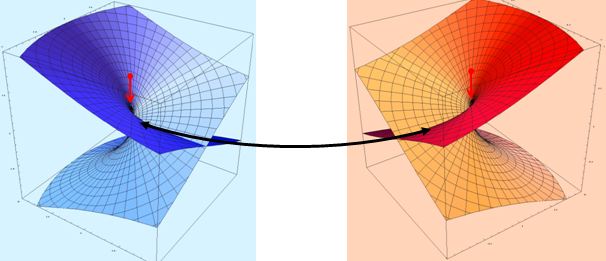
In short, we’ll always be dealing with ‘nice’ functions and then we can show that the s0-called ‘fundamental’ theorem of calculus (i.e. the one that links integrals with derivatives, or – to be somewhat more precise – with the antiderivative of the integrand) also applies to complex-valued valued functions. We have:

f(z)dz = ∫[a, b] f[z(t)]z'(t)dt = F[z(b)] – F[z(a)]

or, more in general: ∫f(z)dz = F(z2) – F(z1)

We also need to note the Cauchy integral formula: if we have a function f that is analytic inside and on a closed contour C, then the value of this function for any point zwill be equal to:

f(z0) = (1/2πi) ∫C [f(z)/(z – z0)]dz

This may look like just another formula, but it’s quite spectacular really: it basically says that the function value of any point zwithin a region enclosed by a curve is completely determined by the values of this function on this curve. Moreover, integrating both sides of this equation repeatedly leads to similar formulas for the derivatives of the first, second, third, and higher order of f: f'(z0) = (1/2πi) ∫[f(z)/(z – z0)2]dz, f”(z0) = (1/2πi) ∫[f(z)/(z – z0)3]dz or, more in general:

f(n)(z0) = (n!/2πi) ∫[f(z)/(z – z0)n+1]dz (n = 1, 2, 3,…)

This formula is also known as Cauchy’s differentiation formula. It is a central theorem in complex analysis really, as it leads to many other interesting theorems, including Gauss’s mean value theorem, Liouville’s theorem, the maximum (and miniumum) modulus principle It is also essential for the next chapter in Brown and Churchill’s course: power series representations of complex functions. However, I will stop here because I guess this ‘introduction’ to complex integrals is already confusing enough.

Post scriptum: I often wondered why one would label one theorem as ‘fundamental’, as it implies that all the other theorems may be important but, obviously, somewhat less fundamental. I checked it out and it turns out there is some randomness here. The Wikipedia article boldly states that the fundamental theorem of algebra (which states that every non-constant single-variable polynomial with complex coefficients has at least one complex roots) is not all that ‘fundamental’ for modern algebra: its title just reflects the fact that there was a time when algebra focused almost exclusively on studying polynomials. The same might be true for the fundamental theorem of arithmetic (i.e. the unique(-prime)-factorization theorem), which states that every integer greater than 1 is either a prime itself or the product of prime numbers, e.g. 1200 = (24)(31)(52).

That being said, the fundamental theorem of calculus is obviously pretty ‘fundamental’ indeed. It leads to many results that are indeed key to understanding and solving problems in physics. One of these is the Divergence Theorem (or Gauss’s Theorem), which states that the outward flux of a vector field through a closed surface is equal to the volume integral of the divergence over the region inside the surface. Huh? Well… Yes. It pops up in any standard treatment of electromagnetism. There are others (like Stokes’ Theorem) but I’ll leave it at that for now, especially because these are theorems involving real-valued integrals.

Riemann surfaces (I)

Pre-scriptum (dated 26 June 2020): the material in this post remains interesting but is, strictly speaking, not a prerequisite to understand quantum mechanics. It’s yet another example of how one can get lost in math when studying or teaching physics. :-/

Original post:

In my previous post on this blog, I once again mentioned the issue of multiple-valuedness. It is probably time to deal with the issue once and for all by introducing Riemann surfaces.

Penrose attaches a lot of importance to these Riemann surfaces (so I must assume they are very important). In contrast, in their standard textbook on complex analysis, Brown and Churchill note that the two sections on Riemann surfaces are not essential reading, as it’s just ‘a geometric device’ to deal with multiple-valuedness. But so let’s go for it.

I already signaled that complex powers w = zc are multiple-valued functions of z and so that causes all kinds of problems, because we can’t do derivatives and integrals and all that. In fact,  zc = ec log z and so we have two components on the right-hand side of this equation. The first one is the (complex) exponential function ec, i.e. the real number e raised to a complex power c. We already know (see the other posts below) that this is a periodic function with (imaginary) period 2πie= ec+2πi eiec = 1ec. While this periodic component of zc is somewhat special (as compared to exponentiation in real analysis), it is not this periodic component but the log z component which is causing the problem of multiple-valuedness. [Of course, it’s true that the problem of multiple-valuedness of the log function is, in fact, a logical consequence of the periodicity of the complex power function, but so you can figure that out yourself I guess.] So let’s look at that log z function once again.

If we write z in its polar form z = reiθ, then log z will be equal to log z = ln r + i(θ+2nπ) with n = 0, ±1, ±2,… Hence, if we write log z in rectangular coordinates (i.e. log z = x + iy) , then we note that the x component (i.e.the real part) of log z is equal to ln r and, hence, x is just an ordinary real number with some fixed value (x = ln r). However, the y component (i.e. the imaginary part of log z) does not have any fixed value: θ is just one of the values, but so are θ+2π and θ – 2π and θ+4π etcetera. In short, we have an infinite number of values for y, and so that’s the issue: what do we do with all these values? It’s not a proper function anymore.

Now, this problem of multiple-valuedness is usually solved by just picking a so-called principal value for log z, which is written as Log z = ln r + iθ, and which is defined by mathematicians by imposing the condition that θ takes a value in the interval between -π and +π only (hence, -π < θ < π). In short, the mathematicians usually just pretend that the 2nπthing doesn’t matter.

However, this is not trivial: as we are imposing these restrictions on the value of Θ, we are actually defining some new single-valued function Log z = ln r + iθ. This Log z function, then, is a complex-valued analytic function with two real-valued components: x = ln r and y = θ. So, while x = ln r can take any value on the real axis, we let θ range from -π to +π only (in the usual counterclockwise or ‘positive’ direction, because that happens to be the convention). If we do this, we get a principal value for zas well: P.V. zc = ec Log z, and so we’ve ‘solved’ the problem of multiple values for the function ztoo in this way.

What we are doing here has a more general significance: we are taking a so-called branch out of a multiple-valued function, in order to make it single-valued and, hence, analytic. To illustrate what is really going on here, let us go back to the original multiple-valued log z = ln r + i(θ+2nπ) function and let’s do away with this integer n by writing log z in the more general form log z = ln r + iΘ. Of course, Θ is equal to θ+2nπ but so we’ll just forget about the θ and, most importantly, about the n, and allow the y component (i.e. the imaginary part) of the imaginary number log z = x + iy to take on any value Θ in the real field. In other words, we treat this angle Θ just like any other ordinary real number. We can now define branches of log z again, but in a more general way: we can pick any value α and say that’s a branch point, as it will define a range α <  Θ < α + 2π in which, once again, we limit the possible values of log z to just one.

For example, if we choose α = -π, then Θ will range from -π to +π and so then we’re back to log z’s principal branch, i.e. Log z. However, let us now, instead of taking this Log z branch, define another branch – we’ll call it the L(z) branch – by choosing α = 0 and, hence, letting Θ range from 0 to 2π. So we have 0 < Θ < 2π and, of course, you’ll note that this range overlaps with the range that is being used for the principal branch of log z (i.e. Log z). It does, and it’s not a problem. Indeed, for values 0 < Θ < π (i.e. the overlapping half-plane) we get the same set of values Log z = L(z) for log z, and so we are talking the same function indeed.

OK. I guess we understand that. So what? Well… The fact is that we have found a very very nice way of illustrating the multiple-valuedness of the log z function and – more importantly – a nice way of ‘solving’ it too. Have a look at the beautiful 3D graph below. It represents the log z function. [Well… Let me be correct and note that, strictly speaking, this particular surface seems to represent the imaginary part of the log z function only, but that’s OK at this stage.]

Riemann_surface_log

Huh? What’s happening here? Well, this spiral surface represents the log z function by ‘gluing’ successive log z branches together. I took the illustration from Wikipedia’s article on the complex logarithm and, to explain how this surface has been constructed, let’s start at the origin, which is located right in the center of this graph, between the yellow-green and the red-pinkish sheets (so the horizontal (x, y) plane we start from is not the bottom of this rectangular prism: you should imagine it at its center).

From there, we start building up the first ‘level’ of this graph (i.e. the yellowish level above the origin) as the angle Θ sweeps around the origin,  in counterclockwise direction, across the upper half of the complex z plane. So it goes from 0 to π and, when Θ crosses the negative side of the real axis, it has added π to its original value. With ‘original value’, I mean its value when it crossed the positive real axis the previous time. As we’ve just started, Θ was equal to 0. We then go from π to 2π, across the lower half of the complex plane, back to the positive real axis: that gives us the first ‘level’ of this spiral staircase (so the vertical distance reflects the value of Θ indeed, which is the imaginary part of log z) . Then we can go around the origin once more, and so Θ goes from 2π to 4π, and so that’s how we get the second ‘level’ above the origin – i.e. the greenish one. But – hey! – how does that work? The angle 2π is the same as zero, isn’t it? And 4π as well, no?Well… No. Not here. It is the same angle in the complex plane, but is not the same ‘angle’ if we’re using it here in this log z = ln r + iΘ function.

Let’s look at the first two levels (so the yellow-green ones) of this 3D graph once again. Let’s start with Θ = 0 and keep Θ fixed at this zero value for a while. The value of log z is then just the real component of this log z = ln r + iΘ function, and so we have log z = ln r + i0 = ln r. This ln r function (or ln(x) as it is written below) is just the (real) logarithmic function, which has the familiar form shown below. I guess there is no need to elaborate on that although I should, perhaps, remind you that r (or x in the graph below) is always some positive real number, as it’s the modulus of a vector – or a vector length if that’s easier to understand. So, while ln(r) can take on any (real-number) value between -∞ and +∞, the argument r is always a positive real number.

375px-Logarithm_derivative

Let us now look at what happens with this log z function as Θ moves from 0 to 2π, first through the upper half of the complex z plane, to Θ = π first, and then further to 2π through the lower half of the complex plane. That’s less easy to visualize, but the illustration below might help. The circles in the plane below (which is the z plane) represent the real part of log z: the parametric representation of these circles is: Re(log z) = ln r = constant. In short, when we’re on these circles, going around the origin, we keep r fixed in the z plane (and, hence, ln r is constant indeed) but we let the argument of z (i.e. Θ) vary from 0 to 2π and, hence, the imaginary part of log z (which is equal to Θ)  will also vary. On the rays it is the other way around: we let r vary but we keep the argument Θ of the complex number z = reiθ fixed. Hence, each ray is the parametric representation of Im(log z) = Θ = constant, so Θ is some fixed angle in the interval 0 < π < 2π.

Logez02

Let’s now go back to that spiral surface and construct the first level of that surface (or the first ‘sheet’ as it’s often referred to) once again. In fact, there is actually more than way to construct such spiral surface: while the spiral ramp above seems to depict the imaginary part of log z only, the vertical distance on the illustration below includes both the real as well as the imaginary part of log z (i.e. Re log z + Im log z = ln r + Θ).

Final graph of log z

Again, we start at the origin, which is, again, the center of this graph (there is a zero (0) marker nearby, but that’s actually just the value of Θ on that ray (Θ = 0), not a marker for the origin point). If we move outwards from the center, i.e. from the origin, on the horizontal two-dimensional z = x + iy = (x,y) plane but along the ray Θ = 0, then we again have log z = ln r + i0 = ln r. So, looking from above, we would see an image resembling the illustration above: we move on a circle around the origin if we keep r constant, and we move on rays if we keep Θ constant. So, in this case, we fix the value of Θ at 0 and move out on a ray indeed and, in three dimensions, the shape of that ray reflects the ln r function. As we then become somewhat more adventurous and start moving around the origin, rather than just moving away from it, the iΘ term in this ln r + iΘ function kicks in and the imaginary part of w (i.e. Im(log z) = y = Θ) grows. To be precise, the value 2π gets added to y with every loop around the origin as we go around it. You can actually ‘measure’ this distance 2π ≈ 6.3 between the various ‘sheets’ on the spiral surface along the vertical coordinate axis (that is if you could read the tiny little figures along the vertical coordinate axis in these 3D graphs, which you probably can’t).

So, by now you should get what’s going on here. We’re looking at this spiral surface and combining both movements now. If we move outwards, away from this center, keeping Θ constant, we can see that the shape of this spiral surface reflects the shape of the ln r function, going to -∞ as we are close to the center of the spiral, and taking on more moderate (positive) values further away from it. So if we move outwards from the center, we get higher up on this surface. We can also see that we also move higher up this surface as we move (counterclockwise) around the origin, rather than away from it. Indeed, as mentioned above, the vertical coordinate in the graph above (i.e. the measurements along the vertical axis of the spiral surface) is equal to the sum of Re(log) and Im(log z). In other words, the ‘z’ coordinate in the Euclidean three-dimensional (x, y, z) space which the illustrations above are using is equal to ln r + Θ, and, hence, as 2π gets added to the previous value of Θ with every turn we’re making around the origin, we get to the next ‘level’ of the spiral, which is exactly 2π higher than the previous level. Vice versa, 2π gets subtracted from the previous value of Θ as we’re going down the spiral, i.e. as we are moving clockwise (or in the ‘negative’ direction as it is aptly termed).

OK. This has been a very lengthy explanation but so I just wanted to make sure you got it. The horizontal plane is the z plane, so that’s all the points z = x + iy = reiθ, and so that’s the domain of the log z function. And then we have the image of all these points z under the log z function, i.e. the points w = ln r + iΘ right above or right below the z points on the horizontal plane through the origin.

Fine. But so how does this ‘solve’ the problem of multiple-valuedness, apart from ‘illustrating’ it? Well… From the title of this post, you’ll have inferred – and rightly so – that the spiral surface which we have just constructed is one of these so-called Riemann surfaces.

We may look at this Riemann surface as just another complex surface because, just like the complex plane, it is a two-dimensional manifold. Indeed, even if we have represented it in 3D, it is not all that different from a sphere as a non-Euclidean two-dimensional surface: we only need two real numbers (r and Θ) to identify any point on this surface and so it’s two-dimensional only indeed (although it has more ‘structure’ than the ‘flat’ complex plane we are used to) . It may help to note that there are other surfaces like this, such as the ones below, which are Riemann surfaces for other multiple-valued functions: in this case, the surfaces below are Riemann surfaces for the (complex) square root function (f(z) = z1/2) and the (complex) arcsin(z) function.

Riemann_surface_sqrtRiemann_surface_arcsin

Nice graphs, you’ll say but, again, what is this all about? These graphs surely illustrate the problem of multiple-valuedness but so how do they help to solve it? Well… The trick is to use such Riemann surface as a domain really: now that we’ve got this Riemann surface, we can actually use it as a domain and then log z (or z1/2 or arcsin(z) if we use these other Riemann surfaces) will be a nice single-valued (and analytic) function for all points on that surface. 

Huh? What? […] Hmm… I agree that it looks fishy: we first use the function itself to construct a ‘Riemannian’ surface, and then we use that very same surface as a ‘Riemannian’ domain for the function itself? Well… Yes. As Penrose puts it: “Complex (analytic) functions have a mind of their own, and decide themselves what their domain should be, irrespective of the region of the complex plane which we ourselves may initially have allotted to it. While we may regard the function’s domain to be represented by the Riemann surface associated with the function, the domain is not given ahead of time: it is the explicit form of the function itself that tells us which Riemann surface the domain actually is.”

I guess we’ll have to judge the value of this bright Riemannian idea (Bernhardt Riemann had many bright ideas during his short lifetime it seems) when we understand somewhat better why we’d need these surfaces for solving physics problems. Back to Penrose. 🙂

Post scriptum: Brown and Churchill seem to approach the matter of how to construct a Riemann surface somewhat less rigorously than I do, as they do not provide any 3D illustrations but just talk about joining thin sheets, by cutting them along the positive half of the real axis and then joining the lower edge of the slit of the first sheet to the upper edge of the slit in the second sheet. This should be done, obviously, by making sure there is no (additional) tearing of the original sheet surfaces and all that (so we’re talking ‘continuous deformations’ I guess), but so that could be done, perhaps, without creating that ‘tornado vortex’ around the vertical axis, which you can clearly see in that gray 3D graph above. If we don’t include the ln r term in the definition of the ‘z’ coordinate in the Euclidean three-dimensional (x, y, z) space which the illustrations above are using, then we’d have a spiral ramp without a ‘hole’ in the center. However, that being said, in order to construct a ‘proper’ two-dimensional manifold, we would probably need some kind function of r in the definition of ‘z’. In fact, we would probably need to write r as some function of Θ in order to make sure we’ve got a proper analytic mapping. I won’t go into detail here (because I don’t know the detail) but leave it to you to check it out on the Web: just check on various parametric representations of spiral ramps: there’s usually (and probably always) a connection between Θ and how, and also how steep, spiral ramps climb around their vertical axis.