The reality of the wavefunction

If you haven’t read any of my previous posts on the geometry of the wavefunction (this link goes to the most recent one of them), then don’t attempt to read this one. It brings too much stuff together to be comprehensible. In fact, I am not even sure if I am going to understand what I write myself. šŸ™‚ [OK. Poor joke. Acknowledged.]

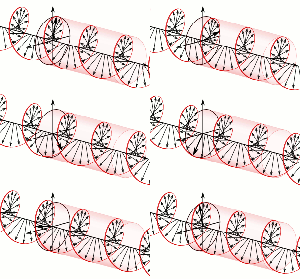
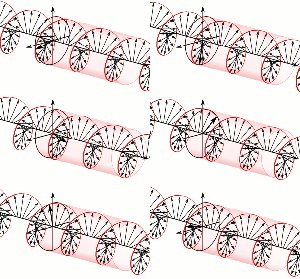
Just to recap the essentials, I part ways with mainstream physicists in regard to theĀ interpretationĀ of the wavefunction. For mainstream physicists, the wavefunction is just some mathematical construct. NothingĀ real. Of course, I acknowledge mainstream physicists have very good reasons for that, but… Well… I believe that, if there is interference, or diffraction, thenĀ somethingĀ must be interfering, or something must be diffracting. I won’t dwell on this because… Well… I have done that too many times already. MyĀ hypothesisĀ is that the wavefunction is, in effect, aĀ rotatingĀ field vector, so it’s just like the electric field vector of a (circularly polarized) electromagnetic wave (illustrated below).

Of course, it must be different, and it is. First, theĀ (physical) dimension of the field vector of the matter-wave must be different. So what is it? Well… I am tempted to associate the real and imaginary component of the wavefunction with a forceĀ per unit massĀ (as opposed to the force per unit charge dimension of the electric field vector). Of course, the newton/kg dimension reduces to the dimension of acceleration (m/s2), so that’s the dimension of a gravitational field.

Second, I also am tempted to think that this gravitational disturbance causes an electron (or any matter-particle) to move about some center, and I believe it does so at the speed of light. In contrast, electromagnetic waves doĀ notĀ involve any mass: they’re just an oscillatingĀ field. Nothing more. Nothing less. Why would I believe there must still be some pointlike particle involved? Well…Ā As Feynman puts it: ā€œWhen you do find the electron some place, the entire charge is there.ā€ (Feynman’sĀ Lectures, III-21-4) So… Well… That’s why.

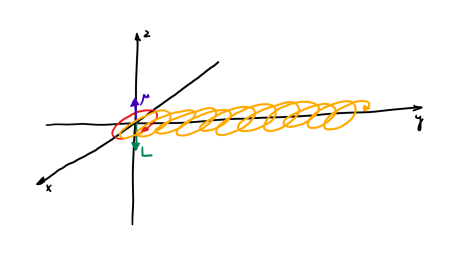
The third difference is one that I thought of only recently: theĀ planeĀ of the oscillation cannotĀ be perpendicular to the direction of motion of our electron, because then we can’t explain the direction of its magnetic moment, which is either up or down when traveling through a Stern-Gerlach apparatus. I am more explicit on that in the mentioned post, so you may want to check there. šŸ™‚

I wish I mastered the software to make animations such as the one above (for which I have to credit Wikipedia), but so I don’t. You’ll just have toĀ imagineĀ it. That’s great mental exercise, so… Well… Just try it. šŸ™‚

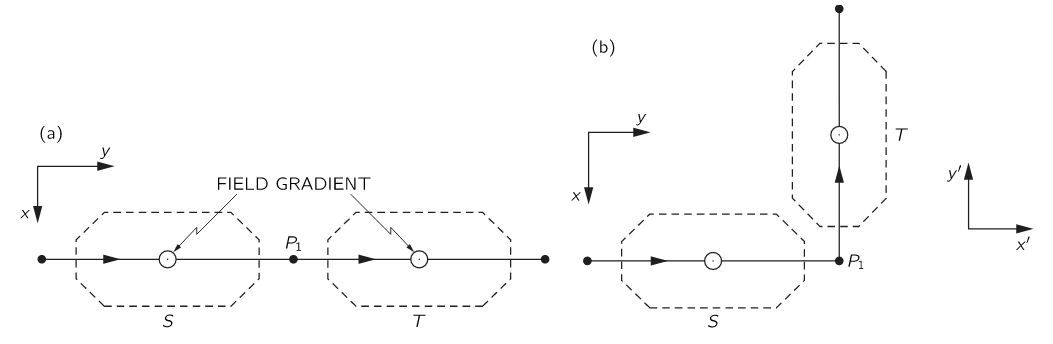
Let’s now think about rotating reference frames and transformations. If theĀ z-direction is the direction along which we measure the angular momentum (or the magnetic moment), then theĀ up-direction will be theĀ positiveĀ z-direction. We’ll also assume theĀ y-direction is the direction of travel of our elementary particle—and let’s just consider an electron here so we’re moreĀ real. šŸ™‚ So we’re in the reference frame that Feynman used to derive the transformation matrices for spin-1/2 particles (or for two-state systems in general). His ‘improved’ Stern-Gerlach apparatus—which I’ll refer to as a beam splitter—illustrates this geometry.

Modified Stern-Gerlach

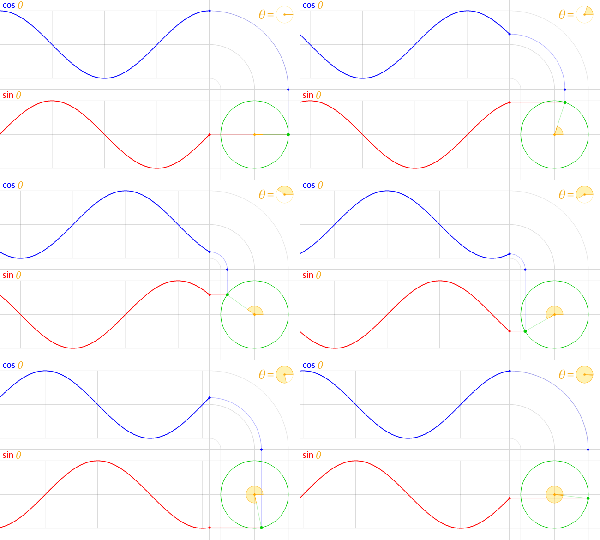
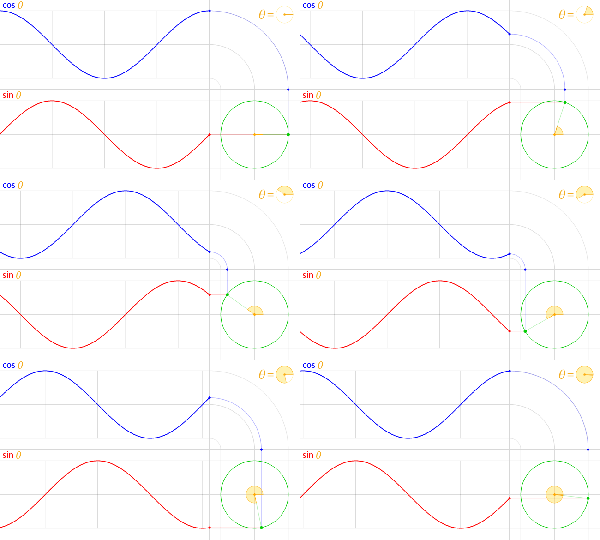
So I think the magnetic moment—or the angular momentum, really—comes from an oscillatory motion in the x– and y-directions. One is theĀ realĀ component (the cosine function) and the other is the imaginary component (the sine function), as illustrated below.Ā Circle_cos_sin

So the crucial difference with the animations above (which illustrate left- and a right-handed polarization respectively) is that we, somehow, need to imagine the circular motion isĀ notĀ in theĀ xz-plane, but in theĀ yz-plane. Now what happens if we change the reference frame?

Well… That depends on what you mean by changing the reference frame. Suppose we’re looking in the positive y-direction—so that’s the direction in which our particle is moving—, then we might imagine how it would look like whenĀ weĀ would make a 180° turn and look at the situation from the other side, so to speak. Now, I did a post on that earlier this year, which you may want to re-read.Ā When we’re looking at the same thing from the other side (from the back side, so to speak), we will want to use our familiar reference frame. So we will want to keep theĀ z-axis as it is (pointing upwards), and we will also want to define theĀ x– andĀ y-axis using the familiar right-hand rule for defining a coordinate frame. So our newĀ x-axis and our newĀ y-axis will the same as the oldĀ x- andĀ y-axes but with the sign reversed. In short, we’ll have the following mini-transformation: (1)Ā z‘ =Ā z, (2) x’ = āˆ’x, and (3) y’ =Ā āˆ’y.

So… Well… If we’re effectively looking at somethingĀ realĀ that was moving along theĀ y-axis, then it will now still be moving along the y’-axis, butĀ in theĀ negativeĀ direction. Hence, our elementary wavefunctionĀ eiĪøĀ = cosĪø +Ā iĀ·sinĪø willĀ transformĀ intoĀ āˆ’cosĪø āˆ’Ā iĀ·sinĪø =Ā āˆ’cosĪø āˆ’Ā iĀ·sinĪø =Ā cosĪø āˆ’Ā iĀ·sinĪø.Ā It’s the same wavefunction. We just… Well… We just changed our reference frame. We didn’t change reality.

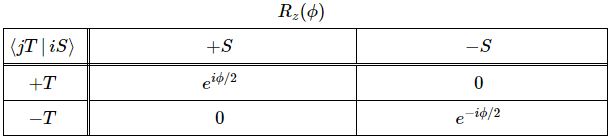
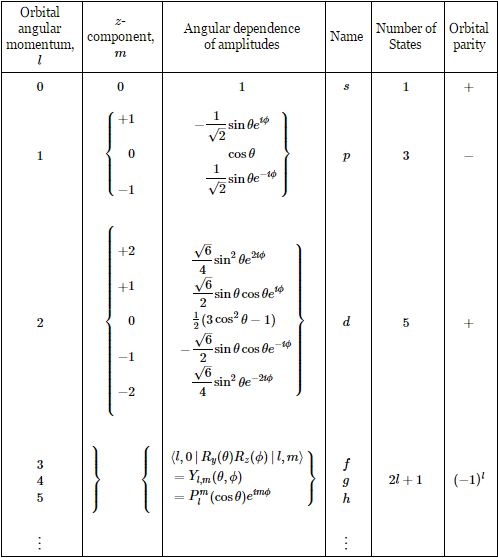
Now you’ll cry wolf, of course, because we just went through all that transformational stuff in our last post. To be specific, we presented the following transformation matrix for a rotation along theĀ z-axis:rotation matrix

Now, if φ is equal to 180° (so that’s Ļ€ in radians), then theseĀ eiφ/2Ā andĀ eāˆ’iφ/2/√2Ā factors areĀ equal toĀ eiĻ€/2Ā =Ā +iĀ andĀ eāˆ’iĻ€/2Ā = āˆ’iĀ respectively. Hence, ourĀ eiĪøĀ = cosĪø +Ā iĀ·sinĪø becomes…

Hey ! Wait a minute ! We’re talking about twoĀ veryĀ different things here, right? TheĀ eiĪøĀ = cosĪø +Ā iĀ·sinĪø is anĀ elementaryĀ wavefunction which, we presume, describes some real-life particle—we talked about an electron with its spin in theĀ up-direction—while these transformation matrices are to be applied to amplitudes describing… Well… Either anĀ up– or a down-state, right?

Right. But… Well… Is itĀ so different, really? Suppose ourĀ eiĪøĀ = cosĪø +Ā iĀ·sinĪø wavefunction describes anĀ up-electron, then we still have to apply thatĀ eiφ/2Ā =Ā eiĻ€/2Ā =Ā +iĀ factor, right? So we get a new wavefunction that will be equal toĀ eiφ/2Ā·eiĪøĀ =Ā eiĻ€/2Ā·eiĪøĀ =Ā +iĀ·eiĪøĀ =Ā iĀ·cosĪø +Ā i2Ā·sinĪø =Ā sinĪø āˆ’Ā iĀ·cosĪø, right? So how can we reconcile that with the cosĪø āˆ’Ā iĀ·sinĪø function we thought we’d find?

We can’t. So… Well… Either my theory is wrong or… Well… Feynman can’t be wrong, can he? I mean… It’s not only Feynman here. We’re talking all mainstream physicists here, right?

Right. But think of it. Our electron in that thought experiment does, effectively, make a turn of 180°, so it is going in the other direction now !Ā That’s more than just… Well… Going around the apparatus and looking at stuff from the other side.

Hmm… Interesting. Let’s think about the difference between theĀ sinĪø āˆ’Ā iĀ·cosĪø andĀ cosĪø āˆ’Ā iĀ·sinĪø functions. First, note that they will give us the same probabilities: the square of the absolute value of both complex numbers is the same. [It’s equal to 1 because we didn’t bother to put a coefficient in front.] Secondly, we should note that the sine and cosine functions are essentially the same. They just differ by a phase factor: cosĪø =Ā sin(Īø + π/2) andĀ āˆ’sinĪø =Ā cos(Īø + π/2). Let’s see what we can do with that. We can write the following, for example:

sinĪø āˆ’Ā iĀ·cosĪø =Ā āˆ’cos(Īø + π/2) āˆ’Ā iĀ·sin(Īø + π/2) =Ā āˆ’[cos(Īø + π/2) +Ā iĀ·sin(Īø + π/2)] =Ā āˆ’eiĀ·(Īø + π/2)

Well… I guess that’s something at least ! The eiĀ·ĪøĀ and āˆ’eiĀ·(Īø + π/2)Ā functions differ by a phase shiftĀ andĀ a minus sign so… Well… That’s what it takes to reverse the direction of an electron. šŸ™‚ Let us mull over that in the coming days. As I mentioned, these more philosophical topics are not easily exhausted. šŸ™‚

Some content on this page was disabled on June 16, 2020 as a result of a DMCA takedown notice from The California Institute of Technology. You can learn more about the DMCA here:

https://wordpress.com/support/copyright-and-the-dmca/

The geometry of the wavefunction, electron spin and the form factor

Pre-script (dated 26 June 2020): Our ideas have evolved into a full-blown realistic (or classical) interpretation of all things quantum-mechanical. In addition, I note the dark force has amused himself by removing some material. So no use to read this. Read my recent papers instead. šŸ™‚

Original post:

Our previous posts showed how a simple geometric interpretation of the elementary wavefunction yielded the (Compton scattering) radius of an elementary particle—for an electron, at least: for the proton, we only got the order of magnitude right—but then a proton is not an elementary particle.Ā We got lots of other interesting equations as well… But… Well… When everything is said and done, it’s that equivalence between theĀ E =Ā mĀ·a2·ω2Ā andĀ E =Ā mĀ·c2Ā relations that we… Well… We need to be moreĀ specific about it.

Indeed, I’ve been ambiguous here and there—oscillatingĀ between various interpretations, so to speak. šŸ™‚ In my own mind, I refer to my unanswered questions, or my ambiguous answers to them, as the form factorĀ problem.Ā So… Well… That explains the title of my post. But so… Well… I do want to be somewhat moreĀ conclusiveĀ in this post. So let’s go and see where we end up. šŸ™‚

To help focus our mind, let us recall the metaphor of the V-2 perpetuum mobile, as illustrated below. With permanently closed valves, the air inside the cylinder compresses and decompresses as the pistons move up and down. It provides, therefore, a restoring force. As such, it will store potential energy, just like a spring, and the motion of the pistons will also reflect that of a mass on a spring: it is described by a sinusoidal function, with the zero point at the center of each cylinder. We can, therefore, think of the moving pistons as harmonic oscillators, just like mechanical springs. Of course, instead of two cylinders with pistons, one may also think of connecting two springs with a crankshaft, but then that’s not fancy enough for me. šŸ™‚

V-2 engine

At first sight, the analogy between our flywheel model of an electron and the V-twin engine seems to be complete: the 90 degree angle of ourĀ V-2 engine makes it possible to perfectly balance the pistons and we may, therefore, think of the flywheel as a (symmetric) rotating mass, whose angular momentum is given by the product of the angular frequency and the moment of inertia: L = ω·I. Of course,Ā the moment of inertia (aka the angular mass) will depend on theĀ formĀ (orĀ shape) of our flywheel:

  1. I = mĀ·a2Ā for a rotating pointĀ mass m or, what amounts to the same, for a circular hoop of mass m and radiusĀ rĀ =Ā a.
  2. For a rotating (uniformly solid)Ā disk, we must add a 1/2 factor: IĀ =Ā mĀ·a2/2.

How can we relate those formulas to the E =Ā mĀ·a2·ω2Ā formula? TheĀ kinetic energy that is being stored in a flywheel is equal EkineticĀ = I·ω2/2, so that is only halfĀ of theĀ E =Ā mĀ·a2·ω2Ā product if we substitute I forĀ I = mĀ·a2. [For a disk, we get a factor 1/4, so that’s even worse!] However, our flywheel model of an electron incorporates potential energy too. In fact, theĀ E =Ā mĀ·a2·ω2Ā formula just adds the (kinetic and potential) energy of two oscillators: we do not really consider the energy in the flywheel itself because… Well… The essence of our flywheel model of an electron is not the flywheel: the flywheel justĀ transfersĀ energy from one oscillator to the other, but so… Well… We don’tĀ includeĀ it in our energy calculations. The essence of our model is thatĀ two-dimensional oscillation whichĀ drivesĀ the electron, and which is reflected in Einstein’sĀ E =Ā mĀ·c2Ā formula.Ā That two-dimensional oscillation—theĀ a2·ω2Ā = c2Ā equation, really—tells us that theĀ resonantĀ (orĀ natural) frequencyĀ of the fabric of spacetime is given by theĀ speed of light—but measured in units ofĀ a. [If you don’t quite get this, re-write theĀ a2·ω2Ā = c2Ā equation as ω = c/a: the radius of our electron appears as a naturalĀ distance unit here.]

Now, we were extremely happy with this interpretation not only because of the key results mentioned above, but also because it has lots of other nice consequences. Think of our probabilities as being proportional to energy densities, for example—and all of the other stuff I describe in my published paper on this. But there is even more on the horizon: a follower of this blog (a reader with an actual PhD in physics, for a change) sent me an article analyzing elementary particles as tiny black holes because… Well… If our electron is effectively spinning around, then its tangential velocity is equal toĀ vĀ =Ā a·ω =Ā c. Now, recent research suggest black holes are also spinning at (nearly) the speed of light. Interesting, right? However, in order to understand what she’s trying to tell me, I’ll first need to get a better grasp of general relativity, so I can relate what I’ve been writing here and in previous posts to the Schwarzschild radiusĀ and other stuff.

Let me get back to the lesson here. In the reference frame of our particle, the wavefunction really looks like the animation below: it has two components, and the amplitude of the two-dimensional oscillation is equal to a, which we calculated asĀ aĀ = ħ·/(mĀ·c) = 3.8616Ɨ10āˆ’13Ā m, so that’s the (reduced) Compton scattering radius of an electron.

Circle_cos_sin

In my original article on this, I used a more complicated argument involving the angular momentum formula, but I now prefer a more straightforward calculation:

cĀ = a·ω =Ā aĀ·E/ħ =Ā aĀ·mĀ·c2/ħ  ⇔ aĀ = ħ/(mĀ·c)

The question is: whatĀ is that rotating arrow? I’ve been vague and not so vague on this. The thing is: I can’tĀ proveĀ anything in this regard. But myĀ hypothesisĀ is that it is, in effect, aĀ rotatingĀ field vector, so it’s just like the electric field vector of a (circularly polarized) electromagnetic wave (illustrated below).

There are a number of crucial differences though:

  1. The (physical) dimension of the field vector of the matter-wave is different: I associate the real and imaginary component of the wavefunction with a force per unit massĀ (as opposed to the force per unit charge dimension of the electric field vector). Of course, the newton/kg dimension reduces to the dimension of acceleration (m/s2), so that’s the dimension of a gravitational field.
  2. I do believe this gravitational disturbance, so to speak, does cause an electron to move about some center, and I believe it does so at the speed of light. In contrast, electromagnetic waves doĀ notĀ involve any mass: they’re just an oscillating field. Nothing more. Nothing less. In contrast, as Feynman puts it: “When you do find the electron some place, the entire charge is there.” (Feynman’s Lectures, III-21-4)
  3. The third difference is one that I thought of only recently: theĀ planeĀ of the oscillation cannotĀ be perpendicular to the direction of motion of our electron, because then we can’t explain the direction of its magnetic moment, which is either up or down when traveling through a Stern-Gerlach apparatus.

I mentioned that in my previous post but, for your convenience, I’ll repeat what I wrote there.Ā The basic idea here is illustrated below (credit for this illustration goes toĀ another blogger on physics). As for the Stern-Gerlach experiment itself, let me refer you to aĀ YouTube videoĀ from theĀ Quantum Made SimpleĀ site.

Figure 1 BohrThe point is: the direction of the angular momentum (and the magnetic moment) of an electron—or, to be precise, its component as measured in the direction of the (inhomogeneous) magnetic field through which our electron isĀ traveling—cannotĀ be parallel to the direction of motion. On the contrary, it isĀ perpendicularĀ to the direction of motion. In other words, if we imagine our electron as spinning around some center, then the disk it circumscribes will compriseĀ the direction of motion.

However, we need to add an interesting detail here. As you know, we don’t really have a precise direction of angular momentum in quantum physics. [If you don’t know this… Well… Just look at one of my many posts on spin and angular momentum in quantum physics.] Now, we’ve explored a number of hypotheses but, when everything is said and done, a rather classical explanation turns out to be the best: an object with an angular momentum JĀ and a magnetic moment μ (I used bold-face because these areĀ vector quantities) that is parallel to some magnetic field B, will notĀ line up, as you’d expect a tiny magnet to do in a magnetic field—or not completely, at least: it willĀ precess. I explained that in another post on quantum-mechanical spin, which I advise you to re-read if you want to appreciate the point that I am trying to make here. That post integrates some interesting formulas, and so one of the things on my ‘to do’ list is to prove that these formulas are, effectively, compatible with the electron model we’ve presented in this and previous posts.

Indeed, when one advances a hypothesis like this, it’s not enough to just sort ofĀ showĀ that the general geometry of the situation makes sense: we also need to show the numbers come out alright. So… Well… Whatever weĀ thinkĀ our electron—or its wavefunction—might be, it needs to be compatible with stuff like the observedĀ precession frequencyĀ of an electron in a magnetic field.

Our model also needs to be compatible with the transformation formulas for amplitudes. I’ve been talking about this for quite a while now, and so it’s about time I get going on that.

Last but not least, those articles that relate matter-particles to (quantum) gravity—such as the one I mentioned above—are intriguing too and, hence, whatever hypotheses I advance here, I’d better check them against those more advanced theories too, right? šŸ™‚ Unfortunately, that’s going to take me a few more years of studying… But… Well… I still have many years ahead—I hope. šŸ™‚

Post scriptum: It’s funny how one’s brain keeps working when sleeping. When I woke up this morning, I thought: “But itĀ isĀ that flywheel that matters, right? That’s the energy storage mechanism and also explains how photons possibly interact with electrons. The oscillatorsĀ driveĀ the flywheel but, without the flywheel, nothing is happening. It is really theĀ transferĀ of energy—through the flywheel—which explains why our flywheel goes round and round.”

It may or may not be useful to remind ourselves of the math in this regard.Ā The motionĀ ofĀ our first oscillator is given by the cos(ω·t) = cosĪø function (Īø = ω·t), and its kinetic energy will be equal toĀ sin2Īø. Hence, the (instantaneous)Ā changeĀ in kinetic energy at any point in time (as a function of the angle Īø) isĀ equal to:Ā d(sin2Īø)/dĪø = 2āˆ™sinĪøāˆ™d(sinĪø)/dĪø = 2āˆ™sinĪøāˆ™cosĪø. Now, the motion of theĀ second oscillator (just look at that second piston going up and down in the V-2 engine) is given by theĀ sinĪø function, which is equal to cos(Īø āˆ’ Ļ€ /2). Hence, its kinetic energy is equal toĀ sin2(Īø āˆ’ Ļ€ /2), and how itĀ changesĀ (as a function of Īø again) is equal toĀ 2āˆ™sin(Īø āˆ’ Ļ€ /2)āˆ™cos(Īø āˆ’ Ļ€ /2) =Ā = āˆ’2āˆ™cosĪøāˆ™sinĪø = āˆ’2āˆ™sinĪøāˆ™cosĪø. So here we have our energy transfer: the flywheel organizes the borrowing and returning of energy, so to speak. That’s the crux of the matter.

So… Well… WhatĀ if the relevant energy formula isĀ E =Ā mĀ·a2·ω2/2 instead ofĀ E =Ā mĀ·a2·ω2? What are the implications? Well… We get a √2 factor in our formula for the radiusĀ a, as shown below.

square 2

Now that isĀ notĀ so nice. For the tangential velocity, we getĀ vĀ =Ā a·ω = √2Ā·c. This is alsoĀ notĀ so nice. How can we save our model? I am not sure, but here I am thinking of the mentioned precession—theĀ wobbling of our flywheel in a magnetic field. Remember we may think of Jz—the angular momentum or, to be precise, its component in theĀ z-direction (the direction in which weĀ measureĀ it—as the projection of theĀ realĀ angular momentumĀ J. Let me insert Feynman’s illustration here again (Feynman’s Lectures, II-34-3), so you get what I am talking about.

precession

Now, all depends on the angle (Īø) betweenĀ JzĀ andĀ J, of course. We did a rather obscure post on these angles, but the formulas there come in handy now. Just click the link and review it if and when you’d want to understand the following formulas for theĀ magnitudeĀ of theĀ presumedĀ actualĀ momentum:magnitude formulaIn this particular case (spin-1/2 particles),Ā j is equal to 1/2 (in units of ħ, of course). Hence,Ā JĀ is equal to √0.75Ā ā‰ˆ 0.866. Elementary geometry then tells us cos(Īø) =Ā (1/2)/√(3/4) =Ā  = 1/√3. Hence,Ā ĪøĀ ā‰ˆ 54.73561°. That’s a big angle—larger than the 45° angle we had secretly expected because… Well… The 45° angle has that √2 factor in it:Ā cos(45°) =Ā sin(45°) = 1/√2.

Hmm… As you can see, there is no easy fix here. Those damn 1/2 factors! They pop up everywhere, don’t they? šŸ™‚ We’ll solve the puzzle. One day… But not today, I am afraid. I’ll call it the form factor problem… Because… Well… It sounds better than the 1/2 or √2 problem, right? šŸ™‚

Note: If you’re into quantum math, you’ll noteĀ aĀ = ħ/(mĀ·c) is theĀ reducedĀ Compton scattering radius. The standard Compton scattering radius is equal toĀ aĀ·2π = (2π·ħ)/(mĀ·c) =Ā  h/(mĀ·c) = h/(mĀ·c). It doesn’t solve the √2 problem. Sorry. The form factor problem. šŸ™‚

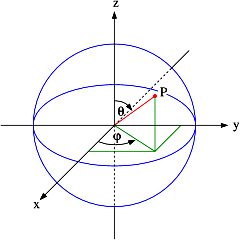
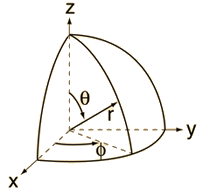
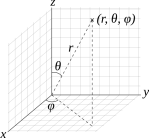
To be honest, I finished my published paper on all of this with a suggestion that, perhaps, we should think of twoĀ circularĀ oscillations, as opposed to linear ones. Think of a tiny ball, whose center of mass stays where it is, as depicted below. Any rotation – around any axis – will be some combination of a rotation around the two other axes. Hence, we may want to think of our two-dimensionalĀ oscillation as an oscillation of a polar and azimuthal angle. It’s just a thought but… Well… I am sure it’s going to keep me busy for a while. šŸ™‚polar_coordsThey are oscillations, still, so I am not thinking ofĀ twoĀ flywheels that keep going around in the same direction. No. More like a wobbling object on a spring. Something like the movement of a bobblehead on a spring perhaps. šŸ™‚bobblehead

Some content on this page was disabled on June 17, 2020 as a result of a DMCA takedown notice from Michael A. Gottlieb, Rudolf Pfeiffer, and The California Institute of Technology. You can learn more about the DMCA here:

https://wordpress.com/support/copyright-and-the-dmca/
Some content on this page was disabled on June 17, 2020 as a result of a DMCA takedown notice from Michael A. Gottlieb, Rudolf Pfeiffer, and The California Institute of Technology. You can learn more about the DMCA here:

https://wordpress.com/support/copyright-and-the-dmca/

Electron spin and the geometry of the wavefunction

In our previous posts, we interpreted the elementary wavefunction ψ = aĀ·eāˆ’iāˆ™ĪøĀ = aĀ·cosĪø āˆ’Ā iĀ·aĀ·sinĪøĀ as a two-dimensional oscillation in spacetime. In addition to assuming the two directions of the oscillation were perpendicular to each other, we also assumed they were perpendicular to the direction of motion. While the first assumption is essential in our interpretation, the second assumption is solely based on an analogy with a circularly polarized electromagnetic wave. We also assumed the matter wave could be right-handed as well as left-handed (as illustrated below), and that these two physical possibilities corresponded to the angular momentum being equal to plus or minus ħ/2 respectively.


This allowed us to derive the Compton scattering radius of an elementary particle. Indeed, we interpreted the rotating vector as aĀ resultant vector, which we get byĀ addingĀ the sine and cosine motions, which represent the real and imaginary components of our wavefunction.Ā The energy of this two-dimensional oscillation isĀ twiceĀ the energy of aĀ one-dimensional oscillator and, therefore, equal toĀ E =Ā mĀ·a2·ω2. Now, the angular frequency is given by ω = E/ħ and E must, obviously, also be equal to E = mĀ·c2. Substitition and re-arranging the terms gives us the Compton scattering radius:

Compton radius

The value given above is the (reduced) Compton scattering radius for anĀ electron. For a proton, we get a value of aboutĀ 2.1Ɨ10āˆ’16Ā m, which is about 1/4 of theĀ radius of a proton as measured in scattering experiments. Hence, for a proton, our formula does not give us the exact (i.e. experimentally verified) value but it does give us the correct order of magnitude—which is fine because we know a proton is not an elementary particle and, hence, the motion of its constituent parts (quarks) is… Well… It complicates the picture hugely.

If we’d presume the electron charge would, effectively, be rotating about the center, then its tangential velocity is given byĀ vĀ =Ā a·ω =Ā [ħ·/(mĀ·c)]Ā·(E/ħ) =Ā c, which is yet another wonderful implication of our hypothesis. Finally, theĀ cĀ =Ā a·ω formula allowed us to interpret the speed of light as theĀ resonant frequencyĀ of the fabric of space itself, as illustrated when re-writing this equality as follows:

Einstein

This gave us a natural and forceful interpretation of Einstein’s mass-energy equivalence formula: the energy in the E =Ā mĀ·c2Ā· equation is, effectively, a two-dimensional oscillation of mass.

However, while toying with this and other results (for example, we may derive a Poynting vector and show probabilities are, effectively, proportional to energy densities), I realize theĀ plane of our two-dimensional oscillation cannotĀ be perpendicular to the direction of motion of our particle. In fact, the direction of motion must lie in the same plane. This is a direct consequence of theĀ directionĀ of the angular momentum as measured by, for example, the Stern-Gerlach experiment. The basic idea here is illustrated below (credit for this illustration goes to another blogger on physics). As for the Stern-Gerlach experiment itself, let me refer you to a YouTube video from theĀ Quantum Made SimpleĀ site.

Figure 1 BohrThe point is: the direction of the angular momentum (and the magnetic moment) of an electron—or, to be precise, its component as measured in the direction of the (inhomogenous) magnetic field through which our electron is traveling—cannotĀ be parallel to the direction of motion. On the contrary, it is perpendicular to the direction of motion. In other words, if we imagine our electron as some rotating disk or a flywheel, then it will actuallyĀ compriseĀ the direction of motion.

What are the implications? I am not sure. I will definitely need to review whatever I wrote about theĀ de BroglieĀ wavelength in previous posts. We will also need to look at those transformations of amplitudes once again. Finally, we will also need to relate this to the quantum-mechanical formulas for the angular momentum and the magnetic moment.

Post scriptum: As in previous posts, I need to mention one particularity of our model. When playing with those formulas, we contemplated two different formulas for the angular mass: one is the formula for a rotating mass (I = mĀ·r2/2), and the other is the one for a rotating mass (I = mĀ·r2). The only difference between the two is a 1/2 factor, but it turns out we need it to get a sensical result. For a rotating mass, the angular momentum is equal to the radius times the momentum, so that’s the radius times the mass times the velocity: L = mĀ·vĀ·r. [See also Feynman, Vol. II-34-2, in this regard)] Hence, for our model, we get L =Ā mĀ·vĀ·rĀ =Ā mĀ·cĀ·a =Ā mĀ·c·ħ/(mĀ·c) = ħ. Now, weĀ knowĀ it’s equal to ±ħ/2, so we need that 1/2 factor in the formula.

Can we relate this 1/2 factor to theĀ g-factor for the electron’s magnetic moment, which is (approximately) equal to 2? Maybe. We’d need to look at the formula for a rotating charged disk. That’s for a later post, however. It’s been enough for today, right? šŸ™‚

I would just like to signal another interesting consequence of our model. If we would interpret the radius of our disk (a)—so that’s the Compton radius of our electron, as opposed to the Thomson radius—as theĀ uncertainty in the position of our electron, then ourĀ L =Ā mĀ·vĀ·rĀ =Ā mĀ·cĀ·aĀ = pĀ·a = ħ/2 formula as a very particular expression of the Uncertainty Principle:Ā pĀ·Ī”x= ħ/2. Isn’t that just plainĀ nice? šŸ™‚

Some content on this page was disabled on June 17, 2020 as a result of a DMCA takedown notice from Michael A. Gottlieb, Rudolf Pfeiffer, and The California Institute of Technology. You can learn more about the DMCA here:

https://wordpress.com/support/copyright-and-the-dmca/

Re-visiting the Complementarity Principle: the field versus the flywheel model of the matter-wave

Note: I have published a paper that is very coherent and fully explains what’s going on.Ā There is nothing magical about it these things. Check it out: The Meaning of the Fine-Structure Constant. No ambiguity. No hocus-pocus.

Jean Louis Van Belle, 23 December 2018

Original post:

This post is a continuation of the previous one: it is just going to elaborate the questions I raised in the post scriptum of that post. Let’s first review the basics once more.

The geometry of the elementary wavefunction

In the reference frame of the particle itself, the geometry of the wavefunction simplifies to what is illustrated below: an oscillation in two dimensions which, viewed together, form a plane that would be perpendicular to the direction of motion—but then our particle doesn’t move in its own reference frame, obviously. Hence, we could be looking at our particle from any direction and we should, presumably, see a similar two-dimensional oscillation. That is interesting because… Well… If we rotate this circle around its center (in whatever direction we’d choose), we get a sphere, right? It’s only when it starts moving, that it loses its symmetry. Now, that isĀ very intriguing, butĀ let’s think about that later.

Circle_cos_sin

Let’s assume we’re looking at it from some specificĀ direction. ThenĀ we presumably have some charge (the green dot) moving about some center, and its movement can be analyzed as the sum of two oscillations (the sine and cosine) which represent the real and imaginary component of the wavefunction respectively—as we observe it, so to speak. [Of course, you’ve been told you can’t observe wavefunctions so… Well… You should probably stop reading this. :-)] We write:

ψ = =Ā aĀ·eāˆ’iāˆ™ĪøĀ =Ā aĀ·eāˆ’iāˆ™EĀ·t/ħ = aĀ·cos(āˆ’Eāˆ™t/ħ) + iĀ·aĀ·sin(āˆ’Eāˆ™t/ħ) = aĀ·cos(Eāˆ™t/ħ) āˆ’ iĀ·aĀ·sin(Eāˆ™t/ħ)Ā 

So that’s the wavefunction in the reference frame of the particle itself. When we think of it as moving in some direction (so relativity kicks in), we need to add the pĀ·x term to the argument (Īø = EĀ·t āˆ’Ā pāˆ™x). It is easy to show this term doesn’t change the argument (Īø), because we also get a different value for the energy in the new reference frame:Ā EvĀ = γ·E0Ā and so… Well… I’ll refer you to my post on this, in which I show the argument of the wavefunction is invariant under a Lorentz transformation: the way EvĀ and pvĀ and, importantly,Ā the coordinates xĀ and tĀ relativisticallyĀ transform ensures the invariance.

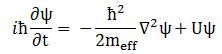
In fact, I’ve always wanted to readĀ de Broglie‘sĀ original thesis because I strongly suspect he saw that immediately. If you click this link, you’ll find an author who suggests the same. Having said that, I should immediately add this doesĀ notĀ imply there is no need for a relativistic waveĀ equation: the wavefunction is aĀ solutionĀ for the wave equation and, yes, I am the first to note the Schrƶdinger equation has some obvious issues, which I briefly touch upon in one of my other posts—and which is why Schrƶdinger himself and other contemporaries came up with a relativistic wave equation (Oskar Klein and Walter Gordon got the credit but others (including Louis de Broglie) also suggested a relativistic wave equation when Schrƶdinger published his). In my humble opinion, the key issue is notĀ that Schrƶdinger’s equation is non-relativistic. It’s that 1/2 factor again but… Well… I won’t dwell on that here. We need to move on. So let’s leave the waveĀ equationĀ for what it is and goĀ back to our wavefunction.

You’ll note the argument (orĀ phase) of our wavefunction moves clockwise—orĀ counterclockwise, depending on whether you’re standing in front of behind the clock. Of course,Ā NatureĀ doesn’t care about where we stand or—to put it differently—whether we measure time clockwise, counterclockwise, in the positive, the negative or whatever direction. Hence, I’ve argued we can have both left- as well as right-handed wavefunctions, as illustrated below (for p ≠ 0). Our hypothesis is that these two physical possibilities correspond to the angular momentum of our electron being eitherĀ positive or negative: JzĀ =Ā +ħ/2 or, else, JzĀ =Ā āˆ’Ä§/2. [If you’ve read a thing or two about neutrinos, then… Well… They’re kinda special in this regard: they have no charge and neutrinos and antineutrinos are actually definedĀ by their helicity. But… Well… Let’s stick to trying to describing electrons for a while.]

The line of reasoning that we followed allowed us toĀ calculateĀ the amplitudeĀ a. We got a result that tentatively confirms we’re on the right track with our interpretation: we found thatĀ aĀ = ħ/meĀ·c, so that’s theĀ Compton scattering radiusĀ of our electron. All good ! But we were still a bit stuck—orĀ ambiguous, I should say—on what the components of our wavefunction actuallyĀ are. Are we really imagining the tip of that rotating arrow is a pointlike electric chargeĀ spinning around the center? [Pointlike or… Well… Perhaps we should think of theĀ ThomsonĀ radius of the electron here, i.e. the so-calledĀ classical electron radius, which isĀ equal to the Compton radius times the fine-structure constant:Ā rThomsonĀ = α·rComptonĀ ā‰ˆ 3.86Ɨ10āˆ’13/137.]

So that would be the flywheel model.

In contrast, we may also think the whole arrow is some rotatingĀ field vector—something like the electric field vector, with the same or some other physicalĀ dimension, like newton per charge unit, or newton per mass unit? So that’s the fieldĀ model. Now, theseĀ interpretations may or may not be compatible—orĀ complementary, I should say. I sure hopeĀ they are but… Well… What can we reasonably say about it?

Let us first note that the flywheel interpretation has a very obvious advantage, because it allows us to explain theĀ interactionĀ between a photon and an electron, as I demonstrated in my previous post: the electromagnetic energy of the photon willĀ driveĀ the circulatory motion of our electron… So… Well… That’s a nice physicalĀ explanation for the transfer of energy.Ā However, when we think about interference or diffraction, we’re stuck: flywheels don’t interfere or diffract. Only waves do. So… Well… What to say?

I am not sure, but here I want to think some more by pushing the flywheelĀ metaphorĀ to its logical limits. Let me remind you of what triggered it all: it was theĀ mathematicalĀ equivalence of the energy equation for an oscillator (E =Ā mĀ·a2·ω2) and Einstein’s formula (E =Ā mĀ·c2), which tells us energy and mass areĀ equivalentĀ but… Well… They’re not the same. So whatĀ areĀ they then? WhatĀ isĀ energy, and whatĀ isĀ mass—in the context of these matter-waves that we’re looking at. To be precise, theĀ E =Ā mĀ·a2·ω2Ā formula gives us the energy ofĀ twoĀ oscillators, so we need aĀ two-spring model which—because I love motorbikes—I referred to as my V-twin engine model, but it’s not anĀ engine, really: it’s two frictionless pistons (or springs) whose direction of motion is perpendicular to each other, so they are in a 90° degree angle and, therefore, their motion is, effectively, independent. In other words: they will not interfereĀ with each other. It’s probably worth showing the illustration just one more time. And… Well… Yes. I’ll also briefly review the math one more time.

V-2 engine

If the magnitude of the oscillation is equal to a, then the motion of these piston (or the mass on a spring) will be described by x = aĀ·cos(ω·t + Ī”).Ā Needless to say, Ī” is just a phase factor which defines our t = 0 point, and ω is theĀ naturalĀ angular frequency of our oscillator. Because of the 90° angle between the two cylinders, Ī” would be 0 for one oscillator, and –π/2 for the other. Hence, the motion of one piston is given by x = aĀ·cos(ω·t), while the motion of the other is given by x = aĀ·cos(ω·t–π/2) = aĀ·sin(ω·t). TheĀ kinetic and potential energy of one oscillator – think of one piston or one spring only – can then be calculated as:

  1. K.E. = T = mĀ·v2/2 =Ā (1/2)Ā·m·ω2Ā·a2Ā·sin2(ω·t + Ī”)
  2. P.E. = U = kĀ·x2/2 = (1/2)Ā·kĀ·a2Ā·cos2(ω·t + Ī”)

The coefficient k in the potential energy formula characterizes the restoring force: F = āˆ’kĀ·x. From the dynamics involved, it is obvious that k must be equal to m·ω2. Hence, the total energy—forĀ oneĀ piston, or one spring—is equal to:

E = T + U = (1/2)Ā· m·ω2Ā·a2Ā·[sin2(ω·t + Ī”) + cos2(ω·t + Ī”)] = mĀ·a2·ω2/2

Hence, adding the energy of the two oscillators, we have a perpetuum mobile storing an energy that is equal to twice this amount: E = mĀ·a2·ω2. It is a great metaphor. Somehow, in this beautiful interplay between linear and circular motion, energy is borrowed from one place and then returns to the other, cycle after cycle. However, we still have to prove this engine is, effectively, a perpetuum mobile: we need to prove the energy that is being borrowed or returned by one piston is the energy that is being returned or borrowed by the other. That is easy to do, butĀ I won’t bother you with that proof here: you can double-check it in the referenced post or – more formally – in an article I posted on viXra.org.

It is all beautiful, and the key question is obvious: if we want to relate theĀ E =Ā mĀ·a2·ω2Ā and E =Ā mĀ·c2Ā formulas, we need to explain why we could, potentially, writeĀ cĀ asĀ cĀ =Ā a·ω =Ā a·√(k/m). We’ve done that already—to some extent at least. TheĀ tangentialĀ velocity of a pointlike particle spinning around some axis is given byĀ vĀ =Ā r·ω. Now, the radiusĀ rĀ is given byĀ aĀ = ħ/(mĀ·c), and ω = E/ħ =Ā mĀ·c2/ħ, soĀ vĀ is equal to toĀ v = [ħ/(mĀ·c)]Ā·[mĀ·c2/ħ] =Ā c. Another beautiful result, but what does itĀ mean? We need to think about theĀ meaning of the ω = √(k/m) formula here. In the mentioned article, we boldly wrote that the speed of light is to be interpreted as theĀ resonantĀ frequency of spacetime, but so… Well… What do we reallyĀ meanĀ by that? Think of the following.

Einstein’s E = mc2 equation implies the ratio between the energy and the mass of any particle is always the same:

F3

This effectively reminds us of the ω2 = C1/L or ω2 = k/mĀ formula for harmonic oscillators.Ā The key difference is that the ω2= C1/L and ω2 = k/m formulas introduce two (or more) degrees of freedom. In contrast, c2= E/m for any particle, always. However, that is exactly the point: we can modulate the resistance, inductance and capacitance of electric circuits, and the stiffness of springs and the masses we put on them, but we live inĀ oneĀ physical space only:Ā ourĀ spacetime. Hence, the speed of light (c) emerges here as the defining property ofĀ spacetime: the resonant frequency, so to speak. We have no further degrees of freedom here.

Let’s think about k. [I am not trying to avoid the ω2= 1/LC formula here. It’s basically the same concept:Ā the ω2= 1/LC formula gives us the natural or resonant frequency for a electric circuit consisting of a resistor, an inductor, and a capacitor. Writing the formula as ω2= Cāˆ’1/L introduces the concept of elastance, which is the equivalent of the mechanical stiffness (k) of a spring, so… Well… You get it, right? The ω2= C1/L and ω2 = k/m sort of describe the same thing: harmonic oscillation. It’s just… Well… Unlike the ω2= C1/L, the ω2 = k/m isĀ directlyĀ compatible with our V-twin engine metaphor, because it also involves physical distances, as I’ll show you here.] TheĀ kĀ in the ω2 = k/m is, effectively, the stiffness of the spring. It isĀ definedĀ by Hooke’s Law, which states thatĀ the force that is needed to extend or compress a springĀ by some distanceĀ xĀ Ā is linearly proportional to that distance, so we write: F = kĀ·x.

NowĀ that is interesting, isn’t it? We’re talkingĀ exactlyĀ the same thing here: spacetime is, presumably,Ā isotropic, so it should oscillate the same in any direction—I am talking those sine and cosine oscillations now, but inĀ physicalĀ space—so there is nothing imaginary here: all is realĀ or… Well… As real as we can imagine it to be. šŸ™‚

We can elaborate the point as follows. TheĀ F = kĀ·xĀ equation implies k is a forceĀ per unit distance: k = F/x. Hence, its physical dimension isĀ newton per meterĀ (N/m). Now, theĀ xĀ in this equation may be equated to theĀ maximumĀ extension of our spring, or theĀ amplitudeĀ of the oscillation, so that’s the radiusĀ rĀ =Ā aĀ in the metaphor we’re analyzing here. NowĀ look at how we can re-write theĀ cĀ =Ā a·ω =Ā a·√(k/m) equation:

Einstein

In case you wonder about the E =Ā FĀ·a substitution: just remember thatĀ energyĀ is force times distance. [Just do a dimensional analysis: you’ll see it works out.] So we have aĀ spectacular result here, for several reasons. The first, and perhaps most obvious reason, is that we can actuallyĀ deriveĀ Einstein’s E = mĀ·c2Ā formula from ourĀ flywheel model. Now, thatĀ isĀ truly glorious, I think. However, even more importantly, this equation suggests we doĀ not necessarilyĀ need to think of some actual mass oscillating up and down and sideways at the same time: the energy in the oscillation can be thought of aĀ forceĀ acting over some distance, regardless of whether or not it is actually acting on a particle.Ā Now,Ā thatĀ energy will have anĀ equivalentĀ mass which is—or should be, I’d say… Well… The mass of our electron or, generalizing, the mass of the particle we’re looking at.

Huh?Ā Yes. In case you wonder what I am trying to get at, I am trying to convey the idea that theĀ two interpretations—the field versus the flywheel model—are actually fullyĀ equivalent, orĀ compatible, if you prefer that term. In Asia, they would say: they are the “same-same but different” šŸ™‚ but, using the language that’s used when discussing the Copenhagen interpretation of quantum physics, we should actually say the two models are complementary.

You may shrug your shoulders but… Well… It is a very deep philosophical point, really. šŸ™‚ As far as I am concerned, I’ve never seen a better illustration of the (in)famous Complementarity Principle in quantum physics because… Well… It goes much beyond complementarity. This is aboutĀ equivalence. šŸ™‚ So it’s just like Einstein’s equation. šŸ™‚

Post scriptum: If you read my posts carefully, you’ll remember I struggle with those 1/2 factors here and there. Textbooks don’t care about them. For example, when deriving the size of an atom, or theĀ RydbergĀ energy, even Feynman casually writes that “we need not trust our answer [to questions like this] within factors like 2, π, etcetera.” Frankly, that’s disappointing. Factors like 2, 1/2, Ļ€ or 2Ļ€ are pretty fundamental numbers, and so they need an explanation. So… Well… I do loose sleep over them. :-/ Let me advance some possible explanation here.

As for Feynman’s model, and the derivation of electron orbitals in general, I think it’s got to do with the fact that electrons do want to pair up when thermal motion doesĀ not come into play: think of the Cooper pairs we use to explain superconductivity (so that’s the BCS theory). The 1/2 factorĀ in Schrƶdinger’s equation also has weird consequences (when you plug in the elementary wavefunction and do the derivatives, you get a weird energy concept: E = mĀ·v2, to be precise). This problem may also be solved when assuming we’re actually calculating orbitals for aĀ pairĀ of electrons, rather than orbitals for just one electron only. [We’d getĀ twiceĀ the mass (and, presumably, the charge, so… Well… It might work—but I haven’t done it yet. It’s on my agenda—as so many other things, but I’ll get there… One day. :-)]

So… Well… Let’s get back to the lesson here. In this particular context (i.e. in the context of trying to find some reasonable physicalĀ interpretation of the wavefunction), you may or may not remember (if not, check my post on it) ‘ll remember I had to use theĀ I = mĀ·r2/2 formula for the angular momentum, as opposed to the I = mĀ·r2Ā formula.Ā I = mĀ·r2/2 (with the 1/2 factor) gives us the angular momentum of aĀ diskĀ with radiusĀ r, as opposed to aĀ pointĀ mass going around some circle with radiusĀ r. I noted that “the addition of this 1/2 factor may seem arbitrary”—and it totallyĀ is, of course—but so it gave us the result we wanted: theĀ exactĀ (Compton scattering)Ā radius of our electron.

Now, the arbitraryĀ 1/2 factor may or may be explained as follows. In the field model of our electron, the force is linearly proportional to the extension or compression. Hence, to calculate the energy involved in stretching it from x = 0 toĀ xĀ =Ā a, we need to calculate it as the following integral:

half factor

So… Well… That will give you some food for thought, I’d guess. šŸ™‚ If it racks your brain too much—or if you’re too exhausted by this point (which is OK, because it racks my brain too!)—just note we’ve also shown that the energy is proportional to theĀ squareĀ of the amplitude here, so that’s a nice result as well… šŸ™‚

Talking food for thought, let me make one final point here. TheĀ c2Ā = a2Ā·k/m relation implies a value for k which is equal to k = mĀ·c2/a = E/a. What does this tell us? In one of our previous posts, we wrote that the radius of our electron appeared as aĀ naturalĀ distance unit. We wrote that because of another reason: the remark was triggered by the fact that we can write theĀ c/ω ratioĀ asĀ c/ω =Ā a·ω/ω =Ā a. This implies the tangential and angular velocity in our flywheel model of an electron would be the same if we’d measure distance in units ofĀ a. Now, the E = aĀ·k =Ā aĀ·F/xĀ (just re-writing…) implies that the force is proportional to the energy— F = (x/a)Ā·E — and the proportionality coefficient is… Well…Ā x/a. So that’s the distance measured in units ofĀ a.Ā So… Well… Isn’t that great? The radius of our atom appearing as aĀ naturalĀ distance unit does fit in nicely with ourĀ geometricĀ interpretation of the wavefunction, doesn’t it? I mean…Ā Do I need to say more?

I hope not because… Well… I can’t explain any better for the time being. I hope I sort of managed to convey the message. Just to make sure, in case you wonder what I was trying to do here, it’s the following: I told youĀ cĀ appears as a resonant frequency of spacetime and, in this post, I tried to explain what that reallyĀ means. I’d appreciate if you could let me know if you got it. If not, I’ll try again. šŸ™‚ When everything is said and done, one only truly understands stuff when one is able to explain it to someone else, right? šŸ™‚ Please do think of more innovative or creative ways if you can! šŸ™‚

OK. That’s it but… Well…Ā I should, perhaps, talk about one other thing here. It’s what I mentioned in the beginning of this post: this analysis assumes we’re looking at our particle from someĀ specificĀ direction. It could be anyĀ direction but… Well… It’sĀ someĀ direction. We have noĀ depth in our line of sight, so to speak. That’s really interesting, and I should do some more thinking about it. Because the direction could beĀ anyĀ direction, our analysis is valid for any direction. Hence, ifĀ our interpretation would happen to be some true—and that’s a bigĀ if, of course—thenĀ our particle has to be spherical, right? Why? Well… Because we see this circular thing from any direction, so itĀ hasĀ to be a sphere, right?

Well… Yes. But then… Well… While that logic seems to beĀ incontournable, as they say in French, I am somewhat reluctant to accept it at face value. Why? I am not sure. Something inside of me says I should look at the symmetries involved… I mean the transformation formulas for wavefunction when doing rotations and stuff. So… Well… I’ll be busy with that for a while, I guess. 😦

Post scriptum 2: You may wonder whether this line of reasoning would also work for a proton. Well… Let’s try it. Because its mass is so much larger than that of an electron (about 1835 times), theĀ aĀ = ħ/(mĀ·c) formula gives a muchĀ smaller radius: 1835 timesĀ smaller, to be precise, so that’s around 2.1Ɨ10āˆ’16Ā m, which is about 1/4 of the so-calledĀ chargeĀ radius of a proton, as measured by scattering experiments. So… Well… We’re not that far off, but… Well… We clearly need some more theory here. Having said that, a proton isĀ notĀ an elementary particle, so its mass incorporates other factors than what we’re considering here (two-dimensional oscillations).

The flywheel model of an electron

One of my readers sent me the following question on the geometric (or evenĀ physical) interpretation of the wavefunction that I’ve been offering in recent posts:

Does this mean that the wave function is merely describing excitations in a matter field; or is this unsupported?

My reply wasĀ veryĀ short:Ā “Yes. In fact, we can think of a matter-particle as a tiny flywheel that stores energy.”

However, I realize this answer answers the question only partially. Moreover, I now feel I’ve been quite ambiguous in my description. When looking at the geometry of the elementary wavefunction (see the animation below, which shows us a left- and right-handed wave respectively), two obvious but somewhat conflicting interpretations readily come to mind:

(1) One is that the components of the elementary wavefunction represent an oscillation (in two dimensions) of aĀ field. We may call it aĀ matterĀ field (yes, think of the scalar Higgs field here), but we could also think of it as an oscillation of theĀ spacetime fabric itself: aĀ tiny gravitational wave, in effect. All we need to do here is to associate the sine and cosine component with aĀ physicalĀ dimension. The analogy here is the electromagnetic field vector, whose dimension isĀ forceĀ per unitĀ chargeĀ (newton/coulomb). So we may associate the sine and cosine components of the wavefunction with, say, theĀ force per unitĀ massĀ dimension (newton/kg) which, using Newton’s Law (F = mĀ·a) reduces to the dimension ofĀ accelerationĀ (m/s2), which is the dimension of gravitational fields.Ā I’ll refer to this interpretation as theĀ fieldĀ interpretation of the matter wave (or wavefunction).

(2) The other interpretation is what I refer to as theĀ flywheelĀ interpretation of the electron. If you google this, you won’t find anything. However, you will probably stumble upon the so-calledĀ ZitterbewegungĀ interpretation of quantum mechanics, which is a more elaborate theory based on the same basic intuition. TheĀ ZitterbewegungĀ (a term which was coined by Erwin Schrƶdinger himself, and which you’ll see abbreviated as zbw) is, effectively, a local circulatory motion of the electron, which is presumed to be the basis of the electron’sĀ spin and magnetic moment. All that I am doing, is… Well… I think I do push the envelope of this interpretation quite a bit. šŸ™‚

The first interpretation implies our rotating arrow is, effectively, someĀ field vector. In contrast, the second interpretation implies it’s only the tip of the rotating arrow that, literally, matters: we should look at it as a pointlike charge moving around a central axis, which is the direction of propagation. Let’s look at both.

The flywheel interpretation

The flywheel interpretation has an advantage over the field interpretation, because it also gives us a wonderfully simple physicalĀ interpretation of the interactionĀ between electrons and photons—or, further speculating, between matter-particles (fermions) and force-carrier particles (bosons) in general. In fact,Ā FeynmanĀ shows how this might work—but in a rather theoreticalĀ LectureĀ on symmetries and conservation principles, and heĀ doesn’t elaborate much, so let me do that for him.Ā The argument goes as follows.

A light beam—an electromagnetic wave—consists of a large number of photons. These photons are thought of as being circularly polarized: look at those animations above again. The Planck-Einstein equation tells us the energy of each photon is equal to E = ħ·ω = hĀ·f. [I should, perhaps, quickly note that the frequencyĀ fĀ is, obviously, the frequency of the electromagnetic wave. It, therefore, is notĀ to be associated with aĀ matterĀ wave: theĀ de BroglieĀ wavelength and the wavelength of light are very different concepts, even if the Planck-Einstein equation looks the same for both.]

Now, if our beam consists ofĀ NĀ photons, the total energy of our beam will be equal to W =Ā NĀ·E =Ā N·ħ·ω. It is crucially important to note that this energy is to be interpreted as the energy that is carried by the beamĀ in a certain time: we should think of the beam as being finite, somehow, in time and in space. Otherwise, our reasoning doesn’t make sense.

The photons carryĀ angular momentum. Just look at those animations (above) once more. It doesn’t matter much whether or not we think of light as particles or as a wave: you canĀ see there is angular momentum there. Photons are spin-1 particles, so the angular momentum will be equal to ± ħ. Hence,Ā thenĀ theĀ totalĀ angular momentum JzĀ (the direction of propagation is supposed to be theĀ z-axis here) will be equal toĀ Jz =Ā N·ħ. [This, of course, assumesĀ all photons are polarized in the same way, which may or may not be the case. You should just go along with the argument right now.] Combining theĀ W =Ā N·ħ·ω andĀ Jz =Ā N·ħ equations, we get:

Jz =Ā N·ħ = W/ω

For a photon, we do accept the field interpretation, as illustrated below. As mentioned above, theĀ z-axis here is the direction of propagation (so that’s the line of sight when looking at the diagram). So we have an electric field vector, which we write as ε (epsilon) so as to not cause any confusion with the Ī• we used for the energy. [You may wonder if we shouldn’t also consider the magnetic field vector, but then we know the magnetic field vector is, basically, aĀ relativisticĀ effect which vanishes in the reference frame of the charge itself.] TheĀ phaseĀ of the electric field vector is φ = ω·t.

RH photon

Now, a chargeĀ (so that’s our electron now) will experience a force which is equal to F = q·ε. We use bold letters here because F and ε are vectors. We now need to look at our electron which, in our interpretation of the elementary wavefunction, we think of as rotating about some axis. So that’s what’s represented below. [Both illustrations are Feynman’s, not mine. As for the animations above, I borrowed them from Wikipedia.]

electron

Now, in previous posts, weĀ calculatedĀ the radiusĀ rĀ based on a similar argument as the one Feynman used to get thatĀ Jz =Ā N·ħ = W/ω equation. I’ll refer you those posts and just mention the result here:Ā r is the Compton scattering radius for an electron, which is equal to:

radius formula

An equally spectacular implication of our flywheel model of the electron was the following: we found that the angular velocityĀ vĀ was equal to v =Ā r·ω =Ā [ħ·/(mĀ·c)]Ā·(E/ħ) =Ā c. Hence, in our flywheel model of an electron, it is effectively spinning around at the speed of light. Note that the angular frequency (ω) in theĀ v =Ā r·ω equation isĀ not the angular frequency of our photon: it’s the frequency of our electron. So we use the same Planck-Einstein equation (ω = E/ħ) but the energy E is the (rest) energy of our electron, so that’s about 0.511 MeV (so that’s an order of magnitude which is 100,000 to 300,000 times that of photons in the visible spectrum). Hence, the angular frequencies of our electron and our photon areĀ veryĀ different. Feynman casually reflects this difference by noting the phases of our electron and our photon will differ by a phase factor, which he writes as φ0.

Just to be clear here, at this point, our analysis here diverges from Feynman’s. Feynman had no intention whatsoever to talk about Schrƶdinger’sĀ ZitterbewegungĀ hypothesis when he wrote what he wrote back in the 1960s. In fact, Feynman is very reluctant to venture intoĀ physicalĀ interpretations of the wavefunction in all hisĀ Lectures on quantum mechanics—which is surprising. Because he comes so tantalizing close at many occasions—as he does here: he describes the motion of the electron here as that of a harmonic oscillator which can be driven by an external electric field. Now thatĀ isĀ a physical interpretation, and it is totally consistent with the one I’ve advanced in my recent posts.Ā Indeed, Feynman also describes it as an oscillation in two dimensions—perpendicular to each other and to the direction of motion, as we do— in both the flywheel as well as the field interpretation of the wavefunction!

This point is important enough to quote Feynman himself in this regard:

“We have often described the motion of the electron in the atom as a harmonic oscillator which can be driven into oscillation by an external electric field. We’ll suppose that the atom is isotropic, so that it can oscillate equally well in theĀ x– orĀ y-Ā directions. Then in the circularly polarized light, theĀ xĀ displacement and theĀ yĀ displacement are the same, but one is 90° behind the other. The net result is that the electron moves in a circle.”

Right on! But so what happens really? As our light beam—the photons, really—are being absorbed by our electron (or our atom), it absorbsĀ angular momentum. In other words, there is aĀ torqueĀ about the central axis. Let me remind you of the formulas for the angular momentum and for torqueĀ respectively: L = rƗp andĀ Ļ„ =Ā rƗF. Needless to say, we have twoĀ vector cross-products here. Hence, if we use theĀ Ļ„ =Ā rƗFĀ formula, we need to find theĀ tangentialĀ component of the force (Ft), whose magnitude will be equal to Ft = q·εt.Ā Now, energy is force over some distance so… Well… You may need to think about it for a while but, if you’ve understood all of the above, you should also be able to understand the following formula:

dW/dt = q·εt·v

[If you have trouble, rememberĀ vĀ is equal to ds/dt =Ā Ī”s/Ī”t forĀ Ī”t → 0, and re-write the equation above asĀ dW =Ā q·εtĀ·vĀ·dt =Ā q·εtĀ·ds =Ā FtĀ·ds. Capito?]

Now, you may or may not remember thatĀ the time rate of change of angular momentumĀ must be equal to the torqueĀ that is being applied. Now, the torque is equal toĀ Ļ„ = FtĀ·rĀ =Ā q·εtĀ·r, so we get:

dJz/dt = q·εt·v

TheĀ ratioĀ ofĀ dW/dt andĀ dJz/dt gives us the following interesting equation:

Feynman formula

Now, Feynman tries to relate this to theĀ Jz =Ā N·ħ = W/ω formula but… Well… We should remind ourselves that the angular frequency of these photons isĀ not the angular frequency of our electron. So… Well… WhatĀ canĀ we say about this equation? Feynman suggests to integrateĀ dJzĀ andĀ dW over some time interval, which makes sense: as mentioned, we interpreted W as the energy that is carried by the beam inĀ a certain time. So if we integrateĀ dW over this time interval, we get W. Likewise, if we integrateĀ dJzĀ over theĀ sameĀ time interval, we should get the totalĀ angular momentum that our electron isĀ absorbingĀ from the light beam. Now, becauseĀ dJzĀ =Ā dW/ω, we do concur withĀ Feynman’s conclusion: the total angular momentum which is being absorbed by the electron is proportional to the total energy of the beam, and the constant of proportionality is equal to 1/ω.

It’s just… Well… The ω here is the angular frequency of the electron. It’sĀ notĀ the angular frequency of the beam. Not in our flywheel model of the electron which, admittedly, isĀ notĀ the model which Feynman used in his analysis. Feynman’s analysis is simpler: he assumes an electron at rest, so to speak, and then the beam drives it so it goes around in a circle with a velocity that is, effectively, given by the angular frequency of the beam itself. So… Well… Fine. Makes sense. As said, I just pushed the analysis a bit further along here. Both analyses raise an interesting question:Ā how and where is the absorbed energy being stored?Ā What is the mechanism here?

In Feynman’s analysis, the answer is quite simple: the electron did not have any motion before but does spin aroundĀ afterĀ the beam hit it. So it has more energy now: it wasn’t a tiny flywheel before, but it is now!

In contrast, in my interpretation of the matter wave, the electron was spinning around already, so where does the extra energy go now? As its energy increases, ω =Ā E/ħ must increase, right? Right. At the same time, the velocityĀ vĀ =Ā r·ω must still be equal toĀ v =Ā r·ω =Ā [ħ·/(mĀ·c)]Ā·(E/ħ) =Ā c, right? Right. So… If ω increases, butĀ r·ω must equal the speed of light, thenĀ rĀ must actuallyĀ decreaseĀ somewhat, right?

Right. It’s a weird but inevitable conclusion, it seems. I’ll let you think about it. šŸ™‚

To conclude this post—which, I hope, the reader who triggered it will find interesting—I would like to quote Feynman on an issue on which most textbooks remain silent: the two-state nature of photons. I will just quote him without trying to comment or alter what he writes, because what he writes is clear enough, I think:

“Now let’s ask the following question: If light is linearly polarized in the x-direction, what is its angular momentum? Light polarized in the x-direction can be represented as the superposition of RHC and LHC polarized light. […] The interference of these two amplitudes produces the linear polarization, but it hasĀ equalĀ probabilities to appear with plus or minus one unit of angular momentum. [Macroscopic measurements made on a beam of linearly polarized light will show that it carries zero angular momentum, because in a large number of photons there are nearly equal numbers of RHC and LHC photons contributing opposite amounts of angular momentum—the average angular momentum is zero.]

Now, we have said that any spin-one particle can have three values of Jz, namelyĀ +1,Ā 0,Ā āˆ’1Ā (the three states we saw in the Stern-Gerlach experiment). But light is screwy; it has only two states. It does not have the zero case. This strange lack is related to the fact that light cannot stand still. For a particle of spinĀ jĀ which is standing still, there must be theĀ 2j+1Ā possible states with values of JzĀ going in steps ofĀ 1Ā fromĀ āˆ’jĀ toĀ +j. But it turns out that for something of spinĀ jĀ with zero mass only the states with the componentsĀ +jĀ andĀ āˆ’jĀ along the direction of motion exist. For example, light does not have three states, but only two—although a photon is still an object of spin one.”

In his typical style and frankness—for which he is revered by some (like me) but disliked by others—he admits this is very puzzling, and not obvious at all! Let me quote him once more:

“How is this consistent with our earlier proofs—based on what happens under rotations in space—that for spin-one particles three states are necessary? For a particle at rest, rotations can be made about any axis without changing the momentum state. Particles with zero rest mass (like photons and neutrinos) cannot be at rest; only rotations about the axis along the direction of motion do not change the momentum state. Arguments about rotations around one axis only are insufficient to prove that three states are required. We have tried to find at least a proof that the component of angular momentum along the direction of motion must for a zero mass particle be an integral multiple of ħ/2—and not something like ħ/3.Ā Even using all sorts of properties of the Lorentz transformation and what not, we failed. Maybe it’s not true. We’ll have to talk about it with Prof. Wigner, who knows all about such things.”

The reference to Eugene Wigner is historically interesting. Feynman probably knew him very well—if only because they had both worked together on the Manhattan Project—and it’s true Wigner was not only a great physicist but a mathematical genius as well. However, Feynman probably quotes him here for the 1963 Nobel Prize he got for… Well… Wigner’s “contributions to the theory of the atomic nucleus and elementary particles,Ā particularly through the discovery and application of fundamental symmetry principles.” šŸ™‚ I’ll let you figure out how what I write about in this post, and symmetry arguments, might be related. šŸ™‚

That’s it for today, folks! I hope you enjoyed this. šŸ™‚

Post scriptum: The mainĀ disadvantage of the flywheel interpretation is that it doesn’t explain interference: waves interfere—some rotating mass doesn’t. Ultimately, the wave and flywheel interpretation must, somehow, be compatible. One way to think about it is that the electron can only move as it does—in a “local circulatory motion”—if there is aĀ forceĀ on it that makes it move the way it does. That force must be gravitational because… Well… There is no other candidate, is there? [We’re not talking some electron orbital here—some negative charge orbiting around a positive nucleus. We’re just considering the electron itself.] So we just need to prove that our rotating arrow willĀ alsoĀ represent a force, whose components will make our electron move the way it does. That should not be difficult. The analogy of the V-twin engine should do the trick. I’ll deal with that in my next post. If we’re able to provide such proof (which, as mentioned, should not be difficult), it will be a wonderful illustration of the complementarity principle. šŸ™‚

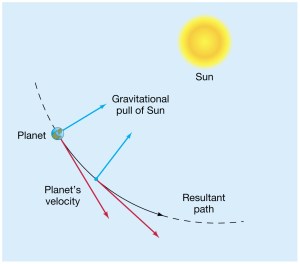
However, just thinking about it does raise some questions already. Circular motion like this can be explained in two equivalent ways. The most obvious way to think about it is to assume some central field. It’s the planetary model (illustrated below). However, that doesn’t suit our purposes because it’s hard – if possible at all – to relate it to the wavefunction oscillation.

planetary model

The second model is our two-spring or V-twin engine modelĀ (illustrated below), but then whatĀ isĀ the mass here? One hypothesis that comes to mind is that we’re constantly accelerating and decelerating an electric charge (the electron charge)—against all other charges in the Universe, so to speak. So that’s a force over a distance—energy. And energy has an equivalent mass.

V-2 engineThe question which remains open, then, is the following: what is the nature of this force? In previous posts, I suggested it might be gravitational, but so here we’re back to the drawing board: we’re talking an electrical force, but applied to someĀ massĀ which acquires mass because of… Well… Because of the force—because of the oscillation (the moving charge) itself. Hmm…. I need to think about this.

Some content on this page was disabled on June 16, 2020 as a result of a DMCA takedown notice from The California Institute of Technology. You can learn more about the DMCA here:

https://wordpress.com/support/copyright-and-the-dmca/
Some content on this page was disabled on June 16, 2020 as a result of a DMCA takedown notice from The California Institute of Technology. You can learn more about the DMCA here:

https://wordpress.com/support/copyright-and-the-dmca/

The speed of light as an angular velocity (2)

My previous post on the speed of light as an angular velocity was rather cryptic. This post will be a bit more elaborate. Not all that much, however: this stuff is and remains quite dense, unfortunately. 😦 But I’ll do my best to try to explain what I am thinking of. Remember the formula (orĀ definition) of theĀ elementary wavefunction:

ψ =Ā aĀ·eāˆ’i[EĀ·t āˆ’ pāˆ™x]/ħ =Ā aĀ·cos(pāˆ™x/ħ āˆ’ Eāˆ™t/ħ) + iĀ·aĀ·sin(pāˆ™x/ħ āˆ’Ā Eāˆ™t/ħ)

How should we interpret this? We know an actual particle will be represented by aĀ wave packet: a sum of wavefunctions, each with its own amplitude ak and its own argument Īøk = (Ekāˆ™t āˆ’ pkāˆ™x)/ħ. But… Well… Let’s see how far we get when analyzing theĀ elementaryĀ wavefunction itself only.

According to mathematicalĀ convention, the imaginary unit (i) is a 90° angle in theĀ counterclockwise direction. However, NatureĀ surely cannot be bothered about our convention of measuring phase angles – orĀ timeĀ itself – clockwiseĀ or counterclockwise. Therefore, both right- as well as left-handed polarization may be possible, as illustrated below.

The left-handed elementary wavefunction would be written as:

ψ =Ā aĀ·ei[EĀ·t āˆ’ pāˆ™x]/ħ =Ā aĀ·cos(pāˆ™x/ħ āˆ’ Eāˆ™t/ħ)Ā āˆ’Ā iĀ·aĀ·sin(pāˆ™x/ħ āˆ’Ā Eāˆ™t/ħ)

In my previous posts, I hypothesized that the two physical possibilities correspond to the angular momentum of our particle – say, an electron – being eitherĀ positive or negative: J = +ħ/2 or, else,Ā J = āˆ’Ä§/2. I will come back to this in a moment. Let us first further examine the functional form of the wavefunction.

We should note that both theĀ directionĀ as well as theĀ magnitudeĀ of the (linear) momentum (p) are relative: they depend on the orientation and relative velocity of our reference frame – which are, in effect, relative to the reference frame of our object. As such, the wavefunction itself is relative: another observer will obtain a different value for both the momentum (p) as well as for the energy (E). Of course, this makes us think of the relativity of the electric and magnetic field vectors (E and B) but… Well… It’s not quite the same because – as I will explain in a moment – the argument of the wavefunction, considered as a whole, is actually invariant under a Lorentz transformation.

Let me elaborate this point.Ā If we consider the reference frame of the particle itself, then the idea of direction and momentum sort of vanishes, as the momentum vector shrinks to the origin itself:Ā p = 0. Let us now look at howĀ the argument of the wavefunction transforms. The E and p in the argument of the wavefunction (Īø = Ļ‰āˆ™t – kāˆ™x = (E/ħ)āˆ™t – (p/ħ)āˆ™x =Ā (Eāˆ™t – pāˆ™x)/ħ) are, of course, the energy and momentum as measured in our frame of reference. Hence, we will want to write these quantities as E = Ev and p = pv = pvāˆ™v. If we then use natural time and distanceĀ units (hence, the numerical value of c is equal to 1 and, hence, the (relative) velocity is then measured as a fraction ofĀ c, with a value between 0 and 1), we can relate the energy and momentum of a moving object to its energy and momentum when at rest using the following relativistic formulas:

EvĀ = γ·E0Ā and pvĀ = γ·m0āˆ™vĀ = γ·E0āˆ™v/c2

The argument of the wavefunction can then be re-written as:

Īø = [γ·E0/ħ]āˆ™t – [(γ·E0āˆ™v/c2)/ħ]āˆ™x = (E0/ħ)Ā·(t āˆ’ vāˆ™x/c2)·γ =Ā (E0/ħ)āˆ™t’

The γ in these formulas is, of course, the Lorentz factor, and t’ is theĀ properĀ time: t’Ā = (t āˆ’ vāˆ™x/c2)/√(1āˆ’v2/c2). Two essential points should be noted here:

1. The argument of the wavefunction is invariant. There is a primed time (t’) but there is no primedĀ Īø (Īø’):Ā Īø = (Ev/ħ)Ā·t – (pv/ħ)Ā·x =Ā (E0/ħ)āˆ™t’.

2.Ā TheĀ E0/ħ coefficient pops up as an angular frequency:Ā E0/ħ = ω0. We may refer to it asĀ theĀ frequency of the elementary wavefunction.

Now, if you don’t like the concept ofĀ angular frequency, we can also write:Ā f0Ā = ω0/2Ļ€ = (E0/ħ)/2Ļ€ = E0/h.Ā Alternatively, and perhaps more elucidating, we get the following formula for theĀ periodĀ of the oscillation:

T0Ā = 1/f0Ā =Ā h/E0

This is interesting, because we can look at the period as aĀ naturalĀ unit of time for our particle. This period is inverselyĀ proportional to the (rest) energy of the particle, and the constant of proportionality is h. Substituting E0Ā for m0Ā·c2, we may also say it’s inversely proportional to the (rest) mass of the particle, with the constant of proportionality equal to h/c2. The period of an electron, for example, would be equal to about 8Ɨ10āˆ’21Ā s. That’sĀ veryĀ small, and it only gets smaller for larger objects ! But what does all of this really tellĀ us? What does it actuallyĀ mean?

We can look at the sine and cosine components of the wavefunction as an oscillation inĀ twoĀ dimensions, as illustrated below.

Circle_cos_sin

Look at the little green dot going around. Imagine it is someĀ mass going around and around. Its circular motion is equivalent to the two-dimensional oscillation. Indeed, instead of saying it moves along a circle, we may also say it moves simultaneously (1) left and right and back again (the cosine) while also moving (2) up and down and back again (the sine).

Now, a mass that rotates about a fixed axis hasĀ angular momentum, which we can write as the vector cross-product L = rƗp or, alternatively, as the product of an angular velocity (ω) and rotational inertia (I), aka as theĀ moment of inertia or the angular mass:Ā L = I·ω. [Note we writeĀ L and ω in boldface here because they are (axial) vectors. If we consider their magnitudes only, we write L = I·ω (no boldface).]

We can now do some calculations. We already know the angular velocity (ω) is equal toĀ E0/ħ. Now, theĀ magnitude ofĀ rĀ in the L =Ā rƗpĀ vector cross-product should equal theĀ magnitudeĀ of ψ =Ā aĀ·eāˆ’iāˆ™EĀ·t/ħ, so we write:Ā r = a. What’s next? Well… The momentum (p) is the product of a linear velocity (v) – in this case, theĀ tangentialĀ velocity –Ā and some mass (m): p = mĀ·v. If we switch to scalarĀ instead ofĀ vector quantities, then the (tangential) velocity is given by v = r·ω.

So now we only need to think about what formula we should use for the angular mass. If we’re thinking, as we are doing here, of some pointĀ mass going around some center, then the formula to use isĀ I = mĀ·r2. However, we may also want to think that the two-dimensional oscillation of our point mass actually describes the surface of a disk, in which case the formula for I becomesĀ I = mĀ·r2/2. Of course, the addition of this 1/2 factor may seem arbitrary but, as you will see, it will give us a more intuitive result. This is what we get:

L = I·ω = (mĀ·r2/2)Ā·(E/ħ) = (1/2)Ā·a2Ā·(E/c2)Ā·(E/ħ) =Ā a2Ā·E2/(2·ħ·c2)

Note that our frame of reference is that of the particle itself, so we should actually write ω0, m0Ā and E0Ā instead of ω, m and E. The value of the rest energy of an electron is about 0.510 MeV, or 8.1871Ɨ10āˆ’14 Nāˆ™m. Now, this momentum should equal J = ±ħ/2. We can, therefore, derive the (Compton scattering) radius of an electron:Formula 1Substituting the various constants with their numerical values, we find that a is equal 3.8616Ɨ10āˆ’13 m, which is the (reduced) Compton scattering radius of an electron.Ā The (tangential) velocity (v) can now be calculated as being equal toĀ v = r·ω = a·ω = [ħ·/(mĀ·c)]Ā·(E/ħ) =Ā c. This is an amazing result. Let us think about it.

In our previous posts, we introduced the metaphor of twoĀ springsĀ or oscillators, whose energy was equal to E =Ā m·ω2. Is this compatible with Einstein’s E =Ā mĀ·c2Ā mass-energy equivalence relation? It is. TheĀ E =Ā mĀ·c2Ā impliesĀ E/m =Ā c2. We, therefore, can write the following:

ω = E/ħ =Ā mĀ·c2/ħ = mĀ·(E/m)Ā·/ħ ⇔ ω =Ā E/ħ

Hence, we should actually have titled this and the previous post somewhat differently: the speed of light appears as aĀ tangentialĀ velocity. Think of the following: theĀ ratioĀ ofĀ c and ω is equal toĀ c/ω =Ā a·ω/ω =Ā a. Hence, the tangential and angular velocity would be the same if we’d measure distance in units ofĀ a. In other words,Ā the radius of an electron appears as a natural distance unit here: if we’d measure ω inĀ units ofĀ aĀ per second, rather than in radians (which are expressed in the SI unit of distance, i.e. the meter) per second, the two concepts would coincide.

More fundamentally, we may want to look at the radius of an electron as a naturalĀ unit of velocity.Ā Huh?Ā Yes. Just re-write theĀ c/ω =Ā a as ω =Ā c/a. What does it say? Exactly what I said, right? As such, the radius of an electron is not only aĀ normĀ for measuring distance but also for time.Ā šŸ™‚

If you don’t quite get this, think of the following. For an electron, we get an angular frequency that is equal to ω = E/ħ = (8.19Ɨ10āˆ’14Ā NĀ·m)/(1.05Ɨ10āˆ’34Ā NĀ·mĀ·s) ā‰ˆ 7.76Ɨ1020Ā radiansĀ per second. That’s an incredible velocity, because radians are expressed in distance units—so that’s inĀ meter. However, our mass is not moving along theĀ unitĀ circle, but along a much tinier orbit. TheĀ ratioĀ of the radius of the unit circle andĀ aĀ is equal to 1/a ā‰ˆĀ (1 m)/(3.86Ɨ10āˆ’13 m) ā‰ˆ 2.59Ɨ1012. Now, if we divide theĀ above-mentionedĀ velocityĀ ofĀ 7.76Ɨ1020Ā radiansĀ per second by this factor, we get… Right ! The speed of light: 2.998Ɨ1082Ā m/s. šŸ™‚

Post scriptum: I have no clear answer to the question as to why we should use the I = mĀ·r2/2 formula, as opposed to theĀ I = mĀ·r2Ā formula. It ensures we get the result we want, but this 1/2 factor is actually rather enigmatic. It makes me think of the 1/2 factor in Schrƶdinger’s equation, which is also quite enigmatic. In my view, the 1/2 factor should not be there in Schrƶdinger’s equation. Electron orbitals tend to be occupied byĀ twoĀ electrons with opposite spin. That’s why their energy levels should beĀ twice as much. And so I’d get rid of the 1/2 factor, solve for the energy levels, and then divide them by two again. Or something like that. šŸ™‚ But then that’s just my personal opinion or… Well… I’ve always been intrigued by the difference between the originalĀ printedĀ edition of the Feynman Lectures and the online version, which has been edited on this point. My printed edition is the third printing, which is dated July 1966, and – on this point – it says the following:

“Don’t forget thatĀ meff has nothing to do with the real mass of an electron. It may be quite different—although in commonly used metals and semiconductors it often happens to turn out to be the same general order of magnitude, about 2 to 20 timesĀ the free-space mass of the electron.”

Two to twenty times. Not 1 or 0.5 to 20 times. No. Two times. As I’ve explained a couple of times, if we’d define a new effective mass which would be twice the old concept – so meffNEWĀ = 2āˆ™meffOLDĀ – then such re-definition would not only solve a number of paradoxes and inconsistencies, but it will also justify my interpretation of energy as a two-dimensional oscillation of mass.

However, the online edition has been edited here to reflect the current knowledge about the behavior of an electron in a medium. Hence, if you click on the link above, you will read that the effective mass can be “about 0.1 to 30 times” the free-space mass of the electron. Well… This is another topic altogether, and so I’ll sign off here and let you think about it all. šŸ™‚

The speed of light as an angular velocity

Over the weekend, I worked on a revised version of my paper on a physical interpretation of the wavefunction. However, I forgot to add the final remarks on the speed of light as an angular velocity. I know… This post is for my faithful followers only. It is dense, but let me add the missing bits here:

12

Post scriptum (29 October):Ā Einstein’s view on aether theories probably still holds true: ā€œWe may say that according to the general theory of relativity space is endowed with physical qualities; in this sense, therefore, there exists an aether. According to the general theory of relativity, space without aether is unthinkable – for in such space there not only would be no propagation of light, but also no possibility of existence for standards of space and time (measuring-rods and clocks), nor therefore any space-time intervals in the physical sense. But this aether may not be thought of as endowed with the quality characteristic of ponderable media, as consisting of parts which may be tracked through time. The idea of motion may not be applied to it.ā€

The above quote is taken from the Wikipedia article on aether theories. The same article also quotes Robert Laughlin, the 1998 Nobel Laureate in Physics, who said this about aether in 2005: ā€œIt is ironic that Einstein’s most creative work, the general theory of relativity, should boil down to conceptualizing space as a medium when his original premise [in special relativity] was that no such medium existed. […] The word ‘aether’ has extremely negative connotations in theoretical physics because of its past association with opposition to relativity. This is unfortunate because, stripped of these connotations, it rather nicely captures the way most physicists actually think about the vacuum. […]The modern concept of the vacuum of space, confirmed every day by experiment, is a relativistic aether. But we do not call it this because it is taboo.ā€

I really love this: a relativistic aether. MyĀ interpretation of the wavefunction is veryĀ consistent with that.

Wavefunctions as gravitational waves

This is the paper I always wanted to write. It is there now, and I think it is good – and that‘s an understatement. šŸ™‚ It is probably best to download it as a pdf-file from the viXra.org site because this was a rather fast ‘copy and paste’ job from the Word version of the paper, so there may be issues with boldface notation (vector notation), italics and, most importantly, with formulas – which I, sadly, have to ‘snip’ into this WordPress blog, as they don’t have an easy copy function for mathematical formulas.

It’s great stuff. If you have been following my blog – and many of you have – you will want to digest this. šŸ™‚

Abstract : This paper explores the implications of associating the components of the wavefunction with a physical dimension: force per unit mass – which is, of course, the dimension of acceleration (m/s2) and gravitational fields. The classical electromagnetic field equations for energy densities, the Poynting vector and spin angular momentum are then re-derived by substituting the electromagnetic N/C unit of field strength (mass per unit charge) by the new N/kg = m/s2 dimension.

The results are elegant and insightful. For example, the energy densities are proportional to the square of the absolute value of the wavefunction and, hence, to the probabilities, which establishes a physical normalization condition. Also, Schrƶdinger’s wave equation may then, effectively, be interpreted as a diffusion equation for energy, and the wavefunction itself can be interpreted as a propagating gravitational wave. Finally, as an added bonus, concepts such as the Compton scattering radius for a particle, spin angular momentum, and the boson-fermion dichotomy, can also be explained more intuitively.

While the approach offers a physical interpretation of the wavefunction, the author argues that the core of the Copenhagen interpretations revolves around the complementarity principle, which remains unchallenged because the interpretation of amplitude waves as traveling fields does not explain the particle nature of matter.

Introduction

This is not another introduction to quantum mechanics. We assume the reader is already familiar with the key principles and, importantly, with the basic math. We offer an interpretation of wave mechanics. As such, we do not challenge the complementarity principle: the physical interpretation of the wavefunction that is offered here explains the wave nature of matter only. It explains diffraction and interference of amplitudes but it does not explain why a particle will hit the detector not as a wave but as a particle. Hence, the Copenhagen interpretation of the wavefunction remains relevant: we just push its boundaries.

The basic ideas in this paper stem from a simple observation: the geometric similarity between the quantum-mechanical wavefunctions and electromagnetic waves is remarkably similar. The components of both waves are orthogonal to the direction of propagation and to each other. Only the relative phase differs : the electric and magnetic field vectors (E and B) have the same phase. In contrast, the phase of the real and imaginary part of the (elementary) wavefunction (ψ = aĀ·eāˆ’iāˆ™Īø = aāˆ™cosĪø – aāˆ™sinĪø) differ by 90 degrees (Ļ€/2).[1] Pursuing the analogy, we explore the following question: if the oscillating electric and magnetic field vectors of an electromagnetic wave carry the energy that one associates with the wave, can we analyze the real and imaginary part of the wavefunction in a similar way?

We show the answer is positive and remarkably straightforward.  If the physical dimension of the electromagnetic field is expressed in newton per coulomb (force per unit charge), then the physical dimension of the components of the wavefunction may be associated with force per unit mass (newton per kg).[2] Of course, force over some distance is energy. The question then becomes: what is the energy concept here? Kinetic? Potential? Both?

The similarity between the energy of a (one-dimensional) linear oscillator (E = mĀ·a2·ω2/2) and Einstein’s relativistic energy equation E = māˆ™c2 inspires us to interpret the energy as a two-dimensional oscillation of mass. To assist the reader, we construct a two-piston engine metaphor.[3] We then adapt the formula for the electromagnetic energy density to calculate the energy densities for the wave function. The results are elegant and intuitive: the energy densities are proportional to the square of the absolute value of the wavefunction and, hence, to the probabilities. Schrƶdinger’s wave equation may then, effectively, be interpreted as a diffusion equation for energy itself.

As an added bonus, concepts such as the Compton scattering radius for a particle and spin angular, as well as the boson-fermion dichotomy can be explained in a fully intuitive way.[4]

Of course, such interpretation is also an interpretation of the wavefunction itself, and the immediate reaction of the reader is predictable: the electric and magnetic field vectors are, somehow, to be looked at as real vectors. In contrast, the real and imaginary components of the wavefunction are not. However, this objection needs to be phrased more carefully. First, it may be noted that, in a classical analysis, the magnetic force is a pseudovector itself.[5] Second, a suitable choice of coordinates may make quantum-mechanical rotation matrices irrelevant.[6]

Therefore, the author is of the opinion that this little paper may provide some fresh perspective on the question, thereby further exploring Einstein’s basic sentiment in regard to quantum mechanics, which may be summarized as follows: there must be some physical explanation for the calculated probabilities.[7]

We will, therefore, start with Einstein’s relativistic energy equation (E = mc2) and wonder what it could possibly tell us. 

I. Energy as a two-dimensional oscillation of mass

The structural similarity between the relativistic energy formula, the formula for the total energy of an oscillator, and the kinetic energy of a moving body, is striking:

  1. E = mc2
  2. E = mω2/2
  3. E = mv2/2

In these formulas, ω, v and c all describe some velocity.[8] Of course, there is the 1/2 factor in the E = mω2/2 formula[9], but that is exactly the point we are going to explore here: can we think of an oscillation in two dimensions, so it stores an amount of energy that is equal to E = 2Ā·m·ω2/2 = m·ω2?

That is easy enough. Think, for example, of a V-2 engine with the pistons at a 90-degree angle, as illustrated below. The 90° angle makes it possible to perfectly balance the counterweight and the pistons, thereby ensuring smooth travel at all times. With permanently closed valves, the air inside the cylinder compresses and decompresses as the pistons move up and down and provides, therefore, a restoring force. As such, it will store potential energy, just like a spring, and the motion of the pistons will also reflect that of a mass on a spring. Hence, we can describe it by a sinusoidal function, with the zero point at the center of each cylinder. We can, therefore, think of the moving pistons as harmonic oscillators, just like mechanical springs.

Figure 1: Oscillations in two dimensionsV-2 engine

If we assume there is no friction, we have a perpetuum mobile here. The compressed air and the rotating counterweight (which, combined with the crankshaft, acts as a flywheel[10]) store the potential energy. The moving masses of the pistons store the kinetic energy of the system.[11]

At this point, it is probably good to quickly review the relevant math. If the magnitude of the oscillation is equal to a, then the motion of the piston (or the mass on a spring) will be described by x = aĀ·cos(ω·t + Ī”).[12] Needless to say, Ī” is just a phase factor which defines our t = 0 point, and ω is the natural angular frequency of our oscillator. Because of the 90° angle between the two cylinders, Ī” would be 0 for one oscillator, and –π/2 for the other. Hence, the motion of one piston is given by x = aĀ·cos(ω·t), while the motion of the other is given by x = aĀ·cos(ω·t–π/2) = aĀ·sin(ω·t).

The kinetic and potential energy of one oscillator (think of one piston or one spring only) can then be calculated as:

  1. K.E. = T = mĀ·v2/2 = (1/2)Ā·m·ω2Ā·a2Ā·sin2(ω·t + Ī”)
  2. P.E. = U = kĀ·x2/2 = (1/2)Ā·kĀ·a2Ā·cos2(ω·t + Ī”)

The coefficient k in the potential energy formula characterizes the restoring force: F = āˆ’kĀ·x. From the dynamics involved, it is obvious that k must be equal to m·ω2. Hence, the total energy is equal to:

E = T + U = (1/2)Ā· m·ω2Ā·a2Ā·[sin2(ω·t + Ī”) + cos2(ω·t + Ī”)] = mĀ·a2·ω2/2

To facilitate the calculations, we will briefly assume k = m·ω2 and a are equal to 1. The motion of our first oscillator is given by the cos(ω·t) = cosĪø function (Īø = ω·t), and its kinetic energy will be equal to sin2Īø. Hence, the (instantaneous) change in kinetic energy at any point in time will be equal to:

d(sin2Īø)/dĪø = 2āˆ™sinĪøāˆ™d(sinĪø)/dĪø = 2āˆ™sinĪøāˆ™cosĪø

Let us look at the second oscillator now. Just think of the second piston going up and down in the V-2 engine. Its motion is given by the sinĪø function, which is equal to cos(Īøāˆ’Ļ€ /2). Hence, its kinetic energy is equal to sin2(Īøāˆ’Ļ€ /2), and how it changes ā€“ as a function of Īø – will be equal to:

2āˆ™sin(Īøāˆ’Ļ€ /2)āˆ™cos(Īøāˆ’Ļ€ /2) = = āˆ’2āˆ™cosĪøāˆ™sinĪø = āˆ’2āˆ™sinĪøāˆ™cosĪø

We have our perpetuum mobile! While transferring kinetic energy from one piston to the other, the crankshaft will rotate with a constant angular velocity: linear motion becomes circular motion, and vice versa, and the total energy that is stored in the system is T + U = ma2ω2.

We have a great metaphor here. Somehow, in this beautiful interplay between linear and circular motion, energy is borrowed from one place and then returns to the other, cycle after cycle. We know the wavefunction consist of a sine and a cosine: the cosine is the real component, and the sine is the imaginary component. Could they be equally real? Could each represent half of the total energy of our particle? Should we think of the c in our E = mc2 formula as an angular velocity?

These are sensible questions. Let us explore them. 

II. The wavefunction as a two-dimensional oscillation

The elementary wavefunction is written as:

ψ = aĀ·eāˆ’i[EĀ·t āˆ’ pāˆ™x]/ħaĀ·eāˆ’i[EĀ·t āˆ’ pāˆ™x]/ħ = aĀ·cos(pāˆ™x/ħ Eāˆ™t/ħ) + iĀ·aĀ·sin(pāˆ™x/ħ Eāˆ™t/ħ)

When considering a particle at rest (p = 0) this reduces to:

ψ = aĀ·eāˆ’iāˆ™EĀ·t/ħ = aĀ·cos(Eāˆ™t/ħ) + iĀ·aĀ·sin(Eāˆ™t/ħ) = aĀ·cos(Eāˆ™t/ħ) iĀ·aĀ·sin(Eāˆ™t/ħ) 

Let us remind ourselves of the geometry involved, which is illustrated below. Note that the argument of the wavefunction rotates clockwise with time, while the mathematical convention for measuring the phase angle (Ļ•) is counter-clockwise.

Figure 2: Euler’s formula760px-eulers_formula

If we assume the momentum p is all in the x-direction, then the p and x vectors will have the same direction, and pāˆ™x/ħ reduces to pāˆ™x/ħ. Most illustrations – such as the one below – will either freeze x or, else, t. Alternatively, one can google web animations varying both. The point is: we also have a two-dimensional oscillation here. These two dimensions are perpendicular to the direction of propagation of the wavefunction. For example, if the wavefunction propagates in the x-direction, then the oscillations are along the y– and z-axis, which we may refer to as the real and imaginary axis. Note how the phase difference between the cosine and the sine  – the real and imaginary part of our wavefunction – appear to give some spin to the whole. I will come back to this.

Figure 3: Geometric representation of the wavefunction5d_euler_f

Hence, if we would say these oscillations carry half of the total energy of the particle, then we may refer to the real and imaginary energy of the particle respectively, and the interplay between the real and the imaginary part of the wavefunction may then describe how energy propagates through space over time.

Let us consider, once again, a particle at rest. Hence, p = 0 and the (elementary) wavefunction reduces to ψ = aĀ·eāˆ’iāˆ™EĀ·t/ħ. Hence, the angular velocity of both oscillations, at some point x, is given by ω = -E/ħ. Now, the energy of our particle includes all of the energy – kinetic, potential and rest energy – and is, therefore, equal to E = mc2.

Can we, somehow, relate this to the mĀ·a2·ω2 energy formula for our V-2 perpetuum mobile? Our wavefunction has an amplitude too. Now, if the oscillations of the real and imaginary wavefunction store the energy of our particle, then their amplitude will surely matter. In fact, the energy of an oscillation is, in general, proportional to the square of the amplitude: E µ a2. We may, therefore, think that the a2 factor in the E = mĀ·a2·ω2 energy will surely be relevant as well.

However, here is a complication: an actual particle is localized in space and can, therefore, not be represented by the elementary wavefunction. We must build a wave packet for that: a sum of wavefunctions, each with their own amplitude ak, and their own ωi = -Ei/ħ. Each of these wavefunctions will contribute some energy to the total energy of the wave packet. To calculate the contribution of each wave to the total, both ai as well as Ei will matter.

What is Ei? Ei varies around some average E, which we can associate with some average mass m: m = E/c2. The Uncertainty Principle kicks in here. The analysis becomes more complicated, but a formula such as the one below might make sense:F1We can re-write this as:F2What is the meaning of this equation? We may look at it as some sort of physical normalization condition when building up the Fourier sum. Of course, we should relate this to the mathematical normalization condition for the wavefunction. Our intuition tells us that the probabilities must be related to the energy densities, but how exactly? We will come back to this question in a moment. Let us first think some more about the enigma: what is mass?

Before we do so, let us quickly calculate the value of c2ħ2: it is about 1Ā“1051 N2āˆ™m4. Let us also do a dimensional analysis: the physical dimensions of the E = mĀ·a2·ω2 equation make sense if we express m in kg, a in m, and ω in rad/s. We then get: [E] = kgāˆ™m2/s2 = (Nāˆ™s2/m)āˆ™m2/s2 = Nāˆ™m = J. The dimensions of the left- and right-hand side of the physical normalization condition is N3āˆ™m5. 

III. What is mass?

We came up, playfully, with a meaningful interpretation for energy: it is a two-dimensional oscillation of mass. But what is mass? A new aether theory is, of course, not an option, but then what is it that is oscillating? To understand the physics behind equations, it is always good to do an analysis of the physical dimensions in the equation. Let us start with Einstein’s energy equation once again. If we want to look at mass, we should re-write it as m = E/c2:

[m] = [E/c2] = J/(m/s)2 = NĀ·māˆ™s2/m2 = NĀ·s2/m = kg

This is not very helpful. It only reminds us of Newton’s definition of a mass: mass is that what gets accelerated by a force. At this point, we may want to think of the physical significance of the absolute nature of the speed of light. Einstein’s E = mc2 equation implies we can write the ratio between the energy and the mass of any particle is always the same, so we can write, for example:F3This reminds us of the ω2= C1/L or ω2 = k/m of harmonic oscillators once again.[13] The key difference is that the ω2= C1/L and ω2 = k/m formulas introduce two or more degrees of freedom.[14] In contrast, c2= E/m for any particle, always. However, that is exactly the point: we can modulate the resistance, inductance and capacitance of electric circuits, and the stiffness of springs and the masses we put on them, but we live in one physical space only: our spacetime. Hence, the speed of light c emerges here as the defining property of spacetime – the resonant frequency, so to speak. We have no further degrees of freedom here.

 

The Planck-Einstein relation (for photons) and the de Broglie equation (for matter-particles) have an interesting feature: both imply that the energy of the oscillation is proportional to the frequency, with Planck’s constant as the constant of proportionality. Now, for one-dimensional oscillations – think of a guitar string, for example – we know the energy will be proportional to the square of the frequency. It is a remarkable observation: the two-dimensional matter-wave, or the electromagnetic wave, gives us two waves for the price of one, so to speak, each carrying half of the total energy of the oscillation but, as a result, we get a proportionality between E and f instead of between E and f2.

However, such reflections do not answer the fundamental question we started out with: what is mass? At this point, it is hard to go beyond the circular definition that is implied by Einstein’s formula: energy is a two-dimensional oscillation of mass, and mass packs energy, and c emerges us as the property of spacetime that defines how exactly.

When everything is said and done, this does not go beyond stating that mass is some scalar field. Now, a scalar field is, quite simply, some real number that we associate with a position in spacetime. The Higgs field is a scalar field but, of course, the theory behind it goes much beyond stating that we should think of mass as some scalar field. The fundamental question is: why and how does energy, or matter, condense into elementary particles? That is what the Higgs mechanism is about but, as this paper is exploratory only, we cannot even start explaining the basics of it.

What we can do, however, is look at the wave equation again (Schrƶdinger’s equation), as we can now analyze it as an energy diffusion equation. 

IV. Schrƶdinger’s equation as an energy diffusion equation

The interpretation of Schrƶdinger’s equation as a diffusion equation is straightforward. Feynman (Lectures, III-16-1) briefly summarizes it as follows:

ā€œWe can think of Schrƶdinger’s equation as describing the diffusion of the probability amplitude from one point to the next. […] But the imaginary coefficient in front of the derivative makes the behavior completely different from the ordinary diffusion such as you would have for a gas spreading out along a thin tube. Ordinary diffusion gives rise to real exponential solutions, whereas the solutions of Schrƶdinger’s equation are complex waves.ā€[17]

Let us review the basic math. For a particle moving in free space – with no external force fields acting on it – there is no potential (U = 0) and, therefore, the Uψ term disappears. Therefore, Schrƶdinger’s equation reduces to:

āˆ‚Ļˆ(x, t)/āˆ‚t = iĀ·(1/2)Ā·(ħ/meff)Ā·āˆ‡2ψ(x, t)

The ubiquitous diffusion equation in physics is:

āˆ‚Ļ†(x, t)/āˆ‚t = DĀ·āˆ‡2φ(x, t)

The structural similarity is obvious. The key difference between both equations is that the wave equation gives us two equations for the price of one. Indeed, because ψ is a complex-valued function, with a real and an imaginary part, we get the following equations[18]:

  1. Re(āˆ‚Ļˆ/āˆ‚t) = āˆ’(1/2)Ā·(ħ/meff)Ā·Im(āˆ‡2ψ)
  2. Im(āˆ‚Ļˆ/āˆ‚t) = (1/2)Ā·(ħ/meff)Ā·Re(āˆ‡2ψ)

These equations make us think of the equations for an electromagnetic wave in free space (no stationary charges or currents):

  1. āˆ‚B/āˆ‚t = ā€“āˆ‡Ć—E
  2. āˆ‚E/āˆ‚t = c2āˆ‡Ć—B

The above equations effectively describe a propagation mechanism in spacetime, as illustrated below.

Figure 4: Propagation mechanismspropagation

The Laplacian operator (āˆ‡2), when operating on a scalar quantity, gives us a flux density, i.e. something expressed per square meter (1/m2). In this case, it is operating on ψ(x, t), so what is the dimension of our wavefunction ψ(x, t)? To answer that question, we should analyze the diffusion constant in Schrƶdinger’s equation, i.e. the (1/2)Ā·(ħ/meff) factor:

  1. As a mathematical constant of proportionality, it will quantify the relationship between both derivatives (i.e. the time derivative and the Laplacian);
  2. As a physical constant, it will ensure the physical dimensions on both sides of the equation are compatible.

Now, the ħ/meff factor is expressed in (NĀ·mĀ·s)/(NĀ· s2/m) = m2/s. Hence, it does ensure the dimensions on both sides of the equation are, effectively, the same: āˆ‚Ļˆ/āˆ‚t is a time derivative and, therefore, its dimension is s1 while, as mentioned above, the dimension of āˆ‡2ψ is m2. However, this does not solve our basic question: what is the dimension of the real and imaginary part of our wavefunction?

At this point, mainstream physicists will say: it does not have a physical dimension, and there is no geometric interpretation of Schrƶdinger’s equation. One may argue, effectively, that its argument, (pāˆ™x – Eāˆ™t)/ħ, is just a number and, therefore, that the real and imaginary part of ψ is also just some number.

To this, we may object that ħ may be looked as a mathematical scaling constant only. If we do that, then the argument of ψ will, effectively, be expressed in action units, i.e. in N·m·s. It then does make sense to also associate a physical dimension with the real and imaginary part of ψ. What could it be?

We may have a closer look at Maxwell’s equations for inspiration here. The electric field vector is expressed in newton (the unit of force) per unit of charge (coulomb). Now, there is something interesting here. The physical dimension of the magnetic field is N/C divided by m/s.[19] We may write B as the following vector cross-product: B = (1/c)āˆ™exƗE, with ex the unit vector pointing in the x-direction (i.e. the direction of propagation of the wave). Hence, we may associate the (1/c)āˆ™exƗ operator, which amounts to a rotation by 90 degrees, with the s/m dimension. Now, multiplication by i also amounts to a rotation by 90° degrees. Hence, we may boldly write: B = (1/c)āˆ™exƗE = (1/c)āˆ™iāˆ™E. This allows us to also geometrically interpret Schrƶdinger’s equation in the way we interpreted it above (see Figure 3).[20]

Still, we have not answered the question as to what the physical dimension of the real and imaginary part of our wavefunction should be. At this point, we may be inspired by the structural similarity between Newton’s and Coulomb’s force laws:F4Hence, if the electric field vector E is expressed in force per unit charge (N/C), then we may want to think of associating the real part of our wavefunction with a force per unit mass (N/kg). We can, of course, do a substitution here, because the mass unit (1 kg) is equivalent to 1 NĀ·s2/m. Hence, our N/kg dimension becomes:
N/kg = N/(NĀ·s2/m)= m/s2

What is this: m/s2? Is that the dimension of the aĀ·cosĪø term in the aĀ·eāˆ’iĪø aĀ·cosĪø āˆ’ iĀ·aĀ·sinĪø wavefunction?

My answer is: why not? Think of it: m/s2 is the physical dimension of acceleration: the increase or decrease in velocity (m/s) per second. It ensures the wavefunction for any particle – matter-particles or particles with zero rest mass (photons) – and the associated wave equation (which has to be the same for all, as the spacetime we live in is one) are mutually consistent.

In this regard, we should think of how we would model a gravitational wave. The physical dimension would surely be the same: force per mass unit. It all makes sense: wavefunctions may, perhaps, be interpreted as traveling distortions of spacetime, i.e. as tiny gravitational waves.

V. Energy densities and flows

Pursuing the geometric equivalence between the equations for an electromagnetic wave and Schrƶdinger’s equation, we can now, perhaps, see if there is an equivalent for the energy density. For an electromagnetic wave, we know that the energy density is given by the following formula:F5E and B are the electric and magnetic field vector respectively. The Poynting vector will give us the directional energy flux, i.e. the energy flow per unit area per unit time. We write:F6Needless to say, the āˆ‡āˆ™ operator is the divergence and, therefore, gives us the magnitude of a (vector) field’s source or sink at a given point. To be precise, the divergence gives us the volume density of the outward flux of a vector field from an infinitesimal volume around a given point. In this case, it gives us the volume density of the flux of S.
We can analyze the dimensions of the equation for the energy density as follows:

  1. E is measured in newton per coulomb, so [Eāˆ™E] = [E2] = N2/C2.
  2. B is measured in (N/C)/(m/s), so we get [Bāˆ™B] = [B2] = (N2/C2)Ā·(s2/m2). However, the dimension of our c2 factor is (m2/s2) and so we’re also left with N2/C2.
  3. The ϵ0 is the electric constant, aka as the vacuum permittivity. As a physical constant, it should ensure the dimensions on both sides of the equation work out, and they do: [ε0] = C2/(NĀ·m2) and, therefore, if we multiply that with N2/C2, we find that is expressed in J/m3.[21]

Replacing the newton per coulomb unit (N/C) by the newton per kg unit (N/kg) in the formulas above should give us the equivalent of the energy density for the wavefunction. We just need to substitute ϵ0 for an equivalent constant. We may to give it a try. If the energy densities can be calculated – which are also mass densities, obviously – then the probabilities should be proportional to them.

Let us first see what we get for a photon, assuming the electromagnetic wave represents its wavefunction. Substituting B for (1/c)āˆ™iāˆ™E or for āˆ’(1/c)āˆ™iāˆ™E gives us the following result:F7Zero!? An unexpected result! Or not? We have no stationary charges and no currents: only an electromagnetic wave in free space. Hence, the local energy conservation principle needs to be respected at all points in space and in time. The geometry makes sense of the result: for an electromagnetic wave, the magnitudes of E and B reach their maximum, minimum and zero point simultaneously, as shown below.[22] This is because their phase is the same.

Figure 5: Electromagnetic wave: E and BEM field

Should we expect a similar result for the energy densities that we would associate with the real and imaginary part of the matter-wave? For the matter-wave, we have a phase difference between aĀ·cosĪø and aĀ·sinĪø, which gives a different picture of the propagation of the wave (see Figure 3).[23] In fact, the geometry of the suggestion suggests some inherent spin, which is interesting. I will come back to this. Let us first guess those densities. Making abstraction of any scaling constants, we may write:F8We get what we hoped to get: the absolute square of our amplitude is, effectively, an energy density !

|ψ|2  = |aĀ·eāˆ’iāˆ™EĀ·t/ħ|2 = a2 = u

This is very deep. A photon has no rest mass, so it borrows and returns energy from empty space as it travels through it. In contrast, a matter-wave carries energy and, therefore, has some (rest) mass. It is therefore associated with an energy density, and this energy density gives us the probabilities. Of course, we need to fine-tune the analysis to account for the fact that we have a wave packet rather than a single wave, but that should be feasible.

As mentioned, the phase difference between the real and imaginary part of our wavefunction (a cosine and a sine function) appear to give some spin to our particle. We do not have this particularity for a photon. Of course, photons are bosons, i.e. spin-zero particles, while elementary matter-particles are fermions with spin-1/2. Hence, our geometric interpretation of the wavefunction suggests that, after all, there may be some more intuitive explanation of the fundamental dichotomy between bosons and fermions, which puzzled even Feynman:

ā€œWhy is it that particles with half-integral spin are Fermi particles, whereas particles with integral spin are Bose particles? We apologize for the fact that we cannot give you an elementary explanation. An explanation has been worked out by Pauli from complicated arguments of quantum field theory and relativity. He has shown that the two must necessarily go together, but we have not been able to find a way of reproducing his arguments on an elementary level. It appears to be one of the few places in physics where there is a rule which can be stated very simply, but for which no one has found a simple and easy explanation. The explanation is deep down in relativistic quantum mechanics. This probably means that we do not have a complete understanding of the fundamental principle involved.ā€ (Feynman, Lectures, III-4-1)

The physical interpretation of the wavefunction, as presented here, may provide some better understanding of ā€˜the fundamental principle involved’: the physical dimension of the oscillation is just very different. That is all: it is force per unit charge for photons, and force per unit mass for matter-particles. We will examine the question of spin somewhat more carefully in section VII. Let us first examine the matter-wave some more. 

VI. Group and phase velocity of the matter-wave

The geometric representation of the matter-wave (see Figure 3) suggests a traveling wave and, yes, of course: the matter-wave effectively travels through space and time. But what is traveling, exactly? It is the pulse – or the signal – only: the phase velocity of the wave is just a mathematical concept and, even in our physical interpretation of the wavefunction, the same is true for the group velocity of our wave packet. The oscillation is two-dimensional, but perpendicular to the direction of travel of the wave. Hence, nothing actually moves with our particle.

Here, we should also reiterate that we did not answer the question as to what is oscillating up and down and/or sideways: we only associated a physical dimension with the components of the wavefunction – newton per kg (force per unit mass), to be precise. We were inspired to do so because of the physical dimension of the electric and magnetic field vectors (newton per coulomb, i.e. force per unit charge) we associate with electromagnetic waves which, for all practical purposes, we currently treat as the wavefunction for a photon. This made it possible to calculate the associated energy densities and a Poynting vector for energy dissipation. In addition, we showed that Schrƶdinger’s equation itself then becomes a diffusion equation for energy. However, let us now focus some more on the asymmetry which is introduced by the phase difference between the real and the imaginary part of the wavefunction. Look at the mathematical shape of the elementary wavefunction once again:

ψ = aĀ·eāˆ’i[EĀ·t āˆ’ pāˆ™x]/ħaĀ·eāˆ’i[EĀ·t āˆ’ pāˆ™x]/ħ = aĀ·cos(pāˆ™x/ħ āˆ’ Eāˆ™t/ħ) + iĀ·aĀ·sin(pāˆ™x/ħ āˆ’ Eāˆ™t/ħ)

The minus sign in the argument of our sine and cosine function defines the direction of travel: an F(xāˆ’vāˆ™t) wavefunction will always describe some wave that is traveling in the positive x-direction (with the wave velocity), while an F(x+vāˆ™t) wavefunction will travel in the negative x-direction. For a geometric interpretation of the wavefunction in three dimensions, we need to agree on how to define i or, what amounts to the same, a convention on how to define clockwise and counterclockwise directions: if we look at a clock from the back, then its hand will be moving counterclockwise. So we need to establish the equivalent of the right-hand rule. However, let us not worry about that now. Let us focus on the interpretation. To ease the analysis, we’ll assume we’re looking at a particle at rest. Hence, p = 0, and the wavefunction reduces to:

ψ = aĀ·eāˆ’iāˆ™EĀ·t/ħ = aĀ·cos(āˆ’Eāˆ™t/ħ) + iĀ·aĀ·sin(āˆ’E0āˆ™t/ħ) = aĀ·cos(E0āˆ™t/ħ) āˆ’ iĀ·aĀ·sin(E0āˆ™t/ħ)

E0 is, of course, the rest mass of our particle and, now that we are here, we should probably wonder whose time we are talking about: is it our time, or is the proper time of our particle? Well… In this situation, we are both at rest so it does not matter: t is, effectively, the proper time so perhaps we should write it as t0. It does not matter. You can see what we expect to see: E0/ħ pops up as the natural frequency of our matter-particle: (E0/ħ)āˆ™t = Ļ‰āˆ™t. Remembering the ω = 2π·f = 2Ļ€/T and T = 1/formulas, we can associate a period and a frequency with this wave, using the ω = 2π·f = 2Ļ€/T. Noting that ħ = h/2Ļ€, we find the following:

T = 2π·(ħ/E0) = h/E0 ā‡” = E0/h = m0c2/h

This is interesting, because we can look at the period as a natural unit of time for our particle. What about the wavelength? That is tricky because we need to distinguish between group and phase velocity here. The group velocity (vg) should be zero here, because we assume our particle does not move. In contrast, the phase velocity is given by vp = Ī»Ā·= (2Ļ€/k)Ā·(ω/2Ļ€) = Ļ‰/k. In fact, we’ve got something funny here: the wavenumber k = p/ħ is zero, because we assume the particle is at rest, so p = 0. So we have a division by zero here, which is rather strange. What do we get assuming the particle is not at rest? We write:

vp = Ļ‰/k = (E/ħ)/(p/ħ) = E/p = E/(mĀ·vg) = (mĀ·c2)/(mĀ·vg) = c2/vg

This is interesting: it establishes a reciprocal relation between the phase and the group velocity, with as a simple scaling constant. Indeed, the graph below shows the shape of the function does not change with the value of c, and we may also re-write the relation above as:

vp/= βp = c/vp = 1/βg = 1/(c/vp)

Figure 6: Reciprocal relation between phase and group velocitygraph

We can also write the mentioned relationship as vpĀ·vg = c2, which reminds us of the relationship between the electric and magnetic constant (1/ε0)Ā·(1/μ0) = c2. This is interesting in light of the fact we can re-write this as (c·ε0)Ā·(c·μ0) = 1, which shows electricity and magnetism are just two sides of the same coin, so to speak.[24]

Interesting, but how do we interpret the math? What about the implications of the zero value for wavenumber k = p/ħ. We would probably like to think it implies the elementary wavefunction should always be associated with some momentum, because the concept of zero momentum clearly leads to weird math: something times zero cannot be equal to c2! Such interpretation is also consistent with the Uncertainty Principle: if Ī”xĀ·Ī”p ā‰„ ħ, then neither Ī”x nor Ī”p can be zero. In other words, the Uncertainty Principle tells us that the idea of a pointlike particle actually being at some specific point in time and in space does not make sense: it has to move. It tells us that our concept of dimensionless points in time and space are mathematical notions only. Actual particles – including photons – are always a bit spread out, so to speak, and – importantly – they have to move.

For a photon, this is self-evident. It has no rest mass, no rest energy, and, therefore, it is going to move at the speed of light itself. We write: p = mĀ·c = mĀ·c2/= E/c. Using the relationship above, we get:

vp = Ļ‰/k = (E/ħ)/(p/ħ) = E/p = c ⇒ vg = c2/vp = c2/c = c

This is good: we started out with some reflections on the matter-wave, but here we get an interpretation of the electromagnetic wave as a wavefunction for the photon. But let us get back to our matter-wave. In regard to our interpretation of a particle having to move, we should remind ourselves, once again, of the fact that an actual particle is always localized in space and that it can, therefore, not be represented by the elementary wavefunction ψ = aĀ·eāˆ’i[EĀ·t āˆ’ pāˆ™x]/ħ or, for a particle at rest, the ψ = aĀ·eāˆ’iāˆ™EĀ·t/ħ function. We must build a wave packet for that: a sum of wavefunctions, each with their own amplitude ai, and their own ωi = āˆ’Ei/ħ. Indeed, in section II, we showed that each of these wavefunctions will contribute some energy to the total energy of the wave packet and that, to calculate the contribution of each wave to the total, both ai as well as Ei matter. This may or may not resolve the apparent paradox. Let us look at the group velocity.

To calculate a meaningful group velocity, we must assume the vg = āˆ‚Ļ‰i/āˆ‚ki = āˆ‚(Ei/ħ)/āˆ‚(pi/ħ) = āˆ‚(Ei)/āˆ‚(pi) exists. So we must have some dispersion relation. How do we calculate it? We need to calculate ωi as a function of ki here, or Ei as a function of pi. How do we do that? Well… There are a few ways to go about it but one interesting way of doing it is to re-write Schrƶdinger’s equation as we did, i.e. by distinguishing the real and imaginary parts of the āˆ‚Ļˆ/āˆ‚t =iĀ·[ħ/(2m)]Ā·āˆ‡2ψ wave equation and, hence, re-write it as the following pair of two equations:

  1. Re(āˆ‚Ļˆ/āˆ‚t) = āˆ’[ħ/(2meff)]Ā·Im(āˆ‡2ψ) ā‡” Ļ‰Ā·cos(kx āˆ’ ωt) = k2Ā·[ħ/(2meff)]Ā·cos(kx āˆ’ ωt)
  2. Im(āˆ‚Ļˆ/āˆ‚t) = [ħ/(2meff)]Ā·Re(āˆ‡2ψ) ā‡” ω·sin(kx āˆ’ ωt) = k2Ā·[ħ/(2meff)]Ā·sin(kx āˆ’ ωt)

Both equations imply the following dispersion relation:

ω = Ä§Ā·k2/(2meff)

Of course, we need to think about the subscripts now: we have ωi, ki, but… What about meff or, dropping the subscript, m? Do we write it as mi? If so, what is it? Well… It is the equivalent mass of Ei obviously, and so we get it from the mass-energy equivalence relation: mi = Ei/c2. It is a fine point, but one most people forget about: they usually just write m. However, if there is uncertainty in the energy, then Einstein’s mass-energy relation tells us we must have some uncertainty in the (equivalent) mass too. Here, I should refer back to Section II: Ei varies around some average energy E and, therefore, the Uncertainty Principle kicks in. 

VII. Explaining spin

The elementary wavefunction vector – i.e. the vector sum of the real and imaginary component – rotates around the x-axis, which gives us the direction of propagation of the wave (see Figure 3). Its magnitude remains constant. In contrast, the magnitude of the electromagnetic vector – defined as the vector sum of the electric and magnetic field vectors – oscillates between zero and some maximum (see Figure 5).

We already mentioned that the rotation of the wavefunction vector appears to give some spin to the particle. Of course, a circularly polarized wave would also appear to have spin (think of the E and B vectors rotating around the direction of propagation – as opposed to oscillating up and down or sideways only). In fact, a circularly polarized light does carry angular momentum, as the equivalent mass of its energy may be thought of as rotating as well. But so here we are looking at a matter-wave.

The basic idea is the following: if we look at Ļˆ = aĀ·eāˆ’iāˆ™EĀ·t/ħ as some real vector – as a two-dimensional oscillation of mass, to be precise – then we may associate its rotation around the direction of propagation with some torque. The illustration below reminds of the math here.

Figure 7: Torque and angular momentum vectorsTorque_animation

A torque on some mass about a fixed axis gives it angular momentum, which we can write as the vector cross-product L = rƗp or, perhaps easier for our purposes here as the product of an angular velocity (ω) and rotational inertia (I), aka as the moment of inertia or the angular mass. We write:

L = I·ω

Note we can write L and Ļ‰ in boldface here because they are (axial) vectors. If we consider their magnitudes only, we write L = I·ω (no boldface). We can now do some calculations. Let us start with the angular velocity. In our previous posts, we showed that the period of the matter-wave is equal to T = 2π·(ħ/E0). Hence, the angular velocity must be equal to:

ω = 2Ļ€/[2π·(ħ/E0)] = E0/ħ

We also know the distance r, so that is the magnitude of r in the LrƗp vector cross-product: it is just a, so that is the magnitude of Ļˆ = aĀ·eāˆ’iāˆ™EĀ·t/ħ. Now, the momentum (p) is the product of a linear velocity (v) – in this case, the tangential velocity – and some mass (m): p = mĀ·v. If we switch to scalar instead of vector quantities, then the (tangential) velocity is given by v = r·ω. So now we only need to think about what we should use for m or, if we want to work with the angular velocity (ω), the angular mass (I). Here we need to make some assumption about the mass (or energy) distribution. Now, it may or may not sense to assume the energy in the oscillation – and, therefore, the mass – is distributed uniformly. In that case, we may use the formula for the angular mass of a solid cylinder: I = mĀ·r2/2. If we keep the analysis non-relativistic, then m = m0. Of course, the energy-mass equivalence tells us that m0 = E0/c2. Hence, this is what we get:

L = I·ω = (m0Ā·r2/2)Ā·(E0/ħ) = (1/2)Ā·a2Ā·(E0/c2)Ā·(E0/ħ) = a2Ā·E02/(2·ħ·c2)

Does it make sense? Maybe. Maybe not. Let us do a dimensional analysis: that won’t check our logic, but it makes sure we made no mistakes when mapping mathematical and physical spaces. We have m2Ā·J2 = m2Ā·N2Ā·m2 in the numerator and NĀ·mĀ·sĀ·m2/s2 in the denominator. Hence, the dimensions work out: we get NĀ·mĀ·s as the dimension for L, which is, effectively, the physical dimension of angular momentum. It is also the action dimension, of course, and that cannot be a coincidence. Also note that the E = mc2 equation allows us to re-write it as:

L = a2·E02/(2·ħ·c2)

Of course, in quantum mechanics, we associate spin with the magnetic moment of a charged particle, not with its mass as such. Is there way to link the formula above to the one we have for the quantum-mechanical angular momentum, which is also measured in NĀ·mĀ·s units, and which can only take on one of two possible values: J = +ħ/2 and āˆ’ħ/2? It looks like a long shot, right? How do we go from (1/2)Ā·a2Ā·m02/ħ to ± (1/2)āˆ™Ä§? Let us do a numerical example. The energy of an electron is typically 0.510 MeV Ā» 8.1871Ɨ10āˆ’14 Nāˆ™m, and a… What value should we take for a?

We have an obvious trio of candidates here: the Bohr radius, the classical electron radius (aka the Thompon scattering length), and the Compton scattering radius.

Let us start with the Bohr radius, so that is about 0.Ɨ10āˆ’10 Nāˆ™m. We get L = a2Ā·E02/(2·ħ·c2) = 9.9Ɨ10āˆ’31 Nāˆ™māˆ™s. Now that is about 1.88Ɨ104 times ħ/2. That is a huge factor. The Bohr radius cannot be right: we are not looking at an electron in an orbital here. To show it does not make sense, we may want to double-check the analysis by doing the calculation in another way. We said each oscillation will always pack 6.626070040(81)Ɨ10āˆ’34 joule in energy. So our electron should pack about 1.24Ɨ10āˆ’20 oscillations. The angular momentum (L) we get when using the Bohr radius for a and the value of 6.626Ɨ10āˆ’34 joule for E0 and the Bohr radius is equal to 6.49Ɨ10āˆ’59 Nāˆ™māˆ™s. So that is the angular momentum per oscillation. When we multiply this with the number of oscillations (1.24Ɨ10āˆ’20), we get about 8.01Ɨ10āˆ’51 Nāˆ™māˆ™s, so that is a totally different number.

The classical electron radius is about 2.818Ɨ10āˆ’15 m. We get an L that is equal to about 2.81Ɨ10āˆ’39 Nāˆ™māˆ™s, so now it is a tiny fraction of ħ/2! Hence, this leads us nowhere. Let us go for our last chance to get a meaningful result! Let us use the Compton scattering length, so that is about 2.42631Ɨ10āˆ’12 m.

This gives us an L of 2.08Ɨ10āˆ’33 Nāˆ™māˆ™s, which is only 20 times ħ. This is not so bad, but it is good enough? Let us calculate it the other way around: what value should we take for a so as to ensure L = a2Ā·E02/(2·ħ·c2) = ħ/2? Let us write it out:F9

In fact, this is the formula for the so-called reduced Compton wavelength. This is perfect. We found what we wanted to find. Substituting this value for a (you can calculate it: it is about 3.8616Ɨ10āˆ’33 m), we get what we should find:F10

This is a rather spectacular result, and one that would – a priori – support the interpretation of the wavefunction that is being suggested in this paper. 

VIII. The boson-fermion dichotomy

Let us do some more thinking on the boson-fermion dichotomy. Again, we should remind ourselves that an actual particle is localized in space and that it can, therefore, not be represented by the elementary wavefunction ψ = aĀ·eāˆ’i[EĀ·t āˆ’ pāˆ™x]/ħ or, for a particle at rest, the ψ = aĀ·eāˆ’iāˆ™EĀ·t/ħ function. We must build a wave packet for that: a sum of wavefunctions, each with their own amplitude ai, and their own ωi = āˆ’Ei/ħ. Each of these wavefunctions will contribute some energy to the total energy of the wave packet. Now, we can have another wild but logical theory about this.

Think of the apparent right-handedness of the elementary wavefunction: surely, Nature can’t be bothered about our convention of measuring phase angles clockwise or counterclockwise. Also, the angular momentum can be positive or negative: J = +ħ/2 or āˆ’ħ/2. Hence, we would probably like to think that an actual particle – think of an electron, or whatever other particle you’d think of – may consist of right-handed as well as left-handed elementary waves. To be precise, we may think they either consist of (elementary) right-handed waves or, else, of (elementary) left-handed waves. An elementary right-handed wave would be written as:

ψ(Īøi= aiĀ·(cosĪøi + iĀ·sinĪøi)

In contrast, an elementary left-handed wave would be written as:

ψ(Īøi= aiĀ·(cosĪøi āˆ’ iĀ·sinĪøi)

How does that work out with the E0Ā·t argument of our wavefunction? Position is position, and direction is direction, but time? Time has only one direction, but Nature surely does not care how we count time: counting like 1, 2, 3, etcetera or like āˆ’1, āˆ’2, āˆ’3, etcetera is just the same. If we count like 1, 2, 3, etcetera, then we write our wavefunction like:

ψ = aĀ·cos(E0āˆ™t/ħ) āˆ’ iĀ·aĀ·sin(E0āˆ™t/ħ)

If we count time like āˆ’1, āˆ’2, āˆ’3, etcetera then we write it as:

 Ļˆ = aĀ·cos(āˆ’E0āˆ™t/ħ) āˆ’ iĀ·aĀ·sin(āˆ’E0āˆ™t/ħ)= aĀ·cos(E0āˆ™t/ħ) + iĀ·aĀ·sin(E0āˆ™t/ħ)

Hence, it is just like the left- or right-handed circular polarization of an electromagnetic wave: we can have both for the matter-wave too! This, then, should explain why we can have either positive or negative quantum-mechanical spin (+ħ/2 or āˆ’Ä§/2). It is the usual thing: we have two mathematical possibilities here, and so we must have two physical situations that correspond to it.

It is only natural. If we have left- and right-handed photons – or, generalizing, left- and right-handed bosons – then we should also have left- and right-handed fermions (electrons, protons, etcetera). Back to the dichotomy. The textbook analysis of the dichotomy between bosons and fermions may be epitomized by Richard Feynman’s Lecture on it (Feynman, III-4), which is confusing and – I would dare to say – even inconsistent: how are photons or electrons supposed to know that they need to interfere with a positive or a negative sign? They are not supposed to know anything: knowledge is part of our interpretation of whatever it is that is going on there.

Hence, it is probably best to keep it simple, and think of the dichotomy in terms of the different physical dimensions of the oscillation: newton per kg versus newton per coulomb. And then, of course, we should also note that matter-particles have a rest mass and, therefore, actually carry charge. Photons do not. But both are two-dimensional oscillations, and the point is: the so-called vacuum – and the rest mass of our particle (which is zero for the photon and non-zero for everything else) – give us the natural frequency for both oscillations, which is beautifully summed up in that remarkable equation for the group and phase velocity of the wavefunction, which applies to photons as well as matter-particles:

(vphaseĀ·c)Ā·(vgroupĀ·c) = 1 ā‡” vpĀ·vg = c2

The final question then is: why are photons spin-zero particles? Well… We should first remind ourselves of the fact that they do have spin when circularly polarized.[25] Here we may think of the rotation of the equivalent mass of their energy. However, if they are linearly polarized, then there is no spin. Even for circularly polarized waves, the spin angular momentum of photons is a weird concept. If photons have no (rest) mass, then they cannot carry any charge. They should, therefore, not have any magnetic moment. Indeed, what I wrote above shows an explanation of quantum-mechanical spin requires both mass as well as charge.[26] 

IX. Concluding remarks

There are, of course, other ways to look at the matter – literally. For example, we can imagine two-dimensional oscillations as circular rather than linear oscillations. Think of a tiny ball, whose center of mass stays where it is, as depicted below. Any rotation – around any axis – will be some combination of a rotation around the two other axes. Hence, we may want to think of a two-dimensional oscillation as an oscillation of a polar and azimuthal angle.

Figure 8: Two-dimensional circular movementoscillation-of-a-ball

The point of this paper is not to make any definite statements. That would be foolish. Its objective is just to challenge the simplistic mainstream viewpoint on the reality of the wavefunction. Stating that it is a mathematical construct only without physical significance amounts to saying it has no meaning at all. That is, clearly, a non-sustainable proposition.

The interpretation that is offered here looks at amplitude waves as traveling fields. Their physical dimension may be expressed in force per mass unit, as opposed to electromagnetic waves, whose amplitudes are expressed in force per (electric) charge unit. Also, the amplitudes of matter-waves incorporate a phase factor, but this may actually explain the rather enigmatic dichotomy between fermions and bosons and is, therefore, an added bonus.

The interpretation that is offered here has some advantages over other explanations, as it explains the how of diffraction and interference. However, while it offers a great explanation of the wave nature of matter, it does not explain its particle nature: while we think of the energy as being spread out, we will still observe electrons and photons as pointlike particles once they hit the detector. Why is it that a detector can sort of ā€˜hook’ the whole blob of energy, so to speak?

The interpretation of the wavefunction that is offered here does not explain this. Hence, the complementarity principle of the Copenhagen interpretation of the wavefunction surely remains relevant.

Appendix 1: The de Broglie relations and energy

The 1/2 factor in Schrƶdinger’s equation is related to the concept of the effective mass (meff). It is easy to make the wrong calculations. For example, when playing with the famous de Broglie relations – aka as the matter-wave equations – one may be tempted to derive the following energy concept:

  1. E = hĀ·f and p = h/Ī». Therefore, f = E/h and Ī» = p/h.
  2. v = fĀ·Ī» = (E/h)āˆ™(p/h) = E/p
  3. p = mĀ·v. Therefore, E = vĀ·p = mĀ·v2

E = mĀ·v2? This resembles the E = mc2 equation and, therefore, one may be enthused by the discovery, especially because the mĀ·v2 also pops up when working with the Least Action Principle in classical mechanics, which states that the path that is followed by a particle will minimize the following integral:F11Now, we can choose any reference point for the potential energy but, to reflect the energy conservation law, we can select a reference point that ensures the sum of the kinetic and the potential energy is zero throughout the time interval. If the force field is uniform, then the integrand will, effectively, be equal to KE āˆ’ PE = mĀ·v2.[27]
However, that is classical mechanics and, therefore, not so relevant in the context of the de Broglie equations, and the apparent paradox should be solved by distinguishing between the group and the phase velocity of the matter wave.

Appendix 2: The concept of the effective mass

The effective mass – as used in Schrƶdinger’s equation – is a rather enigmatic concept. To make sure we are making the right analysis here, I should start by noting you will usually see Schrƶdinger’s equation written as:F12This formulation includes a term with the potential energy (U). In free space (no potential), this term disappears, and the equation can be re-written as:

āˆ‚Ļˆ(x, t)/āˆ‚t = iĀ·(1/2)Ā·(ħ/meff)Ā·āˆ‡2ψ(x, t)

We just moved the i·ħ coefficient to the other side, noting that 1/i = –i. Now, in one-dimensional space, and assuming ψ is just the elementary wavefunction (so we substitute aĀ·eāˆ’iāˆ™[EĀ·t āˆ’ pāˆ™x]/ħ for ψ), this implies the following:

āˆ’aĀ·iĀ·(E/ħ)Ā·eāˆ’iāˆ™[EĀ·t āˆ’ pāˆ™x]/ħ = āˆ’iĀ·(ħ/2meff)Ā·aĀ·(p2/ħ2)Ā· eāˆ’iāˆ™[EĀ·t āˆ’ pāˆ™x]/ħ 

⇔ E = p2/(2meff) ⇔ meff = māˆ™(v/c)2/2 = māˆ™Ī²2/2

It is an ugly formula: it resembles the kinetic energy formula (K.E. = māˆ™v2/2) but it is, in fact, something completely different. The β2/2 factor ensures the effective mass is always a fraction of the mass itself. To get rid of the ugly 1/2 factor, we may re-define meff as two times the old meff (hence, meffNEW = 2āˆ™meffOLD), as a result of which the formula will look somewhat better:

meff = māˆ™(v/c)2 = māˆ™Ī²2

We know β varies between 0 and 1 and, therefore, meff will vary between 0 and m. Feynman drops the subscript, and just writes meff as m in his textbook (see Feynman, III-19). On the other hand, the electron mass as used is also the electron mass that is used to calculate the size of an atom (see Feynman, III-2-4). As such, the two mass concepts are, effectively, mutually compatible. It is confusing because the same mass is often defined as the mass of a stationary electron (see, for example, the article on it in the online Wikipedia encyclopedia[28]).

In the context of the derivation of the electron orbitals, we do have the potential energy term – which is the equivalent of a source term in a diffusion equation – and that may explain why the above-mentioned meff = māˆ™(v/c)2 = māˆ™Ī²2 formula does not apply.

References

This paper discusses general principles in physics only. Hence, references can be limited to references to physics textbooks only. For ease of reading, any reference to additional material has been limited to a more popular undergrad textbook that can be consulted online: Feynman’s Lectures on Physics (http://www.feynmanlectures.caltech.edu). References are per volume, per chapter and per section. For example, Feynman III-19-3 refers to Volume III, Chapter 19, Section 3.

Notes

[1] Of course, an actual particle is localized in space and can, therefore, not be represented by the elementary wavefunction ψ = aĀ·eāˆ’iāˆ™ĪøaĀ·eāˆ’i[EĀ·t āˆ’ pāˆ™x]/ħ = aĀ·(cosĪø iĀ·aĀ·sinĪø). We must build a wave packet for that: a sum of wavefunctions, each with its own amplitude ak and its own argument Īøk = (Ekāˆ™t – pkāˆ™x)/ħ. This is dealt with in this paper as part of the discussion on the mathematical and physical interpretation of the normalization condition.

[2] The N/kg dimension immediately, and naturally, reduces to the dimension of acceleration (m/s2), thereby facilitating a direct interpretation in terms of Newton’s force law.

[3] In physics, a two-spring metaphor is more common. Hence, the pistons in the author’s perpetuum mobile may be replaced by springs.

[4] The author re-derives the equation for the Compton scattering radius in section VII of the paper.

[5] The magnetic force can be analyzed as a relativistic effect (see Feynman II-13-6). The dichotomy between the electric force as a polar vector and the magnetic force as an axial vector disappears in the relativistic four-vector representation of electromagnetism.

[6] For example, when using Schrƶdinger’s equation in a central field (think of the electron around a proton), the use of polar coordinates is recommended, as it ensures the symmetry of the Hamiltonian under all rotations (see Feynman III-19-3)

[7] This sentiment is usually summed up in the apocryphal quote: ā€œGod does not play dice.ā€The actual quote comes out of one of Einstein’s private letters to Cornelius Lanczos, another scientist who had also emigrated to the US. The full quote is as follows: “You are the only person I know who has the same attitude towards physics as I have: belief in the comprehension of reality through something basically simple and unified… It seems hard to sneak a look at God’s cards. But that He plays dice and uses ‘telepathic’ methods… is something that I cannot believe for a single moment.” (Helen Dukas and Banesh Hoffman, Albert Einstein, the Human Side: New Glimpses from His Archives, 1979)

[8] Of course, both are different velocities: ω is an angular velocity, while v is a linear velocity: ω is measured in radians per second, while v is measured in meter per second. However, the definition of a radian implies radians are measured in distance units. Hence, the physical dimensions are, effectively, the same. As for the formula for the total energy of an oscillator, we should actually write: E = mĀ·a2āˆ™Ļ‰2/2. The additional factor (a) is the (maximum) amplitude of the oscillator.

[9] We also have a 1/2 factor in the E = mv2/2 formula. Two remarks may be made here. First, it may be noted this is a non-relativistic formula and, more importantly, incorporates kinetic energy only. Using the Lorentz factor (γ), we can write the relativistically correct formula for the kinetic energy as K.E. = E āˆ’ E0 = mvc2 āˆ’ m0c2 = m0γc2 āˆ’ m0c2 = m0c2(γ āˆ’ 1). As for the exclusion of the potential energy, we may note that we may choose our reference point for the potential energy such that the kinetic and potential energy mirror each other. The energy concept that then emerges is the one that is used in the context of the Principle of Least Action: it equals E = mv2. Appendix 1 provides some notes on that.

[10] Instead of two cylinders with pistons, one may also think of connecting two springs with a crankshaft.

[11] It is interesting to note that we may look at the energy in the rotating flywheel as potential energy because it is energy that is associated with motion, albeit circular motion. In physics, one may associate a rotating object with kinetic energy using the rotational equivalent of mass and linear velocity, i.e. rotational inertia (I) and angular velocity ω. The kinetic energy of a rotating object is then given by K.E. = (1/2)Ā·I·ω2.

[12] Because of the sideways motion of the connecting rods, the sinusoidal function will describe the linear motion only approximately, but you can easily imagine the idealized limit situation.

[13] The ω2= 1/LC formula gives us the natural or resonant frequency for a electric circuit consisting of a resistor (R), an inductor (L), and a capacitor (C). Writing the formula as ω2= C1/L introduces the concept of elastance, which is the equivalent of the mechanical stiffness (k) of a spring.

[14] The resistance in an electric circuit introduces a damping factor. When analyzing a mechanical spring, one may also want to introduce a drag coefficient. Both are usually defined as a fraction of the inertia, which is the mass for a spring and the inductance for an electric circuit. Hence, we would write the resistance for a spring as γm and as R = γL respectively.

[15] Photons are emitted by atomic oscillators: atoms going from one state (energy level) to another. Feynman (Lectures, I-33-3) shows us how to calculate the Q of these atomic oscillators: it is of the order of 108, which means the wave train will last about 10–8 seconds (to be precise, that is the time it takes for the radiation to die out by a factor 1/e). For example, for sodium light, the radiation will last about 3.2Ɨ10–8 seconds (this is the so-called decay time Ļ„). Now, because the frequency of sodium light is some 500 THz (500Ɨ1012 oscillations per second), this makes for some 16 million oscillations. There is an interesting paradox here: the speed of light tells us that such wave train will have a length of about 9.6 m! How is that to be reconciled with the pointlike nature of a photon? The paradox can only be explained by relativistic length contraction: in an analysis like this, one need to distinguish the reference frame of the photon – riding along the wave as it is being emitted, so to speak – and our stationary reference frame, which is that of the emitting atom.

[16] This is a general result and is reflected in the K.E. = T = (1/2)Ā·m·ω2Ā·a2Ā·sin2(ω·t + Ī”) and the P.E. = U = kĀ·x2/2 = (1/2)Ā· m·ω2Ā·a2Ā·cos2(ω·t + Ī”) formulas for the linear oscillator.

[17] Feynman further formalizes this in his Lecture on Superconductivity (Feynman, III-21-2), in which he refers to Schrƶdinger’s equation as the ā€œequation for continuity of probabilitiesā€. The analysis is centered on the local conservation of energy, which confirms the interpretation of Schrƶdinger’s equation as an energy diffusion equation.

[18] The meff is the effective mass of the particle, which depends on the medium. For example, an electron traveling in a solid (a transistor, for example) will have a different effective mass than in an atom. In free space, we can drop the subscript and just write meff = m. Appendix 2 provides some additional notes on the concept. As for the equations, they are easily derived from noting that two complex numbers a + iāˆ™b and c + iāˆ™d are equal if, and only if, their real and imaginary parts are the same. Now, the āˆ‚Ļˆ/āˆ‚t = iāˆ™(ħ/meff)āˆ™āˆ‡2ψ equation amounts to writing something like this: a + iāˆ™b = iāˆ™(c + iāˆ™d). Now, remembering that i2 = āˆ’1, you can easily figure out that iāˆ™(c + iāˆ™d) = iāˆ™c + i2āˆ™d = āˆ’ d + iāˆ™c.

[19] The dimension of B is usually written as N/(māˆ™A), using the SI unit for current, i.e. the ampere (A). However, 1 C = 1 Aāˆ™s and, hence, 1 N/(māˆ™A) = 1 (N/C)/(m/s).     

[20] Of course, multiplication with i amounts to a counterclockwise rotation. Hence, multiplication by –i also amounts to a rotation by 90 degrees, but clockwise. Now, to uniquely identify the clockwise and counterclockwise directions, we need to establish the equivalent of the right-hand rule for a proper geometric interpretation of Schrƶdinger’s equation in three-dimensional space: if we look at a clock from the back, then its hand will be moving counterclockwise. When writing B = (1/c)āˆ™iāˆ™E, we assume we are looking in the negative x-direction. If we are looking in the positive x-direction, we should write: B = -(1/c)āˆ™iāˆ™E. Of course, Nature does not care about our conventions. Hence, both should give the same results in calculations. We will show in a moment they do.

[21] In fact, when multiplying C2/(NĀ·m2) with N2/C2, we get N/m2, but we can multiply this with 1 = m/m to get the desired result. It is significant that an energy density (joule per unit volume) can also be measured in newton (force per unit area.

[22] The illustration shows a linearly polarized wave, but the obtained result is general.

[23] The sine and cosine are essentially the same functions, except for the difference in the phase: sinĪø = cos(Īøāˆ’Ļ€ /2).

[24] I must thank a physics blogger for re-writing the 1/(ε0·μ0) = c2 equation like this. See: http://reciprocal.systems/phpBB3/viewtopic.php?t=236 (retrieved on 29 September 2017).

[25] A circularly polarized electromagnetic wave may be analyzed as consisting of two perpendicular electromagnetic plane waves of equal amplitude and 90° difference in phase.

[26] Of course, the reader will now wonder: what about neutrons? How to explain neutron spin? Neutrons are neutral. That is correct, but neutrons are not elementary: they consist of (charged) quarks. Hence, neutron spin can (or should) be explained by the spin of the underlying quarks.

[27] We detailed the mathematical framework and detailed calculations in the following online article: https://readingfeynman.org/2017/09/15/the-principle-of-least-action-re-visited.

[28] https://en.wikipedia.org/wiki/Electron_rest_mass (retrieved on 29 September 2017).

Math, physics and reality

Pre-scriptum (dated 26 June 2020): This post did not suffer from the attack by the dark force—which is good because I still like it: it is delightfully short but significant. In fact, it could probably serve as the summary of all of my deconstructions of the so-called mysteries in quantum physics—in particular my deconstruction of Feynman’s derivation of the Hamiltonian matrix.

Original post:

This blog has been nice. It doesn’t get an awful lot of traffic (about a thousand visitors a week) but, from time to time, I do get a response or a question that fires me up, if only because it tells me someone is actuallyĀ reading what I write.

Looking at the site now, I feel like I need to reorganize it completely. It’s justĀ chaos, right? But then that’s what gets me the positive feedback: my readers are in the same boat. We’re trying to make sense of what physicists tell us is reality. TheĀ interference modelĀ I presented in my previous post is really nice. It has all the ingredients of quantum mechanics, which I would group under two broad categories: uncertainty and duality. Both are related, obviously. I will not talk about theĀ realityĀ of the wavefunction here, because I am biased: I firmly believe the wavefunction represents something real. Why? Because Einstein’s E = mĀ·c2Ā formula tells us so: energy is a two-dimensional oscillation of mass. Two-dimensional, because it’s gotĀ twiceĀ the energy of the classroom oscillator (think of a mass on a spring). More importantly, the real and imaginary dimension of the oscillation are both real: they’re perpendicular to the direction of motion of the wave-particle. Photon or electron. It doesn’t matter. Of course, we have all of the transformation formulas, but… Well… These areĀ notĀ real: they are only there to accommodateĀ ourĀ perspective: the state of the observer.

The distinction between theĀ groupĀ andĀ phaseĀ velocity of a wave packet is probably the best example of the failure of ordinary words to describe reality: particles are not waves, and waves are not particles. They are both… Well… Both at the same time. To calculate theĀ actionĀ along someĀ path, we assume there is some path, and we assume there is some particle following some path. The path and the particle are just figments of our mind. Useful figments of the mind, but… Well… There is no such thing as an infinitesimally small particle, and the concept of some one-dimensional line in spacetime does not make sense either. Or… Well… They do. Because they helpĀ usĀ to make sense of the world. Of whatĀ is, whatever it is. šŸ™‚

The mainstream views on the physical significance of the wavefunction are probably best summed up in the EncyclopƦdia Britannica, which says the wavefunction has no physical significance. Let me quote the relevant extract here:

“TheĀ wave function,Ā in quantum mechanics, is a variable quantity that mathematically describes the wave characteristics of a particle. The value of the wave function of a particle at a given point of space and time is related to the likelihood of the particle’s being there at the time. By analogy with waves such as those of sound, a wave function, designated by the Greek letter psi, ĪØ, may be thought of as an expression for the amplitude of the particle wave (or de Broglie wave), although for such waves amplitude has no physical significance. The square of the wave function, ĪØ2, however, does have physical significance: the probability of finding the particle described by a specific wave function ĪØ at a given point and time is proportional to the value of ĪØ2.”

Really? First, this is factuallyĀ wrong: the probability is given by the square of theĀ absoluteĀ value of the wave function. These are twoĀ veryĀ different things:

  1. The square of a complex number is just another complex number:Ā (aĀ + ib)2Ā = a2Ā + (ib)2Ā + 2iab = a2Ā +Ā i2b2Ā + 2iab = a2 – b2Ā + 2iab.
  2. In contrast, the square of the absolute value always gives us a real number, to which we assign the mentioned physical interpretation:|a + ib|2 = [√(a2 + b2)]2 = a2 + b2.

But it’s not only position: using the right operators, we can also get probabilities on momentum, energy and other physical variables. Hence, the wavefunction is so much more than what theĀ EncyclopƦdia BritannicaĀ suggests.

More fundamentally, what is written there is philosophicallyĀ inconsistent.Ā Squaring something – the number itself or its norm –Ā is a mathematical operation. How can a mathematical operation suddenly yield something that has physical significance, if none of the elements it operates on, has any. One cannot just go from the mathematical to the physical space. The mathematical space describesĀ the physical space. Always. In physics, at least. šŸ™‚

So… Well… There is too much nonsense around. Disgusting. And theĀ EncyclopƦdia BritannicaĀ should not just present the mainstream view. The truth is: the jury is still out, and there are many guys like me. We think the majority view is plain wrong. In this case, at least. šŸ™‚

Thinking again…

Pre-script (dated 26 June 2020): This post got mutilated by the removal of some material by the dark force. You should be able to follow the main story line, however. If anything, the lack of illustrations might actually help you to think things through for yourself. In any case, we now have different views on these concepts as part of our realist interpretation of quantum mechanics, so we recommend you read our recent papers instead of these old blog posts.

Original post:

One of the comments on my other blog made me think I should, perhaps, write something on waves again. The animation below shows theĀ elementaryĀ wavefunction ψ =Ā aĀ·eāˆ’iĪøĀ = ψ =Ā aĀ·eāˆ’iĀ·ĪøĀ Ā = aĀ·eāˆ’i(ω·tāˆ’kĀ·x)Ā = aĀ·eāˆ’(i/ħ)Ā·(EĀ·tāˆ’pĀ·x)Ā .AnimationWe know this elementary wavefunction cannotĀ represent a real-lifeĀ particle. Indeed, the aĀ·eāˆ’iĀ·ĪøĀ function implies the probability of finding the particle – an electron, a photon, or whatever – would be equal to P(x, t) = |ψ(x, t)|2Ā = |aĀ·eāˆ’(i/ħ)Ā·(EĀ·tāˆ’pĀ·x)|2Ā = |a|2Ā·|eāˆ’(i/ħ)Ā·(EĀ·tāˆ’pĀ·x)|2Ā = |a|2Ā·12= a2Ā everywhere. Hence, the particle would be everywhere – and, therefore, nowhere really. We need to localize the wave – or build a wave packet. We can do so by introducing uncertainty: we then addĀ a potentially infinite number of these elementary wavefunctions with slightly different values for E and p, and various amplitudes a. Each of these amplitudes will then reflect theĀ contributionĀ to the composite wave, which – in three-dimensional space – we can write as:

ψ(r, t) = eāˆ’iĀ·(E/ħ)Ā·tĀ·f(r)

As I explained in previous posts (see, for example, my recent postĀ on reality and perception), theĀ f(r) function basically provides some envelope for the two-dimensional eāˆ’iĀ·ĪøĀ =Ā eāˆ’iĀ·(E/ħ)Ā·tĀ = cosĪø + iĀ·sinĪøĀ oscillation, with rĀ = (x, y, z),Ā Īø = (E/ħ)Ā·tĀ = ω·tĀ and ω = E/ħ.

Note that it looks like the wave propagatesĀ from left to right – in theĀ positive direction of an axis which we may refer to as the x-axis. Also note this perception results from the fact that, naturally, we’d associate time with theĀ rotationĀ of that arrow at the center – i.e. with the motion in the illustration,Ā while the spatial dimensions are just what they are: linear spatial dimensions. [This point is, perhaps, somewhat less self-evident than you may think at first.]

Now, the axis which points upwards is usually referred to as the z-axis, and the third and final axis – which points towardsĀ us –Ā would then be the y-axis, obviously.Ā Unfortunately, this definition would violate the so-called right-hand rule for defining a proper reference frame: the figures below shows the two possibilities – a left-handed and a right-handed reference frame – and it’s the right-handed reference (i.e. the illustration on the right) which we have to use in order to correctly define all directions, including the direction ofĀ rotationĀ of the argument of the wavefunction.400px-Cartesian_coordinate_system_handednessHence, if we don’t change the direction of the y– and z-axes – so we keep defining the z-axis as the axis pointing upwards, and the y-axis as the axis pointing towardsĀ us – then the positive direction of the x-axis would actually be the direction from right to left, and we should say that the elementary wavefunction in the animation above seems to propagate in the negativeĀ x-direction. [Note that this left- or right-hand rule is quite astonishing: simply swapping the direction ofĀ oneĀ axis of a left-handed frame makes it right-handed, and vice versa.]

Note my language when I talk about the direction of propagation of our wave. I wrote: it looks like, or it seems toĀ go in this or that direction. And I mean that: there is no real travelingĀ here. At this point, you may want to review a post I wrote for my son, which explains the basic math behind waves, and in which I also explained the animation below.

wave_opposite-group-phase-velocity

Note how the peaks and troughs of this pulse seem to move leftwards, but the wave packet (or theĀ groupĀ or theĀ envelopeĀ of the wave—whatever you want to call it) moves to the right. The point is: the pulse itself doesn’tĀ travel left or right. Think of the horizontal axis in the illustration above as an oscillating guitar string: each point on the string just moves up and down. Likewise, if our repeated pulse would represent a physical wave in water, for example, then the water just stays where it is: it just moves up and down. Likewise, if we shake up some rope, the rope is not going anywhere: we just started some motionĀ that is traveling down the rope.Ā In other words, the phase velocity is just a mathematical concept. The peaks and troughs that seem to be traveling are just mathematical points that are ā€˜traveling’ left or right. That’s why there’s no limit on the phase velocity: it canĀ – and, according to quantum mechanics, actually willĀ –Ā exceed the speed of light. In contrast, the groupĀ velocity – which is the actual speed of the particle that is being represented by the wavefunction – may approachĀ – or, in the case of a massless photon, will actually equalĀ –Ā the speed of light, but will never exceedĀ it, and itsĀ directionĀ will, obviously, have aĀ physicalĀ significance as it is, effectively, the direction of travel of our particle – be it an electron, a photon (electromagnetic radiation), or whatever.

Hence, you should not think theĀ spinĀ of a particle – integer or half-integer – is somehow related to the direction of rotation of the argument of the elementary wavefunction. It isn’t: Nature doesn’t give a damn about our mathematical conventions, and that’s what the direction of rotation of the argument of that wavefunction is: just some mathematical convention. That’s why we write aĀ·eāˆ’i(ω·tāˆ’kĀ·x)Ā rather thanĀ aĀ·ei(ω·t+kĀ·x)Ā orĀ aĀ·ei(ω·tāˆ’kĀ·x): it’s just because of the right-hand rule for coordinate frames, and also because Euler defined the counter-clockwise direction as theĀ positive direction of an angle. There’s nothing more to it.

OK. That’s obvious. Let me now return to my interpretation of Einstein’s E = mĀ·c2Ā formula (see my previous posts on this). I noted that, in the reference frame of the particle itself (see my basics page), the elementary wavefunction aĀ·eāˆ’(i/ħ)Ā·(EĀ·tāˆ’pĀ·x)Ā reduces to aĀ·eāˆ’(i/ħ)Ā·(E’Ā·t’): the origin of the reference frame then coincides with (the center of) our particle itself, and the wavefunction only varies with the time in the inertial reference frame (i.e. the properĀ time t’), with the rest energy of the object (E’) as the time scale factor. How should we interpret this?

Well… Energy is force times distance, and force is defined as that what causes some massĀ toĀ accelerate. To be precise, theĀ newtonĀ – as the unit of force – is defined as theĀ magnitude of a force which would cause a mass of one kg to accelerate with one meter per secondĀ per second. Per second per second. This is not a typo: 1 N corresponds to 1 kg times 1 m/sĀ per second, i.e. 1 kgĀ·m/s2. So… Because energy is force times distance, the unit of energyĀ may be expressed in units of kgĀ·m/s2Ā·m, or kgĀ·m2/s2, i.e. the unit of mass times the unit ofĀ velocity squared. To sum it all up:

1 J = 1 NĀ·m = 1 kgĀ·(m/s)2

This reflects the physical dimensionsĀ on both sides of theĀ E = mĀ·c2Ā formula again but… Well… How should weĀ interpretĀ this? Look at the animation below once more, and imagine the green dot is some tinyĀ massĀ moving around the origin, in an equally tiny circle. We’ve gotĀ twoĀ oscillations here: each packingĀ halfĀ of the total energy of… Well… Whatever it is that our elementary wavefunction might represent in realityĀ – which we don’t know, of course.

circle_cos_sin

Now, the blue and the red dot – i.e. the horizontal and vertical projectionĀ of the green dot –Ā accelerate up and down. If we look carefully, we see these dots accelerateĀ towardsĀ the zero point and, once they’ve crossed it, theyĀ decelerate, so as to allow for a reversal of direction: the blue dot goes up, and then down. Likewise, the red dot does the same. The interplay between the two oscillations, because of the 90° phase difference, is interesting: if the blue dot is at maximum speed (near or at the origin), the red dot reverses speed (its speed is, therefore, (almost) nil), and vice versa. The metaphor of our frictionless V-2 engine, our perpetuum mobile,Ā comes to mind once more.

The question is: what’s going on, really?

My answer is: I don’t know. I do think that, somehow, energy should be thought of as some two-dimensional oscillation of something – something which we refer to asĀ mass, but we didn’t define mass very clearly either. It also, somehow, combines linear and rotational motion. Each of the two dimensions packs half of the energy of the particle that is being represented by our wavefunction. It is, therefore, only logical that the physical unitĀ of both is to be expressed as a force over some distance – which is, effectively, the physical dimension of energy – or the rotational equivalent of them: torqueĀ over some angle.Ā Indeed, the analogy between linear and angular movement is obvious: theĀ kineticĀ energy of a rotating object is equal to K.E. = (1/2)Ā·I·ω2. In this formula, I is the rotational inertiaĀ – i.e. the rotational equivalent of mass – and ω is the angular velocity – i.e. the rotational equivalent of linearĀ velocity. Noting that the (average) kinetic energy in any system must be equal to the (average) potential energy in the system, we can add both, so we get a formula which is structurallyĀ similar to theĀ E = mĀ·c2Ā formula. But isĀ it the same? Is the effective mass of some object the sum of an almost infinite number of quantaĀ that incorporate some kind ofĀ rotationalĀ motion? And – if we use the right units – is the angular velocity of these infinitesimally small rotations effectively equal to the speed of light?

I am not sure. Not at all, really. But, so far, I can’t think of any explanation of the wavefunction that would make more sense than this one. I just need to keep trying to find better ways toĀ articulateĀ orĀ imagineĀ what might be going on. šŸ™‚ In this regard, I’d like to add a point – which may or may not be relevant. When I talked about that guitar string, or the water wave, and wrote that each point on the string – or each water drop – just moves up and down, we should think of the physicality of the situation: when the string oscillates, itsĀ lengthĀ increases. So it’s only because our string is flexible that it can vibrate between the fixed points at its ends. For a rope that’sĀ notĀ flexible, the end points would need to move in and out with the oscillation. Look at the illustration below, for example: the two kids who are holding rope must come closer to each other, so as to provide the necessary space inside of the oscillation for the other kid. šŸ™‚kid in a ropeThe next illustration – of how water waves actually propagate – is, perhaps, more relevant. Just think of a two-dimensional equivalent – and of the two oscillations as being transverseĀ waves, as opposed to longitudinal.Ā See how string theory starts making sense? šŸ™‚

rayleighwaveThe most fundamental question remains the same: what is it,Ā exactly, that is oscillating here? What is theĀ field? It’s always some force on some charge – but what charge, exactly? Mass? What is it? Well… I don’t have the answer to that. It’s the same as asking: what isĀ electricĀ charge,Ā really? So the question is: what’s theĀ realityĀ of mass, of electric charge, or whatever other charge that causes a force toĀ actĀ on it?

If youĀ know, please letĀ meĀ know. šŸ™‚

Post scriptum: The fact that we’re talking someĀ two-dimensional oscillation here – think of a surface now – explains the probability formula: we need toĀ squareĀ the absolute value of the amplitude to get it. And normalize, of course. Also note that, when normalizing, we’d expect to get some factor involving π somewhere, because we’re talking someĀ circularĀ surface – as opposed to a rectangular one. But I’ll letĀ youĀ figure that out. šŸ™‚

Reality and perception

It’s quite easy to get lost in all of the math when talking quantum mechanics. In this post, I’d like to freewheel a bit. I’ll basically try to relate the wavefunction we’ve derived for the electron orbitals to the more speculative posts I wrote on how toĀ interpretĀ the wavefunction. So… Well… Let’s go. šŸ™‚

If there is one thing you should remember from all of the stuff I wrote in my previous posts, then it’s that the wavefunction for an electron orbital – ψ(x, t), so that’s a complex-valued function in twoĀ variables (position and time) – canĀ be written as the product of two functions in oneĀ variable:

ψ(x, t) = eāˆ’iĀ·(E/ħ)Ā·tĀ·f(x)

In fact, we wrote f(x) as ψ(x), but I told you how confusing that is: the ψ(x) and ψ(x, t) functions are, obviously,Ā veryĀ different. To be precise,Ā theĀ f(x) = ψ(x) function basically provides some envelope for the two-dimensional eiĪøĀ =Ā eāˆ’iĀ·(E/ħ)Ā·tĀ = cosĪø + iĀ·sinĪøĀ oscillation – as depicted below (Īø = āˆ’(E/ħ)Ā·tĀ = ω·tĀ with ω = āˆ’E/ħ).Circle_cos_sinWhen analyzing this animation – look at the movement of the green, red and blue dots respectively – one cannot miss the equivalence between this oscillation and the movement of a mass on a spring – as depicted below.spiral_sThe eāˆ’iĀ·(E/ħ)Ā·tĀ function just gives us twoĀ springs for the price of one. šŸ™‚ Now, you may want to imagine some kind of elastic medium – Feynman’s famous drum-head, perhaps šŸ™‚ – and you may also want to think of all of this in terms of superimposed waves but… Well… I’d need to review if that’s really relevant to what we’re discussing here, so I’d rather notĀ make things too complicated and stick to basics.
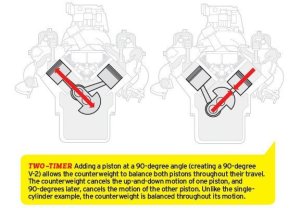
First note that the amplitude of the two linear oscillations above is normalized: the maximum displacement of the object from equilibrium, in the positive or negative direction, which we may denote by x = ±A, is equal to one. Hence, the energy formula is just the sum of the potential and kinetic energy: T + U = (1/2)Ā·A2Ā·m·ω2Ā = (1/2)Ā·m·ω2. But so we haveĀ twoĀ springs and, therefore, the energy in this two-dimensional oscillation is equal to E = 2Ā·(1/2)Ā·m·ω2Ā =Ā m·ω2.

This formula is structurally similar to Einstein’sĀ E = mĀ·c2Ā formula. Hence, one may want to assume that the energy of some particle (an electron, in our case, because we’re discussing electron orbitals here)Ā is just the two-dimensional motion of itsĀ mass. To put it differently, we might also want to think that the oscillating real and imaginary component of our wavefunction each store one halfĀ of the total energy of our particle.

However, the interpretation of this rather bold statement is not so straightforward. First, you should note that the ω in the E =Ā m·ω2Ā formula is an angularĀ velocity, as opposed to the cĀ in theĀ E = mĀ·c2Ā formula, which is a linear velocity. Angular velocities are expressed inĀ radiansĀ per second, while linear velocities are expressed inĀ meterĀ per second. However, while theĀ radianĀ measures an angle, we know it does so by measuring a length. Hence, if our distance unit is 1 m, an angle of 2π rad will correspond to a length of 2π meter, i.e. the circumference of the unit circle. So… Well… The two velocities mayĀ notĀ be so different after all.

There are other questions here. In fact, the other questions are probably more relevant. First, we should note that the ω in the E =Ā m·ω2Ā can take on any value. For a mechanical spring, ω will be a function of (1) the stiffnessĀ of the spring (which we usually denote by k, and which is typically measured in newton (N) per meter) and (2) the mass (m) on the spring. To be precise, we write: ω2Ā = k/m – or, what amounts to the same, ω = √(k/m). Both k and m are variablesĀ and, therefore, ω can really be anything. In contrast, we know that c is a constant: cĀ equalsĀ 299,792,458 meter per second, to be precise. So we have this rather remarkable expression: cĀ = √(E/m), and it is valid for anyĀ particle – our electron, or the proton at the center, or our hydrogen atom as a whole. It is also valid for more complicated atoms, of course. In fact, it is valid forĀ anyĀ system.

Hence, we need to take another look at the energy conceptĀ that is used in our ψ(x, t) = eāˆ’iĀ·(E/ħ)Ā·tĀ·f(x) wavefunction. You’ll remember (if not, youĀ should) that the E here is equal to EnĀ = āˆ’13.6 eV, āˆ’3.4 eV, āˆ’1.5 eV and so on, for nĀ = 1, 2, 3, etc. Hence, this energy concept is rather particular. As Feynman puts it: “The energies are negative because we picked our zero point as the energy of an electron located far from the proton. When it is close to the proton, its energy is less, so somewhat below zero. The energy is lowest (most negative) for n = 1, and increases toward zero with increasing n.”

Now, this is theĀ one and onlyĀ issue I have with the standard physics story. I mentioned it in one of my previous posts and, just for clarity, let me copy what I wrote at the time:

Feynman gives us a rather casual explanation [on choosing a zero point for measuring energy] in one of his very firstĀ LecturesĀ on quantum mechanics, where he writes the following:Ā ā€œIf we have a ā€œconditionā€ which is a mixture of two different states with different energies, then the amplitude for each of the two states will vary with time according to an equation likeĀ aĀ·eāˆ’iωt, with ħ·ω =Ā EĀ = mĀ·c2. Hence, we can write the amplitude for the two states, for example as:

eāˆ’i(E1/ħ)Ā·tĀ and eāˆ’i(E2/ħ)Ā·t

And if we have some combination of the two, we will have an interference. But notice that if we added a constant to both energies, it wouldn’t make any difference. If somebody else were to use a different scale of energy in which all the energies were increased (or decreased) by a constant amount—say, by the amount A—then the amplitudes in the two states would, from his point of view, be:

eāˆ’i(E1+A)Ā·t/ħ and eāˆ’i(E2+A)Ā·t/ħ

All of his amplitudes would be multiplied by the same factor eāˆ’i(A/ħ)Ā·t, and all linear combinations, or interferences, would have the same factor. When we take the absolute squares to find the probabilities, all the answers would be the same. The choice of an origin for our energy scale makes no difference; we can measure energy from any zero we want. For relativistic purposes it is nice to measure the energy so that the rest mass is included, but for many purposes that aren’t relativistic it is often nice to subtract some standard amount from all energies that appear. For instance, in the case of an atom, it is usually convenient to subtract the energy MsĀ·c2, where MsĀ is the mass of all the separate pieces—the nucleus and the electrons—which is, of course, different from the mass of the atom. For other problems, it may be useful to subtract from all energies the amount MgĀ·c2, where MgĀ is the mass of the whole atom in the ground state; then the energy that appears is just the excitation energy of the atom. So, sometimes we may shift our zero of energy by some very large constant, but it doesn’t make any difference, provided we shift all the energies in a particular calculation by the same constant.ā€

It’s a rather long quotation, but it’s important. The key phrase here is, obviously, the following: ā€œFor other problems, it may be useful to subtract from all energies the amount MgĀ·c2, where MgĀ is the mass of the whole atom in the ground state; then the energy that appears is just the excitation energy of the atom.ā€ So that’s what he’s doing when solving Schrƶdinger’s equation. However, I should make the following point here: if we shift the origin of our energy scale, it does not make any difference in regard to theĀ probabilitiesĀ we calculate, but it obviously does make a difference in terms of our wavefunction itself. To be precise, itsĀ densityĀ in time will beĀ veryĀ different. Hence, if we’d want to give the wavefunction someĀ physicalĀ meaning – which is what I’ve been trying to do all along – itĀ doesĀ make a huge difference. When we leave the rest mass of all of the pieces in our system out, we can no longer pretend we capture their energy.

So… Well… There you go. If we’d want to try to interpret our ψ(x, t) = eāˆ’iĀ·(En/ħ)Ā·tĀ·f(x) function as a two-dimensional oscillation of theĀ massĀ of our electron, the energy concept in it – so that’s the EnĀ in it – should include all pieces. Most notably, it should also include the electron’sĀ rest energy, i.e. its energy when it is notĀ in a bound state. This rest energy is equal to 0.511 MeV. […]Ā Read this again: 0.511 mega-electronvolt (106Ā eV), so that’s huge as compared to the tiny energy values we mentioned so far (āˆ’13.6 eV, āˆ’3.4 eV, āˆ’1.5 eV,…).

Of course, this gives us a rather phenomenal order of magnitude for the oscillation that we’re looking at. Let’s quickly calculate it. We need to convert to SI units,Ā of course: 0.511 MeV is about 8.2Ɨ10āˆ’14Ā jouleĀ (J), and so the associated frequencyĀ is equal to ν = E/h = (8.2Ɨ10āˆ’14Ā J)/(6.626Ɨ10āˆ’34 JĀ·s) ā‰ˆ 1.23559Ɨ1020Ā cycles per second. Now, I know such number doesn’t say all that much: just note it’s the same order of magnitude as the frequency of gamma raysĀ and… Well… No. I won’t say more. You should try to think about this for yourself. [If you do,Ā think – for starters – aboutĀ the difference between bosons and fermions: matter-particles are fermions, and photons are bosons. Their nature is very different.]

The correspondingĀ angularĀ frequency is just the same number but multiplied by 2Ļ€ (one cycle corresponds to 2π radiansĀ and, hence, ω = 2π·ν = 7.76344Ɨ1020Ā radĀ per second. Now, if our green dot would be moving around the origin, along the circumference of our unit circle, then its horizontal and/or vertical velocity would approach the same value. Think of it. We have thisĀ eiĪøĀ =Ā eāˆ’iĀ·(E/ħ)Ā·tĀ =Ā ei·ω·tĀ = cos(ω·t) +Ā iĀ·sin(ω·t) function, with ω = E/ħ. So theĀ cos(ω·t) captures the motion along the horizontal axis, while the sin(ω·t) function captures the motion along the vertical axis.Ā Now, the velocity along the horizontalĀ axis as a function of time is given by the following formula:

v(t) = d[x(t)]/dt = d[cos(ω·t)]/dt =Ā āˆ’Ļ‰Ā·sin(ω·t)

Likewise, the velocity along theĀ verticalĀ axis is given byĀ v(t) = d[sin(ω·t)]/dt = ω·cos(ω·t). These are interesting formulas: they show the velocity (v) along one of the two axes is always lessĀ than theĀ angular velocity (ω). To be precise, the velocity vĀ approaches – or, in the limit, is equal to –Ā the angular velocity ω when ω·t is equal to ω·tĀ = 0, π/2, Ļ€ or 3Ļ€/2. So… Well… 7.76344Ɨ1020Ā meterĀ per second!? That’s like 2.6Ā trillionĀ times the speed of light. So that’s not possible, of course!

That’s where theĀ amplitudeĀ of our wavefunction comes in – our envelope functionĀ f(x): the green dot doesĀ notĀ move along the unit circle. The circle is much tinier and, hence, the oscillation shouldĀ notĀ exceed the speed of light. In fact, I should probably try to prove it oscillatesĀ atĀ the speed of light, thereby respecting Einstein’s universal formula:

c = √(E/m)

Written like this – rather than as you know it: E = mĀ·c2Ā – this formula shows the speed of light is just a property of spacetime, just like the ω = √(k/m) formula (or the ω = √(1/LC) formula for a resonant AC circuit) shows that ω, the naturalĀ frequency of our oscillator, is a characteristic of the system.

Am I absolutely certain of what I am writing here? No. My level of understanding of physics is still that of an undergrad. But… Well… It all makes a lot of sense, doesn’t it? šŸ™‚

Now, I said there were a fewĀ obvious questions, and so far I answered only one. The other obvious question is why energy would appear to us as mass in motionĀ in two dimensions only. Why is it an oscillation in a plane? We might imagine a third spring, so to speak, moving in and out from us, right? Also, energyĀ densitiesĀ are measured per unitĀ volume, right?

NowĀ that‘s a clever question, and I must admit I can’t answer it right now. However, I do suspect it’s got to do with the fact that the wavefunction depends on the orientation of our reference frame. If we rotate it, it changes. So it’s like we’ve lost one degree of freedom already, so only two are left. Or think of the third direction as the direction of propagationĀ of the wave. šŸ™‚Ā Also, we should re-read what we wrote about the Poynting vector for the matter wave, or what Feynman wrote about probabilityĀ currents. Let me give you some appetite for that by noting that we can re-writeĀ jouleĀ per cubic meter (J/m3) asĀ newtonĀ perĀ squareĀ meter: J/m3Ā = NĀ·m/m3Ā = N/m2. [Remember: the unit of energy is force times distance. In fact, looking at Einstein’s formula, I’d say it’s kgĀ·m2/s2Ā (mass times a squared velocity), but that simplifies to the same: kgĀ·m2/s2Ā = [N/(m/s2)]Ā·m2/s2.]

I should probably also remindĀ you that there is no three-dimensional equivalent of Euler’s formula, and the way the kinetic and potential energy of those two oscillations works together is rather unique. Remember I illustrated it with the image of a V-2 engine in previous posts. There is no such thing as a V-3 engine. [Well… There actually is – but not with the third cylinder being positioned sideways.]two-timer-576-px-photo-369911-s-original

But… Then… Well… Perhaps we should think of some weird combination ofĀ twoĀ V-2 engines. The illustration below shows the superposition of twoĀ one-dimensional waves – I think – one traveling east-west and back, and the other one traveling north-south and back. So, yes, we may to think of Feynman’s drum-head again – but combiningĀ two-dimensional waves –Ā twoĀ waves thatĀ bothĀ have an imaginary as well as a real dimension

dippArticle-14

Hmm… Not sure. If we go down this path, we’d need to add a third dimension – so w’d have a super-weird V-6 engine! As mentioned above, the wavefunction does depend on our reference frame: we’re looking at stuff from a certain directionĀ and, therefore, we can only see what goes up and down, and what goes left or right. We can’t see what comes near and what goes away from us. Also think of the particularities involved in measuring angular momentum – or the magnetic moment of some particle. We’re measuring that along one direction only! Hence, it’s probably no use to imagine we’re looking atĀ threeĀ waves simultaneously!

In any case…Ā I’ll let you think about all of this. I do feel I am on to something. I am convinced that my interpretation of the wavefunction as anĀ energy propagationĀ mechanism, or asĀ energy itselfĀ – as a two-dimensional oscillation of mass – makes sense. šŸ™‚

Of course, I haven’t answered oneĀ keyĀ question here: whatĀ isĀ mass? What is that green dot – in reality, that is? At this point, we can only waffle – probably best to just give its standard definition: mass is a measure ofĀ inertia. A resistance to acceleration or deceleration, or to changing direction. But that doesn’t say much. I hate to say that – in many ways – all that I’ve learned so far hasĀ deepenedĀ the mystery, rather than solve it. The more we understand, the less we understand? But… Well… That’s all for today, folks ! Have fun working through it for yourself. šŸ™‚

Post scriptum: I’ve simplified the wavefunction a bit. As I noted in my post on it, the complex exponential is actually equal toĀ eāˆ’iĀ·[(E/ħ)Ā·tĀ āˆ’Ā m·φ], so we’ve got a phase shift because of m, the quantum number which denotes the z-component of the angular momentum. But that’s a minor detail that shouldn’t trouble or worry you here.

Re-visiting electron orbitals (III)

Pre-script (dated 26 June 2020): Our ideas have evolved into a full-blown realistic (or classical) interpretation of all things quantum-mechanical. In addition, I note the dark force has amused himself by removing some material. So no use to read this. Read my recent papers instead. šŸ™‚

Original post:

In my previous post, I mentioned that it wasĀ not so obvious (both from a physicalĀ as well as from aĀ mathematicalĀ point of view) to write the wavefunction for electron orbitals – which we denoted as ψ(x, t), i.e. a function of two variables (or four: one time coordinate and three space coordinates) –Ā as the product of two other functions in one variable only.

[…] OK. The above sentence is difficult to read. Let me write in math. šŸ™‚ It isĀ notĀ so obvious to write ψ(x, t) as:

ψ(x, t) = eāˆ’iĀ·(E/ħ)Ā·t·ψ(x)

As I mentioned before, the physicists’ use of the same symbol (ψ, psi) for both the ψ(x, t) and ψ(x) function is quite confusing – because the two functions areĀ veryĀ different:

  • ψ(x, t) is a complex-valued function of twoĀ (real)Ā variables: x and t. OrĀ four, I should say, because xĀ = (x, y, z) – but it’s probably easier to think of x as oneĀ vectorĀ variable – aĀ vector-valued argument, so to speak. And then t is, of course, just aĀ scalarĀ variable. So… Well… A function of twoĀ variables: the position in space (x), and time (t).
  • In contrast, ψ(x) is a real-valuedĀ function ofĀ oneĀ (vector) variable only: x, so that’s the position in space only.

Now you should cry foul, of course: ψ(x) is notĀ necessarilyĀ real-valued. It mayĀ be complex-valued. You’re right.Ā You know the formula:wavefunctionNote the derivation of this formula involved a switch from Cartesian to polar coordinates here, so from xĀ = (x, y, z) to rĀ = (r, Īø, φ), and that the function is also a function of the twoĀ quantum numbersĀ l and m now, i.e. the orbital angular momentum (l) and its z-component (m) respectively. In my previous post(s), I gave you the formulas for Yl,m(Īø, φ) and Fl,m(r) respectively. Fl,m(r) was a real-valued function alright, but the Yl,m(Īø, φ) had that eiĀ·m·φ factor in it. So… Yes. You’re right: the Yl,m(Īø, φ) function is real-valued if – and onlyĀ if – m = 0, in which case eiĀ·m·φ = 1.Ā Let me copy the table from Feynman’s treatment of the topic once again:spherical harmonics 2The Plm(cosĪø) functions are the so-called (associated) Legendre polynomials, and the formula for these functions is rather horrible:Legendre polynomialDon’t worry about it too much: just note the Plm(cosĪø)Ā is aĀ real-valuedĀ function. The point is the following:the ψ(x, t) is a complex-valuedĀ function because – andĀ onlyĀ because – we multiply a real-valued envelope function – which depends on positionĀ only – with eāˆ’iĀ·(E/ħ)Ā·tĀ·eiĀ·m·φ = eāˆ’iĀ·[(E/ħ)Ā·tĀ āˆ’Ā m·φ].

[…]

Please read the above once again and – more importantly – think about it for a while. šŸ™‚ You’ll have to agree with the following:

  • As mentioned in my previous post,Ā the eiĀ·m·φ factor just gives us phase shift: just aĀ re-set of our zero point for measuring time, so to speak, and the whole eāˆ’iĀ·[(E/ħ)Ā·tĀ āˆ’Ā m·φ]Ā factor just disappears when we’re calculating probabilities.
  • The envelope function gives us the basic amplitude – in theĀ classicalĀ sense of the word:Ā the maximum displacement fromĀ theĀ zeroĀ value. And so it’s that eāˆ’iĀ·[(E/ħ)Ā·tĀ āˆ’Ā m·φ]Ā that ensures the whole expression somehow captures the energyĀ of the oscillation.

Let’s first look at the envelope function again. Let me copy the illustration forĀ n = 5 and lĀ = 2 from aĀ Wikimedia CommonsĀ article.Ā Note the symmetry planes:

  • Any plane containing theĀ z-axis is a symmetry plane – like a mirror in which we can reflect one half of theĀ shape to get the other half. [Note that I am talking theĀ shapeĀ only here. Forget about the colors for a while – as these reflect the complex phase of the wavefunction.]
  • Likewise, the plane containingĀ bothĀ the x– and the y-axis is a symmetry plane as well.

n = 5

The first symmetry plane – or symmetryĀ line, really (i.e. theĀ z-axis) – should not surprise us, because the azimuthal angle φ is conspicuously absent in the formula for our envelope function if, as we are doing in this article here, we merge theĀ eiĀ·m·φ factor with the eāˆ’iĀ·(E/ħ)Ā·t, so it’s just part and parcel of what the author of the illustrations above refers to as the ‘complex phase’ of our wavefunction.Ā OK. Clear enough – I hope. šŸ™‚ But why is theĀ the xy-plane a symmetry plane too? We need to look at that monstrous formula for the Plm(cosĪø) function here: just note the cosĪø argument in it is being squaredĀ before it’s used in all of the other manipulation. Now, we know that cosĪø = sin(Ļ€/2Ā āˆ’Ā Īø). So we can define someĀ newĀ angle – let’s just call it α – which is measured in the way we’re used to measuring angle, which is notĀ from the z-axis but from the xy-plane. So we write: cosĪø = sin(Ļ€/2Ā āˆ’Ā Īø) = sinα. The illustration below may or may not help you to see what we’re doing here.angle 2So… To make a long story short, we can substitute the cosĪø argument in the Plm(cosĪø) function for sinα = sin(Ļ€/2Ā āˆ’Ā Īø). Now, if the xy-plane is a symmetry plane, then we must find the same value for Plm(sinα) and Plm[sin(āˆ’Ī±)]. Now, that’s not obvious, because sin(āˆ’Ī±) = āˆ’sinα ≠ sinα. However, because the argument in that Plm(x) function is being squared before any other operation (like subtracting 1 and exponentiating the result), it is OK: [āˆ’sinα]2Ā = [sinα]2Ā =Ā sin2α. […] OK, I am sure the geeks amongst my readers will be able to explain this more rigorously. In fact, I hope they’ll have a look at it, because there’s also that dl+m/dxl+mĀ operator, and so you should check what happens with the minus sign there. šŸ™‚

[…] Well… By now, you’re probably totally lost, but the fact of the matter is that we’ve got a beautiful result here. Let me highlight the most significant results:

  • AĀ definiteĀ energy state of a hydrogen atom (or of an electron orbiting around some nucleus, I should say) appears to us as some beautifully shaped orbital – an envelopeĀ function in three dimensions, really – whichĀ has the z-axis – i.e. the vertical axis – as a symmetry line and the xy-plane as a symmetry plane.
  • The eāˆ’iĀ·[(E/ħ)Ā·tĀ āˆ’Ā m·φ]Ā factor gives us the oscillation within the envelope function. As such, it’s this factor that, somehow,Ā captures the energyĀ of the oscillation.

It’s worth thinking about this. Look at the geometry of the situation again – as depicted below. We’re looking at the situation along the x-axis, in the direction of the origin, which is the nucleus of our atom.

spherical

The eiĀ·m·φ factor just gives us phase shift: just aĀ re-set of our zero point for measuring time, so to speak. Interesting, weird – but probably less relevant than the eāˆ’iĀ·[(E/ħ)Ā·tĀ factor, which gives us the two-dimensional oscillation that captures the energy of the state.

Circle_cos_sin

Now, the obvious question is: the oscillation of what, exactly? I am not quite sure but – as I explained in my Deep BlueĀ page – the real and imaginary part of our wavefunction are really like the electric and magnetic field vector of an oscillating electromagnetic field (think of electromagnetic radiation – if that makes it easier). Hence, just like the electric and magnetic field vector represent some rapidly changing forceĀ on a unit charge, the real and imaginary part of our wavefunction must also represent some rapidly changingĀ forceĀ on… Well… I am not quite sure on what though. The unit charge is usually defined as the charge of a proton – rather than an electron – but then forces act on some mass, right? And the massĀ of a proton is hugely different from the mass of an electron. The same electric (or magnetic) force will, therefore, give a hugely different acceleration to both.

So… Well… My guts instinct tells me the real and imaginary part of our wavefunction just represent, somehow, a rapidly changing force on some unit ofĀ mass, but then I am not sure how to define that unit right now (it’s probably notĀ the kilogram!).

Now, there is another thing we should note here: we’re actually sort of de-constructing a rotationĀ (look at the illustration above once again) in two linearly oscillating vectors – one along the z-axis and the other along the y-axis.Ā Hence, in essence, we’re actually talking about something that’s spinning.Ā In other words, we’re actually talking someĀ torqueĀ around the x-axis. In what direction? I think that shouldn’t matter – that we can write E or āˆ’E, in other words, but… Well… I need to explore this further – as should you! šŸ™‚

Let me just add one more note on the eiĀ·m·φ factor. It sort of defines the geometryĀ of the complex phase itself. Look at the illustration below. Click on it to enlarge it if necessary – or, better still, visit the magnificent Wikimedia Commons article from which I get these illustrations. These are the orbitals nĀ = 4 and lĀ = 3. Look at the red hues in particular – or the blue – whatever: focus on one color only, and see how how – for mĀ = ±1, we’ve got one appearance of that color only. For mĀ = ±1, the same color appears at two ends of the ‘tubes’ – or toriĀ (plural of torus), I should say – just to sound more professional. šŸ™‚ For mĀ = ±2, the torus consists of three parts – or, in mathematical terms, we’d say the order of its rotational symmetryĀ is equal to 3.Ā Check that Wikimedia Commons article for higher values ofĀ nĀ andĀ l: the shapes become very convoluted, but the observation holds. šŸ™‚

l = 3

Have fun thinking all of this through for yourself – and please do look at those symmetries in particular. šŸ™‚

Post scriptum: You should do some thinking on whether or not theseĀ mĀ = ±1, ±2,…, ±lĀ orbitals are really different. As I mentioned above, a phase difference is just what it is: a re-set of the t = 0 point. Nothing more, nothing less. So… Well… As far as I am concerned, that’s notĀ aĀ realĀ difference, is it? šŸ™‚ As with other stuff, I’ll let you think about this for yourself.

Some content on this page was disabled on June 17, 2020 as a result of a DMCA takedown notice from Michael A. Gottlieb, Rudolf Pfeiffer, and The California Institute of Technology. You can learn more about the DMCA here:

https://wordpress.com/support/copyright-and-the-dmca/

An interpretation of the wavefunction

This is my umpteenth post on the same topic. 😦 It is obvious that this search for a sensible interpretation is consuming me. Why? I am not sure. Studying physics is frustrating. As a leading physicist puts it:

“TheĀ teaching of quantum mechanics these days usuallyĀ follows the same dogma: firstly, the student is told about the failure of classical physics atĀ the beginning of the last century; secondly, the heroic confusions of the founding fathersĀ are described and the student is given to understand that no humble undergraduate studentĀ could hope to actually understand quantum mechanics for himself; thirdly, a deus exĀ machina arrives in the form of a set of postulates (the Schrƶdinger equation, the collapseĀ of the wavefunction, etc); fourthly, a bombardment of experimental verifications is given,Ā so that the student cannot doubt that QM is correct; fifthly, the student learns how toĀ solve the problems that will appear on the exam paper, hopefully with as little thought asĀ possible.”

That’s obviously not the way we want to understand quantum mechanics. [With we,Ā I mean, me, of course, and you, if you’re reading this blog.]Ā Of course, that doesn’t mean I don’t believe Richard Feynman, one of the greatest physicists ever, when he tells us no one, including himself, understands physics quite the way we’dĀ likeĀ to understand it. Such statements should not prevent us from tryingĀ harder. So let’s look for betterĀ metaphors.Ā The animation below shows the two components of the archetypal wavefunction – a simple sine and cosine. They’re the same function actually, but their phases differ by 90 degrees (Ļ€/2).

circle_cos_sin

It makes me think of a V-2 engine with the pistons at a 90-degree angle. Look at the illustration below, which I took from a rather simple article on cars and engines that has nothing to do with quantum mechanics. Think of the moving pistons as harmonic oscillators, like springs.

two-timer-576-px-photo-369911-s-original

We will also think of theĀ center of each cylinder as the zero point: think of that point as a point where – if we’re looking at one cylinder alone – the internal and external pressure balance each other, so the piston would not move… Well… If it weren’t for the other piston, because the second piston isĀ not at the centerĀ when the first is. In fact, it is easy to verify and compare the following positions of both pistons, as well as the associated dynamics of the situation:

Piston 1

Piston 2

Motion of Piston 1

Motion Piston 2

Top

Center

Compressed air will push piston down

Piston moves down against external pressure

Center

Bottom

Piston moves down against external pressure

External air pressure will push piston up

Bottom

Center

External air pressure will push piston up

Piston moves further up and compresses the air

Center

Top

Piston moves further up and compresses the air

Compressed air will push piston down

When the pistons move, their linear motion will be described by a sinusoidal function: a sine or a cosine. In fact, the 90-degree V-2 configuration ensures that the linear motion of the two pistons will be exactly the same, except for a phase difference of 90 degrees. [Of course, because of the sideways motion of the connecting rods, our sine and cosine function describes the linear motion only approximately, but you can easily imagine the idealizedĀ limit situation. If not, check Feynman’s description of the harmonic oscillator.]

The question is: if we’d have a set-up like this, two springs – or two harmonic oscillators – attached to a shaft through a crank, would this really work as a perpetuum mobile? We obviously talk energyĀ being transferred back and forth between the rotating shaft and the moving pistons… So… Well… Let’s model this: the totalĀ energy, potentialĀ andĀ kinetic, in each harmonic oscillator is constant. Hence, the piston only delivers or receivesĀ kineticĀ energy from the rotating mass of the shaft.

Now, in physics, that’s a bit of an oxymoron: we don’t think of negative or positive kinetic (or potential) energy in the context of oscillators. We don’t think of the direction of energy. But… Well… If we’ve got twoĀ oscillators, our picture changes, and so we may have to adjust our thinking here.

Let me start by giving you an authoritative derivation of the various formulas involved here, taking the example of the physical spring as an oscillator—but the formulas are basically the same forĀ any harmonic oscillator.

energy harmonic oscillator

The first formula is a general description of the motion of our oscillator. The coefficient in front of the cosine function (a)Ā is the maximum amplitude. Of course, you will also recognize ω0Ā as theĀ naturalĀ frequency of the oscillator, andĀ Ī” as the phase factor, which takes into account our t = 0 point. In our case, for example, we have two oscillators with a phase difference equal to Ļ€/2 and, hence, Ī” would be 0 for one oscillator, and –π/2 for the other. [The formula to apply here is sinĪø = cos(Īø – Ļ€/2).] Also note that we can equate our Īø argument to ω0Ā·t.Ā Now, ifĀ aĀ = 1 (which is the case here), then these formulas simplify to:

  1. K.E. = T = mĀ·v2/2 =Ā m·ω02Ā·sin2(Īø + Ī”) = m·ω02Ā·sin2(ω0Ā·t + Ī”)
  2. P.E. = U = kĀ·x2/2 = kĀ·cos2(Īø + Ī”)

The coefficient k in the potential energy formula characterizes the force: F = āˆ’kĀ·x. The minus sign reminds us our oscillator wants to return to the center point, so the force pulls back. From the dynamics involved, it is obvious that k must be equal to m·ω02., so that gives us the famous T + U = m·ω02/2 formula or, including aĀ once again, T + U = mĀ·a2·ω02/2.

Now, if we normalizeĀ our functions by equating k to one (k = 1), thenĀ the motion ofĀ our first oscillator is given by the cosĪø function, and its kinetic energy will be equal toĀ sin2Īø. Hence, the (instantaneous)Ā changeĀ in kinetic energy at any point in time will be equal to:

d(sin2Īø)/dĪø = 2āˆ™sinĪøāˆ™d(sinĪø)/dt = 2āˆ™sinĪøāˆ™cosĪø

Let’s look at the second oscillator now. Just think of the second piston going up and down in our V-twin engine. Its motion is given by theĀ sinĪø function which, as mentioned above, is equal to cos(Īøāˆ’Ļ€ /2). Hence, its kinetic energy is equal toĀ sin2(Īøāˆ’Ļ€ /2), and how itĀ changesĀ – as a function of Īø – will be equal to:

2āˆ™sin(Īøāˆ’Ļ€ /2)āˆ™cos(Īøāˆ’Ļ€ /2) =Ā = āˆ’2āˆ™cosĪøāˆ™sinĪø = āˆ’2āˆ™sinĪøāˆ™cosĪø

We have our perpetuum mobile! While transferring kinetic energy from one piston to the other, the rotating shaft moves at constant speed. Linear motion becomes circular motion, and vice versa, in a frictionless Universe. We have the metaphor we were looking for!

Somehow, in this beautiful interplay between linear and circular motion, energy is being borrowed from one place to another, and then returned. From what place to what place? I am not sure. We may call it the real and imaginary energy space respectively, but what does that mean? One thing is for sure, however: the interplay between the real and imaginary part of the wavefunction describes how energy propagates through space!

How exactly? Again, I am not sure. Energy is, obviously, mass in motion – as evidenced by the E = mĀ·c2Ā equation, and it may not have any direction (when everything is said and done, it’s a scalarĀ quantity without direction), but the energy in a linear motion is surely different from that in a circular motion, and our metaphor suggests we need to think somewhat more along those lines. Perhaps we will, one day, able toĀ square this circle. šŸ™‚

Schrƶdinger’s equation

Let’s analyze the interplay between the real and imaginary part of the wavefunction through an analysis of Schrƶdinger’s equation, which we write as:

iĀ·Ä§āˆ™āˆ‚Ļˆ/āˆ‚t = –(ħ2/2m)āˆ™āˆ‡2ψ + V·ψ

We can do a quick dimensional analysis of both sides:

  • [iĀ·Ä§āˆ™āˆ‚Ļˆ/āˆ‚t] = Nāˆ™māˆ™s/s = Nāˆ™m
  • [–(ħ2/2m)āˆ™āˆ‡2ψ] = Nāˆ™m3/m2 = Nāˆ™m
  • [V·ψ] = Nāˆ™m

Note the dimension of the ‘diffusion’ constant ħ2/2m: [ħ2/2m] = N2āˆ™m2āˆ™s2/kg = N2āˆ™m2āˆ™s2/(NĀ·s2/m) = Nāˆ™m3. Also note that, in order for the dimensions to come out alright, the dimension of V – the potential – must be that of energy. Hence, Feynman’s description of it as the potential energy – rather than the potential tout court – is somewhat confusing but correct: V must equal the potential energy of the electron. Hence, V is not the conventional (potential) energy of the unit charge (1 coulomb). Instead, the natural unit of charge is used here, i.e. the charge of the electron itself.

Now, Schrƶdinger’s equation – without the V·ψ term – can be written as the following pair of equations:

  1. Re(āˆ‚Ļˆ/āˆ‚t) = āˆ’(1/2)āˆ™(ħ/m)āˆ™Im(āˆ‡2ψ)
  2. Im(āˆ‚Ļˆ/āˆ‚t) = (1/2)āˆ™(ħ/m)āˆ™Re(āˆ‡2ψ)

This closely resembles the propagation mechanism of an electromagnetic wave as described by Maxwell’s equation for free space (i.e. a space with no charges), but E and B are vectors, not scalars. How do we get this result. Well… ψ is a complex function, which we can write as a + iāˆ™b. Likewise, āˆ‚Ļˆ/āˆ‚t is a complex function, which we can write as c + iāˆ™d, and āˆ‡2ψ can then be written as e + iāˆ™f. If we temporarily forget about the coefficients (ħ, ħ2/m and V), then Schrƶdinger’s equation – including V·ψ term – amounts to writing something like this:

iāˆ™(c + iāˆ™d) = –(e + iāˆ™f) + (a + iāˆ™b) ⇔ a + iāˆ™b = iāˆ™c āˆ’ d + e+ iāˆ™f  ⇔ a = āˆ’d + e and b = c + f

Hence, we can now write:

  1. Vāˆ™Re(ψ) = āˆ’Ä§āˆ™Im(āˆ‚Ļˆ/āˆ‚t) + (1/2)āˆ™( ħ2/m)āˆ™Re(āˆ‡2ψ)
  2. Vāˆ™Im(ψ) = Ä§āˆ™Re(āˆ‚Ļˆ/āˆ‚t) + (1/2)āˆ™( ħ2/m)āˆ™Im(āˆ‡2ψ)

This simplifies to the two equations above for V = 0, i.e. when there is no potential (electron in free space). Now we can bring the Re and Im operators into the brackets to get:

  1. Vāˆ™Re(ψ) = āˆ’Ä§āˆ™āˆ‚Im (ψ)/āˆ‚t + (1/2)āˆ™( ħ2/m)āˆ™āˆ‡2Re(ψ)
  2. Vāˆ™Im(ψ) = Ä§āˆ™āˆ‚Re(ψ)/āˆ‚t + (1/2)āˆ™( ħ2/m)āˆ™āˆ‡2Im(ψ)

This is very interesting, because we can re-write this using the quantum-mechanical energy operator H = –(ħ2/2m)āˆ™āˆ‡2 + VĀ· (note the multiplication sign after the V, which we do not have – for obvious reasons – for the –(ħ2/2m)āˆ™āˆ‡2 expression):

  1. H[Re (ψ)] = āˆ’Ä§āˆ™āˆ‚Im(ψ)/āˆ‚t
  2. H[Im(ψ)] = Ä§āˆ™āˆ‚Re(ψ)/āˆ‚t

A dimensional analysis shows us both sides are, once again, expressed in Nāˆ™m. It’s a beautiful expression because – if we write the real and imaginary part of ψ as rāˆ™cosĪø and rāˆ™sinĪø, we get:

  1. H[cosĪø] = āˆ’Ä§āˆ™āˆ‚sinĪø/āˆ‚t = Eāˆ™cosĪø
  2. H[sinĪø] = Ä§āˆ™āˆ‚cosĪø/āˆ‚t = Eāˆ™sinĪø

Indeed, ĪøĀ = (Eāˆ™t āˆ’ pāˆ™x)/ħ and, hence, āˆ’Ä§āˆ™āˆ‚sinĪø/āˆ‚t = Ä§āˆ™cosĪøāˆ™E/ħ = Eāˆ™cosĪø and Ä§āˆ™āˆ‚cosĪø/āˆ‚t = Ä§āˆ™sinĪøāˆ™E/ħ = Eāˆ™sinĪø.Ā  Now we can combine the two equations in one equation again and write:

H[rāˆ™(cosĪø + iāˆ™sinĪø)] = rāˆ™(Eāˆ™cosĪø + iāˆ™sinĪø) ⇔ H[ψ] = Eāˆ™Ļˆ

The operator H – applied to the wavefunction – gives us the (scalar) product of the energy E and the wavefunction itself. Isn’t this strange?

Hmm… I need to further verify and explain this result… I’ll probably do so in yet another post on the same topic… šŸ™‚

Post scriptum: The symmetry of our V-2 engine – or perpetuum mobileĀ – is interesting: its cross-section has only one axis of symmetry. Hence, we may associate some angle with it, so as to define its orientation in the two-dimensional cross-sectional plane. Of course, the cross-sectional plane itself is at right angles to the crankshaft axis, which we may also associate with some angle in three-dimensional space. Hence, its geometry defines two orthogonal directions which, in turn, define a spherical coordinate system, as shown below.

558px-3d_spherical

We may, therefore, say that three-dimensional space is actually being impliedĀ byĀ the geometry of our V-2 engine. Now thatĀ isĀ interesting, isn’t it? šŸ™‚

Re-visiting uncertainty…

I re-visited the Uncertainty Principle a couple of times already, but here I really want to get at the bottom of the thing? What’s uncertain? The energy? The time? The wavefunction itself? These questions are not easily answered, and I need to warn you: you won’t get too much wiser when you’re finished reading this. I just felt like freewheeling a bit. [NoteĀ that the first part of this post repeats what you’ll find on the Occam page, or my post on Occam’s Razor. But these post doĀ notĀ analyze uncertainty, which is what I will beĀ tryingĀ to do here.]

Let’s first think about the wavefunction itself. It’s tempting to think it actuallyĀ isĀ the particle, somehow. But it isn’t. So what is it then? Well… Nobody knows. In my previous post, I said I like to think it travelsĀ with the particle, but then doesn’t make much sense either. It’s like a fundamentalĀ propertyĀ of the particle. Like the color of an apple. But where isĀ that color? In the apple, in the light it reflects, in the retina of our eye, or is it in our brain? If you know a thing or two about how perception actually works, you’ll tend to agree the quality ofĀ colorĀ is notĀ in the apple. When everything is said and done, the wavefunction is aĀ mental construct: when learning physics, we start to think of a particle as a wavefunction, but they are two separate things: the particle is reality, the wavefunction is imaginary.

But that’s not what I want to talk about here. It’s about thatĀ uncertainty. Where is the uncertainty? You’ll say: you just said it was in our brain. No. I didn’t say that. It’s not that simple. Let’s look at the basic assumptions of quantum physics:

  1. Quantum physics assumes there’s always some randomnessĀ in Nature and, hence, we can measure probabilitiesĀ only. We’ve got randomness in classical mechanics too, but this is different. This is an assumption about how Nature works: we don’t really know what’s happening. We don’t know the internal wheels and gears, so to speak, or the ā€˜hidden variables’, as one interpretation of quantum mechanics would say. In fact, the most commonly accepted interpretation of quantum mechanics says there are no ā€˜hidden variables’.
  2. However, as Shakespeare hasĀ one of his charactersĀ say: there is a method in the madness, and the pioneers– I mean Werner Heisenberg, Louis de Broglie, Niels Bohr, Paul Dirac, etcetera – discovered that method: all probabilities can be found by taking the square of the absolute value of a complex-valued wavefunctionĀ (often denoted by ĪØ), whose argument, or phaseĀ (Īø),Ā is given by the de Broglie relations ω = E/ħ and kĀ =Ā p/ħ. The generic functional form of that wavefunction is:

ĪØ = ĪØ(x, t) =Ā aĀ·eāˆ’iĪøĀ = aĀ·eāˆ’i(ω·t āˆ’ kĀ āˆ™x)Ā = aĀ·eāˆ’iĀ·[(E/ħ)Ā·t āˆ’ (p/ħ)āˆ™x]

That should be obvious by now, as I’ve written more than a dozens of posts on this. šŸ™‚ I still have trouble interpreting this, however—and I am not ashamed, because the Great Ones I just mentioned have trouble with that too. It’s not that complex exponential. ThatĀ eāˆ’iφ is a very simple periodic function, consisting of two sine waves rather than just one, as illustrated below. [It’s a sine and a cosine, but they’re the same function: there’s just a phase difference of 90 degrees.]Ā sine

No. To understand the wavefunction, we need to understand thoseĀ de BroglieĀ relations, ω = E/ħ and kĀ =Ā p/ħ, and then, as mentioned, we need to understand the Uncertainty Principle. We need to understand where it comes from. Let’sĀ try to go as far as we can by making a few remarks:

  • Adding or subtracting two terms in math, (E/ħ)Ā·t āˆ’ (p/ħ)āˆ™x, implies the two terms should have the sameĀ dimension: we can only add apples to apples, and oranges to oranges. We shouldn’t mix them. Now, theĀ (E/ħ)Ā·t and (p/ħ)Ā·x termsĀ are actually dimensionless: they are pure numbers. So that’s even better. Just check it: energy is expressed in newtonĀ·meterĀ (energy, or work, is force over distance, remember?) or electronvoltsĀ (1 eVĀ =Ā 1.6Ɨ10āˆ’19 J = 1.6Ɨ10āˆ’19 NĀ·m); Planck’s constant, as the quantum of action,Ā is expressed in JĀ·s or eVĀ·s; and the unit ofĀ (linear) momentum is 1Ā NĀ·s = 1Ā kgĀ·m/s = 1Ā NĀ·s. E/ħ gives a number expressed per second, and p/ħ a number expressed per meter. Therefore, multiplying E/ħ and p/ħ by t and x respectively gives us a dimensionless number indeed.
  • It’s also an invariant number, which means we’ll always get the same value for it, regardless of our frame of reference. As mentioned above, that’s because theĀ four-vector product pμxμ =Ā EĀ·t āˆ’ pāˆ™xĀ is invariant: it doesn’t change when analyzing a phenomenon in oneĀ reference frame (e.g. our inertial reference frame)Ā or another (i.e. in a moving frame).
  • Now, Planck’s quantum of actionĀ h, or ħ – h and ħ only differ in their dimension: h is measured in cyclesĀ per second, while ħ is measured inĀ radiansĀ per second: both assume we can at least measure oneĀ cycle – is the quantum of energy really. Indeed, if ā€œenergy is the currency of the Universeā€, and it’s real and/or virtual photons who are exchanging it, then it’s good to know the currency unit is h, i.e. the energy that’s associated with one cycleĀ of a photon. [In case you want to see the logic of this, see my post on the physical constantsĀ c, h and α.]
  • It’s not only time and space that are related, as evidenced by the fact that t āˆ’ x itself is an invariant four-vector, E and p are related too, of course! They are related through the classical velocity of the particle that we’re looking at: E/p = c2/v and, therefore, we can write:Ā E·β = pĀ·c, with β = v/c, i.e. the relativeĀ velocity of our particle, as measured as aĀ ratioĀ of the speed of light.Ā Now, I should add that theĀ t āˆ’ xĀ four-vector is invariant only if we measure time and space in equivalent units. Otherwise, we have to write cĀ·t āˆ’ x. If we do that, so our unit of distance becomes cĀ meter, rather than one meter, or our unit of time becomes the time that is needed for light to travel one meter, thenĀ cĀ = 1, and the E·β = pĀ·cĀ becomes E·β = p, which we also write as β = p/E: the ratio of the energyĀ and theĀ momentumĀ of our particle is its (relative) velocity.

Combining all of the above, we may want to assume that we are measuring energyĀ andĀ momentum in terms of the Planck constant, i.e. theĀ ā€˜natural’ unit for both. In addition, we may also want to assume that we’re measuring time and distance in equivalent units. Then the equation for the phase of our wavefunctions reduces to:

Īø =Ā (ω·t āˆ’ kĀ āˆ™x) = EĀ·tĀ āˆ’ pĀ·x

Now,Ā Īø is the argument of a wavefunction, and we can alwaysĀ re-scaleĀ such argument by multiplying or dividing it by someĀ constant. It’s just like writing the argument of a wavefunction asĀ vĀ·t–x or (vĀ·t–x)/vĀ = t –x/vĀ  withĀ vĀ the velocity of the waveform that we happen to be looking at. [In case you have trouble following this argument, please check the post I did for my kids on waves and wavefunctions.] Now, the energy conservation principle tells us the energy of a free particle won’t change. [Just to remind you, a ā€˜free particle’ means it’s in a ā€˜field-free’ space, so our particle is in a region ofĀ uniform potential.] So we can, in this case, treat E as a constant, and divideĀ EĀ·tĀ āˆ’ pĀ·x by E, so we get a re-scaled phase for our wavefunction, which I’ll write as:

φ =Ā (EĀ·tĀ āˆ’ pĀ·x)/E = t āˆ’ (p/E)Ā·x = t āˆ’ β·x

Alternatively, we could also look at p as some constant, as there is no variation in potential energy that will cause a change in momentum, and the related kinetic energy. We’d then divide by p and we’d getĀ (EĀ·tĀ āˆ’ pĀ·x)/p = (E/p)Ā·t āˆ’ x) = t/β āˆ’ x, which amounts to the same, as we can always re-scale by multiplying it with β, which would again yield the same t āˆ’ β·x argument.

The point is, if we measure energy and momentum in terms of the Planck unit (I mean:Ā in terms of the Planck constant, i.e. theĀ quantum of energy), and if we measure time and distance in ā€˜natural’ units too, i.e. we take the speed of light to be unity, then our Platonic wavefunction becomes as simple as:

Φ(φ) =Ā aĀ·eāˆ’iφ = aĀ·eāˆ’i(t āˆ’ β·x)

This is a wonderful formula, but let me first answer your most likely question: why would we use a relativeĀ velocity?Well… Just think of it: when everything is said and done, the whole theory of relativity and, hence, the whole of physics, is based onĀ one fundamental and experimentally verified fact: the speed of light isĀ absolute. In whatever reference frame, we willĀ alwaysĀ measure it asĀ 299,792,458 m/s. That’s obvious, you’ll say, but it’s actually the weirdest thing ever if you start thinking about it, and it explains why those Lorentz transformations look so damn complicated. In any case, thisĀ factĀ legitimately establishes cĀ as some kind ofĀ absoluteĀ measure against which all speeds can be measured. Therefore, it is onlyĀ naturalĀ indeed to express a velocity as some number between 0 and 1. Now that amounts to expressing it as the β = v/c ratio.

Let’s now go back to that Φ(φ) =Ā aĀ·eāˆ’iφ = aĀ·eāˆ’i(t āˆ’ β·x)Ā wavefunction. Its temporal frequency ω is equal to one, and its spatial frequency k is equal to β = v/c. It couldn’t be simpler but, of course, we’ve got this remarkably simple result because we re-scaled the argument of our wavefunction using theĀ energyĀ andĀ momentumĀ itself as the scale factor. So, yes, we can re-write the wavefunction of our particle in a particular elegant and simple form using the only information that we have when looking at quantum-mechanical stuff: energy and momentum, because that’s what everything reduces to at that level.

So… Well… We’ve pretty much explained what quantum physics is all about here.Ā You just need to get used to that complex exponential: eāˆ’iφ = cos(āˆ’Ļ†) + iĀ·sin(āˆ’Ļ†) =Ā cos(φ) āˆ’iĀ·sin(φ). It would have been nice if Nature would have given us a simple sine or cosine function. [Remember the sine and cosine function are actually the same, except for a phase difference of 90 degrees: sin(φ) = cos(Ļ€/2āˆ’Ļ†) = cos(φ+Ļ€/2). So we can go always from one to the other by shifting the origin of our axis.] But… Well… As we’ve shown so many times already, a real-valued wavefunction doesn’t explain the interference we observe, be it interference of electrons or whatever other particles or, for that matter, the interference of electromagnetic waves itself, which, as you know, we also need to look at as a stream ofĀ photonsĀ , i.e. light quanta, rather than as some kind of infinitely flexibleĀ aetherĀ that’s undulating, like water or air.

However, the analysis above does notĀ include uncertainty. That’s as fundamental to quantum physics as de Broglie‘s equations, so let’s think about that now.

Introducing uncertainty

Our information on the energy and the momentum of our particle will be incomplete: we’ll write E = E0 ± σE, and p = p0 ± σp. Huh?Ā No Ī”E or Ī”E?Ā Well… It’s the same, really, but I am a bit tired of using the Ī” symbol, so I am using the σ symbol here, which denotes aĀ standard deviationĀ of some density function. It underlines the probabilistic, or statistical, nature of our approach.

The simplest model is that of a two-state system, because it involves two energy levels only: E = E0 ± A, with A some constant. Large or small, it doesn’t matter. All is relative anyway. šŸ™‚Ā We explained the basics of the two-state system using the example of an ammonia molecule, i.e. an NH3Ā molecule, so it consists on one nitrogen and three hydrogen atoms. We had two baseĀ states in this system: ā€˜up’ or ā€˜down’, which we denoted asĀ baseĀ stateĀ | 1 〉 and baseĀ stateĀ | 2 〉 respectively. This ‘up’ and ‘down’ had nothing to do with the classical or quantum-mechanical notion of spin, which is related to theĀ magneticĀ moment. No. It’s much simpler than that: the nitrogen atom could be either beneath or, else, above the plane of the hydrogens, as shown below, with ‘beneath’ and ‘above’ being defined in regard to the molecule’s direction of rotation around its axis of symmetry.

Capture

In any case, for the details, I’ll refer you to the post(s) on it. Here I just want to mention the result. We wroteĀ theĀ amplitudeĀ to find the molecule in either one of these two states as:

  • C1Ā = 〈 1 | ψ 〉 = (1/2)Ā·eāˆ’(i/ħ)Ā·(E0Ā āˆ’ A)Ā·tĀ + (1/2)Ā·eāˆ’(i/ħ)Ā·(E0Ā + A)Ā·t
  • C2Ā = 〈 2 | ψ 〉 = (1/2)Ā·eāˆ’(i/ħ)Ā·(E0Ā āˆ’ A)Ā·t – (1/2)Ā·eāˆ’(i/ħ)Ā·(E0Ā + A)Ā·t

That gave us the following probabilities:

graph

If our molecule can be in two states only, and it starts off in one, then the probability that it willĀ remain in that state will gradually decline, while the probability that it flips into the other state will gradually increase.

Now, the point you should note is that we get theseĀ time-dependentĀ probabilitiesĀ onlyĀ because we’re introducingĀ two differentĀ energy levels:Ā E0Ā + A andĀ E0Ā āˆ’ A. [Note they separated by an amount equal to 2Ā·A, as I’ll use that information later.] If we’d haveĀ oneĀ energy level only – which amounts to saying that weĀ knowĀ it, and that it’s somethingĀ definite – then we’d just have oneĀ wavefunction, which we’d write as:

aĀ·eāˆ’iĪøĀ = aĀ·eāˆ’(i/ħ)Ā·(E0Ā·t āˆ’Ā pĀ·x)Ā = aĀ·eāˆ’(i/ħ)Ā·(E0Ā·t)Ā·e(i/ħ)Ā·(pĀ·x)

Note that we can always split our wavefunction in a ā€˜time’ and a ā€˜space’ part, which is quite convenient. In fact, because our ammonia molecule stays where it is, it has no momentum: p = 0. Therefore, its wavefunction reduces to:

aĀ·eāˆ’iĪøĀ = aĀ·eāˆ’(i/ħ)Ā·(E0Ā·t)

As simple as it can be. šŸ™‚ The point is that a wavefunction like this, i.e. a wavefunction that’s defined by a definiteĀ energy, will alwaysĀ yield a constant and equal probability, both in time as well as in space. That’s just the math of it: |aĀ·eāˆ’iĪø|2Ā = a2. Always!Ā If you want to know why, you should think of Euler’s formula and Pythagoras’ Theorem: cos2Īø +sin2Īø = 1. Always!Ā šŸ™‚

That constant probability is annoying, because our nitrogen atom never ‘flips’, and we know it actually does, thereby overcoming a energy barrier: it’s a phenomenon that’s referred to as ‘tunneling’, and it’s real! The probabilities in that graph above are real! Also, if our wavefunction would represent some moving particle, it would imply that the probability to find it somewhereĀ in space is the sameĀ all over space, which implies our particle isĀ everywhereĀ and nowhere at the same time, really.

So, in quantum physics, this problem is solved by introducing uncertainty.Ā Introducing some uncertainty about the energy, or about the momentum, is mathematically equivalent to saying that we’re actually looking at a compositeĀ wave, i.e. the sum of a finite or potentially infinite set ofĀ component waves. So we have the same ω = E/ħ and kĀ = p/ħ relations, but we apply them to nĀ energy levels, or to some continuousĀ rangeĀ of energy levelsĀ Ī”E. It amounts to saying that our wave function doesn’t have a specific frequency: it now has n frequencies, or a range of frequencies Δω =Ā Ī”E/ħ. In our two-state system, n = 2, obviously! So we’veĀ twoĀ energy levels only and so our composite wave consists of two component waves only.

We know what that does: it ensures our wavefunction is being ā€˜contained’ in some ā€˜envelope’. It becomes a wavetrain, or a kind of beat note, as illustrated below:

File-Wave_group

[The animation comes from Wikipedia, and shows the difference between theĀ groupĀ andĀ phaseĀ velocity: the green dot shows the group velocity, while the red dot travels at the phase velocity.]

So… OK. That should be clear enough. Let’s now apply these thoughts to our ‘reduced’ wavefunction

Φ(φ) =Ā aĀ·eāˆ’iφ = aĀ·eāˆ’i(t āˆ’ β·x)

Thinking about uncertainty

Frankly, I tried to fool you above. If the functional form of the wavefunction isĀ aĀ·eāˆ’(i/ħ)Ā·(EĀ·t āˆ’Ā pĀ·x), then we can measure E and p in whatever unit we want, including h or ħ, but we cannotĀ re-scale the argument of the function, i.e. the phaseĀ Īø, without changingĀ the functional form itself. I explained that in that post for my kids on wavefunctions:, in which I explained we may represent theĀ same electromagneticĀ wave by two different functional forms:

Ā F(ctāˆ’x) = G(tāˆ’x/c)

So F and G represent the same wave, but they are different wavefunctions. In this regard, you should note that the argument of F is expressed in distance units, as we multiply t with the speed of light (so it’s like our time unit is 299,792,458 m now), while the argument of G is expressed in time units, as we divide x by the distance traveled in one second). But F and G are different functional forms. Just do an example and take a simple sine function: you’ll agree that sin(Īø) ≠ sin(Īø/c) for all values of Īø, except 0. Re-scaling changes the frequency, or the wavelength, and it does so quite drastically in this case. šŸ™‚ Likewise, you can see thatĀ aĀ·eāˆ’i(φ/E)Ā = [aĀ·eāˆ’iφ]1/E, so that’s aĀ veryĀ different function. In short, we were a bit too adventurous above. Now, while weĀ canĀ drop the 1/ħ in the aĀ·eāˆ’(i/ħ)Ā·(EĀ·t āˆ’Ā pĀ·x)Ā function when measuring energy and momentum in units that are numerically equal to ħ, we’ll just revert to our original wavefunction for the time being, which equals

ĪØ(Īø) =Ā aĀ·eāˆ’iĪøĀ = aĀ·eāˆ’iĀ·[(E/ħ)Ā·t āˆ’Ā (p/ħ)Ā·x]

Let’s now introduce uncertainty once again. The simplest situation is that we have two closely spaced energy levels. In theory, the difference between the two can be as small as ħ, so we’d write: E = E0 ± ħ/2. [Remember what I said about the ± A: it means the differenceĀ is 2A.] However, we can generalize this and write: E = E0 ± n·ħ/2, with n = 1, 2, 3,… This doesĀ notĀ imply any greater uncertainty – we still have two states only – but just a largerĀ differenceĀ between the two energy levels.

Let’s also simplify by looking at the ‘time part’ of our equation only, i.e.Ā aĀ·eāˆ’iĀ·(E/ħ)Ā·t. It doesn’t mean we don’t care about the ‘space part’: it just means that we’re onlyĀ looking at how our function variesĀ in timeĀ and so we just ‘fix’ or ‘freeze’ x. Now, the uncertainty is in the energy really but, from a mathematical point of view, we’ve got an uncertainty in the argument of our wavefunction, really.Ā This uncertainty in the argument is, obviously, equal to:

(E/ħ)·t = [(E0 ± n·ħ/2)/ħ]·t = (E0/ħ ± n/2)·t = (E0/ħ)·t ± (n/2)·t

So we can write:

aĀ·eāˆ’iĀ·(E/ħ)Ā·tĀ =Ā aĀ·eāˆ’iĀ·[(E0/ħ)Ā·t ± (1/2)Ā·t]Ā =Ā aĀ·eāˆ’iĀ·[(E0/ħ)Ā·t]Ā·eiĀ·[±(n/2)Ā·t]

This is valid forĀ anyĀ value of t. What the expression says is that, from a mathematical point of view, introducing uncertainty about the energy is equivalentĀ to introducing uncertainty about the wavefunction itself. It may be equal to aĀ·eāˆ’iĀ·[(E0/ħ)Ā·t]Ā·eiĀ·(n/2)Ā·t, but it may also be equal to aĀ·eāˆ’iĀ·[(E0/ħ)Ā·t]Ā·eāˆ’iĀ·(n/2)Ā·t. The phases of the eāˆ’iĀ·t/2Ā and eiĀ·t/2Ā factors are separated by a distance equal to t.

So… Well…

[…]

Hmm… I am stuck. How is this going to lead me to theĀ Ī”EĀ·Ī”t = ħ/2 principle? To anyone out there: can you help? šŸ™‚

[…]

The thing is: you won’t get the Uncertainty Principle by staring at that formula above. It’s a bit more complicated. The idea is that we have some distribution of theĀ observables, like energy and momentum, and that implies some distribution of the associated frequencies, i.e. ω for E, and k for p. The Wikipedia article on the Uncertainty Principle gives you a formal derivation of the Uncertainty Principle, using the so-called Kennard formulation of it. You can have a look, but it involves a lot of formalism—which is what I wanted to avoid here!

I hope you get the idea though. It’s like statistics. First, we assume weĀ knowĀ the population, and then we describe that population using all kinds of summary statistics. But then we reverse the situation: we don’t know the population but we do haveĀ sampleĀ information, which we also describe using all kinds of summary statistics. Then, based on what we find for the sample, we calculate the estimated statistics for the population itself, like the mean value and the standard deviation, to name the most important ones. So it’s a bit the same here, except that, in quantum mechanics, there may not be anyĀ realĀ value underneath: the mean and the standard deviation represent something fuzzy, rather than something precise.

Hmm… I’ll leave you with these thoughts. We’ll develop them further as we will be digging into all much deeper over the coming weeks. šŸ™‚

Post scriptum: I know you expect something more from me, so… Well… Think about the following. If we have some uncertainty about the energy E, we’ll have some uncertainty about the momentum p according to that β = p/E. [By the way, pleaseĀ thinkĀ about this relationship: it says, all other things being equal (such as the inertia, i.e. theĀ mass, of our particle), that more energy will all go into more momentum. More specifically, note thatĀ āˆ‚p/āˆ‚p = β according to this equation. In fact, if we include theĀ massĀ of our particle, i.e. its inertia, as potential energy, then we might say that (1āˆ’Ī²)Ā·E isĀ the potential energy of our particle, as opposed to its kinetic energy.] So let’s try to think about that.

Let’sĀ denote the uncertainty about the energy as Ī”E. As should be obvious from the discussion above, it can be anything: it can mean twoĀ separate energy levels E = E0 ± A, or a potentially infiniteĀ setĀ of values. However, even if the set is infinite, we know the various energy levels need to be separated by ħ, at least. So if the set is infinite, it’s going to be aĀ countableĀ infinite set, like the set of natural numbers, or the set of integers. But let’s stick to our example of two values E = E0 ± A only, with A = ħ so E +Ā Ī”E =Ā E0 ± ħ and, therefore, Ī”E = ± ħ. That implies Ī”p = Ī”(β·E) = β·ΔE = ± β·ħ.

Hmm… This is a bit fishy, isn’t it? We said we’d measure the momentum in units of ħ, but so here we say the uncertainty in the momentum can actually be a fraction of ħ. […] Well… Yes. Now, the momentum is the product of the mass, as measured by the inertiaĀ of our particle to accelerations or decelerations, and its velocity. If we assume the inertia of our particle, or itsĀ mass, to be constant – so we say it’s a property of the object that isĀ notĀ subject to uncertainty, which, I admit, is a rather dicey assumption (if all other measurable properties of the particle are subject to uncertainty, then why not its mass?) – then we can also write: Ī”p = Ī”(mĀ·v) = Ī”(m·β) =Ā m·Δβ. [Note that we’re not only assuming that the mass is not subject to uncertainty, but also that the velocity is non-relativistic. If not, we couldn’t treat the particle’s mass as a constant.] But let’s be specific here: what we’re saying is that, if Ī”E = ± ħ, then Ī”v = Δβ will be equal to Δβ =Ā Ī”p/m = ± (β/m)·ħ. The point to note is that we’re no longer sure about the velocityĀ of our particle. Its (relative) velocity is now:

β ± Δβ = β ± (β/m)·ħ

But, because velocity is the ratio of distance over time, this introduces an uncertainty about time and distance. Indeed, if its velocity is β ± (β/m)·ħ, then, over some time T, it will travel some distance X = [β ± (β/m)·ħ]·T. Likewise, it we have some distance X, then our particle will need a time equal to T = X/[β ± (β/m)·ħ].

You’ll wonder what I am trying to say because… Well… If we’d just measure X and T precisely, then all the uncertainty is gone and we know if the energy isĀ E0Ā + ħ orĀ E0Ā āˆ’ ħ. Well… Yes and no. TheĀ uncertainty is fundamental – at least that’s what’s quantum physicists believe – so our uncertainty about the time and the distance we’re measuring is equally fundamental: we can have eitherĀ of the two values X = [β ± (β/m)·ħ] TĀ = X/[β ± (β/m)·ħ], whenever or wherever we measure. So we have aĀ Ī”X andĀ Ī”T that are equal to ± [(β/m)·ħ]Ā·T andĀ X/[± (β/m)·ħ] respectively. We can relate this toĀ Ī”E andĀ Ī”p:

  • Ī”X = (1/m)Ā·TĀ·Ī”p
  • Ī”T = X/[(β/m)Ā·Ī”E]

You’ll grumble: this still doesn’t give us the Uncertainty Principle in its canonical form. Not at all, really. I know… I need to do some more thinking here. But I feel I am getting somewhere. šŸ™‚ Let me know if you see where, and if you think you can get any further. šŸ™‚

The thing is: you’ll have to read a bit more about Fourier transforms and why and how variables like time and energy, or position and momentum, are so-called conjugate variables. As you can see, energy and time, and position and momentum, are obviously linked through the EĀ·t and pĀ·xĀ products in theĀ E0Ā·t āˆ’Ā pĀ·xĀ sum. That says a lot, and it helps us to understand, in a more intuitive way, why the Ī”EĀ·Ī”t and Ī”pĀ·Ī”xĀ products should obey the relation they are obeying, i.e. the Uncertainty Principle, which we write asĀ Ī”EĀ·Ī”t ≄ ħ/2 and Ī”pĀ·Ī”x ≄ ħ/2. But so provingĀ involves more than just staring at that ĪØ(Īø) =Ā aĀ·eāˆ’iĪøĀ = aĀ·eāˆ’iĀ·[(E/ħ)Ā·t āˆ’Ā (p/ħ)Ā·x]Ā relation.

Having said, it helps to think about how that EĀ·t āˆ’ pĀ·x sum works. For example, think about two particles, a and b, with different velocity and mass, but with the same momentum, so paĀ = pb ⇔ maĀ·vaĀ = maĀ·va ⇔ ma/vbĀ = mb/va. The spatial frequency of the wavefunction Ā would be the same for both but the temporalĀ frequency would be different, because their energy incorporates the rest mass and, hence, because ma ≠ mb, we also know that Ea ≠ Eb.Ā So… It all works out but, yes, I admit it’s all very strange, and it takes a long time and a lot of reflection to advance our understanding.