Electric circuits (1): the circuit elements

OK. No escape. It’s part of physics. I am not going to go into the nitty-gritty of it all (because this is a blog about physics, not about engineering) but it’s good to review the basics, which are, essentially, Kirchoff’s rules. Just for the record, Gustav Kirchhoff was a German genius who formulated these circuit laws while he was still a student, when he was like 20 years old or so. He did it as a seminar exercise 170 years ago, and then turned it into doctoral dissertation. Makes me think of that Dire Straits song—That’s the way you do it—Them guys ain’t dumb. 🙂

So this post is, in essence, just an ‘explanation’ of Feynman’s presentation of Kirchoff’s rules, so I am writing this post basically for myself, so as to ensure I am not missing anything. To be frank, Feynman’s use of notation when working with complex numbers is confusing at times and so, yes, I’ll do some ‘re-writing’ here. The nice thing about Feynman’s presentation of electrical circuits is that he sticks to Maxwell’s Laws when describing all ideal circuit elements, so he keeps using line integrals of the electric field E around closed paths (that’s what a circuit is, indeed) to describe the so-called passive circuit elements, and he also recapitulates the idea of the electromotive force when discussing the so-called active circuit element, so that’s the generator. That’s nice, because it links it all with what we’ve learned so far, i.e. the fundamentals as expressed in Maxwell’s set of equations. Having said that, I won’t make that link here in this post, because I feel it makes the whole approach rather heavy.

OK. Let’s go for it. Let’s first recall the concept of impedance.

The impedance concept

There are three ideal (passive) circuit elements: the resistor, the capacitor and the inductor. Real circuit elements usually combine characteristics of all of them, even if they are designed to work like ideal circuit elements. Collectively, these ideal (passive) circuit elements are referred to as impedances, because… Well… Because they have some impedance. In fact, you should note that, if we reserve the terms ending with -ance for the property of the circuit elements, and those ending on -or for the objects themselves, then we should call them impedors. However, that term does not seem to have caught on.

You already know what impedance is. I explained it before, notably in my post on the intricacies related to self- and mutual inductance. Impedance basically extends the concept of resistance, as we know it from direct current (DC) circuits, to alternating current (AC) circuits. To put it simply, when AC currents are involved – so when the flow of charge periodically changes reverses direction – then it’s likely that, because of the properties of the circuit, the current signal will lag the voltage signal, and so we’ll have some phase difference telling us by how much. So, resistance is just a simple real number R – it’s the ratio between (1) the voltage that is being applied across the resistor and (2) the current through it, so we write R = V/I – and it’s got a magnitude only, but impedance is a ‘number’ that has both a magnitude as well as phase, so it’s a complex number, or a vector.

In engineering, such ‘numbers’ with a magnitude as well as a phase are referred to as phasors. A phasor represents voltages, currents and impedances as a phase vector (note the bold italics: they explain how we got the pha-sor term). It’s just a rotating vector really. So a phasor has a varying magnitude (A) and phase (φ) , which is determined by (1) some maximum magnitude A0, (2) some angular frequency ω and (3) some initial phase (θ). So we can write the amplitude A as:

A = A(φ) = A0·cos(φ) = A0·cos(ωt + θ)

As usual, Wikipedia has a nice animation for it:

Unfasor

In case you wonder why I am using a cosine rather than a sine function, the answer is that it doesn’t matter: the sine and the cosine are the same function except for a π/2 phase difference: just rotate the animation above by 90 degrees, or think about the formula: sinφ = cos(φ−π/2). 🙂

So A = A0·cos(ωt + θ) is the amplitude. It could be the voltage, or the current, or whatever real variable. The phase vector itself is represented by a complex number, i.e. a two-dimensional number, so to speak, which we can write as all of the following:

A = A0·eiφ = A0·cosφ + i·A0·sinφ = A0·cos(ωt+θ) + i·A0·sin(ωt+θ)

= A0·ei(ωt+θ) = A0·eiθ·eiωt = A0·eiωt with A= A0·eiθ

That’s just Euler’s formula, and I am afraid I have to refer you to my page on the essentials if you don’t get this. I know what you are thinking: why do we need the vector notation? Why can’t we just be happy with the A = A0·cos(ωt+θ) formula? The truthful answer is: it’s just to simplify calculations: it’s easier to work with exponentials than with cosines or sines. For example, writing ei(ωt + θ) = eiθ·eiωt is easier than writing cos(ωt + θ) = … […] Well? […] Hmm… 🙂

See! You’re stuck already. You’d have to use the cos(α+β) = cosα·cosβ − sinα·sinβ formula: you’d get the same results (just do it for the simple calculation of the impedance below) but it takes a lot more time, and it’s easier to make mistake. Having said why complex number notation is great, I also need to warn you. There are a few things you have to watch out for. One of these things is notation. The other is the kind of mathematical operations we can do: it’s usually alright but we need to watch out with the i2 = –1 thing when multiplying complex numbers. However, I won’t talk about that here because it would only confuse you even more. 🙂

Just for the notation, let me note that Feynman would write Aas A0 with the little hat or caret symbol (∧) on top of it, so as to indicate the complex coefficient is not a variable. So he writes Aas Â0 = A0·eiθ. However, I find that confusing and, hence, I prefer using bold-type for any complex number, variable or not. The disadvantage is that we need to remember that the coefficient in front of the exponential is not a variable: it’s a complex number alright, but not a variable. Indeed, do look at that A= A0·eiθ equality carefully: Ais a specific complex number that captures the initial phase θ. So it’s not the magnitude of the phasor itself, i.e. |A| = A0. In fact, magnitude, amplitude, phase… We’re using a lot confusing terminology here, and so that’s why you need to ‘get’ the math.

The impedance is not a variable either. It’s some constant. Having said that, this constant will depend on the angular frequency ω. So… Well… Just think about this as you continue to read. 🙂 So the impedance is some number, just like resistance, but it’s a complex number. We’ll denote it by Z and, using Euler’s formula once again, we’ll write it as:

Z = |Z|eiθ = V/I = |V|ei(ωt + θV)/|I|ei(ωt + θI= [|V|/|I|]·ei(θ− θI)

So, as you can see, it is, literally, some complex ratio, just like R = V/I was some real ratio: it is a complex ratio because it has a magnitude and a direction, obviously. Also please do note that, as I mentioned already, the impedance is, in general, some function of the frequency ω, as evidenced by the ωt term in the exponential, but so we’re not looking at ω as a variable: V and I are variables and, as such, they depend on ω, but so you should look at ω as some parameter. I know I should, perhaps, not be so explicit on what’s going on, but I want to make sure you understand.

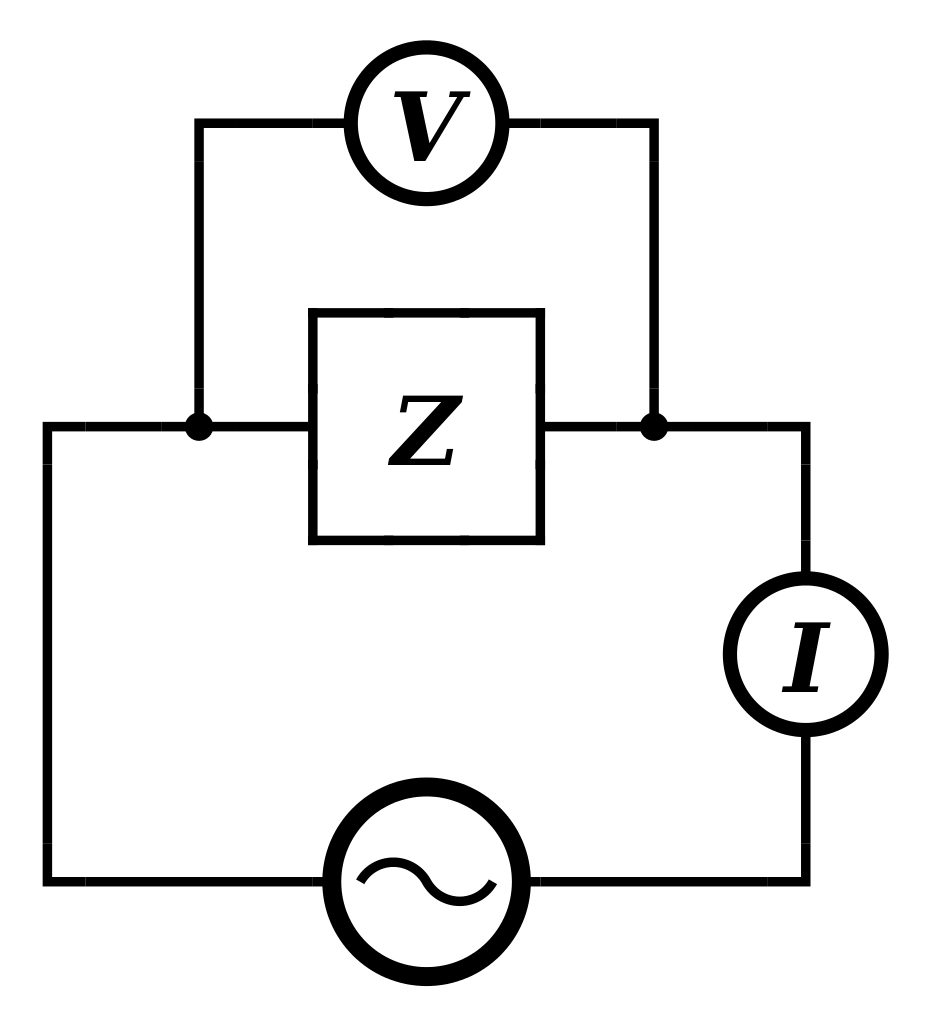
So what’s going on? The illustration below (credit goes to Wikipedia, once again) explains. It’s a pretty generic view of a very simple AC circuit. So we don’t care what the impedance is: it might be an inductor or a capacitor, or a combination of both, but we don’t care: we just call it an impedance, or an impedor if you want. 🙂 The point is: if we apply an alternating current, then the current and the voltage will both go up and down, but the current signal will lag the voltage signal, and some phase factor θ tells us by how much, so θ will be the phase difference.

General_AC_circuit

Now, we’re dividing one complex number by another in that Z = V/I formula above, and dividing one complex number by another is not all that straightforward, so let me re-write that formula for Z above as:

V = IZ = I∗|Z|eiθ

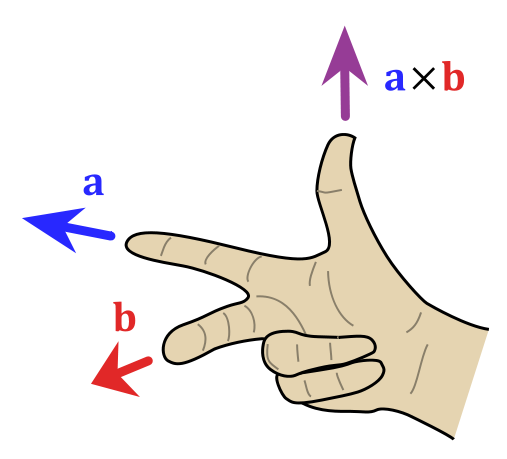
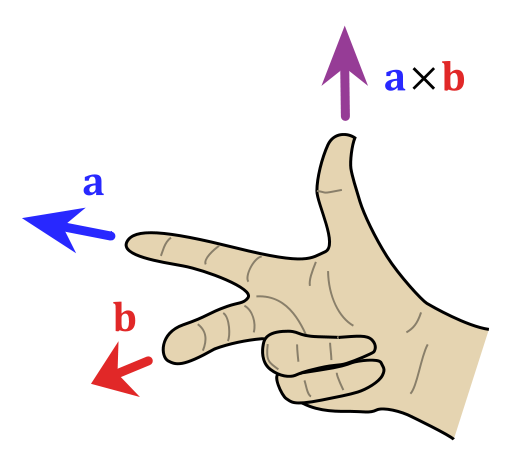
Now, while that V = IZ formula resembles the V = I·R formula, you should note the bold-face type for V and I, and the ∗ symbol I am using here for multiplication. The bold-face for V and I implies they’re vectors, or complex numbers. As for the ∗ symbol, that’s to make it clear we’re not talking a vector cross product A×B here, but a product of two complex numbers. [It’s obviously not a vector dot product either, because a vector dot product yields a real number, not some other vector.]

Now we write V and I as you’d expect us to write them:

  • = |V|ei(ωt + θV) = V0·ei(ωt + θV)
  • = |I|ei(ωt + θI= I0·ei(ωt + θI)

θV and θare, obviously, the so-called initial phase of the voltage and the current respectively. These ‘initial’ phases are not independent: we’re talking a phase difference really, between the voltage and the current signal, and it’s determined by the properties of the circuit. In fact, that’s the whole point here: the impedance is a property of the circuit and determines how the current signal varies as a function of the voltage signal. In fact, we’ll often choose the t = 0 point such that θand so then we need to find θI. […] OK. Let’s get on with it. Writing out all of the factors in the V = IZ = I∗|Z|eiθ equation yields:

= |V|ei(ωt + θV) IZ = |I|ei(ωt + θI)∗|Z|eiθ = |I||Z|ei(ωt + θ+ θ) 

Now, this equation must hold for all values of t, so we can equate the magnitudes and phases and, hence, the following equalities must hold:

  1. |V| = |I||Z| ⇔ |Z| = |V|/|I|
  2. ωt + θV =  ωt + θθ ⇔ θ = θV − θI

Done! 

Of course, you’ll complain once again about those complex numbers: voltage and current are something real, isn’t it? And so what is really about this complex numbers? Well… I can just say what I said already. You’re right. I’ve used the complex notation only to simplify the calculus, so it’s only the real part of those complex-valued functions that counts.

OK. We’re done with impedance. We can now discuss the impedors, including resistors (for which we won’t have such lag or phase difference, but the concept of impedance applies nevertheless).

Before I start, however, you should think about what I’ve done above: I explained the concept of impedance, but I didn’t do much with it. The real-life problem will usually be that you get the voltage as a function of time, and then you’ll have to calculate the impedance of a circuit and, then, the current as a function of time. So I just showed the fundamental relations but, in real life, you won’t know what θ and θI could possibly be. Well… Let me correct that statement: we’ll give you formulas for θ as we discuss the various circuit elements and their impedance below, and so then you can use these formulas to calculate θI. 🙂

Resistors

Let’s start with what seems to be the easiest thing: a resistor. A real resistor is actually not easy to understand, because it requires us to understand the properties of real materials. Indeed, it may or may not surprise you, but the linear relation between the voltage and the current for real materials is only approximate. Also, the way resistors dissipate energy is not easy to understand. Indeed, unlike inductors and capacitors, i.e. the other two passive components of an electrical circuit, a resistor does not store but dissipates energy, as shown below.

Electric_load_animation_2

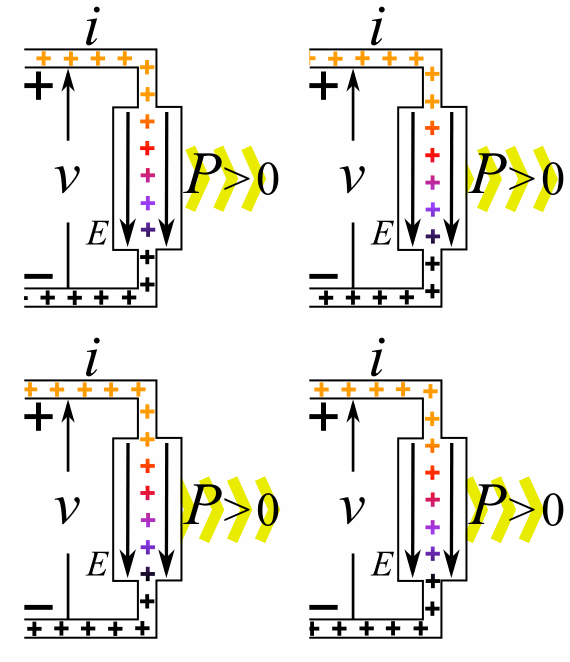
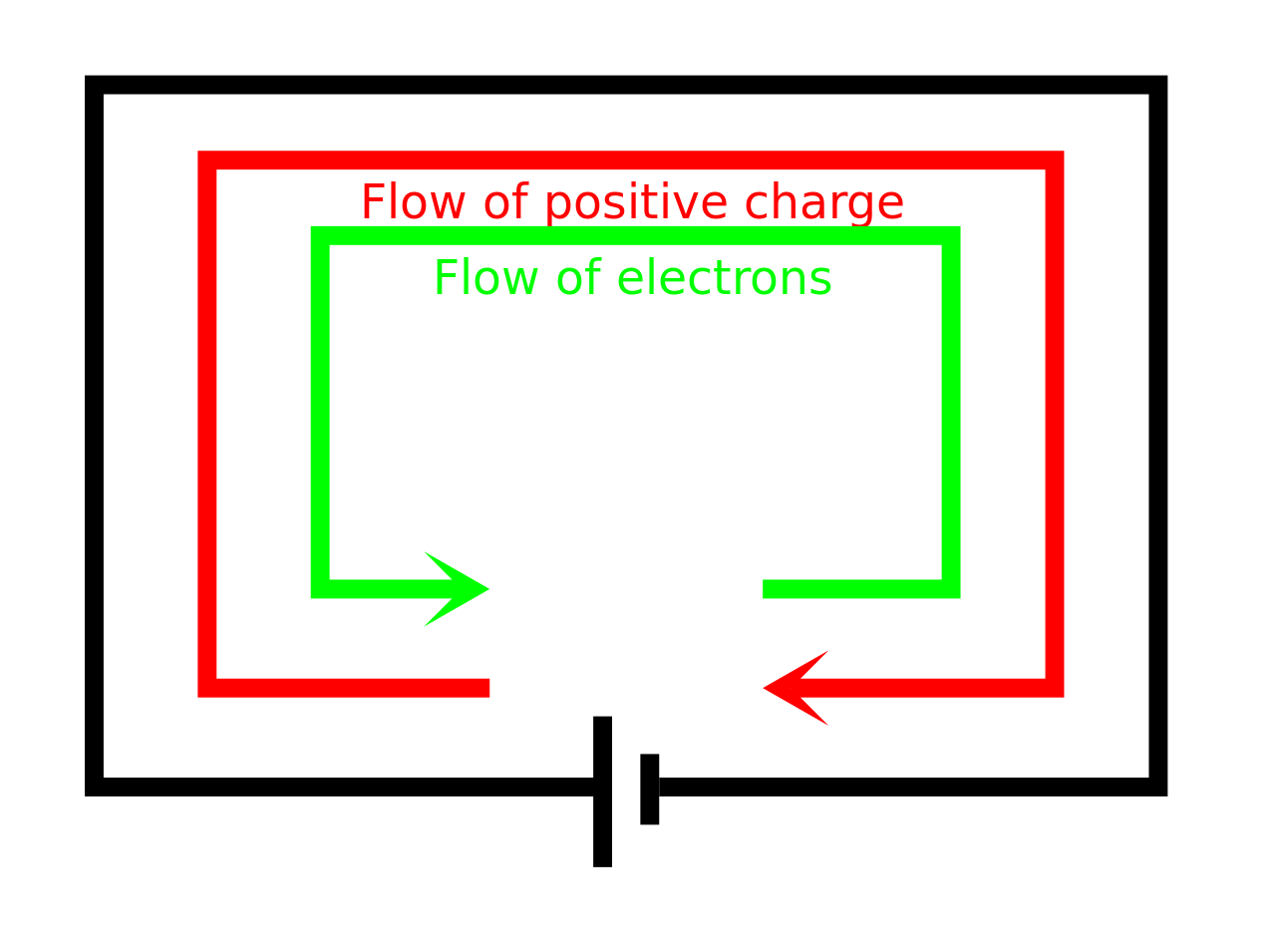
It’s a nice animation (credit for it has to go to Wikipedia once more), as it shows how energy is being used in an electric circuit. Note that the little moving pluses are in line with the convention that a current is defined as the movement of positive charges, so we write I = dQ/dt instead of I = −dQ/dt. That also explains the direction of the field line E, which has been added to show that the charges move with the field that is being generated by the power source (which is not shown here). So, what we have here is that, on one side of the circuit, some generator or voltage source will create an emf pushing the charges, and so the animation shows how some load – i.e. the resistor in this case – will consume their energy, so they lose their push (as shown by the change in color from yellow to black). So power, i.e.energy per unit time, is supplied, and is then consumed.

To increase the current in the circuit above, you need to increase the voltage, but increasing both amounts to increasing the power that’s being consumed in the circuit. Electric power is voltage times current, so P = V·I (or v·i, if I use the small letters that are used in the two animations below). Now, Ohm’s Law (I = V/R) says that, if we’d want to double the current, we’d need to double the voltage, and so we’re quadrupling the power then: P2 = V2·I= (2·V1)·(2·I1) = 4·V1·I= 22·P1. So we have a square-cube law for the power, which we get by substituting V for R·I or by substituting I for V/R, so we can write the power P as P = V2/R = I2·R. This square-cube law says exactly the same: if you want to double the voltage or the current, you’ll actually have to double both and, hence, you’ll quadruple the power.

But back to the impedance: Ohm’s Law is the Z = V/I law for resistors, but we can simplify it because we know the voltage across the resistor and the current that’s going through are in phase. Hence, θV and θare identical and, therefore, the θ = θθin Z = |Z|eiθ is equal to zero and, hence, Z = |Z|. Now, |Z| = |V|/|I| = V0/I0. So the impedance is just some real number R = V0/I0, which we can also write as:

R = V0/I= (V0·ei(ωt + α))/(I0·ei(ωt + α)) = V(t)/I(t), with α = θV = θI

The equation above goes from R = V0/Ito R = V(t)/I(t) = V/I. It’s note the same thing: the second equation says that, at any point in time, the voltage and the current will be proportional to each other, with R or its reciprocal as the proportionality constant. In any case, we have our formula for Z here:

Z = R = V/I = V0/I0

So that’s simple. Before we move to the next, let me note that the resistance of a real resistor may depend on its temperature, so in real-life applications one will want to keep its temperature as stable as possible. That’s why real-life resistors have power ratings and recommended operating temperatures. The image below illustrates how so-called heat-sink resistors can be mounted on a heat sink with a simple spring clip so as to ensure the dissipated heat is transported away. These heat-sink resistors are rather small (10 by 15 mm only) but are rated for 35 watt – so that’s quite a lot for such small thing – if correctly mounted.

spring-clips-mounting-technigques

As mentioned, the linear relation between the voltage and the current is only approximate, and the observed relation is also there only for frequencies that are not ‘too high’ because, if the frequency becomes very high, the free electrons will start radiating energy away, as they produce electromagnetic radiation. So one always needs to look at the tolerances of real-life resistors, which may be ± 5%, ± 10%, or whatever. In any case… On to the next.

Capacitors (condensers)

We talked at length about capacitors (aka condensers) in our post explaining capacitance or, the more widely used term, capacity: the capacity of a capacitor is the observed proportionality between (1) the voltage (V) across and (2) the charge (Q) on the capacitor, so we wrote it as:

C = Q/V

Now, it’s easy to confuse the C here with the C for coulomb, which I’ll also use in a moment, and so… Well… Just don’t! 🙂 The meaning of the symbol is usually obvious from the context.

As for the explanation of this relation, it’s quite simple: a capacitor consists of two separate conductors in space, with positive charge on one, and an equal and opposite (i.e. negative) charge on the other. Now, the logic of the superposition of fields implies that, if we double the charges, we will also double the fields, and so the work one needs to do to carry a unit charge from one conductor to the other is also doubled! So that’s why the potential difference between the conductors is proportional to the charge.

The C = Q/V formula actually measures the ability of the capacitor to store electric charge and, therefore, to store energy, so that’s why the term capacity is really quite appropriate. I’ll let you google a few illustrations like the one below, that shows how a capacitor is actually being charged in a circuit. Usually, some resistance will be there in the circuit, so as to limit the current when it’s connected to the voltage source and, therefore, as you can see, the R times C factor (R·C) determines how fast or how slow the capacitor charges and/or discharges. Also note that the current is equal to the time rate of change of the charge: I = dQ/dt.

images

In the above-mentioned post, we also give a few formulas for the capacity of specific types of condensers. For example, for a parallel-plate condenser, the formula was C =  ε0A/d. We also mentioned its unit, which is is coulomb/volt, obviously, but – in honor of Michael Faraday, who gave us Faraday’s Law, and many other interesting formulas – it’s referred to as the farad: 1 F = 1 C/V. The C here is coulomb, of course. Sorry we have to use C to denote two different things but, as I mentioned, the meaning of the symbol is usually clear from the context.

We also talked about how dielectrics actually work in that post, but we did not talk about the impedance of a capacitor, so let’s do that now. The calculation is pretty straightforward. Its interpretation somewhat less so. But… Well… Let’s go for it.

It’s the current that’s charging the condenser (sorry I keep using both terms interchangeably), and we know that the current is the time rate of change of the charge (I = dQ/dt). Now, you’ll remember that, in general, we’d write a phasor A as A = A0·eiωt with A= A0·eiθ, so Ais a complex coefficient incorporating the initial phase, which we wrote as θand θfor the voltage and for the current respectively. So we’ll represent the voltage and the current now using that notation, so we write: V = V0·eiωt and I = I0·eiωt. So let’s now use that C = Q/V by re-writing it as Q = C·V and, because C is some constant, we can write:

I = dQ/dt = d(C·V)/dt = C·dV/dt

Now, what’s dV/dt? Oh… You’ll say: V is the magnitude of V, so it’s equal to |V| = |V0·eiωt| = |V0|·|eiωt| = |V0| = |V0·eiθ| = |V0|·|eiθ| = |V0| = V0. So… Well… What? V0 is some constant here! It’s the maximum amplitude of V, so… Well… It’s time derivative is zero: dV0/dt = 0.

Yes. Indeed. We did something very wrong here! You really need to watch out with this complex-number notation, and you need to think about what you’re doing. V is not the magnitude of V but its (varying) amplitude. So it’s the real voltage V that varies with time: it’s equal to V0·cos(ωt + θV), which is the real part of our phasor V. Huh? Yes. Just hang in for a while. I know it’s difficult and, frankly, Feynman doesn’t help us very much here. Let’s take one step back and so – you will see why I am doing this in a moment – let’s calculate the time derivative of our phasor V, instead of the time derivative of our real voltage V. So we calculate dV/dt, which is equal to:

dV/dtd(V0·eiωt)/dt = V0·d(eiωt)/dt = V0·(iω)·eiωt = iω·V0·eiωt = iω·V

Remarkable result, isn’t it? We take the time derivative of our phasor, and the result is the phasor itself multiplied with iω. Well… Yes. It’s a general property of exponentials, but still… Remarkable indeed! We’d get the same with I, but we don’t need that for the moment. What we do need to do is go from our I = C·dV/dt relation, which connects the real parts of I and V one to another, to the I = C·dV/dt relation, which relates the (complex) phasors. So we write:

 I = C·dV/dt ⇔ I = C·dV/dt

Can we do that? Just like that? We just replace I and V by I and V? Yes, we can. Why? Well… We know that I is the real part of I and so we can write I = Re(I)+ Im(Ii = I + Im(Ii, and then we can write the right-hand side of the equation as C·dV/dt = Re(C·dV/dt)+ Im(C·dV/dt)·i. Now, two complex numbers are equal if, and only if, their real and imaginary parts are the same, so… Well… Write it all out, if you want, using Euler’s formula, and you’ll see it all makes sense indeed.

So what do we get? The I = C·dV/dt gives us:

I = C·dV/dt = C·(iω)·V

That implies that I/V = C·(iω) and, hence, we get – finally! – what we need to get:

Z = V/I = 1/(iωC)

This is a grand result and, while I am sorry I made you suffer for it, I think it did a good job here because, if you’d check Feynman on it, you’ll see he – or, more probably, his assistants, – just skate over this without bothering too much about mathematical rigor. OK. All that’s left now is to interpret this ‘number’ Z = 1/(iωC). It is a purely imaginary number, and it’s a constant indeed, albeit a complex constant. It can be re-written as:

Z = 1/(iωC) = i-1/(ωC) = –i/(ωC) = (1/ωC)·ei·π/2

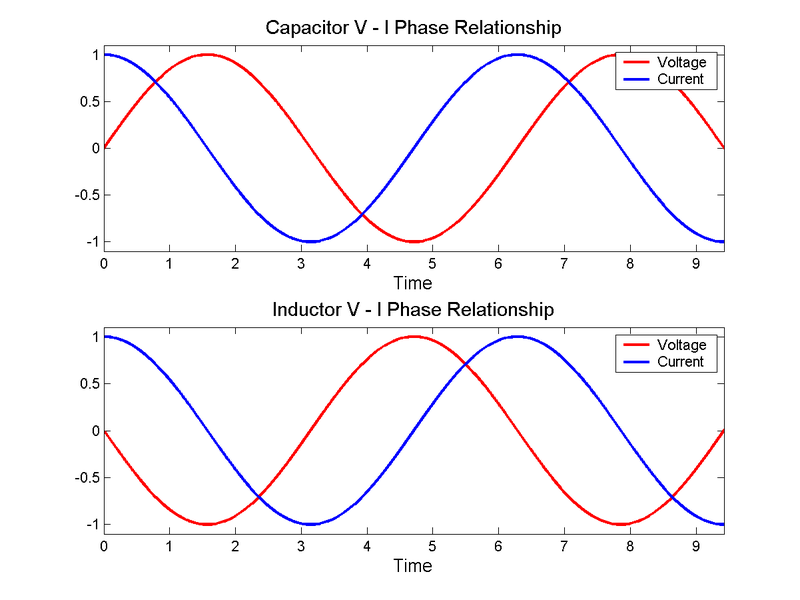
[Sorry. I can’t be more explicit here. It’s just of the wonders of complex numbers: i-1 = –i. Just check one my posts on complex numbers for more detail.] Now, a –i factor corresponds to a rotation of minus 90 degrees, and so that gives you the true meaning of what’s usually said about a circuit with a capacitor: the voltage across the capacitor will lag the current with a phase difference equal to π/2, as shown below. Of course, as it’s the voltage driving the current, we should say it’s the current that is lagging with a phase difference of 3π/2, rather than stating it the other way around! Indeed, i-1 = –i = –1·i = i2·i = i3, so that amounts to three ‘turns’ of the phase in the counter-clockwise direction, which is the direction in which our ωt angle is ‘turning’.

800px-VI_phase

It is a remarkable result, though. The illustration above assumes the maximum amplitude of the voltage and the current are the same, so |Z| = |V|/|I| = 1, but what if they are not the same? What are the real bits then? I can hear you, indeed: “To hell with the bold-face letters: what’s V and I? What’s the real thing?”

Well… V and I are the real bits of = |V|ei(ωt+θV) = V0·ei(ωt+θVand of= |I|ei(ωt+θI= I0·ei(ωt+θV−θ) = I0·ei(ωt−θ) = I0·ei(ωt+π/2respectively so, assuming θV = 0 (as mentioned above, that’s just a matter of choosing a convenient t = 0 point), we get:

  • V = V0·cos(ωt)
  • I = I0·cos(ωt + π/2)

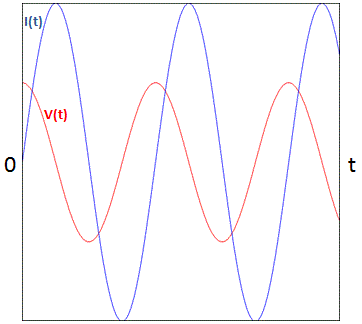
So the π/2 phase difference is there (you need to watch out with the signs, of course: θ = −π/2, but so it’s the current that seems to lead here) but the V0/Iratio doesn’t have to be one, so the real voltage and current could look like something below, where the maximum amplitude of the current is only half of the maximum amplitude of the voltage.

Capture

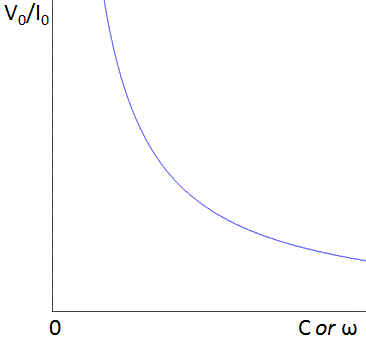
So let’s analyze this quickly: the V0/Iratio is equal to |Z| = |V|/|I| = V0/I= 1/ωC = (1/ω)(1/C) (note that it’s not equal to V/I = V(t)/I(t), which is a ratio that doesn’t make sense because I(t) goes through zero as the current switches direction). So what? Well… It means the ratio is inversely proportional to both the frequency ω as well as the capacity C, as shown below. Think about this: if ω goes to zero, V0/Igoes to ∞, which means that, for a given voltage, the current must go to zero. That makes sense, because we’re talking DC current when ω → 0, and the capacitor charges itself and then that’s it: no more currents. Now, if C goes to zero, so we’re talking capacitors with hardly any capacity, we’ll also get tiny currents. Conversely, for large C, we’ll get huge currents, as the capacitor can take pretty much any charge you throw at it, so that makes for small V0/Iratios. The most interesting thing to consider is ω going to infinity, as the V0/Iratio is also quite small then. What happens? The capacitor doesn’t get the time to charge, and so it’s always in this state where it has large currents flowing in and out of it, as it can’t build the voltage that would counter the electromotive force that’s being supplied by the voltage source.

graph 6OK. That’s it. Le’s discuss the last (passive) element.

Inductors

We’ve spoiled the party a bit with that illustration above, as it gives the phase difference for an inductor already:

Z = iωL = ωL·ei·π/2, with L the inductance of the coil

So, again assuming that θV = 0, we can calculate I as:

= |I|ei(ωt+θI= I0·ei(ωt+θV−θ) = I0·ei(ωt−θ) = I0·ei(ωt−π/2

Of course, you’ll want to relate this, once again, to the real voltage and the real current, so let’s write the real parts of our phasors:

  • V = V0·cos(ωt)
  • I = I0·cos(ωt − π/2)

Just to make sure you’re not falling asleep as you’re reading, I’ve made another graph of how things could look like. So now’s it’s the current signal that’s lagging the voltage signal with a phase difference equal to θ = π/2.

Capture

Also, to be fully complete, I should show you how the V0/Iratio now varies with L and ω. Indeed, here also we can write that |Z| = |V|/|I| = V0/I0, but so here we find that V0/I0 =  ωL, so we have a simple linear proportionality here! For example, for a given voltage V0, we’ll have smaller currents as ω increases, so that’s the opposite of what happens with our ideal capacitors. I’ll let you think about that… 🙂

Capture

Now how do we get that Z = iωL formula? In my post on inductance, I explained what an inductor is: a coil of wire, basically. Its defining characteristic is that a changing current will cause a changing magnetic field in it and, hence, some change in the flux of the magnetic field. Now, Faraday’s Law tells us that that will cause some circulation of the electric field in the coil, which amounts to an induced potential difference which is referred to as the electromotive force (emf). Now, it turns out that the induced emf is proportional to the change in current. So we’ve got another constant of proportionality here, so it’s like how we defined resistance, or capacitance. So, in many ways, the inductance is just another proportionality coefficient. If we denote it by L – the symbol is said to honor the Russian phyicist Heinrich Lenz, whom you know from Lenz’ Law – then we define it as:

L = −Ɛ/(dI/dt)

The dI/dt factor is, obviously, the time rate of change of the current, and the negative sign indicates that the emf opposes the change in current, so it will tend to cause an opposing current. However, the power of our voltage source will ensure the current does effectively change, so it will counter the ‘back emf’ that’s being generated by the inductor. To be precise, the voltage across the terminals of our inductor, which we denote by V, will be equal and opposite to Ɛ, so we write:

V = −Ɛ = L·(dI/dt)

Now, this very much resembles the I = C·dV/dt relation we had for capacitors, and it’s completely analogous indeed: we just need to switch the I and V, and C and L symbols. So we write:

 V = L·dI/dt⇔ V = L·dI/dt

Now, dI/dt is a similar time derivative as dV/dt. We calculate it as:

dI/dtd(I0·eiωt)/dt = I0·d(eiωt)/dt = I0·(iω)·eiωt = iω·I0·eiωt = iω·I

So we get what we want and have to get:

V = L·dI/dt = iωL·I

Now, Z = V/I, so ZiωL indeed!

Summary of conclusions

Let’s summarize what we found:

  1. For a resistor, we have Z(resistor) = Z= R = V/I = V0/I0
  2. For an capacitor, we have Z(capacitor) = Z= 1/(iωC) = –i/(ωC)
  3. For an inductor, we have Z(inductance) = ZL= iωL

Note that the impedance of capacitors decreases as frequency increases, while for inductors, it’s the other way around. We explained that by making you think of the currents: for a given voltage, we’ll have large currents for high frequencies, and, hence, a small V0/Iratio. Can you think of what happens with an inductor? It’s not so easy, so I’ll refer you to the addendum below for some more explanation.

Let me also note that, as you can see, the impedance of (ideal) inductors and capacitors is a pure imaginary number, so that’s a complex number which has no real part. In engineering, the imaginary part of the impedance is referred to as the reactance, so engineers will say that ideal capacitors and inductors have a purely imaginary reactive impedance

However, in real life, the impedance will usually have both a real as well as an imaginary part, so it will be some kind of mix, so to speak. The real part is referred to as the ‘resistance’ R, and the ‘imaginary’ part is referred to as the ‘reactance’ X. The formula for both is given below:

formula resistance and reactance

But here I have to end my post on circuit elements. It’s become quite long, so I’ll discuss Kirchoff’s rules in my next post.

Addendum: Why is V = − Ɛ?

Inductors are not easy to understand—intuitively, that is. That’s why I spent so much time writing on them in my other post on them, to which I should be referring you here. But let me recapitulate the key points. The key idea is that we’re pumping energy into an inductor when applying a current and, as you know, the time rate of change is power: P = dW/dt, so we’re talking power here too, which is voltage times current: P = dW/dt = V·I. The illustration below shows what happens when an alternating current is applied to the circuit with the inductor. So the assumption is that the current goes in one and then in the other direction, so I > 0, and then I < 0, etcetera. We’re also assuming some nice sinusoidal curve for the current here (i.e. the blue curve), and so we get what we get for U (i.e. the red curve), which is the energy that’s stored in the inductor really, as it tries to resist the changing current: the energy goes up and down between zero and some maximum amplitude that’s determined by the maximum current.

power 2

So, yes, building up current requires energy from some external source, which is used to overcome the ‘back emf’ in the inductor, and that energy is stored in the inductor itself. [If you still wonder why it’s stored in the inductor, think about the other question: where else would it be stored?] How is stored? Look at the graph and think: it’s stored as kinetic energy of the charges, obviously. That explains why the energy is zero when the current is zero, and why the energy maxes out when the current maxes out. So, yes, it all makes sense! 🙂

Let me give another example. The graph below assumes the current builds up to some maximum. As it reaches its maximum, the stored energy will also max out. This example assumes direct current, so it’s a DC circuit: the current builds up, but then stabilizes at some maximum that we can find by applying Ohm’s Law to the resistance of the circuit: I = V/R. Resistance? But we were talking an ideal inductor? We are. If there’s no other resistance in the circuit, we’ll have a short-circuit, so the assumption is that we do have some resistance in the circuit and, therefore, we should also think of some energy loss to heat from the current in the resistance. If not, well… Your power source will obviously soon reach its limits. 🙂

power

So what’s going on then? We have some changing current in the coil but, obviously, some kind of inertia also: the coil itself opposes the change in current through the ‘back emf’. Now, it requires energy, or power, to overcome the inertia, so that’s the power that comes from our voltage source: it will offset the ‘back emf’, so we may effectively think of a little circuit with an inductor and a voltage source, as shown below.

circuit with coil

But why do we write V = − Ɛ? Our voltage source can have any voltage, can’t it? Yes. Sure. But so the coil will always provide an emf that’s exactly the opposite of this voltage. Think of it: we have some voltage that’s being applied across the terminals of the inductor, and so we’ll have some current. A current that’s changing. And it’s that current will generate an emf that’s equal to Ɛ = –L·(dI/dt). So don’t think of Ɛ as some constant: it’s the self-inductance coefficient L that’s constant, but I (and, hence, dI/dt) and V are variable.

The point is: we cannot have any potential difference in a perfect conductor, which is what the terminals are: any potential difference, i.e. any electric field really, would cause huge currents. In other words, the voltage V and the emf Ɛ have to cancel each other out, all of the time. If not, we’d have huge currents in the wires re-establishing the V = −Ɛ equality.

Let me use Feynman’s argument here. Perhaps that will work better. 🙂 Our ideal inductor is shown below: it’s shielded by some metal box so as to ensure it does not interact with the rest of the circuit. So we have some current I, which we assume to be an AC current, and we know some voltage is needed to cause that current, so that’s the potential difference V between the terminals.

inductor

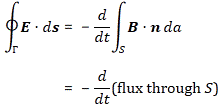
The total circulation of E – around the whole circuit – can be written as the sum of two parts:

Formula circulaton

Now, we know circulation of E can only be caused by some changing magnetic field, which is what’s going on in the inductor:

emf

So this change in the magnetic flux is what it causing the ‘back emf’, and so the integral on the left is, effectively, equal to Ɛ, not minus Ɛ but +Ɛ. Now, the second integral is equal to V, because that’s the voltage V between the two terminals a and b. So the whole integral is equal to 0 = Ɛ + V and, therefore, we have that:

V = − Ɛ = L·dI/dt

Some content on this page was disabled on June 16, 2020 as a result of a DMCA takedown notice from The California Institute of Technology. You can learn more about the DMCA here:

https://wordpress.com/support/copyright-and-the-dmca/
Some content on this page was disabled on June 16, 2020 as a result of a DMCA takedown notice from The California Institute of Technology. You can learn more about the DMCA here:

https://wordpress.com/support/copyright-and-the-dmca/

The Liénard–Wiechert potentials and the solution for Maxwell’s equations

In my post on gauges and gauge transformations in electromagnetics, I mentioned the full and complete solution for Maxwell’s equations, using the electric and magnetic (vector) potential Φ and A. Feynman frames it nicely, so I should print it and put it on the kitchen door, so I can look at it everyday. 🙂

frame

I should print the wave equation we derived in our previous post too. Hmm… Stupid question, perhaps, but why is there no wave equation above? I mean: in the previous post, we said the wave equation was the solution for Maxwell’s equation, didn’t we? The answer is simple, of course: the wave equation is a solution for waves originating from some source and traveling through free space, so that’s a special case. Here we have everything. Those integrals ‘sweep’ all over space, and so that’s real space, which is full of moving charges and so there’s waves everywhere. So the solution above is far more general and captures it all: it’s the potential at every point in space, and at every point in time, taking into account whatever else is there, moving or not moving. In fact, it is the general solution of Maxwell’s equations.

How do we find it? Well… I could copy Feynman’s 21st Lecture but I won’t do that. The solution is based on the formula for Φ and A for a small blob of charge, and then the formulas above just integrate over all of space. That solution for a small blob of charge, i.e. a point charge really, was first deduced in 1898, by a French engineer: Alfred-Marie Liénard. However, his equations did not get much attention, apparently, because a German physicist, Emil Johann Wiechert, worked on the same thing and found the very same equations just two years later. That’s why they are referred to as the Liénard-Wiechert potentials, so they both get credit for it, even if both of them worked it out independently. These are the equations:

electric potential

magnetic potential

Now, you may wonder why I am mentioning them, and you may also wonder how we get those integrals above, i.e. our general solution for Maxwell’s equations, from them. You can find the answer to your second question in Feynman’s 21st Lecture. 🙂 As for the first question, I mention them because one can derive two other formulas for E and B from them. It’s the formulas that Feynman uses in his first Volume, when studying light: E

B

Now you’ll probably wonder how we can get these two equations from the Liénard-Wiechert potentials. They don’t look very similar, do they? No, they don’t. Frankly, I would like to give you the same answer as above, i.e. check it in Feynman’s 21st Lecture, but the truth is that the derivation is so long and tedious that even Feynman says one needs “a lot of paper and a lot of time” for that. So… Well… I’d suggest we just use all of those formulas and not worry too much about where they come from. If we can agree on that, we’re actually sort of finished with electromagnetism. All the chapters that follow Feynman’s 21st Lecture are applications indeed, so they do not add all that much to the core of the classical theory of electromagnetism.

So why did I write this post? Well… I am not sure. I guess I just wanted to sum things up for myself, so I can print it all out and put it on the kitchen door indeed. 🙂 Oh, and now that I think of it, I should add one more formula, and that’s the formula for spherical waves (as opposed to the plane waves we discussed in my previous post). It’s a very simple formula, and entirely what you’d expect to see:

spherical wave

The S function is the source function, and you can see that the formula is a Coulomb-like potential, but with the retarded argument. You’ll wonder: what is ψ? Is it E or B or what? Well… You can just substitute: ψ can be anything. Indeed, Feynman gives a very general solution for any type of spherical wave here. 🙂

So… That’s it, folks. That’s all there is to it. I hope you enjoyed it. 🙂

Addendum: Feynman’s equation for electromagnetic radiation

I talked about Feynman’s formula for electromagnetic radiation before, but it’s probably good to quickly re-explain it here. Note that it talks about the electric field only, as the magnetic field is so tiny and, in any case, if we have E then we can find B. So the formula is:

E

The geometry of the situation is depicted below. We have some charge q that, we assume, is moving through space, and so it creates some field E at point P. The er‘ vector is the unit vector from P to Q, so it points at the charge. Well… It points to where the charge was at the time just a little while ago, i.e. at the time t – r‘/c. Why? Well… We don’t know where q is right now, because the field needs some time travel, we don’t know q right now, i.e. q at time t. It might be anywhere. Perhaps it followed some weird trajectory during the time r‘/c, like the trajectory below.

radiation formula

So our er‘ vector moves as the charge moves, and so it will also have velocity and, likely, some acceleration, but what we measure for its velocity and acceleration, i.e. the d(er)/dt and d2(er)/dt2 in that Feynman equation, is also the retarded velocity and the retarded acceleration. But look at the terms in the equation. The first two terms have a 1/r’2 in them, so these two effects diminish with the square of the distance. The first term is just Coulomb’s Law (note that the minus sign in front takes care of the fact that like charges repel and so the E vector will point in the other way). Well… It is and it isn’t, because of the retarded time argument, of course. And so we have the second term, which sort of compensates for that. Indeed, the d(er)/dt is the time rate of change of er and, hence, if r‘/c = Δt, then (r‘/cd(er)/dt is a first-order approximation of Δer.

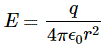
As Feynman puts it: “The second term is as though nature were trying to allow for the fact that the Coulomb effect is retarded, if we might put it very crudely. It suggests that we should calculate the delayed Coulomb field but add a correction to it, which is its rate of change times the time delay that we use. Nature seems to be attempting to guess what the field at the present time is going to be, by taking the rate of change and multiplying by the time that is delayed.” In short, the first two terms can be written as E = −(q/4πε0)/r2·[er + Δer] and, hence, it’s a sort of modified Coulomb Law that sort of tries to guess what the electrostatic field at P should be based on (a) what it is right now, and (b) how q’s direction and velocity, as measured now, would change it.

Now, the third term has a 1/c2 factor in front but, unlike the other two terms, this effect does not fall off with distance. So the formula below fully describes electromagnetic radiation, indeed, because it’s the only important term when we get ‘far enough away’, with ‘far enough’ meaning that the parts that go as the square of the distance have fallen off so much that they’re no longer significant.

radiation formula 2Of course, you’re smart, and so you’ll immediately note that, as r increases, that unit vector keeps wiggling but that effect will also diminish. You’re right. It does, but in a fairly complicated way. The acceleration of er has two components indeed. One is the transverse or tangential piece, because the end of er goes up and down, and the other is a radial piece because it stays on a sphere and so it changes direction. The radial piece is the smallest bit, and actually also varies as the inverse square of r when r is fairly large. The tangential piece, however, varies only inversely as the distance, so as 1/r. So, yes, the wigglings of er look smaller and smaller, inversely as the distance, but the tangential piece is and remains significant, because it does not vary as 1/r2 but as 1/r only.  That’s why you’ll usually see the law of radiation written in an even simpler way:

final law of radiation

This law reduces the whole effect to the component of the acceleration that is perpendicular to the line of sight only. It assumes the distance is huge as compared to the distance over which the charge is moving and, therefore, that r‘ and r can be equated for all practical purposes. It also notes that the tangential piece is all that matters, and so it equates d2(er)/dtwith ax/r. The whole thing is probably best illustrated as below: we have a generator driving charges up and down in G – so it’s an antenna really – and so we’ll measure a strong signal when putting the radiation detector D in position 1, but we’ll measure nothing in position 3. [The detector is, of course, another antenna, but with an amplifier for the signal.] But so here I am starting to talk about electromagnetic radiation once more, which was not what I wanted to do here, if only because Feynman does a much better job at that than I could ever do. 🙂radiator

Some content on this page was disabled on June 16, 2020 as a result of a DMCA takedown notice from The California Institute of Technology. You can learn more about the DMCA here:

https://wordpress.com/support/copyright-and-the-dmca/
Some content on this page was disabled on June 16, 2020 as a result of a DMCA takedown notice from The California Institute of Technology. You can learn more about the DMCA here:

https://wordpress.com/support/copyright-and-the-dmca/
Some content on this page was disabled on June 16, 2020 as a result of a DMCA takedown notice from The California Institute of Technology. You can learn more about the DMCA here:

https://wordpress.com/support/copyright-and-the-dmca/
Some content on this page was disabled on June 16, 2020 as a result of a DMCA takedown notice from The California Institute of Technology. You can learn more about the DMCA here:

https://wordpress.com/support/copyright-and-the-dmca/
Some content on this page was disabled on June 16, 2020 as a result of a DMCA takedown notice from The California Institute of Technology. You can learn more about the DMCA here:

https://wordpress.com/support/copyright-and-the-dmca/
Some content on this page was disabled on June 17, 2020 as a result of a DMCA takedown notice from Michael A. Gottlieb, Rudolf Pfeiffer, and The California Institute of Technology. You can learn more about the DMCA here:

https://wordpress.com/support/copyright-and-the-dmca/
Some content on this page was disabled on June 20, 2020 as a result of a DMCA takedown notice from Michael A. Gottlieb, Rudolf Pfeiffer, and The California Institute of Technology. You can learn more about the DMCA here:

https://wordpress.com/support/copyright-and-the-dmca/

Traveling fields: the wave equation and its solutions

Pre-script (dated 26 June 2020): Our ideas have evolved into a full-blown realistic (or classical) interpretation of all things quantum-mechanical. In addition, I note the dark force has amused himself by removing some material. So no use to read this. Read my recent papers instead. 🙂

Original post:

We’ve climbed a big mountain over the past few weeks, post by post, 🙂 slowly gaining height, and carefully checking out the various routes to the top. But we are there now: we finally fully understand how Maxwell’s equations actually work. Let me jot them down once more:

Maxwell's equations

As for how real or unreal the E and B fields are, I gave you Feynman’s answer to it, so… Well… I can’t add to that. I should just note, or remind you, that we have a fully equivalent description of it all in terms of the electric and magnetic (vector) potential Φ and A, and so we can ask the same question about Φ and A. They explain real stuff, so they’re real in that sense. That’s what Feynman’s answer amounts to, and I am happy with it. 🙂

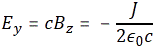
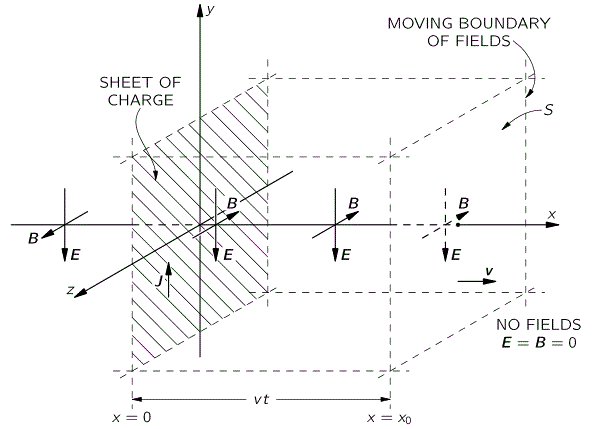
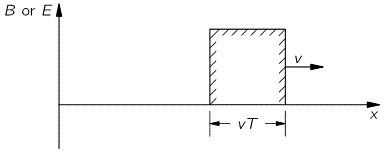
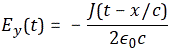
What I want to do here is show how we can get from those equations to some kind of wave equation: an equation that describes how a field actually travels through space. So… Well… Let’s first look at that very particular wave function we used in the previous post to prove that electromagnetic waves propagate with speed c, i.e. the speed of light. The fields were very simple: the electric field had a y-component only, and the magnetic field a z-component only. Their magnitudes, i.e. their magnitude where the field had reached, as it fills the space traveling outwards, were given in terms of J, i.e. the surface current density going in the positive y-direction, and the geometry of the situation is illustrated below.

equation

sheet of charge

The fields were, obviously, zero where the fields had not reached as they were traveling outwards. And, yes, I know that sounds stupid. But… Well… It’s just to make clear what we’re looking at here. 🙂

We also showed how the wave would look like if we would turn off its First Cause after some time T, so if the moving sheet of charge would no longer move after time T. We’d have the following pulse traveling through space, a rectangular shape really:

wavefrontWe can imagine more complicated shapes for the pulse, like the shape shown below. J goes from one unit to two units at time t = t1 and then to zero at t = t2. Now, the illustration on the right shows the electric field as a function of x at the time t shown by the arrow. We’ve seen this before when discussing waves: if the speed of travel of the wave is equal to c, then x is equal to x = c·t, and the pattern is as shown below indeed: it mirrors what happened at the source x/c seconds ago. So we write:

equation 2

12

This idea of using the retarded time t’ = tx/c in the argument of a wave function f – or, what amounts to the same, using x − c/t – is key to understanding wave functions. I’ve explained this in very simple language in a post for my kids and, if you don’t get this, I recommend you check it out. What we’re doing, basically, is converting something expressed in time units into something expressed in distance units, or vice versa, using the velocity of the wave as the scale factor, so time and distance are both expressed in the same unit, which may be seconds, or meter.

To see how it works, suppose we add some time Δt to the argument of our wave function f, so we’re looking at f[x−c(t+Δt)] now, instead of f(x−ct). Now, f[x−c(t+Δt)] = f(x−ct−cΔt), so we’ll get a different value for our function—obviously! But it’s easy to see that we can restore our wave function F to its former value by also adding some distance Δx = cΔt to the argument. Indeed, if we do so, we get f[x+Δx−c(t+Δt)] = f(x+cΔt–ct−cΔt) = f(x–ct). You’ll say: t − x/c is not the same as x–ct. It is and it isn’t: any function of x–ct is also a function of t − x/c, because we can write:

capture

Here, I need to add something about the direction of travel. The pulse above travel in the positive x-direction, so that’s why we have x minus ct in the argument. For a wave traveling in the negative x-direction, we’ll have a wave function y = F(x+ct). In any case, I can’t dwell on this, so let me move on.

Now, Maxwell’s equations in free or empty space, where are there no charges nor currents to interact with, reduce to:

Maxwell in free space

Now, how can we relate this set of complicated equations to a simple wave function? Let’s do the exercise for our simple Ey and Bz wave. Let’s start by writing out the first equation, i.e. ·E = 0, so we get:

f1

Now, our wave does not vary in the y and z direction, so none of the components, including Ey and Edepend on y or z. It only varies in the x-direction, so ∂Ey/∂y and ∂Ez/∂z are zero. Note that the cross-derivatives ∂Ey/∂z and ∂Ez/∂y are also zero: we’re talking a plane wave here, the field varies only with x. However, because ·E = 0, ∂Ex/∂x must be zero and, hence, Ex must be zero.

Huh? What? How is that possible? You just said that our field does vary in the x-direction! And now you’re saying it doesn’t it? Read carefully. I know it’s complicated business, but it all makes sense. Look at the function: we’re talking Ey, not Ex. Ey does vary as a function of x, but our field does not have an x-component, so Ex = 0. We have no cross-derivative ∂Ey/∂x in the divergence of E (i.e. in ·E = 0).

Huh? What? Let me put it differently. E has three components: Ex, Ey and Ez, and we have three space coordinates: x, y and z, so we have nine cross-derivatives. What I am saying is that all derivatives with respect to y and z are zero. That still leaves us with three derivatives: ∂Ex/∂x, ∂Ey/∂x, and ∂Ey/∂x. So… Because all derivatives in respect to y and z are zero, and because of the ·E = 0 equation, we know that ∂Ex/∂x must be zero. So, to make a long story short, I did not say anything about ∂Ey/∂x or ∂Ez/∂x. These may still be whatever they want to be, and they may vary in more or in less complicated ways. I’ll give an example of that in a moment.

Having said that, I do agree that I was a bit quick in writing that, because ∂Ex/∂x = 0, Ex must be zero too. Looking at the math only, Ex is not necessarily zero: it might be some non-zero constant. So… Yes. That’s a mathematical possibility. The static field from some charged condenser plate would be an example of a constant Ex field. However, the point is that we’re not looking at such static fields here: we’re talking dynamics here, and we’re looking at a particular type of wave: we’re talking a so-called plane wave. Now, the wave front of a plane wave is… Well… A plane. 🙂 So Ex is zero indeed. It’s a general result for plane waves: the electric field of a plane wave will always be at right angles to the direction of propagation.

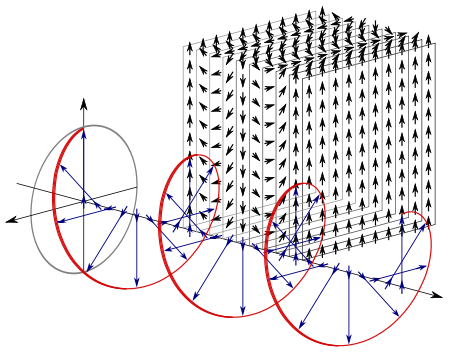
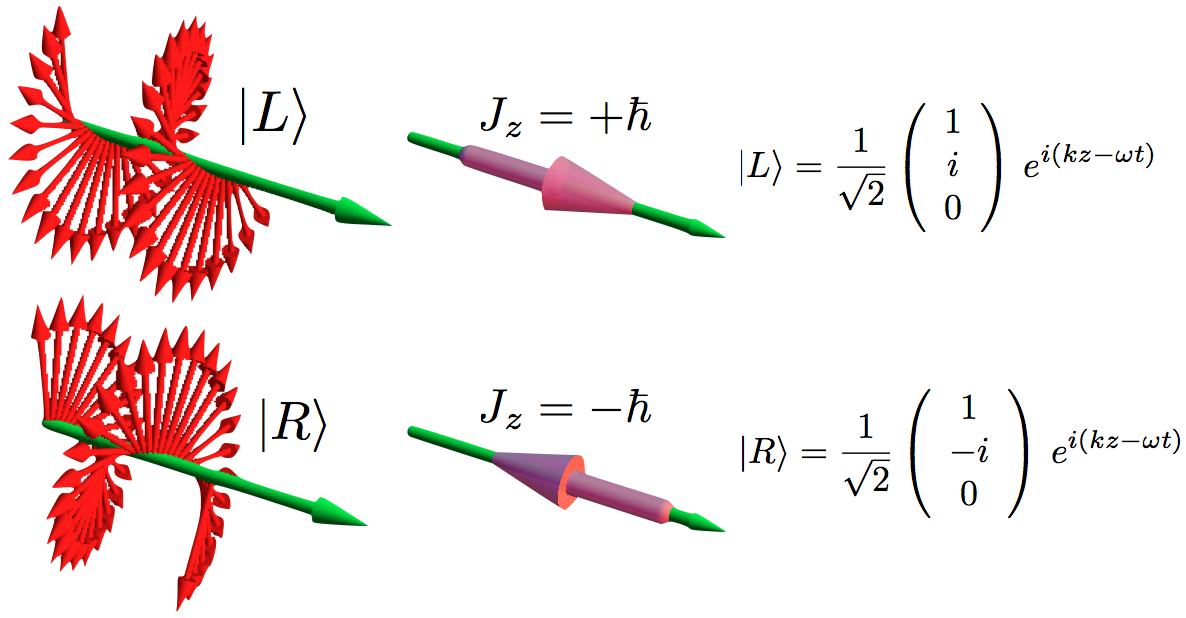
Hmm… I can feel your skepticism here. You’ll say I am arbitrarily restricting the field of analysis… Well… Yes. For the moment. It’s not a reasonable restriction though. As I mentioned above, the field of a plane wave may still vary in both the y- and z-directions, as shown in the illustration below (for which the credit goes to Wikipedia), which visualizes the electric field of circularly polarized light. In any case, don’t worry too much about. Let’s get back to the analysis. Just note we’re talking plane waves here. We’ll talk about non-plane waves i.e. incoherent light waves later. 🙂

circular polarization

So we have plane waves and, therefore, a so-called transverse E field which we can resolve in two components: Eand Ez. However, we wanted to study a very simply Efield only. Why? Remember the objective of this lesson: it’s just to show how we go from Maxwell’s equations to the wave function, and so let’s keep the analysis simple as we can for now: we can make it more general later. In fact, if we do the analysis now for non-zero Eand zero Ez, we can do a similar analysis for non-zero Eand zero Ey, and the general solution is going to be some superposition of two such fields, so we’ll have a non-zero Eand Ez. Capito? 🙂 So let me write out Maxwell’s second equation, and use the results we got above, so I’ll incorporate the zero values for the derivatives with respect to y and z, and also the assumption that Ez is zero. So we get:

f3[By the way: note that, out of the nine derivatives, the curl involves only the (six) cross-derivatives. That’s linked to the neat separation between the curl and the divergence operator. Math is great! :-)]

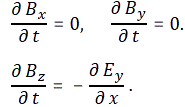
Now, because of the flux rule (×E = –∂B/∂t), we can (and should) equate the three components of ×E above with the three components of –∂B/∂t, so we get:

f4

[In case you wonder what it is that I am trying to do, patience, please! We’ll get where we want to get. Just hang in there and read on.] Now, ∂Bx/∂t = 0 and ∂By/∂t = 0 do not necessarily imply that Bx and Bare zero: there might be some magnets and, hence, we may have some constant static field. However, that’s a matter of choosing a reference point or, more simply, assuming that empty space is effectively empty, and so we don’t have magnets lying around and so we assume that Bx and Bare effectively zero. [Again, we can always throw more stuff in when our analysis is finished, but let’s keep it simple and stupid right now, especially because the Bx = B= 0 is entirely in line with the Ex = E= 0 assumption.]

The equations above tell us what we know already: the E and B fields are at right angles to each other. However, note, once again, that this is a more general result for all plane electromagnetic waves, so it’s not only that very special caterpillar or butterfly field that we’re looking at it. [If you didn’t read my previous post, you won’t get the pun, but don’t worry about it. You need to understand the equations, not the silly jokes.]

OK. We’re almost there. Now we need Maxwell’s last equation. When we write it out, we get the following monstrously looking set of equations:

f5

However, because of all of the equations involving zeroes above 🙂 only ∂Bz/∂x is not equal to zero, so the whole set reduced to only simple equation only:

f6

Simplifying assumptions are great, aren’t they? 🙂 Having said that, it’s easy to be confused. You should watch out for the denominators: a ∂x and a ∂t are two very different things. So we have two equations now involving first-order derivatives:

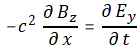
  1. ∂Bz/∂t = −∂Ey/∂x
  2. c2∂Bz/∂x = −∂Ey/∂t

So what? Patience, please! 🙂 Let’s differentiate the first equation with respect to x and the second with respect to t. Why? Because… Well… You’ll see. Don’t complain. It’s simple. Just do it. We get:

  1. ∂[∂Bz/∂t]/∂x = −∂2Ey/∂x2
  2. ∂[−c2∂Bz/∂x]/∂t = −∂2Ey/∂x2

So we can equate the left-hand sides of our two equations now, and what we get is a differential equation of the second order that we’ve encountered already, when we were studying wave equations. In fact, it is the wave equation for one-dimensional waves:

f7In case you want to double-check, I did a few posts on this, but, if you don’t get this, well… I am sorry. You’ll need to do some homework. More in particular, you’ll need to do some homework on differential equations. The equation above is basically some constraint on the functional form of Ey. More in general, if we see an equation like:

f8

then the function ψ(x, t) must be some function

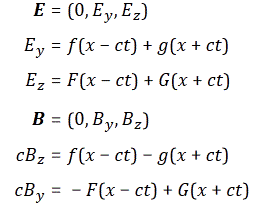
solution

So any function ψ like that will work. You can check it out by doing the necessary derivatives and plug them into the wave equation. [In case you wonder how you should go about this, Feynman actually does it for you in his Lecture on this topic, so you may want to check it there.]

In fact, the functions f(x − c/t) and g(x + c/t) themselves will also work as possible solutions. So we can drop one or the other, which amounts to saying that our ‘shape’ has to travel in some direction, rather than in both at the same time. 🙂 Indeed, from all of my explanations above, you know what f(x − c/t) represents: it’s a wave that travels in the positive x-direction. Now, it may be periodic, but it doesn’t have to be periodic. The f(x − c/t) function could represent any constant ‘shape’ that’s traveling in the positive x-direction at speed c. Likewise, the g(x + c/t) function could represent any constant ‘shape’ that’s traveling in the negative x-direction at speed c. As for super-imposing both…

Well… I suggest you check that post I wrote for my son, Vincent. It’s on the math of waves, but it doesn’t have derivatives and/or differential equations. It just explains how superimposition and all that works. It’s not very abstract, as it revolves around a vibrating guitar string. So, if you have trouble with all of the above, you may want to read that first. 🙂 The bottom line is that we can get any wavefunction we want by superimposing simple sinusoidals that are traveling in one or the other direction, and so that’s what’s the more general solution really says. Full stop. So that’s what’s we’re doing really: we add very simple waves to get very more complicated waveforms. 🙂

Now, I could leave it at this, but then it’s very easy to just go one step further, and that is to assume that Eand, therefore, Bare not zero. It’s just a matter of super-imposing solutions. Let me just give you the general solution. Just look at it for a while. If you understood all that I’ve said above, 20 seconds or so should be sufficient to say: “Yes, that makes sense. That’s the solution in two dimensions.” At least, I hope so! 🙂

General solution two dimensions

OK. I should really stop now. But… Well… Now that we’ve got a general solution for all plane waves, why not be even bolder and think about what we could possibly say about three-dimensional waves? So then Eand, therefore, Bwould not necessarily be zero either. After all, light can behave that way. In fact, light is likely to be non-polarized and, hence, Eand, therefore, Bare most probably not equal to zero!

Now, you may think the analysis is going to be terribly complicated. And you’re right. It would be if we’d stick to our analysis in terms of x, y and z coordinates. However, it turns out that the analysis in terms of vector equations is actually quite straightforward. I’ll just copy the Master here, so you can see His Greatness. 🙂

waves in three dimensions

But what solution does an equation like (20.27) have? We can appreciate it’s actually three equations, i.e. one for each component, and so… Well… Hmm… What can we say about that? I’ll quote the Master on this too:

“How shall we find the general wave solution? The answer is that all the solutions of the three-dimensional wave equation can be represented as a superposition of the one-dimensional solutions we have already found. We obtained the equation for waves which move in the x-direction by supposing that the field did not depend on y and z. Obviously, there are other solutions in which the fields do not depend on x and z, representing waves going in the y-direction. Then there are solutions which do not depend on x and y, representing waves travelling in the z-direction. Or in general, since we have written our equations in vector form, the three-dimensional wave equation can have solutions which are plane waves moving in any direction at all. Again, since the equations are linear, we may have simultaneously as many plane waves as we wish, travelling in as many different directions. Thus the most general solution of the three-dimensional wave equation is a superposition of all sorts of plane waves moving in all sorts of directions.”

It’s the same thing once more: we add very simple waves to get very more complicated waveforms. 🙂

You must have fallen asleep by now or, else, be watching something else. Feynman must have felt the same. After explaining all of the nitty-gritty above, Feynman wakes up his students. He does so by appealing to their imagination:

“Try to imagine what the electric and magnetic fields look like at present in the space in this lecture room. First of all, there is a steady magnetic field; it comes from the currents in the interior of the earth—that is, the earth’s steady magnetic field. Then there are some irregular, nearly static electric fields produced perhaps by electric charges generated by friction as various people move about in their chairs and rub their coat sleeves against the chair arms. Then there are other magnetic fields produced by oscillating currents in the electrical wiring—fields which vary at a frequency of 6060 cycles per second, in synchronism with the generator at Boulder Dam. But more interesting are the electric and magnetic fields varying at much higher frequencies. For instance, as light travels from window to floor and wall to wall, there are little wiggles of the electric and magnetic fields moving along at 186,000 miles per second. Then there are also infrared waves travelling from the warm foreheads to the cold blackboard. And we have forgotten the ultraviolet light, the x-rays, and the radiowaves travelling through the room.

Flying across the room are electromagnetic waves which carry music of a jazz band. There are waves modulated by a series of impulses representing pictures of events going on in other parts of the world, or of imaginary aspirins dissolving in imaginary stomachs. To demonstrate the reality of these waves it is only necessary to turn on electronic equipment that converts these waves into pictures and sounds.

If we go into further detail to analyze even the smallest wiggles, there are tiny electromagnetic waves that have come into the room from enormous distances. There are now tiny oscillations of the electric field, whose crests are separated by a distance of one foot, that have come from millions of miles away, transmitted to the earth from the Mariner II space craft which has just passed Venus. Its signals carry summaries of information it has picked up about the planets (information obtained from electromagnetic waves that travelled from the planet to the space craft).

There are very tiny wiggles of the electric and magnetic fields that are waves which originated billions of light years away—from galaxies in the remotest corners of the universe. That this is true has been found by “filling the room with wires”—by building antennas as large as this room. Such radiowaves have been detected from places in space beyond the range of the greatest optical telescopes. Even they, the optical telescopes, are simply gatherers of electromagnetic waves. What we call the stars are only inferences, inferences drawn from the only physical reality we have yet gotten from them—from a careful study of the unendingly complex undulations of the electric and magnetic fields reaching us on earth.

There is, of course, more: the fields produced by lightning miles away, the fields of the charged cosmic ray particles as they zip through the room, and more, and more. What a complicated thing is the electric field in the space around you! Yet it always satisfies the three-dimensional wave equation.”

So… Well… That’s it for today, folks. 🙂 We have some more gymnastics to do, still… But we’re really there. Or here, I should say: on top of the peak. What a view we have here! Isn’t it beautiful? It took us quite some effort to get on top of this thing, and we’re still trying to catch our breath as we struggle with what we’ve learned so far, but it’s really worthwhile, isn’t it? 🙂

Some content on this page was disabled on June 16, 2020 as a result of a DMCA takedown notice from The California Institute of Technology. You can learn more about the DMCA here:

https://wordpress.com/support/copyright-and-the-dmca/
Some content on this page was disabled on June 16, 2020 as a result of a DMCA takedown notice from The California Institute of Technology. You can learn more about the DMCA here:

https://wordpress.com/support/copyright-and-the-dmca/
Some content on this page was disabled on June 16, 2020 as a result of a DMCA takedown notice from The California Institute of Technology. You can learn more about the DMCA here:

https://wordpress.com/support/copyright-and-the-dmca/
Some content on this page was disabled on June 16, 2020 as a result of a DMCA takedown notice from The California Institute of Technology. You can learn more about the DMCA here:

https://wordpress.com/support/copyright-and-the-dmca/
Some content on this page was disabled on June 16, 2020 as a result of a DMCA takedown notice from The California Institute of Technology. You can learn more about the DMCA here:

https://wordpress.com/support/copyright-and-the-dmca/
Some content on this page was disabled on June 16, 2020 as a result of a DMCA takedown notice from The California Institute of Technology. You can learn more about the DMCA here:

https://wordpress.com/support/copyright-and-the-dmca/
Some content on this page was disabled on June 16, 2020 as a result of a DMCA takedown notice from The California Institute of Technology. You can learn more about the DMCA here:

https://wordpress.com/support/copyright-and-the-dmca/
Some content on this page was disabled on June 16, 2020 as a result of a DMCA takedown notice from The California Institute of Technology. You can learn more about the DMCA here:

https://wordpress.com/support/copyright-and-the-dmca/
Some content on this page was disabled on June 16, 2020 as a result of a DMCA takedown notice from The California Institute of Technology. You can learn more about the DMCA here:

https://wordpress.com/support/copyright-and-the-dmca/
Some content on this page was disabled on June 20, 2020 as a result of a DMCA takedown notice from Michael A. Gottlieb, Rudolf Pfeiffer, and The California Institute of Technology. You can learn more about the DMCA here:

https://wordpress.com/support/copyright-and-the-dmca/
Some content on this page was disabled on June 20, 2020 as a result of a DMCA takedown notice from Michael A. Gottlieb, Rudolf Pfeiffer, and The California Institute of Technology. You can learn more about the DMCA here:

https://wordpress.com/support/copyright-and-the-dmca/

A post for Vincent: on the math of waves

Pre-scriptum (dated 26 June 2020): These posts on elementary math and physics for my kids (they are 21 and 23 now and no longer need such explanations) have not suffered much the attack by the dark force—which is good because I still like them. While my views on the true nature of light, matter and the force or forces that act on them have evolved significantly as part of my explorations of a more realist (classical) explanation of quantum mechanics, I think most (if not all) of the analysis in this post remains valid and fun to read. In fact, I find the simplest stuff is often the best. 🙂

Original post:

I wrote this post to just briefly entertain myself and my teenage kids. To be precise, I am writing this for Vincent, as he started to study more math this year (eight hours a week!), and as he also thinks he might go for engineering studies two years from now. So let’s see if he gets this and − much more importantly − if he likes the topic. If not… Well… Then he should get even better at golf than he already is, so he can make a living out of it. 🙂

To be sure, nothing what I write below requires an understanding of stuff you haven’t seen yet, like integrals, or complex numbers. There’s no derivatives, exponentials or logarithms either: you just need to know what a sine or a cosine is, and then it’s just a bit of addition and multiplication. So it’s just… Well… Geometry and waves as I would teach it to an interested teenager. So let’s go for it. And, yes, I am talking to you now, Vincent! 🙂

The animation below shows a repeating pulse. It is a periodic function: a traveling wave. It obviously travels in the positive x-direction, i.e. from left to right as per our convention. As you can see, the amplitude of our little wave varies as a function of time (t) and space (x), so it’s a function in two variables, like y = F(u, v). You know what that is, and you also know we’d refer to y as the dependent variable and to u and v as the independent variables.

pulse

Now, because it’s a wave, and because it travels in the positive x-direction, the argument of the wave function F will be x−ct, so we write:

y = F(x−ct)

Just to make sure: c is the speed of travel of this particular wave, so don’t think it’s the speed of light. This wave can be any wave: a water wave, a sound wave,… Whatever. Our dependent variable y is the amplitude of our wave, so it’s the vertical displacement − up or down − of whatever we’re looking at. As it’s a repeating pulse, y is zero most of the time, except when that pulse is pulsing. 🙂

So what’s the wavelength of this thing?

[…] Come on, Vincent. Think! Don’t just look at this! 

[…] I got it, daddy! It’s the distance between two peaks, or between the center of two successive pulses— obviously! 🙂

[…] Good! 🙂 OK. That was easy enough. Now look at the argument of this function once again:

F = F(x−ct)

We are not merely acknowledging here that F is some function of x and t, i.e. some function varying in space and time. Of course, F is that too, so we can write: y = F = F(x, t) = F(x−ct), but it’s more than just some function: we’ve got a very special argument here, x−ct, and so let’s start our little lesson by explaining it.

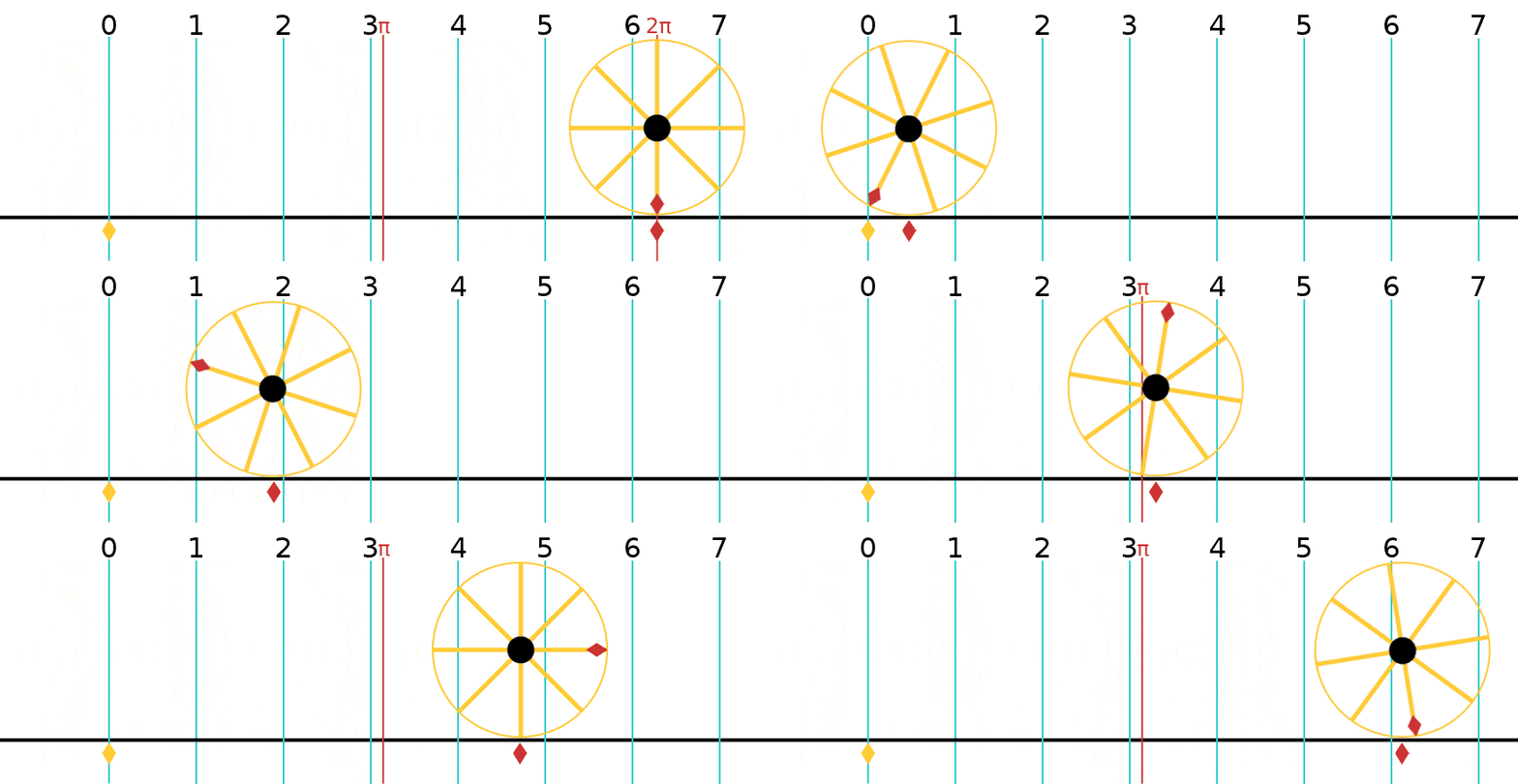
The x−ct argument is there because we’re talking waves, so that is something moving through space and time indeed. Now, what are we actually doing when we write x−ct? Believe it or not, we’re basically converting something expressed in time units into something expressed in distance units. So we’re converting time into distance, so to speak. To see how this works, suppose we add some time Δt to the argument of our function y = F, so we’re looking at F[x−c(t+Δt)] now, instead of F(x−ct). Now, F[x−c(t+Δt)] = F(x−ct−cΔt), so we’ll get a different value for our function—obviously! But it’s easy to see that we can restore our wave function F to its former value by also adding some distance Δx = cΔt to the argument. Indeed, if we do so, we get F[x+Δx−c(t+Δt)] = F(x+cΔt–ct−cΔt) = F(x–ct). For example, if = 3 m/s, then 2 seconds of time correspond to (2 s)×(3 m/s) = 6 meters of distance.

The idea behind adding both some time Δt as well as some distance Δx is that you’re traveling with the waveform itself, or with its phase as they say. So it’s like you’re riding on its crest or in its trough, or somewhere hanging on to it, so to speak. Hence, the speed of a wave is also referred to as its phase velocity, which we denote by vp = c. Now, let me make some remarks here.

First, there is the direction of travel. The pulses above travel in the positive x-direction, so that’s why we have x minus ct in the argument. For a wave traveling in the negative x-direction, we’ll have a wave function y = F(x+ct). [And, yes, don’t be lazy, Vincent: please go through the Δx = cΔt math once again to double-check that.]

The second thing you should note is that the speed of a regular periodic wave is equal to to the product of its wavelength and its frequency, so we write: vp = c = λ·f, which we can also write as λ = c/f or f = c/λ. Now, you know we express the frequency in oscillations or cycles per second, i.e. in hertz: one hertz is, quite simply, 1 s−1, so the unit of frequency is the reciprocal of the second. So the m/s and the Hz units in the fraction below give us a wavelength λ equal to λ = (20 m/s)/(5/s) = 4 m. You’ll say that’s too simple but I just want to make sure you’ve got the basics right here.

Capture

The third thing is that, in physics, and in math, we’ll usually work with nice sinusoidal functions, i.e. sine or cosine functions. A sine and a cosine function are the same function but with a phase difference of 90 degrees, so that’s π/2 radiansThat’s illustrated below: cosθ = sin(θ+π/2).

Circle_cos_sin

Now, when we converted time to distance by multiplying it with c, what we actually did was to ensure that the argument of our wavefunction F was expressed in one unit only: the meter, so that’s the distance unit in the international SI system of units. So that’s why we had to convert time to distance, so to speak.

The other option is to express all in seconds, so that’s in time units. So then we should measure distance in seconds, rather than meters, so to speak, and the corresponding argument is t–x/c, and our wave function would be written as y = G(t–x/c). Just go through the same Δx = cΔt math once more: G[t+Δt–(x+Δx)/c] = G(t+Δt–x/ccΔt/c) = G(t–x/c).

In short, we’re talking the same wave function here, so F(x−ct) = G(t−x/c), but the argument of F is expressed in distance units, while the argument of G is expressed in time units. If you’d want to double-check what I am saying here, you can use the same 20 m/s wave example again: suppose the distance traveled is 100 m, so x = 100 m and x/c = (100 m)/(20 m/s) = 5 seconds. It’s always important to check the units, and you can see they come out alright in both cases! 🙂

Now, to go from F or G to our sine or cosine function, we need to do yet another conversion of units, as the argument of a sinusoidal function is some angle θ, not meters or seconds. In physics, we refer to θ as the phase of the wave function. So we need degrees or, more common now, radians, which I’ll explain in a moment. Let me first jot it down:

y = sin(2π(x–ct)/λ)

So what are we doing here? What’s going on? Well… First, we divide x–ct by the wavelength λ, so that’s the (x–ct)/λ in the argument of our sine function. So our ‘distance unit’ is no longer the meter but the wavelength of our wave, so we no longer measure in meter but in wavelengths. For example, if our argument x–ct was 20 m, and the wavelength of our wave is 4 m, we get (x–ct)/λ = 5 between the brackets. It’s just like comparing our length: ten years ago you were about half my size. Now you’re the same: one unit. 🙂 When we’re saying that, we’re using my length as the unit – and so that’s also your length unit now 🙂 – rather than meters or centimeters.

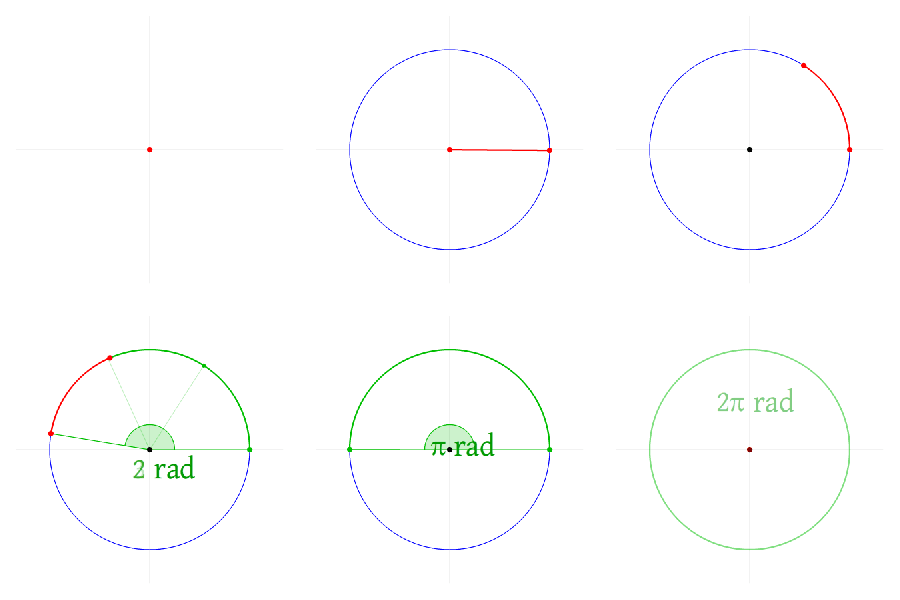
Now I need to explain the 2π factor, which is only slightly more difficult. Think about it: one wavelength corresponds to one full cycle, so that’s the full 360° of the circle below. In fact, we’ll express angles in radians, and the two animations below illustrate what a radian really is: an angle of 1 rad defines an arc whose length, as measured on the circle, is equal to the radius of that circle. […] Oh! Please look at the animations as two separate things: they illustrate the same idea, but they’re not synchronized, unfortunately! 🙂
2pi-unrolledCircle_radians

So… I hope it all makes sense now: if we add one wavelength to the argument of our wave function, we should get the same value, and so it’s equivalent to adding 2π to the argument of our sine function. Adding half a wavelength, or 35% of it, or a quarter, or two wavelengths, or e wavelengths, etc is equivalent to adding π, or 35%·2π ≈ 2.2, or 2π/4 = π/2, or 2·2π = 4π, or e·2π, etc to it. So… Well… Think about it: to go from the argument of our wavefunction expressed as a number of wavelengths − so that’s (x–ct)/λ – to the argument of our sine function, which is expressed in radians, we need to multiply by 2π.

[…] OK, Vincent. If it’s easier for you, you may want to think of the 1/λ and 2π factors in the argument of the sin(2π(x–ct)/λ) function as scaling factors: you’d use a scaling factor when you go from one measurement scale to another indeed. It’s like using vincents rather than meter. If one vincent corresponds to 1.8 m, then we need to re-scale all lengths by dividing them by 1.8 so as to express them in vincents. Vincent ten year ago was 0.9 m, so that’s half a vincent: 0.9/1.8 = 0.5. 🙂

[…] OK. […] Yes, you’re right: that’s rather stupid and makes nobody smile. Fine. You’re right: it’s time to move on to more complicated stuff. Now, read the following a couple of times. It’s my one and only message to you:

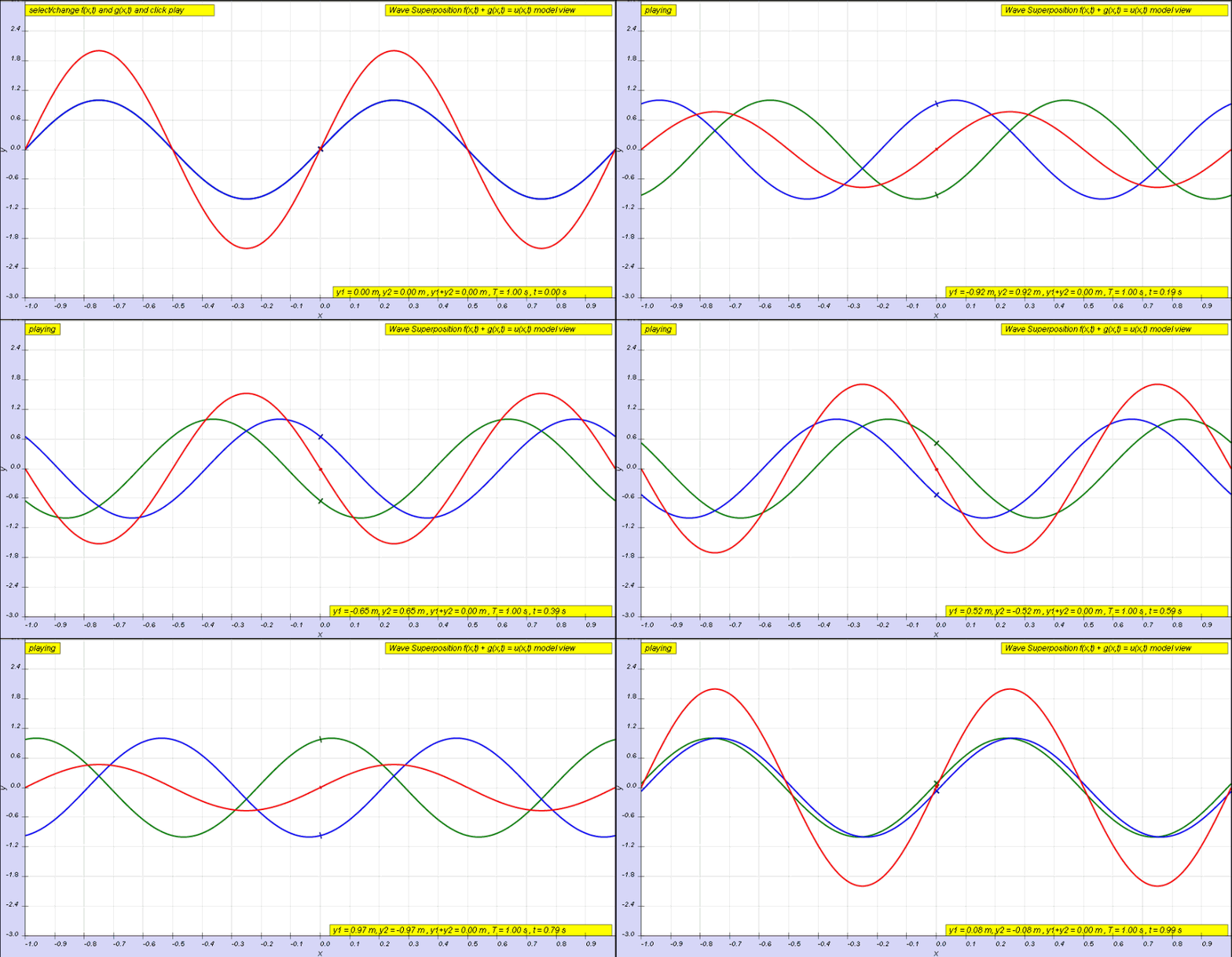
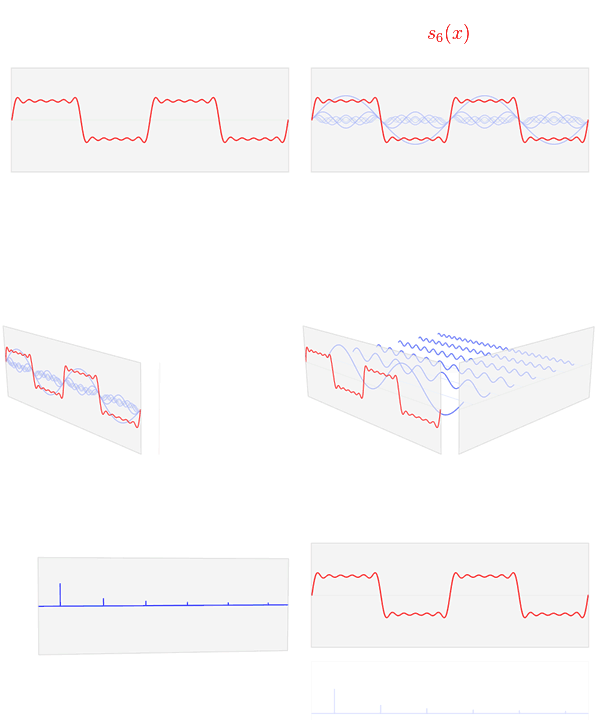
If there’s anything at all that you should remember from all of the nonsense I am writing about in this physics blog, it’s that any periodic phenomenon, any motion really, can be analyzed by assuming that it is the sum of the motions of all the different modes of what we’re looking at, combined with appropriate amplitudes and phases.

It really is a most amazing thing—it’s something very deep and very beautiful connecting all of physics with math.

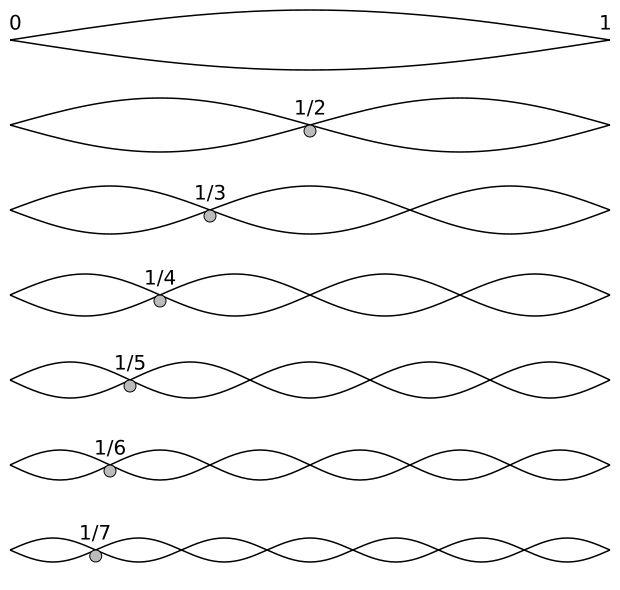
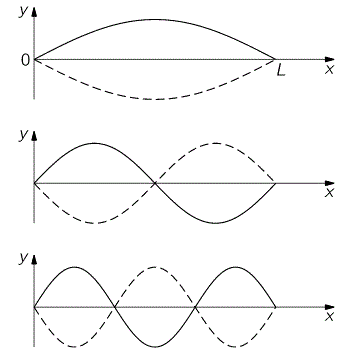
We often refer to these modes as harmonics and, in one of my posts on the topic, I explained how the wavelengths of the harmonics of a classical guitar string – it’s just an example – depended on the length of the string only. Indeed, if we denote the various harmonics by their harmonic number n = 1, 2, 3,… n,… and the length of the string by L, we have λ1 = 2L = (1/1)·2L, λ2 = L = (1/2)·2L, λ3 = (1/3)·2L,… λn = (1/n)·2L. So they look like this:

620px-Harmonic_partials_on_strings

etcetera (1/8, 1/9,…,1/n,… 1/∞)

The diagram makes it look like it’s very obvious, but it’s an amazing fact: the material of the string, or its tension, doesn’t matter. It’s just the length: simple geometry is all that matters! As I mentioned in my post on music and physics, this realization led to a somewhat misplaced fascination with harmonic ratios, which the Greeks thought could explain everything. For example, the Pythagorean model of the orbits of the planets would also refer to these harmonic ratios, and it took intellectual giants like Galileo and Copernicus to finally convince the Pope that harmonic ratios are great, but that they cannot explain everything. 🙂 [Note: When I say that the material of the string, or its tension, doesn’t matter, I should correct myself: they do come into play when time becomes the variable. Also note that guitar strings are not the same length when strung on a guitar: the so-called bridge saddle is not in an exact right angle to the strings: this is a link to some close-up pictures of a bridge saddle on a guitar, just in case you don’t have a guitar at home to check.]

Now, I already explained the need to express the argument of a wave function in radians – because we’re talking periodic functions and so we want to use sinusoidals − and how it’s just a matter of units really, and so how we can go from meter to wavelengths to radians. I also explained how we could do the same for seconds, i.e. for time. The key to converting distance units to time units, and vice versa, is the speed of the wave, or the phase velocity, which relates wavelength and frequency: c = λ·f. Now, as we have to express everything in radians anyway, we’ll usually substitute the wavelength and frequency by the wavenumber and the angular frequency so as to convert these quantities too to something expressed in radians. Let me quickly explain how it works:

  1. The wavenumber k is equal to k = 2π/λ, so it’s some number expressed in radians per unit distance, i.e. radians per meter. In the example above, where λ was 4 m, we have k = 2π/(4 m) = π/2 radians per meter. To put it differently, if our wave travels one meter, its phase θ will change by π/2.
  2. Likewise, the angular frequency is ω = 2π·f = 2π/T. Using the same example once more, so assuming a frequency of 5 Hz, i.e. a period of one fifth of a second, we have ω = 2π/[(1/5)·s] = 10π per second. So the phase of our wave will change with 10 times π in one second. Now that makes sense because, in one second, we have five cycles, and so that corresponds to 5 times 2π.

Note that our definition implies that λ = 2π/k, and that it’s also easy to figure out that our definition of ω, combined with the = c/λ relation, implies that ω = 2π·c/λ and, hence, that c = ω·λ/(2π) = (ω·2π/k)/(2π) = ω/k. OK. Let’s move on.

Using the definitions and explanations above, it’s now easy to see that we can re-write our y = sin(2π(x–ct)/λ) as:

y = sin(2π(x–ct)/λ) = sin[2π(x–(ω/k)t)/(2π/k)] = sin[(x–(ω/k)t)·k)] = sin(kx–ωt)

Remember, however, that we were talking some wave that was traveling in the positive x-direction. For the negative x-direction, the equation becomes:

y = sin(2π(x+ct)/λ) = sin(kx+ωt)

OK. That should be clear enough. Let’s go back to our guitar string. We can go from λ to k by noting that λ = 2L and, hence, we get the following for all of the various modes:

k = k1 = 2π·1/(2L) = π/L, k2 = 2π·2/(2L) = 2k, k3 = 2π·3/(2L) = 3k,,… kn = 2π·3/(2L) = nk,…

That gives us our grand result, and that’s that we can write some very complicated waveform Ψ(x) as the sum of an infinite number of simple sinusoids, so we have:

Ψ(x) = a1sin(kx) + a2sin(2kx) + a3sin(3kx) + … + ansin(nkx) + … = ∑ ansin(nkx)

The equation above assumes we’re looking at the oscillation at some fixed point in time. If we’d be looking at the oscillation at some fixed point in space, we’d write:

Φ(t) = a1sin(ωt) + a2sin(2ωt) + a3sin(3ωt) + … + ansin(nωt) + … = ∑ ansin(nωt)

Of course, to represent some very complicated oscillation on our guitar string, we can and should combine some Ψ(x) as well as some Φ(t) function, but how do we do that, exactly? Well… We’ll obviously need both the sin(kx–ωt) as well as those sin(kx+ωt) functions, as I’ll explain in a moment. However, let me first make another small digression, so as to complete your knowledge of wave mechanics. 🙂

We look at a wave as something that’s traveling through space and time at the same time. In that regard, I told you that the speed of the wave is its so-called phase velocity, which we denoted as vp = c and which, as I explained above, is equal to vp = c = λ·= (2π/k)·(ω/2π) = ω/k. The animation below (credit for it must go to Wikipedia—and sorry I forget to acknowledge the same source for the illustrations above) illustrates the principle: the speed of travel of the red dot is the phase velocity. But you can see that what’s going on here is somewhat more complicated: we have a series of wave packets traveling through space and time here, and so that’s where the concept of the so-called group velocity comes in: it’s the speed of travel of the green dot.

Wave_group

Now, look at the animation below. What’s going on here? The wave packet (or the group or the envelope of the wave—whatever you want to call it) moves to the right, but the phase goes to the left, as the peaks and troughs move leftward indeed. Huh? How is that possible? And where is this wave going? Left or right? Can we still associate some direction with the wave here? It looks like it’s traveling in both directions at the same time!

Wave_opposite-group-phase-velocity

The wave actually does travel in both directions at the same time. Well… Sort of. The point is actually quite subtle. When I started this post by writing that the pulses were ‘obviously’ traveling in the positive x-direction… Well… That’s actually not so obvious. What is it that is traveling really? Think about an oscillating guitar string: nothing travels left or right really. Each point on the string just moves up and down. Likewise, if our repeated pulse is some water wave, then the water just stays where it is: it just moves up and down. Likewise, if we shake up some rope, the rope is not going anywhere: we just started some motion that is traveling down the rope. In other words, the phase velocity is just a mathematical concept. The peaks and troughs that seem to be traveling are just mathematical points that are ‘traveling’ left or right.

What about the group velocity? Is that a mathematical notion too? It is. The wave packet is often referred to as the envelope of the wave curves, for obviously reasons: they’re enveloped indeed. Well… Sort of. 🙂 However, while both the phase and group velocity are velocities of mathematical constructs, it’s obvious that, if we’re looking at wave packets, the group velocity would be of more interest to us than the phase velocity. Think of those repeated pulses as real water waves, for example: while the water stays where it is (as mentioned, the water molecules just go up and down—more or less, at least), we’d surely be interested to know how fast these waves are ‘moving’, and that’s given by the group velocity, not the phase velocity. Still, having said that, the group velocity is as ‘unreal’ as the phase velocity: both are mathematical concepts. The only thing that’s ‘real’ is the up and down movement. Nothing travels in reality. Now, I shouldn’t digress too much here, but that’s why there’s no limit on the phase velocity: it can exceed the speed of light. In fact, in quantum mechanics, some real-life particle − like an electron, for instance – will be represented by a complex-valued wave function, and there’s no reason to put some limit on the phase velocity. In contrast, the group velocity will actually be the speed of the electron itself, and that speed can, obviously, approach the speed of light – in particle accelerators, for example – but it can never exceed it. [If you’re smart, and you are, you’ll wonder: what about photons? Well…The classical and quantum-mechanical view of an electromagnetic wave are surely not the same, but they do have a lot in common: both photons and electromagnetic radiation travel at the speed c. Photons can do so because their rest mass is zero. But I can’t go into any more detail here, otherwise this thing will become way too long.]

OK. Let me get back to the issue at hand. So I’ll now revert to the simpler situation we’re looking at here, and so that’s these harmonic waves, whose form is a simple sinusoidal indeed. The animation below (and, yes, it’s also from Wikipedia) is the one that’s relevant for this situation. You need to study it for a while to understand what’s going on. As you can see, the green wave travels to the right, the blue one travels to the left, and the red wave function is the sum of both.

Superpositionprinciple

Of course, after all that I wrote above, I should use quotation marks and write ‘travel’ instead of travel, so as to indicate there’s nothing traveling really, except for those mathematical points, but then no one does that, and so I won’t do it either. Just make sure you always think twice when reading stuff like this! Back to the lesson: what’s going on here?

As I explained, the argument of a wave traveling towards the negative x-direction will be x+ct. Conversely, the argument of a wave traveling in the positive x-direction will be x–ct. Now, our guitar string is going nowhere, obviously: it’s like the red wave function above. It’s a so-called standing wave. The red wave function has nodes, i.e. points where there is no motion—no displacement at all! Between the nodes, every point moves up and down sinusoidally, but the pattern of motion stays fixed in space. So that’s the kind of wave function we want, and the animation shows us how we can get it.

Indeed, there’s a funny thing with fixed strings: when a wave reaches the clamped end of a string, it will be reflected with a change in sign, as illustrated below: we’ve got that F(x+ct) wave coming in, and then it goes back indeed, but with the sign reversed.

Capture

The illustration above speaks for itself but, of course, once again I need to warn you about the use of sentences like ‘the wave reaches the end of the string’ and/or ‘the wave gets reflected back’. You know what it really means now: it’s some movement that travels through space. […] In any case, let’s get back to the lesson once more: how do we analyze that?

Easy: the red wave function is the sum of two waves: one traveling to the right, and one traveling to the left. We’ll call these component waves F and G respectively, so we have y = F(x, t) + G(x, t). Let’s go for it.

Let’s first assume the string is not held anywhere, so that we have an infinite string along which waves can travel in either direction. In fact, the most general functional form to capture the fact that a waveform can travel in any direction is to write the displacement y as the sum of two functions: one wave traveling one way (which we’ll denote by F, indeed), and the other wave (which, yes, we’ll denote by G) traveling the other way. From the illustration above, it’s obvious that the F wave is traveling towards the negative x-direction and, hence, its argument will be x+ct. Conversely, the G wave travels in the positive x-direction, so its argument is x–ct. So we write:

y = F(x, t) + G(x, t) = F(x+ct) + G(x–ct)

So… Well… We know that the string is actually not infinite, but that it’s fixed to two points. Hence, y is equal to zero there: y = 0. Now let’s choose the origin of our x-axis at the fixed end so as to simplify the analysis. Hence, where y is zero, x is also zero. Now, at x = 0, our general solution above for the infinite string becomes  y = F(ct) + G(−ct) = 0, for all values of t. Of course, that means G(−ct) must be equal to –F(ct). Now, that equality is there for all values of t. So it’s there for all values of ct and −ct. In short, that equality is valid for whatever value of the argument of G and –F. As Feynman puts it: “of anything must be –of minus that same thing.” Now, the ‘anything’ in G is its argument: x – ct, so ‘minus that same thing’ is –(x–ct) = −x+ct. Therefore, our equation becomes:

y = F(x+ct) − F(−x+ct)

So that’s what’s depicted in the diagram above: the F(x+ct) wave ‘vanishes’ behind the wall as the − F(−x+ct) wave comes out of it. Now, of course, so as to make sure our guitar string doesn’t stop its vibration after being plucked, we need to ensure F is a periodic function, like a sin(kx+ωt) function. 🙂 Why? Well… If this F and G function would simply disappear and ‘serve’ only once, so to speak, then we only have one oscillation and that’s it! So the waves need to continue and so that’s why it needs to be periodic.

OK. Can we just take sin(kx+ωt) and −sin(−kx+ωt) and add both? It makes sense, doesn’t it? Indeed, −sinα = sin(−α) and, therefore, −sin(−kx+ωt) = sin(kx−ωt). Hence, y = F(x+ct) − F(−x+ct) would be equal to:

y = sin(kx+ωt) + sin(kx–ωt) = sin(2π(x+ct)/λ) + sin(2π(x−ct)/λ)

Done! Let’s use specific values for k and ω now. For the first harmonic, we know that k = 2π/2L = π/L. What about ω? Hmm… That depends on the wave velocity and, therefore, that actually does depend on the material and/or the tension of the string! The only thing we can say is that ω = c·k, so ω = c·2π/λ = c·π/L. So we get:

sin(kx+ωt) = sin(π·x/L + π·c·t/L) = sin[(π/L)·(x+ct)]

But this is our F function only. The whole oscillation is y = F(x+ct) − F(−x+ct), and − F(−x+ct) is equal to:

 –sin[(π/L)·(−x+ct)] = –sin(−π·x/L+π·c·t/L) = −sin(−kx+ωt) = sin(kx–ωt) = sin[(π/L)·(x–ct)]

So, yes, we should add both functions to get:

y = sin[π(x+ct)/L] + sin[π(x−ct)/L]

Now, we can, of course, apply our trigonometric formulas for the addition of angles, which say that sin(α+β) = sinαcosβ + sinβcosα and sin(α–β) = sinαcosβ – sinβcosα. Hence, y = sin(kx+ωt) + sin(kx–ωt) is equal to sin(kx)cos(ωt) + sin(ωt)cos(kx) + sin(kx)cos(ωt) – sin(ωt)cos(kx) = 2sin(kx)cos(ωt). Now, that’s a very interesting result, so let’s give it some more prominence by writing it in boldface:

y = sin(kx+ωt) + sin(kx–ωt) = 2sin(kx)cos(ωt) = 2sin(π·x/L)cos(π·c·t/L)

The sin(π·x/L) factor gives us the nodes in space. Indeed, sin(π·x/L) = 0 if x is equal to 0 or L (values of x outside of the [0, L] interval are obviously not relevant here). Now, the other factor cos(π·c·t/L) can be re-written cos(2π·c·t/λ) = cos(2π·f·t) = cos(2π·t/T), with T the period T = 1/f = λ/c, so the amplitude reaches a maximum (+1 or −1 or, including the factor 2, +2 or −2) if 2π·t/T is equal to a multiple of π, so that’s if t = n·T/2 with n = 0, 1, 2, etc. In our example above, for f = 5 Hz, that means the amplitude reaches a maximum (+2 or −2) every tenth of a second.

The analysis for the other modes is as easy, and I’ll leave it you, Vincent, as an exercise, to work it all out and send me the y = 2·sin[something]·cos[something else] formula (with the ‘something’ and ‘something else’ written in terms of L and c, of course) for the higher harmonics. 🙂

[…] You’ll say: what’s the point, daddy? Well… Look at that animation again: isn’t it great we can analyze any standing wave, or any harmonic indeed, as the sum of two component waves with the same wavelength and frequency but ‘traveling’ in opposite directions? 

Superpositionprinciple

Yes, Vincent. I can hear you sigh: “Daddy, I really do not see why I should be interested in this.”

Well… Your call… What can I say? Maybe one day you will. In fact, if you’re going to go for engineering studies, you’ll have to. 🙂

To conclude this post, I’ll insert one more illustration. Now that you know what modes are, you can start thinking about those more complicated Ψ and Φ functions. The illustration below shows how the first and second mode of our guitar string combine to give us some composite wave traveling up and down the very same string.

composite wave

Think about it. We have one physical phenomenon here: at every point in time, the string is somewhere, but where exactly, depends on the mathematical shape of its components. If this doesn’t illustrate the beauty of Nature, the fact that, behind every simple physical phenomenon − most of which are some sort of oscillation indeed − we have some marvelous mathematical structure, then… Well… Then I don’t know how to explain why am absolutely fascinated by this stuff.

Addendum 1: On actual waves

My examples of waves above were all examples of so-called transverse waves, i.e. oscillations at a right angle to the direction of the wave. The other type of wave is longitudinal. I mentioned sound waves above, but they are essentially longitudinal. So there  the displacement of the medium is in the same direction of the wave, as illustrated below.Onde_compression_impulsion_1d_30_petit

Real-life waves, like water waves, may be neither of the two. The illustration below shows how water molecules actually move as a wave passes. They move in little circles, with a systemic phase shift from circle to circle.

Water waves

Why is this so? I’ll let Feynman answer, as he also provided the illustration above:

“Although the water at a given place is alternately trough or hill, it cannot simply be moving up and down, by the conservation of water. That is, if it goes down, where is the water going to go? The water is essentially incompressible. The speed of compression of waves—that is, sound in the water—is much, much higher, and we are not considering that now. Since water is incompressible on this scale, as a hill comes down the water must move away from the region. What actually happens is that particles of water near the surface move approximately in circles. When smooth swells are coming, a person floating in a tire can look at a nearby object and see it going in a circle. So it is a mixture of longitudinal and transverse, to add to the confusion. At greater depths in the water the motions are smaller circles until, reasonably far down, there is nothing left of the motion.”

So… There you go… 🙂

Addendum 2: On non-periodic waves, i.e. pulses

A waveform is not necessarily periodic. The pulse we looked at could, perhaps, not repeat itself. It is not possible, then, to describe its wavelength. However, it’s still a wave and, hence, its functional form would still be some y = F(x−ct) or y = F(x+ct) form, depending on its direction of travel.

The example below also comes out of Feynman’s Lectures: electromagnetic radiation is caused by some accelerating electric charge – an electron, usually, because its mass is small and, hence, it’s much easier to move than a proton 🙂 – and then the electric field travels out in space. So the two diagrams below show (i) the acceleration (a) as a function of time (t) and (ii) the electric field strength (E) as a function of the distance (r). [To be fully precise, I should add he ignores the 1/r variation, but that’s a fine point which doesn’t matter much here.]

EM 1EM 2    

He basically uses this illustration to explain why we can use a y = G(t–x/c) functional form to describe a wave. The point is: he actually talks about one pulse only here. So the F(x±ct) or G(t±x/c) or sin(kx±ωt) form has nothing to do with whether or not we’re looking at a periodic or non-periodic waveform. The gist of the matter is that we’ve got something moving through space, and it doesn’t matter whether it’s periodic or not: the periodicity or non-periodicity, of a wave has nothing to do with the x±ct, t±x/c or kx±ωt shape of the argument of our wave function. The functional form of our argument is just the result of what I said about traveling along with our wave.

So what is it about periodicity then? Well… If periodicity kicks it, you’ll talk sinusoidal functions, and so the circle will be needed once more. 🙂   

Now, I mentioned we cannot associate any particular wavelength with such non-periodic wave. Having said that, it’s still possible to analyze this pulse as a sum of sinusoids through a mathematical procedure which is referred to as the Fourier transform. If you’re going for engineer, you’ll need to learn how to master this technique. As for now, however, you can just have a look at the Wikipedia article on it. 🙂

Some content on this page was disabled on June 16, 2020 as a result of a DMCA takedown notice from The California Institute of Technology. You can learn more about the DMCA here:

https://wordpress.com/support/copyright-and-the-dmca/
Some content on this page was disabled on June 16, 2020 as a result of a DMCA takedown notice from The California Institute of Technology. You can learn more about the DMCA here:

https://wordpress.com/support/copyright-and-the-dmca/

The field from a grid

Pre-script (dated 26 June 2020): This post got mutilated by the removal of some material by the dark force. You should be able to follow the main story-line, however. If anything, the lack of illustrations might actually help you to think things through for yourself.

Original post:

As part of his presentation of indirect methods for finding the field, Feynman presents an interesting argument on the electrostatic field of a grid. It’s just another indirect method to arrive at meaningful conclusions on how a field is supposed to look like, but it’s quite remarkable, and that’s why I am expanding it here. Feynman’s presentation is extremely succint indeed and, hence, I hope the elaboration below will help you to understand it somewhat quicker than I did. 🙂

The grid is shown below: it’s just a uniformly spaced array of parallel wires in a plane. We are looking at the field above the plane of wires here, and the dotted lines represent equipotential surfaces above the grid.

grid

As you can see, for larger distances above the plane, we see a constant electric field, just as though the charge were uniformly spread over a sheet of charge, rather than over a grid. However, as we approach the grid, the field begins to deviate from the uniform field.

Let’s analyze it by assuming the wires lie in the xy-plane, running parallel to the y-axis. The distance between the wires is measured along the x-axis, and the distance to the grid is measured along the z-axis, as shown in the illustration above. We assume the wires are infinitely long and, hence, the electric field does not depend on y. So the component of E in the y-direction is 0, so E= –∂Φ/∂y = 0. Therefore, ∂2Φ/∂y= 0 and our Poisson equation above the wires (where there are no charges) is reduced to ∂2Φ/∂x+ ∂2Φ/∂z=0. What’s next?

Let’s look at the field of two positive wires first. The plot below comes from the Wolfram Demonstrations Project. I recommend you click the link and play with it: you can vary the charges and the distance, and the tool will redraw the equipotentials and the field lines accordingly. It will give you a better feel for the (a)symmetries involved. The equipotential lines are the gray contours: they are cross-sections of equipotential surfaces. The red curves are the field lines, which are always orthogonal to the equipotentials.

WolframThe point at the center is really interesting: the straight horizontal and vertical red lines through it are limits really. Feynman’s illustration below shows the point represents an unstable equilibrium: the hollow tube prevents the charge from going sideways. So if it wouldn’t be there, the charge would go sideways, of course! So it’s some kind of saddle point. Onward!hollow tube

Look at the illustration below and try to imagine how the field looks like by thinking about the value of the potential as you move along one of the two blue lines below: the potential goes down as we move to the right, reaches a minimum in the middle, and then goes up again. Also think about the difference between the lighter and darker blue line: going along the light-blue line, we start at a lower potential, and its minimum will also be lower than that of the dark-blue line.

lines

So you can start drawing curves. However, I have to warn you: the graphs are not so simple. Look at the detail below. The potential along the blue line goes slightly up before it decreases, so the graph of the potential may resemble the green curve on the right of the image. I did an actual calculation here. 🙂 If there are only two charges, the formula for the potential is quite simple: Φ = (1/4πε0)·(q1/r1) + (1/4πε0)·(q2/r2). Briefly forgetting about the (1/4πε0) and equating q1 and q2 to +1, we get Φ = 1/r1 + 1/r= (r1 + r2)/r1r2.  That looks like an easy function, and it is. You should think of it as the equivalent of the 1/r formula, but written as 1/r = r/r2, and with a factor 2 in front because we have two charges. 🙂

However, we need to express it as a function of x, keeping z (i.e. the ‘vertical’ coordinate) constant. That’s what I did to get the graphs below. It’s easy to see that 1/r= (x+ z2)−1/2, while 1/r= [(a−x)+ z2]−1/2. Assuming a = 2 and z = 0.8, the contribution from the first charge is given by the blue curve, the contribution of the second charge is represented by the red curve, and the green curve adds both and, hence, represents the potential generated by both charges, i.e. qat x = 0 and qat x = a. OK… Onward!

 lines 3graph 2

The point to note is that we have an extremely simple situation here – two charges only, or two wires, I should say – but a potential function that is surely not some simple sinusoidal function. To drive the point home, I plotted a few more curves below, keeping a at a = 2, but equating z with 0.4, 0.7 and 1.7 respectively. The z = 1.7 curve shows that, at larger distances, the potential actually increases slightly as we move from left to right along the z = 1.7 line. Note the remarkable symmetry of the curves and the equipotential lines: there should be some obvious mathematical explanation for that but, unfortunately, not obvious enough for me to find it, so please let me know if you see it! 🙂

graph 3

OK. Let’s get back to our grid. For your convenience, I copied it once more below.

grid

Feynman’s approach to calculating the variations is quite original. He also duly notes that the potential function is surely not some simple sinusoidal function. However, he also notes that, when everything is said and done, it is some periodic quantity, in one way or another, and, therefore, we should be able to do a Fourier analysis and express it as a sum of sinusoidal waves. To be precise, we should be able to write Φ(x, z) as a sum of harmonics.

[…] I know. […] Now you say: Oh sh**! And you’ll just turn off. That’s OK, but why don’t you give it a try? I promise to be lengthy. 🙂

Before we get too much into the weeds, let’s briefly recall how it works for our classical guitar string. That post explained how the wavelengths of the harmonics of a string depended on its length. If we denote the various harmonics by their harmonic number n = 1, 2, 3 etcetera, and the length of the string by L, we have λ1 = 2L = (1/1)·2L, λ2 = L = (1/2)·2L, λ3 = (1/3)·2L,… λn = (1/n)·2L. In short, the harmonics – i.e. the components of our waveform – look like this:

620px-Harmonic_partials_on_strings

etcetera (1/8, 1/9,…,1/n,… 1/∞)

Beautiful, isn’t it? As I explained in that post, it’s so beautiful it triggered a misplaced fascination with harmonic ratios. It was misplaced because the Pythagorean theory was a bit too simple to be true. However, their intuition was right, and they set the stage for guys like Copernicus, Fourier and Feynman, so that was good! 🙂

Now, as you know, we’ll usually substitute wavelength and frequency by wavenumber and angular frequency so as to convert all to something expressed in radians, which we can then use as the argument in the sine and/or cosine component waves. [Yes, the Pythagoreans once again! :-)] The wavenumber k is equal to k = 2π/λ, and the angular frequency is ω = 2π·f = 2π/T (in case you doubt, you can quickly check that the speed of a wave is equal to the product of the wavelength and its frequency by substituting: = λ·= (2π/k)·(ω/2π) = ω/k, which gives you the phase velocity vp= c). To make a long story short, we wrote k = k1 = 2π·1/(2L), k2 = 2π·2/(2L) = 2k, k3 = 2π·3/(2L) = 3k,,… kn = 2π·3/(2L) = nk,… to arrive at the grand result, and that’s our wave F(x) expressed as the sum of an infinite number of simple sinusoids: 

F(x) = a1cos(kx) + a2cos(2kx) + a3cos(3kx) + … + ancos(nkx) + … = ∑ ancos(nkx)

That’s easy enough. The problem is to find those amplitudes a1, a2, a3,… of course, but the great French mathematician who gave us the Fourier series also gave us the formulas for that, so we should be fine! Can we use them here? Should we use them here? Let’s see…

The in the analysis, i.e. the spacing of the wires, is the physical quantity that corresponds to the length of our guitar string in our musical sound problem. In fact, a corresponds to 2L, because guitar strings are fixed at two ends and, hence, the two ends have to be nodes and, therefore, the wavelength of our first harmonic is twice the length of the string. Huh? Well… Something like that. As you can see from the illustration of the grid, a, in contrast to L, does correspond to one full wavelength of our periodic function. So we write:

Φ(x) = ∑ ancos(n·k·x) = ∑ ancos(2π·n·x/a) (n = 1, 2, 3,…)

Now, that’s the formula for Φ(x) assuming we’re fixing z, so it’s Φ(x) at some fixed distance from the grid. Let’s think about those amplitudes an now. They should not depend on x, because the harmonics themselves (i.e. the cos(2π·n·x/a) components) are all that varies with x. So they have be some function of n and – most importantlysome function of z also. So we denote them by Fn(z) and re-write the equation above as:

 Φ(x, z) = ∑ Fn(z)·cos(2π·n·x/a) (n = 1, 2, 3,…)

Now, the rest of Feynman’s analysis speaks for itself, so I’ll just shamelessly copy it:

Feynman

What did he find here? What is he saying, really? 🙂 First note that the derivation above has been done for one term in the Fourier sum only, so we’re talking a specific harmonic here. That harmonic is a function of z which – let me remind you – is the distance from the grid. To be precise, the function is Fn(z) = Ane−z/z0. [In case you wonder how Feynman goes from equation (7.43) to (7.44), he’s just solving a second-order linear differential equation here. :-)]

Now, you’ve seen the graph of that function a zillion times before: it starts at Afor z = 0 and goes to zero as z goes to infinity, as shown below. 🙂

graph 4

Now, that’s the case for all Fn(z) coefficients of course. As Feynman writes:

“We have found that if there is a Fourier component of the field of harmonic n, that component will decrease exponentially with a characteristic distance z= a/2πn. For the first harmonic (n=1), the amplitude falls by the factor e−2π (i.e. a large decrease) each time we increase z by one grid spacing a. The other harmonics fall off even more rapidly as we move away from the grid. We see that if we are only a few times the distance a away from the grid, the field is very nearly uniform, i.e., the oscillating terms are small. There would, of course, always remain the “zero harmonic” field, i.e. Φ= −E0·z, to give the uniform field at large z. Of course, for the complete solution, the sum needs to be made, and the coefficients An would need to be adjusted so that the total sum, when differentiated, gives an electric field that would fit the charge density of the grid wires.” 

Phew! Quite something, isn’t it? But that’s it really, and it’s actually simpler than the ‘direct’ calculations of the field that I googled. Those calculations involve complicated series and logs and what have you, to arrive at the same result: the field away from a grid of charged wires is very nearly uniform.

Let me conclude this post by noting Feynman’s explanation of shielding by a screen. It’s quite terse:

“The method we have just developed can be used to explain why electrostatic shielding by means of a screen is often just as good as with a solid metal sheet. Except within a distance from the screen a few times the spacing of the screen wires, the fields inside a closed screen are zero. We see why copper screen—lighter and cheaper than copper sheet—is often used to shield sensitive electrical equipment from external disturbing fields.”

Hmm… So how does that work? The logic should be similar to the logic I explained when discussing shielding in one of my previous posts. Have a look—if only because it’s a lot easier to understand than the rather convoluted business I presented above. 🙂 But then I guess it’s all par for the course, isn’t it? 🙂

Some content on this page was disabled on June 16, 2020 as a result of a DMCA takedown notice from The California Institute of Technology. You can learn more about the DMCA here:

https://wordpress.com/support/copyright-and-the-dmca/
Some content on this page was disabled on June 16, 2020 as a result of a DMCA takedown notice from The California Institute of Technology. You can learn more about the DMCA here:

https://wordpress.com/support/copyright-and-the-dmca/
Some content on this page was disabled on June 16, 2020 as a result of a DMCA takedown notice from The California Institute of Technology. You can learn more about the DMCA here:

https://wordpress.com/support/copyright-and-the-dmca/

Maxwell, Lorentz, gauges and gauge transformations

Pre-script (dated 26 June 2020): This post got severely mutilated by the removal of material by the dark force. It may, therefore, be difficult to follow the main story-line. :-/

Original post:

I’ve done quite a few posts already on electromagnetism. They were all focused on the math one needs to understand Maxwell’s equations. Maxwell’s equations are a set of (four) differential equations, so they relate some function with its derivatives. To be specific, they relate E and B, i.e. the electric and magnetic field vector respectively, with their derivatives in space and in time. [Let me be explicit here: E and B have three components, but depend on both space as well as time, so we have three dependent and four independent variables for each function: E = (Ex, Ey, Ez) = E(x, y, z, t) and B = (Bx, By, Bz) = B(x, y, z, t).] That’s simple enough to understand, but the dynamics involved are quite complicated, as illustrated below.

Maxwell interactionI now want to do a series on the more interesting stuff, including an exploration of the concept of gauge in field theory, and I also want to show how one can derive the wave equation for electromagnetic radiation from Maxwell’s equations. Before I start, let’s recall the basic concept of a field.

The reality of fields

I said a couple of time already that (electromagnetic) fields are real. They’re more than just a mathematical structure. Let me show you why. Remember the formula for the electrostatic potential caused by some charge q at the origin:

E 4

We know that the (negative) gradient of this function, at any point in space, gives us the electric field vector at that point: E = –Φ. [The minus sign is there because of convention: we take the reference point Φ = 0 at infinity.] Now, the electric field vector gives us the force on a unit charge (i.e. the charge of a proton) at that point. If q is some positive charge, the force will be repulsive, and the unit charge will accelerate away from our q charge at the origin. Hence, energy will be expended, as force over distance implies work is being done: as the charges separate, potential energy is converted into kinetic energy. Where does the energy come from? The energy conservation law tells us that it must come from somewhere.

It does: the energy comes from the field itself. Bringing in more or bigger charges (from infinity, or just from further away) requires more energy. So the new charges change the field and, therefore, its energy. How exactly? That’s given by Gauss’ Law: the total flux out of a closed surface is equal to:

Gauss Law

You’ll say: flux and energy are two different things. Well… Yes and no. The energy in the field depends on E. Indeed, the formula for the energy density in space (i.e. the energy per unit volume) is

D 6

Getting the energy over a larger space is just another integral, with the energy density as the integral kernel:

energy integral

Feynman’s illustration below is not very sophisticated but, as usual, enlightening. 🙂

energy in the field

Gauss’ Theorem connects both the math as well as the physics of the situation and, as such, underscores the reality of fields: the energy is not in the electric charges. The energy is in the fields they produce. Everything else is just the principle of superposition of fields –  i.e. E = E+ E– coming into play. I’ll explain Gauss’ Theorem in a moment. Let me first make some additional remarks.

First, the formulas are valid for electrostatics only (so E and B only vary in space, not in time), so they’re just a piece of the larger puzzle. 🙂 As for now, however, note that, if a field is real (or, to be precise, if its energy is real), then the flux is equally real.

Second, let me say something about the units. Field strength (E or, in this case, its normal component En = E·n) is measured in newton (N) per coulomb (C), so in N/C. The integral above implies that flux is measured in (N/C)·m2. It’s a weird unit because one associates flux with flow and, therefore, one would expect flux is some quantity per unit time and per unit area, so we’d have the m2 unit (and the second) in the denominator, not in the numerator. But so that’s true for heat transfer, for mass transfer, for fluid dynamics (e.g. the amount of water flowing through some cross-section) and many other physical phenomena. But for electric flux, it’s different. You can do a dimensional analysis of the expression above: the sum of the charges is expressed in coulomb (C), and the electric constant (i.e. the vacuum permittivity) is expressed in C2/(N·m2), so, yes, it works: C/[C2/(N·m2)] = (N/C)·m2. To make sense of the units, you should think of the flux as the total flow, and of the field strength as a surface density, so that’s the flux divided by the total area, so (field strength) = (flux)/(area). Conversely, (flux) = (field strength)×(area). Hence, the unit of flux is [flux] = [field strength]×[area] = (N/C)·m2.

OK. Now we’re ready for Gauss’ Theorem. 🙂 I’ll also say something about its corollary, Stokes’ Theorem. It’s a bit of a mathematical digression but necessary, I think, for a better understanding of all those operators we’re going to use.

Gauss’ Theorem

The concept of flux is related to the divergence of a vector field through Gauss’ Theorem. Gauss’s Theorem has nothing to do with Gauss’ Law, except that both are associated with the same genius. Gauss’ Theorem is:

Gauss Theorem

The ·C in the integral on the right-hand side is the divergence of a vector field. It’s the volume density of the outward flux of a vector field from an infinitesimal volume around a given point.

Huh? What’s a volume density? Good question. Just substitute C for E in the surface and volume integral above (the integral on the left is a surface integral, and the one on the right is a volume integral), and think about the meaning of what’s written. To help you, let me also include the concept of linear density, so we have (1) linear, (2) surface and (3) volume density. Look at that representation of a vector field once again: we said the density of lines represented the magnitude of E. But what density? The representation hereunder is flat, so we can think of a linear density indeed, measured along the blue line: so the flux would be six (that’s the number of lines), and the linear density (i.e. the field strength) is six divided by the length of the blue line.

Linear density

However, we defined field strength as a surface density above, so that’s the flux (i.e. the number of field lines) divided by the surface area (i.e. the area of a cross-section): think of the square of the blue line, and field lines going through that square. That’s simple enough. But what’s volume density? How do we count the number of lines inside of a box? The answer is: mathematicians actually define it for an infinitesimally small cube by adding the fluxes out of the six individual faces of an infinitesimally small cube:

Volume density for small cube 1

So, the truth is: volume density is actually defined as a surface density, but for an infinitesimally small volume element. That, in turn, gives us the meaning of the divergence of a vector field. Indeed, the sum of the derivatives above is just ·C (i.e. the divergence of C), and ΔxΔyΔz is the volume of our infinitesimal cube, so the divergence of some field vector C at some point P is the flux – i.e. the outgoing ‘flow’ of Cper unit volume, in the neighborhood of P, as evidenced by writing

Volume density for small cube

Indeed, just bring ΔV to the other side of the equation to check the ‘per unit volume’ aspect of what I wrote above. The whole idea is to determine whether the small volume is like a sink or like a source, and to what extent. Think of the field near a point charge, as illustrated below. Look at the black lines: they are the field lines (the dashed lines are equipotential lines) and note how the positive charge is a source of flux, obviously, while the negative charge is a sink.

equipotential

Now, the next step is to acknowledge that the total flux from a volume is the sum of the fluxes out of each part. Indeed, the flux through the part of the surfaces common to two parts will cancel each other out. Feynman illustrates that with a rough drawing (below) and I’ll refer you to his Lecture on it for more detail.

cut

So… Combining all of the gymnastics above – and integrating the divergence over an entire volume, indeed –  we get Gauss’ Theorem:

Gauss Theorem

Stokes’ Theorem

There is a similar theorem involving the circulation of a vector, rather than its flux. It’s referred to as Stokes’ Theorem. Let me jot it down:

Stokes Theorem

We have a contour integral here (left) and a surface integral (right). The reasoning behind is quite similar: a surface bounded by some loop Γ is divided into infinitesimally small squares, and the circulation around Γ is the sum of the circulations around the little loops. We should take care though: the surface integral takes the normal component of ×C, so that’s (×C)n = (×Cn. The illustrations below should help you to understand what’s going on.

Stokes Theorem 1Stokes Theorem 2

The electric versus the magnetic force

There’s more than just the electric force: we also have the magnetic force. The so-called Lorentz force is the combination of both. The formula, for some charge q in an electromagnetic field, is equal to:

Lorentz force

Hence, if the velocity vector v is not equal to zero, we need to look at the magnetic field vector B too! The simplest situation is magnetostatics, so let’s first have a look at that.

Magnetostatics imply that that the flux of E doesn’t change, so Maxwell’s third equation reduces to c2×B = j0. So we just have a steady electric current (j): no accelerating charges. Maxwell’s fourth equation, B = 0, remains what is was: there’s no such thing as a magnetic charge. The Lorentz force also remains what it is, of course: F = q(E+v×B) = qE +qv×B. Also note that the v, j and the lack of a magnetic charge all point to the same: magnetism is just a relativistic effect of electricity.

What about units? Well… While the unit of E, i.e. the electric field strength, is pretty obvious from the F = qE term  – hence, E = F/q, and so the unit of E must be [force]/[charge] = N/C – the unit of the magnetic field strength is more complicated. Indeed, the F = qv×B identity tells us it must be (N·s)/(m·C), because 1 N = 1C·(m/s)·(N·s)/(m·C). Phew! That’s as horrendous as it looks, and that’s why it’s usually expressed using its shorthand, i.e. the tesla: 1 T = 1 (N·s)/(m·C). Magnetic flux is the same concept as electric flux, so it’s (field strength)×(area). However, now we’re talking magnetic field strength, so its unit is T·m= (N·s·m)/(m·C) = (N·s·m)/C, which is referred to as the weber (Wb). Remembering that 1 volt = 1 N·m/C, it’s easy to see that a weber is also equal to 1 Wb = 1 V·s. In any case, it’s a unit that is not so easy to interpret.

Magnetostatics is a bit of a weird situation. It assumes steady fields, so the ∂E/∂t and ∂B/∂t terms in Maxwell’s equations can be dropped. In fact, c2×B = j0 implies that ·(c2×B ·(j0) and, therefore, that ·= 0. Now, ·= –∂ρ/∂t and, therefore, magnetostatics is a situation which assumes ∂ρ/∂t = 0. So we have electric currents but no change in charge densities. To put it simply, we’re not looking at a condenser that is charging or discharging, although that condenser may act like the battery or generator that keeps the charges flowing! But let’s go along with the magnetostatics assumption. What can we say about it? Well… First, we have the equivalent of Gauss’ Law, i.e. Ampère’s Law:

Ampere Law

We have a line integral here around a closed curve, instead of a surface integral over a closed surface (Gauss’ Law), but it’s pretty similar: instead of the sum of the charges inside the volume, we have the current through the loop, and then an extra c2 factor in the denominator, of course. Combined with the B = 0 equation, this equation allows us to solve practical problems. But I am not interested in practical problems. What’s the theory behind?

The magnetic vector potential

TheB = 0 equation is true, always, unlike the ×E = 0 expression, which is true for electrostatics only (no moving charges). It says the divergence of B is zero, always, and, hence, it means we can represent B as the curl of another vector field, always. That vector field is referred to as the magnetic vector potential, and we write:

·B = ·(×A) = 0 and, hence, B×A

In electrostatics, we had the other theorem: if the curl of a vector field is zero (everywhere), then the vector field can be represented as the gradient of some scalar function, so if ×= 0, then there is some Ψ for which CΨ. Substituting C for E, and taking into account our conventions on charge and the direction of flow, we get E = –Φ. Substituting E in Maxwell’s first equation (E = ρ/ε0) then gave us the so-called Poisson equation: ∇2Φ = ρ/ε0, which sums up the whole subject of electrostatics really! It’s all in there!

Except magnetostatics, of course. Using the (magnetic) vector potential A, all of magnetostatics is reduced to another expression:

2A= −j0, with ·A = 0

Note the qualifier: ·A = 0. Why should the divergence of A be equal to zero? You’re right. It doesn’t have to be that way. We know that ·(×C) = 0, for any vector field C, and always (it’s a mathematical identity, in fact, so it’s got nothing to do with physics), but choosing A such that ·A = 0 is just a choice. In fact, as I’ll explain in a moment, it’s referred to as choosing a gauge. The·A = 0 choice is a very convenient choice, however, as it simplifies our equations. Indeed, c2×B = j0 = c2×(×A), and – from our vector calculus classes – we know that ×(×C) = (·C) – ∇2C. Combining that with our choice of A (which is such that ·A = 0, indeed), we get the ∇2A= −j0 expression indeed, which sums up the whole subject of magnetostatics!

The point is: if the time derivatives in Maxwell’s equations, i.e. ∂E/∂t and ∂B/∂t, are zero, then Maxwell’s four equations can be nicely separated into two pairs: the electric and magnetic field are not interconnected. Hence, as long as charges and currents are static, electricity and magnetism appear as distinct phenomena, and the interdependence of E and B does not appear. So we re-write Maxwell’s set of four equations as:

  1. ElectrostaticsE = ρ/ε0 and ×E = 0
  2. Magnetostatics: ×B = j/c2ε0 and B = 0

Note that electrostatics is a neat example of a vector field with zero curl and a given divergence (ρ/ε0), while magnetostatics is a neat example of a vector field with zero divergence and a given curl (j/c2ε0).

Electrodynamics

But reality is usually not so simple. With time-varying fields, Maxwell’s equations are what they are, and so there is interdependence, as illustrated in the introduction of this post. Note, however, that the magnetic field remains divergence-free in dynamics too! That’s because there is no such thing as a magnetic charge: we only have electric charges. So ·B = 0 and we can define a magnetic vector potential A and re-write B as B×A, indeed.

I am writing a vector potential field because, as I mentioned a couple of times already, we can choose A. Indeed, as long as ·A = 0, it’s fine, so we can add curl-free components to the magnetic potential: it won’t make a difference. This condition is referred to as gauge invariance. I’ll come back to that, and also show why this is what it is.

While we can easily get B from A because of the B×A, getting E from some potential is a different matter altogether. It turns out we can get E using the following expression, which involves both Φ (i.e. the electric or electrostatic potential) as well as A (i.e. the magnetic vector potential):

E = –Φ – ∂A/∂t

Likewise, one can show that Maxwell’s equations can be re-written in terms of Φ and A, rather than in terms of E and B. The expression looks rather formidable, but don’t panic:

Equations 2

Just look at it. We have two ‘variables’ here (Φ and A) and two equations, so the system is fully defined. [Of course, the second equation is three equations really: one for each component x, y and z.] What’s the point? Why would we want to re-write Maxwell’s equations? The first equation makes it clear that the scalar potential (i.e. the electric potential) is a time-varying quantity, so things are not, somehow, simpler. The answer is twofold. First, re-writing Maxwell’s equations in terms of the scalar and vector potential makes sense because we have (fairly) easy expressions for their value in time and in space as a function of the charges and currents. For statics, these expressions are:

Integrals staticsSo it is, effectively, easier to first calculate the scalar and vector potential, and then get E and B from them. For dynamics, the expressions are similar:

Integrals dynamics

Indeed, they are like the integrals for statics, but with “a small and physically appealing modification”, as Feynman notes: when doing the integrals, we must use the so-called retarded time t′ = t − r12/ct’. The illustration below shows how it works: the influences propagate from point (2) to point (1) at the speed c, so we must use the values of ρ and j at the time t′ = t − r12/ct’ indeed!

Retarded timeThe second aspect of the answer to the question of why we’d be interested in Φ and A has to do with the topic I wanted to write about here: the concept of a gauge and a gauge transformation.

Gauges and gauge transformations in electromagnetics

Let’s see what we’re doing really. We calculate some A and then solve for B by writing: B = ×A. Now, I say some A because any A‘ = AΨ, with Ψ any scalar field really. Why? Because the curl of the gradient of Ψ – i.e. curl(gradΨ) = ×(Ψ) – is equal to 0. Hence, ×(AΨ) = ×A×Ψ = ×A.

So we have B, and now we need E. So the next step is to take Faraday’s Law, which is Maxwell’s second equation: ×E = –∂B/∂t. Why this one? It’s a simple one, as it does not involve currents or charges. So we combine this equation and our B = ×A expression and write:

×E = –∂(∇×A)/∂t

Now, these operators are tricky but you can verify this can be re-written as:

×(E + ∂A/∂t) = 0

Looking carefully, we see this expression says that E + ∂A/∂t is some vector whose curl is equal to zero. Hence, this vector must be the gradient of something. When doing electrostatics, When we worked on electrostatics, we only had E, not the ∂A/∂t bit, and we said that E tout court was the gradient of something, so we wrote E = −Φ. We now do the same thing for E + ∂A/∂t, so we write:

E + ∂A/∂t = −Φ

So we use the same symbol Φ but it’s a bit of a different animal, obviously. However, it’s easy to see that, if the ∂A/∂t would disappear (as it does in electrostatics, where nothing changes with time), we’d get our ‘old’ −Φ. Now, E + ∂A/∂t = −Φ can be written as:

E = −Φ – ∂A/∂t

So, what’s the big deal? We wrote B and E as a function of Φ and A. Well, we said we could replace A by any A‘ = AΨ but, obviously, such substitution would not yield the same E. To get the same E, we need some substitution rule for Φ as well. Now, you can verify we will get the same E if we’d substitute Φ for Φ’ = Φ – ∂Ψ/∂t. You should check it by writing it all out:

E = −Φ’–∂A’/∂t = −(Φ–∂Ψ/∂t)–∂(A+Ψ)/∂t

= −Φ+(∂Ψ/∂t)–∂A/∂t–∂(Ψ)/∂t = −Φ – ∂A/∂t = E

Again, the operators are a bit tricky, but the +(∂Ψ/∂t) and –∂(Ψ)/∂t terms do cancel out. Where are we heading to? When everything is said and done, we do need to relate it all to the currents and the charges, because that’s the real stuff out there. So let’s take Maxwell’s E = ρ/ε0 equation, which has the charges in it, and let’s substitute E for E = −Φ – ∂A/∂t. We get:

Capture

That equation can be re-written as:

equation 1

So we have one equation here relating Φ and A to the sources. We need another one, and we also need to separate Φ and A somehow. How do we do that?

Maxwell’s fourth equation, i.e. c2×B = j+ ∂E/∂t can, obviously, be written as c2×− E/∂t = j0. Substituting both E and B yields the following monstrosity:

equation 3

We can now apply the general ∇×(×C) = (·C) – ∇2C identity to the first term to get:

equation 4

It’s equally monstrous, obviously, but we can simplify the whole thing by choosing Φ and A in a clever way. For the magnetostatic case, we chose A such that ·A = 0. We could have chosen something else. Indeed, it’s not because B is divergence-free, that A has to be divergence-free too! For example, I’ll leave it to you to show that choosing ·A such that

equation 5also respects the general condition that any A and Φ we choose must respect the A‘ = AΨ and Φ’ = Φ – ∂Ψ/∂t equalities. Now, if we choose ·A such that ·A = −c–2·∂Φ/∂t indeed, then the two middle terms in our monstrosity cancel out, and we’re left with a much simpler equation for A:

equation 6

In addition, doing the substitution in our other equation relating Φ and A to the sources yields an equation for Φ that has the same form:

equation 7

What’s the big deal here? Well… Let’s write it all out. The equation above becomes:

wave equation

That’s a wave equation in three dimensions. In case you wonder, just check one of my posts on wave equations. The one-dimensional equivalent for a wave propagating in the x direction at speed c (like a sound wave, for example) is ∂2Φ/∂xc–2·∂2Φ/∂t2, indeed. The equation for A yields above yields similar wave functions for A‘s components Ax, Ay, and Az.

So, yes, it is a big deal. We’ve written Maxwell’s equations in terms of the scalar (Φ) and vector (A) potential and in a form that makes immediately apparent that we’re talking electromagnetic waves moving out at the speed c. Let me copy them again:

Equations 2

You may, of course, say that you’d rather have a wave equation for E and B, rather than for A and Φ. Well… That can be done. Feynman gives us two derivations that do so. The first derivation is relatively simple and assumes the source our electromagnetic wave moves in one direction only. The second derivation is much more complicated and gives an equation for E that, if you’ve read the first volume of Feynman’s Lectures, you’ll surely remember:

equation for E

The links are there, and so I’ll let you have fun with those Lectures yourself. I am finished here, indeed, in terms of what I wanted to do in this post, and that is to say a few words about gauges in field theory. It’s nothing much, really, and so we’ll surely have to discuss the topic again, but at least you now know what a gauge actually is in classical electromagnetic theory. Let’s quickly go over the concepts:

  1. Choosing the ·A is choosing a gauge, or a gauge potential (because we’re talking scalar and vector potential here). The particular choice is also referred to as gauge fixing.
  2. Changing A by adding ψ is called a gauge transformation, and the scalar function Ψ is referred to as a gauge function. The fact that we can add curl-free components to the magnetic potential without them making any difference is referred to as gauge invariance.
  3. Finally, the ·A = −c–2·∂Φ/∂t gauge is referred to as a Lorentz gauge.

Just to make sure you understand: why is that Lorentz gauge so special? Well… Look at the whole argument once more: isn’t it amazing we get such beautiful (wave) equations if we stick it in? Also look at the functional shape of the gauge itself: it looks like a wave equation itself! […] Well… No… It doesn’t. I am a bit too enthusiastic here. We do have the same 1/c2 and a time derivative, but it’s not a wave equation. 🙂 In any case, it all confirms, once again, that physics is all about beautiful mathematical structures. But, again, it’s not math only. There’s something real out there. In this case, that ‘something’ is a traveling electromagnetic field. 🙂

But why do we call it a gauge? That should be equally obvious. It’s really like choosing a gauge in another context, such as measuring the pressure of a tyre, as shown below. 🙂

abs-gauge-press

Gauges and group theory

You’ll usually see gauges mentioned with some reference to group theory. For example, you will see or hear phrases like: “The existence of arbitrary numbers of gauge functions ψ(r, t) corresponds to the U(1) gauge freedom of the electromagnetic theory.” The U(1) notation stands for a unitary group of degree n = 1. It is also known as the circle group. Let me copy the introduction to the unitary group from the Wikipedia article on it:

In mathematics, the unitary group of degree n, denoted U(n), is the group of n × n unitary matrices, with the group operation that of matrix multiplication. The unitary group is a subgroup of the general linear group GL(n, C). In the simple case n = 1, the group U(1) corresponds to the circle group, consisting of all complex numbers with absolute value 1 under multiplication. All the unitary groups contain copies of this group.

The unitary group U(n) is a real Lie group of of dimension n2. The Lie algebra of U(n) consists of n × n skew-Hermitian matrices, with the Lie bracket given by the commutator. The general unitary group (also called the group of unitary similitudes) consists of all matrices A such that A*A is a nonzero multiple of the identity matrix, and is just the product of the unitary group with the group of all positive multiples of the identity matrix.

Phew! Does this make you any wiser? If anything, it makes me realize I’ve still got a long way to go. 🙂 The Wikipedia article on gauge fixing notes something that’s more interesting (if only because I more or less understand what it says):

Although classical electromagnetism is now often spoken of as a gauge theory, it was not originally conceived in these terms. The motion of a classical point charge is affected only by the electric and magnetic field strengths at that point, and the potentials can be treated as a mere mathematical device for simplifying some proofs and calculations. Not until the advent of quantum field theory could it be said that the potentials themselves are part of the physical configuration of a system. The earliest consequence to be accurately predicted and experimentally verified was the Aharonov–Bohm effect, which has no classical counterpart.

This confirms, once again, that the fields are real. In fact, what this says is that the potentials are real: they have a meaningful physical interpretation. I’ll leave it to you to expore that Aharanov-Bohm effect. In the meanwhile, I’ll study what Feynman writes on potentials and all that as used in quantum physics. It will probably take a while before I’ll get into group theory though. :-/

Indeed, it’s probably best to study physics at a somewhat less abstract level first, before getting into the more sophisticated stuff.

Some content on this page was disabled on June 16, 2020 as a result of a DMCA takedown notice from The California Institute of Technology. You can learn more about the DMCA here:

https://wordpress.com/support/copyright-and-the-dmca/
Some content on this page was disabled on June 16, 2020 as a result of a DMCA takedown notice from The California Institute of Technology. You can learn more about the DMCA here:

https://wordpress.com/support/copyright-and-the-dmca/
Some content on this page was disabled on June 16, 2020 as a result of a DMCA takedown notice from The California Institute of Technology. You can learn more about the DMCA here:

https://wordpress.com/support/copyright-and-the-dmca/
Some content on this page was disabled on June 16, 2020 as a result of a DMCA takedown notice from The California Institute of Technology. You can learn more about the DMCA here:

https://wordpress.com/support/copyright-and-the-dmca/
Some content on this page was disabled on June 16, 2020 as a result of a DMCA takedown notice from The California Institute of Technology. You can learn more about the DMCA here:

https://wordpress.com/support/copyright-and-the-dmca/
Some content on this page was disabled on June 16, 2020 as a result of a DMCA takedown notice from The California Institute of Technology. You can learn more about the DMCA here:

https://wordpress.com/support/copyright-and-the-dmca/
Some content on this page was disabled on June 16, 2020 as a result of a DMCA takedown notice from The California Institute of Technology. You can learn more about the DMCA here:

https://wordpress.com/support/copyright-and-the-dmca/
Some content on this page was disabled on June 16, 2020 as a result of a DMCA takedown notice from The California Institute of Technology. You can learn more about the DMCA here:

https://wordpress.com/support/copyright-and-the-dmca/
Some content on this page was disabled on June 16, 2020 as a result of a DMCA takedown notice from The California Institute of Technology. You can learn more about the DMCA here:

https://wordpress.com/support/copyright-and-the-dmca/
Some content on this page was disabled on June 16, 2020 as a result of a DMCA takedown notice from The California Institute of Technology. You can learn more about the DMCA here:

https://wordpress.com/support/copyright-and-the-dmca/
Some content on this page was disabled on June 16, 2020 as a result of a DMCA takedown notice from The California Institute of Technology. You can learn more about the DMCA here:

https://wordpress.com/support/copyright-and-the-dmca/
Some content on this page was disabled on June 16, 2020 as a result of a DMCA takedown notice from The California Institute of Technology. You can learn more about the DMCA here:

https://wordpress.com/support/copyright-and-the-dmca/
Some content on this page was disabled on June 16, 2020 as a result of a DMCA takedown notice from The California Institute of Technology. You can learn more about the DMCA here:

https://wordpress.com/support/copyright-and-the-dmca/
Some content on this page was disabled on June 16, 2020 as a result of a DMCA takedown notice from The California Institute of Technology. You can learn more about the DMCA here:

https://wordpress.com/support/copyright-and-the-dmca/
Some content on this page was disabled on June 16, 2020 as a result of a DMCA takedown notice from The California Institute of Technology. You can learn more about the DMCA here:

https://wordpress.com/support/copyright-and-the-dmca/
Some content on this page was disabled on June 16, 2020 as a result of a DMCA takedown notice from The California Institute of Technology. You can learn more about the DMCA here:

https://wordpress.com/support/copyright-and-the-dmca/
Some content on this page was disabled on June 16, 2020 as a result of a DMCA takedown notice from The California Institute of Technology. You can learn more about the DMCA here:

https://wordpress.com/support/copyright-and-the-dmca/
Some content on this page was disabled on June 16, 2020 as a result of a DMCA takedown notice from The California Institute of Technology. You can learn more about the DMCA here:

https://wordpress.com/support/copyright-and-the-dmca/
Some content on this page was disabled on June 16, 2020 as a result of a DMCA takedown notice from The California Institute of Technology. You can learn more about the DMCA here:

https://wordpress.com/support/copyright-and-the-dmca/
Some content on this page was disabled on June 16, 2020 as a result of a DMCA takedown notice from The California Institute of Technology. You can learn more about the DMCA here:

https://wordpress.com/support/copyright-and-the-dmca/
Some content on this page was disabled on June 16, 2020 as a result of a DMCA takedown notice from The California Institute of Technology. You can learn more about the DMCA here:

https://wordpress.com/support/copyright-and-the-dmca/
Some content on this page was disabled on June 16, 2020 as a result of a DMCA takedown notice from The California Institute of Technology. You can learn more about the DMCA here:

https://wordpress.com/support/copyright-and-the-dmca/
Some content on this page was disabled on June 16, 2020 as a result of a DMCA takedown notice from The California Institute of Technology. You can learn more about the DMCA here:

https://wordpress.com/support/copyright-and-the-dmca/
Some content on this page was disabled on June 16, 2020 as a result of a DMCA takedown notice from The California Institute of Technology. You can learn more about the DMCA here:

https://wordpress.com/support/copyright-and-the-dmca/
Some content on this page was disabled on June 17, 2020 as a result of a DMCA takedown notice from Michael A. Gottlieb, Rudolf Pfeiffer, and The California Institute of Technology. You can learn more about the DMCA here:

https://wordpress.com/support/copyright-and-the-dmca/
Some content on this page was disabled on June 17, 2020 as a result of a DMCA takedown notice from Michael A. Gottlieb, Rudolf Pfeiffer, and The California Institute of Technology. You can learn more about the DMCA here:

https://wordpress.com/support/copyright-and-the-dmca/
Some content on this page was disabled on June 20, 2020 as a result of a DMCA takedown notice from Michael A. Gottlieb, Rudolf Pfeiffer, and The California Institute of Technology. You can learn more about the DMCA here:

https://wordpress.com/support/copyright-and-the-dmca/

Music and Math

Pre-scriptum (dated 26 June 2020): These posts on elementary math and physics have not suffered much the attack by the dark force—which is good because I still like them. While my views on the true nature of light, matter and the force or forces that act on them have evolved significantly as part of my explorations of a more realist (classical) explanation of quantum mechanics, I think most (if not all) of the analysis in this post remains valid and fun to read. In fact, I find the simplest stuff is often the best. 🙂

Original post:

I ended my previous post, on Music and Physics, by emphatically making the point that music is all about structure, about mathematical relations. Let me summarize the basics:

1. The octave is the musical unit, defined as the interval between two pitches with the higher frequency being twice the frequency of the lower pitch. Let’s denote the lower and higher pitch by a and b respectively, so we say that b‘s frequency is twice that of a.

2. We then divide the [a, b] interval (whose length is unity) in twelve equal sub-intervals, which define eleven notes in-between a and b. The pitch of the notes in-between is defined by the exponential function connecting a and b. What exponential function? The exponential function with base 2, so that’s the function y = 2x.

Why base 2? Because of the doubling of the frequencies when going from a to b, and when going from b to b + 1, and from b + 1 to b + 2, etcetera. In music, we give a, b, b + 1, b + 2, etcetera the same name, or symbol: A, for example. Or Do. Or C. Or Re. Whatever. If we have the unit and the number of sub-intervals, all the rest follows. We just add a number to distinguish the various As, or Cs, or Gs, so we write A1, A2, etcetera. Or C1, C2, etcetera. The graph below illustrates the principle for the interval between C4 and C5. Don’t think the function is linear. It’s exponential: note the logarithmic frequency scale. To make the point, I also inserted another illustration (credit for that graph goes to another blogger).

Frequency_vs_name

equal-tempered-scale-graph-linear

You’ll wonder: why twelve sub-intervals? Well… That’s random. Non-Western cultures use a different number. Eight instead of twelve, for example—which is more logical, at first sight at least: eight intervals amounts to dividing the interval in two equal halves, and the halves in halves again, and then once more: so the length of the sub-interval is then 1/2·1/2·1/2 = (1/2)3 = 1/8. But why wouldn’t we divide by three, so we have 9 = 3·3 sub-intervals? Or by 27 = 3·3·3? Or by 16? Or by 5?

The answer is: we don’t know. The limited sensitivity of our ear demands that the intervals be cut up somehow. [You can do tests of the sensitivity of your ear to relative frequency differences online: it’s fun. Just try them! Some of the sites may recommend a hearing aid, but don’t take that crap.] So… The bottom line is that, somehow, mankind settled on twelve sub-intervals within our musical unit—or our sound unit, I should say. So it is what it is, and the ratio of the frequencies between two successive (semi)tones (e.g. C and C#, or E and F, as E and F are also separated by one half-step only) is 21/12 = 1.059463… Hence, the pitch of each note is about 6% higher than the pitch of the previous note. OK. Next thing.

3. What’s the similarity between C1, C2, C3 etcetera? Or between A1, A2, A3 etcetera? The answer is: harmonics. The frequency of the first overtone of a string tuned at pitch A3 (i.e. 220 Hz) is equal to the fundamental frequency of a string tuned at pitch A4 (i.e. 440 Hz). Likewise, the frequency of the (pitch of the) C4 note above (which is the so-called middle C) is 261.626 Hz, while the frequency of the (pitch of the) next C note (C5) is twice that frequency: 523.251 Hz. [I should quickly clarify the terminology here: a tone consists of several harmonics, with frequencies f, 2·f, 3·f,… n·f,… The first harmonic is referred to as the fundamental, with frequency f. The second, third, etc harmonics are referred to as overtones, with frequency 2·f, 3·f, etc.]

To make a long story short: our ear is able to identify the individual harmonics in a tone, and if the frequency of the first harmonic of one tone (i.e. the fundamental) is the same frequency as the second harmonic of another, then we feel they are separated by one musical unit.

Isn’t that most remarkable? Why would it be that way?

My intuition tells me I should look at the energy of the components. The energy theorem tells us that the total energy in a wave is just the sum of the energies in all of the Fourier components. Surely, the fundamental must carry most of the energy, and then the first overtone, and then the second. Really? Is that so?

Well… I checked online to see if there’s anything on that, but my quick check reveals there’s nothing much out there in terms of research: if you’d google ‘energy levels of overtones’, you’ll get hundreds of links to research on the vibrational modes of molecules, but nothing that’s related to music theory. So… Well… Perhaps this is my first truly original post! 🙂 Let’s go for it. 🙂

The energy in a wave is proportional to the square of its amplitude, and we must integrate over one period (T) of the oscillation. The illustration below should help you to understand what’s going on. The fundamental mode of the wave is an oscillation with a wavelength (λ1) that is twice the length of the string (L). For the second mode, the wavelength (λ2) is just L. For the third mode, we find that λ3 = (2/3)·L. More in general, the wavelength of the nth mode is λn = (2/n)·L.

modes

The illustration above shows that we’re talking sine waves here, differing in their frequency (or wavelength) only. [The speed of the wave (c), as it travels back and forth along the string, i constant, so frequency and wavelength are in that simple relationship: c = f·λ.] Simplifying and normalizing (i.e. choosing the ‘right’ units by multiplying scales with some proportionality constant), the energy of the first mode would be (proportional to):

Integral 1

What about the second and third modes? For the second mode, we have two oscillations per cycle, but we still need to integrate over the period of the first mode T = T1, which is twice the period of the second mode: T1 = 2·T2. Hence, T2 = (1/2)·T1. Therefore, the argument of the sine wave (i.e. the x variable in the integral above) should go from 0 to 4π. However, we want to compare the energies of the various modes, so let’s substitute cleverly. We write:

Integral 2

The period of the third mode is equal to T3 = (1/3)·T1. Conversely, T1 = 3·T3. Hence, the argument of the sine wave should go from 0 to 6π. Again, we’ll substitute cleverly so as to make the energies comparable. We write:

Integral 3

Now that is interesting! For a so-called ideal string, whose motion is the sum of a sinusoidal oscillation at the fundamental frequency f, another at the second harmonic frequency 2·f, another at the third harmonic 3·f, etcetera, we find that the energies of the various modes are proportional to the values in the harmonic series 1, 1/2, 1/3, 1/4,… 1/n, etcetera. Again, Pythagoras’ conclusion was wrong (the ratio of frequencies of individual notes do not respect simple ratios), but his intuition was right: the harmonic series ∑n−1 (n = 1, 2,…,∞) is very relevant in describing natural phenomena. It gives us the respective energies of the various natural modes of a vibrating string! In the graph below, the values are represented as areas. It is all quite deep and mysterious really!

602px-Integral_Test

So now we know why we feel C4 and C5 have so much in common that we call them by the same name: C, or Do. It also helps us to understand why the E and A tones have so much in common: the third harmonic of the 110 Hz A2 string corresponds to the fundamental frequency of the E4 string: both are 330 Hz! Hence, E and A have ‘energy in common’, so to speak, but less ‘energy in common’ than two successive E notes, or two successive A notes, or two successive C notes (like C4 and C5).

[…] Well… Sort of… In fact, the analysis above is quite appealing but – I hate to say it – it’s wrong, as I explain in my post scriptum to this post. It’s like Pythagoras’ number theory of the Universe: the intuition behind is OK, but the conclusions aren’t quite right. 🙂

Ideality versus reality

We’ve been talking ideal strings. Actual tones coming out of actual strings have a quality, which is determined by the relative amounts of the various harmonics that are present in the tone, which is not some simple sum of sinusoidal functions. Actual tones have a waveform that may resemble something like the wavefunction I presented in my previous post, when discussing Fourier analysis. Let me insert that illustration once again (and let me also acknowledge its source once more: it’s Wikipedia). The red waveform is the sum of six sine functions, with harmonically related frequencies, but with different amplitudes. Hence, the energy levels of the various modes will not be proportional to the values in that harmonic series ∑n−1, with n = 1, 2,…,∞.

Fourier_series_and_transform

Das wohltemperierte Klavier

Nothing in what I wrote above is related to questions of taste like: why do I seldomly select a classical music channel on my online radio station? Or why am I not into hip hop, even if my taste for music is quite similar to that of the common crowd (as evidenced from the fact that I like ‘Listeners’ Top’ hit lists)?

Not sure. It’s an unresolved topic, I guess—involving rhythm and other ‘structures’ I did not mention. Indeed, all of the above just tells us a nice story about the structure of the language of music: it’s a story about the tones, and how they are related to each other. That relation is, in essence, an exponential function with base 2. That’s all. Nothing more, nothing less. It’s remarkably simple and, at the same time, endlessly deep. 🙂 But so it is not a story about the structure of a musical piece itself, of a pop song of Ellie Goulding, for instance, or one of Bach’s preludes or fugues.

That brings me back to the original question I raised in my previous post. It’s a question which was triggered, long time ago, when I tried to read Douglas Hofstadter‘s Gödel, Escher and Bach, frustrated because my brother seemed to understand it, and I didn’t. So I put it down, and never ever looked at it again. So what is it really about that famous piece of Bach?

Frankly, I still amn’t sure. As I mentioned in my previous post, musicians were struggling to find a tuning system that would allow them to easily transpose musical compositions. Transposing music amounts to changing the so-called key of a musical piece, so that’s moving the whole piece up or down in pitch by some constant interval that is not equal to an octave. It’s a piece of cake now. In fact, increasing or decreasing the playback speed of a recording also amounts to transposing a piece: a increase or decrease of the playback speed by 6% will shift the pitch up or down by about one semitone. Why? Well… Go back to what I wrote above about that 12th root of 2. We’ve got the right tuning system now, and so everything is easy. Logarithms are great! 🙂

Back to Bach. Despite their admiration for the Greek ideas around aesthetics – and, most notably, their fascination with harmonic ratios! – (almost) all Renaissance musicians were struggling with the so-called Pythagorean tuning system, which was used until the 18th century and which was based on a correct observation (similar strings, under the same tension but differing in length, sound ‘pleasant’ when sounded together if – and only if  – the ratio of the length of the strings is like 1:2, 2:3, 3:4, 3:5, 4:5, etcetera) but a wrong conclusion (the frequencies of musical tones should also obey the same harmonic ratios), and Bach’s so-called ‘good’ temperament tuning system was designed such that the piece could, indeed, be played in most keys without sounding… well… out of tune. 🙂

Having said that, the modern ‘equal temperament’ tuning system, which prescribes that tuning should be done such that the notes are in the above-described simple logarithmic relation to each other, had already been invented. So the true question is: why didn’t Bach embrace it? Why did he stick to ratios? Why did it take so long for the right system to be accepted?

I don’t know. If you google, you’ll find a zillion of possible explanations. As far as I can see, most are all rather mystic. More importantly, most of them do not mention many facts. My explanation is rather simple: while Bach was, obviously, a musical genius, he may not have understood what an exponential, or a logarithm, is all about. Indeed, a quick read of summary biographies reveals that Bach studied a wide range of topics, like Latin and Greek, and theology—of course! But math is not mentioned. He didn’t write about tuning and all that: all of his time went to writing musical masterpieces!

What the biographies do mention is that he always found other people’s tunings unsatisfactory, and that he tuned his harpsichords and clavichords himself. Now that is quite revealing, I’d say! In my view, Bach couldn’t care less about the ratios. He knew something was wrong with the Pythagorean system (or the variants as were then used, which are referred to as meantone temperament) and, as a musical genius, he probably ended up tuning by ear. [For those who’d wonder what I am talking about, let me quickly insert a Wikipedia graph illustrating the difference between the Pythagorean system (and two of these meantone variants) and the equal temperament tuning system in use today.]

Meantone

So… What’s the point I am trying to make? Well… Frankly, I’d bet Bach’s own tuning was actually equal temperament, and so he should have named his masterpiece Das gleichtemperierte Klavier. Then we wouldn’t have all that ‘noise’ around it. 🙂

Post scriptum: Did you like the argument on the respective energy levels of the harmonics of an ideal string? Too bad. It’s wrong. I made a common mistake: when substituting variables in the integral, I ‘forgot’ to substitute the lower and upper bound of the interval over which I was integrating the function. The calculation below corrects the mistake, and so it does the required substitutions—for the first three modes at least. What’s going on here? Well… Nothing much… I just integrate over the length L taking a snapshot at t = 0 (as mentioned, we can always shift the origin of our independent variable, so here we do it for time and so it’s OK). Hence, the argument of our wave function sin(kx−ωt) reduces to kx, with k = 2π/λ, and λ = 2L, λ = L, λ = (2/3)·L for the first, second and third mode respectively. [As for solving the integral of the sine squared, you can google the formula, and please do check my substitutions. They should be OK, but… Well… We never know, do we? :-)]

energy integrals

[…] No… This doesn’t make all that much sense either. Those integrals yield the same energy for all three modes. Something must be wrong: shorter wavelengths (i.e. higher frequencies) are associated with higher energy levels. Full stop. So the ‘solution’ above can’t be right… […] You’re right. That’s where the time aspect comes into play. We were taking a snapshot, indeed, and the mean value of the sine squared function is 1/2 = 0.5, as should be clear from Pythagoras’ theorem: cos2x + sin2x = 1. So what I was doing is like integrating a constant function over the same-length interval. So… Well… Yes: no wonder I get the same value again and again.

[…]

We need to integrate over the same time interval. You could do that, as an exercise, but there’s a more direct approach to it: the energy of a wave is directly proportional to its frequency, so we write: E ∼ f. If the frequency doubles, triples, quadruples etcetera, then its energy doubles, triples, quadruples etcetera too. But – remember – we’re talking one string only here, with a fixed wave speed c = λ·f – so f = c/λ (read: the frequency is inversely proportional to the wavelength) – and, therefore (assuming the same (maximum) amplitude), we get that the energy level of each mode is inversely proportional to the wavelength, so we find that E ∼ 1/f.

Now, with direct or inverse proportionality relations, we can always invent some new unit that makes the relationship an identity, so let’s do that and turn it into an equation indeed. [And, yes, sorry… I apologize again to your old math teacher: he may not quite agree with the shortcut I am taking here, but he’ll justify the logic behind.] So… Remembering that λ1 = 2L, λ2 = L, λ3 = (2/3)·L, etcetera, we can then write:

E1 = (1/2)/L, E2 = (2/2)/L, E3 = (3/2)/L, E4 = (4/2)/L, E5 = (5/2)/L,…, En = (n/2)/L,…

That’s a really nice result, because… Well… In quantum theory, we have this so-called equipartition theorem, which says that the permitted energy levels of a harmonic oscillator are equally spaced, with the interval between them equal to h or ħ (if you use the angular frequency to describe a wave (so that’s ω = 2π·f), then Planck’s constant (h) becomes ħ = h/2π). So here we’ve got equipartition too, with the interval between the various energy levels equal to (1/2)/L.

You’ll say: So what? Frankly, if this doesn’t amaze you, stop reading—but if this doesn’t amaze you, you actually stopped reading a long time ago. 🙂 Look at what we’ve got here. We didn’t specify anything about that string, so we didn’t care about its materials or diameter or tension or how it was made (a wound guitar string is a terribly complicated thing!) or about whatever. Still, we know its fundamental (or normal) modes, and their frequency or nodes or energy or whatever depend on the length of the string only, with the ‘fundamental’ unit of energy being equal to the reciprocal length. Full stop. So all is just a matter of size and proportions. In other words, it’s all about structure. Absolute measurements don’t matter.

You may say: Bull****. What’s the conclusion? You still didn’t tell me anything about how the total energy of the wave is supposed to be distributed over its normal modes! 

That’s true. I didn’t. Why? Well… I am not sure, really. I presented a lot of stuff here, but I did not present a clear and unambiguous answer as to how the total energy of a string is distributed over its modes. Not for actual strings, nor for ideal strings. Let me be honest: I don’t know. I really don’t. Having said that, my guts instinct that most of the energy – of, let’s say, a C4 note – should be in the primary mode (i.e. in the fundamental frequency) must be right: otherwise we would not call it a C4 note. So let’s try to make some assumptions. However, before doing so, let’s first briefly touch base with reality.

For actual strings (or actual musical sounds), I suspect the analysis can be quite complicated, as evidenced by the following illustration, which I took from one of the many interesting sites on this topic. Let me quote the author: “A flute is essentially a tube that is open at both ends. Air is blown across one end and sound comes out the other. The harmonics are all whole number multiples of the fundamental frequency (436 Hz, a slightly flat A4 — a bit lower in frequency than is normally acceptable). Note how the second harmonic is nearly as intense as the fundamental. [My = blog writer’s 🙂 italics] This strong second harmonic is part of what makes a flute sound like a flute.”

Hmmm… What I see in the graph is a first harmonic that is actually more intense than its fundamental, so what’s that all about? So can we actually associate a specific frequency to that tone? Not sure. :-/ So we’re in trouble already.

flute

If reality doesn’t match our thinking, what about ideality? Hmmm… What to say? As for ideal strings – or ideal flutes 🙂 – I’d venture to say that the most obvious distribution of energy over the various modes (or harmonics, when we’re talking sound) would is the Boltzmann distribution.

Huh? Yes. Have a look at one of my posts on statistical mechanics. It’s a weird thing: the distribution of molecular speeds in a gas, or the density of the air in the atmosphere, or whatever involving many particles and/or a great degree of complexity (so many, or such a degree of complexity, that only some kind of statistical approach to the problem works—all that involves Boltzmann’s Law, which basically says the distribution function will be a function of the energy levels involved: fe–energy. So… Well… Yes. It’s the logarithmic scale again. It seems to govern the Universe. 🙂

Huh? Yes. That’s why think: the distribution of the total energy of the oscillation should be some Boltzmann function, so it should depend on the energy of the modes: most of the energy will be in the lower modes, and most of the most in the fundamental. […] Hmmm… It again begs the question: how much exactly?

Well… The Boltzmann distribution strongly resembles the ‘harmonic’ distribution shown above (1, 1/2, 1/3, 1/4 etc), but it’s not quite the same. The graph below shows how they are similar and dissimilar in shape. You can experiment yourself with coefficients and all that, but your conclusion will be the same. As they say in Asia: they are “same-same but different.” 🙂 […] It’s like the ‘good’ and ‘equal’ temperament used when tuning musical instruments: the ‘good’ temperament – which is based on harmonic ratios – is good, but not good enough. Only the ‘equal’ temperament obeys the logarithmic scale and, therefore, is perfect. So, as I mentioned already, while my assumption isn’t quite right (the distribution is not harmonic, in the Pythagorean sense), the intuition behind is OK. So it’s just like Pythagoras’ number theory of the Universe. Having said that, I’ll leave it to you to draw the correct the conclusions from it. 🙂

graph

Music and Physics

Pre-scriptum (dated 26 June 2020): These posts on elementary math and physics have not suffered much the attack by the dark force—which is good because I still like them. While my views on the true nature of light, matter and the force or forces that act on them have evolved significantly as part of my explorations of a more realist (classical) explanation of quantum mechanics, I think most (if not all) of the analysis in this post remains valid and fun to read. In fact, I find the simplest stuff is often the best. 🙂

Original post:

My first working title for this post was Music and Modes. Yes. Modes. Not moods. The relation between music and moods is an interesting research topic as well but so it’s not what I am going to write about. 🙂

It started with me thinking I should write something on modes indeed, because the concept of a mode of a wave, or any oscillator really, is quite central to physics, both in classical physics as well as in quantum physics (quantum-mechanical systems are analyzed as oscillators too!). But I wondered how to approach it, as it’s a rather boring topic if you look at the math only. But then I was flying back from Europe, to Asia, where I live and, as I am also playing a bit of guitar, I suddenly wanted to know why we like music. And then I thought that’s a question you may have asked yourself at some point of time too! And so then I thought I should write about modes as part of a more interesting story: a story about music—or, to be precise, a story about the physics behind music. So… Let’s go for it.

Philosophy versus physics

There is, of course, a very simple answer to the question of why we like music: we like music because it is music. If it would not be music, we would not like it. That’s a rather philosophical answer, and it probably satisfies most people. However, for someone studying physics, that answer can surely not be sufficient. What’s the physics behind? I reviewed Feynman’s Lecture on sound waves in the plane, combined it with some other stuff I googled when I arrived, and then I wrote this post, which gives you a much less philosophical answer. 🙂

The observation at the center of the discussion is deceptively simple: why is it that similar strings (i.e. strings made of the same material, with the same thickness, etc), under the same tension but differing in length, sound ‘pleasant’ when sounded together if – and only if  – the ratio of the length of the strings is like 1:2, 2:3, 3:4, 3:5, 4:5, etc (i.e. like whatever other ratio of two small integers)?

You probably wonder: is that the question, really? It is. The question is deceptively simple indeed because, as you will see in a moment, the answer is quite complicated. So complicated, in fact, that the Pythagoreans didn’t have any answer. Nor did anyone else for that matter—until the 18th century or so, when musicians, physicists and mathematicians alike started to realize that a string (of a guitar, or a piano, or whatever instrument Pythagoras was thinking of at the time), or a column of air (in a pipe organ or a trumpet, for example), or whatever other thing that actually creates the musical tone, actually oscillates at numerous frequencies simultaneously.

The Pythagoreans did not suspect that a string, in itself, is a rather complicated thing – something which physicists refer to as a harmonic oscillator – and that its sound, therefore, is actually produced by many frequencies, instead of only one. The concept of a pure note, i.e. a tone that is free of harmonics (i.e. free of all other frequencies, except for the fundamental frequency) also didn’t exist at the time. And if it did, they would not have been able to produce a pure tone anyway: producing pure tones – or notes, as I’ll call them, somewhat inaccurately (I should say: a pure pitch) – is remarkably complicated, and they do not exist in Nature. If the Pythagoreans would have been able to produce pure tones, they would have observed that pure tones do not give any sensation of consonance or dissonance if their relative frequencies respect those simple ratios. Indeed, repeated experiments, in which such pure tones are being produced, have shown that human beings can’t really say whether it’s a musical sound or not: it’s just sound, and it’s neither pleasant (or consonant, we should say) or unpleasant (i.e. dissonant).

The Pythagorean observation is valid, however, for actual (i.e. non-pure) musical tones. In short, we need to distinguish between tones and notes (i.e. pure tones): they are two very different things, and the gist of the whole argument is that musical tones coming out of one (or more) string(s) under tension are full of harmonics and, as I’ll explain in a minute, that’s what explains the observed relation between the lengths of those strings and the phenomenon of consonance (i.e. sounding ‘pleasant’) or dissonance (i.e. sounding ‘unpleasant’).

Of course, it’s easy to say what I say above: we’re 2015 now, and so we have the benefit of hindsight. Back then –  so that’s more than 2,500 years ago! – the simple but remarkable fact that the lengths of similar strings should respect some simple ratio if they are to sound ‘nice’ together, triggered a fascination with number theory (in fact, the Pythagoreans actually established the foundations of what is now known as number theory). Indeed, Pythagoras felt that similar relationships should also hold for other natural phenomena! To mention just one example, the Pythagoreans also believed that the orbits of the planets would also respect such simple numerical relationships, which is why they talked of the ‘music of the spheres’ (Musica Universalis).

We now know that the Pythagoreans were wrong. The proportions in the movements of the planets around the Sun do not respect simple ratios and, with the benefit of hindsight once again, it is regrettable that it took many courageous and brilliant people, such as Galileo Galilei and Copernicus, to convince the Church of that fact. 😦 Also, while Pythagoras’ observations in regard to the sounds coming out of whatever strings he was looking at were correct, his conclusions were wrong: the observation does not imply that the frequencies of musical notes should all be in some simple ratio one to another.

Let me repeat what I wrote above: the frequencies of musical notes are not in some simple relationship one to another. The frequency scale for all musical tones is logarithmic and, while that implies that we can, effectively, do some tricks with ratios based on the properties of the logarithmic scale (as I’ll explain in a moment), the so-called ‘Pythagorean’ tuning system, which is based on simple ratios, was plain wrong, even if it – or some variant of it (instead of the 3:2 ratio, musicians used the 5:4 ratio from about 1510 onwards) – was generally used until the 18th century! In short, Pythagoras was wrong indeed—in this regard at least: we can’t do much with those simple ratios.

Having said that, Pythagoras’ basic intuition was right, and that intuition is still very much what drives physics today: it’s the idea that Nature can be described, or explained (whatever that means), by quantitative relationships only. Let’s have a look at how it actually works for music.

Tones, noise and notes

Let’s first define and distinguish tones and notes. A musical tone is the opposite of noise, and the difference between the two is that musical tones are periodic waveforms, so they have a period T, as illustrated below. In contrast, noise is a non-periodic waveform. It’s as simple as that.

noise versus music

Now, from previous posts, you know we can write any period function as the sum of a potentially infinite number of simple harmonic functions, and that this sum is referred to as the Fourier series. I am just noting it here, so don’t worry about it as for now. I’ll come back to it later.

You also know we have seven musical notes: Do-Re-Mi-Fa-Sol-La-Si or, more common in the English-speaking world, A-B-C-D-E-F-G. And then it starts again with A (or Do). So we have two notes, separated by an interval which is referred to as an octave (from the Greek octo, i.e. eight), with six notes in-between, so that’s eight notes in total. However, you also know that there are notes in-between, except between E and F and between B and C. They are referred to as semitones or half-steps. I prefer the term ‘half-step’ over ‘semitone’, because we’re talking notes really, not tones.

We have, for example, F–sharp (denoted by F#), which we can also call G-flat (denoted by Gb). It’s the same thing: a sharp # raises a note by a semitone (aka half-step), and a flat b lowers it by the same amount, so F# is Gb. That’s what shown below: in an octave, we have eight notes but twelve half-steps. 

Frequency_vs_name

Let’s now look at the frequencies. The frequency scale above (expressed in oscillations per second, so that’s the hertz unit) is a logarithmic scale: frequencies double as we go from one octave to another: the frequency of the C4 note above (the so-called middle C) is 261.626 Hz, while the frequency of the next C note (C5) is double that: 523.251 Hz. [Just in case you’d want to know: the 4 and 5 number refer to its position on a standard 88-key piano keyboard: C4 is the fourth C key on the piano.]

Now, if we equate the interval between C4 and C5 with 1 (so the octave is our musical ‘unit’), then the interval between the twelve half-steps is, obviously, 1/12. Why? Because we have 12 halve-steps in our musical unit. You can also easily verify that, because of the way logarithms work, the ratio of the frequencies of two notes that are separated by one half-step (between D# and E, for example) will be equal to 21/12. Likewise, the ratio of the frequencies of two notes that are separated by half-steps is equal to 2n/12. [In case you’d doubt, just do an example. For instance, if we’d denote the frequency of C4 as f0, and the frequency of C# as f1 and so on (so the frequency of D is f2, the frequency of C5 is f12, and everything else is in-between), then we can write the f2/fratio as f2/f= ( f2/f1)(f1/f0) =  21/12·21/12 = 22/12 = 21/6. I must assume you’re smart enough to generalize this result yourself, and that f12/fis, obviously, equal to 212/12 =21 = 2, which is what it should be!]

Now, because the frequencies of the various C notes are expressed as a number involving some decimal fraction (like 523.251 Hz, and the 0.251 is actually an approximation only), and because they are, therefore, a bit hard to read and/or work with, I’ll illustrate the next idea – i.e. the concept of harmonics – with the A instead of the C. 🙂

Harmonics

The lowest A on a piano is denoted by A0, and its frequency is 27.5 Hz. Lower A notes exist (we have one at 13.75 Hz, for instance) but we don’t use them, because they are near (or actually beyond) the limit of the lowest frequencies we can hear. So let’s stick to our grand piano and start with that 27.5 Hz frequency. The next A note is A1, and its frequency is 55 Hz. We then have A2, which is like the A on my (or your) guitar: its frequency is equal to 2×55 = 110 Hz. The next is A3, for which we double the frequency once again: we’re at 220 Hz now. The next one is the A in the illustration of the C scale above: A4, with a frequency of 440 Hz.

[Let me, just for the record, note that the A4 note is the standard tuning pitch in Western music. Why? Well… There’s no good reason really, except convention. Indeed, we can derive the frequency of any other note from that A4 note using our formula for the ratio of frequencies but, because of the properties of a logarithmic function, we could do the same using whatever other note really. It’s an important point: there’s no such thing as an absolute reference point in music: once we define our musical ‘unit’ (so that’s the so-called octave in Western music), and how many steps we want to have in-between (so that’s 12 steps—again, in Western music, that is), we get all the rest. That’s just how logarithms work. So music is all about structure, i.e. mathematical relationships. Again, Pythagoras’ conclusions were wrong, but his intuition was right.]

Now, the notes we are talking about here are all so-called pure tones. In fact, when I say that the A on our guitar is referred to as A2 and that it has a frequency of 110 Hz, then I am actually making a huge simplification. Worse, I am lying when I say that: when you play a string on a guitar, or when you strike a key on a piano, all kinds of other frequencies – so-called harmonics – will resonate as well, and that’s what gives the quality to the sound: it’s what makes it sound beautiful. So the fundamental frequency (aka as first harmonic) is 110 Hz alright but we’ll also have second, third, fourth, etc harmonics with frequency 220 Hz, 330 Hz, 440 Hz, etcetera. In music, the basic or fundamental frequency is referred to as the pitch of the tone and, as you can see, I often use the term ‘note’ (or pure tone) as a synonym for pitch—which is more or less OK, but not quite correct actually. [However, don’t worry about it: my sloppiness here does not affect the argument.]

What’s the physics behind? Look at the illustration below (I borrowed it from the Physics Classroom site). The thick black line is the string, and the wavelength of its fundamental frequency (i.e. the first harmonic) is twice its length, so we write λ1 = 2·L or, the other way around, L = (1/2)·λ1. Now that’s the so-called first mode of the string. [One often sees the term fundamental or natural or normal mode, but the adjective is not necessary really. In fact, I find it confusing, although I sometimes find myself using it too.]

string

We also have a second, third, etc mode, depicted below, and these modes correspond to the second, third, etc harmonic respectively.

modes

For the second, third, etc mode, the relationship between the wavelength and the length of the string is, obviously, the following: L = (2/2)·λ= λ2, L = L = (3/2)·λ3, etc. More in general, for the nth mode, L will be equal to L = (n/2)·λn, with n = 1, 2, etcetera. In fact, because L is supposed to be some fixed length, we should write it the other way around: λn = (2/n)·L.

What does it imply for the frequencies? We know that the speed of the wave – let’s denote it by c – as it travels up and down the string, is a property of the string, and it’s a property of the string only. In other words, it does not depend on the frequency. Now, the wave velocity is equal to the frequency times the wavelength, always, so we have c = f·λ. To take the example of the (classical) guitar string: its length is 650 mm, i.e. 0.65 m. Hence, the identities λ1 = (2/1)·L, λ2 = (2/2)·L, λ3 = (2/3)·L etc become λ1 = (2/1)·0.65 = 1.3 m, λ2 = (2/2)·0.65 = 0.65 m, λ3 = (2/3)·0.65 = 0.433.. m and so on. Now, combining these wavelengths with the above-mentioned frequencies, we get the wave velocity c = (110 Hz)·(1.3 m) = (220 Hz)·(0.65 m) = (330 Hz)·(0.433.. m) = 143 m/s.

Let me now get back to Pythagoras’ string. You should note that the frequencies of the harmonics produced by a simple guitar string are related to each other by simple whole number ratios. Indeed, the frequencies of the first and second harmonics are in a simple 2 to 1 ratio (2:1). The second and third harmonics have a 3:2 frequency ratio. The third and fourth harmonics a 4:3 ratio. The fifth and fourth harmonic 5:4, and so on and so on. They have to be. Why? Because the harmonics are simple multiples of the basic frequency. Now that is what’s really behind Pythagoras’ observation: when he was sounding similar strings with the same tension but different lengths, he was making sounds with the same harmonics. Nothing more, nothing less. 

Let me be quite explicit here, because the point that I am trying to make here is somewhat subtle. Pythagoras’ string is Pythagoras’ string: he talked similar strings. So we’re not talking some actual guitar or a piano or whatever other string instrument. The strings on (modern) string instruments are not similar, and they do not have the same tension. For example, the six strings of a guitar strings do not differ in length (they’re all 650 mm) but they’re different in tension. The six strings on a classical guitar also have a different diameter, and the first three strings are plain strings, as opposed to the bottom strings, which are wound. So the strings are not similar but very different indeed. To illustrate the point, I copied the values below for just one of the many commercially available guitar string sets.  tensionIt’s the same for piano strings. While they are somewhat more simple (they’re all made of piano wire, which is very high quality steel wire basically), they also differ—not only in length but in diameter as well, typically ranging from 0.85 mm for the highest treble strings to 8.5 mm (so that’s ten times 0.85 mm) for the lowest bass notes.

In short, Pythagoras was not playing the guitar or the piano (or whatever other more sophisticated string instrument that the Greeks surely must have had too) when he was thinking of these harmonic relationships. The physical explanation behind his famous observation is, therefore, quite simple: musical tones that have the same harmonics sound pleasant, or consonant, we should say—from the Latin con-sonare, which, literally, means ‘to sound together’ (from sonare = to sound and con = with). And otherwise… Well… Then they do not sound pleasant: they are dissonant.

To drive the point home, let me emphasize that, when we’re plucking a string, we produce a sound consisting of many frequencies, all in one go. One can see it in practice: if you strike a lower A string on a piano – let’s say the 110 Hz A2 string – then its second harmonic (220 Hz) will make the A3 string vibrate too, because it’s got the same frequency! And then its fourth harmonic will make the A4 string vibrate too, because they’re both at 440 Hz. Of course, the strength of these other vibrations (or their amplitude we should say) will depend on the strength of the other harmonics and we should, of course, expect that the fundamental frequency (i.e. the first harmonic) will absorb most of the energy. So we pluck one string, and so we’ve got one sound, one tone only, but numerous notes at the same time!

In this regard, you should also note that the third harmonic of our 110 Hz A2 string corresponds to the fundamental frequency of the E4 tone: both are 330 Hz! And, of course, the harmonics of E, such as its second harmonic (2·330 Hz = 660 Hz) correspond to higher harmonics of A too! To be specific, the second harmonic of our E string is equal to the sixth harmonic of our A2 string. If your guitar is any good, and if your strings are of reasonable quality too, you’ll actually see it: the (lower) E and A strings co-vibrate if you play the A major chord, but by striking the upper four strings only. So we’ve got energy – motion really – being transferred from the four strings you do strike to the two strings you do not strike! You’ll say: so what? Well… If you’ve got any better proof of the actuality (or reality) of various frequencies being present at the same time, please tell me! 🙂

So that’s why A and E sound very well together (A, E and C#, played together, make up the so-called A major chord): our ear likes matching harmonics. And so that why we like musical tones—or why we define those tones as being musical! 🙂 Let me summarize it once more: musical tones are composite sound waves, consisting of a fundamental frequency and so-called harmonics (so we’ve got many notes or pure tones altogether in one musical tone). Now, when other musical tones have harmonics that are shared, and we sound those notes too, we get the sensation of harmony, i.e. the combination sounds consonant.

Now, i’s not difficult to see that we will always have such shared harmonics if we have similar strings, with the same tension but different lengths, being sounded together. In short, what Pythagoras observed has nothing much to do with notes, but with tones. Let’s go a bit further in the analysis now by introducing some more math. And, yes, I am very sorry: it’s the dreaded Fourier analysis indeed! 🙂

Fourier analysis

You know that we can decompose any periodic function into a sum of a (potentially infinite) series of simple sinusoidal functions, as illustrated below. I took the illustration from Wikipedia: the red function s6(x) is the sum of six sine functions of different amplitudes and (harmonically related) frequencies. The so-called Fourier transform S(f) (in blue) relates the six frequencies with the respective amplitudes.

Fourier_series_and_transform

In light of the discussion above, it is easy to see what this means for the sound coming from a plucked string. Using the angular frequency notation (so we write everything using ω instead of f), we know that the normal or natural modes of oscillation have frequencies ω = 2π/T = 2πf  (so that’s the fundamental frequency or first harmonic), 2ω (second harmonic), 3ω (third harmonic), and so on and so on.

Now, there’s no reason to assume that all of the sinusoidal functions that make up our tone should have the same phase: some phase shift Φ may be there and, hence, we should write our sinusoidal function  not as cos(ωt), but as cos(ωt + Φ) in order to ensure our analysis is general enough. [Why not a sine function? It doesn’t matter: the cosine and sine function are the same, except for another phase shift of 90° = π/2.] Now, from our geometry classes, we know that we can re-write cos(ωt + Φ) as

cos(ωt + Φ) = [cos(Φ)cos(ωt) – sin(Φ)sin(ωt)]

We have a lot of these functions of course – one for each harmonic, in fact – and, hence, we should use subscripts, which is what we do in the formula below, which says that any function f(t) that is periodic with the period T can be written mathematically as:

Fourier series

You may wonder: what’s that period T? It’s the period of the fundamental mode, i.e. the first harmonic. Indeed, the period of the second, third, etc harmonic will only be one half, one third etcetera of the period of the first harmonic. Indeed, T2 = (2π)/(2ω) = (1/2)·(2π)/ω = (1/2)·T1, and T3 = (2π)/(3ω) = (1/3)·(2π)/ω = (1/3)·T1, and so on. However, it’s easy to see that these functions also repeat themselves after two, three, etc periods respectively. So all is alright, and the general idea behind the Fourier analysis is further illustrated below. [Note that both the formula as well as the illustration below (which I took from Feynman’s Lectures) add a ‘zero-frequency term’ a0 to the series. That zero-frequency term will usually be zero for a musical tone, because the ‘zero’ level of our tone will be zero indeed. Also note that the an and bn coefficients are, of course, equal to an = cos Φand b= –sinΦn, so you can relate the illustration and the formula easily.]

Fourier 2You’ll say: What the heck! Why do we need the mathematical gymnastics here? It’s just to understand that other characteristic of a musical tone: its quality (as opposed to its pitch). A so-called rich tone will have strong harmonics, while a pure tone will only have the first harmonic. All other characteristics – the difference between a tone produced by a violin as opposed to a piano – are then related to the ‘mix’ of all those harmonics.

So we have it all now, except for loudness which is, of course, related to the magnitude of the air pressure changes as our waveform moves through the air: pitch, loudness and quality. that’s what makes a musical tone. 🙂

Dissonance

As mentioned above, if the sounds are not consonant, they’re dissonant. But what is dissonance really? What’s going on? The answer is the following: when two frequencies are near to a simple fraction, but not exact, we get so-called beats, which our ear does not like.

Huh? Relax. The illustration below, which I copied from the Wikipedia article on piano tuning, illustrates the phenomenon. The blue wave is the sum of the red and the green wave, which are originally identical. But then the frequency of the green wave is increased, and so the two waves are no longer in phase, and the interference results in a beating pattern. Of course, our musical tone involves different frequencies and, hence, different periods T1,T2, Tetcetera, but you get the idea: the higher harmonics also oscillate with period T1, and if the frequencies are not in some exact ratio, then we’ll have a similar problem: beats, and our ear will not like the sound.

220px-WaveInterference

Of course, you’ll wonder: why don’t we like beats in tones? We can ask that, can’t we? It’s like asking why we like music, isn’t it? […] Well… It is and it isn’t. It’s like asking why our ear (or our brain) likes harmonics. We don’t know. That’s how we are wired. The ‘physical’ explanation of what is musical and what isn’t only goes so far, I guess. 😦

Pythagoras versus Bach

From all of what I wrote above, it is obvious that the frequencies of the harmonics of a musical tone are, indeed, related by simple ratios of small integers: the frequencies of the first and second harmonics are in a simple 2 to 1 ratio (2:1); the second and third harmonics have a 3:2 frequency ratio; the third and fourth harmonics a 4:3 ratio; the fifth and fourth harmonic 5:4, etcetera. That’s it. Nothing more, nothing less.

In other words, Pythagoras was observing musical tones: he could not observe the pure tones behind, i.e. the actual notesHowever, aesthetics led Pythagoras, and all musicians after him – until the mid-18th century – to also think that the ratio of the frequencies of the notes within an octave should also be simple ratios. From what I explained above, it’s obvious that it should not work that way: the ratio of the frequencies of two notes separated by n half-steps is 2n/12, and, for most values of n, 2n/12 is not some simple ratio. [Why? Just take your pocket calculator and calculate the value of 21/12: it’s 20.08333… = 1.0594630943… and so on… It’s an irrational number: there are no repeating decimals. Now, 2n/12 is equal to 21/12·21/12·…·21/12 (n times). Why would you expect that product to be equal to some simple ratio?]

So – I said it already – Pythagoras was wrong—not only in this but also in other regards, such as when he espoused his views on the solar system, for example. Again, I am sorry to have to say that, but it is what is: the Pythagoreans did seem to prefer mathematical ideas over physical experiment. 🙂 Having said that, musicians obviously didn’t know about any alternative to Pythagoras, and they had surely never heard about logarithmic scales at the time. So… Well… They did use the so-called Pythagorean tuning system. To be precise, they tuned their instruments by equating the frequency ratio between the first and the fifth tone in the C scale (i.e. the C and G, as they did not include the C#, D# and F# semitones when counting) with the ratio 3/2, and then they used other so-called harmonic ratios for the notes in-between.

Now, the 3/2 ratio is actually almost correct, because the actual frequency ratio is 27/12 (we have seven tones, including the semitones—not five!), and so that’s 1.4983, approximately. Now, that’s pretty close to 3/2 = 1.5, I’d say. 🙂 Using that approximation (which, I admit, is fairly accurate indeed), the tuning of the other strings would then also be done assuming certain ratios should be respected, like the ones below.

Capture

So it was all quite good. Having said that, good musicians, and some great mathematicians, felt something was wrong—if only because there were several so-called just intonation systems around (for an overview, check out the Wikipedia article on just intonation). More importantly, they felt it was quite difficult to transpose music using the Pythagorean tuning system. Transposing music amounts to changing the so-called key of a musical piece: what one does, basically, is moving the whole piece up or down in pitch by some constant interval that is not equal to an octave. Today, transposing music is a piece of cake—Western music at least. But that’s only because all Western music is played on instruments that are tuned using that logarithmic scale (technically, it’s referred to as the 12-tone equal temperament (12-TET) system). When you’d use one of the Pythagorean systems for tuning, a transposed piece does not sound quite right. 

The first mathematician who really seemed to know what was wrong (and, hence, who also knew what to do) was Simon Stevin, who wrote a manuscript based on the ’12th root of 2 principle’ around AD 1600. It shouldn’t surprise us: the thinking of this mathematician from Bruges would inspire John Napier’s work on logarithms. Unfortunately, while that manuscript describes the basic principles behind the 12-TET system, it didn’t get published (Stevin had to run away from Bruges, to Holland, because he was protestant and the Spanish rulers at the time didn’t like that). Hence, musicians, while not quite understanding the math (or the physics, I should say) behind their own music, kept trying other tuning systems, as they felt it made their music sound better indeed.

One of these ‘other systems’ is the so-called ‘good’ temperament, which you surely heard about, as it’s referred to in Bach’s famous composition, Das Wohltemperierte Klavier, which he finalized in the first half of the 18th century. What is that ‘good’ temperament really? Well… It is what it is: it’s one of those tuning systems which made musicians feel better about their music for a number of reasons, all of which are well described in the Wikipedia article on it. But the main reason is that the tuning system that Bach recommended was a great deal better when it came to playing the same piece in another key. However, it still wasn’t quite right, as it wasn’t the equal temperament system (i.e. the 12-TET system) that’s in place now (in the West at least—the Indian music scale, for instance, is still based on simple ratios).

Why do I mention this piece of Bach? The reason is simple: you probably heard of it because it’s one of the main reference points in a rather famous book: Gödel, Escher and Bach—an Eternal Golden Braid. If not, then just forget about it. I am mentioning it because one of my brothers loves it. It’s on artificial intelligence. I haven’t read it, but I must assume Bach’s master piece is analyzed there because of its structure, not because of the tuning system that one’s supposed to use when playing it. So… Well… I’d say: don’t make that composition any more mystic than it already is. 🙂 The ‘magic’ behind it is related to what I said about A4 being the ‘reference point’ in music: since we’re using a universal logarithmic scale now, there’s no such thing as an absolute reference point any more: once we define our musical ‘unit’ (so that’s the so-called octave in Western music), and also define how many steps we want to have in-between (so that’s 12—in Western music, that is), we get all the rest. That’s just how logarithms work.

So, in short, music is all about structure, i.e. it’s all about mathematical relations, and about mathematical relations only. Again, Pythagoras’ conclusions were wrong, but his intuition was right. And, of course, it’s his intuition that gave birth to science: the simple ‘models’ he made – of how notes are supposed to be related to each other, or about our solar system – were, obviously, just the start of it all. And what a great start it was! Looking back once again, it’s rather sad conservative forces (such as the Church) often got in the way of progress. In fact, I suddenly wonder: if scientists would not have been bothered by those conservative forces, could mankind have sent people around the time that Charles V was born, i.e. around A.D. 1500 already? 🙂

Post scriptum: My example of the the (lower) E and A guitar strings co-vibrating when playing the A major chord striking the upper four strings only, is somewhat tricky. The (lower) E and A strings are associated with lower pitches, and we said overtones (i.e. the second, third, fourth, etc harmonics) are multiples of the fundamental frequency. So why is that the lower strings co-vibrate? The answer is easy: they oscillate at the higher frequencies only. If you have a guitar: just try it. The two strings you do not pluck do vibrate—and very visibly so, but the low fundamental frequencies that come out of them when you’d strike them, are not audible. In short, they resonate at the higher frequencies only. 🙂

The example that Feynman gives is much more straightforward: his example mentions the lower C (or A, B, etc) notes on a piano causing vibrations in the higher C strings (or the higher A, B, etc string respectively). For example, striking the C2 key (and, hence, the C2 string inside the piano) will make the (higher) C3 string vibrate too. But few of us have a grand piano at home, I guess. That’s why I prefer my guitar example. 🙂

Some content on this page was disabled on June 16, 2020 as a result of a DMCA takedown notice from The California Institute of Technology. You can learn more about the DMCA here:

https://wordpress.com/support/copyright-and-the-dmca/

Maxwell-Boltzmann, Bose-Einstein and Fermi-Dirac statistics

Pre-scriptum added much later: We have advanced much in our understanding since we wrote this post. If you are reading it because you want to understand more about the boson-fermion distinction, then you shouldn’t be here. The general distinction between bosons and fermions is a useless theoretical generalization which actually prevents you from understanding what is really going on. I am keeping this post online for documentation purposes only. It is interesting from a math point of view but you are not here to learn math, are you?

Jean Louis Van Belle, 20 May 2020

Original post:

I’ve discussed statistics, in the context of quantum mechanics, a couple of times already (see, for example, my post on amplitudes and statistics). However, I never took the time to properly explain those distribution functions which are referred to as the Maxwell-Boltzmann, Bose-Einstein and Fermi-Dirac distribution functions respectively. Let me try to do that now—without, hopefully, getting lost in too much math! It should be a nice piece, as it connects quantum mechanics with statistical mechanics, i.e. two topics I had nicely separated so far. 🙂

You know the Boltzmann Law now, which says that the probabilities of different conditions of energy are given by e−energy/kT = 1/eenergy/kT. Different ‘conditions of energy’ can be anything: density, molecular speeds, momenta, whatever. The point is: we have some probability density function f, and it’s a function of the energy E, so we write:

f(E) = C·e−energy/kT = C/eenergy/kT

C is just a normalization constant (all probabilities have to add up to one, so the integral of this function over its domain must be one), and k and T are also usual suspects: T is the (absolute) temperature, and k is the Boltzmann constant, which relates the temperate to the kinetic energy of the particles involved. We also know the shape of this function. For example, when we applied it to the density of the atmosphere at various heights (which are related to the potential energy, as P.E. = m·g·h), assuming constant temperature, we got the following graph. The shape of this graph is that of an exponential decay function (we’ll encounter it again, so just take a mental note of it).

graph

A more interesting application is the quantum-mechanical approach to the theory of gases, which I introduced in my previous post. To explain the behavior of gases under various conditions, we assumed that gas molecules are like oscillators but that they can only take on discrete levels of energy. [That’s what quantum theory is about!] We denoted the various energy levels, i.e. the energies of the various molecular states, by E0, E1, E2,…, Ei,…, and if Boltzmann’s Law applies, then the probability of finding a molecule in the particular state Ei is proportional to e−Ei /kT. We can then calculate the relative probabilities, i.e. the probability of being in state Ei, relative to the probability of being in state E0, is:

Pi/P0 = e−Ei /kT/e−E0 /kT = e−(Ei–E0)/kT = 1/e(Ei–E0)/kT

Now, Pi obviously equals ni/N, so it is the ratio of the number of molecules in state Ei (ni) and the total number of molecules (N). Likewise, P0 = n0/N and, therefore, we can write:

ni/ne−(Ei−E0)/kT = 1/e(Ei–E0)/kT

This formulation is just another Boltzmann Law, but it’s nice in that it introduces the idea of a ground state, i.e. the state with the lowest energy level. We may or may not want to equate E0 with zero. It doesn’t matter really: we can always shift all energies by some arbitrary constant because we get to choose the reference point for the potential energy.

So that’s the so-called Maxwell-Boltzmann distribution. Now, in my post on amplitudes and statistics, I had jotted down the formulas for the other distributions, i.e. the distributions when we’re not talking classical particles but fermions and/or bosons. As you know, fermions are particles governed by the Fermi exclusion principle: indistinguishable particles cannot be together in the same state. For bosons, it’s the other way around: having one in some quantum state actually increases the chance of finding another one there, and we can actually have an infinite number of them in the same state.

We also know that fermions and bosons are the real world: fermions are the matter-particles, bosons are the force-carriers, and our ‘Boltzmann particles’ are nothing but a classical approximation of the real world. Hence, even if we can’t see them in the actual world, the Fermi-Dirac and Bose-Einstein distributions are the real-world distributions. 🙂 Let me jot down the equations once again:

Fermi-Dirac (for fermions): f(E) = 1/[Ae(E − EF)/kT + 1]

Bose-Einstein (for bosons):  f(E) = 1/[AeE/kT − 1]

We’ve got some other normalization constant here (A), which we shouldn’t be too worried about—for the time being, that is. Now, to see how these distributions are different from the Maxwell-Boltzmann distribution (which we should re-write as f(E) = C·e−E/kT = 1/[A·eE/kT] so as to make all formulas directly comparable), we should just make a graph. Please go online to find a graph tool (I found a new one recently—really easy to use), and just do it. You’ll see they are all like that exponential decay function. However, in order to make a proper comparison, we would actually need to calculate the normalization coefficients and, for the Fermi energy, we would also need the Fermi energy E(note that, for simplicity, we did equate E0 with zero). Now, we could give it a try, but it’s much easier to google and find an example online.

The HyperPhysics website of Georgia State University gives us one: the example assumes 6 particles and 9 energy levels, and the table and graph below compare the Maxwell-Boltzmann and Bose-Einstein distributions for the model.

Graph Table

Now that is an interesting example, isn’t it? In this example (but all depends on its assumptions, of course), the Maxwell-Boltzmann and Bose-Einstein distributions are almost identical. Having said that, we can clearly see that the lower energy states are, indeed, more probable with Bose-Einstein statistics than with the Maxwell-Boltzmann statistics. While the difference is not dramatic at all in this example, the difference does become very dramatic, in reality, with large numbers (i.e. high matter density) and, more importantly, at very low temperatures, at which bosons can condense into the lowest energy state. This phenomenon is referred to as Bose-Einstein condensation: it causes superfluidity and superconductivity, and it’s real indeed: it has been observed with supercooled He-4, which is not an everyday substance, but real nevertheless!

What about the Fermi-Dirac distribution for this example? The Fermi-Dirac distribution is given below: the lowest energy state is now less probable, the mid-range energies much more, and none of the six particles occupy any of the four highest energy levels. Again, while the difference is not dramatic in this example, it can become very dramatic, in reality, with large numbers (read: high matter density) and very low temperatures: at absolute zero, all of the possible energy states up to the Fermi energy level will be occupied, and all the levels above the Fermi energy will be vacant.

graph 2 Table 2

What can we make out of all of this? First, you may wonder why we actually have more than one particle in one state above: doesn’t that contradict the Fermi exclusion principle? No. We need to distinguish micro- and macro-states. In fact, the example assumes we’re talking electrons here, and so we can have two particles in each energy state—with opposite spin, however. At the same time, it’s true we cannot have three, or more, in any state. That results, in the example we’re looking at here, in five possible distributions only, as shown below.

Table 3

The diagram is an interesting one: if the particles were to be classical particles, or bosons, then 26 combinations are possible, including the five Fermi-Dirac combinations, as shown above. Note the little numbers above the 26 possible combinations (e.g. 6, 20, 30,… 180): they are proportional to the likelihood of occurring under the Maxwell-Boltzmann assumption (so if we assume the particles are ‘classical’ particles). Let me introduce you to the math behind the example by using the diagram below, which shows three possible distributions/combinations (I know the terminology is quite confusing—sorry for that!).

table 4

If we could distinguish the particles, then we’d have 2002 micro-states, which is the total of all those little numbers on top of the combinations that are shown (6+60+180+…). However, the assumption is that we cannot distinguish the particles. Therefore, the first combination in the diagram above, with five particles in the zero energy state and one particle in state 9, occurs 6 times into 2002 and, hence, it has a probability of 6/2002 ≈ 0.003 only. In contrast, the second combination is 10 times more likely, and the third one is 30 times more likely! In any case, the point is, in the classical situation (and in the Bose-Einstein hypothesis as well), we have 26 possible macro-states, as opposed to 5 only for fermions, and so that leads to a very different density function. Capito?

No? Well, this blog is not a textbook on physics and, therefore, I should refer you to the mentioned site once again, which references a 1992 textbook on physics (Frank Blatt, Modern Physics, 1992) as the source of this example. However, I won’t do that: you’ll find the details in the Post Scriptum to this post. 🙂

Let’s first focus on the fundamental stuff, however. The most burning question is: if the real world consists of fermions and bosons, why is that that we only see the Maxwell-Boltzmann distribution in our actual (non-real?) world? 🙂 The answer is that both the Fermi-Dirac and Bose-Einstein distribution approach the Maxwell–Boltzmann distribution if higher temperatures and lower particle densities are involved. In other words, we cannot see the Fermi-Dirac distributions (all matter is fermionic, except for weird stuff like superfluid helium-4 at 1 or 2 degrees Kelvin), but they are there!

Let’s approach it mathematically: the most general formula, encompassing both Fermi-Dirac and Bose-Einstein statistics, is:

Ni(Ei) ∝ 1/[e(Ei − μ)/kT ± 1]

If you’d google, you’d find a formula involving an additional coefficient, gi, which is the so-called degeneracy of the energy level Ei. I included it in the formula I used in the above-mentioned post of mine. However, I don’t want to make it any more complicated than it already is and, therefore, I omitted it this time. What you need to look at are the two terms in the denominator: e(Ei − μ)/kT and ± 1.

From a math point of view, it is obvious that the values of e(Ei − μ)/kT + 1 (Fermi-Dirac) and e(Ei − μ)/kT − 1 (Bose-Einstein) will approach each other if e(Ei − μ)/kT is much larger than ±1, so if e(Ei − μ)/kT >> 1. That’s the case, obviously, if the (Ei − μ)/kT ratio is large, so if (Ei − μ) >> kT. In fact, (Ei − μ) should, obviously, be much larger than kT for the lowest energy levels too! Now, the conditions under which that is the case are associated with the classical situation (such as a cylinder filled with gas, for example). Why?

Well… […] Again, I have to say that this blog can’t substitute for a proper textbook. Hence, I am afraid I have to leave it to you to do the necessary research to see why. 🙂 The non-mathematical approach is to simple note that quantum effects, i.e. the ±1 term, only apply if the concentration of particles is high enough. Indeed, quantum effects appear if the concentration of particles is higher than the so-called quantum concentration. Only when the quantum concentration is reached, particles will start interacting according to what they are, i.e. as bosons or as fermions. At higher temperature, that concentration will not be reached, except in massive objects such as a white dwarf (white dwarfs are stellar remnants with the mass like that of the Sun but a volume like that of the Earth). So, in general, we can say that at higher temperatures and at low concentration we will not have any quantum effects. That should settle the matter—as for now, at least.

You’ll have one last question: we derived Boltzmann’s Law from the kinetic theory of gases, but how do we derive that Ni(Ei) = 1/[Ae(Ei − μ)/kT ± 1] expression? Good question but, again, we’d need more than a few pages to explain that! The answer is: quantum mechanics, of course! Go check it out in Feynman’s third Volume of Lectures! 🙂

Post scriptum: combinations, permutations and multiplicity

The mentioned example from HyperPhysics is really interesting, if only because it shows you also need to master a bit of combinatorics to get into quantum mechanics. Let’s go through the basics. If we have n distinct objects, we can order hem in n! ways, with n! (read: n factorial) equal to n·(n–1)·(n–2)·…·3·2·1. Note that 0! is equal to 1, per definition. We’ll need that definition.

For example, a red, blue and green ball can be ordered in 3·2·1 = 6 ways. Each way is referred to as a permutation.

Besides permutations, we also have the concept of a k-permutation, which we can denote in a number of ways but let’s choose P(n, k). [The P stands for permutation here, not for probability.] P(n, k) is the number of ways to pick k objects out of a set of n objects. Again, the objects are supposed to be distinguishable. The formula is P(n, k) = n·(n–1)·(n–2)·…·(n–k+1) = n!/(n–k)!. That’s easy to understand intuitively: on your first pick you have n choices; on your second, n–1; on your third, n–2, etcetera. When n = k, we obviously get n! again.

There is a third concept: the k-combination (as opposed to the k-permutation), which we’ll denote by C(n, k). That’s when the order within our subset doesn’t matter: an ace, a queen and a jack taken out of some card deck are a queen, a jack, and an ace: we don’t care about the order. If we have k objects, there are k! ways of ordering them and, hence, we just have to divide P(n, k) by k! to get C(n, k). So we write: C(n, k) = P(n, k)/k! = n!/[(n–k)!k!]. You recognize C(n, k): it’s the binomial coeficient.

Now, the HyperPhysics example illustrating the three mentioned distributions (Maxwell-Boltzmann, Bose-Einstein and Fermi-Dirac) is a bit more complicated: we need to associate q energy levels with N particles. Every possible configuration is referred to as a micro-state, and the total number of possible micro-states is referred to as the multiplicity of the system, denoted by Ω(N, q). The formula for Ω(N, q) is another binomial coefficient: Ω(N, q) = (q+N–1)!/[q!(N–1)!]. Ω(N, q) = Ω(6, 9) = (9+6–1)!/[9!(6–1)!] = 2002.

In our example, however, we do not have distinct particles and, therefore, we only have 26 macro-states (as opposed to 2002 micro-states), which are also referred to, confusingly, as distributions or combinations.

Now, the number of micro-states associated with the same macro-state is given by yet another formula: it is equal to N!/[n1!·n2!·n3!·…·nq!], with ni! the number of particles in level i. [See why we need the 0! = 1 definition? It ensures unoccupied states do not affect the calculation.] So that’s how we get those numbers 6, 60 and 180 for those three macro-states.

But how do we calculate those average numbers of particles for each energy level? In other words, how do we calculate the probability densities under the Maxwell-Boltzmann, Fermi-Dirac and Bose-Einstein hypothesis respectively?

For the Maxwell-Boltzmann distribution, we proceed as follows: for each energy level j (or Ej, I should say), we calculate n= ∑nij·Pi over all macro-states i. In this summation, we have nij, which is the number of particles in energy level j in micro-state i, while Pi is the probability of macro-state i as calculated by the ratio of (i) the number of micro-states associated with macro-state i and (ii) the total number of micro-states. For Pi, we gave the example of 3/2002 ≈ 0.3%. For 60 and 180, we get 60/2002 ≈ 3% and 180/2002 ≈ 9%. Calculating all the nj‘s for j ranging from 1 to 9 should yield the numbers and the graph below indeed.

M-B graphOK. That’s how it works for Maxwell-Boltzmann. Now, it is obvious that the Fermi-Dirac and the Bose-Einstein distribution should not be calculated in the same way because, if they were, they would not be different from the Maxwell-Boltzmann distribution! The trick is as follows.

For the Bose-Einstein distribution, we give all macro-states equal weight—so that’s a weight of one, as shown below. Hence, the probability Pi  is, quite simply, 1/26 ≈ 3.85% for all 26 macro-states. So we use the same n= ∑nij·Pformula but with Pi = 1/26.

BE

Finally, I already explained how we get the Fermi-Dirac distribution: we can only have (i) one, (ii) two, or (iii) zero fermions for each energy level—not more than two! Hence, out of the 26 macro-states, only five are actually possible under the Fermi-Dirac hypothesis, as illustrated below once more. So it’s a very different distribution indeed!

Table 3

Now, you’ll probably still have questions. For example, why does the assumption, for the Bose-Einstein analysis, that macro-states have equal probability favor the lower energy states? The answer is that the model also integrates other constraints: first, when associating a particle with an energy level, we do not favor one energy level over another, so all energy levels have equal probability. However, at the same time, the whole system has some fixed energy level, and so we cannot put the particles in the higher energy levels only! At the same time, we know that, if we have q particles, and the probability of a particle having some energy level j is the same for all j, then they are likely not to be all at the same energy level: they’ll be distributed, effectively, as evidenced by the very low chance (0.3% only) of having 5 particles in the ground state and 1 particle at a higher level, as opposed to the 3% and 9% chance of the other two combinations shown in that diagram with three possible Maxwell-Boltzmann (MB) combinations.

So what happens when assigning an equal probability to all 26 possible combinations (with value 1/26) is that the combinations that were previously rather unlikely – because they did have a rather heavy concentration of particles in the ground state only – are now much more likely. So that’s why the Bose-Einstein distribution, in this example at least, is skewed towards the lowest energy level—as compared to the Maxwell-Boltzmann distribution, that is.

So that’s what’s behind, and that should also answer the other question you surely have when looking at those five acceptable Fermi-Dirac configurations: why don’t we have the same five configurations starting from the top down, rather than from the bottom up? Now you know: such configuration would have much higher energy overall, and so that’s not allowed under this particular model.

There’s also this other question: we said the particles were indistinguishable, but so then we suddenly say there can be two at any energy level, because their spin is opposite. It’s obvious this is rather ad hoc as well. However, if we’d allow only one particle at any energy level, we’d have no allowable combinations and, hence, we’d have no Fermi-Dirac distribution at all in this example.

In short, the example is rather intuitive, which is actually why I like it so much: it shows how bosonic and fermionic behavior appear rather gradually, as a consequence of variables that are defined at the system level, such as density, or temperature. So, yes, you’re right if you think the HyperPhysics example lacks rigor. That’s why I think it’s such wonderful pedagogic device. 🙂

The Quantum-Mechanical Gas Law

Pre-script (dated 26 June 2020): This post has become less relevant (even irrelevant, perhaps) because my views on all things quantum-mechanical have evolved significantly as a result of my progression towards a more complete realist (classical) interpretation of quantum physics. The text also got mutilated because of the removal of material by the dark force. I keep blog posts like these mainly because I want to keep track of where I came from. I might review them one day, but I currently don’t have the time or energy for it. 🙂

Original post:

In my previous posts, it was mentioned repeatedly that the kinetic theory of gases is not quite correct: the experimentally measured values of the so-called specific heat ratio (γ) vary with temperature and, more importantly, their values differ, in general, from what classical theory would predict. It works, more or less, for noble gases, which do behave as ideal gases and for which γ is what the kinetic theory of gases would want it to be: γ = 5/3—but we get in trouble immediately, even for simple diatomic gases like oxygen or hydrogen, as illustrated below: the theoretical value is 9/7 (so that’s 1.286, more or less), but the measured value is very different.

Heat ratioLet me quickly remind you how we get the theoretical number. According to classical theory, a diatomic molecule like oxygen can be represented as two atoms connected by a spring. Each of the atoms absorbs kinetic energy, and for each direction of motion (x, y and z), that energy is equal to kT/2, so the kinetic energy of both atoms – added together – is 2·3·kT/2 = 3kT. However, I should immediately add that not all of that energy is to be associated with the center-of-mass motion of the whole molecule, which determines the temperature of the gas: that energy is and remains equal to the 3kT/2, always. We also have rotational and vibratory motion. The molecule can rotate in two independent directions (and any combination of these directions, of course) and, hence, rotational motion is to absorb an amount of energy equal to 2·kT/2 = kT. Finally, the vibratory motion is to be analyzed as any other oscillation, so like a spring really. There is only one dimension involved and, hence, the kinetic energy here is just kT/2. However, we know that the total energy in an oscillator is the sum of the kinetic and potential energy, which adds another kT/2 term. Putting it all together, we find that the average energy for each diatomic particle is (or should be) equal to 7·kT/2 = (7/2)kT. Now, as mentioned above, the temperature of the gas (T) is proportional to the mean molecular energy of the center-of-mass motion only (in fact, that’s how temperature is defined), with the constant of proportionality equal to 3k/2. Hence, for monatomic ideal gases, we can write: U = N·(3k/2)T and, therefore, PV = NkT = (2/3)·U. Now, γ appears as follows in the ideal gas law: PV = (γ–1)U. Therefore, γ = 2/3 + 1 = 5/3, but so that’s for monatomic ideal gases only! The total kinetic energy of our diatomic molecule is U = N·(7k/2)T and, therefore, PV = (2/7)·U. So γ must be γ = 2/7 + 1 = 9/7 ≈ 1.286 for diatomic gases, like oxygen and hydrogen.

Phew! So that’s the theory. However, as we can see from the diagram, γ approaches that value only when we heat the gas to a few thousand degrees! So what’s wrong? One assumption is that certain kinds of motions “freeze out” as the temperature falls—although it’s kinda weird to think of something ‘freezing out’ at a thousand degrees Kelvin! In any case, at the end of the 19th century, that was the assumption that was advanced, very reluctantly, by scientists such as James Jeans. However, the mystery was about to be solved then, as Max Planck, even more reluctantly, presented his quantum theory of energy at the turn of the century itself.

But the quantum theory was confirmed and so we should now see how we can apply it to the behavior of gas. In my humble view, it’s a really interesting analysis, because we’re applying quantum theory here to a phenomenon that’s usually being analyzed as a classical problem only.

Boltzmann’s Law

We derived Boltzmann’s Law in our post on the First Principles of Statistical Mechanics. To be precise, we gave Boltzmann’s Law for the density of a gas (which we denoted by n = N/V)  in a force field, like a gravitational field, or in an electromagnetic field (assuming our gas particles are electrically charged, of course). We noted, however, Boltzmann’s Law was also applicable to much more complicated situations, like the one below, which shows a potential energy function for two molecules that is quite characteristic of the way molecules actually behave: when they come very close together, they repel each other but, at larger distances, there’s a force of attraction. We don’t really know the forces behind but we don’t need to: as long as these forces are conservative, they can combine in whatever way they want to combine, and Boltzmann’s Law will be applicable. [It should be obvious why. If you hesitate, just think of the definition of work and how it affects potential energy and all that. Work is force times distance, but when doing work, we’re also changing potential energy indeed! So if we’ve got a potential energy function, we can get all the rest.]

randomBoltzmann’s Law itself is illustrated by the graph below, which also gives the formula for it: n = n0·e−P.E/kT.

graph

It’s a graph starting at n = n0 for P.E. = 0, and it then decreases exponentially. [Funny expression, isn’t it? So as to respect mathematical terminology, I should say that it decays exponentially.] In any case, if anything, Boltzmann’s Law shows the natural exponential function is quite ‘natural’ indeed, because Boltzmann’s Law pops up in Nature everywhere! Indeed, Boltzmann’s Law is not limited to functions of potential energy only. For example, Feynman derives another Boltzmann Law for the distribution of molecular speeds or, so as to ensure the formula is also valid in relativity, the distribution of molecular momenta. In case you forgot, momentum (p) is the product of mass (m) and velocity (u), and the relevant Boltzmann Law is:

f(p)·dp = C·e−K.E/kT·dp

The argument is not terribly complicated but somewhat lengthy, and so I’ll refer you to the link for more details. As for the f(p) function (and the dp factor on both sides of the equation), that’s because we’re not talking exact values of p but some range equal to dp and some probability of finding particles that have a momentum within that range. The principle is illustrated below for molecular speeds (denoted by u = p/m), so we have a velocity distribution below. The illustration for p would look the same: just substitute u for p.

Distribution

Boltzmann’s Law can be stated, much more generally, as follows:

The probability of different conditions of energy (E), potential or kinetic, is proportional to e−E/kT

As Feynman notes, “This is a rather beautiful proposition, and a very easy thing to remember too!” It is, and we’ll need it for the next bit.

The quantum-mechanical theory of gases

According to quantum theory, energy comes in discrete packets, quanta, and any system, like an oscillator, will only have a discrete set of energy levels, i.e. states of different energy. An energy state is, obviously, a condition of energy and, hence, Boltzmann’s Law applies. More specifically, if we denote the various energy levels, i.e. the energies of the various molecular states, by E0, E1, E2,…, Ei,…, and if Boltzmann’s Law applies, then the probability of finding a molecule in the particular state Ei will be proportional to e−Ei /kT.

Now, we know we’ve got some constant there, but we can get rid of that by calculating relative probabilities. For example, the probability of being in state E1, relative to the probability of being in state E0, is:

P1/P0 = e−E1 /kT/e−E0 /kT = e−(E1–E0)/kT

But the relative probability Pshould, obviously, also be equal to the ratio n1/N, i.e. the ratio of the number of molecules in state E1 and the total number of molecules. Likewise, P= n0/N. Hence, P1/P0 = n1/nand, therefore, we can write:

n = n0e−(E1–E0)/kT

What can we do with that? Remember we want to explain the behavior of non-monatomic gas—like diatomic gas, for example. Now we need some other assumption, obviously. As it turns out, the assumption that we can represent a system as some kind of oscillation still makes sense! In fact, the assumption that our diatomic molecule is like a spring is equally crucial to our quantum-theoretical analysis of gases as it is to our classical kinetic theory of gases. To be precise, in both theories, we look at it as a harmonic oscillator.

Don’t panic. A harmonic oscillator is, quite simply, a system that, when displaced from its equilibrium position, experiences some kind of restoring force. Now, for it to be harmonic, the force needs to be linear. For example, when talking springs, the restoring force F will be proportional to the displacement x). It basically means we can use a linear differential equation to analyze the system, like m·(d2x/dt2) = –kx. […] I hope you recognize this equation, because you should! It’s Newton’s Law: F = m·a with F = –k·x. If you remember the equation, you’ll also remember that harmonic oscillations were sinusoidal oscillations with a constant amplitude and a constant frequency. That frequency did not depend on the amplitude: because of the sinusoidal function involved, it was easier to write that frequency as an angular frequency, which we denoted by ω0 and which, in the case of our spring, was equal to ω0 = (k/m)1/2. So it’s a property of the system. Indeed, ωis the square root of the ratio of (1) k, which characterizes the spring (it’s its stiffness), and (2) m, i.e. the mass on the spring. Solving the differential equation yielded x = A·cos(ω0t + Δ) as a general solution, with A the (maximum) amplitude, and Δ some phase shift determined by our t = 0 point. Let me quickly jot down too more formulas: the potential energy in the spring is kx2/2, while its kinetic energy is mv2/2, as usual (so the kinetic energy depends on the mass and its velocity, while the potential energy only depends on the displacement and the spring’s stiffness). Of course, kinetic and potential energy add up to the total energy of the system, which is constant and proportional to the square of the (maximum) amplitude: K.E. + P.E. = E ∝ A2. To be precise, E = kA2/2.

That’s simple enough. Let’s get back to our molecular oscillator. While the total energy of an oscillator in classical theory can take on any value, Planck challenged that assumption: according to quantum theory, it can only take up energies equal to ħω at a time. [Note that we use the so-called reduced Planck constant here (i.e. h-bar), because we’re dealing with angular frequencies.] Hence, according to quantum theory, we have an oscillator with equally spaced energy levels, and the difference between them is ħω. Now, ħω is terribly tiny—but it’s there. Let me visualize what I just wrote:

Equipartition-3

So our expression for P1/P0 becomes P1/P0 = e−ħω/kT/e−0/kT = e−ħω/kT. More generally, we have Pi/P0 = e−i·ħω/kT. So what? Well… We’ve got a function here which gives the chance of finding a molecule in state Pi relative to that of finding it in state E0, and it’s a function of temperature. Now, the graph below illustrates the general shape of that function. It’s a bit peculiar, but you can see that the relative probability goes up and down with temperature. The graph makes it clear that, at extremely low temperatures, most particles will be in state E0 and, of course, the internal energy of our body of gas will be close to nil.

Capture-2

Now, we can look at the oscillators in the bottom state (i.e. particles in the molecular energy state E0) as being effectively ‘frozen’: they don’t contribute to the specific heat. However, as we increase the temperature, our molecules gradually begin to have an appreciable probability to be in the second state, and then in the next state, and so on, and so the internal energy of the gas increases effectively. Now, when the probability is appreciable for many states, the quantized states become nearly indistinguishable and, hence, the situation is like classical physics: it is nearly indistinguishable from a continuum of energies.

Now, while you can imagine such analysis should explain why the specific heat ratio for oxygen and hydrogen varies as it does in the very first graph of this post, you can also imagine the details of that analysis fill quite a few pages! In fact, even Feynman doesn’t include it in his Lectures. What he does include is the analysis of the blackbody radiation problem, which is remarkably similar. So… Well… For more details on that, I’ll refer you to Feynman indeed. 🙂

I hope you appreciated this little ‘lecture’, as it sort of wraps up my ‘series’ of posts on statistical mechanics, thermodynamics and, central to both, the classical theory of gases. Have fun with it all!

Some content on this page was disabled on June 16, 2020 as a result of a DMCA takedown notice from The California Institute of Technology. You can learn more about the DMCA here:

https://wordpress.com/support/copyright-and-the-dmca/
Some content on this page was disabled on June 16, 2020 as a result of a DMCA takedown notice from The California Institute of Technology. You can learn more about the DMCA here:

https://wordpress.com/support/copyright-and-the-dmca/
Some content on this page was disabled on June 16, 2020 as a result of a DMCA takedown notice from The California Institute of Technology. You can learn more about the DMCA here:

https://wordpress.com/support/copyright-and-the-dmca/
Some content on this page was disabled on June 16, 2020 as a result of a DMCA takedown notice from The California Institute of Technology. You can learn more about the DMCA here:

https://wordpress.com/support/copyright-and-the-dmca/

Entropy, energy and enthalpy

Pre-script (dated 26 June 2020): This post has become less relevant (even irrelevant, perhaps) because my views on all things quantum-mechanical have evolved significantly as a result of my progression towards a more complete realist (classical) interpretation of quantum physics. The text also got mutilated because of the removal of material by the dark force. I keep blog posts like these mainly because I want to keep track of where I came from. I might review them one day, but I currently don’t have the time or energy for it. 🙂

Original post:

Phew! I am quite happy I got through Feynman’s chapters on thermodynamics. Now is a good time to review the math behind it. We thoroughly understand the gas equation now:

PV = NkT = (γ–1)U

The gamma (γ) in this equation is the specific heat ratio: it’s 5/3 for ideal gases (so that’s about 1.667) and, theoretically, 4/3 ≈ 1.333 or 9/7 ≈ 1.286 for diatomic gases, depending on the degrees of freedom we associate with diatomic molecules. More complicated molecules have even more degrees of freedom and, hence, can absorb even more energy, so γ gets closer to one—according to the kinetic gas theory, that is. While we know that the kinetic gas theory is not quite accurate – an approach involving molecular energy states is a better match for reality – that doesn’t matter here. As for the term (specific heat ratio), I’ll explain that later. [I promise. 🙂 You’ll see it’s quite logical.]

The point to note is that this body of gas (or whatever substance) stores an amount of energy U that is directly proportional to the temperature (T), and Nk/(γ–1) is the constant of proportionality. We can also phrase it the other way around: the temperature is directly proportional to the energy, with (γ–1)/Nk the constant of proportionality. It means temperature and energy are in a linear relationship. [Yes, direct proportionality implies linearity.] The graph below shows the T = [(γ–1)/Nk]·U relationship for three different values of γ, ranging from 5/3 (i.e. the maximum value, which characterizes monatomic noble gases such as helium, neon or krypton) to a value close to 1, which is characteristic of more complicated molecular arrangements indeed, such as heptane (γ = 1.06) or methyl butane ((γ = 1.08). The illustration shows that, unlike monatomic gas, more complicated molecular arrangements allow the gas to absorb a lot of (heat) energy with a relatively moderate rise in temperature only.

CaptureWe’ll soon encounter another variable, enthalpy (H), which is also linearly related to energy: H = γU. From a math point of view, these linear relationships don’t mean all that much: they just show these variables – temperature, energy and enthalphy – are all directly related and, hence, can be defined in terms of each other.

We can invent other variables, like the Gibbs energy, or the Helmholtz energy. In contrast, entropy, while often being mentioned as just some other state function, is something different altogether. In fact, the term ‘state function’ causes a lot of confusion: pressure and volume are state variables too. The term is used to distinguish these variables from so-called process functions, notably heat and work. Process functions describe how we go from one equilibrium state to another, as opposed to the state variables, which describe the equilibrium situation itself. Don’t worry too much about the distinction—for now, that is.

Let’s look at non-linear stuff. The PV = NkT = (γ–1)U says that pressure (P) and volume (V) are inversely proportional one to another, and so that’s a non-linear relationship. [Yes, inverse proportionality is non-linear.] To help you visualize things, I inserted a simple volume-pressure diagram below, which shows how pressure and volume are related for three different values of U (or, what amounts to the same, three different values of T).

graph 2

The curves are simple hyperbolas which have the x- and y-axis as horizontal and vertical asymptote respectively. If you’ve studied social sciences (like me!) – so if you know a tiny little bit of the ‘dismal science’, i.e. economics (like me!) – you’ll note they look like indifference curves. The x- and y-axis then represent the quantity of some good X and some good Y respectively, and the curves closer to the origin are associated with lower utility. How much X and Y we will buy then, depends on (a) their price and (b) our budget, which we represented by a linear budget line tangent to the curve we can reach with our budget, and then we are a little bit happy, very happy or extremely happy, depending on our budget. Hence, our budget determines our happiness. From a math point of view, however, we can also look at it the other way around: our happiness determines our budget. [Now that‘s a nice one, isn’t it? Think about it! 🙂 And, in the process, think about hyperbolas too: the y = 1/x function holds the key to understanding both infinity and nothingness. :-)]

U is a state function but, as mentioned above, we’ve got quite a few state variables in physics. Entropy, of course, denoted by S—and enthalpy too, denoted by H. Let me remind you of the basics of the entropy concept:

  1. The internal energy U changes because (a) we add or remove some heat from the system (ΔQ), (b) because some work is being done (by the gas on its surroundings or the other way around), or (c) because of both. Using the differential notation, we write: dU = dQ – dW, always. The (differential) work that’s being done is PdV. Hence, we have dU = dQ – PdV.
  2. When transferring heat to a system at a certain temperature, there’s a quantity we refer to as the entropy. Remember that illustration of Feynman’s in my post on entropy: we go from one point to another on the temperature-volume diagram, taking infinitesimally small steps along the curve, and, at each step, an infinitesimal amount of work dW is done, and an infinitesimal amount of entropy dS = dQ/T is being delivered.
  3. The total change in entropy, ΔS, is a line integral: ΔS = ∫dQ/T = ∫dS.

That’s somewhat tougher to understand than economics, and so that’s why it took me more time to come with terms with it. 🙂 Just go through Feynman’s Lecture on it, or through that post I referenced above. If you don’t want to do that, then just note that, while entropy is a very mysterious concept, it’s deceptively simple from a math point of view: ΔS = ΔQ/T, so the (infinitesimal) change in entropy is, quite simply, the ratio of (1) the (infinitesimal or incremental) amount of heat that is being added or removed as the system goes from one state to another through a reversible process and (2) the temperature at which the heat is being transferred. However, I am not writing this post to discuss entropy once again. I am writing it to give you an idea of the math behind the system.

So dS = dQ/T. Hence, we can re-write dU = dQ – dW as:

dU = TdS – PdV ⇔ dU + d(PV) = TdS – PdV + d(PV)

⇔ d(U + PV) = dH = TdS – PdV + PdV + VdP = TdS + VdP

The U + PV quantity on the left-hand side of the equation is the so-called enthalpy of the system, which I mentioned above. It’s denoted by H indeed, and it’s just another state variable, like energy: same-same but different, as they say in Asia. We encountered it in our previous post also, where we said that chemists prefer to analyze the behavior of substances using temperature and pressure as ‘independent variables’, rather than temperature and volume. Independent variables? What does that mean, exactly?

According to the PV = NkT equation, we only have two independent variables: if we assign some value to two variables, we’ve got a value for the third one. Indeed, remember that other equation we got when we took the total differential of U. We wrote U as U(V, T) and, taking the total differential, we got:

dU = (∂U/∂T)dT + (∂U/∂V)dV

We did not need to add a (∂U/∂P)dP term, because the pressure is determined by the volume and the temperature. We could also have written U = U(P, T) and, therefore, that dU = (∂U/∂T)dT + (∂U/∂P)dP. However, when working with temperature and pressure as the ‘independent’ variables, it’s easier to work with H rather than U. The point to note is that it’s all quite flexible really: we have two independent variables in the system only. The third one (and all of the other variables really, like energy or enthalpy or whatever) depend on the other two. In other words, from a math point of view, we only have two degrees of freedom in the system here: only two variables are actually free to vary. 🙂

Let’s look at that dH = TdS + VdP equation. That’s a differential equation in which not temperature and pressure, but entropy (S) and pressure (P) are ‘independent’ variables, so we write:

dH(S, P) = TdS + VdP

Now, it is not very likely that we will have some problem to solve with data on entropy and pressure. At our level of understanding, any problem that’s likely to come our way will probably come with data on more common variables, such as the heat, the pressure, the temperature, and/or the volume. So we could continue with the expression above but we don’t do that. It makes more sense to re-write the expression substituting TdS for dQ once again, so we get:

dH = dQ + VdP

That resembles our dU = dQ – PdV expression: it just substitutes V for –P. And, yes, you guessed it: it’s because the two expressions resemble each other that we like to work with H now. 🙂 Indeed, we’re talking the same system and the same infinitesimal changes and, therefore, we can use all the formulas we derived already by just substituting H for U, V for –P, and dP for dV. Huh? Yes. It’s a rather tricky substitution. If we switch V for –P (or vice versa) in a partial derivative involving T, we also need to include the minus sign. However, we do not need to include the minus sign when substituting dV and dP, and we also don’t need to change the sign of the partial derivatives of U and H when going from one expression to another! It’s a subtle and somewhat weird point, but a very important one! I’ll explain it in a moment. Just continue to read as for now. Let’s do the substitution using our rules:

dU = (∂Q/∂T)VdT + [T(∂P/∂T)V − P]dV becomes:

dH = (∂Q/∂T)PdT + (∂H/∂P)TdP = CPdT + [–T·(∂V/∂T)P + V]dP

Note that, just as we referred to (∂Q/∂T)as the specific heat capacity of a substance at constant volume, which we denoted by CV, we now refer to (∂Q/∂T)P as the specific heat capacity at constant pressure, which we’ll denote, logically, as CP. Dropping the subscripts of the partial derivatives, we re-write the expression above as:

dH = CPdT + [–T·(∂V/∂T) + V]dP

So we’ve got what we wanted: we switched from an expression involving derivatives assuming constant volume to an expression involving derivatives assuming constant pressure. [In case you wondered what we wanted, this is it: we wanted an equation that helps us to solve another type of problem—another formula for a problem involving a different set of data.]

As mentioned above, it’s good to use subscripts with the partial derivatives to emphasize what changes and what is constant when calculating those partial derivatives but, strictly speaking, it’s not necessary, and you will usually not find the subscripts when googling other texts. For example, in the Wikipedia article on enthalpy, you’ll find the expression written as:

dH = CPdT + V(1–αT)dP with α = (1/V)(∂V/∂T)

Just write it all out and you’ll find it’s the same thing, exactly. It just introduces another coefficient, α, i.e. the coefficient of (cubic) thermal expansion. If you find this formula is easier to remember, then please use this one. It doesn’t matter.

Now, let’s explain that funny business with the minus signs in the substitution. I’ll do so by going back to that infinitesimal analysis of the reversible cycle in my previous post, in which we had that formula involving ΔQ for the work done by the gas during an infinitesimally small reversible cycle: ΔW = ΔVΔP = ΔQ·(ΔT/T). Now, we can either write that as:

  1. ΔQ = T·(ΔP/ΔT)·ΔV = dQ = T·(∂P/∂T)V·dV – which is what we did for our analysis of (∂U/∂V)or, alternatively, as
  2. ΔQ = T·(ΔV/ΔT)·ΔP = dQ = T·(∂V/∂T)P·dP, which is what we’ve got to do here, for our analysis of (∂H/∂P)T.

Hence, dH = dQ + VdP becomes dH = T·(∂V/∂T)P·dP + V·dP, and dividing all by dP gives us what we want to get: dH/dP = (∂H/∂P)= T·(∂V/∂T)+ V.

[…] Well… NO! We don’t have the minus sign in front of T·(∂V/∂T)P, so we must have done something wrong or, else, that formula above is wrong.

The formula is right (it’s in Wikipedia, so it must be right :-)), so we are wrong. Indeed! The thing is: substituting dT, dV and dP for ΔT, ΔV and ΔP is somewhat tricky. The geometric analysis (illustrated below) makes sense but we need to watch the signs.

Carnot 2

We’ve got a volume increase, a temperature drop and, hence, also a pressure drop over the cycle: the volume goes from V to V+ΔV (and then back to V, of course), while the pressure and the temperature go from P to P–ΔP and T to T–ΔT respectively (and then back to P and T, of course). Hence, we should write: ΔV = dV, –ΔT = dT, and –ΔP = dP. Therefore, as we replace the ratio of the infinitesimal change of pressure and temperature, ΔP/ΔT, by a proper derivative (i.e. ∂P/∂T), we should add a minus sign: ΔP/ΔT = –∂P/∂T. Now that gives us what we want: dH/dP = (∂H/∂P)= –T·(∂V/∂T)+ V, and, therefore, we can, indeed, write what we wrote above:

dU = (∂Q/∂T)VdT + [T(∂P/∂T)V − P]dV becomes:

dH = (∂Q/∂T)PdT + [–T·(∂V/∂T)P + V]dP = CPdT + [–T·(∂V/∂T)P + V]dP

Now, in case you still wonder: what’s the use of all these different expressions stating the same? The answer is simple: it depends on the problem and what information we have. Indeed, note that all derivatives we use in our expression for dH expression assume constant pressure, so if we’ve got that kind of data, we’ll use the chemists’ representation of the system. If we’ve got data describing performance at constant volume, we’ll need the physicists’ formulas, which are given in terms of derivatives assuming constant volume. It all looks complicated but, in the end, it’s the same thing: the PV = NkT equation gives us two ‘independent’ variables and one ‘dependent’ variable. Which one is which will determine our approach.

Now, we left one thing unexplained. Why do we refer to γ as the specific heat ratio? The answer is: it is the ratio of the specific heat capacities indeed, so we can write:

γ = CP/CV

However, it is important to note that that’s valid for ideal gases only. In that case, we know that the (∂U/∂V)derivative in our dU = (∂U/∂T)VdT + (∂U/∂V)TdV expression is zero: we can change the volume, but if the temperature remains the same, the internal energy remains the same. Hence, dU = (∂U/∂T)VdT = CVdT, and dU/dT = CV. Likewise, the (∂H/∂P)T derivative in our dH = (∂H/∂T)PdT + (∂H/∂P)TdP expression is zero—for ideal gases, that is. Hence, dH = (∂H/∂T)PdT = CPdT, and dH/dT = CP. Hence,

CP/CV = (dH/dT)/(dU/dT) = dH/dU

Does that make sense? If dH/dU = γ, then H must be some linear function of U. More specifically, H must be some function H = γU + c, with c some constant (it’s the so-called constant of integration). Now, γ is supposed to be constant too, of course. That’s all perfectly fine: indeed, combining the definition of H (H = U + PV), and using the PV = (γ–1)U relation, we have H = U + (γ–1)U = γU (hence, c = 0). So, yes, dH/dU = γ, and γ = CP/CV.

Note the qualifier, however: we’re assuming γ is constant (which does not imply the gas has to be ideal, so the interpretation is less restrictive than you might think it is). If γ is not a constant, it’s a different ballgame. […] So… Is γ actually constant? The illustration below shows γ is not constant for common diatomic gases like hydrogen or (somewhat less common) oxygen. It’s the same for other gases: when mentioning γ, we need to state the temperate at which we measured it too. 😦  However, the illustration also shows the assumption of γ being constant holds fairly well if temperature varies only slightly (like plus or minus 100° C), so that’s OK. 🙂

Heat ratio

I told you so: the kinetic gas theory is not quite accurate. An approach involving molecular energy states works much better (and is actually correct, as it’s consistent with quantum theory). But so we are where we are and I’ll save the quantum-theoretical approach for later. 🙂

So… What’s left? Well… If you’d google the Wikipedia article on enthalphy in order to check if I am not writing nonsense, you’ll find it gives γ as the ratio of H and U itself: γ = H/U. That’s not wrong, obviously (γ = H/U = γU/U = γ), but that formula doesn’t really explain why γ is referred to as the specific heat ratio, which is what I wanted to do here.

OK. We’ve covered a lot of ground, but let’s reflect some more. We did not say a lot about entropy, and/or the relation between energy and entropy. Too bad… The relationship between entropy and energy is obviously not so simple as between enthalpy and energy. Indeed, because of that easy H = γU relationship, enthalpy emerges as just some auxiliary variable: some temporary variable we need to calculate something. Entropy is, obviously, something different. Unlike enthalpy, entropy involves very complicated thinking, involving (ir)reversibility and all that. So it’s quite deep, I’d say – but I’ll write more about that later. I think this post has gone as far as it should. 🙂

Some content on this page was disabled on June 16, 2020 as a result of a DMCA takedown notice from The California Institute of Technology. You can learn more about the DMCA here:

https://wordpress.com/support/copyright-and-the-dmca/

The Ideal versus the Actual Gas Law

Pre-script (dated 26 June 2020): This post has become less relevant (even irrelevant, perhaps) because my views on all things quantum-mechanical have evolved significantly as a result of my progression towards a more complete realist (classical) interpretation of quantum physics. The text also got mutilated because of the removal of material by the dark force. I keep blog posts like these mainly because I want to keep track of where I came from. I might review them one day, but I currently don’t have the time or energy for it. 🙂

Original post:

In previous posts, we referred, repeatedly, to the so-called ideal gas law, for which we have various expressions. The expression we derived from analyzing the kinetics involved when individual gas particles (atoms or molecules) move and collide was P·V = N·k·T, in which the variables are P (pressure), V (volume), N (the number of particles in the given volume), T (temperature) and k (the Boltzmann constant). We also wrote it as P·V = (2/3)·U, in which U represents the total energy, i.e. the sum of the energies of all gas particles. We also said the P·V = (2/3)·U formula was only valid for monatomic gases, in which case U is the kinetic energy of the center-of-mass motion of the atoms.

In order to provide some more generality, the equation is often written as P·V = (γ–1)·U. Hence, for monatomic gases, we have γ = 5/3. For a diatomic gas, we’ll also have vibrational and rotational kinetic energy. As we pointed out in a previous post, each independent direction of motion, i.e. each degree of freedom in the system, will absorb an amount of energy equal to k·T/2. For monatomic gases, we have three independent directions of motion (x, y, z) and, hence, the total energy U = 3·k·T/2 = (2/3)·U.

Finally, when we’re considering adiabatic expansion/compression only – so when we do not add or remove any heat to/from to the gas – we can also write the ideal gas law as PVγ = C, with C some constant. [It is important to note that this PVγ = C relation can be derived from the more general P·V = (γ–1)·U expression, but that the two expressions are not equivalent. Please have a look at the P.S. to this post on this, which shows how we get that PVγ = constant expression, and talks a bit about its meaning.]

So what’s the gas law for diatomic gas, like O2, i.e. oxygen? The key to the analysis of diatomic gases is, basically, a model which represents the oxygen molecule as two atoms connected by a spring, but with a force law that’s not as simplistic as Hooke’s law: we’re not looking at some linear force, but a force that’s referred to as a van der Waals force. The image below gives a vague idea of what that might imply. Remember: when moving an object in a force field, we change its potential energy, and the work done, as we move with or against the force, is equal to the change in potential energy. The graph below shows the force is anything but linear.

randomThe illustration above is a graph of potential energy for two molecules, but we can also apply it for the ‘spring’ model for two atoms within a single molecule. For the detail, I’ll refer you to Feynman’s Lecture on this. It’s not that the full story is too complicated: it’s just too lengthy to reproduce it in this post. Just note the key point of the whole story: one arrives at a theoretical value for γ that is equal to γ = 9/7 ≈ 1.286Wonderful! Yes. Except for the fact that value does not correspond to what is measured in reality: the experimentally confirmed value for γ for oxygen (O2) is about 1.40.

What about other gases? When measuring the value for other diatomic gases, like iodine (I2) or bromine (Br2), we get a value closer to the theoretical value (1.30 and 1.32 respectively) but, still, there’s a variation to be explained here. The value for hydrogen H2 is about 1.4, so that’s like oxygen again. For other gases, we again get different values. Why? What’s the problem?

It cannot be explained using classical theory. In addition, doing the measurements for oxygen and hydrogen at various temperatures also reveals that γ is a function of temperature, as shown below. Now that’s another experimental fact that does not line up with our kinetic theory of gases!

Heat ratioReality is right, always. Hence, our theory must be wrong. Our analysis of the independent direction of motions inside of a molecule doesn’t work—even for the simple case of a diatomic molecule. Great minds such as James Clerk Maxwell couldn’t solve the puzzle in the 19th century and, hence, had to admit classical theory was in trouble. Indeed, popular belief has it that the black-body radiation problem was the only thing classical theory couldn’t explain in the late 19th century but that’s not true: there were many more problems keeping physicists awake. But so we’ve got a problem here. As Feynman writes: “We might try some force law other than a spring but it turns out that anything else will only make γ higher. If we include more forms of energy, γ approaches unity more closely, contradicting the facts. All the classical theoretical things that one can think of will only make it worse. The fact is that there are electrons in each atom, and we know from their spectra that there are internal motions; each of the electrons should have at least kT/2 of kinetic energy, and something for the potential energy, so when these are added in, γ gets still smaller. It is ridiculous. It is wrong.

So what’s the answer? The answer is to be found in quantum mechanics. Indeed, one can develop a model distinguishing various molecular states with various energy levels E0, E1, E2,…, Ei,…, and then associate a probability distribution which gives us the probability of finding a molecule in a particular state. Some more assumptions, all quite similar to the assumptions used by Planck when he solved the black-body radiation problem, then give us what we want: to put it simply, it is like some of the motions ‘freeze out’ at lower temperatures. As a result, γ goes up as we go down in temperature.

Hence, quantum mechanics saves the day, again. However, that’s not what I want to write about here. What I want to do here is to give you an equation for the internal energy of a gas which is based on what we can actually measure, so that’s pressure, volume and temperature. I’ll refer to it as the Actual Gas Law, because it takes into account that γ is not some fixed value (so it’s not some natural constant, like Planck’s or Boltzmann’s constant), and it also takes into account that we’re not always gas—ideal or actual gas—but also liquids and solids.

Now, we have many inter-connected variables here, and so the analysis is quite complicated. In fact, it’s a great opportunity to learn more about partial derivatives and how we can use them. So the lesson is as much about math as it about physics. In fact, it’s probably more about math. 🙂 Let’s see what we can make out of it.

Energy, work, force, pressure and volume

First, I should remind you that work is something that is done by a force on some object in the direction of the displacement of that object. Hence, work is force times distance. Now, because the force may actually vary as our object is being displaced and while the work is being done, we represent work as a line integral:

W = ∫F·ds

We write F and s in bold-face and, hence, we’ve got a vector dot product here, which ensures we only consider the component of the force in the direction of the displacement: F·Δ= |F|·|Δs|·cosθ, with θ the angle between the force and the displacement.

As for the relationship between energy and work, you know that one: as we do work on an object, we change its energy, and that’s what we are looking at here: the (internal) energy of our substance. Indeed, when we have a volume of gas exerting pressure, it’s the same thing: some force is involved (pressure is the force per unit area, so we write: P = F/A) and, using the model of the box with the frictionless piston (illustrated below), we write:

dW = F(–dx) = – PAdx = – PdV

gas-pressure

The dW = – PdV formula is the one we use when looking at infinitesimal changes. When going through the full thing, we should integrate, as the volume (and the pressure) changes over the trajectory, so we write:

W = ∫PdV

Now, it is very important to note that the formulas above (dW = – PdV and W = ∫PdV) are always valid. Always? Yes. We don’t care whether or not the compression (or expansion) is adiabatic or isothermal. [To put it differently, we don’t care whether or not heat is added to (or removed from) the gas as it expands (or decreases in volume).] We also don’t keep track of the temperature here. It doesn’t matter. Work is work.

Now, as you know, an integral is some area under a graph so I can rephrase our result as follows: the work that is being done by a gas, as it expands (or the work that we need to put in in order to compress it), is the area under the pressure-volume graph, always.

Of course, as we go through a so-called reversible cycle, getting work out of it, and then putting some work back in, we’ll have some overlapping areas cancelling each other. That’s how we derived the amount of useful (i.e. net) work that can be done by an ideal gas engine (illustrated below) as it goes through a Carnot cycle, taking in some amount of heat Q1 from one reservoir (which is usually referred to as the boiler) and delivering some other amount of heat (Q1) to another reservoir (usually referred to as the condenser). As I don’t want to repeat myself too much, I’ll refer you to one of my previous posts for more details. Hereunder, I just present the diagram once again. If you want to understand anything of what follows, you need to understand it—thoroughly.

Carnot cycle graphIt’s important to note that work is being done in each of the four steps of the cycle, and that the work done by the gas is positive when it expands, and negative when its volume is being reduced. So, let me repeat: the W = ∫PdV formula is valid for both adiabatic as well as isothermal expansion/compression. We just need to be careful about the sign and see in which direction it goes. Having said that, it’s obvious adiabatic and isothermal expansion/compression are two very different things and, hence, their impact on the (internal) energy of the gas is quite different:

  1. Adiabatic compression/expansion assumes that no (external) heat energy (Q) is added or removed and, hence, all the work done goes into changing the internal energy (U). Hence, we can write: W = PΔV = –ΔU and, therefore, ΔU = –PΔV. Of course, adiabatic compression/expansion must involve a change in temperature, as the kinetic energy of the gas molecules is being transferred from/to the piston. Hence, the temperature (which is nothing but the average kinetic energy of the molecules) changes.
  2. In contrast, isothermal compression/expansion (i.e. a volume change without any change in temperature) must involve an exchange of heat energy with the surroundings so to allow the temperature to remain constant. So ΔQ ≠ 0 in this case.

The grand but simple formula capturing all is, obviously:

ΔU = ΔQ – PΔV

It says what we’ve said already: the internal energy of a substance (a gas) changes because some work is being done as its volume changes and/or because some heat is added or removed.

Now we have to get serious about partial derivatives, which relate one variable (the so-called ‘dependent’ variable) to another (the ‘independent’ variable). Of course, in reality, all depends on all and, hence, the distinction is quite artificial. Physicists tend to treat temperature and volume as the ‘independent’ variables, while chemists seem to prefer to think in terms of pressure and temperature. In math, it doesn’t matter all that much: we simply take the reciprocal and there you go: dy/dx = 1/(dx/dy). We go from one to another. Well… OK… We’ve got a lot of variables here, so… Yes. You’re right. It’s not going to be that simple, obviously! 🙂

Differential analysis

If we have some function f in two variables, x and y, then we can write: Δf = f(x + Δx, y + Δy) –  f(x, y). We can then write the following clever thing:

partial derivativeWhat’s being said here is that we can approximate Δf using the partial derivatives ∂f/∂x and ∂f/∂y. Note that the formula above actually implies that we’re evaluating the (partial) ∂f/∂x derivative at point (x, y+Δy), rather than the point (x, y) itself. It’s a minor detail, but I think it’s good to signal it: this ‘clever thing’ is just pedagogical. [Feynman is the greatest teacher of all times! :-)] The mathematically correct approach is to simply give the formal definition of partial derivatives, and then just get on with it:

Partial derivative definitionNow, let us apply that Δf formula to what we’re interested in, and that’s the change in the (internal) energy U. So we write:

formula 1Now, we can’t do anything with this, in practice, because we cannot directly measure the two partial derivatives. So, while this is an actual gas law (which is what we want), it’s not a practical one, because we can’t use it. 🙂 Let’s see what we can do about that. We need to find some formula for those partial derivatives. Let’s have a look at the (∂U/∂T)factor first. That factor is defined and referred to as the specific heat capacity at constant volume, and it’s usually denoted by CV. Hence, we write:

CV = specific heat capacity at constant volume = (∂U/∂T)V

Heat capacity? But we’re talking internal energy here? It’s the same. Remember that ΔU = ΔQ – PΔV formula: if we keep the volume constant, then ΔV = 0 and, hence, ΔU = ΔQ. Hence, all of the change in internal energy (and I really mean all of the change) is the heat energy we’re adding or removing from the gas. Hence, we can also write CV in its more usual definitional form:

C= (∂Q/∂T)V

As for its interpretation, you should look at it as a ratio: Cis the amount of heat one must put into (or remove from) a substance in order to change its temperature by one degree with the volume held constant. Note that the term ‘specific heat capacity’ is usually referred to as the ‘specific heat’, as that’s shorter and simpler. However, you can see it’s some kind of ‘capacity’ indeed. More specifically, it’s a capacity of a substance to absorb heat. Now that’s stuff we can actually measure and, hence, we’re done with the first term in that ΔU = ΔT·(∂U/∂T)+ ΔV·(∂U/∂V)expression, which we can now write as:

ΔT·(∂U/∂T)= ΔT·(∂Q/∂T)= ΔT·CV

OK. So we’re done with the first term. Just to make sure we’re on the right track here, let’s have a quick look at the units here: the unit in which we should measure Cis, obviously, joule per degree (Kelvin), i.e. J/K. And then we multiply with ΔT, which is measured in degrees Kelvin, and we get some amount in Joule. Fine. We’re done, indeed. 🙂

Let’s look at the second term now, i.e. the ΔV·(∂U/∂V)T term. Now, you may think that we could define CT = (∂U/∂V)as the specific heat capacity at constant temperature because… Well… Hmm… It is the amount of heat one must put into (or remove from) a substance in order to change its volume by one unit with the temperature held constant, isn’t it? So we write CT = (∂U/∂V)T = (∂Q/∂V)T and we’re done here too, aren’t we?

NO! HUGE MISTAKE!

It’s not that simple. Two very different things are happening here. Indeed, the change in (internal) energy ΔU, as the volume changes by ΔV while keeping the temperature constant (we’re looking at that (∂U/∂V)T factor here, and I’ll remind you of that subscript T a couple of times), consists of two parts:

  1. First, the volume is not being kept constant and, hence, the internal energy (U) changes because work is being done.
  2. Second, the internal energy (U) also changes because heat is being put in, so the temperature can be kept constant indeed.

So we cannot simplify. We’re stuck with the full thing: ΔU = ΔQ – PΔV, in which – PΔV is the (infinitesimal amount of) work that’s being done on the substance, and ΔQ is the (infinitesimal amount of) heat that’s being put in. What can we do? How can we relate this to actual measurables?

Now, the logic is quite abstruse, so please be patient and bear with me. The key to the analysis is that diagram of the reversible Carnot cycle, with the shaded area representing the net work that’s being done, except that we’re now talking infinitesimally small changes in volume, temperature and pressure. So we redraw the diagram and get something like this:

Carnot 2Now, you can easily see the equivalence between the shaded area and the ΔPΔV rectangle below:

equivalenceSo the work done by the gas is the shaded area, whose surface is equal to ΔPΔV. […] But… Hey, wait a minute! You should object: we are not talking ideal engines here and, hence, we are not going through a full Carnot cycle, are we? We’re calculating the change in internal energy when the temperature changes with ΔT, the volume changes with ΔV, and the pressure changes with ΔP. Full stop. So we’re not going back to where we came from and, hence, we should not be analyzing this thing using the Carnot cycle, should we? Well… Yes and no. More yes than no. Remember we’re looking at the second term only here: ΔV·(∂U/∂V)T. So we are changing the volume (and, hence, the internal energy) but the subscript in the (∂U/∂V)term makes it clear we’re doing so at constant temperature. In practice, that means we’re looking at a theoretical situation here that assumes a complete and fully reversible cycle indeed. Hence, the conceptual idea is, indeed, that we put some heat in, that the gas does some work as it expands, and that we then are actually putting some work back in to bring the gas back to its original temperature T. So, in short, yes, the reversible cycle idea applies.

[…] I know, it’s very confusing. I am actually struggling with the analysis myself, so don’t be too hard on yourself. Think about it, but don’t lose sleep over it. 🙂 I added a note on it in the P.S. to this post on it so you can check that out too. However, I need to get back to the analysis itself here. From our discussion of the Carnot cycle and ideal engines, we know that the work done is equal to the difference between the heat that’s being put in and the heat that’s being delivered: W = Q1 – Q2. Now, because we’re talking reversible processes here, we also know that Q1/T1 = Q2/T2. Hence, Q2 = (T 2/T1)Q1 and, therefore, the work done is also equal to W = Q– (T 2/T1)Q1 = Q1(1 – T 2/T1) = Q1[(T– T2)/T1]= Q1(ΔT/T1). Let’s now drop the subscripts by equating Q1 with ΔQ, so we have:

W = ΔQ(ΔT/T)

You should note that ΔQ is not the difference between Q1 and Q2. It is not. ΔQ is the heat we put in as it expands isothermally from volume V to volume V + ΔV. I am explicit about it because the Δ symbol usually denotes some difference between two values. In case you wonder how we can do away with Q2, think about it. […] The answer is that we did not really get away with it: the information is captured in the ΔT factor, as T–ΔT is the final temperature reached by the gas as it expands adiabatically on the second leg of the cycle, and the change in temperature obviously depends on Q2! Again, it’s all quite confusing because we’re looking at infinitesimal changes only, but the analysis is valid. [Again, go through the P.S. of this post if you want more remarks on this, although I am not sure they’re going to help you much. The logic is really very deep.]

[…] OK… I know you’re getting tired, but we’re almost done. Hang in there. So what do we have now? The work done by the gas as it goes through this infinitesimally small cycle is the shaded area in the diagram above, and it is equal to:

W = ΔPΔV = ΔQ(ΔT/T)

From this, it follows that ΔQ = T·ΔV·ΔP/ΔT. Now, you should look at the diagram once again to check what ΔP actually stands for: it’s the change in pressure when the temperature changes at constant volume. Hence, using our partial derivative notation, we write:

ΔP/ΔT = (∂P/∂T)V

We can now write ΔQ = T·ΔV·(∂P/∂T)and, therefore, we can re-write ΔU = ΔQ – PΔV as:

ΔU = T·ΔV·(∂P/∂T)– PΔV

Now, dividing both sides by ΔV, and writing all using the partial derivative notation, we get:

ΔU/ΔV = (∂U/∂V)T = T·(∂P/∂T)– P

So now we know how to calculate the (∂U/∂V)factor, from measurable stuff, in that ΔU = ΔT·(∂U/∂T)+ ΔV·(∂U/∂V)expression, and so we’re done. Let’s write it all out:

ΔU = ΔT·(∂U/∂T)+ ΔV·(∂U/∂V)= ΔT·C+ ΔV·[T·(∂P/∂T)– P]

Phew! That was tough, wasn’t it? It was. Very tough. As far as I am concerned, this is probably the toughest of all I’ve written so far.

Dependent and independent variables 

Let’s pause to take stock of what we’ve done here. The expressions above should make it clear we’re actually treating temperature and volume as the independent variables, and pressure and energy as the dependent variables, or as functions of (other) variables, I should say. Let’s jot down the key equations once more:

  1. ΔU = ΔQ – PΔV
  2. ΔU = ΔT·(∂U/∂T)+ ΔV·(∂U/∂V)
  3. (∂U/∂T)= (∂Q/∂T)V = CV
  4. (∂U/∂V)T = T·(∂P/∂T)– P

It looks like Chinese, doesn’t it? 🙂 What can we do with this? Plenty. Especially the first equation is really handy for analyzing and solving various practical problems. The second equation is much more difficult and, hence, less practical. But let’s try to apply this equation for actual gases to an ideal gas—just to see if we’re getting our ideal gas law once again. 🙂 We know that, for an ideal gas, the internal energy depends on temperature, not on V. Indeed, if we change the volume but we keep the temperature constant, the internal energy should be the same, as it only depends on the motion of the molecules and their number. Hence, (∂U/∂V)must equal zero and, hence, T·(∂P/∂T)– P = 0. Replacing the partial derivative with an ordinary one (not forgetting that the volume is kept constant), we get:

T·(dP/dT) – P = 0 (constant volume)

⇔ (1/P)·(dP/dT) = 1/T (constant volume)

Integrating both sides yields: lnP = lnT + constant. This, in turn, implies that P = T × constant. [Just re-write the first constant as the (natural) logarithm of some other constant, i.e. the second constant, obviously).] Now that’s consistent with our ideal gas P = NkT/V, because N, k and V are all constant. So, yes, the ideal gas law is a special case of our more general thermodynamical expression. Fortunately! 🙂

That’s not very exciting, you’ll say—and you’re right. You may be interested – although I doubt it 🙂 – in the chemists’ world view: they usually have performance data (read: values for derivatives) measured under constant pressure. The equations above then transform into:

  1. ΔH = Δ(U + P·V) = ΔQ + VΔP
  2. ΔH = ΔT·(∂H/∂T)+ ΔP·(∂H/∂P)
  3. (∂H/∂P)T = –T·(∂V/∂T)+ V

H? Yes. H is another so-called state variable, so it’s like entropy or internal energy but different. As they say in Asia: “Same-same but different.” 🙂 It’s defined as H = U + PV and its name is enthalpy. Why do we need it? Because some clever man noted that, if you take the total differential of P·V, i.e. Δ(P·V) = P·ΔV + V·ΔP, and our ΔU = ΔQ – P·ΔV expression, and you add both sides of both expressions, you get Δ(U + P·V) = ΔQ + VΔP. So we’ve substituted –P for V – so as to please the chemists – and all our equations hold provided we substitute U for H and, importantly, –P for V. [Note the sign switch is to be applied to derivatives as well: if we substitute P for –V, then ∂P/∂T becomes ∂(–V)/∂T = –(∂V/∂T)!

So that’s the chemists’ model of the world, and they’ll usually measure the specific heat capacity at constant pressure, rather than at constant volume. Indeed, one can show the following:

(∂H/∂T)= (∂Q/∂T)= CP = the specific heat capacity at constant pressure

In short, while we referred to γ as the specific heat ratio in our previous posts, assuming we’re talking ideal gases only, we can now appreciate the fact there is actually no such thing as the specific heat: there are various variables and, hence, various definitions. Indeed, it’s not only pressure or volume: the specific heat capacity of some substance will usually also be expressed as a function of its mass (i.e. per kg), the number of particles involved (i.e. per mole), or its volume (i.e. per m3). In that case, we talk about the molar or volumetric heat capacity respectively. The name for the same thing expressed in joule per degree Kelvin and per kg (J/kg·K) is the same: specific heat capacity. So we’ve got three different concepts here, and two ways of measuring them: at constant pressure or at constant volume. No wonder one gets quite confused when googling tables listing the actual values! 🙂

Now, there’s one question left: why is γ being referred to as the specific heat ratio? The answer is simple: it actually is the ratio of the specific heat capacities CP and CV. Hence, γ is equal to:

γ = CP/CV

I could show you how that works. However, I would just be copying the Wikipedia article on it, so I won’t do that: you’re sufficiently knowledgeable now to check it out yourself, and verify it’s actually true. Good luck with it ! In the process, please also do check why Cis always larger than Cso you can explain why γ is always larger than one. 🙂

Post scriptum: As usual, Feynman’s Lectures, were the inspiration here—once more. Now, Feynman has a habit of ‘integrating’ expressions and, frankly, I never found a satisfactory answer to a pretty elementary question: integration in regard to what variable? His exposé on both the ideal as well as the actual gas law has enlightened me. The answer is simple: it doesn’t matter. 🙂 Let me show that by analyzing the following argument of Feynman:

expose

So… What is that ‘integration’ that ‘yields’ that γlnV + lnP = lnC expression? Are we solving some differential equation here? Well… Yes. But let’s be practical and take the derivative of the expression in regard to V, P and T respectively. Let’s first see where we come from. The fundamental equation is PV = (γ–1)U. That means we’ve got two ‘independent’ variables, and one that ‘depends’ on the others: if we fix P and V, we have U, or if we fix U, then P and V are in an inversely proportional relationship. That’s easy enough. We’ve got three ‘variables’ here: U, P and V—or, in differential form, dU, dP and dV. However, Feynman eliminates one by noting that dU = –PdV. He rightly notes we can only do that because we’re talking adiabatic expansion/compression here: all the work done while expanding/compressing the gas goes into changing the internal energy: no heat is added or removed. Hence, there is no dQ term here.

So we are left with two ‘variables’ only now: P and V, or dP and dV when talking differentials. So we can choose: P depends on V, or V depends on P. If we think of V as the independent variable, we can write:

d[γ·lnV + lnP]/dV = γ·(1/V)·(dV/dV) + (1/P)·(dP/dV), while d[lnC]/dV = 0

So we have γ·(1/V)·(dV/dV) + (1/P)·(dP/dV) = 0, and we can then multiply sides by dV to get:

(γ·dV/V) + (dP/P) = 0,

which is the core equation in this argument, so that’s the one we started off with. Picking P as the ‘independent’ variable and, hence, integrating with respect to P yields the same:

d[γ·lnV + lnP]/dP = γ·(1/V)·(dV/dP) + (1/P)·(dP/dP), while d[lnC]/dP = 0

Multiplying both sides by dP yields the same thing: (γ·dV/V) + (dP/P) = 0. So it doesn’t matter, indeed. But let’s be smart and assume both P and V, or dP and dV, depend on some implicit variable—a parameter really. The obvious candidate is temperature (T). So we’ll now integrate and differentiate in regard to T. We get:

d[γ·lnV + lnP]/dT = γ·(1/V)·(dV/dT) + (1/P)·(dP/dT), while d[lnC]/dT = 0

We can, once again, multiply both sides with dT and – surprise, surprise! – we get the same result: 

(γ·dV/V) + (dP/P) = 0

The point is that the γlnV + lnP = lnC expression is damn valid, and C or lnC or whatever is ‘the constant of integration’ indeed, in regard to whatever variable: it doesn’t matter. So then we can, indeed, take the exponential of both sides (which is much more straightforward than ‘integrating both sides’), so we get:

eγlnV + lnP = eln= C

It then doesn’t take too much intelligence to see that eγlnV + lnP = e(lnV)γ+ln= e(lnV)γ·elnP Vγ·P = P·Vγ. So we’ve got the grand result that what we wanted: PVγ = C, with C some constant determined by the situation we’re in (think of the size of the box, or the density of the gas).

So, yes, we’ve got a ‘law’ here. We should just remind ourselves, always, that it’s only valid when we’re talking adiabatic compression or expansion: so we we do not add or remove heat energy or, as Feynman puts it, much more succinctly, “no heat is being lost“. And, of course, we’re also talking ideal gases only—which excludes a number of real substances. 🙂 In addition, we’re talking adiabatic processes only: we’re not adding nor removing heat.

It’s a weird formula: the pressure times the volume to the 5/3 power is a constant for monatomic gas. But it works: as long as individual atoms are not bound to each other, the law holds. As mentioned above, when various molecular states, with associated energy levels are at play, it becomes an entirely different ballgame. 🙂

I should add one final note as to the functional form of PVγ = C. We can re-write it as P = C/Vγ. Because The shape of that graph is similar to the P = NkT/V relationship we started off with. Putting the two equations side by side, makes it clear our constant and temperature are obviously related one to another, but they are not directly proportional to each other. In fact, as the graphs below clearly show, the P = NkT/V gives us these isothermal lines on the pressure-volume graph (i.e. they show P and V are related at constant temperature), while the P = C/Vγ equation gives us the adiabatic lines. Just google an online function graph tool, and you can now draw your own diagrams of the Carnot cycle! Just change the denominator (i.e. the constants C and T in both equations). 🙂

graphNow, I promised I would say something more about that infinitesimal Carnot cycle: why is it there? Why don’t we limit the analysis to just the first two steps? In fact, the shortest and best explanation I can give is something like this: think of the whole cycle as the first step in a reversible process really. We put some heat in (ΔQ) and the gas does some work, but so that heat has to go through the whole body of gas, and the energy has to go somewhere too. In short, the heat and the work is not being absorbed by the surroundings but it all stays in the ‘system’ that we’re analyzing, so to speak, and that’s why we’re going through the full cycle, not the first two steps only. Now, this ‘answer’ may or may not satisfy you, but I can’t do better. You may want to check Feynman’s explanation itself, but he’s very short on this and, hence, I think it won’t help you much either. 😦

Some content on this page was disabled on June 16, 2020 as a result of a DMCA takedown notice from The California Institute of Technology. You can learn more about the DMCA here:

https://wordpress.com/support/copyright-and-the-dmca/
Some content on this page was disabled on June 16, 2020 as a result of a DMCA takedown notice from The California Institute of Technology. You can learn more about the DMCA here:

https://wordpress.com/support/copyright-and-the-dmca/
Some content on this page was disabled on June 17, 2020 as a result of a DMCA takedown notice from Michael A. Gottlieb, Rudolf Pfeiffer, and The California Institute of Technology. You can learn more about the DMCA here:

https://wordpress.com/support/copyright-and-the-dmca/
Some content on this page was disabled on June 17, 2020 as a result of a DMCA takedown notice from Michael A. Gottlieb, Rudolf Pfeiffer, and The California Institute of Technology. You can learn more about the DMCA here:

https://wordpress.com/support/copyright-and-the-dmca/
Some content on this page was disabled on June 17, 2020 as a result of a DMCA takedown notice from Michael A. Gottlieb, Rudolf Pfeiffer, and The California Institute of Technology. You can learn more about the DMCA here:

https://wordpress.com/support/copyright-and-the-dmca/

The Strange Theory of Light and Matter (III)

Pre-script (dated 26 June 2020): This post has become less relevant (even irrelevant, perhaps) because my views on all things quantum-mechanical have evolved significantly as a result of my progression towards a more complete realist (classical) interpretation of quantum physics. I keep blog posts like these mainly because I want to keep track of where I came from. I might review them one day, but I currently don’t have the time or energy for it. 🙂

Original post:

This is my third and final comments on Feynman’s popular little booklet: The Strange Theory of Light and Matter, also known as Feynman’s Lectures on Quantum Electrodynamics (QED).

The origin of this short lecture series is quite moving: the death of Alix G. Mautner, a good friend of Feynman’s. She was always curious about physics but her career was in English literature and so she did not manage the math. Hence, Feynman introduces this 1985 publication by writing: “Here are the lectures I really prepared for Alix, but unfortunately I can’t tell them to her directly, now.”

Alix Mautner died from a brain tumor, and it is her husband, Leonard Mautner, who sponsored the QED lectures series at the UCLA, which Ralph Leigton transcribed and published as the booklet that we’re talking about here. Feynman himself died a few years later, at the relatively young age of 69. Tragic coincidence: he died of cancer too. Despite all this weirdness, Feynman’s QED never quite got the same iconic status of, let’s say, Stephen Hawking’s Brief History of Time. I wonder why, but the answer to that question is probably in the realm of chaos theory. 🙂 I actually just saw the movie on Stephen Hawking’s life (The Theory of Everything), and I noted another strange coincidence: Jane Wilde, Hawking’s first wife, also has a PhD in literature. It strikes me that, while the movie documents that Jane Wilde gave Hawking three children, after which he divorced her to marry his nurse, Elaine, the movie does not mention that he separated from Elaine too, and that he has some kind of ‘working relationship’ with Jane again.

Hmm… What to say? I should get back to quantum mechanics here or, to be precise, to quantum electrodynamics.

One reason why Feynman’s Strange Theory of Light and Matter did not sell like Hawking’s Brief History of Time, might well be that, in some places, the text is not entirely accurate. Why? Who knows? It would make for an interesting PhD thesis in History of Science. Unfortunately, I have no time for such PhD thesis. Hence, I must assume that Richard Feynman simply didn’t have much time or energy left to correct some of the writing of Ralph Leighton, who transcribed and edited these four short lectures a few years before Feynman’s death. Indeed, when everything is said and done, Ralph Leighton is not a physicist and, hence, I think he did compromise – just a little bit – on accuracy for the sake of readability. Ralph Leighton’s father, Robert Leighton, an eminent physicist who worked with Feynman, would probably have done a much better job.

I feel that one should not compromise on accuracy, even when trying to write something reader-friendly. That’s why I am writing this blog, and why I am writing three posts specifically on this little booklet. Indeed, while I’d warmly recommend that little book on QED as an excellent non-mathematical introduction to the weird world of quantum mechanics, I’d also say that, while Ralph Leighton’s story is great, it’s also, in some places, not entirely accurate indeed.

So… Well… I want to do better than Ralph Leighton here. Nothing more. Nothing less. 🙂 Let’s go for it.

I. Probability amplitudes: what are they?

The greatest achievement of that little QED publication is that it manages to avoid any reference to wave functions and other complicated mathematical constructs: all of the complexity of quantum mechanics is reduced to three basic events or actions and, hence, three basic amplitudes which are represented as ‘arrows’—literally.

Now… Well… You may or may not know that a (probability) amplitude is actually a complex number, but it’s not so easy to intuitively understand the concept of a complex number. In contrast, everyone easily ‘gets’ the concept of an ‘arrow’. Hence, from a pedagogical point of view, representing complex numbers by some ‘arrow’ is truly a stroke of genius.

Whatever we call it, a complex number or an ‘arrow’, a probability amplitude is something with (a) a magnitude and (b) a phase. As such, it resembles a vector, but it’s not quite the same, if only because we’ll impose some restrictions on the magnitude. But I shouldn’t get ahead of myself. Let’s start with the basics.

A magnitude is some real positive number, like a length, but you should not associate it with some spatial dimension in physical space: it’s just a number. As for the phase, we could associate that concept with some direction but, again, you should just think of it as a direction in a mathematical space, not in the real (physical) space.

Let me insert a parenthesis here. If I say the ‘real’ or ‘physical’ space, I mean the space in which the electrons and photons and all other real-life objects that we’re looking at exist and move. That’s a non-mathematical definition. In fact, in math, the real space is defined as a coordinate space, with sets of real numbers (vectors) as coordinates, so… Well… That’s a mathematical space only, not the ‘real’ (physical) space. So the real (vector) space is not real. 🙂 The mathematical real space may, or may not, accurately describe the real (physical) space. Indeed, you may have heard that physical space is curved because of the presence of massive objects, which means that the real coordinate space will actually not describe it very accurately. I know that’s a bit confusing but I hope you understand what I mean: if mathematicians talk about the real space, they do not mean the real space. They refer to a vector space, i.e. a mathematical construct. To avoid confusion, I’ll use the term ‘physical space’ rather than ‘real’ space in the future. So I’ll let the mathematicians get away with using the term ‘real space’ for something that isn’t real actually. 🙂

End of digression. Let’s discuss these two mathematical concepts – magnitude and phase – somewhat more in detail.

A. The magnitude

Let’s start with the magnitude or ‘length’ of our arrow. We know that we have to square these lengths to find some probability, i.e. some real number between 0 and 1. Hence, the length of our arrows cannot be larger than one. That’s the restriction I mentioned already, and this ‘normalization’ condition reinforces the point that these ‘arrows’ do not have any spatial dimension (not in any real space anyway): they represent a function. To be specific, they represent a wavefunction.

If we’d be talking complex numbers instead of ‘arrows’, we’d say the absolute value of the complex number cannot be larger than one. We’d also say that, to find the probability, we should take the absolute square of the complex number, so that’s the square of the magnitude or absolute value of the complex number indeed. We cannot just square the complex number: it has to be the square of the absolute value.

Why? Well… Just write it out. [You can skip this section if you’re not interested in complex numbers, but I would recommend you try to understand. It’s not that difficult. Indeed, if you’re reading this, you’re most likely to understand something of complex numbers and, hence, you should be able to work your way through it. Just remember that a complex number is like a two-dimensional number, which is why it’s sometimes written using bold-face (z), rather than regular font (z). However, I should immediately add this convention is usually not followed. I like the boldface though, and so I’ll try to use it in this post.] The square of a complex number z = a + bi is equal to z= a+ 2abi – b2, while the square of its absolute value (i.e. the absolute square) is |z|= [√(a+ b2)]2 = a+ b2. So you can immediately see that the square and the absolute square of a complex numbers are two very different things indeed: it’s not only the 2abi term, but there’s also the minus sign in the first expression, because of the i= –1 factor. In case of doubt, always remember that the square of a complex number may actually yield a negative number, as evidenced by the definition of the imaginary unit itself: i= –1.

End of digression. Feynman and Leighton manage to avoid any reference to complex numbers in that short series of four lectures and, hence, all they need to do is explain how one squares a length. Kids learn how to do that when making a square out of rectangular paper: they’ll fold one corner of the paper until it meets the opposite edge, forming a triangle first. They’ll then cut or tear off the extra paper, and then unfold. Done. [I could note that the folding is a 90 degree rotation of the original length (or width, I should say) which, in mathematical terms, is equivalent to multiplying that length with the imaginary unit (i). But I am sure the kids involved would think I am crazy if I’d say this. 🙂 So let me get back to Feynman’s arrows.

B. The phase

Feynman and Leighton’s second pedagogical stroke of genius is the metaphor of the ‘stopwatch’ and the ‘stopwatch hand’ for the variable phase. Indeed, although I think it’s worth explaining why z = a + bi = rcosφ + irsinφ in the illustration below can be written as z = reiφ = |z|eiφ, understanding Euler’s representation of complex number as a complex exponential requires swallowing a very substantial piece of math and, if you’d want to do that, I’ll refer you to one of my posts on complex numbers).

Complex_number_illustration

The metaphor of the stopwatch represents a periodic function. To be precise, it represents a sinusoid, i.e. a smooth repetitive oscillation. Now, the stopwatch hand represents the phase of that function, i.e. the φ angle in the illustration above. That angle is a function of time: the speed with which the stopwatch turns is related to some frequency, i.e. the number of oscillations per unit of time (i.e. per second).

You should now wonder: what frequency? What oscillations are we talking about here? Well… As we’re talking photons and electrons here, we should distinguish the two:

  1. For photons, the frequency is given by Planck’s energy-frequency relation, which relates the energy (E) of a photon (1.5 to 3.5 eV for visible light) to its frequency (ν). It’s a simple proportional relation, with Planck’s constant (h) as the proportionality constant: E = hν, or ν = E/h.
  2. For electrons, we have the de Broglie relation, which looks similar to the Planck relation (E = hf, or f = E/h) but, as you know, it’s something different. Indeed, these so-called matter waves are not so easy to interpret because there actually is no precise frequency f. In fact, the matter wave representing some particle in space will consist of a potentially infinite number of waves, all superimposed one over another, as illustrated below.

Sequential_superposition_of_plane_waves

For the sake of accuracy, I should mention that the animation above has its limitations: the wavetrain is complex-valued and, hence, has a real as well as an imaginary part, so it’s something like the blob underneath. Two functions in one, so to speak: the imaginary part follows the real part with a phase difference of 90 degrees (or π/2 radians). Indeed, if the wavefunction is a regular complex exponential reiθ, then rsin(φ–π/2) = rcos(φ), which proves the point: we have two functions in one here. 🙂 I am actually just repeating what I said before already: the probability amplitude, or the wavefunction, is a complex number. You’ll usually see it written as Ψ (psi) or Φ (phi). Here also, using boldface (Ψ or Φ instead of Ψ or Φ) would usefully remind the reader that we’re talking something ‘two-dimensional’ (in mathematical space, that is), but this convention is usually not followed.

Photon wave

In any case… Back to frequencies. The point to note is that, when it comes to analyzing electrons (or any other matter-particle), we’re dealing with a range of frequencies f really (or, what amounts to the same, a range of wavelengths λ) and, hence, we should write Δf = ΔE/h, which is just one of the many expressions of the Uncertainty Principle in quantum mechanics.

Now, that’s just one of the complications. Another difficulty is that matter-particles, such as electrons, have some rest mass, and so that enters the energy equation as well (literally). Last but not least, one should distinguish between the group velocity and the phase velocity of matter waves. As you can imagine, that makes for a very complicated relationship between ‘the’ wavelength and ‘the’ frequency. In fact, what I write above should make it abundantly clear that there’s no such thing as the wavelength, or the frequency: it’s a range really, related to the fundamental uncertainty in quantum physics. I’ll come back to that, and so you shouldn’t worry about it here. Just note that the stopwatch metaphor doesn’t work very well for an electron!

In his postmortem lectures for Alix Mautner, Feynman avoids all these complications. Frankly, I think that’s a missed opportunity because I do not think it’s all that incomprehensible. In fact, I write all that follows because I do want you to understand the basics of waves. It’s not difficult. High-school math is enough here. Let’s go for it.

One turn of the stopwatch corresponds to one cycle. One cycle, or 1 Hz (i.e. one oscillation per second) covers 360 degrees or, to use a more natural unit, 2π radians. [Why is radian a more natural unit? Because it measures an angle in terms of the distance unit itself, rather than in arbitrary 1/360 cuts of a full circle. Indeed, remember that the circumference of the unit circle is 2π.] So our frequency ν (expressed in cycles per second) corresponds to a so-called angular frequency ω = 2πν. From this formula, it should be obvious that ω is measured in radians per second.

We can also link this formula to the period of the oscillation, T, i.e. the duration of one cycle. T = 1/ν and, hence, ω = 2π/T. It’s all nicely illustrated below. [And, yes, it’s an animation from Wikipedia: nice and simple.]

AngularFrequency

The easy math above now allows us to formally write the phase of a wavefunction – let’s denote the wavefunction as φ (phi), and the phase as θ (theta) – as a function of time (t) using the angular frequency ω. So we can write: θ = ωt = 2π·ν·t. Now, the wave travels through space, and the two illustrations above (i.e. the one with the super-imposed waves, and the one with the complex wave train) would usually represent a wave shape at some fixed point in time. Hence, the horizontal axis is not t but x. Hence, we can and should write the phase not only as a function of time but also of space. So how do we do that? Well… If the hypothesis is that the wave travels through space at some fixed speed c, then its frequency ν will also determine its wavelength λ. It’s a simple relationship: c = λν (the number of oscillations per second times the length of one wavelength should give you the distance traveled per second, so that’s, effectively, the wave’s speed).

Now that we’ve expressed the frequency in radians per second, we can also express the wavelength in radians per unit distance too. That’s what the wavenumber does: think of it as the spatial frequency of the wave. We denote the wavenumber by k, and write: k = 2π/λ. [Just do a numerical example when you have difficulty following. For example, if you’d assume the wavelength is 5 units distance (i.e. 5 meter) – that’s a typical VHF radio frequency: ν = (3×10m/s)/(5 m) = 0.6×10⁸ Hz = 60 MHz – then that would correspond to (2π radians)/(5 m) ≈ 1.2566 radians per meter. Of course, we can also express the wave number in oscillations per unit distance. In that case, we’d have to divide k by 2π, because one cycle corresponds to 2π radians. So we get the reciprocal of the wavelength: 1/λ. In our example, 1/λ is, of course, 1/5 = 0.2, so that’s a fifth of a full cycle. You can also think of it as the number of waves (or wavelengths) per meter: if the wavelength is λ, then one can fit 1/λ waves in a meter.

waveform-showing-wavelength

Now, from the ω = 2πν, c = λν and k = 2π/λ relations, it’s obvious that k = 2π/λ = 2π/(c/ν) = (2πν)/c = ω/c. To sum it all up, frequencies and wavelengths, in time and in space, are all related through the speed of propagation of the wave c. More specifically, they’re related as follows:

c = λν = ω/k

From that, it’s easy to see that k = ω/c, which we’ll use in a moment. Now, it’s obvious that the periodicity of the wave implies that we can find the same phase by going one oscillation (or a multiple number of oscillations back or forward in time, or in space. In fact, we can also find the same phase by letting both time and space vary. However, if we want to do that, it should be obvious that we should either (a) go forward in space and back in time or, alternatively, (b) go back in space and forward in time. In other words, if we want to get the same phase, then time and space sort of substitute for each other. Let me quote Feynman on this: “This is easily seen by considering the mathematical behavior of a(tr/c). Evidently, if we add a little time Δt, we get the same value for a(tr/c) as we would have if we had subtracted a little distance: ΔcΔt.” The variable a stands for the acceleration of an electric charge here, causing an electromagnetic wave, but the same logic is valid for the phase, with a minor twist though: we’re talking a nice periodic function here, and so we need to put the angular frequency in front. Hence, the rate of change of the phase in respect to time is measured by the angular frequency ω. In short, we write:

θ = ω(t–x/c) = ωt–kx

Hence, we can re-write the wavefunction, in terms of its phase, as follows:

φ(θ) = φ[θ(x, t)] = φ[ωt–kx]

Note that, if the wave would be traveling in the ‘other’ direction (i.e. in the negative x-direction), we’d write φ(θ) = φ[kx+ωt]. Time travels in one direction only, of course, but so one minus sign has to be there because of the logic involved in adding time and subtracting distance. You can work out an example (with a sine or cosine wave, for example) for yourself.

So what, you’ll say? Well… Nothing. I just hope you agree that all of this isn’t rocket science: it’s just high-school math. But so it shows you what that stopwatch really is and, hence, – but who am I? – would have put at least one or two footnotes on this in a text like Feynman’s QED.

Now, let me make a much longer and more serious digression:

Digression 1: on relativity and spacetime

As you can see from the argument (or phase) of that wave function φ(θ) = φ[θ(x, t)] = φ[ωt–kx] = φ[–k(x–ct)], any wave equation establishes a deep relation between the wave itself (i.e. the ‘thing’ we’re describing) and space and time. In fact, that’s what the whole wave equation is all about! So let me say a few things more about that.

Because you know a thing or two about physics, you may ask: when we’re talking time, whose time are we talking about? Indeed, if we’re talking photons going from A to B, these photons will be traveling at or near the speed of light and, hence, their clock, as seen from our (inertial) frame of reference, doesn’t move. Likewise, according to the photon, our clock seems to be standing still.

Let me put the issue to bed immediately: we’re looking at things from our point of view. Hence, we’re obviously using our clock, not theirs. Having said that, the analysis is actually fully consistent with relativity theory. Why? Well… What do you expect? If it wasn’t, the analysis would obviously not be valid. 🙂 To illustrate that it’s consistent with relativity theory, I can mention, for example, that the (probability) amplitude for a photon to travel from point A to B depends on the spacetime interval, which is invariant. Hence, A and B are four-dimensional points in spacetime, involving both spatial as well as time coordinates: A = (xA, yA, zA, tA) and B = (xB, yB, zB, tB). And so the ‘distance’ – as measured through the spacetime interval – is invariant.

Now, having said that, we should draw some attention to the intimate relationship between space and time which, let me remind you, results from the absoluteness of the speed of light. Indeed, one will always measure the speed of light c as being equal to 299,792,458 m/s, always and everywhere. It does not depend on your reference frame (inertial or moving). That’s why the constant c anchors all laws in physics, and why we can write what we write above, i.e. include both distance (x) as well as time (t) in the wave function φ = φ(x, t) = φ[ωt–kx] = φ[–k(x–ct)]. The k and ω are related through the ω/k = c relationship: the speed of light links the frequency in time (ν = ω/2π = 1/T) with the frequency in space (i.e. the wavenumber or spatial frequency k). There is only degree of freedom here: the frequency—in space or in time, it doesn’t matter: ν and ω are not independent.  [As noted above, the relationship between the frequency in time and in space is not so obvious for electrons, or for matter waves in general: for those matter-waves, we need to distinguish group and phase velocity, and so we don’t have a unique frequency.]

Let me make another small digression within the digression here. Thinking about travel at the speed of light invariably leads to paradoxes. In previous posts, I explained the mechanism of light emission: a photon is emitted – one photon only – when an electron jumps back to its ground state after being excited. Hence, we may imagine a photon as a transient electromagnetic wave–something like what’s pictured below. Now, the decay time of this transient oscillation (τ) is measured in nanoseconds, i.e. billionths of a second (1 ns = 1×10⁻⁹ s): the decay time for sodium light, for example, is some 30 ns only.
decay time

However, because of the tremendous speed of light, that still makes for a wavetrain that’s like ten meter long, at least (30×10–9 s times 3×10m/s is nine meter, but you should note that the decay time measures the time for the oscillation to die out by a factor 1/e, so the oscillation itself lasts longer than that). Those nine or ten meters cover like 16 to 17 million oscillations (the wavelength of sodium light is about 600 nm and, hence, 10 meter fits almost 17 million oscillations indeed). Now, how can we reconcile the image of a photon as a ten-meter long wavetrain with the image of a photon as a point particle?

The answer to that question is paradoxical: from our perspective, anything traveling at the speed of light – including this nine or ten meter ‘long’ photon – will have zero length because of the relativistic length contraction effect. Length contraction? Yes. I’ll let you look it up, because… Well… It’s not easy to grasp. Indeed, from the three measurable effects on objects moving at relativistic speeds – i.e. (1) an increase of the mass (the energy needed to further accelerate particles in particle accelerators increases dramatically at speeds nearer to c), (2) time dilation, i.e. a slowing down of the (internal) clock (because of their relativistic speeds when entering the Earth’s atmosphere, the measured half-life of muons is five times that when at rest), and (3) length contraction – length contraction is probably the most paradoxical of all.

Let me end this digression with yet another short note. I said that one will always measure the speed of light c as being equal to 299,792,458 m/s, always and everywhere and, hence, that it does not depend on your reference frame (inertial or moving). Well… That’s true and not true at the same time. I actually need to nuance that statement a bit in light of what follows: an individual photon does have an amplitude to travel faster or slower than c, and when discussing matter waves (such as the wavefunction that’s associated with an electron), we can have phase velocities that are faster than light! However, when calculating those amplitudes, is a constant.

That doesn’t make sense, you’ll say. Well… What can I say? That’s how it is unfortunately. I need to move on and, hence, I’ll end this digression and get back to the main story line. Part I explained what probability amplitudes are—or at least tried to do so. Now it’s time for part II: the building blocks of all of quantum electrodynamics (QED).

II. The building blocks: P(A to B), E(A to B) and j

The three basic ‘events’ (and, hence, amplitudes) in QED are the following:

1. P(A to B)

P(A to B) is the (probability) amplitude for a photon to travel from point A to B. However, I should immediately note that A and B are points in spacetime. Therefore, we associate them not only with some specific (x, y, z) position in space, but also with a some specific time t. Now, quantum-mechanical theory gives us an easy formula for P(A to B): it depends on the so-called (spacetime) interval between the two points A and B, i.e. I = Δr– Δt= (x2–x1)2+(y2–y1)2+(z2–z1)– (t2–t1)2. The point to note is that the spacetime interval takes both the distance in space as well as the ‘distance’ in time into account. As I mentioned already, this spacetime interval does not depend on our reference frame and, hence, it’s invariant (as long as we’re talking reference frames that move with constant speed relative to each other). Also note that we should measure time and distance in equivalent units when using that Δr– Δtformula for I. So we either measure distance in light-seconds or, else, we measure time in units that correspond to the time that’s needed for light to travel one meter. If no equivalent units are adopted, the formula is I = Δrc·Δt2.

Now, in quantum theory, anything is possible and, hence, not only do we allow for crooked paths, but we also allow for the difference in time to differ from  the time you’d expect a photon to need to travel along some curve (whose length we’ll denote by l), i.e. l/c. Hence, our photon may actually travel slower or faster than the speed of light c! There is one lucky break, however, that makes all come out alright: it’s easy to show that the amplitudes associated with the odd paths and strange timings generally cancel each other out. [That’s what the QED booklet shows.] Hence, what remains, are the paths that are equal or, importantly, those that very near to the so-called ‘light-like’ intervals in spacetime only. The net result is that light – even one single photon – effectively uses a (very) small core of space as it travels, as evidenced by the fact that even one single photon interferes with itself when traveling through a slit or a small hole!

[If you now wonder what it means for a photon to interfere for itself, let me just give you the easy explanation: it may change its path. We assume it was traveling in a straight line – if only because it left the source at some point in time and then arrived at the slit obviously – but so it no longer travels in a straight line after going through the slit. So that’s what we mean here.]

2. E(A to B)

E(A to B) is the (probability) amplitude for an electron to travel from point A to B. The formula for E(A to B) is much more complicated, and it’s the one I want to discuss somewhat more in detail in this post. It depends on some complex number j (see the next remark) and some real number n.

3. j

Finally, an electron could emit or absorb a photon, and the amplitude associated with this event is denoted by j, for junction number. It’s the same number j as the one mentioned when discussing E(A to B) above.

Now, this junction number is often referred to as the coupling constant or the fine-structure constant. However, the truth is, as I pointed out in my previous post, that these numbers are related, but they are not quite the same: α is the square of j, so we have α = j2. There is also one more, related, number: the gauge parameter, which is denoted by g (despite the g notation, it has nothing to do with gravitation). The value of g is the square root of 4πε0α, so g= 4πε0α. I’ll come back to this. Let me first make an awfully long digression on the fine-structure constant. It will be awfully long. So long that it’s actually part of the ‘core’ of this post actually.

Digression 2: on the fine-structure constant, Planck units and the Bohr radius

The value for j is approximately –0.08542454.

How do we know that?

The easy answer to that question is: physicists measured it. In fact, they usually publish the measured value as the square root of the (absolute value) of j, which is that fine-structure constant α. Its value is published (and updated) by the US National Institute on Standards and Technology. To be precise, the currently accepted value of α is 7.29735257×10⁻³. In case you doubt, just check that square root:

j = –0.08542454 ≈ –√0.00729735257 = –√α

As noted in Feynman’s (or Leighton’s) QED, older and/or more popular books will usually mention 1/α as the ‘magical’ number, so the ‘special’ number you may have seen is the inverse fine-structure constant, which is about 137, but not quite:

1/α = 137.035999074 ± 0.000000044

I am adding the standard uncertainty just to give you an idea of how precise these measurements are. 🙂 About 0.32 parts per billion (just divide the 137.035999074 number by the uncertainty). So that‘s the number that excites popular writers, including Leighton. Indeed, as Leighton puts it:

“Where does this number come from? Nobody knows. It’s one of the greatest damn mysteries of physics: a magic number that comes to us with no understanding by man. You might say the “hand of God” wrote that number, and “we don’t know how He pushed his pencil.” We know what kind of a dance to do experimentally to measure this number very accurately, but we don’t know what kind of dance to do on the computer to make this number come out, without putting it in secretly!”

Is it Leighton, or did Feynman really say this? Not sure. While the fine-structure constant is a very special number, it’s not the only ‘special’ number. In fact, we derive it from other ‘magical’ numbers. To be specific, I’ll show you how we derive it from the fundamental properties – as measured, of course – of the electron. So, in fact, I should say that we do know how to make this number come out, which makes me doubt whether Feynman really said what Leighton said he said. 🙂

So we can derive α from some other numbers. That brings me to the more complicated answer to the question as to what the value of j really is: j‘s value is the electron charge expressed in Planck units, which I’ll denote by –eP:

j = –eP

[You may want to reflect on this, and quickly verify on the Web. The Planck unit of electric charge, expressed in Coulomb, is about 1.87555×10⁻¹⁸ C. If you multiply that j = –eP, so with –0.08542454, you get the right answer: the electron charge is about –0.160217×10⁻¹⁸ C.]

Now that is strange.

Why? Well… For starters, when doing all those quantum-mechanical calculations, we like to think of j as a dimensionless number: a coupling constant. But so here we do have a dimension: electric charge.

Let’s look at the basics. If is –√α, and it’s also equal to –eP, then the fine-structure constant must also be equal to the square of the electron charge eP, so we can write:

α = eP2

You’ll say: yes, so what? Well… I am pretty sure that, if you’ve ever seen a formula for α, it’s surely not this simple j = –eP or α = eP2 formula. What you’ve seen, most likely, is one or more of the following expressions below :

Fine-structure constant formula

That’s a pretty impressive collection of physical constants, isn’t it? 🙂 They’re all different but, somehow, when we combine them in one or the other ratio (we have not less than five different expressions here (each identity is a separate expression), and I could give you a few more!), we get the very same number: α. Now that is what I call strange. Truly strange. Incomprehensibly weird!

You’ll say… Well… Those constants must all be related… Of course! That’s exactly the point I am making here. They are, but look how different they are: mmeasures mass, rmeasures distance, e is a charge, and so these are all very different numbers with very different dimensions. Yet, somehow, they are all related through this α number. Frankly, I do not know of any other expression that better illustrates some kind of underlying unity in Nature than the one with those five identities above.

Let’s have a closer look at those constants. You know most of them already. The only constants you may not have seen before are μ0Rand, perhaps, ras well as m. However, these can easily be defined as some easy function of the constants that you did see before, so let me quickly do that:

  1. The μ0 constant is the so-called magnetic constant. It’s something similar as ε0 and it’s referred to as the magnetic permeability of the vacuum. So it’s just like the (electric) permittivity of the vacuum (i.e. the electric constant ε0) and the only reason why this blog hasn’t mentioned this constant before is because I haven’t really discussed magnetic fields so far. I only talked about the electric field vector. In any case, you know that the electric and magnetic force are part and parcel of the same phenomenon (i.e. the electromagnetic interaction between charged particles) and, hence, they are closely related. To be precise, μ0ε0 = 1/c= c–2. So that shows the first and second expression for α are, effectively, fully equivalent. [Just in case you’d doubt that μ0ε0 = 1/c2, let me give you the values: μ0 = 4π·10–7 N/A2, and ε0 = (1/4π·c2)·10C2/N·m2. Just plug them in, and you’ll see it’s bang on. Moreover, note that the ampere (A) unit is equal to the coulomb per second unit (C/s), so even the units come out alright. 🙂 Of course they do!]
  2. The ke constant is the Coulomb constant and, from its definition ke = 1/4πε0, it’s easy to see how those two expressions are, in turn, equivalent with the third expression for α.
  3. The Rconstant is the so-called von Klitzing constant. Huh? Yes. I know. I am pretty sure you’ve never ever heard of that one before. Don’t worry about it. It’s, quite simply, equal to Rh/e2. Hence, substituting (and don’t forget that h = 2πħ) will demonstrate the equivalence of the fourth expression for α.
  4. Finally, the re factor is the classical electron radius, which is usually written as a function of me, i.e. the electron mass: re = e2/4πε0mec2. Also note that this also implies that reme = e2/4πε0c2. In words: the product of the electron mass and the electron radius is equal to some constant involving the electron (e), the electric constant (ε0), and c (the speed of light).

I am sure you’re under some kind of ‘formula shock’ now. But you should just take a deep breath and read on. The point to note is that all these very different things are all related through α.

So, again, what is that α really? Well… A strange number indeed. It’s dimensionless (so we don’t measure in kg, m/s, eV·s or whatever) and it pops up everywhere. [Of course, you’ll say: “What’s everywhere? This is the first time I‘ve heard of it!” :-)]

Well… Let me start by explaining the term itself. The fine structure in the name refers to the splitting of the spectral lines of atoms. That’s a very fine structure indeed. 🙂 We also have a so-called hyperfine structure. Both are illustrated below for the hydrogen atom. The numbers n, JI, and are quantum numbers used in the quantum-mechanical explanation of the emission spectrum, which is  also depicted below, but note that the illustration gives you the so-called Balmer series only, i.e. the colors in the visible light spectrum (there are many more ‘colors’ in the high-energy ultraviolet and the low-energy infrared range).

Fine_hyperfine_levels

Prism_5902760665342950662

To be precise: (1) n is the principal quantum number: here it takes the values 1 or 2, and we could say these are the principal shells; (2) the S, P, D,… orbitals (which are usually written in lower case: s, p, d, f, g, h and i) correspond to the (orbital) angular momentum quantum number l = 0, 1, 2,…, so we could say it’s the subshell; (3) the J values correspond to the so-called magnetic quantum number m, which goes from –l to +l; (4) the fourth quantum number is the spin angular momentum s. I’ve copied another diagram below so you see how it works, more or less, that is.

hydrogen spectrum

Now, our fine-structure constant is related to these quantum numbers. How exactly is a bit of a long story, and so I’ll just copy Wikipedia’s summary on this: ” The gross structure of line spectra is the line spectra predicted by the quantum mechanics of non-relativistic electrons with no spin. For a hydrogenic atom, the gross structure energy levels only depend on the principal quantum number n. However, a more accurate model takes into account relativistic and spin effects, which break the degeneracy of the the energy levels and split the spectral lines. The scale of the fine structure splitting relative to the gross structure energies is on the order of ()2, where Z is the atomic number and α is the fine-structure constant.” There you go. You’ll say: so what? Well… Nothing. If you aren’t amazed by that, you should stop reading this.

It is an ‘amazing’ number, indeed, and, hence, it does quality for being “one of the greatest damn mysteries of physics”, as Feynman and/or Leighton put it. Having said that, I would not go as far as to write that it’s “a magic number that comes to us with no understanding by man.” In fact, I think Feynman/Leighton could have done a much better job when explaining what it’s all about. So, yes, I hope to do better than Leighton here and, as he’s still alive, I actually hope he reads this. 🙂

The point is: α is not the only weird number. What’s particular about it, as a physical constant, is that it’s dimensionless, because it relates a number of other physical constants in such a way that the units fall away. Having said that, the Planck or Boltzmann constant are at least as weird.

So… What is this all about? Well… You’ve probably heard about the so-called fine-tuning problem in physics and, if you’re like me, your first reaction will be to associate fine-tuning with fine-structure. However, the two terms have nothing in common, except for four letters. 🙂 OK. Well… I am exaggerating here. The two terms are actually related, to some extent at least, but let me explain how.

The term fine-tuning refers to the fact that all the parameters or constants in the so-called Standard Model of physics are, indeed, all related to each other in the way they are. We can’t sort of just turn the knob of one and change it, because everything falls apart then. So, in essence, the fine-tuning problem in physics is more like a philosophical question: why is the value of all these physical constants and parameters exactly what it is? So it’s like asking: could we change some of the ‘constants’ and still end up with the world we’re living in? Or, if it would be some different world, how would it look like? What if was some other number? What if ke or ε0 was some other number? In short, and in light of those expressions for α, we may rephrase the question as: why is α what is is?

Of course, that’s a question one shouldn’t try to answer before answering some other, more fundamental, question: how many degrees of freedom are there really? Indeed, we just saw that ke and εare intimately related through some equation, and other constants and parameters are related too. So the question is like: what are the ‘dependent’ and the ‘independent’ variables in this so-called Standard Model?

There is no easy answer to that question. In fact, one of the reasons why I find physics so fascinating is that one cannot easily answer such questions. There are the obvious relationships, of course. For example, the ke = 1/4πεrelationship, and the context in which they are used (Coulomb’s Law) does, indeed, strongly suggest that both constants are actually part and parcel of the same thing. Identical, I’d say. Likewise, the μ0ε0 = 1/crelation also suggests there’s only one degree of freedom here, just like there’s only one degree of freedom in that ω/k = relationship (if we set a value for ω, we have k, and vice versa). But… Well… I am not quite sure how to phrase this, but… What physical constants could be ‘variables’ indeed?

It’s pretty obvious that the various formulas for α cannot answer that question: you could stare at them for days and weeks and months and years really, but I’d suggest you use your time to read more of Feynman’s real Lectures instead. 🙂 One point that may help to come to terms with this question – to some extent, at least – is what I casually mentioned above already: the fine-structure constant is equal to the square of the electron charge expressed in Planck units: α = eP2.

Now, that’s very remarkable because Planck units are some kind of ‘natural units’ indeed (for the detail, see my previous post: among other things, it explains what these Planck units really are) and, therefore, it is quite tempting to think that we’ve actually got only one degree of freedom here: α itself. All the rest should follow from it.

[…]

It should… But… Does it?

The answer is: yes and no. To be frank, it’s more no than yes because, as I noted a couple of times already, the fine-structure constant relates a lot of stuff but it’s surely not the only significant number in the Universe. For starters, I said that our E(A to B) formula has two ‘variables’:

  1. We have that complex number j, which, as mentioned, is equal to the electron charge expressed in Planck units. [In case you wonder why –eP ≈ –0.08542455 is said to be an amplitude, i.e. a complex number or an ‘arrow’… Well… Complex numbers include the real numbers and, hence, –0.08542455 is both real and complex. When combining ‘arrows’ or, to be precise, when multiplying some complex number with –0.08542455, we will (a) shrink the original arrow to about 8.5% of its original value (8.542455% to be precise) and (b) rotate it over an angle of plus or minus 180 degrees. In other words, we’ll reverse its direction. Hence, using Euler’s notation for complex numbers, we can write: –1 = eiπ eiπ and, hence, –0.085 = 0.085·eiπ = 0.085·eiπ. So, in short, yes, j is a complex number, or an ‘arrow’, if you prefer that term.]
  2. We also have some some real number n in the E(A to B) formula. So what’s the n? Well… Believe it or not, it’s the electron mass! Isn’t that amazing?

You’ll say: “Well… Hmm… I suppose so.” But then you may – and actually should – also wonder: the electron mass? In what units? Planck units again? And are we talking relativistic mass (i.e. its total mass, including the equivalent mass of its kinetic energy) or its rest mass only? And we were talking α here, so can we relate it to α too, just like the electron charge?

These are all very good questions. Let’s start with the second one. We’re talking rather slow-moving electrons here, so the relativistic mass (m) and its rest mass (m0) is more or less the same. Indeed, the Lorentz factor γ in the m = γm0 equation is very close to 1 for electrons moving at their typical speed. So… Well… That question doesn’t matter very much. Really? Yes. OK. Because you’re doubting, I’ll quickly show it to you. What is their ‘typical’ speed?

We know we shouldn’t attach too much importance to the concept of an electron in orbit around some nucleus (we know it’s not like some planet orbiting around some star) and, hence, to the concept of speed or velocity (velocity is speed with direction) when discussing an electron in an atom. The concept of momentum (i.e. velocity combined with mass or energy) is much more relevant. There’s a very easy mathematical relationship that gives us some clue here: the Uncertainty Principle. In fact, we’ll use the Uncertainty Principle to relate the momentum of an electron (p) to the so-called Bohr radius r (think of it as the size of a hydrogen atom) as follows: p ≈ ħ/r. [I’ll come back on this in a moment, and show you why this makes sense.]

Now we also know its kinetic energy (K.E.) is mv2/2, which we can write as p2/2m. Substituting our p ≈ ħ/r conjecture, we get K.E. = mv2/2 = ħ2/2mr2. This is equivalent to m2v2 = ħ2/r(just multiply both sides with m). From that, we get v = ħ/mr. Now, one of the many relations we can derive from the formulas for the fine-structure constant is re = α2r. [I haven’t showed you that yet, but I will shortly. It’s a really amazing expression. However, as for now, just accept it as a simple formula for interim use in this digression.] Hence, r = re2. The rfactor in this expression is the so-called classical electron radius. So we can now write v = ħα2/mre. Let’s now throw c in: v/c = α2ħ/mcre. However, from that fifth expression for α, we know that ħ/mcre = α, so we get v/c = α. We have another amazing result here: the v/c ratio for an electron (i.e. its speed expressed as a fraction of the speed of light) is equal to that fine-structure constant α. So that’s about 1/137, so that’s less than 1% of the speed of light. Now… I’ll leave it to you to calculate the Lorentz factor γ but… Well… It’s obvious that it will be very close to 1. 🙂 Hence, the electron’s speed – however we want to visualize that – doesn’t matter much indeed, so we should not worry about relativistic corrections in the formulas.

Let’s now look at the question in regard to the Planck units. If you know nothing at all about them, I would advise you to read what I wrote about them in my previous post. Let me just note we get those Planck units by equating not less than five fundamental physical constants to 1, notably (1) the speed of light, (2) Planck’s (reduced) constant, (3) Boltzmann’s constant, (4) Coulomb’s constant and (5) Newton’s constant (i.e. the gravitational constant). Hence, we have a set of five equations here (ħ = kB = ke = G = 1), and so we can solve that to get the five Planck units, i.e. the Planck length unit, the Planck time unit, the Planck mass unit, the Planck energy unit, the Planck charge unit and, finally (oft forgotten), the Planck temperature unit. Of course, you should note that all mass and energy units are directly related because of the mass-energy equivalence relation E = mc2, which simplifies to E = m if c is equated to 1. [I could also say something about the relation between temperature and (kinetic) energy, but I won’t, as it would only further confuse you.]

Now, you may or may not remember that the Planck time and length units are unimaginably small, but that the Planck mass unit is actually quite sizable—at the atomic scale, that is. Indeed, the Planck mass is something huge, like the mass of an eyebrow hair, or a flea egg. Is that huge? Yes. Because if you’d want to pack it in a Planck-sized particle, it would make for a tiny black hole. 🙂 No kidding. That’s the physical significance of the Planck mass and the Planck length and, yes, it’s weird. 🙂

Let me give you some values. First, the Planck mass itself: it’s about 2.1765×10⁻⁸ kg. Again, if you think that’s tiny, think again. From the E = mc2 equivalence relationship, we get that this is equivalent to 2 giga-joule, approximately. Just to give an idea, that’s like the monthly electricity consumption of an average American family. So that’s huge indeed! 🙂 [Many people think that nuclear energy involves the conversion of mass into energy, but the story is actually more complicated than that. In any case… I need to move on.]

Let me now give you the electron mass expressed in the Planck mass unit:

  1. Measured in our old-fashioned super-sized SI kilogram unit, the electron mass is me = 9.1×10⁻³¹ kg.
  2. The Planck mass is mP = 2.1765×10⁻⁸ kg.
  3. Hence, the electron mass expressed in Planck units is meP = me/mP = (9.1×10⁻³¹ kg)/(2.1765×10−8 kg) = 4.181×10⁻²³.

We can, once again, write that as some function of the fine-structure constant. More specifically, we can write:

meP = α/reP = α/α2rP  = 1/αrP

So… Well… Yes: yet another amazing formula involving α.

In this formula, we have reP and rP, which are the (classical) electron radius and the Bohr radius expressed in Planck (length) units respectively. So you can see what’s going on here: we have all kinds of numbers here expressed in Planck units: a charge, a radius, a mass,… And we can relate all of them to the fine-structure constant

Why? Who knows? I don’t. As Leighton puts it: that’s just the way “God pushed His pencil.” 🙂

Note that the beauty of natural units ensures that we get the same number for the (equivalent) energy of an electron. Indeed, from the E = mc2 relation, we know the mass of an electron can also be written as 0.511 MeV/c2. Hence, the equivalent energy is 0.511 MeV (so that’s, quite simply, the same number but without the 1/cfactor). Now, the Planck energy EP (in eV) is 1.22×1028 eV, so we get EeP = Ee/EP = (0.511×10eV)/(1.22×1028 eV) = 4.181×10⁻²³. So it’s exactly the same as the electron mass expressed in Planck units. Isn’t that nice? 🙂

Now, are all these numbers dimensionless, just like α? The answer to that question is complicated. Yes, and… Well… No:

  1. Yes. They’re dimensionless because they measure something in natural units, i.e. Planck units, and, hence, that’s some kind of relative measure indeed so… Well… Yes, dimensionless.
  2. No. They’re not dimensionless because they do measure something, like a charge, a length, or a mass, and when you chose some kind of relative measure, you still need to define some gauge, i.e. some kind of standard measure. So there’s some ‘dimension’ involved there.

So what’s the final answer? Well… The Planck units are not dimensionless. All we can say is that they are closely related, physically. I should also add that we’ll use the electron charge and mass (expressed in Planck units) in our amplitude calculations as a simple (dimensionless) number between zero and one. So the correct answer to the question as to whether these numbers have any dimension is: expressing some quantities in Planck units sort of normalizes them, so we can use them directly in dimensionless calculations, like when we multiply and add amplitudes.

Hmm… Well… I can imagine you’re not very happy with this answer but it’s the best I can do. Sorry. I’ll let you further ponder that question. I need to move on.  

Note that that 4.181×10⁻²³ is still a very small number (23 zeroes after the decimal point!), even if it’s like 46 million times larger than the electron mass measured in our conventional SI unit (i.e. 9.1×10⁻³¹ kg). Does such small number make any sense? The answer is: yes, it does. When we’ll finally start discussing that E(A to B) formula (I’ll give it to you in a moment), you’ll see that a very small number for n makes a lot of sense.

Before diving into it all, let’s first see if that formula for that alpha, that fine-structure constant, still makes sense with me expressed in Planck units. Just to make sure. 🙂 To do that, we need to use the fifth (last) expression for a, i.e. the one with re in it. Now, in my previous post, I also gave some formula for re: re = e2/4πε0mec2, which we can re-write as reme = e2/4πε0c2. If we substitute that expression for reme  in the formula for α, we can calculate α from the electron charge, which indicates both the electron radius and its mass are not some random God-given variable, or “some magic number that comes to us with no understanding by man“, as Feynman – well… Leighton, I guess – puts it. No. They are magic numbers alright, one related to another through the equally ‘magic’ number α, but so I do feel we actually can create some understanding here.

At this point, I’ll digress once again, and insert some quick back-of-the-envelope argument from Feynman’s very serious Caltech Lectures on Physics, in which, as part of the introduction to quantum mechanics, he calculates the so-called Bohr radius from Planck’s constant h. Let me quickly explain: the Bohr radius is, roughly speaking, the size of the simplest atom, i.e. an atom with one electron (so that’s hydrogen really). So it’s not the classical electron radius re. However, both are also related to that ‘magical number’ α. To be precise, if we write the Bohr radius as r, then re = α2r ≈ 0.000053… times r, which we can re-write as:

α = √(re /r) = (re /r)1/2

So that’s yet another amazing formula involving the fine-structure constant. In fact, it’s the formula I used as an ‘interim’ expression to calculate the relative speed of electrons. I just used it without any explanation there, but I am coming back to it here. Alpha again…

Just think about it for a while. In case you’d still doubt the magic of that number, let me write what we’ve discovered so far:

(1) α is the square of the electron charge expressed in Planck units: α = eP2.

(2) α is the square root of the ratio of (a) the classical electron radius and (b) the Bohr radius: α = √(re /r). You’ll see this more often written as re = α2r. Also note that this is an equation that does not depend on the units, in contrast to equation 1 (above), and 4 and 5 (below), which require you to switch to Planck units. It’s the square of a ratio and, hence, the units don’t matter. They fall away.

(3) α is the (relative) speed of an electron: α = v/c. [The relative speed is the speed as measured against the speed of light. Note that the ‘natural’ unit of speed in the Planck system of units is equal to c. Indeed, if you divide one Planck length by one Planck time unit, you get (1.616×10⁻³⁵ m)/(5.391×10−44 s) = m/s. However, this is another equation, just like (2), that does not depend on the units: we can express v and c in whatever unit we want, as long we’re consistent and express both in the same units.]

(4) Finally – I’ll show you in a moment – α is also equal to the product of (a) the electron mass (which I’ll simply write as me here) and (b) the classical electron radius re (if both are expressed in Planck units): α = me·re. Now think that’s, perhaps, the most amazing of all of the expressions for α. If you don’t think that’s amazing, I’d really suggest you stop trying to study physics. 🙂

Note that, from (2) and (4), we find that:

(5) The electron mass (in Planck units) is equal me = α/r= α/α2r = 1/αr. So that gives us an expression, using α once again, for the electron mass as a function of the Bohr radius r expressed in Planck units.

Finally, we can also substitute (1) in (5) to get:

(6) The electron mass (in Planck units) is equal to me = α/r = eP2/re. Using the Bohr radius, we get me = 1/αr = 1/eP2r.

So… As you can see, this fine-structure constant really links ALL of the fundamental properties of the electron: its charge, its radius, its distance to the nucleus (i.e. the Bohr radius), its velocity, its mass (and, hence, its energy),… In short,

IT IS ALL IN ALPHA!

Now that should answer the question in regard to the degrees of freedom we have here, doesn’t it? It looks like we’ve got only one degree of freedom here. Indeed, if we’ve got some value for α, then we’ve have the electron charge, and from the electron charge, we can calculate the Bohr radius r (as I will show below), and if we have r, we have mand re. And then we can also calculate v, which gives us its momentum (mv) and its kinetic energy (mv2/2). In short,

ALPHA GIVES US EVERYTHING!

Isn’t that amazing? Hmm… You should reserve your judgment as for now, and carefully go over all of the formulas above and verify my statement. If you do that, you’ll probably struggle to find the Bohr radius from the charge (i.e. from α). So let me show you how you do that, because it will also show you why you should, indeed, reserve your judgment. In other words, I’ll show you why alpha does NOT give us everything! The argument below will, finally, prove some of the formulas that I didn’t prove above. Let’s go for it:

1. If we assume that (a) an electron takes some space – which I’ll denote by r 🙂 – and (b) that it has some momentum p because of its mass m and its velocity v, then the ΔxΔp = ħ relation (i.e. the Uncertainty Principle in its roughest form) suggests that the order of magnitude of r and p should be related in the very same way. Hence, let’s just boldly write r ≈ ħ/p and see what we can do with that. So we equate Δx with r and Δp with p. As Feynman notes, this is really more like a ‘dimensional analysis’ (he obviously means something very ‘rough’ with that) and so we don’t care about factors like 2 or 1/2. [Indeed, note that the more precise formulation of the Uncertainty Principle is σxσ≥ ħ/2.] In fact, we didn’t even bother to define r very rigorously. We just don’t care about precise statements at this point. We’re only concerned about orders of magnitude. [If you’re appalled by the rather rude approach, I am sorry for that, but just try to go along with it.]

2. From our discussions on energy, we know that the kinetic energy is mv2/2, which we can write as p2/2m so we get rid of the velocity factor. [Why? Because we can’t really imagine what it is anyway. As I said a couple of times already, we shouldn’t think of electrons as planets orbiting around some star. That model doesn’t work.] So… What’s next? Well… Substituting our p ≈ ħ/r conjecture, we get K.E. = ħ2/2mr2. So that’s a formula for the kinetic energy. Next is potential.

3. Unfortunately, the discussion on potential energy is a bit more complicated. You’ll probably remember that we had an easy and very comprehensible formula for the energy that’s needed (i.e. the work that needs to be done) to bring two charges together from a large distance (i.e. infinity). Indeed, we derived that formula directly from Coulomb’s Law (and Newton’s law of force) and it’s U = q1q2/4πε0r12. [If you think I am going too fast, sorry, please check for yourself by reading my other posts.] Now, we’re actually talking about the size of an atom here in my previous post, so one charge is the proton (+e) and the other is the electron (–e), so the potential energy is U = P.E. = –e2/4πε0r, with r the ‘distance’ between the proton and the electron—so that’s the Bohr radius we’re looking for!

[In case you’re struggling a bit with those minus signs when talking potential energy  – I am not ashamed to admit I did! – let me quickly help you here. It has to do with our reference point: the reference point for measuring potential energy is at infinity, and it’s zero there (that’s just our convention). Now, to separate the proton and the electron, we’d have to do quite a lot of work. To use an analogy: imagine we’re somewhere deep down in a cave, and we have to climb back to the zero level. You’ll agree that’s likely to involve some sweat, don’t you? Hence, the potential energy associated with us being down in the cave is negative. Likewise, if we write the potential energy between the proton and the electron as U(r), and the potential energy at the reference point as U(∞) = 0, then the work to be done to separate the charges, i.e. the potential difference U(∞) – U(r), will be positive. So U(∞) – U(r) = 0 – U(r) > 0 and, hence, U(r) < 0. If you still don’t ‘get’ this, think of the electron being in some (potential) well, i.e. below the zero level, and so it’s potential energy is less than zero. Huh? Sorry. I have to move on. :-)]

4. We can now write the total energy (which I’ll denote by E, but don’t confuse it with the electric field vector!) as

E = K.E. + P.E. =  ħ2/2mr– e2/4πε0r

Now, the electron (whatever it is) is, obviously, in some kind of equilibrium state. Why is that obvious? Well… Otherwise our hydrogen atom wouldn’t or couldn’t exist. 🙂 Hence, it’s in some kind of energy ‘well’ indeed, at the bottom. Such equilibrium point ‘at the bottom’ is characterized by its derivative (in respect to whatever variable) being equal to zero. Now, the only ‘variable’ here is r (all the other symbols are physical constants), so we have to solve for dE/dr = 0. Writing it all out yields:

dE/dr = –ħ2/mr+ e2/4πε0r= 0 ⇔ r = 4πε0ħ2/me2

You’ll say: so what? Well… We’ve got a nice formula for the Bohr radius here, and we got it in no time! 🙂 But the analysis was rough, so let’s check if it’s any good by putting the values in:

r = 4πε0h2/me2

= [(1/(9×109) C2/N·m2)·(1.055×10–34 J·s)2]/[(9.1×10–31 kg)·(1.6×10⁻¹⁹ C)2]

= 53×10–12 m = 53 pico-meter (pm)

So what? Well… Double-check it on the Internet: the Bohr radius is, effectively, about 53 trillionths of a meter indeed! So we’re right on the spot! 

[In case you wonder about the units, note that mass is a measure of inertia: one kg is the mass of an object which, subject to a force of 1 newton, will accelerate at the rate of 1 m/s per second. Hence, we write F = m·a, which is equivalent to m = F/a. Hence, the kg, as a unit, is equivalent to 1 N/(m/s2). If you make this substitution, we get r in the unit we want to see: [(C2/N·m2)·(N2·m2·s2)/[(N·s2/m)·C2] = m.]

Moreover, if we take that value for r and put it in the (total) energy formula above, we’d find that the energy of the electron is –13.6 eV. [Don’t forget to convert from joule to electronvolt when doing the calculation!] Now you can check that on the Internet too: 13.6 eV is exactly the amount of energy that’s needed to ionize a hydrogen atom (i.e. the energy that’s needed to kick the electron out of that energy well)!

Waw ! Isn’t it great that such simple calculations yield such great results? 🙂 [Of course, you’ll note that the omission of the 1/2 factor in the Uncertainty Principle was quite strategic. :-)] Using the r = 4πε0ħ2/meformula for the Bohr radius, you can now easily check the re = α2r formula. You should find what we jotted down already: the classical electron radius is equal to re = e2/4πε0mec2. To be precise, re = (53×10–6)·(53×10–12m) = 2.8×10⁻¹⁵ m. Now that’s again something you should check on the Internet. Guess what? […] It’s right on the spot again. 🙂

We can now also check that α = m·re formula: α = m·r= 4.181×10⁻²³ times… Hey! Wait! We have to express re in Planck units as well, of course! Now, (2.81794×10⁻¹⁵ m)/(1.616×10–35 m) ≈ 1.7438 ×10²⁰. So now we get 4.181×10−23 times 1.7438×1020 = 7.29×10–3 = 0.00729 ≈ 1/137. Bingo! We got the magic number once again. 🙂

So… Well… Doesn’t that confirm we actually do have it all with α?

Well… Yes and no… First, you should note that I had to use h in that calculation of the Bohr radius. Moreover, the other physical constants (most notably c and the Coulomb constant) were actually there as well, ‘in the background’ so to speak, because one needs them to derive the formulas we used above. And then we have the equations themselves, of course, most notably that Uncertainty Principle… So… Well…

It’s not like God gave us one number only (α) and that all the rest flows out of it. We have a whole bunch of ‘fundamental’ relations and ‘fundamental’ constants here.

Having said that, it’s true that statement still does not diminish the magic of alpha.

Hmm… Now you’ll wonder: how many? How many constants do we need in all of physics?

Well… I’d say, you should not only ask about the constants: you should also ask about the equations: how many equations do we need in all of physics? [Just for the record, I had to smile when the Hawking of the movie says that he’s actually looking for one formula that sums up all of physics. Frankly, that’s a nonsensical statement. Hence, I think the real Hawking never said anything like that. Or, if he did, that it was one of those statements one needs to interpret very carefully.]

But let’s look at a few constants indeed. For example, if we have c, h and α, then we can calculate the electric charge e and, hence, the electric constant ε= e2/2αhc. From that, we get Coulomb’s constant ke, because ke is defined as 1/4πε0… But…

Hey! Wait a minute! How do we know that ke = 1/4πε0? Well… From experiment. But… Yes? That means 1/4π is some fundamental proportionality coefficient too, isn’t it?

Wow! You’re smart. That’s a good and valid remark. In fact, we use the so-called reduced Planck constant ħ in a number of calculations, and so that involves a 2π factor too (ħ = h/2π). Hence… Well… Yes, perhaps we should consider 2π as some fundamental constant too! And, then, well… Now that I think of it, there’s a few other mathematical constants out there, like Euler’s number e, for example, which we use in complex exponentials.

?!?

I am joking, right? I am not saying that 2π and Euler’s number are fundamental ‘physical’ constants, am I? [Note that it’s a bit of a nuisance we’re also using the symbol for Euler’s number, but so we’re not talking the electron charge here: we’re talking that 2.71828…etc number that’s used in so-called ‘natural’ exponentials and logarithms.]

Well… Yes and no. They’re mathematical constants indeed, rather than physical, but… Well… I hope you get my point. What I want to show here, is that it’s quite hard to say what’s fundamental and what isn’t. We can actually pick and choose a bit among all those constants and all those equations. As one physicist puts its: it depends on how we slice it. The one thing we know for sure is that a great many things are related, in a physical way (α connects all of the fundamental properties of the electron, for example) and/or in a mathematical way (2π connects not only the circumference of the unit circle with the radius but quite a few other constants as well!), but… Well… What to say? It’s a tough discussion and I am not smart enough to give you an unambiguous answer. From what I gather on the Internet, when looking at the whole Standard Model (including the strong force, the weak force and the Higgs field), we’ve got a few dozen physical ‘fundamental’ constants, and then a few mathematical ones as well.

That’s a lot, you’ll say. Yes. At the same time, it’s not an awful lot. Whatever number it is, it does raise a very fundamental question: why are they what they are? That brings us back to that ‘fine-tuning’ problem. Now, I can’t make this post too long (it’s way too long already), so let me just conclude this discussion by copying Wikipedia on that question, because what it has on this topic is not so bad:

“Some physicists have explored the notion that if the physical constants had sufficiently different values, our Universe would be so radically different that intelligent life would probably not have emerged, and that our Universe therefore seems to be fine-tuned for intelligent life. The anthropic principle states a logical truism: the fact of our existence as intelligent beings who can measure physical constants requires those constants to be such that beings like us can exist.

I like this. But the article then adds the following, which I do not like so much, because I think it’s a bit too ‘frivolous’:

“There are a variety of interpretations of the constants’ values, including that of a divine creator (the apparent fine-tuning is actual and intentional), or that ours is one universe of many in a multiverse (e.g. the many-worlds interpretation of quantum mechanics), or even that, if information is an innate property of the universe and logically inseparable from consciousness, a universe without the capacity for conscious beings cannot exist.”

Hmm… As said, I am quite happy with the logical truism: we are there because alpha (and a whole range of other stuff) is what it is, and we can measure alpha (and a whole range of other stuff) as what it is, because… Well… Because we’re here. Full stop. As for the ‘interpretations’, I’ll let you think about that for yourself. 🙂

I need to get back to the lesson. Indeed, this was just a ‘digression’. My post was about the three fundamental events or actions in quantum electrodynamics, and so I was talking about that E(A to B) formula. However, I had to do that digression on alpha to ensure you understand what I want to write about that. So let me now get back to it. End of digression. 🙂

The E(A to B) formula

Indeed, I must assume that, with all these digressions, you are truly despairing now. Don’t. We’re there! We’re finally ready for the E(A to B) formula! Let’s go for it.

We’ve now got those two numbers measuring the electron charge and the electron mass in Planck units respectively. They’re fundamental indeed and so let’s loosen up on notation and just write them as e and m respectively. Let me recap:

1. The value of e is approximately –0.08542455, and it corresponds to the so-called junction number j, which is the amplitude for an electron-photon coupling. When multiplying it with another amplitude (to find the amplitude for an event consisting of two sub-events, for example), it corresponds to a ‘shrink’ to less than one-tenth (something like 8.5% indeed, corresponding to the magnitude of e) and a ‘rotation’ (or a ‘turn’) over 180 degrees, as mentioned above.

Please note what’s going on here: we have a physical quantity, the electron charge (expressed in Planck units), and we use it in a quantum-mechanical calculation as a dimensionless (complex) number, i.e. as an amplitude. So… Well… That’s what physicists mean when they say that the charge of some particle (usually the electric charge but, in quantum chromodynamics, it will be the ‘color’ charge of a quark) is a ‘coupling constant’.

2. We also have m, the electron mass, and we’ll use in the same way, i.e. as some dimensionless amplitude. As compared to j, it’s is a very tiny number: approximately 4.181×10⁻²³. So if you look at it as an amplitude, indeed, then it corresponds to an enormous ‘shrink’ (but no turn) of the amplitude(s) that we’ll be combining it with.

So… Well… How do we do it?

Well… At this point, Leighton goes a bit off-track. Just a little bit. 🙂 From what he writes, it’s obvious that he assumes the frequency (or, what amounts to the same, the de Broglie wavelength) of an electron is just like the frequency of a photon. Frankly, I just can’t imagine why and how Feynman let this happen. It’s wrong. Plain wrong. As I mentioned in my introduction already, an electron traveling through space is not like a photon traveling through space.

For starters, an electron is much slower (because it’s a matter-particle: hence, it’s got mass). Secondly, the de Broglie wavelength and/or frequency of an electron is not like that of a photon. For example, if we take an electron and a photon having the same energy, let’s say 1 eV (that corresponds to infrared light), then the de Broglie wavelength of the electron will be 1.23 nano-meter (i.e. 1.23 billionths of a meter). Now that’s about one thousand times smaller than the wavelength of our 1 eV photon, which is about 1240 nm. You’ll say: how is that possible? If they have the same energy, then the f = E/h and ν = E/h should give the same frequency and, hence, the same wavelength, no?

Well… No! Not at all! Because an electron, unlike the photon, has a rest mass indeed – measured as not less than 0.511 MeV/c2, to be precise (note the rather particular MeV/c2 unit: it’s from the E = mc2 formula) – one should use a different energy value! Indeed, we should include the rest mass energy, which is 0.511 MeV. So, almost all of the energy here is rest mass energy! There’s also another complication. For the photon, there is an easy relationship between the wavelength and the frequency: it has no mass and, hence, all its energy is kinetic, or movement so to say, and so we can use that ν = E/h relationship to calculate its frequency ν: it’s equal to ν = E/h = (1 eV)/(4.13567×10–15 eV·s) ≈ 0.242×10¹⁵ Hz = 242 tera-hertz (1 THz = 1012 oscillations per second). Now, knowing that light travels at the speed of light, we can check the result by calculating the wavelength using the λ = c/ν relation. Let’s do it: (2.998×10m/s)/(242×1012 Hz) ≈ 1240 nm. So… Yes, done!

But so we’re talking photons here. For the electron, the story is much more complicated. That wavelength I mentioned was calculated using the other of the two de Broglie relations: λ = h/p. So that uses the momentum of the electron which, as you know, is the product of its mass (m) and its velocity (v): p = mv. You can amuse yourself and check if you find the same wavelength (1.23 nm): you should! From the other de Broglie relation, f = E/h, you can also calculate its frequency: for an electron moving at non-relativistic speeds, it’s about 0.123×10²¹ Hz, so that’s like 500,000 times the frequency of the photon we we’re looking at! When multiplying the frequency and the wavelength, we should get its speed. However, that’s where we get in trouble. Here’s the problem with matter waves: they have a so-called group velocity and a so-called phase velocity. The idea is illustrated below: the green dot travels with the wave packet – and, hence, its velocity corresponds to the group velocity – while the red dot travels with the oscillation itself, and so that’s the phase velocity. [You should also remember, of course, that the matter wave is some complex-valued wavefunction, so we have both a real as well as an imaginary part oscillating and traveling through space.]

Wave_group (1)

To be precise, the phase velocity will be superluminal. Indeed, using the usual relativistic formula, we can write that p = γm0v and E = γm0c2, with v the (classical) velocity of the electron and what it always is, i.e. the speed of light. Hence, λ = h/γm0v and = γm0c2/h, and so λf = c2/v. Because v is (much) smaller than c, we get a superluminal velocity. However, that’s the phase velocity indeed, not the group velocity, which corresponds to v. OK… I need to end this digression.

So what? Well, to make a long story short, the ‘amplitude framework’ for electrons is differerent. Hence, the story that I’ll be telling here is different from what you’ll read in Feynman’s QED. I will use his drawings, though, and his concepts. Indeed, despite my misgivings above, the conceptual framework is sound, and so the corrections to be made are relatively minor.

So… We’re looking at E(A to B), i.e. the amplitude for an electron to go from point A to B in spacetime, and I said the conceptual framework is exactly the same as that for a photon. Hence, the electron can follow any path really. It may go in a straight line and travel at a speed that’s consistent with what we know of its momentum (p), but it may also follow other paths. So, just like the photon, we’ll have some so-called propagator function, which gives you amplitudes based on the distance in space as well as in the distance in ‘time’ between two points. Now, Ralph Leighton identifies that propagator function with the propagator function for the photon, i.e. P(A to B), but that’s wrong: it’s not the same.

The propagator function for an electron depends on its mass and its velocity, and/or on the combination of both (like it momentum p = mv and/or its kinetic energy: K.E. = mv2 = p2/2m). So we have a different propagator function here. However, I’ll use the same symbol for it: P(A to B).

So, the bottom line is that, because of the electron’s mass (which, remember, is a measure for inertia), momentum and/or kinetic energy (which, remember, are conserved in physics), the straight line is definitely the most likely path, but (big but!), just like the photon, the electron may follow some other path as well.

So how do we formalize that? Let’s first associate an amplitude P(A to B) with an electron traveling from point A to B in a straight line and in a time that’s consistent with its velocity. Now, as mentioned above, the P here stands for propagator function, not for photon, so we’re talking a different P(A to B) here than that P(A to B) function we used for the photon. Sorry for the confusion. 🙂 The left-hand diagram below then shows what we’re talking about: it’s the so-called ‘one-hop flight’, and so that’s what the P(A to B) amplitude is associated with.

Diagram 1Now, the electron can follow other paths. For photons, we said the amplitude depended on the spacetime interval I: when negative or positive (i.e. paths that are not associated with the photon traveling in a straight line and/or at the speed of light), the contribution of those paths to the final amplitudes (or ‘final arrow’, as it was called) was smaller.

For an electron, we have something similar, but it’s modeled differently. We say the electron could take a ‘two-hop flight’ (via point C or C’), or a ‘three-hop flight’ (via D and E) from point A to B. Now, it makes sense that these paths should be associated with amplitudes that are much smaller. Now that’s where that n-factor comes in. We just put some real number n in the formula for the amplitude for an electron to go from A to B via C, which we write as:

P(A to C)∗n2∗P(C to B)

Note what’s going on here. We multiply two amplitudes, P(A to C) and P(C to B), which is OK, because that’s what the rules of quantum mechanics tell us: if an ‘event’ consists of two sub-events, we need to multiply the amplitudes (not the probabilities) in order to get the amplitude that’s associated with both sub-events happening. However, we add an extra factor: n2. Note that it must be some very small number because we have lots of alternative paths and, hence, they should not be very likely! So what’s the n? And why n2 instead of just n?

Well… Frankly, I don’t know. Ralph Leighton boldly equates n to the mass of the electron. Now, because he obviously means the mass expressed in Planck units, that’s the same as saying n is the electron’s energy (again, expressed in Planck’s ‘natural’ units), so n should be that number m = meP = EeP = 4.181×10⁻²³. However, I couldn’t find any confirmation on the Internet, or elsewhere, of the suggested n = m identity, so I’ll assume n = m indeed, but… Well… Please check for yourself. It seems the answer is to be found in a mathematical theory that helps physicists to actually calculate j and n from experiment. It’s referred to as perturbation theory, and it’s the next thing on my study list. As for now, however, I can’t help you much. I can only note that the equation makes sense.

Of course, it does: inserting a tiny little number n, close to zero, ensures that those other amplitudes don’t contribute too much to the final ‘arrow’. And it also makes a lot of sense to associate it with the electron’s mass: if mass is a measure of inertia, then it should be some factor reducing the amplitude that’s associated with the electron following such crooked path. So let’s go along with it, and see what comes out of it.

A three-hop flight is even weirder and uses that n2 factor two times:

P(A to E)∗n2∗P(E to D)∗n2∗P(D to B)

So we have an (n2)= nfactor here, which is good, because two hops should be much less likely than one hop. So what do we get? Well… (4.181×10⁻²³)≈ 305×10−92. Pretty tiny, huh? 🙂 Of course, any point in space is a potential hop for the electron’s flight from point A to B and, hence, there’s a lot of paths and a lot of amplitudes (or ‘arrows’ if you want), which, again, is consistent with a very tiny value for n indeed.

So, to make a long story short, E(A to B) will be a giant sum (i.e. some kind of integral indeed) of a lot of different ways an electron can go from point A to B. It will be a series of terms P(A to E) + P(A to C)∗n2∗P(C to B) + P(A to E)∗n2∗P(E to D)∗n2∗P(D to B) + … for all possible intermediate points C, D, E, and so on.

What about the j? The junction number of coupling constant. How does that show up in the E(A to B) formula? Well… Those alternative paths with hops here and there are actually the easiest bit of the whole calculation. Apart from taking some strange path, electrons can also emit and/or absorb photons during the trip. In fact, they’re doing that constantly actually. Indeed, the image of an electron ‘in orbit’ around the nucleus is that of an electron exchanging so-called ‘virtual’ photons constantly, as illustrated below. So our image of an electron absorbing and then emitting a photon (see the diagram on the right-hand side) is really like the tiny tip of a giant iceberg: most of what’s going on is underneath! So that’s where our junction number j comes in, i.e. the charge (e) of the electron.

So, when you hear that a coupling constant is actually equal to the charge, then this is what it means: you should just note it’s the charge expressed in Planck units. But it’s a deep connection, isn’t? When everything is said and done, a charge is something physical, but so here, in these amplitude calculations, it just shows up as some dimensionless negative number, used in multiplications and additions of amplitudes. Isn’t that remarkable?

d2 d3

The situation becomes even more complicated when more than one electron is involved. For example, two electrons can go in a straight line from point 1 and 2 to point 3 and 4 respectively, but there’s two ways in which this can happen, and they might exchange photons along the way, as shown below. If there’s two alternative ways in which one event can happen, you know we have to add amplitudes, rather than multiply them. Hence, the formula for E(A to B) becomes even more complicated.

D5d4

Moreover, a single electron may first emit and then absorb a photon itself, so there’s no need for other particles to be there to have lots of j factors in our calculation. In addition, that photon may briefly disintegrate into an electron and a positron, which then annihilate each other to again produce a photon: in case you wondered, that’s what those little loops in those diagrams depicting the exchange of virtual photons is supposed to represent. So, every single junction (i.e. every emission and/or absorption of a photon) involves a multiplication with that junction number j, so if there are two couplings involved, we have a j2 factor, and so that’s 0.085424552 = α ≈ 0.0073. Four couplings implies a factor of 0.085424554 ≈ 0.000053.

Just as an example, I copy two diagrams involving four, five or six couplings indeed. They all have some ‘incoming’ photon, because Feynman uses them to explain something else (the so-called magnetic moment of a photon), but it doesn’t matter: the same illustrations can serve multiple purposes.

d6 d7

Now, it’s obvious that the contributions of the alternatives with many couplings add almost nothing to the final amplitude – just like the ‘many-hop’ flights add almost nothing – but… Well… As tiny as these contributions are, they are all there, and so they all have to be accounted for. So… Yes. You can easily appreciate how messy it all gets, especially in light of the fact that there are so many points that can serve as a ‘hop’ or a ‘coupling’ point!

So… Well… Nothing. That’s it! I am done! I realize this has been another long and difficult story, but I hope you appreciated and that it shed some light on what’s really behind those simplified stories of what quantum mechanics is all about. It’s all weird and, admittedly, not so easy to understand, but I wouldn’t say an understanding is really beyond the reach of us, common mortals. 🙂

Post scriptum: When you’ve reached here, you may wonder: so where’s the final formula then for E(A to B)? Well… I have no easy formula for you. From what I wrote above, it should be obvious that we’re talking some really awful-looking integral and, because it’s so awful, I’ll let you find it yourself. 🙂

I should also note another reason why I am reluctant to identify n with m. The formulas in Feynman’s QED are definitely not the standard ones. The more standard formulations will use the gauge coupling parameter about which I talked already. I sort of discussed it, indirectly, in my first comments on Feynman’s QED, when I criticized some other part of the book, notably its explanation of the phenomenon of diffraction of light, which basically boiled down to: “When you try to squeeze light too much [by forcing it to go through a small hole], it refuses to cooperate and begins to spread out”, because “there are not enough arrows representing alternative paths.”

Now that raises a lot of questions, and very sensible ones, because that simplification is nonsensical. Not enough arrows? That statement doesn’t make sense. We can subdivide space in as many paths as we want, and probability amplitudes don’t take up any physical space. We can cut up space in smaller and smaller pieces (so we analyze more paths within the same space). The consequence – in terms of arrows – is that directions of our arrows won’t change but their length will be much and much smaller as we’re analyzing many more paths. That’s because of the normalization constraint. However, when adding them all up – a lot of very tiny ones, or a smaller bunch of bigger ones – we’ll still get the same ‘final’ arrow. That’s because the direction of those arrows depends on the length of the path, and the length of the path doesn’t change simply because we suddenly decide to use some other ‘gauge’.

Indeed, the real question is: what’s a ‘small’ hole? What’s ‘small’ and what’s ‘large’ in quantum electrodynamics? Now, I gave an intuitive answer to that question in that post of mine, but it’s much more accurate than Feynman’s, or Leighton’s. The answer to that question is: there’s some kind of natural ‘gauge’, and it’s related to the wavelength. So the wavelength of a photon, or an electron, in this case, comes with some kind of scale indeed. That’s why the fine-structure constant is often written in yet another form:

α = 2πree = rek

λe and kare the Compton wavelength and wavenumber of the electron (so kis not the Coulomb constant here). The Compton wavelength is the de Broglie wavelength of the electron. [You’ll find that Wikipedia defines it as “the wavelength that’s equivalent to the wavelength of a photon whose energy is the same as the rest-mass energy of the electron”, but that’s a very confusing definition, I think.]

The point to note is that the spatial dimension in both the analysis of photons as well as of matter waves, especially in regard to studying diffraction and/or interference phenomena, is related to the frequencies, wavelengths and/or wavenumbers of the wavefunctions involved. There’s a certain ‘gauge’ involved indeed, i.e. some measure that is relative, like the gauge pressure illustrated below. So that’s where that gauge parameter g comes in. And the fact that it’s yet another number that’s closely related to that fine-structure constant is… Well… Again… That alpha number is a very magic number indeed… 🙂

abs-gauge-press

Post scriptum (5 October 2015):

Much stuff is physics is quite ‘magical’, but it’s never ‘too magical’. I mean: there’s always an explanation. So there is a very logical explanation for the above-mentioned deep connection between the charge of an electron, its energy and/or mass, its various radii (or physical dimensions) and the coupling constant too. I wrote a piece about that, much later than when I wrote the piece above. I would recommend you read that piece too. It’s a piece in which I do take the magic out of ‘God’s number’. Understanding it involves a deep understanding of electromagnetism, however, and that requires some effort. It’s surely worth the effort, though.

Fields and charges (I)

Pre-script (dated 26 June 2020): This post has become less relevant (even irrelevant, perhaps) because my views on all things quantum-mechanical have evolved significantly as a result of my progression towards a more complete realist (classical) interpretation of quantum physics. In addition, some of the material was removed by a dark force (that also created problems with the layout, I see now). In any case, we recommend you read our recent papers. I keep blog posts like these mainly because I want to keep track of where I came from. I might review them one day, but I currently don’t have the time or energy for it. 🙂

Original post:

My previous posts focused mainly on photons, so this one should be focused more on matter-particles, things that have a mass and a charge. However, I will use it more as an opportunity to talk about fields and present some results from electrostatics using our new vector differential operators (see my posts on vector analysis).

Before I do so, let me note something that is obvious but… Well… Think about it: photons carry the electromagnetic force, but have no electric charge themselves. Likewise, electromagnetic fields have energy and are caused by charges, but so they also carry no charge. So… Fields act on a charge, and photons interact with electrons, but it’s only matter-particles (notably the electron and the proton, which is made of quarks) that actually carry electric charge. Does that make sense? It should. 🙂

Another thing I want to remind you of, before jumping into it all head first, are the basic units and relations that are valid always, regardless of what we are talking about. They are represented below:

Capture

Let me recapitulate the main points:

  • The speed of light is always the same, regardless of the reference frame (inertial or moving), and nothing can travel faster than light (except mathematical points, such as the phase velocity of a wavefunction).
  • This universal rule is the basis of relativity theory and the mass-energy equivalence relation E = mc2.
  • The constant speed of light also allows us to redefine the units of time and/or distance such that c = 1. For example, if we re-define the unit of distance as the distance traveled by light in one second, or the unit of time as the time light needs to travel one meter, then c = 1.
  • Newton’s laws of motion define a force as the product of a mass and its acceleration: F = m·a. Hence, mass is a measure of inertia, and the unit of force is 1 newton (N) = 1 kg·m/s2.
  • The momentum of an object is the product of its mass and its velocity: p = m·v. Hence, its unit is 1 kg·m/s = 1 N·s. Therefore, the concept of momentum combines force (N) as well as time (s).
  • Energy is defined in terms of work: 1 Joule (J) is the work done when applying a force of one newton over a distance of one meter: 1 J = 1 N·m. Hence, the concept of energy combines force (N) and distance (m).
  • Relativity theory establishes the relativistic energy-momentum relation pc = Ev/c, which can also be written as E2 = p2c+ m02c4, with mthe rest mass of an object (i.e. its mass when the object would be at rest, relative to the observer, of course). These equations reduce to m = E and E2 = p2 + m0when choosing time and/or distance units such that c = 1. The mass is the total mass of the object, including its inertial mass as well as the equivalent mass of its kinetic energy.
  • The relationships above establish (a) energy and time and (b) momentum and position as complementary variables and, hence, the Uncertainty Principle can be expressed in terms of both. The Uncertainty Principle, as well as the Planck-Einstein relation and the de Broglie relation (not shown on the diagram), establish a quantum of action, h, whose dimension combines force, distance and time (h ≈ 6.626×10⁻³⁴ N·m·s). This quantum of action (Wirkung) can be defined in various ways, as it pops up in more than one fundamental relation, but one of the more obvious approaches is to define h as the proportionality constant between the energy of a photon (i.e. the ‘light particle’) and its frequency: h = E/ν.

Note that we talked about forces and energy above, but we didn’t say anything about the origin of these forces. That’s what we are going to do now, even if we’ll limit ourselves to the electromagnetic force only.

Electrostatics

According to Wikipedia, electrostatics deals with the phenomena and properties of stationary or slow-moving electric charges with no acceleration. Feynman usually uses the term when talking about stationary charges only. If a current is involved (i.e. slow-moving charges with no acceleration), the term magnetostatics is preferred. However, the distinction does not matter all that much because  – remarkably! – with stationary charges and steady currents, the electric and magnetic fields (E and B) can be analyzed as separate fields: there is no interconnection whatsoever! That shows, mathematically, as a neat separation between (1) Maxwell’s first and second equation and (2) Maxwell’s third and fourth equation:

  1. Electrostatics: (i) ∇•E = ρ/ε0 and (ii) ×E = 0.
  2. Magnetostatics: (iii) c2∇×B = j0 and (iv) B = 0.

Electrostatics: The ρ in equation (i) is the so-called charge density, which describes the distribution of electric charges in space: ρ = ρ(x, y, z). To put it simply: ρ is the ‘amount of charge’ (which we’ll denote by Δq) per unit volume at a given point. As for ε0, that’s a constant which ensures all units are ‘compatible’. Equation (i) basically says we have some flux of E, the exact amount of which is determined by the charge density ρ or, more in general, by the charge distribution in space. As for equation (ii), i.e. ×E = 0, we can sort of forget about that. It means the curl of E is zero: everywhere, and always. So there’s no circulation of E. Hence, E is a so-called curl-free field, in this case at least, i.e. when only stationary charges and steady currents are involved.

Magnetostatics: The j in (iii) represents a steady current indeed, causing some circulation of B. The cfactor is related to the fact that magnetism is actually only a relativistic effect of electricity, but I can’t dwell on that here. I’ll just refer you to what Feynman writes about this in his Lectures, and warmly recommend to read it. Oh… Equation (iv), B = 0, means that the divergence of B is zero: everywhere, and always. So there’s no flux of B. None. So B is a divergence-free field.

Because of the neat separation, we’ll just forget about B and talk about E only.

The electric potential

OK. Let’s try to go through the motions as quickly as we can. As mentioned in my introduction, energy is defined in terms of work done. So we should just multiply the force and the distance, right? 1 Joule = 1 newton × 1 meter, right? Well… Yes and no. In discussions like this, we talk potential energy, i.e. energy stored in the system, so to say. That means that we’re looking at work done against the force, like when we carry a bucket of water up to the third floor or, to use a somewhat more scientific description of what’s going on, when we are separating two masses. Because we’re doing work against the force, we put a minus sign in front of our integral:

formula 1

Now, the electromagnetic force works pretty much like gravity, except that, when discussing gravity, we only have positive ‘charges’ (the mass of some object is always positive). In electromagnetics, we have positive as well as negative charge, and please note that two like charges repel (that’s not the case with gravity). Hence, doing work against the electromagnetic force may involve bringing like charges together or, alternatively, separating opposite charges. We can’t say. Fortunately, when it comes to the math of it, it doesn’t matter: we will have the same minus sign in front of our integral. The point is: we’re doing work against the force, and so that’s what the minus sign stands for. So it has nothing to do with the specifics of the law of attraction and repulsion in this case (electromagnetism as opposed to gravity) and/or the fact that electrons carry negative charge. No.

Let’s get back to the integral. Just in case you forgot, the integral sign ∫ stands for an S: the S of summa, i.e. sum in Latin, and we’re using these integrals because we’re adding an infinite number of infinitesimally small contributions to the total effort here indeed. You should recognize it, because it’s a general formula for energy or work. It is, once again, a so-called line integral, so it’s a bit different than the ∫f(x)dx stuff you learned from high school. Not very different, but different nevertheless. What’s different is that we have a vector dot product F•ds after the integral sign here, so that’s not like f(x)dx. In case you forgot, that f(x)dx product represents the surface of an infinitesimally rectangle, as shown below: we make the base of the rectangle smaller and smaller, so dx becomes an infinitesimal indeed. And then we add them all up and get the area under the curve. If f(x) is negative, then the contributions will be negative.

 420px-Integral_approximationsIntegral_example

But so we don’t have little rectangles here. We have two vectors, F and ds, and their vector dot product, F•ds, which will give you… Well… I am tempted to write: the tangential component of the force along the path, but that’s not quite correct: if ds was a unit vector, it would be true—because then it’s just like that h•n product I introduced in our first vector calculus class. However, ds is not a unit vector: it’s an infinitesimal vector, and, hence, if we write the tangential component of the force along the path as Ft, then F•d= |F||ds|cosθ = F·cosθ·ds = Ft·ds. So this F•ds is a tangential component over an infinitesimally small segment of the curve. In short, it’s an infinitesimally small contribution to the total amount of work done indeed. You can make sense of this by looking at the geometrical representation of the situation below.

illustration 1

I am just saying this so you know what that integral stands for. Note that we’re not adding arrows once again, like we did when calculating amplitudes or so. It’s all much more straightforward really: a vector dot product is a scalar, so it’s just some real number—just like any component of a vector (tangential, normal, in the direction of one of the coordinates axes, or in whatever direction) is not a vector but a real number. Hence, W is also just some real number. It can be positive or negative because… Well… When we’d be going down the stairs with our bucket of water, our minus sign doesn’t disappear. Indeed, our convention to put that minus sign there should obviously not depend on what point a and b we’re talking about, so we may actually be going along the direction of the force when going from a to b.

As a matter of fact, you should note that’s actually the situation which is depicted above. So then we get a negative number for W. Does that make sense? Of course it does: we’re obviously not doing any work here as we’re moving along the direction, so we’re surely not adding any (potential) energy to the system. On the contrary, we’re taking energy out of the system. Hence, we are reducing its (potential) energy and, hence, we should have a negative value for W indeed. So, just think of the minus sign being there to ensure we add potential energy to the system when going against the force, and reducing it when going with the force.

OK. You get this. You probably also know we’ll re-define W as a difference in potential between two points, which we’ll write as Φ(b) – Φ(a). Now that should remind you of your high school integral ∫f(x)dx once again. For a definite integral over a line segment [a, b], you’d have to find the antiderivative of f(x), which you’d write as F(x), and then you’d take the difference F(b) – F(a) too. Now, you may or may not remember that this antiderivative was actually a family of functions F(x) + k, and k could be any constant – 5/9, 6π, 3.6×10124, 0.86, whatever! – because such constant vanishes when taking the derivative.

Here we have the same, we can define an infinite number of functions Φ(r) + k, of which the gradient will yield… Stop! I am going too fast here. First, we need to re-write that W function above in order to ensure we’re calculating stuff in terms of the unit charge, so we write:

unit chage

Huh? Well… Yes. I am using the definition of the field E here really: E is the force (F) when putting a unit charge in the field. Hence, if we want the work done per unit charge, i.e. W(unit), then we have to integrate the vector dot product E·ds over the path from a to b. But so now you see what I want to do. It makes the comparison with our high school integral complete. Instead of taking a derivative in regard to one variable only, i.e. dF(x)/dx) = f(x), we have a function Φ here not in one but in three variables: Φ = Φ(x, y, z) = Φ(r) and, therefore, we have to take the vector derivative (or gradient as it’s called) of Φ to get E:

Φ(x, y, z) = (∂Φ/∂x, ∂Φ/∂y, ∂Φ/∂z) = –E(x, y, z)

But so it’s the same principle as what you learned how to use to solve your high school integral. Now, you’ll usually see the expression above written as:

E = –Φ

Why so short? Well… We all just love these mysterious abbreviations, don’t we? 🙂 Jokes aside, it’s true some of those vector equations pack an awful lot of information. Just take Feynman’s advice here: “If it helps to write out the components to be sure you understand what’s going on, just do it. There is nothing inelegant about that. In fact, there is often a certain cleverness in doing just that.” So… Let’s move on.

I should mention that we can only apply this more sophisticated version of the ‘high school trick’ because Φ and E are like temperature (T) and heat flow (h): they are fields. T is a scalar field and h is a vector field, and so that’s why we can and should apply our new trick: if we have the scalar field, we can derive the vector field. In case you want more details, I’ll just refer you to our first vector calculus class. Indeed, our so-called First Theorem in vector calculus was just about the more sophisticated version of the ‘high school trick’: if we have some scalar field ψ (like temperature or potential, for example: just substitute the ψ in the equation below for T or Φ), then we’ll always find that:

First theorem

The Γ here is the curve between point 1 and 2, so that’s the path along which we’re going, and ψ must represent some vector field.

Let’s go back to our W integral. I should mention that it doesn’t matter what path we take: we’ll always get the same value for W, regardless of what path we take. That’s why the illustration above showed two possible paths: it doesn’t matter which one we take. Again, that’s only because E is a vector field. To be precise, the electrostatic field is a so-called conservative vector field, which means that we can’t get energy out of the field by first carrying some charge along one path, and then carrying it back along another. You’ll probably find that’s obvious,  and it is. Just note it somewhere in the back of your mind.

So we’re done. We should just substitute E for Φ, shouldn’t we? Well… Yes. For minus Φ, that is. Another minus sign. Why? Well… It makes that W(unit) integral come out alright. Indeed, we want a formula like W = Φ(b) – Φ(a), not like Φ(a) – Φ(b). Look at it. We could, indeed, define E as the (positive) gradient of some scalar field ψ = –Φ, and so we could write E = ψ, but then we’d find that W = –[ψ(b) – ψ(a)] = ψ(a) – ψ(b).

You’ll say: so what? Well… Nothing much. It’s just that our field vectors would point from lower to higher values of ψ, so they would be flowing uphill, so to say. Now, we don’t want that in physics. Why? It just doesn’t look good. We want our field vectors to be directed from higher potential to lower potential, always. Just think of it: heat (h) flows from higher temperature (T) to lower, and Newton’s apple falls from greater to lower height. Likewise, when putting a unit charge in the field, we want to see it move from higher to lower electric potential. Now, we can’t change the direction of E, because that’s the direction of the force and Nature doesn’t care about our conventions and so we can’t choose the direction of the force. But we can choose our convention. So that’s why we put a minus sign in front of Φ when writing E = –Φ. It makes everything come out alright. 🙂 That’s why we also have a minus sign in the differential heat flow equation: h = –κT.

So now we have the easy W(unit) = Φ(b) – Φ(a) formula that we wanted all along. Now, note that, when we say a unit charge, we mean a plus one charge. Yes: +1. So that’s the charge of the proton (it’s denoted by e) so you should stop thinking about moving electrons around! [I am saying this because I used to confuse myself by doing that. You end up with the same formulas for W and Φ but it just takes you longer to get there, so let me save you some time here. :-)]
But… Yes? In reality, it’s electrons going through a wire, isn’t? Not protons. Yes. But it doesn’t matter. Units are units in physics, and they’re always +1, for whatever (time, distance, charge, mass, spin, etcetera). AlwaysFor whatever. Also note that in laboratory experiments, or particle accelerators, we often use protons instead of electrons, so there’s nothing weird about it. Finally, and most fundamentally, if we have a –e charge moving through a neutral wire in one direction, then that’s exactly the same as a +e charge moving in the other way.

Just to make sure you get the point, let’s look at that illustration once again. We already said that we have F and, hence, E pointing from a to b and we’ll be reducing the potential energy of the system when moving our unit charge from a to b, so W was some negative value. Now, taking into account we want field lines to point from higher to lower potential, Φ(a) should be larger than Φ(b), and so… Well.. Yes. It all makes sense: we have a negative difference Φ(b) – Φ(a) = W(unit), which amounts, of course, to the reduction in potential energy.

The last thing we need to take care of now, is the reference point. Indeed, any Φ(r) + k function will do, so which one do we take? The approach here is to take a reference point Pat infinity. What’s infinity? Well… Hard to say. It’s a place that’s very far away from all of the charges we’ve got lying around here. Very far away indeed. So far away we can say there is nothing there really. No charges whatsoever. 🙂 Something like that. 🙂 In any case. I need to move on. So Φ(P0) is zero and so we can finally jot down the grand result for the electric potential Φ(P) (aka as the electrostatic or electric field potential):

potential

So now we can calculate all potentials, i.e. when we know where the charges are at least. I’ve shown an example below. As you can see, besides having zero potential at infinity, we will usually also have one or more equipotential surfaces with zero potential. One could say these zero potential lines sort of ‘separate’ the positive and negative space. That’s not a very scientifically accurate description but you know what I mean.

potential

Let me make a few final notes about the units. First, let me, once again, note that our unit charge is plus one, and it will flow from positive to negative potential indeed, as shown below, even if we know that, in an actual electric circuit, and so now I am talking about a copper wire or something similar, that means the (free) electrons will move in the other direction.

1280px-Current_notationIf you’re smart (and you are), you’ll say: what about the right-hand rule for the magnetic force? Well… We’re not discussing the magnetic force here but, because you insist, rest assured it comes out alright. Look at the illustration below of the magnetic force on a wire with a current, which is a pretty standard one.

terminalSo we have a given B, because of the bar magnet, and then v, the velocity vector for the… Electrons? No. You need to be consistent. It’s the velocity vector for the unit charges, which are positive (+e). Now just calculate the force F = qv×B = ev×B using the right-hand rule for the vector cross product, as illustrated below. So v is the thumb and B is the index finger in this case. All you need to do is tilt your hand, and it comes out alright.

507px-Right_hand_rule_cross_product

But… We know it’s electrons going the other way. Well… If you insist. But then you have to put a minus sign in front of the q, because we’re talking minus e (–e). So now v is in the other direction and so v×B is in the other direction indeed, but our force F = qv×B = –ev×is not. Fortunately not, because physical reality should not depend on our conventions. 🙂 So… What’s the conclusion. Nothing. You may or may not want to remember that, when we say that our current j current flows in this or that direction, we actually might be talking electrons (with charge minus one) flowing in the opposite direction, but then it doesn’t matter. In addition, as mentioned above, in laboratory experiments or accelerators, we may actually be talking protons instead of electrons, so don’t assume electromagnetism is the business of electrons only.

To conclude this disproportionately long introduction (we’re finally ready to talk more difficult stuff), I should just make a note on the units. Electric potential is measured in volts, as you know. However, it’s obvious from all that I wrote above that it’s the difference in potential that matters really. From the definition above, it should be measured in the same unit as our unit for energy, or for work, so that’s the joule. To be precise, it should be measured in joule per unit charge. But here we have one of the very few inconsistencies in physics when it comes to units. The proton is said to be the unit charge (e), but its actual value is measured in coulomb (C). To be precise: +1 e = 1.602176565(35)×10−19 C. So we do not measure voltage – sorry, potential difference 🙂 – in joule but in joule per coulomb (J/C).

Now, we usually use another term for the joule/coulomb unit. You guessed it (because I said it): it’s the volt (V). One volt is one joule/coulomb: 1 V = 1 J/C. That’s not fair, you’ll say. You’re right, but so the proton charge e is not a so-called SI unit. Is the Coulomb an SI unit? Yes. It’s derived from the ampere (A) which, believe it or not, is actually an SI base unit. One ampere is 6.241×10¹⁸ electrons (i.e. one coulomb) per second. You may wonder how the ampere (or the coulomb) can be a base unit. Can they be expressed in terms of kilogram, meter and second, like all other base units. The answer is yes but, as you can imagine, it’s a bit of a complex description and so I’ll refer you to the Web for that.

The Poisson equation

I started this post by saying that I’d talk about fields and present some results from electrostatics using our ‘new’ vector differential operators, so it’s about time I do that. The first equation is a simple one. Using our E = –Φ formula, we can re-write the ∇•E = ρ/ε0 equation as:

∇•E = ∇•∇Φ = ∇2Φ = –ρ/ε0

This is a so-called Poisson equation. The ∇2 operator is referred to as the Laplacian and is sometimes also written as Δ, but I don’t like that because it’s also the symbol for the total differential, and that’s definitely not the same thing. The formula for the Laplacian is given below. Note that it acts on a scalar field (i.e. the potential function Φ in this case).

LaplacianAs Feynman notes: “The entire subject of electrostatics is merely the study of the solutions of this one equation.” However, I should note that this doesn’t prevent Feynman from devoting at least a dozen of his Lectures on it, and they’re not the easiest ones to read. [In case you’d doubt this statement, just have a look at his lecture on electric dipoles, for example.] In short: don’t think the ‘study of this one equation’ is easy. All I’ll do is just note some of the most fundamental results of this ‘study’.

Also note that ∇•E is one of our ‘new’ vector differential operators indeed: it’s the vector dot product of our del operator () with E. That’s something very different than, let’s say, Φ. A little dot and some bold-face type make an enormous difference here. 🙂 You may or may remember that we referred to the ∇• operator as the divergence (div) operator (see my post on that).

Gauss’ Law

Gauss’ Law is not to be confused with Gauss’ Theorem, about which I wrote elsewhere. It gives the flux of E through a closed surface S, any closed surface S really, as the sum of all charges inside the surface divided by the electric constant ε(but then you know that constant is just there to make the units come out alright).

Gauss' Law

The derivation of Gauss’ Law is a bit lengthy, which is why I won’t reproduce it here, but you should note its derivation is based, mainly, on the fact that (a) surface areas are proportional to r2 (so if we double the distance from the source, the surface area will quadruple), and (b) the magnitude of E is given by an inverse-square law, so it decreases as 1/r2. That explains why, if the surface S describes a sphere, the number we get from Gauss’ Law is independent of the radius of the sphere. The diagram below (credit goes to Wikipedia) illustrates the idea.

flux

The diagram can be used to show how a field and its flux can be represented. Indeed, the lines represent the flux of E emanating from a charge. Now, the total number of flux lines depends on the charge but is constant with increasing distance because the force is radial and spherically symmetric. A greater density of flux lines (lines per unit area) means a stronger field, with the density of flux lines (i.e. the magnitude of E) following an inverse-square law indeed, because the surface area of a sphere increases with the square of the radius. Hence, in Gauss’ Law, the two effect cancel out: the two factors vary with distance, but their product is a constant.

Now, if we describe the location of charges in terms of charge densities (ρ), then we can write Qint as:

Q int

Now, Gauss’ Law also applies to an infinitesimal cubical surface and, in one of my posts on vector calculus, I showed that the flux of E out of such cube is given by E·dV. At this point, it’s probably a good idea to remind you of what this ‘new’ vector differential operator •, i.e. our ‘divergence’ operator, stands for: the divergence of E (i.e. • applied to E, so that’s E) represents the volume density of the flux of E out of an infinitesimal volume around a given point. Hence, it’s the flux per unit volume, as opposed to the flux out of the infinitesimal cube itself, which is the product of and dV, i.e. E·dV.

So what? Well… Gauss’ Law applied to our infinitesimal volume gives us the following equality:

ES 1

That, in turn, simplifies to:

ES 2

So that’s Maxwell’s first equation once again, which is equivalent to our Poisson equation: E = ∇2Φ = –ρ/ε0. So what are we doing here? Just listing equivalent formulas? Yes. I should also note they can be derived from Coulomb’s law of force, which is probably the one you learned in high school. So… Yes. It’s all consistent. But then that’s what we should expect, of course. 🙂

The energy in a field

All these formulas look very abstract. It’s about time we use them for something. A lot of what’s written in Feynman’s Lectures on electrostatics is applied stuff indeed: it focuses, among other things, on calculating the potential in various circumstances and for various distributions of charge. Now, funnily enough, while that E = –ρ/ε0 equation is equivalent to Coulomb’s law and, obviously, much more compact to write down, Coulomb’s law is easier to start with for basic calculations. Let me first write Coulomb’s law. You’ll probably recognize it from your high school days:

Coulomb's law

Fis the force on charge q1, and Fis the force on charge q2. Now, qand q2. may attract or repel each other but, in both cases, the forces will be equal and opposite. [In case you wonder, yes, that’s basically the law of action and reaction.] The e12 vector is the unit vector from qto q1, not from qto q2, as one might expect. That’s because we’re not talking gravity here: like charges do not attract but repel and, hence, we have to switch the order here. Having said that, that’s basically the only peculiar thing about the equation. All the rest is standard:

  1. The force is inversely proportional to the square of the distance and so we have an inverse-square law here indeed.
  2. The force is proportional to the charge(s).
  3. Finally, we have a proportionality constant, 1/4πε0, which makes the units come out alright. You may wonder why it’s written the way it’s written, i.e. with that 4π factor, but that factor (4π or 2π) actually disappears in a number of calculations, so then we will be left with just a 1/ε0 or a 1/2ε0 factor. So don’t worry about it.

We want to calculate potentials and all that, so the first thing we’ll do is calculate the force on a unit charge. So we’ll divide that equation by q1, to calculate E(1) = F1/q1:

E 1

Piece of cake. But… What’s E(1) really? Well… It’s the force on the unit charge (+e), but so it doesn’t matter whether or not that unit charge is actually there, so it’s the field E caused by a charge q2. [If that doesn’t make sense to you, think again.] So we can drop the subscripts and just write:

E 3

What a relief, isn’t it? The simplest formula ever: the (magnitude) of the field as a simple function of the charge q and its distance (r) from the point that we’re looking at, which we’ll write as P = (x, y, z). But what origin are we using to measure x, y and z. Don’t be surprised: the origin is q.

Now that’s a formula we can use in the Φ(P) integral. Indeed, the antiderivative is ∫(q/4πε0r2)dr. Now, we can bring q/4πε0 out and so we’re left with ∫(1/r2)dr. Now ∫(1/r2)dr is equal to –1/r + k, and so the whole antiderivative is –q/4πε0r + k. However, the minus sign cancels out with the minus sign in front of the Φ(P) = Φ(x, y, z)  integral, and so we get:

E 4

You should just do the integral to check this result. It’s the same integral but with P0 (infinity) as point a and P as point b in the integral, so we have ∞ as start value and r as end value. The integral then yields Φ(P) – Φ(P0) = –q/4πε0[1/r – 1/∞). [The k constant falls away when subtracting Φ(P0) from Φ(P).] But 1/∞ = 0, and we had a minus sign in front of the integral, which cancels the sign of –q/4πε0. So, yes, we get the wonderfully simple result above. Also please do quickly check if it makes sense in terms of sign: the unit charge is +e, so that’s a positive charge. Hence, Φ(x, y, z) will be positive if the sign of q is also positive, but negative if q would happen to be negative. So that’s OK.

Also note that the potential – which, remember, represents the amount of work to be done when bringing a unit charge (e) from infinity to some distance r from a charge q – is proportional to the charge of q. We also know that the force and, hence, the work is proportional to the charge that we are bringing in (that’s how we calculated the work per unit in the first place: by dividing the total amount of work by the charge). Hence, if we’d not bring some unit charge but some other charge q2, the work done would also be proportional to q2. Now, we need to make sure we understand what we’re writing and so let’s tidy up and re-label our first charge once again as q1, and the distance r as r12, because that’s what r is: the distance between the two charges. We then have another obvious but nice result: the work done in bringing two charges together from a large distance (infinity) is

U 1Now, one of the many nice properties of fields (scalar or vector fields) and the associated energies (because that’s what we are talking about here) is that we can simply add up contributions. For example, if we’d have many charges and we’d want to calculate the potential Φ at a point which we call 1, we can use the same Φ(r) = q/4πε0r formula which we had derived for one charge only, for all charges, and then we simply add the contributions of each to get the total potential:

P 1

Now that we’re here, I should, of course, also give the continuum version of this formula, i.e. the formula used when we’re talking charge densities rather than individual charges. The sum then becomes an infinite sum (i.e. an integral), and qj (note that j goes from 2 to n) becomes a variable which we write as ρ(2). We get:

U 2

Going back to the discrete situation, we get the same type of sum when bringing multiple pairs of charges qi and qj together. Hence, the total electrostatic energy U is the sum of the energies of all possible pairs of charges:

U 3It’s been a while since you’ve seen any diagram or so, so let me insert one just to reassure you it’s as simple as that indeed:

U system

Now, we have to be aware of the risk of double-counting, of course. We should not be adding qiqj/4πε0rij twice. That’s why we write ‘all pairs’ under the ∑ summation sign, instead of the usual i, j subscripts. The continuum version of this equation below makes that 1/2 factor explicit:

U 4

Hmm… What kind of integral is that? It’s a so-called double integral because we have two variables here. Not easy. However, there’s a lucky break. We can use the continuum version of our formula for Φ(1) to get rid of the ρ(2) and dV2 variables and reduce the whole thing to a more standard ‘single’ integral. Indeed, we can write:

U 5Now, because our point (2) no longer appears, we can actually write that more elegantly as:

U 6That looks nice, doesn’t it? But do we understand it? Just to make sure. Let me explain it. The potential energy of the charge ρdV is the product of this charge and the potential at the same point. The total energy is therefore the integral over ϕρdV, but then we are counting energies twice, so that’s why we need the 1/2 factor. Now, we can write this even more beautifully as:

U 7

Isn’t this wonderful? We have an expression for the energy of a field, not in terms of the charges or the charge distribution, but in terms of the field they produce.

I am pretty sure that, by now, you must be suffering from ‘formula overload’, so you probably are just gazing at this without even bothering to try to understand. Too bad, and you should take a break then or just go do something else, like biking or so. 🙂

First, you should note that you know this EE expression already: EE is just the square of the magnitude of the field vector E, so EE = E2. That makes sense because we know, from what we know about waves, that the energy is always proportional to the square of an amplitude, and so we’re just writing the same here but with a little proportionality constant (ε0).

OK, you’ll say. But you probably still wonder what use this formula could possibly have. What is that number we get from some integration over all space? So we associate the Universe with some number and then what? Well… Isn’t that just nice? 🙂 Jokes aside, we’re actually looking at that EE = Eproduct inside of the integral as representing an energy density (i.e. the energy per unit volume). We’ll denote that with a lower-case symbol and so we write:

D 6

Just to make sure you ‘get’ what we’re talking about here: u is the energy density in the little cube dV in the rather simplistic (and, therefore, extremely useful) illustration below (which, just like most of what I write above, I got from Feynman).

Capture

Now that should make sense to you—I hope. 🙂 In any case, if you’re still with me, and if you’re not all formula-ed out you may wonder how we get that ε0EE = ε0E2 expression from that ρΦ expression. Of course, you know that E = –∇Φ, and we also have the Poisson equation ∇2Φ = –ρ/ε0, but that doesn’t get you very far. It’s one of those examples where an easy-looking formula requires a lot of gymnastics. However, as the objective of this post is to do some of that, let me take you through the derivation.

Let’s do something with that Poisson equation first, so we’ll re-write it as ρ = –ε02Φ, and then we can substitute ρ in the integral with the ρΦ product. So we get:

U 8

Now, you should check out those fancy formulas with our new vector differential operators which we listed in our second class on vector calculus, but, unfortunately, none of them apply. So we have to write it all out and see what we get:

D 1

Now that looks horrendous and so you’ll surely think we won’t get anywhere with that. Well… Physicists don’t despair as easily as we do, it seems, and so they do substitute it in the integral which, of course, becomes an even more monstrous expression, because we now have two volume integrals instead of one! Indeed, we get:

D 2But if Φ is a vector field (it’s minus E, remember!), then ΦΦ is a vector field too, and we can then apply Gauss’ Theorem, which we mentioned in our first class on vector calculus, and which – mind you! – has nothing to do with Gauss’ Law. Indeed, Gauss produced so much it’s difficult to keep track of it all. 🙂 So let me remind you of this theorem. [I should also show why ΦΦ still yields a field, but I’ll assume you believe me.] Gauss’ Theorem basically shows how we can go from a volume integral to a surface integral:

Gauss Theorem-2If we apply this to the second integral in our U expression, we get:

D 4

So what? Where are we going with this? Relax. Be patient. What volume and surface are we talking about here? To make sure we have all charges and influences, we should integrate over all space and, hence, the surface goes to infinity. So we’re talking a (spherical) surface of enormous radius R whose center is the origin of our coordinate system. I know that sounds ridiculous but, from a math point of view, it is just the same like bringing a charge in from infinity, which is what we did to calculate the potential. So if we don’t difficulty with infinite line integrals, we should not have difficulty with infinite surface and infinite volumes. That’s all I can, so… Well… Let’s do it.

Let’s look at that product ΦΦ•n in the surface integral. Φ is a scalar and Φ is a vector, and so… Well… Φ•is a scalar too: it’s the normal component of Φ = –E. [Just to make sure, you should note that the way we define the normal unit vector n is such that ∇Φ•n is some positive number indeed! So n will point in the same direction, more or less, as ∇Φ = –E. So the θ angle  between ∇Φ = –E and n is surely less than ± 90° and, hence, the cosine factor in the ∇Φ•= |∇Φ||n|cosθ = |∇Φ|cosθ is positive, and so the whole vector dot product is positive.]

So, we have a product of two scalars here.  What happens with them if R goes to infinity? Well… The potential varies as 1/r as we’re going to infinity. That’s obvious from that Φ = (q/4πε0)(1/r) formula: just think of q as some kind of average now, which works because we assume all charges are located within some finite distance, while we’re going to infinity. What about Φ•n? Well… Again assuming that we’re reasonably far away from the charges, we’re talking the density of flux lines here (i.e. the magnitude of E) which, as shown above, follows an inverse-square law, because the surface area of a sphere increases with the square of the radius. So Φ•n varies not as 1/r but as 1/r2. To make a long story short, the whole product ΦΦ•n falls of as 1/r goes to infinity. Now, we shouldn’t forget we’re integrating a surface integral here, with r = R, and so it’s R going to infinity. So that surface integral has to go to zero when we include all space. The volume integral still stands however, so our formula for U now consists of one term only, i.e. the volume integral, and so we now have:

D 5

Done !

What’s left?

In electrostatics? Lots. Electric dipoles (like polar molecules), electrolytes, plasma oscillations, ionic crystals, electricity in the atmosphere (like lightning!), dielectrics and polarization (including condensers), ferroelectricity,… As soon as we try to apply our theory to matter, things become hugely complicated. But the theory works. Fortunately! 🙂 I have to refer you to textbooks, though, in case you’d want to know more about it. [I am sure you don’t, but then one never knows.]

What I wanted to do is to give you some feel for those vector and field equations in the electrostatic case. We now need to bring magnetic field back into the picture and, most importantly, move to electrodynamics, in which the electric and magnetic field do not appear as completely separate things. No! In electrodynamics, they are fully interconnected through the time derivatives ∂E/∂t and ∂B/∂t. That shows they’re part and parcel of the same thing really: electromagnetism. 

But we’ll try to tackle that in future posts. Goodbye for now!

Some content on this page was disabled on June 16, 2020 as a result of a DMCA takedown notice from The California Institute of Technology. You can learn more about the DMCA here:

https://wordpress.com/support/copyright-and-the-dmca/
Some content on this page was disabled on June 16, 2020 as a result of a DMCA takedown notice from The California Institute of Technology. You can learn more about the DMCA here:

https://wordpress.com/support/copyright-and-the-dmca/
Some content on this page was disabled on June 16, 2020 as a result of a DMCA takedown notice from The California Institute of Technology. You can learn more about the DMCA here:

https://wordpress.com/support/copyright-and-the-dmca/
Some content on this page was disabled on June 16, 2020 as a result of a DMCA takedown notice from The California Institute of Technology. You can learn more about the DMCA here:

https://wordpress.com/support/copyright-and-the-dmca/
Some content on this page was disabled on June 16, 2020 as a result of a DMCA takedown notice from The California Institute of Technology. You can learn more about the DMCA here:

https://wordpress.com/support/copyright-and-the-dmca/
Some content on this page was disabled on June 16, 2020 as a result of a DMCA takedown notice from The California Institute of Technology. You can learn more about the DMCA here:

https://wordpress.com/support/copyright-and-the-dmca/
Some content on this page was disabled on June 16, 2020 as a result of a DMCA takedown notice from The California Institute of Technology. You can learn more about the DMCA here:

https://wordpress.com/support/copyright-and-the-dmca/
Some content on this page was disabled on June 16, 2020 as a result of a DMCA takedown notice from The California Institute of Technology. You can learn more about the DMCA here:

https://wordpress.com/support/copyright-and-the-dmca/
Some content on this page was disabled on June 16, 2020 as a result of a DMCA takedown notice from The California Institute of Technology. You can learn more about the DMCA here:

https://wordpress.com/support/copyright-and-the-dmca/
Some content on this page was disabled on June 17, 2020 as a result of a DMCA takedown notice from Michael A. Gottlieb, Rudolf Pfeiffer, and The California Institute of Technology. You can learn more about the DMCA here:

https://wordpress.com/support/copyright-and-the-dmca/
Some content on this page was disabled on June 17, 2020 as a result of a DMCA takedown notice from Michael A. Gottlieb, Rudolf Pfeiffer, and The California Institute of Technology. You can learn more about the DMCA here:

https://wordpress.com/support/copyright-and-the-dmca/
Some content on this page was disabled on June 17, 2020 as a result of a DMCA takedown notice from Michael A. Gottlieb, Rudolf Pfeiffer, and The California Institute of Technology. You can learn more about the DMCA here:

https://wordpress.com/support/copyright-and-the-dmca/
Some content on this page was disabled on June 17, 2020 as a result of a DMCA takedown notice from Michael A. Gottlieb, Rudolf Pfeiffer, and The California Institute of Technology. You can learn more about the DMCA here:

https://wordpress.com/support/copyright-and-the-dmca/
Some content on this page was disabled on June 17, 2020 as a result of a DMCA takedown notice from Michael A. Gottlieb, Rudolf Pfeiffer, and The California Institute of Technology. You can learn more about the DMCA here:

https://wordpress.com/support/copyright-and-the-dmca/
Some content on this page was disabled on June 17, 2020 as a result of a DMCA takedown notice from Michael A. Gottlieb, Rudolf Pfeiffer, and The California Institute of Technology. You can learn more about the DMCA here:

https://wordpress.com/support/copyright-and-the-dmca/
Some content on this page was disabled on June 17, 2020 as a result of a DMCA takedown notice from Michael A. Gottlieb, Rudolf Pfeiffer, and The California Institute of Technology. You can learn more about the DMCA here:

https://wordpress.com/support/copyright-and-the-dmca/
Some content on this page was disabled on June 17, 2020 as a result of a DMCA takedown notice from Michael A. Gottlieb, Rudolf Pfeiffer, and The California Institute of Technology. You can learn more about the DMCA here:

https://wordpress.com/support/copyright-and-the-dmca/
Some content on this page was disabled on June 17, 2020 as a result of a DMCA takedown notice from Michael A. Gottlieb, Rudolf Pfeiffer, and The California Institute of Technology. You can learn more about the DMCA here:

https://wordpress.com/support/copyright-and-the-dmca/
Some content on this page was disabled on June 17, 2020 as a result of a DMCA takedown notice from Michael A. Gottlieb, Rudolf Pfeiffer, and The California Institute of Technology. You can learn more about the DMCA here:

https://wordpress.com/support/copyright-and-the-dmca/
Some content on this page was disabled on June 17, 2020 as a result of a DMCA takedown notice from Michael A. Gottlieb, Rudolf Pfeiffer, and The California Institute of Technology. You can learn more about the DMCA here:

https://wordpress.com/support/copyright-and-the-dmca/
Some content on this page was disabled on June 17, 2020 as a result of a DMCA takedown notice from Michael A. Gottlieb, Rudolf Pfeiffer, and The California Institute of Technology. You can learn more about the DMCA here:

https://wordpress.com/support/copyright-and-the-dmca/
Some content on this page was disabled on June 17, 2020 as a result of a DMCA takedown notice from Michael A. Gottlieb, Rudolf Pfeiffer, and The California Institute of Technology. You can learn more about the DMCA here:

https://wordpress.com/support/copyright-and-the-dmca/
Some content on this page was disabled on June 20, 2020 as a result of a DMCA takedown notice from Michael A. Gottlieb, Rudolf Pfeiffer, and The California Institute of Technology. You can learn more about the DMCA here:

https://wordpress.com/support/copyright-and-the-dmca/

The wave-particle duality revisited

Pre-script (dated 26 June 2020): This post has become less relevant (even irrelevant, perhaps) because my views on all things quantum-mechanical have evolved significantly as a result of my progression towards a more complete realist (classical) interpretation of quantum physics. I keep blog posts like these mainly because I want to keep track of where I came from. I might review them one day, but I currently don’t have the time or energy for it. 🙂

Original post:

As an economist, having some knowledge of what’s around in my field (social science), I think I am well-placed to say that physics is not an easy science. Its ‘first principles’ are complicated, and I am not ashamed to say that, after more than a year of study now, I haven’t reached what I would call a ‘true understanding’ of it.

Sometimes, the teachers are to be blamed. For example, I just found out that, in regard to the question of the wave function of a photon, the answer of two nuclear scientists was plain wrong. Photons do have a de Broglie wave, and there is a fair amount of research and actual experimenting going on trying to measure it. One scientific article which I liked in particular, and I hope to fully understand a year from now or so, is on such ‘direct measurement of the (quantum) wavefunction‘. For me, it drove home the message that these idealized ‘thought experiments’ that are supposed to make autodidacts like me understand things better, are surely instructive in regard to the key point, but confusing in other respects.

A typical example of such idealized thought experiment is the double-slit experiment with ‘special detectors’ near the slits, which may or may not detect a photon, depending on whether or not they’re switched on as well as on their accuracy. Depending on whether or not the detectors are switched on, and their accuracy, we get full interference (a), no interference (b), or a mixture of (a) and (b), as shown in (c) and (d).

set-up photons double-slit photons - results

I took the illustrations from Feynman’s lovely little book, QED – The Strange Theory of Light and Matter, and he surely knows what he’s talking about. Having said that, the set-up raises a key question in regard to these detectors: how do they work, exactly? More importantly, how do they disturb the photons?

I googled for actual double-slit experiments with such ‘special detectors’ near the slits, but only found such experiments for electrons. One of these, a 2010 experiment of an Italian team, suggests that it’s the interaction between the detector and the electron wave that may cause the interference pattern to disappear. The idea is shown below. The electron is depicted as an incoming plane wave, which breaks up as it goes through the slits. The slit on the left has no ‘filter’ (which you may think of as a detector) and, hence, the plane wave goes through as a cylindrical wave. The slit on the right-hand side is covered by a ‘filter’ made of several layers of ‘low atomic number material’, so the electron goes through but, at the same time, the barrier creates a spherical wave as it goes through. The researchers note that “the spherical and cylindrical wave do not have any phase correlation, and so even if an electron passed through both slits, the two different waves that come out cannot create an interference pattern on the wall behind them.” [Needless to say, while being represented as ‘real’ waves here, the ‘waves’ are, in fact, complex-valued psi functions.]

double-slit experiment

In fact, to be precise, there actually still was an interference effect if the filter was thin enough. Let me quote the reason for that: “The thicker the filter, the greater the probability for inelastic scattering. When the electron suffers inelastic scattering, it is localized. This means that its wavefunction collapses and, after the measurement act, it propagates roughly as a spherical wave from the region of interaction, with no phase relation at all with other elastically or inelastically scattered electrons. If the filter is made thick enough, the interference effects cancels out almost completely.”

This, of course, doesn’t solve the mystery. The mystery, in such experiments, is that, when we put detectors, it is either the detector at A or the detector at B that goes off. They should never go off together—”at half strength, perhaps?”, as Feynman puts it. That’s why I used italics when writing “even if an electron passed through both slits.” The electron, or the photon in a similar set-up, is not supposed to do that. As mentioned above, the wavefunction collapses or reduces. Now that’s where these so-called ‘weak measurement’ experiments come in: they indicate the interaction doesn’t have to be that way. It’s not all or nothing: our observations should not necessarily destroy the wavefunction. So, who knows, perhaps we will be able, one day, to show that the wavefunction does go through both slits, as it should (otherwise the interference pattern cannot be explained), and then we will have resolved the paradox.

I am pretty sure that, when that’s done, physicists will also be able to relate the image of a photon as a transient electromagnetic wave (first diagram below), being emitted by an atomic oscillator for a few nanoseconds only (we gave the example for sodium light, for which the decay time was 3.2×10⁻⁸ seconds) with the image of a photon as a de Broglie wave (second diagram below). I look forward to that day. I think it will come soon.

Photon wavePhoton wave

Spin

Pre-script (dated 26 June 2020): This post has become less relevant (even irrelevant, perhaps) because my views on all things quantum-mechanical have evolved significantly as a result of my progression towards a more complete realist (classical) interpretation of quantum physics. In addition, some of the material was removed by a dark force (that also created problems with the layout, I see now). In any case, we recommend you read our recent papers. I keep blog posts like these mainly because I want to keep track of where I came from. I might review them one day, but I currently don’t have the time or energy for it. 🙂

Original post:

In the previous posts, I showed how the ‘real-world’ properties of photons and electrons emerge out of very simple mathematical notions and shapes. The basic notions are time and space. The shape is the wavefunction.

Let’s recall the story once again. Space is an infinite number of three-dimensional points (x, y, z), and time is a stopwatch hand going round and round—a cyclical thing. All points in space are connected by an infinite number of paths – straight or crooked, whatever  – of which we measure the length. And then we have ‘photons’ that move from A to B, but so we don’t know what is actually moving in space here. We just associate each and every possible path (in spacetime) between A and B with an amplitude: an ‘arrow‘ whose length and direction depends on (1) the length of the path l (i.e. the ‘distance’ in space measured along the path, be it straight or crooked), and (2) the difference in time between the departure (at point A) and the arrival (at point B) of our photon (i.e. the ‘distance in time’ as measured by that stopwatch hand).

Now, in quantum theory, anything is possible and, hence, not only do we allow for crooked paths, but we also allow for the difference in time to differ from l/c. Hence, our photon may actually travel slower or faster than the speed of light c! There is one lucky break, however, that makes all come out alright: the arrows associated with the odd paths and strange timings cancel each other out. Hence, what remains, are the nearby paths in spacetime only—the ‘light-like’ intervals only: a small core of space which our photon effectively uses as it travels through empty space. And when it encounters an obstacle, like a sheet of glass, it may or may not interact with the other elementary particle–the electron. And then we multiply and add the arrows – or amplitudes as we call them – to arrive at a final arrow, whose square is what physicists want to find, i.e. the likelihood of the event that we are analyzing (such a photon going from point A to B, in empty space, through two slits, or through as sheet of glass, for example) effectively happening.

The combining of arrows leads to diffraction, refraction or – to use the more general description of what’s going on – interference patterns:

  1. Adding two identical arrows that are ‘lined up’ yields a final arrow with twice the length of either arrow alone and, hence, a square (i.e. a probability) that is four times as large. This is referred to as ‘positive’ or ‘constructive’ interference.
  2. Two arrows of the same length but with opposite direction cancel each other out and, hence, yield zero: that’s ‘negative’ or ‘destructive’ interference.

Both photons and electrons are represented by wavefunctions, whose argument is the position in space (x, y, z) and time (t), and whose value is an amplitude or ‘arrow’ indeed, with a specific direction and length. But here we get a bifurcation. When photons interact with other, their wavefunctions interact just like amplitudes: we simply add them. However, when electrons interact with each other, we have to apply a different rule: we’ll take a difference. Indeed, anything is possible in quantum mechanics and so we combine arrows (or amplitudes, or wavefunctions) in two different ways: we can either add them or, as shown below, subtract one from the other.

vector addition

There are actually four distinct logical possibilities, because we may also change the order of A and B in the operation, but when calculating probabilities, all we need is the square of the final arrow, so we’re interested in its final length only, not in its direction (unless we want to use that arrow in yet another calculation). And so… Well… The fundamental duality in Nature between light and matter is based on this dichotomy only: identical (elementary) particles behave in one of two ways: their wavefunctions interfere either constructively or destructively, and that’s what distinguishes bosons (i.e. force-carrying particles, such as photons) from fermions (i.e. matter-particles, such as electrons). The mathematical description is complete and respects Occam’s Razor. There is no redundancy. One cannot further simplify: every logical possibility in the mathematical description reflects a physical possibility in the real world.

Having said that, there is more to an electron than just Fermi-Dirac statistics, of course. What about its charge, and this weird number, its spin?,

Well… That’s what’s this post is about. As Feynman puts it: “So far we have been considering only spin-zero electrons and photons, fake electrons and fake photons.”

I wouldn’t call them ‘fake’, because they do behave like real photons and electrons already but… Yes. We can make them more ‘real’ by including charge and spin in the discussion. Let’s go for it.

Charge and spin

From what I wrote above, it’s clear that the dichotomy between bosons and fermions (i.e. between ‘matter-particles’ and ‘force-carriers’ or, to put it simply, between light and matter) is not based on the (electric) charge. It’s true we cannot pile atoms or molecules on top of each other because of the repulsive forces between the electron clouds—but it’s not impossible, as nuclear fusion proves: nuclear fusion is possible because the electrostatic repulsive force can be overcome, and then the nuclear force is much stronger (and, remember, no quarks are being destroyed or created: all nuclear energy that’s being released or used is nuclear binding energy).

It’s also true that the force-carriers we know best, notably photons and gluons, do not carry any (electric) charge, as shown in the table below. So that’s another reason why we might, mistakenly, think that charge somehow defines matter-particles. However, we can see that matter-particles, first carry very different charges (positive or negative, and with very different values: 1/3, 2/3 or 1), and even be neutral, like the neutrinos. So, if there’s a relation, it’s very complex. In addition, one of the two force-carrier for the weak force, the W boson, can have positive or negative charge too, so that doesn’t make sense, does it? [I admit the weak force is a bit of a ‘special’ case, and so I should leave it out of the analysis.] The point is: the electric charge is what it is, but it’s not what defines matter. It’s just one of the possible charges that matter-particles can carry. [The other charge, as you know, is the color charge but, to confuse the picture once again, that’s a charge that can also be carried by gluons, i.e. the carriers of the strong force.]

Standard_Model_of_Elementary_ParticlesSo what is it, then? Well… From the table above, you can see that the property of ‘spin’ (i.e. the third number in the top left-hand corner) matches the above-mentioned dichotomy in behavior, i.e. the two different types of interference (bosons versus fermions or, to use a heavier term, Bose-Einstein statistics versus Fermi-Dirac statistics): all matter-particles are so-called spin-1/2 particles, while all force-carriers (gauge bosons) all have spin one. [Never mind the Higgs particle: that’s ‘just’ a mechanism to give (most) elementary particles some mass.]

So why is that? Why are matter-particles spin-1/2 particles and force-carries spin-1 particles? To answer that question, we need to answer the question: what’s this spin number? And to answer that question, we first need to answer the question: what’s spin?

Spin in the classical world

In the classical world, it’s, quite simply, the momentum associated with a spinning or rotating object, which is referred to as the angular momentum. We’ve analyzed the math involved in another post, and so I won’t dwell on that here, but you should note that, in classical mechanics, we distinguish two types of angular momentum:

  1. Orbital angular momentum: that’s the angular momentum an object gets from circling in an orbit, like the Earth around the Sun.
  2. Spin angular momentum: that’s the angular momentum an object gets from spinning around its own axis., just like the Earth, in addition to rotating around the Sun, is rotating around its own axis (which is what causes day and night, as you know).

The math involved in both is pretty similar, but it’s still useful to distinguish the two, if only because we’ll distinguish them in quantum mechanics too! Indeed, when I analyzed the math in the above-mentioned post, I showed how we represent angular momentum by a vector that’s perpendicular to the direction of rotation, with its direction given by the ubiquitous right-hand rule—as in the illustration below, which shows both the angular momentum (L) as well as the torque (τ) that’s produced by a rotating mass. The formulas are given too: the angular momentum L is the vector cross product of the position vector r and the linear momentum p, while the magnitude of the torque τ is given by the product of the length of the lever arm and the applied force. An alternative approach is to define the angular velocity ω and the moment of inertia I, and we get the same result: L = Iω. 

Torque_animation

Of course, the illustration above shows orbital angular momentum only and, as you know, we no longer have a ‘planetary model’ (aka the Rutherford model) of an atom. So should we be looking at spin angular momentum only?

Well… Yes and no. More yes than no, actually. But it’s ambiguous. In addition, the analogy between the concept of spin in quantum mechanics, and the concept of spin in classical mechanics, is somewhat less than straightforward. Well… It’s not straightforward at all actually. But let’s get on with it and use more precise language. Let’s first explore it for light, not because it’s easier (it isn’t) but… Well… Just because. 🙂

The spin of a photon

I talked about the polarization of light in previous posts (see, for example, my post on vector analysis): when we analyze light as a traveling electromagnetic wave (so we’re still in the classical analysis here, not talking about photons as ‘light particles’), we know that the electric field vector oscillates up and down and is, in fact, likely to rotate in the xy-plane (with z being the direction of propagation). The illustration below shows the idealized (aka limiting) case of perfectly circular polarization: if there’s polarization, it is more likely to be elliptical. The other limiting case is plane polarization: in that case, the electric field vector just goes up and down in one direction only. [In case you wonder whether ‘real’ light is polarized, it often is: there’s an easy article on that on the Physics Classroom site.]

spin angular momentumThe illustration above uses Dirac’s bra-ket notation |L〉 and |R〉 to distinguish the two possible ‘states’, which are left- or right-handed polarization respectively. In case you forgot about bra-ket notations, let me quickly remind you: an amplitude is usually denoted by 〈x|s〉, in which 〈x| is the so-called ‘bra’, i.e. the final condition, and |s〉 is the so-called ‘ket’, i.e. the starting condition, so 〈x|s〉 could mean: a photon leaves at s (from source) and arrives at x. It doesn’t matter much here. We could have used any notation, as we’re just describing some state, which is either |L〉 (left-handed polarization) or |R〉 (right-handed polarization). The more intriguing extras in the illustration above, besides the formulas, are the values: ± ħ = ±h/2π. So that’s plus or minus the (reduced) Planck constant which, as you know, is a very tiny constant. I’ll come back to that. So what exactly is being represented here?

At first, you’ll agree it looks very much like the momentum of light (p) which, in a previous post, we calculated from the (average) energy (E) as p = E/c. Now, we know that E is related to the (angular) frequency of the light through the Planck-Einstein relation E = hν = ħω. Now, ω is the speed of light (c) times the wave number (k), so we can write: p = ħω = ħck/c = ħk. The wave number is the ‘spatial frequency’, expressed either in cycles per unit distance (1/λ) or, more usually, in radians per unit distance (k = 2π/λ), so we can also write p = ħk = h/λ. Whatever way we write it, we find that this momentum (p) depends on the energy and/or, what amounts to saying the same, the frequency and/or the wavelength of the light.

So… Well… The momentum of light is not just h or ħ, i.e. what’s written in that illustration above. So it must be something different. In addition, I should remind you this momentum was calculated from the magnetic field vector, as shown below (for more details, see my post on vector calculus once again), so it had nothing to do with polarization really.

radiation pressure

Finally, last but not least, the dimensions of ħ and p = h/λ are also different (when one is confused, it’s always good to do a dimensional analysis in physics):

  1. The dimension of Planck’s constant (both h as well as ħ = h/2π) is energy multiplied by time (J·s or eV·s) or, equivalently, momentum multiplied by distance. It’s referred to as the dimension of action in physics, and h is effectively, the so-called quantum of action.
  2. The dimension of (linear) momentum is… Well… Let me think… Mass times velocity (mv)… But what’s the mass in this case? Light doesn’t have any mass. However, we can use the mass-energy equivalence: 1 eV = 1.7826×10−36 kg. [10−36? Well… Yes. An electronvolt is a very tiny measure of energy.] So we can express p in eV·m/s units.

Hmm… We can check: momentum times distance gives us the dimension of Planck’s constant again – (eV·m/s)·m = eV·s. OK. That’s good… […] But… Well… All of this nonsense doesn’t make us much smarter, does it? 🙂 Well… It may or may not be more useful to note that the dimension of action is, effectively, the same as the dimension of angular momentum. Huh? Why? Well… From our classical L = r×p formula, we find L should be expressed in m·(eV·m/s) = eV·m2/s  units, so that’s… What? Well… Here we need to use a little trick and re-express energy in mass units. We can then write L in kg·m2/s units and, because 1 Newton (N) is 1 kg⋅m/s2, the kg·m2/s unit is equivalent to the N·m·s = J·s unit. Done!

Having said that, all of this still doesn’t answer the question: are the linear momentum of light, i.e. our p, and those two angular momentum ‘states’, |L〉 and |R〉, related? Can we relate |L〉 and |R〉 to that L = r×p formula?

The answer is simple: no. The |L〉 and |R〉 states represent spin angular momentum indeed, while the angular momentum we would derive from the linear momentum of light using that L = r×p is orbital angular momentum. Let’s introduce the proper symbols: orbital angular momentum is denoted by L, while spin angular momentum is denoted by S. And then the total angular momentum is, quite simply, J = L + S.

L and S can both be calculated using either a vector cross product r × p (but using different values for r and p, of course) or, alternatively, using the moment of inertia tensor I and the angular velocity ω. The illustrations below (which I took from Wikipedia) show how, and also shows how L and S are added to yield J = L + S.

1280px-Classical_angular_momentum

LS_coupling

So what? Well… Nothing much. The illustration above show that the analysis – which is entirely classical, so far – is pretty complicated. [You should note, for example, that in the S = Iω and L Iω formulas, we don’t use the simple (scalar) moment of inertia but the moment of inertia tensor (so that’s a matrix denoted by I, instead of the scalar I), because S (or L) and ω are not necessarily pointing in the same direction.

By now, you’re probably very confused and wondering what’s wiggling really. The answer for the orbital angular momentum is: it’s the linear momentum vector p. Now…

Hey! Stop! Why would that vector wiggle?

You’re right. Perhaps it doesn’t. The linear momentum p is supposed to be directed in the direction of travel of the wave, isn’t it? It is. In vector notation, we have p = ħk, and that k vector (i.e. the wavevector) points in the direction of travel of the wave indeed and so… Well… No. It’s not that simple. The wave vector is perpendicular to the surfaces of constant phase, i.e. the so-called wave fronts, as show in the illustration below (see the direction of ek, which is a unit vector in the direction of k).

wave vector

So, yes, if we’re analyzing light moving in a straight one-dimensional line only, or we’re talking a plane wave, as illustrated below, then the orbital angular momentum vanishes.

plane wave

But the orbital angular momentum L does not vanish when we’re looking at a real light beam, like the ones below. Real waves? Well… OK… The ones below are idealized wave shapes as well, but let’s say they are somewhat more real than a plane wave. 🙂

402px-Helix_oam

So what do we have here? We have wavefronts that are shaped as helices, except for the one in the middle (marked by m = 0) which is, once again, an example of plane wave—so for that one (m = 0), we have zero orbital angular momentum indeed. But look, very carefully, at the m = ± 1 and m = ± 2 situations. For m = ± 1, we have one helical surface with a step length equal to the wavelength λ. For m = ± 2, we have two intertwined helical surfaces with the step length of each helix surface equal to 2λ. [Don’t worry too much about the second and third column: they show a beam cross-section (so that’s not a wave front but a so-called phase front) and the (averaged) light intensity, again of a beam cross-section.] Now, we can further generalize and analyze waves composed of m helices with the step length of each helix surface equal to |m|λ. The Wikipedia article on OAM (orbital angular momentum of light), from which I got this illustration, gives the following formula to calculate the OAM:

Formula OAMThe same article also notes that the quantum-mechanical equivalent of this formula, i.e. the orbital angular momentum of the photons one would associate with the not-cylindrically-symmetric waves above (i.e. all those for which m ≠ 0), is equal to:

Lz = mħ

So what? Well… I guess we should just accept that as a very interesting result. For example, I duly note that Lis along the direction of propagation of the wave (as indicated by the z subscript), and I also note the very interesting fact that, apparently, Lz  can be either positive or negative. Now, I am not quite sure how such result is consistent with the idea of radiation pressure, but I am sure there must be some logical explanation to that. The other point you should note is that, once again, any reference to the energy (or to the frequency or wavelength) of our photon has disappeared. Hmm… I’ll come back to this, as I promised above already.

The thing is that this rather long digression on orbital angular momentum doesn’t help us much in trying to understand what that spin angular momentum (SAM) is all about. So, let me just copy the final conclusion of the Wikipedia article on the orbital angular momentum of light: the OAM is the component of angular momentum of light that is dependent on the field spatial distribution, not on the polarization of light.

So, again, what’s the spin angular momentum? Well… The only guidance we have is that same little drawing again and, perhaps, another illustration that’s supposed to compare SAM with OAM (underneath).

spin angular momentum

800px-Sam-oam-interactionNow, the Wikipedia article on SAM (spin angular momentum), from which I took the illustrations above, gives a similar-looking formula for it:

Formula SAM

When I say ‘similar-looking’, I don’t mean it’s the same. [Of course not! Spin and orbital angular momentum are two different things!]. So what’s different in the two formulas? Well… We don’t have any del operator () in the SAM formula, and we also don’t have any position vector (r) in the integral kernel (or integrand, if you prefer that term). However, we do find both the electric field vector (E) as well as the (magnetic) vector potential (A) in the equation again. Hence, the SAM (also) takes both the electric as well as the magnetic field into account, just like the OAM. [According to the author of the article, the expression also shows that the SAM is nonzero when the light polarization is elliptical or circular, and that it vanishes if the light polarization is linear, but I think that’s much more obvious from the illustration than from the formula… However, I realize I really need to move on here, because this post is, once again, becoming way too long. So…]

OK. What’s the equivalent of that formula in quantum mechanics?

Well… In quantum mechanics, the SAM becomes a ‘quantum observable’, described by a corresponding operator which has only two eigenvalues:

Sz = ± ħ

So that corresponds to the two possible values for Jz, as mentioned in the illustration, and we can understand, intuitively, that these two values correspond to two ‘idealized’ photons which describe a left- and right-handed circularly polarized wave respectively.

So… Well… There we are. That’s basically all there is to say about it. So… OK. So far, so good.

But… Yes? Why do we call a photon a spin-one particle?

That has to do with convention. A so-called spin-zero particle has no degrees of freedom in regard to polarization. The implied ‘geometry’ is that a spin-zero particle is completely symmetric: no matter in what direction you turn it, it will always look the same. In short, it really behaves like a (zero-dimensional) mathematical point. As you can see from the overview of all elementary particles, it is only the Higgs boson which has spin zero. That’s why the Higgs field is referred to as a scalar field: it has no direction. In contrast, spin-one particles, like photons, are also ‘point particles’, but they do come with one or the other kind of polarization, as evident from all that I wrote above. To be specific, they are polarized in the xy-plane, and can have one of two directions. So, when rotating them, you need a full rotation of 360° if you want them to look the same again.

Now that I am here, let me exhaust the topic (to a limited extent only, of course, as I don’t want to write a book here) and mention that, in theory, we could also imagine spin-2 particles, which would look the same after half a rotation (180°). However, as you can see from the overview, none of the elementary particles has spin-2. A spin-2 particle could be like some straight stick, as that looks the same even after it is rotated 180 degrees. I am mentioning the theoretical possibility because the graviton, if it would effectively exist, is expected to be a massless spin-2 boson. [Now why do I mention this? Not sure. I guess I am just noting this to remind you of the fact that the Higgs boson is definitely not the (theoretical) graviton, and/or that we have no quantum theory for gravity.]

Oh… That’s great, you’ll say. But what about all those spin-1/2 particles in the table? You said that all matter-particles are spin 1/2 particles, and that it’s this particular property that actually makes them matter-particles. So what’s the geometry here? What kind of ‘symmetries’ do they respect?

Well… As strange as it sounds, a spin-1/2 particle needs two full rotations (2×360°=720°) until it is again in the same state. Now, in regard to that particularity, you’ll often read something like: “There is nothing in our macroscopic world which has a symmetry like that.” Or, worse, “Common sense tells us that something like that cannot exist, that it simply is impossible.” [I won’t quote the site from which I took this quotes, because it is, in fact, the site of a very respectable  research center!] Bollocks! The Wikipedia article on spin has this wonderful animation: look at how the spirals flip between clockwise and counterclockwise orientations, and note that it’s only after spinning a full 720 degrees that this ‘point’ returns to its original configuration after spinning a full 720 degrees.

Spin_One-Half_(Slow)

So, yes, we can actually imagine spin-1/2 particles, and with not all that much imagination, I’d say. But… OK… This is all great fun, but we have to move on. So what’s the ‘spin’ of these spin-1/2 particles and, more in particular, what’s the concept of ‘spin’ of an electron?

The spin of an electron

When starting to read about it, I thought that the angular momentum of an electron would be easier to analyze than that of a photon. Indeed, while a photon has no mass and no electric charge, that analysis with those E and B vectors is damn complicated, even when sticking to a strictly classical analysis. For an electron, the classical picture seems to be much more straightforward—but only at first indeed. It quickly becomes equally weird, if not more.

We can look at an electron in orbit as a rotating electrically charged ‘cloud’ indeed. Now, from Maxwell’s equations (or from your high school classes even), you know that a rotating electric charged body creates a magnetic dipole. So an electron should behave just like a tiny bar magnet. Of course, we have to make certain assumptions about the distribution of the charge in space but, in general, we can write that the magnetic dipole moment μ is equal to:

formule magnetic dipole moment

In case you want to know, in detail, where this formula comes from, let me refer you to Feynman once again, but trust me – for once 🙂 – it’s quite straightforward indeed: the L in this formula is the angular momentum, which may be the spin angular momentum, the orbital angular momentum, or the total angular momentum. The e and m are, of course, the charge and mass of the electron respectively.

So that’s a good and nice-looking formula, and it’s actually even correct except for the spin angular momentum as measured in experiments. [You’ll wonder how we can measure orbital and spin angular momentum respectively, but I’ll talk about an 1921 experiment in a few minutes, and so that will give you some clue as to that mystery. :-)] To be precise, it turns out that one has to multiply the above formula for μ with a factor which is referred to as the g-factor. [And, no, it’s got nothing to do with the gravitational constant or… Well… Nothing. :-)] So, for the spin angular momentum, the formula should be:

formula spin angular momentum

Experimental physicists are constantly checking that value and they know measure it to be something like g = is 2.00231930419922 ± 1.5×10⁻¹². So what’s the explanation for that g? Where does it come from? There is, in fact, a classical explanation for it, which I’ll copy hereunder (yes, from Wikipedia). This classical explanation is based on assuming that the distribution of the electric charge of the electron and its mass does not coincide:

classical theory

Why do I mention this classical explanation? Well… Because, in most popular books on quantum mechanics (including Feynman’s delightful QED), you’ll read that (a) the value for g can be derived from a quantum-theoretical equation known as Dirac’s equation (or ‘Dirac theory’, as it’s referred to above) and, more importantly, that (b) physicists call the “accurate prediction of the electron g-factor” from quantum theory (i.e. ‘Dirac’s theory’ in this case) “one of the greatest triumphs” of the theory.

So what about it? Well… Whatever the merits of both explanations (classical or quantum-mechanical), they are surely not the reason why physicists abandoned the classical theory. So what was the reason then? What a stupid question! You know that already! The Rutherford model was, quite simply, not consistent: according to classical theory, electrons should just radiate their energy away and spiral into the nucleus. More in particular, there was yet another experiment that wasn’t consistent with classical theory, and it’s one that’s very relevant for the discussion at hand: it’s the so-called Stern-Gerlach experiment.

It was just as ‘revolutionary’ as the Michelson-Morley experiment (which couldn’t measure the speed of light), or the discovery of the positron in 1932. The Stern-Gerlach experiment was done in 1921, so that’s many years before quantum theory replaced classical theory and, hence, it’s not one of those experiments confirming quantum theory. No. Quite the contrary. It was, in fact, one of the experiments that triggered the so-called quantum revolution. Let me insert the experimental set-up and summarize it (below).

sterngerlach

  • The German scientists Otto Stern and Walther Gerlach produced a beam of electrically-neutral silver atoms and let it pass through a (non-uniform) magnetic field. Why silver atoms? Well… Silver atoms are easy to handle (in a lab, that is) and easy to detect with a photoplate.
  • These atoms came out of an oven (literally), in which the silver was being evaporated (yes, one can evaporate silver), so they had no special orientation in space and, so Stern and Gerlach thought, the magnetic moment (or spin) of the outer electrons in these atoms would point into all possible directions in space.
  • As expected, the magnetic field did deflect the silver atoms, just like it would deflect little dipole magnets if you would shoot them through the field. However, the pattern of deflection was not the one which they expected. Instead of hitting the plate all over the place, within some contour, of course, only the contour itself was hit by the atoms. There was nothing in the middle!
  • And… Well… It’s a long story, but I’ll make it short. There was only one possible explanation for that behavior, and that’s that the magnetic moments – and, therefore the spins – had only two orientations in space, and two possible values only which – Surprise, surprise! – are ±ħ/2 (so that’s half the value of the spin angular momentum of photons, which explains the spin-1/2 terminology).

The spin angular momentum of an electron is more popularly known as ‘up’ or ‘down’.

So… What about it? Well… It explains why a atomic orbital can have two electrons, rather than one only and, as such, the behavior of the electron here is the basis of the so-called periodic table, which explains all properties of the chemical elements. So… Yes. Quantum theory is relevant, I’d say. 🙂

Conclusion

This has been a terribly long post, and you may no longer remember what I promised to do. What I promised to do, is to write some more about the difference between a photon and an electron and, more in particular, I said I’d write more about their charge, and that “weird number”: their spin. I think I lived up to that promise. The summary is simple:

  1. Photons have no (electric) charge, but they do have spin. Their spin is linked to their polarization in the xy-plane (if z is the direction of propagation) and, because of the strangeness of quantum mechanics (i.e. the quantization of (quantum) observables), the value for this spin is either +ħ orħ, which explains why they are referred to as spin-one particles (because either value is one unit of the Planck constant).
  2. Electrons have both electric charge as well as spin. Their spin is different and is, in fact, related to their electric charge. It can be interpreted as the magnetic dipole moment, which results from the fact we have a spinning charge here. However, again, because of the strangeness of quantum mechanics, their dipole moment is quantized and can take only one of two values: ±ħ/2, which is why they are referred to as spin-1/2 particles.

So now you know everything you need to know about photons and electrons, and then I mean real photons and electrons, including their properties of charge and spin. So they’re no longer ‘fake’ spin-zero photons and electrons now. Isn’t that great? You’ve just discovered the real world! 🙂

So… I am done—for the moment, that is… 🙂 If anything, I hope this post shows that even those ‘weird’ quantum numbers are rooted in ‘physical reality’ (or in physical ‘geometry’ at least), and that quantum theory may be ‘crazy’ indeed, but that it ‘explains’ experimental results. Again, as Feynman says:

“We understand how Nature works, but not why Nature works that way. Nobody understands that. I can’t explain why Nature behave in this particular way. You may not like quantum theory and, hence, you may not accept it. But physicists have learned to realize that whether they like a theory or not is not the essential question. Rather, it is whether or not the theory gives predictions that agree with experiment. The theory of quantum electrodynamics describes Nature as absurd from the point of view of common sense. But it agrees fully with experiment. So I hope you can accept Nature as She is—absurd.”

Frankly speaking, I am not quite prepared to accept Nature as absurd: I hope that some more familiarization with the underlying mathematical forms and shapes will make it look somewhat less absurd. More, I hope that such familiarization will, in the end, make everything look just as ‘logical’, or ‘natural’ as the two ways in which amplitudes can ‘interfere’.

Post scriptum: I said I would come back to the fact that, in the analysis of orbital and spin angular momentum of a photon (OAM and SAM), the frequency or energy variable sort of ‘disappears’. So why’s that? Let’s look at those expressions for |L〉 and |R〉 once again:

Formula L spin

Formula R spin

What’s written here really? If |L〉 and |R〉 are supposed to be equal to either +ħ orħ, then that product of ei(kz–ωt) with the 3×1 matrix (which is a ‘column vector’ in this case) does not seem to make much sense, does it? Indeed, you’ll remember that ei(kz–ωt) just a regular wave function. To be precise, its phase is φ = kz–ωt (with z the direction of propagation of the wave), and its real and imaginary part can be written as eiφ = cos(φ) + isin(φ) = a + bi. Multiplying it with that 3×1 column vector (1, i, 0) or (1, –i, 0) just yields another 3×1 column vector. To be specific, we get:

  1. The 3×1 ‘vector’ (a + bi, –b+ai, 0) for |L〉, and
  2. The 3×1 ‘vector’ (a + bi, b–ai, 0) for |R〉.

So we have two new ‘vectors’ whose components are complex numbers. Furthermore, we can note that their ‘x’-component is the same, their ‘y’-component is each other’s opposite –b+ai = –(b–ai), and their ‘z’-component is 0.

So… Well… In regard to their ‘y’-component, I should note that’s just the result of the multiplication with i and/or –i: multiplying a complex number with i amounts to a 90° degree counterclockwise rotation, while multiplication with –i amounts to the same but clockwise. Hence, we must arrive at two complex numbers that are each other’s opposite. [Indeed, in complex analysis, the value –1 = eiπ = eiπ is a 180° rotation, both clockwise (φ = –π) or counterclockwise (φ = +π), of course!.]

Hmm… Still… What does it all mean really? The truth is that it takes some more advanced math to interpret the result. To be precise, pure quantum states, such |L〉 and |R〉 here, are represented by so-called ‘state vectors’ in a Hilbert space over complex numbers. So that’s what we’ve got here. So… Well… I can’t say much more about this right now: we’ll just need to study some more before we’ll ‘understand’ those expressions for |L〉 and |R〉. So let’s not worry about it right now. We’ll get there.

Just for the record, I should note that, initially, I thought 1/√2 factor in front gave some clue as to what’s going on here: 1/√2 ≈ 0.707 is a factor that’s used to calculate the root mean square (RMS) value for a sine wave. It’s illustrated below. The RMS value is a ‘special average’ one can use to calculate the energy or power (i.e. energy per time unit) of a wave. [Using the term ‘average’ is misleading, because the average of a sine wave is 1/2 over half a cycle, and 0 over a fully cycle, as you can easily see from the shape of the function. But I guess you know what I mean.]

V-rmsIndeed, you’ll remember that the energy (E) of a wave is proportional to the square of its amplitude (A): E ∼ A2. For example, when we have a constant current I, the power P will be proportional to its square: P ∼ I2. With a varying current (I) and voltage (V), the formula is more complicated but we can simply it using the rms values: Pavg = VRMS·IRMS.

So… Looking at that formula, should we think of h and/or ħ as some kind of ‘average’ energy, like the energy of a photon per cycle or per radian? That’s an interesting idea so let’s explore it. If the energy of a photon is equal to E = ν = ω/2π = ħω, then we can also write:

h = E/ν and/or ħ = E/ω

So, yes: is the energy of a photon per cycle obviously and, because the phase covers 2π radians during each cycle, and ħ must be the energy of the photon per radian! That’s a great result, isn’t it? It also gives a wonderfully simple interpretation to Planck’s quantum of action!

Well… No. We made at least two mistakes here. The first mistake is that if we think of a photon as wave train being radiated by an atom – which, as we calculated in another post, lasts about 3.2×10⁻⁸ seconds – the graph for its energy is going to resemble the graph of its amplitude, so it’s going to die out and each oscillation will carry less and less energy. Indeed, the decay time given here (τ = 3.2×10⁻⁸ seconds) was the time it takes for the radiation (we assumed sodium light with a wavelength of 600 nanometer) to die out by a factor 1/e. To be precise, the shape of the energy curve is E = E0e−t/τ, and so it’s an envelope resembling the A(t) curve below.

decay time

Indeed, remember, the energy of a wave is determined not only by its frequency (or wavelength) but also by its amplitude, and so we cannot assume the amplitude of a ‘photon wave’ is going to be the same everywhere. Just for the record: note that the energy of a wave is proportional to the frequency (doubling the frequency doubles the energy) but, when linking it to the amplitude, we should remember that the energy is proportional to the square of the amplitude, so we write E ∼ A2.

The second mistake is that both ν and ω are the light frequency (expressed in cycles or radians respectively) of the light per second, i.e per time unit. So that’s not the number of cycles or radians that we should associate with the wavetrain! We should use the number of cycles (or radians) packed into one photon. We can calculate that easily from the value for the decay time τ. Indeed, for sodium light, which which has a frequency of 500 THz (500×1012 oscillations per second) and a wavelength of 600 nm (600×10–9 meter), we said the radiation lasts about 3.2×10⁻⁸ seconds (that’s actually the time it takes for the radiation’s energy to die out by a factor 1/e, so the wavetrain will actually last (much) longer, but so the amplitude becomes quite small after that time), and so that makes for some 16 million oscillations, and a ‘length’ of the wavetrain of about 9.6 meter! Now, the energy of a sodium light photon is about 2eV (h·ν ≈ 4×10⁻¹⁵ electronvolt·second times 0.5×10¹⁵ cycles/sec = 2eV) and so we could say the average energy of each of those 16 million oscillations would be 2/(16×106) eV = 0.125×10⁻⁶ eV. But, from all that I wrote above, it’s obvious that this number doesn’t mean all that much, because the wavetrain is not likely to be shaped very regularly.

So, in short, we cannot say that h is the photon energy per cycle or that ħ is the photon energy per radian!  That’s not only simplistic but, worse, false. Planck’s constant is what is is: a factor of proportionality for which there is no simple ‘arithmetic’ and/or ‘geometric’ explanation. It’s just there, and we’ll need to study some more math to truly understand the meaning of those two expressions for |L〉 and |R〉.

Having said that, and having thought about it all some more, I find there’s, perhaps, a more interesting way to re-write E = ν:

h = E/ν = (λ/c)E = T·E

T? Yes. T is the period, so that’s the time needed for one oscillation: T is just the reciprocal of the frequency (T = 1/ν = λ/c). It’s a very tiny number, because we divide (1) a very small number (the wavelength of light measured in meter) by (2) a very large number (the distance (in meter) traveled by light). For sodium light, T is equal to 2×10–15 seconds, so that’s two femtoseconds, i.e. two quadrillionths of a second.

Now, we can think of the period as a fraction of a second, and smaller fractions are, obviously, associated with higher frequencies and, what amounts to the same, shorter wavelengths (and, hence, higher energies). However, when writing T = λ/c, we can also think of T being another kind of fraction: λ/can also be written as the ratio of the wavelength and the distance traveled by light in one second, i.e. a light-second (remember that light-seconds are measures of length, not of distance). The two fractions are the same when we express time and distance in equivalent units indeed (i.e. distance in light-second, or time in sec/units).

So that links h to both time as well as distance and we may look at h as some kind of fraction or energy ‘density’ even (although the term ‘density’ in this context is not quite accurate). In the same vein, I should note that, if there’s anything that should make you think about h, is the fact that its value depends on how we measure time and distance. For example, if w’d measure time in other units (for example, the more ‘natural’ unit defined by the time light needs to travel one meter), then we get a different unit for h. And, of course, you also know we can relate energy to distance (1 J = 1 N·m). But that’s something that’s obvious from h‘s dimension (J·s), and so I shouldn’t dwell on that.

Hmm… Interesting thoughts. I think I’ll develop these things a bit further in one of my next posts. As for now, however, I’ll leave you with your own thoughts on it.

Note 1: As you’re trying to follow what I am writing above, you may have wondered whether or not the duration of the wavetrain that’s emitted by an atom is a constant, or whether or not it packs some constant number of oscillations. I’ve thought about that myself as I wrote down the following formula at some point of time:

h = (the duration of the wave)·(the energy of the photon)/(the number of oscillations in the wave)

As mentioned above, interpreting h as some kind of average energy per oscillation is not a great idea but, having said that, it would be a good exercise for you to try to answer that question in regard to the duration of these wavetrains, and/or the number of oscillations packed into them, yourself. There are various formulas for the Q of an atomic oscillator, but the simplest one is the one expressed in terms of the so-called classical electron radius r0:

Q = 3λ/4πr0

As you can see, the Q depends on λ: higher wavelengths (so lower energy) are associated with higher Q. In fact, the relationship is directly proportional: twice the wavelength will give you twice the Q. Now, the formula for the decay time τ is also dependent on the wavelength. Indeed, τ = 2Q/ω = Qλ/πc. Combining the two formulas yields (if I am not mistaken):

τ = 3λ2/4π2r0c.

Hence, the decay time is proportional to the square of the wavelength. Hmm… That’s an interesting result. But I really need to learn how to be a bit shorter, and so I’ll really let you think now about what all this means or could mean.

Note 2: If that 1/√2 factor has nothing to do with some kind of rms calculation, where does it come from? I am not sure. It’s related to state vector math, it seems, and I haven’t started that as yet. I just copy a formula from Wikipedia here, which shows the same factor in front:

state vector

The formula above is said to represent the “superposition of joint spin states for two particles”. My gut instinct tells me 1/√2 factor has to do with the normalization condition and/or with the fact that we have to take the (absolute) square of the (complex-valued) amplitudes to get the probability.

Some content on this page was disabled on June 17, 2020 as a result of a DMCA takedown notice from Michael A. Gottlieb, Rudolf Pfeiffer, and The California Institute of Technology. You can learn more about the DMCA here:

https://wordpress.com/support/copyright-and-the-dmca/
Some content on this page was disabled on June 17, 2020 as a result of a DMCA takedown notice from Michael A. Gottlieb, Rudolf Pfeiffer, and The California Institute of Technology. You can learn more about the DMCA here:

https://wordpress.com/support/copyright-and-the-dmca/

The Strange Theory of Light and Matter (II)

If we limit our attention to the interaction between light and matter (i.e. the behavior of photons and electrons only—so we we’re not talking quarks and gluons here), then the ‘crazy ideas’ of quantum mechanics can be summarized as follows:

  1. At the atomic or sub-atomic scale, we can no longer look at light as an electromagnetic wave. It consists of photons, and photons come in blobs. Hence, to some extent, photons are ‘particle-like’.
  2. At the atomic or sub-atomic scale, electrons don’t behave like particles. For example, if we send them through a slit that’s small enough, we’ll observe a diffraction pattern. Hence, to some extent, electrons are ‘wave-like’.

In short, photons aren’t waves, but they aren’t particles either. Likewise, electrons aren’t particles, but they aren’t waves either. They are neither. The weirdest thing of all, perhaps, is that, while light and matter are two very different things in our daily experience – light and matter are opposite concepts, I’d say, just like particles and waves are opposite concepts) – they look pretty much the same in quantum physics: they are both represented by a wavefunction.

Let me immediately make a little note on terminology here. The term ‘wavefunction’ is a bit ambiguous, in my view, because it makes one think of a real wave, like a water wave, or an electromagnetic wave. Real waves are described by real-valued wave functions describing, for example, the motion of a ball on a spring, or the displacement of a gas (e.g. air) as a sound wave propagates through it, or – in the case of an electromagnetic wave – the strength of the electric and magnetic field.

You may have questions about the ‘reality’ of fields, but electromagnetic waves – i.e. the classical description of light – are quite ‘real’ too, even if:

  1. Light doesn’t travel in a medium (like water or air: there is no aether), and
  2. The magnitude of the electric and magnetic field (they are usually denoted by E and B) depend on your reference frame: if you calculate the fields using a moving coordinate system, you will get a different mixture of E and B. Therefore, E and B may not feel very ‘real’ when you look at them separately, but they are very real when we think of them as representing one physical phenomenon: the electromagnetic interaction between particles. So the E and B mix is, indeed, a dual representation of one reality. I won’t dwell on that, as I’ve done that in another post of mine.

How ‘real’ is the quantum-mechanical wavefunction?

The quantum-mechanical wavefunction is not like any of these real waves. In fact, I’d rather use the term ‘probability wave’ but, apparently, that’s used only by bloggers like me 🙂 and so it’s not very scientific. That’s for a good reason, because it’s not quite accurate either: the wavefunction in quantum mechanics represents probability amplitudes, not probabilities. So we should, perhaps, be consistent and term it a ‘probability amplitude wave’ – but then that’s too cumbersome obviously, so the term ‘probability wave’ may be confusing, but it’s not so bad, I think.

Amplitudes and probabilities are related as follows:

  1. Probabilities are real numbers between 0 and 1: they represent the probability of something happening, e.g. a photon moves from point A to B, or a photon is absorbed (and emitted) by an electron (i.e. a ‘junction’ or ‘coupling’, as you know).
  2. Amplitudes are complex numbers, or ‘arrows’ as Feynman calls them: they have a length (or magnitude) and a direction.
  3. We get the probabilities by taking the (absolute) square of the amplitudes.

So photons aren’t waves, but they aren’t particles either. Likewise, electrons aren’t particles, but they aren’t waves either. They are neither. So what are they? We don’t have words to describe what they are. Some use the term ‘wavicle’ but that doesn’t answer the question, because who knows what a ‘wavicle’ is? So we don’t know what they are. But we do know how they behave. As Feynman puts it, when comparing the behavior of light and then of electrons in the double-slit experiment—struggling to find language to describe what’s going on: “There is one lucky break: electrons behave just like light.”

He says so because of that wave function: the mathematical formalism is the same, for photons and for electrons. Exactly the same? […] But that’s such a weird thing to say, isn’t it? We can’t help thinking of light as waves, and of electrons as particles. They can’t be the same. They’re different, aren’t they? They are.

Scales and senses

To some extent, the weirdness can be explained because the scale of our world is not atomic or sub-atomic. Therefore, we ‘see’ things differently. Let me say a few words about the instrument we use to look at the world: our eye.

Our eye is particular. The retina has two types of receptors: the so-called cones are used in bright light, and distinguish color, but when we are in a dark room, the so-called rods become sensitive, and it is believed that they actually can detect a single photon of light. However, neural filters only allow a signal to pass to the brain when at least five photons arrive within less than a tenth of a second. A tenth of a second is, roughly, the averaging time of our eye. So, as Feynman puts it: “If we were evolved a little further so we could see ten times more sensitively, we wouldn’t have this discussion—we would all have seen very dim light of one color as a series of intermittent little flashes of equal intensity.” In other words, the ‘particle-like’ character of light would have been obvious to us.

Let me make a few more remarks here, which you may or may not find useful. The sense of ‘color’ is not something ‘out there’:  colors, like red or brown, are experiences in our eye and our brain. There are ‘pigments’ in the cones (cones are the receptors that work only if the intensity of the light is high enough) and these pigments absorb the light spectrum somewhat differently, as a result of which we ‘see’ color. Different animals see different things. For example, a bee can distinguish between white paper using zinc white versus lead white, because they reflect light differently in the ultraviolet spectrum, which the bee can see but we don’t. Bees can also tell the direction of the sun without seeing the sun itself, because they are sensitive to polarized light, and the scattered light of the sky (i.e. the blue sky as we see it) is polarized. The bee can also notice flicker up to 200 oscillations per second, while we see it only up to 20, because our averaging time is like a tenth of a second, which is short for us, but so the averaging time of the bee is much shorter. So we cannot see the quick leg movements and/or wing vibrations of bees, but the bee can!

Sometimes we can’t see any color. For example, we see the night sky in ‘black and white’ because the light intensity is very low, and so it’s our rods, not the cones, that process the signal, and so these rods can’t ‘see’ color. So those beautiful color pictures of nebulae are not artificial (although the pictures are often enhanced). It’s just that the camera that is used to take those pictures (film or, nowadays, digital) is much more sensitive than our eye. 

Regardless, color is a quality which we add to our experience of the outside world ourselves. What’s out there are electromagnetic waves with this or that wavelength (or, what amounts to the same, this or that frequency). So when critics of the exact sciences say so much is lost when looking at (visible) light as an electromagnetic wave in the range of 430 to 790 teraherz, they’re wrong. Those critics will say that physics reduces reality. That is not the case.

What’s going on is that our senses process the signal that they are receiving, especially when it comes to vision. As Feynman puts it: “None of the other senses involves such a large amount of calculation, so to speak, before the signal gets into a nerve that one can make measurements on. The calculations for all the rest of the senses usually happen in the brain itself, where it is very difficult to get at specific places to make measurements, because there are so many interconnections. Here, with the visual sense, we have the light, three layers of cells making calculations, and the results of the calculations being transmitted through the optic nerve.”

Hence, things like color and all of the other sensations that we have are the object of study of other sciences, including biochemistry and neurobiology, or physiology. For all we know, what’s ‘out there’ is, effectively, just ‘boring’ stuff, like electromagnetic radiation, energy and ‘elementary particles’—whatever they are. No colors. Just frequencies. 🙂

Light versus matter

If we accept the crazy ideas of quantum mechanics, then the what and the how become one and the same. Hence we can say that photons and electrons are a wavefunction somewhere in space. Photons, of course, are always traveling, because they have energy but no rest mass. Hence, all their energy is in the movement: it’s kinetic, not potential. Electrons, on the other hand, usually stick around some nucleus. And, let’s not forget, they have an electric charge, so their energy is not only kinetic but also potential.

But, otherwise, it’s the same type of ‘thing’ in quantum mechanics: a wavefunction, like those below.

QuantumHarmonicOscillatorAnimation

Why diagram A and B? It’s just to emphasize the difference between a real-valued wave function and those ‘probability waves’ we’re looking at here (diagram C to H). A and B represent a mass on a spring, oscillating at more or less the same frequency but a different amplitude. The amplitude here means the displacement of the mass. The function describing the displacement of a mass on a spring (so that’s diagram A and B) is an example of a real-valued wave function: it’s a simple sine or cosine function, as depicted below. [Note that a sine and a cosine are the same function really, except for a phase difference of 90°.]

cos and sine

Let’s now go back to our ‘probability waves’. Photons and electrons, light and matter… The same wavefunction? Really? How can the sunlight that warms us up in the morning and makes trees grow be the same as our body, or the tree? The light-matter duality that we experience must be rooted in very different realities, isn’t it?

Well… Yes and no. If we’re looking at one photon or one electron only, it’s the same type of wavefunction indeed. The same type… OK, you’ll say. So they are the same family or genus perhaps, as they say in biology. Indeed, both of them are, obviously, being referred to as ‘elementary particles’ in the so-called Standard Model of physics. But so what makes an electron and a photon specific as a species? What are the differences?

There’re  quite a few, obviously:

1. First, as mentioned above, a photon is a traveling wave function and, because it has no rest mass, it travels at the ultimate speed, i.e. the speed of light (c). An electron usually sticks around or, if it travels through a wire, it travels at very low speeds. Indeed, you may find it hard to believe, but the drift velocity of the free electrons in a standard copper wire is measured in cm per hour, so that’s very slow indeed—and while the electrons in an electron microscope beam may be accelerated up to 70% of the speed of light, and close to in those huge accelerators, you’re not likely to find an electron microscope or accelerator in Nature. In fact, you may want to remember that a simple thing like electricity going through copper wires in our houses is a relatively modern invention. 🙂

So, yes, those oscillating wave functions in those diagrams above are likely to represent some electron, rather than a photon. To be precise, the wave functions above are examples of standing (or stationary) waves, while a photon is a traveling wave: just extend that sine and cosine function in both directions if you’d want to visualize it or, even better, think of a sine and cosine function in an envelope traveling through space, such as the one depicted below.

Photon wave

Indeed, while the wave function of our photon is traveling through space, it is likely to be limited in space because, when everything is said and done, our photon is not everywhere: it must be somewhere. 

At this point, it’s good to pause and think about what is traveling through space. It’s the oscillation. But what’s the oscillation? There is no medium here, and even if there would be some medium (like water or air or something like aether—which, let me remind you, isn’t there!), the medium itself would not be moving, or – I should be precise here – it would only move up and down as the wave propagates through space, as illustrated below. To be fully complete, I should add we also have longitudinal waves, like sound waves (pressure waves): in that case, the particles oscillate back and forth along the direction of wave propagation. But you get the point: the medium does not travel with the wave.

Simple_harmonic_motion_animation

When talking electromagnetic waves, we have no medium. These E and B vectors oscillate but is very wrong to assume they use ‘some core of nearby space’, as Feynman puts it. They don’t. Those field vectors represent a condition at one specific point (admittedly, a point along the direction of travel) in space but, for all we know, an electromagnetic wave travels in a straight line and, hence, we can’t talk about its diameter or so.

Still, as mentioned above, we can imagine, more or less, what E and B stand for (we can use field line to visualize them, for instance), even if we have to take into account their relativity (calculating their values from a moving reference frame results in different mixtures of E and B). But what are those amplitudes? How should we visualize them?

The honest answer is: we can’t. They are what they are: two mathematical quantities which, taken together, form a two-dimensional vector, which we square to find a value for a real-life probability, which is something that – unlike the amplitude concept – does make sense to us. Still, that representation of a photon above (i.e. the traveling envelope with a sine and cosine inside) may help us to ‘understand’ it somehow. Again, you absolute have to get rid of the idea that these ‘oscillations’ would somehow occupy some physical space. They don’t. The wave itself has some definite length, for sure, but that’s a measurement in the direction of travel, which is often denoted as x when discussing uncertainty in its position, for example—as in the famous Uncertainty Principle (ΔxΔp > h).

You’ll say: Oh!—but then, at the very least, we can talk about the ‘length’ of a photon, can’t we? So then a photon is one-dimensional at least, not zero-dimensional! The answer is yes and no. I’ve talked about this before and so I’ll be short(er) on it now. A photon is emitted by an atom when an electron jumps from one energy level to another. It thereby emits a wave train that lasts about 10–8 seconds. That’s not very long but, taking into account the rather spectacular speed of light (3×10m/s), that still makes for a wave train with a length of not less than 3 meter. […] That’s quite a length, you’ll say. You’re right. But you forget that light travels at the speed of light and, hence, we will see this length as zero because of the relativistic length contraction effect. So… Well… Let me get back to the question: if photons and electrons are both represented by a wavefunction, what makes them different?

2. A more fundamental difference between photons and electrons is how they interact with each other.

From what I’ve written above, you understand that probability amplitudes are complex numbers, or ‘arrows’, or ‘two-dimensional vectors’. [Note that all of these terms have precise mathematical definitions and so they’re actually not the same, but the difference is too subtle to matter here.] Now, there are two ways of combining amplitudes, which are referred to as ‘positive’ and ‘negative’ interference respectively. I should immediately note that there’s actually nothing ‘positive’ or ‘negative’ about the interaction: we’re just putting two arrows together, and there are two ways to do that. That’s all.

The diagrams below show you these two ways. You’ll say: there are four! However, remember that we square an arrow to get a probability. Hence, the direction of the final arrow doesn’t matter when we’re taking the square: we get the same probability. It’s the direction of the individual amplitudes that matters when combining them. So the square of A+B is the same as the square of –(A+B) = –A+(–B) = –AB. Likewise, the square of AB is the same as the square of –(AB) = –A+B.

vector addition

These are the only two logical possibilities for combining arrows. I’ve written ad nauseam about this elsewhere: see my post on amplitudes and statistics, and so I won’t go into too much detail here. Or, in case you’d want something less than a full mathematical treatment, I can refer you to my previous post also, where I talked about the ‘stopwatch’ and the ‘phase’: the convention for the stopwatch is to have its hand turn clockwise (obviously!) while, in quantum physics, the phase of a wave function will turn counterclockwise. But so that’s just convention and it doesn’t matter, because it’s the phase difference between two amplitudes that counts. To use plain language: it’s the difference in the angles of the arrows, and so that difference is just the same if we reverse the direction of both arrows (which is equivalent to putting a minus sign in front of the final arrow).

OK. Let me get back to the lesson. The point is: this logical or mathematical dichotomy distinguishes bosons (i.e. force-carrying ‘particles’, like photons, which carry the electromagnetic force) from fermions (i.e. ‘matter-particles’, such as electrons and quarks, which make up protons and neutrons). Indeed, the so-called ‘positive’ and ‘negative’ interference leads to two very different behaviors:

  1. The probability of getting a boson where there are already present, is n+1 times stronger than it would be if there were none before.
  2. In contrast, the probability of getting two electrons into exactly the same state is zero. 

The behavior of photons makes lasers possible: we can pile zillions of photon on top of each other, and then release all of them in one powerful burst. [The ‘flickering’ of a laser beam is due to the quick succession of such light bursts. If you want to know how it works in detail, check my post on lasers.]

The behavior of electrons is referred to as Fermi’s exclusion principle: it is only because real-life electrons can have one of two spin polarizations (i.e. two opposite directions of angular momentum, which are referred to as ‘up’ or ‘down’, but they might as well have been referred to as ‘left’ or ‘right’) that we find two electrons (instead of just one) in any atomic or molecular orbital.

So, yes, while both photons and electrons can be described by a similar-looking wave function, their behavior is fundamentally different indeed. How is that possible? Adding and subtracting ‘arrows’ is a very similar operation, isn’it?

It is and it isn’t. From a mathematical point of view, I’d say: yes. From a physics point of view, it’s obviously not very ‘similar’, as it does lead to these two very different behaviors: the behavior of photons allows for laser shows, while the behavior of electrons explain (almost) all the peculiarities of the material world, including us walking into doors. 🙂 If you want to check it out for yourself, just check Feynman’s Lectures for more details on this or, else, re-read my posts on it indeed.

3. Of course, there are even more differences between photons and electrons than the two key differences I mentioned above. Indeed, I’ve simplified a lot when I wrote what I wrote above. The wavefunctions of electrons in orbit around a nucleus can take very weird shapes, as shown in the illustration below—and please do google a few others if you’re not convinced. As mentioned above, they’re so-called standing waves, because they occupy a well-defined position in space only, but standing waves can look very weird. In contrast, traveling plane waves, or envelope curves like the one above, are much simpler.

1280px-D_orbitals

In short: yes, the mathematical representation of photons and electrons (i.e. the wavefunction) is very similar, but photons and electrons are very different animals indeed.

Potentiality and interconnectedness

I guess that, by now, you agree that quantum theory is weird but, as you know, quantum theory does explain all of the stuff that couldn’t be explained before: “It works like a charm”, as Feynman puts it. In fact, he’s often quoted as having said the following:

“It is often stated that of all the theories proposed in this century, the silliest is quantum theory. Some say the the only thing that quantum theory has going for it, in fact, is that it is unquestionably correct.”

Silly? Crazy? Uncommon-sensy? Truth be told, you do get used to thinking in terms of amplitudes after a while. And, when you get used to them, those ‘complex’ numbers are no longer complicated. 🙂 Most importantly, when one thinks long and hard enough about it (as I am trying to do), it somehow all starts making sense.

For example, we’ve done away with dualism by adopting a unified mathematical framework, but the distinction between bosons and fermions still stands: an ‘elementary particle’ is either this or that. There are no ‘split personalities’ here. So the dualism just pops up at a different level of description, I’d say. In fact, I’d go one step further and say it pops up at a deeper level of understanding.

But what about the other assumptions in quantum mechanics. Some of them don’t make sense, do they? Well… I struggle for quite a while with the assumption that, in quantum mechanics, anything is possible really. For example, a photon (or an electron) can take any path in space, and it can travel at any speed (including speeds that are lower or higher than light). The probability may be extremely low, but it’s possible.

Now that is a very weird assumption. Why? Well… Think about it. If you enjoy watching soccer, you’ll agree that flying objects (I am talking about the soccer ball here) can have amazing trajectories. Spin, lift, drag, whatever—the result is a weird trajectory, like the one below:

soccer

But, frankly, a photon taking the ‘southern’ route in the illustration below? What are the ‘wheels and gears’ there? There’s nothing sensible about that route, is there?

615px-Three_paths_from_A_to_B

In fact, there’s at least three issues here:

  1. First, you should note that strange curved paths in the real world (such as the trajectories of billiard or soccer balls) are possible only because there’s friction involved—between the felt of the pool table cloth and the ball, or between the balls, or, in the case of soccer, between the ball and the air. There’s no friction in the vacuum. Hence, in empty space, all things should go in a straight line only.
  2. While it’s quite amazing what’s possible, in the real world that is, in terms of ‘weird trajectories’, even the weirdest trajectories of a billiard or soccer ball can be described by a ‘nice’ mathematical function. We obviously can’t say the same of that ‘southern route’ which a photon could follow, in theory that is. Indeed, you’ll agree the function describing that trajectory cannot be ‘nice’. So even we’d allow all kinds of ‘weird’ trajectories, shouldn’t we limit ourselves to ‘nice’ trajectories only? I mean: it doesn’t make sense to allow the photons traveling from your computer screen to your retina take some trajectory to the Sun and back, does it?
  3. Finally, and most fundamentally perhaps, even when we would assume that there’s some mechanism combining (a) internal ‘wheels and gears’ (such as spin or angular momentum) with (b) felt or air or whatever medium to push against, what would be the mechanism determining the choice of the photon in regard to these various paths? In Feynman’s words: How does the photon ‘make up its mind’?

Feynman answers these questions, fully or partially (I’ll let you judge), when discussing the double-slit experiment with photons:

“Saying that a photon goes this or that way is false. I still catch myself saying, “Well, it goes either this way or that way,” but when I say that, I have to keep in mind that I mean in the sense of adding amplitudes: the photon has an amplitude to go one way, and an amplitude to go the other way. If the amplitudes oppose each other, the light won’t get there—even though both holes are open.”

It’s probably worth re-calling the results of that experiment here—if only to help you judge whether or not Feynman fully answer those questions above!

The set-up is shown below. We have a source S, two slits (A and B), and a detector D. The source sends photons out, one by one. In addition, we have two special detectors near the slits, which may or may not detect a photon, depending on whether or not they’re switched on as well as on their accuracy.

set-up photons

First, we close one of the slits, and we find that 1% of the photons goes through the other (so that’s one photon for every 100 photons that leave S). Now, we open both slits to study interference. You know the results already:

  1. If we switch the detectors off (so we have no way of knowing where the photon went), we get interference. The interference pattern depends on the distance between A and B and varies from 0% to 4%, as shown in diagram (a) below. That’s pretty standard. As you know, classical theory can explain that too assuming light is an electromagnetic wave. But so we have blobs of energy – photons – traveling one by one. So it’s really that double-slit experiment with electrons, or whatever other microscopic particles (as you know, they’ve done these interference electrons with large molecules as well—and they get the same result!). We get the interference pattern by using those quantum-mechanical rules to calculate probabilities: we first add the amplitudes, and it’s only when we’re finished adding those amplitudes, that we square the resulting arrow to the final probability.
  2. If we switch those special detectors on, and if they are 100% reliable (i.e. all photons going through are being detected), then our photon suddenly behaves like a particle, instead of as a wave: they will go through one of the slits only, i.e. either through A, or, alternatively, through B. So the two special detectors never go off together. Hence, as Feynman puts it: we shouldn’t think there is “sneaky way that the photon divides in two and then comes back together again.” It’s one or the other way and, and there’s no interference: the detector at D goes off 2% of the time, which is the simple sum of the probabilities for A and B (i.e. 1% + 1%).
  3. When the special detectors near A and B are not 100% reliable (and, hence, do not detect all photons going through), we have three possible final conditions: (i) A and D go off, (ii) B and D go off, and (iii) D goes off alone (none of the special detectors went off). In that case, we have a final curve that’s a mixture, as shown in diagram (c) and (d) below. We get it using the same quantum-mechanical rules: we add amplitudes first, and then we square to get the probabilities.

double-slit photons - results

Now, I think you’ll agree with me that Feynman doesn’t answer my (our) question in regard to the ‘weird paths’. In fact, all of the diagrams he uses assume straight or nearby paths. Let me re-insert two of those diagrams below, to show you what I mean.

 Many arrowsFew arrows

So where are all the strange non-linear paths here? Let me, in order to make sure you get what I am saying here, insert that illustration with the three crazy routes once again. What we’ve got above (Figure 33 and 34) is not like that. Not at all: we’ve got only straight lines there! Why? The answer to that question is easy: the crazy paths don’t matter because their amplitudes cancel each other out, and so that allows Feynman to simplify the whole situation and show all the relevant paths as straight lines only.

615px-Three_paths_from_A_to_B

Now, I struggled with that for quite a while. Not because I can’t see the math or the geometry involved. No. Feynman does a great job showing why those amplitudes cancel each other out indeed (if you want a summary, see my previous post once again).  My ‘problem’ is something else. It’s hard to phrase it, but let me try: why would we even allow for the logical or mathematical possibility of ‘weird paths’ (and let me again insert that stupid diagram below) if our ‘set of rules’ ensures that the truly ‘weird’ paths (like that photon traveling from your computer screen to your eye doing a detour taking it to the Sun and back) cancel each other out anyway? Does that respect Occam’s Razor? Can’t we devise some theory including ‘sensible’ paths only?

Of course, I am just an autodidact with limited time, and I know hundreds (if not thousands) of the best scientists have thought long and hard about this question and, hence, I readily accept the answer is quite simply: no. There is no better theory. I accept that answer, ungrudgingly, not only because I think I am not so smart as those scientists but also because, as I pointed out above, one can’t explain any path that deviates from a straight line really, as there is no medium, so there are no ‘wheels and gears’. The only path that makes sense is the straight line, and that’s only because…

Well… Thinking about it… We think the straight path makes sense because we have no good theory for any of the other paths. Hmm… So, from a logical point of view, assuming that the straight line is the only reasonable path is actually pretty random too. When push comes to shove, we have no good theory for the straight line either!

You’ll say I’ve just gone crazy. […] Well… Perhaps you’re right. 🙂 But… Somehow, it starts to make sense to me. We allow for everything to, then, indeed weed out the crazy paths using our interference theory, and so we do end up with what we’re ending up with: some kind of vague idea of “light not really traveling in a straight line but ‘smelling’ all of the neighboring paths around it and, hence, using a small core of nearby space“—as Feynman puts it.

Hmm… It brings me back to Richard Feynman’s introduction to his wonderful little book, in which he says we should just be happy to know how Nature works and not aspire to know why it works that way. In fact, he’s basically saying that, when it comes to quantum mechanics, the ‘how’ and the ‘why’ are one and the same, so asking ‘why’ doesn’t make sense, because we know ‘how’. He compares quantum theory with the system of calculation used by the Maya priests, which was based on a system of bars and dots, which helped them to do complex multiplications and divisions, for example. He writes the following about it: “The rules were tricky, but they were a much more efficient way of getting an answer to complicated questions (such as when Venus would rise again) than by counting beans.”

When I first read this, I thought the comparison was flawed: if a common Maya Indian did not want to use the ‘tricky’ rules of multiplication and what have you (or, more likely, if he didn’t understand them), he or she could still resort to counting beans. But how do we count beans in quantum mechanics? We have no ‘simpler’ rules than those weird rules about adding amplitudes and taking the (absolute) square of complex numbers so… Well… We actually are counting beans here then:

  1. We allow for any possibility—any path: straight, curved or crooked. Anything is possible.
  2. But all those possibilities are inter-connected. Also note that every path has a mirror image: for every route ‘south’, there is a similar route ‘north’, so to say, except for the straight line, which is a mirror image of itself.
  3. And then we have some clock ticking. Time goes by. It ensures that the paths that are too far removed from the straight line cancel each other. [Of course, you’ll ask: what is too far? But I answered that question –  convincingly, I hope – in my previous post: it’s not about the ‘number of arrows’ (as suggested in the caption under that Figure 34 above), but about the frequency and, hence, the ‘wavelength’ of our photon.]
  4. And so… Finally, what’s left is a limited number of possibilities that interfere with each other, which results in what we ‘see’: light seems to use a small core of space indeed–a limited number of nearby paths.

You’ll say… Well… That still doesn’t ‘explain’ why the interference pattern disappears with those special detectors or – what amounts to the same – why the special detectors at the slits never click simultaneously.

You’re right. How do we make sense of that? I don’t know. You should try to imagine what happens for yourself. Everyone has his or her own way of ‘conceptualizing’ stuff, I’d say, and you may well be content and just accept all of the above without trying to ‘imagine’ what’s happening really when a ‘photon’ goes through one or both of those slits. In fact, that’s the most sensible thing to do. You should not try to imagine what happens and just follow the crazy calculus rules.

However, when I think about it, I do have some image in my head. The image is of one of those ‘touch-me-not’ weeds. I quickly googled one of these images, but I couldn’t quite find what I am looking for: it would be more like something that, when you touch it, curls up in a little ball. Any case… You know what I mean, I hope.

Mimosa_Pudica

You’ll shake your head now and solemnly confirm that I’ve gone mad. Touch-me-not weeds? What’s that got to do with photons? 

Well… It’s obvious you and I cannot really imagine how a photon looks like. But I think of it as a blob of energy indeed, which is inseparable, and which effectively occupies some space (in three dimensions that is). I also think that, whatever it is, it actually does travel through both slits, because, as it interferes with itself, the interference pattern does depend on the space between the two slits as well as the width of those slits. In short, the whole ‘geometry’ of the situation matters, and so the ‘interaction’ is some kind of ‘spatial’ thing. [Sorry for my awfully imprecise language here.]

Having said that, I think it’s being detected by one detector only because only one of them can sort of ‘hook’ it, somehow. Indeed, because it’s interconnected and inseparable, it’s the whole blob that gets hooked, not just one part of it. [You may or may not imagine that the detectors that’s got the best hold of it gets it, but I think that’s pushing the description too much.] In any case, the point is that a photon is surely not like a lizard dropping its tail while trying to escape. Perhaps it’s some kind of unbreakable ‘string’ indeed – and sorry for summarizing string theory so unscientifically here – but then a string oscillating in dimensions we can’t imagine (or in some dimension we can’t observe, like the Kaluza-Klein theory suggests). It’s something, for sure, and something that stores energy in some kind of oscillation, I think.

What it is, exactly, we can’t imagine, and we’ll probably never find out—unless we accept that the how of quantum mechanics is not only the why, but also the what. 🙂

Does this make sense? Probably not but, if anything, I hope it fired your imagination at least. 🙂

Applied vector analysis (II)

Pre-script (dated 26 June 2020): This post has become less relevant (even irrelevant, perhaps) because my views on all things quantum-mechanical have evolved significantly as a result of my progression towards a more complete realist (classical) interpretation of quantum physics. In addition, some of the material was removed by a dark force (that also created problems with the layout, I see now). In any case, we recommend you read our recent papers. I keep blog posts like these mainly because I want to keep track of where I came from. I might review them one day, but I currently don’t have the time or energy for it. 🙂

Original post:

We’ve covered a lot of ground in the previous post, but we’re not quite there yet. We need to look at a few more things in order to gain some kind of ‘physical’ understanding’ of Maxwell’s equations, as opposed to a merely ‘mathematical’ understanding only. That will probably disappoint you. In fact, you probably wonder why one needs to know about Gauss’ and Stokes’ Theorems if the only objective is to ‘understand’ Maxwell’s equations.

To some extent, your skepticism is justified. It’s already quite something to get some feel for those two new operators we’ve introduced in the previous post, i.e. the divergence (div) and curl operators, denoted by ∇• and × respectively. By now, you understand that these two operators act on a vector field, such as the electric field vector E, or the magnetic field vector B, or, in the example we used, the heat flow h, so we should write •(a vector) and ×(a vector. And, as for that del operator – i.e.  without the dot (•) or the cross (×) – if there’s one diagram you should be able to draw off the top of your head, it’s the one below, which shows:

  1. The heat flow vector h, whose magnitude is the thermal energy that passes, per unit time and per unit area, through an infinitesimally small isothermal surface, so we write: h = |h| = ΔJ/ΔA.
  2. The gradient vector T, whose direction is opposite to that of h, and whose magnitude is proportional to h, so we can write the so-called differential equation of heat flow: h = –κT.
  3. The components of the vector dot product ΔT = T•ΔR = |T|·ΔR·cosθ.

Temperature drop

You should also remember that we can re-write that ΔT = T•ΔR = |T|·ΔR·cosθ equation – which we can also write as ΔT/ΔR = |T|·cosθ – in a more general form:

Δψ/ΔR = |ψ|·cosθ

That equation says that the component of the gradient vector ψ along a small displacement ΔR is equal to the rate of change of ψ in the direction of ΔRAnd then we had three important theorems, but I can imagine you don’t want to hear about them anymore. So what can we do without them? Let’s have a look at Maxwell’s equations again and explore some linkages.

Curl-free and divergence-free fields

From what I wrote in my previous post, you should remember that:

  1. The curl of a vector field (i.e. ×C) represents its circulation, i.e. its (infinitesimal) rotation.
  2. Its divergence (i.e. ∇•C) represents the outward flux out of an (infinitesimal) volume around the point we’re considering.

Back to Maxwell’s equations:

Maxwell's equations-2

Let’s start at the bottom, i.e. with equation (4). It says that a changing electric field (i.e. ∂E/∂t ≠ 0) and/or a (steady) electric current (j0) will cause some circulation of B, i.e. the magnetic field. It’s important to note that (a) the electric field has to change and/or (b) that electric charges (positive or negative) have to move  in order to cause some circulation of B: a steady electric field will not result in any magnetic effects.

This brings us to the first and easiest of all the circumstances we can analyze: the static case. In that case, the time derivatives ∂E/∂t and ∂B/∂t are zero, and Maxwell’s equations reduce to:

  1. ∇•E = ρ/ε0. In this equation, we have ρ, which represents the so-called charge density, which describes the distribution of electric charges in space: ρ = ρ(x, y, z). To put it simply: ρ is the ‘amount of charge’ (which we’ll denote by Δq) per unit volume at a given point. Hence, if we  consider a small volume (ΔV) located at point (x, y, z) in space – an infinitesimally small volume, in fact (as usual) –then we can write: Δq =  ρ(x, y, z)ΔV. [As for ε0, you already know this is a constant which ensures all units are ‘compatible’.] This equation basically says we have some flux of E, the exact amount of which is determined by the charge density ρ or, more in general, by the charge distribution in space.  
  2. ×E = 0. That means that the curl of E is zero: everywhere, and always. So there’s no circulation of E. We call this a curl-free field.
  3. B = 0. That means that the divergence of B is zero: everywhere, and always. So there’s no flux of B. None. We call this a divergence-free field.
  4. c2∇×B = j0. So here we have steady current(s) causing some circulation of B, the exact amount of which is determined by the (total) current j. [What about that cfactor? Well… We talked about that before: magnetism is, basically, a relativistic effect, and so that’s where that factor comes from. I’ll just refer you to what Feynman writes about this in his Lectures, and warmly recommend to read it, because it’s really quite interesting: it gave me at least a much deeper understanding of what it’s all about, and so I hope it will help you as much.]

Now you’ll say: why bother with all these difficult mathematical constructs if we’re going to consider curl-free and divergence-free fields only. Well… B is not curl-free, and E is not divergence-free. To be precise:

  1. E is a field with zero curl and a given divergence, and
  2. B is a field with zero divergence and a given curl.

Yeah, but why can’t we analyze fields that have both curl and divergence? The answer is: we can, and we will, but we have to start somewhere, and so we start with an easier analysis first.

Electrostatics and magnetostatics

The first thing you should note is that, in the static case (i.e. when charges and currents are static), there is no interdependence between E and B. The two fields are not interconnected, so to say. Therefore, we can neatly separate them into two pairs:

  1. Electrostatics: (1) ∇•E = ρ/ε0 and (2) ×E = 0.
  2. Magnetostatics: (1) ∇×B = j/c2ε0 and (2) B = 0.

Now, I won’t go through all of the particularities involved. In fact, I’ll refer you to a real physics textbook on that (like Feynman’s Lectures indeed). My aim here is to use these equations to introduce some more math and to gain a better understanding of vector calculus – an understanding that goes, in fact, beyond the math (i.e. a ‘physical’ understanding, as Feynman terms it).

At this point, I have to introduce two additional theorems. They are nice and easy to understand (although not so easy to prove, and so I won’t):

Theorem 1: If we have a vector field – let’s denote it by C – and we find that its curl is zero everywhere, then C must be the gradient of something. In other words, there must be some scalar field ψ (psi) such that C is equal to the gradient of ψ. It’s easier to write this down as follows:

If ×= 0, there is a ψ such that C = ψ.

Theorem 2: If we have a vector field – let’s denote it by D, just to introduce yet another letter – and we find that its divergence is zero everywhere, then D must be the curl of some vector field A. So we can write:

If D = 0, there is an A such that D = ×A.

We can apply this to the situation at hand:

  1. For E, there is some scalar potential Φ such that E = –Φ. [Note that we could integrate the minus sign in Φ, but we leave it there as a reminder that the situation is similar to that of heat flow. It’s a matter of convention really: E ‘flows’ from higher to lower potential.]
  2. For B, there is a so-called vector potential A such that B = ×A.

The whole game is then to compute Φ and A everywhere. We can then take the gradient of Φ, and the curl of A, to find the electric and magnetic field respectively, at every single point in space. In fact, most of Feynman’s second Volume of his Lectures is devoted to that, so I’ll refer you that if you’d be interested. As said, my goal here is just to introduce the basics of vector calculus, so you gain a better understanding of physics, i.e. an understanding which goes beyond the math.

Electrodynamics

We’re almost done. Electrodynamics is, of course, much more complicated than the static case, but I don’t have the intention to go too much in detail here. The important thing is to see the linkages in Maxwell’s equations. I’ve highlighted them below:

Maxwell interaction

I know this looks messy, but it’s actually not so complicated. The interactions between the electric and magnetic field are governed by equation (2) and (4), so equation (1) and (3) is just ‘statics’. Something needs to trigger it all, of course. I assume it’s an electric current (that’s the arrow marked by [0]).

Indeed, equation (4), i.e. c2∇×B = ∂E/∂t + j0, implies that a changing electric current – an accelerating electric charge, for instance – will cause the circulation of B to change. More specifically, we can write: ∂[c2∇×B]/∂t = ∂[j0]∂t. However, as the circulation of B changes, the magnetic field B itself must be changing. Hence, we have a non-zero time derivative of B (∂B/∂t ≠ 0). But, then, according to equation (2), i.e. ∇×E = –∂B/∂t, we’ll have some circulation of E. That’s the dynamics marked by the red arrows [1].

Now, assuming that ∂B/∂t is not constant (because that electric charge accelerates and decelerates, for example), the time derivative ∂E/∂t will be non-zero too (∂E/∂t ≠ 0). But so that feeds back into equation (4), according to which a changing electric field will cause the circulation of B to change. That’s the dynamics marked by the yellow arrows [2].

The ‘feedback loop’ is closed now: I’ve just explained how an electromagnetic field (or radiation) actually propagates through space. Below you can see one of the fancier animations you can find on the Web. The blue oscillation is supposed to represent the oscillating magnetic vector, while the red oscillation is supposed to represent the electric field vector. Note how the effect travels through space.

emwave2

This is, of course, an extremely simplified view. To be precise, it assumes that the light wave (that’s what an electromagnetic wave actually is) is linearly (aka as plane) polarized, as the electric (and magnetic field) oscillate on a straight line. If we choose the direction of propagation as the z-axis of our reference frame, the electric field vector will oscillate in the xy-plane. In other words, the electric field will have an x- and a y-component, which we’ll denote as Ex and Erespectively, as shown in the diagrams below, which give various examples of linear polarization.

linear polarizationLight is, of course, not necessarily plane-polarized. The animation below shows circular polarization, which is a special case of the more general elliptical polarization condition.

Circular.Polarization.Circularly.Polarized.Light_Right.Handed.Animation.305x190.255Colors

The relativity of magnetic and electric fields

Allow me to make a small digression here, which has more to do with physics than with vector analysis. You’ll have noticed that we didn’t talk about the magnetic field vector anymore when discussing the polarization of light. Indeed, when discussing electromagnetic radiation, most – if not all – textbooks start by noting we have E and B vectors, but then proceed to discuss the E vector only. Where’s the magnetic field? We need to note two things here.

1. First, I need to remind you of the force on any electrically charged particle (and note we only have electric charge: there’s no such thing as a magnetic charge according to Maxwell’s third equation) consists of two components. Indeed, the total electromagnetic force (aka Lorentz force) on a charge q is:

F = q(E + v×B) = qE + q(v×B) = FE + FM

The velocity vector v is the velocity of the charge: if the charge is not moving, then there’s no magnetic force. The illustration below shows you the components of the vector cross product that, by now, you’re fully familiar with. Indeed, in my previous post, I gave you the expressions for the x, y and z coordinate of a cross product, but there’s a geometrical definition as well:

v×B = |v||B|sin(θ)n

magnetic force507px-Right_hand_rule_cross_product

The magnetic force FM is q(v×B) = qv×B q|v||B|sin(θ)n. The unit vector n determines the direction of the force, which is determined by that right-hand rule that, by now, you also are fully familiar with: it’s perpendicular to both v and B (cf. the two 90° angles in the illustration). Just to make sure, I’ve also added the right-hand rule illustration above: check it out, as it does involve a bit of arm-twisting in this case. 🙂

In any case, the point to note here is that there’s only one electromagnetic force on the particle. While we distinguish between an E and a B vector, the E and B vector depend on our reference frame. Huh? Yes. The velocity v is relative: we specify the magnetic field in a so-called inertial frame of reference here. If we’d be moving with the charge, the magnetic force would, quite simply, disappear, because we’d have a v equal to zero, so we’d have v×B = 0×B= 0. Of course, all other charges (i.e. all ‘stationary’ and ‘moving’ charges that were causing the field in the first place) would have different velocities as well and, hence, our E and B vector would look very different too: they would come in a ‘different mixture’, as Feynman puts it. [If you’d want to know in what mixture exactly, I’ll refer you Feynman: it’s a rather lengthy analysis (five rather dense pages, in fact), but I can warmly recommend it: in fact, you should go through it if only to test your knowledge at this point, I think.]

You’ll say: So what? That doesn’t answer the question above. Why do physicists leave out the magnetic field vector in all those illustrations?

You’re right. I haven’t answered the question. This first remark is more like a warning. Let me quote Feynman on it:

“Since electric and magnetic fields appear in different mixtures if we change our frame of reference, we must be careful about how we look at the fields E and B. […] The fields are our way of describing what goes on at a point in space. In particular, E and B tell us about the forces that will act on a moving particle. The question “What is the force on a charge from a moving magnetic field?” doesn’t mean anything precise. The force is given by the values of E and B at the charge, and the F = q(E + v×B) formula is not to be altered if the source of E or B is moving: it is the values of E and B that will be altered by the motion. Our mathematical description deals only with the fields as a function of xy, z, and t with respect to some inertial frame.”

If you allow me, I’ll take this opportunity to insert another warning, one that’s quite specific to how we should interpret this concept of an electromagnetic wave. When we say that an electromagnetic wave ‘travels’ through space, we often tend to think of a wave traveling on a string: we’re smart enough to understand that what is traveling is not the string itself (or some part of the string) but the amplitude of the oscillation: it’s the vertical displacement (i.e. the movement that’s perpendicular to the direction of ‘travel’) that appears first at one place and then at the next and so on and so on. It’s in that sense, and in that sense only, that the wave ‘travels’. However, the problem with this comparison to a wave traveling on a string is that we tend to think that an electromagnetic wave also occupies some space in the directions that are perpendicular to the direction of travel (i.e. the x and y directions in those illustrations on polarization). Now that’s a huge misconception! The electromagnetic field is something physical, for sure, but the E and B vectors do not occupy any physical space in the x and y direction as they ‘travel’ along the z direction!

Let me conclude this digression with Feynman’s conclusion on all of this:

“If we choose another coordinate system, we find another mixture of E and B fields. However, electric and magnetic forces are part of one physical phenomenon—the electromagnetic interactions of particles. While the separation of this interaction into electric and magnetic parts depends very much on the reference frame chosen for the description, the complete electromagnetic description is invariant: electricity and magnetism taken together are consistent with Einstein’s relativity.”

2. You’ll say: I don’t give a damn about other reference frames. Answer the question. Why are magnetic fields left out of the analysis when discussing electromagnetic radiation?

The answer to that question is very mundane. When we know E (in one or the other reference frame), we also know B, and, while B is as ‘essential’ as E when analyzing how an electromagnetic wave propagates through space, the truth is that the magnitude of B is only a very tiny fraction of that of E.

Huh? Yes. That animation with these oscillating blue and red vectors is very misleading in this regard. Let me be precise here and give you the formulas:

E vector of wave

B vector of a wave

I’ve analyzed these formulas in one of my other posts (see, for example, my first post on light and radiation), and so I won’t repeat myself too much here. However, let me recall the basics of it all. The eR′ vector is a unit vector pointing in the apparent direction of the charge. When I say ‘apparent’, I mean that this unit vector is not pointing towards the present position of the charge, but at where is was a little while ago, because this ‘signal’ can only travel from the charge to where we are now at the same speed of the wave, i.e. at the speed of light c. That’s why we prime the (radial) vector R also (so we write R′ instead of R). So that unit vector wiggles up and down and, as the formula makes clear, it’s the second-order derivative of that movement which determines the electric field. That second-order derivative is the acceleration vector, and it can be substituted for the vertical component of the acceleration of the charge that caused the radiation in the first place but, again, I’ll refer you my post on that, as it’s not the topic we want to cover here.

What we do want to look at here, is that formula for B: it’s the cross product of that eR′ vector (the minus sign just reverses the direction of the whole thing) and E divided by c. We also know that the E and eR′ vectors are at right angles to each, so the sine factor (sinθ) is 1 (or –1) too. In other words, the magnitude of B is |E|/c =  E/c, which is a very tiny fraction of E indeed (remember: c ≈ 3×10⁸).

So… Yes, for all practical purposes, B doesn’t matter all that much when analyzing electromagnetic radiation, and so that’s why physicists will note it but then proceed and look at E only when discussing radiation. Poor BThat being said, the magnetic force may be tiny, but it’s quite interesting. Just look at its direction! Huh? Why? What’s so interesting about it?  I am not talking the direction of B here: I am talking the direction of the force. Oh… OK… Hmm… Well…

Let me spell it out. Take the force formula: F = q(E + v×B) = qE + q(v×B). When our electromagnetic wave hits something real (I mean anything real, like a wall, or some molecule of gas), it is likely to hit some electron, i.e. an actual electric charge. Hence, the electric and magnetic field should have some impact on it. Now, as we pointed here, the magnitude of the electric force will be the most important one – by far – and, hence, it’s the electric field that will ‘drive’ that charge and, in the process, give it some velocity v, as shown below. In what direction? Don’t ask stupid questions: look at the equation. FE = qE, so the electric force will have the same direction as E.

radiation pressure

But we’ve got a moving charge now and, therefore, the magnetic force comes into play as well! That force is FM  = q(v×B) and its direction is given by the right-hand rule: it’s the F above in the direction of the light beam itself. Admittedly, it’s a tiny force, as its magnitude is F = qvE/c only, but it’s there, and it’s what causes the so-called radiation pressure (or light pressure tout court). So, yes, you can start dreaming of fancy solar sailing ships (the illustration below shows one out of of Star Trek) but… Well… Good luck with it! The force is very tiny indeed and, of course, don’t forget there’s light coming from all directions in space!

solar sail

Jokes aside, it’s a real and interesting effect indeed, but I won’t say much more about it. Just note that we are really talking the momentum of light here, and it’s a ‘real’ as any momentum. In an interesting analysis, Feynman calculates this momentum and, rather unsurprisingly (but please do check out how he calculates these things, as it’s quite interesting), the same 1/c factor comes into play once: the momentum (p) that’s being delivered when light hits something real is equal to 1/c of the energy that’s being absorbed. So, if we denote the energy by W (in order to not create confusion with the E symbol we’ve used already), we can write: p = W/c.

Now I can’t resist one more digression. We’re, obviously, fully in classical physics here and, hence, we shouldn’t mention anything quantum-mechanical here. That being said, you already know that, in quantum physics, we’ll look at light as a stream of photons, i.e. ‘light particles’ that also have energy and momentum. The formula for the energy of a photon is given by the Planck relation: E = hf. The h factor is Planck’s constant here – also quite tiny, as you know – and f is the light frequency of course. Oh – and I am switching back to the symbol E to denote energy, as it’s clear from the context I am no longer talking about the electric field here.

Now, you may or may not remember that relativity theory yields the following relations between momentum and energy:  

E2 – p2c2 = m0cand/or pc = Ev/c

In this equations, mstands, obviously, for the rest mass of the particle, i.e. its mass at v = 0. Now, photons have zero rest mass, but their speed is c. Hence, both equations reduce to p = E/c, so that’s the same as what Feynman found out above: p = W/c.

Of course, you’ll say: that’s obvious. Well… No, it’s not obvious at all. We do find the same formula for the momentum of light (p) – which is great, of course –  but so we find the same thing coming from very different necks parts of the woods. The formula for the (relativistic) momentum and energy of particles comes from a very classical analysis of particles – ‘real-life’ objects with mass, a very definite position in space and whatever other properties you’d associate with billiard balls – while that other p = W/c formula comes out of a very long and tedious analysis of light as an electromagnetic wave. The two analytical frameworks couldn’t differ much more, could they? Yet, we come to the same conclusion indeed.

Physics is wonderful. 🙂

So what’s left?

Lots, of course! For starters, it would be nice to show how these formulas for E and B with eR′ in them can be derived from Maxwell’s equations. There’s no obvious relation, is there? You’re right. Yet, they do come out of the very same equations. However, for the details, I have to refer you to Feynman’s Lectures once again – to the second Volume to be precise. Indeed, besides calculating scalar and vector potentials in various situations, a lot of what he writes there is about how to calculate these wave equations from Maxwell’s equations. But so that’s not the topic of this post really. It’s, quite simply, impossible to ‘summarize’ all those arguments and derivations in a single post. The objective here was to give you some idea of what vector analysis really is in physics, and I hope you got the gist of it, because that’s what needed to proceed. 🙂

The other thing I left out is much more relevant to vector calculus. It’s about that del operator () again: you should note that it can be used in many more combinations. More in particular, it can be used in combinations involving second-order derivatives. Indeed, till now, we’ve limited ourselves to first-order derivatives only. I’ll spare you the details and just copy a table with some key results:

  1. •(T) = div(grad T) = T = ()T = ∇2T = ∂2T/∂x+ ∂2T/∂y+ ∂2T/∂z= a scalar field
  2. ()h = ∇2= a vector field
  3. (h) = grad(div h) = a vector field
  4. ×(×h) = curl(curl h) =(h) – ∇2h
  5. ∇•(×h) = div(curl h) = 0 (always)
  6. ×(T) = curl(grad T) = 0 (always)

So we have yet another set of operators here: not less than six, to be precise. You may think that we can have some more, like (×), for example. But… No. A (×) operator doesn’t make sense. Just write it out and think about it. Perhaps you’ll see why. You can try to invent some more but, if you manage, you’ll see they won’t make sense either. The combinations that do make sense are listed above, all of them.

Now, while of these combinations make (some) sense, it’s obvious that some of these combinations are more useful than others. More in particular, the first operator, ∇2, appears very often in physics and, hence, has a special name: it’s the Laplacian. As you can see, it’s the divergence of the gradient of a function.

Note that the Laplace operator (∇2) can be applied to both scalar as well as vector functions. If we operate with it on a vector, we’ll apply it to each component of the vector function. The Wikipedia article on the Laplace operator shows how and where it’s used in physics, and so I’ll refer to that if you’d want to know more. Below, I’ll just write out the operator itself, as well as how we apply it to a vector:

Laplacian

Laplacian-2

So that covers (1) and (2) above. What about the other ‘operators’?

Let me start at the bottom. Equations (5) and (6) are just what they are: two results that you can use in some mathematical argument or derivation. Equation (4) is… Well… Similar: it’s an identity that may or may not help one when doing some derivation.

What about (3), i.e. the gradient of the divergence of some vector function? Nothing special. As Feynman puts it: “It is a possible vector field, but there is nothing special to say about it. It’s just some vector field which may occasionally come up.”

So… That should conclude my little introduction to vector analysis, and so I’ll call it a day now. 🙂 I hope you enjoyed it.

Some content on this page was disabled on June 17, 2020 as a result of a DMCA takedown notice from Michael A. Gottlieb, Rudolf Pfeiffer, and The California Institute of Technology. You can learn more about the DMCA here:

https://wordpress.com/support/copyright-and-the-dmca/
Some content on this page was disabled on June 17, 2020 as a result of a DMCA takedown notice from Michael A. Gottlieb, Rudolf Pfeiffer, and The California Institute of Technology. You can learn more about the DMCA here:

https://wordpress.com/support/copyright-and-the-dmca/
Some content on this page was disabled on June 17, 2020 as a result of a DMCA takedown notice from Michael A. Gottlieb, Rudolf Pfeiffer, and The California Institute of Technology. You can learn more about the DMCA here:

https://wordpress.com/support/copyright-and-the-dmca/
Some content on this page was disabled on June 17, 2020 as a result of a DMCA takedown notice from Michael A. Gottlieb, Rudolf Pfeiffer, and The California Institute of Technology. You can learn more about the DMCA here:

https://wordpress.com/support/copyright-and-the-dmca/
Some content on this page was disabled on June 20, 2020 as a result of a DMCA takedown notice from Michael A. Gottlieb, Rudolf Pfeiffer, and The California Institute of Technology. You can learn more about the DMCA here:

https://wordpress.com/support/copyright-and-the-dmca/

Applied vector analysis (I)

Pre-script (dated 26 June 2020): This post has become less relevant (even irrelevant, perhaps) because my views on all things quantum-mechanical have evolved significantly as a result of my progression towards a more complete realist (classical) interpretation of quantum physics. In addition, some of the material was removed by a dark force (that also created problems with the layout, I see now). In any case, we recommend you read our recent papers. I keep blog posts like these mainly because I want to keep track of where I came from. I might review them one day, but I currently don’t have the time or energy for it. 🙂

Original post:

The relationship between math and physics is deep. When studying physics, one sometimes feels physics and math become one and the same. But they are not. In fact, eminent physicists such as Richard Feynman warn against emphasizing the math side of physics too much: “It is not because you understand the Maxwell equations mathematically inside out, that you understand physics inside out.”

We should never lose sight of the fact that all these equations and mathematical constructs represent physical realities. So the math is nothing but the ‘language’ in which we express physical reality and, as Feynman puts it, one (also) needs to develop a ‘physical’ – as opposed to a ‘mathematical’ – understanding of the equations. Now you’ll ask: what’s a ‘physical’ understanding? Well… Let me quote Feynman once again on that: “A physical understanding is a completely unmathematical, imprecise, and inexact thing, but absolutely necessary for a physicist.

It’s rather surprising to hear that from him: this is a rather philosophical statement, indeed, and Feynman doesn’t like philosophy (see, for example, what he writes on the philosophical implications of the Uncertainty Principle). Indeed, while most physicists – or scientists in general, I’d say – will admit there is some value in a philosophy of science (that’s the branch of philosophy concerned with the foundations and methods of science), they will usually smile derisively when hearing someone talk about metaphysics. However, if metaphysics is the branch of philosophy that deals with ‘first principles’, then it’s obvious that the Standard Model (SM) in physics is, in fact, also some kind of ‘metaphysical’ model! Indeed, what everything is said and done, physicists assume those complex-valued wave functions are, somehow, ‘real’, but all they can ‘see’ (i.e. measure or verify by experiment) are (real-valued) probabilities: we can’t ‘see’ the probability amplitudes.

The only reason why we accept the SM theory is because its predictions agree so well with experiment. Very well indeed. The agreement between theory and experiment is most perfect in the so-called electromagnetic sector of the SM, but the results for the weak force (which I referred to as the ‘weird force’ in some of my posts) are very good too. For example, using CERN data, researchers could finally, recently, observe an extremely rare decay mode which, once again, confirms that the Standard Model, as complicated as it is, is the best we’ve got: just click on the link if you want to hear more about it. [And please do: stuff like this is quite readable and, hence, interesting.]

As this blog makes abundantly clear, it’s not easy to ‘summarize’ the Standard Model in a couple of sentences or in one simple diagram. In fact, I’d say that’s impossible. If there’s one or two diagrams sort of ‘covering’ it all, then it’s the two diagrams that you’ve seen ad nauseam already: (a) the overview of the three generations of matter, with the gauge bosons for the electromagnetic, strong and weak force respectively, as well as the Higgs boson, next to it, and (b) the overview of the various interactions between them. [And, yes, these two diagrams come from Wikipedia.]

Standard_Model_of_Elementary_ParticlesElementary_particle_interactions_in_the_Standard_Model

I’ve said it before: the complexity of the Standard Model (it has not less than 61 ‘elementary’ particles taking into account that quarks and gluons come in various ‘colors’, and also including all antiparticles – which we have to include them in out count because they are just as ‘real’ as the particles), and the ‘weirdness’ of the weak force, plus a astonishing range of other ‘particularities’ (these ‘quantum numbers’ or ‘charges’ are really not easy to ‘understand’), do not make for a aesthetically pleasing theory but, let me repeat it again, it’s the best we’ve got. Hence, we may not ‘like’ it but, as Feynman puts it: “Whether we like or don’t like a theory is not the essential question. It is whether or not the theory gives predictions that agree with experiment.” (Feynman, QED – The Strange Theory of Light and Matter, p. 10)

It would be foolish to try to reduce the complexity of the Standard Model to a couple of sentences. That being said, when digging into the subject-matter of quantum mechanics over the past year, I actually got the feeling that, when everything is said and done, modern physics has quite a lot in common with Pythagoras’ ‘simple’ belief that mathematical concepts – and numbers in particular – might have greater ‘actuality’ than the reality they are supposed to describe. To put it crudely, the only ‘update’ to the Pythagorean model that’s needed is to replace Pythagoras’ numerological ideas by the equipartition theorem and quantum-mechanical wave functions, describing probability amplitudes that are represented by complex numbers. Indeed, complex numbers are numbers too, and Pythagoras would have reveled in their beauty. In fact, I can’t help thinking that, if he could have imagined them, he would surely have created a ‘religion’ around Euler’s formula, rather than around the tetrad. 🙂

In any case… Let’s leave the jokes and the silly comparisons aside, as that’s not what I want to write about in this post (if you want to read more about this, I’ll refer you another blog of mine). In this post, I want to present the basics of vector calculus, an understanding of which is absolutely essential in order to gain both a mathematical as well as a ‘physical’ understanding of what fields really are. So that’s classical mechanics once again. However, as I found out, one can’t study quantum mechanics without going through the required prerequisites. So let’s go for it.

Vectors in math and physics

What’s a vector? It may surprise you, but the term ‘vector’, in physics and in math, refers to more than a dozen different concepts, and that’s a major source of confusion for people like us–autodidacts. The term ‘vector’ refers to many different things indeed. The most common definitions are:

  1. The term ‘vector’ often refers to a (one-dimensional) array of numbers. In that case, a vector is, quite simply, an element of Rn, while the array will be referred to as an n-tuple. This definition can be generalized to also include arrays of alphanumerical values, or blob files, or any type of object really, but that’s a definition that’s more relevant for other sciences – most notably computer science. In math and physics, we usually limit ourselves to arrays of numbers. However, you should note that a ‘number’ may also be a complex number, and so we have real as well as complex vector spaces. The most straightforward example of a complex vector space is the set of complex numbers itself: C. In that case, the n-tuple is a ‘1-tuple’, aka as a singleton, but the element in it (i.e. a complex number) will have ‘two dimensions’, so to speak. [Just like the term ‘vector’, the term ‘dimension’ has various definitions in math and physics too, and so it may be quite confusing.] However, we can also have 2-tuples, 3-tuples or, more in general, n-tuples of complex numbers. In that case, the vector space is denoted by Cn. I’ve written about vector spaces before and so I won’t say too much about this.
  2. A vector can also be a point vector. In that case, it represents the position of a point in physical space – in one, two or three dimensions – in relation to some arbitrarily chosen origin (i.e. the zero point). As such, we’ll usually write it as x (in one dimension) or, in three dimensions, as (x, y, z). More generally, a point vector is often denoted by the bold-face symbol R. This definition is obviously ‘related’ to the definition above, but it’s not the same: we’re talking physical space here indeed, not some ‘mathematical’ space. Physical space can be curved, as you obviously know when you’re reading this blog, and I also wrote about that in the above-mentioned post, so you can re-visit that topic too if you want. Here, I should just mention one point which may or may not confuse you: while (two-dimensional) point vectors and complex numbers have a lot in common, they are not the same, and it’s important to understand both the similarities as well as the differences between both. For example, multiplying two vectors and multiplying two complex numbers is definitely not the same. I’ll come back to this.
  3. A vector can also be a displacement vector: in that case, it will specify the change in position of a point relative to its previous position. Again, such displacement vectors may be one-, two-, or three-dimensional, depending on the space we’re envisaging, which may be one-dimensional (a simple line), two-dimensional (i.e. the plane), three-dimensional (i.e. three-dimensional space), or four-dimensional (i.e. space-time). A displacement vector is often denoted by s or ΔR, with the delta indicating we’re talking a a distance or a difference indeed: s = ΔR = R2 – R1 = (x2 – x1, y2 – y1, z2 – z1). That’s kids’ stuff, isn’t it?
  4. A vector may also refer to a so-called four-vector: a four-vector obeys very specific transformation rules, referred to as the Lorentz transformation. In this regard, you’ve surely heard of space-time vectors, referred to as events, and noted as X = (ct, r), with r the spatial vector r = (x, y, z) and c the speed of light (which, in this case, is nothing but a proportionality constant ensuring that space and time are measured in compatible units). So we can also write X as X = (ct, x, y, z). However, there is another four-vector which you’ve probably also seen already (see, for example, my post on (special) Relativity Theory): P = (E/c, p), which relates energy and momentum in spacetime. Of course, spacetime can also be curved. In fact, Einstein’s (general) Relativity Theory is about the curvature of spacetime, not of ordinary space. But I should not write more about this here, as it’s about time I get back to the main story line of this post.
  5. Finally, we also have vector operators, like the gradient vector . Now that is what I want to write about in this post. Vector operators are also considered to be ‘vectors’ – to some extent, at least: we use them in a ‘vector products’, for example, as I will show below – but, because they are operators and, as such, “hungry for something to operate on”, they are obviously quite different from any of the ‘vectors’ I defined in point (1) to (4) above. [Feynman attributes this ‘hungry for something to operate on’ expression to the British mathematician Sir James Hopwood Jeans, who’s best known from the infamous Rayleigh-Jeans law, whose inconsistency with observations is known as the ultraviolet catastrophe or ‘black-body radiation problem’. But that’s a fairly useless digression so let me got in with it.]

In a text on physics, the term ‘vector’ may refer to any of the above but it’s often the second and third definition (point and/or displacement vectors) that will be implicit. As mentioned above, I want to write about the fifth ‘type’ of vector: vector operators. Now, the title of this post is ‘vector calculus’, and so you’ll immediately wonder why I say these vector operators may or may not be defined as vectors. Moreover, the fact of the matter is that these operators operate on yet another type of ‘vector’ – so that’s a sixth definition I need to introduce here: field vectors.

Now, funnily enough, the term ‘field vector’, while being the most obvious description of what it is, is actually not widely used: what I call a ‘field vector’ is often referred to as a gradient vector, and the vectors and B are usually referred to as the electric or magnetic field, tout court. Indeed, if you google the terms ‘electromagnetic vector’ (or electric or magnetic vector), you will usually be redirected. However, when everything is said and done, E and B are vectors: they have a magnitude, and they have a direction. To be even more precise, while they depend on both space and time – so we can write E as E = E(x, y, z, t) and we have four independent variables here – they have three components: one of each direction in space, so we can write E as:

 E = E(x, y, z, t) = [Ex, Ey, Ez] = [Ex(x, y, z, t), Ey(x, y, z, t), Ez(x, y, z, t)]

So, truth be told, vector calculus (aka vector analysis) in physics is about (vector) fields and (vector) operators,. While the ‘scene’ for these fields and operators is, obviously, physical space (or spacetime) and, hence, a vector space, it’s good to be clear on terminology and remind oneself that, in physics, vector calculus is not about mathematical vectors: it’s about real stuff. That’s why Feynman prefers a much longer term than vector calculus or vector analysis: he calls it differential calculus of vector fields which, indeed, is what it is – but I am sure you would not have bothered starting reading this post if I would have used that term too. 🙂

Now, this has probably become the longest introduction ever to a blog post, and so I had better get on with it. 🙂

Vector fields and scalar fields

Let’s dive straight into it. Vector fields like E and B behave like h, which is the symbol used in a number of textbooks for the heat flow in some body or block of material: E, B and h are all vector fields derived from a scalar field.

Huh? Scalar field? Aren’t we talking vectors? We are. If I say we can derive the vector field h (i.e. the heat flow) from a scalar field, I am basically saying that the relationship between h and the temperature T (i.e. the scalar field) is direct and very straightforward. Likewise, the relationship between E and the scalar field Φ is also direct and very straightforward.

[To be fully precise and complete, I should qualify the latter statement: it’s only true in electrostatics, i.e. when we’re considering charges that don’t move. When we have moving charges, magnetic effects come into play, and then we have a more complicated relationship between (i) two scalar fields, namely A (the magnetic potential – i.e. the ‘magnetic scalar field’) and Φ (the electrostatic potential, or ‘electric scalar field’), and (ii) two vector fields, namely B and E. The relationships between the two are then a bit more complicated than the relationship between T and h. However, the math involved is the same. In fact, the complication arises from the fact that magnetism is actually a relativistic effect. However, at this stage, this statement will only confuse you, and so I will write more about that in my next post.]

Let’s look at h and T. As you know, the temperature is a measure for energy. In a block of material, the temperature T will be a scalar: some real number that we can measure in Kelvin, Fahrenheit or Celsius but – whatever unit we use – any observer using the same unit will measure the same at any given point. That’s what distinguishes a ‘scalar’ quantity from ‘real numbers’ in general: a scalar field is something real. It represents something physical. A real number is just… Well… A real number, i.e. a mathematical concept only.  

The same is true for a vector field: it is something real. As Feynman puts it: “It is not true that any three numbers form a vector [in physics]. It is true only if, when we rotate the coordinate system, the components of the vector transform among themselves in the correct way.” What’s the ‘correct way’? It’s a way that ensures that any observer using the same unit will measure the same at any given point.

How does it work?

In physics, we associate a point in space with physical realities, such as:

  1. Temperature, the ‘height‘ of a body in a gravitational field, or the pressure distribution in a gas or a fluid, are all examples of scalar fields: they are just (real) numbers from a math point of view but, because they do represent a physical reality, these ‘numbers’ respect certain mathematical conditions: in practice, they will be a continuous or continuously differentiable function of position.
  2. Heat flow (h), the velocity (v) of the molecules/atoms in a rotating object, or the electric field (E), are examples of vector fields. As mentioned above, the same condition applies: any observer using the same unit should measure the same at any given point.
  3. Tensors, which represent, for example, stress or strain at some point in space (in various directions), or the curvature of space (or spacetime, to be fully correct) in the general theory of relativity.
  4. Finally, there are also spinors, which are often defined as a “generalization of tensors using complex numbers instead of real numbers.” They are very relevant in quantum mechanics, it is said, but I don’t know enough about them to write about them, and so I won’t.

How do we derive a vector field, like h, from a scalar field (i.e. T in this case)? The two illustrations below (taken from Feynman’s Lectures) illustrate the ‘mechanics’ behind it: heat flows, obviously, from the hotter to the colder places. At this point, we need some definitions. Let’s start with the definition of the heat flow: the (magnitude of the) heat flow (h) is the amount of thermal energy (ΔJ) that passes, per unit time and per unit area, through an infinitesimal surface element at right angles to the direction of flow.

Fig 1 Fig 2

A vector has both a magnitude and a direction, as defined above, and, hence, if we define ef as the unit vector in the direction of flow, we can write:

h = h·ef = (ΔJ/Δa)·ef

ΔJ stands for the thermal energy flowing through an area marked as Δa in the diagram above per unit time. So, if we incorporate the idea that the aspect of time is already taken care of, we can simplify the definition above, and just say that the heat flow is the flow of thermal energy per unit area. Simple trigonometry will then yield an equally simple formula for the heat flow through any surface Δa2 (i.e. any surface that is not at right angles to the heat flow h):

ΔJ/Δa2 = (ΔJ/Δa1)cosθ = h·n

Capture

When I say ‘simple’, I must add that all is relative, of course, Frankly, I myself did not immediately understand why the heat flow through the Δa1 and Δa2 areas below must be the same. That’s why I added the blue square in the illustration above (which I took from Feynman’s Lectures): it’s the same area as Δa1, but it shows more clearly – I hope! – why the heat flow through the two areas is the same indeed, especially in light of the fact that we are looking at infinitesimally small areas here (so we’re taking a limit here).

As for the cosine factor in the formula above, you should note that, in that ΔJ/Δa2 = (ΔJ/Δa1)cosθ = h·equation, we have a dot product (aka as a scalar product) of two vectors: (1) h, the heat flow and (2) n, the unit vector that is normal (orthogonal) to the surface Δa2. So let me remind you of the definition of the scalar (or dot) product of two vectors. It yields a (real) number:

A·B = |A||B|cosθ, with θ the angle between A and B

In this case, h·n = |h||n|cosθ = |h|·1·cosθ = |h|cosθ = h·cosθ. What we are saying here is that we get the component of the heat flow that’s perpendicular (or normal, as physicists and mathematicians seem to prefer to say) to the surface Δa2 by taking the dot product of the heat flow h and the unit normal n. We’ll use this formula later, and so it’s good to take note of it here.

OK. Let’s get back to the lesson. The only thing that we need to do to prove that ΔJ/Δa2 = (ΔJ/Δa1)cosθ formula is show that Δa2 = Δa1/cosθ or, what amounts to the same, that Δa1 = Δa2cosθ. Now that is something you should be able to figure out yourself: it’s quite easy to show that the angle between h and n is equal to the angle between the surfaces Δa1 and Δa2. The rest is just plain triangle trigonometry.

For example, when the surfaces coincide, the angle θ will be zero and then h·n is just equal to |h|cosθ = |h| = h·1 = h = ΔJ/Δa1. The other extreme is that orthogonal surfaces: in that case, the angle θ will be 90° and, hence, h·n = |h||n|cos(π/2) = |h|·1·0 = 0: there is no heat flow normal to the direction of heat flow.

OK. That’s clear enough. The point to note is that the vectors h and n represent physical entities and, therefore, they do not depend on our reference frame (except for the units we use to measure things). That allows us to define  vector equations.

The ∇ (del) operator and the gradient

Let’s continue our example of temperature and heat flow. In a block of material, the temperature (T) will vary in the x, y and z direction and, hence, the partial derivatives ∂T/∂x, ∂T/∂y and ∂T/∂z make sense: they measure how the temperature varies with respect to position. Now, the remarkable thing is that the 3-tuple (∂T/∂x, ∂T/∂y, ∂T/∂z) is a physical vector itself: it is independent, indeed, of the reference frame (provided we measure stuff in the same unit) – so we can do a translation and/or a rotation of the coordinate axes and we get the same value. This means this set of three numbers is a vector indeed:

(∂T/∂x, ∂T/∂y, ∂T/∂z) = a vector

If you like to see a formal proof of this, I’ll refer you to Feynman once again – but I think the intuitive argument will do: if temperature and space are real, then the derivatives of temperature in regard to the x-, y- and z-directions should be equally real, isn’t it? Let’s go for the more intricate stuff now.

If we go from one point to another, in the x-, y- or z-direction, then we can define some (infinitesimally small) displacement vector ΔR = (Δx, Δy, Δz), and the difference in temperature between two nearby points (ΔT) will tend to the (total) differential of T – which we denote by ΔT – as the two point get closer and closer. Hence, we write:

ΔT = (∂T/∂x)Δx + (∂T/∂y)Δy + (∂T/∂z)Δz

The two equations above combine to yield:

ΔT = (∂T/∂x, ∂T/∂y, ∂T/∂z)(Δx, Δy, Δz) = T·ΔR

In this equation, we used the (del) operator, i.e. the vector differential operator. It’s an operator like the differential operator ∂/∂x (i.e. the derivative) but, unlike the derivative, it returns not one but three values, i.e. a vector, which is usually referred to as the gradient, i.e. T in this case. More in general, we can write f(x, y, z), ψ or followed by whatever symbol for the function we’re looking at.

In other words, the operator acts on a scalar-valued function (T), aka a scalar field, and yields a vector:

T = (∂T/∂x, ∂T/∂y, ∂T/∂z)

That’s why we write  in bold-type too, just like the vector R. Indeed, using bold-type (instead of an arrow or so) is a convenient way to mark a vector, and the difference (in print) between  and ∇ is subtle, but it’s there – and for a good reason as you can see!

[To be precise, I should add that we do not write all of the operators that return three components in bold-type. The most simple example is the common derivative ∂E/∂t = [∂Ex/∂t, ∂Ey/∂t, ∂Ez/∂t]. We have a lot of other possible combinations. Some make sense, and some don’t, like ∂h/∂y = [∂hx/∂y, ∂hy/∂y, ∂hz/∂y], for example.]

If T is a vector, what’s its direction? Think about it. […] The rate of change of T in the x-, y- and z-direction are the x-, y- and z-component of our T vector respectively. In fact, the rate of change of T in any direction will be the component of the T vector in that direction. Now, the magnitude of a vector component will always be smaller than the magnitude of the vector itself, except if it’s the component in the same direction as the vector, in which case the component is the vector. [If you have difficulty understanding this, read what I write once again, but very slowly and attentively.] Therefore, the direction of T will be the direction in which the (instantaneous) rate of change of T is largest. In Feynman’s words: “The gradient of T has the direction of the steepest uphill slope in T.” Now, it should be quite obvious what direction that really is: it is the opposite direction of the heat flow h.

That’s all you need to know to understand our first real vector equation:

h = –κT

Indeed, you don’t need too much math to understand this equation in the way we want to understand it, and that’s in some kind of ‘physical‘ way (as opposed to just the math side of it). Let me spell it out:

  1. The direction of heat flow is opposite to the direction of the gradient vector T. Hence, heat flows from higher to lower temperature (i.e. ‘downhill’), as we would expect, of course!). So that’s the minus sign.
  2. The magnitude of h is proportional to the magnitude of the gradient T, with the constant of proportionality equal to κ (kappa), which is called the thermal conductivity. Now, in case you wonder what this means (again: do go beyond the math, please!), remember that the heat flow is the flow of thermal energy per unit area (and per unit time, of course): |h| = h = ΔJ/Δa.

But… Yes? Why would it be proportional? Why don’t we have some exponential relation or something? Good question, but the answer is simple, and it’s rooted in physical reality – of course! The heat flow between two places – let’s call them 1 and 2 – is proportional to the temperature difference between those two places, so we have: ΔJ ∼  T2 – T1. In fact, that’s where the factor of proportionality comes in. If we imagine a very small slab of material (infinitesimally small, in fact) with two faces, parallel to the isothermals, with a surface area ΔA and a tiny distance Δs between them, we can write:

ΔJ = κ(T2 – T1)ΔA/Δs = ΔJ = κ·ΔT·ΔA/Δs ⇔ ΔJ/ΔA = κΔT/Δs

Now, we defined ΔJ/ΔA as the magnitude of h. As for its direction, it’s obviously perpendicular (not parallel) to the isothermals. Now, as Δs tends to zero, ΔT/Δs is nothing but the rate of change of T with position. We know it’s the maximum rate of change, because the position change is also perpendicular to the isotherms (if the faces are parallel, that tiny distance Δs is perpendicular). Hence, ΔT/Δs must be the magnitude of the gradient vector (T). As its direction is opposite to that of h, we can simply pop in a minus sign and switch from magnitudes to vectors to write what we wrote already: h = –κT.

But let’s get back to the lesson. I think you ‘get’ all of the above. In fact, I should probably not have introduced that extra equation above (the ΔJ expression) and all the extra stuff (i.e. the ‘infinitesimally small slab’ explanation), as it probably only confuses you. So… What’s the point really? Well… Let’s look, once again, at that equation h = –κT and  let us generalize the result:

  1. We have a scalar field here, the temperature T – but it could be any scalar field really!
  2. When we have the ‘formula’ for the scalar field – it’s obviously some function T(x, y, z) – we can derive the heat flow h from it, i.e. a vector quantity, which has a property which we can vaguely refer to as ‘flow’.
  3. We do so using this brand-new operator . That’s a so-called vector differential operator aka the del operator. We just apply it to the scalar field and we’re done! The only thing left is to add some proportionality factor, but so that’s just because of our units. [In case you wonder about the symbol it self, ∇ is the so-called nabla symbol: the name comes from the Hebrew word for a harp, which has a similar shape indeed.] 

This truly is a most remarkable result, and we’ll encounter the same equation elsewhere. For example, if the electric potential is Φ, then we can immediately calculate the electric field using the following formula:

E = –Φ

Indeed, the situation is entirely analogous from a mathematical point of view. For example, we have the same minus sign, so E also ‘flows’ from higher to lower potential. Where’s the factor of proportionality? Well… We don’t have one, as we assume that the units in which we measure E and Φ are ‘fully compatible’ (so don’t worry about them now). Of course, as mentioned above, this formula for E is only valid in electrostatics, i.e. when there are no moving charges. When moving charges are involved, we also have the magnetic force coming into play, and then equations become a bit more complicated. However, this extra complication does not fundamentally alter the logic involved, and I’ll come back to this so you see how it all nicely fits together.

Note: In case you feel I’ve skipped some of the ‘explanation’ of that vector equation h = –κT… Well… You may be right. I feel that it’s enough to simply point out that T is a vector with opposite direction to h, so that explains the minus sign in front of the T factor. The only thing left to ‘explain’ then is the magnitude of h, but so that’s why we pop in that kappa factor (κ), and so we’re done, I think, in terms of ‘understanding’ this equation. But so that’s what I think indeed. Feynman offers a much more elaborate ‘explanation‘, and so you can check that out if you think my approach to it is a bit too much of a shortcut.

Interim summary

So far, we have only have shown two things really:

[I] The first thing to always remember is that h·n product: it gives us the component of ‘flow’ (per unit time and per unit area) of perpendicular through any surface element Δa. Of course, this result is valid for any other vector field, or any vector for that matter: the scalar product of a vector and a unit vector will always yield the component of that vector in the direction of that unit vector. [But note the second vector needs to be a unit vector: it is not generally true that the dot product of one vector with another yields the component of the first vector in the direction of the second: there’s a scale factor that comes into play.]

Now, you should note that the term ‘component’ (of a vector) usually refers to a number (not to a vector) – and surely in this case, because we calculate it using a scalar product! I am just highlighting this because it did confuse me for quite a while. Why? Well… The concept of a ‘component’ of a vector is, obviously, intimately associated with the idea of ‘direction’: we always talk about the component in some direction, e.g. in the x-, y- or z-direction, or in the direction of any combination of x, y and z. Hence, I think it’s only natural to think of a ‘component’ as a vector in its own right. However, as I note here, we shouldn’t do that: a ‘component’ is just a magnitude, i.e. a number only. If we’d want to include the idea of direction, it’s simple: we can just multiply the component with the normal vector n once again, and then we have a vector quantity once again, instead of just a scalar. So then we just write (h·nn = (h·n)nSimple, isn’t it? 🙂

[As I am smiling here, I should quickly say something about this dot (·) symbol: we use the same symbol here for (i) a product between scalars (i.e. real or complex numbers), like 3·4; (ii) a product between a scalar and a vector, like 3·– but then I often omit the dot to simply write 3v; and, finally, (iii) a scalar product of two vectors, like h·indeed. We should, perhaps, introduce some new symbol for multiplying numbers, like ∗ for example, but then I hope you’re smart enough to see from the context what’s going on really.]

Back to the lesson. Let me jot down the formula once again: h·n = |h||n|cosθ = h·cosθ. Hence, the number we get here is (i.e. the amount of heat flow in the direction of flow) multiplied by cosθ, with θ the angle between (i) the surface we’re looking at (which, as mentioned above, is any surface really) and (ii) the surface that’s perpendicular to the direction of flow.

Hmm… […] The direction of flow? Let’s take a moment to think about what we’re saying here. Is there any particular or unique direction really? Heat flows in all directions from warmer to colder areas, and not just in one direction, doesn’t it? You’re right. Once again, the terminology may confuse you – which is yet another reason why math is so much better as a language to express physical ideas 🙂 – and so we should be precise: the direction of h is the direction in which the amount of heat flow (i.e. h·cosθ) is largest (hence, the angle θ is zero). As we pointed out above, that’s the direction in which the temperature T changes the fastest. In fact, as Feynman notes: “We can, if we wish, consider that this statement defines h.”

That brings me to the second thing you should – always and immediately – remember from all of that I’ve written above.

[II] If we write the infinitesimal (i.e. the differential) change in temperature (in whatever direction) as ΔT, then we know that

ΔT = (∂T/∂x, ∂T/∂y, ∂T/∂z)(Δx, Δy, Δz) = T·ΔR

Now, what does this say really? Δis an (infinitesimal) displacement vector: ΔR = (Δx, Δy, Δz). Hence, it has some direction. To be clear: that can be any direction in space really. So that’s simple. What about the second factor in this dot product, i.e. that gradient vector T? 

The direction of the gradient (i.e. T) is not just ‘any direction’: it’s the direction in which the rate of change of T is largest, and we know what direction that is: it’s the opposite direction of the heat flow h, as evidenced by the minus sign in our vector equations h = –κT or E = –Φ. So, once again, we have a (scalar) product of two vectors here, T·ΔR, which yields… Hmm… Good question. That T·Δexpression is very similar to that h·n expression above, but it’s not quite the same. It’s also a vector dot product – or a scalar product, in other words, but, unlike that n vector, the ΔR vector is not a unit vector: it’s an infinitesimally small displacement vector. So we do not get some ‘component’ of T. More in general, you should note that the dot product of two vectors A and B does not, in general, yield the component of A in the direction of B, unless B is a unit vector – which, again, is not the case here. So if we don’t have that here, what do we have?

Let’s look at the (physical) geometry of the situation once again. Heat obviously flows in one direction only: from warmer to colder places – not in the opposite direction. Therefore, the θ in the h·n = h·cosθ expression varies from –90° to +90° only. Hence, the cosine factor (cosθ) is always positive. Always. Indeed, we do not have any right- or left-hand rule here to distinguish between the ‘front’ side and the ‘back’ side of our surface area. So when we’re looking at that h·n product, we should remember that that normal unit vector n is a unit vector that’s normal to the surface but which is oriented, generally, towards the direction of flow. Therefore, that h·n product will always yield some positive value, because θ varies from –90° to +90° only indeed.

When looking at that ΔT = T·ΔR product, the situation is quite different: while T has a very specific direction (I really mean unique)  – which, as mentioned above is opposite to that of h – that ΔR vector can point in any direction – and then I mean literally any direction, including directions ‘uphill’. Likewise, it’s obvious that the temperature difference ΔT can be both positive or negative (or zero, when we’re moving on a isotherm itself). In fact, it’s rather obvious that, if we go in the direction of flow, we go from higher to lower temperatures and, hence, ΔT will, effectively, be negative: ΔT = T2 – T1 < 0, as shown below.

Temperature drop

Now, because |T| and |ΔR| are absolute values (or magnitudes) of vectors, they are always positive (always!). Therefore, if ΔT has a minus sign, it will have to come from the cosine factor in the ΔT = T·ΔR = |T|·|ΔRcosθ expression. [Again, if you wonder where this expression comes from: it’s just the definition of a vector dot product.] Therefore, ΔT and cosθ will have the same sign, always, and θ can have any value between –180° to +180°. In other words, we’re effectively looking at the full circle here. To make a long story short, we can write the following:

ΔT = |T|·|ΔRcosθ = |T|·ΔR·cosθ ⇔ ΔT/ΔR = |T|cosθ

As you can see, θ is the angle between T and ΔR here and, as mentioned above, it can take on any value – well… Any value between –180° to +180°, that is. ΔT/ΔR is, obviously, the rate of change of T in the direction of ΔR and, from the expression above, we can see it is equal to the component of T in the direction of ΔR:

ΔT/ΔR = |T|cosθ

So we have a negative component here? Yes. The rate of change is negative and, therefore, we have a negative component. Indeed, any vector has components in all directions, including directions that point away from it. However, in the directions that point away from it, the component will be negative. More in general, we have the following interesting result: the rate of change of a scalar field ψ in the direction of a (small) displacement ΔR is the component of the gradient ∇ψ along that displacement. We write that result as:

Δψ/ΔR = |ψ|cosθ

[Note the (not so) subtle difference between ΔR (i.e. a vector) and ΔR (some real number). It’s quite important. ]

We’ve said a lot of (not so) interesting things here, but we still haven’t answered the original question: what’s T·ΔR? Well… We can’t say more than what we said already: it’s equal to ΔT, which is a differential: ΔT = (∂T/∂x)Δx + (∂T/∂y)Δy + (∂T/∂z)Δz. A differential and a derivative (i.e. a rate of change) are not the same, but they are obviously closely related, as evidenced from the equations above: the rate of change is the change per unit distance. [Likewise, note that |ψ|cosθ is just a product of two real numbers, while T·Δis a vector dot product, i.e. a (scalar) product of two vectors!]

In any case, this is enough of a recapitulation. In fact, this ‘interim summary’ has become longer than the preceding text! We’re now ready to discuss what I’ll call the First Theorem of vector calculus in physics. Of course, never mind the term: what’s first or second or third doesn’t matter really: you’ll need all of the theorems below to understand vector calculus.

The First Theorem

Let’s assume we have some scalar field ψ in space: ψ might be the temperature, but it could be any scalar field really. Now, if we go from one point (1) to another (2) in space, as shown below, we’ll follow some arbitrary path, which is denoted by the curve Γ in the illustrations below. Each point along the curve can then be associated with a gradient ψ (think of the h = –κT and E = –Φ expressions above if you’d want examples). Its tangential component is obviously equal to (ψ)t·Δs = ψ·Δs. [Please note, once again, the subtle difference between Δs (with the s in bold-face) and Δs: Δs is a vector, and Δs is its magnitude.] 

Line integral-1 Line integral-2

As shown in the illustrations above, we can mark off the curve at a number of points (a, b, c, etcetera) and join these points by straight-line segments Δsi. Now let’s consider the first line segment, i.e. Δs1. It’s obvious that the change in ψ from point 1 to point a is equal to Δψ= ψ(a) – ψ(1). Now, we have that general Δψ = (∂ψ/∂x, ∂ψ/∂y, ∂ψ/∂z)(Δx, Δy, Δz) = ψ·Δs equation. [If you find it difficult to interpret what I am writing here, just substitute ψ for T and Δs for ΔR.] So we can write:

Δψ= ψ(a) – ψ(1) = (ψ)1·Δs1

Likewise, we can write:

ψ(b) – ψ(a) = (ψ)2·Δs1

In these expressions, (ψ)and (ψ)mean the gradient evaluated at segment Δs1 and point Δs2 respectively, not at point 1 and 2 – obviously. Now, if we add the two equations above, we get:

ψ(b) – ψ(1) = (ψ)1·Δs+ (ψ)2·Δs1

To make a long story short, we can keep adding such terms to get:

ψ(2) – ψ(1) = ∑(ψ)i·Δsi

We can add more and more segments and, hence, take a limit: as Δsi tends to zero, ∑ becomes a sum of an infinite number of terms – which we denote using the integral sign ∫ – in which ds is – quite simply – just the infinitesimally small displacement vector. In other words, we get the following line integral along that curve Γ: 

Line integral - expression

This is a gem, and our First Theorem indeed. It’s a remarkable result, especially taking into account the fact that the path doesn’t matter: we could have chosen any curve Γ indeed, and the result would be the same. So we have:

Line integral - expression -2

You’ll say: so what? What do we do with this? Well… Nothing much for the moment, but we’ll need this result later. So I’d say: just hang in there, and note this is the first significant use of our del operator in a mathematical expression that you’ll encounter very often in physics. So just let it sink in, and allow me to proceed with the rest of the story.

Before doing so, however, I should note that even Feynman sins when trying to explain this theorem in a more ‘intuitive’ way. Indeed, in his Lecture on the topic, he writes the following: “Since the gradient represents the rate of change of a field quantity, if we integrate that rate of change, we should get the total change.” Now, from that Δψ/ΔR = |ψ|cosθ formula, it’s obvious that the gradient is the rate of change in a specific direction only. To be precise, in this particular case – with the field quantity ψ equal to the temperature T – it’s the direction in which T changes the fastest.

You should also note that the integral above is not the type of integral you known from high school. Indeed, it’s not of the rather straightforward ∫f(x)dx type, with f(x) the integrand and dx the variable of integration. That type of integral, we knew how to solve. A line integral is quite different. Look at it carefully: we have a vector dot product after the ∫ sign. So, unlike what Feynman suggests, it’s not just a matter of “integrating the rate of change.”

Now, I’ll refer you to Wikipedia for a good discussion of what a line integral really is, but I can’t resist the temptation to copy the animation in that article, because it’s very well made indeed. While it shows that we can think of a line integral as the two- or three-dimensional equivalent of the standard type of integral we learned to solve in high school (you’ll remember the solution was also the area under the graph of the function that had to be integrated), the way to go about it is quite different. Solving them will, in general, involve some so-called parametrization of the curve C.

Line_integral_of_scalar_field

However, this post is becoming way too long and, hence, I really need to move on now.

Operations with ∇:  divergence and curl

You may think we’ve covered a lot of ground already, and we did. At the same time, everything I wrote above is actually just the start of it. I emphasized the physics of the situation so far. Let me now turn to the math involved. Let’s start by dissociating the del operator from the scalar field, so we just write:

 = (∂/∂x, ∂/∂y, ∂/∂z)

This doesn’t mean anything, you’ll say, because the operator has nothing to operate on. And, yes, you’re right. However, in math, it doesn’t matter: we can combine this ‘meaningless’ operator (which looks like a vector, because it has three components) with something else. For example, we can do a vector dot product:

·(a vector)

As mentioned above, we can ‘do’ this product because has three components, so it’s a ‘vector’ too (although I find such name-giving quite confusing), and so we just need to make sure that the vector we’re operating on has three components too. To continue with our heat flow example, we can write, for example:

·h = (∂/∂x, ∂/∂y, ∂/∂z)·(hxhyhz) = ∂hx/∂x + ∂hy/∂y, ∂hz/∂z

This del operator followed by a dot, and acting on a vector – i.e. ·(vector) – is, in fact, a new operator. Note that we use two existing symbols, the del () and the dot (·), but it’s one operator really. [Inventing a new symbol for it would not be wise, because we’d forget where it comes from and, hence, probably scratch our head when we’d see it.] It’s referred to as a vector operator, just like the del operator, but don’t worry about the terminology here because, once again, the terminology here might confuse you. Indeed, our del operator acted on a scalar to yield a vector, and now it’s the other way around: we have an operator acting on a vector to return a scalar. In a few minutes, we’ll define yet another operator acting on a vector to return a vector. Now, all of these operators are so-called vector operators, not because there’s some vector involved, but because they all involve the del operator. It’s that simple. So there’s no such thing as a scalar operator. 🙂 But let me get back to the main line of the story. This ·  operator is quite important in physics, and so it has a name (and an abbreviated notation) of its own:

·h = div h = the divergence of h

The physical significance of the divergence is related to the so-called flux of a vector field: it measures the magnitude of a field’s source or sink at a given point. Continuing our example with temperature, consider air as it is heated or cooled. The relevant vector field is now the velocity of the moving air at a point. If air is heated in a particular region, it will expand in all directions such that the velocity field points outward from that region. Therefore the divergence of the velocity field in that region would have a positive value, as the region is a source. If the air cools and contracts, the divergence has a negative value, as the region is a sink.

A less intuitive but more accurate definition is the following: the divergence represents the volume density of the outward flux of a vector field from an infinitesimal volume around a given point.

Phew! That sounds more serious, doesn’t it? We’ll come back to this definition when we’re ready to define the concept of flux somewhat accurately. For now, just note two of Maxwell’s famous equations involve the divergence operator:

·E = ρ/ε0 and ·B = 0

In my previous post, I gave a verbal description of those two equations:

  1. The flux of E through a closed surface = (the net charge inside)/ε0
  2. The flux of B through a closed surface = zero

The first equation basically says that electric charges cause an electric field. The second equation basically says there is no such thing as a magnetic charge: the magnetic force only appears when charges are moving and/or when electric fields are changing. Note that we’re talking closed surface here, so they define a volume indeed. We can also look at the flux through a non-closed surface (and we’ll do that shortly) but, in the context of Maxwell’s equations, we’re talking volumes and, hence, closed surfaces.

Let me quickly throw in some remarks on the units in which we measure stuff. Electric field strength (so the unit we use to measure the magnitude of E) is measured in Newton per Coulomb, so force divided by charge. That makes sense, because E is defined as the force on the unit charge: E = F/q, and so the unit is N/C. Please do think about why we have q in the denominator: if we’d have the same force on an electric charge that is twice as big, then we’d have a field strength that’s only half, so we have an inverse proportionality here. Conversely, if we’d have twice the force on the same electric charge, the field strength would also double.

Now, flux and field strength are obviously related, but not the same. The flux is obviously proportional to the field strength (expressed in N/C), but then we also know it’s some number expressed per unit area. Hence, you might think that the unit of flux is field strength per square meter, i.e. N/C/m2. It’s not. It’s a stupid mistake, but one that is commonly made. Flux is expressed in N/C times m2, so that’s the product (N/C)·m= (N·m/C)·m = (J/C)·m. Why is that? Think about the common graphical representation of a field: we just draw lines, all tangent to the direction of the field vector at every point, and the density of the lines (i.e. the number of lines per unit area) represents the magnitude of our electric field vector. Now, the flux through some area is the number of lines we count in that area. Hence, if you double the area, you should get twice the flux. Halve the area, and you should get half the flux. So we have a direct proportionality here. In fact, assuming the electric field is uniform, we can write the (electric) flux as the product of the field strength E and the (vector) area S, so we write ΦE = E·S = E·S·cosθ.

field strength 2

Huh? Yes. The origin of the mistake is that we, somehow, think the ‘per unit area’ qualification comes with the flux. It doesn’t: it’s in the idea of field strength itself. Indeed, an alternative to the presentation above is just to draw arrows representing the same field strength, as illustrated below. However, instead of drawing more arrows (of some standard length) to represent increasing field strength, we’d just draw longer arrows—not more of them. So then the idea of the number of lines per unit area is no longer valid.

field strength

[…] OK. I realize I am probably just confusing you here. Just one more thing, perhaps. We also have magnetic flux, denoted as ΦB, and it’s defined in the same way: ΦB = B·S = B·S·cosθ. However, because the unit of magnetic field strength is different, the unit of magnetic flux is different too. It’s the weber, and I’ll let you look up its definition yourself. 🙂 Note that it’s a bit of a different beast, because the magnetic force is a bit of a different beast. 🙂

So let’s get back to our operators. You’ll anticipate the second new operator now, because that’s the one that appears in the other two equations in Maxwell’s set of equations. It’s the cross product:

∇×E = (∂/∂x, ∂/∂y, ∂/∂z)×(Ex, Ey, Ez) = … What?

Well… The cross product is not as straightforward to write down as the dot product. We get a vector indeed, not a scalar, and its three components are:

(∇×E)z = ∇xEyE= ∂Ey/∂x – ∂Ex/∂y

(∇×E)x = ∇yEzE= ∂Ez/∂y – ∂Ey/∂z

(∇×E)y = ∇zExE= ∂Ex/∂z – ∂Ez/∂x

I know this looks pretty monstrous, but so that’s how cross products work. Please do check it out: you have to play with the order of the x, y and z subscripts. I gave the geometric formula for a dot product above, so I should also give you the same for a cross product:

A×B = |A||B|sin(θ)n

In this formula, we once again have θ, the angle between A and B, but note that, this time around, it’s the sine, not the cosine, that pops up when calculating the magnitude of this vector. In addition, we have n at the end: n is a unit vector at right angles to both A and B. It’s what makes the cross product a vector. Indeed, as you can see, multiplying by n will not alter the magnitude (|A||B|sinθ) of this product, but it gives the whole thing a direction, so we get a new vector indeed. Of course, we have two unit vectors at right angles to A and B, and so we need a rule to choose one of these: the direction of the n vector we want is given by that right-hand rule which we encountered a couple of times already.

Again, it’s two symbols but one operator really, and we also have a special name (and notation) for it:

∇×h = curl h = the curl of h

The curl is, just like the divergence, a so-called vector operator but, as mentioned above, that’s just because it involves the del operator. Just note that it acts on a vector and that its result is a vector too. What’s the geometric interpretation of the curl? Well… It’s a bit hard to describe that but let’s try. The curl describes the ‘rotation’ or ‘circulation’ of a vector field:

  1. The direction of the curl is the axis of rotation, as determined by the right-hand rule.
  2. The magnitude of the curl is the magnitude of rotation.

I know. This is pretty abstract, and I’ll probably have to come back to it in another post. Let’s first ask some basic question: should we associate some unit with the curl? In fact, when you google, you’ll find lots of units used in electromagnetic theory (like the weber, for example), but nothing for circulation. I am not sure why, because if flux is related to some density, the idea of curl (or circulation) is pretty much the same. It’s just that it isn’t used much in actual engineering problems, and surely not those you may have encountered in your high school physics course!

In any case, just note we defined three new operators in this ‘introduction’ to vector calculus:

  1. T = grad T = a vector
  2. ∇·h = div h = a scalar
  3. ×h = curl h = a vector

That’s all. It’s all we need to understand Maxwell’s famous equations:

Maxwell's equations-2

Huh? Hmm… You’re right: understanding the symbols, to some extent, doesn’t mean we ‘understand’ these equations. What does it mean to ‘understand’ an equation? Let me quote Feynman on that: “What it means really to understand an equation—that is, in more than a strictly mathematical sense—was described by Dirac. He said: “I understand what an equation means if I have a way of figuring out the characteristics of its solution without actually solving it.” So if we have a way of knowing what should happen in given circumstances without actually solving the equations, then we “understand” the equations, as applied to these circumstances.”

We’re surely not there yet. In fact, I doubt we’ll ever reach Dirac’s understanding of Maxwell’s equations. But let’s do what we can.

In order to ‘understand’ the equations above in a more ‘physical’ way, let’s explore the concepts of divergence and curl somewhat more. We said the divergence was related to the ‘flux’ of a vector field, and the curl was related to its ‘circulation’. In my previous post, I had already illustrated those two concepts copying the following diagrams from Feynman’s Lectures:

flux

flux = (average normal component)·(surface area)

So that’s the flux (through a non-closed surface).

To illustrate the concept of circulation, we have not one but three diagrams, shown below. Diagram (a) gives us the vector field, such as the velocity field in a liquid. In diagram (b), we imagine a tube (of uniform cross section) that follows some arbitrary closed curve. Finally, in diagram (c), we imagine we’d suddenly freeze the liquid everywhere except inside the tube. Then the liquid in the tube would circulate as shown in (c), and so that’s the concept of circulation.

circulation-1circulation-2circulation-3

We have a similar formula as for the flux:

circulation = (the average tangential component)·(the distance around)

In both formulas (flux and circulation), we have a product of two scalars: (i) the average normal component and the average tangential component (for the flux and circulation respectively) and (ii) the surface area and the distance around (again, for the flux and circulation respectively). So we get a scalar as a result. Does that make sense? When we related the concept of flux to the divergence of a vector field, we said that the flux would have a positive value if the region is a source, and a negative value if the region is a sink. So we have a number here (otherwise we wouldn’t be talking ‘positive’ or ‘negative’ values). So that’s OK. But are we talking about the same number? Yes. I’ll show they are the same in a few minutes.

But what about circulation? When we related the concept of circulation of the curl of a vector field, we introduced a vector cross product, so that yields a vector, not a scalar. So what’s the relation between that vector and the number we get when multiplying the ‘average tangential component’ and the ‘distance around’. The answer requires some more mathematical analysis, and I’ll give you what you need in a minute. Let me first make a remark about conventions here.

From what I write above, you see that we use a plus or minus sign for the flux to indicate the direction of flow: the flux has a positive value if the region is a source, and a negative value if the region is a sink. Now, why don’t we do the same for circulation? We said the curl is a vector, and its direction is the axis of rotation as determined by the right-hand rule. Why do we need a vector here? Why can’t we have a scalar taking on positive or negative values, just like we do for the flux?

The intuitive answer to this question (i.e. the ‘non-mathematical’ or ‘physical’ explanation, I’d say) is the following. Although we can calculate the flux through a non-closed surface, from a mathematical point of view, flux is effectively being defined by referring to the infinitesimal volume around some point and, therefore, we can easily, and unambiguously, determine whether we’re inside or outside of that volume. Therefore, the concepts of positive and negative values make sense, as we can define them referring to some unique reference point, which is either inside or outside of the region.

When talking circulation, however, we’re talking about some curve in space. Now it’s not so easy to find some unique reference point. We may say that we are looking at some curve from some point ‘in front of’ that curve, but some other person whose position, from our point of view, would be ‘behind’ the curve, would not agree with our definition of ‘in front of’: in fact, his definition would be exactly the opposite of ours. In short, because of the geometry of the situation involved, our convention in regard to the ‘sign’ of circulation (positive or negative) becomes somewhat more complicated. It’s no longer a simple matter of ‘inward’ or ‘outward’ flow: we need something like a ‘right-hand rule’ indeed. [We could, of course, also adopt a left-hand rule but, by now, you know that, in physics, there’s not much use for a left hand. :-)]

That also ‘explains’ why the vector cross product is non-commutative: A×BB×A. To be fully precise, A×B and B×have the same magnitude but opposite direction: A×B = |A||B|sin(θ)n = –|A||B|sin(θ)(–n) = –(B×A) = B×A. The dot product, on the other hand, is fully commutative: A·B = B·A.

In fact, the concept of circulation is very much related to the concept of angular momentum which, as you’ll remember from a previous post, also involves a vector cross product.

[…]

I’ve confused you too much already. The only way out is the full mathematical treatment. So let’s go for that.

Flux

Some of the confusion as to what flux actually means in electromagnetism is probably caused by the fact that the illustration above is not a closed surface and, from my previous post, you should remember that Maxwell’s first and third equation define the flux of E and B through closed surfaces. It’s not that the formula above for the flux through a non-closed surface is wrong: it’s just that, in electromagnetism, we usually talk about the flux through a closed surface.

A closed surface has no boundary. In contrast, the surface area above does have a clear boundary and, hence, it’s not a closed surface. A sphere is an example of a closed surface. A cube is an example as well. In fact, an infinitesimally small cube is what’s used to prove a very convenient theorem, referred to as Gauss’ Theorem. We will not prove it here, but just try to make sure you ‘understand’ what it says.

Suppose we have some vector field C and that we have some closed surface S – a sphere, for example, but it may also be some very irregular volume. Its shape doesn’t matter: the only requirement is that it’s defined by a closed surface. Let’s then denote the volume that’s enclosed by this surface by V. Now, the flux through some (infinitesimal) surface element da will, effectively, be given by that formula above:

flux = (average normal component)·(surface area)

What’s the average normal component in this case? It’s given by that ΔJ/Δa2 = (ΔJ/Δa1)cosθ = h·formula, except that we just need to substitute h for C here, so we have C·n instead of h·n. To get the flux through the closed surface S, we just need to add all the contributions. Adding those contributions amounts to taking the following surface integral:

Surface integral

Now, I talked about Gauss’ Theorem above, and I said I would not prove it, but this is what Gauss’ Theorem says:

Gauss Theorem

Huh? Don’t panic. Just try to ‘read’ what’s written here. From all that I’ve said so far, you should ‘understand’ the surface integral on the left-hand side. So that should be OK. Let’s now look at the right-hand side. The right-hand side uses the divergence operator which I introduced above: ·(vector). In this case, ·C. That’s a scalar, as we know, and it represents the outward flux from an infinitesimally small cube inside the surface indeed. The volume integral on the right-hand side adds all of the fluxes out of each part (think of it as zillions of infinitesimally small cubes) of the volume V that is enclosed by the (closed) surface S. So that’s what Gauss’ Theorem is all about. In words, we can state Gauss’ Theorem as follows:

Gauss’ Theorem: The (surface) integral of the normal component of a vector (field) over a closed surface is the (volume) integral of the divergence of the vector over the volume enclosed by the surface.

Again, I said I would not prove Gauss’ Theorem, but its proof is actually quite intuitive: to calculate the flux out of a large volume, we can ‘cut it up’ in smaller volumes, and then calculate the flux out of these volumes. If we add it up, we’ll get the total flux. In any case, I’ll refer you to Feynman in case you’d want to see how it goes exactly. So far, I did what I promised to do, and that’s to relate the formula for flux (i.e. that (average normal component)·(surface area) formula) to the divergence operator. Let’s now do the same for the curl.

Curl

For non-native English speakers (like me), it’s always good to have a look at the common-sense definition of ‘curl’: as a verb (to curl), it means ‘to form or cause to form into a curved or spiral shape’. As a noun (e.g. a curl of hair), it means ‘something having a spiral or inwardly curved form’. It’s clear that, while not the same, we can indeed relate this common-sense definition to the concept of circulation that we introduced above:

circulation = (the average tangential component)·(the distance around)

So that’s the (scalar) product we already mentioned above. How do we relate it to that curl operator?

Patience, please ! The illustration below shows what we actually have to do to calculate the circulation around some loop Γ: we take an infinite number of vector dot products C·ds. Take a careful look at the notation here: I use bold-face for s and, hence, ds is some little vector indeed. Going to the limit, ds becomes a differential indeed. The fact that we’re talking a vector dot product here ensures that only the tangential component of C enters the equation’, so to speak. I’ll come back to that in a moment. Just have a good look at the illustration first.

circulation-4

Such infinite sum of vector dot products C·dis, once again, an integral. It’s another ‘special’ integral, in fact. To be precise, it’s a line integral. Moreover, it’s not just any line integral: we have to go all around the (closed) loop to take it. We cannot stop somewhere halfway. That’s why Feynman writes it with a little loop (ο) through the integral sign (∫):

Line integral

Note the subtle difference between the two products in the integrands of the integrals above: Ctds versus C·ds. The first product is just a product of two scalars, while the second is a dot product of two vectors. Just check it out using the definition of a dot product (A·B = |A||B|cosθ) and substitute A and B by C and ds respectively, noting that the tangential component Ct equals C times cosθ indeed.

Now, once again, we want to relate this integral with that dot product inside to one of those vector operators we introduced above. In this case, we’ll relate the circulation with the curl operator. The analysis involves infinitesimal squares (as opposed to those infinitesimal cubes we introduced above), and the result is what is referred to as Stokes’ Theorem. I’ll just write it down:

Stokes Theorem

Again, the integral on the left was explained above: it’s a line integral taking around the full loop Γ. As for the integral on the right-hand side, that’s a surface integral once again but, instead of a div operator, we have the curl operator inside and, moreover, the integrand is the normal component of the curl only. Now, remembering that we can always find the normal component of a vector (i.e. the component that’s normal to the surface) by taking the dot product of that vector and the unit normal vector (n), we can write Stokes’s Theorem also as:

Stokes Theorem-2

That doesn’t look any ‘nicer’, but it’s the form in which you’ll usually see it. Once again, I will not give you any formal proof of this. Indeed, if you’d want to see how it goes, I’ll just refer you to Feynman’s Lectures. However, the philosophy behind is the same. The first step is to prove that we can break up the surface bounded by the loop Γ into a number of smaller areas, and that the circulation around Γ will be equal to the sum of the circulations around the little loops. The idea is illustrated below:

Proof Stokes

Of course, we then go to the limit and cut up the surface into an infinite number of infinitesimally small squares. The next step in the proof then shows that the circulation of around an infinitesimal square is, indeed, (i) the component of the curl of C normal to the surface enclosed by that square multiplied by (ii) the area of that (infinitesimal) square. The diagram and formula below do not give you the proof but just illustrate the idea:

Stokes proof

Stokes proof - 2

OK, you’ll say, so what? Well… Nothing much. I think you have enough to digest as for now. It probably looks very daunting, but so that’s all we need to know – for the moment that is – to arrive at a better ‘physical’ understanding of Maxwell’s famous equations. I’ll come back to them in my next post. Before proceeding to the summary of this whole post, let me just write down Stokes’ Theorem in words:

Stokes’ TheoremThe line integral of the tangential component of a vector (field) around a closed loop is equal to the surface integral of the normal component of the curl of that vector over any surface which is bounded by the loop.

Summary

We’ve defined three so-called vector operators, which we’ll use very often in physics:

  1. T = grad T = a vector
  2. ∇·h = div h = a scalar
  3. ×h = curl h = a vector

Moreover, we also explained three important theorems, which we’ll use as least as much:

[1] The First Theorem:

Line integral - expression -2

[2] Gauss Theorem:

Gauss Theorem-2

[3] Stokes Theorem:

Stokes Theorem-2

As said, we’ll come back to them in my next post. As for now, just try to familiarize yourself with these div and curl operators. Try to ‘understand’ them as good as you can. Don’t look at them as just some weird mathematical definition: try to understand them in a ‘physical’ way, i.e. in a ‘completely unmathematical, imprecise, and inexact way’, remembering that’s what it takes to understand to truly understand physics. 🙂

Some content on this page was disabled on June 17, 2020 as a result of a DMCA takedown notice from Michael A. Gottlieb, Rudolf Pfeiffer, and The California Institute of Technology. You can learn more about the DMCA here:

https://wordpress.com/support/copyright-and-the-dmca/
Some content on this page was disabled on June 17, 2020 as a result of a DMCA takedown notice from Michael A. Gottlieb, Rudolf Pfeiffer, and The California Institute of Technology. You can learn more about the DMCA here:

https://wordpress.com/support/copyright-and-the-dmca/
Some content on this page was disabled on June 17, 2020 as a result of a DMCA takedown notice from Michael A. Gottlieb, Rudolf Pfeiffer, and The California Institute of Technology. You can learn more about the DMCA here:

https://wordpress.com/support/copyright-and-the-dmca/
Some content on this page was disabled on June 17, 2020 as a result of a DMCA takedown notice from Michael A. Gottlieb, Rudolf Pfeiffer, and The California Institute of Technology. You can learn more about the DMCA here:

https://wordpress.com/support/copyright-and-the-dmca/
Some content on this page was disabled on June 17, 2020 as a result of a DMCA takedown notice from Michael A. Gottlieb, Rudolf Pfeiffer, and The California Institute of Technology. You can learn more about the DMCA here:

https://wordpress.com/support/copyright-and-the-dmca/
Some content on this page was disabled on June 17, 2020 as a result of a DMCA takedown notice from Michael A. Gottlieb, Rudolf Pfeiffer, and The California Institute of Technology. You can learn more about the DMCA here:

https://wordpress.com/support/copyright-and-the-dmca/
Some content on this page was disabled on June 17, 2020 as a result of a DMCA takedown notice from Michael A. Gottlieb, Rudolf Pfeiffer, and The California Institute of Technology. You can learn more about the DMCA here:

https://wordpress.com/support/copyright-and-the-dmca/
Some content on this page was disabled on June 17, 2020 as a result of a DMCA takedown notice from Michael A. Gottlieb, Rudolf Pfeiffer, and The California Institute of Technology. You can learn more about the DMCA here:

https://wordpress.com/support/copyright-and-the-dmca/
Some content on this page was disabled on June 17, 2020 as a result of a DMCA takedown notice from Michael A. Gottlieb, Rudolf Pfeiffer, and The California Institute of Technology. You can learn more about the DMCA here:

https://wordpress.com/support/copyright-and-the-dmca/
Some content on this page was disabled on June 17, 2020 as a result of a DMCA takedown notice from Michael A. Gottlieb, Rudolf Pfeiffer, and The California Institute of Technology. You can learn more about the DMCA here:

https://wordpress.com/support/copyright-and-the-dmca/
Some content on this page was disabled on June 17, 2020 as a result of a DMCA takedown notice from Michael A. Gottlieb, Rudolf Pfeiffer, and The California Institute of Technology. You can learn more about the DMCA here:

https://wordpress.com/support/copyright-and-the-dmca/
Some content on this page was disabled on June 17, 2020 as a result of a DMCA takedown notice from Michael A. Gottlieb, Rudolf Pfeiffer, and The California Institute of Technology. You can learn more about the DMCA here:

https://wordpress.com/support/copyright-and-the-dmca/
Some content on this page was disabled on June 17, 2020 as a result of a DMCA takedown notice from Michael A. Gottlieb, Rudolf Pfeiffer, and The California Institute of Technology. You can learn more about the DMCA here:

https://wordpress.com/support/copyright-and-the-dmca/
Some content on this page was disabled on June 17, 2020 as a result of a DMCA takedown notice from Michael A. Gottlieb, Rudolf Pfeiffer, and The California Institute of Technology. You can learn more about the DMCA here:

https://wordpress.com/support/copyright-and-the-dmca/
Some content on this page was disabled on June 17, 2020 as a result of a DMCA takedown notice from Michael A. Gottlieb, Rudolf Pfeiffer, and The California Institute of Technology. You can learn more about the DMCA here:

https://wordpress.com/support/copyright-and-the-dmca/
Some content on this page was disabled on June 17, 2020 as a result of a DMCA takedown notice from Michael A. Gottlieb, Rudolf Pfeiffer, and The California Institute of Technology. You can learn more about the DMCA here:

https://wordpress.com/support/copyright-and-the-dmca/
Some content on this page was disabled on June 17, 2020 as a result of a DMCA takedown notice from Michael A. Gottlieb, Rudolf Pfeiffer, and The California Institute of Technology. You can learn more about the DMCA here:

https://wordpress.com/support/copyright-and-the-dmca/
Some content on this page was disabled on June 17, 2020 as a result of a DMCA takedown notice from Michael A. Gottlieb, Rudolf Pfeiffer, and The California Institute of Technology. You can learn more about the DMCA here:

https://wordpress.com/support/copyright-and-the-dmca/
Some content on this page was disabled on June 17, 2020 as a result of a DMCA takedown notice from Michael A. Gottlieb, Rudolf Pfeiffer, and The California Institute of Technology. You can learn more about the DMCA here:

https://wordpress.com/support/copyright-and-the-dmca/
Some content on this page was disabled on June 20, 2020 as a result of a DMCA takedown notice from Michael A. Gottlieb, Rudolf Pfeiffer, and The California Institute of Technology. You can learn more about the DMCA here:

https://wordpress.com/support/copyright-and-the-dmca/

Newtonian, Lagrangian and Hamiltonian mechanics

Post scriptum (dated 16 November 2015): You’ll smile because… Yes, I am starting this post with a post scriptum, indeed. 🙂 I’ve added it, a year later or so, because, before you continue to read, you should note I am not going to explain the Hamiltonian matrix here, as it’s used in quantum physics. That’s the topic of another post, which involves far more advanced mathematical concepts. If you’re here for that, don’t read this post. Just go to my post on the matrix indeed. 🙂 But so here’s my original post. I wrote it to tie up some loose end. 🙂

As an economist, I thought I knew a thing or two about optimization. Indeed, when everything is said and done, optimization is supposed to an economist’s forte, isn’t it? 🙂 Hence, I thought I sort of understood what a Lagrangian would represent in physics, and I also thought I sort of intuitively understood why and how it could be used it to model the behavior of a dynamic system. In short, I thought that Lagrangian mechanics would be all about optimizing something subject to some constraints. Just like in economics, right?

[…] Well… When checking it out, I found that the answer is: yes, and no. And, frankly, the honest answer is more no than yes. 🙂 Economists (like me), and all social scientists (I’d think), learn only about one particular type of Lagrangian equations: the so-called Lagrange equations of the first kind. This approach models constraints as equations that are to be incorporated in an objective function (which is also referred to as a Lagrangian–and that’s where the confusion starts because it’s different from the Lagrangian that’s used in physics, which I’ll introduce below) using so-called Lagrange multipliers. If you’re an economist, you’ll surely remember it: it’s a problem written as “maximize f(x, y) subject to g(x, y) = c”, and we solve it by finding the so-called stationary points (i.e. the points for which the derivative is zero) of the (Lagrangian) objective function f(x, y) + λ[g(x, y) – c].

Now, it turns out that, in physics, they use so-called Lagrange equations of the second kind, which incorporate the constraints directly by what Wikipedia refers to as a “judicious choice of generalized coordinates.”

Generalized coordinates? Don’t worry about it: while generalized coordinates are defined formally as “parameters that describe the configuration of the system relative to some reference configuration”, they are, in practice, those coordinates that make the problem easy to solve. For example, for a particle (or point) that moves on a circle, we’d not use the Cartesian coordinates x and y but just the angle that locates the particles (or point). That simplifies matters because then we only need to find one variable. In practice, the number of parameters (i.e. the number of generalized coordinates) will be defined by the number of degrees of freedom of the system, and we know what that means: it’s the number of independent directions in which the particle (or point) can move. Now, those independent directions may or may not include the x, y and z directions (they may actually exclude one of those), and they also may or may not include rotational and/or vibratory movements. We went over that when discussing kinetic gas theory, so I won’t say more about that here.

So… OK… That was my first surprise: the physicist’s Lagrangian is different from the social scientist’s Lagrangian. 

The second surprise was that all physics textbooks seem to dislike the Lagrangian approach. Indeed, they opt for a related but different function when developing a model of a dynamic system: it’s a function referred to as the Hamiltonian. The modeling approach which uses the Hamiltonian instead of the Lagrangian is, of course, referred to as Hamiltonian mechanics. We may think the preference for the Hamiltonian approach has to do with William Rowan Hamilton being Anglo-Irish, while Joseph-Louis Lagrange (born as Giuseppe Lodovico Lagrangia) was Italian-French but… No. 🙂

And then we have good old Newtonian mechanics as well, obviously. In case you wonder what that is: it’s the modeling approach that we’ve been using all along. 🙂 But I’ll remind you of what it is in a moment: it amounts to making sense of some situation by using Newton’s laws of motion only, rather than a more sophisticated mathematical argument using more abstract concepts, such as energy, or action.

Introducing Lagrangian and Hamiltonian mechanics is quite confusing because the functions that are involved (i.e. the so-called Lagrangian and Hamiltonian functions) look very similar: we write the Lagrangian as the difference between the kinetic and potential energy of a system (L = T – V), while the Hamiltonian is the sum of both (H = T + V). Now, I could make this post very simple and just ask you to note that both approaches are basically ‘equivalent’ (in the sense that they lead to the same solutions, i.e. the same equations of motion expressed as a function of time) and that a choice between them is just a matter of preference–like choosing between an English versus a continental breakfast. 🙂 Of course, an English breakfast has usually some extra bacon, or a sausage, so you get more but… Well… Not necessarily something better. 🙂 So that would be the end of this digression then, and I should be done. However, I must assume you’re a curious person, just like me, and, hence, you’ll say that, while being ‘equivalent’, they’re obviously not the same. So how do the two approaches differ exactly?

Let’s try to get a somewhat intuitive understanding of it all by taking, once again, the example of a simple harmonic oscillator, as depicted below. It could be a mass on a spring. In fact, our example will, in fact, be that of an oscillating mass on a spring. Let’s also assume there’s no damping, because that makes the analysis soooooooo much easier.

Simple_harmonic_motion_animation

Of course, we already know all of the relevant equations for this system just from applying Newton’s laws (so that’s Newtonian mechanics). We did that in a previous post. [I can’t remember which one, but I am sure I’ve done this already.] Hence, we don’t really need the Lagrangian or Hamiltonian. But, of course, that’s the point of this post: I want to illustrate how these other approaches to modeling a dynamic system actually work, and so it’s good we have the correct answer already so we can make sure we’re not going off track here. So… Let’s go… 🙂

I. Newtonian mechanics

Let me recapitulate the basics of a mass on a spring which, in jargon, is called a harmonic oscillator. Hooke’s law is there: the force on the mass is proportional to its distance from the zero point (i.e. the displacement), and the direction of the force is towards the zero point–not away from it, and so we have a minus sign. In short, we can write:

F = –kx (i.e. Hooke’s law)

Now, Newton‘s Law (Newton’s second law to be precise) says that F is equal to the mass times the acceleration: F = ma. So we write:

F = ma = m(d2x/dt2) = –kx

So that’s just Newton’s law combined with Hooke’s law. We know this is a differential equation for which there’s a general solution with the following form:

x(t) = A·cos(ωt + α)

If you wonder why… Well… I can’t digress on that here again: just note, from that differential equation, that we apparently need a function x(t) that yields itself when differentiated twice. So that must be some sinusoidal function, like sine or cosine, because these do that. […] OK… Sorry, but I must move on.

As for the new ‘variables’ (A, ω and α), A depends on the initial condition and is the (maximum) amplitude of the motion. We also already know from previous posts (or, more likely, because you already know a lot about physics) that A is related to the energy of the system. To be precise: the energy of the system is proportional to the square of the amplitude: E ∝ A2. As for ω, the angular frequency, that’s determined by the spring itself and the oscillating mass on it: ω = (k/m)1/2 = 2π/T = 2πf (with T the period, and f the frequency expressed in oscillations per second, as opposed to the angular frequency, which is the frequency expressed in radians per second). Finally, I should note that α is just a phase shift which depends on how we define our t = 0 point: if x(t) is zero at t = 0, then that cosine function should be zero and then α will be equal to ±π/2.

OK. That’s clear enough. What about the ‘operational currency of the universe’, i.e. the energy of the oscillator? Well… I told you already/ We don’t need the energy concept here to find the equation of motion. In fact, that’s what distinguishes this ‘Newtonian’ approach from the Lagrangian and Hamiltonian approach. But… Now that we’re at it, and we have to move to a discussion of these two animals (I mean the Lagrangian and Hamiltonian), let’s go for it.

We have kinetic versus potential energy. Kinetic energy (T) is what it always is. It depends on the velocity and the mass: K.E. = T = mv2/2 = m(dx/dt)2/2 = p2/2m. Huh? What’s this expression with p in it? […] It’s momentum: p = mv. Just check it: it’s an alternative formula for T really. Nothing more, nothing less. I am just noting it here because it will pop up again in our discussion of the Hamiltonian modeling approach. But that’s for later. Onwards!

What about potential energy (V)? We know that’s equal to V = kx2/2. And because energy is conserved, potential energy (V) and kinetic energy (T) should add up to some constant. Let’s check it: dx/dt = d[Acos(ωt + α)]/dt = –Aωsin(ωt + α). [Please do the derivation: don’t accept things at face value. :-)] Hence, T = mA2ω2sin2(ωt + α)/2 = mA2(k/m)sin2(ωt + α)/2 = kA2sin2(ωt + α)/2. Now, V is equal to V = kx2/2 = k[Acos(ωt + α)]2/2 = k[Acos(ωt + α)]2/2 = kA2cos2(ωt + α)/2. Adding both yields:

T + V = kA2sin2(ωt + α)/2 + kA2cos2(ωt + α)/2

= (1/2)kA2[sin2(ωt + α) + cos2(ωt + α)] = kA2/2.

Ouff! Glad that worked out: the total energy is, indeed, proportional to the square of the amplitude and the constant of proportionality is equal to k/2. [You should now wonder why we do not have m in this formula but, if you’d think about it, you can answer your own question: the amplitude will depend on the mass (bigger mass, smaller amplitude, and vice versa), so it’s actually in the formula already.]

The point to note is that this Hamiltonian function H = T + V is just a constant, not only for this particular case (an oscillation without damping), but in all cases where H represents the total energy of a (closed) system.

OK. That’s clear enough. How does our Lagrangian look like? That’s not a constant obviously. Just so you can visualize things, I’ve drawn the graph below:

  1. The red curve represents kinetic energy (T) as a function of the displacement x: T is zero at the turning points, and reaches a maximum at the x = 0 point.
  2. The blue curve is potential energy (V): unlike T, V reaches a maximum at the turning points, and is zero at the x = 0 point. In short, it’s the mirror image of the red curve.
  3. The Lagrangian is the green graph: L = T – V. Hence, L reaches a minimum at the turning points, and a maximum at the x = 0 point.

graph

While that green function would make an economist think of some Lagrangian optimization problem, it’s worth noting we’re not doing any such thing here: we’re not interested in stationary points. We just want the equation(s) of motion. [I just thought that would be worth stating, in light of my own background and confusion in regard to it all. :-)]

OK. Now that we have an idea of what the Lagrangian and Hamiltonian functions are (it’s probably worth noting also that we do not have a ‘Newtonian function’ of some sort), let us now show how these ‘functions’ are used to solve the problem. What problem? Well… We need to find some equation for the motion, remember? [I find that, in physics, I often have to remind myself of what the problem actually is. Do you feel the same? 🙂 ] So let’s go for it.

II. Lagrangian mechanics

As this post should not turn into a chapter of some math book, I’ll just describe the how, i.e. I’ll just list the steps one should take to model and then solve the problem, and illustrate how it goes for the oscillator above. Hence, I will not try to explain why this approach gives the correct answer (i.e. the equation(s) of motion). So if you want to know why rather than how, then just check it out on the Web: there’s plenty of nice stuff on math out there.

The steps that are involved in the Lagrangian approach are the following:

  1. Compute (i.e. write down) the Lagrangian function L = T – V. Hmm? How do we do that? There’s more than one way to express T and V, isn’t it? Right you are! So let me clarify: in the Lagrangian approach, we should express T as a function of velocity (v) and V as a function of position (x), so your Lagrangian should be L = L(x, v). Indeed, if you don’t pick the right variables, you’ll get nowhere. So, in our example, we have L = mv2/2 – kx2/2.
  2. Compute the partial derivatives ∂L/∂x and ∂L/∂v. So… Well… OK. Got it. Now that we’ve written L using the right variables, that’s a piece of cake. In our example, we have: ∂L/∂x = – kx and ∂L/∂v = mv. Please note how we treat x and v as independent variables here. It’s obvious from the use of the symbol for partial derivatives: ∂. So we’re not taking any total differential here or so. [This is an important point, so I’d rather mention it.]
  3. Write down (‘compute’ sounds awkward, doesn’t it?) Lagrange’s equation: d(∂L/∂v)/dt = ∂L/∂x. […] Yep. That’s it. Why? Well… I told you I wouldn’t tell you why. I am just showing the how here. This is Lagrange’s equation and so you should take it for granted and get on with it. 🙂 In our example: d(∂L/∂v)/dt = d(mv)/dt = –k(dx/dt) = ∂L/∂x = – kx. We can also write this as m(dv/dt) = m(d2x/dt2) = –kx.     
  4. Finally, solve the resulting differential equation. […] ?! Well… Yes. […] Of course, we’ve done that already. It’s the same differential equation as the one we found in our ‘Newtonian approach’, i.e. the equation we found by combining Hooke’s and Newton’s laws. So the general solution is x(t) = Acos(ωt + α), as we already noted above.

So, yes, we’re solving the same differential equation here. So you’ll wonder what’s the difference then between Newtonian and Lagrangian mechanics? Yes, you’re right: we’re indeed solving the same second-order differential equation here. Exactly. Fortunately, I’d say, because we don’t want any other equation(s) of motion because we’re talking the same system. The point is: we got that differential equation using an entirely different procedure, which I actually didn’t explain at all: I just said to compute this and then that and… – Surprise, surprise! – we got the same differential equation in the end. 🙂 So, yes, the Newtonian and Lagrangian approach to modeling a dynamic system yield the same equations, but the Lagrangian method is much more (very much more, I should say) convenient when we’re dealing with lots of moving bits and if there’s more directions (i.e. degrees of freedom) in which they can move.

In short, Lagrange could solve a problem more rapidly than Newton with his modeling approach and so that’s why his approach won out. 🙂 In fact, you’ll usually see the spatial variables noted as qj. In this notation, j = 1, 2,… n, and n is the number of degrees of freedom, i.e. the directions in which the various particles can move. And then, of course, you’ll usually see a second subscript i = 1, 2,… m to keep track of every qfor each and every particle in the system, so we’ll have n×m qij‘s in our model and so, yes, good to stick to Lagrange in that case.

OK. You get that, I assume. Let’s move on to Hamiltonian mechanics now.

III. Hamiltonian mechanics

The steps here are the following. [Again, I am just explaining the how, not the why. You can find mathematical proofs of why this works in handbooks or, better still, on the Web.]

  1. The first step is very similar as the one above. In fact, it’s exactly the same: write T and V as a function of velocity (v) and position (x) respectively and construct the Lagrangian. So, once again, we have L = L(x, v). In our example: L(x, v) = mv2/2 – kx2/2.
  2. The second step, however, is different. Here, the theory becomes more abstract, as the Hamiltonian approach does not only keep track of the position but also of the momentum of the particles in a system. Position (x) and momentum (p) are so-called canonical variables in Hamiltonian mechanics, and the relation with Lagrangian mechanics is the following: p = ∂L/∂v. Huh? Yeah. Again, don’t worry about the why. Just check it for our example: ∂(mv2/2 – kx2/2)/∂v = 2mv/2 = mv. So, yes, it seems to work. Please note, once again, how we treat x and v as independent variables here, as is evident from the use of the symbol for partial derivatives. Let me get back to the lesson, however. The second step is: calculate the conjugate variables. In more familiar wording: compute the momenta.
  3. The third step is: write down (or ‘build’ as you’ll see it, but I find that wording strange too) the Hamiltonian function H = T + V. We’ve got the same problem here as the one I mentioned with the Lagrangian: there’s more than one way to express T and V. Hence, we need some more guidance. Right you are! When writing your Hamiltonian, you need to make sure you express the kinetic energy as a function of the conjugate variable, i.e. as a function of momentum, rather than velocity. So we have H = H(x, p), not H = H(x, v)! In our example, we have H = T + V = p2/2m + kx2/2.
  4. Finally, write and solve the following set of equations: (I) ∂H/∂p = dx/dt and (II) –∂H/∂x = dp/dt. [Note the minus sign in the second equation.] In our example: (I) p/m = dx/dt and (II) –kx = dp/dt. The first equation is actually nothing but the definition of p: p = mv, and the second equation is just Hooke’s law: F = –kx. However, from a formal-mathematical point of view, we have two first-order differential equations here (as opposed to one second-order equation when using the Lagrangian approach), which should be solved simultaneously in order to find position and momentum as a function of time, i.e. x(t) and p(t). The end result should be the same: x(t) = Acos(ωt + α) and p(t) = … Well… I’ll let you solve this: time to brush up your knowledge about differential equations. 🙂

You’ll say: what the heck? Why are you making things so complicated? Indeed, what am I doing here? Am I making things needlessly complicated?

The answer is the usual one: yes, and no. Yes. If we’d want to do stuff in the classical world only, the answer seems to be: yes! In that case, the Lagrangian approach will do and may actually seem much easier, because we don’t have a set of equations to solve. And why would we need to keep track of p(t)? We’re only interested in the equation(s) of motion, aren’t we? Well… That’s why the answer to your question is also: no! In classical mechanics, we’re usually only interested in position, but in quantum mechanics that concept of conjugate variables (like x and p indeed) becomes much more important, and we will want to find the equations for both. So… Yes. That means a set of differential equations (one for each variable (x and p) in the example above) rather than just one. In short, the real answer to your question in regard to the complexity of the Hamiltonian modeling approach is the following: because the more abstract Hamiltonian approach to mechanics is very similar to the mathematics used in quantum mechanics, we will want to study it, because a good understanding of Hamiltonian mechanics will help us to understand the math involved in quantum mechanics. And so that’s the reason why physicists prefer it to the Lagrangian approach.

[…] Really? […] Well… At least that’s what I know about it from googling stuff here and there. Of course, another reason for physicists to prefer the Hamiltonian approach may well that they think social science (like economics) isn’t real science. Hence, we – social scientists – would surely expect them to develop approaches that are much more intricate and abstract than the ones that are being used by us, wouldn’t we?

[…] And then I am sure some of it is also related to the Anglo-French thing. 🙂

Post scriptum 1 (dated 21 March 2016): I hate to write about stuff and just explain the how—rather than the why. However, in this case, the why is really rather complicated. The math behind is referred to as calculus of variations – which is a rather complicated branch of mathematics – but the physical principle behind is the Principle of Least Action. Just click the link, and you’ll see how the Master used to explain stuff like this. It’s an easy and difficult piece at the same time. Near the end, however, it becomes pretty complicated, as he applies the theory to quantum mechanics, indeed. In any case, I’ll let you judge for yourself. 🙂

Post scriptum 2 (dated 13 September 2017): I started a blog on the Exercises on Feynman’s Lectures, and the posts on the exercises on Chapter 4 have a lot more detail, and basically give you all the math you’ll ever want on this. Just click the link. However, let me warn you: the math is not easy. Not at all, really. :-/