Math, physics and reality

Pre-scriptum (dated 26 June 2020): This post did not suffer from the attack by the dark force—which is good because I still like it: it is delightfully short but significant. In fact, it could probably serve as the summary of all of my deconstructions of the so-called mysteries in quantum physics—in particular my deconstruction of Feynman’s derivation of the Hamiltonian matrix.

Original post:

This blog has been nice. It doesn’t get an awful lot of traffic (about a thousand visitors a week) but, from time to time, I do get a response or a question that fires me up, if only because it tells me someone is actually reading what I write.

Looking at the site now, I feel like I need to reorganize it completely. It’s just chaos, right? But then that’s what gets me the positive feedback: my readers are in the same boat. We’re trying to make sense of what physicists tell us is reality. The interference model I presented in my previous post is really nice. It has all the ingredients of quantum mechanics, which I would group under two broad categories: uncertainty and duality. Both are related, obviously. I will not talk about the reality of the wavefunction here, because I am biased: I firmly believe the wavefunction represents something real. Why? Because Einstein’s E = m·c2 formula tells us so: energy is a two-dimensional oscillation of mass. Two-dimensional, because it’s got twice the energy of the classroom oscillator (think of a mass on a spring). More importantly, the real and imaginary dimension of the oscillation are both real: they’re perpendicular to the direction of motion of the wave-particle. Photon or electron. It doesn’t matter. Of course, we have all of the transformation formulas, but… Well… These are not real: they are only there to accommodate our perspective: the state of the observer.

The distinction between the group and phase velocity of a wave packet is probably the best example of the failure of ordinary words to describe reality: particles are not waves, and waves are not particles. They are both… Well… Both at the same time. To calculate the action along some path, we assume there is some path, and we assume there is some particle following some path. The path and the particle are just figments of our mind. Useful figments of the mind, but… Well… There is no such thing as an infinitesimally small particle, and the concept of some one-dimensional line in spacetime does not make sense either. Or… Well… They do. Because they help us to make sense of the world. Of what is, whatever it is. 🙂

The mainstream views on the physical significance of the wavefunction are probably best summed up in the Encyclopædia Britannica, which says the wavefunction has no physical significance. Let me quote the relevant extract here:

“The wave functionin quantum mechanics, is a variable quantity that mathematically describes the wave characteristics of a particle. The value of the wave function of a particle at a given point of space and time is related to the likelihood of the particle’s being there at the time. By analogy with waves such as those of sound, a wave function, designated by the Greek letter psi, Ψ, may be thought of as an expression for the amplitude of the particle wave (or de Broglie wave), although for such waves amplitude has no physical significance. The square of the wave function, Ψ2, however, does have physical significance: the probability of finding the particle described by a specific wave function Ψ at a given point and time is proportional to the value of Ψ2.”

Really? First, this is factually wrong: the probability is given by the square of the absolute value of the wave function. These are two very different things:

  1. The square of a complex number is just another complex number: (a + ib)2 = a+ (ib)+ 2iab = ai2b+ 2iab = a– b+ 2iab.
  2. In contrast, the square of the absolute value always gives us a real number, to which we assign the mentioned physical interpretation:|a + ib|2 = [√(a+ b2)]2 = a+ b2.

But it’s not only position: using the right operators, we can also get probabilities on momentum, energy and other physical variables. Hence, the wavefunction is so much more than what the Encyclopædia Britannica suggests.

More fundamentally, what is written there is philosophically inconsistent. Squaring something – the number itself or its norm – is a mathematical operation. How can a mathematical operation suddenly yield something that has physical significance, if none of the elements it operates on, has any. One cannot just go from the mathematical to the physical space. The mathematical space describes the physical space. Always. In physics, at least. 🙂

So… Well… There is too much nonsense around. Disgusting. And the Encyclopædia Britannica should not just present the mainstream view. The truth is: the jury is still out, and there are many guys like me. We think the majority view is plain wrong. In this case, at least. 🙂

Playing with amplitudes

Pre-script (dated 26 June 2020): This post got mutilated by the removal of some material by the dark force. You should be able to follow the main story line, however. If anything, the lack of illustrations might actually help you to think things through for yourself. In any case, we now have different views on these concepts as part of our realist interpretation of quantum mechanics, so we recommend you read our recent papers instead of these old blog posts.

Original post:

Let’s play a bit with the stuff we found in our previous post. This is going to be unconventional, or experimental, if you want. The idea is to give you… Well… Some ideas. So you can play yourself. 🙂 Let’s go.

Let’s first look at Feynman’s (simplified) formula for the amplitude of a photon to go from point a to point b. If we identify point by the position vector r1 and point by the position vector r2, and using Dirac’s fancy bra-ket notation, then it’s written as:

propagator

So we have a vector dot product here: pr12 = |p|∙|r12|· cosθ = p∙r12·cosα. The angle here (α) is the angle between the and r12 vector. All good. Well… No. We’ve got a problem. When it comes to calculating probabilities, the α angle doesn’t matter: |ei·θ/r|2 = 1/r2. Hence, for the probability, we get: P = | 〈r2|r1〉 |2 = 1/r122. Always ! Now that’s strange. The θ = pr12/ħ argument gives us a different phase depending on the angle (α) between p and r12. But… Well… Think of it: cosα goes from 1 to 0 when α goes from 0 to ±90° and, of course, is negative when p and r12 have opposite directions but… Well… According to this formula, the probabilities do not depend on the direction of the momentum. That’s just weird, I think. Did Feynman, in his iconic Lectures, give us a meaningless formula?

Maybe. We may also note this function looks like the elementary wavefunction for any particle, which we wrote as:

ψ(x, t) = a·e−i∙θ = a·e−i(E∙t − px)/ħ= a·ei(E∙t)/ħ·ei(px)/ħ

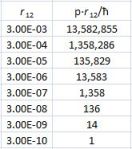
The only difference is that the 〈r2|r1〉 sort of abstracts away from time, so… Well… Let’s get a feel for the quantities. Let’s think of a photon carrying some typical amount of energy. Hence, let’s talk visible light and, therefore, photons of a few eV only – say 5.625 eV = 5.625×1.6×10−19 J = 9×10⁻¹⁹ J. Hence, their momentum is equal to p = E/c = (9×10⁻¹⁹ N·m)/(3×105 m/s) = 3×10⁻²⁴ N·s. That’s tiny but that’s only because newtons and seconds are enormous units at the (sub-)atomic scale. As for the distance, we may want to use the thickness of a playing card as a starter, as that’s what Young used when establishing the experimental fact of light interfering with itself. Now, playing cards in Young’s time were obviously rougher than those today, but let’s take the smaller distance: modern cards are as thin as 0.3 mm. Still, that distance is associated with a value of θ that is equal to 13.6 million. Hence, the density of our wavefunction is enormous at this scale, and it’s a bit of a miracle that Young could see any interference at all ! As shown in the table below, we only get meaningful values (remember: θ is a phase angle) when we go down to the nanometer scale (10−9 m) or, even better, the angstroms scale ((10−9 m). table action

So… Well… Again: what can we do with Feynman’s formula? Perhaps he didn’t give us a propagator function but something that is more general (read: more meaningful) at our (limited) level of knowledge. As I’ve been reading Feynman for quite a while now – like three or four years 🙂 – I think… Well… Yes. That’s it. Feynman wants us to think about it. 🙂 Are you joking again, Mr. Feynman? 🙂 So let’s assume the reasonable thing: let’s assume it gives us the amplitude to go from point a to point by the position vector along some path r. So, then, in line with what we wrote in our previous post, let’s say p·r (momentum over a distance) is the action (S) we’d associate with this particular path (r) and then see where we get. So let’s write the formula like this:

ψ = a·ei·θ = (1/rei·S = ei·p∙r/r

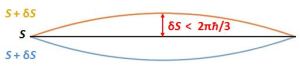
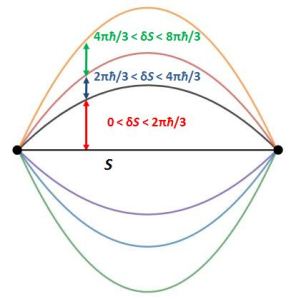
We’ll use an index to denote the various paths: r0 is the straight-line path and ri is any (other) path. Now, quantum mechanics tells us we should calculate this amplitude for every possible path. The illustration below shows the straight-line path and two nearby paths. So each of these paths is associated with some amount of action, which we measure in Planck units: θ = S/ħalternative paths

The time interval is given by = tr0/c, for all paths. Why is the time interval the same for all paths? Because we think of a photon going from some specific point in space and in time to some other specific point in space and in time. Indeed, when everything is said and done, we do think of light as traveling from point a to point at the speed of light (c). In fact, all of the weird stuff here is all about trying to explain how it does that. 🙂

Now, if we would think of the photon actually traveling along this or that path, then this implies its velocity along any of the nonlinear paths will be larger than c, which is OK. That’s just the weirdness of quantum mechanics, and you should actually not think of the photon actually traveling along one of these paths anyway although we’ll often put it that way. Think of something fuzzier, whatever that may be. 🙂

So the action is energy times time, or momentum times distance. Hence, the difference in action between two paths and j is given by:

δ= p·rj − p·ri = p·(rj − ri) = p·Δr

I’ll explain the δS < ħ/3 thing in a moment. Let’s first pause and think about the uncertainty and how we’re modeling it. We can effectively think of the variation in as some uncertainty in the action: δ= ΔS = p·Δr. However, if S is also equal to energy times time (= E·t), and we insist is the same for all paths, then we must have some uncertainty in the energy, right? Hence, we can write δas ΔS = ΔE·t. But, of course, E = E = m·c2 = p·c, so we will have an uncertainty in the momentum as well. Hence, the variation in should be written as:

δ= ΔS = Δp·Δr

That’s just logical thinking: if we, somehow, entertain the idea of a photon going from some specific point in spacetime to some other specific point in spacetime along various paths, then the variation, or uncertainty, in the action will effectively combine some uncertainty in the momentum and the distance. We can calculate Δp as ΔE/c, so we get the following:

δ= ΔS = Δp·Δr = ΔE·Δr/c = ΔE·Δt with ΔtΔr/c

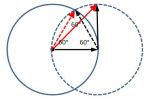
So we have the two expressions for the Uncertainty Principle here: ΔS = Δp·Δr = ΔE·Δt. Just be careful with the interpretation of Δt: it’s just the equivalent of Δr. We just express the uncertainty in distance in seconds using the (absolute) speed of light. We are not changing our spacetime interval: we’re still looking at a photon going from to in seconds, exactly. Let’s now look at the δS < ħ/3 thing. If we’re adding two amplitudes (two arrows or vectors, so to speak) and we want the magnitude of the result to be larger than the magnitude of the two contributions, then the angle between them should be smaller than 120 degrees, so that’s 2π/3 rad. The illustration below shows how you can figure that out geometrically.angles 2Hence, if S0 is the action for r0, then S1 = S0 + ħ and S2 = S0 + 2·ħ are still good, but S3 = S0 + 3·ħ is not good. Why? Because the difference in the phase angles is Δθ = S1/ħ − S0/ħ = (S0 + ħ)/ħ − S0/ħ = 1 and Δθ = S2/ħ − S0/ħ = (S0 + 2·ħ)/ħ − S0/ħ = 2 respectively, so that’s 57.3° and 114.6° respectively and that’s, effectively, less than 120°. In contrast, for the next path, we find that Δθ = S3/ħ − S0/ħ = (S0 + 3·ħ)/ħ − S0/ħ = 3, so that’s 171.9°. So that amplitude gives us a negative contribution.

Let’s do some calculations using a spreadsheet. To simplify things, we will assume we measure everything (time, distance, force, mass, energy, action,…) in Planck units. Hence, we can simply write: Sn = S0 + n. Of course, = 1, 2,… etcetera, right? Well… Maybe not. We are measuring action in units of ħ, but do we actually think action comes in units of ħ? I am not sure. It would make sense, intuitively, but… Well… There’s uncertainty on the energy (E) and the momentum (p) of our photon, right? And how accurately can we measure the distance? So there’s some randomness everywhere. 😦 So let’s leave that question open as for now.

We will also assume that the phase angle for S0 is equal to 0 (or some multiple of 2π, if you want). That’s just a matter of choosing the origin of time. This makes it really easy: ΔSn = Sn − S0 = n, and the associated phase angle θn = Δθn is the same. In short, the amplitude for each path reduces to ψn = ei·n/r0. So we need to add these first and then calculate the magnitude, which we can then square to get a probability. Of course, there is also the issue of normalization (probabilities have to add up to one) but let’s tackle that later. For the calculations, we use Euler’s r·ei·θ = r·(cosθ + i·sinθ) = r·cosθ + i·r·sinθ formula. Needless to say, |r·ei·θ|2 = |r|2·|ei·θ|2 = |r|2·(cos2θ + sin2θ) = r. Finally, when adding complex numbers, we add the real and imaginary parts respectively, and we’ll denote the ψ0 + ψ1 +ψ2 + … sum as Ψ.

Now, we also need to see how our ΔS = Δp·Δr works out. We may want to assume that the uncertainty in p and in r will both be proportional to the overall uncertainty in the action. For example, we could try writing the following: ΔSn = Δpn·Δrn = n·Δp1·Δr1. It also makes sense that you may want Δpn and Δrn to be proportional to Δp1 and Δr1 respectively. Combining both, the assumption would be this:

Δpn = √n·Δpand Δrn = √n·Δr1

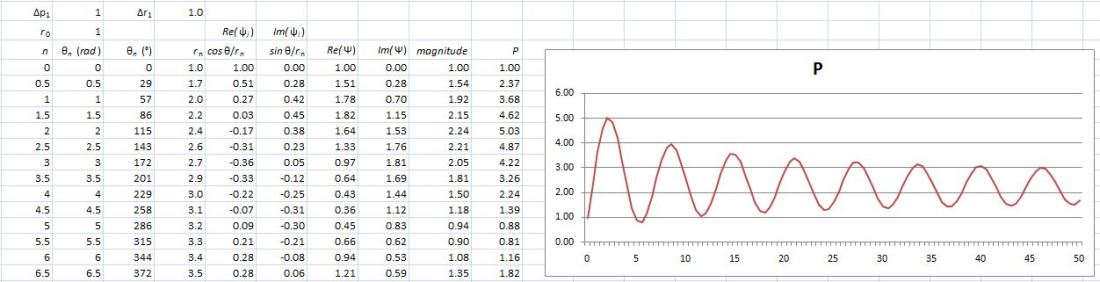
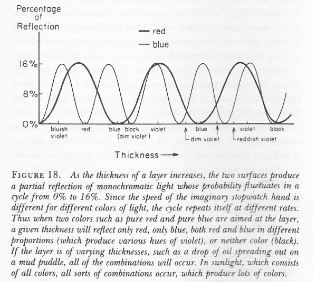
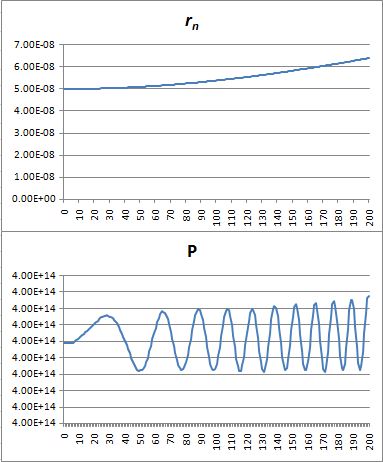
So now we just need to decide how we will distribute ΔS1 = ħ = 1 over Δp1 and Δr1 respectively. For example, if we’d assume Δp1 = 1, then Δr1 = ħ/Δp1 = 1/1 = 1. These are the calculations. I will let you analyze them. 🙂newnewWell… We get a weird result. It reminds me of Feynman’s explanation of the partial reflection of light, shown below, but… Well… That doesn’t make much sense, does it?

partial reflection

Hmm… Maybe it does. 🙂 Look at the graph more carefully. The peaks sort of oscillate out so… Well… That might make sense… 🙂

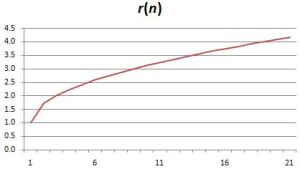
Does it? Are we doing something wrong here? These amplitudes should reflect the ones that are reflected in those nice animations (like this one, for example, which is part of that’s part of the Wikipedia article on Feynman’s path integral formulation of quantum mechanics). So what’s wrong, if anything? Well… Our paths differ by some fixed amount of action, which doesn’t quite reflect the geometric approach that’s used in those animations. The graph below shows how the distance varies as a function of ngeometry

If we’d use a model in which the distance would increase linearly or, preferably, exponentially, then we’d get the result we want to get, right?

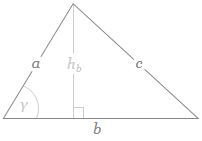
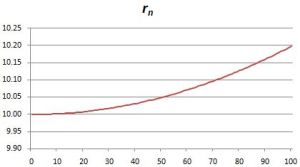
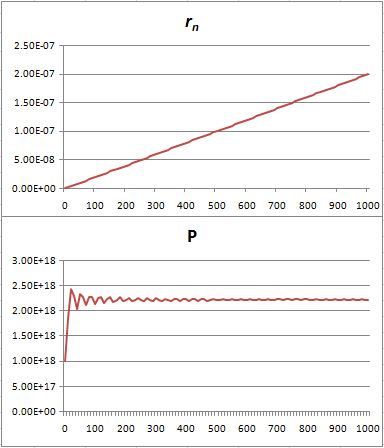
Well… Maybe. Let’s try it. Hmm… We need to think about the geometry here. Look at the triangle below. triangle sideIf is the straight-line path (r0), then ac could be one of the crooked paths (rn). To simplify, we’ll assume isosceles triangles, so equals c and, hence, rn = 2·a = 2·c. We will also assume the successive paths are separated by the same vertical distance (h = h1) right in the middle, so hb = hn = n·h1. It is then easy to show the following:r formulaThis gives the following graph for rn = 10 and h= 0.01.r graph

Is this the right step increase? Not sure. We can vary the values in our spreadsheet. Let’s first build it. The photon will have to travel faster in order to cover the extra distance in the same time, so its momentum will be higher. Let’s think about the velocity. Let’s start with the first path (= 1). In order to cover the extra distance Δr1, the velocity c1 must be equal to (r0 + Δr1)/= r0/+ Δr1/t = + Δr1/= c0 + Δr1/t. We can write c1 as c1 = c0 + Δc1, so Δc1 = Δr1/t. Now, the ratio of p1  and p0 will be equal to the ratio of c1 and c0 because p1/p= (mc1)/mc0) = c1/c0. Hence, we have the following formula for p1:

p1 = p0·c1/c0 = p0·(c0 + Δc1)/c0 = p0·[1 + Δr1/(c0·t) = p0·(1 + Δr1/r0)

For pn, the logic is the same, so we write:

pn = p0·cn/c0 = p0·(c0 + Δcn)/c0 = p0·[1 + Δrn/(c0·t) = p0·(1 + Δrn/r0)

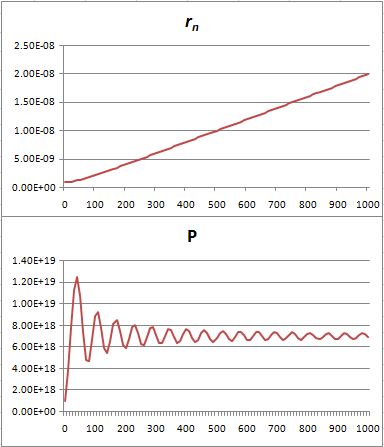
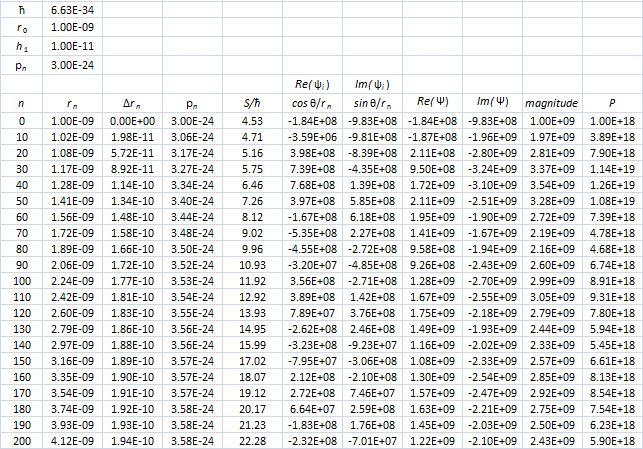
Let’s do the calculations, and let’s use meaningful values, so the nanometer scale and actual values for Planck’s constant and the photon momentum. The results are shown below. original

Pretty interesting. In fact, this looks really good. The probability first swings around wildly, because of these zones of constructive and destructive interference, but then stabilizes. [Of course, I would need to normalize the probabilities, but you get the idea, right?] So… Well… I think we get a very meaningful result with this model. Sweet ! 🙂 I’m lovin’ it ! 🙂 And, here you go, this is (part of) the calculation table, so you can see what I am doing. 🙂newnew

The graphs below look even better: I just changed the h1/r0 ratio from 1/100 to 1/10. The probability stabilizes almost immediately. 🙂 So… Well… It’s not as fancy as the referenced animation, but I think the educational value of this thing here is at least as good ! 🙂great

🙂 This is good stuff… 🙂

Post scriptum (19 September 2017): There is an obvious inconsistency in the model above, and in the calculations. We assume there is a path r1 = , r2, r2,etcetera, and then we calculate the action for it, and the amplitude, and then we add the amplitude to the sum. But, surely, we should count these paths twice, in two-dimensional space, that is. Think of the graph: we have positive and negative interference zones that are sort of layered around the straight-line path, as shown below.zones

In three-dimensional space, these lines become surfaces. Hence, rather than adding one arrow for every δ  having one contribution only, we may want to add… Well… In three-dimensional space, the formula for the surface around the straight-line path would probably look like π·hn·r1, right? Hmm… Interesting idea. I changed my spreadsheet to incorporate that idea, and I got the graph below. It’s a nonsensical result, because the probability does swing around, but it gradually spins out of control: it never stabilizes.revisedThat’s because we increase the weight of the paths that are further removed from the center. So… Well… We shouldn’t be doing that, I guess. 🙂 I’ll you look for the right formula, OK? Let me know when you found it. 🙂

Some content on this page was disabled on June 16, 2020 as a result of a DMCA takedown notice from The California Institute of Technology. You can learn more about the DMCA here:

https://wordpress.com/support/copyright-and-the-dmca/

Some thoughts on the nature of reality

Pre-script (dated 26 June 2020): This post got mutilated by the removal of some material by the dark force. You should be able to follow the main story line, however. If anything, the lack of illustrations might actually help you to think things through for yourself. In any case, we now have different views on these concepts as part of our realist interpretation of quantum mechanics, so we recommend you read our recent papers instead of these old blog posts.

Original post:

Some other comment on an article on my other blog, inspired me to structure some thoughts that are spread over various blog posts. What follows below, is probably the first draft of an article or a paper I plan to write. Or, who knows, I might re-write my two introductory books on quantum physics and publish a new edition soon. 🙂

Physical dimensions and Uncertainty

The physical dimension of the quantum of action (h or ħ = h/2π) is force (expressed in newton) times distance (expressed in meter) times time (expressed in seconds): N·m·s. Now, you may think this N·m·s dimension is kinda hard to imagine. We can imagine its individual components, right? Force, distance and time. We know what they are. But the product of all three? What is it, really?

It shouldn’t be all that hard to imagine what it might be, right? The N·m·s unit is also the unit in which angular momentum is expressed – and you can sort of imagine what that is, right? Think of a spinning top, or a gyroscope. We may also think of the following:

  1. [h] = N·m·s = (N·m)·s = [E]·[t]
  2. [h] = N·m·s = (N·s)·m = [p]·[x]

Hence, the physical dimension of action is that of energy (E) multiplied by time (t) or, alternatively, that of momentum (p) times distance (x). To be precise, the second dimensional equation should be written as [h] = [p]·[x], because both the momentum and the distance traveled will be associated with some direction. It’s a moot point for the discussion at the moment, though. Let’s think about the first equation first: [h] = [E]·[t]. What does it mean?

Energy… Hmm… In real life, we are usually not interested in the energy of a system as such, but by the energy it can deliver, or absorb, per second. This is referred to as the power of a system, and it’s expressed in J/s, or watt. Power is also defined as the (time) rate at which work is done. Hmm… But so here we’re multiplying energy and time. So what’s that? After Hiroshima and Nagasaki, we can sort of imagine the energy of an atomic bomb. We can also sort of imagine the power that’s being released by the Sun in light and other forms of radiation, which is about 385×1024 joule per second. But energy times time? What’s that?

I am not sure. If we think of the Sun as a huge reservoir of energy, then the physical dimension of action is just like having that reservoir of energy guaranteed for some time, regardless of how fast or how slow we use it. So, in short, it’s just like the Sun – or the Earth, or the Moon, or whatever object – just being there, for some definite amount of time. So, yes: some definite amount of mass or energy (E) for some definite amount of time (t).

Let’s bring the mass-energy equivalence formula in here: E = mc2. Hence, the physical dimension of action can also be written as [h] = [E]·[t] = [mc]2·[t] = (kg·m2/s2)·s = kg·m2/s. What does that say? Not all that much – for the time being, at least. We can get this [h] = kg·m2/s through some other substitution as well. A force of one newton will give a mass of 1 kg an acceleration of 1 m/s per second. Therefore, 1 N = 1 kg·m/s2 and, hence, the physical dimension of h, or the unit of angular momentum, may also be written as 1 N·m·s = 1 (kg·m/s2)·m·s = 1 kg·m2/s, i.e. the product of mass, velocity and distance.

Hmm… What can we do with that? Nothing much for the moment: our first reading of it is just that it reminds us of the definition of angular momentum – some mass with some velocity rotating around an axis. What about the distance? Oh… The distance here is just the distance from the axis, right? Right. But… Well… It’s like having some amount of linear momentum available over some distance – or in some space, right? That’s sufficiently significant as an interpretation for the moment, I’d think…

Fundamental units

This makes one think about what units would be fundamental – and what units we’d consider as being derived. Formally, the newton is a derived unit in the metric system, as opposed to the units of mass, length and time (kg, m, s). Nevertheless, I personally like to think of force as being fundamental:  a force is what causes an object to deviate from its straight trajectory in spacetime. Hence, we may want to think of the quantum of action as representing three fundamental physical dimensions: (1) force, (2) time and (3) distance – or space. We may then look at energy and (linear) momentum as physical quantities combining (1) force and distance and (2) force and time respectively.

Let me write this out:

  1. Force times length (think of a force that is acting on some object over some distance) is energy: 1 joule (J) = 1 newton·meter (N). Hence, we may think of the concept of energy as a projection of action in space only: we make abstraction of time. The physical dimension of the quantum of action should then be written as [h] = [E]·[t]. [Note the square brackets tell us we are looking at a dimensional equation only, so [t] is just the physical dimension of the time variable. It’s a bit confusing because I also use square brackets as parentheses.]
  2. Conversely, the magnitude of linear momentum (p = m·v) is expressed in newton·seconds: 1 kg·m/s = 1 (kg·m/s2)·s = 1 N·s. Hence, we may think of (linear) momentum as a projection of action in time only: we make abstraction of its spatial dimension. Think of a force that is acting on some object during some time. The physical dimension of the quantum of action should then be written as [h] = [p]·[x]

Of course, a force that is acting on some object during some time, will usually also act on the same object over some distance but… Well… Just try, for once, to make abstraction of one of the two dimensions here: time or distance.

It is a difficult thing to do because, when everything is said and done, we don’t live in space or in time alone, but in spacetime and, hence, such abstractions are not easy. [Of course, now you’ll say that it’s easy to think of something that moves in time only: an object that is standing still does just that – but then we know movement is relative, so there is no such thing as an object that is standing still in space in an absolute sense: Hence, objects never stand still in spacetime.] In any case, we should try such abstractions, if only because of the principle of least action is so essential and deep in physics:

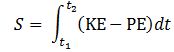
  1. In classical physics, the path of some object in a force field will minimize the total action (which is usually written as S) along that path.
  2. In quantum mechanics, the same action integral will give us various values S – each corresponding to a particular path – and each path (and, therefore, each value of S, really) will be associated with a probability amplitude that will be proportional to some constant times e−i·θ = ei·(S/ħ). Because ħ is so tiny, even a small change in S will give a completely different phase angle θ. Therefore, most amplitudes will cancel each other out as we take the sum of the amplitudes over all possible paths: only the paths that nearly give the same phase matter. In practice, these are the paths that are associated with a variation in S of an order of magnitude that is equal to ħ.

The paragraph above summarizes, in essence, Feynman’s path integral formulation of quantum mechanics. We may, therefore, think of the quantum of action expressing itself (1) in time only, (2) in space only, or – much more likely – (3) expressing itself in both dimensions at the same time. Hence, if the quantum of action gives us the order of magnitude of the uncertainty – think of writing something like S ± ħ, we may re-write our dimensional [ħ] = [E]·[t] and [ħ] = [p]·[x] equations as the uncertainty equations:

  • ΔE·Δt = ħ 
  • Δp·Δx = ħ

You should note here that it is best to think of the uncertainty relations as a pair of equations, if only because you should also think of the concept of energy and momentum as representing different aspects of the same reality, as evidenced by the (relativistic) energy-momentum relation (E2 = p2c2 – m02c4). Also, as illustrated below, the actual path – or, to be more precise, what we might associate with the concept of the actual path – is likely to be some mix of Δx and Δt. If Δt is very small, then Δx will be very large. In order to move over such distance, our particle will require a larger energy, so ΔE will be large. Likewise, if Δt is very large, then Δx will be very small and, therefore, ΔE will be very small. You can also reason in terms of Δx, and talk about momentum rather than energy. You will arrive at the same conclusions: the ΔE·Δt = h and Δp·Δx = relations represent two aspects of the same reality – or, at the very least, what we might think of as reality.

Uncertainty

Also think of the following: if ΔE·Δt = and Δp·Δx = h, then ΔE·Δt = Δp·Δx and, therefore, ΔE/Δp must be equal to Δx/Δt. Hence, the ratio of the uncertainty about x (the distance) and the uncertainty about t (the time) equals the ratio of the uncertainty about E (the energy) and the uncertainty about p (the momentum).

Of course, you will note that the actual uncertainty relations have a factor 1/2 in them. This may be explained by thinking of both negative as well as positive variations in space and in time.

We will obviously want to do some more thinking about those physical dimensions. The idea of a force implies the idea of some object – of some mass on which the force is acting. Hence, let’s think about the concept of mass now. But… Well… Mass and energy are supposed to be equivalent, right? So let’s look at the concept of energy too.

Action, energy and mass

What is energy, really? In real life, we are usually not interested in the energy of a system as such, but by the energy it can deliver, or absorb, per second. This is referred to as the power of a system, and it’s expressed in J/s. However, in physics, we always talk energy – not power – so… Well… What is the energy of a system?

According to the de Broglie and Einstein – and so many other eminent physicists, of course – we should not only think of the kinetic energy of its parts, but also of their potential energy, and their rest energy, and – for an atomic system – we may add some internal energy, which may be binding energy, or excitation energy (think of a hydrogen atom in an excited state, for example). A lot of stuff. 🙂 But, obviously, Einstein’s mass-equivalence formula comes to mind here, and summarizes it all:

E = m·c2

The m in this formula refers to mass – not to meter, obviously. Stupid remark, of course… But… Well… What is energy, really? What is mass, really? What’s that equivalence between mass and energy, really?

I don’t have the definite answer to that question (otherwise I’d be famous), but… Well… I do think physicists and mathematicians should invest more in exploring some basic intuitions here. As I explained in several posts, it is very tempting to think of energy as some kind of two-dimensional oscillation of mass. A force over some distance will cause a mass to accelerate. This is reflected in the dimensional analysis:

[E] = [m]·[c2] = 1 kg·m2/s2 = 1 kg·m/s2·m = 1 N·m

The kg and m/sfactors make this abundantly clear: m/s2 is the physical dimension of acceleration: (the change in) velocity per time unit.

Other formulas now come to mind, such as the Planck-Einstein relation: E = h·f = ω·ħ. We could also write: E = h/T. Needless to say, T = 1/f is the period of the oscillation. So we could say, for example, that the energy of some particle times the period of the oscillation gives us Planck’s constant again. What does that mean? Perhaps it’s easier to think of it the other way around: E/f = h = 6.626070040(81)×10−34 J·s. Now, is the number of oscillations per second. Let’s write it as = n/s, so we get:

E/= E/(n/s) = E·s/n = 6.626070040(81)×10−34 J·s ⇔ E/= 6.626070040(81)×10−34 J

What an amazing result! Our wavicle – be it a photon or a matter-particle – will always pack 6.626070040(81)×10−34 joule in one oscillation, so that’s the numerical value of Planck’s constant which, of course, depends on our fundamental units (i.e. kg, meter, second, etcetera in the SI system).

Of course, the obvious question is: what’s one oscillation? If it’s a wave packet, the oscillations may not have the same amplitude, and we may also not be able to define an exact period. In fact, we should expect the amplitude and duration of each oscillation to be slightly different, shouldn’t we? And then…

Well… What’s an oscillation? We’re used to counting them: oscillations per second, so that’s per time unit. How many do we have in total? We wrote about that in our posts on the shape and size of a photon. We know photons are emitted by atomic oscillators – or, to put it simply, just atoms going from one energy level to another. Feynman calculated the Q of these atomic oscillators: it’s of the order of 10(see his Lectures, I-33-3: it’s a wonderfully simple exercise, and one that really shows his greatness as a physics teacher), so… Well… This wave train will last about 10–8 seconds (that’s the time it takes for the radiation to die out by a factor 1/e). To give a somewhat more precise example, for sodium light, which has a frequency of 500 THz (500×1012 oscillations per second) and a wavelength of 600 nm (600×10–9 meter), the radiation will lasts about 3.2×10⁻⁸ seconds. [In fact, that’s the time it takes for the radiation’s energy to die out by a factor 1/e, so(i.e. the so-called decay time τ), so the wavetrain will actually last longer, but so the amplitude becomes quite small after that time.] So… Well… That’s a very short time but… Still, taking into account the rather spectacular frequency (500 THz) of sodium light, that makes for some 16 million oscillations and, taking into the account the rather spectacular speed of light (3×10m/s), that makes for a wave train with a length of, roughly, 9.6 meter. Huh? 9.6 meter!? But a photon is supposed to be pointlike, isn’it it? It has no length, does it?

That’s where relativity helps us out: as I wrote in one of my posts, relativistic length contraction may explain the apparent paradox. Using the reference frame of the photon – so if we’d be traveling at speed c,’ riding’ with the photon, so to say, as it’s being emitted – then we’d ‘see’ the electromagnetic transient as it’s being radiated into space.

However, while we can associate some mass with the energy of the photon, none of what I wrote above explains what the (rest) mass of a matter-particle could possibly be. There is no real answer to that, I guess. You’ll think of the Higgs field now but… Then… Well. The Higgs field is a scalar field. Very simple: some number that’s associated with some position in spacetime. That doesn’t explain very much, does it? 😦 When everything is said and done, the scientists who, in 2013 only, got the Nobel Price for their theory on the Higgs mechanism, simply tell us mass is some number. That’s something we knew already, right? 🙂

The reality of the wavefunction

The wavefunction is, obviously, a mathematical construct: a description of reality using a very specific language. What language? Mathematics, of course! Math may not be universal (aliens might not be able to decipher our mathematical models) but it’s pretty good as a global tool of communication, at least.

The real question is: is the description accurate? Does it match reality and, if it does, how good is the match? For example, the wavefunction for an electron in a hydrogen atom looks as follows:

ψ(r, t) = ei·(E/ħ)·t·f(r)

As I explained in previous posts (see, for example, my recent post on reality and perception), the f(r) function basically provides some envelope for the two-dimensional ei·θ = ei·(E/ħ)·t = cosθ + i·sinθ oscillation, with r = (x, y, z), θ = (E/ħ)·t = ω·t and ω = E/ħ. So it presumes the duration of each oscillation is some constant. Why? Well… Look at the formula: this thing has a constant frequency in time. It’s only the amplitude that is varying as a function of the r = (x, y, z) coordinates. 🙂 So… Well… If each oscillation is to always pack 6.626070040(81)×10−34 joule, but the amplitude of the oscillation varies from point to point, then… Well… We’ve got a problem. The wavefunction above is likely to be an approximation of reality only. 🙂 The associated energy is the same, but… Well… Reality is probably not the nice geometrical shape we associate with those wavefunctions.

In addition, we should think of the Uncertainty Principle: there must be some uncertainty in the energy of the photons when our hydrogen atom makes a transition from one energy level to another. But then… Well… If our photon packs something like 16 million oscillations, and the order of magnitude of the uncertainty is only of the order of h (or ħ = h/2π) which, as mentioned above, is the (average) energy of one oscillation only, then we don’t have much of a problem here, do we? 🙂

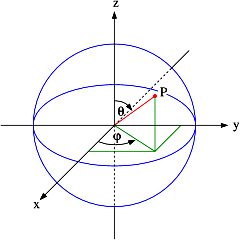
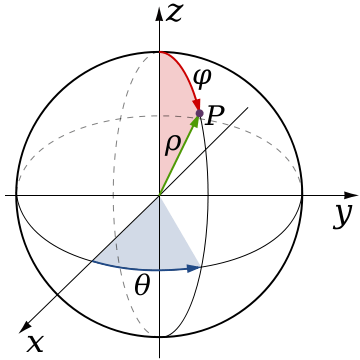
Post scriptum: In previous posts, we offered some analogies – or metaphors – to a two-dimensional oscillation (remember the V-2 engine?). Perhaps it’s all relatively simple. If we have some tiny little ball of mass – and its center of mass has to stay where it is – then any rotation – around any axis – will be some combination of a rotation around our x- and z-axis – as shown below. Two axes only. So we may want to think of a two-dimensional oscillation as an oscillation of the polar and azimuthal angle. 🙂

oscillation of a ball

Thinking again…

Pre-script (dated 26 June 2020): This post got mutilated by the removal of some material by the dark force. You should be able to follow the main story line, however. If anything, the lack of illustrations might actually help you to think things through for yourself. In any case, we now have different views on these concepts as part of our realist interpretation of quantum mechanics, so we recommend you read our recent papers instead of these old blog posts.

Original post:

One of the comments on my other blog made me think I should, perhaps, write something on waves again. The animation below shows the elementary wavefunction ψ = a·eiθ = ψ = a·ei·θ  = a·ei(ω·t−k·x) = a·e(i/ħ)·(E·t−p·x) .AnimationWe know this elementary wavefunction cannot represent a real-life particle. Indeed, the a·ei·θ function implies the probability of finding the particle – an electron, a photon, or whatever – would be equal to P(x, t) = |ψ(x, t)|2 = |a·e(i/ħ)·(E·t−p·x)|2 = |a|2·|e(i/ħ)·(E·t−p·x)|2 = |a|2·12= a2 everywhere. Hence, the particle would be everywhere – and, therefore, nowhere really. We need to localize the wave – or build a wave packet. We can do so by introducing uncertainty: we then add a potentially infinite number of these elementary wavefunctions with slightly different values for E and p, and various amplitudes a. Each of these amplitudes will then reflect the contribution to the composite wave, which – in three-dimensional space – we can write as:

ψ(r, t) = ei·(E/ħ)·t·f(r)

As I explained in previous posts (see, for example, my recent post on reality and perception), the f(r) function basically provides some envelope for the two-dimensional ei·θ = ei·(E/ħ)·t = cosθ + i·sinθ oscillation, with r = (x, y, z), θ = (E/ħ)·t = ω·t and ω = E/ħ.

Note that it looks like the wave propagates from left to right – in the positive direction of an axis which we may refer to as the x-axis. Also note this perception results from the fact that, naturally, we’d associate time with the rotation of that arrow at the center – i.e. with the motion in the illustration, while the spatial dimensions are just what they are: linear spatial dimensions. [This point is, perhaps, somewhat less self-evident than you may think at first.]

Now, the axis which points upwards is usually referred to as the z-axis, and the third and final axis – which points towards us – would then be the y-axis, obviously. Unfortunately, this definition would violate the so-called right-hand rule for defining a proper reference frame: the figures below shows the two possibilities – a left-handed and a right-handed reference frame – and it’s the right-handed reference (i.e. the illustration on the right) which we have to use in order to correctly define all directions, including the direction of rotation of the argument of the wavefunction.400px-Cartesian_coordinate_system_handednessHence, if we don’t change the direction of the y– and z-axes – so we keep defining the z-axis as the axis pointing upwards, and the y-axis as the axis pointing towards us – then the positive direction of the x-axis would actually be the direction from right to left, and we should say that the elementary wavefunction in the animation above seems to propagate in the negative x-direction. [Note that this left- or right-hand rule is quite astonishing: simply swapping the direction of one axis of a left-handed frame makes it right-handed, and vice versa.]

Note my language when I talk about the direction of propagation of our wave. I wrote: it looks like, or it seems to go in this or that direction. And I mean that: there is no real traveling here. At this point, you may want to review a post I wrote for my son, which explains the basic math behind waves, and in which I also explained the animation below.

wave_opposite-group-phase-velocity

Note how the peaks and troughs of this pulse seem to move leftwards, but the wave packet (or the group or the envelope of the wave—whatever you want to call it) moves to the right. The point is: the pulse itself doesn’t travel left or right. Think of the horizontal axis in the illustration above as an oscillating guitar string: each point on the string just moves up and down. Likewise, if our repeated pulse would represent a physical wave in water, for example, then the water just stays where it is: it just moves up and down. Likewise, if we shake up some rope, the rope is not going anywhere: we just started some motion that is traveling down the rope. In other words, the phase velocity is just a mathematical concept. The peaks and troughs that seem to be traveling are just mathematical points that are ‘traveling’ left or right. That’s why there’s no limit on the phase velocity: it can – and, according to quantum mechanics, actually will – exceed the speed of light. In contrast, the group velocity – which is the actual speed of the particle that is being represented by the wavefunction – may approach – or, in the case of a massless photon, will actually equal – the speed of light, but will never exceed it, and its direction will, obviously, have a physical significance as it is, effectively, the direction of travel of our particle – be it an electron, a photon (electromagnetic radiation), or whatever.

Hence, you should not think the spin of a particle – integer or half-integer – is somehow related to the direction of rotation of the argument of the elementary wavefunction. It isn’t: Nature doesn’t give a damn about our mathematical conventions, and that’s what the direction of rotation of the argument of that wavefunction is: just some mathematical convention. That’s why we write a·ei(ω·t−k·x) rather than a·ei(ω·t+k·x) or a·ei(ω·t−k·x): it’s just because of the right-hand rule for coordinate frames, and also because Euler defined the counter-clockwise direction as the positive direction of an angle. There’s nothing more to it.

OK. That’s obvious. Let me now return to my interpretation of Einstein’s E = m·c2 formula (see my previous posts on this). I noted that, in the reference frame of the particle itself (see my basics page), the elementary wavefunction a·e(i/ħ)·(E·t−p·x) reduces to a·e(i/ħ)·(E’·t’): the origin of the reference frame then coincides with (the center of) our particle itself, and the wavefunction only varies with the time in the inertial reference frame (i.e. the proper time t’), with the rest energy of the object (E’) as the time scale factor. How should we interpret this?

Well… Energy is force times distance, and force is defined as that what causes some mass to accelerate. To be precise, the newton – as the unit of force – is defined as the magnitude of a force which would cause a mass of one kg to accelerate with one meter per second per second. Per second per second. This is not a typo: 1 N corresponds to 1 kg times 1 m/s per second, i.e. 1 kg·m/s2. So… Because energy is force times distance, the unit of energy may be expressed in units of kg·m/s2·m, or kg·m2/s2, i.e. the unit of mass times the unit of velocity squared. To sum it all up:

1 J = 1 N·m = 1 kg·(m/s)2

This reflects the physical dimensions on both sides of the E = m·c2 formula again but… Well… How should we interpret this? Look at the animation below once more, and imagine the green dot is some tiny mass moving around the origin, in an equally tiny circle. We’ve got two oscillations here: each packing half of the total energy of… Well… Whatever it is that our elementary wavefunction might represent in reality – which we don’t know, of course.

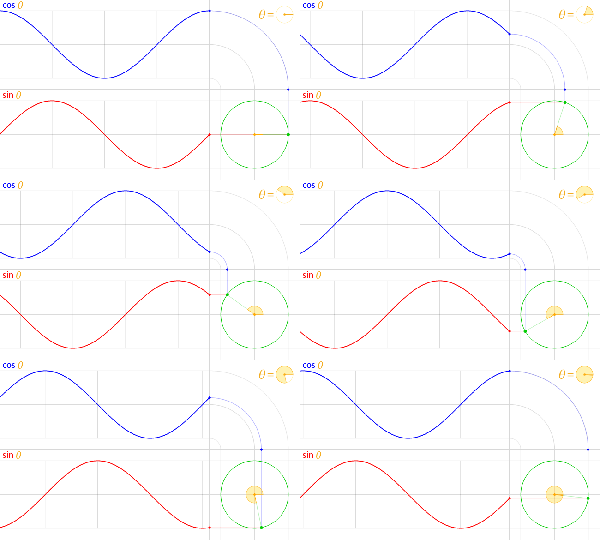
circle_cos_sin

Now, the blue and the red dot – i.e. the horizontal and vertical projection of the green dot – accelerate up and down. If we look carefully, we see these dots accelerate towards the zero point and, once they’ve crossed it, they decelerate, so as to allow for a reversal of direction: the blue dot goes up, and then down. Likewise, the red dot does the same. The interplay between the two oscillations, because of the 90° phase difference, is interesting: if the blue dot is at maximum speed (near or at the origin), the red dot reverses speed (its speed is, therefore, (almost) nil), and vice versa. The metaphor of our frictionless V-2 engine, our perpetuum mobile, comes to mind once more.

The question is: what’s going on, really?

My answer is: I don’t know. I do think that, somehow, energy should be thought of as some two-dimensional oscillation of something – something which we refer to as mass, but we didn’t define mass very clearly either. It also, somehow, combines linear and rotational motion. Each of the two dimensions packs half of the energy of the particle that is being represented by our wavefunction. It is, therefore, only logical that the physical unit of both is to be expressed as a force over some distance – which is, effectively, the physical dimension of energy – or the rotational equivalent of them: torque over some angle. Indeed, the analogy between linear and angular movement is obvious: the kinetic energy of a rotating object is equal to K.E. = (1/2)·I·ω2. In this formula, I is the rotational inertia – i.e. the rotational equivalent of mass – and ω is the angular velocity – i.e. the rotational equivalent of linear velocity. Noting that the (average) kinetic energy in any system must be equal to the (average) potential energy in the system, we can add both, so we get a formula which is structurally similar to the E = m·c2 formula. But is it the same? Is the effective mass of some object the sum of an almost infinite number of quanta that incorporate some kind of rotational motion? And – if we use the right units – is the angular velocity of these infinitesimally small rotations effectively equal to the speed of light?

I am not sure. Not at all, really. But, so far, I can’t think of any explanation of the wavefunction that would make more sense than this one. I just need to keep trying to find better ways to articulate or imagine what might be going on. 🙂 In this regard, I’d like to add a point – which may or may not be relevant. When I talked about that guitar string, or the water wave, and wrote that each point on the string – or each water drop – just moves up and down, we should think of the physicality of the situation: when the string oscillates, its length increases. So it’s only because our string is flexible that it can vibrate between the fixed points at its ends. For a rope that’s not flexible, the end points would need to move in and out with the oscillation. Look at the illustration below, for example: the two kids who are holding rope must come closer to each other, so as to provide the necessary space inside of the oscillation for the other kid. 🙂kid in a ropeThe next illustration – of how water waves actually propagate – is, perhaps, more relevant. Just think of a two-dimensional equivalent – and of the two oscillations as being transverse waves, as opposed to longitudinal. See how string theory starts making sense? 🙂

rayleighwaveThe most fundamental question remains the same: what is it, exactly, that is oscillating here? What is the field? It’s always some force on some charge – but what charge, exactly? Mass? What is it? Well… I don’t have the answer to that. It’s the same as asking: what is electric charge, really? So the question is: what’s the reality of mass, of electric charge, or whatever other charge that causes a force to act on it?

If you know, please let me know. 🙂

Post scriptum: The fact that we’re talking some two-dimensional oscillation here – think of a surface now – explains the probability formula: we need to square the absolute value of the amplitude to get it. And normalize, of course. Also note that, when normalizing, we’d expect to get some factor involving π somewhere, because we’re talking some circular surface – as opposed to a rectangular one. But I’ll let you figure that out. 🙂

An introduction to virtual particles (2)

Pre-script (dated 26 June 2020): Our ideas have evolved into a full-blown realistic (or classical) interpretation of all things quantum-mechanical. In addition, I note the dark force has amused himself by removing some material. So no use to read this. Read my recent papers instead. 🙂

Original post:

When reading quantum mechanics, it often feels like the more you know, the less you understand. My reading of the Yukawa theory of force, as an exchange of virtual particles (see my previous post), must have left you with many questions. Questions I can’t answer because… Well… I feel as much as a fool as you do when thinking about it all. Yukawa first talks about some potential – which we usually think of as being some scalar function – and then suddenly this potential becomes a wavefunction. Does that make sense? And think of the mass of that ‘virtual’ particle: the rest mass of a neutral pion is about 135 MeV. That’s an awful lot – at the (sub-)atomic scale that is: it’s equivalent to the rest mass of some 265 electrons!

But… Well… Think of it: the use of a static potential when solving Schrödinger’s equation for the electron orbitals around a hydrogen nucleus (a proton, basically) also raises lots of questions: if we think of our electron as a point-like particle being first here and then there, then that’s also not very consistent with a static (scalar) potential either!

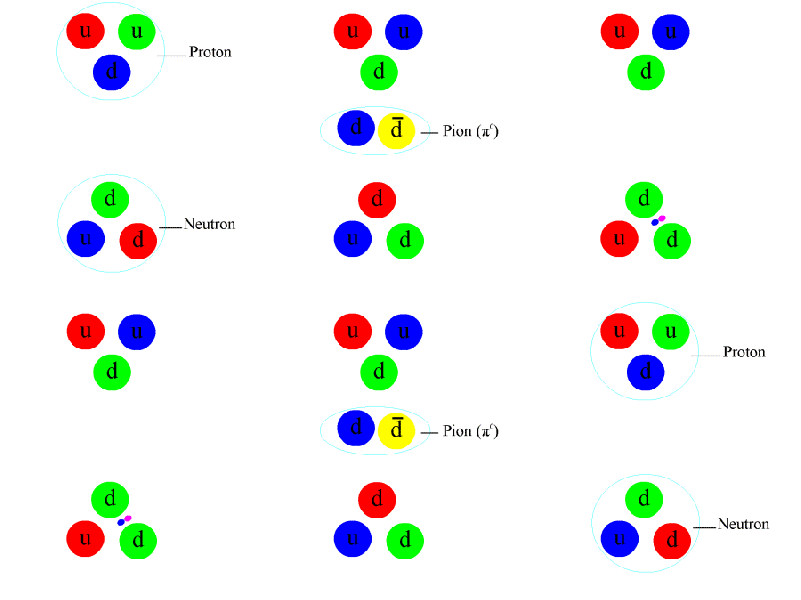
One of the weirdest aspects of the Yukawa theory is that these emissions and absorptions of virtual particles violate the energy conservation principle. Look at the animation once again (below): it sort of assumes a rather heavy particle – consisting of a d- or u-quark and its antiparticle – is emitted – out of nothing, it seems – to then vanish as the antiparticle is destroyed when absorbed. What about the energy balance here: are we talking six quarks (the proton and the neutron), or six plus two?Nuclear_Force_anim_smallerNow that we’re talking mass, note a neutral pion (π0) may either be a uū or a dđ combination, and that the mass of a u-quark and a d-quark is only 2.4 and 4.8 MeV – so the binding energy of the constituent parts of this πparticle is enormous: it accounts for most of its mass.

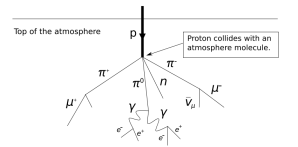
The thing is… While we’ve presented the πparticle as a virtual particle here, you should also note we find πparticles in cosmic rays. Cosmic rays are particle rays, really: beams of highly energetic particles. Quite a bunch of them are just protons that are being ejected by our Sun. [The Sun also ejects electrons – as you might imagine – but let’s think about the protons here first.] When these protons hit an atom or a molecule in our atmosphere, they usually break up in various particles, including our πparticle, as shown below. 850px-Atmospheric_Collision


So… Well… How can we relate these things? What is going on, really, inside of that nucleus?

Well… I am not sure. Aitchison and Hey do their utmost to try to explain the pion – as a virtual particle, that is – in terms of energy fluctuations that obey the Uncertainty Principle for energy and time: ΔE·Δt ≥ ħ/2. Now, I find such explanations difficult to follow. Such explanations usually assume any measurement instrument – measuring energy, time, momentum of distance – measures those variables on some discrete scale, which implies some uncertainty indeed. But that uncertainty is more like an imprecision, in my view. Not something fundamental. Let me quote Aitchison and Hey:

“Suppose a device is set up capable of checking to see whether energy is, in fact, conserved while the pion crosses over.. The crossing time Δt must be at least r/c, where r is the distance apart of the nucleons. Hence, the device must be capable of operating on a time scale smaller than Δt to be able to detect the pion, but it need not be very much less than this. Thus the energy uncertainty in the reading by the device will be of the order ΔE ∼ ħ/Δt) = ħ·(c/r).”

As said, I find such explanations really difficult, although I can sort of sense some of the implicit assumptions. As I mentioned a couple of times already, the E = m·c2 equation tells us energy is mass in motion, somehow: some weird two-dimensional oscillation in spacetime. So, yes, we can appreciate we need some time unit to count the oscillations – or, equally important, to measure their amplitude.

[…] But… Well… This falls short of a more fundamental explanation of what’s going on. I like to think of Uncertainty in terms of Planck’s constant itself: ħ or h or – as you’ll usually see it – as half of that value: ħ/2. [The Stern-Gerlach experiment implies it’s ħ/2, rather than h/2 or ħ or h itself.] The physical dimension of Planck’s constant is action: newton times distance times time. I also like to think action can express itself in two ways: as (1) some amount of energy (ΔE: some force of some distance) over some time (Δt) or, else, as (2) some momentum (Δp: some force during some time) over some distance (Δs). Now, if we equate ΔE with the energy of the pion (135 MeV), then we may calculate the order of magnitude of Δt from ΔE·Δt ≥ ħ/2 as follows:

 Δt = (ħ/2)/(135 MeV) ≈ (3.291×10⁻¹⁶ eV·s)/(134.977×10eV) ≈ 0.02438×10⁻²² s

Now, that’s an unimaginably small time unit – but much and much larger than the Planck time (the Planck time unit is about 5.39 × 10−44 s). The corresponding distance is equal to = Δt·c = (0.02438×10⁻²² s)·(2.998×10m/s) ≈ 0.0731×10⁻¹⁴ m = 0.731 fm. So… Well… Yes. We got the answer we wanted… So… Well… We should be happy about that but…

Well… I am not. I don’t like this indeterminacy. This randomness in the approach. For starters, I am very puzzled by the fact that the lifetime of the actual πparticle we see in the debris of proton collisions with other particles as cosmic rays enter the atmosphere is like 8.4×10⁻¹⁷ seconds, so that’s like 35 million times longer than the Δt = 0.02438×10⁻²² s we calculated above.

Something doesn’t feel right. I just can’t see the logic here. Sorry. I’ll be back. :-/

An introduction to virtual particles

Pre-script (dated 26 June 2020): Our ideas have evolved into a full-blown realistic (or classical) interpretation of all things quantum-mechanical. In addition, I note the dark force has amused himself by removing some material. So no use to read this. Read my recent papers instead. 🙂

Original post:

We are going to venture beyond quantum mechanics as it is usually understood – covering electromagnetic interactions only. Indeed, all of my posts so far – a bit less than 200, I think 🙂 – were all centered around electromagnetic interactions – with the model of the hydrogen atom as our most precious gem, so to speak.

In this post, we’ll be talking the strong force – perhaps not for the first time but surely for the first time at this level of detail. It’s an entirely different world – as I mentioned in one of my very first posts in this blog. Let me quote what I wrote there:

“The math describing the ‘reality’ of electrons and photons (i.e. quantum mechanics and quantum electrodynamics), as complicated as it is, becomes even more complicated – and, important to note, also much less accurate – when it is used to try to describe the behavior of  quarks. Quantum chromodynamics (QCD) is a different world. […] Of course, that should not surprise us, because we’re talking very different order of magnitudes here: femtometers (10–15 m), in the case of electrons, as opposed to attometers (10–18 m) or even zeptometers (10–21 m) when we’re talking quarks.”

In fact, the femtometer scale is used to measure the radius of both protons as well as electrons and, hence, is much smaller than the atomic scale, which is measured in nanometer (1 nm = 10−9 m). The so-called Bohr radius for example, which is a measure for the size of an atom, is measured in nanometer indeed, so that’s a scale that is a million times larger than the femtometer scale. This gap in the scale effectively separates entirely different worlds. In fact, the gap is probably as large a gap as the gap between our macroscopic world and the strange reality of quantum mechanics. What happens at the femtometer scale, really?

The honest answer is: we don’t know, but we do have models to describe what happens. Moreover, for want of better models, physicists sort of believe these models are credible. To be precise, we assume there’s a force down there which we refer to as the strong force. In addition, there’s also a weak force. Now, you probably know these forces are modeled as interactions involving an exchange of virtual particles. This may be related to what Aitchison and Hey refer to as the physicist’s “distaste for action-at-a-distance.” To put it simply: if one particle – through some force – influences some other particle, then something must be going on between the two of them.

Of course, now you’ll say that something is effectively going on: there’s the electromagnetic field, right? Yes. But what’s the field? You’ll say: waves. But then you know electromagnetic waves also have a particle aspect. So we’re stuck with this weird theoretical framework: the conceptual distinction between particles and forces, or between particle and field, are not so clear. So that’s what the more advanced theories we’ll be looking at – like quantum field theory – try to bring together.

Note that we’ve been using a lot of confusing and/or ambiguous terms here: according to at least one leading physicist, for example, virtual particles should not be thought of as particles! But we’re putting the cart before the horse here. Let’s go step by step. To better understand the ‘mechanics’ of how the strong and weak interactions are being modeled in physics, most textbooks – including Aitchison and Hey, which we’ll follow here – start by explaining the original ideas as developed by the Japanese physicist Hideki Yukawa, who received a Nobel Prize for his work in 1949.

So what is it all about? As said, the ideas – or the model as such, so to speak – are more important than Yukawa’s original application, which was to model the force between a proton and a neutron. Indeed, we now explain such force as a force between quarks, and the force carrier is the gluon, which carries the so-called color charge. To be precise, the force between protons and neutrons – i.e. the so-called nuclear force – is now considered to be a rather minor residual force: it’s just what’s left of the actual strong force that binds quarks together. The Wikipedia article on this has some good text and a really nice animation on this. But… Well… Again, note that we are only interested in the model right now. So how does that look like?

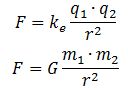
First, we’ve got the equivalent of the electric charge: the nucleon is supposed to have some ‘strong’ charge, which we’ll write as gs. Now you know the formulas for the potential energy – because of the gravitational force – between two masses, or the potential energy between two charges – because of the electrostatic force. Let me jot them down once again:

  1. U(r) = –G·M·m/r
  2. U(r) = (1/4πε0)·q1·q2/r

The two formulas are exactly the same. They both assume U = 0 for → ∞. Therefore, U(r) is always negative. [Just think of q1 and q2 as opposite charges, so the minus sign is not explicit – but it is also there!] We know that U(r) curve will look like the one below: some work (force times distance) is needed to move the two charges some distance away from each other – from point 1 to point 2, for example. [The distance r is x here – but you got that, right?]potential energy

Now, physics textbooks – or other articles you might find, like on Wikipedia – will sometimes mention that the strong force is non-linear, but that’s very confusing because… Well… The electromagnetic force – or the gravitational force – aren’t linear either: their strength is inversely proportional to the square of the distance and – as you can see from the formulas for the potential energy – that 1/r factor isn’t linear either. So that isn’t very helpful. In order to further the discussion, I should now write down Yukawa’s hypothetical formula for the potential energy between a neutron and a proton, which we’ll refer to, logically, as the n-p potential:n-p potentialThe −gs2 factor is, obviously, the equivalent of the q1·q2 product: think of the proton and the neutron having equal but opposite ‘strong’ charges. The 1/4π factor reminds us of the Coulomb constant: k= 1/4πε0. Note this constant ensures the physical dimensions of both sides of the equation make sense: the dimension of ε0 is N·m2/C2, so U(r) is – as we’d expect – expressed in newton·meter, or joule. We’ll leave the question of the units for gs open – for the time being, that is. [As for the 1/4π factor, I am not sure why Yukawa put it there. My best guess is that he wanted to remind us some constant should be there to ensure the units come out alright.]

So, when everything is said and done, the big new thing is the er/a/factor, which replaces the usual 1/r dependency on distance. Needless to say, e is Euler’s number here – not the electric charge. The two green curves below show what the er/a factor does to the classical 1/r function for = 1 and = 0.1 respectively: smaller values for a ensure the curve approaches zero more rapidly. In fact, for = 1, er/a/is equal to 0.368 for = 1, and remains significant for values that are greater than 1 too. In contrast, for = 0.1, er/a/is equal to 0.004579 (more or less, that is) for = 4 and rapidly goes to zero for all values greater than that.

graph 1graph 2Aitchison and Hey call a, therefore, a range parameter: it effectively defines the range in which the n-p potential has a significant value: outside of the range, its value is, for all practical purposes, (close to) zero. Experimentally, this range was established as being more or less equal to ≤ 2 fm. Needless to say, while this range factor may do its job, it’s obvious Yukawa’s formula for the n-p potential comes across as being somewhat random: what’s the theory behind? There’s none, really. It makes one think of the logistic function: the logistic function fits many statistical patterns, but it is (usually) not obvious why.

Next in Yukawa’s argument is the establishment of an equivalent, for the nuclear force, of the Poisson equation in electrostatics: using the E = –Φ formula, we can re-write Maxwell’s ∇•E = ρ/ε0 equation (aka Gauss’ Law) as ∇•E = –∇•∇Φ = –2Φ ⇔ 2Φ= –ρ/ε0 indeed. The divergence operator the • operator gives us the volume density of the flux of E out of an infinitesimal volume around a given point. [You may want to check one of my post on this. The formula becomes somewhat more obvious if we re-write it as ∇•E·dV = –(ρ·dV)/ε0: ∇•E·dV is then, quite simply, the flux of E out of the infinitesimally small volume dV, and the right-hand side of the equation says this is given by the product of the charge inside (ρ·dV) and 1/ε0, which accounts for the permittivity of the medium (which is the vacuum in this case).] Of course, you will also remember the Φ notation: is just the gradient (or vector derivative) of the (scalar) potential Φ, i.e. the electric (or electrostatic) potential in a space around that infinitesimally small volume with charge density ρ. So… Well… The Poisson equation is probably not so obvious as it seems at first (again, check my post on it on it for more detail) and, yes, that • operator – the divergence operator – is a pretty impressive mathematical beast. However, I must assume you master this topic and move on. So… Well… I must now give you the equivalent of Poisson’s equation for the nuclear force. It’s written like this:Poisson nuclearWhat the heck? Relax. To derive this equation, we’d need to take a pretty complicated détour, which we won’t do. [See Appendix G of Aitchison and Grey if you’d want the details.] Let me just point out the basics:

1. The Laplace operator (∇2) is replaced by one that’s nearly the same: ∇2 − 1/a2. And it operates on the same concept: a potential, which is a (scalar) function of the position r. Hence, U(r) is just the equivalent of Φ.

2. The right-hand side of the equation involves Dirac’s delta function. Now that’s a weird mathematical beast. Its definition seems to defy what I refer to as the ‘continuum assumption’ in math.  I wrote a few things about it in one of my posts on Schrödinger’s equation – and I could give you its formula – but that won’t help you very much. It’s just a weird thing. As Aitchison and Grey write, you should just think of the whole expression as a finite range analogue of Poisson’s equation in electrostatics. So it’s only for extremely small that the whole equation makes sense. Outside of the range defined by our range parameter a, the whole equation just reduces to 0 = 0 – for all practical purposes, at least.

Now, of course, you know that the neutron and the proton are not supposed to just sit there. They’re also in these sort of intricate dance which – for the electron case – is described by some wavefunction, which we derive as a solution from Schrödinger’s equation. So U(r) is going to vary not only in space but also in time and we should, therefore, write it as U(r, t). Now, we will, of course, assume it’s going to vary in space and time as some wave and we may, therefore, suggest some wave equation for it. To appreciate this point, you should review some of the posts I did on waves. More in particular, you may want to review the post I did on traveling fields, in which I showed you the following: if we see an equation like:f8then the function ψ(x, t) must have the following general functional form:solutionAny function ψ like that will work – so it will be a solution to the differential equation – and we’ll refer to it as a wavefunction. Now, the equation (and the function) is for a wave traveling in one dimension only (x) but the same post shows we can easily generalize to waves traveling in three dimensions. In addition, we may generalize the analyse to include complex-valued functions as well. Now, you will still be shocked by Yukawa’s field equation for U(r, t) but, hopefully, somewhat less so after the above reminder on how wave equations generally look like:Yukawa wave equationAs said, you can look up the nitty-gritty in Aitchison and Grey (or in its appendices) but, up to this point, you should be able to sort of appreciate what’s going on without getting lost in it all. Yukawa’s next step – and all that follows – is much more baffling. We’d think U, the nuclear potential, is just some scalar-valued wave, right? It varies in space and in time, but… Well… That’s what classical waves, like water or sound waves, for example do too. So far, so good. However, Yukawa’s next step is to associate a de Broglie-type wavefunction with it. Hence, Yukawa imposes solutions of the type:potential as particleWhat? Yes. It’s a big thing to swallow, and it doesn’t help most physicists refer to U as a force field. A force and the potential that results from it are two different things. To put it simply: the force on an object is not the same as the work you need to move it from here to there. Force and potential are related but different concepts. Having said that, it sort of make sense now, doesn’t it? If potential is energy, and if it behaves like some wave, then we must be able to associate it with a de Broglie-type particle. This U-quantum, as it is referred to, comes in two varieties, which are associated with the ongoing absorption-emission process that is supposed to take place inside of the nucleus (depicted below):

p + U → n and n + U+ → p

absorption emission

It’s easy to see that the U and U+ particles are just each other’s anti-particle. When thinking about this, I can’t help remembering Feynman, when he enigmatically wrote – somewhere in his Strange Theory of Light and Matter – that an anti-particle might just be the same particle traveling back in time. In fact, the exchange here is supposed to happen within a time window that is so short it allows for the brief violation of the energy conservation principle.

Let’s be more precise and try to find the properties of that mysterious U-quantum. You’ll need to refresh what you know about operators to understand how substituting Yukawa’s de Broglie wavefunction in the complicated-looking differential equation (the wave equation) gives us the following relation between the energy and the momentum of our new particle:mass 1Now, it doesn’t take too many gimmicks to compare this against the relativistically correct energy-momentum relation:energy-momentum relationCombining both gives us the associated (rest) mass of the U-quantum:rest massFor ≈ 2 fm, mU is about 100 MeV. Of course, it’s always to check the dimensions and calculate stuff yourself. Note the physical dimension of ħ/(a·c) is N·s2/m = kg (just think of the F = m·a formula). Also note that N·s2/m = kg = (N·m)·s2/m= J/(m2/s2), so that’s the [E]/[c2] dimension. The calculation – and interpretation – is somewhat tricky though: if you do it, you’ll find that:

ħ/(a·c) ≈ (1.0545718×10⁻³⁴ N·m·s)/[(2×10−15 m)·(2.997924583×10⁸ m/s)] ≈ 0.176×10⁻²⁷ kg

Now, most physics handbooks continue that terrible habit of writing particle weights in eV, rather than using the correct eV/c2 unit. So when they write: mU is about 100 MeV, they actually mean to say that it’s 100 MeV/c2. In addition, the eV is not an SI unit. Hence, to get that number, we should first write 0.176×10⁻²⁷ kg as some value expressed in J/c2, and then convert the joule (J) into electronvolt (eV). Let’s do that. First, note that c2 ≈ 9×10¹⁶ m2/s2, so 0.176×10⁻²⁷ kg ≈ 1.584×10⁻¹¹ J/c2. Now we do the conversion from joule to electronvolt. We get: (1.584×10⁻¹¹ J/c2)·(6.24215×1018 eV/J) ≈ 9.9×10⁷ eV/c2 = 99 MeV/c2Bingo! So that was Yukawa’s prediction for the nuclear force quantum.

Of course, Yukawa was wrong but, as mentioned above, his ideas are now generally accepted. First note the mass of the U-quantum is quite considerable: 100 MeV/c2 is a bit more than 10% of the individual proton or neutron mass (about 938-939 MeV/c2). While the binding energy causes the mass of an atom to be less than the mass of their constituent parts (protons, neutrons and electrons), it’s quite remarkably that the deuterium atom – a hydrogen atom with an extra neutron – has an excess mass of about 13.1 MeV/c2, and a binding energy with an equivalent mass of only 2.2 MeV/c2. So… Well… There’s something there.

As said, this post only wanted to introduce some basic ideas. The current model of nuclear physics is represented by the animation below, which I took from the Wikipedia article on it. The U-quantum appears as the pion here – and it does not really turn the proton into a neutron and vice versa. Those particles are assumed to be stable. In contrast, it is the quarks that change color by exchanging gluons between each other. And we know look at the exchange particle – which we refer to as the pion – between the proton and the neutron as consisting of two quarks in its own right: a quark and a anti-quark. So… Yes… All weird. QCD is just a different world. We’ll explore it more in the coming days and/or weeks. 🙂Nuclear_Force_anim_smallerAn alternative – and simpler – way of representing this exchange of a virtual particle (a neutral pion in this case) is obtained by drawing a so-called Feynman diagram:Pn_scatter_pi0OK. That’s it for today. More tomorrow. 🙂

Some content on this page was disabled on June 20, 2020 as a result of a DMCA takedown notice from Michael A. Gottlieb, Rudolf Pfeiffer, and The California Institute of Technology. You can learn more about the DMCA here:

https://wordpress.com/support/copyright-and-the-dmca/
Some content on this page was disabled on June 20, 2020 as a result of a DMCA takedown notice from Michael A. Gottlieb, Rudolf Pfeiffer, and The California Institute of Technology. You can learn more about the DMCA here:

https://wordpress.com/support/copyright-and-the-dmca/

Reality and perception

It’s quite easy to get lost in all of the math when talking quantum mechanics. In this post, I’d like to freewheel a bit. I’ll basically try to relate the wavefunction we’ve derived for the electron orbitals to the more speculative posts I wrote on how to interpret the wavefunction. So… Well… Let’s go. 🙂

If there is one thing you should remember from all of the stuff I wrote in my previous posts, then it’s that the wavefunction for an electron orbital – ψ(x, t), so that’s a complex-valued function in two variables (position and time) – can be written as the product of two functions in one variable:

ψ(x, t) = ei·(E/ħ)·t·f(x)

In fact, we wrote f(x) as ψ(x), but I told you how confusing that is: the ψ(x) and ψ(x, t) functions are, obviously, very different. To be precise, the f(x) = ψ(x) function basically provides some envelope for the two-dimensional eiθ = ei·(E/ħ)·t = cosθ + i·sinθ oscillation – as depicted below (θ = −(E/ħ)·t = ω·t with ω = −E/ħ).Circle_cos_sinWhen analyzing this animation – look at the movement of the green, red and blue dots respectively – one cannot miss the equivalence between this oscillation and the movement of a mass on a spring – as depicted below.spiral_sThe ei·(E/ħ)·t function just gives us two springs for the price of one. 🙂 Now, you may want to imagine some kind of elastic medium – Feynman’s famous drum-head, perhaps 🙂 – and you may also want to think of all of this in terms of superimposed waves but… Well… I’d need to review if that’s really relevant to what we’re discussing here, so I’d rather not make things too complicated and stick to basics.

First note that the amplitude of the two linear oscillations above is normalized: the maximum displacement of the object from equilibrium, in the positive or negative direction, which we may denote by x = ±A, is equal to one. Hence, the energy formula is just the sum of the potential and kinetic energy: T + U = (1/2)·A2·m·ω2 = (1/2)·m·ω2. But so we have two springs and, therefore, the energy in this two-dimensional oscillation is equal to E = 2·(1/2)·m·ω2 = m·ω2.

This formula is structurally similar to Einstein’s E = m·c2 formula. Hence, one may want to assume that the energy of some particle (an electron, in our case, because we’re discussing electron orbitals here) is just the two-dimensional motion of its mass. To put it differently, we might also want to think that the oscillating real and imaginary component of our wavefunction each store one half of the total energy of our particle.

However, the interpretation of this rather bold statement is not so straightforward. First, you should note that the ω in the E = m·ω2 formula is an angular velocity, as opposed to the in the E = m·c2 formula, which is a linear velocity. Angular velocities are expressed in radians per second, while linear velocities are expressed in meter per second. However, while the radian measures an angle, we know it does so by measuring a length. Hence, if our distance unit is 1 m, an angle of 2π rad will correspond to a length of 2π meter, i.e. the circumference of the unit circle. So… Well… The two velocities may not be so different after all.

There are other questions here. In fact, the other questions are probably more relevant. First, we should note that the ω in the E = m·ω2 can take on any value. For a mechanical spring, ω will be a function of (1) the stiffness of the spring (which we usually denote by k, and which is typically measured in newton (N) per meter) and (2) the mass (m) on the spring. To be precise, we write: ω2 = k/m – or, what amounts to the same, ω = √(k/m). Both k and m are variables and, therefore, ω can really be anything. In contrast, we know that c is a constant: equals 299,792,458 meter per second, to be precise. So we have this rather remarkable expression: c = √(E/m), and it is valid for any particle – our electron, or the proton at the center, or our hydrogen atom as a whole. It is also valid for more complicated atoms, of course. In fact, it is valid for any system.

Hence, we need to take another look at the energy concept that is used in our ψ(x, t) = ei·(E/ħ)·t·f(x) wavefunction. You’ll remember (if not, you should) that the E here is equal to En = −13.6 eV, −3.4 eV, −1.5 eV and so on, for = 1, 2, 3, etc. Hence, this energy concept is rather particular. As Feynman puts it: “The energies are negative because we picked our zero point as the energy of an electron located far from the proton. When it is close to the proton, its energy is less, so somewhat below zero. The energy is lowest (most negative) for n = 1, and increases toward zero with increasing n.”

Now, this is the one and only issue I have with the standard physics story. I mentioned it in one of my previous posts and, just for clarity, let me copy what I wrote at the time:

Feynman gives us a rather casual explanation [on choosing a zero point for measuring energy] in one of his very first Lectures on quantum mechanics, where he writes the following: “If we have a “condition” which is a mixture of two different states with different energies, then the amplitude for each of the two states will vary with time according to an equation like a·eiωt, with ħ·ω = E = m·c2. Hence, we can write the amplitude for the two states, for example as:

ei(E1/ħ)·t and ei(E2/ħ)·t

And if we have some combination of the two, we will have an interference. But notice that if we added a constant to both energies, it wouldn’t make any difference. If somebody else were to use a different scale of energy in which all the energies were increased (or decreased) by a constant amount—say, by the amount A—then the amplitudes in the two states would, from his point of view, be:

ei(E1+A)·t/ħ and ei(E2+A)·t/ħ

All of his amplitudes would be multiplied by the same factor ei(A/ħ)·t, and all linear combinations, or interferences, would have the same factor. When we take the absolute squares to find the probabilities, all the answers would be the same. The choice of an origin for our energy scale makes no difference; we can measure energy from any zero we want. For relativistic purposes it is nice to measure the energy so that the rest mass is included, but for many purposes that aren’t relativistic it is often nice to subtract some standard amount from all energies that appear. For instance, in the case of an atom, it is usually convenient to subtract the energy Ms·c2, where Ms is the mass of all the separate pieces—the nucleus and the electrons—which is, of course, different from the mass of the atom. For other problems, it may be useful to subtract from all energies the amount Mg·c2, where Mg is the mass of the whole atom in the ground state; then the energy that appears is just the excitation energy of the atom. So, sometimes we may shift our zero of energy by some very large constant, but it doesn’t make any difference, provided we shift all the energies in a particular calculation by the same constant.”

It’s a rather long quotation, but it’s important. The key phrase here is, obviously, the following: “For other problems, it may be useful to subtract from all energies the amount Mg·c2, where Mg is the mass of the whole atom in the ground state; then the energy that appears is just the excitation energy of the atom.” So that’s what he’s doing when solving Schrödinger’s equation. However, I should make the following point here: if we shift the origin of our energy scale, it does not make any difference in regard to the probabilities we calculate, but it obviously does make a difference in terms of our wavefunction itself. To be precise, its density in time will be very different. Hence, if we’d want to give the wavefunction some physical meaning – which is what I’ve been trying to do all along – it does make a huge difference. When we leave the rest mass of all of the pieces in our system out, we can no longer pretend we capture their energy.

So… Well… There you go. If we’d want to try to interpret our ψ(x, t) = ei·(En/ħ)·t·f(x) function as a two-dimensional oscillation of the mass of our electron, the energy concept in it – so that’s the Ein it – should include all pieces. Most notably, it should also include the electron’s rest energy, i.e. its energy when it is not in a bound state. This rest energy is equal to 0.511 MeV. […] Read this again: 0.511 mega-electronvolt (106 eV), so that’s huge as compared to the tiny energy values we mentioned so far (−13.6 eV, −3.4 eV, −1.5 eV,…).

Of course, this gives us a rather phenomenal order of magnitude for the oscillation that we’re looking at. Let’s quickly calculate it. We need to convert to SI units, of course: 0.511 MeV is about 8.2×10⁻¹⁴ joule (J), and so the associated frequency is equal to ν = E/h = (8.2×10⁻¹⁴ J)/(6.626×10−34 J·s) ≈ 1.23559×10²⁰ cycles per second. Now, I know such number doesn’t say all that much: just note it’s the same order of magnitude as the frequency of gamma rays and… Well… No. I won’t say more. You should try to think about this for yourself. [If you do, think – for starters – about the difference between bosons and fermions: matter-particles are fermions, and photons are bosons. Their nature is very different.]

The corresponding angular frequency is just the same number but multiplied by 2π (one cycle corresponds to 2π radians and, hence, ω = 2π·ν = 7.76344×10²⁰ rad per second. Now, if our green dot would be moving around the origin, along the circumference of our unit circle, then its horizontal and/or vertical velocity would approach the same value. Think of it. We have this eiθ = ei·(E/ħ)·t = ei·ω·t = cos(ω·t) + i·sin(ω·t) function, with ω = E/ħ. So the cos(ω·t) captures the motion along the horizontal axis, while the sin(ω·t) function captures the motion along the vertical axis. Now, the velocity along the horizontal axis as a function of time is given by the following formula:

v(t) = d[x(t)]/dt = d[cos(ω·t)]/dt = −ω·sin(ω·t)

Likewise, the velocity along the vertical axis is given by v(t) = d[sin(ω·t)]/dt = ω·cos(ω·t). These are interesting formulas: they show the velocity (v) along one of the two axes is always less than the angular velocity (ω). To be precise, the velocity approaches – or, in the limit, is equal to – the angular velocity ω when ω·t is equal to ω·= 0, π/2, π or 3π/2. So… Well… 7.76344×10²⁰ meter per second!? That’s like 2.6 trillion times the speed of light. So that’s not possible, of course!

That’s where the amplitude of our wavefunction comes in – our envelope function f(x): the green dot does not move along the unit circle. The circle is much tinier and, hence, the oscillation should not exceed the speed of light. In fact, I should probably try to prove it oscillates at the speed of light, thereby respecting Einstein’s universal formula:

c = √(E/m)

Written like this – rather than as you know it: E = m·c2 – this formula shows the speed of light is just a property of spacetime, just like the ω = √(k/m) formula (or the ω = √(1/LC) formula for a resonant AC circuit) shows that ω, the natural frequency of our oscillator, is a characteristic of the system.

Am I absolutely certain of what I am writing here? No. My level of understanding of physics is still that of an undergrad. But… Well… It all makes a lot of sense, doesn’t it? 🙂

Now, I said there were a few obvious questions, and so far I answered only one. The other obvious question is why energy would appear to us as mass in motion in two dimensions only. Why is it an oscillation in a plane? We might imagine a third spring, so to speak, moving in and out from us, right? Also, energy densities are measured per unit volume, right?

Now that‘s a clever question, and I must admit I can’t answer it right now. However, I do suspect it’s got to do with the fact that the wavefunction depends on the orientation of our reference frame. If we rotate it, it changes. So it’s like we’ve lost one degree of freedom already, so only two are left. Or think of the third direction as the direction of propagation of the wave. 🙂 Also, we should re-read what we wrote about the Poynting vector for the matter wave, or what Feynman wrote about probability currents. Let me give you some appetite for that by noting that we can re-write joule per cubic meter (J/m3) as newton per square meter: J/m3 = N·m/m3 = N/m2. [Remember: the unit of energy is force times distance. In fact, looking at Einstein’s formula, I’d say it’s kg·m2/s2 (mass times a squared velocity), but that simplifies to the same: kg·m2/s2 = [N/(m/s2)]·m2/s2.]

I should probably also remind you that there is no three-dimensional equivalent of Euler’s formula, and the way the kinetic and potential energy of those two oscillations works together is rather unique. Remember I illustrated it with the image of a V-2 engine in previous posts. There is no such thing as a V-3 engine. [Well… There actually is – but not with the third cylinder being positioned sideways.]two-timer-576-px-photo-369911-s-original

But… Then… Well… Perhaps we should think of some weird combination of two V-2 engines. The illustration below shows the superposition of two one-dimensional waves – I think – one traveling east-west and back, and the other one traveling north-south and back. So, yes, we may to think of Feynman’s drum-head again – but combining two-dimensional waves – two waves that both have an imaginary as well as a real dimension

dippArticle-14

Hmm… Not sure. If we go down this path, we’d need to add a third dimension – so w’d have a super-weird V-6 engine! As mentioned above, the wavefunction does depend on our reference frame: we’re looking at stuff from a certain direction and, therefore, we can only see what goes up and down, and what goes left or right. We can’t see what comes near and what goes away from us. Also think of the particularities involved in measuring angular momentum – or the magnetic moment of some particle. We’re measuring that along one direction only! Hence, it’s probably no use to imagine we’re looking at three waves simultaneously!

In any case… I’ll let you think about all of this. I do feel I am on to something. I am convinced that my interpretation of the wavefunction as an energy propagation mechanism, or as energy itself – as a two-dimensional oscillation of mass – makes sense. 🙂

Of course, I haven’t answered one key question here: what is mass? What is that green dot – in reality, that is? At this point, we can only waffle – probably best to just give its standard definition: mass is a measure of inertia. A resistance to acceleration or deceleration, or to changing direction. But that doesn’t say much. I hate to say that – in many ways – all that I’ve learned so far has deepened the mystery, rather than solve it. The more we understand, the less we understand? But… Well… That’s all for today, folks ! Have fun working through it for yourself. 🙂

Post scriptum: I’ve simplified the wavefunction a bit. As I noted in my post on it, the complex exponential is actually equal to ei·[(E/ħ)·− m·φ], so we’ve got a phase shift because of m, the quantum number which denotes the z-component of the angular momentum. But that’s a minor detail that shouldn’t trouble or worry you here.

Re-visiting electron orbitals (III)

Pre-script (dated 26 June 2020): Our ideas have evolved into a full-blown realistic (or classical) interpretation of all things quantum-mechanical. In addition, I note the dark force has amused himself by removing some material. So no use to read this. Read my recent papers instead. 🙂

Original post:

In my previous post, I mentioned that it was not so obvious (both from a physical as well as from a mathematical point of view) to write the wavefunction for electron orbitals – which we denoted as ψ(x, t), i.e. a function of two variables (or four: one time coordinate and three space coordinates) – as the product of two other functions in one variable only.

[…] OK. The above sentence is difficult to read. Let me write in math. 🙂 It is not so obvious to write ψ(x, t) as:

ψ(x, t) = ei·(E/ħ)·t·ψ(x)

As I mentioned before, the physicists’ use of the same symbol (ψ, psi) for both the ψ(x, t) and ψ(x) function is quite confusing – because the two functions are very different:

  • ψ(x, t) is a complex-valued function of two (real) variables: x and t. Or four, I should say, because x = (x, y, z) – but it’s probably easier to think of x as one vector variable – a vector-valued argument, so to speak. And then t is, of course, just a scalar variable. So… Well… A function of two variables: the position in space (x), and time (t).
  • In contrast, ψ(x) is a real-valued function of one (vector) variable only: x, so that’s the position in space only.

Now you should cry foul, of course: ψ(x) is not necessarily real-valued. It may be complex-valued. You’re right. You know the formula:wavefunctionNote the derivation of this formula involved a switch from Cartesian to polar coordinates here, so from = (x, y, z) to r = (r, θ, φ), and that the function is also a function of the two quantum numbers l and m now, i.e. the orbital angular momentum (l) and its z-component (m) respectively. In my previous post(s), I gave you the formulas for Yl,m(θ, φ) and Fl,m(r) respectively. Fl,m(r) was a real-valued function alright, but the Yl,m(θ, φ) had that ei·m·φ factor in it. So… Yes. You’re right: the Yl,m(θ, φ) function is real-valued if – and only if – m = 0, in which case ei·m·φ = 1. Let me copy the table from Feynman’s treatment of the topic once again:spherical harmonics 2The Plm(cosθ) functions are the so-called (associated) Legendre polynomials, and the formula for these functions is rather horrible:Legendre polynomialDon’t worry about it too much: just note the Plm(cosθ) is a real-valued function. The point is the following:the ψ(x, t) is a complex-valued function because – and only because – we multiply a real-valued envelope function – which depends on position only – with ei·(E/ħ)·t·ei·m·φ = ei·[(E/ħ)·− m·φ].

[…]

Please read the above once again and – more importantly – think about it for a while. 🙂 You’ll have to agree with the following:

  • As mentioned in my previous post, the ei·m·φ factor just gives us phase shift: just a re-set of our zero point for measuring time, so to speak, and the whole ei·[(E/ħ)·− m·φ] factor just disappears when we’re calculating probabilities.
  • The envelope function gives us the basic amplitude – in the classical sense of the word: the maximum displacement from the zero value. And so it’s that ei·[(E/ħ)·− m·φ] that ensures the whole expression somehow captures the energy of the oscillation.

Let’s first look at the envelope function again. Let me copy the illustration for n = 5 and = 2 from Wikimedia Commons article. Note the symmetry planes:

  • Any plane containing the z-axis is a symmetry plane – like a mirror in which we can reflect one half of the shape to get the other half. [Note that I am talking the shape only here. Forget about the colors for a while – as these reflect the complex phase of the wavefunction.]
  • Likewise, the plane containing both the x– and the y-axis is a symmetry plane as well.

n = 5

The first symmetry plane – or symmetry line, really (i.e. the z-axis) – should not surprise us, because the azimuthal angle φ is conspicuously absent in the formula for our envelope function if, as we are doing in this article here, we merge the ei·m·φ factor with the ei·(E/ħ)·t, so it’s just part and parcel of what the author of the illustrations above refers to as the ‘complex phase’ of our wavefunction. OK. Clear enough – I hope. 🙂 But why is the the xy-plane a symmetry plane too? We need to look at that monstrous formula for the Plm(cosθ) function here: just note the cosθ argument in it is being squared before it’s used in all of the other manipulation. Now, we know that cosθ = sin(π/2 − θ). So we can define some new angle – let’s just call it α – which is measured in the way we’re used to measuring angle, which is not from the z-axis but from the xy-plane. So we write: cosθ = sin(π/2 − θ) = sinα. The illustration below may or may not help you to see what we’re doing here.angle 2So… To make a long story short, we can substitute the cosθ argument in the Plm(cosθ) function for sinα = sin(π/2 − θ). Now, if the xy-plane is a symmetry plane, then we must find the same value for Plm(sinα) and Plm[sin(−α)]. Now, that’s not obvious, because sin(−α) = −sinα ≠ sinα. However, because the argument in that Plm(x) function is being squared before any other operation (like subtracting 1 and exponentiating the result), it is OK: [−sinα]2 = [sinα]sin2α. […] OK, I am sure the geeks amongst my readers will be able to explain this more rigorously. In fact, I hope they’ll have a look at it, because there’s also that dl+m/dxl+m operator, and so you should check what happens with the minus sign there. 🙂

[…] Well… By now, you’re probably totally lost, but the fact of the matter is that we’ve got a beautiful result here. Let me highlight the most significant results:

  • definite energy state of a hydrogen atom (or of an electron orbiting around some nucleus, I should say) appears to us as some beautifully shaped orbital – an envelope function in three dimensions, really – which has the z-axis – i.e. the vertical axis – as a symmetry line and the xy-plane as a symmetry plane.
  • The ei·[(E/ħ)·− m·φ] factor gives us the oscillation within the envelope function. As such, it’s this factor that, somehow, captures the energy of the oscillation.

It’s worth thinking about this. Look at the geometry of the situation again – as depicted below. We’re looking at the situation along the x-axis, in the direction of the origin, which is the nucleus of our atom.

spherical

The ei·m·φ factor just gives us phase shift: just a re-set of our zero point for measuring time, so to speak. Interesting, weird – but probably less relevant than the ei·[(E/ħ)·t factor, which gives us the two-dimensional oscillation that captures the energy of the state.

Circle_cos_sin

Now, the obvious question is: the oscillation of what, exactly? I am not quite sure but – as I explained in my Deep Blue page – the real and imaginary part of our wavefunction are really like the electric and magnetic field vector of an oscillating electromagnetic field (think of electromagnetic radiation – if that makes it easier). Hence, just like the electric and magnetic field vector represent some rapidly changing force on a unit charge, the real and imaginary part of our wavefunction must also represent some rapidly changing force on… Well… I am not quite sure on what though. The unit charge is usually defined as the charge of a proton – rather than an electron – but then forces act on some mass, right? And the mass of a proton is hugely different from the mass of an electron. The same electric (or magnetic) force will, therefore, give a hugely different acceleration to both.

So… Well… My guts instinct tells me the real and imaginary part of our wavefunction just represent, somehow, a rapidly changing force on some unit of mass, but then I am not sure how to define that unit right now (it’s probably not the kilogram!).

Now, there is another thing we should note here: we’re actually sort of de-constructing a rotation (look at the illustration above once again) in two linearly oscillating vectors – one along the z-axis and the other along the y-axis. Hence, in essence, we’re actually talking about something that’s spinning. In other words, we’re actually talking some torque around the x-axis. In what direction? I think that shouldn’t matter – that we can write E or −E, in other words, but… Well… I need to explore this further – as should you! 🙂

Let me just add one more note on the ei·m·φ factor. It sort of defines the geometry of the complex phase itself. Look at the illustration below. Click on it to enlarge it if necessary – or, better still, visit the magnificent Wikimedia Commons article from which I get these illustrations. These are the orbitals = 4 and = 3. Look at the red hues in particular – or the blue – whatever: focus on one color only, and see how how – for m = ±1, we’ve got one appearance of that color only. For m = ±1, the same color appears at two ends of the ‘tubes’ – or tori (plural of torus), I should say – just to sound more professional. 🙂 For m = ±2, the torus consists of three parts – or, in mathematical terms, we’d say the order of its rotational symmetry is equal to 3. Check that Wikimedia Commons article for higher values of and l: the shapes become very convoluted, but the observation holds. 🙂

l = 3

Have fun thinking all of this through for yourself – and please do look at those symmetries in particular. 🙂

Post scriptum: You should do some thinking on whether or not these = ±1, ±2,…, ±orbitals are really different. As I mentioned above, a phase difference is just what it is: a re-set of the t = 0 point. Nothing more, nothing less. So… Well… As far as I am concerned, that’s not a real difference, is it? 🙂 As with other stuff, I’ll let you think about this for yourself.

Some content on this page was disabled on June 17, 2020 as a result of a DMCA takedown notice from Michael A. Gottlieb, Rudolf Pfeiffer, and The California Institute of Technology. You can learn more about the DMCA here:

https://wordpress.com/support/copyright-and-the-dmca/

Some more on symmetries…

In our previous post, we talked a lot about symmetries in space – in a rather playful way. Let’s try to take it further here by doing some more thinking on symmetries in spacetime. This post will pick up some older stuff – from my posts on states and the related quantum math in November 2015, for example – but that shouldn’t trouble you too much. On the contrary, I actually hope to tie up some loose ends here.

Let’s first review some obvious ideas. Think about the direction of time. On a time axis, time goes from left to right. It will usually be measured from some zero point – like when we started our experiment or something 🙂 – to some +point but we may also think of some point in time before our zero point, so the minus (−t) points – the left side of the axis – make sense as well. So the direction of time is clear and intuitive. Now, what does it mean to reverse the direction of time? We need to distinguish two things here: the convention, and… Well… Reality. If we would suddenly decide to reverse the direction in which we measure time, then that’s just another convention. We don’t change reality: trees and kids would still grow the way they always did. 🙂 We would just have to change the numbers on our clocks or, alternatively, the direction of rotation of the hand(s) of our clock, as shown below. [I only showed the hour hand because… Well… I don’t want to complicate things by introducing two time units. But adding the minute hand doesn’t make any difference.]

clock problemNow, imagine you’re the dictator who decided to change our time measuring convention. How would you go about it? Would you change the numbers on the clock or the direction of rotation? Personally, I’d be in favor of changing the direction of rotation. Why? Well… First, we wouldn’t have to change expressions such as: “If you are looking north right now, then west is in the 9 o’clock direction, so go there.” 🙂 More importantly, it would align our clocks with the way we’re measuring angles. On the other hand, it would not align our clocks with the way the argument (θ) of our elementary wavefunction ψ = a·eiθ = ei·(E·t – p·x)/ħ is measured, because that’s… Well… Clockwise.

So… What are the implications here? We would need to change t for −t in our wavefunction as well, right? Yep. Good point. So that’s another convention that would change: we should write our elementary wavefunction now as ψ = a·ei·(E·t – p·x)/ħ. So we would have to re-define θ as θ = –E·t + p·x = p·x –E·t. So… Well… Done!

So… Well… What’s next? Nothing. Note that we’re not changing reality here. We’re just adapting our formulas to a new dictatorial convention according to which we should count time from positive to negative – like 2, 1, 0, -1, -2 etcetera, as shown below. Fortunately, we can fix all of our laws and formulas in physics by swapping for -t. So that’s great. No sweat. time reversal

Is that all? Yes. We don’t need to do anything else. We’ll still measure the argument of our wavefunction as an angle, so that’s… Well… After changing our convention, it’s now clockwise. 🙂 Whatever you want to call it: it’s still the same direction. Our dictator can’t change physical reality 🙂

Hmm… But so we are obviously interested in changing physical reality. I mean… Anyone can become a dictator, right? In contrast, we – enlightened scientists – want to really change the world, don’t we? 🙂 So what’s a time reversal in reality? Well… I don’t know… You tell me. 🙂 We may imagine some movie being played backwards, or trees and kids shrinking instead of growing, or some bird flying backwards – and I am not talking the hummingbird here. 🙂

Hey! The latter illustration – that bird flying backwards – is probably the better one: if we reverse the direction of time – in reality, that is – then we should also reverse all directions in space. But… Well… What does that mean, really? We need to think in terms of force fields here. A stone that’d be falling must now go back up. Two opposite charges that were going towards each other, should now move away from each other. But… My God! Such world cannot exist, can it?

No. It cannot. And we don’t need to invoke the second law of thermodynamics for that. 🙂 None of what happens in a movie that’s played backwards makes sense: a heavy stone does not suddenly fly up and decelerate upwards. So it is not like the anti-matter world we described in our previous post. No. We can effectively imagine some world in which all charges have been replaced by their opposite: we’d have positive electrons (positrons) around negatively charged nuclei consisting of antiprotons and antineutrons and, somehow, negative masses. But Coulomb’s law would still tell us two opposite charges – q1 and –q2 , for example – don’t repel but attract each other, with a force that’s proportional to the product of their charges, i.e. q1·(-q2) = –q1·q2. Likewise, Newton’s law of gravitation would still tell us that two masses m1 and m2 – negative or positive – will attract each other with a force that’s proportional to the product of their masses, i.e. m1·m= (-m1)·(-m2). If you’d make a movie in the antimatter world, it would look just like any other movie. It would definitely not look like a movie being played backwards.

In fact, the latter formula – m1·m= (-m1)·(-m2) – tells us why: we’re not changing anything by putting a minus sign in front of all of our variables, which are time (t), position (x), mass (m) and charge (q). [Did I forget one? I don’t think so.] Hence, the famous CPT Theorem – which tells us that a world in which (1) time is reversed, (2) all charges have been conjugated (i.e. all particles have been replaced by their antiparticles), and (3) all spatial coordinates now have the opposite sign, is entirely possible (because it would obey the same Laws of Nature that we, in our world, have discovered over the past few hundred years) – is actually nothing but a tautology. Now, I mean that literally: a tautology is a statement that is true by necessity or by virtue of its logical form. Well… That’s the case here: if we flip the signs of all of our variables, we basically just agreed to count or measure everything from positive to negative. That’s it. Full stop. Such exotic convention is… Well… Exotic, but it cannot change the real world. Full stop.

Of course, this leaves the more intriguing questions entirely open. Partial symmetries. Like time reversal only. 🙂 Or charge conjugation only. 🙂 So let’s think about that.

We know that the world that we see in a mirror must be made of anti-matter but, apart from that particularity, that world makes sense: if we drop a stone in front of the mirror, the stone in the mirror will drop down too. Two like charges will be seen as repelling each other in the mirror too, and concepts such as kinetic or potential energy look just the same. So time just seems to tick away in both worlds – no time reversal here! – and… Well… We’ve got two CP-symmetrical worlds here, don’t we? We only flipped the sign of the coordinate frame and of the charges. Both are possible, right? And what’s possible must exist, right? Well… Maybe. That’s the next step. Let’s first see if both are possible. 🙂

Now, when you’ve read my previous post, you’ll note that I did not flip the z-coordinate when reflecting my world in the mirror. That’s true. But… Well… That’s entirely beside the point. We could flip the z-axis too and so then we’d have a full parity inversion. [Or parity transformation – sounds more serious, doesn’t it? But it’s only a simple inversion, really.] It really doesn’t matter. The point is: axial vectors have the opposite sign in the mirror world, and so it’s not only about whether or not an antimatter world is possible (it should be, right?): it’s about whether or not the sign reversal of all of those axial vectors makes sense in each and every situation. The illustration below, for example, shows how a left-handed neutrino should be a right-handed antineutrino in the mirror world.right-handed antineutrinoI hope you understand the left- versus right-handed thing. Think, for example, of how the left-circularly polarized wavefunction below would look like in the mirror. Just apply the customary right-hand rule to determine the direction of the angular momentum vector. You’ll agree it will be right-circularly polarized in the mirror, right? That’s why we need the charge conjugation: think of the magnetic moment of a circulating charge! So… Well… I can’t dwell on this too much but – if Maxwell’s equations are to hold – then that world in the mirror must be made of antimatter.animation

Now, we know that some processes – in our world – are not entirely CP-symmetrical. I wrote about this at length in previous posts, so I won’t dwell on these experiments here. The point is: these experiments – which are not easy to understand – lead physicists, philosophers, bloggers and what have you to solemnly state that the world in the mirror cannot really exist. And… Well… They’re right. However, I think their observations are beside the point. Literally.

So… Well… I would just like to make a very fundamental philosophical remark about all those discussions. My point is quite simple:

We should realize that the mirror world and our world are effectively separated by the mirror. So we should not be looking at stuff in the mirror from our perspective, because that perspective is well… Outside of the mirror. A different world. 🙂 In my humble opinion, the valid point of reference would be the observer in the mirror, like the photographer in the image below. Now note the following: if the real photographer, on this side of the mirror, would have a left-circularly polarized beam in front of him, then the imaginary photographer, on the other side of the mirror, would see the mirror image of this left-circularly polarized beam as a left-circularly polarized beam too. 🙂 I know that sounds complicated but re-read it a couple of times and – I hope – you’ll see the point. If you don’t… Well… Let me try to rephrase it: the point is that the observer in the mirror would be seeing our world – just the same laws and what have you, all makes sense! – but he would see our world in his world, so he’d see it in the mirror world. 🙂

Mirror

Capito? If you would actually be living in the mirror world, then all the things you would see in the mirror world would make perfectly sense. But you would be living in the mirror world. You would not look at it from outside, i.e. from the other side of the mirror. In short, I actually think the mirror world does exist – but in the mirror only. 🙂 […] I am, obviously, joking here. Let me be explicit: our world is our world, and I think those CP violations in Nature are telling us that it’s the only real world. The other worlds exist in our mind only – or in some mirror. 🙂

Post scriptum: I know the Die Hard philosophers among you will now have an immediate rapid-backfire question. [Hey – I just invented a new word, didn’t I? A rapid-backfire question. Neat.] How would the photographer in the mirror look at our world? The answer to that question is simple: symmetry! He (or she) would think it’s a mirror world only. His world and our world would be separated by the same mirror. So… What are the implications here?

Well… That mirror is only a piece of glass with a coating. We made it. Or… Well… Some man-made company made it. 🙂 So… Well… If you think that observer in the mirror – I am talking about that image of the photographer in that picture above now – would actually exist, then… Well… Then you need to be aware of the consequences: the corollary of his existence is that you do not exist. 🙂 And… Well… No. I won’t say more. If you’re reading stuff like this, then you’re smart enough to figure it out for yourself. We live in one world. Quantum mechanics tells us the perspective on that world matters very much – amplitudes are different in different reference frames – but… Well… Quantum mechanics – or physics in general – does not give us many degrees of freedoms. None, really. It basically tells us the world we live in is the only world that’s possible, really. But… Then… Well… That’s just because physics… Well… When everything is said and done, it’s just mankind’s drive to ensure our perception of the Universe lines up with… Well… What we perceive it to be. 😦 or 🙂 Whatever your appreciation of it. Those Great Minds did an incredible job. 🙂

Symmetries and transformations

In my previous post, I promised to do something on symmetries. Something simple but then… Well… You know how it goes: one question always triggers another one. 🙂

Look at the situation in the illustration on the left below. We suppose we have something real going on there: something is moving from left to right (so that’s in the 3 o’clock direction), and then something else is going around clockwise (so that’s not the direction in which we measure angles (which also include the argument θ of our wavefunction), because that’s always counter-clockwise, as I note at the bottom of the illustration). To be precise, we should note that the angular momentum here is all about the y-axis, so the angular momentum vector L points in the (positive) y-direction. We get that direction from the familiar right-hand rule, which is illustrated in the top right corner.

mirrorNow, suppose someone else is looking at this from the other side – or just think of yourself going around a full 180° to look at the same thing from the back side. You’ll agree you’ll see the same thing going from right to left (so that’s in the 9 o’clock direction now – or, if our clock is transparent, the 3 o’clock direction of our reversed clock). Likewise, the thing that’s turning around will now go counter-clockwise.

Note that both observers – so that’s me and that other person (or myself after my walk around this whole thing) – use a regular coordinate system, which implies the following:

  1. We’ve got regular 90° degree angles between our coordinates axes.
  2. Our x-axis goes from negative to positive from left to right, and our y-axis does the same going away from us.
  3. We also both define our z-axis using, once again, the ubiquitous right-hand rule, so our z-axis points upwards.

So we have two observers looking at the same reality – some linear as well as some angular momentum – but from opposite sides. And so we’ve got a reversal of both the linear as well as the angular momentum. Not in reality, of course, because we’re looking at the same thing. But we measure it differently. Indeed, if we use the subscripts 1 and 2 to denote the measurements in the two coordinate systems, we find that p2 = –p1. Likewise, we also find that L2 = –L1.

Now, when you see these two equations, you will probably not worry about that p2 = –p1 equation – although you should, because it’s actually only valid for this rather particular orientation of the linear momentum (I’ll come back to that in a moment). It’s the L2 = –L1 equation which should surprise you most. Why? Because you’ve always been told there is a big difference between (1) real vectors (aka polar vectors), like the momentum p, or the velocity v, or the force F, and (2) pseudo-vectors (aka axial vectors), like the angular momentum L. You may also remember how to distinguish between the two: if you change the direction of the axes of your reference frame, polar vectors will change sign too, as opposed to axial vectors: axial vectors do not swap sign if we swap the coordinate signs.

So… Well… How does that work here? In fact, what we should ask ourselves is: why does that not work here? Well… It’s simple, really. We’re not changing the direction of the axes here. Or… Well… Let me be more precise: we’re only swapping the sign of the x– and y-axis. We did not flip the z-axis. So we turned things around, but we didn’t turn them upside down. It makes a huge difference. Note, for example, that if all of the linear momentum would have been in the z-direction only (so our p vector would have been pointing in the z-direction, and in the z-direction only), it would not swap sign. The illustration below shows what really happens with the coordinates of some vector when we’re doing a rotation. It’s, effectively, only the x– and y-coordinates that flip sign.reflection symmetry

It’s easy to see that this rotation about the z-axis here preserves our deep sense of ‘up’ versus ‘down’, but that it swaps ‘left’ for ‘right’, and vice versa. Note that this is not a reflection. We are not looking at some mirror world here. The difference between a reflection (a mirror world) and a rotation (the real world seen from another angle) is illustrated below. It’s quite confusing but, unlike what you might think, a reflection does not swap left for right. It does turn things inside out, but that’s what a rotation does as well: near becomes far, and far becomes near.difference between reflection and rotation

Before we move on, let me say a few things about the mirror world and, more in particular, about the obvious question: could it possibly exist? Well… What do you think? Your first reaction might well be: “Of course! What nonsense question! We just walk around whatever it is that we’re seeing – or, what amounts to the same, we just turn it around – and there it is: that’s the mirror world, right? So of course it exists!” Well… No. That’s not the mirror world. That’s just the real world seen from the opposite direction, and that world… Well… That’s just the real world. 🙂 The mirror world is, literally, the world in the mirror – like the photographer in the illustration below. We don’t swap left for right here: some object going from left to right in the real world is still going from left to right in the mirror world!MirrorOf course, you may now involve the photographer in the picture above and observe – note that you’re now an observer of the observer of the mirror 🙂 – that, if he would move his left arm in the real world, the photographer in the mirror world would be moving his right arm. But… Well… No. You’re saying that because you’re now imaging that you’re the photographer in the mirror world yourself now, who’s looking at the real world from inside, so to speak. So you’ve rotated the perspective in your mind and you’re saying it’s his right arm because you imagine yourself to be the photographer in the mirror. We usually do that because… Well… Because we look in a mirror every day, right? So we’re used to seeing ourselves that way and we always think it’s us we’re seeing. 🙂 However, the illustration above is correct: the mirror world only swaps near for far, and far for near, so it only swaps the sign of the y-axis.

So the question is relevant: could the mirror world actually exist? What we’re really asking here is the following: can we swap the sign of one coordinate axis only in all of our physical laws and equations and… Well… Do we then still get the same laws and equations? Do we get the same Universe – because that’s what those laws and equations describe? If so, our mirror world can exist. If not, then not.

Now, I’ve done a post on that, in which I explain that mirror world can only exist if it would consist of anti-matter. So if our real world and the mirror world would actually meet, they would annihilate each other. 🙂 But that post is quite technical. Here I want to keep it very simple: I basically only want to show what the rotation operation implies for the wavefunction. There is no doubt whatsoever that the rotated world exists. In fact, the rotated world is just our world. We walk around some object, or we turn it around, but so we’re still watching the same object. So we’re not thinking about the mirror world here. We just want to know how things look like when adopting some other perspective.

So, back to the starting point: we just have two observers here, who look at the same thing but from opposite directions. Mathematically, this corresponds to a rotation of our reference frame about the z-axis of 180°. Let me spell out – somewhat more precisely – what happens to the linear and angular momentum here:

  1. The direction of the linear momentum in the xy-plane swaps direction.
  2. The angular momentum about the y-axis, as well as about the x-axis, swaps direction too.

Note that the illustration only shows angular momentum about the y-axis, but you can easily verify the statement about the angular momentum about the x-axis. In fact, the angular momentum about any line in the xy-plane will swap direction.

Of course, the x-, y-, z-axes in the other reference frame are different than mine, and so I should give them a subscript, right? Or, at the very least, write something like x’, y’, z’, so we have a primed reference frame here, right? Well… Maybe. Maybe not. Think about it. 🙂 A coordinate system is just a mathematical thing… Only the momentum is real… Linear or angular… Equally real… And then Nature doesn’t care about our position, does it? So… Well… No subscript needed, right? Or… Well… What do you think? 🙂

It’s just funny, isn’t it? It looks like we can’t really separate reality and perception here. Indeed, note how our p2 = –pand L2 = –L1 equations already mix reality with how we perceive it. It’s the same thing in reality but the coordinates of p1 and L1 are positive, while the coordinates of p2 and Lare negative. To be precise, these coordinates will look like this:

  1. p1 = (p, 0, 0) and L1 = (0, L, 0)
  2. p2 = (−p, 0, 0) and L1 = (0, −L, 0)

So are they two different things or are they not? 🙂 Think about it. I’ll move on in the meanwhile. 🙂

Now, you probably know a thing or two about parity symmetry, or P-symmetry: if if we flip the sign of all coordinates, then we’ll still find the same physical laws, like F = m·a and what have you. [It works for all physical laws, including quantum-mechanical laws – except those involving the weak force (read: radioactive decay processes).] But so here we are talking rotational symmetry. That’s not the same as P-symmetry. If we flip the signs of all coordinates, we’re also swapping ‘up’ for ‘down’, so we’re not only turning around, but we’re also getting upside down. The difference between rotational symmetry and P-symmetry is shown below.up and down swap

As mentioned, we’ve talked about P-symmetry at length in other posts, and you can easily google a lot more on that. The question we want to examine here – just as a fun exercise – is the following:

How does that rotational symmetry work for a wavefunction?

The very first illustration in this post gave you the functional form of the elementary wavefunction  eiθ = ei·(E·t p·x)/ħ. We should actually use a bold type x = (x, y, z) in this formula but we’ll assume we’re talking something similar to that p vector: something moving in the x-direction only – or in the xy-plane only. The z-component doesn’t change. Now, you know that we can reduce all actual wavefunctions to some linear combination of such elementary wavefunctions by doing a Fourier decomposition, so it’s fine to look at the elementary wavefunction only – so we don’t make it too complicated here. Now think of the following.

The energy E in the eiθ = ei·(E·t – p·x)/ħ function is a scalar, so it doesn’t have any direction and we’ll measure it the same from both sides – as kinetic or potential energy or, more likely, by adding both. But… Well… Writing ei·(E·t – p·x)/ħ or ei·(E·t + p·x)/ħ is not the same, right? No, it’s not. However, think of it as follows: we won’t be changing the direction of time, right? So it’s OK to not change the sign of E. In fact, we can re-write the two expressions as follows:

  1. ei·(E·t – p·x)/ħ = ei·(E/ħ)·t·ei·(p/ħ)·x
  2. ei·(E·t + p·x)/ħ = ei·(E/ħ)·t·ei·(p/ħ)·x

The first wavefunction describes some particle going in the positive x-direction, while the second wavefunction describes some particle going in the negative x-direction, so… Well… That’s exactly what we see in those two reference frames, so there is no issue whatsoever. 🙂 It’s just… Well… I just wanted to show the wavefunction does look different too when looking at something from another angle.

So why am I writing about this? Why am I being fussy? Well.. It’s just to show you that those transformations are actually quite natural – just as natural as it is to see some particle go in one direction in one reference frame and see it go in the other in the other. 🙂 It also illustrates another point that I’ve been trying to make: the wavefunction is something real. It’s not just a figment of our imagination. The real and imaginary part of our wavefunction have a precise geometrical meaning – and I explained what that might be in my more speculative posts, which I’ve brought together in the Deep Blue page of this blog. But… Well… I can’t dwell on that here because… Well… You should read that page. 🙂

The point to note is the following: we do have different wavefunctions in different reference frames, but these wavefunctions describe the same physical reality, and they also do respect the symmetries we’d expect them to respect, except… Well… The laws describing the weak force don’t, but I wrote about that a very long time ago, and it was not in the context of trying to explain the relatively simple basic laws of quantum mechanics. 🙂 If you’re interested, you should check out my post(s) on that or, else, just google a bit. It’s really exciting stuff, but not something that will help you much to understand the basics, which is what we’re trying to do here. 🙂

The second point to note is that those transformations of the wavefunction – or of quantum-mechanical states – which we go through when rotating our reference frame, for example – are really quite natural. There’s nothing special about them. We had such transformations in classical mechanics too! But… Well… Yes, I admit they do look complicated. But then that’s why you’re so fascinated and why you’re reading this blog, isn’t it? 🙂

Post scriptum: It’s probably useful to be somewhat more precise on all of this. You’ll remember we visualized the wavefunction in some of our posts using the animation below. It uses a left-handed coordinate system, which is rather unusual but then it may have been made with a software which uses a left-handed coordinate system (like RenderMan, for example). Now the rotating arrow at the center moves with time and gives us the polarization of our wave. Applying our customary right-hand rule,you can see this beam is left-circularly polarized. [I know… It’s quite confusing, but just go through the motions here and be consistent.]AnimationNow, you know that ei·(p/ħ)·x and ei·(p/ħ)·x are each other’s complex conjugate:

  1. ei·k·x cos(k·x) + i·sin(k·x)
  2. ei·k·x cos(-k·x) + i·sin(-k·x) = cos(k·x) − i·sin(k·x)

Their real part – the cosine function – is the same, but the imaginary part – the sine function – has the opposite sign. So, assuming the direction of propagation is, effectively, the x-direction, then what’s the polarization of the mirror image? Well… The wave will now go from right to left, and its polarization… Hmm… Well… What? 

Well… If you can’t figure it out, then just forget about those signs and just imagine you’re effectively looking at the same thing from the backside. In fact, if you have a laptop, you can push the screen down and go around your computer. 🙂 There’s no shame in that. In fact, I did that just to make sure I am not talking nonsense here. 🙂 If you look at this beam from the backside, you’ll effectively see it go from right to left – instead of from what you see on this side, which is a left-to-right direction. And as for its polarization… Well… The angular momentum vector swaps direction too but the beam is still left-circularly polarized. So… Well… That’s consistent with what we wrote above. 🙂 The real world is real, and axial vectors are as real as polar vectors. This real beam will only appear to be right-circularly polarized in a mirror. Now, as mentioned above, that mirror world is not our world. If it would exist – in some other Universe – then it would be made up of anti-matter. 🙂

So… Well… Might it actually exist? Is there some other world made of anti-matter out there? I don’t know. We need to think about that reversal of ‘near’ and ‘far’ too: as mentioned, a mirror turns things inside out, so to speak. So what’s the implication of that? When we walk around something – or do a rotation – then the reversal between ‘near’ and ‘far’ is something physical: we go near to what was far, and we go away from what was near. But so how would we get into our mirror world, so to speak? We may say that this anti-matter world in the mirror is entirely possible, but then how would we get there? We’d need to turn ourselves, literally, inside out – like short of shrink to the zero point and then come back out of it to do that parity inversion along our line of sight. So… Well… I don’t see that happen, which is why I am a fan of the One World hypothesis. 🙂 So think the mirror world is just what it is: the mirror world. Nothing real. But… Then… Well… What do you think? 🙂

Quantum-mechanical magnitudes

As I was writing about those rotations in my previous post (on electron orbitals), I suddenly felt I should do some more thinking on (1) symmetries and (2) the concept of quantum-mechanical magnitudes of vectors. I’ll write about the first topic (symmetries) in some other post. Let’s first tackle the latter concept. Oh… And for those I frightened with my last post… Well… This should really be an easy read. More of a short philosophical reflection about quantum mechanics. Not a technical thing. Something intuitive. At least I hope it will come out that way. 🙂

First, you should note that the fundamental idea that quantities like energy, or momentum, may be quantized is a very natural one. In fact, it’s what the early Greek philosophers thought about Nature. Of course, while the idea of quantization comes naturally to us (I think it’s easier to understand than, say, the idea of infinity), it is, perhaps, not so easy to deal with it mathematically. Indeed, most mathematical ideas – like functions and derivatives – are based on what I’ll loosely refer to as continuum theory. So… Yes, quantization does yield some surprising results, like that formula for the magnitude of some vector J:Magnitude formulasThe J·J in the classical formula above is, of course, the equally classical vector dot product, and the formula itself is nothing but Pythagoras’ Theorem in three dimensions. Easy. I just put a + sign in front of the square roots so as to remind you we actually always have two square roots and that we should take the positive one. 🙂

I will now show you how we get that quantum-mechanical formula. The logic behind it is fairly straightforward but, at the same time… Well… You’ll see. 🙂 We know that a quantum-mechanical variable – like the spin of an electron, or the angular momentum of an atom – is not continuous but discrete: it will have some value = jj-1, j-2, …, -(j-2), -(j-1), –j. Our here is the maximum value of the magnitude of the component of our vector (J) in the direction of measurement, which – as you know – is usually written as Jz. Why? Because we will usually choose our coordinate system such that our z-axis is aligned accordingly. 🙂 Those values jj-1, j-2, …, -(j-2), -(j-1), –j are separated by one unit. That unit would be Planck’s quantum of action ħ ≈ 1.0545718×10⁻³⁴ N·m·s – by the way, isn’t it amazing we can actually measure such tiny stuff in some experiment? 🙂 – if J would happen to be the angular momentum, but the approach here is more general – action can express itself in various ways 🙂 – so the unit doesn’t matter: it’s just the unit, so that’s just one. 🙂 It’s easy to see that this separation implies must be some integer or half-integer. [Of course, now you might think the values of a series like 2.4, 1.4, 0.4, -0.6, -1.6 are also separated by one unit, but… Well… That would violate the most basic symmetry requirement so… Well… No. Our has to be an integer or a half-integer. Please also note that the number of possible values for is equal to 2j+1, as we’ll use that in a moment.]

OK. You’re familiar with this by now and so I should not repeat the obvious. To make things somewhat more real, let’s assume = 3/2, so =  3/2, 1/2, -1/2 or +3/2. Now, we don’t know anything about the system and, therefore, these four values are all equally likely. Now, you may not agree with this assumption but… Well… You’ll have to agree that, at this point, you can’t come up with anything else that would make sense, right? It’s just like a classical situation: J might point in any direction, so we have to give all angles an equal probability. [In fact, I’ll show you – in a minute or so – that you actually have a point here: we should think some more about this assumption – but so that’s for later. I am asking you to just go along with this story as for now.]

So the expected value of Jz is E[Jz] is equal to E[Jz] = (1/4)·(3/2)+(1/4)·(1/2)+(1/4)·(-1/2)+(1/4)·(-3/2) = 0. Nothing new here. We just multiply probabilities with all of the possible values to get an expected value. So we get zero here because our values are distributed symmetrically around the zero point. No surprise. Now, to calculate a magnitude, we don’t need Jbut Jz2. In case you wonder, that’s what this squaring business is all about: we’re abstracting away from the direction and so we’re going to square both positive as well as negative values to then add it all up and take a square root. Now, the expected value of Jz2 is equal to E[Jz] = (1/4)·(3/2)2+(1/4)·(1/2)2+(1/4)·(-1/2)2+(1/4)·(-3/2)2 = 5/4 = 1.25. Some positive value.

You may note that it’s a bit larger than the average of the absolute value of our variable, which is equal to (|3/2|+|1/2|+|-1/2|+|-3/2|)/4 = 1, but that’s just because the squaring favors larger values 🙂 Also note that, of course, we’d also get some positive value if Jwould be a continuous variable over the [-3/2, +3/2] interval, but I’ll let you think about what positive value we’d get for Jzassuming Jz is uniform distributed over the [-3/2, +3/2] interval, because that calculation is actually not so straightforward as it may seem at first. In any case, these considerations are not very relevant to our story here, so let’s move on.

Of course, our z-direction was random, and so we get the same thing for whatever direction. More in particular, we’ll also get it for the x– and y-directions: E[Jx] = E[Jy] = E[Jz] = 5/4. Now, at this point it’s probably good to give you a more generalized formula for these quantities. I think you’ll easily agree to the following one:magnitude squared formulaSo now we can apply our classical J·J = JxJyJzformula to these quantities by calculating the expected value of JJ·J, which is equal to:

E[J·J] = E[Jx2] + E[Jy2] + E[Jz2] = 3·E[Jx2] = 3·E[Jy2] = 3·E[Jz2]

You should note we’re making use of the E[X Y] = E[X]+ E[Y] property here: the expected value of the sum of two variables is equal to the sum of the expected values of the variables, and you should also note this is true even if the individual variables would happen to be correlated – which might or might not be the case. [What do you think is the case here?]

For = 3/2, it’s easy to see we get E[J·J] = 3·E[Jx] = 3·5/4 = (3/2)·(3/2+1) = j·(j+1). We should now generalize this formula for other values of j,  which is not so easy… Hmm… It obviously involves some formula for a series, and I am not good at that… So… Well… I just checked if it was true for = 1/2 and = 1 (please check that at least for yourself too!) and then I just believe the authorities on this for all other values of j. 🙂

Now, in a classical situation, we know that J·J product will be the same for whatever direction J would happen to have, and so its expected value will be equal to its constant value J·J. So we can write: E[J·J] = J·J. So… Well… That’s why we write what we wrote above:Magnitude formulas

Makes sense, no? E[J·J] = E[Jx2+Jy2+Jz2] = E[Jx2]+E[Jy2]+E[Jz2] = j·(j+1) = J·J = J2, so = +√[j(j+1)], right?

Hold your horses, man! Think! What are we doing here, really? We didn’t calculate all that much above. We only found that E[Jx2]+E[Jy2]+E[Jz2] = E[Jx2+Jy2+Jz2] =  j·(j+1). So what? Well… That’s not a proof that the J vector actually exists.

Huh? 

Yes. That J vector might just be some theoretical concept. When everything is said and done, all we’ve been doing – or at least, we imagined we did – is those repeated measurements of JxJy and Jz here – or whatever subscript you’d want to use, like Jθ,φ, for example (the example is not random, of course) – and so, of course, it’s only natural that we assume these things are the magnitude of the component (in the direction of measurement) of some real vector that is out there, but then… Well… Who knows? Think of what we wrote about the angular momentum in our previous post on electron orbitals. We imagine – or do like to think – that there’s some angular momentum vector J out there, which we think of as being “cocked” at some angle, so its projection onto the z-axis gives us those discrete values for m which, for = 2, for example, are equal to 0, 1 or 2 (and -1 and -2, of course) – like in the illustration below. 🙂cocked angle 2But… Well… Note those weird angles: we get something close to 24.1° and then another value close to 54.7°. No symmetry here. 😦 The table below gives some more values for larger j. They’re easy to calculate – it’s, once again, just Pythagoras’ Theorem – but… Well… No symmetries here. Just weird values. [I am not saying the formula for these angles is not straightforward. That formula is easy enough: θ = sin-1(m/√[j(j+1)]). It’s just… Well… No symmetry. You’ll see why that matters in a moment.]CaptureI skipped the half-integer values for in the table above so you might think they might make it easier to come up with some kind of sensible explanation for the angles. Well… No. They don’t. For example, for = 1/2 and m = ± 1/2, the angles are ±35.2644° – more or less, that is. 🙂 As you can see, these angles do not nicely cut up our circle in equal pieces, which triggers the obvious question: are these angles really equally likely? Equal angles do not correspond to equal distances on the z-axis (in case you don’t appreciate the point, look at the illustration below).  angles distance

So… Well… Let me summarize the issue on hand as follows: the idea of the angle of the vector being randomly distributed is not compatible with the idea of those Jz values being equally spaced and equally likely. The latter idea – equally spaced and equally likely Jz values – relates to different possible states of the system being equally likely, so… Well… It’s just a different idea. 😦

Now there is another thing which we should mention here. The maximum value of the z-component of our J vector is always smaller than that quantum-mechanical magnitude, and quite significantly so for small j, as shown in the table below. It is only for larger values of that the ratio of the two starts to converge to 1. For example, for = 25, it is about 1.02, so that’s only 2% off. convergenceThat’s why physicists tell us that, in quantum mechanics, the angular momentum is never “completely along the z-direction.” It is obvious that this actually challenges the idea of a very precise direction in quantum mechanics, but then that shouldn’t surprise us, does it? After, isn’t this what the Uncertainty Principle is all about?

Different states, rather than different directions… And then Uncertainty because… Well… Because of discrete variables that won’t split in the middle. Hmm… 😦

Perhaps. Perhaps I should just accept all of this and go along with it… But… Well… I am really not satisfied here, despite Feynman’s assurance that that’s OK: “Understanding of these matters comes very slowly, if at all. Of course, one does get better able to know what is going to happen in a quantum-mechanical situation—if that is what understanding means—but one never gets a comfortable feeling that these quantum-mechanical rules are ‘natural’.”

I do want to get that comfortable feeling – on some sunny day, at least. 🙂 And so I’ll keep playing with this, until… Well… Until I give up. 🙂 In the meanwhile, if you’d feel you’ve got some better or some more intuitive explanation for all of this, please do let me know. I’d be very grateful to you. 🙂

Post scriptum: Of course, we would all want to believe that J somehow exists because… Well… We want to explain those states somehow, right? I, for one, am not happy with being told to just accept things and shut up. So let me add some remarks here. First, you may think that the narrative above should distinguish between polar and axial vectors. You’ll remember polar vectors are the real vectors, like a radius vector r, or a force F, or velocity or (linear) momentum. Axial vectors (also known as pseudo-vectors) are vectors like the angular momentum vector: we sort of construct them from… Well… From real vectors. The angular momentum L, for example, is the vector cross product of the radius vector r and the linear momentum vector p: we write L = r×p. In that sense, they’re a figment of our imagination. But then… What’s real and unreal? The magnitude of L, for example, does correspond to something real, doesn’t it? And its direction does give us the direction of circulation, right? You’re right. Hence, I think polar and axial vectors are both real – in whatever sense you’d want to define real. Their reality is just different, and that’s reflected in their mathematical behavior: if you change the direction of the axes of your reference frame, polar vectors will change sign too, as opposed to axial vectors: they don’t swap sign. They do something else, which I’ll explain in my next post, where I’ll be talking symmetries.

But let us, for the sake of argument, assume whatever I wrote about those angles applies to axial vectors only. Let’s be even more specific, and say it applies to the angular momentum vector only. If that’s the case, we may want to think of a classical equivalent for the mentioned lack of a precise direction: free nutation. It’s a complicated thing – even more complicated than the phenomenon of precession, which we should be familiar with by now. Look at the illustration below (which I took from an article of a physics professor from Saint Petersburg), which shows both precession as well as nutation. Think of the movement of a spinning top when you release it: its axis will, at first, nutate around the axis of precession, before it settles in a more steady precession.nutationThe nutation is caused by the gravitational force field, and the nutation movement usually dies out quickly because of dampening forces (read: friction). Now, we don’t think of gravitational fields when analyzing angular momentum in quantum mechanics, and we shouldn’t. But there is something else we may want to think of. There is also a phenomenon which is referred to as free nutation, i.e. a nutation that is not caused by an external force field. The Earth, for example, nutates slowly because of a gravitational pull from the Sun and the other planets – so that’s not a free nutation – but, in addition to this, there’s an even smaller wobble – which is an example of free nutation – because the Earth is not exactly spherical. In fact, the Great Mathematician, Leonhard Euler, had already predicted this, back in 1765, but it took another 125 years or so before an astronomist, Seth Chandler, could finally experimentally confirm and measure it. So they named this wobble the Chandler wobble (Euler already has too many things named after him). 🙂

Now I don’t have much backup here – none, actually 🙂 – but why wouldn’t we imagine our electron would also sort of nutate freely because of… Well… Some symmetric asymmetry – something like the slightly elliptical shape of our Earth. 🙂 We may then effectively imagine the angular momentum vector as continually changing direction between a minimum and a maximum angle – something like what’s shown below, perhaps, between 0 and 40 degrees. Think of it as a rotation within a rotation, or an oscillation within an oscillation – or a standing wave within a standing wave. 🙂wobblingI am not sure if this approach would solve the problem of our angles and distances – the issue of whether we should think in equally likely angles or equally likely distances along the z-axis, really – but… Well… I’ll let you play with this. Please do send me some feedback if you think you’ve found something. 🙂

Whatever your solution is, it is likely to involve the equipartition theorem and harmonics, right? Perhaps we can, indeed, imagine standing waves within standing waves, and then standing waves within standing waves. How far can we go? 🙂

Post scriptum 2: When re-reading this post, I was thinking I should probably do something with the following idea. If we’ve got a sphere, and we’re thinking of some vector pointing to some point on the surface of that sphere, then we’re doing something which is referred to as point picking on the surface of a sphere, and the probability distributions – as a function of the polar and azimuthal angles θ and φ – are quite particular. See the article on the Wolfram site on this, for example. I am not sure if it’s going to lead to some easy explanation of the ‘angle problem’ we’ve laid out here but… Well… It’s surely an element in the explanation. The key idea here is shown in the illustration below: if the direction of our momentum in three-dimensional space is really random, there may still be more of a chance of an orientation towards the equator, rather than towards the pole. So… Well… We need to study the math of this. 🙂 But that’s for later.density

The Aharonov-Bohm effect

Pre-script (dated 26 June 2020): Our ideas have evolved into a full-blown realistic (or classical) interpretation of all things quantum-mechanical. In addition, I note the dark force has amused himself by removing some material. So no use to read this. Read my recent papers instead. 🙂

Original post:

This title sounds very exciting. It is – or was, I should say – one of these things I thought I would never ever understand, until I started studying physics, that is. 🙂

Having said that, there is – incidentally – nothing very special about the Aharonov-Bohm effect. As Feynman puts it: “The theory was known from the beginning of quantum mechanics in 1926. […] The implication was there all the time, but no one paid attention to it.”

To be fair, he also admits the experiment itself – proving the effect – is “very, very difficult”, which is why the first experiment that claimed to confirm the predicted effect was set up in 1960 only. In fact, some claim the results of that experiment were ambiguous, and that it was only in 1986, with the experiment of Akira Tonomura, that the Aharonov-Bohm effect was unambiguously demonstrated. So what is it about?

In essence, it proves the reality of the vector potential—and of the (related) magnetic field. What do we mean with a real field? To put it simply, a real field cannot act on some particle from a distance through some kind of spooky ‘action-at-a-distance’: real fields must be specified at the position of the particle itself and describe what happens there. Now you’ll immediately wonder: so what’s a non-real field? Well… Some field that does act through some kind of spooky ‘action-at-a-distance.’ As for an example… Well… I can’t give you one because we’ve only been discussing real fields so far. 🙂

So it’s about what a magnetic (or an electric) field does in terms influencing motion and/or quantum-mechanical amplitudes. In fact, we discussed this matter  quite a while ago (check my 2015 post on it). Now, I don’t want to re-write that post, but let me just remind you of the essentials. The two equations for the magnetic field (B) in Maxwell’s set of four equations (the two others specify the electric field E) are: (1) B = 0 and (2) c2×B = j0 + ∂E/ ∂t. Now, you can temporarily forget about the second equation, but you should note that the B = 0 equation is always true (unlike the ×E = 0 expression, which is true for electrostatics only, when there are no moving charges). So it says that the divergence of B is zero, always.

Now, from our posts on vector calculus, you may or may not remember that the divergence of the curl of a vector field is always zero. We wrote: div (curl A) = •(×A) = 0, always. Now, there is another theorem that we can now apply, which says the following: if the divergence of a vector field, say D, is zero – so if D = 0, then D will be the curl of some other vector field C, so we can write: D×C. When we now apply this to our B = 0 equation, we can confidently state the following: 

If B = 0, then there is an A such that B×A

We can also write this as follows:·B = ·(×A) = 0 and, hence, B×A. Now, it’s this vector field A that is referred to as the (magnetic) vector potential, and so that’s what we want to talk about here. As a start, it may be good to write out all of the components of our B×A vector:

formula for B

In that 2015 post, I answered the question as to why we’d need this new vector field in a way that wasn’t very truthful: I just said that, in many situations, it would be more convenient – from a mathematical point of view, that is – to first find A, and then calculate the derivatives above to get B.

Now, Feynman says the following about this argument in his Lecture on the topic: “It is true that in many complex problems it is easier to work with A, but it would be hard to argue that this ease of technique would justify making you learn about one more vector field. […] We have introduced A because it does have an important physical significance: it is a real physical field.” Let us follow his argument here.

Quantum-mechanical interference effects

Let us first remind ourselves of the quintessential electron interference experiment illustrated below. [For a much more modern rendering of this experiment, check out the  Tout Est Quantique video on it. It’s much more amusing than my rather dry exposé here, but it doesn’t give you the math.]

interference

We have electrons, all of (nearly) the same energy, which leave the source – one by one – and travel towards a wall with two narrow slits. Beyond the wall is a backstop with a movable detector which measures the rate, which we call I, at which electrons arrive at a small region of the backstop at the distance x from the axis of symmetry. The rate (or intensityI is proportional to the probability that an individual electron that leaves the source will reach that region of the backstop. This probability has the complicated-looking distribution shown in the illustration, which we understand is due to the interference of two amplitudes, one from each slit. So we associate the two trajectories with two amplitudes, which Feynman writes as A1eiΦ1 and A2eiΦ2 respectively.

As usual, Feynman abstracts away from the time variable here because it is, effectively, not relevant: the interference pattern depends on distances and angles only. Having said that, for a good understanding, we should – perhaps – write our two wavefunctions as A1ei(ωt + Φ1and A2ei(ωt + Φ2respectively. The point is: we’ve got two wavefunctions – one for each trajectory – even if it’s only one electron going through the slit: that’s the mystery of quantum mechanics. 🙂 We need to add these waves so as to get the interference effect:

R = A1ei(ωt + Φ1A2ei(ωt + Φ2= [A1eiΦ1 A2eiΦ2eiωt

Now, we know we need to take the absolute square of this thing to get the intensity – or probability (before normalization). The absolute square of a product, is the product of the absolute squares of the factors, and we also know that the absolute square of any complex number is just the product of the same number with its complex conjugate. Hence, the absolute square of the eiωt factor is equal to |eiωt|2 = eiωteiωt = e= 1. So the time-dependent factor doesn’t matter: that’s why we can always abstract away from it. Let us now take the absolute square of the [A1eiΦ1 A2eiΦ2] factor, which we can write as:

|R|= |A1eiΦ1 A2eiΦ2|= (A1eiΦ1 A2eiΦ2)·(A1eiΦ1 A2eiΦ2)

= A1+ A2+ 2·A1·A2·cos(Φ1−Φ2) = A1+ A2+ 2·A1·A2·cosδ with δ = Φ1−Φ2

OK. This is probably going a bit quick, but you should be able to figure it out, especially when remembering that eiΦ eiΦ = 2·cosΦ and cosΦ = cos(−Φ). The point to note is that the intensity is equal to the sum of the intensities of both waves plus a correction factor, which is equal to 2·A1·A2·cos(Φ1−Φ2) and, hence, ranges from −2·A1·A2 to +2·A1·A2. Now, it takes a bit of geometrical wizardry to be able to write the phase difference δ = Φ1−Φas

δ = 2π·a/λ = 2π·(x/L)·d/λ

—but it can be done. 🙂 Well… […] OK. 🙂 Let me quickly help you here by copying another diagram from Feynman – one he uses to derive the formula for the phase difference on arrival between the signals from two oscillators. A1 and A2 are equal here (A1 = A2 = A) so that makes the situation below somewhat simpler to analyze. However, instead, we have the added complication of a phase difference (α) at the origin – which Feynman refers to as an intrinsic relative phasetriangle

When we apply the geometry shown above to our electron passing through the slits, we should, of course, equate α to zero. For the rest, the picture is pretty similar as the two-slit picture. The distance in the two-slit – i.e. the difference in the path lengths for the two trajectories of our electron(s) – is, obviously, equal to the d·sinθ factor in the oscillator picture. Also, because L is huge as compared to x, we may assume that trajectory 1 and 2 are more or less parallel and, importantly, that the triangles in the picture – small and large – are rectangular. Now, trigonometry tells us that sinθ is equal to the ratio of the opposite side of the triangle and the hypotenuse (i.e. the longest side of the rectangular triangle). The opposite side of the triangle is x and, because is very, very small as compared to L, we may approximate the length of the hypotenuse with L. [I know—a lot of approximations here, but… Well… Just go along with it as for now…] Hence, we can equate sinθ to x/L and, therefore, d·x/L. Now we need to calculate the phase difference. How many wavelengths do we have in a? That’s simple: a/λ, i.e. the total distance divided by the wavelength. Now these wavelengths correspond to 2π·aradians (one cycle corresponds to one wavelength which, in turn, corresponds to 2π radians). So we’re done. We’ve got the formula: δ = Φ1−Φ= 2π·a/λ = 2π·(x/L)·d/λ.

Huh? Yes. Just think about it. I need to move on. The point is: when is equal to zero, the two waves are in phase, and the probability will have a maximum. When δ = π, then the waves are out of phase and interfere destructively (cosπ = −1), so the intensity (and, hence, the probability) reaches a minimum. 

So that’s pretty obvious – or should be pretty obvious if you’ve understood some of the basics we presented in this blog. We now move to the non-standard stuff, i.e. the Aharonov-Bohm effect(s).

Interference in the presence of an electromagnetic field

In essence, the Aharonov-Bohm effect is nothing special: it is just a law – two laws, to be precise – that tells us how the phase of our wavefunction changes because of the presence of a magnetic and/or electric field. As such, it is not very different from previous analyses and presentations, such as those showing how amplitudes are affected by a potential − such as an electric potential, or a gravitational field, or a magnetic field − and how they relate to a classical analysis of the situation (see, for example, my November 2015 post on this topic). If anything, it’s just a more systematic approach to the topic and – importantly – an approach centered around the use of the vector potential A (and the electric potential Φ). Let me give you the formulas:

f1

f2

The first formula tells us that the phase of the amplitude for our electron (or whatever charged particle) to arrive at some location via some trajectory is changed by an amount that is equal to the integral of the vector potential along the trajectory times the charge of the particle over Planck’s constant. I know that’s quite a mouthful but just read it a couple of times.

The second formula tells us that, if there’s an electrostatic field, it will produce a phase change given by the negative of the time integral of the (scalar) potential Φ.

These two expressions – taken together – tell us what happens for any electromagnetic field, static or dynamic. In fact, they are really the (two) law(s) replacing the q(v×B) expression in classical mechanics.

So how does it work? Let me further follow Feynman’s treatment of the matter—which analyzes what happens when we’d have some magnetic field in the two-slit experiment (so we assume there’s no electric field: we only look at some magnetic field). We said Φ1 was the phase of the wave along trajectory 1, and Φ2 was the phase of the wave along trajectory 2. Without magnetic field, that is, so B = 0. Now, the (first) formula above tells us that, when the field is switched on, the new phases will be the following:

f3

f4

Hence, the phase difference δ = Φ1−Φwill now be equal to:

f5

Now, we can combine the two integrals into one that goes forward along trajectory 1 and comes back along trajectory 2. We’ll denote this path as 1-2 and write the new integral as follows:

f6

Note that we’re using a notation here which suggests that the 1-2 path is closed, which is… Well… Yet another approximation of the Master. In fact, his assumption that the new 1-2 path is closed proves to be essential in the argument that follows the one we presented above, in which he shows that the inherent arbitrariness in our choice of a vector potential function doesn’t matter, but… Well… I don’t want to get too technical here.

Let me conclude this post by noting we can re-write our grand formula above in terms of the flux of the magnetic field B:

f7

So… Well… That’s it, really. I’ll refer you to Feynman’s Lecture on this matter for a detailed description of the 1960 experiment itself, which involves a magnetized iron whisker that acts like a tiny solenoid—small enough to match the tiny scale of the interference experiment itself. I must warn you though: there is a rather long discussion in that Lecture on the ‘reality’ of the magnetic and the vector potential field which – unlike Feynman’s usual approach to discussions like this – is rather philosophical and partially misinformed, as it assumes there is zero magnetic field outside of a solenoid. That’s true for infinitely long solenoids, but not true for real-life solenoids: if we have some A, then we must also have some B, and vice versa. Hence, if the magnetic field (B) is a real field (in the sense that it cannot act on some particle from a distance through some kind of spooky ‘action-at-a-distance’), then the vector potential A is an equally real field—and vice versa. Feynman admits as much as he concludes his rather lengthy philosophical excursion with the following conclusion (out of which I already quoted one line in my introduction to this post):

“This subject has an interesting history. The theory we have described was known from the beginning of quantum mechanics in 1926. The fact that the vector potential appears in the wave equation of quantum mechanics (called the Schrödinger equation) was obvious from the day it was written. That it cannot be replaced by the magnetic field in any easy way was observed by one man after the other who tried to do so. This is also clear from our example of electrons moving in a region where there is no field and being affected nevertheless. But because in classical mechanics A did not appear to have any direct importance and, furthermore, because it could be changed by adding a gradient, people repeatedly said that the vector potential had no direct physical significance—that only the magnetic and electric fields are “real” even in quantum mechanics. It seems strange in retrospect that no one thought of discussing this experiment until 1956, when Bohm and Aharonov first suggested it and made the whole question crystal clear. The implication was there all the time, but no one paid attention to it. Thus many people were rather shocked when the matter was brought up. That’s why someone thought it would be worthwhile to do the experiment to see if it was really right, even though quantum mechanics, which had been believed for so many years, gave an unequivocal answer. It is interesting that something like this can be around for thirty years but, because of certain prejudices of what is and is not significant, continues to be ignored.”

Well… That’s it, folks! Enough for today! 🙂

Some content on this page was disabled on June 16, 2020 as a result of a DMCA takedown notice from The California Institute of Technology. You can learn more about the DMCA here:

https://wordpress.com/support/copyright-and-the-dmca/
Some content on this page was disabled on June 16, 2020 as a result of a DMCA takedown notice from The California Institute of Technology. You can learn more about the DMCA here:

https://wordpress.com/support/copyright-and-the-dmca/
Some content on this page was disabled on June 16, 2020 as a result of a DMCA takedown notice from The California Institute of Technology. You can learn more about the DMCA here:

https://wordpress.com/support/copyright-and-the-dmca/
Some content on this page was disabled on June 16, 2020 as a result of a DMCA takedown notice from The California Institute of Technology. You can learn more about the DMCA here:

https://wordpress.com/support/copyright-and-the-dmca/
Some content on this page was disabled on June 16, 2020 as a result of a DMCA takedown notice from The California Institute of Technology. You can learn more about the DMCA here:

https://wordpress.com/support/copyright-and-the-dmca/
Some content on this page was disabled on June 16, 2020 as a result of a DMCA takedown notice from The California Institute of Technology. You can learn more about the DMCA here:

https://wordpress.com/support/copyright-and-the-dmca/
Some content on this page was disabled on June 16, 2020 as a result of a DMCA takedown notice from The California Institute of Technology. You can learn more about the DMCA here:

https://wordpress.com/support/copyright-and-the-dmca/
Some content on this page was disabled on June 16, 2020 as a result of a DMCA takedown notice from The California Institute of Technology. You can learn more about the DMCA here:

https://wordpress.com/support/copyright-and-the-dmca/
Some content on this page was disabled on June 16, 2020 as a result of a DMCA takedown notice from The California Institute of Technology. You can learn more about the DMCA here:

https://wordpress.com/support/copyright-and-the-dmca/

An interpretation of the wavefunction

This is my umpteenth post on the same topic. 😦 It is obvious that this search for a sensible interpretation is consuming me. Why? I am not sure. Studying physics is frustrating. As a leading physicist puts it:

“The teaching of quantum mechanics these days usually follows the same dogma: firstly, the student is told about the failure of classical physics at the beginning of the last century; secondly, the heroic confusions of the founding fathers are described and the student is given to understand that no humble undergraduate student could hope to actually understand quantum mechanics for himself; thirdly, a deus ex machina arrives in the form of a set of postulates (the Schrödinger equation, the collapse of the wavefunction, etc); fourthly, a bombardment of experimental verifications is given, so that the student cannot doubt that QM is correct; fifthly, the student learns how to solve the problems that will appear on the exam paper, hopefully with as little thought as possible.”

That’s obviously not the way we want to understand quantum mechanics. [With we, I mean, me, of course, and you, if you’re reading this blog.] Of course, that doesn’t mean I don’t believe Richard Feynman, one of the greatest physicists ever, when he tells us no one, including himself, understands physics quite the way we’d like to understand it. Such statements should not prevent us from trying harder. So let’s look for better metaphors. The animation below shows the two components of the archetypal wavefunction – a simple sine and cosine. They’re the same function actually, but their phases differ by 90 degrees (π/2).

circle_cos_sin

It makes me think of a V-2 engine with the pistons at a 90-degree angle. Look at the illustration below, which I took from a rather simple article on cars and engines that has nothing to do with quantum mechanics. Think of the moving pistons as harmonic oscillators, like springs.

two-timer-576-px-photo-369911-s-original

We will also think of the center of each cylinder as the zero point: think of that point as a point where – if we’re looking at one cylinder alone – the internal and external pressure balance each other, so the piston would not move… Well… If it weren’t for the other piston, because the second piston is not at the center when the first is. In fact, it is easy to verify and compare the following positions of both pistons, as well as the associated dynamics of the situation:

Piston 1

Piston 2

Motion of Piston 1

Motion Piston 2

Top

Center

Compressed air will push piston down

Piston moves down against external pressure

Center

Bottom

Piston moves down against external pressure

External air pressure will push piston up

Bottom

Center

External air pressure will push piston up

Piston moves further up and compresses the air

Center

Top

Piston moves further up and compresses the air

Compressed air will push piston down

When the pistons move, their linear motion will be described by a sinusoidal function: a sine or a cosine. In fact, the 90-degree V-2 configuration ensures that the linear motion of the two pistons will be exactly the same, except for a phase difference of 90 degrees. [Of course, because of the sideways motion of the connecting rods, our sine and cosine function describes the linear motion only approximately, but you can easily imagine the idealized limit situation. If not, check Feynman’s description of the harmonic oscillator.]

The question is: if we’d have a set-up like this, two springs – or two harmonic oscillators – attached to a shaft through a crank, would this really work as a perpetuum mobile? We obviously talk energy being transferred back and forth between the rotating shaft and the moving pistons… So… Well… Let’s model this: the total energy, potential and kinetic, in each harmonic oscillator is constant. Hence, the piston only delivers or receives kinetic energy from the rotating mass of the shaft.

Now, in physics, that’s a bit of an oxymoron: we don’t think of negative or positive kinetic (or potential) energy in the context of oscillators. We don’t think of the direction of energy. But… Well… If we’ve got two oscillators, our picture changes, and so we may have to adjust our thinking here.

Let me start by giving you an authoritative derivation of the various formulas involved here, taking the example of the physical spring as an oscillator—but the formulas are basically the same for any harmonic oscillator.

energy harmonic oscillator

The first formula is a general description of the motion of our oscillator. The coefficient in front of the cosine function (a) is the maximum amplitude. Of course, you will also recognize ω0 as the natural frequency of the oscillator, and Δ as the phase factor, which takes into account our t = 0 point. In our case, for example, we have two oscillators with a phase difference equal to π/2 and, hence, Δ would be 0 for one oscillator, and –π/2 for the other. [The formula to apply here is sinθ = cos(θ – π/2).] Also note that we can equate our θ argument to ω0·t. Now, if = 1 (which is the case here), then these formulas simplify to:

  1. K.E. = T = m·v2/2 = m·ω02·sin2(θ + Δ) = m·ω02·sin20·t + Δ)
  2. P.E. = U = k·x2/2 = k·cos2(θ + Δ)

The coefficient k in the potential energy formula characterizes the force: F = −k·x. The minus sign reminds us our oscillator wants to return to the center point, so the force pulls back. From the dynamics involved, it is obvious that k must be equal to m·ω02., so that gives us the famous T + U = m·ω02/2 formula or, including once again, T + U = m·a2·ω02/2.

Now, if we normalize our functions by equating k to one (k = 1), then the motion of our first oscillator is given by the cosθ function, and its kinetic energy will be equal to sin2θ. Hence, the (instantaneous) change in kinetic energy at any point in time will be equal to:

d(sin2θ)/dθ = 2∙sinθ∙d(sinθ)/dt = 2∙sinθ∙cosθ

Let’s look at the second oscillator now. Just think of the second piston going up and down in our V-twin engine. Its motion is given by the sinθ function which, as mentioned above, is equal to cos(θ−π /2). Hence, its kinetic energy is equal to sin2(θ−π /2), and how it changes – as a function of θ – will be equal to:

2∙sin(θ−π /2)∙cos(θ−π /2) = = −2∙cosθ∙sinθ = −2∙sinθ∙cosθ

We have our perpetuum mobile! While transferring kinetic energy from one piston to the other, the rotating shaft moves at constant speed. Linear motion becomes circular motion, and vice versa, in a frictionless Universe. We have the metaphor we were looking for!

Somehow, in this beautiful interplay between linear and circular motion, energy is being borrowed from one place to another, and then returned. From what place to what place? I am not sure. We may call it the real and imaginary energy space respectively, but what does that mean? One thing is for sure, however: the interplay between the real and imaginary part of the wavefunction describes how energy propagates through space!

How exactly? Again, I am not sure. Energy is, obviously, mass in motion – as evidenced by the E = m·c2 equation, and it may not have any direction (when everything is said and done, it’s a scalar quantity without direction), but the energy in a linear motion is surely different from that in a circular motion, and our metaphor suggests we need to think somewhat more along those lines. Perhaps we will, one day, able to square this circle. 🙂

Schrödinger’s equation

Let’s analyze the interplay between the real and imaginary part of the wavefunction through an analysis of Schrödinger’s equation, which we write as:

i·ħ∙∂ψ/∂t = –(ħ2/2m)∙∇2ψ + V·ψ

We can do a quick dimensional analysis of both sides:

  • [i·ħ∙∂ψ/∂t] = N∙m∙s/s = N∙m
  • [–(ħ2/2m)∙∇2ψ] = N∙m3/m2 = N∙m
  • [V·ψ] = N∙m

Note the dimension of the ‘diffusion’ constant ħ2/2m: [ħ2/2m] = N2∙m2∙s2/kg = N2∙m2∙s2/(N·s2/m) = N∙m3. Also note that, in order for the dimensions to come out alright, the dimension of V – the potential – must be that of energy. Hence, Feynman’s description of it as the potential energy – rather than the potential tout court – is somewhat confusing but correct: V must equal the potential energy of the electron. Hence, V is not the conventional (potential) energy of the unit charge (1 coulomb). Instead, the natural unit of charge is used here, i.e. the charge of the electron itself.

Now, Schrödinger’s equation – without the V·ψ term – can be written as the following pair of equations:

  1. Re(∂ψ/∂t) = −(1/2)∙(ħ/m)∙Im(∇2ψ)
  2. Im(∂ψ/∂t) = (1/2)∙(ħ/m)∙Re(∇2ψ)

This closely resembles the propagation mechanism of an electromagnetic wave as described by Maxwell’s equation for free space (i.e. a space with no charges), but E and B are vectors, not scalars. How do we get this result. Well… ψ is a complex function, which we can write as a + i∙b. Likewise, ∂ψ/∂t is a complex function, which we can write as c + i∙d, and ∇2ψ can then be written as e + i∙f. If we temporarily forget about the coefficients (ħ, ħ2/m and V), then Schrödinger’s equation – including V·ψ term – amounts to writing something like this:

i∙(c + i∙d) = –(e + i∙f) + (a + i∙b) ⇔ a + i∙b = i∙c − d + e+ i∙f  ⇔ a = −d + e and b = c + f

Hence, we can now write:

  1. V∙Re(ψ) = −ħ∙Im(∂ψ/∂t) + (1/2)∙( ħ2/m)∙Re(∇2ψ)
  2. V∙Im(ψ) = ħ∙Re(∂ψ/∂t) + (1/2)∙( ħ2/m)∙Im(∇2ψ)

This simplifies to the two equations above for V = 0, i.e. when there is no potential (electron in free space). Now we can bring the Re and Im operators into the brackets to get:

  1. V∙Re(ψ) = −ħ∙∂Im (ψ)/∂t + (1/2)∙( ħ2/m)∙∇2Re(ψ)
  2. V∙Im(ψ) = ħ∙∂Re(ψ)/∂t + (1/2)∙( ħ2/m)∙∇2Im(ψ)

This is very interesting, because we can re-write this using the quantum-mechanical energy operator H = –(ħ2/2m)∙∇2 + V· (note the multiplication sign after the V, which we do not have – for obvious reasons – for the –(ħ2/2m)∙∇2 expression):

  1. H[Re (ψ)] = −ħ∙∂Im(ψ)/∂t
  2. H[Im(ψ)] = ħ∙∂Re(ψ)/∂t

A dimensional analysis shows us both sides are, once again, expressed in N∙m. It’s a beautiful expression because – if we write the real and imaginary part of ψ as r∙cosθ and r∙sinθ, we get:

  1. H[cosθ] = −ħ∙∂sinθ/∂t = E∙cosθ
  2. H[sinθ] = ħ∙∂cosθ/∂t = E∙sinθ

Indeed, θ = (E∙t − px)/ħ and, hence, −ħ∙∂sinθ/∂t = ħ∙cosθ∙E/ħ = E∙cosθ and ħ∙∂cosθ/∂t = ħ∙sinθ∙E/ħ = E∙sinθ.  Now we can combine the two equations in one equation again and write:

H[r∙(cosθ + i∙sinθ)] = r∙(E∙cosθ + i∙sinθ) ⇔ H[ψ] = E∙ψ

The operator H – applied to the wavefunction – gives us the (scalar) product of the energy E and the wavefunction itself. Isn’t this strange?

Hmm… I need to further verify and explain this result… I’ll probably do so in yet another post on the same topic… 🙂

Post scriptum: The symmetry of our V-2 engine – or perpetuum mobile – is interesting: its cross-section has only one axis of symmetry. Hence, we may associate some angle with it, so as to define its orientation in the two-dimensional cross-sectional plane. Of course, the cross-sectional plane itself is at right angles to the crankshaft axis, which we may also associate with some angle in three-dimensional space. Hence, its geometry defines two orthogonal directions which, in turn, define a spherical coordinate system, as shown below.

558px-3d_spherical

We may, therefore, say that three-dimensional space is actually being implied by the geometry of our V-2 engine. Now that is interesting, isn’t it? 🙂

Quantum-mechanical operators

I wrote a post on quantum-mechanical operators some while ago but, when re-reading it now, I am not very happy about it, because it tries to cover too much ground in one go. In essence, I regret my attempt to constantly switch between the matrix representation of quantum physics – with the | state 〉 symbols – and the wavefunction approach, so as to show how the operators work for both cases. But then that’s how Feynman approaches this.

However, let’s admit it: while Heisenberg’s matrix approach is equivalent to Schrödinger’s wavefunction approach – and while it’s the only approach that works well for n-state systems – the wavefunction approach is more intuitive, because:

  1. Most practical examples of quantum-mechanical systems (like the description of the electron orbitals of an atomic system) involve continuous coordinate spaces, so we have an infinite number of states and, hence, we need to describe it using the wavefunction approach.
  2. Most of us are much better-versed in using derivatives and integrals, as opposed to matrix operations.
  3. A more intuitive statement of the same argument above is the following: the idea of one state flowing into another, rather than being transformed through some matrix, is much more appealing. 🙂

So let’s stick to the wavefunction approach here. So, while you need to remember that there’s a ‘matrix equivalent’ for each of the equations we’re going to use in this post, we’re not going to talk about it.

The operator idea

In classical physics – high school physics, really – we would describe a pointlike particle traveling in space by a function relating its position (x) to time (t): x = x(t). Its (instantaneous) velocity is, obviously, v(t) = dx/dt. Simple. Obvious. Let’s complicate matters now by saying that the idea of a velocity operator would sort of generalize the v(t) = dx/dt velocity equation by making abstraction of the specifics of the x = x(t) function.

Huh? Yes. We could define a velocity ‘operator’ as:

velocity operator

Now, you may think that’s a rather ridiculous way to describe what an operator does, but – in essence – it’s correct. We have some function – describing an elementary particle, or a system, or an aspect of the system – and then we have some operator, which we apply to our function, to extract the information from it that we want: its velocity, its momentum, its energy. Whatever. Hence, in quantum physics, we have an energy operator, a position operator, a momentum operator, an angular momentum operator and… Well… I guess I listed the most important ones. 🙂

It’s kinda logical. Our velocity operator looks at one particular aspect of whatever it is that’s going on: the time rate of change of position. We do refer to that as the velocity. Our quantum-mechanical operators do the same: they look at one aspect of what’s being described by the wavefunction. [At this point, you may wonder what the other properties of our classical ‘system’ – i.e. other properties than velocity – because we’re just looking at a pointlike particle here, but… Well… Think of electric charge and forces acting on it, so it accelerates and decelerates in all kinds of ways, and we have kinetic and potential energy and all that. Or momentum. So it’s just the same: the x = x(t) function may cover a lot of complexities, just like the wavefunction does!]

The Wikipedia article on the momentum operator is, for a change (I usually find Wikipedia quite abstruse on these matters), quite simple – and, therefore – quite enlightening here. It applies the following simple logic to the elementary wavefunction ψ = ei·(ω·t − k∙x), with the de Broglie relations telling us that ω = E/ħ and k = p/ħ:

mom op 1

Note we forget about the normalization coefficient a here. It doesn’t matter: we can always stuff it in later. The point to note is that we can sort of forget about ψ (or abstract away from it—as mathematicians and physicists would say) by defining the momentum operator, which we’ll write as:

mom op 2

Its three-dimensional equivalent is calculated in very much the same way:

wiki

So this operator, when operating on a particular wavefunction, gives us the (expected) momentum when we would actually catch our particle there, provided the momentum doesn’t vary in time. [Note that it may – and actually is likely to – vary in space!]

So that’s the basic idea of an operator. However, the comparison goes further. Indeed, a superficial reading of what operators are all about gives you the impression we get all these observables (or properties of the system) just by applying the operator to the (wave)function. That’s not the case. There is the randomness. The uncertainty. Actual wavefunctions are superpositions of several elementary waves with various coefficients representing their amplitudes. So we need averages, or expected values: E[X] Even our velocity operator ∂/∂t – in the classical world – gives us an instantaneous velocity only. To get the average velocity (in quantum mechanics, we’ll be interested in the the average momentum, or the average position, or the average energy – rather than the average velocity), we’re going to have the calculate the total distance traveled. Now, that’s going to involve a line integral:

= ∫ds.

The principle is illustrated below.

line integral

You’ll say: this is kids stuff, and it is. Just note how we write the same integral in terms of the x and t coordinate, and using our new velocity operator:

integral

Kids stuff. Yes. But it’s good to think about what it represents really. For example, the simplest quantum-mechanical operator is the position operator. It’s just for the x-coordinate, for the y-coordinate, and z for the z-coordinate. To get the average position of a stationary particle – represented by the wavefunction ψ(r, t) – in three-dimensional space, we need to calculate the following volume integral:

position operator 3D V2

Simple? Yes and no. The r·|ψ(r)|2 integrand is obvious: we multiply each possible position (r) by its probability (or likelihood), which is equal to P(r) = |ψ(r)|2. However, look at the assumptions: we already omitted the time variable. Hence, the particle we’re describing here must be stationary, indeed! So we’ll need to re-visit the whole subject allowing for averages to change with time. We’ll do that later. I just wanted to show you that those integrals – even with very simple operators, like the position operator – can become very complicated. So you just need to make sure you know what you’re looking at.

One wavefunction—or two? Or more?

There is another reason why, with the immeasurable benefit of hindsight, I now feel that my earlier post is confusing: I kept switching between the position and the momentum wavefunction, which gives the impression we have different wavefunctions describing different aspects of the same thing. That’s just not true. The position and momentum wavefunction describe essentially the same thing: we can go from one to the other, and back again, by a simple mathematical manipulation. So I should have stuck to descriptions in terms of ψ(x, t), instead of switching back and forth between the ψ(x, t) and φ(x, t) representations.

In any case, the damage is done, so let’s move forward. The key idea is that, when we know the wavefunction, we know everything. I tried to convey that by noting that the real and imaginary part of the wavefunction must, somehow, represent the total energy of the particle. The structural similarity between the mass-energy equivalence relation (i.e. Einstein’s formula: E = m·c2) and the energy formulas for oscillators and spinning masses is too obvious:

  1. The energy of any oscillator is given by the E = m·ω02/2. We may want to liken the real and imaginary component of our wavefunction to two oscillators and, hence, add them up. The E = m·ω02 formula we get is then identical to the E = m·c2 formula.
  2. The energy of a spinning mass is given by an equivalent formula: E = I·ω2/2 (I is the moment of inertia in this formula). The same 1/2 factor tells us our particle is, somehow, spinning in two dimensions at the same time (i.e. a ‘real’ as well as an ‘imaginary’ space—but both are equally real, because amplitudes interfere), so we get the E = I·ω2 formula. 

Hence, the formulas tell us we should imagine an electron – or an electron orbital – as a very complicated two-dimensional standing wave. Now, when I write two-dimensional, I refer to the real and imaginary component of our wavefunction, as illustrated below. What I am asking you, however, is to not only imagine these two components oscillating up and down, but also spinning about. Hence, if we think about energy as some oscillating mass – which is what the E = m·c2 formula tells us to do, we should remind ourselves we’re talking very complicated motions here: mass oscillates, swirls and spins, and it does so both in real as well as in imaginary space.  rising_circular

What I like about the illustration above is that it shows us – in a very obvious way – why the wavefunction depends on our reference frame. These oscillations do represent something in absolute space, but how we measure it depends on our orientation in that absolute space. But so I am writing this post to talk about operators, not about my grand theory about the essence of mass and energy. So let’s talk about operators now. 🙂

In that post of mine, I showed how the position, momentum and energy operator would give us the average position, momentum and energy of whatever it was that we were looking at, but I didn’t introduce the angular momentum operator. So let me do that now. However, I’ll first recapitulate what we’ve learnt so far in regard to operators.

The energy, position and momentum operators

The equation below defines the energy operator, and also shows how we would apply it to the wavefunction:

energy operator

To the purists: sorry for not (always) using the hat symbol. [I explained why in that post of mine: it’s just too cumbersome.] The others 🙂 should note the following:

  • Eaverage is also an expected value: Eav = E[E]
  • The * symbol tells us to take the complex conjugate of the wavefunction.
  • As for the integral, it’s an integral over some volume, so that’s what the d3r shows. Many authors use double or triple integral signs (∫∫ or ∫∫∫) to show it’s a surface or a volume integral, but that makes things look very complicated, and so I don’t that. I could also have written the integral as ∫ψ(r)*·H·ψ(r) dV, but then I’d need to explain that the dV stands for dVolume, not for any (differental) potential energy (V).
  • We must normalize our wavefunction for these formulas to work, so all probabilities over the volume add up to 1.

OK. That’s the energy operator. As you can see, it’s a pretty formidable beast, but then it just reflects Schrödinger’s equation which, as I explained a couple of times already, we can interpret as an energy propagation mechanism, or an energy diffusion equation, so it is actually not that difficult to memorize the formula: if you’re able to remember Schrödinger’s equation, then you’ll also have the operator. If not… Well… Then you won’t pass your undergrad physics exam. 🙂

I already mentioned that the position operator is a much simpler beast. That’s because it’s so intimately related to our interpretation of the wavefunction. It’s the one thing you know about quantum mechanics: the absolute square of the wavefunction gives us the probability density function. So, for one-dimensional space, the position operator is just:

position operator

The equivalent operator for three-dimensional space is equally simple:

position operator 3D V2

Note how the operator, for the one- as well as for the three-dimensional case, gets rid of time as a variable. In fact, the idea itself of an average makes abstraction of the temporal aspect. Well… Here, at least—because we’re looking at some box in space, rather than some box in spacetime. We’ll re-visit that rather particular idea of an average, and allow for averages that change with time, in a short while.

Next, we introduced the momentum operator in that post of mine. For one dimension, Feynman shows this operator is given by the following formula:

momentum operator

Now that does not look very simple. You might think that the ∂/∂x operator reflects our velocity operator, but… Well… No: ∂/∂t gives us a time rate of change, while ∂/∂x gives us the spatial variation. So it’s not the same. Also, that ħ/i factor is quite intriguing, isn’t it? We’ll come back to it in the next section of this post. Let me just give you the three-dimensional equivalent which, remembering that 1/i = −i, you’ll understand to be equal to the following vector operator:

momentum vector operator

Now it’s time to define the operator we wanted to talk about, i.e. the angular momentum operator.

The angular momentum operator

The formula for the angular momentum operator is remarkably simple:

angular momentum operator

Why do I call this a simple formula? Because it looks like the familiar formula of classical mechanics for the z-component of the classical angular momentum L = r × p. I must assume you know how to calculate a vector cross product. If not, check one of my many posts on vector analysis. I must also assume you remember the L = r × p formula. If not, the following animation might bring it all back. If that doesn’t help, check my post on gyroscopes. 🙂

torque_animation-1.gif

Now, spin is a complicated phenomenon, and so, to simplify the analysis, we should think of orbital angular momentum only. This is a simplification, because electron spin is some complicated mix of intrinsic and orbital angular momentum. Hence, the angular momentum operator we’re introducing here is only the orbital angular momentum operator. However, let us not get bogged down in all of the nitty-gritty and, hence, let’s just go along with it for the time being.

I am somewhat hesitant to show you how we get that formula for our operator, but I’ll try to show you using an intuitive approach, which uses only bits and pieces of Feynman’s more detailed derivation. It will, hopefully, give you a bit of an idea of how these differential operators work. Think about a rotation of our reference frame over an infinitesimally small angle – which we’ll denote as ε – as illustrated below.

rotation

Now, the whole idea is that, because of that rotation of our reference frame, our wavefunction will look different. It’s nothing fundamental, but… Well… It’s just because we’re using a different coordinate system. Indeed, that’s where all these complicated transformation rules for amplitudes come in.  I’ve spoken about these at length when we were still discussing n-state systems. In contrast, the transformation rules for the coordinates themselves are very simple:

rotation

Now, because ε is an infinitesimally small angle, we may equate cos(θ) = cos(ε) to 1, and cos(θ) = sin(ε) to ε. Hence, x’ and y’ are then written as x’+ εy and y’− εx, while z‘ remains z. Vice versa, we can also write the old coordinates in terms of the new ones: x = x’ − εy, y = y’ + εx, and zThat’s obvious. Now comes the difficult thing: you need to think about the two-dimensional equivalent of the simple illustration below.

izvod

If we have some function y = f(x), then we know that, for small Δx, we have the following approximation formula for f(x + Δx): f(x + Δx) ≈ f(x) + (dy/dx)·Δx. It’s the formula you saw in high school: you would then take a limit (Δ0), and define dy/dx as the Δy/Δx ratio for Δ0. You would this after re-writing the f(x + Δx) ≈ f(x) + (dy/dx)·Δx formula as:

Δy = Δf = f(x + Δx) − f(x) ≈ (dy/dx)·Δx

Now you need to substitute f for ψ, and Δx for ε. There is only one complication here: ψ is a function of two variables: x and y. In fact, it’s a function of three variables – x, y and z – but we keep constant. So think of moving from and to + εy = + Δand to + Δ− εx. Hence, Δ= εy and Δ= −εx. It then makes sense to write Δψ as:

angular momentum operator v2

If you agree with that, you’ll also agree we can write something like this:

formula 2

Now that implies the following formula for Δψ:

repair

This looks great! You can see we get some sort of differential operator here, which is what we want. So the next step should be simple: we just let ε go to zero and then we’re done, right? Well… No. In quantum mechanics, it’s always a bit more complicated. But it’s logical stuff. Think of the following:

1. We will want to re-write the infinitesimally small ε angle as a fraction of i, i.e. the imaginary unit.

Huh? Yes. This little represents many things. In this particular case, we want to look at it as a right angle. In fact, you know multiplication with i amounts to a rotation by 90 degrees. So we should replace ε by ε·i. It’s like measuring ε in natural units. However, we’re not done.

2. We should also note that Nature measures angles clockwise, rather than counter-clockwise, as evidenced by the fact that the argument of our wavefunction rotates clockwise as time goes by. So our ε is, in fact, a −ε. We will just bring the minus sign inside of the brackets to solve this issue.

Huh? Yes. Sorry. I told you this is a rather intuitive approach to getting what we want to get. 🙂

3. The third modification we’d want to make is to express ε·i as a multiple of Planck’s constant.

Huh? Yes. This is a very weird thing, but it should make sense—intuitively: we’re talking angular momentum here, and its dimension is the same as that of physical action: N·m·s. Therefore, Planck’s quantum of action (ħ = h/2π ≈ 1×10⁻³⁴ J·s ≈ 6.6×10⁻¹⁶ eV·s) naturally appears as… Well… A natural unit, or a scaling factor, I should say.

To make a long story short, we’ll want to re-write ε as −(i/ħ)·ε. However, there is a thing called mathematical consistency, and so, if we want to do such substitutions and prepare for that limit situation (ε → 0), we should re-write that Δψ equation as follows:

final

So now – finally! – we do have the formula we wanted to find for our angular momentum operator:

final 2

The final substitution, which yields the formula we just gave you when commencing this section, just uses the formula for the linear momentum operator in the x– and y-direction respectively. We’re done! 🙂 Finally! 

Well… No. 🙂 The question, of course, is the same as always: what does it all mean, really? That’s always a great question. 🙂 Unfortunately, the answer is rather boring: we can calculate the average angular momentum in the z-direction, using a similar integral as the one we used to get the average energy, or the average linear momentum in some direction. That’s basically it.

To compensate for that very boring answer, however, I will show you something that is far less boring. 🙂

Quantum-mechanical weirdness

I’ll shameless copy from Feynman here. He notes that many classical equations get carried over into a quantum-mechanical form (I’ll copy some of his illustrations later). But then there are some that don’t. As Feynman puts it—rather humorously: “There had better be some that don’t come out right, because if everything did, then there would be nothing different about quantum mechanics. There would be no new physics.” He then looks at the following super-obvious equation in classical mechanics:

x·p− px·x = 0

In fact, this equation is so super-obvious that it’s almost meaningless. Almost. It’s super-obvious because multiplication is commutative (for real as well for complex numbers). However, when we replace x and pby the position and momentum operator, we get an entirely different result. You can verify the following yourself:

strange

This is plain weird! What does it mean? I am not sure. Feynman’s take on it is nice but leaves us in the dark on it:

Feynman quote 2

He adds: “If Planck’s constant were zero, the classical and quantum results would be the same, and there would be no quantum mechanics to learn!” Hmm… What does it mean, really? Not sure. Let me make two remarks here:

1. We should not put any dot (·) between our operators, because they do not amount to multiplying one with another. We just apply operators successively. Hence, commutativity is not what we should expect.

2. Note that Feynman forgot to put the subscript in that quote. When doing the same calculations for the equivalent of the x·p− py·x expression, we do get zero, as shown below:

not strange

These equations – zero or not – are referred to as ‘commutation rules’. [Again, I should not have used any dot between x and py, because there is no multiplication here. It’s just a separation mark.] Let me quote Feynman on it, so the matter is dealt with:

quote

OK. So what do we conclude? What are we talking about?

Conclusions

Some of the stuff above was really intriguing. For example, we found that the linear and angular momentum operators are differential operators in the true sense of the word. The angular momentum operator shows us what happens to the wavefunction if we rotate our reference frame over an infinitesimally small angle ε. That’s what’s captured by the formulas we’ve developed, as summarized below:

angular momentum

Likewise, the linear momentum operator captures what happens to the wavefunction for an infinitesimally small displacement of the reference frame, as shown by the equivalent formulas below:

linear momentum

What’s the interpretation for the position operator, and the energy operator? Here we are not so sure. The integrals above make sense, but these integrals are used to calculate averages values, as opposed to instantaneous values. So… Well… There is not all that much I can say about the position and energy operator right now, except… Well… We now need to explore the question of how averages could possibly change over time. Let’s do that now.

Averages that change with time

I know: you are totally quantum-mechanicked out by now. So am I. But we’re almost there. In fact, this is Feynman’s last Lecture on quantum mechanics and, hence, I think I should let the Master speak here. So just click on the link and read for yourself. It’s a really interesting chapter, as he shows us the equivalent of Newton’s Law in quantum mechanics, as well as the quantum-mechanical equivalent of other standard equations in classical mechanics. However, I need to warn you: Feynman keeps testing the limits of our intellectual absorption capacity by switching back and forth between matrix and wave mechanics. Interesting, but not easy. For example, you’ll need to remind yourself of the fact that the Hamiltonian matrix is equal to its own complex conjugate (or – because it’s a matrix – its own conjugate transpose.

Having said that, it’s all wonderful. The time rate of change of all those average values is denoted by using the over-dot notation. For example, the time rate of change of the average position is denoted by:

p1

Once you ‘get’ that new notation, you will quickly understand the derivations. They are not easy (what derivations are in quantum mechanics?), but we get very interesting results. Nice things to play with, or think about—like this identity:

formula2

It takes a while, but you suddenly realize this is the equivalent of the classical dx/dtv = p/m formula. 🙂

Another sweet result is the following one:

formula3

This is the quantum-mechanical equivalent of Newton’s force law: F = m·a. Huh? Yes. Think of it: the spatial derivative of the (potential) energy is the force. Now just think of the classical dp/dt = d(m·v) = m·dv/dt = m·a formula. […] Can you see it now? Isn’t this just Great Fun?

Note, however, that these formulas also show the limits of our analysis so far, because they treat m as some constant. Hence, we’ll need to relativistically correct them. But that’s complicated, and so we’ll postpone that to another day.

[…]

Well… That’s it, folks! We’re really through! This was the last of the last of Feynman’s Lectures on Physics. So we’re totally done now. Isn’t this great? What an adventure! I hope that, despite the enormous mental energy that’s required to digest all this stuff, you enjoyed it as much as I did. 🙂

Post scriptum 1: I just love Feynman but, frankly, I think he’s sometimes somewhat sloppy with terminology. In regard to what these operators really mean, we should make use of better terminology: an average is something else than an expected value. Our momentum operator, for example, as such returns an expected value – not an average momentum. We need to deepen the analysis here somewhat, but I’ll also leave that for later.

Post scriptum 2: There is something really interesting about that i·ħ or −(i/ħ) scaling factor – or whatever you want to call it – appearing in our formulas. Remember the Schrödinger equation can also be written as:

i·ħ·∂ψ/∂t = −(1/2)·(ħ2/m)∇2ψ + V·ψ = Hψ

This is interesting in light of our interpretation of the Schrödinger equation as an energy propagation mechanism. If we write Schrödinger’s equation like we write it here, then we have the energy on the right-hand side – which is time-independent. How do we interpret the left-hand side now? Well… It’s kinda simple, but we just have the time rate of change of the real and imaginary part of the wavefunction here, and the i·ħ factor then becomes a sort of unit in which we measure the time rate of change. Alternatively, you may think of ‘splitting’ Planck’s constant in two: Planck’s energy, and Planck’s time unit, and then you bring the Planck energy unit to the other side, so we’d express the energy in natural units. Likewise, the time rate of change of the components of our wavefunction would also be measured in natural time units if we’d do that.

I know this is all very abstract but, frankly, it’s crystal clear to me. This formula tells us that the energy of the particle that’s being described by the wavefunction is being carried by the oscillations of the wavefunction. In fact, the oscillations are the energy. You can play with the mass factor, by moving it to the left-hand side too, or by using Einstein’s mass-energy equivalence relation. The interpretation remains consistent.

In fact, there is something really interesting here. You know that we usually separate out the spatial and temporal part of the wavefunction, so we write: ψ(r, t) = ψ(rei·(E/ħ)·t. In fact, it is quite common to refer to ψ(r) – rather than to ψ(r, t) – as the wavefunction, even if, personally, I find that quite confusing and misleading (see my page onSchrödinger’s equation). Now, we may want to think of what happens when we’d apply the energy operator to ψ(r) rather than to ψ(r, t). We may think that we’d get a time-independent value for the energy at that point in space, so energy is some function of position only, not of time. That’s an interesting thought, and we should explore it. For example, we then may think of energy as an average that changes with position—as opposed to the (average) position and momentum, which we like to think of as averages than change with time, as mentioned above. I will come back to this later – but perhaps in another post or so. Not now. The only point I want to mention here is the following: you cannot use ψ(r) in Schrödinger’s equation. Why? Well… Schrödinger’s equation is no longer valid when substituting ψ for ψ(r), because the left-hand side is always zero, as ∂ψ(r)/∂t is zero – for any r.

There is another, related, point to this observation. If you think that Schrödinger’s equation implies that the operators on both sides of Schrödinger’s equation must be equivalent (i.e. the same), you’re wrong:

i·ħ·∂/∂t ≠ H = −(1/2)·(ħ2/m)∇2 + V

It’s a basic thing, really: Schrödinger’s equation is not valid for just any function. Hence, it does not work for ψ(r). Only ψ(r, t) makes it work, because… Well… Schrödinger’s equation gave us ψ(r, t)!

Some content on this page was disabled on June 16, 2020 as a result of a DMCA takedown notice from The California Institute of Technology. You can learn more about the DMCA here:

https://wordpress.com/support/copyright-and-the-dmca/
Some content on this page was disabled on June 16, 2020 as a result of a DMCA takedown notice from The California Institute of Technology. You can learn more about the DMCA here:

https://wordpress.com/support/copyright-and-the-dmca/
Some content on this page was disabled on June 16, 2020 as a result of a DMCA takedown notice from The California Institute of Technology. You can learn more about the DMCA here:

https://wordpress.com/support/copyright-and-the-dmca/

The Essence of Reality

Pre-script (dated 26 June 2020): This post got mutilated by the removal of some material by the dark force. You should be able to follow the main story line, however. If anything, the lack of illustrations might actually help you to think things through for yourself. In any case, we now have different views on these concepts as part of our realist interpretation of quantum mechanics, so we recommend you read our recent papers instead of these old blog posts.

Original post:

I know it’s a crazy title. It has no place in a physics blog, but then I am sure this article will go elsewhere. […] Well… […] Let me be honest: it’s probably gonna go nowhere. Whatever. I don’t care too much. My life is happier than Wittgenstein’s. 🙂

My original title for this post was: discrete spacetime. That was somewhat less offensive but, while being less offensive, it suffered from the same drawback: the terminology was ambiguous. The commonly accepted term for discrete spacetime is the quantum vacuum. However, because I am just an arrogant bastard trying to establish myself in this field, I am telling you that term is meaningless. Indeed, wouldn’t you agree that, if the quantum vacuum is a vacuum, then it’s empty. So it’s nothing. Hence, it cannot have any properties and, therefore, it cannot be discrete – or continuous, or whatever. We need to put stuff in it to make it real.

Therefore, I’d rather distinguish mathematical versus physical space. Of course, you are smart, and so you now you’ll say that my terminology is as bad as that of the quantum vacuumists. And you are right. However, this is a story that am writing, and so I will write it the way want to write it. 🙂 So where were we? Spacetime! Discrete spacetime.

Yes. Thank you! Because relativity tells us we should think in terms of four-vectors, we should not talk about space but about spacetime. Hence, we should distinguish mathematical spacetime from physical spacetime. So what’s the definitional difference?

Mathematical spacetime is just what it is: a coordinate space – Cartesian, polar, or whatever – which we define by choosing a representation, or a base. And all the other elements of the set are just some algebraic combination of the base set. Mathematical space involves numbers. They don’t – let me emphasize that: they do not!– involve the physical dimensions of the variables. Always remember: math shows us the relations, but it doesn’t show us the stuff itself. Think of it: even if we may refer to the coordinate axes as time, or distance, we do not really think of them as something physical. In math, the physical dimension is just a label. Nothing more. Nothing less.

In contrast, physical spacetime is filled with something – with waves, or with particles – so it’s spacetime filled with energy and/or matter. In fact, we should analyze matter and energy as essentially the same thing, and please do carefully re-read what I wrote: I said they are essentially the same. I did not say they are the same. Energy and mass are equivalent, but not quite the same. I’ll tell you what that means in a moment.

These waves, or particles, come with mass, energy and momentum. There is an equivalence between mass and energy, but they are not the same. There is a twist – literally (only after reading the next paragraphs, you’ll realize how literally): even when choosing our time and distance units such that is numerically equal to 1 – e.g. when measuring distance in light-seconds (or time in light-meters), or when using Planck units – the physical dimension of the cfactor in Einstein’s E = mcequation doesn’t vanish: the physical dimension of energy is kg·m2/s2.

Using Newton’s force law (1 N = 1 kg·m/s2), we can easily see this rather strange unit is effectively equivalent to the energy unit, i.e. the joule (1 J = 1 kg·m2/s2 = 1 (N·s2/m)·m2/s= 1 N·m), but that’s not the point. The (m/s)2 factor – i.e. the square of the velocity dimension – reflects the following:

  1. Energy is nothing but mass in motion. To be precise, it’s oscillating mass. [And, yes, that’s what string theory is all about, but I didn’t want to mention that. It’s just terminology once again: I prefer to say ‘oscillating’ rather than ‘vibrating’. :-)]
  2. The rapidly oscillating real and imaginary component of the matter-wave (or wavefunction, we should say) each capture half of the total energy of the object E = mc2.
  3. The oscillation is an oscillation of the mass of the particle (or wave) that we’re looking at.

In the mentioned publication, I explore the structural similarity between:

  1. The oscillating electric and magnetic field vectors (E and B) that represent the electromagnetic wave, and
  2. The oscillating real and imaginary part of the matter-wave.

The story is simple or complicated, depending on what you know already, but it can be told in an abnoxiously easy way. Note that the associated force laws do not differ in their structure:

Coulomb Law

gravitation law

The only difference is the dimension of m versus q: mass – the measure of inertia -versus charge. Mass comes in one color only, so to speak: it’s always positive. In contrast, electric charge comes in two colors: positive and negative. You can guess what comes next, but I won’t talk about that here.:-) Just note the absolute distance between two charges (with the same or the opposite sign) is twice the distance between 0 and 1, which must explains the rather mysterious 2 factor I get for the Schrödinger equation for the electromagnetic wave (but I still need to show how that works out exactly).

The point is: remembering that the physical dimension of the electric field is N/C (newton per coulomb, i.e. force per unit of charge) it should not come as a surprise that we find that the physical dimension of the components of the matter-wave is N/kg: newton per kg, i.e. force per unit of mass. For the detail, I’ll refer you to that article of mine (and, because I know you will not want to work your way through it, let me tell you it’s the last chapter that tells you how to do the trick).

So where were we? Strange. I actually just wanted to talk about discrete spacetime here, but I realize I’ve already dealt with all of the metaphysical questions you could possible have, except the (existential) Who Am I? question, which I cannot answer on your behalf. 🙂

I wanted to talk about physical spacetime, so that’s sanitized mathematical space plus something. A date without logistics. Our mind is a lazy host, indeed.

Reality is the guest that brings all of the wine and the food to the party.

In fact, it’s a guest that brings everything to the party: you – the observer – just need to set the time and the place. In fact, in light of what Kant – and many other eminent philosophers – wrote about space and time being constructs of the mind, that’s another statement which you should interpret literally. So physical spacetime is spacetime filled with something – like a wave, or a field. So how does that look like? Well… Frankly, I don’t know! But let me share my idea of it.

Because of the unity of Planck’s quantum of action (ħ ≈ 1.0545718×10⁻³⁴ N·m·s), a wave traveling in spacetime might be represented as a set of discrete spacetime points and the associated amplitudes, as illustrated below. [I just made an easy Excel graph. Nothing fancy.]

spacetime

The space in-between the discrete spacetime points, which are separated by the Planck time and distance units, is not real. It is plain nothingness, or – if you prefer that term – the space in-between in is mathematical space only: a figment of the mind – nothing real, because quantum theory tells us that the real, physical, space is discontinuous.

Why is that so? Well… Smaller time and distance units cannot exist, because we would not be able to pack Planck’s quantum of action in them: a box of the Planck scale, with ħ in it, is just a black hole and, hence, nothing could go from here to there, because all would be trapped. Of course, now you’ll wonder what it means to ‘pack‘ Planck’s quantum of action in a Planck-scale spacetime box. Let me try  to explain this. It’s going to be a rather rudimentary explanation and, hence, it may not satisfy you. But then the alternative is to learn more about black holes and the Schwarzschild radius, which I warmly recommend for two equivalent reasons:

  1. The matter is actually quite deep, and I’d recommend you try to fully understand it by reading some decent physics course.
  2. You’d stop reading this nonsense.

If, despite my warning, you would continue to read what I write, you may want to note that we could also use the logic below to define Planck’s quantum of action, rather than using it to define the Planck time and distance unit. Everything is related to everything in physics. But let me now give the rather naive explanation itself:

  • Planck’s quantum of action (ħ ≈ 1.0545718×10⁻³⁴ N·m·s) is the smallest thing possible. It may express itself as some momentum (whose physical dimension is N·s) over some distance (Δs), or as some amount of energy (whose dimension is N·m) over some time (Δt).
  • Now, energy is an oscillation of mass (I will repeat that a couple of times, and show you the detail of what that means in the last chapter) and, hence, ħ must necessarily express itself both as momentum as well as energy over some time and some distance. Hence, it is what it is: some force over some distance over some time. This reflects the physical dimension of ħ, which is the product of force, distance and time. So let’s assume some force ΔF, some distance Δs, and some time Δt, so we can write ħ as ħ = ΔF·Δs·Δt.
  • Now let’s pack that into a traveling particle – like a photon, for example – which, as you know (and as I will show in this publication) is, effectively, just some oscillation of mass, or an energy flow. Now let’s think about one cycle of that oscillation. How small can we make it? In spacetime, I mean.
  • If we decrease Δs and/or Δt, then ΔF must increase, so as to ensure the integrity (or unity) of ħ as the fundamental quantum of action. Note that the increase in the momentum (ΔF·Δt) and the energy (ΔF·Δs) is proportional to the decrease in Δt and Δs. Now, in our search for the Planck-size spacetime box, we will obviously want to decrease Δs and Δt simultaneously.
  • Because nothing can exceed the speed of light, we may want to use equivalent time and distance units, so the numerical value of the speed of light is equal to 1 and all velocities become relative velocities. If we now assume our particle is traveling at the speed of light – so it must be a photon, or a (theoretical) matter-particle with zero rest mass (which is something different than a photon) – then our Δs and Δt should respect the following condition: Δs/Δt = c = 1.
  • Now, when Δs = 1.6162×10⁻³⁵ m and Δt = 5.391×10−44 s, we find that Δs/Δt = c, but ΔF = ħ/(Δs·Δt) = (1.0545718×10⁻³⁴ N·m·s)/[(1.6162×10−35 m)·(5.391×10−44 s)] ≈ 1.21×1044 N. That force is monstrously huge. Think of it: because of gravitation, a mass of 1 kg in our hand, here on Earth, will exert a force of 9.8 N. Now note the exponent in that 1.21×1044 number.
  • If we multiply that monstrous force with Δs – which is extremely tiny – we get the Planck energy: (1.6162×10⁻³⁵ m)·(1.21×1044 N) ≈ 1.956×10⁹ joule. Despite the tininess of Δs, we still get a fairly big value for the Planck energy. Just to give you an idea, it’s the energy that you’d get out of burning 60 liters of gasoline—or the mileage you’d get out of 16 gallons of fuel! In fact, the equivalent mass of that energy, packed in such tiny space, makes it a black hole.
  • In short, the conclusion is that our particle can’t move (or, thinking of it as a wave, that our wave can’t wave) because it’s caught in the black hole it creates by its own energy: so the energy can’t escape and, hence, it can’t flow. 🙂

Of course, you will now say that we could imagine half a cycle, or a quarter of that cycle. And you are right: we can surely imagine that, but we get the same thing: to respect the unity of ħ, we’ll then have to pack it into half a cycle, or a quarter of a cycle, which just means the energy of the whole cycle is 2·ħ, or 4·ħ. However, our conclusion still stands: we won’t be able to pack that half-cycle, or that quarter-cycle, into something smaller than the Planck-size spacetime box, because it would make it a black hole, and so our wave wouldn’t go anywhere, and the idea of our wave itself – or the particle – just doesn’t make sense anymore.

This brings me to the final point I’d like to make here. When Maxwell or Einstein, or the quantum vacuumists – or I 🙂 – say that the speed of light is just a property of the vacuum, then that’s correct and not correct at the same time. First, we should note that, if we say that, we might also say that ħ is a property of the vacuum. All physical constants are. Hence, it’s a pretty meaningless statement. Still, it’s a statement that helps us to understand the essence of reality. Second, and more importantly, we should dissect that statement. The speed of light combines two very different aspects:

  1. It’s a physical constant, i.e. some fixed number that we will find to be the same regardless of our reference frame. As such, it’s as essential as those immovable physical laws that we find to be the same in each and every reference frame.
  2. However, its physical dimension is the ratio of the distance and the time unit: m/s. We may choose other time and distance units, but we will still combine them in that ratio. These two units represent the two dimensions in our mind that – as Kant noted – structure our perception of reality: the temporal and spatial dimension.

Hence, we cannot just say that is ‘just a property of the vacuum’. In our definition of as a velocity, we mix reality – the ‘outside world’ – with our perception of it. It’s unavoidable. Frankly, while we should obviously try – and we should try very hard! – to separate what’s ‘out there’ versus ‘how we make sense of it’, it is and remains an impossible job because… Well… When everything is said and done, what we observe ‘out there’ is just that: it’s just what we – humans – observe. 🙂

So, when everything is said and done, the essence of reality consists of four things:

  1. Nothing
  2. Mass, i.e. something, or not nothing
  3. Movement (of something), from nowhere to somewhere.
  4. Us: our mind. Or God’s Mind. Whatever. Mind.

The first is like yin and yang, or manicheism, or whatever dualistic religious system. As for Movement and Mind… Hmm… In some very weird way, I feel they must be part of one and the same thing as well. 🙂 In fact, we may also think of those four things as:

  1. 0 (zero)
  2. 1 (one), or as some sine or a cosine, which is anything in-between 0 and 1.
  3. Well… I am not sure! I can’t really separate point 3 and point 4, because they combine point 1 and point 2.

So we’ve don’t have a quadrupality, right? We do have Trinity here, don’t we? […] Maybe. I won’t comment, because I think I just found Unity here. 🙂

The wavefunction and relativity

When reading about quantum theory, and wave mechanics, you will often encounter the rather enigmatic statement that the Schrödinger equation is not relativistically correct. What does that mean?

In my previous post on the wavefunction and relativity, I boldly claimed that relativity theory had been around for quite a while when the young Comte Louis de Broglie wrote his short groundbreaking PhD thesis, back in 1924. Moreover, it is more than likely that he suggested the θ = ω∙t – kx = (E∙t – px)/ħ formula for the argument of the wavefunction exactly because relativity theory had already established the invariance of the four-vector product pμxμ = E∙t – px = pμ‘xμ‘ = E’∙t’ – p’x’. [Note that Planck’s constant, as a physical constant, should obviously not depend on the reference frame either. Hence, if the E∙t – px product is invariant, so is (E∙t – px)/ħ.] However, I didn’t prove that, and I didn’t relate it to Schrödinger’s equation. Hence, let’s explore the matter somewhat further here.

I don’t want to do the academic thing, of course – and that is to prove the invariance of the four-vector dot product. If you want such proof, let me just give you a link to some course material that does just that. Here, I will just summarize the conclusions of such course material:

  1. Four-vector dot products – like xμxμ = xμ2, pμpμ = pμ2, the spacetime interval s= (Δr)– Δt2, or our pμxμ product here – are invariant under a Lorentz transformation (aka as a Lorentz boost). To be formally correct, I should write xμxμ, pμpμ, and pμxμ, because the product multiplies a row vector with a column vector, which is what the sub- and superscript indicate.
  2. Four-vector dot products are referred to as Lorentz scalars.
  3. When derivatives are involved, we must use the so-called four-gradient, which is denoted by  or μ and defined as:

 = μ = (∂/∂t, –) = (∂/∂t, –∂/∂x, –∂/∂y, –∂/∂z)

Applying the four-gradient vector operator to the wavefunction, we get:

μψ= (∂ψ/∂t, –ψ) = (∂ψ/∂t, –∂ψ/∂x, –∂ψ/∂y, –∂ψ/∂z)

We wrote about that in the context of electromagnetic theory (see, for instance, my post on the relativistic transformation of fields), so I won’t dwell on it here. Note, however, that that’s the weak spot in Schrödinger’s equation: it’s good, but not good enough. However, in the context in which it’s being used – i.e. to calculate electron orbitals – the approximation works just fine, so you shouldn’t worry about it. The point to remember is that the wavefunction itself is relativistically correct. 🙂

Of course, it is always good to work through a simple example, so let’s do that here. Let me first remind you of that transformation we presented a couple of times already, and that’s how to calculate the argument of the wavefunction in the reference frame of the particle itself, i.e. the inertial frame. It goes like this: when measuring all variables in Planck units, the physical constants ħ and c are numerically equal to one, then we can then re-write the argument of the wavefunction as follows:

  1. ħ = 1 ⇒ θ = (E∙t – p∙x)/ħ = E∙t – p∙x = Ev∙t − (mvv)∙x
  2. E= E0/√(1−v2) and m= m0/√(1−v2)  ⇒ θ = [E0/√(1−v2)]∙t – [m0v/√(1−v2)]∙x
  3. c = 1 ⇒ m0 = E⇒ θ = [E0/√(1−v2)]∙t – [E0v/√(1−v2)]∙x = E0∙(t − v∙x)/√(1−v2)

⇔ θ = E0∙t’ = E’·t’ with t’ = (t − v∙x)/√(1−v2)

The t’ in the θ = E0∙t’ expression is, obviously, the proper time as measured in the inertial reference frame. Needless to say, is the relative velocity, which is usually denoted by β. Note that this derivation uses the numerical m0 = E0 identity, which emerges when using natural time and distance units (c = 1). However, while mass and energy are equivalent, they are different physical concepts and, hence, they still have different physical dimensions. It is interesting to spell out what happens with the dimensions here:

  • The dimension of Evt and/or E0∙t’ is (N∙m)∙s, i.e. the dimension of (physical) action.
  • The dimension of the (mvv)∙x term must be the same, but how is that possible? Despite us using natural units – so the value of is now some number between 0 and 1 – velocity is what it is: velocity. Hence, its dimension is m/s. Hence, the dimension of the mvv∙x term is kg∙m = (N∙s2/m)∙(m/s)∙m = N∙m∙s.
  • Hence, the dimension of the [E0v/√(1−v2)]∙x term only makes sense if we remember the m2/s2 dimension of the c2 factor in the E = m∙c2 equivalence relation. We write: [E0v∙x] = [E0]∙[v]∙[x] = [(N∙m)∙(s2/m2)]∙(m/s)∙m = N∙m∙s. In short, when doing the mv = Ev and/or m0 = E0 substitution, we should not get rid of the physical 1/c2 dimension.

That should be clear enough. Let’s now do the example. The rest energy of an electron, expressed in Planck units, EeP = Ee/EP = (0.511×10eV)/(1.22×1028 eV) = 4.181×10⁻²³. That is a very tiny fraction. However, the numerical value of the Planck time unit is even smaller: about 5.4×10−44 seconds. Hence, as a frequency is expressed as the number of cycles (or, as an angular frequency, as the number of radians) per time unit, the natural frequency of the wavefunction of the electron is 4.181×10⁻²³ rad per Planck time unit, so that’s a frequency in the order of [4.181×10⁻²³/(2π)]/(5.4×10−44 s) ≈ 1×10²⁰ cycles per second (or hertz). The relevant calculations are given hereunder.

Electron
Rest energy (in joule) 8.1871E-14
Planck energy (in joule) 1.9562E+09
Rest energy in Planck units 4.1853E-23
Frequency in cycles per second 1.2356E+20

Because of these rather incredible numbers (like 10–31 or 1020), the calculations are not always very obvious, but the logic is clear enough: a higher rest mass increases the (angular) frequency of the real and imaginary part of the wavefunction, and gives them a much higher density in spacetime. How does a frequency like 1.235×10²⁰ Hz compare to, say, the frequency of gamma rays. The answer may surprise you: they are of the same order, as is their energy! 🙂 However, their nature, as a wave ,is obviously very different: gamma rays are an electromagnetic wave, so they involve an E and B vector, rather than the two components of the matter-wave. As an energy propagation mechanism, they are structurally similar, though, as I showed in my previous post.

Now, the typical speed of an electron is given by of the fine-structure constant (α), which is (also) equal to the  is the (relative) speed of an electron (for the many interpretations of the fine-structure constant, see my post on it). So we write:

α = β = v/c

More importantly, we can use this formula to calculate it, which is done hereunder. As you can see, while the typical electron speed is quite impressive (about 2,188 km per second), it is only a fraction of the speed of light and, therefore, the Lorentz factor is still equal to one for all practical purposes. Therefore, its speed adds hardly anything to its energy.


Fine-structure constant 0.007297353
Typical speed of the electron (m/s) 2.1877E+06
Typical speed of the electron (km/s) 2,188 km/s
Lorentz factor (γ) 1.0000266267

But I admit it does have momentum now and, hence, the p∙x term in the θ = E∙t – p∙x comes into play. What is its momentum? That’s calculated below. Remember we calculate all in Planck units here!

Electron energy moving at alpha (in Planck units) 4.1854E-23
Electron mass moving at alpha (in Planck units) 4.1854E-23
Planck momentum (p = m·v = m·α ) 3.0542E-25

The momentum is tiny, but it’s real. Also note the increase in its energy. Now, when substituting x for x = v·t, we get the following formula for the argument of our wavefunction:

θ = E·t – p·x = E·t − p·v·t = mv·t − mv·v·v·t = mv·(1 − v2)·t

Now, how does that compare to our θ = θ = E0∙t’ = E’·t’ expression? Well… The value of the two coefficients is calculated below. You can, effectively, see it hardly matters.

mv·(1 − v2) 4.1852E-23
Rest energy in Planck units 4.1853E-23

With that, we are finally ready to use the non-relativistic Schrödinger equation in a non-relativistic way, i.e. we can start calculating electron orbitals with it now, which is what we did in one of my previous posts, but I will re-visit that post soon – and provide some extra commentary! 🙂

The Poynting vector for the matter-wave

Pre-script (dated 26 June 2020): This post got mutilated by the removal of some material by the dark force. You should be able to follow the main story line, however. If anything, the lack of illustrations might actually help you to think things through for yourself. In any case, we now have different views on these concepts as part of our realist interpretation of quantum mechanics, so we recommend you read our recent papers instead of these old blog posts.

Original post:

In my various posts on the wavefunction – which I summarized in my e-book – I wrote at the length on the structural similarities between the matter-wave and the electromagnetic wave. Look at the following images once more:

Animation 5d_euler_f

Both are the same, and then they are not. The illustration on the right-hand side is a regular quantum-mechanical wavefunction, i.e. an amplitude wavefunction: the x-axis represents time, so we are looking at the wavefunction at some particular point in space. [Of course, we  could just switch the dimensions and it would all look the same.] The illustration on the left-hand side looks similar, but it is not an amplitude wavefunction. The animation shows how the electric field vector (E) of an electromagnetic wave travels through space. Its shape is the same. So it is the same function. Is it also the same reality?

Yes and no. The two energy propagation mechanisms are structurally similar. The key difference is that, in electromagnetics, we get two waves for the price of one. Indeed, the animation above does not show the accompanying magnetic field vector (B), which is equally essential. But, for the rest, Schrödinger’s equation and Maxwell’s equation model a similar energy propagation mechanism, as shown below.

amw propagation

They have to, as the force laws are similar too:

Coulomb Law

gravitation law

The only difference is that mass comes in one color only, so to speak: it’s always positive. In contrast, electric charge comes in two colors: positive and negative. You can now guess what comes next: quantum chromodynamics, but I won’t write about that here, because I haven’t studied that yet. I won’t repeat what I wrote elsewhere, but I want to make good on one promise, and that is to develop the idea of the Poynting vector for the matter-wave. So let’s do that now. Let me first remind you of the basic ideas, however.

Basics

The animation below shows the two components of the archetypal wavefunction, i.e. the sine and cosine:

circle_cos_sin

Think of the two oscillations as (each) packing half of the total energy of a particle (like an electron or a photon, for example). Look at how the sine and cosine mutually feed into each other: the sine reaches zero as the cosine reaches plus or minus one, and vice versa. Look at how the moving dot accelerates as it goes to the center point of the axis, and how it decelerates when reaching the end points, so as to switch direction. The two functions are exactly the same function, but for a phase difference of 90 degrees, i.e. a right angle. Now, I love engines, and so it makes me think of a V-2 engine with the pistons at a 90-degree angle. Look at the illustration below. If there is no friction, we have a perpetual motion machine: it would store energy in its moving parts, while not requiring any external energy to keep it going.

two-timer-576-px-photo-369911-s-original

If it is easier for you, you can replace each piston by a physical spring, as I did below. However, I should learn how to make animations myself, because the image below does not capture the phase difference. Hence, it does not show how the real and imaginary part of the wavefunction mutually feed into each other, which is (one of the reasons) why I like the V-2 image much better. 🙂

summary 2

The point to note is: all of the illustrations above are true representations – whatever that means – of (idealized) stationary particles, and both for matter (fermions) as well as for force-carrying particles (bosons). Let me give you an example. The (rest) energy of an electron is tiny: about 8.2×10⁻¹⁴ joule. Note the minus 14 exponent: that’s an unimaginably small amount. It sounds better when using the more commonly used electronvolt scale for the energy of elementary particles: 0.511 MeV. Despite its tiny mass (or energy, I should say, but then mass and energy are directly proportional to each other: the proportionality coefficient is given by the E = m·c2 formula), the frequency of the matter-wave of the electron is of the order of 1×1020 = 100,000,000,000,000,000,000 cycles per second. That’s an unimaginably large number and – as I will show when we get there – that’s not because the second is a huge unit at the atomic or sub-atomic scale.

We may refer to this as the natural frequency of the electron. Higher rest masses increase the frequency and, hence, give the wavefunction an even higher density in spacetime. Let me summarize things in a very simple way:

  • The (total) energy that is stored in an oscillating spring is the sum of the kinetic and potential energy (T and U) and is given by the following formula: E = T + U = a02·m·ω02/2. The afactor is the maximum amplitude – which depends on the initial conditions, i.e. the initial pull or push. The ωin the formula is the natural frequency of our spring, which is a function of the stiffness of the spring (k) and the mass on the spring (m): ω02 = k/m.
  • Hence, the total energy that’s stored in two springs is equal to a02·m·ω02.
  • The similarity between the E = a02·m·ω02 and the E = m·c2 formula is much more than just striking. It is fundamental: the two oscillating components of the wavefunction each store half of the total energy of our particle.
  • To emphasize the point: ω0 = √(k/m) is, obviously, a characteristic of the system. Likewise, = √(E/m) is just the same: a property of spacetime.

Of course, the key question is: what is that is oscillating here? In our V-2 engine, we have the moving parts. Now what exactly is moving when it comes to the wavefunction? The easy answer is: it’s the same thing. The V-2 engine, or our springs, store energy because of the moving parts. Hence, energy is equivalent only to mass that moves, and the frequency of the oscillation obviously matters, as evidenced by the E = a02·m·ω02/2 formula for the energy in a oscillating spring. Mass. Energy is moving mass. To be precise, it’s oscillating mass. Think of it: mass and energy are equivalent, but they are not the same. That’s why the dimension of the c2 factor in Einstein’s famous E = m·c2 formula matters. The equivalent energy of a 1 kg object is approximately 9×10¹⁶ joule. To be precise, it is the following monstrous number:

89,875,517,873,681,764 kg·m2/s2

Note its dimension: the joule is the product of the mass unit and the square of the velocity unit. So that, then, is, perhaps, the true meaning of Einstein’s famous formula: energy is not just equivalent to mass. It’s equivalent to mass that’s moving. In this case, an oscillating mass. But we should explore the question much more rigorously, which is what I do in the next section. Let me warn you: it is not an easy matter and, even if you are able to work your way through all of the other material below in order to understand the answer, I cannot promise you that the answer will satisfy you entirely. However, it will surely help you to phrase the question.

The Poynting vector for the matter-wave

For the photon, we have the electric and magnetic field vectors E and B. The boldface highlights the fact that these are vectors indeed: they have a direction as well as a magnitude. Their magnitude has a physical dimension. The dimension of E is straightforward: the electric field strength (E) is a quantity expressed in newton per coulomb (N/C), i.e. force per unit charge. This follows straight from the F = q·E force relation.

The dimension of B is much less obvious: the magnetic field strength (B) is measured in (N/C)/(m/s) = (N/C)·(s/m). That’s what comes out of the F = q·v×B force relation. Just to make sure you understand: v×B is a vector cross product, and yields another vector, which is given by the following formula:

a×b =  |a×bn = |a|·|bsinφ·n

The φ in this formula is the angle between a and b (in the plane containing them) and, hence, is always some angle between 0 and π. The n is the unit vector that is perpendicular to the plane containing a and b in the direction given by the right-hand rule. The animation below shows it works for some rather special angles:

Cross_product

We may also need the vector dot product, so let me quickly give you that formula too. The vector dot product yields a scalar given by the following formula:

ab = |a|·|bcosφ

Let’s get back to the F = q·v×B relation. A dimensional analysis shows that the dimension of B must involve the reciprocal of the velocity dimension in order to ensure the dimensions come out alright:

[F]= [q·v×B] = [q]·[v]·[B] = C·(m/s)·(N/C)·(s/m) = N

We can derive the same result in a different way. First, note that the magnitude of B will always be equal to E/c (except when none of the charges is moving, so B is zero), which implies the same:

[B] = [E/c] = [E]/[c] = (N/C)/(m/s) = (N/C)·(s/m)

Finally, the Maxwell equation we used to derive the wavefunction of the photon was ∂E/∂t = c2∇×B, which also tells us the physical dimension of B must involve that s/m factor. Otherwise, the dimensional analysis would not work out:

  1. [∂E/∂t] = (N/C)/s = N/(C·s)
  2. [c2∇×B] = [c2]·[∇×B] = (m2/s2)·[(N/C)·(s/m)]/m = N/(C·s)

This analysis involves the curl operator ∇×, which is a rather special vector operator. It gives us the (infinitesimal) rotation of a three-dimensional vector field. You should look it up so you understand what we’re doing here.

Now, when deriving the wavefunction for the photon, we gave you a purely geometric formula for B:

B = ex×E = i·E

Now I am going to ask you to be extremely flexible: wouldn’t you agree that the B = E/c and the B = ex×E = i·E formulas, jointly, only make sense if we’d assign the s/m dimension to ex and/or to i? I know you’ll think that’s nonsense because you’ve learned to think of the ex× and/or operation as a rotation only. What I am saying here is that it also transforms the physical dimension of the vector on which we do the operation: it multiplies it with the reciprocal of the velocity dimension. Don’t think too much about it, because I’ll do yet another hat trick. We can think of the real and imaginary part of the wavefunction as being geometrically equivalent to the E and B vector. Just compare the illustrations below:

e-and-b Rising_circular

Of course, you are smart, and you’ll note the phase difference between the sine and the cosine (illustrated below). So what should we do with that? Not sure. Let’s hold our breath for the moment.

circle_cos_sin

Let’s first think about what dimension we could possible assign to the real part of the wavefunction. We said this oscillation stores half of the energy of the elementary particle that is being described by the wavefunction. How does that storage work for the E vector? As I explained in my post on the topic, the Poynting vector describes the energy flow in a varying electromagnetic field. It’s a bit of a convoluted story (which I won’t repeat here), but the upshot is that the energy density is given by the following formula:
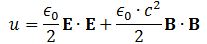
energy density

Its shape should not surprise you. The formula is quite intuitive really, even if its derivation is not. The formula represents the one thing that everyone knows about a wave, electromagnetic or not: the energy in it is proportional to the square of its amplitude, and so that’s E•E = E2 and B•B = B2. You should also note he cfactor that comes with the B•B product. It does two things here:

  1. As a physical constant, with some dimension of its own, it ensures that the dimensions on both sides of the equation come out alright.
  2. The magnitude of B is 1/c of that of E, so cB = E, and so that explains the extra c2 factor in the second term: we do get two waves for the price of one here and, therefore, twice the energy.

Speaking of dimensions, let’s quickly do the dimensional analysis:

  1. E is measured in newton per coulomb, so [E•E] = [E2] = N2/C2.
  2. B is measured in (N/C)/(m/s), so we get [B•B] = [B2] = (N2/C2)·(s2/m2). However, the dimension of our c2 factor is (m2/s2) and so we’re left with N2/C2. That’s nice, because we need to add stuff that’s expressed in the same units.
  3. The ε0 is that ubiquitous physical constant in electromagnetic theory: the electric constant, aka as the vacuum permittivity. Besides ensuring proportionality, it also ‘fixes’ our units, and so we should trust it to do the same thing here, and it does: [ε0] = C2/(N·m2), so if we multiply that with N2/C2, we find that u is expressed in N/m2.

Why is N/m2 an energy density? The correct answer to that question involves a rather complicated analysis, but there is an easier way to think about it: just multiply N/mwith m/m, and then its dimension becomes N·m/m= J/m3, so that’s  joule per cubic meter. That looks more like an energy density dimension, doesn’t it? But it’s actually the same thing. In any case, I need to move on.

We talked about the Poynting vector, and said it represents an energy flow. So how does that work? It is also quite intuitive, as its formula really speaks for itself. Let me write it down:

energy flux

Just look at it: u is the energy density, so that’s the amount of energy per unit volume at a given point, and so whatever flows out of that point must represent its time rate of change. As for the –S expression… Well… The • operator is the divergence, and so it give us the magnitude of a (vector) field’s source or sink at a given point. If C is a vector field (any vector field, really), then C is a scalar, and if it’s positive in a region, then that region is a source. Conversely, if it’s negative, then it’s a sink. To be precise, the divergence represents the volume density of the outward flux of a vector field from an infinitesimal volume around a given point. So, in this case, it gives us the volume density of the flux of S. If you’re somewhat familiar with electromagnetic theory, then you will immediately note that the formula has exactly the same shape as the j = −∂ρ/∂t formula, which represents a flow of electric charge.

But I need to get on with my own story here. In order to not create confusion, I will denote the total energy by U, rather than E, because we will continue to use E for the magnitude of the electric field. We said the real and the imaginary component of the wavefunction were like the E and B vector, but what’s their dimension? It must involve force, but it should obviously not involve any electric charge. So what are our options here? You know the electric force law (i.e. Coulomb’s Law) and the gravitational force law are structurally similar:

Coulomb Law

gravitation law

So what if we would just guess that the dimension of the real and imaginary component of our wavefunction should involve a newton per kg factor (N/kg), so that’s force per mass unit rather than force per unit charge? But… Hey! Wait a minute! Newton’s force law defines the newton in terms of mass and acceleration, so we can do a substitution here: 1 N = 1 kg·m/s2 ⇔ 1 kg = 1 N·s2/m. Hence, our N/kg dimension becomes:

N/kg = N/(N·s2/m)= m/s2

What is this: m/s2? Is that the dimension of the a·cosθ term in the a·ei·θ = a·cosθ − i·a·sinθ wavefunction? I hear you. This is getting quite crazy, but let’s see where it leads us. To calculate the equivalent energy density, we’d then need an equivalent for the ε0 factor, which – replacing the C by kg in the [ε0] = C2/(N·m2) expression – would be equal to kg2/(N·m2). Because we know what we want (energy is defined using the force unit, not the mass unit), we’ll want to substitute the kg unit once again, so – temporarily using the μ0 symbol for the equivalent of that ε0 constant – we get:

0] = [N·s2/m]2/(N·m2) = N·s4/m4

Hence, the dimension of the equivalent of that ε0·E2 term becomes:

 [(μ0/2)]·[cosθ]2 = (N·s4/m4)·m2/s= N/m2

Bingo! How does it work for the other component? The other component has the imaginary unit (i) in front. If we continue to pursue our comparison with the E and B vectors, we should assign an extra s/m dimension because of the ex and/or i factor, so the physical dimension of the i·sinθ term would be (m/s2)·(s/m) = s. What? Just the second? Relax. That second term in the energy density formula has the c2 factor, so it all works out:

 [(μ0/2)]·[c2]·[i·sinθ]2 = [(μ0/2)]·[c2]·[i]2·[sinθ]2 (N·s4/m4)·(m2/s2)·(s2/m2)·m2/s= N/m2

As weird as it is, it all works out. We can calculate and, hence, we can now also calculate the equivalent Poynting vector (S). However, I will let you think about that as an exercise. 🙂 Just note the grand conclusions:

  1. The physical dimension of the argument of the wavefunction is physical action (newton·meter·second) and Planck’s quantum of action is the scaling factor.
  2. The physical dimension of both the real and imaginary component of the elementary wavefunction is newton per kg (N/kg). This allows us to analyze the wavefunction as an energy propagation mechanism that is structurally similar to Maxwell’s equations, which represent the energy propagation mechanism when electromagnetic energy is involved.

As such, all we presented so far was a deep exploration of the mathematical equivalence between the gravitational and electromagnetic force laws:

Coulomb Law

gravitation law

The only difference is that mass comes in one color only, so to speak: it’s always positive. In contrast, electric charge comes in two colors: positive and negative. You can now guess what comes next. 🙂

Despite our grand conclusions, you should note we have not answered the most fundamental question of all. What is mass? What is electric charge? We have all these relations and equations, but are we any wiser, really? The answer to that question probably lies in general relativity: mass is that what curves spacetime. Likewise, we may look at electric charge as causing a very special type of spacetime curvature. However, even such answer – which would involve a much more complicated mathematical analysis – may not satisfy you. In any case, I will let you digest this post. I hope you enjoyed it as much as I enjoyed writing it. 🙂

Post scriptum: Of all of the weird stuff I presented here, I think the dimensional analyses were the most interesting. Think of the N/kg = N/(N·s2/m)= m/sidentity, for example. The m/s2 dimension is the dimension of physical acceleration (or deceleration): the rate of change of the velocity of an object. The identity comes straight out of Newton’s force law:

F = m·a ⇔ F/m = a

Now look, once again, at the animation, and remember the formula for the argument of the wavefunction: θ = E0∙t’. The energy of the particle that is being described is the (angular) frequency of the real and imaginary components of the wavefunction.

circle_cos_sin

The relation between (1) the (angular) frequency of a harmonic oscillator (which is what the sine and cosine represent here) and (2) the acceleration along the axis is given by the following equation:

a(x) = −ω02·x

I’ll let you think about what that means. I know you will struggle with it – because I did – and, hence, let me give you the following hint:

  1. The energy of an ordinary string wave, like a guitar string oscillating in one dimension only, will be proportional to the square of the frequency.
  2. However, for two-dimensional waves – such as an electromagnetic wave – we find that the energy is directly proportional to the frequency. Think of Einstein’s E = h·f = ħ·ω relation, for example. There is no squaring here!

It is a strange observation. Those two-dimensional waves – the matter-wave, or the electromagnetic wave – give us two waves for the price of one, each carrying half of the total energy but, as a result, we no longer have that square function. Think about it. Solving the mystery will make you feel like you’ve squared the circle, which – as you know – is impossible. 🙂

Some content on this page was disabled on June 16, 2020 as a result of a DMCA takedown notice from The California Institute of Technology. You can learn more about the DMCA here:

https://wordpress.com/support/copyright-and-the-dmca/

Quantum Mechanics: The Other Introduction

About three weeks ago, I brought my most substantial posts together in one document: it’s the Deep Blue page of this site. I also published it on Amazon/Kindle. It’s nice. It crowns many years of self-study, and many nights of short and bad sleep – as I was mulling over yet another paradox haunting me in my dreams. It’s been an extraordinary climb but, frankly, the view from the top is magnificent. 🙂 

The offer is there: anyone who is willing to go through it and offer constructive and/or substantial comments will be included in the book’s acknowledgements section when I go for a second edition (which it needs, I think). First person to be acknowledged here is my wife though, Maria Elena Barron, as she has given me the spacetime:-) and, more importantly, the freedom to take this bull by its horns.Below I just copy the foreword, just to give you a taste of it. 🙂

Foreword

Another introduction to quantum mechanics? Yep. I am not hoping to sell many copies, but I do hope my unusual background—I graduated as an economist, not as a physicist—will encourage you to take on the challenge and grind through this.

I’ve always wanted to thoroughly understand, rather than just vaguely know, those quintessential equations: the Lorentz transformations, the wavefunction and, above all, Schrödinger’s wave equation. In my bookcase, I’ve always had what is probably the most famous physics course in the history of physics: Richard Feynman’s Lectures on Physics, which have been used for decades, not only at Caltech but at many of the best universities in the world. Plus a few dozen other books. Popular books—which I now regret I ever read, because they were an utter waste of time: the language of physics is math and, hence, one should read physics in math—not in any other language.

But Feynman’s Lectures on Physics—three volumes of about fifty chapters each—are not easy to read. However, the experimental verification of the existence of the Higgs particle in CERN’s LHC accelerator a couple of years ago, and the award of the Nobel prize to the scientists who had predicted its existence (including Peter Higgs and François Englert), convinced me it was about time I take the bull by its horns. While, I consider myself to be of average intelligence only, I do feel there’s value in the ideal of the ‘Renaissance man’ and, hence, I think stuff like this is something we all should try to understand—somehow. So I started to read, and I also started a blog (www.readingfeynman.org) to externalize my frustration as I tried to cope with the difficulties involved. The site attracted hundreds of visitors every week and, hence, it encouraged me to publish this booklet.

So what is it about? What makes it special? In essence, it is a common-sense introduction to the key concepts in quantum physics. However, while common-sense, it does not shy away from the math, which is complicated, but not impossible. So this little book is surely not a Guide to the Universe for Dummies. I do hope it will guide some Not-So-Dummies. It basically recycles what I consider to be my more interesting posts, but combines them in a comprehensive structure.

It is a bit of a philosophical analysis of quantum mechanics as well, as I will – hopefully – do a better job than others in distinguishing the mathematical concepts from what they are supposed to describe, i.e. physical reality.

Last but not least, it does offer some new didactic perspectives. For those who know the subject already, let me briefly point these out:

I. Few, if any, of the popular writers seems to have noted that the argument of the wavefunction (θ = E·t – p·t) – using natural units (hence, the numerical value of ħ and c is one), and for an object moving at constant velocity (hence, x = v·t) – can be written as the product of the proper time of the object and its rest mass:

θ = E·t – p·x = E·t − p·x = mv·t − mv·v·x = mv·(t − v·x)

⇔ θ = m0·(t − v·x)/√(1 – v2) = m0·t’

Hence, the argument of the wavefunction is just the proper time of the object with the rest mass acting as a scaling factor for the time: the internal clock of the object ticks much faster if it’s heavier. This symmetry between the argument of the wavefunction of the object as measured in its own (inertial) reference frame, and its argument as measured by us, in our own reference frame, is remarkable, and allows to understand the nature of the wavefunction in a more intuitive way.

While this approach reflects Feynman’s idea of the photon stopwatch, the presentation in this booklet generalizes the concept for all wavefunctions, first and foremost the wavefunction of the matter-particles that we’re used to (e.g. electrons).

II. Few, if any, have thought of looking at Schrödinger’s wave equation as an energy propagation mechanism. In fact, when helping my daughter out as she was trying to understand non-linear regression (logit and Poisson regressions), it suddenly realized we can analyze the wavefunction as a link function that connects two physical spaces: the physical space of our moving object, and a physical energy space.

Re-inserting Planck’s quantum of action in the argument of the wavefunction – so we write θ as θ = (E/ħ)·t – (p/ħ)·x = [E·t – p·x]/ħ – we may assign a physical dimension to it: when interpreting ħ as a scaling factor only (and, hence, when we only consider its numerical value, not its physical dimension), θ becomes a quantity expressed in newton·meter·second, i.e. the (physical) dimension of action. It is only natural, then, that we would associate the real and imaginary part of the wavefunction with some physical dimension too, and a dimensional analysis of Schrödinger’s equation tells us this dimension must be energy.

This perspective allows us to look at the wavefunction as an energy propagation mechanism, with the real and imaginary part of the probability amplitude interacting in very much the same way as the electric and magnetic field vectors E and B. This leads me to the next point, which I make rather emphatically in this booklet:  the propagation mechanism for electromagnetic energy – as described by Maxwell’s equations – is mathematically equivalent to the propagation mechanism that’s implicit in the Schrödinger equation.

I am, therefore, able to present the Schrödinger equation in a much more coherent way, describing not only how this famous equation works for electrons, or matter-particles in general (i.e. fermions or spin-1/2 particles), which is probably the only use of the Schrödinger equation you are familiar with, but also how it works for bosons, including the photon, of course, but also the theoretical zero-spin boson!

In fact, I am personally rather proud of this. Not because I am doing something that hasn’t been done before (I am sure many have come to the same conclusions before me), but because one always has to trust one’s intuition. So let me say something about that third innovation: the photon wavefunction.

III. Let me tell you the little story behind my photon wavefunction. One of my acquaintances is a retired nuclear scientist. While he knew I was delving into it all, I knew he had little time to answer any of my queries. However, when I asked him about the wavefunction for photons, he bluntly told me photons didn’t have a wavefunction. I should just study Maxwell’s equations and that’s it: there’s no wavefunction for photons: just this traveling electric and a magnetic field vector. Look at Feynman’s Lectures, or any textbook, he said. None of them talk about photon wavefunctions. That’s true, but I knew he had to be wrong. I mulled over it for several months, and then just sat down and started doing to fiddle with Maxwell’s equations, assuming the oscillations of the E and B vector could be described by regular sinusoids. And – Lo and behold! – I derived a wavefunction for the photon. It’s fully equivalent to the classical description, but the new expression solves the Schrödinger equation, if we modify it in a rather logical way: we have to double the diffusion constant, which makes sense, because E and B give you two waves for the price of one!

[…]

In any case, I am getting ahead of myself here, and so I should wrap up this rather long introduction. Let me just say that, through my rather long journey in search of understanding – rather than knowledge alone – I have learned there are so many wrong answers out there: wrong answers that hamper rather than promote a better understanding. Moreover, I was most shocked to find out that such wrong answers are not the preserve of amateurs alone! This emboldened me to write what I write here, and to publish it. Quantum mechanics is a logical and coherent framework, and it is not all that difficult to understand. One just needs good pointers, and that’s what I want to provide here.

As of now, it focuses on the mechanics in particular, i.e. the concept of the wavefunction and wave equation (better known as Schrödinger’s equation). The other aspect of quantum mechanics – i.e. the idea of uncertainty as implied by the quantum idea – will receive more attention in a later version of this document. I should also say I will limit myself to quantum electrodynamics (QED) only, so I won’t discuss quarks (i.e. quantum chromodynamics, which is an entirely different realm), nor will I delve into any of the other more recent advances of physics.

In the end, you’ll still be left with lots of unanswered questions. However, that’s quite OK, as Richard Feynman himself was of the opinion that he himself did not understand the topic the way he would like to understand it. But then that’s exactly what draws all of us to quantum physics: a common search for a deep and full understanding of reality, rather than just some superficial description of it, i.e. knowledge alone.

So let’s get on with it. I am not saying this is going to be easy reading. In fact, I blogged about much easier stuff than this in my blog—treating only aspects of the whole theory. This is the whole thing, and it’s not easy to swallow. In fact, it may well too big to swallow as a whole. But please do give it a try. I wanted this to be an intuitive but formally correct introduction to quantum math. However, when everything is said and done, you are the only who can judge if I reached that goal.

Of course, I should not forget the acknowledgements but… Well… It was a rather lonely venture, so I am only going to acknowledge my wife here, Maria, who gave me all of the spacetime and all of the freedom I needed, as I would get up early, or work late after coming home from my regular job. I sacrificed weekends, which we could have spent together, and – when mulling over yet another paradox – the nights were often short and bad. Frankly, it’s been an extraordinary climb, but the view from the top is magnificent.

I just need to insert one caution, my site (www.readingfeynman.org) includes animations, which make it much easier to grasp some of the mathematical concepts that I will be explaining. Hence, I warmly recommend you also have a look at that site, and its Deep Blue page in particular – as that page has the same contents, more or less, but the animations make it a much easier read.

Have fun with it!

Jean Louis Van Belle, BA, MA, BPhil, Drs.

The Imaginary Energy Space

Post scriptum note added on 11 July 2016: This is one of the more speculative posts which led to my e-publication analyzing the wavefunction as an energy propagation. With the benefit of hindsight, I would recommend you to immediately the more recent exposé on the matter that is being presented here, which you can find by clicking on the provided link. In addition, I see the dark force has amused himself by removing some material even here!

Original post:

Intriguing title, isn’t it? You’ll think this is going to be highly speculative and you’re right. In fact, I could also have written: the imaginary action space, or the imaginary momentum space. Whatever. It all works ! It’s an imaginary space – but a very real one, because it holds energy, or momentum, or a combination of both, i.e. action. 🙂

So the title is either going to deter you or, else, encourage you to read on. I hope it’s the latter. 🙂

In my post on Richard Feynman’s exposé on how Schrödinger got his famous wave equation, I noted an ambiguity in how he deals with the energy concept. I wrote that piece in February, and we are now May. In-between, I looked at Schrödinger’s equation from various perspectives, as evidenced from the many posts that followed that February post, which I summarized on my Deep Blue page, where I note the following:

  1. The argument of the wavefunction (i.e. θ = ωt – kx = [E·t – p·x]/ħ) is just the proper time of the object that’s being represented by the wavefunction (which, in most cases, is an elementary particle—an electron, for example).
  2. The 1/2 factor in Schrödinger’s equation (∂ψ/∂t = i·(ħ/2m)·∇2ψ) doesn’t make all that much sense, so we should just drop it. Writing ∂ψ/∂t = i·(m/ħ)∇2ψ (i.e. Schrödinger’s equation without the 1/2 factor) does away with the mentioned ambiguities and, more importantly, avoids obvious contradictions.

Both remarks are rather unusual—especially the second one. In fact, if you’re not shocked by what I wrote above (Schrödinger got something wrong!), then stop reading—because then you’re likely not to understand a thing of what follows. 🙂 In any case, I thought it would be good to follow up by devoting a separate post to this matter.

The argument of the wavefunction as the proper time

Frankly, it took me quite a while to see that the argument of the wavefunction is nothing but the t’ = (t − v∙x)/√(1−v2)] formula that we know from the Lorentz transformation of spacetime. Let me quickly give you the formulas (just substitute the for v):

relativity

In fact, let me be precise: the argument of the wavefunction also has the particle’s rest mass m0 in it. That mass factor (m0) appears in it as a general scaling factor, so it determines the density of the wavefunction both in time as well as in space. Let me jot it down:

ψ(x, t) = a·ei·(mv·t − p∙x) = a·ei·[(m0/√(1−v2))·t − (m0·v/√(1−v2))∙x] = a·ei·m0·(t − v∙x)/√(1−v2)

Huh? Yes. Let me show you how we get from θ = ωt – kx = [E·t – p·x]/ħ to θ = mv·t − p∙x. It’s really easy. We first need to choose our units such that the speed of light and Planck’s constant are numerically equal to one, so we write: = 1 and ħ = 1. So now the 1/ħ factor no longer appears.

[Let me note something here: using natural units does not do away with the dimensions: the dimensions of whatever is there remain what they are. For example, energy remains what it is, and so that’s force over distance: 1 joule = 1 newton·meter (1 J = 1 N·m. Likewise, momentum remains what it is: force times time (or mass times velocity). Finally, the dimension of the quantum of action doesn’t disappear either: it remains the product of force, distance and time (N·m·s). So you should distinguish between the numerical value of our variables and their dimension. Always! That’s where physics is different from algebra: the equations actually mean something!]

Now, because we’re working in natural units, the numerical value of both and cwill be equal to 1. It’s obvious, then, that Einstein’s mass-energy equivalence relation reduces from E = mvc2 to E = mv. You can work out the rest yourself – noting that p = mv·v and mv = m0/√(1−v2). Done! For a more intuitive explanation, I refer you to the above-mentioned page.

So that’s for the wavefunction. Let’s now look at Schrödinger’s wave equation, i.e. that differential equation of which our wavefunction is a solution. In my introduction, I bluntly said there was something wrong with it: that 1/2 factor shouldn’t be there. Why not?

What’s wrong with Schrödinger’s equation?

When deriving his famous equation, Schrödinger uses the mass concept as it appears in the classical kinetic energy formula: K.E. = m·v2/2, and that’s why – after all the complicated turns – that 1/2 factor is there. There are many reasons why that factor doesn’t make sense. Let me sum up a few.

[I] The most important reason is that de Broglie made it quite clear that the energy concept in his equations for the temporal and spatial frequency for the wavefunction – i.e. the ω = E/ħ and k = p/ħ relations – is the total energy, including rest energy (m0), kinetic energy (m·v2/2) and any potential energy (V). In fact, if we just multiply the two de Broglie (aka as matter-wave equations) and use the old-fashioned v = λ relation (so we write E as E = ω·ħ = (2π·f)·(h/2π) = f·h, and p as p = k·ħ = (2π/λ)·(h/2π) = h/λ and, therefore, we have = E/h and p = h/p), we find that the energy concept that’s implicit in the two matter-wave equations is equal to E = m∙v2, as shown below:

  1. f·λ = (E/h)·(h/p) = E/p
  2. v = λ ⇒ f·λ = v = E/p ⇔ E = v·p = v·(m·v) ⇒ E = m·v2

Huh? E = m∙v2? Yes. Not E = m∙c2 or m·v2/2 or whatever else you might be thinking of. In fact, this E = m∙v2 formula makes a lot of sense in light of the two following points.

Skeptical note: You may – and actually should – wonder whether we can use that v = λ relation for a wave like this, i.e. a wave with both a real (cos(-θ)) as well as an imaginary component (i·sin(-θ). It’s a deep question, and I’ll come back to it later. But… Yes. It’s the right question to ask. 😦

[II] Newton told us that force is mass time acceleration. Newton’s law is still valid in Einstein’s world. The only difference between Newton’s and Einstein’s world is that, since Einstein, we should treat the mass factor as a variable as well. We write: F = mv·a = mv·= [m0/√(1−v2)]·a. This formula gives us the definition of the newton as a force unit: 1 N = 1 kg·(m/s)/s = 1 kg·m/s2. [Note that the 1/√(1−v2) factor – i.e. the Lorentz factor (γ) – has no dimension, because is measured as a relative velocity here, i.e. as a fraction between 0 and 1.]

Now, you’ll agree the definition of energy as a force over some distance is valid in Einstein’s world as well. Hence, if 1 joule is 1 N·m, then 1 J is also equal to 1 (kg·m/s2)·m = 1 kg·(m2/s2), so this also reflects the E = m∙v2 concept. [I can hear you mutter: that kg factor refers to the rest mass, no? No. It doesn’t. The kg is just a measure of inertia: as a unit, it applies to both mas well as mv. Full stop.]

Very skeptical note: You will say this doesn’t prove anything – because this argument just shows the dimensional analysis for both equations (i.e. E = m∙v2 and E = m∙c2) is OK. Hmm… Yes. You’re right. 🙂 But the next point will surely convince you! 🙂

[III] The third argument is the most intricate and the most beautiful at the same time—not because it’s simple (like the arguments above) but because it gives us an interpretation of what’s going on here. It’s fairly easy to verify that Schrödinger’s equation, ∂ψ/∂t = i·(ħ/2m)·∇2ψ equation (including the 1/2 factor to which I object), is equivalent to the following set of two equations:

  1. Re(∂ψ/∂t) = −(ħ/2m)·Im(∇2ψ)
  2. Im(∂ψ/∂t) = (ħ/2m)·Re(∇2ψ)

[In case you don’t see it immediately, note that two complex numbers a + i·b and c + i·d are equal if, and only if, their real and imaginary parts are the same. However, here we have something like this: a + i·b = i·(c + i·d) = i·c + i2·d = − d + i·c (remember i= −1).]

Now, before we proceed (i.e. before I show you what’s wrong here with that 1/2 factor), let us look at the dimensions first. For that, we’d better analyze the complete Schrödinger equation so as to make sure we’re not doing anything stupid here by looking at one aspect of the equation only. The complete equation, in its original form, is:

schrodinger 5

Notice that, to simplify the analysis above, I had moved the and the ħ on the left-hand side to the right-hand side (note that 1/= −i, so −(ħ2/2m)/(i·ħ) = ħ/2m). Now, the ħfactor on the right-hand side is expressed in J2·s2. Now that doesn’t make much sense, but then that mass factor in the denominator makes everything come out alright. Indeed, we can use the mass-equivalence relation to express m in J/(m/s)2 units. So our ħ2/2m coefficient is expressed in (J2·s2)/[J/(m/s)2] = J·m2. Now we multiply that by that Laplacian operating on some scalar, which yields some quantity per square meter. So the whole right-hand side becomes some amount expressed in joule, i.e. the unit of energy! Interesting, isn’t it?

On the left-hand side, we have i and ħ. We shouldn’t worry about the imaginary unit because we can treat that as just another number, albeit a very special number (because its square is minus 1). However, in this equation, it’s like a mathematical constant and you can think of it as something like π or e. [Think of the magical formula: eiπ = i2 = −1.] In contrast, ħ is a physical constant, and so that constant comes with some dimension and, therefore, we cannot just do what we want. [I’ll show, later, that even moving it to the other side of the equation comes with interpretation problems, so be careful with physical constants, as they really mean something!] In this case, its dimension is the action dimension: J·s = N·m·s, so that’s force times distance times time. So we multiply that with a time derivative and we get joule once again (N·m·s/s = N·m = J), so that’s the unit of energy. So it works out: we have joule units both left and right in Schrödinger’s equation. Nice! Yes. But what does it mean? 🙂

Well… You know that we can – and should – think of Schrödinger’s equation as a diffusion equation – just like a heat diffusion equation, for example – but then one describing the diffusion of a probability amplitude. [In case you are not familiar with this interpretation, please do check my post on it, or my Deep Blue page.] But then we didn’t describe the mechanism in very much detail, so let me try to do that now and, in the process, finally explain the problem with the 1/2 factor.

The missing energy

There are various ways to explain the problem. One of them involves calculating group and phase velocities of the elementary wavefunction satisfying Schrödinger’s equation but that’s a more complicated approach and I’ve done that elsewhere, so just click the reference if you prefer the more complicated stuff. I find it easier to just use those two equations above:

  1. Re(∂ψ/∂t) = −(ħ/2m)·Im(∇2ψ)
  2. Im(∂ψ/∂t) = (ħ/2m)·Re(∇2ψ)

The argument is the following: if our elementary wavefunction is equal to ei(kx − ωt) = cos(kx−ωt) + i∙sin(kx−ωt), then it’s easy to proof that this pair of conditions is fulfilled if, and only if, ω = k2·(ħ/2m). [Note that I am omitting the normalization coefficient in front of the wavefunction: you can put it back in if you want. The argument here is valid, with or without normalization coefficients.] Easy? Yes. Check it out. The time derivative on the left-hand side is equal to:

∂ψ/∂t = −iω·iei(kx − ωt) = ω·[cos(kx − ωt) + i·sin(kx − ωt)] = ω·cos(kx − ωt) + iω·sin(kx − ωt)

And the second-order derivative on the right-hand side is equal to:

2ψ = ∂2ψ/∂x= i·k2·ei(kx − ωt) = k2·cos(kx − ωt) + i·k2·sin(kx − ωt)

So the two equations above are equivalent to writing:

  1. Re(∂ψB/∂t) =   −(ħ/2m)·Im(∇2ψB) ⇔ ω·cos(kx − ωt) = k2·(ħ/2m)·cos(kx − ωt)
  2. Im(∂ψB/∂t) = (ħ/2m)·Re(∇2ψB) ⇔ ω·sin(kx − ωt) = k2·(ħ/2m)·sin(kx − ωt)

So both conditions are fulfilled if, and only if, ω = k2·(ħ/2m). You’ll say: so what? Well… We have a contradiction here—something that doesn’t make sense. Indeed, the second of the two de Broglie equations (always look at them as a pair) tells us that k = p/ħ, so we can re-write the ω = k2·(ħ/2m) condition as:

ω/k = vp = k2·(ħ/2m)/k = k·ħ/(2m) = (p/ħ)·(ħ/2m) = p/2m ⇔ p = 2m

You’ll say: so what? Well… Stop reading, I’d say. That p = 2m doesn’t make sense—at all! Nope! In fact, if you thought that the E = m·v2  is weird—which, I hope, is no longer the case by now—then… Well… This p = 2m equation is much weirder. In fact, it’s plain nonsense: this condition makes no sense whatsoever. The only way out is to remove the 1/2 factor, and to re-write the Schrödinger equation as I wrote it, i.e. with an ħ/m coefficient only, rather than an (1/2)·(ħ/m) coefficient.

Huh? Yes.

As mentioned above, I could do those group and phase velocity calculations to show you what rubbish that 1/2 factor leads to – and I’ll do that eventually – but let me first find yet another way to present the same paradox. Let’s simplify our life by choosing our units such that = ħ = 1, so we’re using so-called natural units rather than our SI units. [Again, note that switching to natural units doesn’t do anything to the physical dimensions: a force remains a force, a distance remains a distance, and so on.] Our mass-energy equivalence then becomes: E = m·c= m·1= m. [Again, note that switching to natural units doesn’t do anything to the physical dimensions: a force remains a force, a distance remains a distance, and so on. So we’d still measure energy and mass in different but equivalent units. Hence, the equality sign should not make you think mass and energy are actually the same: energy is energy (i.e. force times distance), while mass is mass (i.e. a measure of inertia). I am saying this because it’s important, and because it took me a while to make these rather subtle distinctions.]

Let’s now go one step further and imagine a hypothetical particle with zero rest mass, so m0 = 0. Hence, all its energy is kinetic and so we write: K.E. = mv·v/2. Now, because this particle has zero rest mass, the slightest acceleration will make it travel at the speed of light. In fact, we would expect it to travel at the speed, so mv = mc and, according to the mass-energy equivalence relation, its total energy is, effectively, E = mv = mc. However, we just said its total energy is kinetic energy only. Hence, its total energy must be equal to E = K.E. = mc·c/2 = mc/2. So we’ve got only half the energy we need. Where’s the other half? Where’s the missing energy? Quid est veritas? Is its energy E = mc or E = mc/2?

It’s just a paradox, of course, but one we have to solve. Of course, we may just say we trust Einstein’s E = m·c2 formula more than the kinetic energy formula, but that answer is not very scientific. 🙂 We’ve got a problem here and, in order to solve it, I’ve come to the following conclusion: just because of its sheer existence, our zero-mass particle must have some hidden energy, and that hidden energy is also equal to E = m·c2/2. Hence, the kinetic and the hidden energy add up to E = m·c2 and all is alright.

Huh? Hidden energy? I must be joking, right?

Well… No. Let me explain. Oh. And just in case you wonder why I bother to try to imagine zero-mass particles. Let me tell you: it’s the first step towards finding a wavefunction for a photon and, secondly, you’ll see it just amounts to modeling the propagation mechanism of energy itself. 🙂

The hidden energy as imaginary energy

I am tempted to refer to the missing energy as imaginary energy, because it’s linked to the imaginary part of the wavefunction. However, it’s anything but imaginary: it’s as real as the imaginary part of the wavefunction. [I know that sounds a bit nonsensical, but… Well… Think about it. And read on!]

Back to that factor 1/2. As mentioned above, it also pops up when calculating the group and the phase velocity of the wavefunction. In fact, let me show you that calculation now. [Sorry. Just hang in there.] It goes like this.

The de Broglie relations tell us that the k and the ω in the ei(kx − ωt) = cos(kx−ωt) + i∙sin(kx−ωt) wavefunction (i.e. the spatial and temporal frequency respectively) are equal to k = p/ħ, and ω = E/ħ. Let’s now think of that zero-mass particle once more, so we assume all of its energy is kinetic: no rest energy, no potential! So… If we now use the kinetic energy formula E = m·v2/2 – which we can also write as E = m·v·v/2 = p·v/2 = p·p/2m = p2/2m, with v = p/m the classical velocity of the elementary particle that Louis de Broglie was thinking of – then we can calculate the group velocity of our ei(kx − ωt) = cos(kx−ωt) + i∙sin(kx−ωt) wavefunction as:

vg = ∂ω/∂k = ∂[E/ħ]/∂[p/ħ] = ∂E/∂p = ∂[p2/2m]/∂p = 2p/2m = p/m = v

[Don’t tell me I can’t treat m as a constant when calculating ∂ω/∂k: I can. Think about it.]

Fine. Now the phase velocity. For the phase velocity of our ei(kx − ωt) wavefunction, we find:

vp = ω/k = (E/ħ)/(p/ħ) = E/p = (p2/2m)/p = p/2m = v/2

So that’s only half of v: it’s the 1/2 factor once more! Strange, isn’t it? Why would we get a different value for the phase velocity here? It’s not like we have two different frequencies here, do we? Well… No. You may also note that the phase velocity turns out to be smaller than the group velocity (as mentioned, it’s only half of the group velocity), which is quite exceptional as well! So… Well… What’s the matter here? We’ve got a problem!

What’s going on here? We have only one wave here—one frequency and, hence, only one k and ω. However, on the other hand, it’s also true that the ei(kx − ωt) wavefunction gives us two functions for the price of one—one real and one imaginary: ei(kx − ωt) = cos(kx−ωt) + i∙sin(kx−ωt). So the question here is: are we adding waves, or are we not? It’s a deep question. If we’re adding waves, we may get different group and phase velocities, but if we’re not, then… Well… Then the group and phase velocity of our wave should be the same, right? The answer is: we are and we aren’t. It all depends on what you mean by ‘adding’ waves. I know you don’t like that answer, but that’s the way it is, really. 🙂

Let me make a small digression here that will make you feel even more confused. You know – or you should know – that the sine and the cosine function are the same except for a phase difference of 90 degrees: sinθ = cos(θ + π/2). Now, at the same time, multiplying something with amounts to a rotation by 90 degrees, as shown below.

Hence, in order to sort of visualize what our ei(kx − ωt) function really looks like, we may want to super-impose the two graphs and think of something like this:

vision

You’ll have to admit that, when you see this, our formulas for the group or phase velocity, or our v = λ relation, do no longer make much sense, do they? 🙂

Having said that, that 1/2 factor is and remains puzzling, and there must be some logical reason for it. For example, it also pops up in the Uncertainty Relations:

Δx·Δp ≥ ħ/2 and ΔE·Δt ≥ ħ/2

So we have ħ/2 in both, not ħ. Why do we need to divide the quantum of action here? How do we solve all these paradoxes? It’s easy to see how: the apparent contradiction (i.e. the different group and phase velocity) gets solved if we’d use the E = m∙v2 formula rather than the kinetic energy E = m∙v2/2. But then… What energy formula is the correct one: E = m∙v2 or m∙c2? Einstein’s formula is always right, isn’t it? It must be, so let me postpone the discussion a bit by looking at a limit situation. If v = c, then we don’t need to make a choice, obviously. 🙂 So let’s look at that limit situation first. So we’re discussing our zero-mass particle once again, assuming it travels at the speed of light. What do we get?

Well… Measuring time and distance in natural units, so c = 1, we have:

E = m∙c2 = m and p = m∙c = m, so we get: E = m = p

Waw ! E = m = p ! What a weird combination, isn’t it? Well… Yes. But it’s fully OK. [You tell me why it wouldn’t be OK. It’s true we’re glossing over the dimensions here, but natural units are natural units and, hence, the numerical value of c and c2 is 1. Just figure it out for yourself.] The point to note is that the E = m = p equality yields extremely simple but also very sensible results. For the group velocity of our ei(kx − ωt) wavefunction, we get:

vg = ∂ω/∂k = ∂[E/ħ]/∂[p/ħ] = ∂E/∂p = ∂p/∂p = 1

So that’s the velocity of our zero-mass particle (remember: the 1 stands for c here, i.e. the speed of light) expressed in natural units once more—just like what we found before. For the phase velocity, we get:

vp = ω/k = (E/ħ)/(p/ħ) = E/p = p/p = 1

Same result! No factor 1/2 here! Isn’t that great? My ‘hidden energy theory’ makes a lot of sense.:-)

However, if there’s hidden energy, we still need to show where it’s hidden. 🙂 Now that question is linked to the propagation mechanism that’s described by those two equations, which now – leaving the 1/2 factor out, simplify to:

  1. Re(∂ψ/∂t) = −(ħ/m)·Im(∇2ψ)
  2. Im(∂ψ/∂t) = (ħ/m)·Re(∇2ψ)

Propagation mechanism? Yes. That’s what we’re talking about here: the propagation mechanism of energy. Huh? Yes. Let me explain in another separate section, so as to improve readability. Before I do, however, let me add another note—for the skeptics among you. 🙂

Indeed, the skeptics among you may wonder whether our zero-mass particle wavefunction makes any sense at all, and they should do so for the following reason: if x = 0 at t = 0, and it’s traveling at the speed of light, then x(t) = t. Always. So if E = m = p, the argument of our wavefunction becomes E·t – p·x = E·t – E·t = 0! So what’s that? The proper time of our zero-mass particle is zero—always and everywhere!?

Well… Yes. That’s why our zero-mass particle – as a point-like object – does not really exist. What we’re talking about is energy itself, and its propagation mechanism. 🙂

While I am sure that, by now, you’re very tired of my rambling, I beg you to read on. Frankly, if you got as far as you have, then you should really be able to work yourself through the rest of this post. 🙂 And I am sure that – if anything – you’ll find it stimulating! 🙂

The imaginary energy space

Look at the propagation mechanism for the electromagnetic wave in free space, which (for = 1) is represented by the following two equations:

  1. B/∂t = –∇×E
  2. E/∂t = ∇×B

[In case you wonder, these are Maxwell’s equations for free space, so we have no stationary nor moving charges around.] See how similar this is to the two equations above? In fact, in my Deep Blue page, I use these two equations to derive the quantum-mechanical wavefunction for the photon (which is not the same as that hypothetical zero-mass particle I introduced above), but I won’t bother you with that here. Just note the so-called curl operator in the two equations above (∇×) can be related to the Laplacian we’ve used so far (∇2). It’s not the same thing, though: for starters, the curl operator operates on a vector quantity, while the Laplacian operates on a scalar (including complex scalars). But don’t get distracted now. Let’s look at the revised Schrödinger’s equation, i.e. the one without the 1/2 factor:

∂ψ/∂t = i·(ħ/m)·∇2ψ

On the left-hand side, we have a time derivative, so that’s a flow per second. On the right-hand side we have the Laplacian and the i·ħ/m factor. Now, written like this, Schrödinger’s equation really looks exactly the same as the general diffusion equation, which is written as: ∂φ/∂t = D·∇2φ, except for the imaginary unit, which makes it clear we’re getting two equations for the price of one here, rather than one only! 🙂 The point is: we may now look at that ħ/m factor as a diffusion constant, because it does exactly the same thing as the diffusion constant D in the diffusion equation ∂φ/∂t = D·∇2φ, i.e:

  1. As a constant of proportionality, it quantifies the relationship between both derivatives.
  2. As a physical constant, it ensures the dimensions on both sides of the equation are compatible.

So the diffusion constant for  Schrödinger’s equation is ħ/m. What is its dimension? That’s easy: (N·m·s)/(N·s2/m) = m2/s. [Remember: 1 N = 1 kg·m/s2.] But then we multiply it with the Laplacian, so that’s something expressed per square meter, so we get something per second on both sides.

Of course, you wonder: what per second? Not sure. That’s hard to say. Let’s continue with our analogy with the heat diffusion equation so as to try to get a better understanding of what’s being written here. Let me give you that heat diffusion equation here. Assuming the heat per unit volume (q) is proportional to the temperature (T) – which is the case when expressing T in degrees Kelvin (K), so we can write q as q = k·T  – we can write it as:

heat diffusion 2

So that’s structurally similar to Schrödinger’s equation, and to the two equivalent equations we jotted down above. So we’ve got T (temperature) in the role of ψ here—or, to be precise, in the role of ψ ‘s real and imaginary part respectively. So what’s temperature? From the kinetic theory of gases, we know that temperature is not just a scalar: temperature measures the mean (kinetic) energy of the molecules in the gas. That’s why we can confidently state that the heat diffusion equation models an energy flow, both in space as well as in time.

Let me make the point by doing the dimensional analysis for that heat diffusion equation. The time derivative on the left-hand side (∂T/∂t) is expressed in K/s (Kelvin per second). Weird, isn’t it? What’s a Kelvin per second? Well… Think of a Kelvin as some very small amount of energy in some equally small amount of space—think of the space that one molecule needs, and its (mean) energy—and then it all makes sense, doesn’t it?

However, in case you find that a bit difficult, just work out the dimensions of all the other constants and variables. The constant in front (k) makes sense of it. That coefficient (k) is the (volume) heat capacity of the substance, which is expressed in J/(m3·K). So the dimension of the whole thing on the left-hand side (k·∂T/∂t) is J/(m3·s), so that’s energy (J) per cubic meter (m3) and per second (s). Nice, isn’t it? What about the right-hand side? On the right-hand side we have the Laplacian operator  – i.e. ∇= ·, with ∇ = (∂/∂x,  ∂/∂y,  ∂/∂z) – operating on T. The Laplacian operator, when operating on a scalar quantity, gives us a flux density, i.e. something expressed per square meter (1/m2). In this case, it’s operating on T, so the dimension of ∇2T is K/m2. Again, that doesn’t tell us very much (what’s the meaning of a Kelvin per square meter?) but we multiply it by the thermal conductivity (κ), whose dimension is W/(m·K) = J/(m·s·K). Hence, the dimension of the product is  the same as the left-hand side: J/(m3·s). So that’s OK again, as energy (J) per cubic meter (m3) and per second (s) is definitely something we can associate with an energy flow.

In fact, we can play with this. We can bring k from the left- to the right-hand side of the equation, for example. The dimension of κ/k is m2/s (check it!), and multiplying that by K/m(i.e. the dimension of ∇2T) gives us some quantity expressed in Kelvin per second, and so that’s the same dimension as that of ∂T/∂t. Done! 

In fact, we’ve got two different ways of writing Schrödinger’s diffusion equation. We can write it as ∂ψ/∂t = i·(ħ/m)·∇2ψ or, else, we can write it as ħ·∂ψ/∂t = i·(ħ2/m)·∇2ψ. Does it matter? I don’t think it does. The dimensions come out OK in both cases. However, interestingly, if we do a dimensional analysis of the ħ·∂ψ/∂t = i·(ħ2/m)·∇2ψ equation, we get joule on both sides. Interesting, isn’t it? The key question, of course, is: what is it that is flowing here?

I don’t have a very convincing answer to that, but the answer I have is interesting—I think. 🙂 Think of the following: we can multiply Schrödinger’s equation with whatever we want, and then we get all kinds of flows. For example, if we multiply both sides with 1/(m2·s) or 1/(m3·s), we get a equation expressing the energy conservation law, indeed! [And you may want to think about the minus sign of the  right-hand side of Schrödinger’s equation now, because it makes much more sense now!]

We could also multiply both sides with s, so then we get J·s on both sides, i.e. the dimension of physical action (J·s = N·m·s). So then the equation expresses the conservation of actionHuh? Yes. Let me re-phrase that: then it expresses the conservation of angular momentum—as you’ll surely remember that the dimension of action and angular momentum are the same. 🙂

And then we can divide both sides by m, so then we get N·s on both sides, so that’s momentum. So then Schrödinger’s equation embodies the momentum conservation law.

Isn’t it just wonderfulSchrödinger’s equation packs all of the conservation laws!:-) The only catch is that it flows back and forth from the real to the imaginary space, using that propagation mechanism as described in those two equations.

Now that is really interesting, because it does provide an explanation – as fuzzy as it may seem – for all those weird concepts one encounters when studying physics, such as the tunneling effect, which amounts to energy flowing from the imaginary space to the real space and, then, inevitably, flowing back. It also allows for borrowing time from the imaginary space. Hmm… Interesting! [I know I still need to make these points much more formally, but… Well… You kinda get what I mean, don’t you?]

To conclude, let me re-baptize my real and imaginary ‘space’ by referring to them to what they really are: a real and imaginary energy space respectively. Although… Now that I think of it: it could also be real and imaginary momentum space, or a real and imaginary action space. Hmm… The latter term may be the best. 🙂

Isn’t this all great? I mean… I could go on and on—but I’ll stop here, so you can freewheel around yourself. For  example, you may wonder how similar that energy propagation mechanism actually is as compared to the propagation mechanism of the electromagnetic wave? The answer is: very similar. You can check how similar in one of my posts on the photon wavefunction or, if you’d want a more general argument, check my Deep Blue page. Have fun exploring! 🙂

So… Well… That’s it, folks. I hope you enjoyed this post—if only because I really enjoyed writing it. 🙂

[…]

OK. You’re right. I still haven’t answered the fundamental question.

So what about  the 1/2 factor?

What about that 1/2 factor? Did Schrödinger miss it? Well… Think about it for yourself. First, I’d encourage you to further explore that weird graph with the real and imaginary part of the wavefunction. I copied it below, but with an added 45º line—yes, the green diagonal. To make it somewhat more real, imagine you’re the zero-mass point-like particle moving along that line, and we observe you from our inertial frame of reference, using equivalent time and distance units.

spacetime travel

So we’ve got that cosine (cosθ) varying as you travel, and we’ve also got the i·sinθ part of the wavefunction going while you’re zipping through spacetime. Now, THINK of it: the phase velocity of the cosine bit (i.e. the red graph) contributes as much to your lightning speed as the i·sinθ bit, doesn’t it? Should we apply Pythagoras’ basic r2 = x2 + yTheorem here? Yes: the velocity vector along the green diagonal is going to be the sum of the velocity vectors along the horizontal and vertical axes. So… That’s great.

Yes. It is. However, we still have a problem here: it’s the velocity vectors that add up—not their magnitudes. Indeed, if we denote the velocity vector along the green diagonal as u, then we can calculate its magnitude as:

u = √u2 = √[(v/2)2 + (v/2)2] = √[2·(v2/4) = √[v2/2] = v/√2 ≈ 0.7·v

So, as mentioned, we’re adding the vectors, but not their magnitudes. We’re somewhat better off than we were in terms of showing that the phase velocity of those sine and cosine velocities add up—somehow, that is—but… Well… We’re not quite there.

Fortunately, Einstein saves us once again. Remember we’re actually transforming our reference frame when working with the wavefunction? Well… Look at the diagram below (for which I  thank the author)

special relativity

In fact, let me insert an animated illustration, which shows what happens when the velocity goes up and down from (close to) −c to +c and back again.  It’s beautiful, and I must credit the author here too. It sort of speaks for itself, but please do click the link as the accompanying text is quite illuminating. 🙂

Animated_Lorentz_Transformation

The point is: for our zero-mass particle, the x’ and t’ axis will rotate into the diagonal itself which, as I mentioned a couple of times already, represents the speed of light and, therefore, our zero-mass particle traveling at c. It’s obvious that we’re now adding two vectors that point in the same direction and, hence, their magnitudes just add without any square root factor. So, instead of u = √[(v/2)2 + (v/2)2], we just have v/2 + v/2 = v! Done! We solved the phase velocity paradox! 🙂

So… I still haven’t answered that question. Should that 1/2 factor in Schrödinger’s equation be there or not? The answer is, obviously: yes. It should be there. And as for Schrödinger using the mass concept as it appears in the classical kinetic energy formula: K.E. = m·v2/2… Well… What other mass concept would he use? I probably got a bit confused with Feynman’s exposé – especially this notion of ‘choosing the zero point for the energy’ – but then I should probably just re-visit the thing and adjust the language here and there. But the formula is correct.

Thinking it all through, the ħ/2m constant in Schrödinger’s equation should be thought of as the reciprocal of m/(ħ/2). So what we’re doing basically is measuring the mass of our object in units of ħ/2, rather than units of ħ. That makes perfect sense, if only because it’s ħ/2, rather than ħthe factor that appears in the Uncertainty Relations Δx·Δp ≥ ħ/2 and ΔE·Δt ≥ ħ/2. In fact, in my post on the wavefunction of the zero-mass particle, I noted its elementary wavefunction should use the m = E = p = ħ/2 values, so it becomes ψ(x, t) = a·ei∙[(ħ/2)∙t − (ħ/2)∙x]/ħ = a·ei∙[t − x]/2.

Isn’t that just nice? 🙂 I need to stop here, however, because it looks like this post is becoming a book. Oh—and note that nothing what I wrote above discredits my ‘hidden energy’ theory. On the contrary, it confirms it. In fact, the nice thing about those illustrations above is that it associates the imaginary component of our wavefunction with travel in time, while the real component is associated with travel in space. That makes our theory quite complete: the ‘hidden’ energy is the energy that moves time forward. The only thing I need to do is to connect it to that idea of action expressing itself in time or in space, cf. what I wrote on my Deep Blue page: we can look at the dimension of Planck’s constant, or at the concept of action in general, in two very different ways—from two different perspectives, so to speak:

  1. [Planck’s constant] = [action] = N∙m∙s = (N∙m)∙s = [energy]∙[time]
  2. [Planck’s constant] = [action] = N∙m∙s = (N∙s)∙m = [momentum]∙[distance]

Hmm… I need to combine that with the idea of the quantum vacuum, i.e. the mathematical space that’s associated with time and distance becoming countable variables…. In any case. Next time. 🙂

Before I sign off, however, let’s quickly check if our a·ei∙[t − x]/2 wavefunction solves the Schrödinger equation:

  • ∂ψ/∂t = −a·ei∙[t − x]/2·(i/2)
  • 2ψ = ∂2[a·ei∙[t − x]/2]/∂x=  ∂[a·ei∙[t − x]/2·(i/2)]/∂x = −a·ei∙[t − x]/2·(1/4)

So the ∂ψ/∂t = i·(ħ/2m)·∇2ψ equation becomes:

a·ei∙[t − x]/2·(i/2) = −i·(ħ/[2·(ħ/2)])·a·ei∙[t − x]/2·(1/4)

⇔ 1/2 = 1/4 !?

The damn 1/2 factor. Schrödinger wants it in his wave equation, but not in the wavefunction—apparently! So what if we take the m = E = p = ħ solution? We get:

  • ∂ψ/∂t = −a·i·ei∙[t − x]
  • 2ψ = ∂2[a·ei∙[t − x]]/∂x=  ∂[a·i·ei∙[t − x]]/∂x = −a·ei∙[t − x]

So the ∂ψ/∂t = i·(ħ/2m)·∇2ψ equation now becomes:

a·i·ei∙[t − x] = −i·(ħ/[2·ħ])·a·ei∙[t − x]

⇔ 1 = 1/2 !?

We’re still in trouble! So… Was Schrödinger wrong after all? There’s no difficulty whatsoever with the ∂ψ/∂t = i·(ħ/m)·∇2ψ equation:

  • a·ei∙[t − x]/2·(i/2) = −i·[ħ/(ħ/2)]·a·ei∙[t − x]/2·(1/4) ⇔ 1 = 1
  • a·i·ei∙[t − x] = −i·(ħ/ħ)·a·ei∙[t − x] ⇔ 1 = 1

What these equations might tell us is that we should measure mass, energy and momentum in terms of ħ (and not in terms of ħ/2) but that the fundamental uncertainty is ± ħ/2. That solves it all. So the magnitude of the uncertainty is ħ but it separates not 0 and ± 1, but −ħ/2 and −ħ/2. Or, more generally, the following series:

…, −7ħ/2, −5ħ/2, −3ħ/2, −ħ/2, +ħ/2, +3ħ/2,+5ħ/2, +7ħ/2,…

Why are we not surprised? The series represent the energy values that a spin one-half particle can possibly have, and ordinary matter – i.e. all fermions – is composed of spin one-half particles.

To  conclude this post, let’s see if we can get any indication on the energy concepts that Schrödinger’s revised wave equation implies. We’ll do so by just calculating the derivatives in the ∂ψ/∂t = i·(ħ/m)·∇2ψ equation (i.e. the equation without the 1/2 factor). Let’s also not assume we’re measuring stuff in natural units, so our wavefunction is just what it is: a·ei·[E·t − p∙x]/ħ. The derivatives now become:

  • ∂ψ/∂t = −a·i·(E/ħ)·ei∙[E·t − p∙x]/ħ
  • 2ψ = ∂2[a·ei∙[E·t − p∙x]/ħ]/∂x=  ∂[a·i·(p/ħ)·ei∙[E·t − p∙x]/ħ]/∂x = −a·(p22ei∙[E·t − p∙x]/ħ

So the ∂ψ/∂t = i·(ħ/m)·∇2ψ = i·(1/m)·∇2ψ equation now becomes:

a·i·(E/ħ)·ei∙[E·t − p∙x]/ħ = −i·(ħ/m)·a·(p22ei∙[E·t − p∙x]/ħ  ⇔ E = p2/m = m·v2

It all works like a charm. Note that we do not assume stuff like E = m = p here. It’s all quite general. Also note that the E = p2/m closely resembles the kinetic energy formula one often sees: K.E. = m·v2/2 = m·m·v2/(2m) = p2/(2m). We just don’t have the 1/2 factor in our E = p2/m formula, which is great—because we don’t want it! :-) Of course, if you’d add the 1/2 factor in Schrödinger’s equation again, you’d get it back in your energy formula, which would just be that old kinetic energy formula which gave us all these contradictions and ambiguities. 😦

Finally, and just to make sure: let me add that, when we wrote that E = m = p – like we did above – we mean their numerical values are the same. Their dimensions remain what they are, of course. Just to make sure you get that subtle point, we’ll do a quick dimensional analysis of that E = p2/m formula:

[E] = [p2/m] ⇔ N·m = N2·s2/kg = N2·s2/[N·m/s2] = N·m = joule (J)

So… Well… It’s all perfect. 🙂

Post scriptum: I revised my Deep Blue page after writing this post, and I think that a number of the ideas that I express above are presented more consistently and coherently there. In any case, the missing energy theory makes sense. Think of it: any oscillator involves both kinetic as well as potential energy, and they both add up to twice the average kinetic (or potential) energy. So why not here? When everything is said and done, our elementary wavefunction does describe an oscillator. 🙂

Some content on this page was disabled on June 16, 2020 as a result of a DMCA takedown notice from The California Institute of Technology. You can learn more about the DMCA here:

https://wordpress.com/support/copyright-and-the-dmca/

Freewheeling…

In my previous post, I copied a simple animation from Wikipedia to show how one can move from Cartesian to polar coordinates. It’s really neat. Just watch it a few times to appreciate what’s going on here.

Cartesian_to_polarFirst, the function is being inverted, so we go from y = f(x) to x = g(y) with gf−1. In this case, we know that if y = sin(6x) + 2 (that’s the function above), then x = (1/6)·arcsin(y – 2). [Note the troublesome convention to denote the inverse function by the -1 superscript: it’s troublesome because that superscript is also used for a reciprocal—and f−1 has, obviously, nothing to do with 1/f. In any case, let’s move on.] So we swap the x-axis for the y-axis, and vice versa. In fact, to be precise, we reflect them about the diagonal. In fact, w’re reflecting the whole space here, including the graph of the function. Note that, in three-dimensional space, this reflection can also be looked at as a rotation – again, of all space, including the graph and the axes  – by 180 degrees. The axis of rotation is, obviously, the same diagonal. [I like how the animation visualizes this. Neat! It made me think!]

Of course, if we swap the axes, then the domain and the range of the function get swapped too. Let’s see how that works here: x goes from −π to +π, so that’s one cycle (but one that starts from −π and goes to +π, rather than from 0 to 2π), and, hence, y ranges between 1 and 3. [Whatever its argument, the sine function always yields a value between −1 and +1, but we add 2 to every value it takes, so we get the [1, 3] interval now.] After swapping the x- and y-axis, the angle, i.e. the interval between −π and +π, is now on the vertical axis. That’s clear enough. So far so good. 🙂 The operation that follows, however, is a much more complicated transformation of space and, therefore, much more interesting.

The transformation bends the graph around the origin so its head and tail meet. That’s easy to see. What’s a bit more difficult to understand is how the coordinate axes transform. I had to look at the animation several times – so please do the same. Note how this transformation wraps all of the vertical lines around a circle, and how the radius of those  circles depends on the distance of those lines from the origin (as measured along the horizontal axis). What about the vertical axis? The animation is somewhat misleading here, as it gives the impression we’re first making another circle out of it, which we then sort of shrink—all the way down to a circle with zero radius! So the vertical axis becomes the origin of our new space. However, there’s no shrinking really. What happens is that we also wrap it around a circle—but one with zero radius indeed!

It’s a very weird operation because we’re dealing with a non-linear transformation here (unlike rotation or reflection) and, therefore, we’re not familiar with it. Even weirder is what happens to the horizontal axis: somehow, this axis becomes an infinite disc, so the distance out is now measured from the center outwards. I should figure out the math here, but that’s for later. The point is: the r = sin(6θ) + 2 function in the final graph (i.e. the curve that looks like a petaled flower) is the same as that y = sin(6x) + 2 curve, so y = r and x = θ, and so we can write what’s written above: r(θ) = sin(6·θ) + 2.

You’ll say: nice, but so what? Well… When I saw this animation, my first reaction was: what if the x and y would be time and space respectively? You’ll say: what space? Well… Just space: three-dimensional space. So think of one of the axes as packing three dimensions really, or three directions—like what’s depicted below. Now think of some point-like object traveling through spacetime, as shown below. It doesn’t need to be point-like, of course—just small enough so we can represent its trajectory by a line. You can also think of the movement of its center-of-mass if you don’t like point-like assumptions. 🙂

trajectory

Of course, you’ll immediately say the trajectory above is not kosher, as our object travels back in time in three sections of this ‘itinerary’.

You’re right. Let’s correct that. It’s easy to see how we should correct it. We just need to ensure the itinerary is a well-defined function, which isn’t the case with the function above: for one value of t, we have only one value of everywhere—except where we allow our particle to travel back in time. So… Well… We shouldn’t allow that. The concept of a well-defined function implies we need to choose one direction in time. 🙂 That’s neat, because this gives us an explanation for the unique direction of time without having to invoke entropy or other macro-concepts. So let’s replace that thing above by something more kosher traveling in spacetime, like the thing below.

trajectory 2Now think of wrapping that around some circle. We’d get something like below. [Don’t worry about the precise shape of the  graph, as I made up a new one. Note the remark on the need to have a well-behaved function applies here too!]

trajectory 4Neat, you’ll say, but so what? All we’ve done so far is show that we can represent some itinerary in spacetime in two different ways. In the first representation, we measure time along some linear axis, while, in the second representation, time becomes some angle—an angle that increases, counter-clockwise. To put it differently: time becomes an angular velocity.

Likewise, the spatial dimension was a linear feature in the first representation, while in the second we think of it as some distance measured from some zero point. Well… In fact… No. That’s not correct. The above has got nothing to do with the distance traveled: the distance traveled would need to be measured along the curve.

Hmm… What’s the deal here?

Frankly, I am not sure. Now that I look at it once more, I note that the exercise with our graph above involved one cycle of a periodic function only—so it’s really not like some object traveling in spacetime, because that’s not a periodic thing. But… Well… Does that matter all that much? It’s easy to imagine how our new representation would just involve some thing that keeps going around and around, as illustrated below.

trajectory 5

So, in this representation, any movement in spacetime – regular or irregular – does become something periodic. But what is periodic here? My first answer is the simplest and, hence, probably the correct one: it’s just time. Time is the periodic thing here.

Having said that, I immediately thought of something else that’s periodic: the wavefunction that’s associated with this object—any object traveling in spacetime, really—is periodic too. So my guts instinct tells me there’s something here that we might want to explore further. 🙂 Could we replace the function for the trajectory with the wavefunction?

Huh? Yes. The wavefunction also associates each x and t, although the association is a bit more complex—literally, because we’ll associate it with two periodic functions: the real part and the imaginary part of the (complex-valued) wavefunction. But for the rest, no problem, I’d say. Remember our wavefunction, when squared, represents the probability of our object being there. [I should say “absolute-squared” rather than squared, but that sounds so weird.]

But… Yes? Well… Don’t we get in trouble here because the same complex number (i.e. r·eθ = x + i·y) may be related to two points in spacetime—as shown in the example above? My answer is the same: I don’t think so. It’s the same thing: our new representation implies stuff keeps going around and around in it. In fact, that just captures the periodicity of the wavefunction. So… Well… It’s fine. 🙂

The more important question is: what can we do with this new representation? Here I do not have any good answer. Nothing much for the moment. I just wanted to jot it down, because it triggers some deep thoughts—things I don’t quite understand myself, as yet.

First, I like the connection between a regular trajectory in spacetime – as represented by a well-defined function – and the unique direction in time it implies. It’s a simple thing: we know something can travel in any direction in space – forward, backwards, sideways, whatever – but time has one direction only. At least we can see why now: both in Cartesian as well as polar coordinates, we’d want to see a well-behaved function. 🙂 Otherwise we couldn’t work with it.

Another thought is the following. We associate the momentum of a particle with a linear trajectory in spacetime. But what’s linear in curved spacetime? Remember how we struggle to represent – or imagine, I would say – curved spacetime, as evidenced by the fact that most illustrations of curved spacetime represent a two-dimensional space in three-dimensional Cartesian space? Think of the typical illustration, like that rubber surface with the ball deforming it.

That’s why this transformation of a Cartesian coordinate space into a polar coordinate space is such an interesting exercise. We now measure distance along the circle. [Note that we suddenly need to keep track of the number of rotations, which we can do by keeping track of time, as time units become some angle, and linear speed becomes angular speed.] The whole thing underscores, in my view, that’s it’s only our mind that separates time and space: the reality of the object is just its movement or velocity – and that’s one movement.

My guts instinct tells me that this is what the periodicity of the wavefunction (or its component waves, I should say) captures, somehow. If the movement is linear, it’s linear both in space as well in time, so to speak:

  • As a mental construct, time is always linear – it goes in one direction (and we think of the clock being regular, i.e. not slowing down or speeding up) – and, hence, the mathematical qualities of the time variable in the wavefunction are the same as those of the position variable: it’s a factor in one of its two terms. To be precise, it appears as the t in the E·t term in the argument θ = E·t – p·x. [Note the minus sign appears because we measure angles counter-clockwise when using polar coordinates or complex numbers.]
  • The trajectory in space is also linear – whether or not space is curved because of the presence of other masses.

OK. I should conclude here, but I want take this conversation one step further. Think of the two graphs below as representing some oscillation in space. Some object that goes back and forth in space: it accelerates and decelerates—and reverses direction. Imagine the g-forces on it as it does so: if you’d be traveling with that object, you would sure feel it’s going back and forth in space! The graph on the left-hand side is our usual perspective on stuff like this: we measure time using some steadily ticking clock, and so the seconds, minutes, hours, days, etcetera just go by.graph 1

The graph on the right-hand side applies our inversion technique. But, frankly, it’s the same thing: it doesn’t give us any new information. It doesn’t look like a well-behaved function but it actually is. It’s just a matter of mathematical convention: if we’d be used to looking at the y-axis as the independent variable (rather than the dependent variable), the function would be acceptable.

This leads me to the idea I started to explore in my previous post, and that’s to try to think of wavefunctions as oscillations of spacetime, rather than oscillations in spacetime. I inserted the following graph in that post—but it doesn’t say all that much, as it suggests we’re doing the same thing here: we’re just swapping axes. The difference is that the θ in the first graph now combines both time and space. We might say it represents spacetime itself. So the wavefunction projects it into some other ‘space’, i.e. the complex space. And then in the second graph, we reflect the whole thing.

dependent independent

So the idea is the following: our functions sort of project one ‘space’ into another ‘space’. In this case: the wavefunction sort of transforms spacetime – i.e. what we like to think of as the ‘physical’ space – into a complex space – which is purely mathematical.

Hmm… This post is becoming way too long, so I need to wrap it up. Look at the graph below, and note the dimension of the axes. We’re looking at an oscillation once more, but an oscillation of time this time around.

Graph 2

Huh? Yes. Imagine that, for some reason, you don’t feel those g-forces while going up and down in space: it’s the rest of the world that’s moving. You think you’re stationary or—what amounts to the same according to the relativity principle—moving in a straight line at constant velocity. The only way how you could explain the rest of the world moving back and forth, accelerating and decelerating, is that time itself is oscillating: objects reverse their direction for no apparent reason—so that’s time reversal—and they do so a varying speeds, so we’ve got a clock going wild!

You’ll nod your head in agreement now and say: that’s Einstein’s intuition in regard to the gravitational force. There’s no force really: mass just bends spacetime in such a way a planet in orbit follows a straight line, in a curved spacetime continuum. What I am saying here is that there must be ways to think of the electromagnetic force in exactly the same way. If the accelerations and decelerations of an electron moving in some electron would really be due to an electromagnetic force in the classical picture of a force (i.e. something pulling or pushing), then it would radiate energy away. We know it doesn’t do that—because otherwise it would spiral down into the nucleus itself. So I’ve been thinking it must be traveling in its own curved spacetime, but then it’s curved because of the electromagnetic force—obviously, as that’s the force that’s much more relevant at this scale.

The underlying thought is simple enough: if gravity curves spacetime, why can’t we look at the other forces as doing the same? Why can’t we think of any force coming ‘with its own space’, so to say? The difference between the various forces is the curvature – which will, obviously, be much more complex (literally) for the electromagnetic force. Just think of the other forces as curving space in more than one dimension. 🙂

I am sure you’ll think I’ve just gone crazy. Perhaps. In any case, I don’t care too much. As mentioned, because the electromagnetic force is different—we don’t have negative masses attracting positive masses when discussing gravity—it’s going to be a much weirder type of curvature, but… Well… That’s probably why we need those ‘two-dimensional’ complex numbers when discussing quantum mechanics! 🙂 So we’ve got some more mathematical dimensions, but the physical principle behind all forces should be the same, no? All forces are measured using Newton’s Law, so we relate them to the motion of some mass. The principle is simple: if force is related to the change in motion of a mass, then the trajectory in the space that’s related to that force will be linear if the force is not acting.

So… Well… Hmm… What? 

All of what I write above is a bit of a play with words, isn’t it? An oscillation of spacetime—but then spacetime must oscillate in something else, doesn’it? So in what then is it oscillating?

Great question. You’re right. It must be oscillating in something else or, to be precise, we need some other reference space so as to define what we mean by an oscillation of spacetime. That space is going to be some complex mathematical space—and I use complex both in its mathematical as well as in its everyday meaning here (complicated). Think of, for example, that x-axis representing three-dimensional space. We’d have something similar here: dimensions within dimensions.

There’s some great videos on YouTube that illustrate how one can turn a sphere inside out without punching a hole in it. That’s basically what we’re talking about here: it’s more than just switching the range for the domain of a function, which we can do by that reflection – or mirroring – using the 45º line. Conceptually, it’s really like turning a sphere inside out. Think of the surface of the curve connecting the two spaces.

Huh? Yes. But… Well… You’re right. Stuff like this is for the graduate level, I guess. So I’ll let you think about it—and do watch the videos that follow it. 🙂

In any case, I have to stop my wandering about here. Rather than wrapping up, however, I thought of something else yesterday—and so I’ll quickly jot that down as well, so I can re-visit it some other time. 🙂

Some other thinking on the Uncertainty Principle

I wanted to jot down something else too here. Something about the Uncertainty Principle once more. In my previous post, I noted we should think of Planck’s constant as expressing itself in time or in space, as we have two ways of looking at the dimension of Planck’s constant:

  1. [Planck’s constant] = [ħ] = N∙m∙s = (N∙m)∙s = [energy]∙[time]
  2. [Planck’s constant] = [ħ] = N∙m∙s = (N∙s)∙m = [momentum]∙[distance]

The bracket symbols [ and ] mean: ‘the dimension of what’s between the brackets’. Now, this may look like kids stuff, but the idea is quite fundamental: we’re thinking here of some amount of action (ħ, i.e. the quantum of action) expressing itself in time or, alternatively, expressing itself in space, indeed. In the former case, some amount of energy is expended during some time. In the latter case, some momentum is expended over some distance. We also know ħ can be written in terms of fundamental units, which are referred to as Planck units:

ħ = FPlP∙tP = Planck force unit × Planck distance unit × Planck time unit

Finally, we thought of the Planck distance unit and the Planck time unit as the smallest units of time and distance possible. As such, they become countable variables, so we’re talking of a trajectory in terms of discrete steps in space and time here, or discrete states of our particle. As such, the E·t and p·x in the argument (θ) of the wavefunction—remember: θ = (E/ħ)·t − (p/ħ)·x—should be some multiple of ħ as well. We may write:

E·t = m·ħ and p·x = n·ħ, with m and n both positive integers

Of course, there’s uncertainty: Δp·Δx ≥ ħ/2 and ΔE·Δt ≥ ħ/2. Now, if Δx and Δt also become countable variables, so Δx and Δt can only take on values like ±1, ±2, ±3, ±4, etcetera, then we can think of trying to model some kind of random walk through spacetime, combining various values for n and m, as well as various values for Δx and Δt. The relation between E and p, and the related difference between m and n, should determine in what direction our particle should be moving even if it can go along different trajectories. In fact, Feynman’s path integral formulation of quantum mechanics tells us it’s likely to move along different trajectories at the same time, with each trajectory having its own amplitude. Feynman’s formulation uses continuum theory, of course, but a discrete analysis – using a random walk approach – should yield the same result because, when everything is said and done, the fact that physics tells us time and space must become countable at some scale (the Planck scale), suggests that continuum theory may not represent reality, but just be an approximation: a limiting situation, in other words.

Hmmm… Interesting… I’ll need to do something more with this. Unfortunately, I have little time over the coming weeks. Again, I am just  writing it down to re-visit it later—probably much later. 😦